How Editing Saved Ferris Bueller’s Day Off & Made It a Classic
“In our salad days, we are ripe for a particular movie that will linger, deathlessly, long after the greenness has gone,” writes the New Yorker’s Anthony Lane in a recent piece on movies in the eighties. “When a friend turned to me after the first twenty minutes of Ferris Bueller’s Day Off, in 1986, and calmly declared, ‘This is the best film ever made,’ I had no cause to disagree.” Many of us reacted similarly, whether we saw the movie in its first theatrical run or not — but we probably wouldn’t have, had the final product adhered more closely to writer-director John Hughes’ original vision. Such, in any case is the contention of the new CinemaStix video essay above.
Incredibly, says the video’s creator Danny Boyd, the Ferris Bueller screenplay “took Hughes less than a week to complete — and, by some accounts, just two nights, finishing the script just as the Writers Guild was about to go on strike, and just 36 hours after pitching the movie to Paramount with nothing but the tagline ‘A high-schooler takes a day off from school.’ ”
At the height of my own adolescent Ferris Bueller-related enthusiasm, I actually read it myself; all I remember is appreciating that the montage Hughes wrote of Ferris gathering up change from cookie jars and sofa cushions, set to Pink Floyd’s “Money,” didn’t make it into the final production.
“Ferris Bueller’s first cut ran two hours and 45 minutes and didn’t work at all,” says Boyd, and its only hope lay in the editing room. Luckily, that room was occupied by Paul Hirsch, editor of Star Wars, Blow Out, and Footloose. The movie had to be not just cut down but rearranged into an order with which audiences — who’d already voiced their displeasure in test screenings — could connect. Initially, Ferris, Sloane, and Cameron’s trip to the Art Institute of Chicago came last, after the parade scene in which Ferris gets up on a float. This may have felt right on the page, but it didn’t on the screen: understanding that the parade “couldn’t be topped,” Hirsch and Hughes realized they had to finish the trio’s excursion with it (and change up its score as well). Thanks to these post-production interventions, Ferris Bueller lives on in the pantheon of modern-day trickster gods.
Related content:
Alfred Hitchcock’s 7‑Minute Master Class on Film Editing
The Art Institute of Chicago Puts 44,000+ Works of Art Online: View Them in High Resolution
Based in Seoul, Colin Marshall writes and broadcasts on cities, language, and culture. His projects include the Substack newsletter Books on Cities and the book The Stateless City: a Walk through 21st-Century Los Angeles. Follow him on Twitter at @colinmarshall or on Facebook.
Read More...What is Electronic Music?: Pioneering Electronic Musician Daphne Oram Explains (1969)
Survey the British public about the most important institution to arise in their country after World War II, and a lot of respondents are going to say the National Health Service. But keep asking around, and you’ll sooner or later encounter a few serious electronic-music enthusiasts who name the BBC Radiophonic Workshop. Established in 1958 to provide music and sound effects for the Beeb’s radio productions — not least the documentaries and dramas of the artistically and intellectually ambitious Third Programme — the unit’s work eventually expanded to work on television shows as well. One could scarcely imagine Doctor Who, which debuted in 1963, without the Radiophonic Workshop’s sonic aesthetic.
By the end of the nineteen-sixties, the Radiophonic Workshop had been creating electronic music and injecting it into the lives of ordinary listeners and viewers for more than a decade. Even so, that same public didn’t necessarily possess a clear understanding of what, exactly, electronic music was. Hence this explanatory BBC television clip from 1969, which brings on Radiophonic Workshop head Desmond Briscoe as well as composers John Baker, David Cain, and Daphne Oram (previously featured here on Open Culture).
Having long since built her own studio, Oram also demonstrates her own techniques for creating and manipulating sound, few of which will look familiar to fans of electronic music in our digital culture today.
Even in 1969, none of Oram’s tools were digital in the way we now understand the term. In fact, the working process shown in this clip was so thoroughly analog as to involve painting the forms of sound waves directly onto slides and strips of film. She crafted sounds by hand in this way not purely due to technical limitation, but because extensive experience had shown her that it produced more interesting results: “if one does it by purely electronic means, one tends to get fixed on one vibration, one frequency of vibrato, which becomes dull.” Believing that “music should be a projection of a thought process in the mind of a human being,” Oram expressed reservations about a future in which computers pump out “music by the yard”: a future that, these 55 years later, seems to have arrived.
Related content:
Daphne Oram Created the BBC’s First-Ever Piece of Electronic Music (1957)
Hear Seven Hours of Women Making Electronic Music (1938–2014)
Based in Seoul, Colin Marshall writes and broadcasts on cities, language, and culture. His projects include the Substack newsletter Books on Cities and the book The Stateless City: a Walk through 21st-Century Los Angeles. Follow him on Twitter at @colinmarshall or on Facebook.
Read More...Ray Bradbury Explains Why Literature is the Safety Valve of Civilization (in Which Case We Need More Literature!)
Ray Bradbury had it all thought out. Behind his captivating works of science fiction, there were subtle theories about what literature was meant to do. The retro clip above takes you back to the 1970s and it shows Bradbury giving a rather intriguing take on the role of literature and art. For the author of Fahrenheit 451 and The Martian Chronicles, literature has more than an aesthetic purpose. It has an important sociological/psychoanalytic role to play. Stories are a safety valve. They keep society collectively, and us individually, from coming apart at the seams. Which is to say–if you’ve been following the news lately–we need a helluva lot more literature these days. And a few new Ray Bradburys.
If you would like to support the mission of Open Culture, consider making a donation to our site. It’s hard to rely 100% on ads, and your contributions will help us continue providing the best free cultural and educational materials to learners everywhere. You can contribute through PayPal, Patreon, and Venmo (@openculture). Thanks!
Related Content
Read More...J. G. Ballard Demystifies Surrealist Paintings by Dalí, Magritte, de Chirico & More
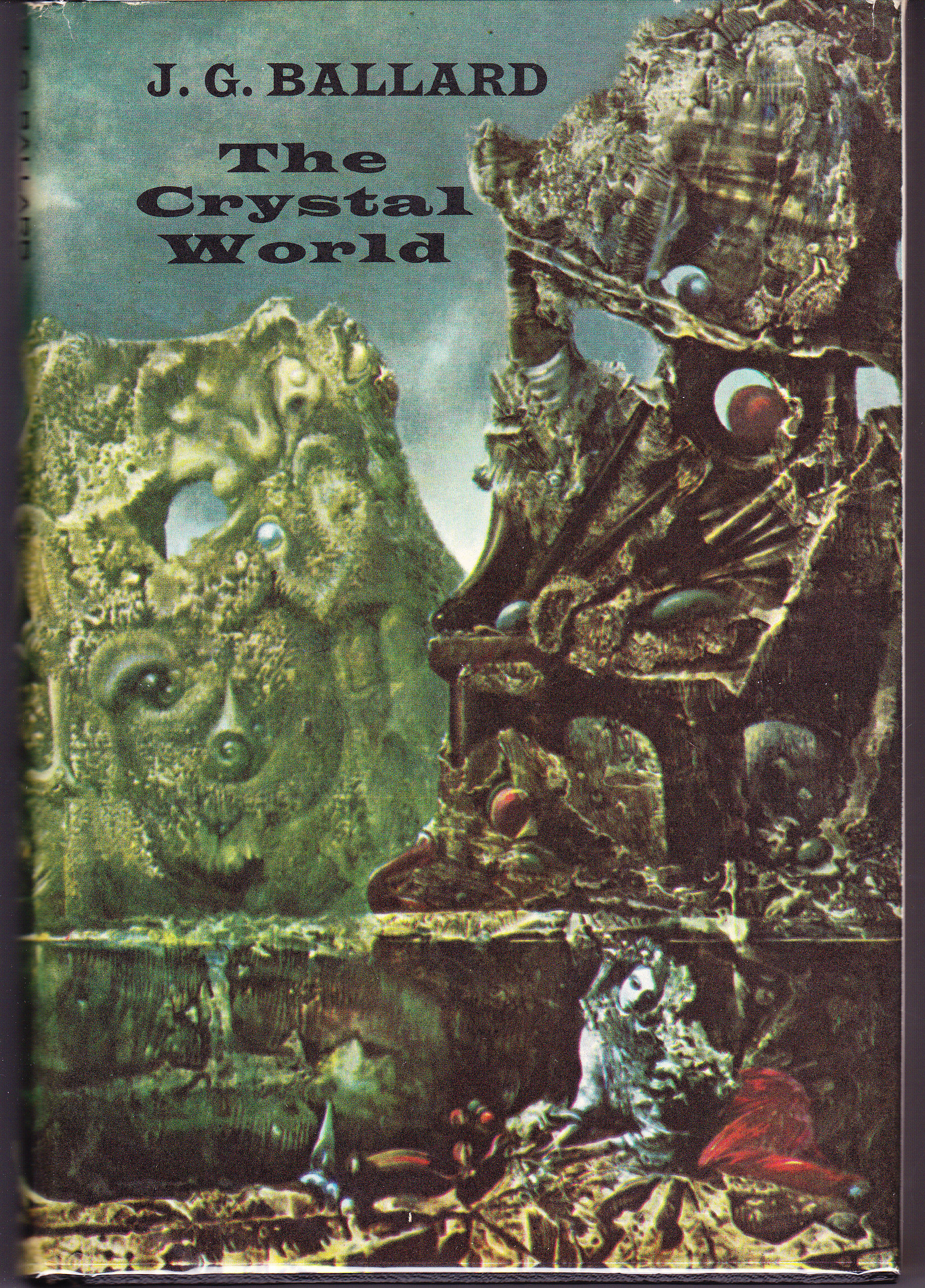
Before his signature works like The Atrocity Exhibition, Crash, and High-Rise, J. G. Ballard published three apocalyptic novels, The Drowned World, The Burning World, and The Crystal World. Each of those books offers a different vision of large-scale environmental disaster, and the last even provides a clue as to its inspiration. Or rather, its original cover does, by using a section of Max Ernst’s painting The Eye of Silence. “This spinal landscape, with its frenzied rocks towering into the air above the silent swamp, has attained an organic life more real than that of the solitary nymph sitting in the foreground,” Ballard writes in “The Coming of the Unconscious,” an article on surrealism written shortly after The Crystal World appeared in 1966.
First published in an issue of the magazine New Worlds (which also contains Ballard’s take on Chris Marker’s La Jetée), the piece is ostensibly a review of Patrick Waldberg’s Surrealism and Marcel Jean’s The History of Surrealist Painting, but it ends up delivering Ballard’s short analyses of a series of paintings by various surrealist masters.
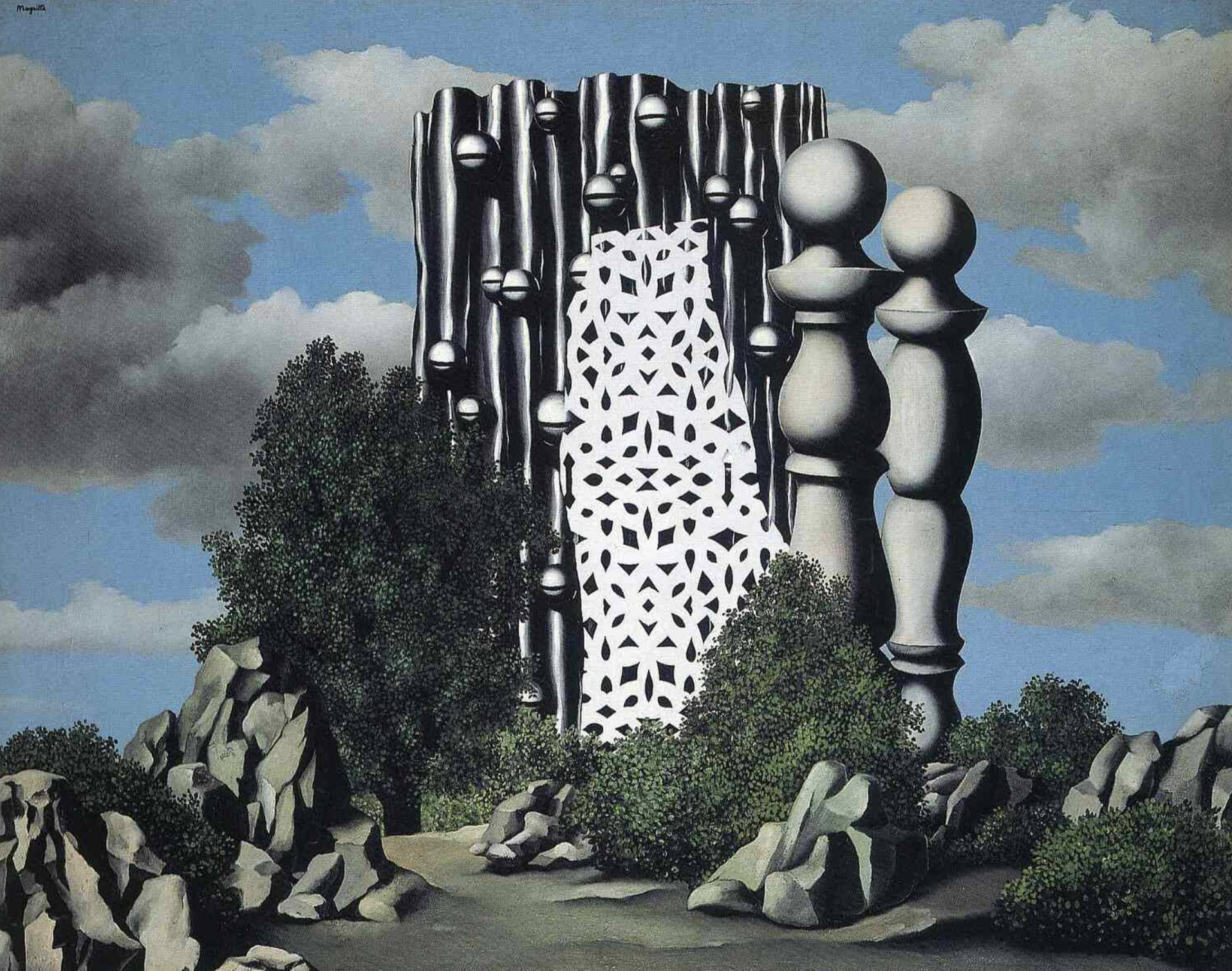
The Eye of Silence shows the landscapes of our world “for what they are — the palaces of flesh and bone that are the living facades enclosing our own subliminal consciousness.” The “terrifying structure” at the center of René Magritte’s The Annunciation is “a neuronic totem, its rounded and connected forms are a fragment of our own nervous systems, perhaps an insoluble code that contains the operating formulae for our own passage through time and space.”
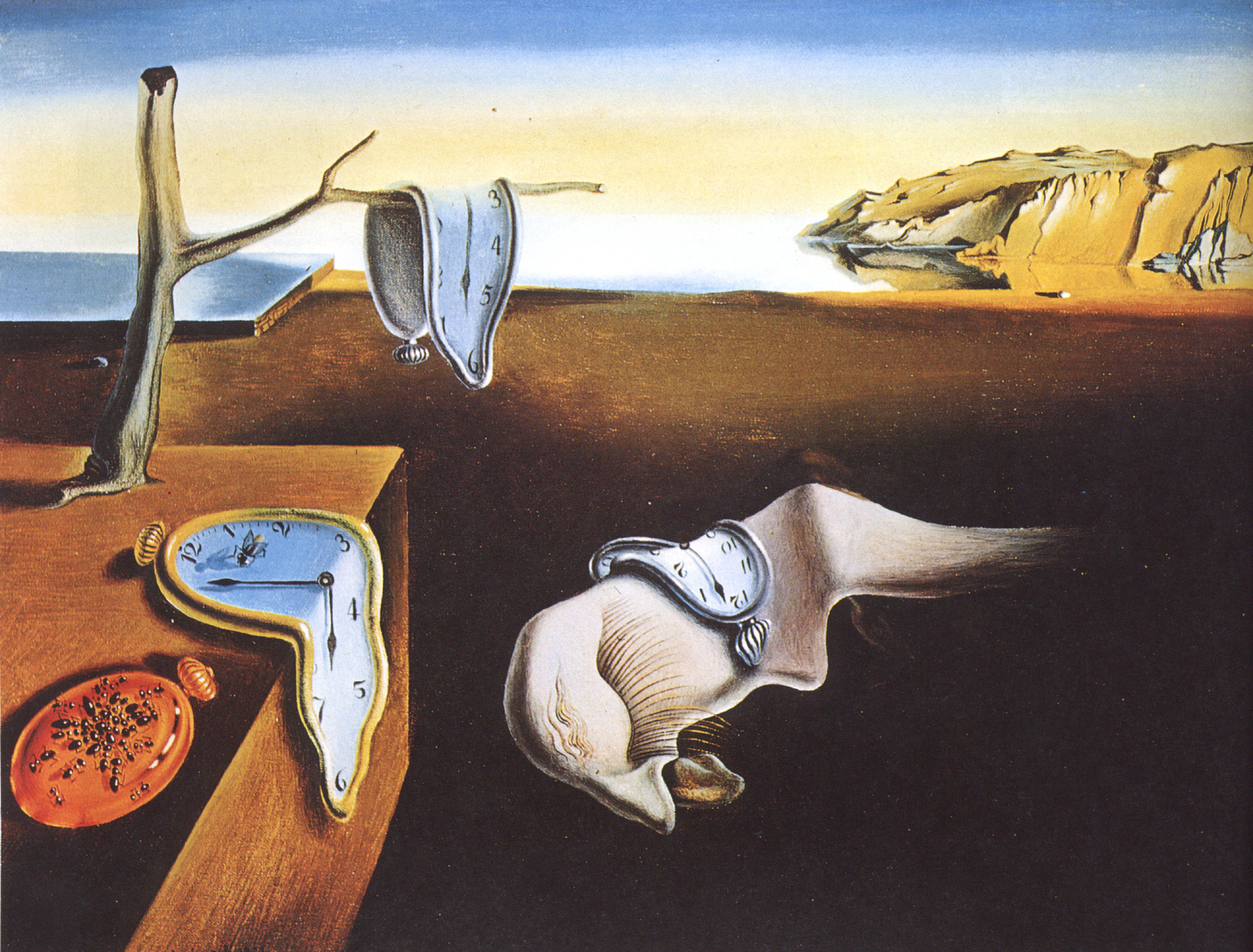
In Giorgio de Chirico’s The Disquieting Muses, “an undefined anxiety has begun to spread across the deserted square. The symmetry and regularity of the arcades conceals an intense inner violence; this is the face of catatonic withdrawal”; its figures are “human beings from whom all transitional time has been eroded.” Another work depicts an empty beach as “a symbol of utter psychic alienation, of a final stasis of the soul”; its displacement of beach and sea through time “and their marriage with our own four-dimensional continuum, has warped them into the rigid and unyielding structures of our own consciousness.” There Ballard writes of no less familiar a canvas than The Persistence of Memory by Salvador Dalí, whom he called “the greatest painter of the twentieth century” more than 40 years after “The Coming of the Unconscious” in the Guardian.
A decade thereafter, that same publication’s Declan Lloyd theorizes that the experimental billboards designed by Ballard in the fifties (previously featured here on Open Culture) had been textual reinterpretations of Dalí’s imagery. Until the late sixties, Ballard says in a 1995 World Art interview, “the Surrealists were very much looked down upon. This was part of their attraction to me, because I certainly didn’t trust English critics, and anything they didn’t like seemed to me probably on the right track. I’m glad to say that my judgment has been seen to be right — and theirs wrong.” He understood the long-term value of Surrealist visions, which had seemingly been obsolesced by World War II before, “all too soon, a new set of nightmares emerged.” We can only hope he won’t be proven as prescient about the long-term habitability of the planet.
Related content:
Sci-Fi Author J.G. Ballard Predicts the Rise of Social Media (1977)
J. G. Ballard’s Experimental Text Collages: His 1958 Foray into Avant-Garde Literature
An Introduction to Surrealism: The Big Aesthetic Ideas Presented in Three Videos
Based in Seoul, Colin Marshall writes and broadcasts on cities, language, and culture. His projects include the Substack newsletter Books on Cities and the book The Stateless City: a Walk through 21st-Century Los Angeles. Follow him on Twitter at @colinmarshall or on Facebook.
Read More...Jean-Paul Sartre Rejects the Nobel Prize in Literature in 1964: “It Was Monstrous!”
In a 2013 blog post, the great Ursula K. Le Guin quotes a London Times Literary Supplement column by a “J.C.,” who satirically proposes the “Jean-Paul Sartre Prize for Prize Refusal.” “Writers all over Europe and America are turning down awards in the hope of being nominated for a Sartre,” writes J.C., “The Sartre Prize itself has never been refused.” Sartre earned the honor of his own prize for prize refusal by turning down the Nobel Prize in Literature in 1964, an act Le Guin calls “characteristic of the gnarly and counter-suggestible Existentialist.” As you can see in the short clip above, Sartre fully believed the committee used the award to whitewash his Communist political views and activism.
But the refusal was not a theatrical or “impulsive gesture,” Sartre wrote in a statement to the Swedish press, which was later published in Le Monde. It was consistent with his longstanding principles. “I have always declined official honors,” he said, and referred to his rejection of the Legion of Honor in 1945 for similar reasons. Elaborating, he cited first the “personal” reason for his refusal
This attitude is based on my conception of the writer’s enterprise. A writer who adopts political, social, or literary positions must act only with the means that are his own—that is, the written word. All the honors he may receive expose his readers to a pressure I do not consider desirable. If I sign myself Jean-Paul Sartre it is not the same thing as if I sign myself Jean-Paul Sartre, Nobel Prize winner.
The writer must therefore refuse to let himself be transformed into an institution, even if this occurs under the most honorable circumstances, as in the present case.
There was another reason as well, an “objective” one, Sartre wrote. In serving the cause of socialism, he hoped to bring about “the peaceful coexistence of the two cultures, that of the East and the West.” (He refers not only to Asia as “the East,” but also to “the Eastern bloc.”)
Therefore, he felt he must remain independent of institutions on either side: “I should thus be quite as unable to accept, for example, the Lenin Prize, if someone wanted to give it to me.”
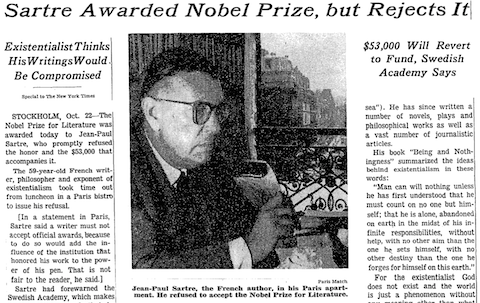
As a flattering New York Times article noted at the time, this was not the first time a writer had refused the Nobel. In 1926, George Bernard Shaw turned down the prize money, offended by the extravagant cash award, which he felt was unnecessary since he already had “sufficient money for my needs.” Shaw later relented, donating the money for English translations of Swedish literature. Boris Pasternak also refused the award, in 1958, but this was under extreme duress. “If he’d tried to go accept it,” Le Guin writes, “the Soviet Government would have promptly, enthusiastically arrested him and sent him to eternal silence in a gulag in Siberia.”
These qualifications make Sartre the only author to ever outright and voluntarily reject both the Nobel Prize in Literature and its sizable cash award. While his statement to the Swedish press is filled with polite explanations and gracious demurrals, his filmed statement above, excerpted from the 1976 documentary Sartre by Himself, minces no words.
Because I was politically involved the bourgeois establishment wanted to cover up my “past errors.” Now there’s an admission! And so they gave me the Nobel Prize. They “pardoned” me and said I deserved it. It was monstrous!
Sartre was in fact pardoned by De Gaulle four years after his Nobel rejection for his participation in the 1968 uprisings. “You don’t arrest Voltaire,” the French President supposedly said. The writer and philosopher, Le Guin points out, “was, of course, already an ‘institution’” at the time of the Nobel award. Nonetheless, she says, the gesture had real meaning. Literary awards, writes Le Guin—who herself refused a Nebula Award in 1976 (she’s won several more since)—can “honor a writer,” in which case they have “genuine value.” Yet prizes are also awarded “as a marketing ploy by corporate capitalism, and sometimes as a political gimmick by the awarders [….] And the more prestigious and valued the prize the more compromised it is.” Sartre, of course, felt the same—the greater the honor, the more likely his work would be coopted and sanitized.
Perhaps proving his point, a short, nasty 1965 Harvard Crimson letter had many, less flattering things than Le Guin to say about Sartre’s motivations, calling him “an ugly toad” and a “poor loser” envious of his former friend Camus, who won in 1957. The letter writer calls Sartre’s rejection of the prize “an act of pretension” and a “rather ineffectual and stupid gesture.” And yet it did have an effect. It seems clear at least to me that the Harvard Crimson writer could not stand the fact that, offered the “most coveted award” the West can bestow, and a heaping sum of money besides, “Sartre’s big line was, ‘Je refuse.’”
Related Content:
Jean-Paul Sartre & Albert Camus: Their Friendship and the Bitter Feud That Ended It
Hear Albert Camus Deliver His Nobel Prize Acceptance Speech (1957)
Josh Jones is a writer and musician based in Durham, NC. Follow him at @jdmagness
Read More...The Steampunk Clocks of 19th-Century Paris: Discover the Ingenious System That Revolutionized Timekeeping in the 1880s
A middle-class Parisian living around the turn of the twentieth century would have to budget for services like not just water or gas, but also time. Though electric clocks had been demonstrated, they were still a high-tech rarity; installing one in the home would have been completely out of the question. If you wanted to synchronize timekeeping across an entire major city, it made more sense to use a proven, reliable, and much cheaper infrastructure: pipes full of compressed air. Paris’ pneumatic postal system had been in service since 1866, and in 1877, Vienna had demonstrated that the same basic technology could be used to run clocks.
“The idea was to have a master clock in the center of Paris that would send out a pulse each minute to synchronize every clock around the city,” writes Ewan Cunningham at Primal Nebula, on a companion page to the Primal Space video above.
“The clocks wouldn’t have to be powered, the bursts of air would simply move all the clocks in the system forward at the same time. As for the master clock itself, it was kept in time by “another super accurate clock that was updated daily using observations of stars and planets” at the Paris Observatory. Just five years after its first implementation in 1880, this system had made possible the installation of thousands of “Popp clocks” (named for its Austrian inventor Victor Popp) in “hotels, train stations, houses, schools and public streets.”
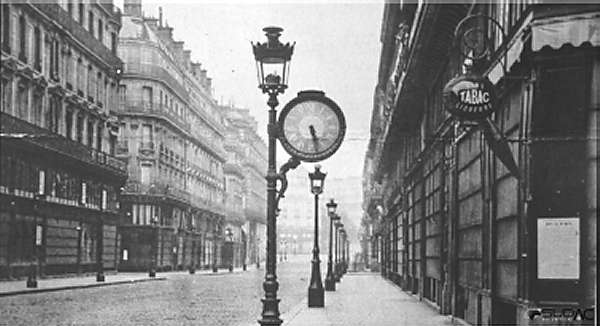
In 1881, the visiting engineer Jules Albert Berly wrote of these “numerous clocks standing on graceful light iron pillars in the squares, at the corners of streets, and in other conspicuous positions about the city,” also noting those “throughout their hotels were, what is unusual with hotel clocks, keeping accurate time.” Apart from the great flood of 1910, which “stopped time” across Paris, this pneumatic time-keeping system seems to have remained in steady service for nearly half a century, until its discontinuation in 1927. But even now, nearly a century late, some of the sites where Popp clocks once stood are still identifiable — and thus worthy sites of pilgrimage for steampunk fans everywhere.
Related Content:
Paris Had a Moving Sidewalk in 1900, and a Thomas Edison Film Captured It in Action
How Big Ben Works: A Detailed Look Inside London’s Beloved Victorian Clock Tower
Clocks Around the World: How Other Languages Tell Time
How Clocks Changed Humanity Forever, Making Us Masters and Slaves of Time
Based in Seoul, Colin Marshall writes and broadcasts on cities, language, and culture. His projects include the Substack newsletter Books on Cities and the book The Stateless City: a Walk through 21st-Century Los Angeles. Follow him on Twitter at @colinmarshall or on Facebook.
Read More...Keith Moon, Drummer of The Who, Passes Out at 1973 Concert; 19-Year-Old Fan Takes Over
In November 1973, Scot Halpin, a 19-year-old kid, scalped tickets to The Who concert in San Francisco, California. Little did he know that he’d wind up playing drums for the band that night — that his name would end up etched in the annals of rock ’n’ roll.
The Who came to California with its album Quadrophenia topping the charts. But despite that, Keith Moon, the band’s drummer, had a case of the nerves. It was, after all, their first show on American soil in two years. When Moon vomited before the concert, he ended up taking some tranquilizers to calm down. The drugs worked all too well. During the show, Moon’s drumming became sloppy and slow, writes his biographer Tony Fletcher. Then, halfway through “Won’t Get Fooled Again,” he slumped onto his drums. Moon was out cold. As the roadies tried to bring him back to form, The Who played as a trio. The drummer returned, but only briefly and collapsed again, this time heading off to the hospital to get his stomach pumped.
Scot Halpin watched the action from near the stage. Years later, he told an NPR interviewer, “my friend got real excited when he saw that [Moon was going to pass out again]. And he started telling the security guy, you know, this guy can help out. And all of a sudden, out of nowhere comes Bill Graham,” the great concert promoter. Graham asked Halpin straight up, “Can you do it?,” and Halpin shot back “yes.”
When Pete Townshend asked the crowd, “Can anybody play the drums?” Halpin mounted the stage, settled into Moon’s drum kit, and began playing the blues jam “Smokestack Lighting” that soon segued into “Spoonful.” It was a way of testing the kid out. Then came a nine minute version of “Naked Eye.” By the time it was over, Halpin was physically spent.
The show ended with Roger Daltrey, Pete Townshend, John Entwistle and Scot Halpin taking a bow center stage. And, to thank him for his efforts, The Who gave him a concert jacket that was promptly stolen.
As a sad footnote to the story, Halpin died in 2008. The cause, a brain tumor. He was only 54 years old.
If you would like to support the mission of Open Culture, consider making a donation to our site. It’s hard to rely 100% on ads, and your contributions will help us continue providing the best free cultural and educational materials to learners everywhere. You can contribute through PayPal, Patreon, and Venmo (@openculture). Thanks!
Related Content
Keith Moon’s Final Performance with The Who (1978)
The Neuroscience of Drumming: Researchers Discover the Secrets of Drumming & The Human Brain
Read More...Public.Work: A Smoothly Searchable Archive of 100,000+ “Copyright-Free” Images

We live in an age, we’re often told, when our ability to conjure up an image is limited only by our imagination. These days, this notion tends to refer to artificial intelligence-powered systems that generate visual material from text prompts, like DALL‑E and the many others that have proliferated in its wake. But however technologically impressive they are, they also reveal that our imagination has its limits, giving form only to what we can put into words. To be inspired properly again, we must explore farther afield, in the visual realms of other times and places, which we can easily do on a site like Public.work.

Jason Kottke describes Public.work as “an image search engine that boasts 100,000 ‘copyright-free’ images from institutions like the NYPL, the Met, etc. It’s fast with a relatively simple interface and uses AI to auto-categorize and suggest possibly related images (both visually and content-wise). And it’s fun to just visually click around on related images.”
These journeys can take you from vintage magazine covers to foreign children’s books, lifelike foreign landscapes to elaborate world maps, Japanese woodblock prints to roadside Americana — or such has been my experience, at any rate.
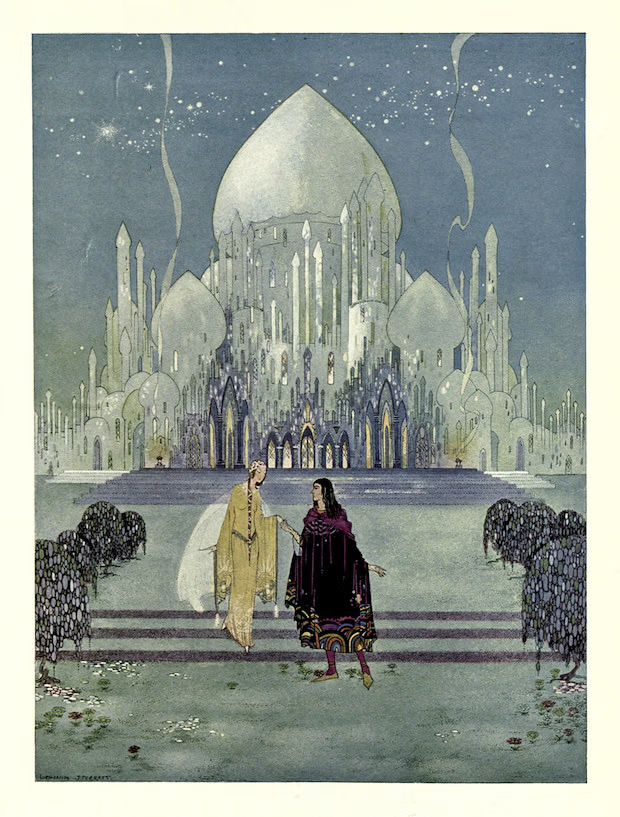
“On the downside,” Kottke adds, “their sourcing and attribution isn’t great — especially when compared to something like Flickr Commons.” According to librarian Jessamyn West, Public.work isn’t exactly a search engine, but an interface for a site called Cosmos, which describes itself as “a Pinterest alternative for creatives” meant to create “a more mindful internet.”
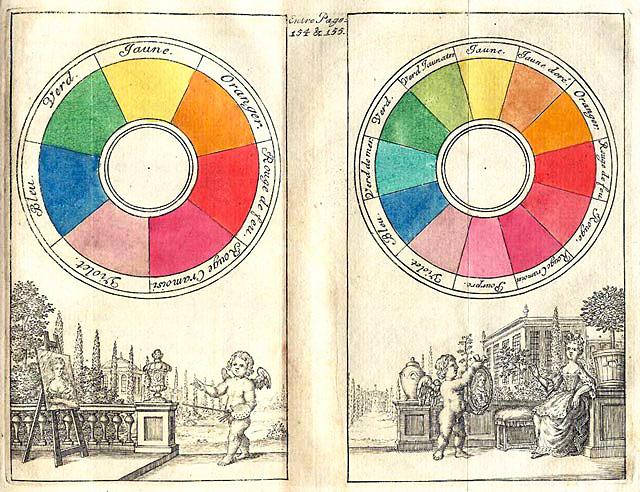
Getting the full story behind any particular images you find there will require you to put a bit of energy into research, or at least to locate the fruits of research done elsewhere on the internet. As for what you do with them, that will, of course, depend on your own creative instincts. Enter Public.work here.

Related content:
A Search Engine for Finding Free, Public Domain Images from World-Class Museums
Download for Free 2.6 Million Images from Books Published Over Last 500 Years on Flickr
Free: Download 5.3 Million Images from Books Published Over Last 500 Years
Based in Seoul, Colin Marshall writes and broadcasts on cities, language, and culture. His projects include the Substack newsletter Books on Cities and the book The Stateless City: a Walk through 21st-Century Los Angeles. Follow him on Twitter at @colinmarshall or on Facebook.
Read More...Buckminster Fuller’s Map of the World: The Innovation That Revolutionized Map Design (1943)
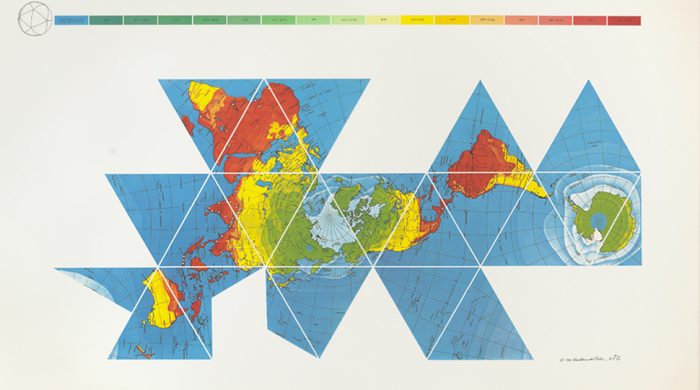
In 2017, we brought you news of a world map purportedly more accurate than any to date, designed by Japanese architect and artist Hajime Narukawa. The map, called the AuthaGraph, updates a centuries-old method of turning the globe into a flat surface by first converting it to a cylinder. Winner of Japan’s Good Design Grand Award, it serves as both a brilliant design solution and an update to our outmoded conceptions of world geography.
But as some readers have pointed out, the AuthaGraph also seems to draw quite heavily on an earlier map made by one of the most visionary of theorists and designers, Buckminster Fuller, who in 1943 applied his Dymaxion trademark to the map you see above, which will likely remind you of his most recognizable invention, the Geodesic Dome, “house of the future.”
Whether Narukawa has acknowledged Fuller as an inspiration I cannot say. In any case, 73 years before the AuthaGraph, the Dymaxion Map achieved a similar feat, with similar motivations. As the Buckminster Fuller Institute (BFI) points out, “The Fuller Projection Map is [or was] the only flat map of the entire surface of the Earth which reveals our planet as one island in the ocean, without any visually obvious distortion of the relative shapes and sizes of the land areas, and without splitting any continents.”

Fuller published his map in Life magazine, as a corrective, he said, “for the layman, engrossed in belated, war-taught lessons in geography…. The Dymaxion World map is a means by which he can see the whole world fairly at once.” Fuller, notes Kelsey Campbell-Dollaghan at Gizmodo, “intended the Dymaxion World map to serve as a tool for communication and collaboration between nations.”

Fuller believed, writes BFI, that “given a way to visualize the whole planet with greater accuracy, we humans will be better equipped to address challenges as we face our common future aboard Spaceship Earth.” Was he naïve or ahead of his time?
We may have had a good laugh at a recent replica of Fuller’s nearly undrivable, “scary as hell,” 1930 Dymaxion Car, one of his first inventions. Many of Fuller’s contemporaries also found his work bizarre and impractical. Elizabeth Kolbert at The New Yorker sums up the reception he often received for his “schemes,” which “had the hallucinatory quality associated with science fiction (or mental hospitals).” The commentary seems unfair.

Fuller’s influence on architecture, design, and systems theory has been broad and deep, though many of his designs only resonated long after their debut. He thought of himself as an “anticipatory design scientist,” rather than an inventor, and remarked, “if you want to teach people a new way of thinking, don’t bother trying to teach them. Instead, give them a tool, the use of which will lead to new ways of thinking.” In this sense, we must agree that the Dymaxion map was an unqualified success as an inspiration for innovative map design.

In addition to its possibly indirect influence on the AuthaGraph, Fuller’s map has many prominent imitators and sparked “a revolution in mapping,” writes Campbell-Dollaghan. She points us to, among others, the Cryosphere, further up, a Fuller map “arranged based on ice, snow, glaciers, permafrost and ice sheets”; to Dubai-based Emirates airline’s map showing flight routes; and to the “Googlespiel,” an interactive Dymaxion map built by Rehabstudio for Google Developer Day, 2011.
And, just above, we see the Dymaxion Woodocean World map by Nicole Santucci, winner of 2013’s DYMAX REDUX, an “open call to create a new and inspiring interpretation of Buckminster Fuller’s Dymaxion Map.” You’ll find a handful of other unique submissions at BFI, including the runner-up, Clouds Dymaxion Map, below, by Anne-Gaelle Amiot, an “absolutely beautiful hand-drawn depiction of a reality that is almost always edited from our maps: cloud patterns circling above Earth.”

Related Content:
Japanese Designers May Have Created the Most Accurate Map of Our World: See the AuthaGraph
A Harrowing Test Drive of Buckminster Fuller’s 1933 Dymaxion Car: Art That Is Scary to Ride
The Life & Times of Buckminster Fuller’s Geodesic Dome: A Documentary
Buckminster Fuller Tells the World “Everything He Knows” in a 42-Hour Lecture Series (1975)
Bertrand Russell & Buckminster Fuller on Why We Should Work Less, and Live and Learn More
Josh Jones is a writer and musician based in Durham, NC. Follow him at @jdmagness
Read More...Ancient Egyptian Pyramids May Have Been Built with Water: A New Study Explore the Use of Hydraulic Lifts

Image by Charles Sharp, via Wikimedia Commons
The compelling but less-than-straightforward question of how the ancient Egyptians built the pyramids has inspired all manner of theory and speculation, grounded to varying degrees in physical reality. Sheer manpower must have played a large part, and it’s certainly not beyond the realm of possibility that various simple machines were involved. But in certain cases, could the machines have been less simple than we imagine today? Such is the proposal advanced in a paper recently published in PLOS ONE, “On the Possible Use of Hydraulic Force to Assist with Building the Step Pyramid of Saqqara.”
“The Step Pyramid was built around 2680 BCE, part of a funerary complex for the Third Dynasty pharaoh Djoser,” writes Ars Technica’s Jennifer Ouellette. “It’s located in the Saqqara necropolis and was the first pyramid to be built, almost a ‘proto-pyramid’ that originally stood some 205 feet high,” as against the more widely known Great Pyramid of Giza, which reached 481 feet.
According to the paper’s first author Xavier Landreau, head of the French research institute Paleotechnic, his team’s intensive research on “the watersheds to the west of the Saqqara plateau” led to “the discovery of “structures they believe constituted a dam, a water treatment facility, and a possible internal hydraulic lift system within the pyramid,” which could have been used to move heavy limestone.
Not every Egypt expert is convinced. As the University of Cambridge’s Judith Bunbury puts it to Ouellette, “there is evidence that Egyptians used other kinds of hydraulic technologies around that time, but there is no evidence of any kind of hydraulic lift system.” At Smithsonian.com, Will Sullivan rounds up other skeptical reactions, including that of University of Toronto archaeologist Oren Siegel, who “tells Science News that the proposed dam could not have held enough water from occasional rain to maintain a hydraulic system.” Clearly, the view of the Step Pyramid taken by Landreau and his researchers will require more concrete support, as it were, before being accepted into the mainstream. But it’s still a good deal more plausible than, say, the somehow persistent notion that members of an advanced spacefaring civilization came to give the ancient Egyptians a hand.
Related content:
How Did They Build the Great Pyramid of Giza?: An Animated Introduction
What the Great Pyramids of Giza Originally Looked Like
Based in Seoul, Colin Marshall writes and broadcasts on cities, language, and culture. His projects include the Substack newsletter Books on Cities and the book The Stateless City: a Walk through 21st-Century Los Angeles. Follow him on Twitter at @colinmarshall or on Facebook.
Read More...Support Us
We're hoping to rely on loyal readers, rather than erratic ads. Please click the Donate button and support Open Culture. You can use Paypal, Venmo, Patreon, even Crypto! We thank you!

About Us

Open Culture scours the web for the best educational media. We find the free courses and audio books you need, the language lessons & educational videos you want, and plenty of enlightenment in between.
Advertise With Us

FREE UPDATES!
GET OUR DAILY EMAIL
Get the best cultural and educational resources on the web curated for you in a daily email. We never spam. Unsubscribe at any time.
FOLLOW ON SOCIAL MEDIA

Open Culture editor Dan Colman scours the web for the best educational media. He finds the free courses and audio books you need, the language lessons & movies you want, and plenty of enlightenment in between.
Advertise With Us


