4 Franz Kafka Animations: Watch Creative Animated Shorts from Poland, Japan, Russia & Canada
Gilles Deleuze and Felix Guattari thought of Kafka as an international writer, in solidarity with minority groups worldwide. Other scholars have characterized his work—and Kafka himself wrote as much—as literature concerned with national identity. Academic debates, however, have no bearing on how ordinary readers, and writers, around the world take in Kafka’s novels and short stories. Writers with both national and international pedigrees such as Borges, Murakami, Marquez, and Nabokov have drawn much inspiration from the Czech-Jewish writer, as have filmmakers and animators. Today we revisit several international animations inspired by Kafka, the first, above by Polish animator Piotr Dumala.
Trained a sculptor, Dumala’s textural brand of “destructive animation” creates chilling, high contrast images that appropriately capture the eerie and unresolved play of light and dark in Kafka’s work. The Polish artist’s Franz Kafka (1992) draws on scenes from the author’s life, as told in his diaries.
Next, watch a very disorienting 2007 Japanese adaptation of Kafka’s “A Country Doctor” by animator Koji Yamamura. The soundtrack and monotone Japanese dialogue (with subtitles) effectively conveys the tone of the story, which John Updike described as “a sensation of anxiety and shame whose center cannot be located and therefore cannot be placated; a sense of an infinite difficulty with things, impeding every step.” Read the original story here.
Russian-American team Alexander Alexeieff and Claire Parker created the 1963 animation above using a “pinscreen” technique, which photographs the three-dimensional movement of hundreds of pins, making images from real light and shadow. We’ve previously written on just “how demanding and painstaking an effort” the animators made to create their work. Their previous efforts got the attention of Orson Welles, who commissioned the above short as a prologue for his Anthony Perkins-starring film version of The Trial. And yes, that voice you hear narrating the parable “Before the Law,” an excerpt from Kafka’s novel, is Welles himself.
Kafka’s most famous story, The Metamorphosis, inspired Canadian animator Caroline Leaf’s 1977 film above. Leaf’s Kafka animation also takes a sculptural approach to the author’s work, this time sculpting in sand, a medium Leaf herself says created “black and white sand images” with “the potential to have a Kafka-esque feel—dark and mysterious.” However we interpret the content of Kafka’s work, the feel of his stories is unmistakable to readers and interpreters across continents. It’s one that consistently inspires artists to use a spare, high contrast style in adapting him.
If you would like to support the mission of Open Culture, consider making a donation to our site. It’s hard to rely 100% on ads, and your contributions will help us continue providing the best free cultural and educational materials to learners everywhere. You can contribute through PayPal, Patreon, and Venmo (@openculture). Thanks!
Related Content:
Vladimir Nabokov (Channelled by Christopher Plummer) Teaches Kafka at Cornell
Hunter S. Thompson and Franz Kafka Inspire Animation for a Bookstore Benefiting Oxfam
Kafka’s Famous Character Gregor Samsa Meets Dr. Seuss in a Great Radio Play
Josh Jones is a writer and musician based in Durham, NC. Follow him at @jdmagness
Read More...What Is Religion Actually For?: Isaac Asimov and Ray Bradbury Weigh In
In the nineteen-sixties, the music media encouraged the notion that a young rock-and-roll fan had to side with either the Beatles or their rivals, the Rolling Stones. On some level, it must have made sense, given the growing aesthetic divide between the music the two world-famous groups were putting out. But, at bottom, not only was there no rivalry between the bands (it was an invention of the music papers), there was no real need, of course, to choose one or the other. In the fifties, something of the same dynamic must have obtained between Ray Bradbury and Isaac Asimov, two popular genre writers, each with his own worldview.
Bradbury and Asimov had much in common: both were (probably) born in 1920, both attended the very first World Science Fiction Convention in 1939, both began publishing in pulp magazines in the forties, and both had an aversion to airplanes. That Bradbury spent most of his life in California and Asimov in New York made for a potentially interesting cultural contrast, though it never seems to have been played up. Still, it may explain something of the basic difference between the two writers as it comes through in the video above, a compilation of talk-show clips in which Bradbury and Asimov respond to questions about their religious beliefs, or lack thereof.
Asimov may have written a guide to the Bible, but he was hardly a literalist, calling the first chapters of Genesis “the sixth-century BC version of how the world might have started. We’ve improved on that since. I don’t believe that those are God’s words. Those are the words of men, trying to make the most sense that they could out of the information they had at the time.” In a later clip, Bradbury, for his part, confesses to a belief in not just Genesis, but also Darwin and even Jean-Baptiste Lamarck, who theorized that characteristics acquired in an organism’s lifetime could be passed down to the next generation. “Nothing is proven,” he declares, “so there’s room for a religious delicatessen.”
One senses that Asimov wouldn’t have agreed, and indeed, would have been perfectly satisfied with a regular delicatessen. Though both he and Bradbury became famous as science-fiction writers around the same time — to say nothing of their copious writing in other genres — they possessed highly distinct imaginations. That works like Fahrenheit 451 and the Foundation trilogy attracted such different readerships is explicable in part through Bradbury’s insistence that “there’s room to believe it all” and Asimov’s dismissal of what he saw as every “get-rich quick scheme of the mind” peddled by “con men of the spirit”: each point of view as thoroughly American, in its way, as the Beatles and the Stones were thoroughly English.
Related content:
Isaac Asimov Explains His Three Laws of Robots
Carl Sagan Answers the Ultimate Question: Is There a God? (1994)
50 Famous Academics & Scientists Talk About God
Based in Seoul, Colin Marshall writes and broadcasts on cities, language, and culture. His projects include the Substack newsletter Books on Cities, the book The Stateless City: a Walk through 21st-Century Los Angeles and the video series The City in Cinema. Follow him on Twitter at @colinmarshall or on Facebook.
Read More...Leonard Bernstein Introduces the Moog Synthesizer to the World in 1969, Playing an Electrified Version of Bach’s “Little Fugue in G”
When Wendy Carlos released Switched-On Bach in 1968, her “greatest hits” compilation of the Baroque composer’s music, played entirely on the Moog analog synthesizer, the album became an immediate hit with both classical and pop audiences. Not only was it “acclaimed as real music by musicians and the listening public alike,” as Bob Moog himself has written, but “as a result, the Moog Synthesizer was suddenly accepted with open arms by the music business community.” There’s some exaggeration here. Stars like the Doors, the Monkees, and the Byrds had already recorded with Moogs the year before. And some classical purists (and classical Luddites) did not, in fact, hail Switched-On Bach as “real music.”
But on the whole, Carlos’s innovative demonstration of the electronic instrument’s capabilities (and her own) marks a milestone in music history as the first classical album to go Platinum, and as the first introduction of both Baroque music and the Moog synthesizer to millions of people unfamiliar with either.
Were it not for Carlos’s “use of the Moog’s oscillations, squeaks, drones, chirps, and other sounds,” as Bruce Eder writes at Allmusic, it’s unlikely we would have the video clip above, of Leonard Bernstein giving his own demonstration of the Moog (dig his hip “HAL” reference from the prior year’s 2001: A Space Odyssey), during one of his popular televised “Young People’s Concerts.”
Having just begun moving out of the studio, the Moog was still a collection of modular boxes and patch cables—an engineer’s instrument—and it takes four men to wheel it out on stage. (The easily portable, self-contained Minimoog wouldn’t appear until 1970.) Most people had no idea what a Moog actually looked like. But, its forbidding appearance aside, the sounds of the Moog were everywhere.
Bernstein mentions Carlos, and those stuffy purists, and makes a few more sci-fi jokes, then, instead of sitting at the keyboard, hits play on a reel-to-reel tape recorder. This pre-recorded version of Bach’s “Little Fugue in G” was actually arranged by Walter Sear, and the recording lacks some of the panache of Carlos’s playing while the tinny playback system makes it sound like 8‑bit video game music. But for this audience, the musical wizardly was still decidedly fresh.
The choice of Bach as Moog material was not just a matter of taste—his music was uniquely suited for Moog adaptation. As Carlos explains, “it was contrapuntal (not chords but musical lines, like the Moog produced), it used clean, Baroque lines, not demanding great ‘expressivo’ (a weakness in the Moog at the time), and it was neutral as to orchestration.” The Moog could also, it seems, make Bach’s fugues fly at almost superhuman speeds. Hear the “Little Fugue” played at a much more stately tempo, on a traditional pipe organ, further up.
Organs and harpsichords, strings and horns, these are still of course the instruments we think of when we think of Bach. Despite Carlos’s inventive foray—and its follow-up, The Well-Tempered Synthesizer—the synthesizer did not radicalize the classical music world, though its avant-garde offspring made much use of it. But it sure changed the sound of pop music, and wowed the kids who saw Bernstein’s program, some of whom may have gone on to popularize both electronic instruments and classical themes in prog-rock, disco, and yes, even video game music.
Related Content:
How the Moog Synthesizer Changed the Sound of Music
A BBC Science Show Introduces the Moog Synthesizer in 1969
Bob Moog Demonstrates His Revolutionary Moog Model D Synthesizer
Josh Jones is a writer and musician based in Durham, NC. Follow him at @jdmagness
Read More...High-Tech Analysis of Ancient Scroll Reveals Plato’s Burial Site and Final Hours
Even if you can name only one ancient Greek, you can name Plato. You can also probably say at least a little about him, if only some of the things humanity has known since antiquity. Until recently, of course, that qualification would have been redundant. But now, thanks to an ongoing high-tech push to read heretofore inaccessible ancient documents, we’re witnessing the emergence of new knowledge about that most famous of all Greek philosophers — or at least one of the most famous Greek philosophers, matched in renown only by his teacher Socrates and his student Aristotle.
Up until now, we’ve only had a general idea of where Plato was interred after his death in 348 BC. But “thanks to an ancient text and specialized scanning technology,” writes Smithsonian.com’s Sonja Anderson, “researchers say they have solved the mystery of Plato’s burial place: The Greek philosopher was interred in the garden of his Athens academy, where he once tutored a young Aristotle.” This location was recorded about two millennia ago “on a papyrus scroll housed in the Roman city of Herculaneum,” which was entombed along with Pompeii by the explosion of Mount Vesuvius in 79 AD.
Like much else in those cities, this scroll was preserved for centuries under layers of ash. It was just one of many scrolls discovered in a villa, which may have belonged to Julius Caesar’s father-in-law, back in 1750. But for long thereafter, those scrolls were more or less unreadable, having been so thoroughly charred by the explosion of Mount Vesuvius that they crumbled to dust at any attempt to unroll them. But “recent breakthroughs have allowed researchers to read the fragile texts without touching them”: witness the projects involving particle accelerators and artificial intelligence previously featured here on Open Culture.

The research project that has deciphered part of this scroll, a text by the philosopher Philodemus called the History of the Academy — that is, Plato’s academy in Athens — is led by University of Pisa professor of papyrology Graziano Ranocchia. Using a “bionic eye” technique involving infrared and X‑ray scanners, he and his team have also discovered evidence that Plato didn’t much like the music played at his deathbed by a Thracian slave girl. “Despite battling a fever and being on the brink of death,” writes the Guardian’s Lorenzo Tondo, he “retained enough lucidity to critique the musician for her lack of rhythm.” Even if you know little about Plato, you’re probably not surprised to hear that he was pointing out the difference between the real and the ideal up until the very end.
Related content:
Researchers Use AI to Decode the First Word on an Ancient Scroll Burned by Vesuvius
Orson Welles Narrates an Animation of Plato’s Cave Allegory
Plato’s Dialogue Gorgias Gets Adapted into a Short Avant-Garde Film
How 99% of Ancient Literature Was Lost
Based in Seoul, Colin Marshall writes and broadcasts on cities, language, and culture. His projects include the Substack newsletter Books on Cities, the book The Stateless City: a Walk through 21st-Century Los Angeles and the video series The City in Cinema. Follow him on Twitter at @colinmarshall or on Facebook.
Read More...RIP Paul Auster: Hear the Master of the Postmodern Page-Turner Discuss How He Became a Writer
In the Louisiana Channel interview clip from 2017 above, the late Paul Auster tells the story of how he became a writer. Its first episode had appeared more than twenty years earlier, in a New Yorker piece titled “Why Write?”: “I was eight years old. At that moment in my life, nothing was more important to me than baseball.” After the first big-league game he ever went to see, the New York Giants versus the Milwaukee Braves at the Polo Grounds, he came face-to-face with a legend-to-be named Willie Mays. “I managed to keep my legs moving in his direction and then, mustering every ounce of my courage, I forced some words out of my mouth. ‘Mr. Mays,’ I said, ‘could I please have your autograph?’ ”
Mays says yes, but there was a problem: “I didn’t have a pencil, so I asked my father if I could borrow his. He didn’t have one, either. Nor did my mother. Nor, as it turned out, did any of the other grownups.” Eventually, the young Auster’s idol “turned to me and shrugged. ‘Sorry, kid,’ he said. ‘Ain’t got no pencil, can’t give no autograph.’ And then he walked out of the ballpark into the night.” From that point on, as the middle-aged Auster tells it, “it became a habit of mine never to leave the house without making sure I had a pencil in my pocket.” Even in this childhood anecdote, readers will recognize some of Auster’s signature elements: the icons of mid-century New York, the life-changing chance encounter, the state of bitter regret.
But it takes more than a pencil to become a writer. “The thing about doing this, which is unlike any other job, is that you have to give maximum effort, all the time,” Auster says. “You have to give every ounce of your being to what you’re doing, and I don’t think there are many jobs that require that. You see lazy lawyers, lazy doctors, lazy judges. They can get through things. You even see lazy athletes.” But “you can’t be a writer or a painter or a musician unless you make maximum effort.” Even after producing nothing usable in one of his usual eight-hour writing shifts, “I can at least stand up and say, at the end of the day, I gave it everything I had. I tried 100 percent. And there’s something satisfying about that, just trying as hard as you can to do something.”
There’s something thoroughly American about these words, as indeed there’s something thoroughly American about Auster’s twenty postmodern page-turners (to say nothing of his many volumes of nonfiction and poetry). Yet he also had one foot in France, where he lived in the early nineteen-seventies, and several of whose respected writers — Sartre, Mallarmé, Blanchot — he translated into English. He gained his first and most fervent fanbase there, becoming a beloved écrivain american of long standing. The announcement of his death on April 30th must have set off something like a national day of mourning, and an occasion to remember what he once said to France Inter: just as a writer should always carry a pencil, “chacun doit être prêt à mourir n’importe quand.”
Related content:
Hear Paul Auster Read the Entirety of The Red Notebook, an Early Collection of Stories
Paul Auster Reads from New Novel Sunset Park
Philip Roth Predicts the Death of the Novel; Paul Auster Counters
Based in Seoul, Colin Marshall writes and broadcasts on cities, language, and culture. His projects include the Substack newsletter Books on Cities, the book The Stateless City: a Walk through 21st-Century Los Angeles and the video series The City in Cinema. Follow him on Twitter at @colinmarshall or on Facebook.
Read More...Artist Draws 9 Portraits on LSD During 1950s Research Experiment
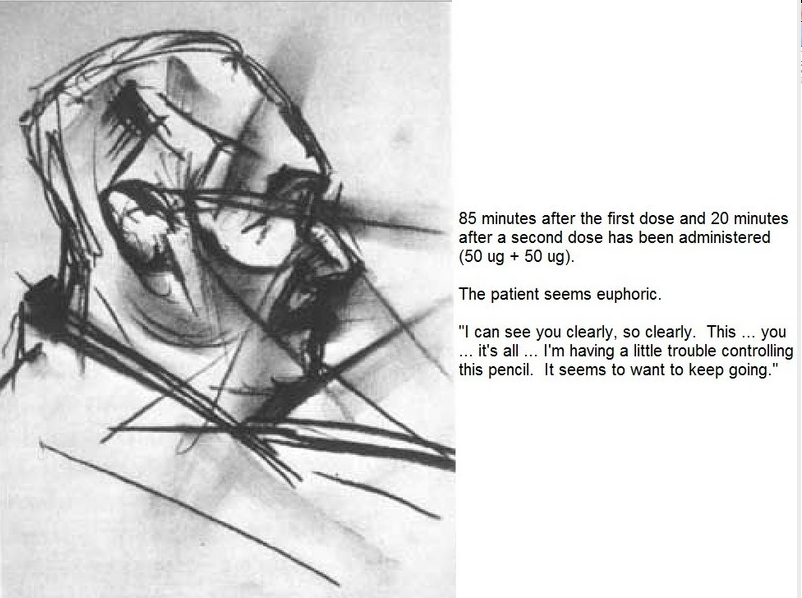
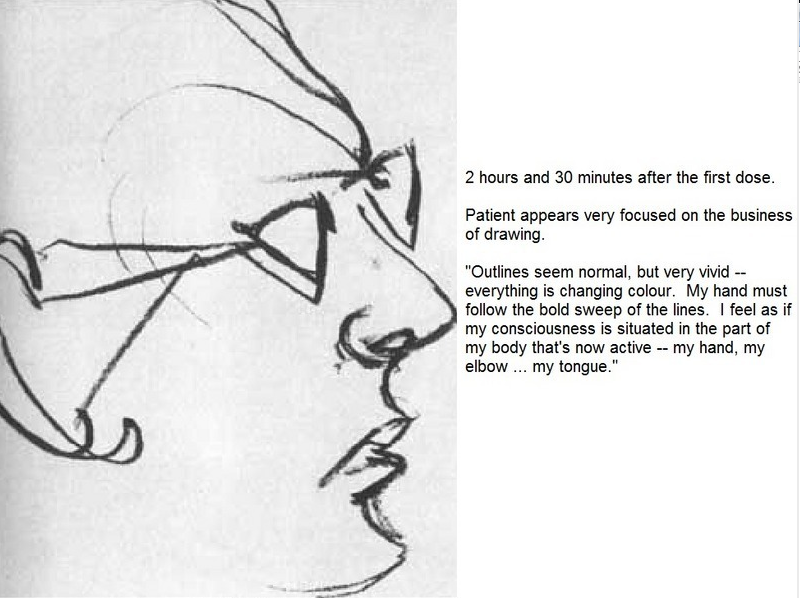
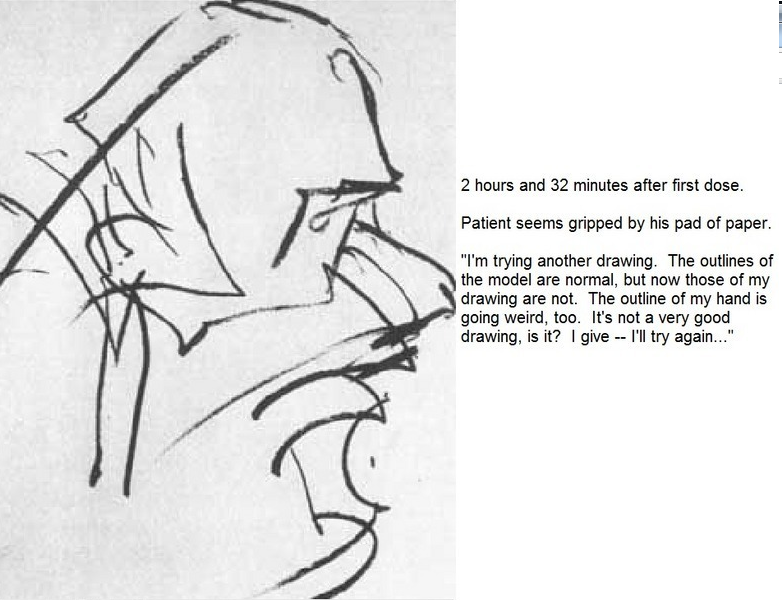
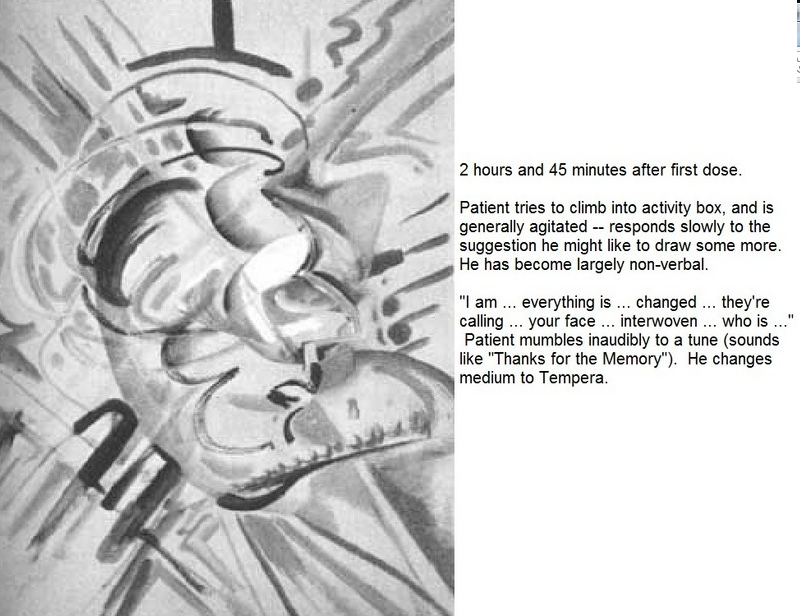
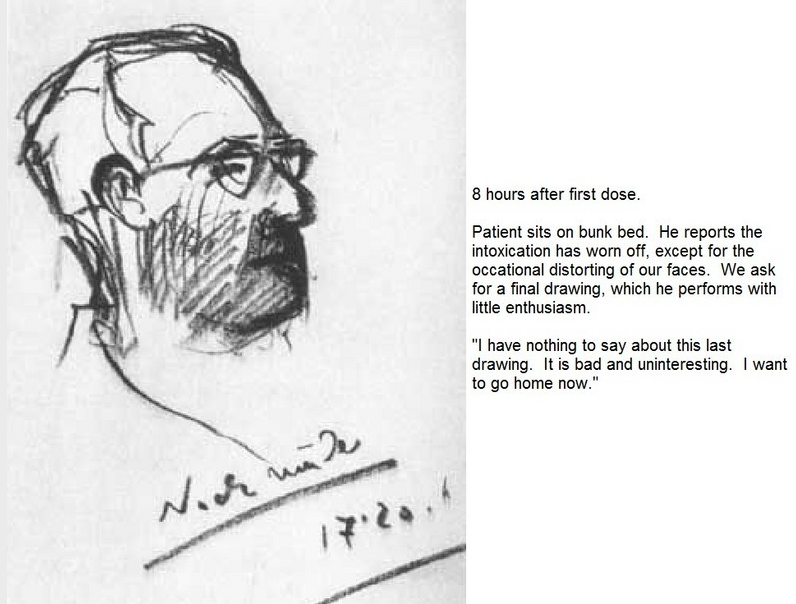
During the 1950s, a researcher gave an artist two 50-microgram doses of LSD (each dose separated by about an hour), and then the artist was encouraged to draw pictures of the doctor who administered the drugs. Nine portraits were drawn over the space of eight hours. We still don’t know the identity of the artist. But it’s surmised that the researcher was Oscar Janiger, a University of California-Irvine psychiatrist known for his work on LSD.
The web site Live Science has Andrew Sewell, a Yale Psychiatry professor (until his recent death), on record saying: “I believe the pictures are from an experiment conducted by the psychiatrist Oscar Janiger starting in 1954 and continuing for seven years, during which time he gave LSD to over 100 professional artists and measured its effects on their artistic output and creative ability. Over 250 drawings and paintings were produced.” The goal, of course, was to investigate what happens to subjects under the influence of psychedelic drugs. During the experiment, the artist explained how he felt as he worked on each sketch. You can watch how things unfolded below (or above):
20 Minutes After First Dose. Artist Claims to Feel Normal

85 Minutes After First Dose: Artist Says “I can see you clearly. I’m having a little trouble controlling this pencil.”
2 hours 30 minutes after first dose. “I feel as if my consciousness is situated in the part of my body that’s now active — my hand, my elbow… my tongue.”
2 hours 32 minutes: ‘I’m trying another drawing… The outline of my hand is going weird too. It’s not a very good drawing is it?”
2 hours 35 minutes: Patient follows quickly with another drawing. ‘I’ll do a drawing in one flourish… without stopping… one line, no break!”

2 hours 45 minutes: Agitated patient says “I am… everything is… changed… they’re calling… your face… interwoven… who is…” He changes medium to Tempera.
4 hours 25 minutes: After taking a break, the patient changes to pen and water color. “This will be the best drawing, like the first one, only better.”
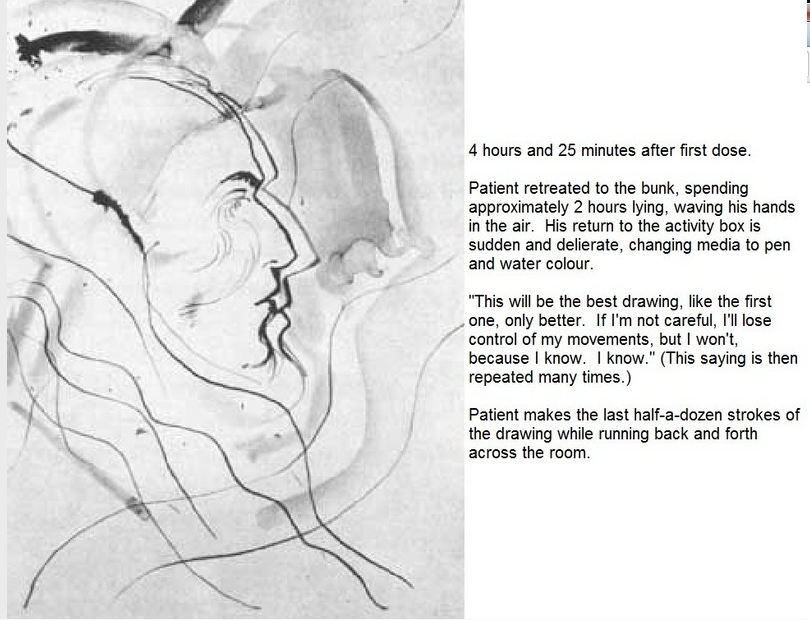
5 hours 45 minutes. “I think it’s starting to wear off. This pencil is mighty hard to hold.” (He is holding a crayon).
8 hours later: The intoxication has worn off. Patient offers up a final drawing.
Related Content:
R. Crumb Describes How He Dropped LSD in the 60s & Instantly Discovered His Artistic Style
Algerian Cave Paintings Suggest Humans Did Magic Mushrooms 9,000 Years Ago
Read More...A 5‑Hour Journey Through North Korean Entertainment: Propaganda Films, Kids’ Cartoons, Sketch Comedy & More
Over the second half of the twentieth century, South Korea became rich, and in the first decades of the twenty-first, it’s become a global cultural superpower. The same can’t be said for North Korea: after a relatively strong start in the nineteen-fifties and sixties, its economy foundered, and in the famine-stricken mid-nineties it practically collapsed. For that and other reasons, the country has never been in a position to send forth its own BTS, Squid Game, Parasite, or “Gangnam Style.” But whatever the difficulties at home, the Democratic People’s Republic of Korea has always managed to produce entertainment for consumption by its own people: movies, animation, television shows, music, and more besides.
Then again, “entertainment” may be too strong a word. A few years ago, attending a North-South cultural exchange group in Seoul, where I live, I had the chance to watch a recent movie called 우리집 이야기, or The Story of Our Home. It told its simple tale of a family of orphans trying to survive on their own with surprising technical competence — at least compared to what I’d expected — albeit with what I remember as occasional jarring lapses into flat propaganda shots, stern national anthem, flapping red-starred flag and all. According to “Entertainment Made By North Korea,” the new five-and-a-half-hour analysis from Youtuber Paper Will, that sort of thing is par for the course.
In order to put North Korean entertainment in its proper context, the video begins before there was a North Korea, describing the films made on the Japanese-occupied Korean peninsula between 1910 and the end of the Second World War. Though the expulsion of the defeated Japan ended colonial rule in Korea, many more hardships would visit both sides of the newly divided country. But even during their struggles to develop, the rulers of both the developing North and South Korea understood the potential of cinema to influence their peoples’ attitudes and perceptions. Watched today, these pictures reveal a great deal about the countries’ priorities. For the DPRK, those priorities included the encouragement of unstinting hard work and allegiance to the state, embodied by its founder Kim Il Sung.
Later, in the seventies and eighties, came some diversification of both media and message, as serial dramas and children’s cartoons, some of them crafted with genuine skill and charm, discouraged individualistic attitudes, sympathy for foreigners, and thoughts of defection. Under Kim Il Sung’s movie-loving Kim Jong Il, North Korean films became more watchable, thanks in large part to his kidnapping and forcibly employing South Korean director Shin Sang-ok. Under his son Kim Jong Un, the country’s popular culture has flirted with the very outer reaches of cool, assembling the likes of instrument-playing girl-group Moranbong. Nevertheless, in North Korea, entertainment continues first and foremost to enforce the preferred ideology of the ruling class, something that — perish the thought — could surely never happen in the West.
Related content:
A‑ha’s “Take On Me” Performed by North Korean Kids with Accordions
How to Defeat the US with Math: An Animated North Korean Propaganda Film for Kids
North Korea’s Cinema of Dreams
Watch More Than 400 Classic Korean Films Free Online Thanks to the Korean Film Archive
Based in Seoul, Colin Marshall writes and broadcasts on cities, language, and culture. His projects include the Substack newsletter Books on Cities, the book The Stateless City: a Walk through 21st-Century Los Angeles and the video series The City in Cinema. Follow him on Twitter at @colinmarshall or on Facebook.
Read More...Google Launches a New Course Called “AI Essentials”: Learn How to Use Generative AI Tools to Increase Your Productivity
This week, Google announced the launch of Google AI Essentials, a new self-paced course designed to help people learn AI skills that can boost their productivity. Taught by Google’s AI experts, and assuming no prior knowledge of programming, the course ventures to show students how to “use AI in the real world,” with an emphasis on helping students:
- Develop ideas and content. If you’re stuck at the beginning of a project, use AI tools to help you brainstorm new ideas. In the course, you’ll use a conversational AI tool to generate concepts for a product and develop a presentation to pitch the product.
- Make more informed decisions. Let’s say you’re planning an event. AI tools can help you research the best location to host it based on your criteria. You can also use AI to help you come up with a tagline or slogan.
- Speed up daily work tasks. Clear out that inbox faster using AI to help you summarize emails and draft responses.
Google AI Essentials features five modules (the video above comes from Module 1) and takes about 9 hours to complete. The tuition is currently set at $49, and those who complete the course will earn a Google certificate that they can share with their professional network.
Google AI Essentials follows up on another course recently-featured here on OC, Generative AI for Educators. Find it here.
Note: Open Culture has a partnership with Coursera. If readers enroll in certain Coursera courses and programs, it helps support Open Culture.
Related Content
Google & MIT Offer a Free Course on Generative AI for Teachers and Educators
Read More...André Breton’s Surrealist Manifesto Turns 100 This Year
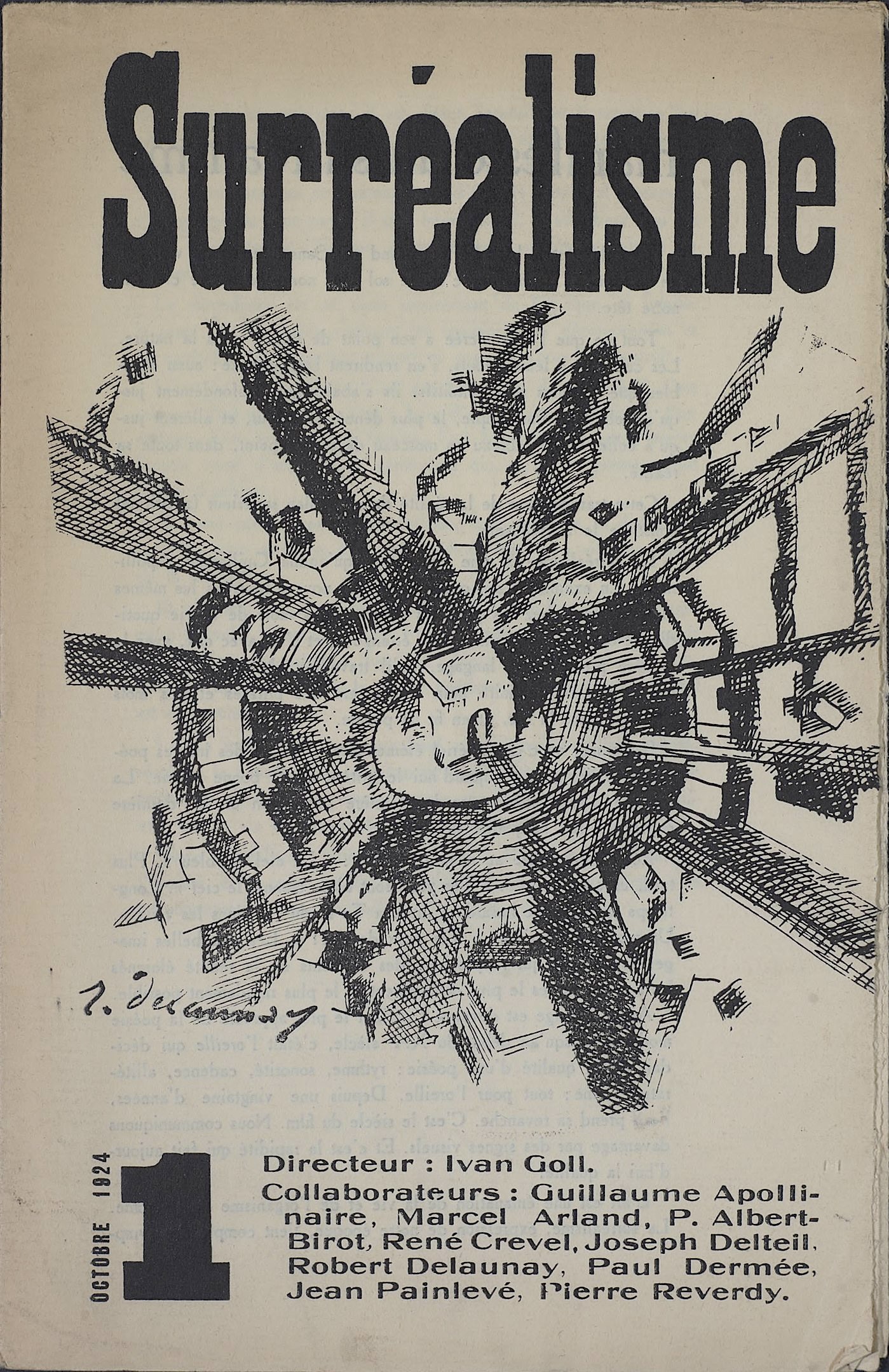
People don’t seem to write a lot of manifestos these days. Or if they do write manifestos, they don’t make the impact that they would have a century ago. In fact, this year marks the hundredth anniversary of the Manifeste du surréalisme, or Surrealist Manifesto, one of the most famous such documents. Or rather, it was two of the most famous such documents, each of them written by a different poet. On October 1, 1924, Yvan Goll published a manifesto in the name of the surrealist artists who looked to him as a leader (including Dada Manifesto author Tristan Tzara). Two weeks later, André Breton published a manifesto — the first of three — representing his own, distinct, group of surrealists with the very same title.
Though Goll may have beaten him to the punch, we can safely say, at a distance of one hundred years, that Breton wrote the more enduring manifesto. You can read it online in the original French as well as in English translation, but before you do, consider watching this short France 24 English documentary on its importance, as well as that of the surrealist art movement that it set off.
“There’s day-to-day reality, and then there’s superior reality,” says its narrator. “That’s what André Breton’s Surrealist Manifesto was aiming for: an artistic and spiritual revolution” driven by the rejection of “reason, logic, and even language, all of which its acolytes believed obscured deeper, more mystical truths.”
“The realistic attitude, inspired by positivism, from Saint Thomas Aquinas to Anatole France, clearly seems to me to be hostile to any intellectual or moral advancement,” the trained doctor Breton declares in the manifesto. “I loathe it, for it is made up of mediocrity, hate, and dull conceit. It is this attitude which today gives birth to these ridiculous books, these insulting plays.” He might well have also seen it as giving rise to events like the First World War, whose grinding senselessness he witnessed working in a neurological ward and carrying stretchers off the battlefield. It was these experiences that directly or indirectly inspired a wave of avant-garde twentieth-century art, more than a few pieces of which startle us even today — which is saying something, given our daily diet of absurdities in twenty-first century life.
Related content:
An Introduction to Surrealism: The Big Aesthetic Ideas Presented in Three Videos
A Brief, Visual Introduction to Surrealism: A Primer by Doctor Who Star Peter Capaldi
The Forgotten Women of Surrealism: A Magical, Short Animated Film
Based in Seoul, Colin Marshall writes and broadcasts on cities, language, and culture. His projects include the Substack newsletter Books on Cities, the book The Stateless City: a Walk through 21st-Century Los Angeles and the video series The City in Cinema. Follow him on Twitter at @colinmarshall or on Facebook.
Read More...How Édouard Manet Became “the Father of Impressionism” with the Scandalous Panting, Le Déjeuner sur l’herbe (1863)
Édouard Manet’s Le Déjeuner sur l’herbe (1863) caused quite a stir when it made its public debut in 1863. Today, we might assume that the controversy surrounding the painting had to do with its containing a nude woman. But, in fact, it does not contain a nude woman — at least according to the analysis presented by gallerist-Youtuber James Payne in his new Great Art Explained video above. “The woman in this painting is not nude,” he explains. “She is naked.” Whereas “the nude is posed, perfect, idealized, the naked is just someone with no clothes on,” and, in this particular work, her faintly accusatory expression seems to be asking us, “What are you looking at?”
Here on Open Culture, we’ve previously featured Manet’s even more scandalous Olympia, which was first exhibited in 1865. In both that painting and Déjeuner, the woman is based on the same real person: Victorine Meurent, whom Manet used more frequently than any other model.
“A respected artist in her own right,” Meurent also “exhibited at the Paris Salon six times, and was inducted into the prestigious Société des Artistes Français in 1903.” That she got on that path after a working-class upbringing “shows a fortitude of mind and a strength of character that Manet needed for Déjeuner.” But whatever personality she exuded, her non-idealized nudity, or rather nakedness, couldn’t have changed art by itself.
Manet gave Meurent’s exposed body an artistic context, and a maximally provocative one at that, by putting it on a large canvas “normally reserved for historical, religious, and mythological subjects” and making choices — the visible brushstrokes, the stage-like background, the obvious classical allusions in a clearly modern setting — that deliberately emphasize “the artificial construction of the painting, and painting in general.” What underscores all this, of course, is that the men sitting with her all have their highly eighteen-sixties-looking clothes on. Manet may have changed the rules, opening the door for Impressionism, but he still reminds us how much of art’s power, whatever the period or movement, comes from sheer contrast.
Related Content:
The Museum of Modern Art (MoMA) Puts Online 90,000 Works of Modern Art
Based in Seoul, Colin Marshall writes and broadcasts on cities, language, and culture. His projects include the Substack newsletter Books on Cities, the book The Stateless City: a Walk through 21st-Century Los Angeles and the video series The City in Cinema. Follow him on Twitter at @colinmarshall or on Facebook.
Read More...Support Us
We're hoping to rely on loyal readers, rather than erratic ads. Please click the Donate button and support Open Culture. You can use Paypal, Venmo, Patreon, even Crypto! We thank you!

About Us

Open Culture scours the web for the best educational media. We find the free courses and audio books you need, the language lessons & educational videos you want, and plenty of enlightenment in between.
Advertise With Us
FREE UPDATES!
GET OUR DAILY EMAIL
Get the best cultural and educational resources on the web curated for you in a daily email. We never spam. Unsubscribe at any time.
FOLLOW ON SOCIAL MEDIA
Open Culture editor Dan Colman scours the web for the best educational media. He finds the free courses and audio books you need, the language lessons & movies you want, and plenty of enlightenment in between.
Advertise With Us

