The 50 Greatest Music Videos of All Time, Ranked by AV Club
It’s not an especially straightforward matter to pin down when music videos first emerged. In a sense, the Beatles were already making them back in the late sixties, but then, MTV, where the music video as we know it rapidly took shape, didn’t start broadcasting until 1981. The very first video aired on the channel, “Video Killed the Radio Star” by the Buggles, had actually been made almost two years earlier, in 1979. But that didn’t stop it from doing a good deal to define the form that would, itself, define the popular culture of the eighties. Nor did it stop it from appearing, 40-odd years later, on The AV Club’s list of the 50 greatest music videos of all time. They’re viewable as a Youtube playlist here, or you can stream them all above.
Not that it ranks especially high. In fact, it comes in at number 50, leading into a selection of videos from artists popular in a range of subsequent periods: Talking Heads, George Michael, Nirvana, LL Cool J, Britney Spears, Taylor Swift. As the artistic ambitions of the music video grew, it reflected not just a song’s cultural moment, but put several such moments in play at once.
In Sonic Youth’s “Teen Age Riot,” “a clip of Elvis Presley is followed by space-jazz pioneer Sun Ra; a snatch of underground comic book auteur Harvey Pekar on Late Night with David Letterman flits by.” For the “high water mark for kitschy 1990s irony” that is Weezer’s “Buddy Holly,” “Spike Jonze sets the video in the 1950s… but it’s the ’50s as seen on Happy Days, a sitcom that painted a rosy picture of the Eisenhower years.”
Jonze also draws inspiration from seventies television for the Beastie Boys’ “Sabotage,” a tribute to the cop shows of that era that makes up for an apparent lack of budget with sheer humor and energy (a reminder of the director’s origin in skateboarding videos). I remember my millennial peers getting excited about that video in the 90s, as, in the 200s, they’d get excited about Michel Gondry’s all-LEGO animation of the White Stripes’ “Fell in Love with a Girl.” This was roughly when Britney Spears was breaking through to superstardom, thanks not least to videos like “Baby One More Time,” which combines the slickness of teen pop with the chintz of teen life. “The idea for Britney’s iconic schoolgirl uniform and pigtails came from the singer herself: director Nigel Dick followed her lead, then had wardrobe buy every stitch of clothing in the video from Kmart.”
This was also before Youtube, whose ascent made the music video more viable than it had been in years. The AV Club’s list does include a few videos from the past decade and a half— Beyoncé’s “Single Ladies,” Lady Gaga’s “Bad Romance” — but on the whole, it underscores that there’s never been another time like the eighties. That decade that went from “Ashes to Ashes” to “Girls Just Want to Have Fun,” “Relax,” “Money for Nothing,” “Walk This Way,” “Take on Me,” and “Rhythm Nation” — to say nothing of institutions like Duran Duran, Madonna, and Michael Jackson, all of whom make the list more than once, but none of whom take its top spot. That goes to Peter Gabriel, whose stop-motion fantasia “Sledgehammer” is MTV’s all-time most-played music video. “If anyone wants to try and copy this video, good luck to them,” Gabriel once said. He meant its painstaking production, but he could just as easily have been talking about the place it attained in pop culture.
Related content:
Watch the First Two Hours of MTV’s Inaugural Broadcast (August 1, 1981)
Michel Gondry’s Finest Music Videos for Björk, Radiohead & More: The Last of the Music Video Gods
All the Music Played on MTV’s 120 Minutes: A 2,500-Video Youtube Playlist
David Bowie Releases 36 Music Videos of His Classic Songs from the 1970s and 1980s
Hans Zimmer Was in the First-Ever Video Aired on MTV, The Buggles’ “Video Killed the Radio Star”
David Lynch’s Music Videos: Nine Inch Nails, Moby, Chris Isaak & More
Based in Seoul, Colin Marshall writes and broadcasts on cities, language, and culture. His projects include the Substack newsletter Books on Cities, the book The Stateless City: a Walk through 21st-Century Los Angeles and the video series The City in Cinema. Follow him on Twitter at @colinmarshall or on Facebook.
Read More...A Mesmerizing Look at the Making of a Late Medieval Book from Start to Finish
Hand binding a book, using primarily 15-century methods and materials sounds like a major undertaking, rife with pitfalls and frustration.
A far more relaxing activity is watching Four Keys Book Arts’ wordless, 24-minute highlights reel of self-taught bookbinder Dennis tackling that same assignment, above. (Bonus — it’s a guaranteed treat for those prone to autonomous sensory meridian response tingles.)
Dennis, whose other recent forays into bespoke bookbinding include a number of elegant matchbox sized volumes and upcycling three Dungeons & Dragons rulebooks into a tome bound in vegetable tanned goatskin, labored on the late-medieval Gothic reproduction for over 60 hours.
For research on this type of binding, he turned to book designer J.A. Szirmai’s The Archaeology of Medieval Bookbinding, and while the goal was never 100% period accuracy, Dennis notes that the craft of traditional hand-binding has remained virtually unchanged for centuries:
The medieval binder would have found many of the tools and techniques to be very familiar. The single biggest anachronism is my use of synthetic PVA glue rather than period-appropriate animal glue. The second historic anomaly is my use of marbled paper, though it could be argued that the earliest European marbled papers of the mid-17th century do overlap with this binding style. The nonpareil pattern I have chosen for the endpapers, though, dates from the 1820’s, and so is distinctly out of place. But apart from those, virtually all of the other materials in this book would have been available to the medieval bookbinder.
Those craving a more step-by-step explanation should set time aside to view the longer videos, below, in which Dennis shares such time-consuming, detail-oriented tasks as trimming and tidying the edges with a cabinet scraper and bookbinder’s plough, sewing endbands to support and protect the book’s head and the spine, and decorating the leather cover with a hand-tooled floral pattern embellished with gold foil highlights.
Rather than cut corners, he literally cuts corners — the metal clasp and corner guards - from a .8mm thick sheet of brass.
Only the final video is narrated, so be sure to activate closed captioning / subtitles in the YouTube toolbar to read his commentary.
Materials and tools used in this project:
Text Paper: Fabriano Accademia 120 gsm drawing paper, 65 x 50 cm, long grain
Endpapers: Four Keys Book Arts handmade marbled paper, Fabriano Accademia 120 gsm drawing paper, red handmade paper
Thread: Undyed Linen 25/3, unknown brand
Cords: Leather, unknown type, roughly 3 oz/ 1 mm
Wax: Natural Beeswax
Glue: Mix of Acid-Free PVA and Methyl Cellulose, 3:2 ratio.
Paper Knife (made from an old kitchen knife)
Bone Folder (handmade in-house)
Scrap book board, various sizes/thickness
Pressing Boards (1/2″ maple plywood, made in house)
Cast-Iron Book Press (Patrick Ritchie, Edinburgh, circa 1850)
Stainless Steel rulers, various sizes
Small Stanley Knife
Maple Laying Press (handmade in-house)
Small Carpenter’s Square, unknown brand
Pencil (Blackwing)
Steel dividers, unknown brand
Lithography Stone (circa 1925)
Cotton Rag
Agate Burnisher
Piercing Cradle (handmade in-house)
Awl
2″ natural bristle brush, generic
parchment release paper
blotting paper
Acetate barrier sheets, .01 gauge
Dahle Vantage 12e Guillotine (found at a thrift store)
Scissors
Bookbinding Needles
Sewing Frame (handmade in-house)
Brass H‑Keys (handmade in-house)
Linen sewing tapes, 12 mm
Pins
Watch a full playlist of Four Keys Book Arts’ Medieval Gothic Binding videos here. See more of Dennis book binding projects on Four Keys Book Arts’ Instagram.
Related Content
Wonderfully Weird & Ingenious Medieval Books
When Medieval Manuscripts Were Recycled & Used to Make the First Printed Books
The Medieval Masterpiece, the Book of Kells, Has Been Digitized and Put Online
– Ayun Halliday is the Chief Primatologist of the East Village Inky zine and author, most recently, of Creative, Not Famous: The Small Potato Manifesto and Creative, Not Famous Activity Book. Follow her @AyunHalliday.
Read More...The Stoic Wisdom of Roman Emperor Marcus Aurelius: An Introduction in Six Short Videos
?si=N6JQU7bXNRhsFgOq
Though it enjoys a particular popularity here in the twenty-first century, the rigorously equanimous Stoic worldview comes to us through the work of three figures from antiquity: Epictetus, Seneca, and Marcus Aurelius. Epictetus was born and raised a slave. Seneca, the son of rhetorician Seneca the Elder, became an advisor to Nero (a position that ultimately forced him to take his own life). Marcus Aurelius, the most exalted of the three, actually did the top job himself, ruling the Roman Empire from 161 to 180 AD. He also left behind a text, the Meditations, that stands alongside Epictetus’ Enchiridion and Seneca’s many essays and letters as a pillar of the canon of Stoicism.
It is from the Meditations that this series of six videos from Youtube channel Einzelgänger draws its wisdom. Each of them introduces different aspects of Marcus Aurelius’ interpretation of Stoicism and applies them to our everyday life here in modernity, presenting strategies for staying calm, not feeling harm, accepting what comes our way, and not being troubled by the actions of others.
Though the importance of these aims can be illustrated any number of ways, their achievement depends on accepting the notion central to all Stoic thought: “the dichotomy of control,” which dictates that “some things are in our control and others aren’t.” When life hurts, “it often means that we care about things we have no control over, and by doing so, we let them control us.”
All the Stoics understood this, but for Marcus Aurelius, “being unperturbed by things outside of his control allowed him to cope with the many responsibilities and challenges he faced as an emperor, and to focus on the task he believed he was given by the gods.” He knew that “it’s not the outside world and the events that take place in it, our bodies included, that hurt us, but our thoughts, memories, and fantasies regarding them.” To indulge those fantasies means to live in perpetual conflict with reality, and thus in perpetual, and futile, grievance against it. The stronger our judgments about what happens, “the more vulnerable we become to the whims of Fortuna, the unpredictable goddess of luck, chance, and fate,” forces that eventually get the better of us all — even if we happen to have the world’s mightiest empire at our command.
Related content:
How to Be a Stoic in Your Everyday Life: Philosophy Professor Massimo Pigliucci Explains
Three Huge Volumes of Stoic Writings by Seneca Now Free Online, Thanks to Tim Ferriss
350 Animated Videos That Will Teach You Philosophy, from Ancient to Post-Modern
Based in Seoul, Colin Marshall writes and broadcasts on cities, language, and culture. His projects include the Substack newsletter Books on Cities, the book The Stateless City: a Walk through 21st-Century Los Angeles and the video series The City in Cinema. Follow him on Twitter at @colinmarshall or on Facebook.
Read More...Alfred Hitchcock’s Strict Rules for Watching Psycho in Theaters (1960)
Psycho, one of Alfred Hitchcock’s iconic films, didn’t come together very easily. Hitchcock’s studio, Paramount Pictures, didn’t like anything about the film and denied him a proper budget. So the director went solo and funded the film through his television company Shamley Productions. The budget was tight — less than $1,000,000. Costs were firmly controlled. Hence why, in 1960, the film was shot in black and white.
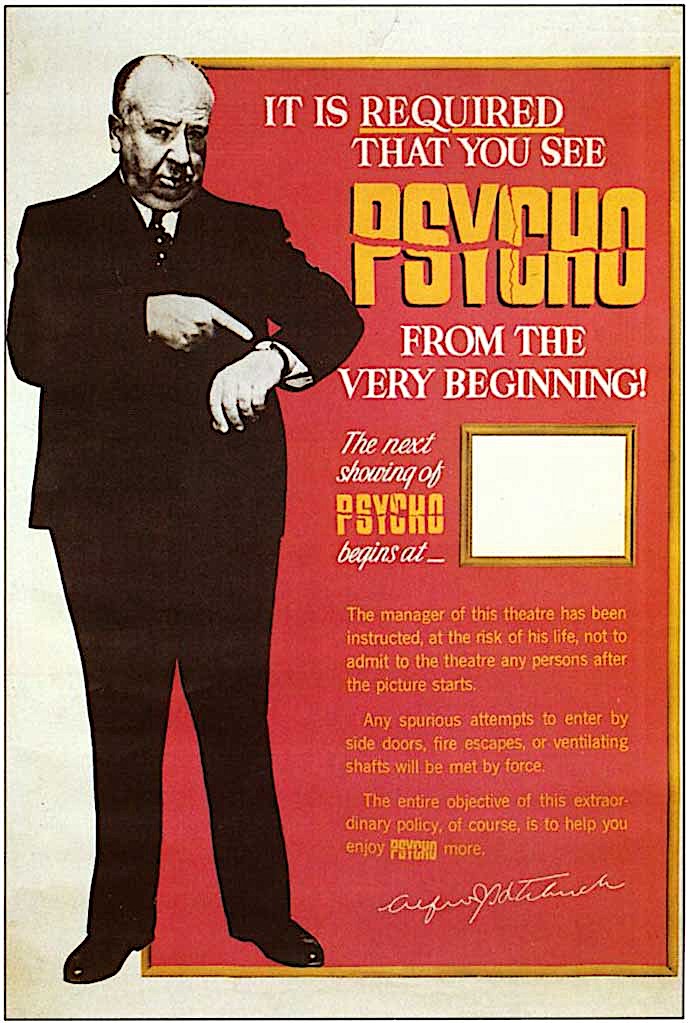
When Psycho hit theaters, Hitchcock controlled the promotion. The stars — Anthony Perkins and Janet Leigh — didn’t make the usual rounds in the media. Critics weren’t given private screenings. And Hitchcock created buzz for the film when he exerted directorial control over the viewing experience of the audience. Showings of the film began on a tightly-controlled schedule in theaters in New York, Chicago, Boston, and Philadelphia. And a firm “no late admission” policy was put in place. You either saw the film from the very beginning, or you didn’t see it all. Signs appeared in front of cinemas reading:
We won’t allow you to cheat yourself. You must see PSYCHO from the very beginning. Therefore, do not expect to be admitted into the theatre after the start of each performance of the picture. We say no one — and we mean no one — not even the manager’s brother, the President of the United States, or the Queen of England (God bless her)!
Theater managers initially balked at the idea, fearing financial losses. But Hitchcock had his way. And he was right. Long lines formed outside the theaters. Psycho enjoyed critical and commercial success, so much so the film was re-released in 1965.
Note: An earlier version of this post appeared on our site in 2012.
If you would like to support the mission of Open Culture, consider making a donation to our site. It’s hard to rely 100% on ads, and your contributions will help us continue providing the best free cultural and educational materials to learners everywhere. You can contribute through PayPal, Patreon, and Venmo (@openculture). Thanks!
Related Content:
The 5 Essential Rules of Film Noir
Watch Alfred Hitchcock Make Cameo Appearances in 37 of His Films
Alfred Hitchcock Reveals The Secret Sauce for Creating Suspense
Read More...Watch Fritz Lang’s Metropolis with a Modern, New Electronic Soundtrack (1927)
From sound artist Tomer Baruch and drummer Alex Brajković comes a new electronic soundtrack for Fritz Lang’s century-old classic film, Metropolis. The new score comes with this preface:
One of the most significant themes in the dystopian feature is the blurred-to-nonexistent line separating man and machine; Human-like machines, Mechanical-humans, real-life android deepfakes, and above all the city of Metropolis, an enormous machine and within it men, slaved to maintain its operation. The theme that was disturbing in the beginning of the 20th century is as relevant as ever with the latest developments in AI, forcing us to rethink again what makes us human.
In analogy to that the soundtrack is based on archive recordings of early 20th century machinery, on top of which Tomer Baruch and Alex Brajkovic play analog synthesizers and drums. They interface with the machines and embody a relentlessly repetitive mechanical motion, one which is usually sequenced or programmed. By creating music which is in itself blurring the line between man and machine, by subjecting themselves to machine-like patterns, the musicians become a part of Metropolis, creating a disillusioned, intensified and darker than ever soundtrack for the film.
Baruch and Alex Brajković created the soundtrack for the Sounds of Silence Film Festival, Den Haag in 2019. Stream it above.
If you would like to support the mission of Open Culture, consider making a donation to our site. It’s hard to rely 100% on ads, and your contributions will help us continue providing the best free cultural and educational materials to learners everywhere. You can contribute through PayPal, Patreon, and Venmo (@openculture). Thanks!
Related Content
If Fritz Lang’s Iconic Film Metropolis Had a Kraftwerk Soundtrack
Read the Original 32-Page Program for Fritz Lang’s Metropolis (1927)
See Metropolis‘ Scandalous Dance Scene Colorized, Enhanced, and Newly Soundtracked
Read More...Sinéad O’Connor Makes Her First US Television Appearance: Watch Her Sing “Mandinka” on Late Night with David Letterman (1988)
On September 7, 1988, a skinny, near bald, 21-year-old mother took the mic midway through Late Night with David Letterman and blew the socks off both the live studio audience and the folks viewing at home.
She also appeared as an unwilling participant in a cheesy greenroom sketch with fellow guests comedian Robert Klein, crooner Jerry Vale, and a female day player costumed as a sexy cigarette girl from another era.
It’s a stupid, retrograde bit that’s become even worse with age, but young Sinead O’Connor’s refusal to play along with the problematic premise was as true to form as her howling performance of Mandinka off her first album, The Lion and the Cobra.
Performing in a studded jean jacket and Claddagh ring, she made her live US television debut with eyes mostly closed.
Letterman introduced her as a “remarkable, young singer and writer from Ireland.”
It’s fun to see the truth of that canned line hitting the house band as the song progresses. Bandleader Paul Shaffer looks especially tickled by the ferocity of O’Connor’s performance and her confident musicianship.
In her memoir Rememberings, O’Connor explains that the song was inspired by the 1977 television adaptation of Alex Haley’s semi-autobiographical historical novel Roots:
I was a young girl when I saw it, and it moved something so deeply in me, I had a visceral response. I came to emotionally identify with the civil rights movement and slavery, especially given the theocracy I lived in and the oppression in my own home.
She reprised Mandinka several months later at the Grammy Awards. She may have lost Best Female Rock Vocal Performance to established legend Tina Turner, but the LA Times waggishly declared her “black halter top, bare midriff, torn, faded blue jeans and large black work shoes” the “outfit of the evening”:
The latest addition to her shaved-head look is a tattoo of militant rap group Public Enemy’s insignia–a view through a telescopic gun sight–over her left ear. None of which detracted from her electrifying performance of her song “Mandinka.”
“I thought it was a little odd that they asked me to perform, because of the way I look,” a nervous-looking O’Connor told the press backstage. “But I find it encouraging that they asked, because it’s an acknowledgment that they are prepared not to be so safe about the music and push forward with people slightly off the wall.”
Two years later, her cover of Prince’s Nothing Compares 2 U, abetted by her defiant appearance, made her a household name. Nominated for four Grammys, she declined an invitation to perform at the ceremony. She also declined her award for Best Alternative Music Performance.
In a letter to the sponsoring organization, the Recording Academy of the United States, she argued against the music industry’s priorities, its overt tendency to rank artists based on their commercial success:
As artists I believe our function is to express the feelings of the human race–to always speak the truth and never keep it hidden even though we are operating in a world which does not like the sound of the truth. I believe that our purpose is to inspire and, in some way, guide and heal the human race, of which we are all equal members.
Those looking for early-90s examples of man-splaining might appreciate Recording Academy President Michael Greene’s response, in which he overlooked the Letterman appearance, claiming the Grammys provided O’Connor with her first nationally televised exposure in the States:
We applaud that Sinead feels so strongly about these issues and believe that her convictions only add to the seriousness of her work. But she may be misguided. We respect her immensely as an artist… But I’m afraid that Sinead may not be properly informed about the difference between the overtly commercial aspects of popularity contests as opposed to the Grammys, which are voted on by the creative community.
O’Connor doubled down, attempting to rally her fellow musicians to shine a light on society’s ills, telling the LA Times that “It’s not enough any more to just sit in your chair and say, ‘Yeah, it’s terrible.’:”
Musicians are in a position to help heal this sickness, but I’d say 90% of the artists in the music business fail in that responsibility. You must acknowledge if you are an artist that you are a role model for young people, whether you like it or not. If you don’t want to accept that responsibility, you shouldn’t be an artist. With power comes responsibility.
The industry, including awards shows, sends out the message that selling more records is good rather than telling the truth.
Honoring commercial success is the obvious purpose of the American Music Awards telecast, but it’s also the intent of the Grammys as well.
I think if artists were to be awarded for what they had achieved in so far as telling the truth … as far as healing the human race, then I’d say Van Morrison or Ice Cube, people like that should be honored.
That statement lends an extra poignancy to our viewing of O’Connor and Morrison’s 1995 Letterman appearance, when, backed by the Chieftans, they duetted on Have I Told You Lately?
In the wake of O’Connor’s death at 56 last week, the media reminded us of the time she ripped up a picture of Pope John Paul II on Saturday Night Live as a way of drawing attention to the Catholic church’s coverup of sexual abuse by the clergy.
They reminded us of the time Frank Sinatra claimed he’d like to “kick her ass” when she wouldn’t submit to singing the National Anthem before a concert.
They reminded us of her correspondence with Miley Cyrus, wherein she warned the younger singer not to “obscure (her) talent by allowing (her)self to be pimped” either consciously or unconsciously.
Meanwhile, Letterman bassist Will Lee reacted to the news by revisiting that 1987 appearance on his Instagram:
Sinead O’Connor RIP — I always felt her pain, but now I don’t have to. She is free. Her death comes as a shock to the system because I always hoped she would find resolve, but she went too soon….
– Ayun Halliday is the Chief Primatologist of the East Village Inky zine and author, most recently, of Creative, Not Famous: The Small Potato Manifesto and Creative, Not Famous Activity Book. Follow her @AyunHalliday.
Read More...Oppenheimer’s Secret City: The Story Behind the Stealthy Creation of Los Alamos, New Mexico
We think of the atomic bomb as a destroyer of cities, namely Hiroshima and Nagasaki. But its development also produced a city: Los Alamos, New Mexico, an officially non-existent community in which the necessary research could be conducted in secret. More recently, it became a major shooting location for Oppenheimer, Christopher Nolan’s new movie about the titular theoretical physicist remembered as the father (or one of the fathers) of the atomic bomb based on his work as the director of the Los Alamos Laboratory. You can learn more about that laboratory, and the town of 6,000 constructed to support it, in the new Vox video above.
Los Alamos was necessary to the Manhattan Project, as the R&D of the world’s first nuclear weapon was code-named, but it wasn’t sufficient: other secret sites involved included “a nuclear reactor under a University of Chicago football field”; “the Alabama Ordinance Works, for producing heavy water”; “a large plant for the enrichment of uranium and production of some plutonium” in Oak Ridge, Tennessee”; and the Hanford Engineer Works in Washington State, which produced even more plutonium.
But the bomb itself was created in Los Alamos, into whose isolation Oppenheimer recruited the likes of Enrico Fermi, Edward Teller, Richard Feynman, and other powerful scientific minds — who brought their wives and children along.
As a 1944 Medical Corp memo warned, the “intellectuals” at Los Alamos would “seek more medical care than the average person”; at the same time, one-fifth of the married women there were pregnant, so up went maternity wards as well. The population of Los Alamos grew so rapidly that “hutments were a common form of accommodation,” though “apartment buildings were also available.” The housing sat alongside “facilities for graphite fabrication, and the cyclotron and Van de Graaff machines.” Less than 250 miles south lay what, in the summer of 1945, would become the site of the Trinity test. It was there, gazing upon the explosion of the unprecedented nuclear weapon whose development he’d overseen, that Oppenheimer saw not merely a destroyer of cities, but a destroyer of worlds.
Related content:
Oppenheimer: The Man Behind the Bomb
Watch Chilling Footage of the Hiroshima & Nagasaki Bombings in Restored Color
See Every Nuclear Explosion in History: 2153 Blasts from 1945–2015
Learn How Richard Feynman Cracked the Safes with Atomic Secrets at Los Alamos
Based in Seoul, Colin Marshall writes and broadcasts on cities, language, and culture. His projects include the Substack newsletter Books on Cities, the book The Stateless City: a Walk through 21st-Century Los Angeles and the video series The City in Cinema. Follow him on Twitter at @colinmarshall or on Facebook.
Read More...Home Taping Is Killing Music: When the Music Industry Waged War on the Cassette Tape During the 1980s, and Punk Bands Fought Back
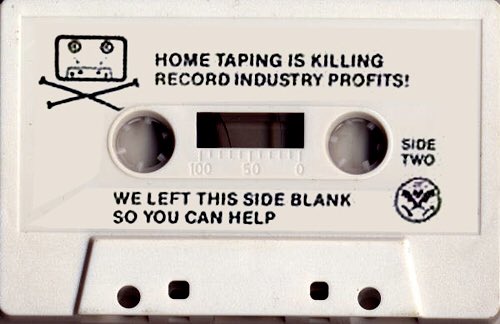
The first time I saw the infamous Skullcassette-and-Bones logo was on holiday in the UK and purchased the very un-punky Chariots of Fire soundtrack. It was on the inner sleeve. “Home Taping Is Killing Music” it proclaimed. It was? I asked myself. “And it’s illegal” a subhead added. It is? I also asked myself. (Ironically, this was a few months before I came into possession of my first combination turntable-cassette deck.)
Ten years and racks and racks of homemade cassette dubs on my shelves later, music seemed to be doing very well. (Later, by going digital, the music industry killed itself, and I had absolutely nothing to do with it.)
British record collectors will no doubt remember this campaign that started in 1981, another business-backed “moral” panic. And funnily enough it had nothing to do with dubbing vinyl.
Instead, the British Phonographic Industry (BPI) were taking aim at people who were recording songs off the radio instead of purchasing records. With the rise of the cassette tape in popularity, the BPI saw pounds and pence leaving their pockets.
Now, figuring out lost profits from home taping could be a fools’ errand, but let’s focus on the “illegal” part. Technically, this is true. Radio stations pay licensing fees to play music, so a consumer taping that song off the radio is infringing on the song’s copyright. Britain has very different “fair use” laws than America. In addition, digital radio and clearer signals have complicated matters over the years.
In practice, however, the whole thing was bunkum. Radio recordings are historic. Mixtapes are culture. I have my tapes of John Peel’s BBC shows, which I recorded for the music. Now, I listen to them for Peel’s intros and outros.
Seriously, the Napalm Death Peel Sessions *only* make sense with his commentary. Whoever taped this is an unknown legend:
The post-punk crowd knew the campaign was bunkum too. Malcolm McLaren, always the provocateur, released Bow Wow Wow’s cassette-only-single C‑30 C‑60 C‑90 Go with a blank B‑side that urged consumers to record their own music. EMI quickly dropped the band.
The Dead Kennedys also repeated the black b‑side gimmick with In God We Trust, Inc. (I would be interested in anybody who picks up a copy used of either to see what *is* on the b‑side).
And then there were the parodies. The metal group Venom used “Home Taping Is Killing Music; So Are Venom” on an album; Peter Principle offered “Home Taping Is Making Music”: Billy Bragg kept it Marxist: “Capitalism is killing music — pay no more than £4.99 for this record”. For the industry, music was the product; for the regular folks, music was communication, it was art, it was a language.
The campaign never did much damage. Attempts to levy a tax on blank cassettes didn’t get traction in the UK. And BPI’s director general John Deacon was frustrated that record companies didn’t want to splash the Jolly Roger on inner sleeves. The logo lives on, however, as part of torrent site Pirate Bay’s sails:
Just after the hysteria died down, compact discs began their rise, planting the seeds for the digital revolution, the mp3, file sharing, and now streaming.
(Wait, is it possible to record internet streams? Why, yes.)
If you have any stories about how you helped “kill music” by recording your favorite DJs, confess your crimes in the comments.
Note: An earlier version of this post appeared on our site in 2019.
If you would like to support the mission of Open Culture, consider making a donation to our site. It’s hard to rely 100% on ads, and your contributions will help us continue providing the best free cultural and educational materials to learners everywhere. You can contribute through PayPal, Patreon, and Venmo (@openculture). Thanks!
Related Content:
Ted Mills is a freelance writer on the arts who currently hosts the artist interview-based FunkZone Podcast and is the producer of KCRW’s Curious Coast. You can also follow him on Twitter at @tedmills, read his other arts writing at tedmills.com and/or watch his films here.
Read More...A Creative List of Meat Carving Terms from the Middle Ages: “Splaye that Breme,” “Splatte that Pyke” & More
A lesser advertised joy of working in food service is achieving command of the slang:
Monkey dish…
Deuces and four tops…
Fire, flash, kill…
As you may have noticed, we here at Open Culture have an insatiable hunger for vintage lingo and it doesn’t get much more vintage than The Boke of Kervynge (The Book of Carving).
This 1508 manual was published for the benefit of young noblemen who’d been placed in affluent households, to learn the ropes of high society by serving the sovereigns.
Few families could afford to serve meat, let alone whole animals, so understandably, the presentation and carving of these precious entrees was not a thing to be undertaken lightly.
The influential London-based publisher Wynkyn de Worde compiled step-by-step instructions for getting different types of meat, game and fish from kitchen to plate, as well as what to serve on seasonal menus and special occasions like Easter and the Feast of St. John the Baptist.
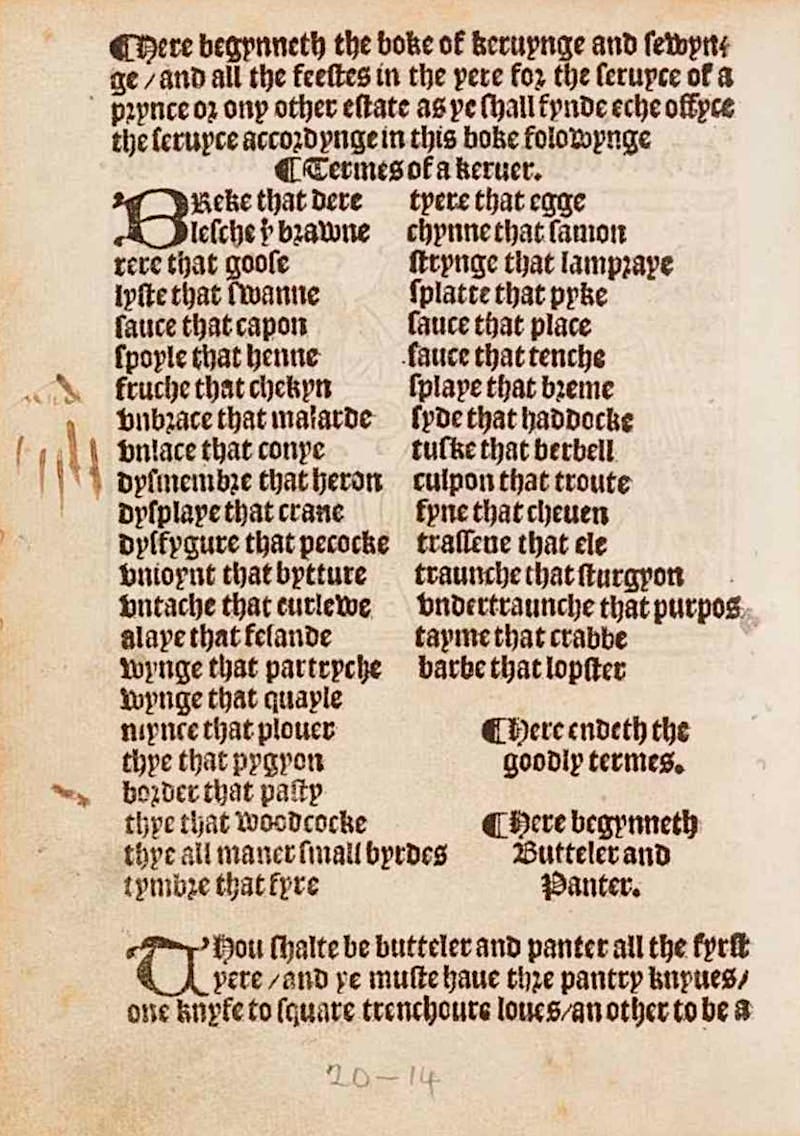
The book opens with the list of “goodly termes” above, essential vocab for any young man eager to prove his skills around the carcass of a deer, goose, or lobster.
There’s nothing here for vegetarians, obviously. And some 21st-century carnivores may find themselves blanching a bit at the thought of tearing into a heron or porpoise.
If, however, you’re a medieval lad tasked with “disfiguring” a peacock, closely observed by an entire dining table of la crème de la crème, The Boke of Kervynge is a lifesaver.
(It also contains some invaluable tips for meeting expectations should you find yourself in the position of chaumberlayne, Marshall or usher.)
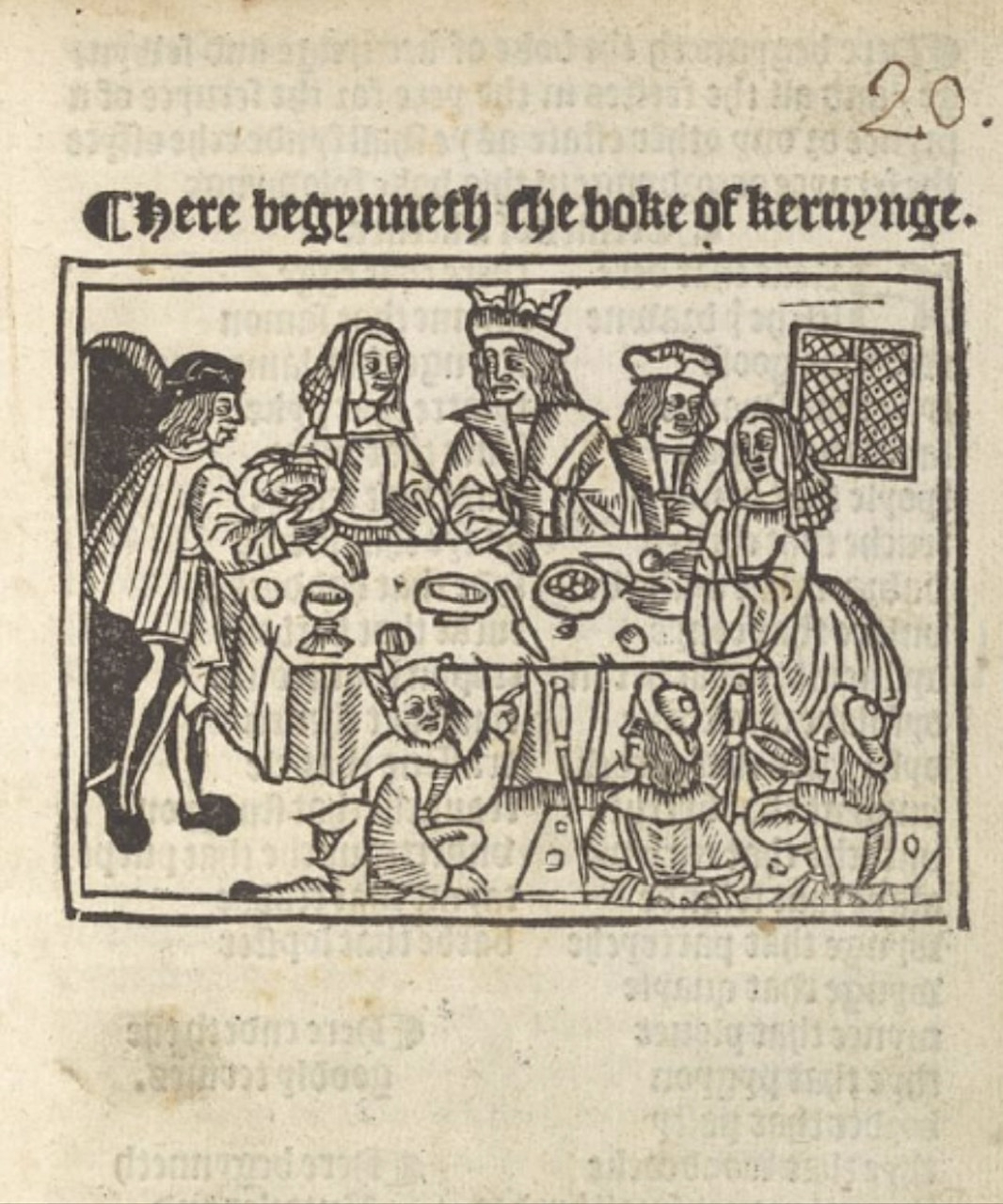
In any event, let’s spice up our vocabulary while rescuing some aged culinary terms from obscurity.
Don’t be surprised if they work their way into an episode of The Bear next season, though you should also feel free to use them metaphorically.
And don’t lose heart if some of the terms are a bit befuddling to modern ears. Lists of Note’s Shaun Usher has taken a stab at truffling up some modern translations for a few of the less familiar sounding words, wisely refraining from hazarding a guess as to the meaning of “fruche that chekyn”.
(It’s not the “chekyn” part giving us pause…)
Termes of a keruer —Terms of a carver
Breke that dere — break that deer
lesche y brawne — leach the brawn
rere that goose — rear that goose
lyft that swanne — lift that swan
sauce that capon — sauce that capon
spoyle that henne — spoil that hen
fruche that chekyn — ? that chicken
vnbrace that malarde — unbrace that mallard
vnlace that cony — unlace that coney
dysmembre that heron — dismember that heron
dysplaye that crane — display that crane
dysfygure that pecocke —disfigure that peacock
vnioynt that bytture — unjoint that bittern
vntache that curlewe — untack that curlew
alaye that fesande — allay that pheasant
wynge that partryche — wing that partridge
wynge that quayle — wing that quail
mynce that plouer — mince that plover
thye that pegyon — thigh that pigeon
border that pasty — border that pasty
thye all maner of small byrdes — thigh all manner of small birds
tymbre that fyre — timber that fire
tyere that egge — tear that egg
chyne that samon — chine that salmon
strynge that lampraye — string that lamprey
splatte that pyke — splat that pike
sauce that playce — sauce that plaice
sauce that tenche — sauce that tench
splaye that breme — splay that bream
syde that haddocke — side that haddock
tuske that barbell — tusk that barbel
culpon that troute — culpon that trout
fynne that cheuen — fin that cheven
trassene that ele — ? that eel
traunche that sturgyon — tranche that sturgeon
vndertraunche yt purpos — undertranch that porpoise
tayme that crabbe — tame that crab
barbe that lopster — barb that lobster
Here endeth the goodly termes.
Peruse a digital copy of the sole surviving copy of the first edition of the Boke of Kervynge here.
Via Lists of Note
Related Content
What Did People Eat in Medieval Times? A Video Series and New Cookbook Explain
A List of 1,065 Medieval Dog Names: Nosewise, Garlik, Havegoodday & More
Ernest Hemingway’s Favorite Hamburger Recipe
– Ayun Halliday is the Chief Primatologist of the East Village Inky zine and author, most recently, of Creative, Not Famous: The Small Potato Manifesto and Creative, Not Famous Activity Book. Follow her @AyunHalliday.
Read More...
How to Spot Bullshit: A Manual by Princeton Philosopher Harry Frankfurt (RIP)
Note: Over the weekend, the Princeton philosopher Harry Frankfurt passed away at the age of 94. After a long career, he became the author of the surprise bestselling book, On Bullshit, which we featured in 2016. Please revisit our original post below.
We live in an age of truthiness. Comedian Stephen Colbert coined the word to describe the Bush administration’s tendency to fudge the facts in its favor.
Ten years after the American Dialect Society named it Word of the Year, former president Bush’s calendar is packed with such leisure activities as golf and painting portraits of world leaders, but “truthiness” remains on active duty.
It’s particularly germane in this election year, though politicians are far from its only practitioners.
Take global warming. NASA makes a pretty rock solid case for both its existence and our role in it:
97 percent or more of actively publishing climate scientists agree: Climate-warming trends over the past century are extremely likely due to human activities. In addition, most of the leading scientific organizations worldwide have issued public statements endorsing this position.
In view of such numbers, it’s understandable that a suburban Joe with a freezer full of factory-farmed beef and multiple SUVs in his garage would cling to the position that global warming is a lie. It’s his last resort, really.
But such self-rationalizations are not truth. They are truthiness.
Or to use the old-fashioned word favored by philosopher Harry Frankfurt, above: bullshit!
Frankfurt–a philosopher at Princeton and the author of On Bullshit–allows that bullshit artists are often charming, or at their very least, colorful. They have to be. Achieving their ends involves engaging others long enough to persuade them that they know what they’re talking about, when in fact, that’s the opposite of the truth.
Speaking of opposites, Frankfurt maintains that bullshit is a different beast from an out-and-out lie. The liar makes a specific attempt to conceal the truth by swapping it out for a lie.
The bullshit artist’s approach is far more vague. It’s about creating a general impression.
There are times when I admit to welcoming this sort of manure. As a maker of low budget theater, your honest opinion of any show I have Little Red Hen’ed into existence is the last thing I want to hear upon emerging from the cramped dressing room, unless you truly loved it.
I’d also encourage you to choose your words carefully when dashing a child’s dreams.
But when it comes to matters of public policy, and the public good, yes, transparency is best.
It’s interesting to me that filmmakers James Nee and Christian Britten transformed a portion of their learned subject’s thoughts into voiceover narration for a lightning fast stock footage montage. It’s diverting and funny, featuring such ominous characters as Nosferatu, Bill Clinton, Charlie Chaplin’s Great Dictator, and Donald Trump, but isn’t it also the sort of misdirection sleight of hand at which true bullshitters excel?
Frankfurt expands upon his thoughts on bullshit in his aptly titled bestselling book, On Bullshit and its followup On Truth.
Related Content:
Noam Chomsky Schools 9/11 Truther; Explains the Science of Making Credible Claims
Ayun Halliday is an author, illustrator, and Chief Primatologist of the East Village Inky zine. Follow her @AyunHalliday
Read More...Support Us
We're hoping to rely on loyal readers, rather than erratic ads. Please click the Donate button and support Open Culture. You can use Paypal, Venmo, Patreon, even Crypto! We thank you!

About Us

Open Culture scours the web for the best educational media. We find the free courses and audio books you need, the language lessons & educational videos you want, and plenty of enlightenment in between.
Advertise With Us

FREE UPDATES!
GET OUR DAILY EMAIL
Get the best cultural and educational resources on the web curated for you in a daily email. We never spam. Unsubscribe at any time.
FOLLOW ON SOCIAL MEDIA

Open Culture editor Dan Colman scours the web for the best educational media. He finds the free courses and audio books you need, the language lessons & movies you want, and plenty of enlightenment in between.
Advertise With Us

