How Stanley Kubrick Adapted Stephen King’s The Shining into a Cinematic Masterpiece
For most of us, the title The Shining first calls to mind the Stanley Kubrick film, not the Stephen King novel from which it was adapted. Though it would be an exaggeration to say that the former has entirely eclipsed the latter, the enormous difference between the works’ relative cultural impact speaks for itself — as does the resentment King occasionally airs about Kubrick’s extensive reworking of his original story. At the center of both versions of The Shining is a winter caretaker at a mountain resort who goes insane and tries to murder his own family, but in most other respects, the experience of the two works could hardly be more different.
How King’s The Shining became Kubrick’s The Shining is the subject of the video essay above from Tyler Knudsen, better known as CinemaTyler, previously featured here on Open Culture for his videos on such auteurs as Robert Wiene, Jean Renoir, and Andrei Tarkovsky (as well as a seven-part series on Kubrick’s own 2001: A Space Odyssey). It begins with Kubrick’s search for a new idea after completing Barry Lyndon, which involved opening book after book at random and tossing against the wall any and all that proved unable to hold his attention. When it became clear that The Shining, the young King’s third novel, wouldn’t go flying, Kubrick enlisted the more experienced novelist Diane Johnson to collaborate with him on an adaptation for the screen.
Almost all of Kubrick’s films are based on books. As Knudsen explains it, “Kubrick felt that there aren’t many original screenwriters who are a high enough caliber as some of the greatest novelists,” and that starting with an already-written work “allowed him to see the story more objectively.” In determining the qualities that resonated with him, personally, “he could get at the core of what was good about the story, strip away the clutter, and enhance the most brilliant aspects with a profound sense of hindsight.” In no case do the transformative effects of this process come through more clearly than The Shining: Kubrick and Johnson reduced King’s almost 450 dialogue- and flashback-filled pages to a resonantly stark two and a half hours of film that has haunted viewers for four decades now.
“I don’t think the audience is likely to miss the many and self-consciously ‘heavy’ pages King devotes to things like Jack’s father’s drinking problem or Wendy’s mother,” Kubrick once said. Still, anyone can hack a story down: the hard part is knowing what to keep, and even more so what to intensify for maximum effect. Knudsen lists off a host of choices Kubrick and Johnson considered (including showing more Native American imagery, which should please fans of Bill Blakemore’s analysis in “The Family of Man”) but ultimately rejected. The result is a film with an abundance of visual detail, but only enough narrative and character detail to facilitate Kubrick’s aim of “using the audience’s own imagination against them,” letting them fill in the gaps with fears of their own. While his version of The Shining evades nearly all clichés, it does demonstrate the truth of one: less is more.
Related content:
How Stanley Kubrick Made 2001: A Space Odyssey: A Seven-Part Video Essay
Stanley Kubrick’s The Shining Reimagined as Wes Anderson and David Lynch Movies
The Shining and Other Complex Stanley Kubrick Films Recut as Simple Hollywood Movies
Based in Seoul, Colin Marshall writes and broadcasts on cities, language, and culture. His projects include the Substack newsletter Books on Cities, the book The Stateless City: a Walk through 21st-Century Los Angeles and the video series The City in Cinema. Follow him on Twitter at @colinmarshall or on Facebook.
Read More...Watch Footage from New York City’s First Gay Pride March (1970)
The forecasted rain held off, the poor air quality caused by Canadian wildfires had abated, and the world’s largest Pride parade stepped off without incident in New York City on the final Sunday in June.
It’s grown quite a bit since the last Sunday of June 1970, when Christopher Street Liberation Day March participants paraded from Sheridan Square to Central Park’s Sheep Meadow.
Seeking to commemorate the one year anniversary of the Stonewall Uprising, when a police raid touched off a riot at the Greenwich Village gay bar, the event’s planners took inspiration from the organized resistance to the Vietnam War and Annual Reminders, a yearly call for equality from the Philadelphia-based Eastern Regional Conference of Homophile Organizations.
Parade co-organizer Craig Rodwell imagined a more freewheeling public event involving larger numbers than Annual Reminders, something that could “encompass the ideas and ideals of the larger struggle in which we are engaged—that of our fundamental human rights.”
In the lead up to the parade, Gay Liberation Front News reported that society stacked the deck against openly gay individuals, an observation echoed by a marcher in lesbian activist Lilli M. Vincenz’s documentary footage, above:
At first I was very guilty, and then I realized that all the things that are taught you, not only by society but by psychiatrists are just to fit you in a mold and I’ve just rejected the mold. And when I rejected the mold, I was happier.
Look carefully for placards from various participating groups, including the Mattachine Societies of Washington and New York, Lavender Menace, the Gay Activists Alliance, a church, and gay student groups at Rutgers and Yale.
Estimates place the crowd at anywhere from 3,000 to 20,000. In addition to marchers, the parade drew plenty of onlookers, some voicing support like a uniformed soldier stationed at Fort Dix who says “Great, man, do your thing!”. Others came prepared to voice their vigorous opposition.
“He’s a closet queen and you can find him in Howard Johnson’s any night,” a marcher cracks when asked his opinion of a counter demonstrator brandishing a sign invoking Sodom and Gomorrah.
Presumably the second part of this marcher’s comment was not intended to signify that the gent in question had a powerful attraction to the venerable Times Square diner’s fried clams, but rather its upstairs neighbor, the all-male Gaiety strip club.
Compared to the flashy festive costumes and booming club music that have become a staple of this millennia’s Pride Marches, 1970’s proceedings were a comparatively modest affair. Marchers chanted in unison, processing uptown in street clothes — hippie-style duds of the period with a couple of square suits and fedoras in the mix.
A clean cut young man in a windbreaker and natty star-spangled tie expressed frank disappointment that Mayor John Lindsay and other political figures had kept their distance.
Younger readers may be taken aback to hear Vincenz asking him how long he had been gay, but gratified when he responds, “I was born homosexual, it’s beautiful.”
By the time the marchers reached the Sheep Meadow, a number of men had shed their shirts. The parade morphed into a pastoral celebration in which revelers can be seen playing Ring Around the Rosie, plucking weeds to decorate each other’s hair, and attempting to break the record for longest kiss.
A man whose bib overalls have been customized with iron-on letters arranged to spell out Stud Farm expresses regret that he spent so many years in the closet.
Co-organizer Foster Gunnison Jr.’s wish was for every queer participant to leave the parade with “a new feeling of pride and self-confidence … to raise the consciences of participating homosexuals-to develop courage, and feelings of dignity and self-worth.”
That first parade’s marshal, Mark Segal, cofounder of Gay Liberation Front, summed it up on the 50th anniversary of the original event:
The march was a reflection of us: out, loud and proud.
Enjoy a glimpse of 2023’s New York City Pride March here.
Via Kottke
Related Content
The Untold Story of Disco and Its Black, Latino & LGBTQ Roots
Different From the Others (1919): The First Gay Rights Movie Ever … Later Destroyed by the Nazis
– Ayun Halliday is the Chief Primatologist of the East Village Inky zine and author, most recently, of Creative, Not Famous: The Small Potato Manifesto and Creative, Not Famous Activity Book. Follow her @AyunHalliday.
Read More...1,500 Paintings & Drawings by Vincent van Gogh Have Been Digitized & Put Online

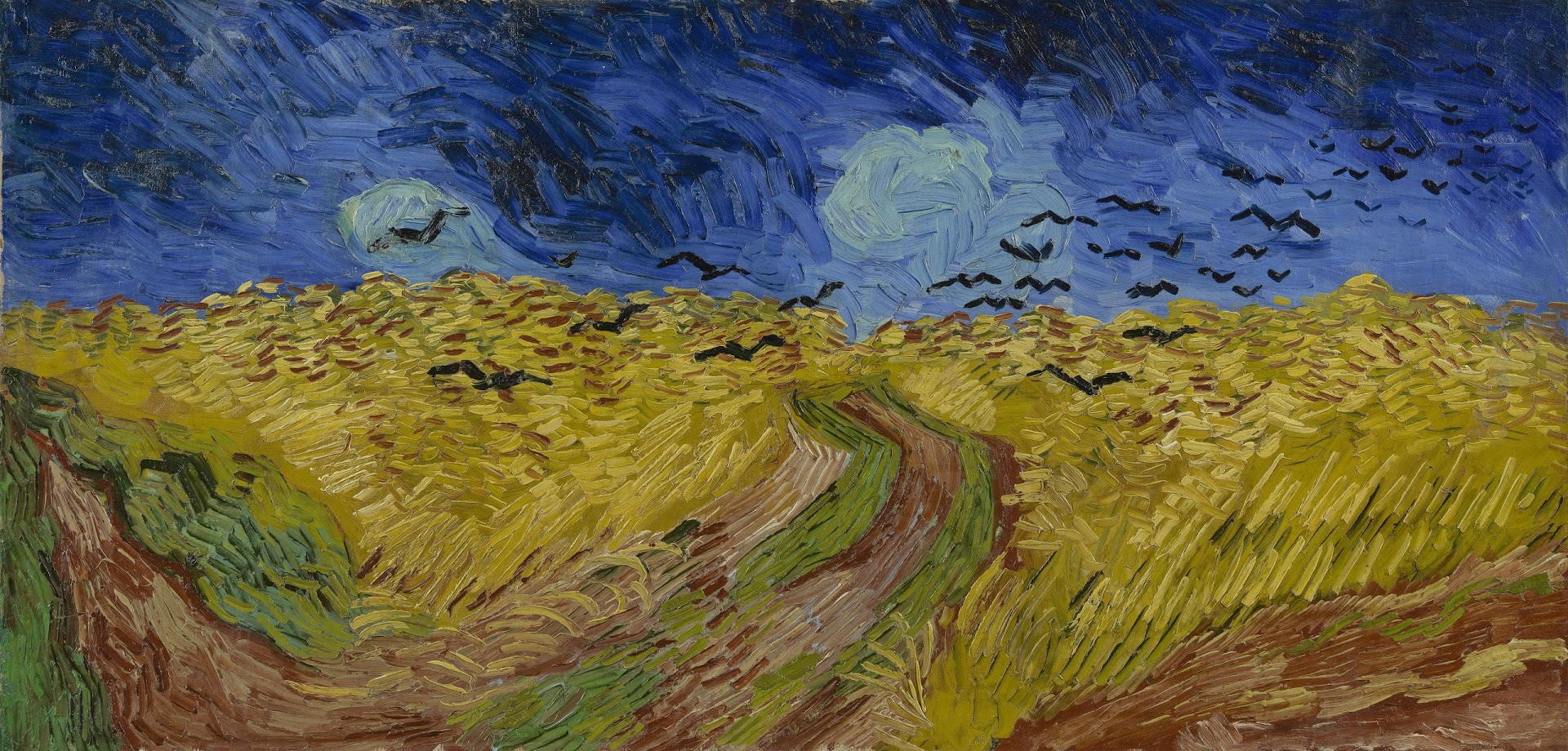
Every artist explores dimensions of space and place, orienting themselves and their works in the world, and orienting their audiences. Then there are artists like Vincent van Gogh, who make space and place a primary subject. In his early paintings of peasant homes and fields, his figures’ muscular shoulders and hands interact with sturdy walls and gnarled trees. Later country scenes—whether curling and delicate, like Wheatfield with a Reaper, or heavy and ominous, like Wheatfield with Crows (both below)—give us the sense of the landscape as a single living entity, pulsating, writhing, blazing in brilliant yellows, reds, greens, and blues.

Van Gogh painted interior scenes, such as his famous The Bedroom, at the top (the first of three versions), with an eye toward using color as the means of making space purposeful: “It’s just simply my bedroom,” he wrote to Paul Gauguin of the 1888 painting, “only here color is to do everything… to be suggestive here of rest or of sleep in general. In a word, looking at the picture ought to rest the brain, or rather the imagination.”
So taken was the painter with the concept of using color to induce “rest or sleep” in his viewers’ imaginations that when water damage threatened the “stability” of the first painting, Chicago’s Art Institute notes, “he became determined to preserve the composition by painting a second version while at an asylum in Saint-Rémy in 1889,” then demonstrated the deep emotional resonance this scene had for him by painting a third, smaller version for his mother and sister.

The opportunity to see all of Van Gogh’s bedroom paintings in one place may have passed us by for now—an exhibit in Chicago brought them together in 2016. But we can see the original bedroom at the yellow house in Arles in a virtual space, along with 1,500 more Van Gogh paintings and drawings, at the Van Gogh Museum in Amsterdam’s site. The digitized collection showcases a vast amount of Van Gogh’s work—including not only landscapes, but also his many portraits, self-portraits, drawings, city scenes, and still-lifes.
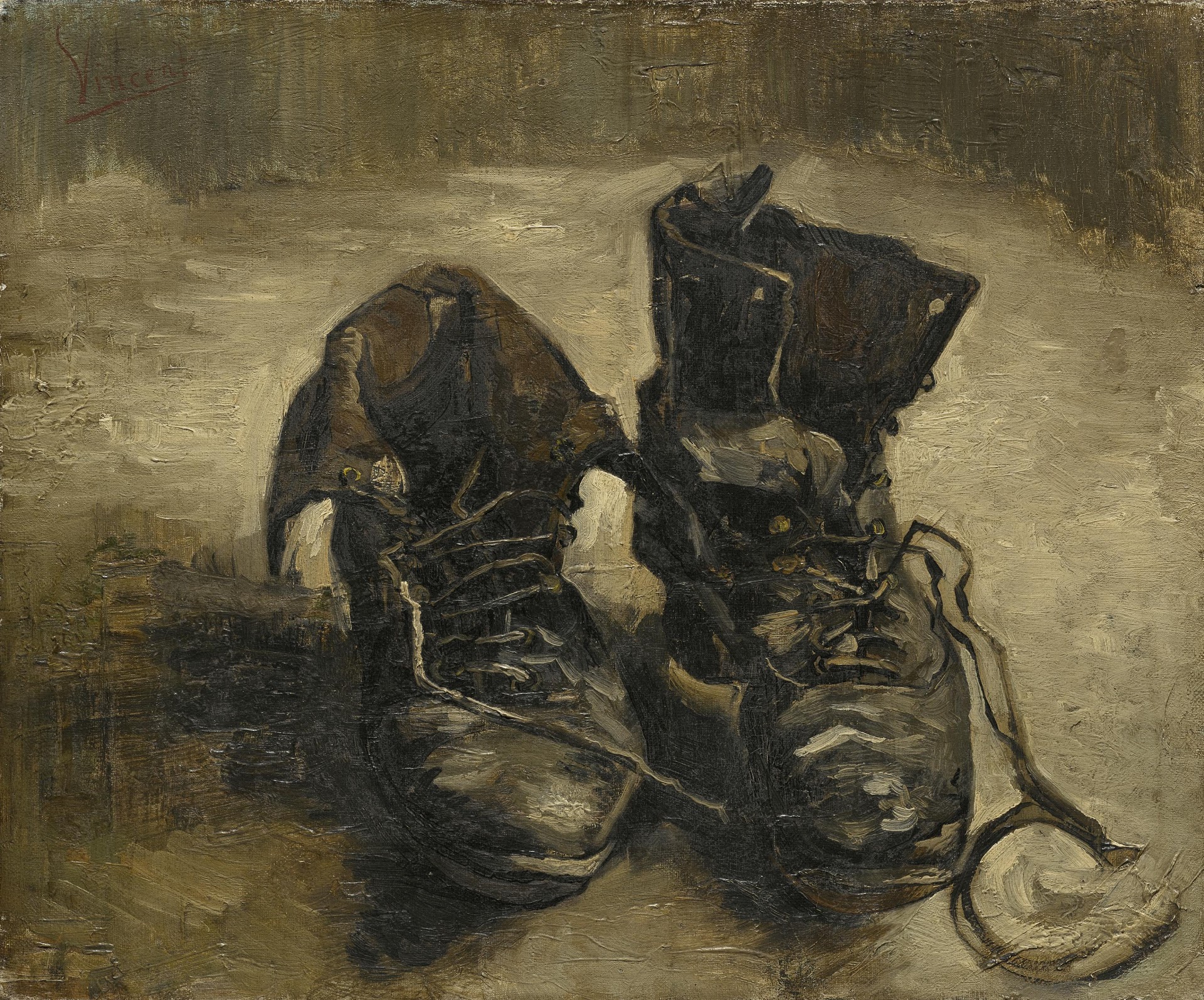
One way to approach these works is through the unifying themes above: how does van Gogh use color to communicate space and place, and to what effect? Even in portraits and still-lifes, his figures compete with the ground. The scored and scalloped paintings of walls, floors, and wallpaper force our attention past the staring eyes of the painter or the finely-rendered fruits and shoes, and into the depths and textures of shadow and light. We begin to see people and objects as inseparable from their surroundings.
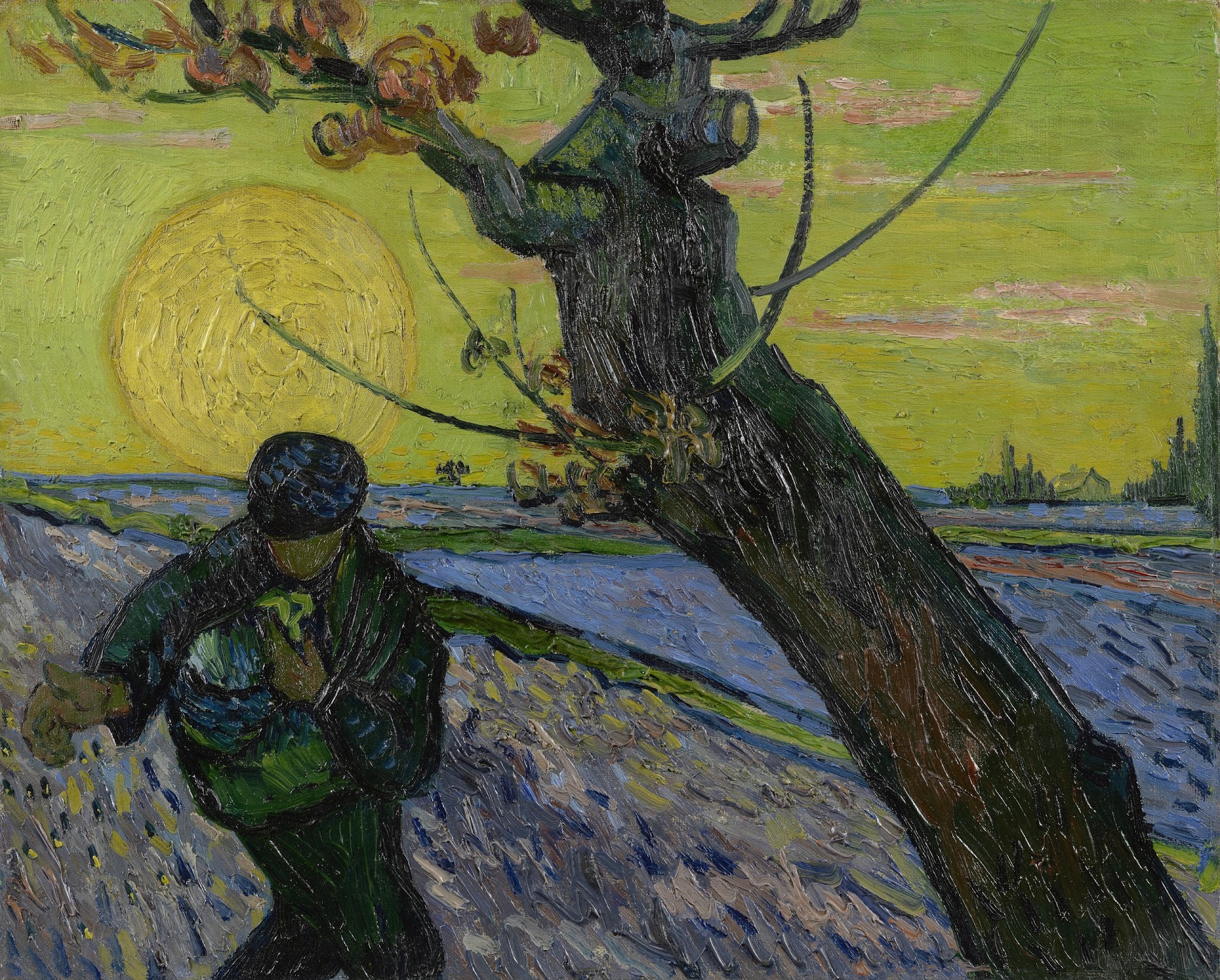
“Painting is a faith,” Van Gogh once wrote, and it is as if his paintings ask us to contemplate the spiritual unity of all things; the same animating flame brings every object in his blazing worlds to life. The Van Gogh Museum houses the largest collection of the artist’s work in the world. On their website you can read essays about his life and work, plan a visit, or shop at the online store. But most importantly, you can experience the stunning breadth of his art through your screen—no replacement for the physical spaces of galleries, but a worthy means nonetheless of communing with Van Gogh’s vision.

Note: An earlier version of this post appeared on our site in 2018.
Related Content:
Experience the Van Gogh Museum in 4K Resolution: A Video Tour in Seven Parts
Vincent Van Gogh’s Self Portraits: Explore & Download a Collection of 17 Paintings Free Online
Vincent Van Gogh’s “The Starry Night”: Why It’s a Great Painting in 15 Minutes
Josh Jones is a writer and musician based in Durham, NC. Follow him at @jdmagness
Read More...How Wes Anderson Uses Miniatures to Create His Aesthetic: A Primer from His Model Maker & Prop Painter
If you haven’t yet seen Wes Anderson’s new movie Asteroid City, I recommend doing so not just in the theater, but in a seat as close to the screen as you can handle. You’ll feel more enveloped by the desert landscapes (the Spanish desert, standing in for Arizona), but you’ll also be better placed to appreciate the detail of all the miniatures that fill it. Over his past two and a half decades of feature films, Anderson’s signature aesthetic has become ever more Andersonian. This has many aspects, one of them being an intensive use of models: real, physical models, as opposed to digital visuals created entirely by computer. In the new Vox video above, model maker and prop painter Simon Weisse, veteran also of Isle of Dogs and The French Dispatch, explains the how and the why behind it
Asteroid City opens with a train crossing a vast, parched expanse, passing alongside (or through) the occasional rock formation. Any viewer would assume the train is a miniature, though not every viewer would immediately think — as revealed in this video’s behind-the-scenes shots — that the same is true of the rocks.
In both cases, the “miniatures” are only so miniature: the relatively large scale offers a canvas for an abundance of painted detail, which as Weisse explains goes a long way to making them believable onscreen. And even if they don’t quite look “real,” per se, they conjure up a reality of their own, an increasingly central task of Anderson’s cinematic project, in a way that pure CGI — which once seemed to have displaced the art of miniatures entirely — so often fails to do.
The video quotes Anderson as saying that audiences pick up on artificiality in all its forms, whether digital or physical; the filmmaker must commit to his own artificiality, accepting its shortcomings and exploiting its strengths. “The particular brand of artificiality that I like to use is an old-fashioned one,” he adds (but needs not, given his undisputed reputation as the auteur of the retro). Christopher Nolan, a director of the same generation who has an entirely different sensibility from Anderson, also goes in for large, detailed miniatures: mostly buildings that blow up, it seems, but his choices still show an understanding of the kind of physicality that even the most advanced digital effects have never replicated. If he’s seen the alien spaceship that descends on Asteroid City (the mention of which no longer seems to count as a spoiler), he must have felt at least a touch of envy.
Related content:
Wes Anderson Movie Sets Recreated in Cute, Miniature Dioramas
An Architect Breaks Down the Design Details of Wes Anderson’s The Grand Budapest Hotel
Why Do Wes Anderson Movies Look Like That?
Blade Runner’s Miniature Props Revealed in 142 Behind-the-Scenes Photos
Based in Seoul, Colin Marshall writes and broadcasts on cities, language, and culture. His projects include the Substack newsletter Books on Cities, the book The Stateless City: a Walk through 21st-Century Los Angeles and the video series The City in Cinema. Follow him on Twitter at @colinmarshall or on Facebook.
Read More...Watch Mall City, the Original Gonzo Documentary That Captures the Height of Shopping-Mall Culture (1983)
No American who came of age in the nineteen-eighties — or in most of the seventies or nineties, for that matter — could pretend not to understand the importance of the mall. Edina, Minnesota’s Southdale Center, which defined the modern shopping mall’s enclosed, department store-anchored form, opened in 1956. Over the decades that followed, living patterns suburbanized and developers responded by plunging into a long and profitable orgy of mall-building, with the result that generations of adolescents lived in reasonably easy reach of such a commercial institution. Some came to shop and others came to work, but if Hugh Kinniburgh’s documentary Mall City is to be believed, most came just to “hang out.”
Introduced as “A SAFARI TO STUDY MALL CULTURE,” Mall City consists of interviews conducted by Kinniburgh and his NYU Film School collaborators during one day in 1983 at the Roosevelt Field Mall on Long Island. Unsurprisingly, their interviewees tend to be young, strenuously coiffed, and dressed with studied nonchalance in striped T‑shirts and Members Only-style windbreakers.
A trip to the mall could offer them a chance to expand their wardrobe, or at the very least to calibrate their fashion sense. You go to the mall, says one stylish young lady, “to see what’s in, what’s out,” and thus to develop your own style. “You look for ideas,” as the interviewer summarizes it, “and then recombine them in your own way, try to be original.”
One part of the value proposition of the mall was its shops; another, larger part was the presence of so many other members of your demographic. In explaining why they come to the mall, some teenagers dissimulate less than others: “It’s like, where the cool people are at,” says one girl, with notable forthrightness. “You’re fakin’ this all. I mean, you’re just tryin’ to meet people.” Kinniburgh and his crew chat with a group of barely adolescent-looking boys — each and every one smoking a cigarette — about what encountering girls has to do with the time they spend hanging out at the mall. One answers without hesitation: “That’s the main reason.” (Yet these labors seem often to have borne bitter fruit: as one former employee and current hanger-out puts it, “Mall relationships don’t last.”)
Opened just two months after Southdale Center, Roosevelt Field is actually one of America’s most venerable shopping malls. (It also possesses unusual architectural credibility, having been designed by none other than I. M. Pei.) By all appearances, it also managed to reconstitute certain functions of a genuine urban social space — or at least it did forty years ago, at the height of “mall culture.” Asked for his thoughts on that phenomenon, one post-hippie type describes it as “probably the wave of the future. Maybe the end of the future, the way things are going.” Here in that future, we speak of shopping malls as decrepit, even vanishing relics of a lost era, one with its own priorities, its own folkways, even its own accents. Could such a variety of pronunciations of the very word “mall” still be heard on Long Island? Clearly, further fieldwork is required.
Related content:
Punks, Goths, and Mods on TV (1983)
The Walkman Turns 40: See Every Generation of Sony’s Iconic Personal Stereo in One Minute
Based in Seoul, Colin Marshall writes and broadcasts on cities, language, and culture. His projects include the Substack newsletter Books on Cities, the book The Stateless City: a Walk through 21st-Century Los Angeles and the video series The City in Cinema. Follow him on Twitter at @colinmarshall or on Facebook.
Read More...Hear a Recently-Discovered 12,000-Year-Old Flute That Musically Mimics the Sound of Raptor Calls
Here on Open Culture, we’ve featured ancient wind instruments going back 9,000, 18,000, even 43,000 years. Just this month, archaeological research has just added a new item to this venerable lineup: a set of 12,000-year-old flutes made from the bones of birds. “The instruments are among the oldest in the world and, according to the researchers, represent the first to be found in the Levant, the region that fostered the first stages of the Neolithic Revolution approximately 12,000 years ago,” writes Discover’s Sam Walters. They’re creations of the Natufian civilization, which “bridged the difference between the foraging of the Paleolithic period and the agriculture of the Neolithic,” and which was “the first to adopt a sedentary lifestyle in the Levant.”
The bones were unearthed in Eynan-Mallaha, which is part of modern-day northern Israel’s Hula Valley. It was “during a recent examination of the artifacts,” writes Smithsonian.com’s Teresa Nowakowski, that “scientists noticed that seven had strange features — like finger holes and mouthpieces — that would have allowed them to function as musical instruments.”
You can read in detail about the discovery and study of these ancient instruments in the article published earlier this month in Scientific Reports. Nowakowski quotes its co-author Tal Simmons as saying that “the sound they produce is very similar to that of two specific birds of prey that were hunted by the people living at the site where they were discovered, namely the kestrel and the sparrowhawk.”
Only the most bird-oriented among us could easily imagine what that sounds like. But they’d surely also be interested to hear the Natufian flute itself, and how closely it, in fact, mimics those calls. The video above offers about a minute of the sound of a replica, the creation of which would have involved a considerable amount of small-detail work, given the tiny size of the bird bones from which the originals were crafted. “Though there were plenty of bigger bird bones preserved at the site, which would have been better for turning into instruments as well as for playing, the Natufians specifically selected smaller bones that produced a screechy sound similar to a bird of prey,” writes Walters. They thus created a useful hunting tool — but they also opened to their civilization a whole new dimension of music.
Related content:
Hear a 9,000 Year Old Flute — the World’s Oldest Playable Instrument — Get Played Again
Hear the Sound Of Endangered Birds Get Turned Into Electronic Music
Hear a Prehistoric Conch Shell Musical Instrument Played for the First Time in 18,000 Years
Hear the World’s Oldest Instrument, the “Neanderthal Flute,” Dating Back Over 43,000 Years
Based in Seoul, Colin Marshall writes and broadcasts on cities, language, and culture. His projects include the Substack newsletter Books on Cities, the book The Stateless City: a Walk through 21st-Century Los Angeles and the video series The City in Cinema. Follow him on Twitter at @colinmarshall or on Facebook.
Read More...How Carole King Revolutionized ’70s Music
In 1960, The Shirelles became the first Black female group to have a #1 US hit with “Will You Love Me Tomorrow?”.
The song also represented a big break for its composer, 17-year-old Carole King, and her then-husband, lyricist Gerry Goffin.
The two set up shop in New York City’s Brill Building, a pre-British Invasion hotbed of songwriting teams, cranking out pop tunes for others to record.
King and Goffin’s collaboration was a fruitful one for both themselves and the artists they sent climbing the charts:
Bobby Vee with “Take Good Care of My Baby”.
The Chiffons with “One Fine Day”.
The Monkees with “Pleasant Valley Sunday”.
“Little Eva” Boyd (the couple’s babysitter) with “The Loco-Motion”.
Aretha Franklin with “(You Make Me Feel Like) A Natural Woman”.
The late 60s ushered in both a musical and social revolution.
As King writes in her memoir, A Natural Woman, “Had I been forty-two and Gerry forty-five, I might have understood his yearning for the Bohemian lifestyle he’d never had:”
But I was a twenty-two year old wife and mother losing my twenty-five year old husband to avant-garde ideas. I wanted my life back. Unfortunately, yesterday had a no return policy, and today wasn’t where I wanted to be. I could only hope tomorrow would be better.
The couple split in 1968, and King left New York for LA, settling in Laurel Canyon, another hive of musical activity. Here, however, singers like Joni Mitchell, James Taylor, and Neil Young wrote their own songs, sharing intimate details of their lives and relationships in the name of creative expression.
King began to explore these avenues, too, though as Polyphonic’s Noah Lefevre observes in the above video essay on her seminal second album, 1971’s Tapestry, the Brill Building’s high bar for solid song craft and catchy hooks had become part of her DNA.
Her first solo recording was little heralded, but Tapestry was a smash from the get go, nabbing King Grammys for both record and song of the year, the first female solo act to be so recognized:
Tapestry changed my life. In an immediate way, it gave me financial independence, which was really wonderful. Less immediate and in an ongoing way, it opened doors.
Released as second wave feminism was cresting, Tapestry’s lyrics resonated with many women who, raised on dreams of marriage and motherhood, found themselves seeking fulfillment elsewhere, whether by choice or circumstance.
Compared to Joni Mitchell’s confessional Blue, Polyphonic’s Lefevre sees Tapestry as a work of “quiet resilience.”
It modeled the soft rock sound that became a 70s staple, and its cover art eschewed the idea of artist as glamorous being, in favor of an approachable human-scale individual.
It also afforded King the opportunity for timely reinterpretations of “Will You Still Love Me Tomorrow” and “A Natural Woman,” this time as a singer-songwriter.
Listen to Carole King’s Tapestry here.
– Ayun Halliday is the Chief Primatologist of the East Village Inky zine and author, most recently, of Creative, Not Famous: The Small Potato Manifesto and Creative, Not Famous Activity Book. Follow her @AyunHalliday.
Read More...A Kubrick Scholar Discovers an Eerie Detail in The Shining That’s Gone Unnoticed for More Than 40 Years
Stanley Kubrick’s The Shining pulls off the uncommon feat of inhabiting a genre without falling victim to its vices. But exactly which genre does it inhabit? Horror? Meta-horror? Supernatural thriller? Psychological drama? Most of the pictures made for these broad fields of cinema share a dispiriting lack of re-watchability, especially those reliant on the device of the twist ending: M. Night Shyamalan’s The Sixth Sense, for example, which now, 24 years after its release, is enjoyed primarily as an artifact of its cultural era. But over the past four decades The Shining has only become a richer viewing experience, and one that continues to yield heretofore unseen details.
In the new video above (and an associated Twitter thread), Kubrick scholar Filippo Ulivieri exposes one such detail — or rather, a whole series of them. Throughout his performance as the Overlook Hotel’s increasingly troubled caretaker Jack Torrance, Jack Nicholson keeps looking directly at the camera. “I’m not talking about when he looks at the camera because he’s talking to someone else,” says Uliveri. “I’m talking about all the times in which Jack Torrance looks at the camera, but there’s no one to look at.”
All are “very brief moments, captured by a few frames of film,” or even just one. But given how many times it happens (much more often than the one fourth-wall-breaking glance already acknowledged by Shining exegetes), as well as Kubrick’s well-known perfectionist attention to detail, all this can hardly be an accident.
Despite the existence of documentary footage that shows Kubrick explicitly telling Nicholson to look down at the camera in one shot, this choice has remained, as it were, overlooked. But what to make of it? It could mean that “we are not safe from Jack’s fury. He knows where we are; he may come for us next.” Yet he also looks at the camera well before descending into insanity. “Who is looking at Jack? Ghosts. The ghosts of the Overlook Hotel.” Perhaps “Jack felt their presence from the very beginning. So the camera in The Shining must be… well, a ghost itself.” But if the subjective camera represents the ghostly point of view, “does that mean that I am a ghost, too?” And more importantly for fans, does that mean Kubrick outdid Shyamalan nearly twenty years before The Sixth Sense came out?
Related content:
Watch Jack Nicholson Get Maniacally Into Character for The Shining’s Iconic Axe Scene
Room 237: New Documentary Explores Stanley Kubrick’s The Shining and Those It Obsesses
Go Inside the First 30 Minutes of Kubrick’s The Shining with This 360º Virtual Reality Video
Stanley Kubrick’s The Shining Reimagined as Wes Anderson and David Lynch Movies
Based in Seoul, Colin Marshall writes and broadcasts on cities, language, and culture. His projects include the Substack newsletter Books on Cities, the book The Stateless City: a Walk through 21st-Century Los Angeles and the video series The City in Cinema. Follow him on Twitter at @colinmarshall or on Facebook.
Read More...Patton Oswalt to William & Mary’s Graduating Class: “You Poor Bastards,” “You Do Not Have a Choice But to Be Anything But Extraordinary”
Patton Oswalt, William & Mary, Class of 1991, graduated with a 2.8 GPA “into a world full of trivia and silliness and fun.”
The Class of 2023, he observed in a recent keynote address at his alma mater, is poised to enter a “hellscape where you will have to fight for every scrap of your humanity and dignity.”
The comedian seasoned his speech with jokes, but its “hard truth” is one that could find favor with activist Greta Thunberg — namely that the inattention, apathy, and blithe wastefulness of his generation, and all generations that came before have saddled today’s young people with a seriously messed up planet:
Your concerns as you stumble out into reality tomorrow are massive. Democracy is crumbling. Truth is up for grabs. The planet’s trying to kill us and loneliness is driving everyone insane.
The good news?
Your generation has rebelled against every bad habit of mine and every generation that came before it. Everything that we let calcify, you have kicked against and demolished.
He sees a student body willing to battle apathy, alienation, and cruelty, who insist on inclusion and openness about mental health.
(By contrast he was a “little daffodil” who angrily took his Physics for Poets prof to task for having committed an inaccuracy involving Star Trek’s chain of command on the final exam.)
The former English major mangles a quote from author Gerald Kirsch’s 1938 short story Busto is a Ghost, Too Mean to Give Us a Fright!
The real quote is:
…there are men whom one hates until a certain moment when one sees, through a chink in their armour, the writhing of something nailed down and in torment.
The paraphrased sentiment retains its power, however, and his sloppy fact checking squares with his portrayal of himself as a lackadaisical B- student.
Returning to campus 32 years later as a successful writer, actor and comedian, he exhorts the most academic members of the Class of 2023 to take a cue from their peers whose GPAs were less than stellar, “the daydreamers, the confused, and the seekers:”
There are people out there who want to manage every moment. They want to divvy up every dream, and they want to commodify every crazy creative caprice that springs out of your cranium. Don’t let them. Be human in all of its bedlam and beauty and madness and mercy for as long as you can and in any way you can.
He may have dashed off his address in his hotel room the night before the ceremony, but he drives his point home with an ingenious Hollywood insider reference that may send the entire class of 2023, their families, professors, and you, dear reader, rushing to view (or revisit) the 1982 sci fi classic, Blade Runner.
As to why Oswalt merits the honorary degree William & Mary conferred on him, fellow alum and Ted Lasso showrunner Bill Lawrence has a theory:
I guess it’s because he didn’t really deserve the degree he got when he was here.
Related Content
John Waters’ RISD Graduation Speech: Real Wealth Is Life Without A*Holes
‘This Is Water’: Complete Audio of David Foster Wallace’s Kenyon Graduation Speech (2005)
“Wear Sunscreen”: The Story Behind the Commencement Speech That Kurt Vonnegut Never Gave
– Ayun Halliday is the Chief Primatologist of the East Village Inky zine and author, most recently, of Creative, Not Famous: The Small Potato Manifesto and Creative, Not Famous Activity Book. Follow her @AyunHalliday.
Read More...The Complete Collection Of MTV’s Headbangers Ball: Watch 1,215 Videos from the Heyday of Metal Videos
Premiering in April 1987, MTV’s Headbangers Ball featured music videos from metal and hard rock bands of the 80s and 90s–everyone from AC/DC and Mötley Crüe, to Ozzy Osbourne, Def Leppard and Twisted Sister, to Judas Priest, Iron Maiden and Van Halen. If you’re jonesing to revisit some metal classics, you’re in luck. Some enterprising soul has created a playlist of 1,215 music videos featured on Headbangers Ball. Watch them above. And all along, keep in mind, that the metalhead kids who passed their time watching these videos turned out alright in the end, largely becoming well-adjusted adults. Or so that’s what retrospective scientific studies show. Enjoy…
PS For those who want to re-experience another MTV show, visit this: All the Music Played on MTV’s 120 Minutes: A 2,500-Video Youtube Playlist
If you would like to support the mission of Open Culture, consider making a donation to our site. It’s hard to rely 100% on ads, and your contributions will help us continue providing the best free cultural and educational materials to learners everywhere. You can contribute through PayPal, Patreon, and Venmo (@openculture). Thanks!
Related Content
1980s Metalhead Kids Are Alright: Scientific Study Shows That They Became Well-Adjusted Adults
Watch the First Two Hours of MTV’s Inaugural Broadcast (August 1, 1981)
Read More...Support Us
We're hoping to rely on loyal readers, rather than erratic ads. Please click the Donate button and support Open Culture. You can use Paypal, Venmo, Patreon, even Crypto! We thank you!

About Us

Open Culture scours the web for the best educational media. We find the free courses and audio books you need, the language lessons & educational videos you want, and plenty of enlightenment in between.
Advertise With Us

FREE UPDATES!
GET OUR DAILY EMAIL
Get the best cultural and educational resources on the web curated for you in a daily email. We never spam. Unsubscribe at any time.
FOLLOW ON SOCIAL MEDIA

Open Culture editor Dan Colman scours the web for the best educational media. He finds the free courses and audio books you need, the language lessons & movies you want, and plenty of enlightenment in between.
Advertise With Us

