The Evolution of Bugs Bunny’s Appearance Over His Eight Decade Career
Bugs Bunny is a quick-thinking, fast-talking, wascally force of nature, and a preternaturally gifted physical comedian, too.
But unlike such lasting greats as Charlie Chapin and Buster Keaton, it took him a while to find his iconic look.
His first appearance, as “Happy Rabbit” in the 1938 black and white theatrical short, Porky’s Hare Hunt, might remind you of those yearbook photos of celebrities before they were famous.
In a video essay considering how Bugs Bunny’s look has evolved over his eight-decade career, animation fan Dave Lee of the popular YouTube series Dave Lee Down Under breaks down some early characteristics, from an undefined, small body and oval-shaped head to white fur and a fluffy cotton ball of a tail.
His voice was also a work in progress, more Woody Woodpecker than the hybrid Brooklyn-Bronx patois that would make him, and voice actor Mel Blanc, famous.
The following year, the rabbit who would become Bugs Bunny returned in Prest‑o Change‑o, a Merry Melodies Technicolor short directed by Chuck Jones.
A few months later character designer (and former Disney animator) Charlie Thorson subjected him to a pretty noticeable makeover for Hare-um Scare-um, another rabbit hunting-themed romp.
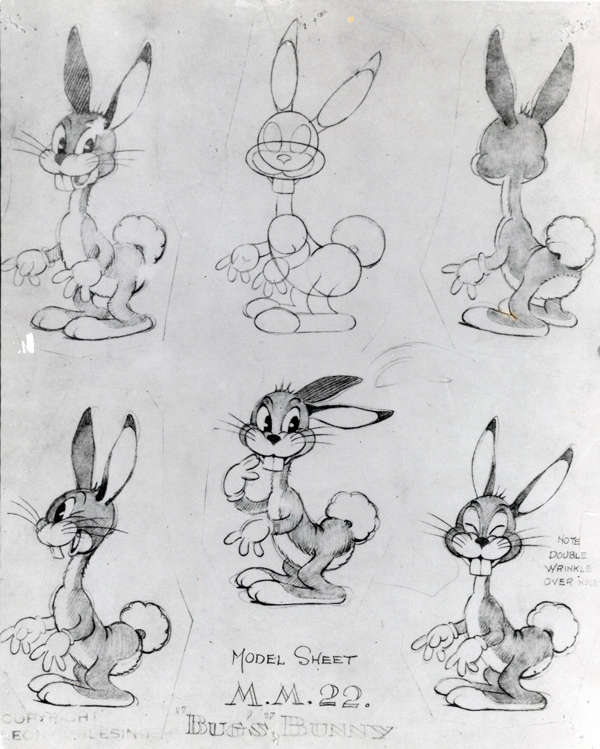
The two-toned grey and white coat, oval muzzle, and mischievous buck-toothed grin are much more aligned with the Bugs most of us grew up watching.
His pear-shaped bod’, long neck, high-rumped stance, and pontoon feet allowed for a much greater range of motion.
A notation on the model sheet alluding to director Ben Hardaway’s nickname — “Bugs” — gives some hint as to how the world’s most popular cartoon character came by his stage name.
For 1940’s Elmer’s Candid Camera, the pink-muzzled Bugs dropped the yellow gloves Thorsen had given him and affected some black ear tips.
Tex Avery, who was in line to direct the pair in the Academy Award-nominated short A Wild Hare, found this look objectionably cute.
He tasked animator Bob Givens with giving the rabbit, now officially known as Bugs Bunny, an edgier appearance.

Animation historian Michael Barrier writes:
In the Givens design, Bugs was no longer defined by Thorson’s tangle of curves. His head was now oval, rather than round. In that respect, Bugs recalled the white rabbit in Porky’s Hare Hunt, but Givens’s design preserved so many of Thorson’s refinements—whiskers, a more naturalistic nose—and introduced so many others—cheek ruffs, less prominent teeth—that there was very little similarity between the new version of Bugs and the Hare Hunt rabbit.
Barrier also details a number of similarities between the titular rabbit character from Disney’s 1935 Silly Symphonies short, The Tortoise and the Hare, and former Disney employee Givens’ design.
While Avery boasted to cartoon historian Milt Gray in 1977 that “the construction was almost identical”, adding, “It’s a wonder I wasn’t sued,” Givens insisted in an interview with the Animation Guild’s oral history project that Bugs wasn’t a Max Hare rip off. ( “I was there. I ought to know.”)
Whatever parallels may exist between Givens’ Bugs and Disney’s Hare, YouTuber Lee sees A Wild Hare as the moment when Bugs Bunny’s character coalesced as “more of a lovable prankster than a malicious deviant,” nonchalantly chomping a carrot like Clark Gable in It Happened One Night, and turning a bit of regional Texas teen slang — “What’s up, Doc?”- into one of the most immortal catch phrases in entertainment history.
A star was born, so much so that four directors — Jones, Avery, Friz Freleng and Bob Clampett — were enlisted to keep up with the demand for Bugs Bunny vehicles.
This multi-pronged approach led to some visual inconsistencies, that were eventually checked by the creation of definitive model sheets, drawn by Bob McKimson, who animated the Clampett-directed shorts.
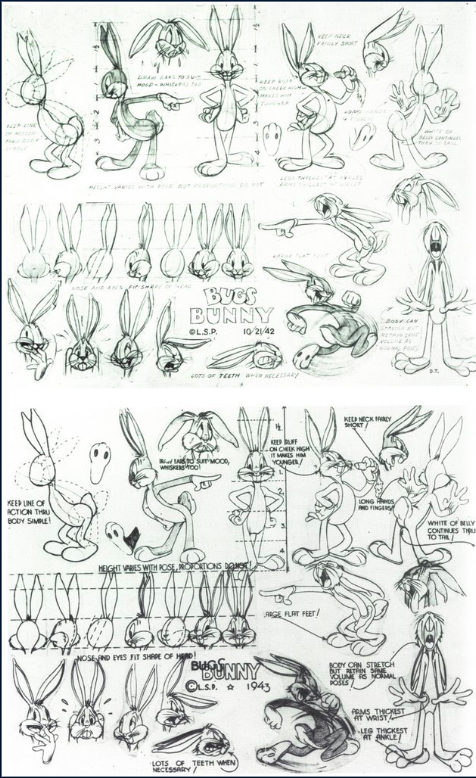
Historian Barrier takes stock:
Bugs’s cheeks were broader, his chin stronger, his teeth a little more prominent, his eyes larger and slanted a little outward instead of in. The most expressive elements of the rabbit’s face had all been strengthened …but because the triangular shape of Bugs’s head had been subtly accentuated, Bugs was, if anything, futher removed from cuteness than ever before. McKimson’s model sheet must be given some of the credit for the marked improvement in Bugs’s looks in all the directors’ cartoons starting in 1943. Not that everyone drew Bugs to match the model sheet, but the awkwardness and uncertainty of the early forties were gone; it was if everyone had suddenly figured out what Bugs really looked like.
Now one of the most recognizable stars on earth, Bugs remained unmistakably himself while spoofing Charles Dickens, Alfred Hitchcock and Wagner; held his own in live action appearances with such heavy hitters as Doris Day and Michael Jordan; and had a memorable cameo in the 1988 feature Who Framed Roger Rabbit, after producers agreed to a deal that guaranteed him the same amount of screen time as his far squarer rival, Mickey Mouse.
This millennium got off to a rockier start, owing to an over-reliance on low budget, simplified flash animation, and the truly execrable trend of shows that reimagine classic characters as cloying toddlers.
In 2011, on the strength of her 2‑minute animated short I Like Pandas, an initially reluctant 24-year-old Jessica Borutski was asked to “freshen up” Bugs’ look for The Looney Tunes Show, a series of longer format cartoons which required its cast to perform such 21st-century activities as texting:
I made their heads a bit bigger because I didn’t like [how] in the ’60s, ’70s Bugs Bunny’s head started to get really small and his body really long. He started to look like a weird guy in a bunny suit.
Lee’s Evolution of Bugs Bunny- 80 Years Explained was released in 2019.
He hasn’t stopped evolving. Gizmodo’s Sabina Graves “sat down with the creative teams shepherding Warner Bros.’ classic Looney Tunes characters into new and reimagined cartoons” at San Diego Comic-Con 2022:
In a push led by Looney Tunes Cartoons’ Alex Kirwan—who spearheads the franchise’s current slate of shorts on HBO Max—the beloved animation icons will soon expand into even more content. There’s the upcoming Tiny Toons Loooniversity revival, a Halloween special, Cartoonito’s Bugs Bunny Builders for kids, and two feature-length animated movies on the way—and we have a feeling that’s not all, folks!
…to quote Bugs, “I knew I shoulda taken that left turn at Albuquerque!”
Related Content
How to Draw Bugs Bunny: A Primer by Legendary Animator Chuck Jones
The Strange Day When Bugs Bunny Saved the Life of Mel Blanc
The Proof That Mel Blanc–the Voice Behind Bugs Bunny, Daffy Duck & Porky Pig–Was a Genius
- Ayun Halliday is the Chief Primatologist of the East Village Inky zine and author, most recently, of Creative, Not Famous: The Small Potato Manifesto. Follow her @AyunHalliday.
Read More...How Rocky Horror Became a Cult Phenomenon
Call us old fashioned but invoking pumpkin spice and The Rocky Horror Picture Show in the same breath feels transgressive to the point of sacrilege.
The creator of the Polyphonic video, above, is on much firmer footing tying the film to queer liberation.
Prior to its now famous cinematic adaptation, The Rocky Horror Show was a low budget theatrical success, with nearly 3,000 performances and the 1973 Evening Standard Theatre Award for Best Musical to its name.
Reviewer Michael Billington lauded Tim Curry’s “garishly Bowiesque performance” as Dr. Frank-N-Furter, the self-proclaimed Sweet Transvestite from Transsexual, Transylvania, but also acknowledged some drabber peacocks defying gender expectations in that production:
…for me the actor of the evening was Jonathan Adams as the Narrator: a bulky, heavy-jowled Kissinger-like figure who enters into the rock numbers with the stately aplomb of a dowager duchess doing a strip.
Playwright Richard O’Brien, who doubled as Frank-N-Furter’s sepulchral butler, Riff Raff, conceived of the show as a spoof on campy sci fi and gothic horror films in the Hammer Productions vein. He also owed a debt to glam rock, which “allowed me to be myself more.”
(Hats off, here, to Polyphonic for one of the best nutshell descriptions of glam rock we’ve ever encountered:
Glam rock was a queer led movement that was built on the back of gender non-conformity. Visually it was a hodgepodge of style from early Hollywood glamour to 50s pinups and cabaret theater augmented by touches of ancient civilizations sci-fi and and the occult.)
“The element of transvestism wasn’t intended as a major theme,” O’Brien told interviewer Patricia Morrisroe, “although it turned out to be one:”
I’ve always thought of Frank as a cross between Ivan the Terrible and Cruella de Ville of Walt Disney’s 101 Dalmations. It’s that sort of evil beauty that’s attractive. I found Brad and Janet very appealing too, especially the whole fifties image of boy-girl relationships. In the end, you see that Janet is not the weak little thing that society demands her to be and Brad is not the pillar of strength.
Audiences and critics may have loved the original show, but the film version did not find immediate favor. Reviewer Roger Ebert reflected that “it would be more fun, I suspect, if it weren’t a picture show:
It belongs on a stage, with the performers and audience joining in a collective send-up…The choreography, the compositions and even the attitudes of the cast imply a stage ambiance. And it invites the kind of laughter and audience participation that makes sense only if the performers are there on the stage, creating mutual karma.
A prophetic statement, as it turns out…
Once the producers began marketing the film as a midnight movie, repeat customers started coming up with the snarky callbacks that have become a de rigueur part of the experience.
“All the characters appear to be sophisticated, knowledgeable people but they’re really not,” O’Brien observed:
That allows people of a similar adolescent nature to feel they could be part of the whole thing. And now, in fact, they are.
Shadow casts positioned themselves in front of the screen, mimicking the action in cobbled together versions of designer Sue Blane’s costumes.
Audiences also afforded themselves the opportunity to dress outside the norm, creating a safe space where attendees could mess around with their gender expressions. The film may not end happily but that final scene is a great excuse for anyone who wants to take a lap in a corset and fishnets.
Rocky Horror’s flamboyance, humor, and defiance of the mainstream made it a natural fit with the queer community, with folks costumed as Frank-N-Furter, Riff Raff, Magenta and Columbia regularly turning up at fundraisers and pride events.
The film also deserves some activist street cred for saving a number of small indie movie theaters by fattening midnight box office receipts, a trend that continues nearly 50 years after the original release.
Admittedly, certain aspects of the script haven’t aged well.
“Virgins” attending their first live screening may be more shocked at the dearth of consent than the spectacle of Frank-n-Furter murdering Columbia’s rocker boyfriend Eddy with a pickaxe, then serving his remains for dinner.
Will they also recoil from Frank as an embodiment of toxic masculity in the queer space?
Quoth Columbia:
My God! I can’t stand any more of this! First you spurn me for Eddie, and then you throw him like an old overcoat for Rocky! You chew people up and then you spit them out again… I loved you… do you hear me? I loved you! And what did it get me? Yeah, I’ll tell you: a big nothing. You’re like a sponge. You take, take, take, and drain others of their love and emotion.
We’re hoping Frank, problematic though he may now seem, won’t ultimately be consigned to the dust bin of history.
For context, O’Brien recently told The Hollywood Reporter that the character was informed by his own experiences of cross-dressing as he tried to get a grip on his gender identity in the early 70s:
I used to beat myself up about the hand I was dealt. I don’t know how it works. I have no idea. I’ve read many tomes about the subject of the transvestic nature. It’s the cards you’re dealt. In a binary world it’s a bit of curse, really. Especially in those days when homosexuality was a crime. It’s just one of those things that western society wasn’t very keen on.
Real Content
1978 News Report on the Rocky Horror Craze Captures a Teenage Michael Stipe in Drag
– Ayun Halliday is the Chief Primatologist of the East Village Inky zine and author, most recently, of Creative, Not Famous: The Small Potato Manifesto and Creative, Not Famous Activity Book. Follow her @AyunHalliday.
Read More...Dorothea Tanning: The Artist Who Pushed the Boundaries of Surrealism
As Great Art Explained’s James Payne notes in the above profile of Surrealist Dorothea Tanning, the emotional and psychological complexity of her work invites interpretation, particularly when it comes to one of best known paintings, 1943’s Eine Kleine Nachtmusik.
Its doors, young girls (femme-enfants, if you prefer) and sunflower were recurrent themes for her.
What’s it mean?
Tanning maintained the painting is about “confrontation:”
Everyone believes he/she is his/her drama. While they don’t always have giant sunflowers (most aggressive of flowers) to contend with, there are always stairways, hallways, even very private theaters where the suffocations and the finalities are being played out, the blood red carpet or cruel yellows, the attacker, the delighted victim….
Art historian Whitney Chadwick, author of Women Artists and the Surrealist Movement, dared to compare Eine Kleine Nachtmusik to Pierre Roy’s 1927 work Danger on the Stairs, which Tanning may have encountered during her life changing visit to the Museum of Modern Art’s ground breaking 1936 exhibit Fantastic Art, Dada, Surrealism.
Both paintings unfold on narrow, windowless landings. Roy’s features a snake, that harbinger of “Freudian symbolic content”, slithering down a staircase; Tanning’s two long-haired girls in Victorian deshabille and a “torn and writhing sunflower, an image strongly identified with Tanning’s Midwestern origins, close to nature and capable of conveying impressions of both fecundity and menace.”
Tanning bridled at the temerity of Chadwick’s characterization:
To compare my vision with the perfectly proportioned and very photographic depiction of a snake (anaconda) on a stair, neatly painted, somewhat in the manner of Magritte, is simple-minded. The scene, though infrequent, is possible in the natural outside world. Mine is not.
Could it be that the sunflower is a trap set for experts unable to resist the pull of publicly interpreting a Surrealist scene?
Tanning died in 2012 at the age of 101, but Eine Kleine Nachtmusik’s sunflower continues to exert its siren pull.
Art historian, Catriona McAra, author of A Surrealist Stratigraphy of Dorothea Tanning’s Chasm sees it as a symbol of “defloration, menstruation and erotic nocturnal knowledge”, while art historian Selin Genc pegs it as “the unknown the child senses within herself: a source of concern and fascination.”
Far be it from us to hazard a guess in the public forum, though we’d be keen to get an adolescent girl’s unofficial take on it, particularly if she shares Tanning’s fascination for Alice’s Adventures in Wonderland and is as yet unacquainted with the Surrealists, female or otherwise.
Given that many young teens understand gender to be a non-binary proposition, our hypothetical interviewee might appreciate Tanning’s staunch rejection of the label ‘woman artist’, insisting that “there is no such thing or person” and it is “just as much a contradiction in terms as ‘man artist’ or ‘elephant artist’.”
21st-century artists of all ages, genders and genres could benefit from her advice to “keep your eye on your inner world and keep away from ads, idiots and movie stars.”
That, friends, is how you make Eine Kleine Nachtmusik.
In a 2001 article in ARTnews titled The Oldest Living Surrealist Tells (Almost) All, Tanning, then 91 and “still alive in every way” spelled it out:
(Art) should make us feel good about life, or at least make us think about the big questions, the things that people don’t want to ask themselves anymore.”
Here’s some more of Dorothea Tanning’s work to get you started on those questions.
Related Content
The Fantastic Women Of Surrealism: An Introduction
An Introduction to Surrealism: The Big Aesthetic Ideas Presented in Three Videos
Discover Leonora Carrington, Britain’s Lost Surrealist Painter
– Ayun Halliday is the Chief Primatologist of the East Village Inky zine and author, most recently, of Creative, Not Famous: The Small Potato Manifesto and Creative, Not Famous Activity Book. Follow her @AyunHalliday.
Read More...The Beatles Release Their Final Song, “Now and Then”: Hear the Song & Watch the Music Video Directed by Peter Jackson
The average music fan of the nineteen-sixties would surely have found it hard to believe that the Rolling Stones would put out a new album in 2023, let alone an album including a performance by Paul McCartney. Here in the twenty-twenties, of course, we’ve long since known that the “rivalry” between the young Stones and Beatles was ginned up by music media. Still, not to be outdone more than half a century after their breakup, the latter have put out the newly completed “Now and Then,” the last song featuring all the Fab Four that will ever be released.
“Now and Then,” or at least its title, will ring a bell in the minds of serious Beatles enthusiasts. For decades, it has been known as one of several promising songs John Lennon recorded without finishing. Others include “Free as a Bird” and “Real Love,” which McCartney, George Harrison, and Ringo Starr built upon in the studio and released in the mid-nineties to accompany the documentary The Beatles Anthology. At that time, Lennon’s home demo of “Now and Then” proved trickier to work with: “the piano was a little hard to hear,” says McCartney in its short making-of film, “and in those days, of course, we didn’t have the technology to do the separation” of one instrument or voice from the others.
Enter Peter Jackson, a Beatlemaniac possessed of uncommon resources and technological know-how. It turns out that the artificial intelligence-based system developed to separate out the audio tracks for the Get Back documentary project, which he directed, could also be used to salvage the muddy “Now and Then.” At last, McCartney says, “we could mix it and make a proper record of it,” a task that also included his laying down a new bass part and Starr doing the same for the drums. Each element led to another: “I’d been vaguely thinking, ‘Strings might be a good thing.’ The Beatles did lots of strings, you know?” This was a job for none other than Giles Martin, son of George. (See the making-of video below.)
As luck would have it, Harrison, who died in 2001, also recorded a guitar part back in 1995, which inspired McCartney to add a slide guitar solo in the same style. The New York Times Jon Pareles also notes “backing vocals from ‘Here, There and Everywhere,’ ‘Eleanor Rigby’ and ‘Because’: ‘oohs’ and ‘ahs’ in harmony.” The result is a genuine Beatles song as well as a genuine Beatles recording, not just in personnel but also in spirit. No sooner did the band get famous, remember, than they began incorporating into their work every advanced studio device and technique at their command. If high technology was a vital factor in their music then, it’s even more of one now.
Note: The official music video above was directed by Peter Jackson.
Related content:
The Making of the Last Beatles Song, “Now and Then”: A Short Film
Watch Paul McCartney Compose The Beatles Classic “Get Back” Out of Thin Air (1969)
A Sneak Peek of Peter Jackson’s New Beatles Documentary Get Back: Watch the New Trailer
Based in Seoul, Colin Marshall writes and broadcasts on cities, language, and culture. His projects include the Substack newsletter Books on Cities, the book The Stateless City: a Walk through 21st-Century Los Angeles and the video series The City in Cinema. Follow him on Twitter at @colinmarshall or on Facebook.
Read More...Jerry Garcia Explains How Abbott and Costello Meet Frankenstein Changed His Life (1995)
If you’re looking for a classic monster movie to watch this Halloween, and one that will also give you a few non-ironic laughs along the way, you’d do well to put on Abbott and Costello Meet Frankenstein. But don’t take this recommendation from me: take it from the Grateful Dead’s own Jerry Garcia, who recalls his own formative viewing experience in the clip above from a 1995 broadcast of AMC’s The Movie that Changed My Life. When Abbott and Costello Meet Frankenstein came out, in 1948, he was just six years old: too tender an age, it seems, to appreciate the monstrous spectacle to which his mother had taken him. “I mostly hid behind the seats,” he remembers. “It was just pure panic.”
Unaware even of who Abbott and Costello were, the young Garcia could hardly have perceived the outwardly horrific picture’s lighthearted comic intentions. Yet it compelled him nevertheless, and even resonated with him on other emotional levels not having to do with fear.
“My father had died the previous year, in ’47, so that also made it kind of a heavy time in my life, emotionally,” he says, and one that perhaps gave him a certain receptiveness to the notion of “a dead thing brought to life.” Abbott and Costello Meet Frankenstein features not just the titular doctor’s monster, played by Glenn Strange, but also Lon Chaney Jr. as the Wolf Man and Bela Lugosi as Dracula. “This was a juicy cast, and it was the last time these characters had dignity.”
For Garcia, these Hollywood monsters “became figures of tremendous fascination,” which led him to discover cultural movements like German expressionist theater and film. While they cast a spell of primal fear — “I think there was some desire on my part to embrace that, to not let that control me” — Abbott and Costello, for their part, suggested to him the great promise of comedy: “It’s a smart strategy to get by in life. If you’re not powerful, if you’re not huge, if you’re not muscular, if intimidation is too much work for you, it works good at disarming powerful adversaries.” Garcia’s “general fascination with the bizarre” also originated with Abbott and Costello Meet Frankenstein, which showed him that “there are things in this world that are really weird” — a fact of which we could all stand to remind ourselves each and every Halloween.
Related content:
Bela Lugosi Discusses His Drug Habit as He Leaves the Hospital in 1955
Stream a Massive Archive of Grateful Dead Concerts from 1965–1995
Based in Seoul, Colin Marshall writes and broadcasts on cities, language, and culture. His projects include the Substack newsletter Books on Cities, the book The Stateless City: a Walk through 21st-Century Los Angeles and the video series The City in Cinema. Follow him on Twitter at @colinmarshall or on Facebook.
Read More...How the CIA Secretly Used Jackson Pollock & Other Abstract Expressionists to Fight the Cold War
What’s the difference between the United States of America and a cup of yogurt? If you leave the cup of yogurt alone for 200 years, it develops a culture. So goes one of many jokes long in circulation about the supposed American tendency toward low-minded, expedient philistinism. I grant, as an American myself, that such humor surrounds at least a grain of truth. But there was a time when the federal government of the U.S., an organization not often accused of excessive high-mindedness, took an active role in promoting the country’s home-grown avant-garde — an appropriate term, notes Lucie Levine at JSTOR Daily, since it “began as a French military term to describe vanguard troops advancing into battle,” and American modern art had become a continuation of politics by other means.
“Up until World War II, America had never produced large, influential art movements like in Europe,” says the narrator of the Conspiracy of Art video above. After the war, “something unexpected happened: a brood of radical American painters helped make New York City the center of the art world.”
Mark Rothko, Willem de Kooning, and Jackson Pollock: they and other artists “captured the world’s attention with large-scale works of pure color and form.” This movement came to be known as abstract expressionism, and in the eyes of the newly established Central Intelligence Agency, it came to show promise as propaganda. If shown abroad, it could function as propaganda, highlighting “the differences between American and Soviet politics” — and more specifically, “the appeal of American culture over Soviet Culture.”
“Was Jackson Pollock a weapon in the Cold War?” asks the New Yorker’s Louis Menand. While Pollock was indeed promoted abroad with CIA money (usually provided through layers of organizational misdirection), you don’t look at a painting like Lavender Mist and “think about ‘artistic free enterprise’ or the CIA, or the cultural politics of Partisan Review. You think about how a painter could have taken all he had experienced across a creative threshold that no one had crossed before, and produced this particular thing.” But its “importance for a certain strand of Cold War cultural politics is part of the story of how it got to us, a generation or more later, and that history is worth knowing.” It’s also worth asking, should the United States once again find itself face-to-face with a formidable political and cultural adversary, whether it will be prepared to draft a few Pollocks back into service.
Related content:
How the CIA Secretly Funded Abstract Expressionism During the Cold War
Watch Portrait of an Artist: Jackson Pollock, the 1987 Documentary Narrated by Melvyn Bragg
How the CIA Helped Shape the Creative Writing Scene in America
Based in Seoul, Colin Marshall writes and broadcasts on cities, language, and culture. His projects include the Substack newsletter Books on Cities, the book The Stateless City: a Walk through 21st-Century Los Angeles and the video series The City in Cinema. Follow him on Twitter at @colinmarshall or on Facebook.
Read More...Researchers Use AI to Decode the First Word on an Ancient Scroll Burned by Vesuvius

In the year 79, AD Mount Vesuvius erupted, burying both Pompeii and Herculaneum. In 1750, an Italian farmworker discovered an entombed seaside villa in Herculaneum while digging a well. When excavated, the residence yielded hundreds of scrolls, all of them turned into what looked and felt like lumps of ash, and practically all of them unrollable, let alone readable. Only in 2015 did humankind — or more specifically, University of Kentucky computer scientist Brent Seales and his team — develop the technology that could let us see what texts these ancient scrolls contain. Eventually, a particle accelerator and machine learning came into play. This timeline comes from the web site of the Vesuvius Challenge, “a machine learning and computer vision competition to read the Herculaneum Papyri.”
Funded by technology entrepreneurs Nat Friedman and Daniel Gross, the Vesuvius Challenge has given out $260,000 of its $1 million of prizes so far, including $40,000 to undergraduate student/engineer Luke Farritor, who identified ten letters in a section of one scroll, and $10,000 to biorobotics graduate student Youssef Nader, who subsequently and independently discovered those same letters.
The word they form? Porphyras, ancient Greek for “purple”: a color, incidentally, that signified wealth and power in the ancient world, not least because of the enormous amount of labor required to extract it from nature. That the Herculaneum Papyri have started to become readable also represents the culmination of a similarly impressive effort, albeit one based on technological development rather than the extraction of sea-snail glands.
As Nicholas Wade writes in the New York Times, the current method “uses computer tomography, the same technique as in CT scans” — executed with the aforementioned particle accelerator — “plus advancements in artificial intelligence” used “to help distinguish ink from papyrus.” You can learn more about the Vesuvius Challenge in the video above. Its creator Garrett Ryan, of ancient-history Youtube channel Told in Stone, has been previously featured here on Open Culture for his explanation of how 99 percent of ancient texts were lost — which means these charred scrolls could hold a great deal of knowledge about the ancient world. Do they contain, as Ryan fantasizes, the lost books of Livy, the dialogues of Aristotle, poems by Sappho? We’ll only know when someone figures out how best to use technology to decode them all. Artificial intelligence may be the key to the future, as we’ve often heard in recent years, but in this particular case, it offers a promising key to the past.
Related content:
Pompeii Rebuilt: A Tour of the Ancient City Before It Was Entombed by Mount Vesuvius
How 99% of Ancient Literature Was Lost
A Newly-Discovered Fresco in Pompeii Reveals a Precursor to Pizza
Based in Seoul, Colin Marshall writes and broadcasts on cities, language, and culture. His projects include the Substack newsletter Books on Cities, the book The Stateless City: a Walk through 21st-Century Los Angeles and the video series The City in Cinema. Follow him on Twitter at @colinmarshall or on Facebook.
Read More...An Introduction to René Magritte, and How the Belgian Artist Used an Ordinary Style to Create Extraordinarily Surreal Paintings
With his dark suit, neat haircut, and bowler hat, René Magritte embodied early-twentieth-century Belgian normality. Yet the feelings his work stirred in their viewers were very much the opposite of normal. He had various ways of accomplishing this. One was “to combine two familiar objects and make a new one,” says gallerist-Youtuber James Payne in the new Great Art Explained video above. “Another method was to paint a solid object as if it were a see-through portal. In some paintings he would defy gravity and show heavy objects floating. He would give an unfamiliar name to familiar objects. He would change scale by making small objects huge and large objects impossibly tiny.”
One of Magritte’s particularly effective methods was “to obscure or to hide a face or an object, setting up a conflict between the visible that is hidden and the visible that is present.” The power of this technique is vividly showcased by The Lovers II, from 1928, in which Magritte takes the “cinematic cliché” of the kiss and “disrupts our voyeuristic pleasure by covering the faces in cloth. A moment of collection becomes one of isolation, of sexual frustration. An intimate moment becomes something dark and effortlessly disturbing, something hidden and anonymous.”
Might this have something to do with the death of his mother, who threw herself in a river when he was young? “When her body was eventually found, a nightdress had been dragged up over her naked body and was covering her face.”
The artist himself wouldn’t have thought so. “Psychology didn’t interest Magritte, who avoided any in-depth interpretation of his work,” Payne says, and yet his work “offers so much opportunity for armchair analysis.” Employing an “extreme contrast between the drabness of his style and the extraordinary subject matter,” he demonstrated his understanding that people want to see what’s hidden, that removing what they expect “creates a tension and an anxiety,” and that “if the style of the image doesn’t attract attention, the irrationality of the image becomes even more shocking.” Given Magritte’s current stature, it may come as a surprise to hear that his painting didn’t earn him much in his lifetime. But given his evident ability to manipulate viewers’ thoughts and feelings through visual means alone, it won’t come as a surprise to hear that he made his money running an advertising agency.
Related content:
René Magritte’s Early Art Deco Posters (1924–1927)
The Home Movies of Two Surrealists: Look Inside the Lives of Man Ray & René Magritte
An Introduction to Surrealism: The Big Aesthetic Ideas Presented in Three Videos
Based in Seoul, Colin Marshall writes and broadcasts on cities, language, and culture. His projects include the Substack newsletter Books on Cities, the book The Stateless City: a Walk through 21st-Century Los Angeles and the video series The City in Cinema. Follow him on Twitter at @colinmarshall or on Facebook.
Read More...The Fantastic Women Of Surrealism: An Introduction
When André Breton, a leader of the Surrealist movement and author of its first manifesto, wrote that “the problem of woman is the most marvelous and disturbing problem in all the world,” he was not alluding to the unfair lack of recognition experienced by his female peers.
Marquee name Surrealists like Breton, Salvador Dalí, Man Ray, René Magritte, and Max Ernst positioned the women in their circle as muses and symbols of erotic femininity, rather than artists in their own right.
As Méret Oppenheim, subject of a recent retrospective at the Museum of Modern Art, is seen remarking at the outset of Behind the Masterpiece’s introduction to “the fantastic women of Surrealism”, above, it was up to female Surrealists to free themselves of the narrowly defined role society — and their male counterparts — sought to impose on them:
A woman isn’t entitled to think, to express aggressive ideas.
The first artist Behind the Masterpiece profiles needs no introduction. Frida Kahlo is surely one of the best known female artists in the world, a woman who played by her own rules, turning to poetic, often brutal imagery as she delved into her own physical and mental suffering:
I paint self-portraits, because I paint my own reality. I paint what I need to. Painting completed my life. I lost three children and painting substituted for all of this… I am not sick, I am broken. But I am happy to be alive as long as I can paint.
The National Museum of Women in the Arts notes that Remedios Varo — the subject of a current exhibition at the Art Institute of Chicago- and Leonora Carrington “were seen as the ‘femmes-enfants’ to the famous and much older male artists in their lives.”
Their friendship was ultimately more satisfying and far longer lasting then their romantic attachments to Surrealist luminaries Ernst and poet Benjamin Péret. Carrington paid tribute to it in her novel, The Hearing Trumpet.
The pair’s work reveals a shared interest in alchemy, astrology and the occult, approaching them from characteristically different angles, as per Stefan van Raay, author of Surreal Friends: Leonora Carrington, Remedios Varo, and Kati Horna:
Carrington’s work is about tone and color and Varo’s is about line and form.
The name of Dorothea Tanning, like that of Leonora Carrington, is often linked to Max Ernst, though she made no bones about her desire to keep her artistic identity separate from that of her husband of 30 years.
Her work evolved several times over the course of a career spanning seven decades, but her first major museum survey was a posthumous one.
University of Cambridge art history professor, Alyce Mahon, co-curator of that Tate Modern exhibit, touches on the nature of Tanning’s deceptively feminine soft sculptures:
If I asked for two words that you associate with pin cushions, you would say sewing and craft, and you would associate those with the female in the house. Tanning played with the idea of wifely skills and took a very humble object and turned it into a fetish. She crafted her first one out of velvet in 1965 and randomly placed pins in it and aligned it with a voodoo doll. She says it ‘bristles’ with images. So she takes something fabulously familiar and makes it uncanny and strange to encourage us to think differently.
Tanning rejected the label of ‘woman artist’, viewing it as “just as much a contradiction in terms as ‘man artist’ or ‘elephant artist’.”
Put that in your pipe and smoke it, Sigmund Freud!
The famed psychoanalyst’s concept of the subconscious mind was central to Surrealism, but he also wrote that “women oppose change, receive passively, and add nothing of their own.”
One wonders what he would have made of Object, the fur lined teacup, saucer and spoon that is Oppenheim’s best known work, for better or worse.
In an essay for Khan Academy’s AP/College Art History course Josh Rose describes how Museum of Modern Art patrons declared it the “quintessential” Surrealist object when it was featured in the influential 1936–37 exhibition “Fantastic Art, Dada, and Surrealism:”
But for Oppenheim, the prestige and focus on this one object proved too much, and she spent more than a decade out of the artistic limelight, destroying much of the work she produced during that period. It was only later when she re-emerged, and began publicly showing new paintings and objects with renewed vigor and confidence, that she began reclaiming some of the intent of her work. When she was given an award for her work by the City of Basel, she touched upon this in her acceptance speech, (saying,) “I think it is the duty of a woman to lead a life that expresses her disbelief in the validity of the taboos that have been imposed upon her kind for thousands of years. Nobody will give you freedom; you have to take it.”
Related Content
Discover Leonora Carrington, Britain’s Lost Surrealist Painter
A Brief Animated Introduction to the Life and Work of Frida Kahlo
The Forgotten Women of Surrealism: A Magical, Short Animated Film
– Ayun Halliday is the Chief Primatologist of the East Village Inky zine and author, most recently, of Creative, Not Famous: The Small Potato Manifesto and Creative, Not Famous Activity Book. Follow her @AyunHalliday.
How to Read Five Books Per Month & Become a Serious Reader: Tips from Deep Work Author Cal Newport
If those who have read Cal Newport’s Deep Work: Rules for Focused Success in a Distracted World — and even more so, those who’ve been meaning to read it — share any one desire, it’s surely the desire to read more books. And for those who have reading habits similar to Newport’s, it wouldn’t actually have been a Herculean task to read more than 400 books over the past seven years since Deep Work’s publication in 2016. Formidable though that total number may sound, it would only require reading about five books per month, and in the video above, a clip from his podcast Deep Questions, Newport explains his strategies for doing just that.
First, Newport recommends choosing “more interesting books”: that is to say, follow your own interests instead of asking, “What book is going to impress other people if they heard I read it?” Read a wide variety of books, changing up the genre, subject, and even format — paper versus audio, for example — every time. (For my part, I’d also recommend reading across several languages, matching the ambitions of your selected books to your skill level in each one.)
Then, schedule regular reading sessions: “Very few people tackle physical exercise with the mindset of, ‘If I have time and I’m in the mood, I’ll do it.’ As we know from long experience, that means you will do exactly zero hours of exercise. The same is true for reading.”
This hardly means you just have to grit your teeth and read. You can “put rituals around reading that make it more enjoyable”: Newport spends his Friday nights in his study with a book and a glass of bourbon, and in the summertime reads on his outdoor couch with a cup of coffee. Also satisfying is making the “closing push,” the final binge when “you’re at that last hundred pages, you have some momentum, you’ve been working on this book for a while, you can see the finish line.” But none of these strategies can have much of an effect if you don’t “take everything interesting off your phone.” Unlike most millennials, Newport has never participated in social media, with the positive side effect that reading books has become “my default activity when I don’t have something else to do.”
If you’d like to know more about how Newport, who’s also a father and a professor of computer science, fits reading into his life, have a look at his discussion of how to become a serious reader. This involves building a “training regime,” beginning with short spurts of whichever books you happen to find most exciting and working your way up to longer sessions with more complex reading material. He also has a video of advice for becoming a disciplined person in general, in which he employs his own specialized concepts, like identifying “deep life buckets” and, from them, drawing “keystone habits.” But as with so much in life, being disciplined in practice is a matter of identity. If you first “convince yourself that you are a disciplined person,” you’ll feel a constant, motivating need to live up to that label. In order to read more, then, declare yourself a reader: not just one who reads a lot, ideally, but one who reads well.
Related content:
Carl Sagan on the Importance of Choosing Wisely What You Read (Even If You Read a Book a Week)
Joseph Brodsky’s List of 83 Books You Should Read to Have an Intelligent Conversation
7 Tips for Reading More Books in a Year
800 Free eBooks for iPad, Kindle & Other Devices
Based in Seoul, Colin Marshall writes and broadcasts on cities, language, and culture. His projects include the Substack newsletter Books on Cities, the book The Stateless City: a Walk through 21st-Century Los Angeles and the video series The City in Cinema. Follow him on Twitter at @colinmarshall or on Facebook.
Read More...Support Us
We're hoping to rely on loyal readers, rather than erratic ads. Please click the Donate button and support Open Culture. You can use Paypal, Venmo, Patreon, even Crypto! We thank you!

About Us

Open Culture scours the web for the best educational media. We find the free courses and audio books you need, the language lessons & educational videos you want, and plenty of enlightenment in between.
Advertise With Us

FREE UPDATES!
GET OUR DAILY EMAIL
Get the best cultural and educational resources on the web curated for you in a daily email. We never spam. Unsubscribe at any time.
FOLLOW ON SOCIAL MEDIA

Open Culture editor Dan Colman scours the web for the best educational media. He finds the free courses and audio books you need, the language lessons & movies you want, and plenty of enlightenment in between.
Advertise With Us

