Is Consciousness an Illusion?? Five Experts in Science, Religion & Technology Explain
Even among non-neuroscientists, determining the origin and purpose of consciousness is widely known as “the hard problem.” Since its coinage by philosopher David Chalmers thirty years ago, that label has worked its way into a variety of contexts; about a decade ago, Tom Stoppard even used it for the title of a play. Unsurprisingly, it’s also referenced in the episode of Big Think’s Dispatches from the Well above, which presents discussions of the nature of consciousness with neuroscientist Christof Koch, Vedanta Society of New York minister Swami Sarvapriyananda, technology entrepreneur Reid Hoffman, Santa Fe Institute Davis Professor of Complexity Melanie Mitchell, and mathematical physicist Roger Penrose.
Koch describes consciousness as “what you see, it’s what you hear, it’s the pains you have, the love you have, the fear, the passion.” It is, in other words, “the experience of anything,” and for all their sophistication, our modern inquiries into it descend from René Descartes’ proposition, “Cogito, ergo sum.” Sarvapriyananda, too, makes reference to Descartes in explaining his own conception of consciousness as “the light of lights,” by which “everything here is lit up.”
Mitchell conceives of it as a continuum: “I’m more conscious when I’m awake,” for example, and “certain species are more conscious than other species.” And perhaps it could develop even in non-biological entities: “I don’t think that we have any machines that are conscious in any interesting sense yet,” Mitchell says, but “if we ever do, they’ll be part of that spectrum.”
The question of whether a machine can attain consciousness naturally arises in host Kmele Foster’s conversation with Hoffman, who’s made serious investments in artificial-intelligence research. As impressive as AI chatbots have lately become, few among us would be willing to deem them conscious; nevertheless, attempting to create not just intelligence but consciousness in machines may prove a fruitful way to learn about the workings of the “genuine articles” within us. Penrose’s theory holds that consciousness arises from as-yet-unpredictable quantum processes occurring in the microtubules of the brain. Perhaps, as Koch has suggested, it actually exists to one degree or another in all forms of matter. Or maybe — to quote from a song in heavy rotation on my childhood Walkman — it’s just what you make of yourself.
Related content:
The Neuronal Basis of Consciousness Course: A Free Online Course from Caltech
John Searle Makes A Forceful Case for Studying Consciousness, Where Everything Else Begins
The Simulation Theory Explained In Three Animated Videos
Based in Seoul, Colin Marshall writes and broadcasts on cities, language, and culture. His projects include the Substack newsletter Books on Cities, the book The Stateless City: a Walk through 21st-Century Los Angeles and the video series The City in Cinema. Follow him on Twitter at @colinmarshall or on Facebook.
Read More...Explore the Surface of Mars in Spectacular 4K Resolution
?si=RFbzFSzSNWzua3‑7
Could you use a mental escape? Maybe a trip to Mars will do the trick. Above, you can find high definition footage captured by NASA’s three Mars rovers–Spirit, Opportunity and Curiosity. The footage (also contributed by JPL-Caltech, MSSS, Cornell University and ASU) was stitched together by ElderFox Documentaries, creating what they call the most lifelike experience of being on Mars. Adding more context, Elder Fox notes:
The footage, captured directly by NASA’s Mars rovers — Spirit, Opportunity, Curiosity, and Perseverance — unveils the red planet’s intricate details. These rovers, acting as robotic geologists, have traversed varied terrains, from ancient lake beds to towering mountains, uncovering Mars’ complex geological history.
As viewers enjoy these images, they will notice informal place names assigned by NASA’s team, providing context to the Martian features observed. Each rover’s unique journey is highlighted, showcasing their contributions to Martian exploration.
Safe travels.
If you would like to support the mission of Open Culture, consider making a donation to our site. It’s hard to rely 100% on ads, and your contributions will help us continue providing the best free cultural and educational materials to learners everywhere. You can contribute through PayPal, Patreon, and Venmo (@openculture). Thanks!
Related Content:
Behold Colorful Geologic Maps of Mars Released by The United States Geological Survey
Carl Sagan Presents Six Lectures on Earth, Mars & Our Solar System … For Kids (1977)
Hear the Very First Sounds Ever Recorded on Mars, Courtesy of NASA
Read More...Can You Crack the Uncrackable Code in Kryptos, the CIA’s Work of Public Art?
It can be challenging to parse the meaning of many non-narrative artworks.
Sometimes the title will offer a clue, or the artist will shed some light in an interview.
Is it a comment on the cultural, socio-economic or political context in which it was created?
Or is the act of creating it the artist’s most salient point?
Are multiple interpretations possible?
Artist Jim Sanborn’s massive sculpture Kryptos may inspire various reactions in its viewers, but there’s definitely a single correct interpretation.
But 78-year-old Sanborn isn’t saying what…
He wants someone else to identify it.
Kryptos’ main mystery — more like “a riddle wrapped in a mystery inside an enigma” to quote Winston Churchill — was hand cut into an S‑shaped copper screen using jigsaws.
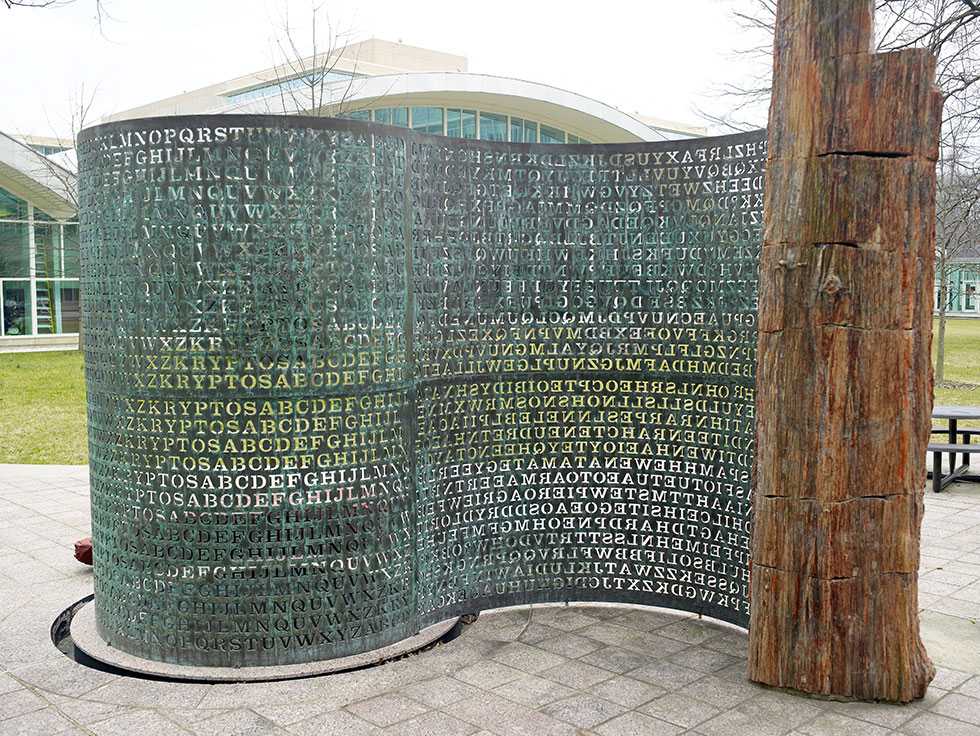
Image courtesy of the CIA
Professional cryptanalysts, hobbyists, and students have been attempting to crack the code of its 865 letters and 4 question marks since 1990, when it was installed on the grounds of CIA headquarters in Langley, Virginia.
The hands-on part fell well within Sanborn’s purview. But a Masters in sculpture from Pratt Institute does not automatically confer cryptography bonafides, so Sanborn enlisted Edward Scheidt, the retired chairman of the CIA’s Cryptographic Center, for a crash course in late 20th-century coding systems.
Sanborn sampled various coding methods for the finished piece, wanting the act of deciphering to feel like “peeling layers off an onion.”
That onion has been partially peeled for years.
Deciphering three of its four panels is a pelt shared by computer scientist and former president of the American Cryptogram Association, James Gillogly, and CIA analyst David Stein.
Gillogly arrived at his solution in 1999, using a Pentium II.
Stein reached the same conclusion a year earlier, after chipping away at it for some 400 hours with pencil and paper, though the CIA kept his achievement on the down low until Gillogly went public with his.
The following year the National Security Agency claimed that four of their employees, working collaboratively, had reached an identical solution in 1992, a fact corroborated by documents obtained through the Freedom of Information Act.
(On a related note, I got Wordle in three this morning…)
This still leaves the 97-character phrase from the final panel up for grabs. Cracking it will be the penultimate step in solving Kryptos’ puzzle. As Sanborn told NPR in 2020, “that phrase is in itself a riddle:”
It’s mysterious. It’s going to lead to something else. It’s not going to be finished when it’s decoded.
The public is welcome to continue making educated guesses.
Sanborn has leaked three clues over the years, all words that can be found in the final passage of decrypted text.
BERLIN, at positions 64 — 69 (2010)
CLOCK, at positions 70 — 74 (2014)
NORTHEAST, at position 26 — 34
Have you solved it, yet?
No?
Don’t feel bad…
Sanborn has been fielding incorrect answers daily for decades, though a rising tide of aggressive and racist messages led him to charge 50 bucks per submission, to which he responds via e‑mail, with absolutely no hope of hints.
Kryptos’ most dedicated fans, like game developer /cryptologist Elonka Dunin, seen plying Sanborn with copious quantities of sushi above in Great Big Story’s video, find value in working together and, sometimes, in person.
Their dream is that Sanborn might inadvertently let slip a valuable tidbit in their presence, though that seems like a long shot.
The artist claims to have gotten very skilled at maintaining a poker face.
(Wait, does that suggest his interlocutors have been getting warmer?)
Dunin has relinquished all fantasies of solving Kryptos solo, and now works to help someone — anyone — solve it.
(Please, Lord, don’t let it be chatGPT…)
Sanford has put a contingency plan in place in case no one ever manages to get to the bottom of the Kryptos (ancient Greek for “hidden”) conundrum.
He, or representatives of his estate, will auction off the solution. He is content with letting the winning bidder decide whether or not to share what’s been revealed to them.
“I do realize that the value of Kryptos is unknown and that perhaps this concept will bear little fruit,” he told the New York Times, though if one takes the masses of people desperate to learn the solution and factors in Sanford’s intention to donate all proceeds to climate research, it may well bear quite a healthy amount of fruit.
Join Elonka Dunin’s online community of Kryptos enthusiasts here.
To give you a taste of what you’re in for, here are the first two panels, followed by their solutions, with the artist’s intentional misspellings intact.
1.
Encrypted Text
EMUFPHZLRFAXYUSDJKZLDKRNSHGNFIVJ
YQTQUXQBQVYUVLLTREVJYQTMKYRDMFD
Decrypted Text
Between subtle shading and the absence of light lies the nuance of iqlusion.
2.
Encrypted Text
VFPJUDEEHZWETZYVGWHKKQETGFQJNCE
GGWHKK?DQMCPFQZDQMMIAGPFXHQRLG
TIMVMZJANQLVKQEDAGDVFRPJUNGEUNA
QZGZLECGYUXUEENJTBJLBQCRTBJDFHRR
YIZETKZEMVDUFKSJHKFWHKUWQLSZFTI
HHDDDUVH?DWKBFUFPWNTDFIYCUQZERE
EVLDKFEZMOQQJLTTUGSYQPFEUNLAVIDX
FLGGTEZ?FKZBSFDQVGOGIPUFXHHDRKF
FHQNTGPUAECNUVPDJMQCLQUMUNEDFQ
ELZZVRRGKFFVOEEXBDMVPNFQXEZLGRE
DNQFMPNZGLFLPMRJQYALMGNUVPDXVKP
DQUMEBEDMHDAFMJGZNUPLGEWJLLAETG
Decrypted Text
It was totally invisible Hows that possible? They used the Earths magnetic field X
The information was gathered and transmitted undergruund to an unknown location X
Does Langley know about this? They should Its buried out there somewhere X
Who knows the exact location? Only WW This was his last message X
Thirty eight degrees fifty seven minutes six point five seconds north
Seventy seven degrees eight minutes forty four seconds west ID by rows
View step by step solutions for the first three of Kryptos’ encrypted panels here.
Related Content
The Enigma Machine: How Alan Turing Helped Break the Unbreakable Nazi Code
– Ayun Halliday is the Chief Primatologist of the East Village Inky zine and author, most recently, of Creative, Not Famous: The Small Potato Manifesto and Creative, Not Famous Activity Book. Follow her @AyunHalliday.
Read More...My Neighbor Totoro Inspires a Line of Traditional Japanese Handicrafts
We suppose it’s conceivable that a gift of a wooden Totoro figurine, hand-carved from a single block using 50 different kinds of chisels, might spark a reverence for traditional Japanese craft and nature in the next generation…
Or, they may be left wishing you’d given them a vastly more huggable machine-made plushie version, especially if you can’t help sucking in your breath every time they start fumbling with that exquisitely crafted ¥330,000 yen heirloom-to-be. (That’s $2341.81 in US dollars.)
Of course, director Hayao Miyazaki’s 1988 animated feature My Neighbor Totoro has legions of fans of all ages, and some will consider themselves quite lucky if they win the lottery that grants them the ability to purchase such a treasure.



They’re not only carved by skilled artisans in Inami, the city of woodcarving, but the wood is also that of a camphor tree — the natural habitat of the mysterious, magical Totoro! (It’s also considered holy by practitioners of the Shinto religion.)
Still, if it’s unclear that the recipient will truly appreciate such thoughtfulness, you’re probably better off going with another offering from Studio Ghibli’s Totoro-themed collaboration with Nakagawa Masashichi Shoten, a purveyor of traditional Japanese crafts.

Perhaps a¥4180 bud vase fired in Ureshino City’s Edo-period Yozan Kiln, featuring Totoro or a cluster of susuwatari, the pom pom-like soot sprites infesting the Kusakabe family’s new home, who also play a part in Spirited Away.

Maybe a tiny Totoro bell amulet, molded by craftsmen in Odawara, celebrated for the quality of their metalwork since the early 1500s, when they outfitted samurai with weapons, armor and helmets?
What about a Totoro-emblazoned treasure box from Yatsuo, made of stencil-dyed handmade washi paper? There’s nothing inherently wrong with stashing your acorn collection in an old Altoid’s tin, but this vessel comes with historic pedigree:
As one of the leading towns along the trunk road, Yatuso flourished through … production of wrapping paper for the nation-wide famous “Toyama Medicine”. At its golden age, from the Edo Era to the beginning of the Meiji Era in the 19th century, many people were engaged in papermaking by handwork in their homes. Yatsuo Japanese paper was expected to be unbreakable because it was used as package for expensive medicine and at the same time it should look brilliant. It had to be thick and stout so that it could be impervious to water and the label printed on the surface would not be smeared.
The list of Totoro-inspired traditional crafts is impressive. A representative sampling:
Chusen-dyed tenugui handkerchiefs and t‑shirts…
Dishtowels made from five layers of Kayaori fabric that “was introduced to Japan during the Nara period and is said to allow wind to pass through but keep mosquitoes out”…
Tiny Arita ware acorn plates that reward members of the clean plate club with a view of the Catbus…
View the collection and learn more about February’s lottery for a chance to purchase a Camphor wood Totoro here.
Hands-on fans may prefer to cultivate an appreciation for traditional Japanese handicrafts by attempting a DIY Totoro.
Via Spoon & Tamago/Colossal
Related Content
– Ayun Halliday is the Chief Primatologist of the East Village Inky zine and author, most recently, of Creative, Not Famous: The Small Potato Manifesto and Creative, Not Famous Activity Book. Follow her @AyunHalliday.
Read More...The Story of The Pogues’ “Fairytale of New York,” the Boozy Ballad That Became a Beloved Christmas Song
Note: With the recent passing of Shane Macgowan, we’re bringing back a post from 2018 and revisiting The Pogues’ song “Fairytale of New York.” The offbeat Christmas classic is currently #5 on the Billboard Singles Chart in the UK.
Drugstore Cowboy, Barfly, Leaving Las Vegas, even Bonnie and Clyde… we love a good story about doomed, down-and-out lovers. Whatever emotional reservoir they tap into, when written well and honestly, such stories have broad cultural appeal. Which in part explains the overwhelming popularity of The Pogues’ 1987 classic “Fairytale of New York,” the kind of “anti-Christmas song,” writes Dorian Lynsky at The Guardian, “that ended up being, for a generation, the Christmas song.”
Many holiday stories cynically trade on the fact that, for a great many people, the holidays are filled with pain and loss. But “Fairytale of New York” doesn’t play this for laughs, nor does it pull the old trick of cheap last-minute redemption.
Sung as a duet by Shane MacGowan and Kirsty MacColl to the boozy tune of an Irish folk ballad, the song “is loved because it feels more emotionally ‘real’ than the homesick sentimentality of ‘White Christmas.’ ” Even if we can’t identify with the plight of a burned-out Irish dreamer spending Christmas in a New York drunk tank, we can feel the ache of broken dreams set in high relief against holiday lights.
The song’s history itself makes for a compelling tale, whether we believe the origin story in accordion player James Fearnley’s memoir Here Comes Everybody: The Story of the Pogues or that told by MacGowan, who maintains that Elvis Costello, the band’s producer, bet the singer that he couldn’t write a Christmas duet. (Fearnley writes that they were trying to top The Band’s 1977 “Christmas Must Be Tonight.”)
Either way, a Christmas song was a good idea. “For a band like the Pogues, very strongly rooted in all kinds of traditions rather than the present, it was a no-brainer,” says banjo-player and co-writer Jem Finer. Not to mention the fact that MacGowan was born on Christmas Day 1957.
Finer began the song as a tale about a sailor missing his wife on Christmas, but after the banjo player’s wife called it “corny” he took her suggestion to adapt the “true story of some mutual friends living in New York.” MacGowan took the title from J.P. Donleavy’s 1973 novel A Fairy Tale of New York, which happened to be lying around the recording studio. After a promising start, the song then went through two years of revisions and re-recordings before the band finally settled on the version millions know and love, produced by Steve Lillywhite and released on the 1988 album If I Should Fall From Grace with God.
Originally intended as a duet between MacGowan and bass player Cait O’Riordan, a version recorded with her was “not quite there,” guitarist Philip Chevron has said. Soon after, O’Riordan left the band, and MacGowan recorded the song again at Abbey Road in 1987, singing both the male and female vocal parts himself. Eventually Lillywhite took the track home to have his wife, English singer Kirsty MacColl, record a temporary guide vocal for the female parts. When MacGowan heard it, he knew he had found the right foil for the character he plays in the song.
“Kirsty knew exactly the right measure of viciousness and femininity and romance to put into it and she had a very strong character and it came across in a big way,” MacGowan later remarked in an interview. “In operas, if you have a double aria, it’s what the woman does that really matters. the man lies, the woman tells the truth.” As part of her character’s “viciousness”, she hurls the slur “f*ggot” at MacGowan, who calls her a “slut.” The offensive words have been censored on radio stations, then uncensored, and good cases have been made for bleeping them out (most recently by Irish DJ Eoghan McDermott on Twitter).
MacGowan himself has issued a statement defending the lyrics as in keeping with the characters. “Sometimes characters in songs and stories have to be evil or nasty in order to tell the story effectively,” he writes, adding, “If people don’t understand that I was trying to accurately portray the character as authentically as possible then I am absolutely fine with them bleeping the word but I don’t want to get into an argument.” Whatever position one takes on this, it’s hard to deny that MacGowan, co-writer Finer, and MacColl totally hit the mark when it comes to authenticity.
The genuine emotions “Fairytale of New York” taps into has made it the most beloved Christmas song of all time in TV, radio, and magazine polls in the UK and Ireland. It has become “far bigger than the people who made it,” writes Lynskey. Or, as Fearnley puts it, “It’s like ‘Fairytale of New York’ went off and inhabited its own planet.” An artist can’t ask for more. See making-of videos by the BBC and Polyphonic at the top. Watch the band sloppily mime the song with MacColl on Top of the Pops further up (MacGowan cannot actually play the piano). And just above, see the official video, starring Drugstore Cowboy’s Matt Dillon—filmed inside a real police station on the Lower East Side during a freezing Thanksgiving week in 1987, for maximum holiday vérité.
Related Content:
An Old-Time Radio Yuletide: Hear 20+ Hours of Vintage Christmas Radio Shows (1938–1956)
Hear Paul McCartney’s Experimental Christmas Mixtape: A Rare & Forgotten Recording from 1965
Josh Jones is a writer and musician based in Durham, NC. Follow him at @jdmagness
Read More...The Oldest Voices That We Can Still Hear: Hear Audio Recordings of Ghostly Voices from the 1800s
What history nerd doesn’t thrill to Thomas Edison speaking to us from beyond the grave in a 50th anniversary repeat of his groundbreaking 1877 spoken word recording of (those hoping for loftier stuff should dial it down now) Mary Had a Little Lamb?
The original represents the first time a recorded human voice was successfully captured and played back. We live in hope that the fragile tinfoil sheet on which it was recorded will turn up in someone’s attic someday.
Apparently Edison got it in the can on the first take. The great inventor later reminisced that he “was never so taken aback” in his life as when he first heard his own voice, issuing forth from the phonograph into which he’d so recently shouted the famous nursery rhyme:
Everybody was astonished. I was always afraid of things that worked the first time.
His achievement was a game changer, obviously, but it wasn’t the first time human speech was successfully recorded, as Kings and Things clarifies in the above video.
That honor goes to Édouard-Léon Scott de Martinville, whose phonautograph, patented in 1857, transcribed vocal sounds as wave forms etched onto lampblack-coated paper, wood, or glass.
Edison’s plans for his invention hinged on its ability to reproduce sound in ways that would be familiar and of service to the listening public. A sampling:
- A music player
- A device for creating audiobooks for blind people
- A linguistic tool
- An academic resource of archived lectures
- A record of telephone conversations
- A means of capturing precious family memories.
Léon Scott’s vision for his phonautograph reflects his preoccupation with the science of sound.
A professional typesetter, with an interest in shorthand, he conceived of the phonautograph as an artificial ear capable of reproducing every hiccup and quirk of pronunciation far more faithfully than a stenographer ever could. It was, in the words of audio historian Patrick Feaster, the “ultimate speech-to-text machine.”
As he told NPR’s Talk of the Nation, Léon Scott was driven to “get sounds down on paper where he could look at them and study them:”
…in terms of what we’re talking about here visually, anybody who’s ever used audio editing software should have a pretty good idea of what we’re talking about here, that kind of wavy line that you see on your screen that somehow corresponds to a sound file that you’re working with…He was hoping people would learn to read those squiggles and not just get the words out of them.
Although Léon Scott managed to sell a few phonautographs to scientific laboratories, the general public took little note of his invention. He was pained by the global acclaim that greeted Edison’s phonograph 21 years later, fearing that his own name would be lost to history.
His fear was not unfounded, though as Conan O’Brien, of all people, mused, “eventually, all our graves go unattended.”
But Léon Scott got a second act, as did several unidentified long-dead humans whose voices he had recorded, when Dr. Feaster and his First Sounds colleague David Giovannoni converted some phonautograms to playable digital audio files using non-contact optical-scanning technology from the Lawrence Berkeley National Laboratory.
Dr. Feaster describes the eerie experience of listening to the cleaned-up spoken word tracks after a long night of tweaking file speeds, using Léon Scott’s phonautograms of tuning forks as his guide:
I’m a sound recording historian, so hearing a voice from 100 years ago is no real surprise for me. But sitting there, I was just kind of stunned to be thinking, now I’m suddenly at last listening to a performance of vocal music made in France before the American Civil War. That was just a stunning thing, feeling like a ghost is trying to sing to me through that static.
Scanning technology also allowed historians to create playable digital files of fragile foil recordings made on Edison devices, like the St. Louis Tinfoil , made by writer and early adopter Thomas Mason in the summer of 1878, as a way of showing off his new-fangled phonograph, purchased for the whopping sum of $95.
The British Library’s Tinfoil Recording is thought to be the earliest in existence. It features an as-yet unidentified woman, who may or may not be quoting from social theorist Harriet Martineau… this garbled ghost is exceptionally difficult to pin down.
Far easier to decipher are the 1889 recordings of Prussian Field Marshall Helmuth Von Multke, who was born in 1800, the last year of the 18th century, making his the earliest-born recorded voice in audio history.
The nonagenarian recites from Hamlet and Faust, and congratulates Edison on his astonishing invention:
This phonograph makes it possible for a man who has already long rested in the grave once again to raise his voice and greet the present.
Related Content
Suzanne Vega, “The Mother of the MP3,” Records “Tom’s Diner” with the Edison Cylinder
A Beer Bottle Gets Turned Into a 19th Century Edison Cylinder and Plays Fine Music
400,000+ Sound Recordings Made Before 1923 Have Entered the Public Domain
– Ayun Halliday is the Chief Primatologist of the East Village Inky zine and author, most recently, of Creative, Not Famous: The Small Potato Manifesto and Creative, Not Famous Activity Book. Follow her @AyunHalliday.
Read More...How Central Park Was Created Entirely By Design & Not By Nature: An Architect Breaks Down America’s Greatest Urban Park
New Yorkers have a variety of sayings about how they want nothing to do with nature, just as nature wants nothing to do with them. As a counterpoint, one might adduce Central Park, whose 843 acres of trees, grass, and water have occupied the middle of Manhattan for a century and a half now. Yet that “most famous city park in the world,” as veteran New York architect Michael Wyetzner puts it in the Architectural Digest video above, is both nature and not. Though Central Park may feel as if it has existed since time immemorial, organically thriving in its space long before the towers that surround it, few large urban spaces had ever been so deliberately conceived.
In the video, Wyetzner (previously featured here on Open Culture for his explanations of New York apartments, subway stations, and bridges, as well as individual works of architecture like Penn Station and the Chrysler Building) shows us several spots in Central Park that reveal the choices that went into its design and construction.
Many were already present in landscape architects Frederick Law Olmsted and Calvert Vaux’s original plan, which they submitted to an open design competition in 1857. Of all the entries, only theirs refused to let the park be cut apart by transverse roads, opting instead to round automobile traffic underground and preserve a continuous experience of “nature” for visitors. (If only more recent urban parks could have kept its example in mind.)
Central Park would be welcome even if it were just a big of expanse of trees, grass, and water. But it also contains many distinctive built structures, such as the much-photographed mall leading to Bethesda Terrace, the “second-oldest cast-iron bridge in the United States,” the dairy that once provided fresh milk to New York’s children, and Belvedere Castle. That last is built at three-quarters scale, “which makes it appear further away than it actually is, and gives it this sort of magical fairy-tale quality,” the same trick that the builders of Disneyland would employ intensively about a century later. But the priorities of Walt Disney and his collaborators differed from the designers of Central Park, who, as Vaux once said, put “nature first, second, and third — architecture after a while.” If a mutually beneficial deal could be struck between those two phenomena anywhere, surely that place is New York City.
Related content:
The Lost Neighborhood Buried Under New York City’s Central Park
An Architect Breaks Down the Design of New York City Subway Stations, from the Oldest to Newest
An Immersive Architectural Tour of New York City’s Iconic Grand Central Terminal
Architect Breaks Down Five of the Most Iconic New York City Apartments
A Whirlwind Architectural Tour of the New York Public Library — “Hidden Details” and All
Based in Seoul, Colin Marshall writes and broadcasts on cities, language, and culture. His projects include the Substack newsletter Books on Cities, the book The Stateless City: a Walk through 21st-Century Los Angeles and the video series The City in Cinema. Follow him on Twitter at @colinmarshall or on Facebook.
Read More...Behold Ancient Egyptian, Greek & Roman Sculptures in Their Original Color
There was a time when we imagined that most ancient sculpture never had any color except for that of the stone from which it was hewed. Doubt fell upon that notion as long ago as the eighteenth century, when archaeological digging in Pompeii and Herculaneum brought up statues whose color had been preserved, but only in recent years has it come to be presented as an exploded myth. Though some of the coverage of the false “whiteness” of ancient Egyptian, Greek, and Roman sculpture has divided along drearily predictable twenty-first-century cultural battle lines, this moment has also presented an opportunity to stage fascinating, even groundbreaking exhibitions.
Take Chroma: Ancient Sculpture in Color, which ran from the summer of last year to the spring of this year at the Metropolitan Museum of Art. You can still see some of its displays in the Smarthistory video at the top of the post, in which art historians Elizabeth Macaulay and Beth Harris discuss the “world of Technicolor” that was antiquity, the Renaissance origins of the “idea that ancient sculpture was not painted,” and the modern attempts to reconstruct the sculptural color schemes almost totally lost to time.
Architect goes deeper into these subjects in the video from the Met itself just above, paying special attention to the museum’s bust of Caligula — not the finest emperor Rome ever had, to put it mildly, but one whose face has become a promising canvas for the restoration of color.
You can see much more of Chroma in the Art Trip tour video just above. Its wonders include not just genuine pieces of ancient sculpture, but strikingly colorful reconstructions of a finial in the form of a sphinx, a Pompeiian statue of the goddess Artemis, a battle-depicting side of the Alexander Sarcophagus, and “a marble archer in the costume of a horseman of the peoples to the north and east of Greece,” to name just a few. You may prefer these historically educated colorizations to the austere monochrome figures you grew up seeing in textbooks, or you may appreciate after all the kind of elegance that only centuries of ruin can bestow. Either way, your relationship to the ancient world will never be quite the same.
Related content:
The Metropolitan Museum of Art Restores the Original Colors to Ancient Statues
How Ancient Greek Statues Really Looked: Research Reveals Their Bold, Bright Colors and Patterns
Roman Statues Weren’t White; They Were Once Painted in Vivid, Bright Colors
The Making of a Marble Sculpture: See Every Stage of the Process, from the Quarry to the Studio
Why Most Ancient Civilizations Had No Word for the Color Blue
Based in Seoul, Colin Marshall writes and broadcasts on cities, language, and culture. His projects include the Substack newsletter Books on Cities, the book The Stateless City: a Walk through 21st-Century Los Angeles and the video series The City in Cinema. Follow him on Twitter at @colinmarshall or on Facebook.
Read More...Behold LEGO Reenactments of Famous Psychology Experiments, as Imagined by Artificial Intelligence

Cognitive scientist Tomer Ullman, head of Harvard’s Computation, Cognition, and Development lab, may have inadvertently blundered into an untapped vein of LEGO Icon inspiration when his interest in AI led him to stage recreations of famous psych experiments.
If you think Vincent Van Gogh’s Starry Night LEGO playset is a challenge, imagine putting together the AI-generated playset inspired by Yale psychologist Stanley Milgram’s 1961 obedience studies, above.
Participants in these studies were assigned to play one of two parts — teacher or learner. Partner pairs were seated in separate rooms, accessible to each other by microphones. The teacher read the learner a list of matched words they’d expected to remember shortly thereafter. If the learner flubbed up, the teacher was to administer an electric shock via a series of labelled switches, upping it by 15-volts for each successive error. The microphones ensured that the teacher was privy to the learner’s increasingly distressed reactions — screams, desperate protestation, and — at the highest voltage — radio silence.
Should a teacher hesitate, they’d be reminded that the parameters of the experiment, for which they were earning $4.50, required them to continue. They also received reassurance that the painful shocks caused no permanent tissue damage.
Here’s the thing:
The teachers were innocent as to the experiment’s true nature. They thought the study’s focus was punishment’s effect on learning ability, but in fact, Milgram was studying the limits of obedience to authority.
The learners were all in on the ruse. They received no shocks. Their responses were all feigned.
If our eyes don’t deceive us, the Milgram experiment that the AI imagines is even more extreme than the original. It appears all participants, including those waiting for their turn, are in the same room.
As someone commented on Bluesky, the new social media platform on which Ullman shared his hypothetical playsets, “the subtle details the AI has got wrong here are the stuff of nightmares.”

AI’s take on the Stanford prison experiment seems more benign than the controversial 1971 experiment that recruited 24 student participants for a filmed study of prison life to be staged in Stanford University’s psychology department’s basement, randomly dividing them into prisoners and guards.
AI’s faithful recreation of the LEGO figurines’ physical limitations can’t really capture the faux guards’ brutality — making their prisoners clean out toilets with their bare hands, stripping them naked, and depriving them of food and beds. Their power abuses were so wanton, and the prisoners’ distress so extreme, that the planned duration of two weeks was scrapped six days in.
It’s worth noting that all the student participants came to the study with clean bills of physical and mental health, and no histories of criminal arrest.
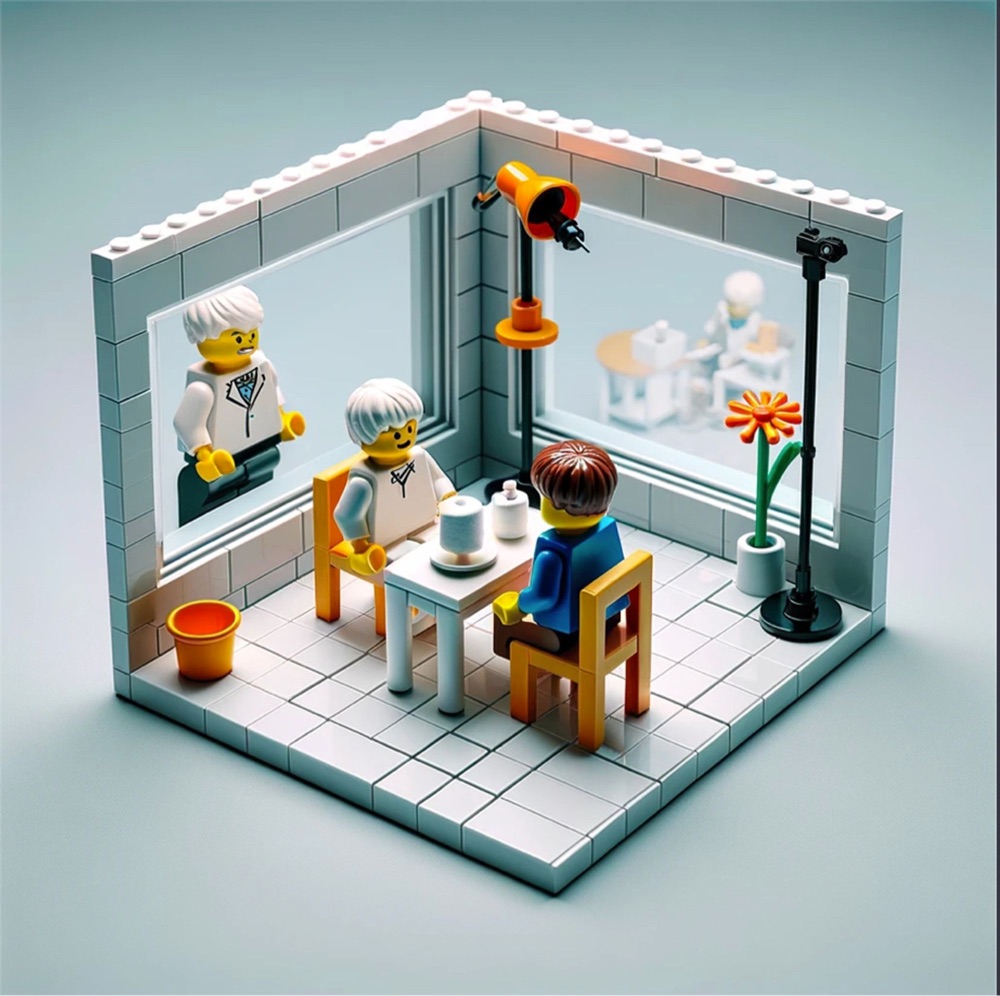

Far less upsetting are the cognitive science experiment playsets depicting the delayed gratification of the Stanford Marshmallow Test and the selective attention of the Invisible Gorilla Test (both right above).
Ullman also steered AI toward LEGO tributes to B.F. Skinner’s operant conditioning chamber and Martin Seligman’s learned helplessness research (below).

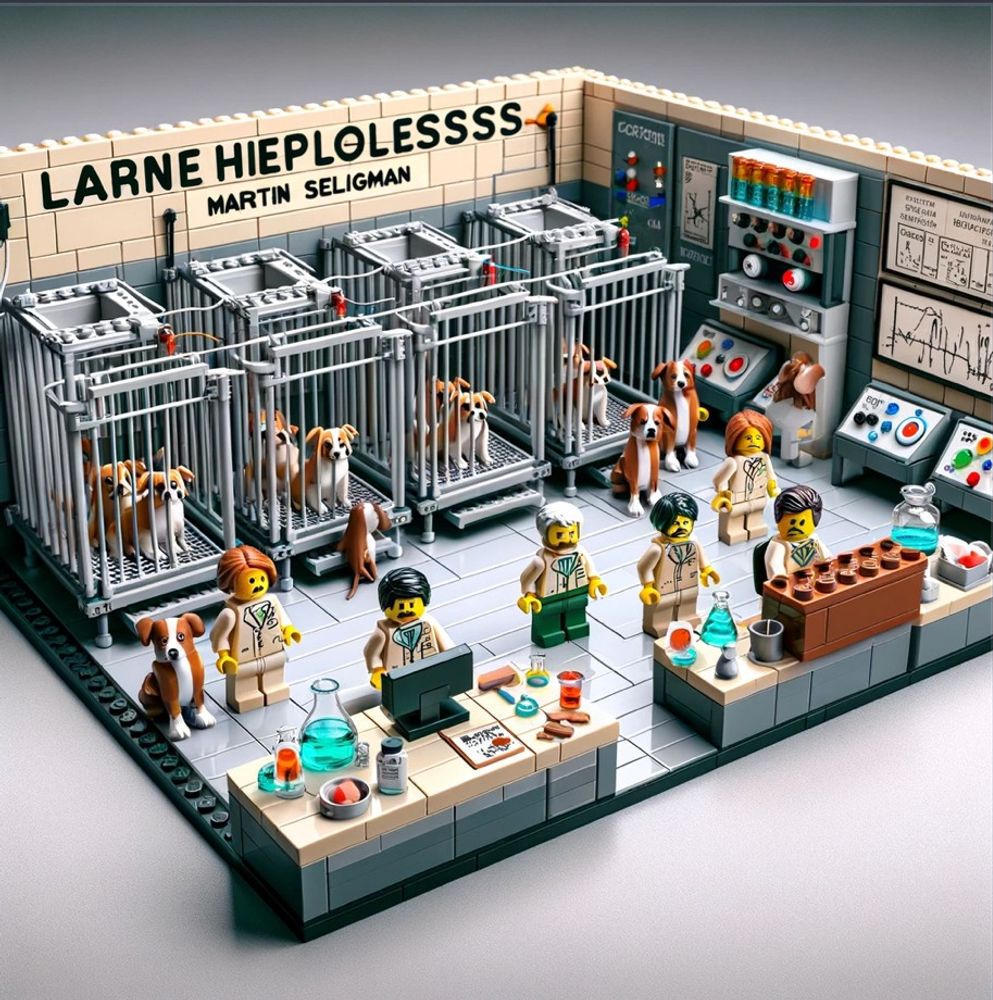
No word on whether he has plans to continue experimenting with AI-engineered LEGO playset proposals featuring historic experiments of psychology and cognitive science.
Follow on Bluesky if you’re curious. You’ll need to register for a free account and apply for an invite code, if you haven’t already… wait, are we setting ourselves up to be unwitting participants in another psych experiment?
Hmmm…
Via Kottke
Related Content
The Psychology Experiment That Shocked the World: Milgram’s Obedience Study (1961)
– Ayun Halliday is the Chief Primatologist of the East Village Inky zine and author, most recently, of Creative, Not Famous: The Small Potato Manifesto and Creative, Not Famous Activity Book. Follow her @AyunHalliday.
Read More...What Is Postmodern Architecture?: An Introduction in Three Videos
“Modern architecture died in St Louis, Missouri on July 15, 1972, at 3:32pm (or thereabouts).” This oft-quoted pronouncement by cultural and architectural theorist Charles Jencks refers to the demolition of the Wendell O. Pruitt Homes and William Igoe Apartments. The fate of that short-lived public housing complex, better and more infamously known as Pruitt-Igoe, still holds rhetorical value in America in arguments against the supposed social-engineering ambitions made concrete (often literally) in large-scale postwar modernist buildings. Though the true story is more complicated, the fact remains that, whenever we pinpoint it, modern architecture was widely regarded as “dead.” What would come after it?
Why, postmodernism, of course. Jencks did more than his part to define modernism’s anything-goes successor movement with The Language of Post-Modern Architecture, in which he tells the tale of Pruitt-Igoe, which was then relatively recent history.
The first edition came out in 1977, early days indeed in the life of postmodernism, which in a video from Historic England architectural historian Elain Harwood calls “the style of the nineteen-eighties.” Its riots of deliberately incongruous shape and color, as well as its heaped-up unsubtle cultural and historical references, suited that unbridled decade as perfectly as did the elegantly garish furniture of the Memphis group.
In recent years, however, the buildings left behind by postmodernism have got more than a few of us asking questions — questions like, “Are they intentionally weird and tacky, or just designed with no taste?” That’s how Youtuber Betty Chen puts it in the ARTiculations video just above, before launching into an investigation of postmodern architecture’s origin, purpose, and place in the built environment today. In her telling, the style was born in the early nineteen-sixties, when architect Robert Venturi designed a rule-breaking house for his mother in Philadelphia, deciding “to distort the pure order of the modernist box by reintroducing disproportional arrangements of classical elements such as four-pane windows, arches, the pediment, and the decorative dado.”
An important theorist of postmodernism as well as a practitioner (usually working in both roles with his wife and collaborator Denise Scott Brown), Venturi converted arch-modernist Ludwig Mies van der Rohe’s declaration that “less is more” into what would become, in effect, postmodernism’s brief manifesto: “Less is a bore.” Venturi described himself as choosing “messy vitality over obvious unity,” and the same could be said of a range of his colleagues in the eighties and nineties: Frank Gehry, Michael Graves, and Charles Moore in America; Also Rossi, Ricardo Bofill, and Bernard Tschumi in Europe; Minoru Takeyama, Kengo Kuma, and Arata Isozaki in Japan.
Postmodern architecture flowered especially in Britain: “The irreverence came from America, the classicism from Europe,” says Harwood. “What British architects did was weave those two elements together.” As one of those architects, Sir Terry Farrell, tells Historic England, “the preceding era had been earnest and anonymous”; after international modernism, the time had come to re-introduce personality, and in a flamboyant manner. His colleague Piers Gough remembers feeling, in the mid-sixties, a certain envy for pop art — “they were doing color, they were doing popular imagery, they had prettier girlfriends” — that inspired them to “ransack popular imagery in architecture.” This project posed certain practical difficulties of its own: “You can design a building to look like a soup can, but the problem really comes when you put the windows in it.”
Renovations to many an aging postmodern building have proven difficult to justify, given that “irreverence and exaggeration are out,” as Brock Keeling writes in a recent Bloomberg piece. “Significant postmodern buildings like the Abrams House in Pittsburgh and the Museum of Contemporary Art in San Diego have already been demolished,” and others are endangered: “Fans of the James R. Thompson Center — Helmut Jahn’s 1985 civic building, noted for its sliced-off dome facade and 17-story atrium with blue-and-salmon trim — fear it will deboned in preparation for Google’s new Chicago headquarters.” The true architectural postmodernism enthusiast also appreciates much humbler works, such as Jeffrey Daniels’ Los Angeles Kentucky Fried Chicken franchise that unintentionally evokes of both a chicken and a chicken bucket. Long may it stand.
Related content:
Why Do People Hate Modern Architecture?: A Video Essay
Meet the Memphis Group, the Bob Dylan-Inspired Designers of David Bowie’s Favorite Furniture
Why People Hate Brutalist Buildings on American College Campuses
Based in Seoul, Colin Marshall writes and broadcasts on cities, language, and culture. His projects include the Substack newsletter Books on Cities, the book The Stateless City: a Walk through 21st-Century Los Angeles and the video series The City in Cinema. Follow him on Twitter at @colinmarshall or on Facebook.
Read More...Support Us
We're hoping to rely on loyal readers, rather than erratic ads. Please click the Donate button and support Open Culture. You can use Paypal, Venmo, Patreon, even Crypto! We thank you!

About Us

Open Culture scours the web for the best educational media. We find the free courses and audio books you need, the language lessons & educational videos you want, and plenty of enlightenment in between.
Advertise With Us

FREE UPDATES!
GET OUR DAILY EMAIL
Get the best cultural and educational resources on the web curated for you in a daily email. We never spam. Unsubscribe at any time.
FOLLOW ON SOCIAL MEDIA

Open Culture editor Dan Colman scours the web for the best educational media. He finds the free courses and audio books you need, the language lessons & movies you want, and plenty of enlightenment in between.
Advertise With Us

