In this short video, Romanian animator Sebastian Cosor brings together two haunting works from different times and different media: The Scream, by Norwegian Expressionist painter Edvard Munch (1863–1944), and “The Great Gig in the Sky,” by the British rock band Pink Floyd.
Munch painted the first of four versions of The Scream in 1893. He later wrote a poem describing the apocalyptic vision behind it:
I was walking along the road with two Friends the Sun was setting — the Sky turned a bloody red And I felt a whiff of Melancholy — I stood Still, deathly tired — over the blue-black Fjord and City hung Blood and Tongues of Fire My Friends walked on — I remained behind – shivering with anxiety — I felt the Great Scream in Nature
Munch’s horrific Great Scream in Nature is combined in the video with Floyd’s otherworldly “The Great Gig in the Sky,” one of the signature pieces from the band’s 1973 masterpiece, Dark Side of the Moon. The vocals on “The Great Gig” were performed by an unknown young songwriter and session singer named Clare Torry.
Torry had been invited by producer Alan Parsons to come to Abbey Road Studios and improvise over a haunting piano chord progression by Richard Wright, on a track that was tentatively called “The Mortality Sequence.” The 25-year-old singer was given very little direction from the band. “Clare came into the studio one day,” said bassist Roger Waters in a 2003 Rolling Stone interview, “and we said, ‘There’s no lyrics. It’s about dying — have a bit of a sing on that, girl.’ ”
Forty-two years later, that “bit of a sing” can still send a shiver down anyone’s spine. For more on the making of “The Great Gig in the Sky,” and Torry’s amazing contribution, see the clip below to hear Torry’s story in her own words.
If you would like to support the mission of Open Culture, consider making a donation to our site. It’s hard to rely 100% on ads, and your contributions will help us continue providing the best free cultural and educational materials to learners everywhere. You can contribute through PayPal, Patreon, and Venmo (@openculture). Thanks!
We know George Orwell’s 1984 and Aldous Huxley’s Brave New World, at least by reputation, and we’ve heard both references tossed around with alarming frequency this past year. Before these watershed dystopian novels, published over a decade apart (1949 and 1932, respectively), came an earlier book, one truly “most relevant to our time,” writes Michael Brendan Dougherty: Yevgeny Zamyatin’s We, written in 1923 and set “1,000 years after a revolution that brought the One State into power.” The novel had a significant influence on Orwell’s more famous political dystopia. And we have a good sense of Orwell’s indebtedness to the Russian writer.
Three years before the publication of 1984, Orwell published a review of Zamyatin’s book, having “at last got my hands on a copy… several years after hearing of its existence.” Orwell describes the novel as “one of the literary curiosities of this book-burning age” and spends a good part of his brief commentary comparing We to Huxley’s novel. “[T]he resemblance with Brave New World is striking,” he writes. “But though Zamyatin’s book is less well put together—it has a rather weak and episodic plot which is too complex to summarise—it has a political point which the other lacks.” The earlier Russian novel, writes Orwell, in 1946, “is on the whole more relevant to our own situation.”
Part of what Orwell found convincing in Zamyatin’s “less well put together” book was the fact that underneath the technocratic totalitarian state he depicts, “many of the ancient human instincts are still there” rather than having been eradicated by eugenics and medication. (Although citizens in We are lobotomized, more or less, if they rebel.) “It may well be,” Orwell goes on to say, “that Zamyatin did not intend the Soviet regime to be the special target of his satire.” He did write the book many years before the Stalinist dictatorship that inspired Orwell’s dystopias. “What Zamyatin seems to be aiming at is not any particular country but the implied aims of industrial civilization.”
In the interview at the top of the post (with clumsy subtitles), Noam Chomsky makes some similar observations, and declares We the superior book to both Brave New World and 1984 (which he pronounces “obvious and wooden”). Zamyatin was “more perceptive” than Orwell or Huxley, says Chomsky. He “was talking about the real world…. I think he sensed what a totalitarian system is like,” projecting an overwhelmingly controlling surveillance state in We before such a thing existed in the form it would in Orwell’s time. The novel will remind us of the many dystopian scenarios that have populated fiction and film in the almost 100 years since its publication. As Dougherty concisely summarizes it, in We:
Citizens are known only by their number, and the story’s protagonist is D‑503, an engineer working on a spaceship that aims to bring the glorious principles of the Revolution to space. This world is ruled by the Benefactor, and presided over by the Guardians. They spy on citizens, who all live in apartments made of glass so that they can be perfectly observed. Trust in the system is absolute.
Equality is enforced, to the point of disfiguring the physically beautiful. Beauty — as well as its companion, art — are a kind of heresy in the One State, because “to be original means to distinguish yourself from others. It follows that to be original is to violate the principle of equality.”
Zamyatin surely drew from earlier dystopias, as well as the classical utopia of Plato’s Republic. But an even more immediate influence, curiously, was his time spent in England just before the Revolution. Like his main character, Zamyatin began his career as an engineer—a shipbuilder, in fact, the craft he studied at St. Petersburg Polytechnical University. He was sent to Newcastle in 1916, writes Yolanda Delgado, “to supervise the construction of icebreakers for the Russian government. However, by the time the ships actually reached Russia, they belonged to the new authorities—the Bolsheviks…. [I]n an ironic twist, Zamyatin, one of the most outspoken early critics of the Soviet regime, actually designed the first Soviet icebreakers.”
While Zamyatin wrote We in response to the Soviet takeover, his style and sci-fi setting was greatly inspired by his immersion in English culture. His two years abroad “greatly influenced him,” from his dress to his speech, earning him the nickname “the Englishman.” He became so fluent in English that he found work as an “editor and translator of foreign authors such as H.G. Wells, Jack London, and Sheridan.” (During his sojourn in England, writes Orwell, Zamyatin “had written some blistering satires on English life.”) Upon returning to Russia, Zamyatin quickly became one of the “very first dissidents.” We was banned by the Soviet censors in 1921, and that year the author published an essay called “I Fear,” in which he described the struggles of Russian artists under the new regime, writing, “the conditions under which we live are tearing us to pieces.”
Eventually smuggling the manuscript of We to New York, Zamyatin was able to get the novel published in 1923, incurring the wrath of the Soviet authorities. He was “ostracized… demonized in the press, blacklisted from publishing and kicked out of the Union of Soviet Writers.” Zamyatin was unapologetic, writing Stalin to ask that he be allowed to leave the country. Stalin not only granted the request, allowing Zamyatin to settle in Paris, but allowed him back into the Union of Soviet Writers in 1934, an unusual turn of events indeed. Just above, you can see a German film adaptation of We (turn on closed captions to watch it with English subtitles). And you can read Orwell’s full review of We here.
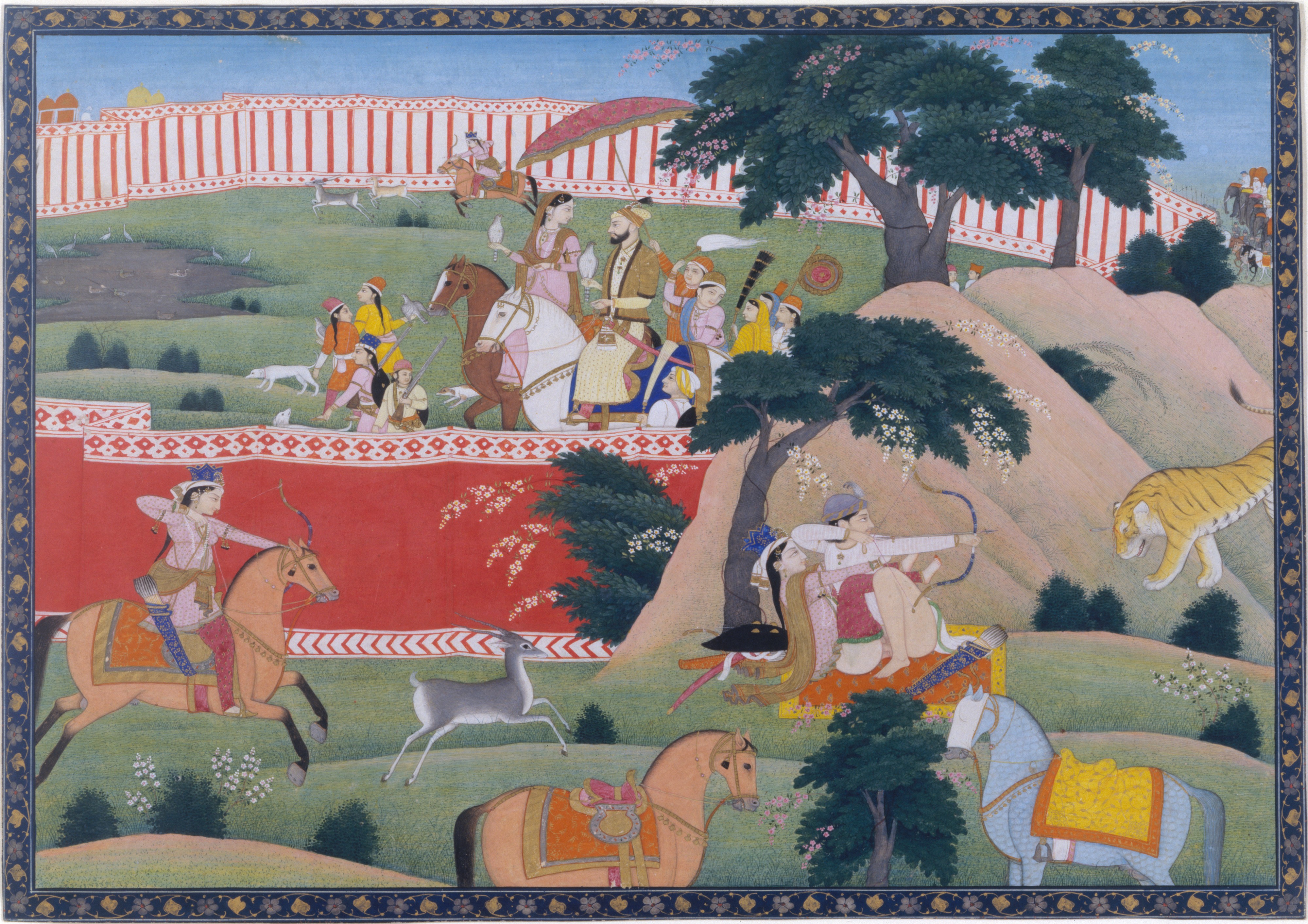
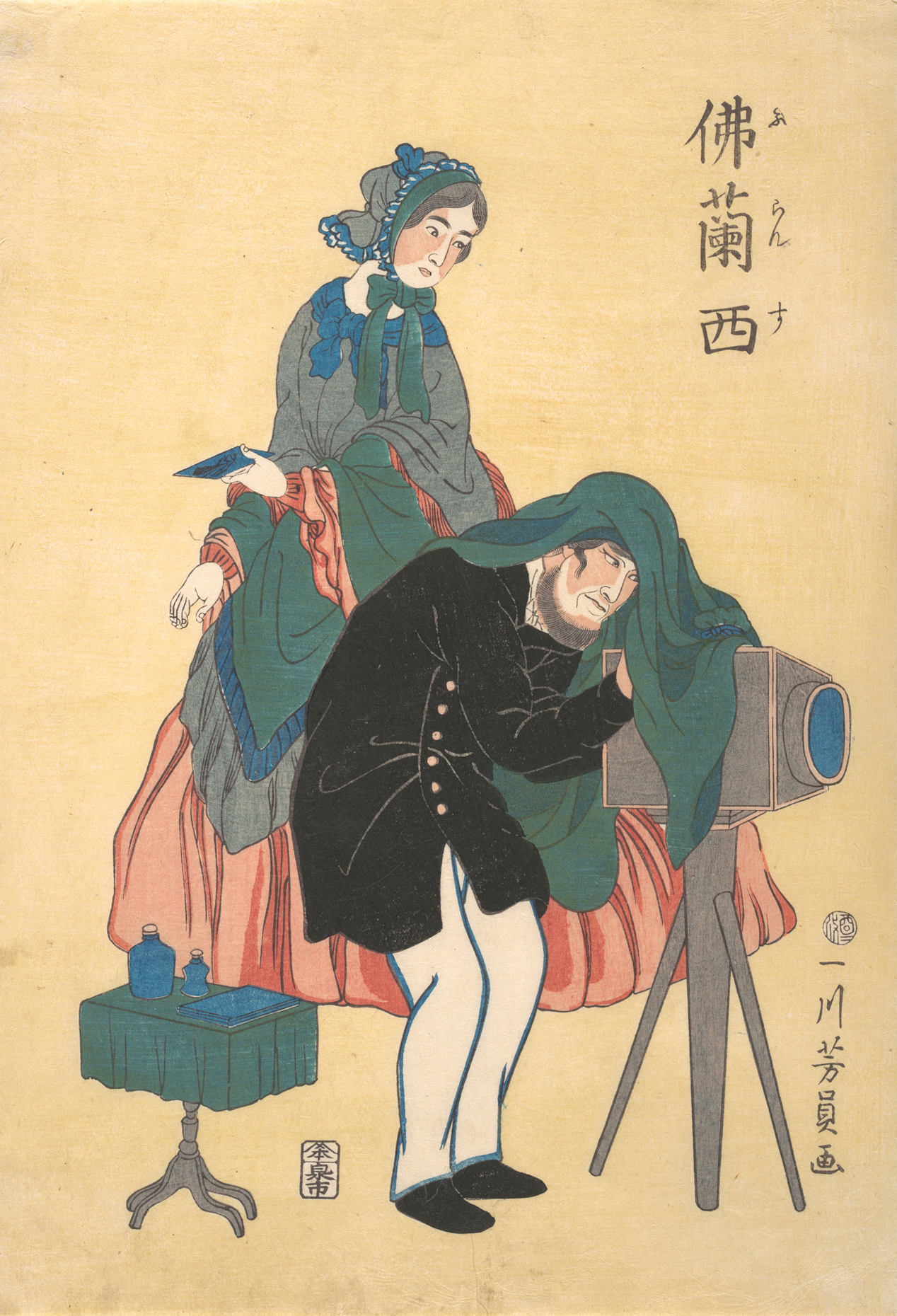
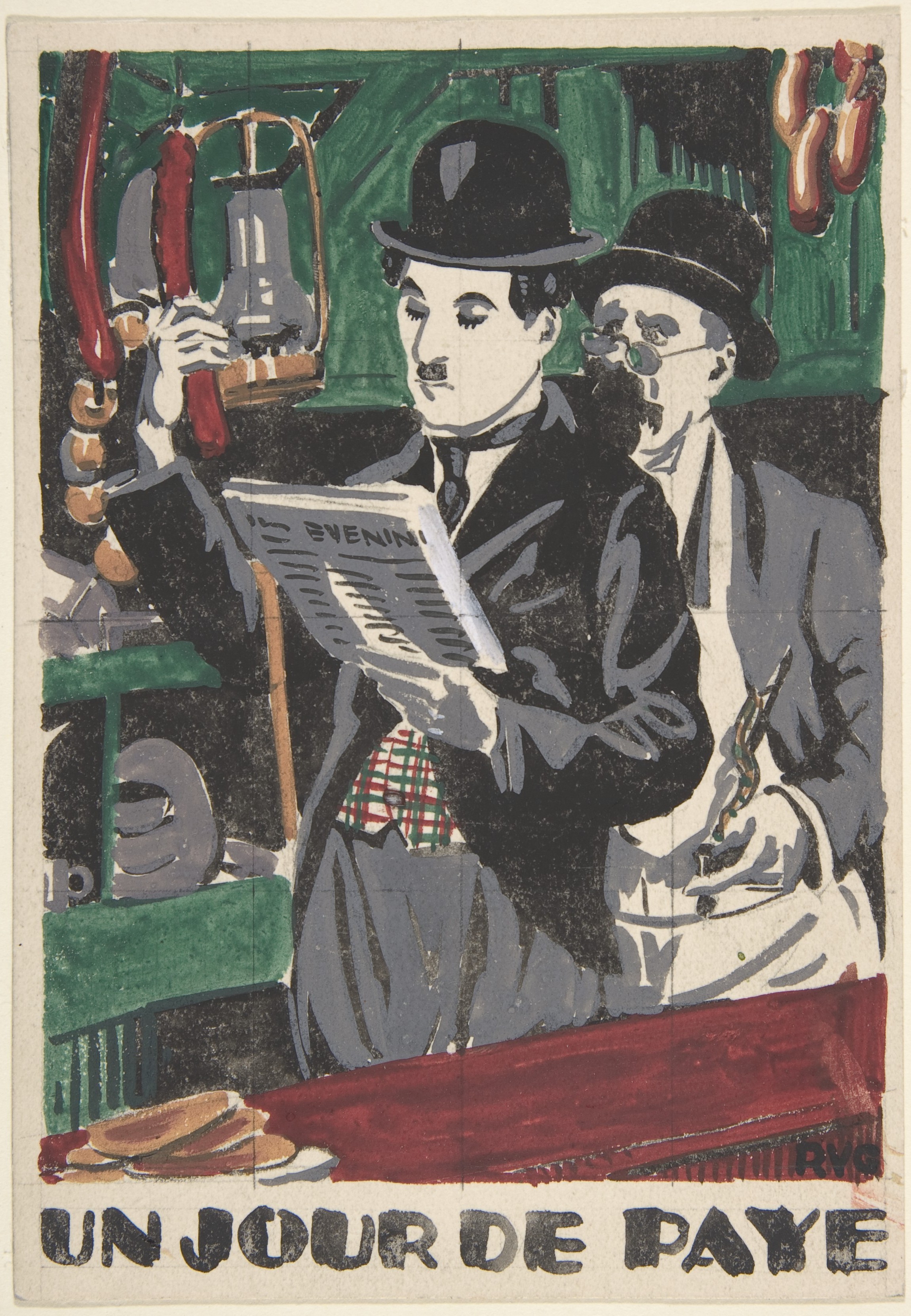
Now, the Internet Archive and the Metropolitan Museum of Art have teamed up to bring you a collection of over 140,000 art images gathered by the latter and organized and hosted by the former.
Most every digital vault in the Internet Archive offers a cultural and historical journey within, but the collaboration with the Metropolitan Museum of Art offers an especially deep one, ranging historically from early 19th-century India (The Pleasures of the Hunt at the top of the post) to midcentury New York (the photo of the mighty locomotive before the entrance to the 1939 World’s Fair above) and, in either direction, well beyond.
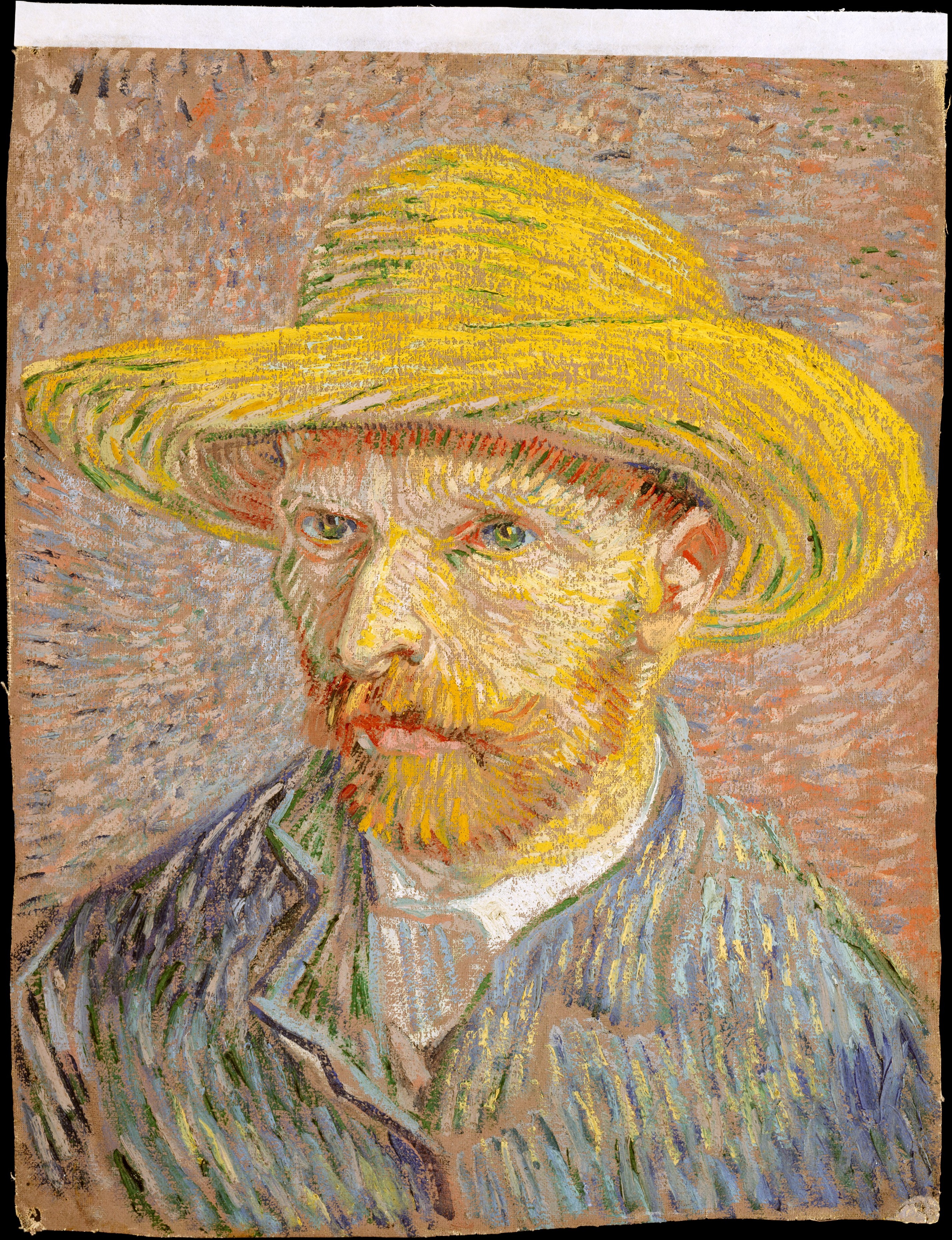
The collection also contains works of the masters, such as Vincent van Gogh’s 1887 Self-Portrait with Straw Hat (as well as its obverse, 1885’s The Potato Peeler), and some of the world’s great vistas, including Francesco Guardi’s 1765 rendering of Venice from the Bacino di San Marco. If you’d like to see what in the collection has drawn the attention of most of its browsers so far, sort it by view count: those at work should beware that nudes and other erotically charged artworks predictably dominate the rankings, but they do it alongside Naruto Whirlpool, the Philosopher’s Stone, and Albert Einstein. Human interest, like human creativity, always has a surprise or two in store.
Forever known, it seems, as keeping a “stiff upper lip,” Stoicism—like its predecessor, Cynicism—is an ancient school of Greek philosophy that has been reduced into an attitude, a pose rather than a way of life. “We do this to our philosophies,” writes Lary Wallace at Aeon, “We redraft their contours based on projected shadows, or give them a cartoonish shape like a caricaturist emphasizing all the wrong features.” We do this especially to schools as obscure to most people as Stoicism and Cynicism.
“In reality,” however, writes Massimo Pigliucci at The Stone, “practicing Stoicism is not really that different from, say, practicing Buddhism (or even certain forms of modern Christianity): it is a mix of reflecting on theoretical precepts, reading inspirational texts, and engaging in meditation, mindfulness, and the like.” Would the ancient Stoics have agreed with this assessment? In the short TED-Ed lesson above, written by Pigliucci and animated by Compote Collective, we learn about Zeno of Cyprus, “stranded miles from home, with no money or possessions.”
Destitute and “shipwrecked in Athens around 300 BCE,” the once-wealthy merchant discovered Socrates, and decided to “seek out and study with the city’s noted philosophers.” Zeno then taught his own students the principles of “virtue, tolerance, and self-control” that underlie Stoic philosophy (called so for “the porch (stoa poikilê) in the Agora at Athens” where the group congregated). Although the ability to remain calm and composed in a crisis—the quality most associated with Stoicism—occupies a prominent place in Stoic thought, it is centrally concerned with two questions.
As the site 99u puts it, Stoics ask: “1. How can we lead a fulfilling, happy life?” and “2. How can we become better human beings?” In brief, we do so not by obeying or submitting to some kind of capricious divine will, but by attending to the rational structure of the universe, the Logos, an intricate web of cause and effect that determines the world as it is, not as we would like it to be. The Stoic cultivates four virtues—Wisdom, Temperance, Justice, and Courage—and the character recommended by Stoic philosophy makes it plain why Star Trek’s Mr. Spock, as Pigliucci notes, was “actually modeled after [Gene Roddenberry’s]—mistaken—understanding of Stoicism.”
Given Stoicism’s concern with happiness and virtue, we might expect Alain de Botton’s School of Life to be an advocate, and we would be right. In the animated introduction to Stoicism above, de Botton assures viewers “you need more of it in your life.” Why? Because “life is difficult,” and Stoicism is “helpful,” for commoners and aristocrats alike. Indeed the most famous of Stoic philosophers, Marcus Aurelius, was Emperor of Rome from 161 to 180 CE. Considered one of the greatest works of ancient thought, Aurelius’ Meditations is also perhaps one of the most accessible of philosophical texts.
In plain, straightforward language, the emperor-philosopher recommends a series of Greco-Roman virtues, and gives credit to his many teachers. In book two, he writes, “Why should any of these things that happen externally, so much distract thee? Give thyself leisure to learn some good thing, and cease roving and wandering to and fro. Thou must also take heed of another kind of wandering, for they are idle in their actions, who toil and labour in this life, and have no certain scope to which to direct all their motions, and desires.” In other words, rather than suffering in courageous silence—the caricature of Stoicism—Aurelius distills much of its essence to this: “Don’t worry about what you can’t control, find good work to do, and do it well and wisely.”
When did you first hear David Sedaris? Normally in the case of a writer, let alone one of the most famous and successful writers alive, the question would be when you first read him, but Sedaris’ writing voice has never really existed apart from his actual voice. He first became famous in 1992 when National Public Radio aired his reading of the “Santaland Diaries,” a piece literally constructed from diaries kept while he worked in Santaland, the Christmas village at Macy’s, as an elf. Though that break illustrates the importance of what we might call two pillars of Sedaris’ writing process, nobody in his enormous fanbase-to-be gave it much thought at the time — they just wanted to hear more of his hilarious storytelling.
A quarter-century later, Sedaris has released more diaries — many more diaries — to his adoring public in the form of Theft by Finding, a hefty volume of selected entries written between 1977 and 2002. They give additional insight into not just the events and characters involved in the personal essays compiled in bestselling books like Naked, Me Talk Pretty One Day, and Dress Your Family in Corduroy and Denim, but also into his writing process itself. “A woman on All Things Considered wrote a book of advice called If You Want to Write and mentioned the importance of keeping a diary,” a 26-year-old Sedaris writes in an entry from 1983. “After a while you’d stop being forced and pretentious and become honest and unafraid of your thoughts.”
Obviously he didn’t need that advice at the time, since even then keeping a diary had already become the first pillar of the David Sedaris writing process. “I started writing one afternoon when I was twenty, and ever since then I have written every day,” he once told the New Yorker, also a publisher of his stories. “At first I had to force myself. Then it became part of my identity, and I did it without thinking.” Most of what he writes in his diary each and every morning he describes as “just whining,” but “every so often there’ll be something I can use later: a joke, a description, a quote.”
The entries later cohere, along with other ideas and experiences, into his widely read stories. One such piece began, Sedaris told Fast Company’s Kristin Hohenadel, as “a diary entry from a trip to Amsterdam. He met a college kid who told him he’d learned that the first person to reach the age of 200 had already been born.” Then, Sedaris said, “I speculated that the first person to reach the age of 200 would be my father. And then I attached it to something else that had been in my diary, that all my dad talks about is me getting a colonoscopy. So I connected the 200-year-old man to my father wanting me to get a colonoscopy, and that became the story.”
Only connect, as E.M. Forster said, but you do need material to connect in the first place. Hence the second pillar of the process: carrying a notebook. To the Missouri Review Sedaris described himself as less funny than observant, adding that “everybody’s got an eye for something. The only difference is that I carry around a notebook in my front pocket. I write everything down, and it helps me recall things,” especially for later inclusion in his diary. When he publicly opened his notebook at the request of a redditor while doing an AMA a few years ago, he found the words, “Illegal metal sharks… white skin classy… driver’s name is free Time… rats eat coconuts… beautiful place city, not beautiful…”
These cryptic lines, he explained, were “notes I wrote in the Mekong delta a few weeks ago. A Vietnamese woman was giving me a little tour, and this is what I jotted down in my notebook.” For instance, “I was asking about all the women whom I saw on motor scooters wearing opera gloves, and masks that covered everything but their eyes. And the driver told me they were trying to keep their skin white, because it’s just classier. Tan skin means you’re a farmer. So that’s something I remembered from our conversation, so when I transcribe my notebook into my diary, I added all of that.” And one day his readers may well see this fragment of life that caught his attention appear again, but as part of a coherent, polished narrative whole.
The better part of that polishing happens through the practice of reading, and revising, in front of an audience. “During his biannual multicity lecture tours, Sedaris says he routinely notices imperfections in the text simply through the act of reading aloud to other people,” writes Hohenadel. “He circles accidental rhymes or closely repeated words, or words that sound alike — like night and nightlife — in the same sentence, rewriting after each reading and trying out revisions during the next stop on his tour.” When a passage gets laughs from the audience, he pencils in a check mark beside it; when one gets coughs (which he likens to “a hammer driving a nail into your coffin”), he draws a skull. “On the page it seems like I’m trying too hard, and that’s one of the things I can usually catch when I’m reading out loud,” he says, whether his writing “sounds a little too obvious” or “like somebody who’s just straining for a laugh.”
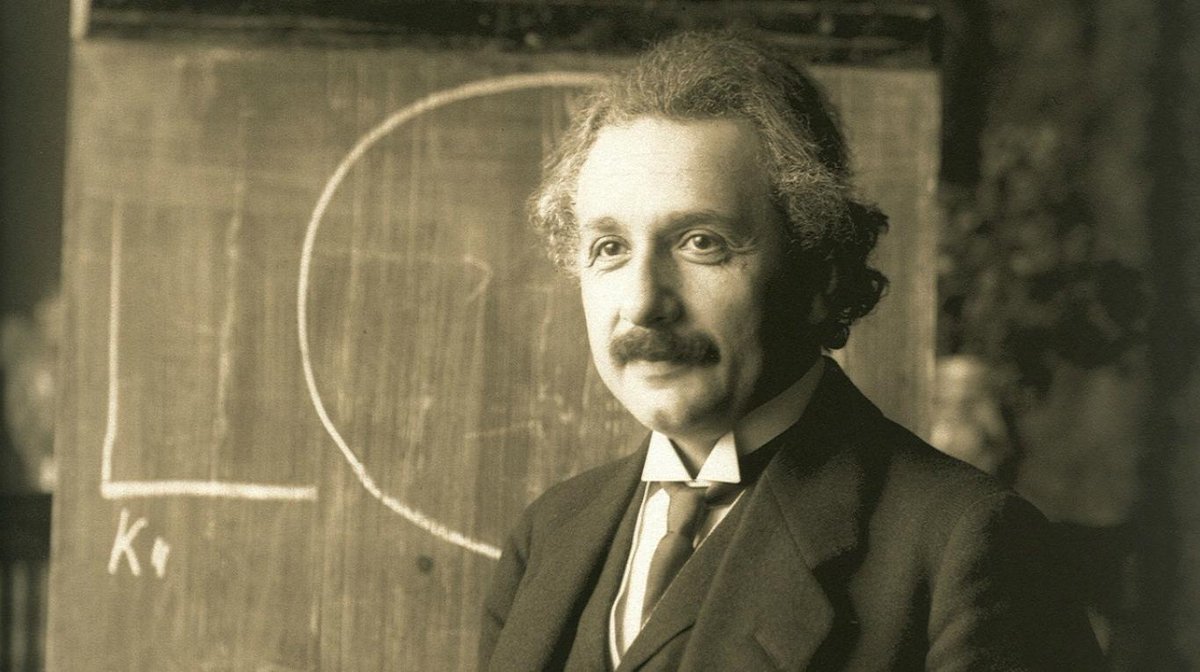
Albert Einstein was a complicated human being, with a wide range of interests. His personality seemed balanced between a certain chilliness when it came to personal matters, and a great deal of warmth and compassion when it came to the wider human family. The physicist struck up friendships with famed American activists Paul Robeson, Marian Anderson, and W.E.B. Du Bois, and he championed the cause of Civil Rights in the U.S. He professed a deep admiration for Gandhi, and praised him several times in letters and speeches. And in 1955, just days before his death, Einstein collaborated with another outspoken public intellectual, Bertrand Russell, on a peace manifesto, which was signed by six other scientists.
Einstein saw a public role for scientists in matters social, political, and even economic. In 1949, he published an article in the Monthly Review titled “Why Socialism?” Anticipating his critics, he begins by asking “is it advisable for one who is not an expert on economic and social issues to express views on the subject of socialism?” To which he replies, “I believe for a number of reasons that it is.”
Einstein goes on, sounding something like a combination of Karl Marx and E.O. Wilson, to elaborate the theoretical basis for socialism as he sees it, first describing what Marx called “primitive accumulation” and what the socialist economist Thorstein Veblen called “’the predatory phase’ of human development.”
…most of the major states of history owed their existence to conquest. The conquering peoples established themselves, legally and economically, as the privileged class of the conquered country. They seized for themselves a monopoly of the land ownership and appointed a priesthood from among their own ranks. The priests, in control of education, made the class division of society into a permanent institution and created a system of values by which the people were thenceforth, to a large extent unconsciously, guided in their social behavior.
The science of economics, as it stands, writes Einstein, still belongs “to that phase.” Such “laws as we can derive” from “the observable economic facts… are not applicable to other phases.” These facts simply describe the predatory state of affairs, and Einstein implies that not even economists have sufficient methods to definitively answer the question “why socialism?”—“economic science in its present state can throw little light on the socialist society of the future.” We should not assume, then, he goes on, “that experts are the only ones who have a right to express themselves on questions affecting the organization of society.” Einstein himself doesn’t pretend to have all the answers. He ends his essay, in fact, with a few questions addressing “some extremely difficult socio-political problems,” of the kind that attend every debate about socialism:
…how is it possible, in view of the far-reaching centralization of political and economic power, to prevent bureaucracy from becoming all-powerful and overweening? How can the rights of the individual be protected and therewith a democratic counterweight to the power of bureaucracy be assured?
Nevertheless, Einstein is “convinced” that the only way to eliminate the “grave evils” of capitalism is “through the establishment of a socialist economy, accompanied by an educational system which would be oriented toward social goals.” For Einstein, the “worst evil” of predatory capitalism is the “crippling of individuals” through an educational system that emphasizes an “exaggerated competitive attitude” and trains students “to worship acquisitive success.” But the problems extend far beyond the individual and into the very nature of the political order.
Private capital tends to become concentrated in few hands… The result of these developments is an oligarchy of private capital the enormous power of which cannot be effectively checked even by a democratically organized political society. This is true since the members of legislative bodies are selected by political parties, largely financed or otherwise influenced by private capitalists who, for all practical purposes, separate the electorate from the legislature. The consequence is that the representatives of the people do not in fact sufficiently protect the interests of the underprivileged sections of the population. Moreover, under existing conditions, private capitalists inevitably control, directly or indirectly, the main sources of information (press, radio, education). It is thus extremely difficult, and indeed in most cases quite impossible, for the individual citizen to come to objective conclusions and to make intelligent use of his political rights.
The political economy Einstein describes is one often lambasted by right libertarians as an impure variety of crony capitalism, one not worthy of the name, but the physicist is skeptical of the claim, writing “there is no such thing as a pure capitalist society.” Private owners always secure their privileges through the manipulation of the political and educational systems and the mass media.
The predatory situation Einstein observes is one of extreme alienation among all classes; “All human beings, whatever their position in society, are suffering from this process of deterioration. Unknowingly prisoners of their own egotism, they feel insecure, lonely, and deprived of the naïve, simple, and unsophisticated enjoyment of life. Man can find meaning in life, short and perilous as it is, only through devoting himself to society.” Einstein believed that devotion should take the form of a socialist economy that promotes both the physical wellbeing and the political rights of everyone. But he did not presume to know exactly what such an economic future would look like, nor how it might come into being. Read his full essay, “Why Socialism?” here.
Dauvit Horsbroch has served as the Language and Information Officer of the Scots Language Centre since 2007, and has spent considerable time living in North East Scotland. Above, watch him give a 19-minute lecture on the history of the Scots language … in Scots. For the first 20 seconds, you might think, no sweat, I can hang with it. Then suddenly your comprehensions fades out, only to return moments later, before disappearing again. And on it goes.
As you listen, you can entertain the long-simmering debate: Is Scots a distant dialect of English? Or is it its own distinct Germanic language? Writes Slate: “Both modern English and Scots descended from Old English in the 1100s, and developed separately for hundreds of years. When Scotland and England joined to form the United Kingdom of Great Britain in 1707, Scots was widely regarded as its own language, distinct from English. It is still one of Scotland’s three official languages (the other two are English and Scottish Gaelic), but because it is mostly mutually intelligible with English, it’s sometimes regarded as a dialect of English or slang.” If you’d like to see Scots written, as opposed to just spoken, spend time over at the Wikipedia Scots page.
If you would like to support the mission of Open Culture, consider making a donation to our site. It’s hard to rely 100% on ads, and your contributions will help us continue providing the best free cultural and educational materials to learners everywhere. You can contribute through PayPal, Patreon, and Venmo (@openculture). Thanks!
Jazz has become institutionalized, for both good and ill. On the upside, it has found a permanent home in prestigious performing arts centers like Jazz at Lincoln Center, where its memory will be preserved for generations. High priests like Wayne Shorter, Wynton Marsalis, and Herbie Hancock pass on the traditions to young jazz acolytes at universities. The American art form has achieved the level of respectability that some of its most innovative practitioners, such as Duke Ellington and Charles Mingus, had always sought, the recognition of the high art world.
On the other hand, we too easily forget how dangerous jazz used to be—how thoroughly cutting edge and disturbing to middlebrow sensibilities. But of course, jazz has passed through many cultural cycles, with each generation of artists shocking its elders by pushing against musical decorum. Late 40s and 50s bebop gave us the lean, mean combo as a challenge to the big band swing era, and produced superstar improvisers who veered thrillingly off script in every performance. But this incarnation of jazz, too, threatened to become staid as the sixties neared.
And so a handful of artists created, to take the title of Ornette Coleman’s groundbreaking 1959 album, “the shape of jazz to come,” free jazz, which represented, writes Chris Kelsey, “a final break with the music’s roots as a popular art form, casting it in an alternative role as an experimental art music.” The sixties saw profound innovation in jazz, as artists like Coleman, Coltrane, Eric Dolphy, Sun Ra, Pharoah Sanders, and others expanded its possibilities. But to read this music as solely experimenting “along the lines of the European ‘classical’ avant-garde” is to ignore the deep cultural wellspring from which it came.
As Amiri Baraka wrote in the liner notes for a 1965 compilation, The New Wave in Jazz, avant-garde jazz was a “touch stone of the new world,” a form that transcended the conditions of slavery, miseducation, and social control; it was the “music of contemporary black culture.”
The people who make this music are intellectuals or mystics or both. The black rhythm energy blues feeling (sensibility) is projected into the area of reflection, intentionally. As Expression…where each term is (equally) co-respondent.
Projection over sustained periods (more time given, and time proposes a history for expression, hence it becomes reflective projection.
Arbitrariness of Form (variety in nature)
Intention of performance as a Learning experience
These were the distinctive “new world” qualities of experimental jazz. Its hip signifiers, Baraka wrote, mark it as “an invention of Black Lives”; it is not music to lull and soothe but to instruct, with force, if necessary. “Getting hit in the head with a stick,” he writes with a wink, “can do you as much good as meditating.” It might be hard for us to hear, now that the music has been so thoroughly enshrined in academic departments and conservatories, but avant-garde jazz once had the power to thoroughly shock and surprise, as the statement of a culture both in dialogue with and revolt against oppressive traditional forms.
In the playlist above, The Sound of Avant-Garde Jazz, you recover a sense of the music’s edginess with recordings from some of its most experimental gurus, including Coleman, Sun Ra, McCoy Tyner, Yusef Lateef, Alice Coltrane, and many, many more. The playlist spans the last 60 years or so, featuring later white adopters like Pat Metheny, John Zorn, and Bill Frisell, and including rocking electric jazz from diverse, eclectic bands like Tony Williams’ Lifetime, whose “Proto-Cosmos,” at the top, epitomizes the expansive range of 70s fusion. The overall experience of this comprehensive playlist may not only shake up your preconceptions of jazz, but may, as Baraka writes, change your preconditioned sense of “the normal feeling of adventure.”
The playlist offers up 350 tracks, and runs 35 hours. If you need Spotify’s free software, download it here.
We all operate at different levels of ambition: some just want to get by and enjoy themselves, while others strive to make achievements with as long-lasting an impact on humanity as possible. If we think of candidates for the latter category, Charles Darwin may well come to mind, at least in the sense that the work he did as a naturalist, and more so the theory of evolution that came out of it, has ensured that we remember his name well over a century after his death and will surely continue to do so centuries hence. But research into Darwin’s working life suggests something less than workaholism — and indeed, that he put in a fraction of the number of hours we associate with serious ambition.
“After his morning walk and breakfast, Darwin was in his study by 8 and worked a steady hour and a half,” writes Nautilus’ Alex Soojung-kim Pang. “At 9:30 he would read the morning mail and write letters. At 10:30, Darwin returned to more serious work, sometimes moving to his aviary, greenhouse, or one of several other buildings where he conducted his experiments. By noon, he would declare, ‘I’ve done a good day’s work,’ and set out on a long walk.” After this walk he would answer letters, take a nap, take another walk, go back to his study, and then have dinner with the family. Darwin typically got to bed, according to a daily schedule drawn from his son Francis’ reminiscences of his father, by 10:30.
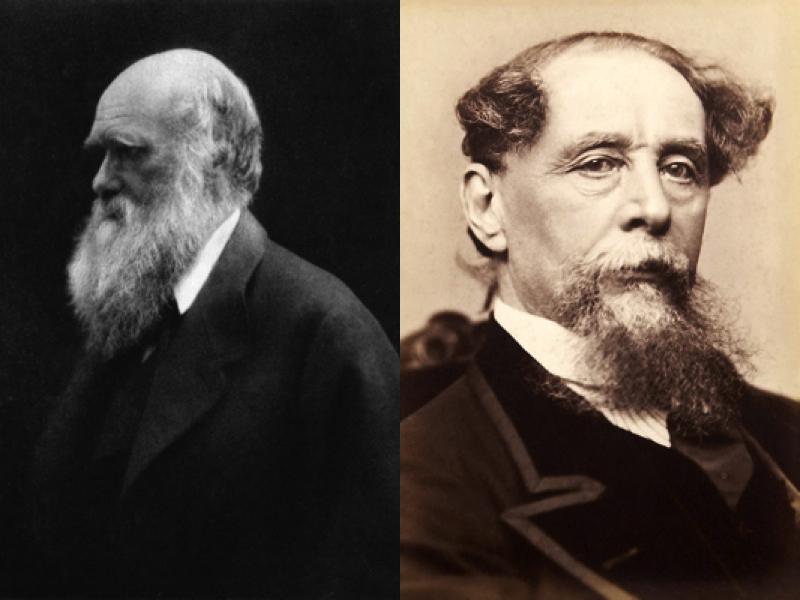
“On this schedule he wrote 19 books, including technical volumes on climbing plants, barnacles, and other subjects,” writes Pang, and of course not failing to mention “The Origin of Species, probably the single most famous book in the history of science, and a book that still affects the way we think about nature and ourselves.” Another textually prolific Victorian Englishman named Charles, adhering to a similarly non-life-consuming work routine, managed to produce — in addition to tireless letter-writing and campaigning for social reform — hundreds of short stories and articles, five novellas, and fifteen novels including Oliver Twist, A Tale of Two Cities, and Great Expectations.
“After an early life burning the midnight oil,” writes Pang, Charles Dickens “settled into a schedule as ‘methodical or orderly’ as a ‘city clerk,’ his son Charley said. Dickens shut himself in his study from 9 until 2, with a break for lunch. Most of his novels were serialized in magazines, and Dickens was rarely more than a chapter or two ahead of the illustrators and printer. Nonetheless, after five hours, Dickens was done for the day.” Pang finds that may other successful writers have kept similarly restrained work schedules, from Anthony Trollope to Alice Munro, Somerset Maugham to Gabriel García Márquez, Saul Bellow to Stephen King. He notes similar habits in science and mathematics as well, including Henri Poincaré and G.H. Hardy.
Research by Pang and others into work habits and productivity have recently drawn a great deal of attention, pointing as it does to the question of whether we might all consider working less in order to work better. “Even if you enjoy your job and work long hours voluntarily, you’re simply more likely to make mistakes when you’re tired,” writes the Harvard Business Review’s Sarah Green Carmichael. What’s more, “work too hard and you also lose sight of the bigger picture. Research has suggested that as we burn out, we have a greater tendency to get lost in the weeds.” This discovery actually dates back to Darwin and Dickens’ 19th century: “When organized labor first compelled factory owners to limit workdays to 10 (and then eight) hours, management was surprised to discover that output actually increased – and that expensive mistakes and accidents decreased.”
This goes just as much for academics, whose workweeks, “as long as they are, are not nearly as lengthy as those on Wall Street (yet),” writes Times Higher Education’s David Matthews in a piece on the research of University of Pennsylvania professor (and ex-Goldman Sachs banker) Alexandra Michel. “Four hours a day is probably the limit for those looking to do genuinely original research, she says. In her experience, the only people who have avoided burnout and achieved some sort of balance in their lives are those sticking to this kind of schedule.” Michel finds that “because academics do not have their hours strictly defined and regulated (as manual workers do), ‘other controls take over. These controls are peer pressure.’ ” So at least we know the first step on the journey toward viable work habits: regarding the likes of Darwin and Dickens as your peers.
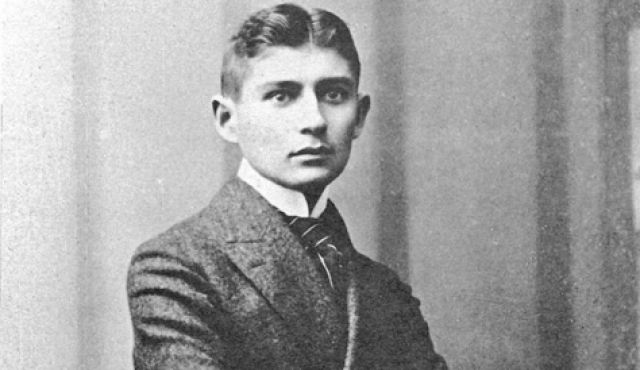
Poor Kafka, born too early to blame his writer’s block on 21st-century digital excuses: social media addiction, cell phone addiction, streaming video…
Would The Metamorphosis have turned out differently had its author had access to a machine that would have allowed him to self-publish, communicate facelessly, and dispense entirely with typists, pens and paper?
How horrified would their author be to read The New Yorker’s opinion that his journals should be regarded as one of his major literary achievements? A Kafka-esque response might be the mildest reaction warranted by the situation:
His life and personality were perfectly suited to the diary form, and in these pages he reveals what he customarily hid from the world.
These once-private pages (available in book format here) reveal a not-unfamiliar writerly tendency to agonize over a perceived lack of output:
JANUARY 20, 1915: The end of writing. When will it take me up again?
JANUARY 29, 1915: Again tried to write, virtually useless.
JANUARY 30, 1915: The old incapacity. Interrupted my writing for barely ten days and already cast out. Once again prodigious efforts stand before me. You have to dive down, as it were, and sink more rapidly than that which sinks in advance of you.
FEBRUARY 7, 1915: Complete standstill. Unending torments.
MARCH 11, 1915: How time flies; another ten days and I have achieved nothing. It doesn’t come off. A page now and then is successful, but I can’t keep it up, the next day I am powerless.
MARCH 13, 1915: Lack of appetite, fear of getting back late in the evening; but above all the thought that I wrote nothing yesterday, that I keep getting farther and farther from it, and am in danger of losing everything I have laboriously achieved these past six months. Provided proof of this by writing one and a half wretched pages of a new story that I have already decided to discard…. Occasionally I feel an unhappiness that almost dismembers me, and at the same time am convinced of its necessity and of the existence of a goal to which one makes one’s way by undergoing every kind of unhappiness.
If you’re stalled because you lost your way, try the opposite of what you usually do—if you’re a plotter, give your imagination free rein for a day; if you’re a freewriter or a pantser, spend a day creating a list of the next 10 scenes that need to happen. This gives your brain a challenge, and for this reason you can take heart, because your billions of neurons love a challenge and are in search of synapses they can form.
2. Your Passion Has Waned
Remember, your writing brain looks for and responds to patterns, so be careful that you don’t make succumbing to boredom or surrendering projects without a fight into a habit. Do your best to work through the reasons you got stalled and to finish what you started. This will lay down a neuronal pathway that your writing brain will merrily travel along in future work.
3. Your Expectations Are Too High
Instead of setting your sights too high, give yourself permission to write anything, on topic or off topic, meaningful or trite, useful or folly. The point is that by attaching so much importance to the work you’re about to do, you make it harder to get into the flow. Also, if your inner critic sticks her nose in (which often happens), tell her that her role is very important to you (and it is!) and that you will summon her when you have something worthy of her attention.
4. You Are Burned Out
You aren’t blocked; you’re exhausted. Give yourself a few days to really rest. Lie on a sofa and watch movies, take long walks in the hour just before dusk, go out to dinner with friends, or take a mini-vacation somewhere restful. Do so with the intention to give yourself—and your brain—a rest. No thinking about your novel for a week! In fact, no heavy thinking for a week. Lie back, have a margarita, and chill.
5. You’re Too Distracted
Take note that, unless you’re just one of those rare birds who always write no matter what, you will experience times in your life when it’s impossible to keep to a writing schedule. People get sick, people have to take a second job, children need extra attention, parents need extra attention, and so on. If you’re in one of those emergency situations (raising small children counts), by all means, don’t berate yourself. Sometimes it’s simply necessary to put the actual writing on hold. It is good, however, to keep your hands in the water. For instance, in lieu of writing your novel:
Read works similar to what you hope to write.
Read books related to the subject you’re writing about.
Keep a designated journal where you jot down ideas for the book (and other works).
Write small vignettes or sketches related to the book
Whenever you find time to meditate, envision yourself writing the book, bringing it to full completion.
Make writing the book a priority.
Additionally, you may find some merit in enlisting a friend to publish, I mean, burn the above-mentioned journals posthumously. Just don’t write anything you wouldn’t want the public to see.
Ayun Halliday is an author, illustrator, theater maker and Chief Primatologist of the East Village Inky zine, currently appearing onstage in New York City in Paul David Young’s Faust 3. Follow her @AyunHalliday.
Note: You can find free courses on machine learning and artificial intelligence in the Relateds below.
If you would like to support the mission of Open Culture, consider making a donation to our site. It’s hard to rely 100% on ads, and your contributions will help us continue providing the best free cultural and educational materials to learners everywhere. You can contribute through PayPal, Patreon, and Venmo (@openculture). Thanks!
We're hoping to rely on loyal readers, rather than erratic ads. Please click the Donate button and support Open Culture. You can use Paypal, Venmo, Patreon, even Crypto! We thank you!
Open Culture scours the web for the best educational media. We find the free courses and audio books you need, the language lessons & educational videos you want, and plenty of enlightenment in between.