Without climate change, we couldn’t inhabit the Earth as we do today. The greenhouse effect, by which gases in a planet’s atmosphere increase the heat of that planet’s surface, “makes life on Earth possible.” So says Carl Sagan in the video above. He adds that without it, the temperature would be about 30 degrees centigrade cooler: “That’s well below the freezing point of water everywhere on the planet. The oceans would be solid.” A little of the climate change induced by the greenhouse effect, then, is a good thing, but “here we are pouring enormous quantities of CO2 and these other gases into the atmosphere every year, with hardly any concern about its long-term and global consequences.”
It’s fair to say that the level of concern has increased since Sagan spoke these words in 1985, when “climate change” wasn’t yet a household term. But even then, his audience was Congress, and his fifteen-minute address, preserved by C‑SPAN, remains a succinct and persuasive case for more research into the phenomenon as well as strategies and action to mitigate it.
What audience would expect less from Sagan, who just five years earlier had hosted the hit PBS television series Cosmos, based on his book of the same name. Its broadcast made contagious his enthusiasm for scientific inquiry in general and the nature of the planets in particular. Who could forget, for example, his introduction to the “thoroughly nasty place” that is Venus, research into whose atmosphere Sagan had conducted in the early 1960s?
Venus is “the nearest planet — a planet of about the same mass, radius, density, as the Earth,” Sagan tells Congress, but it has a “surface temperature about 470 degrees centigrade, 900 Fahrenheit.” The reason? “A massive greenhouse effect in which carbon dioxide plays the major role.” As for our planet, estimates then held that, without changes in the rates of fossil fuel-burning and “infrared-absorbing” gases released into the atmosphere, there will be “a several-centigrade-degree temperature increase” on average “by the middle to the end of the next century.” Given the potential effects of such a rise, “if we don’t do the right thing now, there are very serious problems that our children and grandchildren will have to face.” It’s impossible to know how many listeners these words convinced at the time, though they certainly seem to have stuck with a young senator in the room by the name of Al Gore.
Based in Seoul, Colin Marshall writes and broadcasts on cities, language, and culture. His projects include the Substack newsletterBooks on Cities, the book The Stateless City: a Walk through 21st-Century Los Angeles and the video series The City in Cinema. Follow him on Twitter at @colinmarshall or on Facebook.
When Bob Dylan released his 2001 album Love and Theft, he lifted the title from a book of the same name by Eric Lott, who studied 19th century American popular music’s musical thefts and contemptuous impersonations. The ambivalence in the title was there, too: musicians of all colors routinely and lovingly stole from each other while developing the jazz and blues traditions that grew into rock and roll. When British invasion bands introduced their version of the blues, it only seemed natural that they would continue the tradition, picking up riffs, licks, and lyrics where they found them, and getting a little slippery about the origins of songs. This was, after all, the music’s history.
In truth, most UK blues rockers who picked up other people’s songs changed them completely or credited their authors when it came time to make records. This may not have been tradition but it was ethical business practice. Fans of Led Zeppelin, on the other hand, now listen to their music with asterisks next to many of their hits — footnotes summarizing court cases, misattributions, and downright thefts from which they profited. In many cases, the band would only admit to stealing under duress. At other times, they freely confessed in interviews to taking songs, tweaking them a bit, and giving themselves sole credit for composing and/or arranging.
A list of ten “rip offs” in a Rolling Stone piece on Led Zeppelin’s penchant for theft is hardly exhaustive. It does not include “Stairway to Heaven,” for which the band was recently sued for lifting a melody from Spirit’s “Taurus.” (An internet user saved the band’s case by finding that both songs used an earlier melody from the 1600s.)
During those recent court proceedings, the prosecution quoted from a 1993 interview Jimmy Page gave Guitar World:
“[A]s far as my end of it goes, I always tried to bring something fresh to anything that I used. I always made sure to come up with some variation. In fact, I think in most cases, you would never know what the original source could be. Maybe not in every case – but in most cases. So most of the comparisons rest on the lyrics. And Robert was supposed to change the lyrics, and he didn’t always do that – which is what brought on most of the grief. They couldn’t get us on the guitar parts of the music, but they nailed us on the lyrics.”
The blame shifting was “not quite fair to Plant,” the court found, “as Page repeatedly took entire musical compositions without attribution.” He stood accused of doing so, for example, in “The Lemon Song,” lifted from Howlin’ Wolf’s “Killing Floor.” After a lawsuit, the song is now co-credited to Chester Burnett (Howlin’ Wolf’s real name). For his part, Plant readily blamed Page when given the chance. In his book Led Zeppelin IV, Barney Hoskyns quotes the singer’s thoughts on the “Whole Lotta Love” controversy:
I think when Willie Dixon turned on the radio in Chicago twenty years after he wrote his blues, he thought, ‘That’s my song.’ … When we ripped it off, I said to Jimmy, ‘Hey, that’s not our song.’ And he said, ‘Shut up and keep walking.’
Led Zeppelin’s musical thievery does not make them less talented or ingenious as musicians. They took others’ material, some of it wholesale, but no one can claim they didn’t make it their own, melding American blues and British folk into a truly strange brew. The Polyphonic video above on their use of others’ music begins with a quote from “poet and famous anti-semite” T.S. Eliot, expressing a sentiment also attributed to Picasso, Faulkner, and Stravinsky:
Immature poets imitate, mature poets steal; bad poets deface what they take, and good poets make it into something better, or at least something different.
As far as copyright goes, Zeppelin didn’t always cross legal lines. But as Jacqui McShee said when Page reworked a composition by her Pentangle bandmate, Bert Jansch, “It’s a very rude thing to do. Pinch somebody else’s thing and credit it to yourself.” Maybe so. Still, nobody ever won any awards for politeness in rock and roll, most especially the band that helped invent the sound of heavy metal. See a scoreboard showing the number of originals, credited covers and uncredited thefts on the band’s first four albums here.’
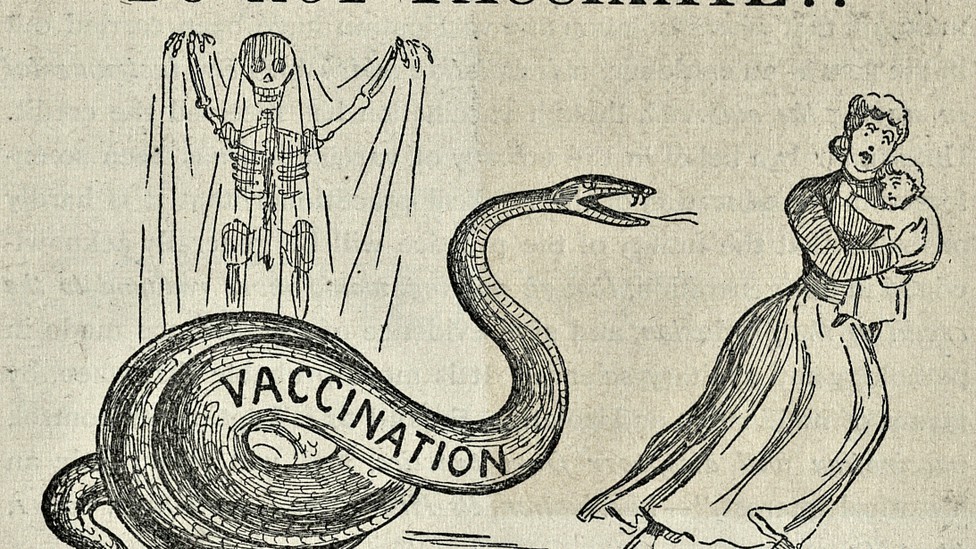
A cartoon from a December 1894 anti-vaccination publication (Courtesy of The Historical Medical Library of The College of Physicians of Philadelphia)
For well over a century people have queued up to get vaccinated against polio, smallpox, measles, mumps, rubella, the flu or other epidemic diseases. And they have done so because they were mandated by schools, workplaces, armed forces, and other institutions committed to using science to fight disease. As a result, deadly viral epidemics began to disappear in the developed world. Indeed, the vast majority of people now protesting mandatory vaccinations were themselves vaccinated (by mandate) against polio, smallpox, measles, mumps, rubella, etc., and hardly any of them have contracted those once-common diseases. The historical argument for vaccines may not be the most scientific (the science is readily available online). But history can act as a reliable guide for understanding patterns of human behavior.
In 1796, Scottish physician Edward Jenner discovered how an injection of cowpox-infected human biological material could make humans immune to smallpox. For the next 100 years after this breakthrough, resistance to inoculation grew into “an enormous mass movement,” says Yale historian of medicine Frank Snowden. “There was a rejection of vaccination on political grounds that it was widely considered as another form of tyranny.”
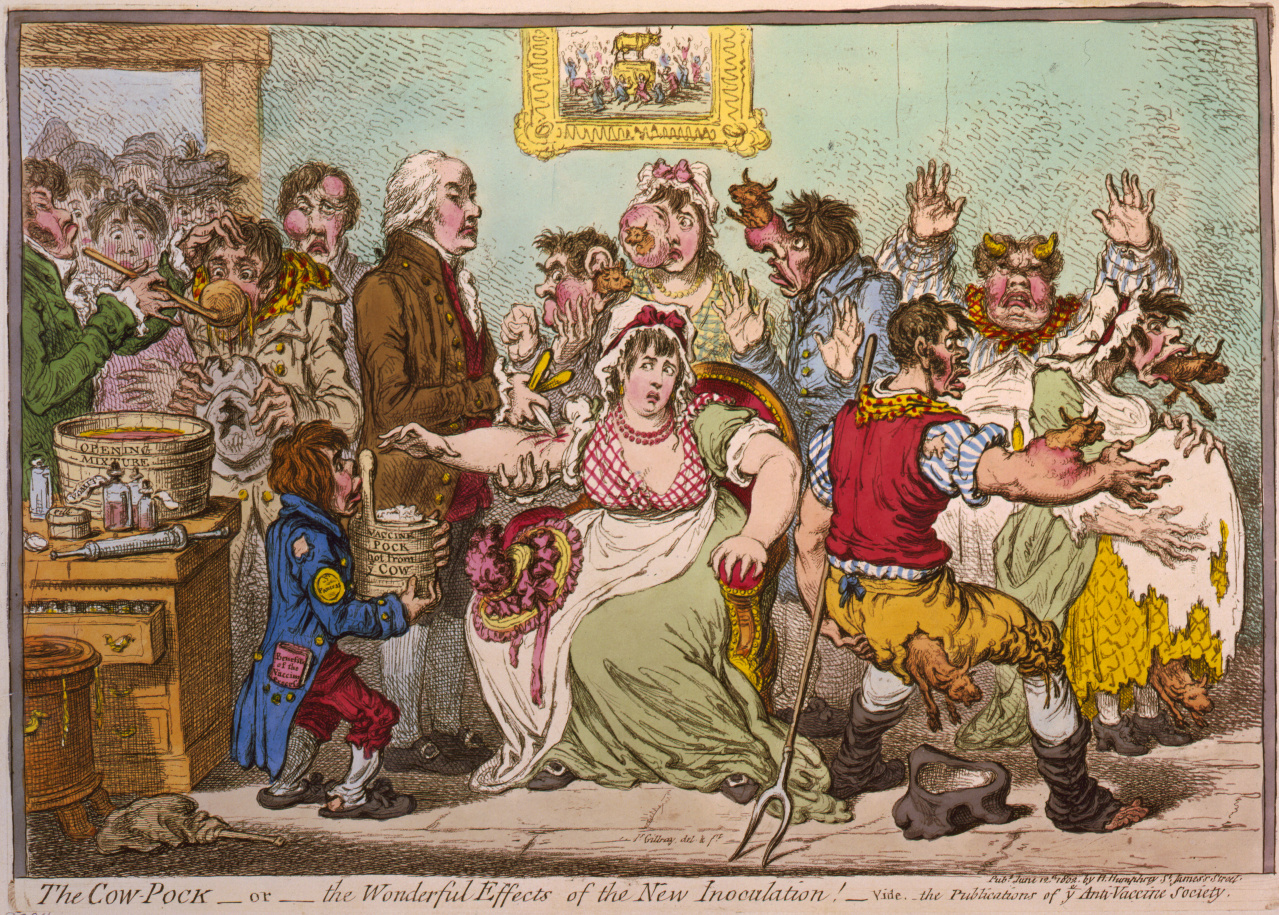
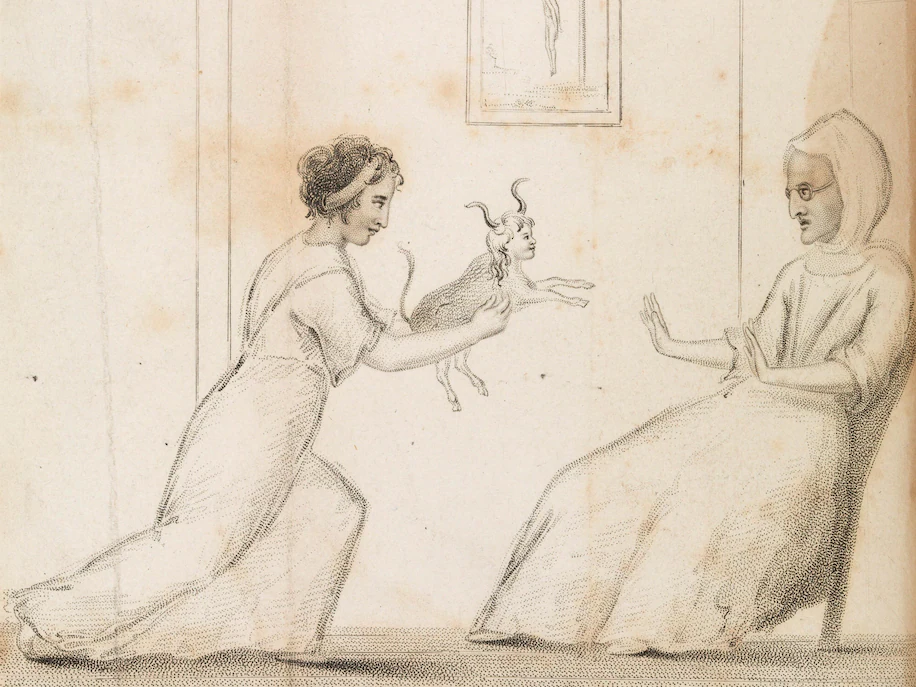
Fears that injections of cowpox would turn people into mutants with cow-like growths were satirized as early as 1802 by cartoonist James Gilray (below). While the anti-vaccination movement may seem relatively new, the resistance, refusal, and denialism are as old as vaccinations to infectious disease in the West.
Image via Wikimedia Commons
“In the early 19th century, British people finally had access to the first vaccine in history, one that promised to protect them from smallpox, among the deadliest diseases in the era,” writes Jess McHugh at The Washington Post. Smallpox killed around 4,000 people a year in the UK and left hundreds more disfigured or blinded. Nonetheless, “many Britons were skeptical of the vaccine.… The side effects they dreaded were far more terrifying: blindness, deafness, ulcers, a gruesome skin condition called ‘cowpox mange’ — even sprouting hoofs and horns.” Giving a person one disease to frighten off another one probably seemed just as absurd a notion as turning into a human/cow hybrid.
Jenner’s method, called variolation, was outlawed in 1840 as safer vaccinations replaced it. By 1867, all British children up to age 14 were required by law to be vaccinated against smallpox. Widespread outrage resulted, even among prominent physicians and scientists, and continued for decades. “Every day the vaccination laws remain in force,” wrote scientist Alfred Russel Wallace in 1898, “parents are being punished, infants are being killed.” In fact, it was smallpox claiming lives, “more than 400,000 lives per year throughout the 19th century, according to the World Health Organization,” writes Elizabeth Earl at The Atlantic. “Epidemic disease was a fact of life at the time.” And so it is again. Covid has killed almost 800,000 people in the U.S. alone over the past two years.
Then as now, medical quackery played its part in vaccine refusal — in this case a much larger part. “Never was the lie of ‘the good old days’ more clear than in medicine,” Greig Watson writes at BBC News. “The 1841 UK census suggested a third of doctors were unqualified.” Common causes of illness in an 1848 medical textbook included “wet feet,” “passionate fear or rage,” and “diseased parents.” Among the many fiery lectures, caricatures, and pamphlets issued by opponents of vaccination, one 1805 tract by William Rowley, a member of the Royal College of Physicians, alleged that the injection of cowpox could mar an entire bloodline. “Who would marry into any family, at the risk of their offspring having filthy beastly diseases?” it asked hysterically.
Then, as now, religion was a motivating factor. “One can see it in biblical terms as human beings created in the image of God,” says Snowden. “The vaccination movement injecting into human bodies this material from an inferior animal was seen as irreligious, blasphemous and medically wrong.” Granted, those who volunteered to get vaccinated had to place their faith in the institutions of science and government. After medical scandals of the recent past like the Tuskegee experiments or Thalidomide, that can be a big ask. In the 19th century, says medical historian Kristin Hussey, “people were asking questions about rights, especially working-class rights. There was a sense the upper class were trying to take advantage, a feeling of distrust.”
The deep distrust of institutions now seems intractable and fully endemic in our current political climate, and much of it may be fully warranted. But no virus has evolved — since the time of the Jenner’s first smallpox inoculation — to care about our politics, religious beliefs, or feelings about authority or individual rights. Without widespread vaccination, viruses are more than happy to exploit our lack of immunity, and they do so without pity or compunction.
The word oud might make some people think of fragrances. Tom Ford’s Oud Wood currently sets fashionistas back between $263 and $360 a bottle: oud can refer to “agarwood,” a very rare ingredient in perfumes. But regular Open Culture readers may be more familiar with the bowl-shaped instrument that made its way to Europe from North Africa during the Middle Ages, giving rise to the lute (al-oud… The word oud, or ud, in Arabic simply means “wood.”) The oud is, after all, a direct, if distant, ancestor of the modern guitar, a subject we like to cover here quite a bit.
Some of the videos we’ve featured on the history of the guitar have starred classical guitarist and stringed instrument specialist Brandon Acker. Just above, he introduces viewers to the tuning, timbre, and playing techniques of the oud, “one of the most popular instruments in Arabic music,” writes the site Maqam World. It is also one of the oldest. Acker leaves his “comfort zone of Western Classical music” in this video because of his fascination with the oud as an ancestor of the lute, “one of the most important instruments of the musical period we call the Renaissance.”
The oud, whose own ancestor dates back some 3500 years to ancient Persia, first arrived with the Moors during their 711 AD invasion of Spain. Although new to Europe, it was known in the Arabic world as “the king or sultan of all instruments” and had evolved from a four string instrument to one with (typically) eleven strings: “that’s five doubled strings tuned in unisons and then one low string, which is single.” Acker goes on to demonstrate the tuning of the single string and doubled “courses,” as they’re called. The strings are plucked and strummed with a long pick called a “risha” (or “feather”), also called a “mizrap” when playing a Turkish oud, or a “zakhme” in Persian.…
Wherever it comes from, each oud features the familiar bowed back, made of strips of wood (hence, “oud”), the flattop soundboard with one to three soundholes, and the fretless neck. “The oud has a warm timbre and a wide tonal range (about 3 octaves),” notes Maqam World. The instrument is tuned to play music written in the Arabic maqam, “a system of scales, habitual melodic phrases, modulation possibilities, etc.,” but it has taken root in many musical cultures in North Africa, the Middle East, and Europe. Acker may come to the oud as a fan of the European lute, but the older instrument is much more than an evolutionary ancestor of the European Renaissance; it is the “sultan” of a rich musical tradition that continues to thrive around the Mediterranean world and beyond.
Famous modern oud players come from Egypt, Syria, Palestine, and Iraq, where Rahim AlHaj was born. The musician “learned to play the oud at age 9,” NPR writes, “and later graduated with honors and a degree in music composition from the Institute of Baghdad,” while also earning a degree in Arabic literature. AlHaj used his talents in the underground movement against Saddam Hussain’s rule, and after imprisonments and beatings, was exiled in 1991. Now based in New Mexico, “he performs around the world, and has even collaborated with Kronos Quartet and R.E.M.” See him perform for Tiny Desk Concert above and hear more oud in contemporary concert settings here.
Andrei Tarkovsky had a rather low opinion of Stanley Kubrick’s 2001: A Space Odyssey. “Phony on many points,” he once called it, built on “a lifeless schema with only pretensions to truth.” His professional response was 1972’s Solaris, by most estimates another high point in the science-fiction cinema of that period. Yet today it isn’t widely regarded as Tarkovsky’s best work; certainly it hasn’t become as much of an object of worship as, say, Stalker. That picture — arguably another work of sci-fi, though one sui generis in practically its every facet — continues to inspire such tributes and exegeses as the video essay on its making we featured earlier this year here on Open Culture.
That video essay came from the channel of Youtuber CinemaTyler, who like many auteur-oriented cinephiles exhibits appreciation for Tarkovsky and Kubrick alike. He’s created numerous examinations on the work that went into Kubrick’s pictures, including A Clockwork Orange, Barry Lyndon, and Full Metal Jacket.
The ambition of 2001, outsized even by Kubrick’s standard, is reflected in what it spurred CinemaTyler on to create: a seven-part series of video essays on its production, with three-hour total runtime that far exceeds that of the film itself. It takes at least that long to explain the achievements Kubrick pulled off, especially with mid-1960s filmmaking technology, which gave us the rare vision of the future that has held up for more than half a century.
Some of the qualities that have made 2001 endure came into being almost by accident. Take the use of Strauss’ “The Blue Danube” to introduce the space station, a stroke of scoring genius inspired by the records Kubrick and company happened to be listening to while viewing their footage. That and other classical pieces replaced an original score by the composer who’d worked on Kubrick’s Spartacus, which would have struck a different mood altogether. So would the portentous narration included in earlier versions of the script, hardly imaginable in the context of such powerfully wordless scenes as the famous four-million-year cut from tossed bone to spacecraft, which turns out to have been originally conceived an Earth-orbiting nuclear-weapon platform. That’s one of the many little-known facts CinemaTyler fits into this series, and a viewing of which even the biggest Kubrick buffs will have reason to admire 2001 more intensely than ever.
Based in Seoul, Colin Marshall writes and broadcasts on cities, language, and culture. His projects include the Substack newsletterBooks on Cities, the book The Stateless City: a Walk through 21st-Century Los Angeles and the video series The City in Cinema. Follow him on Twitter at @colinmarshall or on Facebook.
We all think we know just what Albert Einstein looked like — and broadly speaking, we’ve got it right. At least since his death in 1955, since which time generation after generation of children around the world have grown up closely associating his bristly mustache and semi-tamed gray hair with the very concept of scientific genius. His sartorial rumpledness and Teutonically hangdog look have long been the stuff of not just caricature, but (as in Nicolas Roeg’s Insignificance) earnest tribute as well. Yet how many of us can say we’ve really taken a good look at Einstein?
Even earlier colorized newsreel footage appears in the video just above, taken from an episode of the Smithsonian Channel series America in Color. It depicts Einstein arriving in the United States in 1930, by which time he was already “the world’s most famous physicist” — a position then meriting a welcome not unlike that which the Beatles would receive 34 years later.
Einstein returned to his native Germany after that visit. The America in Color clip also shows him back at his cottage outside Berlin (and in his pajamas), but his time back in his homeland amounted only to a few years. The reason: Hitler. During Einstein’s visiting professorship at Cal Tech in 1933, the Gestapo raided his cottage and Berlin apartment, as well as confiscated his sailboat. Later the Nazi government banned Jews from holding official positions, including at universities, effectively cutting off his professional prospects and those of no few other German citizens besides. The 1943 color footage above offers a glimpse of Einstein a decade into his American life.
A couple of years thereafter, the end of the Second World War made Einstein even more famous. He became, in the minds of many Americans, the brilliant physicist who “helped discover the atom bomb.” So declares the announcer in that first newsreel, but in the decades since, the public has come to associate Einstein more instinctively with his theory of relativity — an achievement less immediately comprehensible than the apocalyptic explosion of the atomic bomb, but one whose scientific implications run much deeper. Many clear and lucid précis of Einstein’s theory exist, but why not first see it explained by the man himself, and in color at that?
Based in Seoul, Colin Marshall writes and broadcasts on cities, language, and culture. His projects include the Substack newsletterBooks on Cities, the book The Stateless City: a Walk through 21st-Century Los Angeles and the video series The City in Cinema. Follow him on Twitter at @colinmarshall or on Facebook.
Long before Fred Armisen became known as a SNL cast member or one half of the dynamic duo behind Portlandia, he was a drummer in a punk band called Trenchmouth. Based out of Chicago, the band released four albums between 1988 and 1996 before disbanding. In that time, Armisen did a lot of drumming and saw a *lot* of bands. Many would go on to grab the fame that seemed to constantly elude his band. In the above clip from The Tonight Show, Armisen’s experience is put to hilarious good use with a trip through indie and punk rock history based on rhythm guitar styles.
He starts with a decent Lou Reed imitation to locate the original source at the Velvet Underground, then up through the Ramones and Sex Pistols, eventually winding its way through the ska-influenced pop-punk of Blink-182 and ending with the Strokes. Host Jimmy Fallon, as always, laughs non-stop throughout. And Armisen also name drops Sleater-Kinney as a knowing wink to his Portlandia mate Carrie Brownstein.
If this sounds like a well-rehearsed bit, well, it is. But when Armisen does it live, it’s on the drum set. In the below clip, he makes almost the same stops along the way on his journey. And it helped confirm my suspicion that his post-punk guitar bit (“I am a neon light”) is his parody of Wire.
Armisen spoke to Sam Jones on his monochromatic Off Camera interview show about his years of punk struggle with Trenchmouth, which will help place his numerous band-based comedy skits in the correct context.
Don’t miss his classic punk music SNL skits in the Relateds below. And if you are jonesing for the punk stylings of the hot, young Armisen, here’s live footage of Trenchmouth from 1992:
Ted Mills is a freelance writer on the arts who currently hosts the Notes from the Shed podcast and is the producer of KCRW’s Curious Coast. You can also follow him on Twitter at @tedmills, and/or watch his films here.
Like many famous episodes in the lives of famous people, Andy Warhol’s 15 minutes quote turns out to be a garbling of what happened. Warhol simply said that everybody wants to be famous (and by implication, famous forever). To which the Factory’s “court photographer” Nat Finkelstein replied, “yeah, for 15 minutes.” Given the way the idea has come down to us, we’ve missed the ambiguity in this exchange. Do we all want to be famous for 15 minutes (and only 15 minutes), or do we only spend 15 minutes wanting to be famous before we move on and accept it as a sucker’s game?
Finkelstein himself might have felt the latter as he watched “pop die and punk being born” (he said in a 2001 interview). It was the death of Warhol’s fame ideal, and the birth of something new: music that loudly declared open hostilities against the gatekeepers of popular culture. Not every punk band reserved its punches for those above them. California hardcore legends Fear — led by confrontational satirist Lee Ving — swing wildly in every direction, hitting their audience as often as the powers that be.
When their first taste of Warholian fame came around — in Penelope Spheeris’ 1981 documentary The Decline of Western Civilization — Ving used the moment in front of the cameras to taunt and abuse audience members until a few of them rushed the stage to fight him. Had NBC executives seen this footage casual violence, profanity, and worrisome ebullience, it’s unlikely they would have let returning guest John Belushi book Fear on Halloween night of that same year.
The SNL appearance — for which Fear proudly earned a permanent ban — became the stuff of legend. Not only did Ving and band get up to their usual antics onstage, but the show brought in a crew of about 80 DC punks (including Dischord Records/Fugazi founder Ian MacKaye), who smashed up the set and joined the band in solidarity against New York and its saxophones. The network cut the broadcast short when one punk (identified as either MacKaye or John Brannon of the band Negative Approach) yelled “F*ck New York!” into an open mic during the last song, “Let’s Start a War.” NBC shelved the footage for years.
Although well-known in fan communities, the appearance might have faded from memory were it not for the internet, which not only has the Warholian power to make anyone famous (or “internet famous”) for no reason, but also routinely resurrects lost moments of fame and makes them last forever. Just so, the legend of Fear on SNL has grown over time on YouTube. It now warrants a short documentary — one made, no less, by Jeff Krulik, a filmmaker who, five years after the Fear appearance, documented another burgeoning Fear-like fandom in his cult short, “Heavy Metal Parking Lot.”
“Fear on SNL,” above, includes several interview clips from firsthand witnesses. DC “punk superfan” Bill MacKenzie listens to an old interview he gave about the show, in which he says the band asked him to come to the taping. As Ian MacKaye tells it, Lorne Michaels himself placed the call. (He must mean producer Dick Ebersol, as Michaels left the show in 1980 and wouldn’t return until 1985.) But both MacKaye and Ving remember that it was Belushi who really rounded up the audience of authentic punks, leveraging his own hard-won celebrity to stick it to the factory that made his fame.
Stephen Fry loves technology. Here on Open Culture we’ve featured his investigations into everything from cloud computing to nanoscience to artificial intelligence and simulation theory. “I have never seen a smartphone I haven’t bought,” he wrote in 2007, the year Apple’s iPhone came out. But the iPhone would surely never have been if not for the Macintosh, the third of which ever sold in the United Kingdom went to Fry. (His fellow British technophile Douglas Adams had already snagged the first two.) And there wouldn’t have been a Macintosh — a stretch though this may seem — if not for the printing press, which by some reckonings set off the technological revolution that carries us along to this day.
The history of the printing press is thus, in a sense, a history of technology in microcosm. In the hourlong documentary The Machine that Made Us, Fry seeks out an understanding of the invention, the workings, and the evolution of the device that, as he puts it, “shaped the modern world.”
The use of movable type to run off many copies of a text goes back to 11th-century China, strictly speaking, but only in Europe did it first flourish to the point of giving rise to mass media. In order to place himself at the beginning of that particular story, Fry travels to Mainz in modern-day Germany, birthplace of a certain Johannes Gutenberg, whose edition of the Bible from the 1450s isn’t just the earliest mass-produced book but the most important one as well.
Fry may not have a straightforward relationship with religion, but he does understand well the ramifications of Gutenberg’s Bible-printing enterprise. And he comes to understand that enterprise itself more deeply while following the “Gutenberg trail,” retracing the steps of the man himself as he assembled the resources to put his invention into action. Since none of the presses Gutenberg built survive today (though at least one functioning approximate model does exist), Fry involves himself in reconstructing an example. He also visits a paper mill and a type foundry whose craftsmen make their materials with the same methods used in the 15th century. The fruit of these combined labors is a single replica page of the Gutenberg Bible: a reminder of what brought about the economic, political, and cultural reality we still inhabit these 570 years later.
Based in Seoul, Colin Marshall writes and broadcasts on cities, language, and culture. His projects include the Substack newsletterBooks on Cities, the book The Stateless City: a Walk through 21st-Century Los Angeles and the video series The City in Cinema. Follow him on Twitter at @colinmarshall or on Facebook.
George Harrison, the quiet Beatle, was the first to break out on his own in 1970 with his glorious triple album All Things Must Pass. “Garbo talks! — Harrison is free!” wrote Melody Maker’s Richard Williams in a review, a reference to the reclusive silent film star who, like the Beatles’ guitarist, kept her mystique and star power even after fans first heard her voice. Harrison’s revelation couldn’t have been as dramatic as all that.
Surely, no fan of “Taxman,” “Within You Without You,” “Here Comes the Sun,” “Something” — and especially The White Album’s stunning “While My Guitar Gently Sleeps” — doubted that George had it in him all along. But the other Beatles would only humor him during The White Album sessions. That is, until he brought Eric Clapton into the studio. “That then made everyone act better,” Harrison remembers in Anthology. “Paul got on the piano and played a nice intro and they all took it more seriously.”
The question in the You Can’t Unhear This video above is whether Paul played bass on the final studio recording and, if not, who did? It’s an integral part of the song’s feel — the gritty, restrained growl, slowly growing in intensity until it sounds like it might give Harrison’s guitar something else to weep about. The mystery of the aggressive-yet-muted part “has perplexed scholars and Beatles fans for decades.” If you’ve remained unperplexed, you might find yourself questioning assumptions about this most beloved of Beatles’ tunes.
Sessions for the song began in late July of 1968, then picked up again in August, but Harrison decided to scrap everything and start over in September once Ringo returned from a “self-imposed exile” in the Mediterranean. The band seemed refreshed: “the quality of the performances on the new September version seemed to reflect that renewed spirit.” Sessions for the track wrapped on September 24. “For many years it was believed that this was the recording session in which Eric Clapton overdubbed his lead guitar solo,” writes the Beatles Bible. Not so — Clapton sat in on all of the live takes recorded with the band. Ah, but who played bass? See the mystery take shape above and post your theories below.
In early 2020, a collection of 16mm film from 1993–95 was discovered in the archive of legendary artist Tom Petty. The film was shot while Tom was on a prolific songwriting streak for years making what he intended to be a double album called Wildflowers. Tom Petty was known for being reclusive about his personal life and his creative process. “Somewhere You Feel Free” allows you to spend 90 minutes immersed in the candid and musically rich world of Tom’s creativity as he makes his first album with legendary producer Rick Rubin. With collaborators providing unrivaled access and featuring never before seen footage captured during the making of Wildflowers, Tom’s personal favorite album.
If you would like to support the mission of Open Culture, consider making a donation to our site. It’s hard to rely 100% on ads, and your contributions will help us continue providing the best free cultural and educational materials to learners everywhere. You can contribute through PayPal, Patreon, and Venmo (@openculture). Thanks!
We're hoping to rely on loyal readers, rather than erratic ads. Please click the Donate button and support Open Culture. You can use Paypal, Venmo, Patreon, even Crypto! We thank you!
Open Culture scours the web for the best educational media. We find the free courses and audio books you need, the language lessons & educational videos you want, and plenty of enlightenment in between.