You never know what the YouTube recommendation algorithm will serve up next. Above, we have Journey’s road crew performing “Separate Ways” as part of a concert soundcheck. And it turns out the crew has some real chops. At least according to the YouTube comments, the crew/band features Scott Appleton on guitar. (In recent years, he has served as the guitar tech for Rush’s Alex Lifeson.) And on drums, we seemingly have Jim Handley, a Nashville-based drummer who performs in the Journey tribute band, Resurrection. The actual performance starts around the 30 second mark. Enjoy.
If you would like to support the mission of Open Culture, consider making a donation to our site. It’s hard to rely 100% on ads, and your contributions will help us continue providing the best free cultural and educational materials to learners everywhere. You can contribute through PayPal, Patreon, and Venmo (@openculture). Thanks!
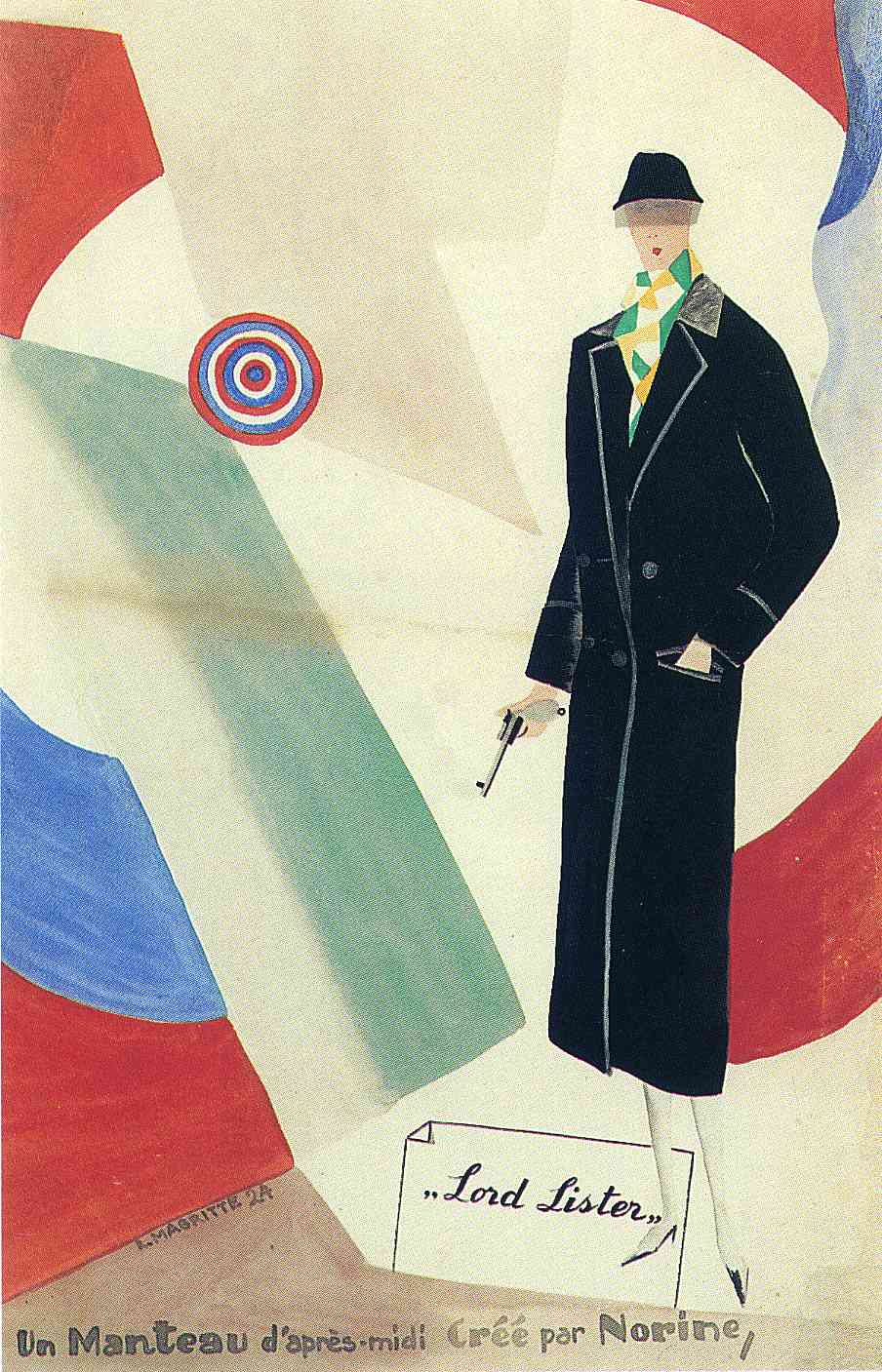
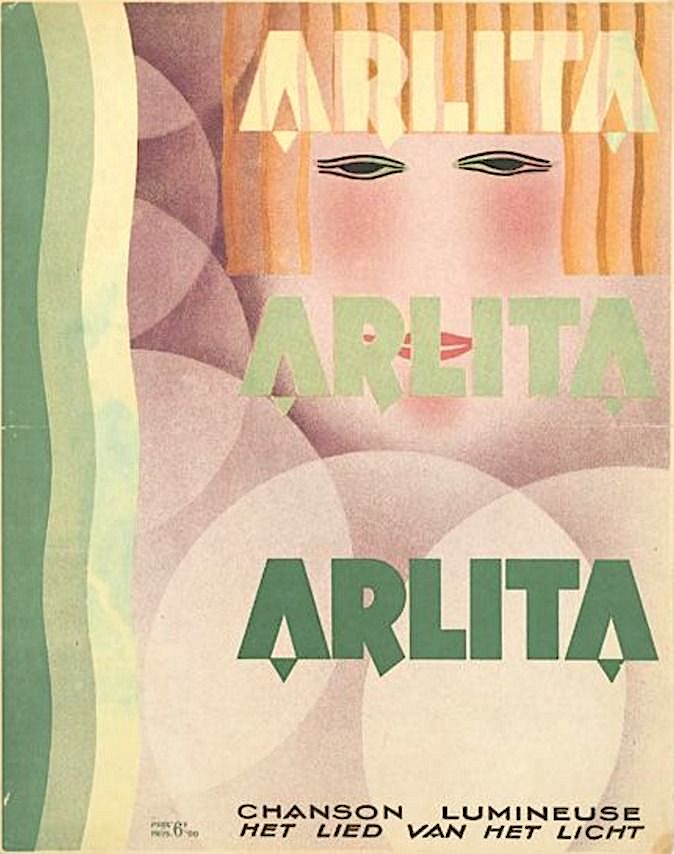
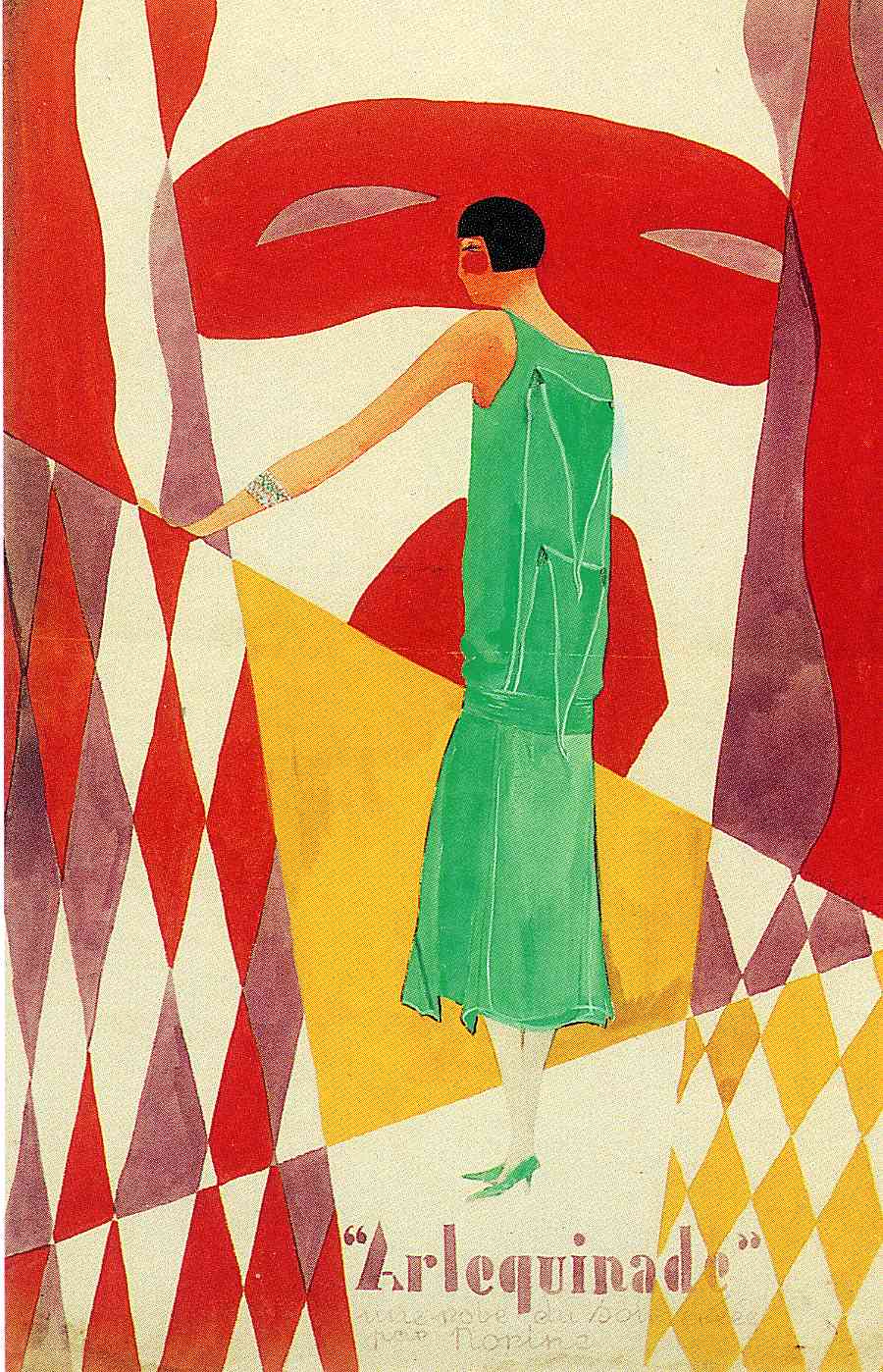
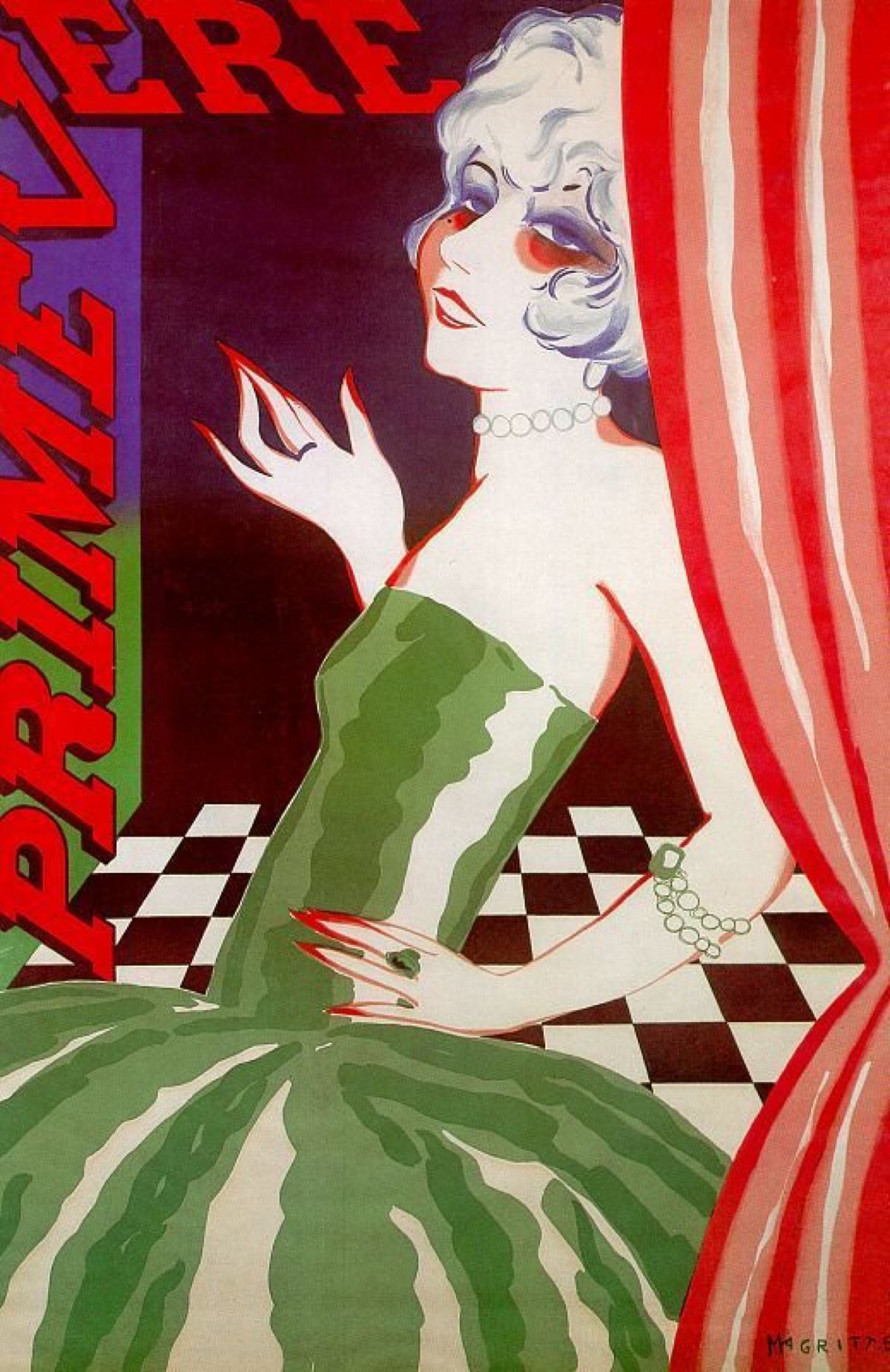
The Belgian painter René Magritte created some of the most enigmatic and iconic works in Surrealist art. But before he moved to Paris in 1927 and began forging relationships with André Breton and the Surrealists, Magritte struggled in Brussels as a freelance commercial artist, creating advertisements in the Art Deco style.
In 1924 Magritte began designing posters and advertisements for the couturier Honorine “Norine” Deschrijver and her husband Paul-Gustave Van Hecke, owners of the Belgian fashion company Norine. Van Hecke also owned art galleries, and was an early champion of surrealism. Van Hecke would eventually pay Magritte a stipend in exchange for the right to market his surrealist works. In the 1924 advertising poster above, Magritte portrays a woman in high heels pretending to be Lord Lister, the gentleman thief from German pulp fiction, wearing “an afternoon coat created by Norine.”
Magritte designed some 40 sheet music covers, most of them in the Art Deco style, according to Hrag Vartanian at Hyperallergic. The one above, “Arlita,” is from about 1925. The French and Dutch subtitles read “The Song of Light.”
The harlequin-themed image above is another advertisement for Norine, circa 1925. Magritte painted it in watercolor and gouache. The penciled inscription at the bottom reads “une robe du soir par Norine” — “an evening gown by Norine.”
In 1926 Magritte was commissioned to create the poster above for the popular singer Marie-Louise Van Emelen, better known as Primevère. For more of Magritte’s Art Deco sheet music covers, visit Hyperallergic.
Note: An earlier version of this post appeared on our site in 2013.
If you would like to support the mission of Open Culture, consider making a donation to our site. It’s hard to rely 100% on ads, and your contributions will help us continue providing the best free cultural and educational materials to learners everywhere. You can contribute through PayPal, Patreon, and Venmo (@openculture). Thanks!
“Democracy is not a spectator sport,” Lawrence Ferlinghetti proclaimed on the wall of his City Lights bookstore, a San Francisco fixture since the poet, activist, and publisher founded the landmark with Peter D. Martin in 1953. Ferlinghetti, who died on Monday at age 101, was himself a fixture, a venerated steward of the counterculture. (See him read “Last Prayer,” above, in a clip from The Last Waltz). On his 100th birthday–on which the city instituted an annual “Lawrence Ferlinghetti Day”–Chloe Veltman interviewed him, describing the poet as “frail and nearly blind… but his mind is still on fire.” It was the same mind that started a publishing house in the 50s with the intent to stir an “international dissident ferment.”
Ferlinghetti and Martin started their bookstore with a mission: “to break literature out of its stuffy, academic cage,” Veltman writes, out of “its self-centered focus on what he calls ‘the me me me,’ and make it accessible to all.” City Lights was the first all-paperback bookstore, opened at a time, he says, when “paperbacks weren’t considered real books.”
For Ferlinghetti, literature and democracy were not separate pursuits. The idea was radical, and so were his patrons. “A bookstore is a natural place for poets to hang out,” Ferlinghetti told NPR’s Tom Vitale, “and they started showing up there”–“They” being East Coast Beats like Ginsberg, Kerouac, and the great, unsung Bob Kaufman.
Like a Northern California Shakespeare and Company, Ferlinghetti’s City Lights became the physical embodiment of a literary movement, especially after the infamous publication of Allen Ginsburg’s Howl and Other Poems, for which Ferlinghetti stood trial for obscenity, an event that “propelled the Beat generation into the international spotlight,” writes Evan Karp. “For the first and–arguably–only time, literature became a popular movement in the U.S.” Young people around the country realized that poetry was relevant to their politics (and lives), and vice versa.
Ferlinghetti published his own first book of poetry, Pictures of the Gone World, in the same year he published Ginsberg’s, but he has not received his critical due alongside the other Beats, despite the fact that his second book, 1958’s A Coney Island of the Mind, “sold more than 1 million copies over the year, ranking perhaps second to Howl as the most popular book of modern American poetry,” Fred Kaplan notes at Slate. (See him read the book’s first poem, “In Goya’s Greatest Scenes We Seem to See…,” from his City Lights office, above.)
His purpose, he writes, was to pierce a culture he calls “a freeway fifty lanes wide / a concrete continent / spaced with bland billboards / illustrating imbecile illusions of happiness.” From his Navy service in WWII–in which he saw the aftermath of Nagasaki weeks after the dropping of the atomic bombs–to the last days of the Trump administration, he kept his keen eye on America’s abuses. His “poetry is notoriously critical of politicians and the status quo,” Karp writes, and he was “unafraid to name names and take stances publicly” as a writer and a lifelong activist.
“Gerald Nicosia, the critic,” Vitale points out, “says Ferlinghetti’s two greatest accomplishments were fighting censorship, and inaugurating a small press revolution.” What did Ferlinghetti himself think of his place in the culture? “In Plato’s republic, poets were considered subversive, a danger to the republic,” he told The New York Times in 1998. “I kind of relish that role.” As for what might finally shake the country out of the anti-democratic spirit that has held its people hostage to corporations and a hostile government, he was not sanguine: “It would take a whole new generation not devoted to the glorification of the capitalist system,” he said. “A generation not trapped in the me, me, me.”
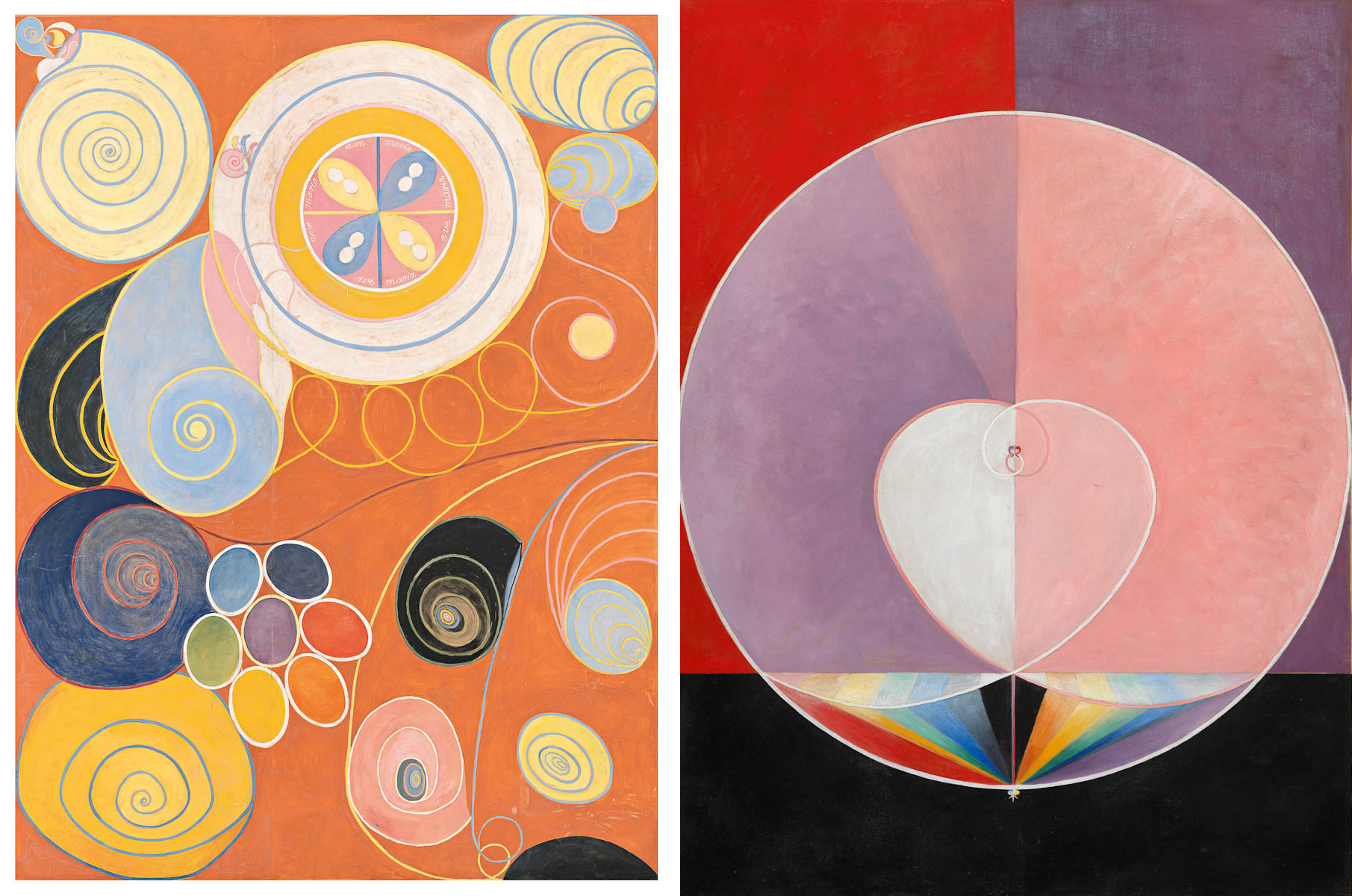
If you are a regular Open Culture reader, you’ve probably seen our many posts on Hilma af Klint, the Swedish abstract painter who might have been recognized, before Wassily Kandinsky, as the first 20th century abstractionist; that is, if she had shown any of her work before her death in obscurity in 1944 (the same year that Kandinsky died, it happens). Instead, af Klint instructed that her paintings not be exhibited until twenty years after her death. Then, another 22 years went by before anyone would see her enigmatic canvases. They first went on display in a 1986 Los Angeles show called, after Kandinsky, “The Spiritual in Art.”
Comparisons seem inevitable, but where the great Russian abstractionist theorized about art and spirit, af Klint encountered it in person, she claimed in her Theosophical accounts, in which she writes of meeting five “high masters” in a séance and receiving instructions for her new style. She was a channel, a vessel, and a medium for the spirits, as she saw it.
“The pictures were painted directly through me, without any preliminary drawings, and with great force. I had no idea what the paintings were supposed to depict; nevertheless, I worked swiftly and surely, without changing a single brush stroke.” She showed her paintings to occultist Rudolph Steiner, who told her to hide them away for the next half century. Discouraged she stopped painting for four years.
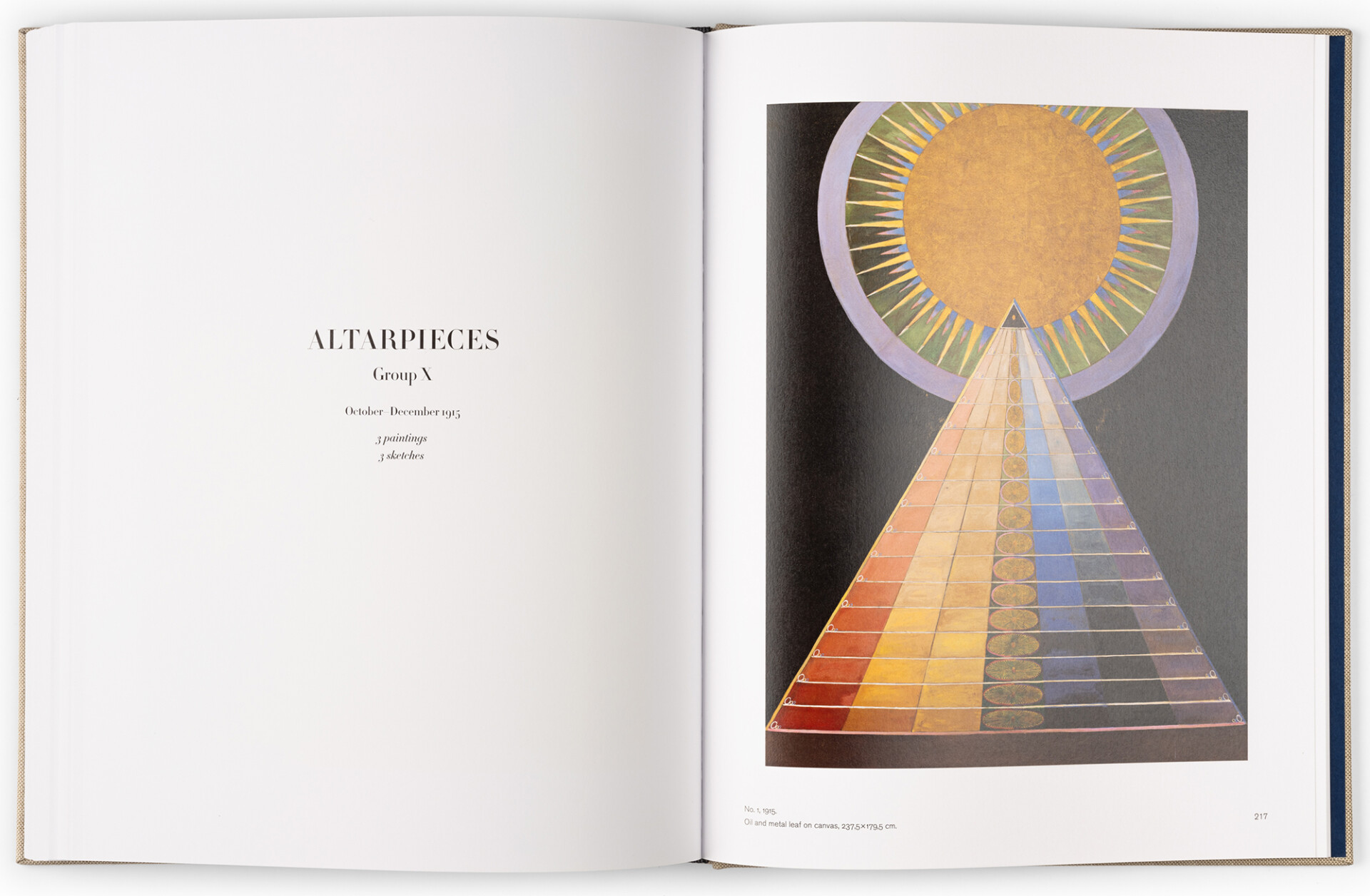
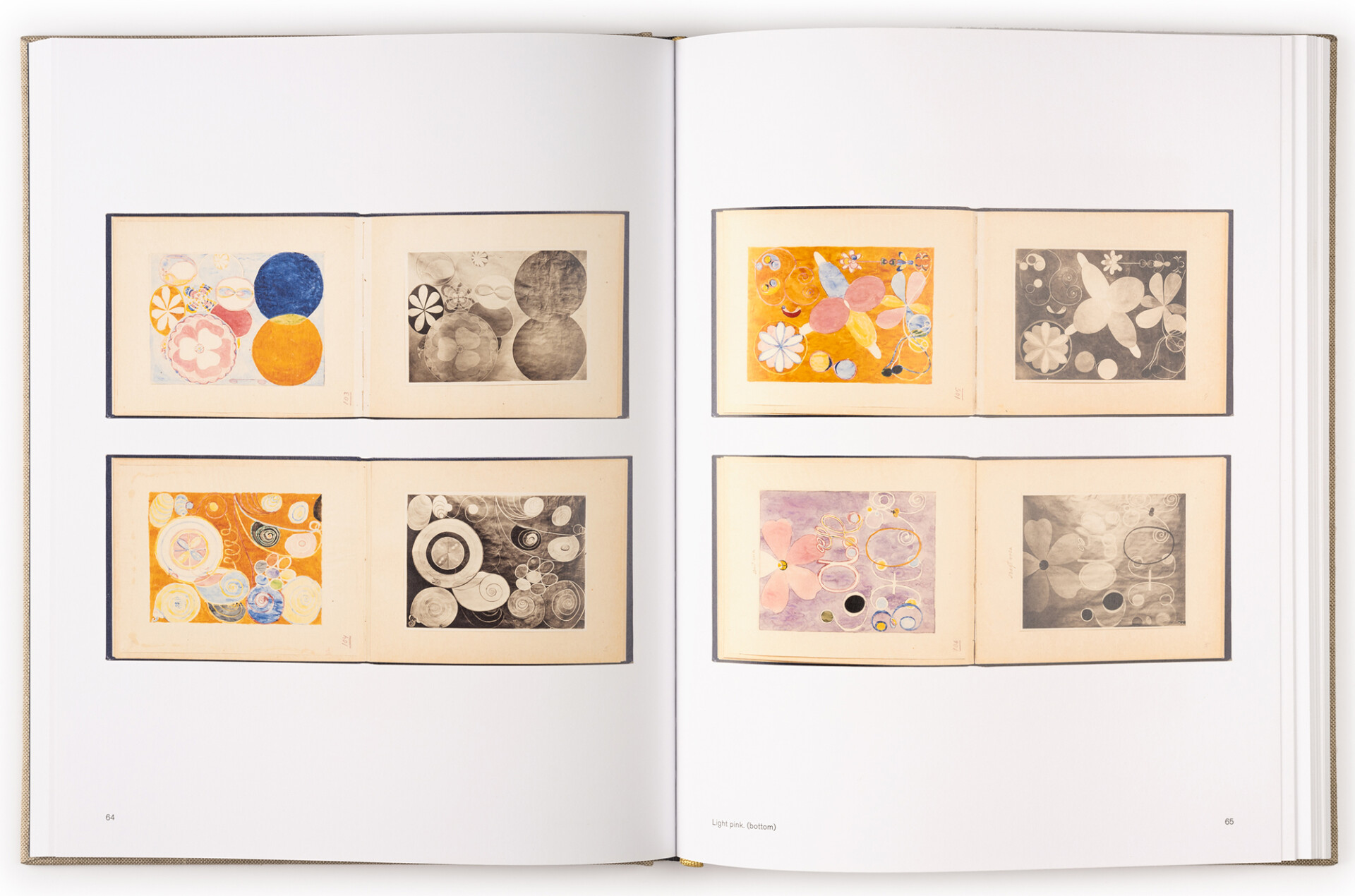
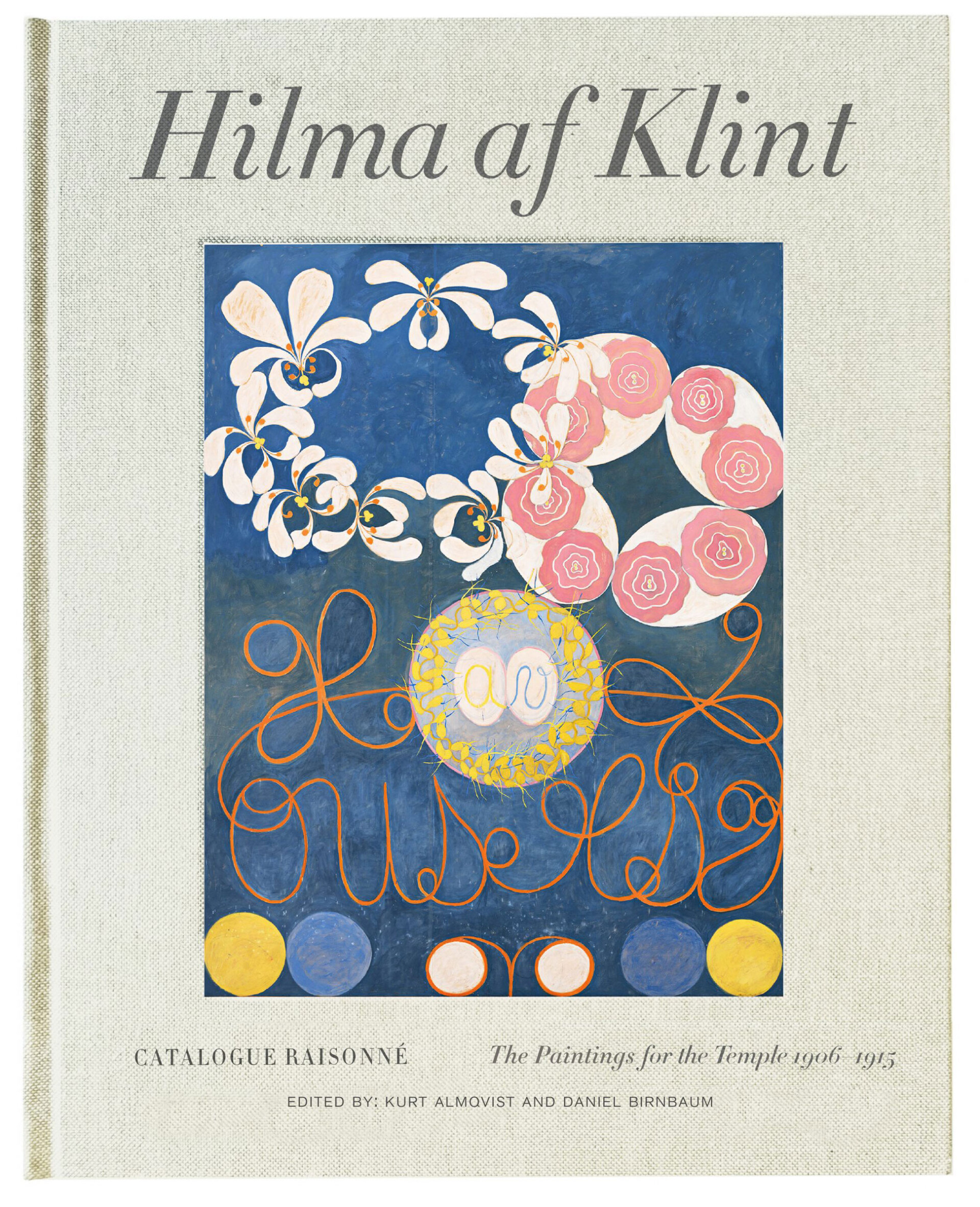
“Af Klint spent her time tending to her blind, dying mother,” writes Dangerous Minds. “She then returned to painting but kept herself and more importantly her work removed from the world.” She was not in conversation with other modern artists. She was in conversation with an unseen world, her own psyche, and a small group of women with whom she regularly conducted séances. Throughout her life, “the prolific Swedish artist created more than 1,600 works,” Grace Ebert writes at Colossal, “an impressive output now collected in Hilma AF Klint: The Complete Catalogue Raisonné: Volumes I‑VII.”
The seven-volume series, published by Bokförlaget Stolpe, “is organized both chronologically and by theme, beginning with the spiritual sketches af Klint made in conjunction with The Five, a group of women who attended séances in hopes of obtaining messages from the dead.” “What makes [af Klint’s] art interesting,” says Daniel Birnbaum, co-editor of the collection, “is that the works are highly interconnected.” Such a comprehensive accounting, a “catalogue raisonné,” is necessary “to see the different cycles, motifs, and symbols that recur in a fascinating way.”
We see such recurring patterns in the work of af Klint’s avant-garde contemporaries, as well, of course, especially in her very famous contemporary Kandinsky. But who knows how her esoteric sources and extremely retiring nature would have been received by the avant-garde movements of her time? Given that even the most extroverted women artists in those movements—from Dada, to Surrealism, to the Bauhaus School, to Abstract Expressionism—have been left out of the story time and again, it’s likely that even had the world known of Hilma af Klint in life, she would not have been appreciated or well-remembered.
But whether we credit the actions of “high masters” or the arbitrary asynchronies of cultural history, it’s clear af Klint’s moment has finally arrived. For “the first time,” Artnet notes, her “dazzling spiritual oeuvre…. will be presented in its totality.”
Above you can watch Badiou, the first feature-length film on France’s most famous living philosopher. On the film’s accompanying website, the directors–Gorav Kalyan and Rohan Kalyan–write:
Nietzsche wrote that all philosophy is a biography of the philosopher. The life of philosopher Alain Badiou suggests that the reverse of this is also true: from one’s life story, we might deduce an entire system of thought.
From his birth in Morocco, to the events of May 1968 in Paris, to his twilight years as a nomadic public intellectual, Badiou’s own biography is perhaps his most complex and thought-provoking work. He is a man who demands to be considered the ally of both Plato and Sartre, St. Paul and Lucifer, the mathematician and the poet.
With intimate access, Gorav and Rohan Kalyan have produced the first feature-length documentary about Alain Badiou. By addressing the inherent contradictions in Badiou’s life and work through cinematic means, the filmmakers are confronted by the inherent contradictions of cinema itself: thought vs action, interiority vs exteriority, presence vs absence. And in order to bring to their complex subject a sense of empathy, clarity, and critique, they must ask a question as old as the medium: can cinema think?
If you would like to support the mission of Open Culture, consider making a donation to our site. It’s hard to rely 100% on ads, and your contributions will help us continue providing the best free cultural and educational materials to learners everywhere. You can contribute through PayPal, Patreon, and Venmo (@openculture). Thanks!
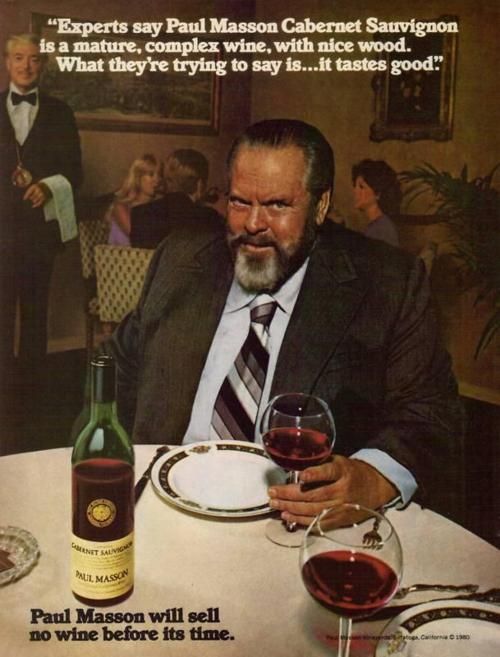
“We will sell no wine before its time”: some Americans respond to this phrase with a chuckle of recognition, others by asking who’ll sell what wine before when. The difference must be generational, since those alive to watch television in the late 1970s and early 80s can’t have avoided hearing those words intoned on a regular basis — and in no less powerful a voice than Orson Welles’. Coming up on forty years after Citizen Kane, the former boy-wonder auteur had fallen on hard times. Struggling to complete his feature The Other Side of the Wind (little knowing that Netflix would eventually do it for him), he relied on acting work to raise professional and personal funds. He’d done it before, but now the productions offering him the most lucrative roles happened to be commercials for cheap wine.
Despite having been cast into the wilderness by Hollywood, if to some degree willingly, Welles still had cultural cachet — exactly what the higher-ups at the mass-market California wine producer Paul Masson thought their brand needed. Making use of Welles’ late-period public image as a Falstaffian gourmand, Paul Masson commissioned a series of television commercials and print advertisements in which he personally endorses a range of their varietals.
In comparing Paul Masson’s “Emerald Dry” to Beethoven’s Fifth Symphony and Gone With the Wind, two works of art known for their prolonged gestation periods, Welles also implicitly acknowledged his own artistic reputation for making films of genius, if films of genius few and far between.
Though Welles balked at the effrontery of a script comparing Paul Masson wine to a Stradivarius violin, he wasn’t without genuine appreciation for the product. “Orson liked Paul Masson’s cabernet,” said John Annarino, the adman at DDB Needham who handled the Paul Masson account. “He often called the ad agency and instructed, ‘Send more red.’ ” He also happened to be a highly experienced booze salesman: “As early as 1945 he had done a radio spot for Cresta Blanca Wines,” writes Inside Hook’s Aaron Goldfarb. “By 1972 he was doing print work with Jim Beam bourbon. By 1975 he was hawking Carlsberg Lager. That same year, he pitched Domecq Sherry, Sandeman port (in which he portrayed their ‘Sandeman Don’ character) and Nikka Japanese Whiskey, which were a huge hit overseas.”
The campaign got Paul Masson a substantial bump in sales, but it stuck DDB Needham with a somewhat difficult star. This is evidenced not just by anecdotes from the set but surviving footage that shows Welles, far from disdainful of the wine at hand, seemingly too satisfied by it to deliver his lines properly. Much like the string of increasingly bitter complaints captured during the voiceover recording of a Findus frozen peas commercial, Welles’ seemingly drunken takes for Paul Masson — and even the finished spots — have gone viral in the internet age. Racking up millions upon millions of views on Youtube, these videos have begun to bring “We will sell no wine before its time,” a catchphrase much-referenced in the 80s, back into the zeitgeist. But then, don’t some things only improve with age?
Based in Seoul, Colin Marshall writes and broadcasts on cities, language, and culture. His projects include the Substack newsletterBooks on Cities, the book The Stateless City: a Walk through 21st-Century Los Angeles and the video series The City in Cinema. Follow him on Twitter at @colinmarshall or on Facebook.
At least 20% of us have some sort of disability, yet such conditions are reflected by only tiny portion of TV and film characterizations, and what characters are portrayed typically get played by non-disabled actors. Depictions often focus on what it’s like to live with the condition. This can of course be socially beneficial, but we don’t want to essentialize people as their conditions, so it’s even more useful to feature disabled actors and characters when the plot is not about their disability.
Pretty Much Pop hosts Mark Linsenmayer, Erica Spyres, and Brian Hirt are joined by playwright Kayla Dryesse to talk about hurdles to representation, disability culture, whether “disability” is even the right word, negative stereotypes (no less than five James Bond villains are in wheelchairs!), and issues in portraying disability related to theater, comedy, horror, and superheroes. Some shows mentioned include Speechless, Atypical, Everything’s Gonna Be Okay, Breaking Bad, Glee, The Stand, The Witches, and The Great British Bake-Off.
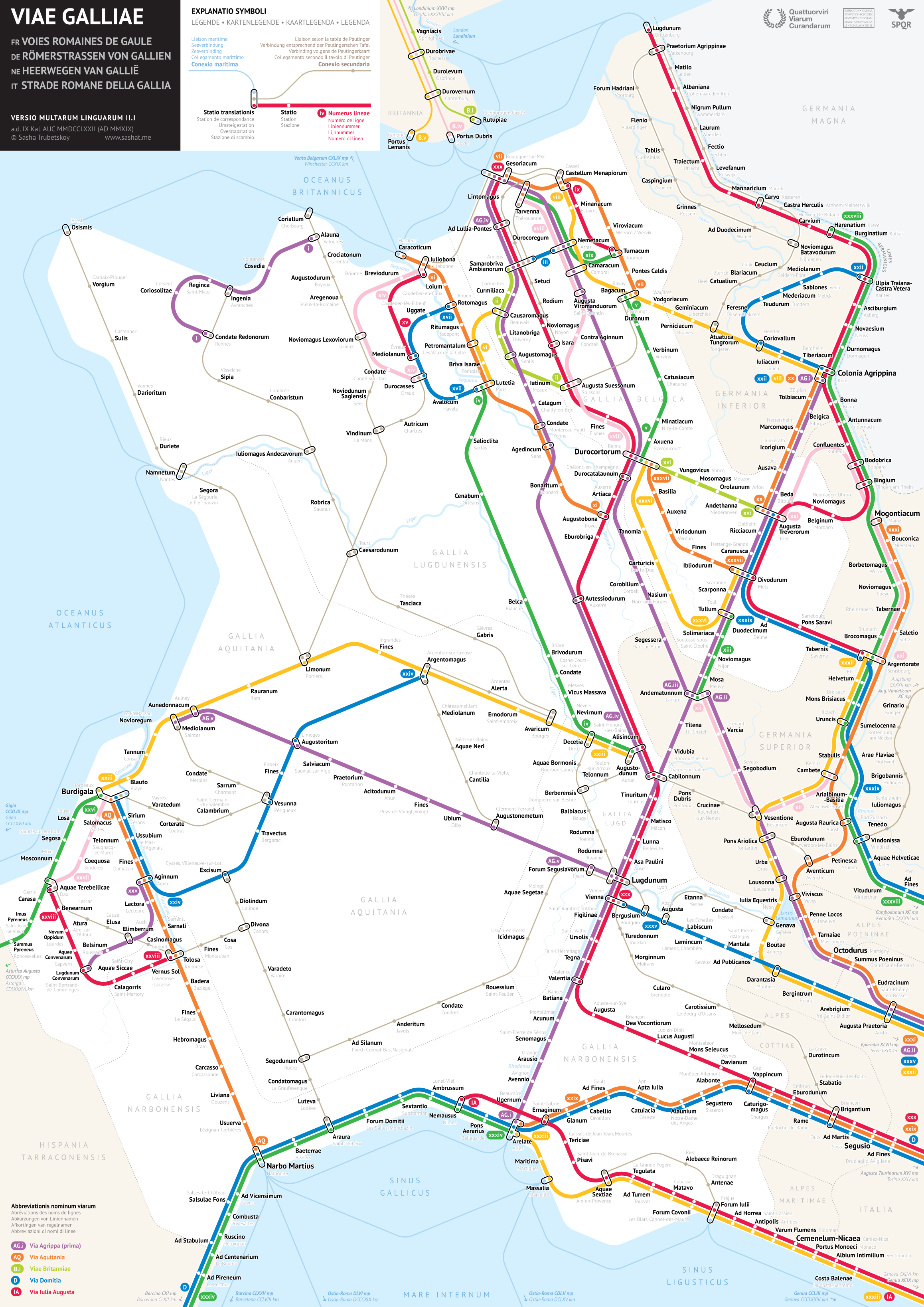
At a casual glance, some travelers may take the map above for a depiction of France’s enviable intercity high-speed rail network Train à Grande Vitesse, better known as TGV. In reality, its content predates that system’s inauguration in the early 1980s — and by nearly two millennia at that. This is in fact a map of Gaul, a region of Europe that, most broadly defined, included modern-day France, Luxembourg, and Belgium, as well as parts of Switzerland, Italy, the Netherlands, and Germany. Ruled by Rome for five centuries until the fall of the Roman Empire itself, Gaul was run through with a number of Roman roads, a subject of fascination for many archaeologically inclined historians.
They’ve also become a subject of fascination for a young data scientist and graphic designer by the name of Sasha Trubetskoy. His work, much featured here on Open Culture, includes maps of the Roman Roads of Britain, Italy, Spain and Portugal, as well as, at a larger scale, those of the entire empire.
“This was an interesting map to make, but I can’t say it was fun all the time,” writes Trubetskoy. “Generally I enjoyed the process, but it was far more challenging than I had anticipated.” You can hear him describe some of the challenges involved, and even show how solving them played out in his design process, in his three-hour explanatory live stream now archived on Youtube.
You can download Trubetskoy’s Roman Roads of Gaul map from his site, and even buy a high-resolution file suitable for printing as a poster (USD $9). “As far as I can tell, it’s done,” writes Trubetskoy of the work, wisely — or from frustrating personal experience — acknowledging that, despite or because of the centuries of distance between us and the relevant historical and geographical facts, those facts could still change. Just as ancient history cannot both make its way to us and maintain absolutely perfect fidelity to the past, so the kind of practical visual design embodied in a subway map necessitates a great deal of simplification and approximation to be useful. And speaking of the graphic arts, just imagine how useful this particular map would’ve been to Asterix.
Based in Seoul, Colin Marshall writes and broadcasts on cities, language, and culture. His projects include the Substack newsletterBooks on Cities, the book The Stateless City: a Walk through 21st-Century Los Angeles and the video series The City in Cinema. Follow him on Twitter at @colinmarshall or on Facebook.
The internet is full of inspirational quotations about writing, many of them from accomplished and respectable writers. But what need could such writers have of inspirational quotations themselves? Surely true literary art flows from its authors without need of encouraging words, demand though it may sustained periods of labor, frustration, and even suffering. These days, more than a few who seek to create such art spend time studying not just its past masterworks but its living masters. “Some years ago,” the novelist Karan Mahajan recently tweeted, “I was lucky to take a class with Denis Johnson, who dressed like a card-shark, in flashy jackets and (unlike a card-shark) wept over sentences. He gave my class a 69-page list of writing quotes he returned to frequently.”
Johnson’s list, which you can see in PDF form here, shows that at least one of our era’s most celebrated writers swore by the kind of writing advice most of us scroll past every day. Though somewhat eccentrically formatted, it rounds up a great deal of valuable wisdom from novelists, poets, and playwrights — as well as philosophers, sculptors, filmmakers, and other figures besides — from different lands and different times.
In it you’ll find these reflections on the art, craft, and life of writing, among many others:
“In genius we perceive our own rejected thoughts, returning to us with a kind of alienated majesty.” — Ralph Waldo Emerson
Simplicity is not an end in art, but we usually arrive at simplicity as we approach the true sense of things.” — Constantin Brâncuși
The first and most obvious characteristic of fiction is that it deals with reality through what can be seen, heard, smelt, tasted, and touched.” ― Flannery O’Connor
“Writing, ideally, is recognizing your bad writing.” — August Wilson
“One is always seeking the touchstone that will dissolve one’s deficiencies as a person and as a craftsman. And one is always bumping up against the fact that there is none except hard work, concentration, and continued application.” — Paul William Gallico
“But what is art, really, but a good instinct for staying alive in your own alley?” — Hunter S. Thompson
There is a microscopically thin line between being brilliantly creative and acting like the most gigantic idiot on earth. — Cynthia Heimel
“A writer is a person for whom writing is more difficult than it is for other people.” — Thomas Mann
“I learned never to empty the well of my writing, but always to stop when there was still something there in the deep part of the well, and let it refill at night from the springs that fed it.” — Ernest Hemingway
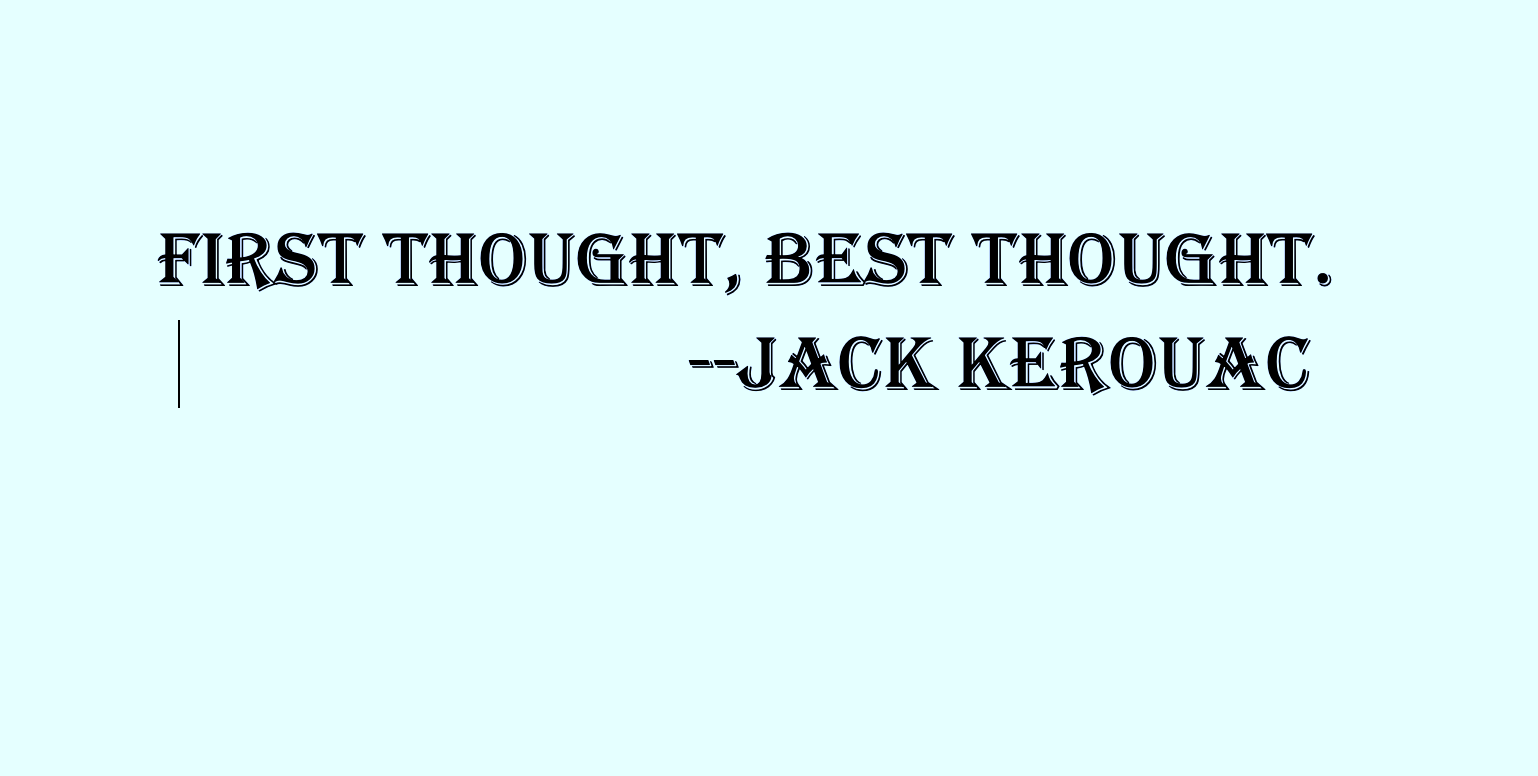
“First thought best thought.” — Jack Kerouac
“The job boils down to two things: paying attention to how the real people around you behave and then telling the truth about what you see.” — Stephen King
“The important thing is that there should be a space of time, say four hours a day at least, when a professional writer doesn’t do anything else but write. He doesn’t have to write, and if he doesn’t feel like it, he shouldn’t try. He can look out of the window or stand on his head or writhe on the floor. But he is not to do any other positive thing, not read, write letters, glance at magazines, or write checks. Write or nothing.” — Raymond Chandler
“I know this, with a sure and certain knowledge: a man’s work is nothing but this slow trek to rediscover, through the detours of art, those two or three great and simple images in whose presence his heart first opened.” — Albert Camus
“Don’t look back.” – Bob Dylan
Over the course of these 69 pages, certain themes emerge: the importance of writing with one’s “blood,” the unimportance of critics, the value of simplicity, the danger of adjectives (and other excess description), the necessity of letting nothing block the flow of the first draft. While many of these quotations offer practical advice — much of it about consistently putting in the hours, both conscious and unconscious — some approach from a more oblique angle not just “writing” as a pursuit but the living of life itself. “To fail to embrace my dreams now would be a disgrace so great that sin itself could not find a name for it,” writes Werner Herzog in the diary he kept during the agonized making of Fitzcarraldo. If this inspired the author of Jesus’ Son and Tree of Smoke, it ought to inspire the rest of us as well.
Based in Seoul, Colin Marshall writes and broadcasts on cities, language, and culture. His projects include the Substack newsletterBooks on Cities, the book The Stateless City: a Walk through 21st-Century Los Angeles and the video series The City in Cinema. Follow him on Twitter at @colinmarshall or on Facebook.
In 1999, Anthony Bourdain’s career seemed to have stalled. While his “principal vocation remained his position as executive chef” at New York’s Les Halles, restless intelligence and wanderlust kept him looking for other opportunities. “He was 43 years old, rode hard and put up wet,” writes Elizabeth Nelson at The Ringer, “a recovering addict with a number of debts and a penchant for finding trouble in failing restaurants across the city.” He had fought for and won an undeniable measure of success, but he hardly seemed on the threshold of the major celebrity chefdom he would maintain until his death twenty years later in 2018.
Then, “in the spring of 2000, his sublimated literary ambitions suddenly caught up with and then quickly surpassed his cooking.” Bourdain’s memoir Kitchen Confidential “became an immediate sensation,” introducing his iconoclasm, acerbic wit, and outrageous confessional style to millions of readers, who would soon become viewers of his try-anything travelogue series, A Cook’s Tour, No Reservations, The Layover, and Parts Unknown, as well as loyal readers of his subsequent books, and even fiction like as Gone Bamboo, a crime novel soon to become a TV series.
How did Bourdain first get his winning personality before the masses? It all started with a 1999 New Yorker article called “Don’t Eat Before Reading This,” the predecessor to Kitchen Confidential and an essay that begins with what we might now recognize as a prototypically Bourdainian sentence: “Good food, good eating, is all about blood and organs, cruelty and decay.” In the interview clip above, from Bourdain’s final, 2017 interview with Fast Company, he talks about how the story led to his “huge break” just a couple days after it ran, when a Bloomsbury editor called with an offer of “the staggeringly high price of fifty thousand dollars to write a book.”
Everyone who loves Bourdain’s writing—and who loved his generous, ecumenical culinary spirit—knows why Kitchen Confidential changed his life overnight, as he says. Yes, “food is pain,” as he writes in the book’s “First Course,” but also, “food is sex”—”the delights of Portuguese squid stew, of Wellfleet oysters on the halfshell, New England clam chowder, of greasy, wonderful, fire-red chorizo sausages, kale soup, and a night when the striped bass jumped right out of the water and onto Cape Cod’s dinner tables.” Bourdain’s prose lingers over every delight, preparing us for the escapades to come.
In Kitchen Confidential, the exhaustion, “sheer weirdness,” and constant “threat of disaster,” that attend New York kitchen life (and life “inside the CIA”—the Culinary Institute of America, that is), becomes fleshed out with scenes of culinary decadence the likes of which most readers had never seen, smelled, or tasted. Fans craved more and more from the chef who wrote, in 1999, just before he would become a bestselling household name, “my career has taken an eerily appropriate turn: these days, I’m the chef de cuisine of a much loved, old-school French brasserie/bistro where… every part of the animal—hooves, snout, cheeks, skin, and organs—is avidly and appreciatively prepared and consumed.”
Read Bourdain’s New Yorker essay here and see his full 2017 interview with Fast Company just above.
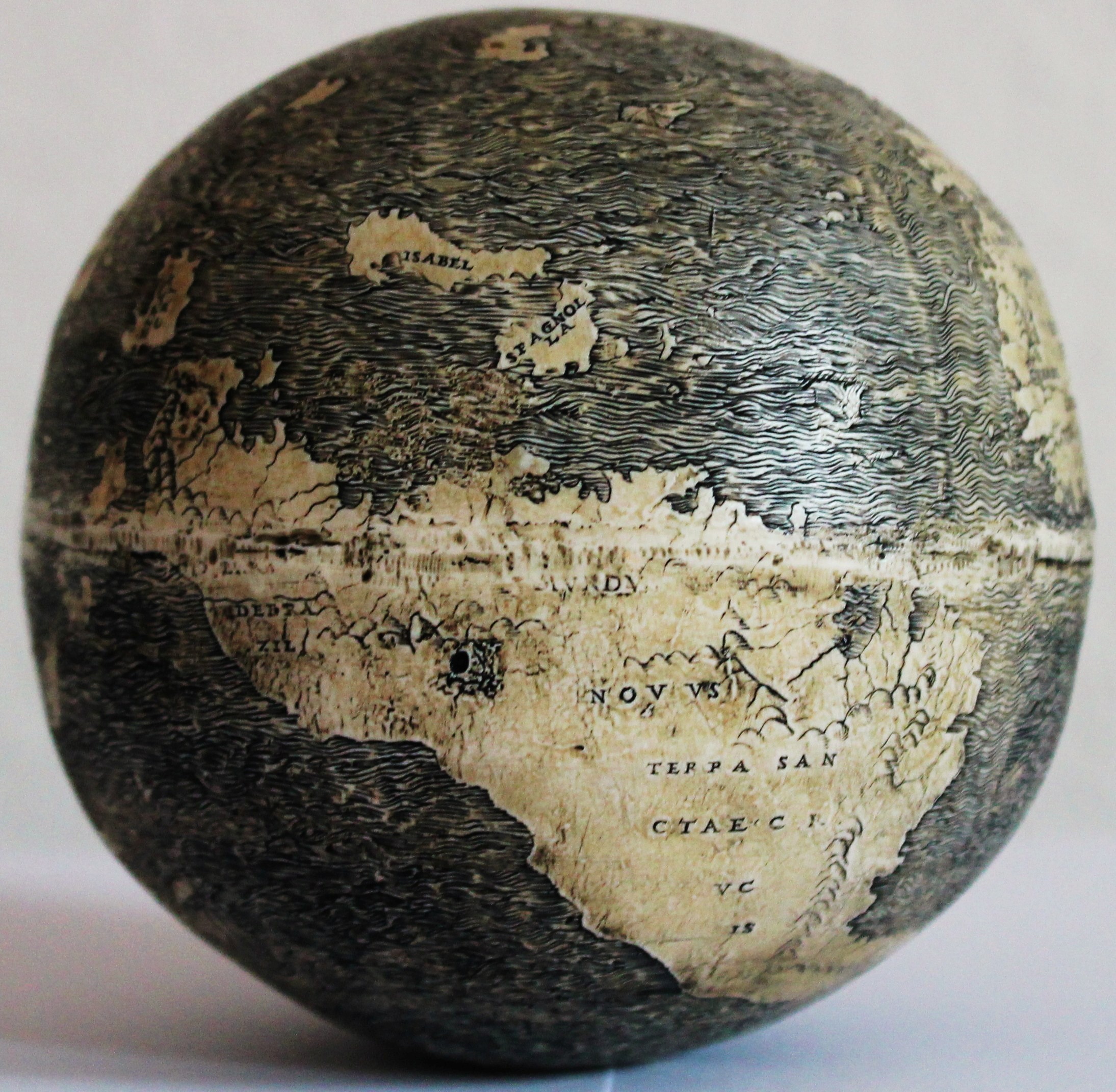
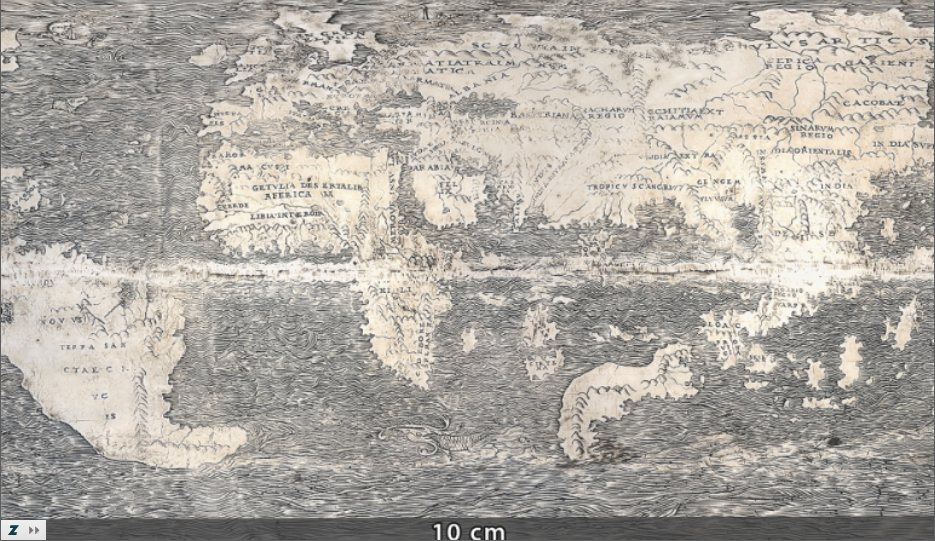
Every time you think you’ve got a handle on Leonardo da Vinci’s genius (which is to say, you think you’ve heard about the most important things he painted, wrote, and invented), yet more evidence comes to light of the many ways he meets the standard for the adjective “genius”.… Recently, Leonardo re-appeared not only as an inventor of futuristic military technology or discoverer of complex human anatomy, but also as the first European to depict the “New World” on a globe–proving he knew about Columbus’ voyages when the globe was made in 1504.
The discovery “marks the first time ever that the names of countries such as Brazil, Germania, Arabia and Judea have appeared on a globe,” notes Cambridge Scholars Publishing, who released a book by the globe’s discoverer and primary researcher, Stefaan Missinne. The artifact attributed to Leonardo is engraved, “with immaculate detail,” writes Meeri Kim at The Washington Post, “on two conjoined halves of ostrich eggs.” And it features a single sentence, in Latin, above Southeast Asia: Hic Sunt Dracones–“Here be dragons.”
We’ll notice other unique features of the engraved egg Missinne calls, simply, “the Da Vinci Globe,” such as the fact that in place of Central and North America are the islands of Columbus’ “discovery,” surrounded by a vast ocean in which Pacific and Atlantic join. Why ostrich eggs? Humans have used them for decorative purposes for millennia. Also, “in that time period,” says Thomas Sander, editor of the Washington Map Society’s journal, Portolan, “the ostrich was quite the animal, and it was a big thing for the noble people to have ostriches in their back gardens.”
Missinne, a real estate developer, collector, and globe expert originally from Belgium, discovered the globe in 2012 at the London Map Fair. It was purchased “from a dealer who said it had been part of an important European collection for decades,” and its buyer and owner remain anonymous. After the globe appeared, Missinne “consulted more than 100 scholars and experts in his year-long analysis,” putting “about five years of research into one year,” says Sander, calling the research “an incredible detective story.”
Missinne’s investigation seems to substantiate his claims that the globe was made by Leonardo or his workshop. The evidence, some of which you can find on the Cambridge Scholars Publishing site, includes a 1503 preparatory map in da Vinci’s papers; the presence of arsenic, which only Leonardo was known to use at the time in copper to keep it from losing its lustre; “The use of chiaroscuro, pentienti, triangular shapes, the mathematics of the scale reflecting Leonardo’s written dimension of planet earth”; and a 1504 letter from Leonardo himself stating, “my world globe I want returned back from my friend Giovanni Benci.”
Missinne and Geert Verhoeven, of the Ludwig Boltzmann Institute for Archaeological Prospection & Virtual Archeology, have published a paper on the “unfolding” of Leonardo’s globe into the two-dimensional image above (see an interactive version here). “This miniature egg globe is not only the oldest extant engraved globe,” the authors write, “but it is also the oldest post-Columbian globe of the world and the first ever to depict Newfoundland and many other territories.” Previously, the Hunt-Lenox Globe, a small copper globe, was thought to be the oldest known such artifact. Dated to around 1510, this globe, Missinne discovered, is actually a copy made from a cast of the older, original ostrich-egg globe.
Missinne’s findings have their detractors, including John W. Hessler of the Library of Congress, who claims Missinne himself is the anonymous owner of the globe, which raises issues of conflict of interest. “Where this thing comes from needs to be clarified,” says Renaissance cartography expert Chet Van Duzer of the John Carter Brown Library in Providence, R.I., though he adds, “It is an exciting discovery, no question.” Missinne’s claims for the egg’s provenance are more modest than his marketing. He “speculates,” writes Kim, “ the egg could have loose connections to the workshop of Leonardo da Vinci.” Hessler’s view is less equivocal: “The Leonardo connection is pure nonsense.”
A layperson like Missinne, whatever his personal investment, might be inclined to overinterpret evidence or make tenuous connections a trained scholar would avoid. The many scholars he cites in support of his claims for the globe are also vulnerable to these charges, however, though to a lesser degree. What do we make of French Mona Lisa expert Pascal Cotte’s testimonial, “I hereby confirm the evidence of the left-handedness of the engravings on the Ostrich Egg Globe. As Leonardo was the only left-handed artist in his workshop, I hereby endorse the hypothesis of Leonardo da Vinci’s authorship”? As in all such academic debates, “Here be dragons.” Weigh the case in full in Missinne’s 2018 book, The Da Vinci Globe.
We're hoping to rely on loyal readers, rather than erratic ads. Please click the Donate button and support Open Culture. You can use Paypal, Venmo, Patreon, even Crypto! We thank you!
Open Culture scours the web for the best educational media. We find the free courses and audio books you need, the language lessons & educational videos you want, and plenty of enlightenment in between.