It took about 110 days to put together. A digital animation comparing the size of trees, from a miniature 3‑inch bonsai, to a sequoia soaring more than 300 feet high. Some trees are smaller than blades of grass. Others bigger than the Statue of Liberty. A lot fall somewhere between.
If you would like to support the mission of Open Culture, consider making a donation to our site. It’s hard to rely 100% on ads, and your contributions will help us continue providing the best free cultural and educational materials to learners everywhere. You can contribute through PayPal, Patreon, and Venmo (@openculture). Thanks!
Happiness, we know, is hard to come by, even in the best times. And if we agree on nothing else, we might agree that these are not the best of times. An air of gloomy dread and outraged alarm prevails for good reason. There have been many other times in history to justifiably feel this way. In 1944, German Jewish philosopher Theodor Adorno—exiled for ten years from his home and sojourning through a U.S. he found increasingly fascist in character—resigned himself to quiet despair.
“There is no way out of entanglement,” he wrote in his trenchant, gloomy collection of aphorisms, Minima Moralia. “The only responsible course is to… conduct oneself privately as modestly, unobtrusively and unpretentiously as is required, no longer by good upbringing, but by the shame of still having air to breathe, in hell.”
Adorno’s absurdist melancholia came from many places: his assessment of capitalism’s inescapability, his survivor’s guilt, his generally morose temperament…. He rarely confessed to having happy thoughts even when things were going well. Another thinker of the period, philosopher of the absurd and a writer for the French Resistance during World War II, had a very different take on the question of happiness in dark times.
Albert Camus reminded us that all times are dark times for someone. Speaking after the war in 1959, he castigated the idea that we should be shamed into misery. “Today happiness is like a crime,” Camus sneered, “never admit it. Don’t say ‘I’m happy’ otherwise you will hear condemnation all around.” One pertinent question both of these very different perspectives address is whether happiness is morally responsible.
Former Talking Heads frontman, record label maven, and frequent cultural critic David Byrne has answered the question in the affirmative with his project, Reasons to Be Cheerful, first an online compendium of news stories, now a curated online magazine designed to be a “tonic for tumultuous times.” Reasons to Be Cheerful starts with the premise that we are subjected daily to “amplified negativity” that wildly skews our view of events around the world.
It’s an old complaint; we’ve all heard, or voiced, a version of why don’t they ever show any good news? Byrne put his creative energy and resources behind the criticism to do something about it, “collecting good news,” he says, “not schmaltzy, feel-good news, but stuff that reminded me, ‘Hey, there’s positive stuff going on! People are solving problems and it’s making a difference!’”
In their blurb for the introductory video at the top, the Reasons to Be Cheerfulteam describe the site as “an online editorial project” that is “part magazine, part therapy session, part blueprint for a better world.” The site’s “stories of hope” don’t shy away from sentiment, but they are “rooted in evidence” and purport to show “smart, proven, replicable solutions to the world’s most pressing problems.”
Byrne and the editors and writing staff make no explicitly political statements, but they clearly value things like quality public education, clean air and water, a sustainable climate, and the creation of more public space—all areas that are now vastly under threat. Whether or not you find your own reasons to be cheerful in this commitment to positive journalism may depend on who and where you are, and whether you tend to see the world more like Adorno or Camus.
Wichita Public Library has a neat system. They write on their blog: “Every time materials are borrowed from the Wichita Public Library (WPL) customers receive a receipt showing how much they have saved in that visit, the year to date, and their lifetime savings. The information is displayed on the receipt similar to the ways that retail stores show savings to club members or coupon users.” They then go on to add: “So far this year, the highest dollar amount saved by a customer’s account is $64,734.12. And the highest dollar amount saved by a customer’s account since this feature was implemented is $196,076.21.” Every book adds up…
If you would like to support the mission of Open Culture, consider making a donation to our site. It’s hard to rely 100% on ads, and your contributions will help us continue providing the best free cultural and educational materials to learners everywhere. You can contribute through PayPal, Patreon, and Venmo (@openculture). Thanks!
“It’s not what a movie is about,” Roger Ebert famously wrote, “it’s how it is about it.” Subject matter, we might say, separates the weak filmmakers from the strong: those who require a striking “high concept” (killer doll, body switch, Snakes on a Plane) fall into the former group, while those who can make a film about absolutely anything fall into the latter. It’s safe to say that not everyone is moved by the scene in American Beauty where the camcorder-toting teenager waxes poetic about his footage of a plastic bag in the wind. But what would similar material look like in the hands of a more assured director?
For an example, have a look at Plastic Bag, the eighteen-minute short above. Every cinephile with an interest in American film knows the name of Plastic Bag’s director, Ramin Bahrani. Over the past decade and a half he has emerged as the maker of unusually powerful and realistic glimpses of life in his homeland, focusing on characters like a Pakistani immigrant running a New York bagel cart, an orphan working at a chop shop, and a Senegalese cab driver in North Carolina.
In its own way, the protagonist and title character of Plastic Bag is also at once an outsider to American life and a figure inseparable from it — and voiced by an insider-outsider of another kind, the German filmmaker Werner Herzog. (Their collaboration has continued: you may remember Herzog’s appearance in a Bahrani-directed episode of Morgan Spurlock’s series We the Economy about a lemonade stand.)
Beginning his journey at a grocery-store checkout counter, he spends his first few happy days at the home of his purchaser. But not long after this idyll of service — carrying tennis balls, being filled with ice to numb a sprain — comes to its inevitable end, he finds himself deposited into a landfill. But the wind comes to his rescue, carrying him across a series of suburban, post-industrial, and finally rural landscapes as he looks desperately for his owner.
Ultimately the bag makes it into places seldom seen by human eyes, with a combination of gravitas and wonder imbued by both Herzog’s diction and the music of Sigur Rós’ Kjartan Sveinsson. Watched today, Plastic Bag feels more elegiac than it did when it debuted a decade ago, since which time plastic-bag bans have continued to spread unabated across the world. How long before not just the hero of Bahrani’s film, but all his polyethylene kind fade from existence — forgotten, if not quite decomposed?
Based in Seoul, Colin Marshall writes and broadcasts on cities, language, and culture. His projects include the book The Stateless City: a Walk through 21st-Century Los Angeles and the video series The City in Cinema. Follow him on Twitter at @colinmarshall or on Facebook.
Mark Linsenmayer, Erica Spyres, and Brian Hirt finally cover a current film, and of course use it as an entry point in discussing the social function of super-hero films more generally, how much realism or grittiness is needed in such stories, whether to repeat or bypass the origin story, everlasting franchises, the use of multi-verses as a storytelling device, exaggerating the potential in a story of new technologies that the audience doesn’t really understand, and more.
It’s one of the ironies of the mid-seventies that Pink Floyd became identified with the worst excesses of popular rock and roll. They were dismissed by punk and New Wave bands as too slick and bombastic, but while they may have turned into a stadium act after Dark Side of the Moon, they also deserved credit for pioneering the kind of avant-art-rock theater punk eventually normalized. One early performance, for example, involved “sawing wood and boiling kettles on stage,” writes Mark Blake, of the album that was meant to be the follow-up to Dark Side of the Moon—an album called Household Objects, consisting entirely of sounds made on… household objects.
The band was totally engrossed in this radically anti-commercial DIY project until 1974, “making chords up from the tapping of beer bottles,” remembers producer John Leckie, then a tape operator at Abbey Road, “tearing newspapers for rhythm, and letting off aerosol cans to get a hi-hat sound.” Given the incredible expense of spending hours a day—over a period of years—recording rubber bands and pencils at Abbey Road studios, one can see the merit in charges of meaningless excess.
But as we’ve seen from Jimi Hendrix, Brian Wilson, The Beatles, and the maddening recording process of Steely Dan, when talented musicians have the luxury to use the studio as an instrument, the results can very well justify the costly means. What did Household Objectsyield? The haunting crystalline sound of the wine glass harp in “Shine One You Crazy Diamond Part 1.” Maybe not much else. Was it worth it? I think so. But how can anyone measure such things?
Better to “go with the flow,” as David Gilmour’s wife Polly Samson tells him in the video at the top—do whatever seems like the intuitive next thing and see what happens. This is not a trivial statement. It was the guiding creative principle of Pink Floyd’s most inspired work. Gilmour takes her advice, and invites wine glass player Igor Sklyarov, whom he met that day on the streets of Venice, to perform on “Shine on You Crazy Diamond” in St. Mark’s Square that very night. (You’ll see some footage of the show in the short clip.)
Of course, the wine glasses have made it into many live performances of the song—see a trio of players rehearse the part above, and play it live below. Sklyarov’s turn on the glasses is just one notable demonstration of Floydian spontaneity. Gilmour’s version of “go with the flow” might always be more rarified than ours, but the lesson he and his erstwhile Pink Floyd bandmates imparted remains relevant and accessible to every artist.
In the postwar Western imagination, modernity took three forms: the rocketship, the jetliner, and the automobile. The first two may have more direct claim to defining the “Space Age,” but only the third lay within reach of the average (or slightly above average) consumer. And at the 1955 Paris Auto Show the world first beheld a car that, aesthetically speaking, might as well have been a spacecraft: the Citroën DS. Pronounced in French like déesse, that language’s word for “goddess,” the car received 80,000 order deposits during the show, a record that stood for six decades until the debut of Tesla’s Model 3 — which, whatever its respectability as a feat of design and engineering, will never have Roland Barthes to extol its beauty.
“I mean the supreme creation of an era, conceived with passion by unknown artists, and consumed in image if not in usage by a whole population which appropriates them as a purely magical object. It is obvious that the new Citroen has fallen from the sky inasmuch as it appears at first sight as a superlative object.” Possessed of all the features of “one of those objects from another universe which have supplied fuel for the neomania of the eighteenth century and that of our own science-fiction: the Déesse is first and foremost a new Nautilus.”
Smoothness, Barthes writes, “is always an attribute of perfection because its opposite reveals a technical and typically human operation of assembling: Christ’s robe was seamless, just as the airships of science-fiction are made of unbroken metal.” Hence his detection, in the unprecedentedly smooth lines of the DS, of “the beginnings of a new phenomenology of assembling, as if one progressed from a world where elements are welded to a world where they are juxtaposed and hold together by sole virtue of their wondrous shape, which of course is meant to prepare one for the idea of a more benign Nature.” Here we have “a humanized art, and it is possible that the Déesse marks a change in the mythology of cars,” raising them from “the bestiary of power” into the realm of the “spiritual and more object-like.”
In the Influx video at the top of the post, British Citroën specialist Matt Damper reads from Barthes’ essay to evoke the distinctive joie de vivre of French car culture in general and classic Citroëns in particular. (It must be said, however, that one of the main “unknown artists” to which the DS owes its unearthly beauty, sculptor turned industrial designer Flaminio Bertoni, hailed from Italy.) “You have to drive it in a completely different way than you drive any other car, really,” says Damper. “It’s that Frenchness: it’s like, ‘We’re right. This is the correct way of building a car. Just get used to it.’ ” Wired’s Jack Stewart echoes the sentiment in the video just above, “The 1955 Citroën DS Still Feels Ahead of Its Time.”
Stewart names the “strange semi-automatic gearbox that you have to get used to,” among the innovative or at least unconventional features with which the DS debuted, a list that also included hydraulic suspension (suited to France’s still-shambolic roads) and disc brakes. “That’s just the thing with Citroëns: they’re unforgiving if you don’t know what you’re doing, so you really have to learn how to drive these cars.” Or as Citroëns’s American ad campaign put it, “It takes a special person to drive a special car.” The DS didn’t sell stateside, in part due to its low-powered engine made to dodge French automobile tax structures, but now car-lovers around the world recognize it as one of the great achievements in motoring. The Citroën DS and the prose of Roland Barthes have a deep commonality: only those who understand that they have to approach the object on its own terms will find themselves in the presence of superior craft — albeit of a distinctively Gallic variety.
Below Jay Leno gives you a close up view of his 1971 Citroën DS and its unique suspension system.
Based in Seoul, Colin Marshall writes and broadcasts on cities, language, and culture. His projects include the book The Stateless City: a Walk through 21st-Century Los Angeles and the video series The City in Cinema. Follow him on Twitter at @colinmarshall or on Facebook.
Haruki Murakami’s vast international fan base includes people dedicated to literature. It also includes people who have barely cracked any books in their lives — apart, that is, from Murakami’s novels with their distinctive mixture of the lighthearted with the grim and the mundane with the uncanny. Since the publication of his first novel, Hear the Wind Sing, 40 years ago in his native Japan, Murakami has become both a literary phenomenon and an extra-literary phenomenon, and different readers endorse different paths into his unique textual realm.
The TED-Ed video above makes the case for one fan favorite in particular: 2002’s Kafka on the Shore, an “epic literary puzzle filled with time travel, hidden histories, and magical underworlds. Readers delight in discovering how the mind-bending imagery, whimsical characters and eerie coincidences fit together.” So says the video’s narrator, reading from a lesson written by literary scholar Iseult Gillespie (who has also made cases for Charles Dickens, Virginia Woolf, and Ray Bradbury).
Murakami tells this story, and keeps it fresh through more than 500 pages, by alternating between two point-of-view characters: a teenager “desperate to escape his tyrannical father and the family curse he feels doomed to repeat,” who “renames himself Kafka after his favorite author and runs away from home,” and an old man with “a mysterious knack for talking to cats.”
When the latter is commissioned to use his unusual skill to track down a lost pet, “he’s thrown onto a dangerous path that runs parallel to Kafka’s.” Soon, “prophecies come true, portals to different dimensions open up — and fish and leeches begin raining from the sky.” But it’s all of a piece with Murakami’s body of work, with its novels and stories that “often forge fantastic connections between personal experience, supernatural possibilities, and Japanese history.” His “references to Western society and Japanese customs tumble over each other, from literature and fashion to food and ghost stories.”
All of it comes tied together with threads of music: “As the runaway Kafka wanders the streets of a strange city, Led Zeppelin and Prince keep him company,” and he later befriends a librarian who “introduces him to classical music like Schubert.” Safe to say that such references put some distance between Murakami’s work and that of his character Kafka’s favorite writer, to whom Murakami himself has been compared. Kafka on the Shore showcases Murakami’s storytelling sensibility, but is it in any sense Kafkaesque? You’ll have plenty more questions after taking the plunge into Murakami’s reality, but there’s another TED-Ed lesson that might at least help you answer that one.
Based in Seoul, Colin Marshall writes and broadcasts on cities, language, and culture. His projects include the book The Stateless City: a Walk through 21st-Century Los Angeles and the video series The City in Cinema. Follow him on Twitter at @colinmarshall or on Facebook.
You’ll hardly ever run into a description of German New Wave wunderkind Klaus Nomi that doesn’t contain a reference to Weimar Germany. It would seem like a serious oversight not to mention Nomi’s embodiment of Weimar cabaret mannerisms, fitted for a space-age late-20th century. But the influence was far more than a stylistic borrowing. Nomi wasn’t just “the most German act ever,” as blogger Debris Slide writes; “Weimar Republic comes to Danceteria, except with spaceships” may also have been the most historically gay act in modern pop.
The Weimar Republic is well known as “a period of remarkable artistic energy,” writes Andrew Dickson at the British Library, “a roaring surge of modernist art, theatre, design, dance and film.” It was also a time when “the constraints of 19th-century manners and mores were torn down.” Hidden sexualities could emerge in public in Berlin, thanks a relaxed policing policy, as historian Robert Beachy shows in his book Gay Berlin. The fine arts and culture of Weimar flourished alongside the cabaret scene, whose camp showed up in everything from German Expressionist film to avant-garde opera.
“I think there probably had never been anything like this before,” Beachy tells NPR, “and there was no culture as open again until the 1970s.” Klaus Nomi arrived in the 70s with his cabaret space alien act to announce that the creative and personal freedoms of Weimar had returned, and he was their avatar, freely mixing opera and pop with astonishing facility, incorporating mime and vaudeville. “The influence of playwright and theatrical icon Bertolt Brecht would come to serve as a definitive touchstone” for Nomi’s career, writes Evan Zwisler at Flypaper.
“One of the ideas that Nomi incorporated into his own act was Verfremdungseffekt (or, ‘the distancing effect’)”—drawing heightened attention to the performance as performance, a significant feature of nearly all avant-garde theater in the early 20th century. Klaus Nomi was also the most Modernist act ever, at least in pop music. He would have fit in with a Dada cabaret revue of sixty years earlier. I’m not sure what it says about Berlin in the 70s that Nomi only truly found himself while onstage in New York. He moved to the city in 1972 after working as an usher in Berlin opera houses, where his astonishing soprano went unappreciated.
Nomi became “a quietly revolutionary part of the New York City art scene,” notes Zwisler, inspiring Jean-Michel Basquiat and Keith Haring. He appeared on Saturday Night Live with David Bowie in 1979 and in the 1981 documentary Urgh! A Music War. Had AIDS not claimed his life in 1983, Nomi’s fame may have spread even farther and wider. As it stood, however, the year before his death, it had at least spread to his home country, where he was welcomed by TV host Thomas Gottschalk on the German program No Sowas!, performing with Kraftwerk, the biggest German pop cultural export to date.
See Nomi sing the aria from Camille Saint-Saens’ “Samson and Delilah.” Then, we have a rare treat: the very Caligari-like cabaret of Kraftwerk, at the height of their austere synth pop fame. Nomi returns to sing “Total Eclipse” from his first album. You can read an English translation of Nomi’s between-song interview with Gottschalk here. The host wraps up this segment by saying, “he is already a big name in America, and now we present him here in Germany.”
Someone should really snap up the rights for a movie about The Critics, a collective of self-taught teenage filmmakers from northwestern Nigeria.
The boys’ dedication, ambition, and no-budget inventiveness calls to mind other filmmaking fanatics, from the sequestered, homeschooled brothers of The Wolfpack to the fictional Sweding specialists of Me and Earl and the Dying Girl and Be Kind, Rewind.
While smartphones and free editing apps have definitely made it easier for aspiring filmmakers to bring their fantasies to fruition, it’s worth noting that The Critics saved for a month to buy the green fabric for their chroma key effects.
Their productions are also plagued with the internet and power outages that are a frequent occurrence in their home base of Kaduna, slowing everything from the rendering process to the Youtube visual effects tutorials that have advanced their craft.
To date they’ve filmed 20 shorts on a smart phone with a smashed screen, mounted to a broken microphone stand that’s found new life as a homemade tripod.
Their simple set up will be coming in for an upgrade, however, now that Nollywood director Kemi Adetiba has brought their efforts to the attention of a much wider audience, who donated $5,800 in a fundraising campaign.
It’s easy to imagine the young male demographic flocking to a feature-length, big-budget expansion of Z: The Beginning. It’s possible even the art house crowd could be lured to a summer blockbuster whose setting is Nigeria, thirty years into the future, a novelty for those of us unversed in Nollywood’s prodigious output.
The post-apocalyptic short, above, took the crew 7 months to film and edit. The stars also inhabited a number of offscreen roles: stunt coordinator, gaffer, prop master, composer, continuity…
What’s next? Earlier this month, Africa News revealed that the boys are busy with a new film whose plot they aren’t at liberty to reveal. We’re guessing a sequel, to go by a not so subtle hint following Z’s final credits and a moving dedication to “the ones we’ve lost.”
“Horror, comedy, sci-fi, action, we do all,” The Critics’ proclaim on their Youtube channel, carefully categorizing their work as “films not skits.” (Their films’ length has thus far been dictated by the unpredictability of their wifi situation—Chase, below, is five minutes long and took two days to render.
“One of the targets we aim for in the years to come is to make the biggest film in Nigeria and probably beyond,” Godwin Josiah, Z’s 19-year-old writer-director told Channels Television, Lagos’ 24-hour news channel:
We want to do something crazy, we want to do something great, something that has not been done before, and from what has been going on now, we believe quite well that it is going to happen soon enough.
Watch The Critics’ films and making-ofs on their Youtube channel.
Support their work with a pledge to their recently launched Patreon.
There was a time—a strange time in pop culture history, I’ll grant—when legal dramas were everywhere in television, popular fiction, and film. Next to the barn-burning courtroom set pieces in A Few Good Men and A Time to Kill, for example, scenes of lawyers poring over case law with loosened ties, high heels kicked off, and martinis and scotches in hand were rendered with maximum dramatic tension, despite the fact that case law is a nigh unreadable jumble of jargon, citations, archaic diction and syntax, etc… anything but brimming with cinematic potential.
Do law students and legal scholars disagree with this assessment? It’s beside the point, many might say. The centuries-old web of case law—reinforcing, contradicting, overturning, creating patterns and structures—is the very stuff the law is made of.
It’s a referential tradition, and when most of the documents are in the hands of only a few people, only those people understand why the law works the way it does. The rest of us are left to wonder why the legal system is so Byzantine and incomprehensible. Real life rarely has the clarity of a satisfying courtroom drama.
Last year, The Harvard Crimson reported a seemingly revolutionary shift in that dynamic, when Harvard Law’s Caselaw Access Project “digitized more than 40 million pages of U.S. state, federal, and territorial case law documents from the Law School library,” dating back to 1658. The Crimson issued one caveat: the full database is accessible to the public, but “users are limited to five hundred full case texts per day.” Plan your intense, scotch-soaked all-nighters accordingly.
Is this altruism, civic duty, a move in the right direction of freeing publicly funded research for public use? Several Harvard Law faculty have said as much. “Case law is the product of public resources poured into our court system,” writes Professor I. Glenn Cohen. “It’s great that the public will now have better access to it.” It is indeed, Professor Christopher T. Bavitz says: “If we want to ensure that people have access to justice, that means that we have to ensure that they have access to cases. The text of cases is the law.”
The law is not a set of abstract principles, theories, or rules, in other words, but a series of historical examples, woven together into a social narrative. Machines can analyze data from The Caselaw Access Project far faster and more efficiently than any human, giving us broader views of legal history and precedent, and greatly expanding public understanding of the system. Harvard’s Library Innovation Lab has itself already created several apps for just this purpose.
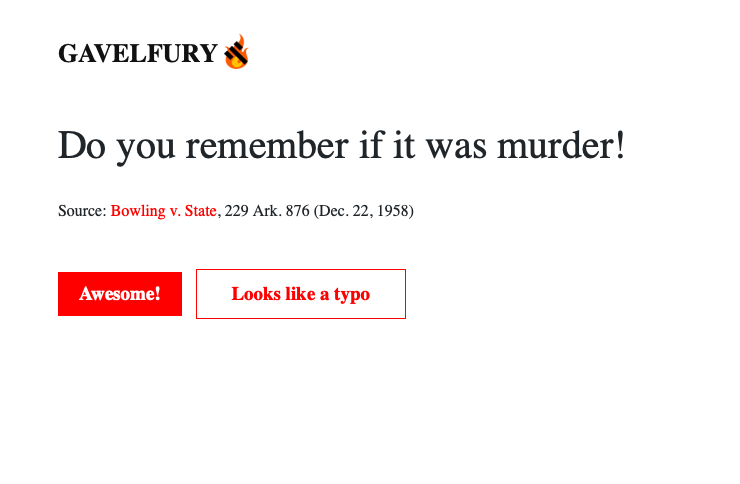
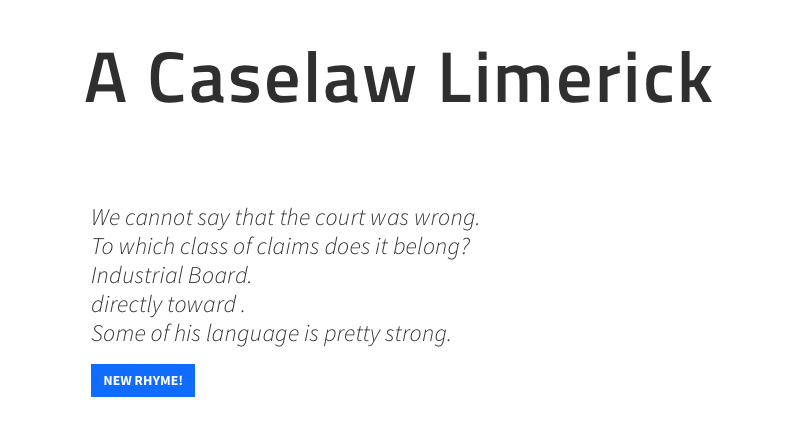
There’s California Wordclouds, which shows the most-used words in California caselaw between 1852 and 2015, and Witchcraft in Caselaw, which does what it says, with an interactive map of all appearances of witchcraft in cases across the country. There’s “Fun Stuff” too, like a Caselaw Limerick Generator, a visual database that analyzes colors in case law, and “Gavelfury,” which analyzes “all instances of ‘!,’” giving us gems like “Do you remember if it was murder!” from Bowling v. State, 229 Ark. 876 (Dec. 22, 1958).
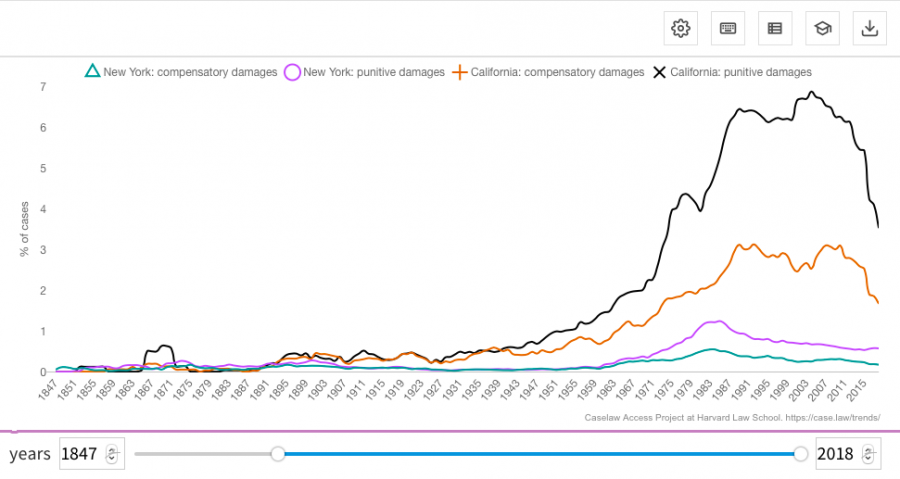
One new graphing tool, Historical Trends, announced in June, makes it easy for users to “visualize word usage in court opinions over time,” writes the Library Innovation Lab. (Examples include comparing the “frequency of ‘compensatory damages’ and ‘punitive damages’ in New York and California” and comparing “privacy” with “publicity.”) Anyone can build their own data visualization using their own search terms. (Learn how and get started here.) Case law may never be glamorous, exactly, or fun to read, but it may be far more interesting, and empowering, than we imagine.
Be aware that the Caselaw Access Project could still find ways to restrict or monetize access, for a short time, at least. “The project was funded partly through a partnership with Ravel, a legal analytics startup founded by two Stanford Law School students,” reports the Crimson. The company “earned ‘some commercial rights’ through March 2024 to charge for greater access to files.” The startup has issued no word on whether this will happen. In the meantime, public interest legal scholars may wish to do their own digging through this trove of caselaw to better understand the public’s right to information of all kinds.
We're hoping to rely on loyal readers, rather than erratic ads. Please click the Donate button and support Open Culture. You can use Paypal, Venmo, Patreon, even Crypto! We thank you!
Open Culture scours the web for the best educational media. We find the free courses and audio books you need, the language lessons & educational videos you want, and plenty of enlightenment in between.