Taught by Yale professor Donald Kagan, this introductory course in Greek history traces “the development of Greek civilization as manifested in political, intellectual, and creative achievements from the Bronze Age to the end of the classical period.” In it, students “read original sources in translation as well as the works of modern scholars.” You can watch the 24 video lectures above, or find them on YouTube. The lectures also appear on iTunes in audio and video. Find the texts used in the course below. More information about the course, including the syllabus, can be found on this Yale website.
Pomeroy, Burstein, Donlan and Roberts. Ancient Greece. Oxford University Press: New York, 1999.
Kagan, Donald. “Problems in Ancient History.” In The Ancient Near East and Greece. 2nd ed., vol. 1. Prentice-Hall: New York, 1975.
If you would like to support the mission of Open Culture, consider making a donation to our site. It’s hard to rely 100% on ads, and your contributions will help us continue providing the best free cultural and educational materials to learners everywhere. You can contribute through PayPal, Patreon, and Venmo (@openculture). Thanks!
Say you find yourself in a one-party state that promises to dismantle every civil institution you believe in and trample every ethical principle you hold dear. You may feel a little despondent. While a “this too shall pass” attitude may help you gain perspective, the problem isn’t simply that you’re on the losing side of a political contest. As George Orwell wrote in 1984, total authoritarian control means that “Who controls the past controls the future. Who controls the present controls the past.” The epistemic baseline you took for granted may become increasingly, frighteningly elusive as the ruling party reshapes all of reality to its designs.
With more vivid clarity than perhaps anyone since, Orwell characterized the mechanisms by which totalitarianism takes hold. His 1948 novel has not only given us a near-universal set of terms to describe the phenomenon, but it also gives us a metric: when our society begins to resemble Orwell’s dystopia in pervasive and alarming ways, we should know without question things have gone badly wrong. Whether we can do much about it is another question, but we should remember that Orwell himself was not simply an armchair observer of Fascism, Soviet totalitarianism, or oppressive English colonial rule. He fought Franco’s forces in Spain during the Spanish Civil War and as a journalist wrote critical articles and essays exposing hypocrisies and abuses of law and language. The impact of his work on later generations speaks for itself.
In the CBC radio documentary The Orwell Tapes, in three parts here, we have a comprehensive introduction to Orwell’s work, thought, and life. It opens with alarming soundbites from lightning rods (and villains or heroes, depending on who you ask) Julian Assange and Edward Snowden. But it doesn’t stray into the clichéd territory of overheated conspiracy those names often inspire. Instead we’re largely treated throughout each episode to firsthand accounts of the subject from those who knew him well.
“CBC is the only media organization in the world,” says host Paul Kennedy, “with a comprehensive archive of recordings featuring people who knew Orwell, from his earliest days, to his final moments. 75 people, 50 hours of recordings.” Edited snippets of these audio recordings make up the bulk of The Orwell Tapes, hence the title, making the program oral history rather than sensationalism. The interviewees include friends, former girlfriends, comrades-in-arms, and critical opponents. Each episode’s page on the CBC site features a list of names and relations to Orwell at the bottom.
But of course, accusations of sensationalism always follow those who warn of Orwellian trends and tendencies. Like many of our contemporaries, Orwell was a contradictory figure. He served as a colonial policeman in Burma even as he grew disgusted with Empire; he considered himself a Democratic Socialist, but he never looked away from the authoritarian horrors of state communism; and he has been held up as a pillar of resistance to state surveillance and control, even as he also stands accused of “naming names.” But the overall impression we get from Orwell’s friends and colleagues is that he was fully committed—to writing, to political engagement, to telling the truth as he saw it.
In releasing The Orwell Tapes this month, the CBC gives us five reasons why Orwell “is still very much with us today.” Some of these—modern surveillance, the corruptions of power (and the power of corruption)—will be familiar, as will number 3, a variation on what we’ve come to call “empathy” for one’s opponent. The 4th reason, CBC notes, is the renewed relevance of socialism as a viable alternative to capitalist predation. And finally, we have the continued danger of speaking truth to power, and to those who serve it religiously, uncritically, and often violently. As Orwell wrote in the preface to Animal Farm, “If liberty means anything at all, it means the right to tell people what they don’t want to hear.”
The writer David Auerbach once posted a fascinating inquest on left-brained literature, an examination of what he calls “a parallel track of literature that is popular specifically among engineers,” excluding genre fiction (science- or otherwise), with an eye toward “which novels of some notoriety and good PR happen to attract members of the engineering professions.” Favored author names turn out to include Richard Powers, Umberto Eco, Haruki Murakami, William Gibson, Italo Calvino, and Jorge Luis Borges.
More of these literarily inclined left-brainers exist than one might imagine. From the publisher’s point of view, what cover art could best attract them? Books targeted toward that demographic could do far worse than to use the work of M.C. Escher, who spent his career with one foot in art and the other in mathematics.
In the hitherto unseen (and even unimagined) worlds pictured in his woodcuts, lithographs, and mezzotints, he made use of mathematical concepts from tessellation to reflection to infinity in ways at once impossible and somehow plausible, all of them still intellectually and aesthetically compelling today.
The non-novelist Douglas Hofstadter appears in Auerbach’s inquest since his best-known work, Gödel, Escher, Bach: an Eternal Golden Braid, “which partly uses fictional forms, is too great not to list.” Not only does Escher’s name appear in Hofstadter’s book title, his art informs its central concepts. “Hofstadter wove a network of connections linking the mathematics of Gödel, the art of Escher, and the music of Bach,” writes Allene M. Parker in the paper “Drawing Borges: a Two-Part Invention on the Labyrinths of Jorge Luis Borges and M.C. Escher.” In Gödel, Escher, Bach he describes their common denominator as a “strange loop,” a phenomenon that “occurs whenever, by movement upwards (or downwards) through the levels of some hierarchical system, we unexpectedly find ourselves right back where we started.”
Parker identifies 1948’s “Drawing Hands” as a “particularly striking and familiar example” of a strange loop in Escher’s work. We can interpret that image by recognizing that “it is Escher, the artist, who is drawing both hands and who stands outside this particular puzzle.” Or we can “adopt a Zen-inspired solution and let mystery be mystery by choosing to embrace a unity which contains oppositions,” such as one described by the opening of Borges’ poem “Labyrinths”:
There’ll never be a door. You’re inside
and the keep encompasses the world
and has neither obverse nor reverse
nor circling in secret center.
The Escher-Borges connections go deeper beyond, and as you can see in John Coulthart’s original post, the selection of Escher-covered books extends farther.
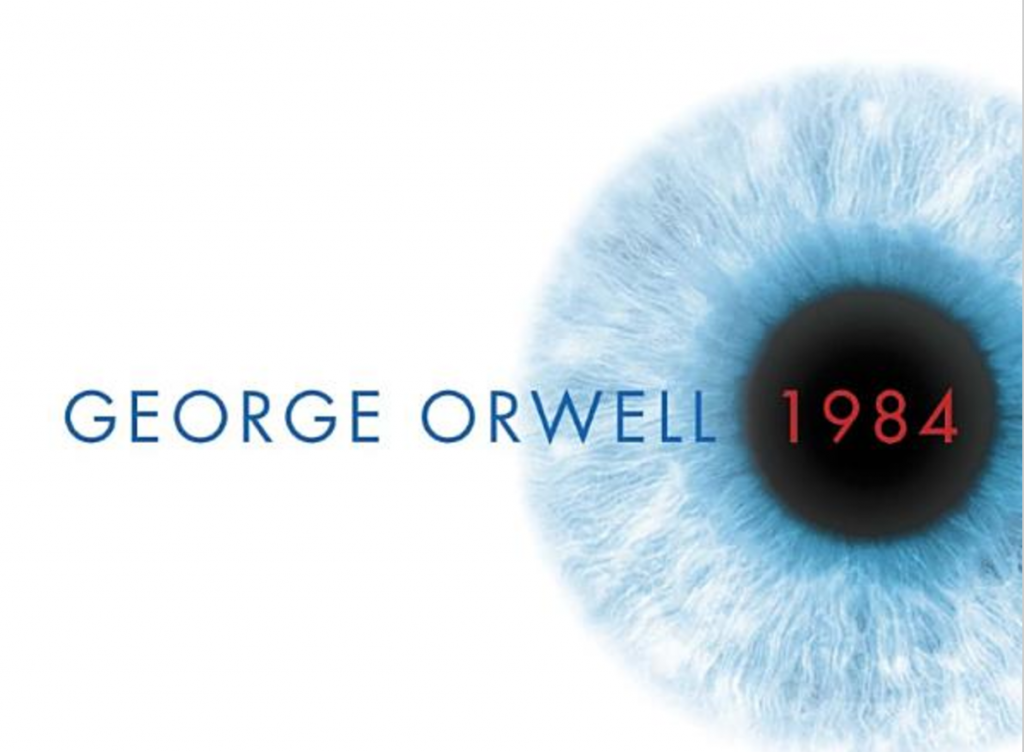
Aside from countless nonfiction publications, the Dutch mathematical master’s work has graced science-fiction and fantasy magazines, one edition of Flatland, a collection of “Forteana, weird fiction, occultism and historical speculation,” Clive Barker’s The Damnation Game, and George Orwell’s 1984, a novel more widely read than ever by the left- and right-brained alike. But no matter which hemisphere we favor, Escher — like Orwell, Borges, and Calvino — shows us how to see reality in more interesting ways.
Satellite-connected devices do all the hard work of navigation for us: plan journeys, plot distances, tell us where we are and where we’re going. The age of the highly skilled cartographer may be coming to an end. But in the past few hundred years—since European states began carving the world between them—the winners of colonial contests, World War battles, and Cold War skirmishes were often those who had the best maps. In addition to their indispensable role in seafaring and battle strategy, “good maps,” writes Danny Lewis at Smithsonian, have been “an integral part of the tradecraft of espionage.”
The CIA will tell you as much… or they will now, at least, since they’ve declassified decades of once-secret maps from the days when they “relied on geographers and cartographers for planning and executing operations around the world” rather than on “digital mapping technologies and satellite images.”
Now celebrating its 75th anniversary, the CIA’s Cartography Center boasts of “a long, proud history of service to the Intelligence Community,” at the Agency’s friendly website; “Since 1941, the Cartography Center maps have told the stories of post-WWII reconstruction, the Suez crisis, the Cuban Missile crisis, the Falklands War, and many other important events in history.”
Whatever noble or nefarious roles the Agency may have played in these and hundreds of other events, we can now see–thanks to this new online gallery at Flickr–what presidents, Directors, and field agents saw when they planned their actions, beginning with the country’s first “non-departmental intelligence organization,” the COI (Office of the Coordinator of Information). Once the U.S. entered WWII, it became the Office of Strategic Services (OSS). The Cartography Center’s first chief, Arthur Robinson, was only 26 and a graduate student in geography when COI director William Donovan recruited him to lead the organization. The office rapidly expanded during the war, and by 1943, “geographers and cartographers amassed what would be the largest collection of maps in the world.”
In the early forties, “map layers were drafted by hand using pen and ink on translucent acetate sheets mounted on large Strathmore boards.” These drafts were typically four times larger than the printed maps themselves, one of which you can see at the top of the post, “The Russian Front in Review.” In the fifties, “improved efficiency in map compilation and construction” produced visually striking documents like that further up from 1955, “USSR: Regional Distribution of Gross National Product.” Not a map, but what we would call an infographic, this image shows how the Cartography Center performed services far in excess of the usual map app—visualizing threats to the U.S. from Cuban surface-to-air missile sites in 1962 (above) and threats to the African elephant population from poachers in 2013 (below). Further down, you can see a 2003 map of Baghdad, with the ominously non-threatening note printed at the top and right, “This map is NOT to be used for TARGETING.”
These maps and many more can be found at the CIA Cartography Flickr account, which has a category for each decade since the 1940s. Each map is downloadable in low to high resolution scans. In addition, one category, “Cartography Tools,” features high-quality photography of vintage draughtsman’s instruments, all of them, like the German-made ink pens further down, symbols of the painstaking handicraft mapmaking once required. While we can probably draw any number of political lessons or historical theses from a deep analysis of this deep state archive, what it seems to ask of us first and foremost is that we consider cartography as not only a useful discipline but as a fine art.
As the Cartography Center’s first director put it, “a map should be aesthetically pleasing, thought-provoking, and communicative.” Given these standards we might see how current technology, for all its tremendous ease of use and undeniable utility, might improve by looking to maps of the past. Visit the CIA’s flickr gallery here.
Google has created a free Python class designed for “people with a little bit of programming experience who want to learn Python.” A fortunate thing since Python is a computer language that’s now strongly in demand. (By the way, did you know that Python takes its name from Monty Python? A true story.)
The class includes “written materials, lecture videos, and lots of code exercises to practice Python coding. These materials are used within Google to introduce Python to people who have just a little programming experience. The first exercises work on basic Python concepts like strings and lists, building up to the later exercises which are full programs dealing with text files, processes, and http connections. The class is geared for people who have a little bit of programming experience in some language, enough to know what a “variable” or “if statement” is. Beyond that, you do not need to be an expert programmer to use this material.
If you’re looking for a generally well-reviewed textbook, consider Learning Python, 5th edition (from O’Reilly Media.
If you would like to support the mission of Open Culture, consider making a donation to our site. It’s hard to rely 100% on ads, and your contributions will help us continue providing the best free cultural and educational materials to learners everywhere. You can contribute through PayPal, Patreon, and Venmo (@openculture). Thanks!
The life of Russian-born poet, novelist, critic, and first female psychologist Lou Andreas-Salomé has provided fodder for both salacious speculation and intellectual drama in film and on the page for the amount of romantic attention she attracted from European intellectuals like philosopher Paul Rée, poet Rainer Maria Rilke, and Friedrich Nietzsche. Emotionally intense Nietzsche became infatuated with Salomé, proposed marriage, and, when she declined, broke off their relationship in abrupt Nietzschean fashion.
For her part, Salomé so valued these friendships she made a proposal of her own: that she, Nietzsche and Rée, writes D.A. Barry at 3:AM Magazine, “live together in a celibate household where they might discuss philosophy, literature and art.” The idea scandalized Nietzsche’s sister and his social circle and may have contributed to the “passionate criticism” Salomé’s 1894 biographical study, Friedrich Nietzsche: The Man and His Works, received. The “much maligned” work deserves a reappraisal, Barry argues, as “a psychological portrait.”
In Nietzsche, Salomé wrote, we see “sorrowful ailing and triumphal recovery, incandescent intoxication and cool consciousness. One senses here the close entwining of mutual contradictions; one senses the overflowing and voluntary plunge of over-stimulated and tensed energies into chaos, darkness and terror, and then an ascending urge toward the light and most tender moments.” We might see this passage as charged by the remembrance of a friend, with whom she once “climbed Monte Sacro,” she claimed, in 1882, “where he told her of the concept of the Eternal Recurrence ‘in a quiet voice with all the signs of deepest horror.’”
We should also, perhaps primarily, see Salomé’s impressions as an effect of Nietzsche’s turbulent prose, reaching its apotheosis in his experimentally philosophical novel, Thus Spake Zarathustra. As a theorist of the embodiment of ideas, of their inextricable relation to the physical and the social, Nietzsche had some very specific ideas about literary style, which he communicated to Salomé in an 1882 note titled “Toward the Teaching of Style.” Well before writers began issuing “similar sets of commandments,” writes Maria Popova at Brain Pickings, Nietzsche “set down ten stylistic rules of writing,” which you can find, in their original list form, below.
1. Of prime necessity is life: a style should live.
2. Style should be suited to the specific person with whom you wish to communicate. (The law of mutual relation.)
3. First, one must determine precisely “what-and-what do I wish to say and present,” before you may write. Writing must be mimicry.
4. Since the writer lacks many of the speaker’s means, he must in general have for his model a very expressive kind of presentation of necessity, the written copy will appear much paler.
5. The richness of life reveals itself through a richness of gestures. One must learn to feel everything — the length and retarding of sentences, interpunctuations, the choice of words, the pausing, the sequence of arguments — like gestures.
6. Be careful with periods! Only those people who also have long duration of breath while speaking are entitled to periods. With most people, the period is a matter of affectation.
7. Style ought to prove that one believes in an idea; not only that one thinks it but also feels it.
8. The more abstract a truth which one wishes to teach, the more one must first entice the senses.
9. Strategy on the part of the good writer of prose consists of choosing his means for stepping close to poetry but never stepping into it.
10. It is not good manners or clever to deprive one’s reader of the most obvious objections. It is very good manners and very clever to leave it to one’s reader alone to pronounce the ultimate quintessence of our wisdom.
As with all such prescriptions, we are free to take or leave these rules as we see fit. But we should not ignore them. While Nietzsche’s perspectivism has been (mis)interpreted as wanton subjectivity, his veneration for antiquity places a high value on formal constraints. His prose, we might say, resides in that tension between Dionysian abandon and Apollonian cool, and his rules address what liberal arts professors once called the Trivium: grammar, rhetoric, and logic: the three supports of moving, expressive, persuasive writing.
Salomé was so impressed with these aphoristic rules that she included them in her biography, remarking, “to examine Nietzsche’s style for causes and conditions means far more than examining the mere form in which his ideas are expressed; rather, it means that we can listen to his inner soundings.” Isn’t this what great writing should feel like?
Salomé wrote in her study that “Nietzsche not only mastered language but also transcended its inadequacies.” (As Nietzsche himself commented in 1886, notes Hugo Drochon, he needed to invent “a language of my very own.”) Nietzsche’s bold-yet-disciplined writing found a complement in Salomé’s boldly keen analysis. From her we can also perhaps glean another principle: “No matter how calumnious the public attacks on her,” writes Barry, “particularly from [his sister] Elisabeth Förster-Nietzsche during the Nazi period in Germany, Salomé did not respond to them.”
Unlikely as it might seem, the Japanese jazz scene has for decades and decades produced some of the finest players in the world, from traditionalists to experimentalists and everything in-between. One might say the same about other jazz-inclined countries (those of northern Europe, for instance, having developed particularly robust scenes), but those countries have to do without enlivenment by “only in Japan” moments like the one we have above: jazz pianist Yōsuke Yamashita, acclaimed on both sides of the Pacific, playing piano on the beach — a piano on fire on the beach, to be precise.
This wasn’t even the first time he’d done it. In 1973, famed graphic designer Kiyoshi Awazu asked Yamashita to appear in his short film burning piano, playing the titular instrument. Watching it again 35 years later, Yamashita wrote, “Seeing myself engaged in that extraordinary performance, I felt this wave of emotion that was like, ‘What was that?’
In one sense, I had performed as an ‘object’ in a Kiyoshi Awazu artwork. In another, however, I had perhaps experienced a form of artistic expression that no one before me had ever experienced before, as the result of a situation that could only have happened at that time. ‘What was that?’ There was only one way I could reconfirm this for myself—by doing it one more time.”
The opportunity arose at the behest of Kanazawa’s 21st Century Museum of Contemporary Art, who staged Burning Piano 2008. You can read the event’s program as a PDF, which contains Yamashita’s reflections leading up to the event. It also contains remarks from an Awazu Design Room representative who witnessed the original burning piano shoot, a local piano dealer (who assures us that long after the piano “began to appear in Japanese homes in the era of high-level economic growth,” some “must be destroyed amid reluctant feelings”), and the mayor of Shika Town, on whose Masuhogaura Beach Yamashita donned his silver protective suit and played a funeral requiem on the flaming instrument until it could produce not a sound more.
“I did not think I was risking my life,” Yamashita later said, “but I was almost suffocating from the smoke that was continuously getting into my eyes and nose. I had decided to keep on playing until the piano stopped making sounds, so though I did not mean it, but it ended up having a life-or-death battle between the piano and myself.” Dedicated jazz players know what it means to suffer for their art, as do all the participants in the age-old intensive Japanese conception of mastery, but who would have guessed that those cultures would intersect so… combustibly?
But it would have been difficult for anyone to overlook seven animatronic dinosaurs, traveling by barge on October 15, 1963, bound for the Sinclair Oil Corporation’s “Dinoland” exhibit at the 1964 World’s Fair.
In a stunt worthy of Barnum, the synthetic beasts trekked 150 miles from the exhibit’s designer, Jonas Studios, to the World’s Fair site in Flushing, Queens, hailed by fireboats and an enthusiastic throng. The sponsoring corporation, whose highly recognizable logo was a brontosaurus, had furnished the public with a timetable of estimated arrivals along the route.
For good measure, every family to visit the exhibit within the first year was offered a coupon for a free gallon of gasoline.
Installed in what the marvelously evocative Jam Handy short below termed a “prime location surrounded by titans of American industry,” the dinosaurs attracted over 10 million “car-owning, traveling” fans. (That’s a lot of fossil fuel.)
On the way out, visitors were encouraged to avail themselves of the Mold-A-Rama machine, which pumped out miniature plastic dinosaur souvenirs at 25¢ a pop.
After the fair closed, the dinosaurs went on tour, put in an appearance in the Macy’s Thanksgiving Day Parade, and eventually settled into zoos and natural history museums around the country.
Sinclair uses the Dinosaur “Brontosaurus” as a symbol to dramatize the age and quality of the crude oils from which Sinclair Petroleum Products are made — crudes which were mellowing in the earth millions of years ago when Dinosaurs lived.
Ayun Halliday is an author, illustrator, theater maker and Chief Primatologist of the East Village Inky zine. Her play Zamboni Godot is opening in New York City in March 2017. Follow her @AyunHalliday.
Taught by Yale professor Paul Bloom, this course presents an Introduction to Psychology and tries to explain what makes us tick:
What do your dreams mean? Do men and women differ in the nature and intensity of their sexual desires? Can apes learn sign language? Why can’t we tickle ourselves? This course tries to answer these questions and many others, providing a comprehensive overview of the scientific study of thought and behavior. It explores topics such as perception, communication, learning, memory, decision-making, religion, persuasion, love, lust, hunger, art, fiction, and dreams. We will look at how these aspects of the mind develop in children, how they differ across people, how they are wired-up in the brain, and how they break down due to illness and injury.
You can watch the 20 lectures from the course above, or find them on YouTube and iTunes. To get more information on the course, including the syllabus, visit this Yale website.
The main texts used in this course include:
Gray, Peter. Psychology. New York: Worth Publishers, 2007.
Which living writer stands as the heir to Edgar Allan Poe? A silly question, admittedly: now, more than 160 years after his death, Poe’s influence has spread so far and wide throughout literature that no one writer’s work could possibly count as his definitive continuation. The most popular and powerful modern storytellers owe more than a thing or two to Poe — or rather, have built upon Poe’s achievements — without even knowing it, especially if they hail from a different part of the world and work a different part of the cultural map than did 19th-century America’s pioneer of new and psychologically intense genre literature.
Take, for instance, Neil Gaiman. “Every year, Worldbuilders holds a giant auction-charity-donation thing, giving people cool things and raising an awful lot of money for a fantastic cause,” he says in the video above, which came out just this holiday season. “And every year, I seem to be reading a poem or book chosen by the people who pay money to Worldbuilders.
This year, for reasons known only to themselves, they have decided I need to read Edgar Allan Poe’s ghastly, gruesome, dark, and famous poem ‘The Raven.’ So I’ve lit a number of candles, fired up the fire, found a copy of the Oxford Book of Narrative Verse, and I’m going to read it to you in a comfortable chair by the fire, as befits a poem told in the days of yore.”
Though many of his fans come to know him through his novels like American Godsand Stardust, Gaiman’s writing career has also included work in poetry, comic books, radio drama, and movies, all of it using his signature mix of fantastical invention, resonant emotion, and polished, witty wordcraft. When potential collaborators on projects in these fields and others want to work with him, they want to tap not just his uncommon storytelling skill, regardless of the medium in which he tells his stories, but his ability to satisfy both wide audiences and critics with those stories.
Poe, too, knew how to do this, and indeed described “The Raven” in a magazine essay as a work deliberately composed to “suit at once the popular and the critical taste,” and since its first publication in 1845, the poem has only grown better-known and more beloved. Here, in Neil Gaiman’s ten-minute reading, we can see and hear one master of high-impact storytelling acknowledging another over all those 171 years.
Local parent tells other local parent how to raise their children: this scenario has provoked many a neighborhood listserv flamewar, and maybe a street brawl or three. Unkempt and inflammatory philosopher Slavoj Žižek telling parents how to raise their children? Well… maybe a few hundred eyerolls.
I exaggerate. Žižek only addresses one small aspect of parenting—a benign, culturally specific one at that, which ranks far beneath, say, health and education and falls in line with whether one should pretend to be a nocturnal creature who lives on children’s teeth, or to see a giant rabbit in the spring.
We’re talking about Santa Claus, and to lie or not to lie to your kids is the question posed to Žižek by students at SUNY Brockport in the low-quality video above. If you can adjust to the audio/video, you’ll hear the cultural theorist give an interesting answer. I can’t vouch for its consonance with child psychology, but as a parent, I can say my tiny demographic confirms the insight.
Though he’s nearly inaudible at first, we eventually hear Žižek saying, “No… they will absolutely take it as this cynical [reason?] of ‘let’s pretend that it’s real,’ no matter how much you insist that you mean it literally.” For those who might agonize over the question, it may be most kids aren’t nearly as gullible as we imagine, just good sports who don’t want to let us down.
This would not be a Žižek answer if it did not veer into claims far more ambitious, or grandiose, than the question seems to warrant. Sensing perhaps he’s on shaky ground with the whole parenting advice thing, he quickly moves on to the subject of “what does it mean, really, to believe?” Belief, says Žižek—in the sense of individual, inward assent to metaphysical propositions—is a modern invention.
In attempting to make Saint Nicholas believable to children, we’ve paradoxically turned him into a cartoon character (and in the U.S. and elsewhere banished his lovable demon sidekick, Krampus). Kids see right through it, says Žižek in another interview above. And so, “You have a belief which is nobody’s belief! Nobody believes in the first person.”
Why, then, not just admit we’re all pretending, and say “we’re enjoying a story together”? We do it every night with children, this one just involves food, lights, family, gifts, sweaters, uncomfortable travel and maybe religious ceremonies of your tradition. You can often hear Žižek opine on those kinds of beliefs as well. My only comment on the matter is to say, sincerely, Happy Holidays.
We're hoping to rely on loyal readers, rather than erratic ads. Please click the Donate button and support Open Culture. You can use Paypal, Venmo, Patreon, even Crypto! We thank you!
Open Culture scours the web for the best educational media. We find the free courses and audio books you need, the language lessons & educational videos you want, and plenty of enlightenment in between.