Organized Religion Got You Down? Discover The Church Of Saint John Coltrane


Orga­nized reli­gion got you down? Feel like giv­ing up on it alto­geth­er? You are not by any stretch alone. Reli­gios­i­ty is in grave decline in Europe and the U.S., prompt­ing pan­ic in some quar­ters and sat­is­fac­tion in oth­ers (that young adults, for exam­ple, agree more with Karl Marx than with the Bible). The list of rea­sons for religion’s grow­ing unpop­u­lar­i­ty is long and rather pre­dictable, and you won’t find a case for the con­trary here—unless, that is, it’s for the St. John Coltrane Church. If there’s any reli­gion that deserves an upswing, so to speak, per­haps it’s one based on the gen­uine­ly ecsta­t­ic, con­scious­ness-expand­ing music of one of America’s most spir­i­tu­al­ly-mind­ed jazz com­posers.

Found­ed in San Fran­cis­co by Bish­op Fran­zo King and his wife Rev­erend Moth­er Mari­na King in 1971 as the Saint John Coltrane African Ortho­dox Church, the small body of wor­ship­pers has since become some­thing a lit­tle more rad­i­cal: The Saint John Will-I-Am Coltrane Church, whose vibe, writes Aeon, “is a rap­tur­ous out-of-your-head-ness, where instead of the choir and the hymn book there is the sin­u­ous, tran­scen­dent music of the jazz saint.” We get a pow­er­ful immer­sion in that vibe in the course of the 30-minute doc­u­men­tary, The Church Of Saint Coltrane. (Watch it above, or find it on Aeon’s YouTube chan­nel). The church band, with Bish­op King him­self on the sopra­no sax­o­phone, gets deep into Coltrane’s music, in funky per­for­mances of cuts from Coltrane’s ground­break­ing 1964 A Love Supreme espe­cial­ly.

That career-defin­ing album of reli­gious music changed the course of Coltrane’s career at the very end of his short life. (He died three years lat­er at the age of 40.) He wasn’t always such a mys­tic. Before he dis­cov­ered the idio­syn­crat­ic God of his recov­ery from hero­in addic­tion in 1957, he was a rapid­ly ris­ing star in an increas­ing­ly pre­car­i­ous place. After his “spir­i­tu­al awak­en­ing,” as he describes it in the lin­er notes to A Love Supreme, Coltrane became a musi­cal evan­ge­list. And Bish­op King heard the call. King’s “sound bap­tism” took place when he saw Coltrane in 1965 at the Jazz Work­shop in San Fran­cis­co, a Pen­te­costal expe­ri­ence for him. “I am the first son born out of sound,” he says.

Oth­er wor­ship­pers iden­ti­fy with Coltrane on a more bio­graph­i­cal lev­el. Sax­o­phon­ist Father Robert Haven is also a for­mer addict and alco­holic, who got sober “under Coltrane’s spell.” At the church, he found both a spir­i­tu­al and musi­cal home. As the doc­u­men­tary pro­gress­es, you’ll see the expe­ri­ences of non-musi­cian church-mem­bers are equal­ly pro­found, but the com­mon thread, of course, is that they all love Coltrane. That would appear to be the most impor­tant cri­te­ri­on for join­ing the Saint John Coltrane Church, where one can osten­si­bly come for the music and stay for the music. At least that seems to be the pitch, and it’s quite a com­pelling one for peo­ple who love Coltrane, though Bish­op King’s ser­vices do get preachy at times. But the res­i­dent church icono­g­ra­ph­er tells us that King con­vert­ed him with one sim­ple phrase, repeat­ed with con­fi­dence over and over: “It’s all in the music.”

The Church Of Saint Coltrane will be added to our col­lec­tion, 4,000+ Free Movies Online: Great Clas­sics, Indies, Noir, West­erns, Doc­u­men­taries & More.

For more back­ground on the church, see our 2014 post: The Church of St. John Coltrane, Found­ed on the Divine Music of A Love Supreme

via Aeon

Relat­ed Con­tent:

The His­to­ry of Spir­i­tu­al Jazz: Hear a Tran­scen­dent 12-Hour Mix Fea­tur­ing John Coltrane, Sun Ra, Her­bie Han­cock & More

The Sto­ry of John Coltrane’s A Love Supreme, Released 50 Years Ago This Month

John Coltrane’s Hand­writ­ten Out­line for His Mas­ter­piece A Love Supreme

Josh Jones is a writer and musi­cian based in Durham, NC. Fol­low him at @jdmagness

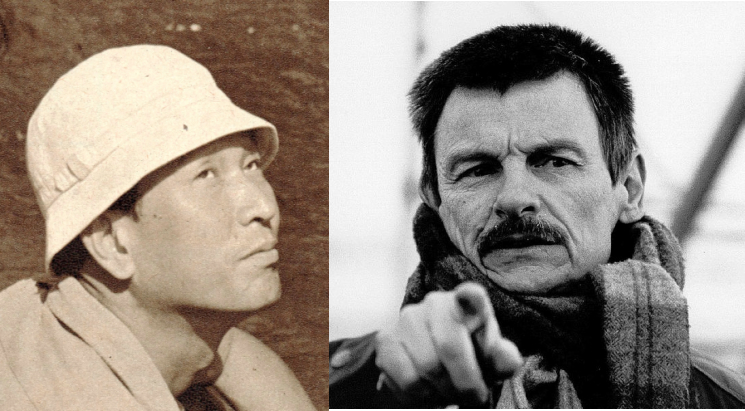
When Akira Kurosawa Watched Solaris with Andrei Tarkovsky: I Was “Very Happy to Find Myself Living on Earth”

tarkovsky-kurosawa

Image of Kuro­sawa and Tarkovsky via NPR

Though Aki­ra Kuro­sawa and Andrei Tarkovsky occu­py the same plane in the pan­theon of auteurs — the high­est one — nei­ther their lives nor their films had much obvi­ous­ly in com­mon. The old­er, longer-lived Kuro­sawa start­ed his career ear­li­er and end­ed it lat­er, but dur­ing those cin­e­mat­i­cal­ly glo­ri­ous decades of the 1960s and 70s, the two brought into the world such pic­tures as Yojim­bo, Ivan’s Child­hoodHigh and LowRed Beard, Andrei Rublev, Dodesukaden, Solaris, The Mir­ror, Der­su Uza­la (Kuro­sawa’s sole Japan­ese-Sovi­et co-pro­duc­tion, though Tarkovsky was­n’t involved), and Stalk­er.

They actu­al­ly met around the mid­dle of that peri­od, when Kuro­sawa came to vis­it the set of Solaris (watch Solaris online along with many oth­er major Tarkovsky films). “Tarkovsky guid­ed me around the set, explain­ing to me as cheer­ful­ly as a young boy who is giv­en a gold­en oppor­tu­ni­ty to show some­one his favorite toy­box,” Kuro­sawa writes in an essay orig­i­nal­ly run in the Asahi Shin­bun in 1977 and repub­lished at Cinephil­ia & Beyond.


“[Direc­tor Sergei] Bon­darchuk, who came with me, asked him about the cost of the set, and left his eyes wide open when Tarkovsky answered it. The cost was so huge: about six hun­dred mil­lion yen as to make Bon­darchuk, who direct­ed that grand spec­ta­cle of a movie War and Peace, agape in won­der.”

But the work, as Kuro­sawa soon found out, mer­it­ed the cost and then some:

Mar­velous progress in sci­ence we have been enjoy­ing, but where will it lead human­i­ty after all? Sheer fear­ful emo­tion this film suc­ceeds in con­jur­ing up in our soul. With­out it, a sci­ence fic­tion movie would be noth­ing more than a pet­ty fan­cy.

These thoughts came and went while I was gaz­ing at the screen.

Tarkovsky was togeth­er with me then. He was at the cor­ner of the stu­dio. When the film was over, he stood up, look­ing at me as if he felt timid. I said to him, “Very good. It makes me feel real fear.” Tarkovsky smiled shy­ly, but hap­pi­ly. And we toast­ed vod­ka at the restau­rant in the Film Insti­tute. Tarkovsky, who didn’t drink usu­al­ly, drank a lot of vod­ka, and went so far as to turn off the speak­er from which music had float­ed into the restau­rant, and began to sing the theme of samu­rai from Sev­en Samu­rai at the top of his voice.

As if to rival him, I joined in.

For I was at that moment very hap­py to find myself liv­ing on Earth.

Solaris makes a view­er feel this, and even this sin­gle fact shows us that Solaris is no ordi­nary SF film. It tru­ly some­how pro­vokes pure hor­ror in our soul. And it is under the total grip of the deep insights of Tarkovsky.

Kuro­sawa pays spe­cial atten­tion to the sequence, which you can watch above ana­lyzed by film schol­ars Vida John­son and Gra­ham Petrie, filmed in his own home­land: “What makes us shud­der is the shot of the loca­tion of Akasakamit­suke, Tokyo, Japan. By a skill­ful use of mir­rors, he turned flows of head lights and tail lamps of cars, mul­ti­plied and ampli­fied, into a vin­tage image of the future city. Every shot of Solaris bears wit­ness to the almost daz­zling tal­ents inher­ent in Tarkovsky.”

Like all of Tarkovsky’s fea­tures, Solaris only holds up more firm­ly with time and thus still enjoys revival screen­ings all over the world, but you can also watch it free online right now. Just get ready, when you descend to Earth after­ward, to feel your own grat­i­tude at find­ing your­self back here.

Relat­ed Con­tent:

Aki­ra Kuro­sawa to Ing­mar Bergman: “A Human Is Not Real­ly Capa­ble of Cre­at­ing Real­ly Good Works Until He Reach­es 80”

Aki­ra Kuro­sawa & Gabriel Gar­cía Márquez Talk About Film­mak­ing (and Nuclear Bombs) in Six Hour Inter­view

Watch Aki­ra Kuro­sawa & Fran­cis Ford Cop­po­la in Japan­ese Whiskey Ads from 1979: The Inspi­ra­tion for Lost in Trans­la­tion

Watch Solaris (1972), Andrei Tarkovsky’s Haunt­ing Vision of the Future

Andrei Tarkovsky’s Solaris Shot by Shot: A 22-Minute Break­down of the Director’s Film­mak­ing

Based in Seoul, Col­in Mar­shall writes and broad­casts on cities and cul­ture. He’s at work on a book about Los Ange­les, A Los Ange­les Primer, the video series The City in Cin­e­ma, the crowd­fund­ed jour­nal­ism project Where Is the City of the Future?, and the Los Ange­les Review of Books’ Korea Blog. Fol­low him on Twit­ter at @colinmarshall or on Face­book.

Cook Up Aleister Crowley’s Rice Recipe: Perfect for Eating with Curry

crowleyricerecipe

Before vis­it­ing a Gnos­tic Mass at one of Aleis­ter Crowley’s Ordo Tem­pli Ori­en­tis chap­ters in the UK, Dan­ger­ous Minds’ Thomas McGrath was warned by a friend in no uncer­tain all caps, “DO NOT EAT THE CAKE OF LIGHT.” I’ll let you find out for your­self why the excess cau­tion against this Crow­ley con­fab­u­lat­ed piece of anti-Catholic sacra­men­tal bread. Suf­fice it to say, the British occultist who called him­self the Great Beast 666 shared oth­er cer­e­mo­ni­al recipes in his copi­ous writ­ings on rit­u­al prac­tices. Many of them involved bod­i­ly flu­ids as a mat­ter of course.

In addi­tion to the Mag­ick for which he’s com­mon­ly known in coun­ter­cul­tur­al cir­cles, Crow­ley was an artist, avid moun­tain climber, world trav­el­er, and aspir­ing chef of more or less edi­ble foods, who often cooked for his trav­el­ing com­pan­ions. Dan­ger­ous Minds draws our atten­tion to one dish Crow­ley described in his “auto­ha­giog­ra­phy,” The Con­fes­sions of Aleis­ter Crow­ley. Called “glac­i­er cur­ry,” the stuff was appar­ent­ly so spicy it made hard­ened moun­taineers “dash out of the tent after one mouth­ful and wal­low in the snow, snap­ping at it like mad dogs.”

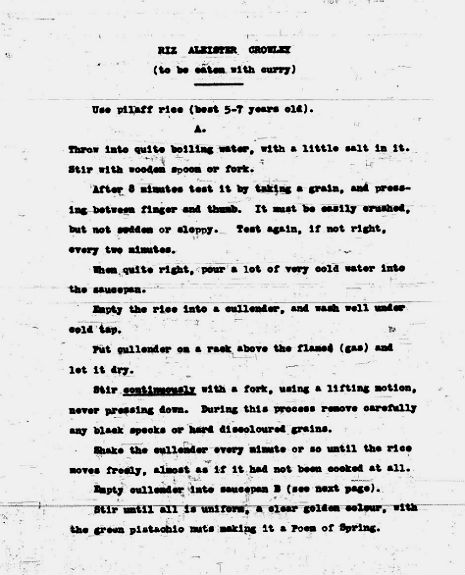
Crow­ley neglect­ed to list the ingre­di­ents and means of prepa­ra­tion for the unbear­able “glac­i­er cur­ry,” but he did leave anoth­er recipe among his papers for a much cool­er accom­pa­ni­ment. (Dis­cov­ered, writes Coil­house, by a “Pro­fes­sor Jack” in the Crow­ley Archives at Bird Library, Syra­cuse Uni­ver­si­ty.) Called “Riz Aleis­ter Crow­ley,” and meant “to be eat­en with cur­ry,” you can find it below. The pro­por­tions have been esti­mat­ed by writer Nico Mara McK­ay, who has made the rice with deli­cious results.

Ingre­di­ents

- 1 cup brown bas­mati rice

- sea salt

- 1/4 cup sul­tanas

- 1/4 cup sliv­ered almonds(1)

- 1/4 cup pis­ta­chio nuts

- pow­dered clove

- pow­dered car­damoms

- turmer­ic pow­der (enough to colour the rice to a clear gold­en tint)

- 2 tblsp. but­ter

Steps

Bring two cups of salt­ed water to a bowl. Throw in in the rice, stir­ring reg­u­lar­ly.

Test the rice after about ten min­utes “by tak­ing a grain, and press­ing between fin­ger and thumb. It must be eas­i­ly crushed, but not sod­den or slop­py. Test again, if not right, every two min­utes.”

When ready, pour cold water into the saucepan.

Emp­ty the rice into a colan­der, and rinse under cold tap.

Put colan­der on a rack above the flames, if you have a gas stove, and let it dry. If, like me, your stove is elec­tric, the rice can be dried by plac­ing large sheets of paper tow­el over and under the rice, soak­ing up the water. Prefer­ably the rice should seem very loose, almost as if it it has not been cooked at all. When you’ve removed as much water as you can, remove the paper tow­el.

Place the rice back into the pot on a much low­er tem­per­a­ture.

Stir­ring con­tin­u­ous­ly, add the but­ter, sul­tanas, almonds, pis­ta­chio nuts, a dash or two of cloves and a dash of car­damom.

Add enough turmer­ic that the rice, after stir­ring, is “uni­form, a clear gold­en colour, with the green pis­ta­chio nuts mak­ing it a Poem of Spring.”

In addi­tion to the esti­mat­ed pro­por­tions, the ver­sion above has been mod­i­fied some­what to fit our con­tem­po­rary recipe expec­ta­tions, but the folks at food blog Hap­py Veg­etable Cow have an exact tran­scrip­tion of Crowley’s type­script (top). They note Crow­ley’s con­ti­nu­ity with free-form recipe tra­di­tions of antiq­ui­ty and cel­e­brate the bit of “cre­ative nar­ra­tive” at the end. For an even more cre­ative­ly phrased grain recipe than Crowley’s aro­mat­ic rice, see David Lynch’s sur­re­al quinoa instruc­tions.

via Dan­ger­ous Minds

Relat­ed Con­tent:

Aleis­ter Crow­ley: The Wickedest Man in the World Doc­u­ments the Life of the Bizarre Occultist, Poet & Moun­taineer

Aleis­ter Crow­ley & William But­ler Yeats Get into an Occult Bat­tle, Pit­ting White Mag­ic Against Black Mag­ic (1900)

Aleis­ter Crow­ley Reads Occult Poet­ry in the Only Known Record­ings of His Voice (1920)

Josh Jones is a writer and musi­cian based in Durham, NC. Fol­low him at @jdmagness

Videos Recreate Isaac Newton’s Neat Alchemy Experiments: Watch Silver Get Turned Into Gold

Yes­ter­day we fea­tured an online archive of “chymi­cal” man­u­scripts from the hand of Isaac New­ton, who, in addi­tion to mod­ern physics and math­e­mat­ics, prac­ticed the mag­i­cal, medieval art of alche­my. Found among his alchem­i­cal papers was a recipe for “soph­ick mer­cury,” a chem­i­cal believed to cre­ate the “Philosopher’s stone,” the occult sub­stance that sup­pos­ed­ly turns base met­als like lead into pure gold. Did such mag­ic ever rise to the lev­el of repeat­able sci­ence or was it pure mytho­log­i­cal fan­ta­sy?

For well over two hun­dred years after Newton’s death in 1727, near­ly every­one believed the lat­ter. How­ev­er, when the physi­cist and mathematician’s alchem­i­cal papers went on auc­tion at Sotheby’s in 1936, “the world of Isaac New­ton schol­ar­ship received a rude shock,” writes Indi­ana University’s archive project The Chym­istry of Isaac New­ton. Hun­dreds of alche­my man­u­scripts that had been qui­et­ly sup­pressed by New­ton’s rel­a­tives and hid­den away in pri­vate col­lec­tions came to light all at once.

In the inter­ven­ing years, New­ton schol­ars and sci­ence his­to­ri­ans have had to reassess his con­sid­er­able lev­el of invest­ment in occult arts. And they’ve come to see alche­my as an impor­tant pre­cur­sor to mod­ern chem­istry. As IU sci­ence his­to­ri­an William New­man “points out,” io9 tells us, “alche­my was­n’t always the laugh­able idea it is today.”

Although his alchem­i­cal man­u­scripts were in con­stant con­ver­sa­tion with ancient and mys­ti­cal sources, “Newton’s chym­istry was in many cas­es ful­ly oper­a­tional and explic­a­ble in mod­ern chem­i­cal ter­mi­nol­o­gy,” writes New­man, who has done much of the work to recov­er the chem­i­cal sci­ence amidst Newton’s alchem­i­cal pseu­do­science.

In the videos you see here, Indi­ana Uni­ver­si­ty seeks to “dri­ve this point home” with lessons that can “be employed in schools as an inte­gral part of their sci­ence edu­ca­tion cur­ric­u­la.” We begin at the top with a clas­si­cal alchem­i­cal exper­i­ment, the “trans­mu­ta­tion” of sil­ver into gold. In this case the medal­lion is already com­posed of a sil­ver-gold alloy. It’s an exper­i­ment in which “alchemists’ knowl­edge of chem­istry actu­al­ly helped them con their con­tem­po­raries into believ­ing they could trans­form sil­ver into gold,” notes New­man. Once the medal­lion is dipped in nitric acid, much of the sil­ver dis­solves, giv­ing the impres­sion of it hav­ing been changed into pure gold.

Fur­ther up, we have oth­er “chymi­cal” exper­i­ments from Newton’s alche­my, like the “transmutation”—or plating—of iron into cop­per and the cre­ation of a sil­i­ca gar­den, illus­trat­ing so-called min­er­al “veg­e­ta­tion.” In exper­i­ments like the one below it, the cre­ation of the “Tree of Diana”—in which a crys­talline growth emerges from an amal­gam of sil­ver and mercury—we see how alchemists were inspired to cre­ate alter­nate ter­mi­nol­o­gy for the prod­ucts of their exper­i­ment that sound to mod­ern ears like unsci­en­tif­ic non­sense. This mys­ti­cal jar­gon often served to con­fuse or ward off the unini­ti­at­ed, who would be unable to make a “Tree of Diana” even if they had the ingre­di­ents on hand, unless they already knew the pro­ce­dure and the prod­uct.

The last two mod­ules, fur­ther up and just above, demon­strate cop­per and iron shot dis­solv­ing in solu­tions of sil­ver nitrate and cop­per nitrate, respec­tive­ly. Edu­ca­tors and the gen­er­al­ly curi­ous should down­load Indi­ana University’s les­son plan on “Newton’s ‘Chym­istry’ of Met­al Sol­u­bil­i­ties.” There­in, you learn that “New­ton spent more time on his alche­my than he did on his physics and math com­bined!” though most of his alchem­i­cal work remains unpub­lished. The few, more respectably-word­ed, exper­i­ments New­ton did pub­lish in his life­time come from “Query 31” of his mas­ter­piece, the Opticks. It is from these pro­ce­dures that the lessons derive.

But even as we see the osten­si­bly straight­for­ward chem­i­cal instruc­tions New­ton pub­lished, we should remem­ber that these came from decades of research in the much murki­er, occult field of alche­my. You’ll find more infor­ma­tion on Newton’s chem­istry here and here, as well as at these many relat­ed web­sites.

via io9 

Relat­ed Con­tent:

Isaac Newton’s Recipe for the Myth­i­cal ‘Philosopher’s Stone’ Is Being Dig­i­tized & Put Online (Along with His Oth­er Alche­my Man­u­scripts)

In 1704, Isaac New­ton Pre­dicts the World Will End in 2060

Sir Isaac Newton’s Papers & Anno­tat­ed Prin­cip­ia Go Dig­i­tal

Josh Jones is a writer and musi­cian based in Durham, NC. Fol­low him at @jdmagness

Father Writes a Great Letter About Censorship When Son Brings Home Permission Slip to Read Ray Bradbury’s Censored Book, Fahrenheit 451

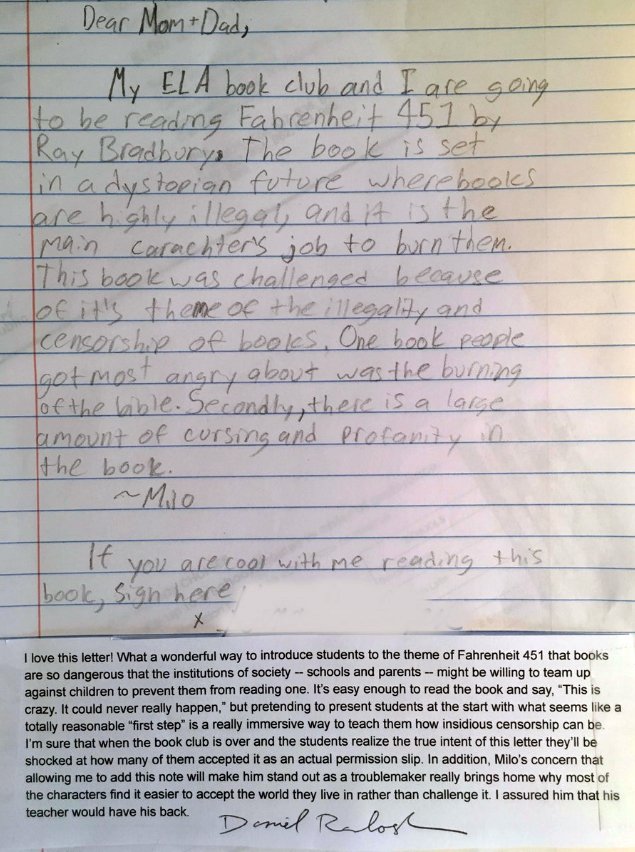
book permission slip.jpg Ironic permission slip request https://twitter.com/i/moments/790703810427494400

How does cen­sor­ship come about in advanced, osten­si­bly demo­c­ra­t­ic soci­eties? In some cas­es, through insti­tu­tions col­lud­ing in ways that go unno­ticed by the gen­er­al pub­lic. As Noam Chom­sky has argued for decades, state agen­cies often col­lude with the press to spread cer­tain nar­ra­tives and sup­press oth­ers. And as we see dur­ing Banned Books Week, leg­is­la­tures, courts, and edu­ca­tion­al insti­tu­tions often col­lude with pub­lish­ers, teach­ers, and par­ents to sup­press lit­er­a­ture they view as threat­en­ing. One such case remains par­tic­u­lar­ly iron­ic giv­en the book in ques­tion: Ray Bradbury’s Fahren­heit 451, the sto­ry of a dystopi­an soci­ety in which all books are banned, and fire depart­ments burn con­tra­band copies.

Between the years 1967 and 1979, Bal­lan­tine pub­lished an expur­gat­ed ver­sion of the nov­el for use in high schools, remov­ing con­tent deemed objec­tion­able. Brad­bury was com­plete­ly unaware. For six of those years, the bowd­ler­ized ver­sion was the only one sold by the pub­lish­er. We can remem­ber this case when we read the response of writer Daniel Radosh to a per­mis­sion slip his son Milo brought home from his 8th grade teacher for a book club read­ing of Fahren­heit 451. Writ­ten in Milo’s own hand, the ini­tial note, at the top, informs Mr. Radosh that the nov­el “was chal­lenged because of it’s [sic] theme of the ille­gal­i­ty and cen­sor­ship of books. One book peo­ple got most angry about was the burn­ing of the bible. Sec­ond­ly, there is a large amount of curs­ing and pro­fan­i­ty in the book.”

After this con­fes­sion, Milo’s note asks for a parental sig­na­ture in a post­script. Address­ing the let­ter’s true writer, Milo’s teacher, Daniel Radosh respond­ed thus, in the typed note attached to his son’s let­ter.

I love this let­ter! What a won­der­ful way to intro­duce stu­dents to the theme of Fahren­heit 451 that books are so dan­ger­ous that the insti­tu­tions of soci­ety – schools and par­ents – might be will­ing to team up against chil­dren to pre­vent them from read­ing one.

It’s easy enough to read the book and say, ‘This is crazy. It could nev­er real­ly hap­pen,’ but pre­tend­ing to present stu­dents at the start with what seems like a total­ly rea­son­able ‘first step’ is a real­ly immer­sive way to teach them how insid­i­ous cen­sor­ship can be.

I’m sure that when the book club is over and the stu­dents realise the true intent of this let­ter they’ll be shocked at how many of them accept­ed it as an actu­al per­mis­sion slip.

In addi­tion, Milo’s con­cern that allow­ing me to add to this note will make him stand out as a trou­ble­mak­er real­ly brings home why most of the char­ac­ters find it eas­i­er to accept the world they live in rather than chal­lenge it.

I assured him that his teacher would have his back.

Radosh’s insin­u­a­tion that the let­ter his son was induced to write is not an “actu­al per­mis­sion slip” under­scores his claim that the exer­cise is real­ly a means of con­trol­ling chil­dren by means of col­lu­sion, even though, he jests, such a thing must be part of the les­son itself. Should he be allowed to read the nov­el, the sign­ing and deliv­ery of the per­mis­sion slip, Radosh dev­as­tat­ing­ly sug­gests, com­pletes Milo’s humil­i­a­tion, bring­ing home to him “why most of the char­ac­ters” in the book remain pas­sive, and “find it eas­i­er to accept the world they live in rather than chal­lenge it.”

In short, Radosh’s response, for all its pithy irony, digs deeply into the mech­a­nisms that sup­press speech deemed so “dan­ger­ous that the insti­tu­tions of society—schools and parents—might be will­ing to team up against chil­dren to pre­vent them” from read­ing it.

See Metro UK for a com­plete tran­scrip­tion of both let­ters.

via Vin­tage Anchor

Relat­ed Con­tent:

Hear Ray Bradbury’s Clas­sic Sci-Fi Sto­ry Fahren­heit 451 as a Radio Dra­ma

The Cov­er of George Orwell’s 1984 Becomes Less Cen­sored with Wear and Tear

Frank Zap­pa Debates Cen­sor­ship on CNN’s Cross­fire (1986)

Josh Jones is a writer and musi­cian based in Durham, NC. Fol­low him at @jdmagness

Watch a 20-Year-Old Mikhail Baryshnikov Win Gold in One of His Earliest Performances (1969)

How well does Mikhail Barysh­nikov dance? The ques­tion answers itself, giv­en that the very word “Barysh­nikov” has come to sig­ni­fy the mas­tery of that art, and espe­cial­ly of male roles in bal­let. Yet there was once a time when no young dancer aspired to become the next Barysh­nikov, because even Barysh­nikov had­n’t yet become Barysh­nikov. Born in Latvia to a dress­mak­er moth­er and an engi­neer father, he began study­ing bal­let in 1960, at age eleven. Four years lat­er, he entered the Vagano­va Acad­e­my of Russ­ian Bal­let, from which he went on to win the ven­er­a­ble Var­na Inter­na­tion­al Bal­let Com­pe­ti­tion and, in 1967, join the Kirov Bal­let and Marin­sky The­ater.

The clip at the top of the post shows Barysh­nikov’s per­for­mance at the 1969 Moscow Inter­na­tion­al Bal­let Com­pe­ti­tion, from which he came out, along­side oth­er such soon-to-be big bal­let names as Nina Soroki­na and Mali­ka Sabiro­va, as a gold lau­re­ate.

“Barysh­nikov’s tech­nique is fault­less, his inter­pre­ta­tion mag­nif­i­cent,” says the announc­er as the still ten­der-aged dancer, just twen­ty years old, exe­cutes a solo from La Bayadère. The praise would, from that point on, keep on com­ing, and not just from the Sovi­et Union; around the same time, New York Times crit­ic Clive Barnes called Barysh­nikov “the most per­fect dancer I have ever seen.”

Yet for all his skill, Barysh­nikov did­n’t fit the tra­di­tion­al bal­let tem­plate: he lacked the height of oth­er famous male dancers, for one, and he also har­bored a desire to go beyond the bound­aries of 19th-cen­tu­ry dance and explore 20th-cen­tu­ry dance’s pos­si­bil­i­ties for inno­va­tion. His defec­tion from the Sovi­et Union in 1974 made it pos­si­ble for him to work with for­ward-think­ing chore­o­g­ra­phers like Alvin Ailey and Twyla Tharp, and to this day, in his mid-60s, he con­tin­ues push­ing his per­for­ma­tive bound­aries on the stage and the screen. Whether the 20-year-old dancer we see here could pos­si­bly have imag­ined such a future for him­self — a future involv­ing projects like his role on Sex and the City in the 2000s and his much-viewed video with Lil Buck for Rag & Bone last year — only Barysh­nikov knows.

Relat­ed Con­tent:

Bal­let in Super Slow Motion

Bal­let Dancers Do Their Hard­est Moves in Slow Motion

Watch an Avant-Garde Bauhaus Bal­let in Bril­liant Col­or, the Tri­adic Bal­let First Staged by Oskar Schlem­mer in 1922

Google Gives You a 360° View of the Per­form­ing Arts, From the Roy­al Shake­speare Com­pa­ny to the Paris Opera Bal­let

Based in Seoul, Col­in Mar­shall writes and broad­casts on cities and cul­ture. He’s at work on a book about Los Ange­les, A Los Ange­les Primer, the video series The City in Cin­e­ma, the crowd­fund­ed jour­nal­ism project Where Is the City of the Future?, and the Los Ange­les Review of Books’ Korea Blog. Fol­low him on Twit­ter at @colinmarshall or on Face­book.

Hear 20 Minutes of Mark Frost’s New Secret History of Twin Peaks, the Book Fans Have Waited 25 Years to Read

We live in a good time to be a Twin Peaks fan. Amid the buzz of a third sea­son of David Lynch and Mark Frost’s inno­v­a­tive­ly sur­re­al prime­time dra­ma pre­mier­ing on Show­time next year, we’ve enjoyed the emer­gence of con­tem­po­rary Twin Peaks-relat­ed mate­ri­als (David Lynch’s hand-drawn map of the tit­u­lar small-town set­ting, the Japan­ese cof­fee com­mer­cials he set there) as well as new­er Twin Peaks-themed projects from oth­er cre­ators (an Atari game, an ele­men­tary school play). And now we can read Frost’s nov­el The Secret His­to­ry of Twin Peaks, billed by its pub­lish­er as “the sto­ry mil­lions of fans have been wait­ing to get their hands on for 25 long years.”

The nov­el­’s “362 pages cov­er what hap­pened to some of the peo­ple of that icon­ic fic­tion­al town since we last saw them 25 years ago, but the time­line starts as ear­ly as the 1800s with the jour­nals of Lewis and Clark,” says fan site Wel­come to Twin Peaks. It also “also offers a deep­er glimpse into the cen­tral mys­tery that was only touched on by the orig­i­nal series, and will include over 100 four-col­or illus­tra­tions and pho­tographs.” The near­ly ten-hour audio­book ver­sion fea­tures the voic­es of orig­i­nal cast mem­bers like Michael Horse as Deputy Hawk, Russ Tam­blyn as Dr. Lawrence Jaco­by, and most Twin Peaks of all, Kyle MacLach­lan as FBI Spe­cial Agent Dale Coop­er.

In the video and audio clips at the top of the post, you can sam­ple The Secret His­to­ry of Twin Peaks’ audio­book expe­ri­ence and get a sense of how it dif­fers from that of a nor­mal audio­book — and how the text itself dif­fers from that of a stan­dard nov­el. It takes the form not of a straight-ahead nar­ra­tive but a thor­ough FBI dossier, the print ver­sion of which Mered­ith Bor­ders of Birth.Movies.Death. describes as “an attrac­tive mul­ti-media hodge­podge, with Xerox­ed mani­la fold­ers and sticky notes, arrest reports, book cov­ers, pho­tos and sketch­es and maps and news­pa­per clip­pings.” The longer excerpt here delves into the sto­ry of Josie Packard, the wid­owed own­er of Packard Sawmill and a par­tic­u­lar­ly mys­te­ri­ous char­ac­ter in a cast of mys­te­ri­ous char­ac­ters. Not to give too much away, but her past involves a fash­ion empire, a Hong Kong drug tri­ad, and a “leg­en­dar­i­ly beau­ti­ful pros­ti­tute.”

As always in Twin Peaks, the more you learn, the stranger things get. But a true fan wants just that, and they can have it and then some by pick­ing up their own copy of the book or audio­book, the lat­ter of which they can get for free if they take audio­book provider Audi­ble up on their 30-day tri­al offer.

via Wel­come to Twin Peaks

Relat­ed Con­tent:

David Lynch Draws a Map of Twin Peaks (to Help Pitch the Show to ABC)

David Lynch Directs a Mini-Sea­son of Twin Peaks in the Form of Japan­ese Cof­fee Com­mer­cials

Play the Twin Peaks Video Game: Retro Fun for David Lynch Fans

Ele­men­tary School Stu­dents Per­form in a Play Inspired by David Lynch’s Twin Peaks

David Lynch’s Twin Peaks Title Sequence, Recre­at­ed in an Adorable Paper Ani­ma­tion

Based in Seoul, Col­in Mar­shall writes and broad­casts on cities and cul­ture. He’s at work on a book about Los Ange­les, A Los Ange­les Primer, the video series The City in Cin­e­ma, the crowd­fund­ed jour­nal­ism project Where Is the City of the Future?, and the Los Ange­les Review of Books’ Korea Blog. Fol­low him on Twit­ter at @colinmarshall or on Face­book.

Hear Vincent Price, Horror Film Legend, Read 8+ Hours of Scary Stories

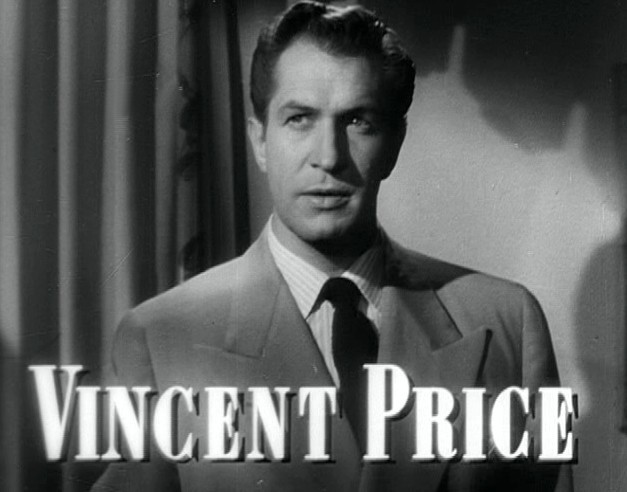
vincent_price_in_laura_trailer

Image via Wiki­me­dia Com­mons

Here’s a good way to inject a lit­tle fright into your Hal­loween cel­e­bra­tion. Below, we’ve pulled togeth­er a playlist fea­tur­ing Vin­cent Price, the icon of so many clas­sic hor­ror films, read­ing 8+ hours of scary sto­ries. The read­ings, avail­able for free on Spo­ti­fy, come from albums record­ed decades ago. The col­lec­tion includes:

  • Tales of Witch­es, Ghosts and Gob­lins (1972)
  • Witch­craft — Mag­ic: An Adven­ture In Demonolo­gy (1969)
  • A Horn­book For Witch­es, Sto­ries And Poems For Hal­loween (1976)
  • Vin­cent Price and Basil Rath­bone Read Edgar Allan Poe Sto­ries & Poems (1954)


If you don’t have Spo­ti­fy’s soft­ware, down­load it here. This Vin­cent Price playlist will be added to our col­lec­tion, 1,000 Free Audio Books: Down­load Great Books for Free.

Relat­ed Con­tent:

Watch Vin­cent, Tim Burton’s Ani­mat­ed Trib­ute to Vin­cent Price & Edgar Allan Poe (1982)

Watch Vin­cent Price Turn Into Edgar Allan Poe & Read Four Clas­sic Poe Sto­ries (1970)

5 Hours of Edgar Allan Poe Sto­ries Read by Vin­cent Price & Basil Rath­bone

by | Permalink | Make a Comment ( 1 ) |

What Makes a Good Horror Movie? The Answer Revealed with a Journey Through Classic Horror Films Clips

A few min­utes with Lewis Bond’s first video essay, “Let’s Dis­cuss Hor­ror,” above, was all it took to scup­per my care­ful avoid­ance of cer­tain film fran­chis­es—Saw, Hos­tel, The Human Cen­tipede

Bond’s cin­e­mat­ic pre­oc­cu­pa­tions usu­al­ly come with far few­er explod­ing heads. Lat­er entries on his Chan­nel Criswell Youtube chan­nel explore such Cri­te­ri­on Col­lec­tion-wor­thy top­ics as “Colour in Sto­ry­telling,” “The French New Wave,” and “Stan­ley Kubrick.”

Clear­ly, he cares about the hor­ror genre, as well as the more rar­i­fied stuff. He opines that hor­ror movies have lost their capac­i­ty to scare. The industry’s quest for ever more trans­gres­sive shocks and gore (many of which are on dis­play above) has left view­ers desen­si­tized. Bond likens the phe­nom­e­non to hit­ting a brick wall and “try­ing to break it down by adding more bricks.”

Part of the prob­lem, Bond sug­gests, is an indus­try onus to deliv­er wall-to-wall deprav­i­ty, the gross­er, the bet­ter. Tor­ture porn may have cor­nered a siz­able piece of the mar­ket, but lack of fore­play is killing the sus­pense. Slow builds such as Dan­ny Torrence’s end­less Big Wheel rides past Room 237 or Rosemary’s uneasy preg­nan­cy are a thing of the past. Today’s film­mak­ers have the meat hooks out from the get go.

When audi­ences become inured to the non-stop buf­fet of burst­ing entrails and the rot­ting zom­bies  who feast on them, film­mak­ers grow even more reliant on jump scares. These pop-go-the-weasel moments invari­ably get a rise out of me, but Bond, like most hor­ror purists, views them with dis­dain. Too easy.

“Let’s Dis­cuss Hor­ror” con­tains a pletho­ra of them, but they seem sil­ly, divorced from the nar­ra­tive and the req­ui­site scary music.

(Speak­ing of which, “Tubu­lar Bells” under­scores a good por­tion of Bond’s breezy nar­ra­tion.)

When­ev­er Bond makes a point with a longer scene from more cel­e­brat­ed fare such as JAWS, Don’t Look Now, or Audi­tion, he includes a click­able link that will deposit view­ers on the oth­er side of spoil­ers. Depend­ing on your sat­u­ra­tion point, you may find your­self wish­ing those links would drop you off in Linus’ pump­kin patch.

Hap­py Hal­loween!

Relat­ed Con­tent:

The First Hor­ror Film, George Méliès’ The Manor of the Dev­il (1896)

Watch the Cult Clas­sic Hor­ror Film Car­ni­val of Souls (1962)

Mar­tin Scors­ese Names the 11 Scari­est Hor­ror Films: Kubrick, Hitch­cock, Tourneur & More

Time Out Lon­don Presents The 100 Best Hor­ror Films: Start by Watch­ing Four Hor­ror Clas­sics Free Online

Ayun Hal­l­i­day is an author, illus­tra­tor, the­ater mak­er and Chief Pri­ma­tol­o­gist of the East Vil­lage Inky zine.  Her play Zam­boni Godot is open­ing in New York City in March 2017. Fol­low her @AyunHalliday.

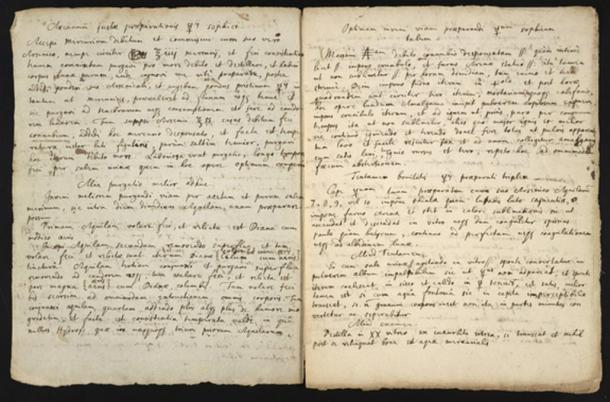
Isaac Newton’s Recipe for the Mythical ‘Philosopher’s Stone’ Is Being Digitized & Put Online (Along with His Other Alchemy Manuscripts)

17th-century-manuscript

In his 1686 Prin­cip­ia Math­e­mat­i­ca, Isaac New­ton elab­o­rat­ed not only his famous Law of Grav­i­ty, but also his Three Laws of Motion, set­ting a cen­turies-long trend for sci­en­tif­ic three-law sets. Newton’s third law has by far proven his most pop­u­lar: “every action has an equal and oppo­site reac­tion.” In Arthur C. Clarke’s 20th cen­tu­ry Three Laws, the third has also attained wide cul­tur­al sig­nif­i­cance. No doubt you’ve heard it: “Any suf­fi­cient­ly advanced tech­nol­o­gy is indis­tin­guish­able from mag­ic.”

Clarke’s third law gets invoked in dis­cus­sions of the so-called “demar­ca­tion prob­lem,” that is, of the bound­aries between sci­ence and pseu­do­science. It also comes up, of course, in sci­ence fic­tion forums, where peo­ple refer to Ted Chiang’s suc­cinct inter­pre­ta­tion: “If you can mass-pro­duce it, it’s sci­ence, and if you can’t, it’s mag­ic.” This makes sense, giv­en the cen­tral impor­tance the sci­ences place on repro­ducibil­i­ty. But in Newton’s pre-indus­tri­al age, the dis­tinc­tions between sci­ence and mag­ic were much blur­ri­er than they are now.

New­ton was an ear­ly fel­low of the British Roy­al Soci­ety, which cod­i­fied repeat­able exper­i­ment and demon­stra­tion with their mot­to, “Noth­ing in words,” and pub­lished the Prin­cip­ia. He lat­er served as the Society’s pres­i­dent for over twen­ty years. But even as the fore­most rep­re­sen­ta­tive of ear­ly mod­ern physics—what Edward Dol­nick called “the clock­work uni­verse”—New­ton held some very strange reli­gious and mag­i­cal beliefs that we would point to today as exam­ples of super­sti­tion and pseu­do­science.

In 1704, for exam­ple, the year after he became Roy­al Soci­ety pres­i­dent, New­ton used cer­tain eso­teric for­mu­lae to cal­cu­late the end of the world, in keep­ing with his long-stand­ing study of apoc­a­lyp­tic prophe­cy. What’s more, the revered math­e­mati­cian and physi­cist prac­ticed the medieval art of alche­my, the attempt to turn base met­als into gold by means of an occult object called the “Philosopher’s stone.” By Newton’s time, many alchemists believed the stone to be a mag­i­cal sub­stance com­posed in part of “soph­ick mer­cury.” In the late 1600s, New­ton copied out a recipe for such stuff from a text by Amer­i­can-born alchemist George Starkey, writ­ing his own notes on the back of the doc­u­ment.

You can see the “soph­ick mer­cury” for­mu­la in Newton’s hand at the top. The recipe con­tains, in part, “Fiery Drag­on, some Doves of Diana, and at least sev­en Eagles of mer­cury,” notes Michael Greshko at Nation­al Geo­graph­ic. New­ton’s alchem­i­cal texts detail what has long been “dis­missed as mys­ti­cal pseu­do­science full of fan­ci­ful, dis­cred­it­ed process­es.” This is why Cam­bridge Uni­ver­si­ty refused to archive Newton’s alchem­i­cal papers in 1888, and why his 1855 biog­ra­ph­er won­dered how he could be tak­en in by “the obvi­ous pro­duc­tion of a fool and a knave.” New­ton’s alche­my doc­u­ments passed qui­et­ly through many pri­vate col­lec­tors’ hands until 1936, when “the world of Isaac New­ton schol­ar­ship received a rude shock,” writes Indi­ana University’s online project, The Chym­istry of Isaac New­ton:

In that year the ven­er­a­ble auc­tion house of Sotheby’s released a cat­a­logue describ­ing three hun­dred twen­ty-nine lots of Newton’s man­u­scripts, most­ly in his own hand­writ­ing, of which over a third were filled with con­tent that was unde­ni­ably alchem­i­cal.

Marked “not to be print­ed” upon his death in 1727, the alchem­i­cal works “raised a host of inter­est­ing ques­tions in 1936 as they do even today.” Those ques­tions include whether or not New­ton prac­ticed alche­my as an ear­ly sci­en­tif­ic pur­suit or whether he believed in a “secret the­o­log­i­cal mean­ing in alchem­i­cal texts, which often describe the trans­mu­ta­tion­al secret as a spe­cial gift revealed by God to his cho­sen sons.” The impor­tant dis­tinc­tion comes into play in Ted Chiang’s dis­cus­sion of Clarke’s Third Law:

Sup­pose some­one says she can trans­form lead into gold. If we can use her tech­nique to build fac­to­ries that turn lead into gold by the ton, then she’s made an incred­i­ble sci­en­tif­ic dis­cov­ery. If on the oth­er hand it’s some­thing that only she can do… then she’s a magi­cian.

Did New­ton think of him­self as a magi­cian? Or, more prop­er­ly giv­en his reli­gios­i­ty, as God’s cho­sen ves­sel for alchem­i­cal trans­for­ma­tion? It’s not entire­ly clear what he believed about alche­my. But he did take the prac­tice of what was then called “chym­istry” as seri­ous­ly as he did his math­e­mat­ics. James Voelkel, cura­tor of the Chem­i­cal Her­itage Foun­da­tion—who recent­ly pur­chased the Philoso­phers’ stone recipe—tells Live­science that its author, Starkey, was “prob­a­bly American’s first renowned, pub­lished sci­en­tist,” as well as an alchemist. While New­ton may not have tried to make the mer­cury, he did cor­rect Starkey’s text and write his own exper­i­ments for dis­till­ing lead ore on the back.

Indi­ana Uni­ver­si­ty sci­ence his­to­ri­an William New­man “and oth­er his­to­ri­ans,” notes Nation­al Geo­graph­ic, “now view alchemists as thought­ful tech­ni­cians who labored over their equip­ment and took copi­ous notes, often encod­ing their recipes with mytho­log­i­cal sym­bols to pro­tect their hard-won knowl­edge.” The occult weird­ness of alche­my, and the strange pseu­do­nyms its prac­ti­tion­ers adopt­ed, often con­sti­tut­ed a means to “hide their meth­ods from the unlearned and ‘unwor­thy,’” writes Dan­ny Lewis at Smith­son­ian. Like his fel­low alchemists, New­ton “dili­gent­ly doc­u­ment­ed his lab tech­niques” and kept a care­ful record of his read­ing.

“Alchemists were the first to real­ize that com­pounds could be bro­ken down into their con­stituent parts and then recom­bined,” says New­man, a prin­ci­ple that influ­enced Newton’s work on optics. It is now acknowl­edged that—while still con­sid­ered a mys­ti­cal pseudoscience—alchemy is an impor­tant “pre­cur­sor to mod­ern chem­istry” and, indeed, as Indi­ana Uni­ver­si­ty notes, it con­tributed sig­nif­i­cant­ly to ear­ly mod­ern phar­ma­col­o­gy” and “iatro­chem­istry… one of the impor­tant new fields of ear­ly mod­ern sci­ence.” The suf­fi­cient­ly advanced tech­nol­o­gy of chem­istry has its ori­gins in the mag­ic of “chym­istry,” and New­ton was “involved in all three of chymistry’s major branch­es in vary­ing degrees.”

Newton’s alchem­i­cal man­u­script papers, such as “Artephius his secret Book” and “Her­mes” sound noth­ing like what we would expect of the dis­cov­er­er of a “clock­work uni­verse.” You can read tran­scrip­tions of these man­u­scripts and sev­er­al dozen more at The Chym­istry of Isaac New­ton, where you’ll also find an Alchem­i­cal Glos­sary, Sym­bol Guide, sev­er­al edu­ca­tion­al resources, and more. The man­u­scripts not only show Newton’s alche­my pur­suits, but also his cor­re­spon­dence with oth­er ear­ly mod­ern alchem­i­cal sci­en­tists like Robert Boyle and Starkey, whose recipe—titled “Prepa­ra­tion of the [Socph­ick] Mer­cury for the [Philoso­phers’] stone by the Antin­o­mi­al Stel­late Reg­u­lus of Mars and Luna from the Man­u­scripts of the Amer­i­can Philosopher”—will be added to the Indi­ana Uni­ver­si­ty online archive soon.

Relat­ed Con­tent:

In 1704, Isaac New­ton Pre­dicts the World Will End in 2060

Sir Isaac Newton’s Papers & Anno­tat­ed Prin­cip­ia Go Dig­i­tal

Isaac New­ton Cre­ates a List of His 57 Sins (Cir­ca 1662)

Josh Jones is a writer and musi­cian based in Durham, NC. Fol­low him at @jdmagness

The 14-Hour Epic Film, Dune, That Alejandro Jodorowsky, Pink Floyd, Salvador Dalí, Moebius, Orson Welles & Mick Jagger Never Made

Frank Her­bert, David Lynch, and Ale­jan­dro Jodor­owsky sure­ly all rank among the most imag­i­na­tive cre­ators of the sec­ond half of the twen­ti­eth cen­tu­ry. It made sense to film pro­duc­ers to turn Her­bert’s Dune into a movie, but they had a dev­il of a time find­ing the right direc­tor to bring that epic nov­el of the feu­dal inter­stel­lar future to the screen. Lynch, as all his fans know and most regret, wound up with the job, and soon after the botched result hit the­aters in 1984, it made his­to­ry as one of the all-time clas­sic mis­match­es between film­mak­er and project, and at $40 mil­lion, one of the most expen­sive. Les­son learned: don’t hire the direc­tor of Eraser­head to helm your big-bud­get sci-fi block­buster.

But what about the direc­tor of the even stranger and more ambi­tious The Holy Moun­tain? In 1975, almost a decade before Lynch’s Dune, Jodor­owsky announced his own adap­ta­tion of Dune, fund­ed by a French con­sor­tium and made in col­lab­o­ra­tion with artists like Chris Foss, H.R. Giger, and Moe­bius, writer and spe­cial effects design­er Dan O’Ban­non (who’d just made the low-bud­get space com­e­dy Dark Star with John Car­pen­ter), and actors like Orson Welles, Glo­ria Swan­son, and David Car­ra­dine.

He also cast such icons not known pri­mar­i­ly for act­ing as Mick Jag­ger and Sal­vador Dalí. “Jodorowsky’s mid­night audi­ences were noto­ri­ous for being high,” writes The Hol­ly­wood Reporter’s Chris O’Falt, “but with Dune the direc­tor set out to make a film that fab­ri­cat­ed the effects of LSD for a sober audi­ence, com­plete with a sound­track by Pink Floyd.”

Or as Dalí once declared, “I don’t do drugs. I am drugs.” This cin­e­mat­ic expe­ri­ence of expand­ed con­scious­ness would have run approx­i­mate­ly four­teen hours, as Her­bert dis­cov­ered when he checked in on the pre-pro­duc­tion to find $2 mil­lion of the film’s $9.5 mil­lion bud­get already spent and a script “the size of a phone book.” Unable to find a stu­dio to bankroll the Dune he and his col­lab­o­ra­tors had envi­sioned, Jodor­owsky ulti­mate­ly dropped the project, but its mate­ri­als — and the stag­ger­ing breadth as well as depth of its vision — pro­vid­ed the basis for the 2014 doc­u­men­tary Jodor­owsky’s Dune, whose trail­er you can watch above.

“Almost all the bat­tles were won, but the war was lost,“Jodorowsky writes in an essay on his expe­ri­ence with the project. “The project was sab­o­taged in Hol­ly­wood. It was French and not Amer­i­can. Its mes­sage was not ‘enough Hol­ly­wood.’ There were intrigues, plun­der­ing. The sto­ry-board cir­cu­lat­ed among all the large stu­dios. Lat­er, the visu­al aspect of Star Wars resem­bled our style. To make Alien, they invit­ed Moe­bius, Foss, Giger, O’Ban­non, etc.,” to say noth­ing of its traces vis­i­ble in Blade Run­ner and The Matrix. While the 87-year-old Jodor­owsky has made a return to film­mak­ing in recent years, his Dune will most like­ly remain on the lists of the great­est movies nev­er made. But its influ­ence, if not its scale, will no doubt con­tin­ue to man­i­fest in gen­er­a­tions of sci-fi cin­e­ma to come.

Relat­ed Con­tent:

Moe­bius’ Sto­ry­boards & Con­cept Art for Jodorowsky’s Dune

Mœbius & Jodorowsky’s Sci-Fi Mas­ter­piece, The Incal, Brought to Life in a Tan­ta­liz­ing Ani­ma­tion

The Glos­sary Uni­ver­sal Stu­dios Gave Out to the First Audi­ences of David Lynch’s Dune (1984)

Napoleon: The Great­est Movie Stan­ley Kubrick Nev­er Made

Based in Seoul, Col­in Mar­shall writes and broad­casts on cities and cul­ture. He’s at work on a book about Los Ange­les, A Los Ange­les Primer, the video series The City in Cin­e­ma, the crowd­fund­ed jour­nal­ism project Where Is the City of the Future?, and the Los Ange­les Review of Books’ Korea Blog. Fol­low him on Twit­ter at @colinmarshall or on Face­book.


  • Great Lectures

  • Sign up for Newsletter

  • About Us

    Open Culture scours the web for the best educational media. We find the free courses and audio books you need, the language lessons & educational videos you want, and plenty of enlightenment in between.


    Advertise With Us

  • Archives

  • Search

  • Quantcast