Here’s an audio collection worth sharing with the cinephiles among you. Alfred Hitchcock Interviews (embedded below) brings together 12 interviews recorded over several decades, collectively running five hours and four minutes. If you need Spotify’s software, download it here. Then tune into Track 3 and hear Hitchcock describe his three theories of film editing. Track 10 lets you listen to his 33-minute “Masters of Cinema” interview recorded in 1972. And Track 12 presents a 96-minute “Master Class” on filmmaking. This audio collection will be housed in our collection, 1,000 Free Audio Books: Download Great Books for Free.
If you would like to support the mission of Open Culture, consider making a donation to our site. It’s hard to rely 100% on ads, and your contributions will help us continue providing the best free cultural and educational materials to learners everywhere. You can contribute through PayPal, Patreon, and Venmo (@openculture). Thanks!
There’s a gender assumption for every stage of life these days. From gender-coded Lego play sets and teen magazines, we progress to lightweight, pink tool sets or their more traditional, apparently “masculine” counterpart.
After that?
Adult diapers.
Physically, it makes sense that the latter would divide along assigned gender lines. Biology may not be the trump card it was once considered to be, but, in general, it continues to visit wider hips on those born female organs than those rocking the frank n’ beans.
(That said, as the mother of babies, I always appreciated when a reliable brand went the extra mile with unisex patterns on the tapes or waist band.)
Filmmaker Errol Morris chose to widen the gender divide in 2009, when he was hired to direct a Depend spot, featuring the company’s new line of gender-specific adult diapers, above.
In the end, the product itself was waiting in the wings, so a couple of cute midlife interviewees could take turns describing their impressions of a single Rorschach blot.
Don’t worry. It’s got nothing to do with absorbency.
The female subject immediately begins to spin a fanciful tale involving two cute birds, while the male hems and haws, apparently the victim of some tragic gender-based lack of imagination. I bet he doesn’t like stopping to ask for directions either.
Given this director’s track record of gripping documentaries, I think I’d have preferred a more straightforward approach. I’d be up for a full-length documentary about the experience of actually wearing those things, especially if Morris used his Interrotron to elicit frank eye contact, as he does above.
It’s an uncomfortable subject for sure, but I’d like to hear how adult diapers impact an individual’s sense of attractiveness and self-worth. I wouldn’t want Morris to generalize, but by and large, is it a radically different experience for men than it is for women?
Perhaps the riffing pair in the commercial spot have more familiarity with the product than they were allowed to let on? If so, I’d imagine it’s from caring for an elderly relative, but I could be wrong. Either way, those would be stories I’d like to hear.
Ayun Halliday is an author, illustrator, theater maker and Chief Primatologist of the East Village Inky zine. Her latest script, Fawnbook, is available in a digital edition from Indie Theater Now. Follow her @AyunHalliday.
Even before you start on a journey through the history of literature, you know some of the stops you’ll make on the way: the Epic of Gilgamesh, the Bible, Homer’s Iliad and Odyssey, Greek tragedy, Shakespeare, Joyce. And so it comes as no surprise that Jacke Wilson, creator and host of the History of Literature podcast (from ancient epics to contemporary classics — Android — RSS), has so far devoted whole episodes, and often more than one, to each of them. A self-described “amateur scholar,” Wilson aims with this show, which he launched last October, to take “a fresh look at some of the most compelling examples of creative genius the world has ever known.”
Wilson also addresses questions like “How did literature develop? What forms has it taken? And what can we learn from engaging with these works today?” And yet he asks this rhetorical one in The History of Literature’s very first episode: “Is it just me, or is literature dying?” The also self-described “wildly unqualified host” admits that he at first tried to create a straightforward, straight-faced march through literary history, but found the result staid and lifeless. And so he loosened up, allowing in not just more of his personality but more of his doubts about the very literary enterprise in the 21st century.
Given that we get so much of our knowledge, human interaction, and pure wordcraft on the internet today, laments Wilson, what remains for novels, stories, poetry, and drama to provide us? As a History of Literaturelistener, I personally see things differently. The fact that we now have such abundant outlets from which to receive all those other things may strip literature of some of the relevance it once held by default, but it also lifts from literature a considerable burden. Just as the development of photography freed painting from the obligation to ever more faithfully represent reality, literature can now find forms and subjects better suited to the artistic experience that it, and only it, can deliver.
Jorge Luis Borges counts as only one of the writers who grasped the unexplored potential of literature, and Wilson uses one of the occasional episodes that breaks from the linearity of history to discuss the “Garden of Forking Paths” author’s thoughts on the meaning of life. He recorded it (listen above) in response to two deaths: that of “Fifth Beatle” George Martin, and even more so that of his uncle. Other relatable parts of Wilson’s life come into play in other conversations about writers both ancient and modern, such as the conversation about the works of Graham Greene and whether he can still get as much out of them as he did during his youthful traveling days. Literature, after all, may have no greater value than that it gets us asking questions — a value The History of Literature demonstrates in every episode.
Back in college, I took a survey class on Russian history, taught by one of these people who take up the profession in their active retirement after a career spent working in the field. This particular professor had gone to work for the State Department after graduate school and served in various posts in Soviet Russia for several decades. The format of his class seemed unremarkable on paper. One standard syllabus, one bulky, expensive textbook. But the classes themselves consisted of long, fascinating stories about personal encounters with Brezhnev and Gorbachev, or journeys into ancient Kiev, or to the outer reaches of the Steppes.
All that was missing from those vivid recollections was a comparable photo essay to tell the story visually. This has been remedied and then some by the “The History of Russia,” an enormous joint archive project from Moscow’s Multimedia Art Museum and Yandex, Russia’s largest search engine. The archive contains over 70,000 photos, gathered from “more than 40 institutions and collections,” writes Hyperallergic, and representing “over 150 years of photographs capturing all sorts of scenes of Russian life.”
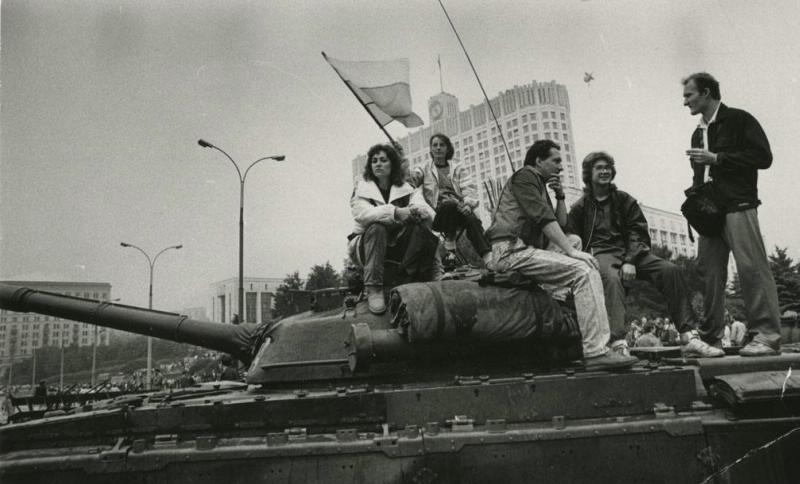
Non-Russian speakers can load the site in Google Chrome and have it translated into English. Additionally, “a timeline allows you to browse by date, a map enables location-based searches, and preset categories filter the images by theme.” Russian speakers can enter specific keywords into the site’s search engine. Currently, the archive features an exhibition on the August Putsch, the 1991 coup attempt on the presidency of Mikhail Gorbachev, staged by hard-line Communist Party Members opposed to reform. See one iconic photo of that historical event above, and many more at the virtual exhibition.
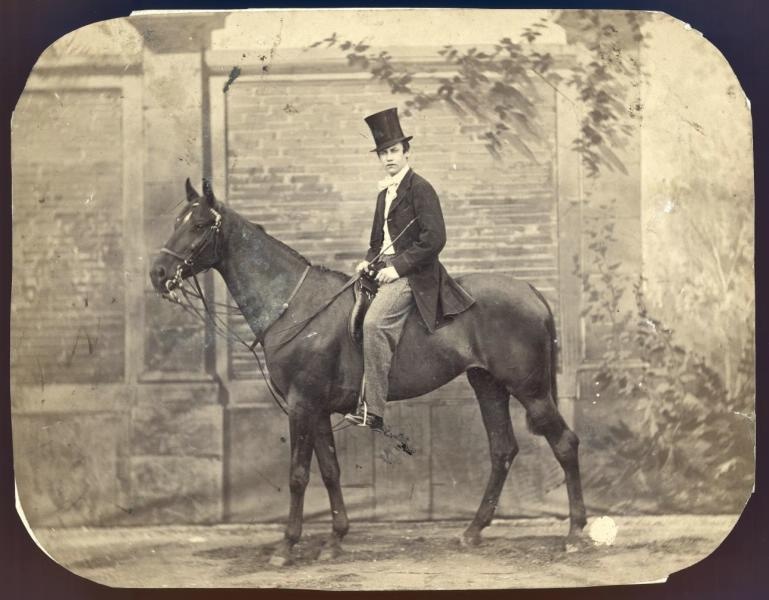
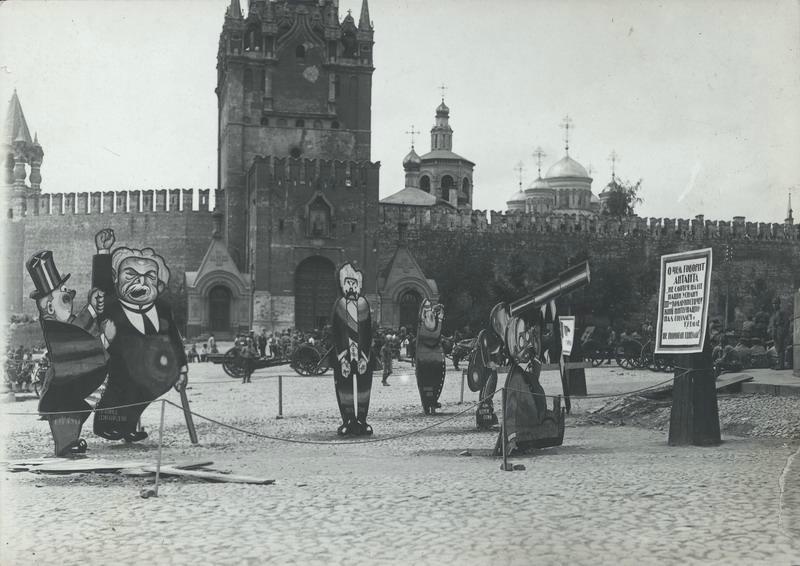
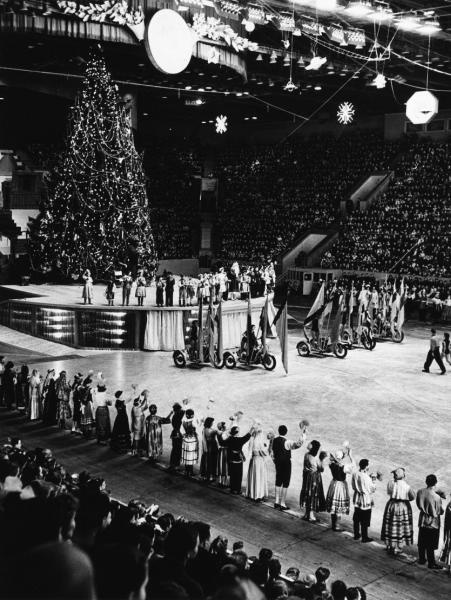
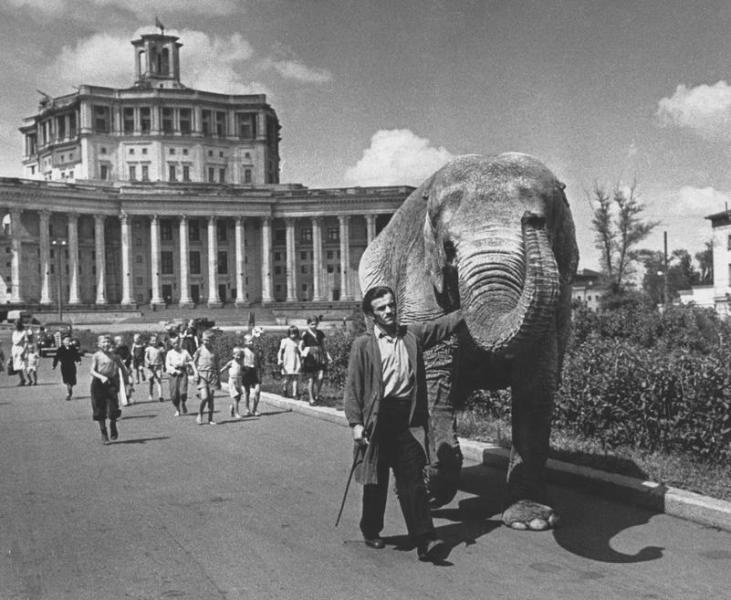
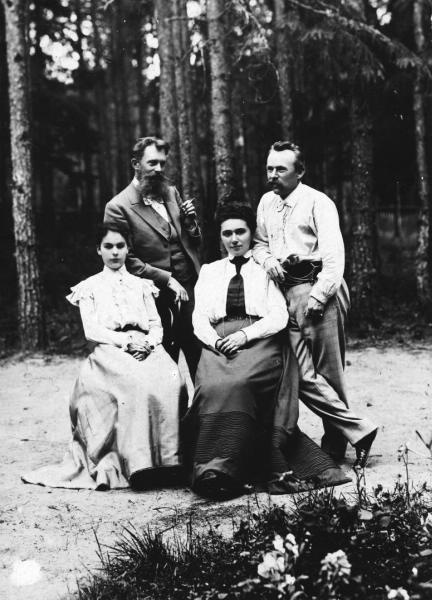
The late 1980s and 90s may be a period of particular interest for students and writers of Russian history, like David Remnick, and for good reason. But every decade in the archive holds its own fascination. Stately portraits from the 1860s, like that at the top of the post, show us the society of Tolstoy in the decade he serialized War and Peace. Photos from the 20s, like the satirical display in Red Square, further down, show us the days of Lenin’s rule and the early years of the Soviet Union. Images from the 50s give us unique insider views—often impossible at the time—of ordinary Soviet life at the height of the Cold War, such as the Christmas tree in the Luzhniki Stadium, above, or the man leading an elephant from the Red Army Theater, below.
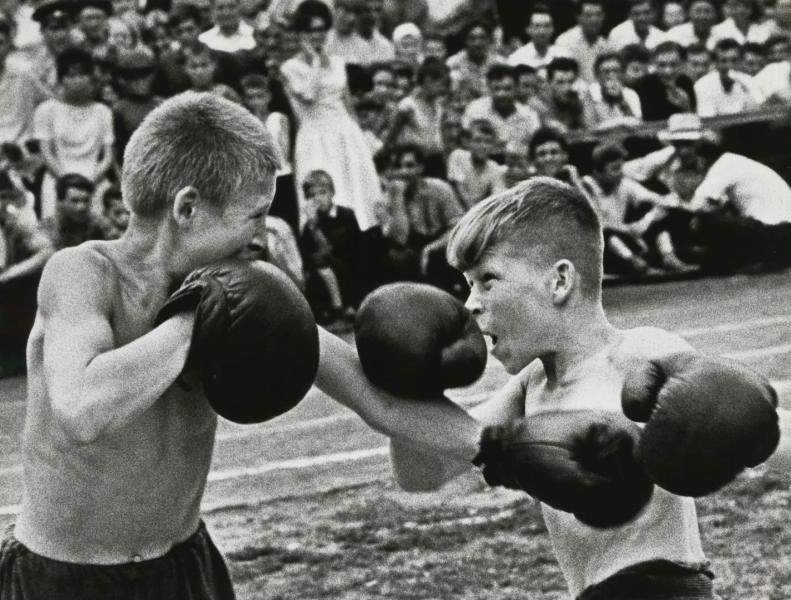
The 60s in particular look like a Life magazine spread, with dramatic photos of Olympic athletes in training, statesmen posed with wives and children, and hundreds of arresting pictures from everyday life, like that of two boys boxing below. The huge galleries can be a little cumbersome to navigate and require some patience on the part of the non-Russian-speaking user. But that patience is richly rewarded with photograph after photograph of a country we rarely hear spoken of in less than inflammatory terms. We encounter, of course, the odd portrait of Stalin and other well-worn propaganda images, but for the most part, the photos look and feel candid, and for good reason.
“According to a release,” Hyperallergic writes, “many of the photographs are published here for the first time, partly because the portal invites users to upload, describe, and tag images from personal archives. It has the feel of a museum collection”—and also of a family photo album stretching back generations. “The History of Russia” archive offers occasional context in addition to the dates, names, and locations of subjects. But informative text appears rarely, and in nearly unreadable translations for us non-speakers. Nonetheless, a few hours lost in these galleries feel like a near total immersion in Russian history. You can enter the archive here.
In every musician’s discography, one album has to rank at the bottom. In the case of the prolific and respected singer-songwriter Elvis Costello, fans and critics alike tend to single out 1984’s Goodbye Cruel World, which even Costello himself once described as “our worst album.” But with an artist like him doing the creating, even the duds hold a certain interest, or have a value at their core that emerges in unexpected ways. “Among the most discordant songs on the album was the forgettable ‘The Deportees Club.’ But then, years later, Costello went back and re-recorded it as ‘Deportee,’ and today it stands as one of his most sublime achievements.”
That comes from “Halleluah,” a recent episode of Revisionist History, the new podcast from Malcolm Gladwell that we first featured back in June. Here, perhaps the best-known curious journalistic mind of our time asks where genius comes from. Or, less abstractly, he asks about “the role that time and iteration play in the production of genius, and how some of the most memorable works of art had modest and undistinguished births.” His other example from the realm of music gives the episode its title. It first appeared, in the same year as did Costello’s “The Deportees Club,” on Leonard Cohen’s Various Positions, not making much of an impact until a cover by John Cale, and then more so one by Jeff Buckley, made it the “Hallelujah” we know today.
“That’s awful,” moans Gladwell, cutting off a clip of Costello’s original “The Deportees Club” — this from a self-described Elvis Costello superfan, who in 1984 bought Goodbye Cruel World the week it came out, just like he bought every other Elvis Costello album the week it came out. He regarded it as unlistenable then and still regards it as unlistenable today, applying that adjective at least twice in this podcast alone. He goes easier on Cohen’s original “Hallelujah,” poking fun at its dirge-like seriousness. Then, being Malcolm Gladwell, he goes on to frame the story of how both songs became great—the former a personal obsession of his own, the latter a phenomenon covered by “nearly everyone”—in terms of a theory: some artists are Picasso, and others are Cézanne.
Artists of the Picasso model execute their works seemingly at a stroke, often after long periods spent consciously or unconsciously assembling a coherent vision. Artists of the Cézanne model execute, execute, and execute again, refining their way from an imperfect first product to a much more perfect final one. Sometimes the first iteration a Cézanne puts out emerges at the wrong time, the initial fate of “The Deportees Club” and “Hallelujah.” Neither song, each by a musician in his own way unsuited to the climate of pop perfectionism that prevailed in the mid-1980s, found its form right away. Both would fit well into an institution I’ve long dreamed of called the Museum of First Drafts: enter and behold just how far a creation still needs to go even after its “creation”—even when created by a Costello, a Cohen or a Cézanne.
Did anyone ever truly want to be a coal miner? The work was dirty, dangerous, and poorly compensated, the workers exploited and their unions blocked by callow employers.
However hard your job may be, it’s not coal mining.
It’s probably not contemporary marble mining either. This may strike you as a pity, after viewing excerpts from Il Capo, filmmaker Yuri Ancarani’s dreamy 15-minute documentary, set in the Bettogli quarry in Tuscany.
As captured above, the shirtless quarry boss’s silent instructions to workers prying enormous slabs of marble from the barren white landscape with industrial excavators are unbelievably lyrical.
Consider yourself lucky if your job is even a fraction as poetic.
Marble mining seems as though it might also be a secret to staying fit—and tan—well into middle age.
I do wonder if vanity caused our middle aged hero to doff his noise-canceling headphones while the camera rolled. These massive slabs do not go down lightly, thus the necessity of non-verbal communication.
The filmmaker states that he was with the delicacy of his subject’s “light, precise and determined” movements. The quarry crew might not find their boss’ physicality reminiscent of a conductor guiding an orchestra through a particularly sensitive movement, but those who caught the film at one of the many galleries, festivals, and museums where it has screened reportedly do.
Clearly, Ancarani has an attraction to work transpiring in unusual landscapes. Il Capo is a part of hisMalady of Iron trilogy, which also documents time spent with divers operating from a submarine deep below the ocean’s surface and a surgical robot whose movements inside the human body are controlled via joystick.
- Ayun Halliday is an author, illustrator, theater maker and Chief Primatologist of the East Village Inky zine. Her latest script, Fawnbook, is available in a digital edition from Indie Theater Now. Follow her @AyunHalliday.
Every year, right before Labor Day, 50,000 people travel to Black Rock City, Nevada to take part in Burning Man — an experimental community dedicated to radical self reliance, radical self-expression and art. The 2016 edition is underway. And you can feel free to drop in any time. Above, watch a live stream of life on the dusty Playa. Hopefully things should get pretty interesting on Saturday night when they set fire to “the Man.”
If you would like to support the mission of Open Culture, consider making a donation to our site. It’s hard to rely 100% on ads, and your contributions will help us continue providing the best free cultural and educational materials to learners everywhere. You can contribute through PayPal, Patreon, and Venmo (@openculture). Thanks!
Looking for free, professionally-read audio books from Audible.com? Here’s a great, no-strings-attached deal. If you start a 30 day free trial with Audible.com, you can download two free audio books of your choice. Get more details on the offer here.
“Did they have color in the past?” This question, one often hears, ranks among the darndest things said by kids, or at least kids who have learned a little about history, but not the history of photography. But even the kids who get seriously swept up in stories and images of the past might hold on to the misconception, given how thoroughly time has monochromatized the artifacts of previous civilizations. As much as such precocious youngsters have always learned from trips to the museum to see, for instance, ancient Greek statues, they haven’t come away with an accurate impression of how they really looked in their day.
Recent research has begun to change that. “To us, classical antiquity means white marble,” writes Smithsonian magazine’s Matthew Gurewitsch. “Not so to the Greeks, who thought of their gods in living color and portrayed them that way too. The temples that housed them were in color, also, like mighty stage sets. Time and weather have stripped most of the hues away. And for centuries people who should have known better pretended that color scarcely mattered.” But today, the right mix of inspection with ultraviolet light and infrared and x‑ray spectroscopy has made it possible to figure out the very colors with which these apparently colorless statues once called out to the eye.
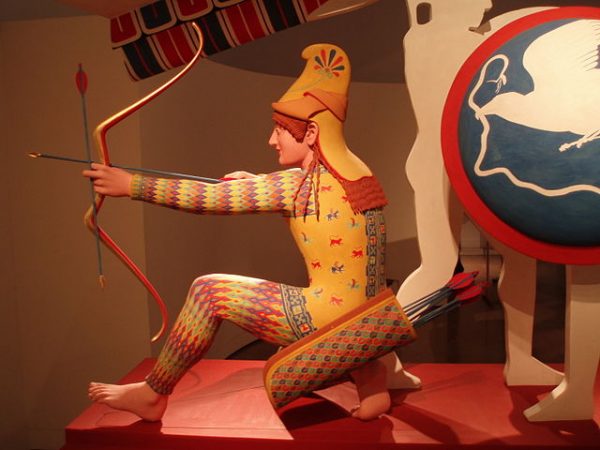
Enter German archaeologist Vinzenz Brinkmann, who, “armed with high-intensity lamps, ultraviolet light, cameras, plaster casts and jars of costly powdered minerals,” has “spent the past quarter century trying to revive the peacock glory that was Greece” by “creating full-scale plaster or marble copies hand-painted in the same mineral and organic pigments used by the ancients: green from malachite, blue from azurite, yellow and ocher from arsenic compounds, red from cinnabar, black from burned bone and vine.” You can see the results in the Getty Museum video at the top of the post.
In the years since the discovery of ancient Greek statues’ original colors, the reactions of us moderns have, shall we say, varied. We’ve grown accustomed to, and grown to admire, the austerity of white marble, which we’ve come to associate with an idea of the purity of antiquity. (The Getty itself used a similarly evocative stone, extensively and at staggering expense, in the construction of their Richard Meier-designed complex overlooking Los Angeles.) And so the bold colors revealed by Brinkmann and his collaborators may, on first or even second glance, strike us as gaudy, kitschy, tacky. However you re-evaluate its aesthetics, though, you have to feel a certain exhilaration at the fact that the ancient world has continued to hold surprises for us.
The image above is an archer from the western pediment of the Temple of Aphaia on Aigina, via Wikimedia Commons.
We're hoping to rely on loyal readers, rather than erratic ads. Please click the Donate button and support Open Culture. You can use Paypal, Venmo, Patreon, even Crypto! We thank you!
Open Culture scours the web for the best educational media. We find the free courses and audio books you need, the language lessons & educational videos you want, and plenty of enlightenment in between.