If you would like to support the mission of Open Culture, consider making a donation to our site. It’s hard to rely 100% on ads, and your contributions will help us continue providing the best free cultural and educational materials to learners everywhere. You can contribute through PayPal, Patreon, and Venmo (@openculture). Thanks!
A visit to William Faulkner’s house once convinced me I’d seen his ghost. Millions of people commune with Elvis’s spirit at Graceland each year. Some lucky person will end up with Toni Morrison’s personal library, and maybe also her Tribeca condo. No matter how well we think we know a favorite artist, there’s nothing like connecting with the spaces and things they left behind. Since 2016, Jimi Hendrix devotees have been able to make a pilgrimage to the London apartment he shared with his girlfriend, Kathy Etchingham, between 1968 and 1969.
The flat on 23 Brook Street has been set up the way it was when Hendrix lived there, thanks to Handel & Hendrix in London, who also maintain the house of George Frideric Handel just next door. The only other connection between the two artists is Hendrix’s ownership of two copies of Handel’s Messiah, “both of which show signs of wear and tear,” the foundation notes, and “which would have been uncanny listening so near to where it was composed.” Jimi tastefully decorated the apartment to his tastes, and told Etchingham it was “my first real home of my own.”
Hendrix’s home was made complete by a 100-plus collection of LPs and a high-end audio system that has recently been recreated in collaboration with the makers of the original components: Bang & Olufsen, Lowther, and LEAK supply the same or similar models of turntable, speaker, and amplifier, respectively, on which Jimi listened to Handel next door to the ghost of Handel. Hearing those records in Jimi’s space, the way he heard them, says Nabihah Iqbal in a video that debuted on Hendrix’s birthday, November 27th, is “a time-traveling experience.”
Iqbal chooses her favorites from the collection—Bob Dylan, Ravi Shankar, Muddy Waters, Django Reinhardt—discussing them as they quietly play in the background. For the full Hendrix experience, we’d need to crank the vintage amplifier to 11. He liked to listen loud. Etchingham “recalled that they had to ‘stick a ha’penny with sellotape onto the turntable arm… otherwise it would jump up and down the louder it got.” He would occasionally blow the reinforced speakers during parties and have to take them in for repair.
The flat also functioned as a composition room, and Hendrix’s friends stopped by to jam. (Richie Havens debuted his “anti-war anthem ‘Handsome Johnny’ to a small party in the flat on Hendrix’s Epiphone acoustic guitar.”) Handel & Hendrix in London have revived the practice with their Hendrix Flat Sessions, inviting musicians to play in the space. Above, Marcus Machado talks about what Hendrix means to him and jams a version of “Voodoo Child (Slight Return)” while sitting on Hendrix’s bed.
See several more Hendrix Flat Sessions here. The records in Hendrix’s collection “cover blues, jazz, folk, rock, psychedelia and even a handful of classical LPs.” See Iqbal’s selections, with annotations from Handel & Hendrix in London, here. The Hendrix Flat is currently open to the public on Saturdays.
Fred Van Lente has written for more than 15 years for his own Evil Twin Comics, Marvel and other outlets. In this episode of Pretty Much Pop, he joins your hosts Mark Linsenmayer, Erica Spyres, and Brian Hirt to discuss comics as an idiosyncratic form of literature.
In the realm of non-fiction, Ryan started with the beloved Action Philosophers! series in 2004 with illustrator Ryan Dunlavey, and this team has gone on to create the very successful Comic Book History of Comics, plus more recently Action Presidents, Action Activists (available free in association with the NYC Department of Education’s Civics for All program), and have just begun releasing The Comic Book History of Animation. While the non-fiction comics format is common in places like Japan, and has a storied history in America, having been used to train soldiers in World War II, this is still something of a novelty in America as comics still struggle to overcome their reputation in (as Ryan puts it) “trash for morons.” Given that visual content is well known to help people learn as compared to text alone, the use of tools like Action Presidents in classrooms shouldn’t be surprising.
The interview also gets into Ryan’s fiction work, from Cowboys & Aliens, which was turned into a 2011 Jon Favreau/Steven Spielberg film entirely without Ryan’s involvement, to titles like Marvel Zombies and X‑Men Noir which use alternate dimension versions of popular characters to tell stories too dark and/or whimsical to have much possibility of ever being transferred to the screen. Despite comics’ reputation as being basically like elaborate film story-boards, their low overhead is exactly what distinguishes them so strongly from film: Their creativity is unlimited by budget, and creators can take tremendous risks. Whatever the mainstream palatability of (alternate dimension) Peter Parker eating Aunt May’s brain, this has been one of the most popular things that Ryan’s been involved with among comic book readers.
Learn more about Fred’s work at fredvanlente.com. You can read there about how Fred constructs scripts; the one Mark refers to with the mysteriously changed coat is right there highlighted at the top of this page, and there are also several sample scripts including the one for Action Philosophers: Immanuel Kant that demonstrates Fred’s methods for vividly explaining a complex idea.
Filmmaker David Lynch answers a basic life question from Mary Anne Hobbs, BBC Radio 6 DJ, during a fan Q&A. The accompanying video apparently comes from The Art Life documentary trailer.
The source of Lynch’s happiness? Most likely meditation. Find more on that below.
It’s often said the sense of smell is most closely connected to long-term memory. The news offers little comfort to us forgetful people with a diminished sense of smell. But increasingly, neuroscientists are discovering how sound can also tap directly into our deepest memories. Patients with Alzheimer’s and dementia seem to come alive, becoming their old selves when they hear music they recognize, especially if they were musicians or dancers in a former life.
“Sound is evolutionarily ancient,” Nina Kraus, a neuroscientist at Northwestern University, tells NPR. “It is deeply, deeply rooted in our nervous system. So the memories that we make, the sound-to-meaning connections that we have and that we’ve made throughout our lives are always there. And it’s a matter of being able to access them.” The earworms we find ourselves humming all day; the songs we never forget how to sing… these are keys to a storehouse of memory.
Stories documenting dementia patients in the presence of music usually focus, understandably, on those who have lost brain function due to old age. In “Don’t Think Twice,” the short documentary above, we meet John Fudge, who sustained a traumatic brain injury when he fell from the white cliffs of Dover and split his head open at 24 years old. “The extent of his injuries weren’t revealed,” writes Aeon, “until decades later, when doctors decided to perform a brain scan after John slipped into a deep depression.”
He was found to have extensive brain damage, “including a progressive form of dementia” called Semantic Dementia that leaves sufferers aware of their deterioration while being unable to express themselves. John’s wife Geraldine “compares his brain to an oak tree, its limbs of knowledge being slowly trimmed away, causing John great mental anguish.” In the short film, however, we see how “his musical abilities” are one “as-yet untrimmed branch.”
John himself explains how he “nearly died three times” and Geraldine assists with her observations of his experience. “It’s all there,” she says, “it’s just bits of it have sort of been blanked out…. Over the years, John’s semantic understanding of the world will deteriorate.” When a young volunteer named Jon from the Hackney Befriending Service stops by, the gloom lifts as John engages his old passion for playing songs by the Beatles and Bob Dylan.
Follow the moving story of how John and Jon became fast friends and excellent harmonizers and see more inspiring stories of how music can change Alzheimer’s and dementia patients’ lives for the better at the links below.
Chances are you’ve looked at more graphs this past year than you did over the previous decade — not just while working at home, but while scrolling through cascades of often-troubling quantitative information during your “off” hours as well. This phenomenon has hardly been limited to the Americans who obsessed over the predictions of and returns from their presidential election last month, an event turned practically into a sideshow by the ongoing pandemic. Around the world, we’ve all wanted to know: Where did the coronavirus come from? What is it? Where is it going?
Apologies to Paul Gauguin, who didn’t even live to see the Spanish flu of 1918, a time when nobody could have imagined instantaneously and widely sharing visual renderings of data about that disease. The world of a century ago may not have had dynamic animated maps and charts, updated in real time, but it did have crochet. Whether or not it had then occurred to anyone as a viable medium for visualizing the spread of disease, it can be convincing today. This is demonstrated by Norwegian biostatistician Kathrine Frey Frøslie, who in the video above shows us her crocheted representations of various “R numbers.”
This now much-heard term, Frøslie’s explains, “denotes reproduction. If the R number is one, this means that each infected person will on average infect one new person during the course of the disease. If R equals two, each infected person will infect two persons,” and so on. Her crocheted version of R=1, with a population of ten, is small and narrow — it looks, in other words, entirely manageable. Such a disease “will always be always present, but the number of infected persons will be constant.” Her R=0.9, which steadily narrows in a way that resembles an unfinished Christmas stocking, looks even less threatening.
Alas, “for the coronavirus, the R is mostly larger than one.” In crocheted form, even R=1.1 is pretty formidable; when she brings out her R=1.5, “it is evident that we have a problem. Even the crochet patch kind of crumbles.” Then out comes R=2, which must have been quite a project: its ten original infections bloom into 2,560 new cases, all represented in almost organically dense folds of yarn. As for R=2.5, when Frøslie eventually gets it hoisted onto her lap, you’ll have to see it to believe it. Throughout 2020, of course, many of our at-home hobbies have grown to monstrous proportions — even those taken up by medical scientists.
Based in Seoul, Colin Marshall writes and broadcasts on cities, language, and culture. His projects include the Substack newsletterBooks on Cities, the book The Stateless City: a Walk through 21st-Century Los Angeles and the video series The City in Cinema. Follow him on Twitter at @colinmarshall, on Facebook, or on Instagram.
Surely you’ve learned, as I have, to filter out the constant threats of doom. It’s impossible to function on high alert all of the time. But one must stay at least minimally informed. To check the news even once a day is to encounter headline after headline announcing DOOM IS COMING! Say that we’re all desensitized, and rather than react, we evaluate: In what way will doom arrive? How bad will the doom be? There are many competing theories of doom. Which one is most likely, and how can we understand them in relation to each other?
For this level of analysis, we might turn to Dominic Walliman, physicist and proprietor of Domain of Science, the YouTube channel and website that has brought us entertaining and comprehensive maps of several scientific fields, such as biology, chemistry, mathematics, computer science, and quantum physics. Is ranking apocalypses a scientific field of study, you might wonder? Yes, when it is a data-driven threat assessment. Walliman surveyed and analyzed, as he says in his introduction, “all of the different threats to humanity that exist.”
When the pandemic hit last winter, “we as a society were completely unprepared for it,” despite the fact that experts had been warning us for decades that exactly such a threat was high on the scale of likelihood. Are we focusing on the wrong kinds of doom, to the exclusion of more pressing threats? Instead of panicking when the coronavirus hit, Walliman cooly wondered what else might be lurking around the corner. “Crikey,” says the New Zealander upon the first reveal of his Map of Doom, “there’s quite a lot aren’t there?”
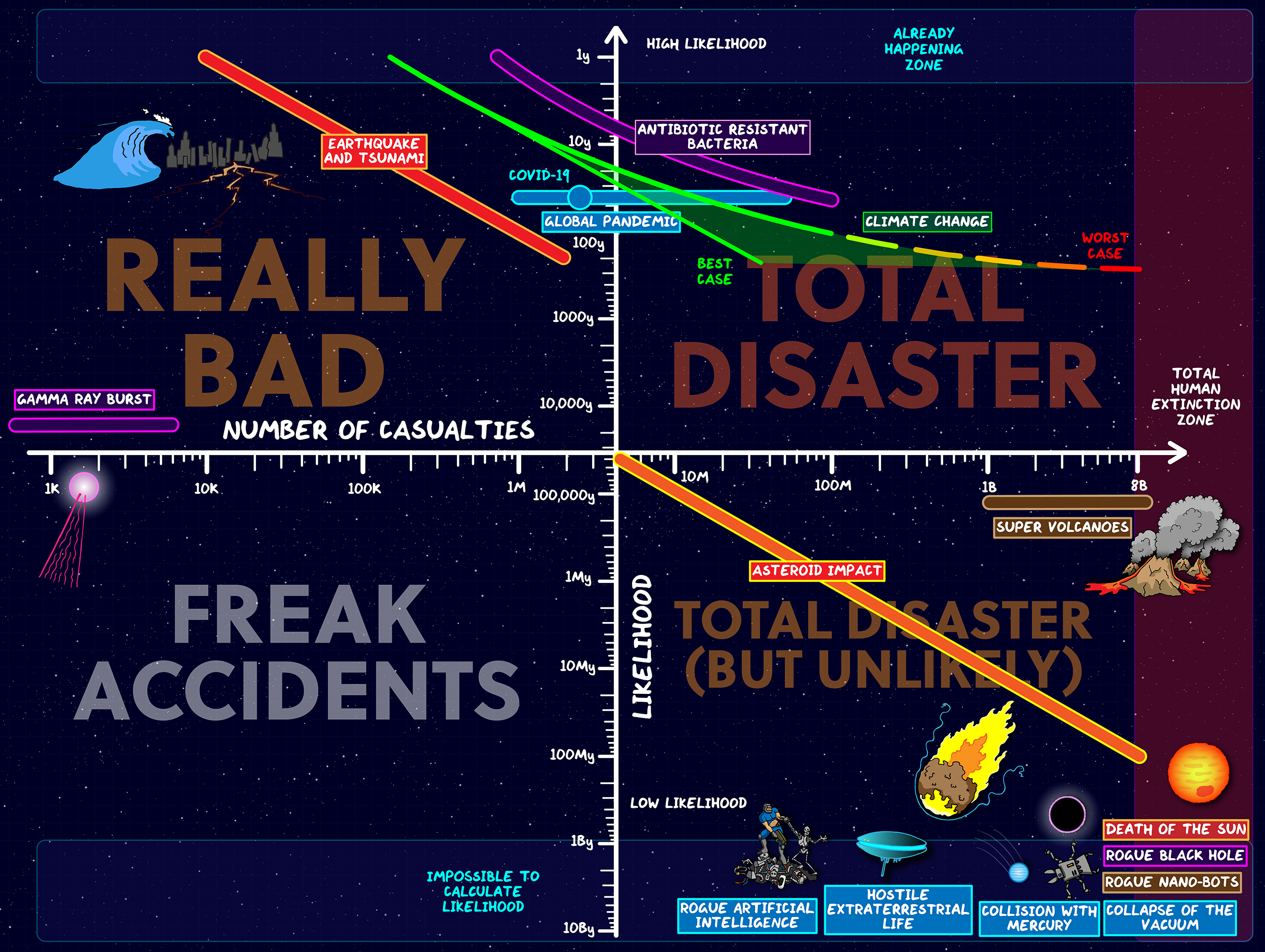
Not content to just collect disasters (and draw them as if they were all happening at the same time), Walliman also wanted to find out which ones pose the biggest threat, “using some real data.” After the Map of Doom comes the Chart of Doom, an XY grid plotting the likelihood and severity of various crises. These include ancient stalwarts like super volcanoes; far more recent threats like nuclear war and catastrophic climate change; cosmic threats like asteroids and collapsing stars; terrestrial threats like widespread societal collapse and extra-terrestrial threats like hostile aliens….
At the top of the graph, at the limit of “high likelihood,” there lies the “already happening zone,” including, of course, COVID-19, climate change, and volatile extreme weather events like hurricanes and tsunamis. At the bottom, in the “impossible to calculate” zone, we find sci-fi events like rogue AI, rogue black holes, rogue nano-bots, hostile aliens, and the collapse of the vacuum of space. All theoretically possible, but in Walliman’s analysis mostly unlikely to occur. As in all of his maps, he cites his sources on the video’s YouTube page.
If you’re not feeling quite up to a data presentation on mass casualty events just now, you can download the Map and Chart of Doom here and peruse them at your leisure. Pick up a Map of Doom for the wall at Walliman’s site, and while you’re there, why not buy an “I survived 2020” sticker. Maybe it’s premature, and maybe in poor taste. And maybe in times of doom we need someone to face the facts of doom squarely, turn them into cartoon infographics of doom, and claim victories like living through another calendar year.
Current auto-industry wisdom holds that no car without cup holders will sell in America. Though this also seems to have become increasingly true across the rest of the world, I like to imagine there still exists a country or two whose driving public holds fast against that particular design vulgarism. Such places would, of course, lie deep in unreconstructed Europe, where nobody can go long without coffee. The solution? The Hertella Auto Kaffeemachine, the first and only known dashboard-mounted coffee maker.
Manufactured specifically for the Volkswagen Beetle, this highly civilized automobile accessory has, 60 years after its introduction, nearly vanished from existence. Judging by the few known examples, it never had the time to evolve past its technical shortcomings. For one, it lacks a power switch: “As soon as you plug it into the cigarette lighter, it just gets hot,” writes The Drive’s Peter Holderith. “And as far as the type of coffee machine that it is, well, you would have to be pretty desperate for caffeine to make coffee in this thing.”
“I always thought they were a percolator, or espresso machine like a Moka… but nope,” says Dave Hord of Classic Car Adventures, who purchased his own Hertella Auto Kaffeemachine from an owner in Serbia. It seems “you fill the vessel with water, put your coffee in the (double layer) screen, and heat up the unit. I presume you heat the unit up with the coffee in it, which means this basically brews coffee as though it’s tea.” Perhaps only a transcontinental road-tripper in 1959 would grow desperate enough to drink it.
Still, as Holderith notes, “the machine does have a few clever features. The porcelain cups that came with it apparently had a metal disc on the bottom of them that allowed them to stick to the machine magnetically” and the unit itself “mounts to the dash with a simple bracket, allowing for the pot to quickly be removed and cleaned when necessary.” Perhaps today’s car designers, a group once again looking to the past for inspiration, will resume the pursuit of dashboard brewing begun by the Hertella Auto Kaffeemachine. If not, Wes Anderson can surely find a use for the thing.
Based in Seoul, Colin Marshall writes and broadcasts on cities, language, and culture. His projects include the Substack newsletterBooks on Cities, the book The Stateless City: a Walk through 21st-Century Los Angeles and the video series The City in Cinema. Follow him on Twitter at @colinmarshall, on Facebook, or on Instagram.
We're hoping to rely on loyal readers, rather than erratic ads. Please click the Donate button and support Open Culture. You can use Paypal, Venmo, Patreon, even Crypto! We thank you!
Open Culture scours the web for the best educational media. We find the free courses and audio books you need, the language lessons & educational videos you want, and plenty of enlightenment in between.