The Ambitious Engineering Behind the Golden Gate Bridge

As many as a mil­lion peo­ple crossed the Gold­en Gate Bridge on foot to cel­e­brate the 50th anniver­sary of its con­struc­tion in 1987. More than a few of them would have remem­bered San Fran­cis­co as it was before it had its most icon­ic struc­ture — and indeed, some would even remem­ber walk­ing across it once before, on its inau­gur­al “Pedes­tri­an Day” in 1937. Bar­ring the pos­si­bil­i­ty of unusu­al­ly vig­or­ous super­cente­nar­i­ans, that won’t be the case 12 years from now, on the Gold­en Gate Bridge’s 100th anniver­sary. But we’ll still be able to appre­ci­ate the enor­mous ambi­tion of its builders, not least its chief design engi­neer Joseph Strauss, who, along with Charles Alton Ellis, made pos­si­ble a project long assumed impos­si­ble.

The video from Sabin Civ­il Engi­neer­ing at the top of the post explains every stage of the Gold­en Gate Bridge’s design and con­struc­tion. Build­ing a sus­pen­sion bridge over the Gold­en Gate, the deep strait between San Fran­cis­co Bay and the Pacif­ic Ocean, posed for­mi­da­ble chal­lenges. The dis­tinc­tive shape we know from so many pho­tographs emerged in part from the need to anchor the bridge in such a way as to bal­ance out the mas­sive forces that would oth­er­wise bend its tow­ers inward, and the steel-on-steel con­struc­tion of its sus­penders and deck was nec­es­sary to pre­vent cat­a­stroph­ic crack for­ma­tion.

The deck hangs from 250 pairs of cables, and each of the main cables that run the length of the bridge actu­al­ly con­sists of 27,000 steel wires wound togeth­er. A sys­tem of ther­mal expan­sion joints accom­mo­dates reg­u­lar elon­ga­tion and shrink­age of near­ly four feet.

And we haven’t even got into the under­wa­ter blast­ing and ter­ri­fy­ing-look­ing drilling work required to put up the tow­ers in the first place. In any case, the painstak­ing efforts of the engi­neers and labor­ers alike have sure­ly been vin­di­cat­ed by the Gold­en Gate Bridge’s func­tion­al­i­ty and pop­u­lar­i­ty over the past 88 years. Nat­u­ral­ly, it’s had to under­go con­sid­er­able main­te­nance and retro­fitting in that time, and it would take a true roman­tic to ignore its lim­i­ta­tions entire­ly. (Take its lack of rail capac­i­ty, which was nei­ther tech­ni­cal­ly nor eco­nom­i­cal­ly fea­si­ble to incor­po­rate dur­ing the Great Depres­sion.) Still, when 300,000 peo­ple jammed them­selves onto its deck at once on its 50th anniver­sary, it may have bent in the mid­dle, but it did­n’t break. That was a tes­ta­ment to the civ­il engi­neer­ing acu­men of Strauss and com­pa­ny — but let’s hope the cen­te­nary fes­tiv­i­ties are bet­ter orga­nized.

Relat­ed con­tent:

“The Bay Lights,” the World’s Largest LED Light Sculp­ture, Debuts in San Fran­cis­co

The 5 Inno­v­a­tive Bridges That Make New York City, New York City

How the Brook­lyn Bridge Was Built: The Sto­ry of One of the Great­est Engi­neer­ing Feats in His­to­ry

A Mes­mer­iz­ing Trip Across the Brook­lyn Bridge: Watch Footage from 1899

Why There Isn’t a Bridge from Italy to Sici­ly – And Why the 2,000-Year-Old Dream of Build­ing the Bridge May Soon Be Real­ized

Built to Last: How Ancient Roman Bridges Can Still With­stand the Weight of Mod­ern Cars & Trucks

Based in Seoul, Col­in Marshall writes and broad­casts on cities, lan­guage, and cul­ture. His projects include the Sub­stack newslet­ter Books on Cities and the book The State­less City: a Walk through 21st-Cen­tu­ry Los Ange­les. Fol­low him on the social net­work for­mer­ly known as Twit­ter at @colinmarshall.

Dozens of M.C. Escher Prints Have Been Digitized & Put Online by the Boston Public Library

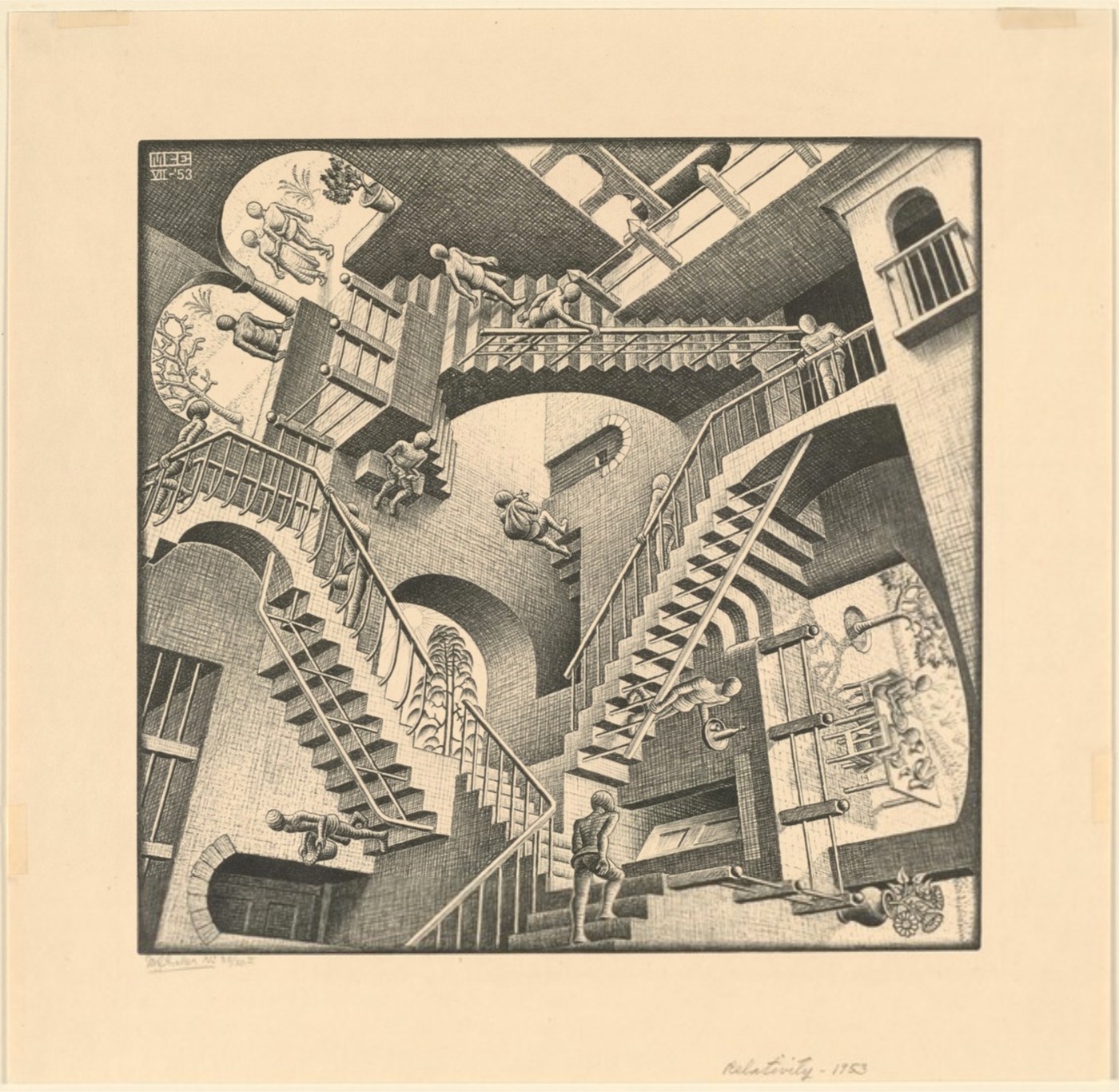
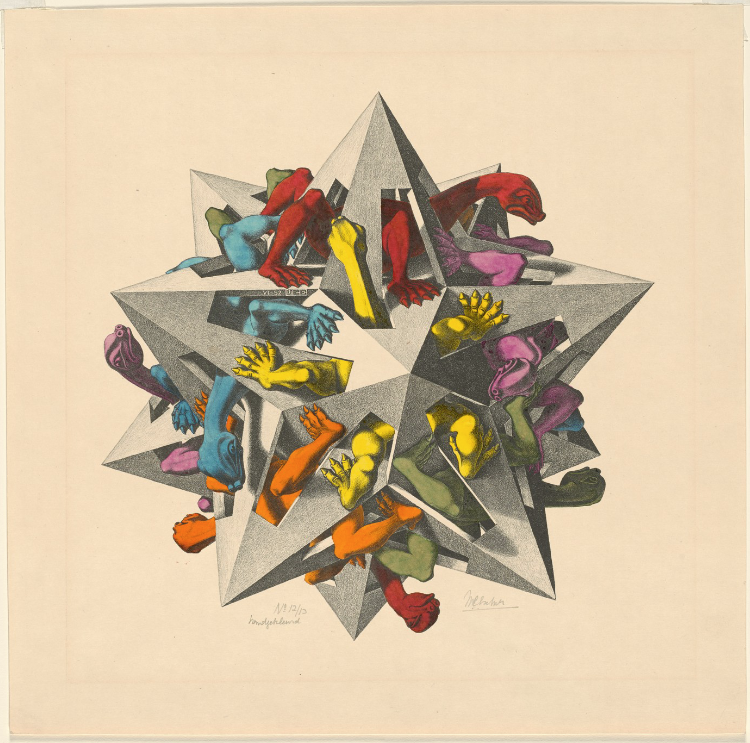
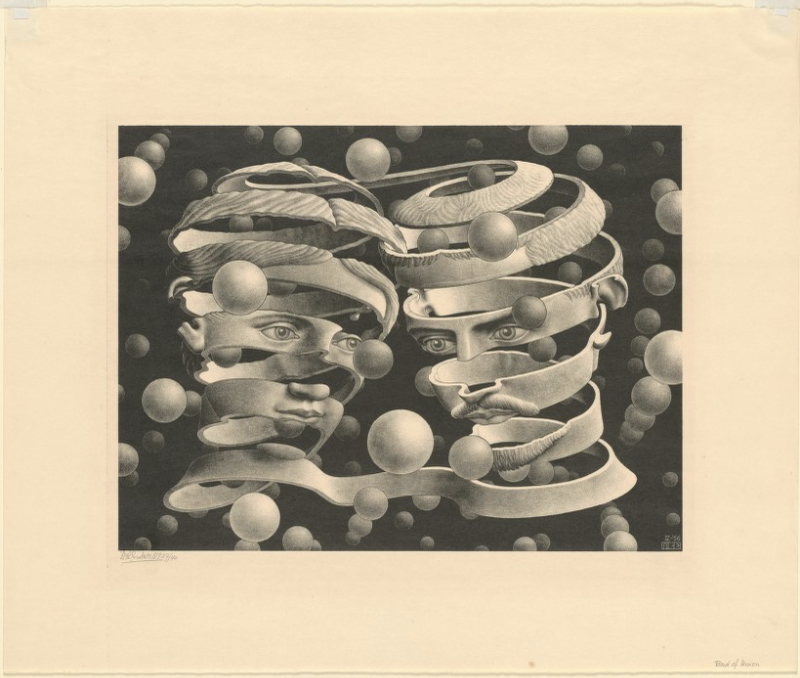
In addi­tion to the icon­ic scene in Jim Henson’s Labyrinth, or appear­ances in ani­mat­ed TV shows and video games, M.C. Esch­er’s work has adorned the cov­ers of albums like Mott the Hoople’s 1969 debut and the spec­u­la­tive fic­tion of Ita­lo Calvi­no and Jorge Luis Borges. A big hit with hip­pies and 1960s col­lege stu­dents, writes Heavy Music Art­work, his mind-bend­ing prints became asso­ci­at­ed with “ques­tion­ing accept­ed views of nor­mal expe­ri­ence and test­ing the lim­its of per­cep­tion with hal­lu­cino­genic drugs.” While he appre­ci­at­ed his cult fol­low­ing, Esch­er “did not encour­age their mys­ti­cal inter­pre­ta­tions of his images.” Reply­ing to one enthu­si­as­tic fan of his print Rep­tiles, who claimed to see in it an image of rein­car­na­tion, Esch­er replied, “Madame, if that’s the way you see it, so be it.”

Rather than illus­trate high­er states of con­scious­ness or meta­phys­i­cal enti­ties, Bruno Ernst writes in The Mag­ic Mir­ror of M.C. Esch­er, the artist intend­ed to cre­ate prac­ti­cal, “pic­to­r­i­al rep­re­sen­ta­tion of intel­lec­tu­al under­stand­ing.” Illus­tra­tions, that is, of philo­soph­i­cal and sci­en­tif­ic thought exper­i­ments. The son of a civ­il engi­neer, Esch­er began his stud­ies in archi­tec­ture before mov­ing to draw­ing and print­mak­ing.

The chal­lenge of cre­at­ing built environments—even seem­ing­ly impos­si­ble ones—always seemed to occu­py his mind. Along with themes from the nat­ur­al world, a high per­cent­age of his works cen­ter on buildings—inspired by for­ma­tive ear­ly years in Rome and his admi­ra­tion for Islam­ic art and Span­ish archi­tec­ture.

In the 50s and 60s Escher’s art piqued the inter­est of aca­d­e­mics and math­e­mati­cians, an audi­ence he found more con­ge­nial to his vision. He cor­re­spond­ed with sci­en­tists and incor­po­rat­ed their ideas into his work, mean­while claim­ing to be “absolute­ly inno­cent of train­ing or knowl­edge in the exact sci­ences.” In the 50s, Esch­er “daz­zled” the likes of math­e­mati­cians like Roger Pen­rose and HSM Cox­eter. In turn, notes Maev Kennedy, he “was inspired by Penrose’s per­spec­ti­val tri­an­gle and Coxeter’s work on crys­tal sym­me­try.”

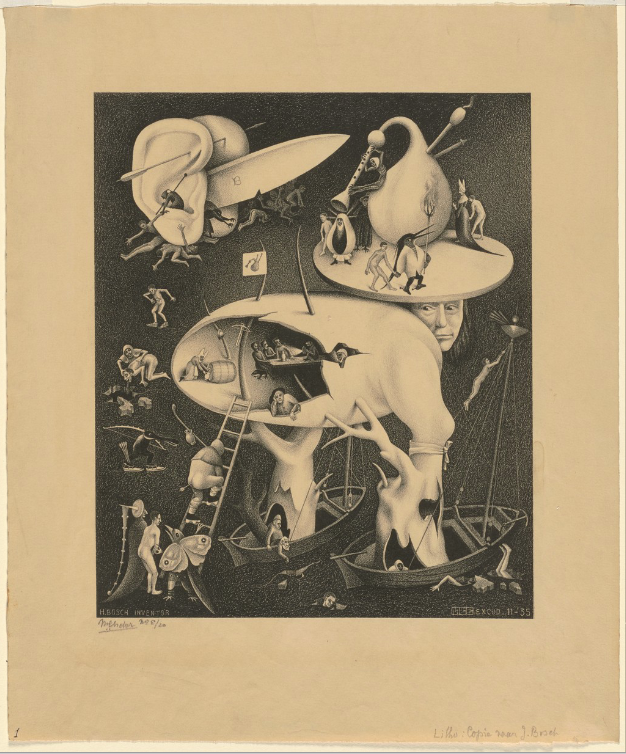
For all the excite­ment he cre­at­ed among math­e­mati­cians, it took a bit longer for Esch­er to get noticed in the art world. When Penrose’s uncle showed Escher’s ver­sion of the per­spec­ti­val tri­an­gle to Picas­so, “Picas­so had heard of the British math­e­mati­cian but not of the Dutch artist.” Escher’s fame spread out­side of the sci­ences in part through the inter­ests of the coun­ter­cul­ture. He may have shrugged off mys­ti­cal and psy­che­del­ic read­ings of his prints, but he had an innate pen­chant for the mar­velous­ly weird (see his copy of a scene, for exam­ple, from Hierony­mus Bosch, above, or his sur­re­al print Grav­i­ty, below).

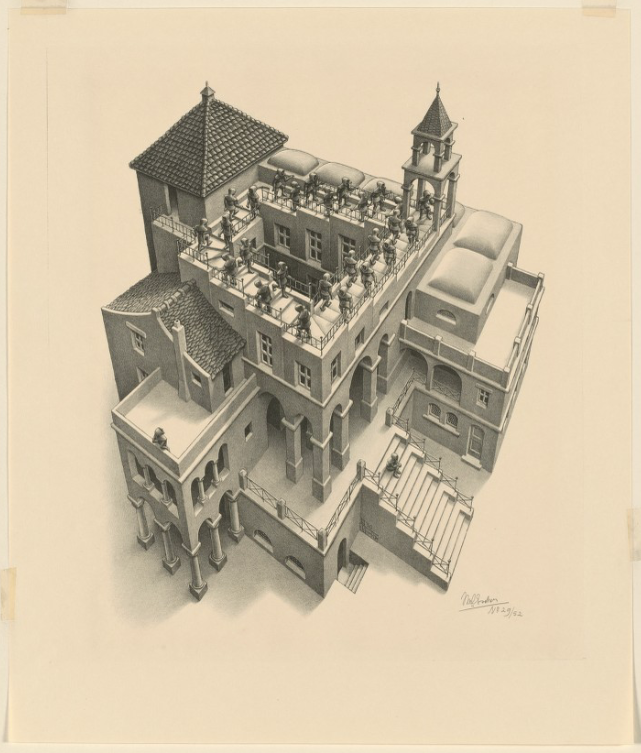
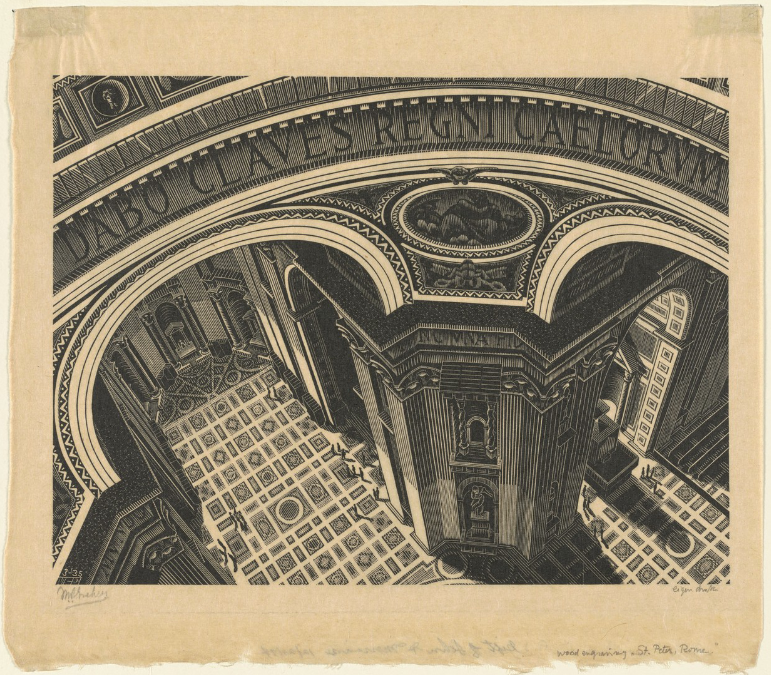
See the prints pic­tured here and a few dozen more dig­i­tized in high res­o­lu­tion at Dig­i­tal Com­mon­wealth, cour­tesy of Boston Pub­lic Library, who scanned their Esch­er col­lec­tion and made it avail­able to the pub­lic. Zoom into the fine details of prints like Inside Saint Peter’s, fur­ther up—a fine­ly ren­dered but oth­er­wise not-espe­cial­ly-Esch­er-like work—and the labyrinthine Ascend­ing and Descend­ing at the top. Whether—as Har­vard Library cura­tor John Over­holt confesses—you’re a “nerd who loves M.C. Esch­er” for his math­e­mat­i­cal mind, an artist with a mys­ti­cal bent who loves him for his hal­lu­ci­na­to­ry qual­i­ties, or some mea­sure of both, you’ll find exact­ly the Esch­er you’re look­ing for in this dig­i­tal gallery.

Note: An ear­li­er ver­sion of this post appeared on our site in 2018.

Relat­ed Con­tent:

Enter an Online Inter­ac­tive Doc­u­men­tary on M.C. Escher’s Art & Life, Nar­rat­ed By Peter Green­away

M.C. Esch­er Cov­er Art for Great Books by Ita­lo Calvi­no, George Orwell & Jorge Luis Borges

Watch M.C. Esch­er Make His Final Artis­tic Cre­ation in the 1971 Doc­u­men­tary Adven­tures in Per­cep­tion

Josh Jones is a writer and musi­cian based in Durham, NC. 

by | Permalink | Make a Comment ( 2 ) |

Skiing Down Mount Everest with No Oxygen: It’s a Wild Ride

From Red Bul­l’s YouTube Chan­nel: “Ski moun­taineer Andrzej Bargiel becomes the first per­son to climb Mount Ever­est and ski back to Ever­est Base Camp with­out sup­ple­men­tary oxy­gen. After near­ly 16 hours climb­ing in the high alti­tude “death zone” (above 8,000m where oxy­gen lev­els are dan­ger­ous­ly low), Bargiel clipped into his skis on the sum­mit of the tallest moun­tain on earth and start­ed his descent via the South Col Route. He reached Camp II that night and rest­ed — the sum­mit ridge and Hillary Step had tak­en longer than planned, mean­ing dark­ness made it dan­ger­ous and dif­fi­cult to nav­i­gate fur­ther that day. The next morn­ing, he skied through the treach­er­ous Khum­bu Ice­fall — guid­ed by a drone flown by his broth­er, Bartek — before safe­ly arriv­ing at Base Camp to become the first per­son to ascend and descend Mount Ever­est on skis with no sup­ple­men­tary oxy­gen.”

View­er be warned, it’s quite a ride!

The Roman Empire’s Vast Road Network—186,000 Miles of It—Has Just Been Mapped in a New Digital Atlas

Every­where you look, you can find traces of the ancient Roman civ­i­liza­tion from which the mod­ern West descends. That’s espe­cial­ly true if you hap­pen to be look­ing in Europe, though echoes of Latin make them­selves heard in major lan­guages used all over the world. Take, for exam­ple, the com­mon Eng­lish word itin­er­ary, mean­ing a planned route for trav­el, which descends from iter, the Latin word for a jour­ney, route, or path. The Romans even­tu­al­ly spoke of itin­er­aria, which meant more or less the same thing as we do when we speak of our trav­el itin­er­aries. Now, bridg­ing these dis­tant eras, we have Itiner‑e, a new online map of ancient Rome’s road net­work, the most com­pre­hen­sive yet.

Orig­i­nal­ly envi­sioned as a kind of “Google Maps for Roman roads,” Itiner‑e is a project of Tom Brugh­mans of Aarhus Uni­ver­si­ty, and Pau de Soto Caña­mares and Adam PaĹľout of the Autonomous Uni­ver­si­ty of Barcelona. Its users can dig­i­tal­ly explore near­ly 300,000 kilo­me­ters of roads laid across the vast Roman Empire at its height in the mid-sec­ond cen­tu­ry — or at least as much of that net­work as edu­cat­ed guess­es can recon­struct.

Researchers can only be sure about less than three per­cent of the net­work, with anoth­er sev­en per­cent of ancient Roman roads doc­u­ment­ed in exis­tence if not in pre­cise loca­tion. Regard­less, Itiner‑e is based on an unprece­dent­ed­ly wide (and open) dataset, which incor­po­rates topo­graph­ic map­ping, satel­lite imagery and cen­turies of his­tor­i­cal records.

Among Itin­er-e’s many fea­tures is a con­fi­dence rat­ing, which shows just how con­fi­dent we can be that any giv­en road actu­al­ly looked like it does on the map. You can also view the whole thing in 3D to get a sense of the ele­va­tions involved in con­struc­tion and trav­el of the net­work; use a rout­ing tool to deter­mine sug­gest­ed routes around the empire “by foot, ox cart or don­key”; and even check satel­lite imagery to find still-extant parts of Roman roads and draw com­par­isons with the same parts of the world today. Though a fair few major Roman roads have evolved into cur­rent routes for trains and auto­mo­biles, we can’t exact­ly trav­el on them in the same way the Romans did. Still, when next you plan a Euro­pean itin­er­ary of your own, con­sid­er punch­ing it in to Itiner‑e and see­ing how the jour­ney most like­ly would’ve been made 1,875 years ago.

Relat­ed Con­tent:

How the Ancient Romans Built Their Roads, the Life­lines of Their Vast Empire

The Roads of Ancient Rome Visu­al­ized in the Style of Mod­ern Sub­way Maps

A Map Show­ing How the Ancient Romans Envi­sioned the World in 40 AD

Built to Last: How Ancient Roman Bridges Can Still With­stand the Weight of Mod­ern Cars & Trucks

The Roman Roads and Bridges You Can Still Trav­el Today

Plan Your Trip Across the Roads of the Roman Empire, Using Mod­ern Web Map­ping Tech­nol­o­gy

Based in Seoul, Col­in Marshall writes and broad­casts on cities, lan­guage, and cul­ture. His projects include the Sub­stack newslet­ter Books on Cities and the book The State­less City: a Walk through 21st-Cen­tu­ry Los Ange­les. Fol­low him on the social net­work for­mer­ly known as Twit­ter at @colinmarshall.

Leonardo da Vinci’s Visionary Inventions Rendered in 3D Animation: Helicopters, Robotic Knights, The First Ever Diving Suit & More

To imag­ine our­selves into the time of Leonar­do da Vin­ci, we must first imag­ine a world with­out such things as heli­copters, para­chutes, tanks, div­ing suits, robots. Yet those all exist­ed for Leonar­do him­self — or rather, they exist­ed in his imag­i­na­tion. What he did­n’t build in real life, he doc­u­ment­ed in his note­books, leav­ing behind mate­r­i­al for appre­ci­a­tions of his genius that would con­tin­ue half a mil­len­ni­um lat­er. One such appre­ci­a­tion appears above in a new video from Lost in Time, which ren­ders his inven­tions using the kind of 3D ani­ma­tion tech­nol­o­gy even the par­a­dig­mat­ic Renais­sance man couldn’t have begun to fore­see.

This helps us see Leonar­do’s work from the per­spec­tive of his con­tem­po­raries, and to feel how sur­prised they would’ve been to encounter a seat­ed knight who stands up, opens his visor, and reveals that there’s no one inside the armor. That sort of thing might even amuse us here in the twen­ty-first cen­tu­ry, but accus­tomed as we are to see­ing machines that move around under their own pow­er — and now, see­ing them take more cred­i­ble humanoid form every day — we would­n’t be inclined to cred­it it with any kind of life force.

In the four­teen-nineties, how­ev­er, man­pow­er was what peo­ple knew, so they instinc­tive­ly looked for the man. Leonar­do, too, con­ceived most of his inven­tions to employ human mus­cle, the study of whose inner work­ings enabled him to make the gears and pul­leys of his “robot­ic” knight move its limbs real­is­ti­cal­ly.

Accord­ing to the plans in one of Leonar­do’s note­books, his “aer­i­al screw,” involv­ing a linen sail wrapped around a wood­en mast, would need four men run­ning in cir­cles around a revolv­ing plat­form, which would the­o­ret­i­cal­ly cause the mast to rotate and the whole con­trap­tion to lift into the air. As designed, it would­n’t have been able to take off, but in 2019, Uni­ver­si­ty of Mary­land sci­en­tists mod­i­fied it to work suc­cess­ful­ly in minia­ture, as a kind of drone. As shown in the video, that’s not the only one of Leonar­do’s unre­al­ized inven­tions his intel­lec­tu­al descen­dants have tried out for them­selves. It seems that none have yet attempt­ed to con­struct his near­ly 80-foot-wide cross­bow, whose use on the bat­tle­field required the efforts of a dozen sol­diers, but then, that’s prob­a­bly all to the good.

via Laugh­ing Squid

Relat­ed Con­tent:

The Inge­nious Inven­tions of Leonar­do da Vin­ci Recre­at­ed with 3D Ani­ma­tion

Leonar­do da Vinci’s Inven­tions Come to Life as Muse­um-Qual­i­ty, Work­able Mod­els: A Swing Bridge, Scythed Char­i­ot, Per­pet­u­al Motion Machine & More

Leonar­do da Vin­ci Draws Designs of Future War Machines: Tanks, Machine Guns & More

A Com­plete Dig­i­ti­za­tion of Leonar­do da Vinci’s Codex Atlanti­cus, the Largest Col­lec­tion of His Draw­ings & Writ­ings

Explore the Largest Online Archive Explor­ing the Genius of Leonard da Vin­ci

Based in Seoul, Col­in Marshall writes and broad­casts on cities, lan­guage, and cul­ture. His projects include the Sub­stack newslet­ter Books on Cities and the book The State­less City: a Walk through 21st-Cen­tu­ry Los Ange­les. Fol­low him on the social net­work for­mer­ly known as Twit­ter at @colinmarshall.

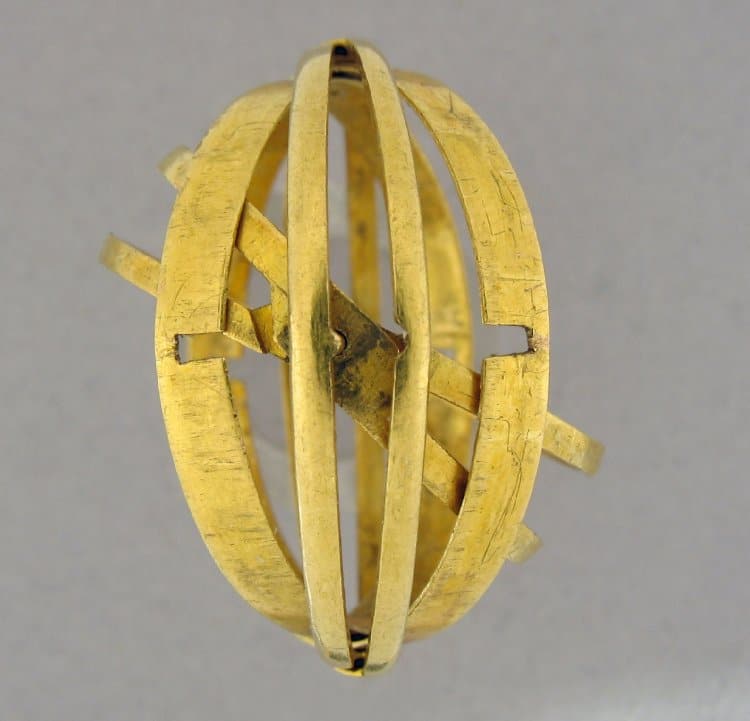
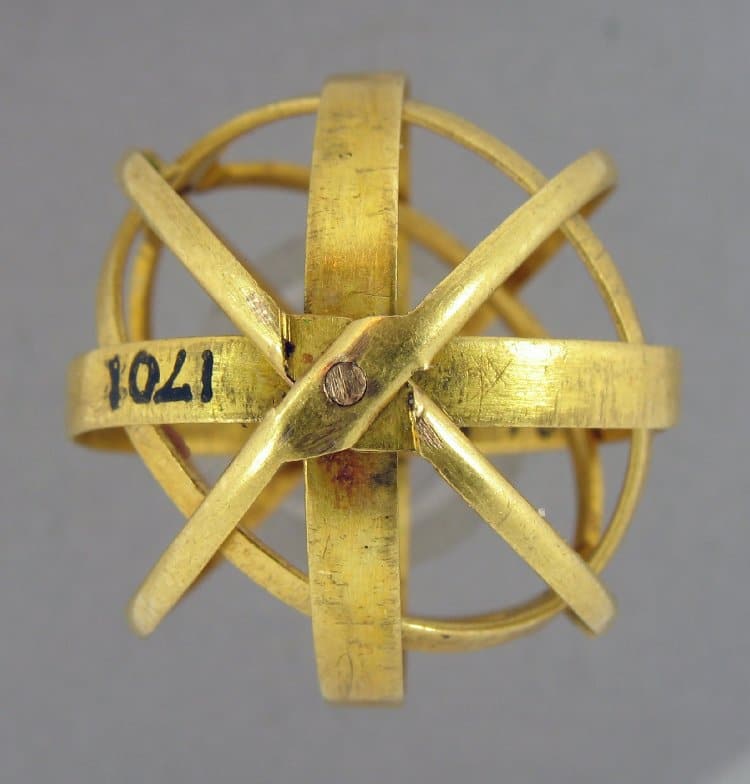
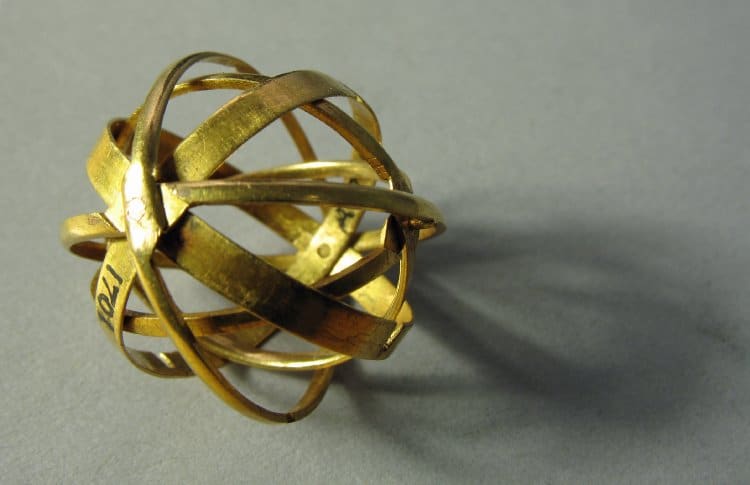
A 400-Year-Old Ring that Unfolds to Track the Movements of the Heavens


Rings with a dis­creet dual pur­pose have been in use since before the com­mon era, when Han­ni­bal, fac­ing extra­di­tion, alleged­ly ingest­ed the poi­son he kept secret­ed behind a gem­stone on his fin­ger. (More recent­ly, poi­son rings gave rise to a pop­u­lar Game of Thrones fan the­o­ry…)

Vic­to­ri­ans pre­vent­ed their most close­ly kept secrets—illicit love let­ters, per­haps? Last wills and testaments?—from falling into the wrong hands by wear­ing the keys to the box­es con­tain­ing these items con­cealed in signet rings and oth­er state­ment-type pieces.

A tiny con­cealed blade could be lethal on the fin­ger of a skilled (and no doubt, beau­ti­ful) assas­sin. These days, they might be used to col­lect a bit of one’s attack­er’s DNA.

Enter the fic­tion­al world of James Bond, and you’ll find a num­ber of handy dandy spy rings includ­ing one that dou­bles as a cam­era, and anoth­er capa­ble of shat­ter­ing bul­let­proof glass with a sin­gle twist.

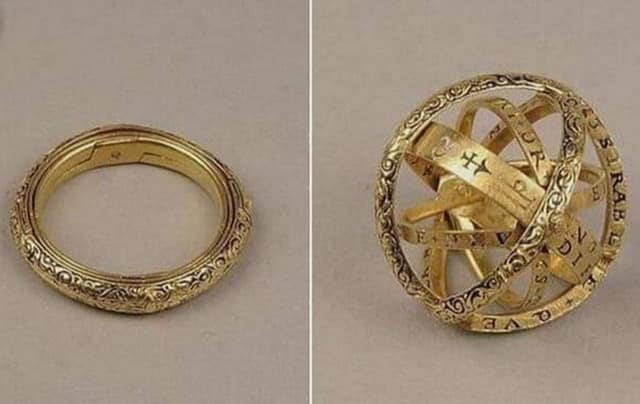
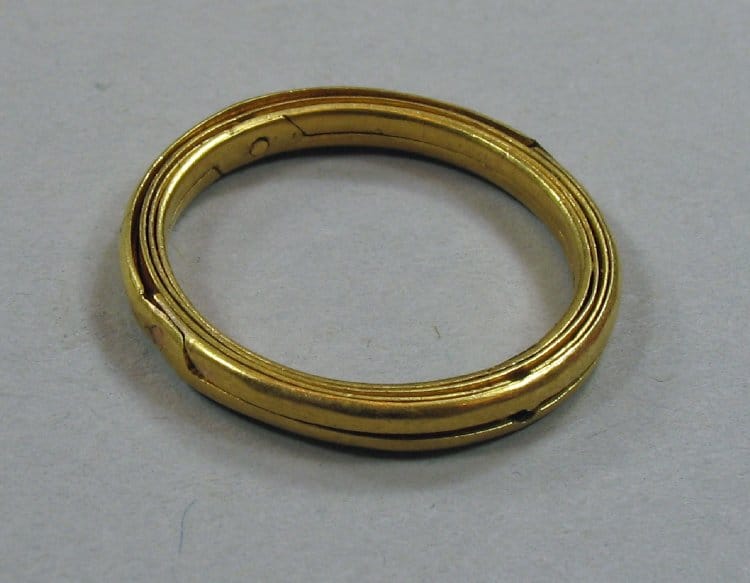
Armil­lary sphere rings like the ones in the British Muse­um’s col­lec­tion and the Swedish His­tor­i­cal Muse­um (top) serve a more benign pur­pose. Fold­ed togeth­er, the two-part out­er hoop and three inte­ri­or hoops give the illu­sion of a sim­ple gold band. Slipped off the wearer’s fin­ger, they can fan out into a phys­i­cal mod­el of celes­tial lon­gi­tude and lat­i­tude.

Art his­to­ri­an Jes­si­ca Stew­art writes that in the 17th cen­tu­ry, rings such as the above spec­i­men were “used by astronomers to study and make cal­cu­la­tions. These pieces of jew­el­ry were con­sid­ered tokens of knowl­edge. Inscrip­tions or zodi­ac sym­bols were often used as dec­o­ra­tive ele­ments on the bands.”

The armil­lary sphere rings in the British Museum’s col­lec­tion are made of a soft high-alloy gold.

Jew­el­ry-lov­ing mod­ern astronomers seek­ing an old school fin­ger-based cal­cu­la­tion tool that real­ly works can order armil­lary sphere rings from Brook­lyn-based design­er Black Adept.

If you would like to sign up for Open Culture’s free email newslet­ter, please find it here. It’s a great way to see our new posts, all bun­dled in one email, each day.

If you would like to sup­port the mis­sion of Open Cul­ture, con­sid­er mak­ing a dona­tion to our site. It’s hard to rely 100% on ads, and your con­tri­bu­tions will help us con­tin­ue pro­vid­ing the best free cul­tur­al and edu­ca­tion­al mate­ri­als to learn­ers every­where. You can con­tribute through Pay­Pal, Patre­on, and Ven­mo (@openculture). Thanks!

Relat­ed Con­tent: 

A 16th-Cen­tu­ry Astron­o­my Book Fea­tured “Ana­log Com­put­ers” to Cal­cu­late the Shape of the Moon, the Posi­tion of the Sun, and More

When Astronomer Johannes Kepler Wrote the First Work of Sci­ence Fic­tion, The Dream (1609)

The Rem­brandt Book Bracelet: Behold a Func­tion­al Bracelet Fea­tur­ing 1400 Rem­brandt Draw­ings

Behold the Astro­nom­icum Cae­sareum, â€śPer­haps the Most Beau­ti­ful Sci­en­tif­ic Book Ever Print­ed” (1540)

Ayun Hal­l­i­day is an author, illus­tra­tor, the­ater mak­er and Chief Pri­ma­tol­o­gist in New York City.

by | Permalink | Make a Comment ( 14 ) |

Discover the Oldest Book of the Americas: A Close Look at the Astronomical Maya Codex of Mexico

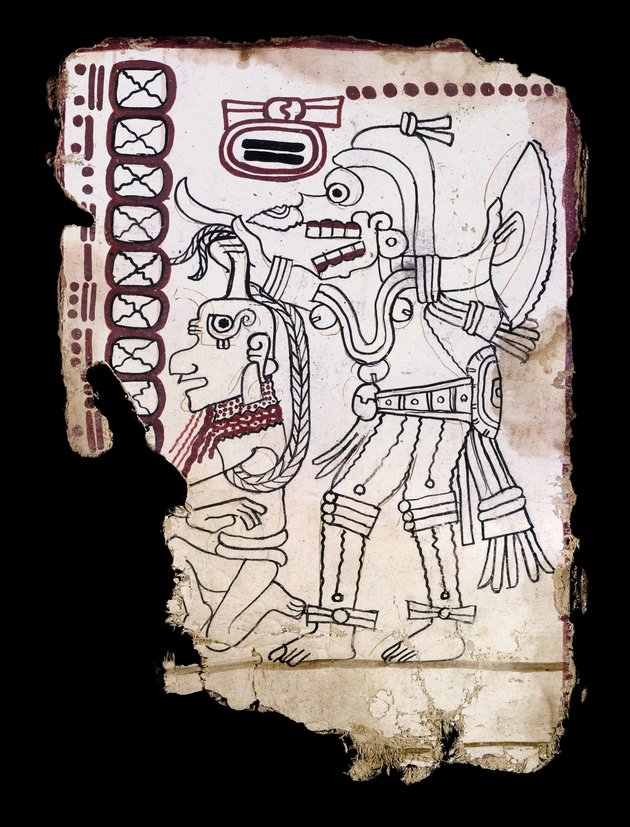
From the mighty Maya civ­i­liza­tion, which dom­i­nat­ed Mesoamer­i­ca for more than three and a half mil­len­nia, we have exact­ly four books. Only one of them pre­dates the arrival of Span­ish con­quis­ta­dors in the six­teenth cen­tu­ry: the Códice Maya de Méx­i­co, or Maya Codex of Mex­i­co, which was cre­at­ed between 1021 and 1152. Though incom­plete, and hard­ly in good shape oth­er­wise, its art­work — col­ored in places with pre­cious mate­ri­als — vivid­ly evokes an ancient world­view now all but lost. In the video above from the Get­ty Muse­um and Smarthis­to­ry, art his­to­ri­ans Andrew Turn­er and Lau­ren Kil­roy-Ewbank tell us what we’re look­ing at when we behold the remains of this sacred Mayan book, the old­est ever found in the Amer­i­c­as.

“This book has a con­tro­ver­sial his­to­ry,” says Turn­er. “It was long con­sid­ered to be a fake due to the strange cir­cum­stances in which it sur­faced.” After its dis­cov­ery in a pri­vate col­lec­tion in Mex­i­co City in the nine­teen-six­ties, it was rumored to have been loot­ed from a cave in Chi­a­pas.

At first pro­nounced a fake by experts, due to its lack of resem­blance to the oth­er extant Mayan texts, it was only ver­i­fied as the gen­uine arti­cle in 2018. For a non-spe­cial­ist, the ques­tion remains: what is the Códice about? Its pur­pose, as Kil­roy-Ewbank puts it, is astro­nom­i­cal, relay­ing as it does “infor­ma­tion about the cycle of the plan­et Venus” — which, as Turn­er adds, “was con­sid­ered a dan­ger­ous plan­et” by the Mayans.


The Códice con­tains records of Venus’ 584-day cycle over the course of 140 years, tes­ti­fy­ing to the scruti­ny Mayan astronomers gave to its com­pli­cat­ed pat­tern of ris­ing and falling. They thus man­aged to deter­mine — as many ancient civ­i­liza­tions did not — that it was both the Morn­ing Star and the Evening Star, although they seem to have been more inter­est­ed in what its move­ments revealed about the inten­tions of the deities they saw as con­trol­ling it, and thus the like­li­hood of events like war or famine. Those gods weren’t benev­o­lent: one page shows “a fright­ful skele­tal deity that has a blunt knife stick­ing out of his nasal cav­i­ty,” hold­ing “a giant jagged blade up” with one hand and “the hair of a cap­tive whose head he’s fresh­ly sev­ered” with the oth­er. That’s hard­ly the sort of image that comes to our mod­ern minds when we gaze up at the night sky, but then, we don’t see things like the Mayans did.

via Aeon

Relat­ed con­tent:

A 16th-Cen­tu­ry Astron­o­my Book Fea­tured “Ana­log Com­put­ers” to Cal­cu­late the Shape of the Moon, the Posi­tion of the Sun, and More

A 400-Year-Old Ring that Unfolds to Track the Move­ments of the Heav­ens

Behold the Astro­nom­icum Cae­sareum, “Per­haps the Most Beau­ti­ful Sci­en­tif­ic Book Ever Print­ed” (1540)

The Ancient Astron­o­my of Stone­henge Decod­ed

Explore the Flo­ren­tine Codex: A Bril­liant 16th Cen­tu­ry Man­u­script Doc­u­ment­ing Aztec Cul­ture Is Now Dig­i­tized & Avail­able Online

How the Ancient Mayans Used Choco­late as Mon­ey

Based in Seoul, Col­in Marshall writes and broad­casts on cities, lan­guage, and cul­ture. His projects include the Sub­stack newslet­ter Books on Cities and the book The State­less City: a Walk through 21st-Cen­tu­ry Los Ange­les. Fol­low him on the social net­work for­mer­ly known as Twit­ter at @colinmarshall.

Inside the Making of the Alien Suit: How H. R. Giger’s Dark Vision Came to Life in Ridley Scott’s Film

In the whole of Alien, the tit­u­lar enti­ty only appears on screen for about three min­utes. That’s one rea­son the movie holds up so well against the oth­er crea­ture fea­tures of its era: in glimpses, you nev­er get a chance to reg­is­ter signs of the alien’s being an arti­fi­cial con­struc­tion. That’s not to say it was a shod­dy piece of work; quite the con­trary, as explained in the new video above from Cin­e­maTyler. Its cre­ation demand­ed the ded­i­cat­ed efforts of an inter­na­tion­al group of pro­fes­sion­als includ­ing spe­cial effects artist Car­lo Ram­bal­di, who’d engi­neered the giant ape head in the 1976 King Kong remake and the aliens in Close Encoun­ters of the Third Kind (and would lat­er work on an even more icon­ic extrater­res­tri­al for E.T.).

Charged with design­ing the alien, and even­tu­al­ly with over­see­ing its fab­ri­ca­tion and assem­bly, was the artist H. R. Giger, whose artis­tic sen­si­bil­i­ty occu­pied the inter­sec­tion of organ­ism and machine, Eros and Thanatos. Though it’s most thor­ough­ly expressed in the dead­ly crea­ture that stows away aboard the space tug Nos­tro­mo, it also, to one degree or anoth­er, per­vades the whole movie’s look and feel.

Whether from the late sev­en­ties or any oth­er peri­od, the usu­al sleek, anti­sep­tic sci-fi futures date rather quick­ly, a con­di­tion hard­ly suf­fered by the unre­lieved­ly dark, dank, and dys­func­tion­al set­ting of Alien. This sur­pris­ing­ly grimy real­ism makes the threat of the alien feel that much more real; hid­den in its many shad­ows, Giger’s vision preys that much more effec­tive­ly on our imag­i­na­tion.

Not that it was guar­an­teed to suc­ceed in doing so. As Cin­e­maTyler explains, the process of cre­at­ing the alien came up against count­less set­backs, all under increas­ing­ly severe con­straints of both time and bud­get. At times the pro­duc­tion got lucky, as when it hap­pened upon the near­ly sev­en-foot-tall Bola­ji Bade­jo, who end­ed up wear­ing the alien cos­tume (despite Scot­t’s insis­tence, ear­ly in the pro­duc­tion, that he did­n’t want to make a movie about “a man in a suit”). But it was attempt­ing to cre­ate a being of a kind nev­er seen on screen before, one that had to be devel­oped through tri­al and error, more often the lat­ter than the for­mer. And it was hard­ly the only dif­fi­cult aspect of the mak­ing of Alien, as evi­denced by the eleven-and-count­ing episodes of Cin­e­maTyler’s series on the sub­ject. Maybe in space, no one can hear you scream, but one can eas­i­ly imag­ine the cries of frus­tra­tion let out by Scott, Giger, and all their pres­sured col­lab­o­ra­tors down here on Earth.

Relat­ed Content:

The Giger Bar: Dis­cov­er the 1980s Tokyo Bar Designed by H. R. Giger, the Same Artist Who Cre­at­ed the Night­mar­ish Mon­ster in Rid­ley Scott’s Alien

H. R. Giger’s Dark, Sur­re­al­ist Album Cov­ers: Deb­bie Har­ry, Emer­son, Lake & Palmer, Celtic Frost, Danzig & More

H. R. Giger’s Tarot Cards: The Swiss Artist, Famous for His Design Work on Alien, Takes a Jour­ney into the Occult

Watch Six New Short Alien Films: Cre­at­ed to Cel­e­brate the 40th Anniver­sary of Rid­ley Scott’s Film

High School Kids Stage Alien: The Play, Get Kudos from Rid­ley Scott and Sigour­ney Weaver

Based in Seoul, Col­in Marshall writes and broad­casts on cities, lan­guage, and cul­ture. His projects include the Sub­stack newslet­ter Books on Cities and the book The State­less City: a Walk through 21st-Cen­tu­ry Los Ange­les. Fol­low him on the social net­work for­mer­ly known as Twit­ter at @colinmarshall.

« Go BackMore in this category... »
Quantcast