On September 30, 1935, a crowd of thousands watched as President Franklin Roosevelt officially opened the Hoover Dam, the largest public works project of its time. “Approximately 5 million barrels of cement and 45 pounds of reinforcement steel” went into it, History.com notes, enough to pave a four-foot-wide sidewalk around the Earth at the equator. The massive hydroelectric dam provided water to 7 surrounding states, transforming the arid American West into an agricultural center. Currently, it generates over four billion kilowatt-hours of electricity per year, “enough to serve 1.3 million people,” notes PBS.
That a project this size could be completed in just five years seems awe-inspiring enough. That it could be done during the worst years of the Great Depression, even more so. When the dam was first proposed in 1922 to deal with flooding on the Colorado River, the crisis still lay over the horizon.
.
A glorious post-war future seemed assured, masterminded by Hoover, the former engineer. (He did not design the dam, but brokered the deal that pushed it through Congress.) During the dam’s construction, on the other hand — a feat compared to building the pyramids in Egypt — the U.S. economy had fully hit rock bottom. Although it had been dedicated to Hoover by President Coolidge in 1928, the Hoover Dam wouldn’t come to bear his name until 1947.
In its early years, the massive, smooth white concrete curve — stretching 1,244 feet across the Black Canyon on the Arizona-Nevada Border — was simply called the Boulder Canyon Dam. It drew some 21,000 workers to divert the river through tunnels, excavate the riverbed down to bedrock, and build the enormous structure and its machinery. “Due to the strict timeframe, workers suffered from horrible work conditions in the tunnels as the heat and carbon monoxide-filled air became unbearable, leading to a strike in August of 1931,” writes Alexia Wulff at the Culture Trip.
Once they began clearing the blasted walls of the canyon, workers “hung from suspended heights of 800 feet above ground — some fell to their death or were injured by the falling rock and dangerous equipment.” Over 100 men died in this way and such deaths, and near-misses, seemed commonplace after a while. In the TED-Ed video by Alex Gendler at the top of the post, we see one jaw-dropping near-miss dramatized in animation. “Business as usual,” says the narrator. “Just another day in the construction of the Hoover Dam.”
Learn much more about the engineering marvels, and the “blood, concrete, and dynamite,” as Gendler puts it, in the short B1M video further up and the full National Geographic documentary just above. While it has been surpassed in size, the Hoover Dam remains one of the largest power plants in the country, and may even be ideal for use as a giant battery that can store excess power created by wind and solar. Even if that idea fails to pan out in coming years, the story of the dam’s construction will keep inspiring engineers and scientists to reach for big solutions, even — and perhaps especially — in the middle of a crisis.
If you’re planning a trip to the Netherlands, do try to fit in Nijmegen, the country’s oldest city. Having originally cohered as a Roman military camp back in the first century B.C., it became at the end of the first century A.D. the first city in the modern-day Netherlands to receive the official designation of municipium, which made Roman citizens of all its residents. Not that Nijmegen stands today as an open-air museum of Roman times. You’re less likely to glimpse traces of its city wall or amphitheater than to come across such thoroughly modern developments as the “dynamic living and working area” of Winkelsteeg, currently under construction — and even now turning up Roman artifacts of its own.
ARTnews’ Francesca Aton reports the discovery, by archaeologists working on the Winkelsteeg excavation, of “a blue glass bowl estimated to be around 2,000 years old.” Strikingly colored by metal oxide, its craftsmanship looks impressive and its condition astonishing: “with no visible cracks or chips, the bowl remains undamaged, making it a remarkable find.
It is believed to have been made in glass workshops in German cities such as Cologne and Xanten, or possibly in Italy” — somewhere, in any case, within the Roman Empire. Priceless now, the bowl would also have been valuable in its day; Aton references a theory that “locals working at outposts along the uppermost border of Hadrian’s Wall in Scotland for the Roman army” would have earned the kind of wage needed to buy it.
In the video just above, posted last week by the government of Nijmegen, archaeologist Pepin van de Geer introduces the excavation site, which has proven a fruitful source of what Aton describes as “Roman graves, homes and wells, and objects such as dishware and jewelry.” Most of these seem to have come out of the ground if not in pieces, then looking just as ancient as they are; not so the miraculous blue glass bowl, of which we also get a view. It may strike us denizens of the 21st century as recognizable enough to enrich at once the feeling of continuity between the people of the Roman Empire and ourselves — or at least it will when we can see it for ourselves in whichever museum Nijmegen sees fit to place it.
Based in Seoul, Colin Marshall writes and broadcasts on cities and culture. His projects include the book The Stateless City: a Walk through 21st-Century Los Angeles and the video series The City in Cinema. Follow him on Twitter at @colinmarshall or on Facebook.
“At roof-top level, Rome may seem a city of spires and steeples and towers that reach up towards eternal truths,” said Anthony Burgess of the great city in which he lived in the mid-70s. “But this city is not built in the sky. It is built on dirt, earth, dung, copulation, death, humanity.” For all the city’s ancient grandeur, the real Rome is to be found in its brothels, bathhouses, and catacombs, a sentiment widely shared by writers in Rome since Lucilius, often credited as Rome’s first satirist, a genre invented to bring the lofty down to earth.
“The Romans … proudly declared that satire was ‘totally ours,’ ” writes Robert Cowan, senior lecturer in classics at the University of Sydney. “Instead of heroes, noble deeds, and city-foundations recounted in elevated language,” ancient Romans constructed their literature from “a hodgepodge of scumbags, orgies, and the breakdown of urban society, spat out in words as filthy as the vices they describe.” Little wonder, perhaps, that the author of A Clockwork Orange found Rome so much to his liking. For all the Christianity overlaid atop the ruins, “the Romans are not a holy people; they are pagans.”
In the video above, see an 8‑minute rooftop-level flight above the ancient imperial city, “the most extensive, detailed and accurate virtual 3D reconstruction of Ancient Rome,” its creators, History in 3D, write. They are about halfway through the project, which currently includes such areas as the Forum, the Colosseum, Imperial Forums, “famous baths, theaters, temples and palaces” and the Trastevere, where Burgess made his home millennia after the period represented in the CGI reconstruction above and where, he wrote in the 1970s, antiquity had been preserved: “Trasteverini… regard themselves as the true Romans.”
The language of this Rome, like that of Juvenal, the ancient city’s greatest satirist, offers “a ground-level view of a Rome we could barely guess at from the heroism of the Aeneid,” writes Cowan. “The language of the Trasteverini is rough,” writes Burgess, “scurrilous, blasphemous, obscene, the tongue of the gutter. Many of them are leaders of intensity, rebels agains the government. They have had two thousand years of bad government and they must look forward to two thousand more.”
As we drift over the city’s rooftops in the impressively rendered animation above, we might imagine its streets below teeming with profane, disgruntled Romans of all kinds. It may be impossible to recreate Ancient Rome at street level, with all of its many sights, smells, and sounds. But if we’ve been to Rome, or ever get the chance to visit, we may marvel, along with Burgess, at its “continuity of culture.… Probably Rome has changed less in two thousand years than Manhattan has in twenty years.” The Empire may have been fated to collapse under its own weight, but Rome, the Eternal City, may indeed endure forever.
“Where’re you from?” one character asks another on the Firesign Theatre’s classic 1969 album How Can You Be in Two Places at Once When You’re Not Anywhere at All. “Nairobi, ma’am,” the other replies. “Isn’t everybody?” Like most of the countless multi-layered gags on their albums, this one makes a cultural reference, presumably to the discoveries made by famed paleoanthropologists Louis and Mary Leakey over the previous 20 years. Their discovery of fossils in Kenya and elsewhere did much to advance the thesis that humankind evolved in Africa, and that the process was happening more than 1.75 million years before.
Like all scientific breakthroughs, the Leakeys’ work only prompted more questions — or rather, created more opportunities for refining and adding detail to the relevant body of knowledge. Subsequent digs all over Africa have produced further evidence of how far our species and its predecessors go back, and where exactly the evolutionary progress happened.
Just this month, Nature published a new paper on the “age of the oldest known Homo sapiens from eastern Africa.” These new findings about known fossils, originally discovered in southwestern Ethiopia in 1967, suggest that the time has come for another revision of the long pre-history of humanity.
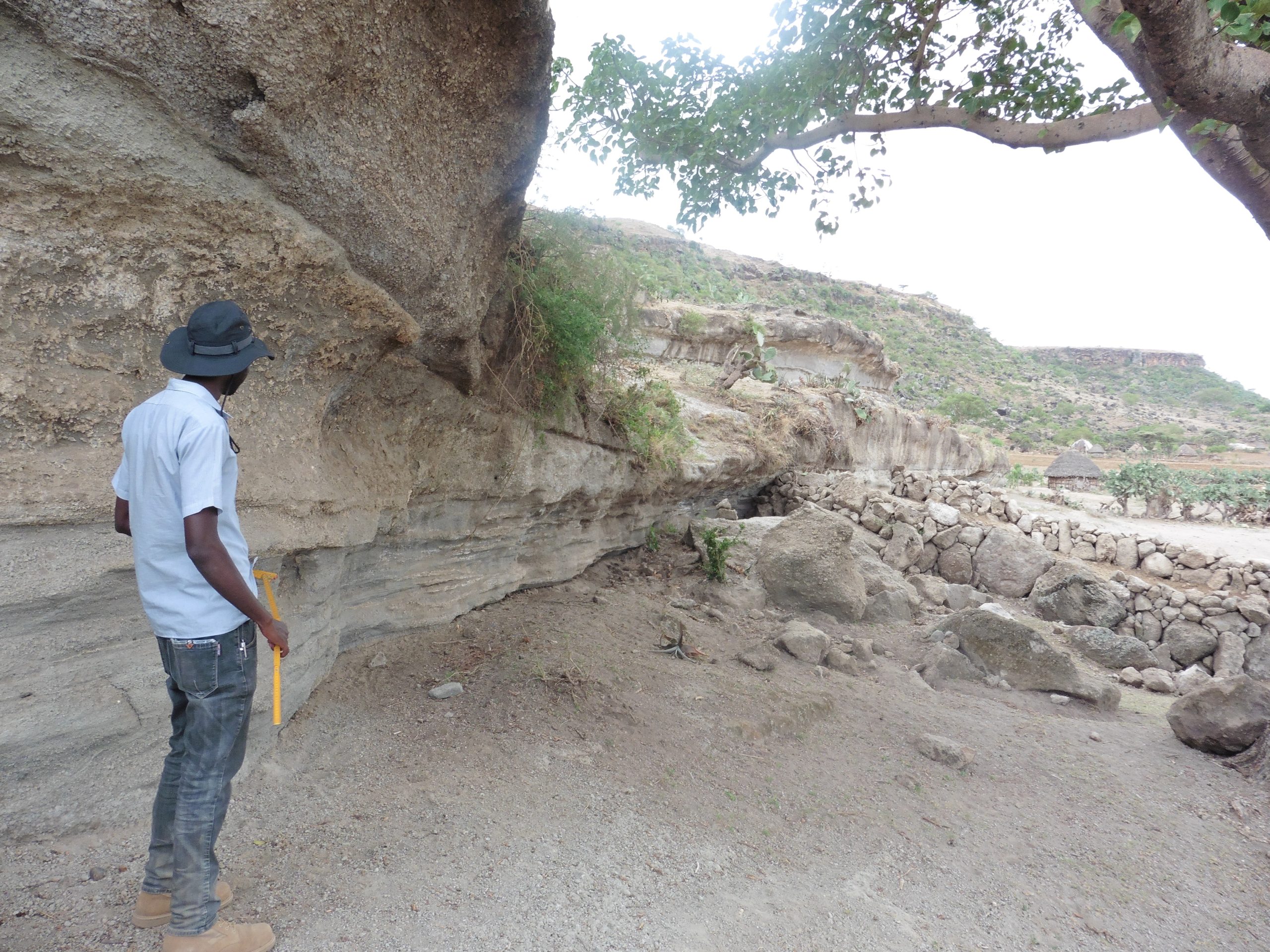
photo by Céline Vidal
The paper’s authors, writes Reuters’ Will Dunham, “used the geochemical fingerprints of a thick layer of ash found above the sediments containing the fossils to ascertain that it resulted from an eruption that spewed volcanic fallout over a wide swathe of Ethiopia roughly 233,000 years ago.” These fossils “include a rather complete cranial vault and lower jaw, some vertebrae and parts of the arms and legs.” After their initial discovery by the late Richard Leakey, son of Louis and Mary (and a man genuinely from Nairobi, born and raised), the fossils buried by this prehistoric Vesuvius were previously believed to be “no more than about 200,000 years old.”
Dunham quotes the paper’s lead author, University of Cambridge volcanologist Celine Vidal, as saying this discovery aligns with “the most recent scientific models of human evolution placing the emergence of Homo sapiens sometime between 350,000 to 200,000 years ago.” Though Vidal and her team’s analysis of the ash’s geochemical composition has determined the minimum age of Omo I, as these fossils are known, the maximum age remains an open question. Or at least, it awaits the efforts of researchers to date the “ash layer below the sediment containing the fossils” and render a more precise estimate. And when that’s established, it will then, ideally, become material for the next big absurdist comedy troupe.
Based in Seoul, Colin Marshall writes and broadcasts on cities and culture. His projects include the book The Stateless City: a Walk through 21st-Century Los Angeles and the video series The City in Cinema. Follow him on Twitter at @colinmarshall or on Facebook.
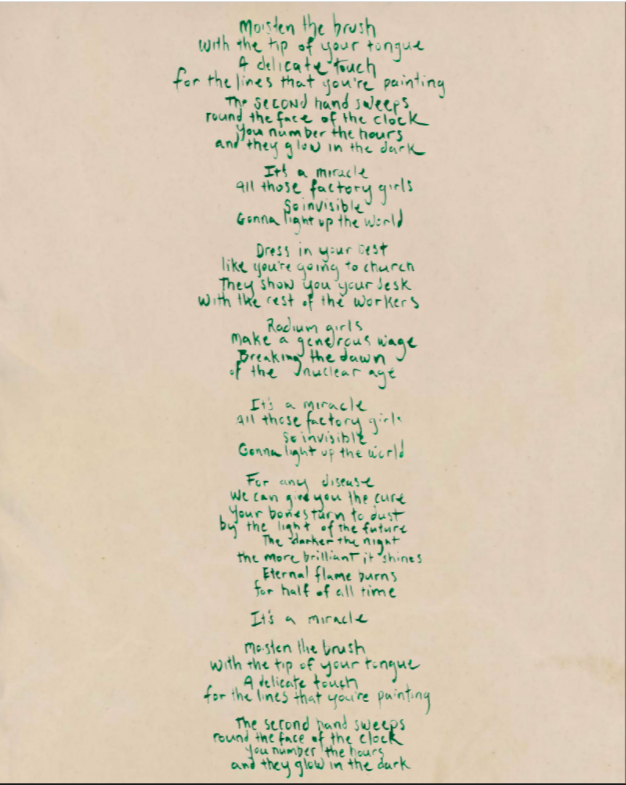
After several years of writing and performing songs influenced by such sources as authors Edward Gorey and Raymond Chandler, filmmaker Tim Burton, and murder ballads in the American folk tradition, Ellia Bisker and Jeffrey Morris, known collectively as Charming Disaster, began casting around for a single, existing narrative that could sustain an album’s worth of original tunes.
The result is Our Lady of Radium, a nine song exploration of Curie’s life and work.
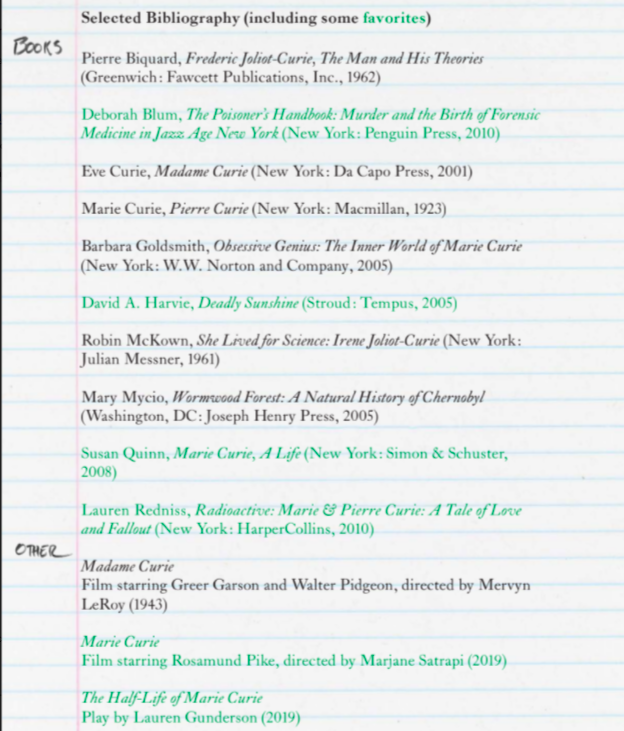
The crowdfunded album, recorded during the pandemic, is so exhaustively researched that the accompanying illustrated booklet includes a bibliography with titles ranging from David I. Harvie’s technically dense Deadly Sunshine: The History and Fatal Legacy of Radium to Deborah Blum’s The Poisoner’s Handbook, described by The New York Observer as “a vicious, page-turning story that reads more like Raymond Chandler than Madame Curie.”
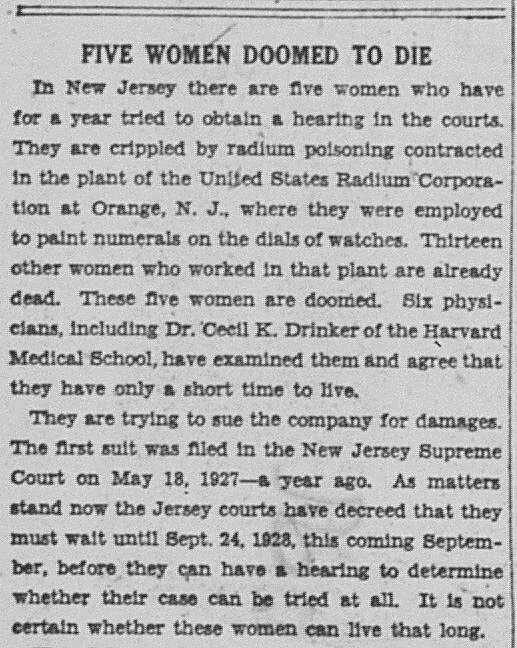
A chapter in the The Poisoner’s Handbook introduced Bisker and Morris to the Radium Girls, young workers whose prolonged exposure to radium-based paint in early 20th-century clock factories had horrific consequences.
Each girl procured a tray containing twenty-four watch dials and the material to be used to paint the numerals upon them so that they would appear luminous. The material was a powder, of about the consistency of cosmetic powder, and consisted of phosphorescent zinc sulphide mixed with radium sulphate…The powder was poured from the vial into a small porcelain crucible, about the size of a thimble. A quantity of gum arabic, as an adhesive, and a thinner of water were then added, and this was stirred with a small glass rod until a paintlike substance resulted. In the course of a working week each girl painted the dials contained on twenty-two to forty-four such trays, depending upon the speed with which she worked, and used a vial of powder for each tray. When the paint-like substance was produced a girl would employ it in painting the figures on a watch dial. There were fourteen numerals, the figure six being omitted. In the painting each girl used a very fine brush of camel’s hair containing about thirty hairs. In order to obtain the fine lines which the work required, a girl would place the bristles in her mouth, and by the action of her tongue and lips bring the bristles to a fine point. The brush was then dipped into the paint, the figures painted upon the dial until more paint was required or until the paint on the brush dried and hardened, when the brush was dipped into a small crucible of water. This water remained in the crucible without change for a day or perhaps two days. The brush would then be repointed in the mouth and dipped into the paint or even repointed in such manner after being dipped into the paint itself, in a continuous process.
The band found themselves haunted by the Radium Girls’ story:
Partly it’s that it seemed like a really good job — it was clean work, it was less physically taxing and paid better than factory or mill jobs, the working environment was nice — and the workers were all young women. They were excited about this sweet gig, and then it betrayed them, poisoning them and cutting their lives short in a horrible way.
There were all these details we learned that we couldn’t stop thinking about. Like the fact that radium gets taken up by bone, which then starts to disintegrate because radium isn’t as hard as calcium. The Radium Girls’ jaw boneswere crumbling away, because they (were instructed) to use their lips to point the brushes when painting watch faces with radium-based paint.
The radium they absorbed was irradiating them from inside, from within their own bones.
Radium decays into radon, and it was eventually discovered that the radium girls were exhaling radon gas. They could expose a photographic plate by breathing on it. Those images—the bones and the breath—stuck with us in particular.
Fellow musician, Omer Gal, of the “theatrical freak folk musical menagerie” Cookie Tongue, heightens the sense of dread in his chilling stop-motion animation for Our Lady of Radium’s first music video, above. There’s no question that a tragic fate awaits the crumbling, uncomprehending little worker.
Before their physical symptoms started to manifest, the Radium Girls believed what they had been told — that the radium-based paint they used on the timepieces’ faces and hands posed no threat to their well being.
Compounding the problem, the paint’s glow-in-the-dark properties proved irresistible to high-spirited teens, as the niece of Margaret “Peg” Looney — 17 when she started work at the Illinois Radium Dial Company (now a Superfund Site) — recounted to NPR:
I can remember my family talking about my aunt bringing home the little vials (of radium paint.) They would go into their bedroom with the lights off and paint their fingernails, their eyelids, their lips and then they’d laugh at each other because they glowed in the dark.
Looney died at 24, having suffered from anemia, debilitating hip pain, and the loss of teeth and bits of her jaw. Although her family harbored suspicions as to the cause of her bewildering decline, no attorney would take their case. They later learned that the Illinois Radium Dial Company had arranged for medical tests to be performed on workers, without truthfully advising them of the results.
Eventually, the mounting death toll made the connection between workers’ health and the workplace impossible to ignore. Lawsuits such as La Porte v. United States Radium Corporation led to improved industrial safety regulations and other labor reforms.
Too late, Charming Disaster notes, for the Radium Girls themselves:
(Our song) Radium Girls is dedicated to the young women who were unwittingly poisoned by their work and who were ignored and maligned in seeking justice. Their plight led to laws and safeguards that eventually became the occupational safety protections we have today. Of course that is still a battle that’s being fought, but it started with them. We wanted to pay tribute to these young women, honor their memory, and give them a voice.
Preorder Charming Disaster’s Our Lady of Radiumhere.
If resistance to the Slave Power was the reserved watchword of your first election, the triumphant war cry of your re-election is Death to Slavery.
In 1864, Karl Marx and his International Working Men’s Association (the “First International”) sent an address to Abraham Lincoln, congratulating “the American people upon your re-election by a large majority.” As historian Robin Blackburn writes, “The US ambassador in London conveyed a friendly but brief response from the president. However, the antecedents and implications of this little exchange are rarely considered.” It was not the first time Marx and Lincoln had encountered each other. They never met personally, but their affinities led to what Blackburn calls an “unfinished revolution” — not a communist revolution in the U.S.; but a potential revolution for democracy.
Lincoln and Marx became mutual admirers in the early 1860s due to the latter’s work as a foreign correspondent for The New York Daily Tribune. From 1852 until the start of the Civil War, Marx, sometimes with Engels, wrote “over five hundred articles for the Tribune,” Blackburn notes. Fiercely anti-slavery, Marx compared Southern planters to the European aristocracy, “an oligarchy of 300,000 slaveholders.” Early in the war, he championed the Union cause, even before Lincoln decided on emancipation as a course of action. Marx believed, writes Blackburn, that ending slavery “would not destroy capitalism, but it would create conditions far more favorable to organizing and elevating labor, whether white or black.”
“Marx was intensely interested in the plight of American slaves,” Gillian Brockell writes at The Washington Post. “In January 1860, he told Engels that the two biggest things happening in the world were ‘on the one hand the movement of the slaves in America started by the death of John Brown, and on the other the movement of serfs in Russia.’ ” Lincoln was an “avid reader” of the Tribune and Marx’s articles. The paper’s managing editor, Charles A. Dana, an American socialist fluent in German who met Marx in 1848, would go on to become “Lincoln’s ‘eyes and ears’ as a special commissioner in the War Department” and later the Department’s Assistant Secretary.
Lincoln was not, of course, a Communist. And yet some of the ideas he absorbed from Marx’s Tribune writings — many of which would later be adapted for the first volume of Capital– made their way into the Republican Party of the 1850s and 60s. That party, writes Brockell, was “anti-slavery, pro-worker and sometimes overtly socialist,” championing, for example, the redistribution of land in the West. (Marx even considered emigrating to Texas himself at one time.) And at times, Lincoln could sound like a Marxist, as in the closing words of his first annual message (later the State of the Union ) in 1861.
“Labor is prior to and independent of capital,” the country’s 16th president concluded in the first speech since his inauguration. “Capital is only the fruit of labor, and could never have existed if labor had not first existed. Labor is the superior of capital, and deserves much the higher consideration.” That full, 7,000 word address appeared in newspapers around the country, including the Confederate South. The Chicago Tribune subtitled its closing arguments “Capital vs. Labor.”
Lincoln’s own position on abolition evolved throughout his presidency, as did his views on the position of the formerly enslaved within the country. For Marx, however, the questions of total abolition and full enfranchisement were settled long before the country entered the Civil War. The democratic revolution that might have begun under Lincoln ended with his assassination. In the summer after the president’s death, Marx received a letter from his friend Engels about the new president, Andrew Johnson: “His hatred of Negroes comes out more and more violently… If things go on like this, in six months all the old villains of secession will be sitting in Congress at Washington. Without colored suffrage, nothing whatever can be done there.” Hear the address Marx drafted to Lincoln for his 1865 re-election read aloud at the top of the post, and read it yourself here.
A good disaster story never fails to fascinate — and, given that it actually happened, the story of Pompeii especially so. Buried and thus frozen in time by the eruption of Mount Vesuvius in 79 AD, the ancient Roman town of 11,000 has provided an object of great historical interest ever since its rediscovery in 1599. Baths, houses, tools and other possessions (including plenty of wine bottles), frescoes, graffiti, an ampitheater, an aqueduct, the “Villa of the Mysteries”: Pompeii has it all, as far as the stuff of first-century Roman life goes.
The ash-preserved ruins of Pompeii, more than any other source, have provided historians with a window into just what life in that time and place was like. A Day in Pompeii, an exhibition held at the Melbourne Museum in 2009, gave its more than 330,000 visitors a chance to experience Pompeii’s life even more vividly. The exhibition included a 3D theater installation that featured the animation above. Watch it, and you can see Pompeii brought back to life with computer-generated imagery — and then, in snapshots over the course of 48 hours, entombed by Vesuvius again.
As inherently compelling as we find the story of Pompeii, modern drama has struggled to capture the power of the disaster that defines it. The late-1960s BBC show Up Pompeii!offered a comedic rendering of life in the city before the explosion, but more serious interpretations, like the 2014 Hollywood movie Pompeii, met with only lukewarm critical reception. Best, it seems, to stick to the words of Pliny the Younger, witness to the destruction and still its most evocative describer:
You could hear the shrieks of women, the wailing of infants, and the shouting of men; some were calling their parents, others their children or their wives, trying to recognize them by their voices. People bewailed their own fate or that of their relatives, and there were some who prayed for death in their terror of dying. Many besought the aid of the gods, but still more imagined there were no gods left, and that the universe was plunged into eternal darkness for evermore.
If you would like to support the mission of Open Culture, consider making a donation to our site. It’s hard to rely 100% on ads, and your contributions will help us continue providing the best free cultural and educational materials to learners everywhere. You can contribute through PayPal, Patreon, and Venmo (@openculture). Thanks!
“Using new technology, recently discovered documents and sophisticated investigative techniques, an international team—led by an obsessed retired FBI agent—has [seemingly] solved the mystery that has haunted generations since World War II: Who betrayed Anne Frank and her family? And why?” That retired FBI agent, Vince Pankoke, gets interviewed by 60 Minutes above. The story behind this new investigation also gets documented in a new book, The Betrayal of Anne Frank: A Cold Case Investigation.
We're hoping to rely on loyal readers, rather than erratic ads. Please click the Donate button and support Open Culture. You can use Paypal, Venmo, Patreon, even Crypto! We thank you!
Open Culture scours the web for the best educational media. We find the free courses and audio books you need, the language lessons & educational videos you want, and plenty of enlightenment in between.