Buster Keaton’s penchant and skill for comedic stunts made him one of the biggest stars of the silent-film era. Nobody at the time imagined that he would still be engaging in dangerous-looking pratfalls 40 years later in his seventies, especially since his career seemed to have come to an end in 1926. That was the year of his Civil War-set film The General, which, though now critically respected, left contemporary audiences cold. Flops are, perhaps, inevitable, but this one happened to incorporate into the picture the most expensive shot in cinema history to date. As a result, says the Ming video above, “Keaton was never given control over his films again.”
Ironically, unlike the cinematic images that had made him famous, the $42,000 shot in The General did not put its director-star in apparent mortal peril, depicting only a railroad bridge collapsing while a train crosses it. Though undoubtedly impressive, it wouldn’t have been what people went to a Buster Keaton movie to see.
Here was a man willing, after all, to fly from the back of a moving streetcar, dangle off the edge of a waterfall, risk being crushed by an entire wall of a house, and even break his neck — though he didn’t discover that he’d done so until eleven years later. Making these and all of Keaton’s other famous stunts involved considerable amounts of both calculated danger and movie magic.
Some of that movie magic was conceived by Keaton himself, the first filmmaker, in Quentin Tarantino’s words, to “use cinema itself to be the joke.” Few performers could have adapted so well to the medium of silent film, with its realms of silent comedy just waiting to be opened. And after sound had been around for a few decades, longtime moviegoers started to feel like cinema had lost some of the visual exuberance that it once possessed. By that time, luckily, Keaton had emerged from his long post-General period of hard-drinking malaise, ready to appear not just in the movies again, but also on television, delighting the generations who remembered his earlier work and fascinating those too young to recognize him. Even today, when we find ourselves laughing at a scene of elaborately orchestrated physical danger, we are, in some sense, witnessing Keaton’s legacy.
Based in Seoul, Colin Marshall writes and broadcasts on cities, language, and culture. His projects include the Substack newsletterBooks on Cities and the book The Stateless City: a Walk through 21st-Century Los Angeles. Follow him on the social network formerly known as Twitter at @colinmarshall.
Designing their new republic, the Founding Fathers of the United States of America looked back to reference points in classical antiquity. That instinct continued to shape American endeavors long thereafter, and not just political ones. Take the example of Mount Rushmore, one of the country’s most popular tourist attractions. Originally conceived in the early nineteen-twenties as a mountain sculpture of America’s wild-west heroes, a means of raising the status of the fledgling state of South Dakota, it was soon changed into a stone tribute to four presidents: Founding Fathers George Washington and Thomas Jefferson as well as Abraham Lincoln and Theodore Roosevelt.
Mount Rushmore’s sculptor Gutzon Borglum suggested the switch from regional figures to national ones, and it wouldn’t be the last good idea he would bring to the table. As explained in the Primal Space video above, he also figured out how to replicate his initial sculpture of the four presidents, made at one-twelfth-scale, on a 500-foot-tall cliff edge.
Building all the necessary infrastructure on and around the mountain constituted a major project in and of itself. But when the workers got into their harnesses, how would they know where to direct their jackhammers into the rock? To guide them, Borglum adapted a mechanical technique used by ancient Greeks to copy statues, a “pointing machine” that could “measure specific points on a sculpture relative to a reference point,” making a three-dimensional shape transferable from one sculpture to another.
Borglum designed a large-scale pointing machine that could be installed atop the mountain and positioned to show workers where and how deep to drill. Though the system worked well, the team could only make progress so fast: after fourteen years, Mount Rushmore remained incomplete when Borglum’s death and World War II put a stop to it altogether. Yet enough had been finished to give it the iconic appearance that has made it recognizable the world over, if not always by name. When I recently gave a talk about American history to some young students in South Korea, where I live, one of them identified a photo of Mount Rushmore as Mount Olympus — and, in a civilizational sense, maybe she was on to something.
Based in Seoul, Colin Marshall writes and broadcasts on cities, language, and culture. His projects include the Substack newsletterBooks on Cities and the book The Stateless City: a Walk through 21st-Century Los Angeles. Follow him on the social network formerly known as Twitter at @colinmarshall.
Purple may not be one of the most popular colors in the apparel of our age, but if you want it — as certain cultural figures have amply demonstrated — you can get as much of it as you like, even if you don’t belong to the aristocracy. That wasn’t the case in antiquity, as explained by ancient-history YouTuber Garrett Ryan in the new video from his channel Told in Stone above. Back then, long before the invention of synthetic dyes, humanity had to get all its colors from nature, and some of those natural sources were more abundant and accessible than others. To produce splendid “Tyrian purple” required the mucus of sea snails, and not just any sea snails: only three species, collectively referred to as murex, would do.
This particular purple, as Ryan explains, “was virtually immune to washing and weathering,” unlike the vegetable dyes commonly used in antiquity, and perhaps that strength inspired the legend that it was discovered by Hercules himself.
Though its recipe has never quite been replicated in modernity, it seems to have required a nearly Herculean labor to execute, with each batch of ten thousand snails producing a single gram of dye. Even ancient Roman senators got just one purple stripe each on their togas; full purple was reserved for triumphing generals and emperors. In some ages, under emperors like Nero, purple — at least in its most luxuriant shades — was forbidden to the common people.
Not that most of them could have afforded it anyway, in Rome or other ancient civilizations. “In classical Athens, a purple cloak cost three minas, or 300 drachmas, when a family of four could live comfortably for a year on 200,” Ryan explains. “The finest purple cloth was worth its weight in silver, and an especially rich garment could cost two talents: 12,000 drachmas.” During the reign of Augustus, when imperial legionaries earned 900 sestertii a year, “a cloak of second-rate purple” might sell for 10,000. Calculating from Diocletian’s Price Edict, you could theoretically trade a few pounds of purple silk for 75,000 pints of beer, 7,500 “succulent sow udders,” 750 pheasants, “a single first-class male lion,” and 150 lawsuits: the makings of quite a high time in Ancient Rome.
Based in Seoul, Colin Marshall writes and broadcasts on cities, language, and culture. His projects include the Substack newsletterBooks on Cities and the book The Stateless City: a Walk through 21st-Century Los Angeles. Follow him on the social network formerly known as Twitter at @colinmarshall.
The expression “YOLO” may now be just passé enough to require explanation. It stands, as only some of us would try to deny remembering, for “You only live once,” a sentiment that reflects an eternal truth. Some bodies of religious belief don’t strictly agree with it, of course, but that was also true 24 centuries ago, when an unknown artist created the so-called “YOLO mosaic” that was unearthed in Southern Turkey in the twenty-tens. That artifact, whose depiction of a wine-drinking skeleton living it up even in death has delighted thousands upon thousands of viewers on the internet, is at the center of the new Hochelaga video above.
To the side of that merry set of bones is the Greek text “ΕΥΦΡΟΣΥΝΟΣ,” often translated as “Be cheerful and live your life.” As Hochelaga creator Tommie Trelawny points out, that’s a somewhat loose interpretation, since the word “roughly means ‘joyful-minded,’ or simply ‘cheerful.’ ” A more important element not often taken into consideration is the mosaic’s context.
It was discovered during the excavation of a third-century BC Greco-Roman villa, where it constituted one end of a dining-room triptych. In the middle was a scene, a trope in comedies of the time, of a toga-clad young “gatecrasher” running in hopes of a free dinner. On the other end is a mostly destroyed image of a type of figure known as “the African fisherman.”
Taken together, this domestic artwork could reflect the Epicurean teaching that “life should be about pursuing happiness and enjoying the simple pleasures while you still can.” But if the “cheerful skeleton,” as Trelawny calls it, draws attention from the rest of the triptych, that speaks to its symbolic power across the ages. Common not only in ancient Rome, the symbolic figure also makes vivid appearances in medieval art (especially during the time of the Black Death), Renaissance portraiture, the Día de Muertos-ready drawings of José Guadalupe Posada, and even Disney cartoons like The Skeleton Dance. As long as death remains undefeated, each era needs its own memento mori, and the cheerful skeleton, in all its paradoxical appeal, will no doubt keep turning up to the job — sometimes with a drink in hand.
Based in Seoul, Colin Marshall writes and broadcasts on cities, language, and culture. His projects include the Substack newsletterBooks on Cities and the book The Stateless City: a Walk through 21st-Century Los Angeles. Follow him on the social network formerly known as Twitter at @colinmarshall.
We all know Marshall McLuhan’s pithy, endlessly quotable line “the medium is the message,” but rarely do we stop to ask which one comes first. The development of communication technologies may genuinely present us with a chicken or egg scenario. After all, only a culture that already prized constant visual stimuli but grossly undervalued physical movement would have invented and adopted television.
In Society of the Spectacle, Guy Debord ties the tendency toward passive visual consumption to “commodity fetishism, the domination of society by ‘intangible as well as tangible things,’ which reaches its absolute fulfillment in the spectacle, where the tangible world is replaced by a selection of images which exist above it, and which simultaneously impose themselves as the tangible par excellence.” It seems an apt description of a screen-addicted culture.
What can we say, then, of a culture addicted to charts and graphs? Earliest examples of the form were often more elaborate than we’re used to seeing, hand-drawn with care and attention. They were also not coy about their ambitions: to condense the vast dimensions of space and time into a two-dimensional, color-coded format. To tidily sum up all human and natural history in easy-to-read visual metaphors.
This was as much a religious project as it was a philosophical, scientific, historical, political, and pedagogical one. The domains are hopelessly entwined in the 18th and 19th centuries. We should not be surprised to see them freely mingle in the earliest infographics. The creators of such images were polymaths, and deeply devout. Joseph Priestley, English chemist, philosopher, theologian, political theorist and grammarian, made several visual chronologies representing “the lives of two thousand men between 1200 BC and 1750 AD” (conveying a clear message about the sole importance of men).
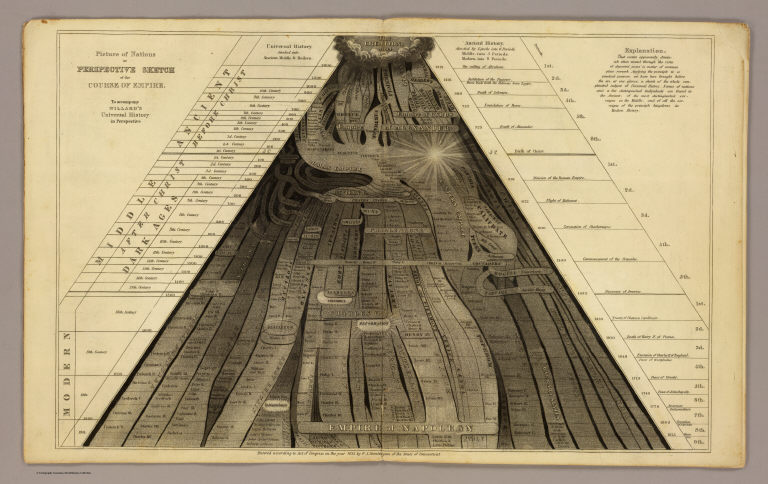
“After Priestley,” writes the Public Domain Review, “timelines flourished, but they generally lacked any sense of the dimensionality of time, representing the past as a uniform march from left to right.” Emma Willard, “one of the century’s most influential educators” set out to update the technology, “to invest chronology with a sense of perspective.” In her 1836 Picture of Nations; or Perspective Sketch of the Course of Empire, above (view and download high resolution images here), she presents “the biblical Creation as the apex of a triangle that then flowed forward in time and space toward the viewer.”
The perspective is also a forced point of view about origins and history. But that was exactly the point: these are didactic tools meant for textbooks and classrooms. Willard, “America’s first professional female mapmaker,” writes Maria Popova, was also a “pioneering educator,” who founded “the first women’s higher education institution in the United States when she was still in her thirties…. In her early forties, she set about composing and publishing a series of history textbooks that raised the standards and sensibilities of scholarship.”
Willard recognized that linear graphs of time did not accurately do justice to a three-dimensional experience of the world. Humans are “embodied creatures who yearn to locate themselves in space and time.” The illusion of space and time on the flat page was an essential feature of Willard’s underlying purpose: “laying out the ground-plan of the intellect, so far as the whole range of history is concerned.” A proper understanding of a Great Man (and at least one Great Woman, Hypatia) version of history—easily condensed, since there were only around 6,000 years from the creation of the universe—would lead to “enlightened and judicious supporters” of democracy.
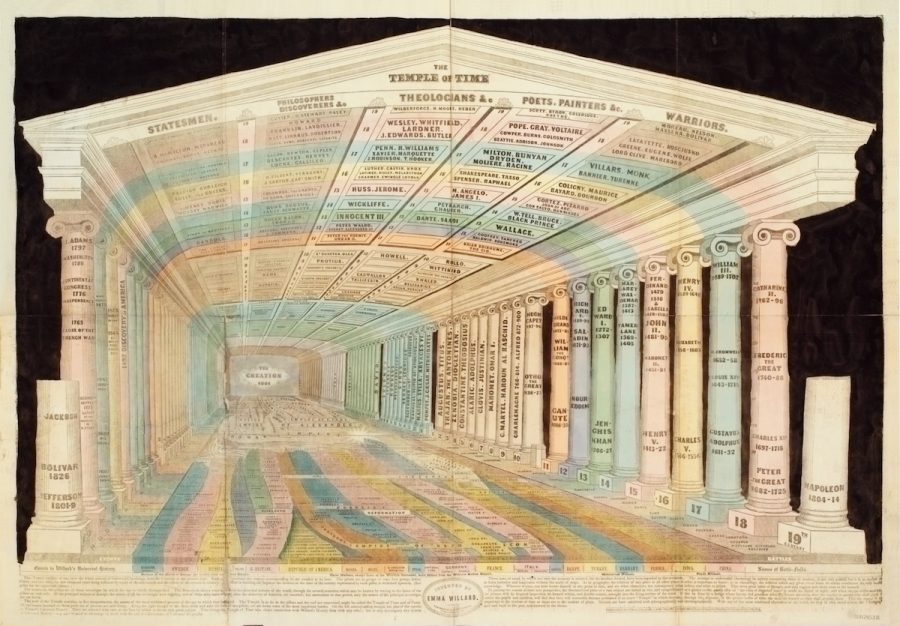
History is represented literally as a sacred space in Willard’s 1846 Temple of Time, its providential beginnings formally balanced in equal proportion to its every monumental stage. Willard’s intent was expressly patriotic, her trappings self-consciously classical. Her maps of time were ways of situating the nation as a natural successor to the empires of old, which flowed from the divine act of creation. They show a progressive widening of the world.
“Half a century before W.E.B. Du Bois… created his modernist data visualizations for the 1900 World’s Fair,” Popova writes, The Temple of Time “won a medal at the 1851 World’s Fair in London.” Willard accompanied the infographic with a statement of intent, articulating a media theory, over a hundred years before McLuhan, that sounds strangely anticipatory of his famous dictum.
The poetic idea of “the vista of departed years” is made an object of sight; and when the eye is the medium, the picture will, by frequent inspection, be formed within, and forever remain, wrought into the living texture of the mind.
The history of medicine is, for the most part, a history of dubious cures. Some were even worse than dubious: for example, the ingestion of antimony, which we now know to be a highly toxic metal. Though it may not occupy an exalted (or, for students in chemistry class, particularly memorable) place on the periodic table today, antimony does have a fairly long cultural history. Its first known use took place in ancient Egypt when stibnite, one of its mineral forms, was ground into the strikingly dark eyeliner-like cosmetic kohl, which was thought to ward off bad spirits.
Ancient Greek civilization recognized antimony less for its effects on the spirit world than on the human one. The Greeks knew full well that the stuff was toxic, but also kept returning to it as a potential form of medicine.
Ancient Rome made its own practical use of antimony, not least in metallurgy, but also kept up certain lines of inquiry into its curative properties. As a substance, it was well-placed to capture imaginations more intensely in the medieval age of alchemy. By the late seventeenth century, people were drinking wine out of antimony cups, as unboxed in the video from the Victoria and Albert Museum above.
“The purpose of it is to try and make you vomit and have diarrhea and sweat a lot,” says Angus Patterson, the V&A’s senior curator of metalwork. In theory, this would re-balance the “humors” of which medieval medicine conceived of the body as being composed. Fancy cups like the one in the video, which was once owned by a lord, weren’t the only antimony objects used for this purpose: the metal was also forged into so-called “perpetual pills,” meant to be swallowed, retrieved from the excrement, then swallowed again when necessary — for multiple generations, in some cases, as a kind of family heirloom. “Not sure I’d fancy swallowing a pill that had been through my grandpa,” Patterson adds, “but needs must when you have a stomachache in 1750.”
Based in Seoul, Colin Marshall writes and broadcasts on cities, language, and culture. His projects include the Substack newsletterBooks on Cities and the book The Stateless City: a Walk through 21st-Century Los Angeles. Follow him on the social network formerly known as Twitter at @colinmarshall.
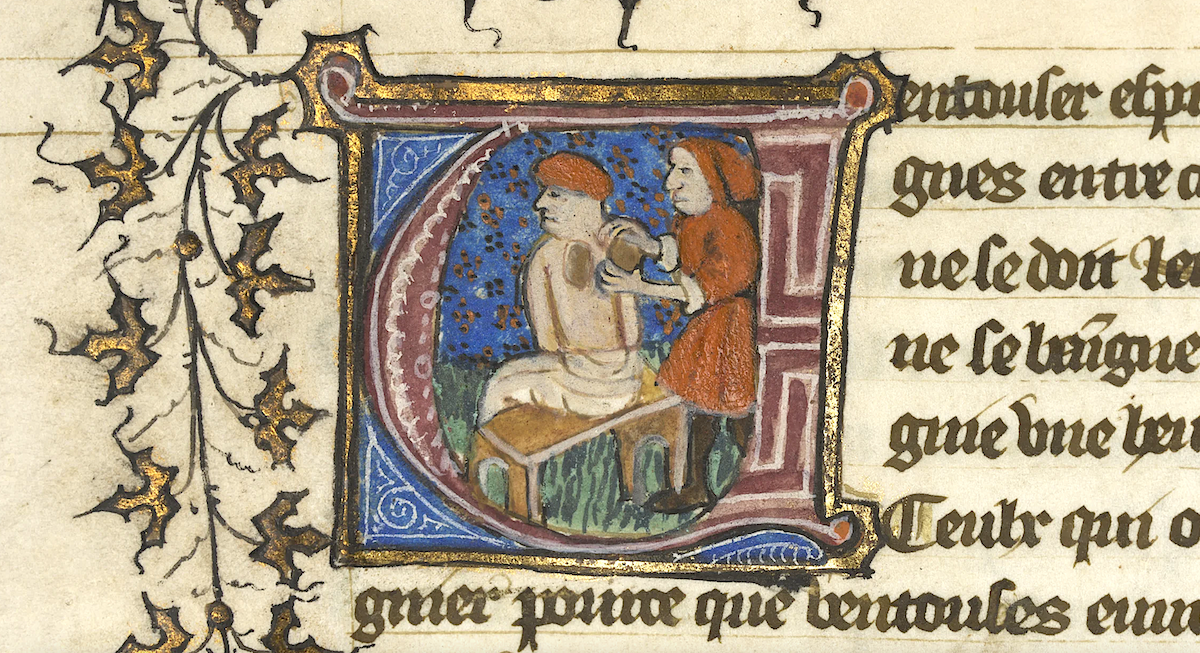
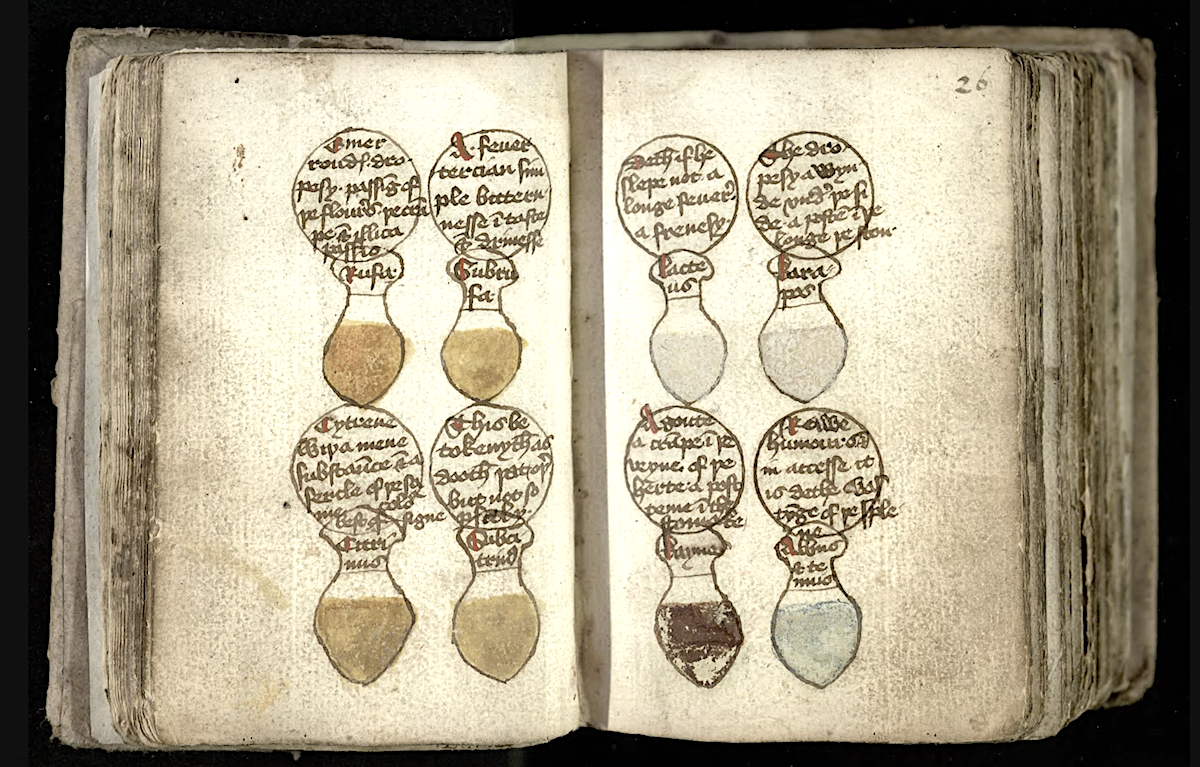
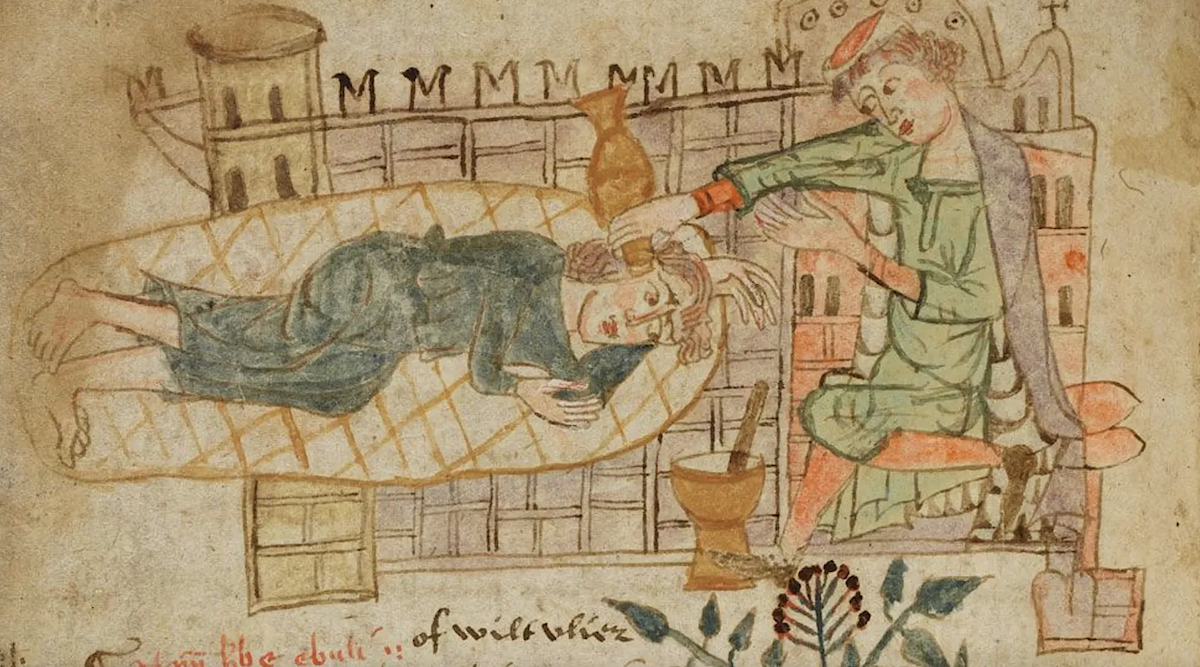
If any discussion of medieval medicine gets going, it’s only a matter of time before someone brings up leeches. And it turns out that the centrality of those squirming blood-suckers to the treatment of disease in the Middle Ages isn’t much overstated, at least judging by a look through Curious Cures. A Wellcome Research Resources Award-funded project of the University of Cambridge Libraries, it has recently finished conserving, digitizing, and making available online 190 manuscripts containing more than 7,000 pages of medieval medical recipes. These books contain a wealth of information even beyond the text on their pages: a multi-spectral imaging analysis of one of them, for example, revealed that it was once owned by a certain “Thomas Word, leche” — or leech, i.e., a healer who made intensive use of the tools you might imagine.
Not that the practice of medieval medicine came down to applying leeches and nothing more. In the manuscripts digitized by Curious Cures (which include not just strictly medical texts but also bibles, law texts, and books of hours), one finds a wonderland of dove feces, fox lungs, salted owl, eel grease, weasel testicles, quicksilver (i.e. mercury) — a wonderland for readers curious about medieval forms of knowledge, if not for the actual patients who had to undergo these dubious treatments.
But as any scholar of the subject would be quick to remind us, medical documents in the Middle Ages may have wantonly mixed folk and “official” knowledge, but they were hardly repositories of pure superstition: rather, they represent the best efforts of intelligent people to understand their own bodies and the world they inhabited, within the dominant worldview of their time and place.
That was a time in which health was thought to be determined by the “four humors,” black bile, yellow bile, blood and phlegm; a time when certain parts of plants or animals were believed to be in “sympathetic” correspondence with certain parts of the human body; a time when repeatedly praying while clipping one’s fingernails, then burying those clippings in an elder tree, could plausibly cure a toothache. And now, it’s easier than ever to get a sense of what it must have been like, thanks to Curious Cures’ transcribed, translated, and searchable archive of all these manuscripts. The more outlandish remedies aside, what’s remarkable is how these books also acknowledge the importance of what we would now call a good night’s sleep, regular exercise, and a balanced, varied diet. Medievals may have understood their own health better than we imagine, but regardless, we’re probably not bringing back leechcraft anytime soon.
Based in Seoul, Colin Marshall writes and broadcasts on cities, language, and culture. His projects include the Substack newsletterBooks on Cities and the book The Stateless City: a Walk through 21st-Century Los Angeles. Follow him on the social network formerly known as Twitter at @colinmarshall.
“Do what thou wilt”: as the central principle of a worldview, it may not sound like much, but at least there are always a great many people ready and willing to hear it. So discovered Aleister Crowley, the early twentieth-century Occultist now remembered not just for his unconventional religious practices, but also for his knack for gathering cults around himself. It was in Liber AL vel Legis, or The Book of the Law, the central text of his religion Thelema, that he instructed his followers to act directly on their own desires, ideally with the aid of some ritualistic black magick.
You can learn more about the life and pursuits that eventually got Crowley dubbed “the wickedest man in the world” from the Hochelaga video above. After living most of his childhood under a Biblical-fundamentalist preacher father, who died when Crowley was eleven, he was sent away to various boarding schools, then turned troublemaker. At Cambridge, where he went to study English literature, he fell for the Romantics, then for the occult. After leaving without his degree, but with a considerable inheritance, he enjoyed the freedom to travel the world, climbing mountains and attempting to master the dark arts — not to mention taking drugs and having affairs.
As he went from country to country, Crowley never met an ancient religion he couldn’t adapt to his own ends. But no gods made as much of an impact on him as those of ancient Egypt, specifically Hoor-paar-kraat, or Harpocrates in the Greek; Crowley claimed to have been contacted by the voice of Hoor-paar-kraat’s messenger Aiwass, from whom he took the dictation that became Liber AL vel Legis. Styling himself as an Egyptian prophet, he preached one way for humanity to push through to a post-Christian age: “Whatever you feel like doing, go and do it, regardless of popular opinion or conventional morality.” After all, it seemed to work for Crowley himself, though the work of a notorious occultist certainly isn’t for everybody.
Nor could even the world’s wickedest man keep it up forever: “Eventually all the traveling, drug-taking, and libertinism had caught up with Crowley.” His inheritance dried up, and his addictions worsened. But he didn’t give up on Thelema, even going so far as to establish a commune in Sicily. Alas, the “responsibility-free lifestyle” advocated by the religion soon drove its headquarters to chaotic dilapidation. But just a couple of decades after his death in England in 1947, Crowley’s glowering visage popped up again, on the cover of Sgt. Pepper’s Lonely Hearts ClubBand. He became the subject of pop-music reference not just by the Beatles, but also David Bowie, Iron Maiden, and the late Ozzy Osbourne. “Genius? Insane? Visionary? Fraud? Freethinker? Cult leader?” We might grant Aleister Crowley all these titles, and that of proto-rock star besides.
Based in Seoul, Colin Marshall writes and broadcasts on cities, language, and culture. His projects include the Substack newsletterBooks on Cities and the book The Stateless City: a Walk through 21st-Century Los Angeles. Follow him on the social network formerly known as Twitter at @colinmarshall.
We're hoping to rely on loyal readers, rather than erratic ads. Please click the Donate button and support Open Culture. You can use Paypal, Venmo, Patreon, even Crypto! We thank you!
Open Culture scours the web for the best educational media. We find the free courses and audio books you need, the language lessons & educational videos you want, and plenty of enlightenment in between.