Kurt Vonnegut Urges Young People to Make Art and “Make Your Soul Grow”

Art not only saves lives, it casts rip­ples, as Kurt Von­negut sure­ly knew when he replied—at length—to five New York City high school stu­dents who’d con­tact­ed him as part of a 2006 Eng­lish assign­ment.  (The iden­ti­ties of the oth­er authors select­ed for this hon­or are lost to time, but not one had the cour­tesy to respond except Von­negut.)

Dear Xavier High School, and Ms. Lock­wood, and Messrs Perin, McFeely, Bat­ten, Mau­r­er and Con­gius­ta:

I thank you for your friend­ly let­ters. You sure know how to cheer up a real­ly old geezer (84) in his sun­set years. I don’t make pub­lic appear­ances any more because I now resem­ble noth­ing so much as an igua­na.

What I had to say to you, more­over, would not take long, to wit: Prac­tice any art, music, singing, danc­ing, act­ing, draw­ing, paint­ing, sculpt­ing, poet­ry, fic­tion, essays, reportage, no mat­ter how well or bad­ly, not to get mon­ey and fame, but to expe­ri­ence becom­ing, to find out what’s inside you, to make your soul grow.

Seri­ous­ly! I mean start­ing right now, do art and do it for the rest of your lives. Draw a fun­ny or nice pic­ture of Ms. Lock­wood, and give it to her. Dance home after school, and sing in the show­er and on and on. Make a face in your mashed pota­toes. Pre­tend you’re Count Drac­u­la.

Here’s an assign­ment for tonight, and I hope Ms. Lock­wood will flunk you if you don’t do it: Write a six line poem, about any­thing, but rhymed. No fair ten­nis with­out a net. Make it as good as you pos­si­bly can. But don’t tell any­body what you’re doing. Don’t show it or recite it to any­body, not even your girl­friend or par­ents or what­ev­er, or Ms. Lock­wood. OK?

Tear it up into tee­ny-wee­ny pieces, and dis­card them into wide­ly sep­a­rat­ed trash recep­ti­cals [sic]. You will find that you have already been glo­ri­ous­ly reward­ed for your poem. You have expe­ri­enced becom­ing, learned a lot more about what’s inside you, and you have made your soul grow.

God bless you all!

Kurt Von­negut

Von­negut’s kind wish­es and Yoko Ono-esque prompt have been wide­ly dis­sem­i­nat­ed on the Inter­net, which is no doubt where stu­dents at Hove Park School in Brighton, East Sus­sex caught the scent. Work­ing with a pro­fes­sion­al pro­duc­tion com­pa­ny that spe­cial­izes in nar­ra­tive-dri­ven work, they lit­er­al­ized  the assign­ment in the video above, and while I might have pre­ferred a sneak peek at the poems and draw­ings such a task might yield, pre-shred­ding, I loved how they acknowl­edged that not every­one heeds the call. (The cast­ing of that one could have gone either way…wouldn’t be sur­prised if you told me that that boy has a punk band that would’ve ripped Von­negut’s ears off.)

via Kate Rix

Relat­ed Con­tent:

Kurt Von­negut Dia­grams the Shape of All Sto­ries in a Master’s The­sis Reject­ed by U. Chica­go

“Wear Sun­screen”: The Sto­ry Behind the Com­mence­ment Speech That Kurt Von­negut Nev­er Gave

Kurt Vonnegut’s Eight Tips on How to Write a Good Short Sto­ry

Kurt Von­negut: Where Do I Get My Ideas From? My Dis­gust with Civ­i­liza­tion

Ayun Hal­l­i­day is spend­ing tonight’s Night of Von­negut in Los Ange­les rather than her home­town of Indi­anapo­lis. So it goes. Fol­low her @AyunHalliday

Mark Twain Creates a List of His Favorite Books For Adults & Kids (1887)

Twainbooklist

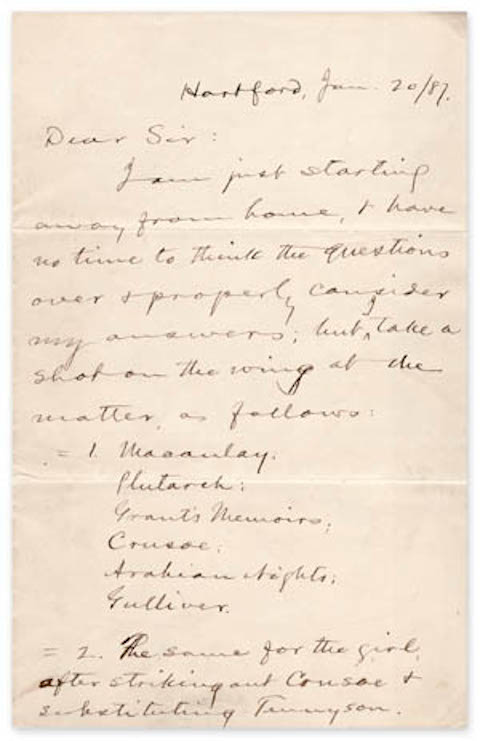
In Jan­u­ary of 1887, Mark Twain wrote the above let­ter to a Rev­erend Charles D. Crane, pas­tor of a Methodist Epis­co­pal Church in Maine, to advise him of the most suit­able read­ing for both chil­dren and adults. Twain’s letter—which, as he did near­ly all his let­ters, he signed with his giv­en name of Samuel Clemens (or “S.L. Clemens”)—came in response to a query in three parts from the Rev. Crane. But we do not seem to have Crane’s let­ter (at least a thor­ough search of the exhaus­tive cat­a­log at the online Mark Twain Project yields no results.) Nonethe­less, we can rea­son­ably infer that he asked the famous author—who was between Adven­tures of Huck­le­ber­ry Finn and A Con­necti­cut Yan­kee in King Arthur’s Court—some­thing like the fol­low­ing:

1) What books should young boys read? 2) And young girls? … 3) [and both/either] What should grown-ups read? [and/or] What are Mr. Samuel Clemens’ favorite books?

Twain, in a hur­ry, “took a shot on the wing” and replied with the let­ter below, which, despite his protes­ta­tions of haste, seems fair­ly well-con­sid­ered. I’ll admit that the ambi­gu­i­ty of the last sen­tence, how­ev­er, gives me the researcher’s buzz to go back and dig through more archives for Crane’s orig­i­nal let­ter.

Dear Sir:


I am just start­ing away from home, & have no time to think the ques­tions over & prop­er­ly con­sid­er my answers; but I take a shot on the wing at the mat­ter, as fol­lows:


1.Macaulay;
Plutarch;
Grant’s Mem­oirs;
Cru­soe;
Ara­bi­an Nights;
Gul­liv­er.


= 2. The same for the girl, after strik­ing out out Cru­soe & sub­sti­tut­ing Ten­nyson.


I can’t answer No. 3 in this sud­den way.  When one is going to choose twelve authors, for bet­ter for worse, for­sak­ing fathers & moth­ers to cling unto them & unto them alone, until death shall them part, there is an awful­ness about the respon­si­bil­i­ty that makes mar­riage with one mere indi­vid­ual & divorcible woman a sacra­ment sod­den with lev­i­ty by com­par­i­son. 


In my list I know I should put Shak­s­peare [sic]; & Brown­ing; & Car­lyle (French Rev­o­lu­tion only); Sir Thomas Mal­o­ry (King Arthur); Park­man’s His­to­ries (a hun­dred of them if there were so many); Ara­bi­an Nights; John­son (Boswell’s), because I like to see that com­pla­cent old gas­om­e­ter lis­ten to him­self talk; Jowet­t’s Pla­to; & “B.B.” (a book which I wrote some years ago, not for pub­li­ca­tion but just for my own pri­vate read­ing.)


I should be sure of these; & I could add the oth­er three — but I should want to hold the oppor­tu­ni­ty open a few years, so as to make no mis­take.


Tru­ly Yours


S.L. CLEMENS


See all six man­u­script pages of Twain’s let­ter (and zoom in to exam­ine them close­ly) at the Shapell Man­u­script Foun­da­tion. We’ve added links to Twain’s rec­om­mend­ed texts above. You can find many in our Free eBooks and Free Audio Books col­lec­tions.

Relat­ed Con­tent:

Christo­pher Hitchens Cre­ates a Read­ing List for Eight-Year-Old Girl

Neil deGrasse Tyson Lists 8 (Free) Books Every Intel­li­gent Per­son Should Read.

“Noth­ing Good Gets Away”: John Stein­beck Offers Love Advice in a Let­ter to His Son (1958)

F. Scott Fitzger­ald Tells His 11-Year-Old Daugh­ter What to Wor­ry About (and Not Wor­ry About) in Life, 1933

Josh Jones is a writer and musi­cian based in Durham, NC. Fol­low him at @jdmagness

David Foster Wallace’s Sharp Letter to His Editor: “Don’t F with the Mechanics of My Piece”

DFWFax

Click for expand­ed ver­sion

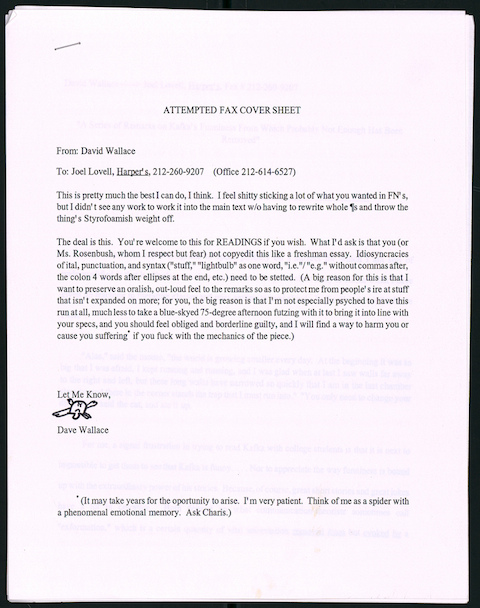
We might imag­ine that David Fos­ter Wal­lace worked out his neu­roses pri­mar­i­ly in his volu­mi­nous fic­tion­al and crit­i­cal out­put, but as we see from a fax above to Harper’s edi­tor Joel Lovell, the painful self-con­scious­ness that drove his writ­ing man­i­fest­ed in even the most mun­dane of doc­u­ments. Wal­lace sub­mit­ted the faxed let­ter with a short essay on Kaf­ka that appeared in Harper’s in 1998. The essay itself—an account of the dif­fi­cul­ties of teach­ing the arch Czech author to Amer­i­can undergraduates—slices through com­mon­places, arriv­ing at the con­clu­sion that “the hor­rif­ic strug­gle to estab­lish a human self results in a self whose human­i­ty is insep­a­ra­ble from that hor­rif­ic strug­gle. That our end­less and impos­si­ble jour­ney toward home is in fact our home.” Reas­sur­ing stuff this ain’t, but then, nei­ther is Kaf­ka. Even amidst all of its elab­o­rate defen­sive strate­gies, Wallace’s writ­ing also expos­es the unheim­lichkeit of human embod­i­ment, and in the Kaf­ka essay, it’s a point he want­ed to make in a very par­tic­u­lar way, unmedi­at­ed by any edi­to­r­i­al inter­ven­tion.

His faxed let­ter to Lovell antic­i­pates and resists crit­i­cism and alter­nates between dis­mis­sive, self-effac­ing, and mock-threat­en­ing in his expressed desire that the Harper’s staff “not copy­ed­it this like a fresh­man essay.” He explains the con­ver­sa­tion­al style of the piece as an effort to “pro­tect me from people’s ire.” The body of the let­ter fin­ish­es with Wallace’s foot­not­ed promise to “find a way to harm you or cause you suf­fer­ing* if you fuck with the mechan­ics of this piece.” It’s clas­sic DFW: com­plete­ly idio­syn­crat­ic, a prose style induced by his “hor­rif­ic strug­gle” to estab­lish an authen­tic self. Read a tran­script below, cour­tesy of Let­ters of Note. All, of course, sic.

ATTEMPTED FAX COVER SHEET

From: David Wal­lace

To: Joel Lovell, Harper’s [redact­ed] (Office [redact­ed])

This is pret­ty much the best I can do, I think. I feel shit­ty stick­ing a lot of what you want­ed in FN’s, but I didn’t see any work to work it into the main text w/o hav­ing to rewrite whole ¶s and throw the thing’s Sty­ro­foamish weight off.

The deal is this. You’re wel­come to this for READINGS if you wish. What I’d ask is that you (or Ms. Rosen­bush, whom I respect but fear) not copy­ed­it this like a fresh­man essay. Idio­syn­cra­cies of ital, punc­tu­a­tion, and syn­tax (“stuff,” “light­bulb” as one word, “i.e.”/“e.g.” with­out com­mas after, the colon 4 words after ellipses at the end, etc.) need to be stet­ted. (A big rea­son for this is that I want to pre­serve an oral­ish, out-loud feel to the remarks so as to pro­tect me from people’s ire at stuff that isn’t expand­ed on more; for you, the big rea­son is that I’m not espe­cial­ly psy­ched to have this run at all, much less to take a blue-skyed 75-degree after­noon futz­ing with it to bring it into line with your specs, and you should feel oblig­ed and bor­der­line guilty, and I will find a way to harm you or cause you suf­fer­ing* if you fuck with the mechan­ics of this piece.

Let Me Know,

Dave Wal­lace

* (It may take years for the opor­tu­ni­ty to arise. I’m very patient. Think of me as a spi­der with a phe­nom­e­nal emo­tion­al mem­o­ry. Ask Charis.)

via F yeah, man­u­scripts!

Relat­ed Con­tent:

30 Free Essays & Sto­ries by David Fos­ter Wal­lace on the Web

David Fos­ter Wallace’s 1994 Syl­labus: How to Teach Seri­ous Lit­er­a­ture with Light­weight Books

David Fos­ter Wal­lace Cre­ates Lists of His Favorite Words: “Mau­gre,” “Taran­tism,” “Ruck,” “Prima­para” & More

Josh Jones is a writer and musi­cian based in Durham, NC. Fol­low him at @jdmagness

Lewis Carroll’s 8 Still-Relevant Rules For Letter-Writing

lewis carroll letter writing

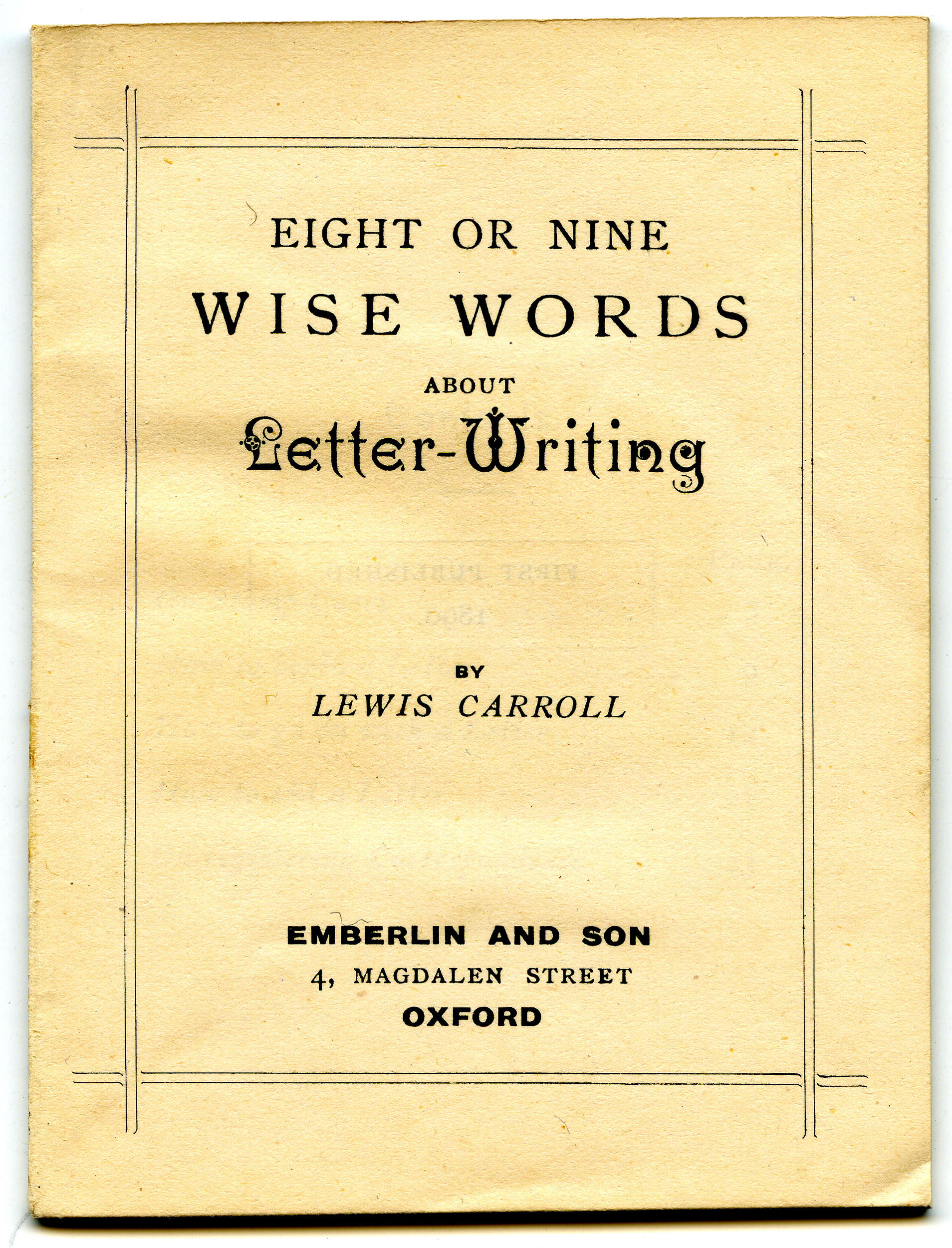
My grad­u­ate school super­vi­sor taught me all I know about pro­fes­sion­al email eti­quette. Vague lan­guage? Poor form. Typos? Noth­ing worse. Run-on para­graphs? A big no-no. Spelling your recipient’s name wrong? No com­ing back from that one. Unfor­tu­nate­ly, hasti­ly com­posed emails and ambigu­ous phras­ing are all too com­mon, par­tic­u­lar­ly with the high vol­ume of emails many peo­ple send dai­ly. Skimp­ing on the cour­tesy and the proof­read­ing, how­ev­er, is like­ly to cost you points with your recip­i­ent. Thank­ful­ly, we’ve pro­vid­ed a list of cor­re­spon­dence best prac­tices, com­piled by an author­i­ty on let­ters: Lewis Car­roll (who, inci­den­tal­ly, would have cel­e­brat­ed his 182nd birth­day today). In 1890, Car­roll began to sell a Won­der­land Stamp Case, which helped its users to orga­nize their var­i­ous postage stamps. Paired with the case was a short essay, enti­tled “Eight Or Nine Wise Words About Let­ter-Writ­ing.”

The ini­tial guide, of course, refers to pen and paper cor­re­spon­dence. In fact, Carroll’s fore­most pre­cept, which instructs one to write leg­i­bly, is no longer a con­cern in the dig­i­tal age. Nev­er­the­less, the remain­ing eight rules pro­vide a clear and sim­ple crib sheet for let­ter-writ­ing that has stood the test of time remark­ably well:

1) Start by address­ing any ques­tions the receiv­er pre­vi­ous­ly had - “Don’t fill more than a page and a half with apolo­gies for not hav­ing writ­ten soon­er!

The best sub­ject, to begin with, is your friend’s last let­ter. Write with the let­ter open before you. Answer his ques­tions, and make any remarks his let­ter sug­gests. Then go on to what you want to say your­self. This arrange­ment is more cour­te­ous, and pleas­an­ter for the read­er, than to fill the let­ter with your own invalu­able remarks, and then hasti­ly answer your friend’s ques­tions in a post­script. Your friend is much more like­ly to enjoy your wit, after his own anx­i­ety for infor­ma­tion has been sat­is­fied.”

2) Don’t repeat your­self - “When once you have said your say, ful­ly and clear­ly, on a cer­tain point, and have failed to con­vince your friend, drop that sub­ject: to repeat your argu­ments, all over again, will sim­ply lead to his doing the same…”

3) Write with a lev­el head — “When you have writ­ten a let­ter that you feel may pos­si­bly irri­tate your friend, how­ev­er nec­es­sary you may have felt it to so express your­self, put it aside till the next day. Then read it over again, and fan­cy it addressed to your­self. This will often lead to your writ­ing it all over again, tak­ing out a lot of the vine­gar and pep­per, and putting in hon­ey instead, and thus mak­ing a much more palat­able dish of it!”

4) When in doubt, err on the side of cour­tesy - “If your friend makes a severe remark, either leave it unno­ticed, or make your reply dis­tinct­ly less severe: and if he makes a friend­ly remark, tend­ing towards ‘mak­ing up’ the lit­tle dif­fer­ence that has arisen between you, let your reply be dis­tinct­ly more friend­ly. If, in pick­ing a quar­rel, each par­ty declined to go more than three-eighths of the way, and if, in mak­ing friends, each was ready to go five-eighths of the way—why, there would be more rec­on­cil­i­a­tions than quar­rels! Which is like the Irishman’s remon­strance to his gad-about daughter—‘Shure, you’re always goin’ out! You go out three times, for wanst that you come in!’ ”

5) Don’t try to have the last word — “How many a con­tro­ver­sy would be nipped in the bud, if each was anx­ious to let the oth­er have the last word! Nev­er mind how telling a rejoin­der you leave unut­tered: nev­er mind your friend’s sup­pos­ing that you are silent from lack of any­thing to say: let the thing drop, as soon as it is pos­si­ble with­out dis­cour­tesy: remem­ber ‘speech is sil­vern, but silence is gold­en’! (N.B.—If you are a gen­tle­man, and your friend a lady, this Rule is super­flu­ous: you won’t get the last word!)”

6) Humor is hard to trans­late to writ­ing. Be obvi­ous. - “If it should ever occur to you to write, jest­ing­ly, in dis­praise of your friend, be sure you exag­ger­ate enough to make the jest­ing obvi­ous: a word spo­ken in jest, but tak­en as earnest, may lead to very seri­ous con­se­quences. I have known it to lead to the break­ing-off of a friend­ship. Sup­pose, for instance, you wish to remind your friend of a sov­er­eign you have lent him, which he has for­got­ten to repay—you might quite mean the words “I men­tion it, as you seem to have a con­ve­nient­ly bad mem­o­ry for debts”, in jest: yet there would be noth­ing to won­der at if he took offence at that way of putting it. But, sup­pose you wrote “Long obser­va­tion of your career, as a pick­pock­et and a bur­glar, has con­vinced me that my one lin­ger­ing hope, for recov­er­ing that sov­er­eign I lent you, is to say ‘Pay up, or I’ll sum­mons yer!’” he would indeed be a mat­ter-of-fact friend if he took that as seri­ous­ly meant!”

7) Don’t for­get that attach­ment! — “When you say, in your let­ter, “I enclose cheque for £5”, or “I enclose John’s let­ter for you to see”, leave off writ­ing for a moment—go and get the doc­u­ment referred to—and put it into the enve­lope. Oth­er­wise, you are pret­ty cer­tain to find it lying about, after the Post has gone!”

8) Using a post­script? Make it short — “A Post­script is a very use­ful inven­tion: but it is not meant (as so many ladies sup­pose) to con­tain the real gist of the let­ter: it serves rather to throw into the shade any lit­tle mat­ter we do not wish to make a fuss about.”

Casu­al Vic­to­ri­an-era “sil­ly women!” sex­ism aside, Car­rol­l’s tips are sur­pris­ing­ly fresh and applic­a­ble. If you’re plan­ning on engag­ing in some seri­ous snail-mail cor­re­spon­dence, we sug­gest you check out Car­rol­l’s com­plete essay over at Project Guten­berg.

Ilia Blin­d­er­man is a Mon­tre­al-based cul­ture and sci­ence writer. Fol­low him at @iliablinderman.

Relat­ed Con­tent:

See Sal­vador Dali’s Illus­tra­tions for the 1969 Edi­tion of Alice’s Adven­tures in Won­der­land

See The Orig­i­nal Alice In Won­der­land Man­u­script, Hand­writ­ten & Illus­trat­ed By Lewis Car­roll (1864)

The Real Alice in Won­der­land Cir­ca 1862


Alfred Hitchcock and Vladimir Nabokov Trade Letters and Ideas for a Film Collaboration (1964)

alfred_hitchcock_and_vladimir_nabokov_were_pen_pals

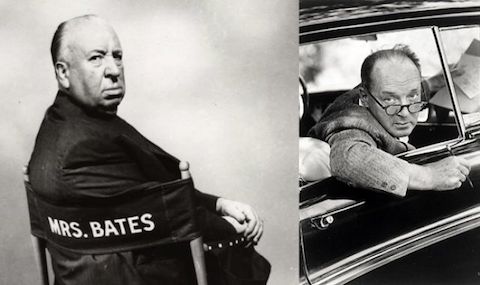
Alfred Hitch­cock, writes James A. David­son in Images, “is usu­al­ly men­tioned in the same breath with Cor­nell Wool­rich, the lit­er­ary ‘mas­ter of sus­pense,’ ” not least because he adapt­ed a novel­la of Wool­rich’s into Rear Win­dow (1954).” Yet David­son him­self finds in Hitch­cock “a much greater affin­i­ty with that of the Russ­ian émi­gré writer Vladimir Nabokov, with whom he is not typ­i­cal­ly asso­ci­at­ed since there is no appar­ent con­nec­tion” like the one between Nabokov and Stan­ley Kubrick, who brought Nabokov’s nov­el Loli­ta to the screen. Hitch­cock and Nabokov nev­er sim­i­lar­ly col­lab­o­rat­ed, but not out of a lack of desire. Close his­tor­i­cal con­tem­po­raries and mutu­al admir­ers, the writer and the direc­tor did once exchange let­ters dis­cussing film ideas they might devel­op togeth­er. You’ll find the full text of both Hitch­cock­’s query and Nabokov’s inter­est­ed response at the Amer­i­can Read­er.

“The first idea I have been think­ing about for some time is based upon a ques­tion that I do not think I have seen dealt with in motion pic­tures or, as far as I know, in lit­er­a­ture,” wrote Hitch­cock to Nabokov on Novem­ber 19, 1964. “It is the prob­lem of the woman who is asso­ci­at­ed, either by mar­riage or engage­ment, to a defec­tor.” After fill­ing out a few details, suit­ing the con­cept per­fect­ly to what he calls “the cus­tom­ary Hitch­cock sus­pense,” he lays out a sec­ond, about a young girl who, “hav­ing spent her life in a con­vent in Switzer­land due to the fact that she had no home to go to and only had a wid­owed father,” sud­den­ly finds her­self released back to the hotel run by her father and his entire fam­i­ly. But ah, “the whole of this fam­i­ly are a gang of crooks, using the hotel as a base of oper­a­tions,” which would lead into the telling of an “extreme­ly col­or­ful sto­ry.” Reply­ing nine days lat­er, Nabokov admits that Hitch­cock­’s first idea, about the defec­tor’s wife, “would present many dif­fi­cul­ties for me” due to his unfa­mil­iar­i­ty with “Amer­i­can secu­ri­ty mat­ters and meth­ods.” The one about the crim­i­nal hotel, how­ev­er, strikes him as “quite accept­able,” and he goes on to make two pitch­es of his own.

Nabokov’s first idea, some­thing of a rever­sal of Hitch­cock­’s first one, involves a defec­tor from the Sovi­et Union in the Unit­ed States. His sec­ond focus­es on a star­let “court­ed by a bud­ding astro­naut.” When this astro­naut returns home famous from a major mis­sion, the actress, whose “star­rise has come to a stop at a mod­er­ate lev­el,” real­izes “that he is not the same as he was before his flight.” Unable to put her fin­ger on it, she “becomes con­cerned, then fright­ened, then pan­icky.” Nabokov tan­ta­liz­ing­ly men­tions hav­ing “more than one inter­est­ing denoue­ment for this plot,” but alas, we’ll nev­er see them cin­e­ma­tized, and cer­tain­ly not by the likes of Hitch­cock. “One can only imag­ine the kind of invo­lut­ed, com­plex, and play­ful work these two men would have pro­duced,” writes David­son. “What is left, in the end, is the work they pro­duced, which can be well sum­ma­rized by a line the fic­tion­al John Shade wrote in Pale Fire: ‘Life is a mes­sage scrib­bled in the dark.’ ”

Relat­ed Con­tent:

21 Free Hitch­cock Movies Online

François Truffaut’s Big Inter­view with Alfred Hitch­cock (Free Audio)

Vladimir Nabokov Mar­vels Over Dif­fer­ent Loli­ta Book Cov­ers

Vladimir Nabokov (Chan­nelled by Christo­pher Plum­mer) Teach­es Kaf­ka at Cor­nell

Col­in Mar­shall hosts and pro­duces Note­book on Cities and Cul­ture and writes essays on cities, Asia, film, lit­er­a­ture, and aes­thet­ics. He’s at work on a book about Los Ange­les, A Los Ange­les Primer. Fol­low him on Twit­ter at @colinmarshall or on his brand new Face­book page.

Hunter S. Thompson’s Personal Hangover Cure (and the Real Science of Hangovers)

Hunter-S-Thompson-hangover-cure

Last year, we brought you a descrip­tion of Hunter S. Thompson’s dai­ly drug and alco­hol reg­i­men, con­sist­ing of fright­en­ing amounts of cocaine and liquor, sup­plant­ed by the occa­sion­al cup of cof­fee or acid tab. While the sto­ry may be apoc­ryphal, Thomp­son was no dilet­tante when it came to psy­choac­tive sub­stances. The father of gonzo jour­nal­ism bur­nished his image as a for­mi­da­ble sub­stance user in the open­ing lines of Fear and Loathing in Las Vegas (1971):

The trunk of the car looked like a mobile police nar­cotics lab. We had two bags of grass, seventy—five pel­lets of mesca­line, five sheets of high—powered blot­ter acid, a salt shak­er half full of cocaine, and a whole galaxy of multi—colored uppers, down­ers, scream­ers, laugh­ers and also a quart of tequi­la, a quart of rum, a case of Bud­weis­er, a pint of raw ether and two dozen amyls. All this had been round­ed up the night before, in a fren­zy of high—speed dri­ving all over Los Ange­les County—from Topan­ga to Watts, we picked up every­thing we could get our hands on. Not that we need­ed all that for the trip, but once you get locked into a seri­ous drug col­lec­tion, the ten­den­cy is to push it as far as you can.

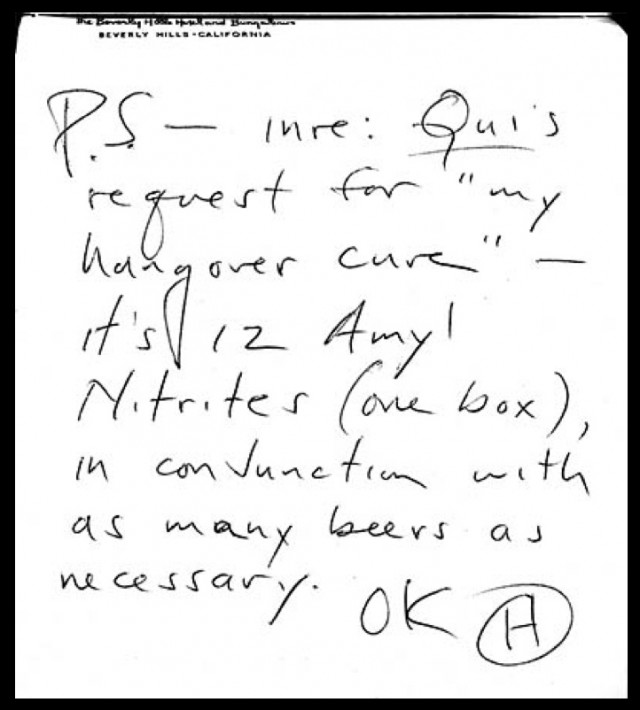
It’s safe to say that if you were to con­sult any­one about a hang­over fix, Thomp­son would be a good can­di­date for coun­sel. Luck­i­ly, the author left us with a guide. In 2011, Play­boy released a com­pendi­um of its 1960s and 1970s cor­re­spon­dences with Thomp­son. Most were dis­ap­point­ing­ly pro­sa­ic, but among the dross was a hur­ried­ly scrib­bled note on the top­ic of hang­over cures:

P.S. — inre: Oui’s request for “my hang­over cure” — it’s 12 amyl nitrites (one box), in con­junc­tion with as many beers as nec­es­sary.

OK H

If a hair of the dog approach doesn’t quite suit you, or if Thompson’s recipe exceeds your ini­tial con­sump­tion, I sug­gest a bot­tle of sports drink at the tail end of a big night to replen­ish elec­trolytes. Still, accord­ing YouTube’s SciShow, which does a fan­tas­tic job of elu­ci­dat­ing the chem­i­cal process­es behind all the headaches and room spins, there’s only one fool­proof method:

As a PSA to stave off angry com­ments, a spoil­er alert: SciShow’s rec­om­men­da­tion is on par with the absti­nence mod­el of birth con­trol: just don’t do it, and you’ll be fine.

Ilia Blin­d­er­man is a Mon­tre­al-based cul­ture and sci­ence writer. Fol­low him at @iliablinderman.

Relat­ed Con­tent:

Hunter S. Thomp­son Calls Tech Sup­port, Unleash­es a Tirade Full of Fear and Loathing (NSFW)

John­ny Depp Reads Let­ters from Hunter S. Thomp­son (NSFW)

Hunter S. Thomp­son Remem­bers Jim­my Carter’s Cap­ti­vat­ing Bob Dylan Speech (1974)

Albert Einstein Imposes on His First Wife a Cruel List of Marital Demands

Albert Ein­stein pas­sion­ate­ly wooed his first wife Mil­e­va Mar­ic, against his family’s wish­es, and the two had a tur­bu­lent but intel­lec­tu­al­ly rich rela­tion­ship that they record­ed for pos­ter­i­ty in their let­ters. Ein­stein and Maric’s love let­ters have inspired the short film above, My Lit­tle Witch (in Ser­bian, I believe, with Eng­lish sub­ti­tles) and sev­er­al crit­i­cal re-eval­u­a­tions of Einstein’s life and Mar­ic’s influ­ence on his ear­ly thought. Some his­to­ri­ans have even sug­gest­ed that Maric—who was also trained in physics—made con­tri­bu­tions to Einstein’s ear­ly work, a claim hot­ly dis­put­ed and, it seems, poor­ly sub­stan­ti­at­ed.

The letters—written between 1897 and 1903 and only dis­cov­ered in 1987—reveal a wealth of pre­vi­ous­ly unknown detail about Mar­ic and the mar­riage. While the con­tro­ver­sy over Mar­ic’s influ­ence on Ein­stein’s the­o­ries raged among aca­d­e­mics and view­ers of PBS’s con­tro­ver­sial doc­u­men­tary, Einstein’s Wife, a scan­dalous per­son­al item in the let­ters got much bet­ter press. As Ein­stein and Mileva’s rela­tion­ship dete­ri­o­rat­ed, and they attempt­ed to scotch tape it togeth­er for the sake of their chil­dren, the avun­cu­lar paci­fist wrote a chill­ing list of “con­di­tions,” in out­line form, that his wife must accept upon his return. Lists of Note tran­scribes them from Wal­ter Isaacson’s biog­ra­phy Ein­stein: His Life and Uni­verse:

CONDITIONS

A. You will make sure:

1. that my clothes and laun­dry are kept in good order;
2. that I will receive my three meals reg­u­lar­ly in my room;
3. that my bed­room and study are kept neat, and espe­cial­ly that my desk is left for my use only.

B. You will renounce all per­son­al rela­tions with me inso­far as they are not com­plete­ly nec­es­sary for social rea­sons. Specif­i­cal­ly, You will forego:

1. my sit­ting at home with you;
2. my going out or trav­el­ling with you.

C. You will obey the fol­low­ing points in your rela­tions with me:

1. you will not expect any inti­ma­cy from me, nor will you reproach me in any way;
2. you will stop talk­ing to me if I request it;
3. you will leave my bed­room or study imme­di­ate­ly with­out protest if I request it.

D. You will under­take not to belit­tle me in front of our chil­dren, either through words or behav­ior.

While it may be unfair to judge anyone’s total char­ac­ter by its most glar­ing defects, there’s no way to read this with­out shud­der­ing. Although Ein­stein tried to pre­serve the mar­riage, once they sep­a­rat­ed for good, he did not lament Mil­e­va’s loss for long. Man­jit Kumar tells us in Quan­tum: Ein­stein Bohr, and the Great Debate about the Nature of Real­i­ty that although “Mil­e­va agreed to his demands and Ein­stein returned”

[I]t could not last. At the end of July, after just three months in Berlin, Mil­e­va and the boys went back to Zurich. As he stood on the plat­form wav­ing good­bye, Ein­stein wept, if not for Mil­e­va and the mem­o­ries of what had been, then for his two depart­ing sons. But with­in a mat­ter of weeks he was hap­pi­ly enjoy­ing liv­ing alone “in my large apart­ment in undi­min­ished tran­quil­i­ty.”

Ein­stein prized his soli­tude great­ly. Anoth­er remark shows his dif­fi­cul­ty with per­son­al rela­tion­ships. While he even­tu­al­ly fell in love with his cousin Elsa and final­ly divorced Mav­ic to mar­ry her in 1919, that mar­riage too was trou­bled. Elsa died in 1936 soon after the cou­ple moved to the U.S. Not long after her death, Ein­stein would write, “I have got­ten used extreme­ly well to life here. I live like a bear in my den…. This bear­ish­ness has been fur­ther enhanced by the death of my woman com­rade, who was bet­ter with oth­er peo­ple than I am.”

Einstein’s per­son­al fail­ings might pass by with­out much com­ment if had not, like his hero Gand­hi, been ele­vat­ed to the sta­tus of a “sec­u­lar saint.” Yet, it is also the per­son­al incon­sis­ten­cies, the weak­ness­es and pet­ty, even incred­i­bly cal­lous moments, that make so many famous fig­ures’ lives com­pelling, if also con­fus­ing. As Ein­stein schol­ar John Stachel says, “Too much of an idol was made of Ein­stein. He’s not an idol—he’s a human, and that’s much more inter­est­ing.”

Relat­ed Con­tent:

Lis­ten as Albert Ein­stein Reads ‘The Com­mon Lan­guage of Sci­ence’ (1941)

The Musi­cal Mind of Albert Ein­stein: Great Physi­cist, Ama­teur Vio­lin­ist and Devo­tee of Mozart

Ein­stein Doc­u­men­tary Offers A Reveal­ing Por­trait of the Great 20th Cen­tu­ry Sci­en­tist

Albert Ein­stein Express­es His Admi­ra­tion for Mahat­ma Gand­hi, in Let­ter and Audio

Josh Jones is a writer and musi­cian based in Durham, NC. Fol­low him at @jdmagness

Akira Kurosawa to Ingmar Bergman: “A Human Is Not Really Capable of Creating Really Good Works Until He Reaches 80”

KurosawatoBergman

In July of 1988, Ing­mar Bergman—retired from film—turned 70. He had every rea­son to believe that his best work lay behind him. After all, he had won three Acad­e­my Awards (and the Irv­ing G. Thal­berg Memo­r­i­al Award), two BAF­TAs, sev­en Cannes prizes, six Gold­en Globes, and a host of oth­er hon­ors. His oeu­vre includ­ed such seem­ing­ly unsur­pass­able achieve­ments as Wild Straw­ber­ries, The Sev­enth Seal, Fan­ny and Alexan­der, and too many more to name, and that year he pub­lished his mem­oirs, The Mag­ic Lantern, in which he con­fessed “I prob­a­bly do mourn the fact that I no longer make films.”

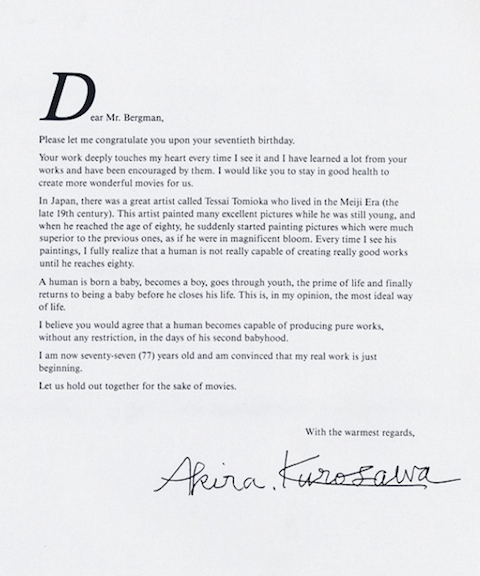
But no!, writes the Swedish director’s Japan­ese coun­ter­part, Aki­ra Kuro­sawa, the “real work is just begin­ning.” At least that’s how Kura­sawa, then 77, felt about his “sec­ond baby­hood.” Kuro­sawa wrote the let­ter above to Bergman on his birth­day, pro­fess­ing his deep admi­ra­tion. The feel­ing went both ways. The typ­i­cal­ly self-dep­re­cat­ing Bergman once called his The Vir­gin Spring a “a lousy imi­ta­tion of Kuro­sawa” and added, “at the time my admi­ra­tion for the Japan­ese cin­e­ma was at its height. I was almost a samuri myself!” Read the full tran­script of Kurosawa’s birth­day wish­es to Bergman below (orig­i­nal­ly pub­lished in Chap­lin mag­a­zine).

Dear Mr. Bergman,

Please let me con­grat­u­late you upon your sev­en­ti­eth birth­day.

Your work deeply touch­es my heart every time I see it and I have learned a lot from your works and have been encour­aged by them. I would like you to stay in good health to cre­ate more won­der­ful movies for us.

In Japan, there was a great artist called Tes­sai Tomio­ka who lived in the Mei­ji Era (the late 19th cen­tu­ry). This artist paint­ed many excel­lent pic­tures while he was still young, and when he reached the age of eighty, he sud­den­ly start­ed paint­ing pic­tures which were much supe­ri­or to the pre­vi­ous ones, as if he were in mag­nif­i­cent bloom. Every time I see his paint­ings, I ful­ly real­ize that a human is not real­ly capa­ble of cre­at­ing real­ly good works until he reach­es eighty.

A human is born a baby, becomes a boy, goes through youth, the prime of life and final­ly returns to being a baby before he clos­es his life. This is, in my opin­ion, the most ide­al way of life.

I believe you would agree that a human becomes capa­ble of pro­duc­ing pure works, with­out any restric­tions, in the days of his sec­ond baby­hood.

I am now sev­en­ty-sev­en (77) years old and am con­vinced that my real work is just begin­ning.

Let us hold out togeth­er for the sake of movies.

With the warmest regards,

Aki­ra Kuro­sawa

Via Cinephil­ia and Beyond

Relat­ed Con­tent:

Stan­ley Kubrick to Ing­mar Bergman: “You Are the Great­est Film­mak­er at Work Today” (1960)

Ing­mar Bergman Eval­u­ates His Fel­low Film­mak­ers — The “Affect­ed” Godard, “Infan­tile” Hitch­cock & Sub­lime Tarkovsky

Watch Kurosawa’s Rashomon Free Online, the Film That Intro­duced Japan­ese Cin­e­ma to the West

Dick Cavett’s Wide-Rang­ing TV Inter­view with Ing­mar Bergman and Lead Actress Bibi Ander­s­son (1971)

Josh Jones is a writer and musi­cian based in Durham, NC. Fol­low him at @jdmagness

« Go BackMore in this category... »
Quantcast