Heads up David Foster Wallace fans. Yesterday, A24 Films released a trailer for The End of the Tour, James Ponsoldt’s upcoming film which stars Jason Segel as David Foster Wallace, and Jesse Eisenberg as Rolling Stone journalist David Lipsky. The film is based on Lipsky’s 2010 memoir, Although of Course You End Up Becoming Yourself, which documents the five-day road trip Lipsky took with Wallace in 1996, just as Wallace was completing the book tour for his breakout novel Infinite Jest.
You might know Jason Segel from lighter and often hilarious comedy films like Forgetting Sarah Marshall and Knocked Up. When The End of the Tourhits theaters on July 31st, you’ll see him inhabiting a very different kind of role.
When you’re done watching the trailer above, you can see the real David Foster Wallace in a Big, Uncut Interview recorded in 2003. It makes for an interesting comparison.
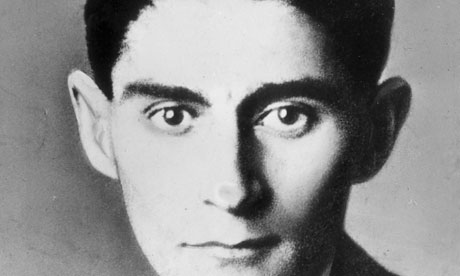
It’s easy to think of Franz Kafka as a celibate, even asexual, writer. There is the notable lack of eroticism of any recognizable sort in so much of his work. There is the prominent biographical detail—integral to so many interpretations—of his outsized fear of his father, which serves to infantilize him in a way. There is the image, writes Spiked, of “a lonely seer too saintly for this rank, sunken world.” All of this, James Hawes writes in his Excavating Kafka, “is pure spin.” Against such idolatry, both literary and quasi-religious, Hawes describes “the real Kafka,” including the fact that he was “far from an infrequent visitor to Prague’s brothels.” Though “tortured”—as his friend, biographer, and executor Max Brod put it—by guilt over his sexuality, Kafka nonetheless did not deny himself the frequent company of prostitutes and a collection of outré pornography.
But a part of the myth, Kafka’s extreme diffidence in romantic relationships with two women in his life—onetime fiancé Felice Bauer and Czech journalist Milena Jesenská—is not far off the mark. These relationships were indeed “tortured,” with Kafka “demanding commitment while doing his best to evade it.” His courtship with Felice was conducted almost entirely through letters, and his personal correspondence to both women, published in separate volumes by Schocken Books, “has all the earmarks of his fiction: the same nervous attention to minute particulars; the same paranoid awareness of shifting balances of power; the same atmosphere of emotional suffocation—combined, surprisingly enough, with moments of boyish ardor and delight.” So writes the New York Times’ Michiko Kakutani in her review of Letters to Felicein 1988.
A March 25, 1914 letter to Felice exemplifies these qualities, including Kafka’s tendency to “berate” his fiancé and to “backpedal” from the serious possibility of marriage. In answer to her seemingly unasked question of whether Bauer might find in him “the vital support you undoubtedly need,” Kafka writes,” there is nothing straightforward I can say to that”:
The exact information you want about me, dearest F., I cannot give you ; I can give it you, if at all, only when running along behind you in the Tiergarten, you always on the point of vanishing altogether, and I on the point of prostrating myself; only when thus humiliated, more deeply than any dog, am I able to do it. When you post that question now I can only say: I love you, F., to the limits of my strength, in this respect you can trust me entirely. But for the rest, F., I do not know myself completely. Surprises and disappointments about myself follow each other in endless succession.
The frustrated mystery, self-abasement, vague and fearful hints, and reference to dogs are all elements of the so oft-invoked Kafkaesque, though the frank proclamation of love is not. Not long after his 1917 diagnosis of tuberculosis, Kafka would break off the engagement. In 1920, he began his—also heavily scripted—affair with Jesenská, his side of which appears in the collected Letters to Milena. In these missives, the same set of personal and literary impulses alternate: tender expressions of devotion give way to dark and cryptic statements like “written kisses… are drunk on the way by the ghosts” and “I have spent all my life resisting the desire to end it.” One letter seems to have nothing at all to do with Milena and everything to do with Kafka’s project as a writer:
I am constantly trying to communicate something incommunicable, to explain something inexplicable, to tell about something I only feel in my bones and which can only be experienced in those bones. Basically it is nothing other than this fear we have so often talked about, but fear spread to everything, fear of the greatest as of the smallest, fear, paralyzing fear of pronouncing a word, although this fear may not only be fear but also a longing for something greater than all that is fearful.
Passages like these warrant the reduplication in Kakutani’s review title: “Kafka’s Kafkaesque Love Letters.” It is almost as if he used these letters as a testing ground for the tangled internal conflicts, doubts, and obsessions that would make their way into his fiction. Or that, in them, we see these Kafkaesque motifs distilled. It is during his engagement to Felice Bauer that Kafka produced “his most significant work, including The Metamorphoses,” and during his relationship with Milena Jesenská that my personal favorite, The Castle, took shape.
Although it has long been fashionable to resist the “biographical fallacy,” reading an author’s life into his or her work, the existence of hundreds of Kafka’s letters in publication makes this separation difficult. Elias Canetti described Kafka’s letters as a dialogue he was “conducting with himself,” one which “provide[s] an index of the emotional events that would inspire ‘The Trial’” and other works. Kafka’s unexpected bouts of romantic passion notwithstanding, these letters add a great deal of support to that critical assessment.
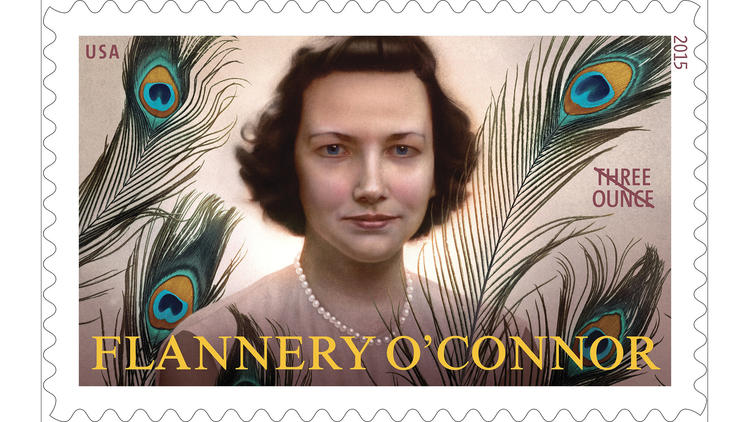
Since 1979, the US Postal Service has made a practice of issuing postage stamps honoring “skillful wordsmiths” who have “spun our favorite tales — and American history along with them.” Edgar Allan Poe, Richard Wright, Julia De Burgos, Mark Twain, O. Henry, and Ralph Ellison have all been fêted since 2009. And soon we can add the Southern Gothic writer Flannery O’Connor to the list. Her stamp will make its debut on June 5th. Until then, we’d encourage you to stream rare recordings of O’Connor reading her famous story, ‘A Good Man is Hard to Find’, and her witty essay, “Some Aspects of the Grotesque in Southern Fiction.” These are the only known recordings of O’Connor reading her work, and they provide a wonderful introduction to O’Connor’s literary talents.
“Where other transgressive figures of the past have mostly been tamed,” wrote Josh Jones in a post here last year, “[Georges] Bataille, I submit, is still quite dangerous.” You can get a sense of that in the documentary featured there, À perte de vue, which introduces the transgressive French intellectual’s life and thought, which from the 1920s to the 1960s produced books like The Solar Anus, The Hatred of Poetry, and The Tears of Eros, all part of a body of work that captivated the likes of Susan Sontag, Michel Foucault, and Jacques Derrida.
At the top of this post, you can enjoy another, straighter shot of Bataille through his 1958 appearance opposite interviewer Pierre Dumayet — the only television interview he ever did. The occasion: the publication of his book Literature and Evil, a title that, Bataille says, refers to “two opposite kinds of evil: the first one is related to the necessity of human activity going well and having the desired results, and the other consists of deliberately violating some fundamental taboos — like, for example, the taboo against murder, or against some sexual possibilities.”
Bataille’s fans expect from him a certain amount of taboo violation, though executed in a specific literary form — not just prose, but the distinctive sort of prose, whether spoken or written, brought to perfection by midcentury French intellectuals. In this ten-minute clip, Bataille elaborates on his conviction that we can’t separate literature from evil: if the former stays away from the latter, “it rapidly becomes boring.” He also gets into a discussion of Baudelaire, Kafka (“both of them knew they were on the side of evil”), Shakespeare, the importance of eroticism and childishness in literature, and the inherently anti-work nature of writing. However relevant you find Bataille’s ideas today, you have to give the man this: he never gets boring.
There’s no getting around it: Norman Rockwell was a square. There’s also no getting around the fact that his career helped define the way mainstream Americans saw themselves for decades. And while an artist like Rockwell—so steeped in nostalgia, so lacking in irony and a taste for transgression—might have faded into complete irrelevance amidst the tumult of the sixties, the opposite in fact occurred. Instead of pale, freckle-faced scamps and neighborly civil servants, Rockwell painted likenesses of world leaders like Nehru and Nasser, as well as a now iconic symbol of the Civil Rights struggle on a 1964 Look magazine cover.
The sixties Rockwell, though still very much a purveyor of small town Americana, became a somewhat weightier figure, even if he never gained (or sought) acceptance in the art world. But we might think of Rockwell as working on two registers throughout his career—as the PG-rated painter of mischievous, childish niceness, and the earnest commentator on mores and values in adult society. In a way, these two sides of America’s most popular illustrator mirror those of the nation’s most popular writer, Mark Twain. Though separated by a generation, the two, writes the Mark Twain House & Museum’s website, are “twinned in many ways in the public consciousness.”
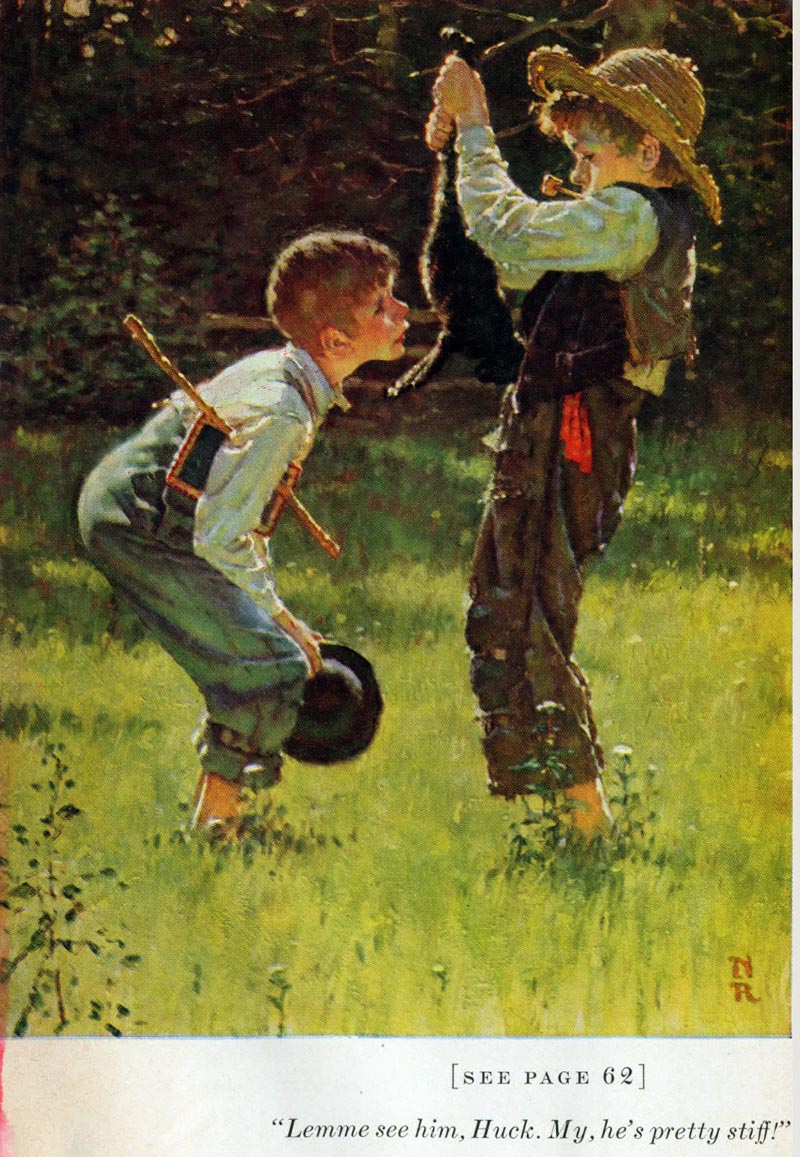
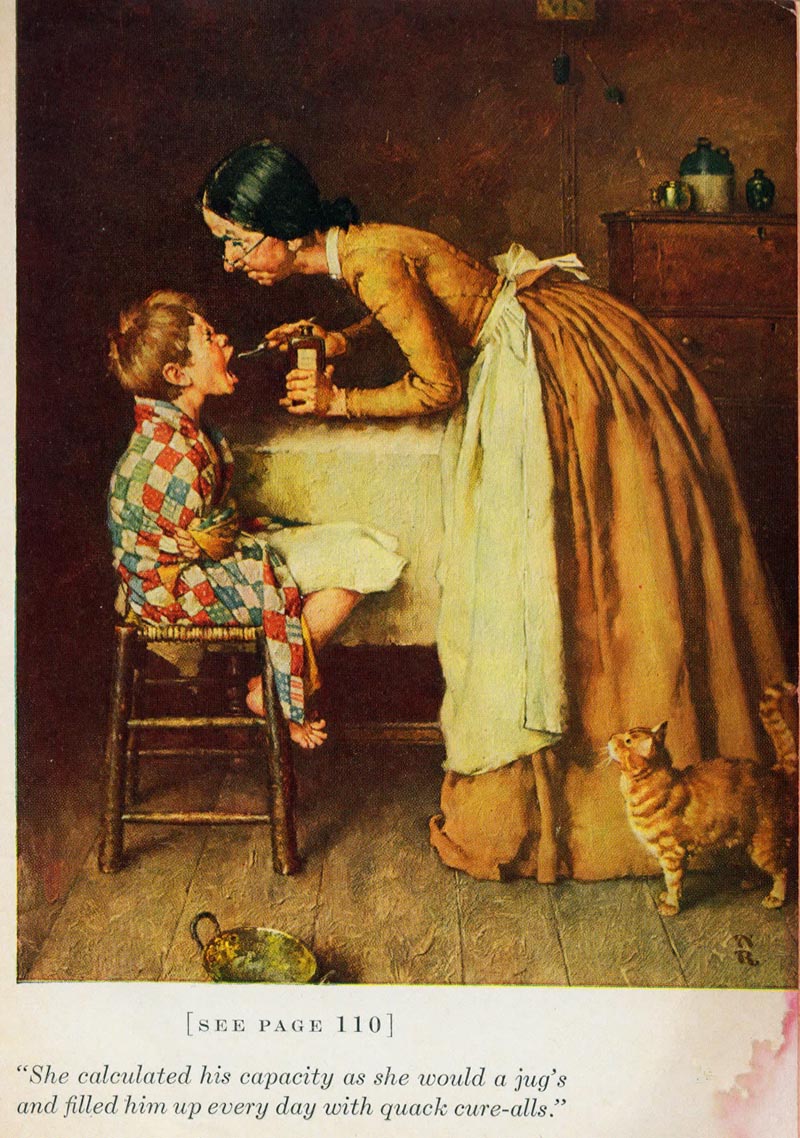
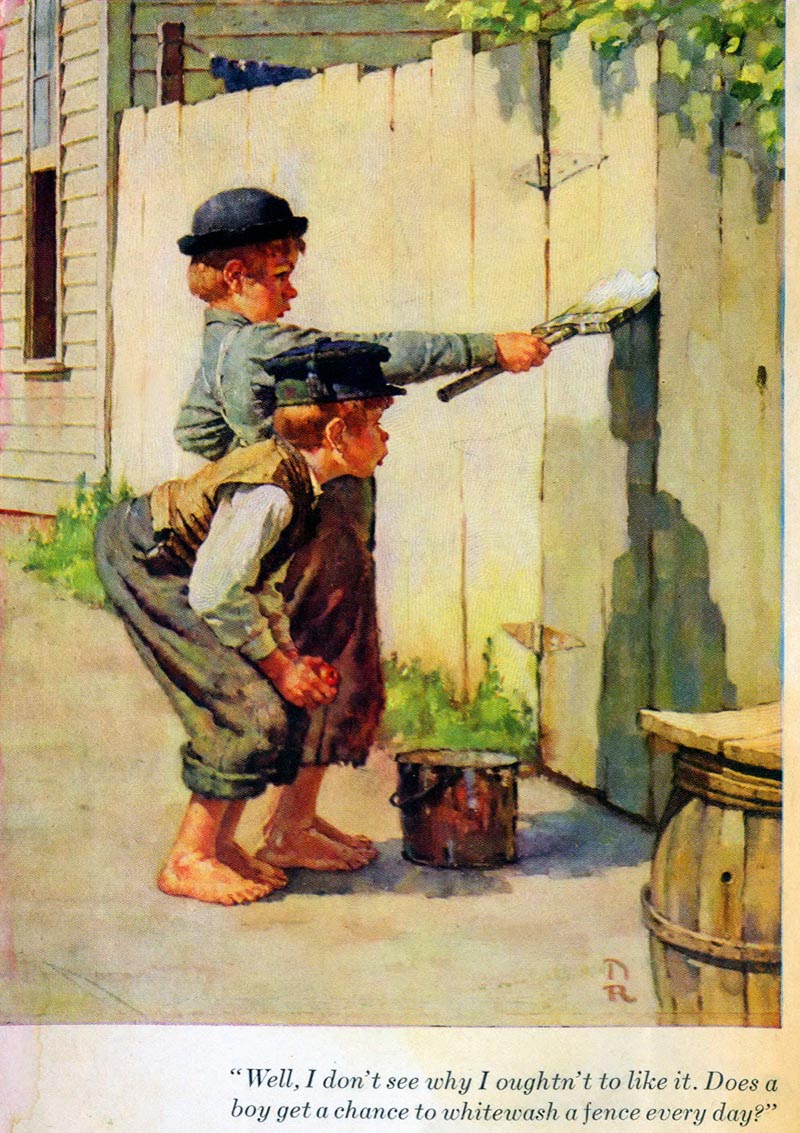
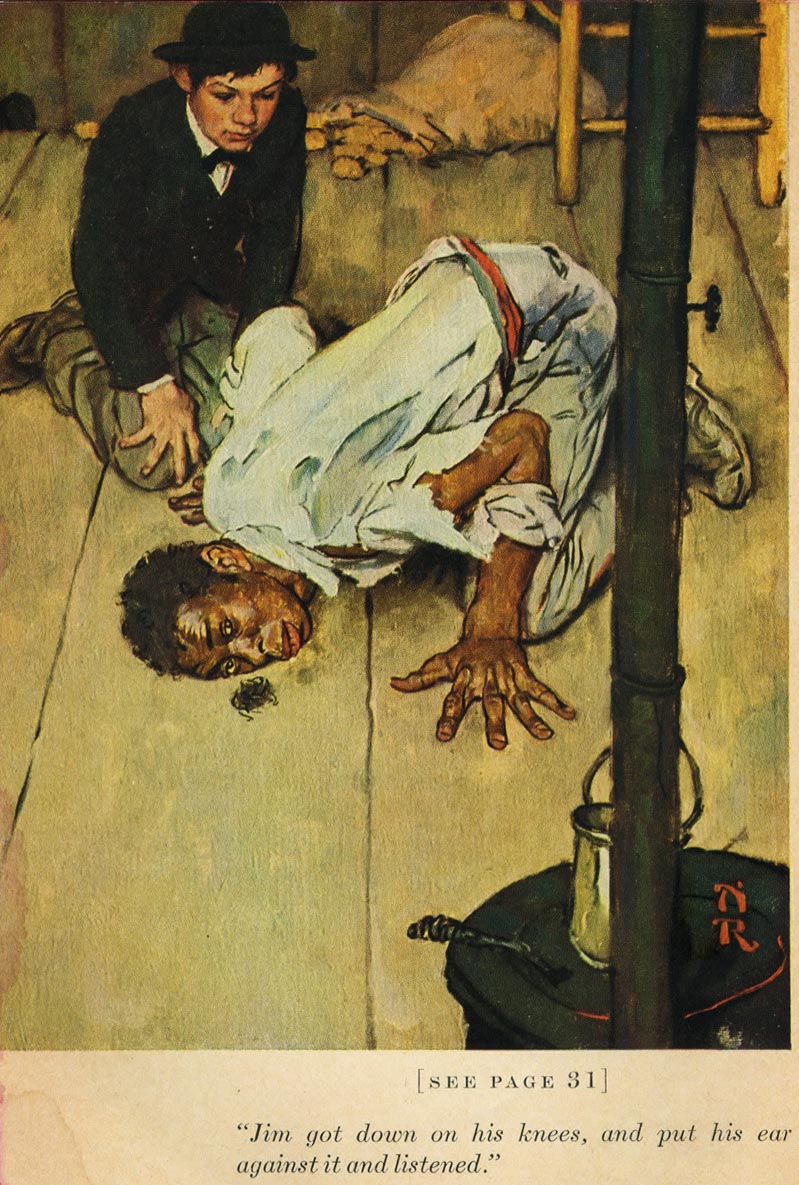
In part, this is because Rockwell illustrated for Heritage Press two of Twain’s most famous books, The Adventures of Tom Sawyer in 1936 and The Adventures of Huckleberry Finn in 1940. Above, see three of Rockwell’s illustrations from Tom Sawyer and, below, one from his Huck Finn. The differences between the two books (so hilariously contrasted by Louis CK), could stand for the two sides of both Twain and Rockwell. As the Mark Twain House puts it, “some critics have dismissed [Twain and Rockwell’s] work as lightweight, blithely ignoring the important statements they made on race.” Tom Sawyer is a lightweight book, the work of Twain the popular humorist. (Twain himself would say, “my books are water: those of the great geniuses are wine. Everybody drinks water.”) Huck Finn on the other hand is a serious adult novel with serious adult themes. For all of its flaws, it makes an admirable attempt to identify with and faithfully render the plight of enslaved people.
Twain’s great strength as a serious writer was his wealth of empathy, a quality Rockwell manifested as well. In fact, in order to best represent Twain’s books, the illustrator traveled to their setting, Hannibal, Missouri, where he “acquired a new respect for the characters,” writes the Norman Rockwell Museum. “The longer I worked at the task,” Rockwell wrote, “the more in love with the different personalities I became.” Illustration and design blog Today’s Inspiration points out that Rockwell purchased old clothes from the Hannibal locals to “soak up the atmosphere”: “Of all the illustrators (and there were quite a few) that illustrated these novels in the past, Rockwell was the first to visit Mark Twain’s home town. In typical Rockwell fashion, no amount of detail or research was ignored, faked or quickly glossed over.”
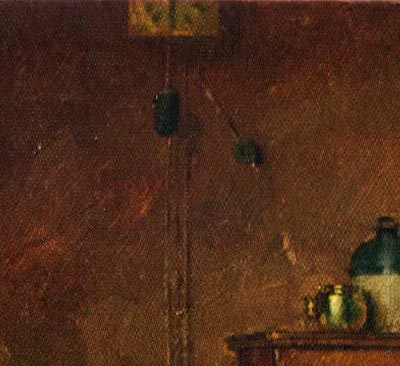
Today’s Inspirationzooms in on details from several of the Tom Sawyer paintings to show the fine, almost Vermeer-like attention Rockwell lavished on each illustration. The extensive examination of these early Rockwell classics makes a good case for the folksy illustrator as a “storytelling genius with pallet and brush.” Rockwell may be dismissed as a creator of kitsch, and in some cases the charge is justified, but—like Twain—even his lighter work depended on a fine attention to details of setting and characterization that make his work memorable and moving, in its corniest and its weightiest moments.
Yes. It’s a comedy about life’s tragedies, great and small.
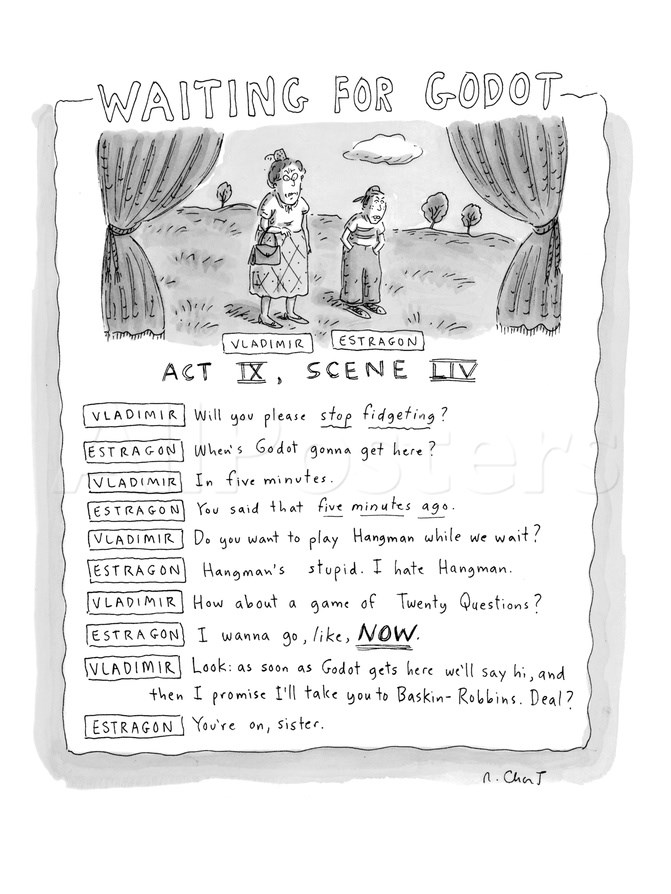
Are cartoons inspired by Waiting for Godot funny?
…mostly not. Especially when they’re set in waiting rooms (or airport arrivals areas).
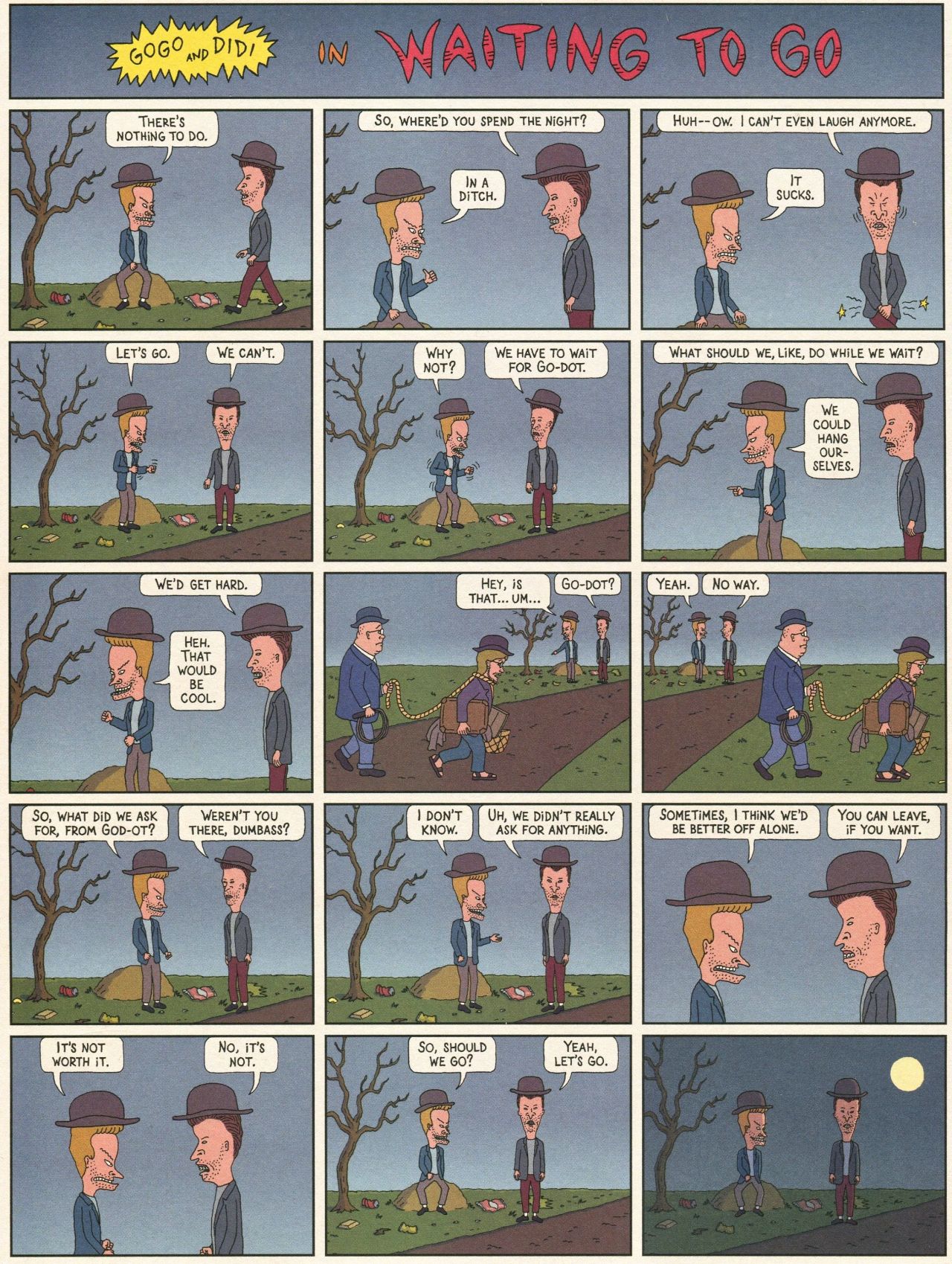
Godot’s a hard trope for a cartoonist on the prowl for something fresh. Dogs, psychiatrists, castaways on desert islands are more elastic subjects, universal, but capable of being spun any number of ways.
To wring a comic worthy ofTheNew Yorker out of Godot, you probably have to be an actual New Yorker cartoonist, like Roz Chast, whose instantly recognizable work can be seen above.
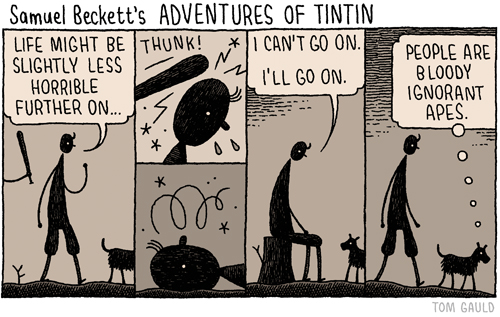
Not to imply that New Yorker cartoonists are the only source for inspired Godot-inspired comics– the late, great Hergé, creator of Tintin made one.
(Oh wait, that’s not Hergé, it’s Tom Gauld who illustrates the Guardian’s Saturday Review letters page, scoring major points by relocating the terminally upbeat boy detective so outside his comfort zone that even Snowy is a negative image.)
Cartoonist Richard Thompson summoned Godot for a strip within a strip installment of his popular syndicated Cul de Sac. (Click the image above to view it in a larger format.) Will readers get the reference? Alice, his preschool-aged heroine, seems to, astutely echoing critic Vivian Mercier’s assessment of Godot as a play where “nothing happens…twice”.
Man’s nature, man’s dignity, is that he acts, lives, loves, and finally destroys himself seeking to penetrate the mystery of existence, and unless we partake in some way, as some part of this human exploration… then we are no more than the pimps of society and the betrayers of our Self.
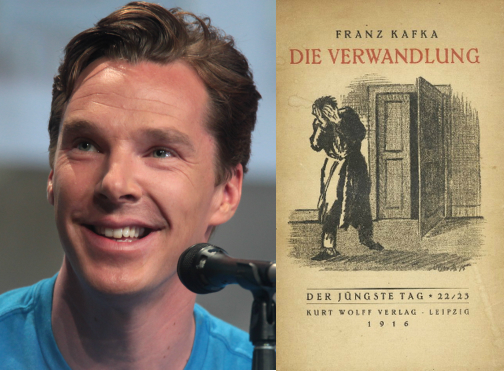
If, on the 100th anniversary of its publication, you want to do a radio broadcast of a novella famously appreciated for its surface weirdness and more rarely appreciated for its sharp sense of humor, it only stands to reason that you’d hire a famous reader with famously appreciated surface oddness and more rarely appreciated sharp sense of humor of his own. I can only assume BBC Radio 4 followed a similar line of thinking when, to record Franz Kafka’s The Metamorphosis (find the text in our collection of Free eBooks), they brought in Sherlock and The Imitation Game star Benedict Cumberbatch.
They’ll air the reading in four parts. The first and second episodes, in which luckless salesman Gregor Samsa inexplicably wakes up as an insect and faces the wrath and fear of his family, have already come available online for your listening pleasure; the next two episodes, when the insectified Samsa grows accustomed to his new form only to come into mortal conflict with his father and the newly dire financial straits of his household, will appear over the next two weeks on the production’s episode guide.
And if the idea of this mundane and monstrous tale told in the voice of Benedict Cumberbatch appeals to you, don’t delay. The BBC’s site will only let you stream it until June 10th (though currently you can find it online here.)
If you still have doubts, see also “Why Benedict Cumberbatch Is the Perfect Actor to Read Kafka’s Metamorphosis” by Slate’s Rebecca Schuman. “Cumberbatch’s trademark style is a withering, perfectly enunciated deadpan whose inflections somehow betray, three-fourths of the way through any sentence, sincere doubts that everyone will be in on the joke,” she writes. “Even better, this is poker face the way Kafka wrote it: tinged with at least some amount of creepiness, thanks to Cumberbatch’s unique ability to both look and sound like a very genteel sociopath.”
For less Cumberbatch-inclined Kafka enthusiasts, we also have this free audiobook of The Metamorphosis, which should remain available indefinitely. It’s recorded by Librivox.
If you would like to support the mission of Open Culture, consider making a donation to our site. It’s hard to rely 100% on ads, and your contributions will help us continue providing the best free cultural and educational materials to learners everywhere. You can contribute through PayPal, Patreon, and Venmo (@openculture). Thanks!
Sometimes it can seem as though the more we think we know a historical figure, the less we actually do. Helen Keller? We’ve all seen (or think we’ve seen) some version of The Miracle Worker, right?—even if we haven’t actually read Keller’s autobiography. And Mark Twain? He can seem like an old family friend. But I find people are often surprised to learn that Keller was a radical socialist firebrand, in sympathy with workers’ movements worldwide. In a short article in praise of Lenin, for example, Keller once wrote, “I cry out against people who uphold the empire of gold…. I am perfectly sure that love will bring everything right in the end, but I cannot help sympathizing with the oppressed who feel driven to use force to gain the rights that belong to them.”
Twain took a more pessimistic, ironic approach, yet he thoroughly opposed religious dogma, slavery, and imperialism. “I am always on the side of the revolutionists,” he wrote, “because there never was a revolution unless there were some oppressive and intolerable conditions against which to revolute.” While a great many people grow more conservative with age, Twain and Keller both grew more radical, which in part accounts for another little-known fact about these two nineteenth century American celebrities: they formed a very close and lasting friendship that, at least in Keller’s case, may have been one of the most important relationships in either figure’s life.
Twain’s importance to Keller, and hers to him, begins in 1895, when the two met at a lunch held for Keller in New York. According to the Mark Twain Library’s extensive documentary exhibit, Keller “seemed to feel more at ease with Twain than with any of the other guests.” She would later write, “He treated me not as a freak, but as a handicapped woman seeking a way to circumvent extraordinary difficulties.”Twain was taken as well, surprised by “her quickness and intelligence.” After the meeting, he wrote to his benefactor Henry H. Rogers, asking Rogers to fund Keller’s education. Rogers, the Mark Twain Library tells us, “personally took charge of Helen Keller’s fortunes, and out of his own means made it possible for her to continue her education and to achieve for herself the enduring fame which Mark Twain had foreseen.”
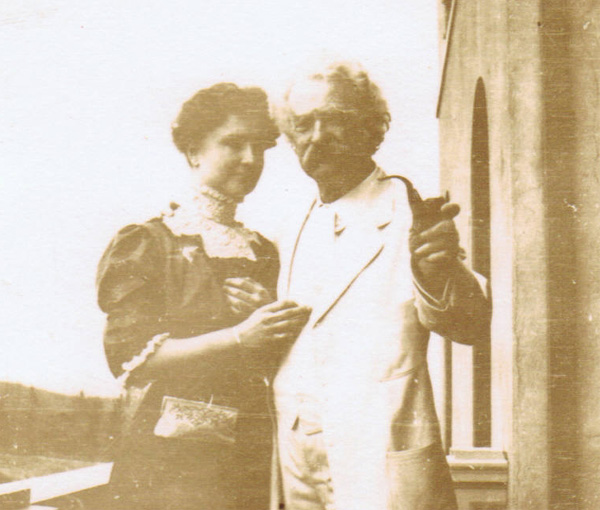
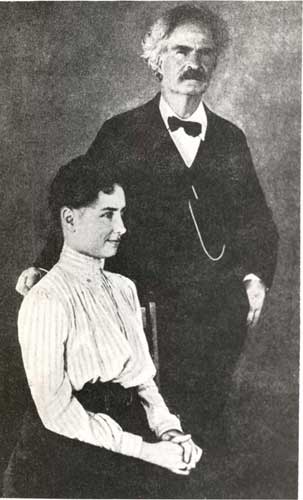
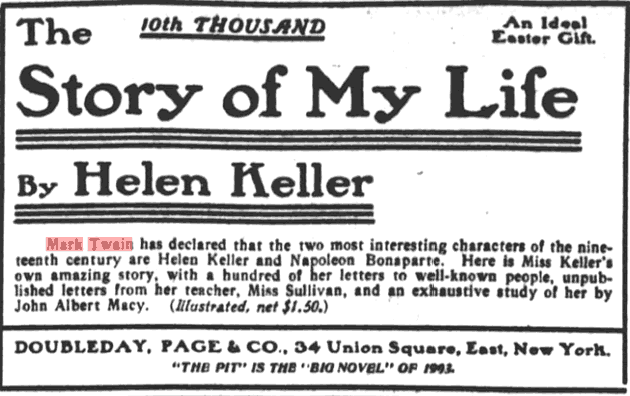
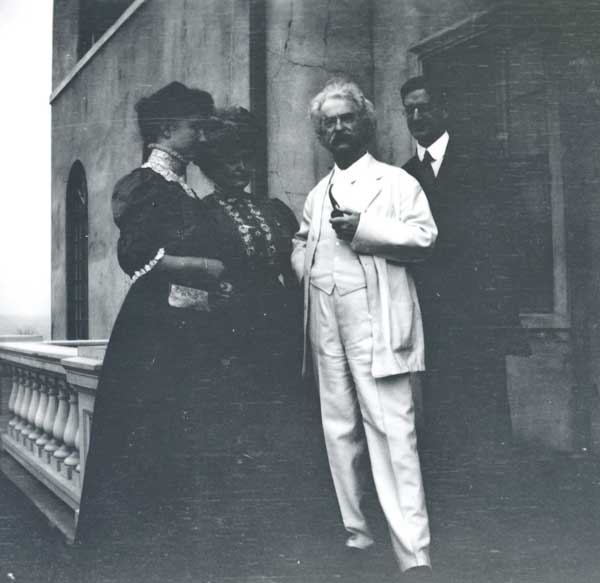
Twain wrote to his wealthy friend, “It won’t do for America to allow this marvelous child to retire from her studies because of poverty. If she can go on with them she will make a fame that will endure in history for centuries.” Thereafter, the two would maintain a “special friendship,” sustained not only by their political sentiments, but also by a love of animals, travel, and other personal similarities. Both writers came to live in Fairfield County, Connecticut at the end of their lives, and she visited him at his Redding home, Stormfield, in 1909, the year before his death (see them there at the top of the post, and more photos here). Twain was especially impressed by Keller’s autobiography, writing to her, “I am charmed with your book—enchanted.” (See his endorsement in a 1903 advertisement, below.)
Twain also came to Keller’s defense, ten years later, after reading in her book about a plagiarism scandal that occurred in 1892 when, at only twelve years old, she was accused of lifting her short story “The Frost King” from Margaret Canby’s “Frost Fairies.” Though a tribunal acquitted Keller of the charges, the incident still piqued Twain, who called it “unspeakably funny and owlishly idiotic and grotesque” in a 1903 letter in which he also declared: “The kernel, the soul—let us go further and say the substance, the bulk, the actual and valuable material of all human utterance—is plagiarism.” What differs from work to work, he contends is “the phrasing of a story”; Keller’s accusers, he writes protectively, were “solemn donkeys breaking a little child’s heart.” (The exquisitely-worded letter is well worth reading in full at Letters of Note).
We also have Twain—not playwright William Gibson—to thank for the “miracle worker” title given to Keller’s teacher, Anne Sullivan. (See Keller, Sullivan, Twain, and Sullivan’s husband John Macy above at Twain’s home). As a tribute to Sullivan for her tireless work with Keller, he presented her with a postcard that read, “To Mrs. John Sullivan Macy with warm regard & with limitless admiration of the wonders she has performed as a ‘miracle-worker.’” In his 1903 letter to Keller, he called Sullivan “your other half… for it took the pair of you to make complete and perfect whole.”
Twain praised Sullivan effusively for “her brilliancy, penetration, originality, wisdom, character, and the fine literary competencies of her pen.” But he reserved his highest praise for Keller herself. “You are a wonderful creature,” he wrote, “The most wonderful in the world.” Keller’s praise of her friend Twain was no less lofty. “I have been in Eden three days and I saw a King,” she wrote in his guestbook during her visit to Stormfield, “I knew he was a King the minute I touched him though I had never touched a King before.” The last words in Twain’s autobiography, the first volume anyway—which he only allowed to be published in 2010—are Keller’s; “You once told me you were a pessimist, Mr. Clemons,” he quotes her as saying, “but great men are usually mistaken about themselves. You are an optimist.”
We're hoping to rely on loyal readers, rather than erratic ads. Please click the Donate button and support Open Culture. You can use Paypal, Venmo, Patreon, even Crypto! We thank you!
Open Culture scours the web for the best educational media. We find the free courses and audio books you need, the language lessons & educational videos you want, and plenty of enlightenment in between.