Isaac Newton Theorized That the Egyptian Pyramids Revealed the Timing of the Apocalypse: See His Burnt Manuscript from the 1680s

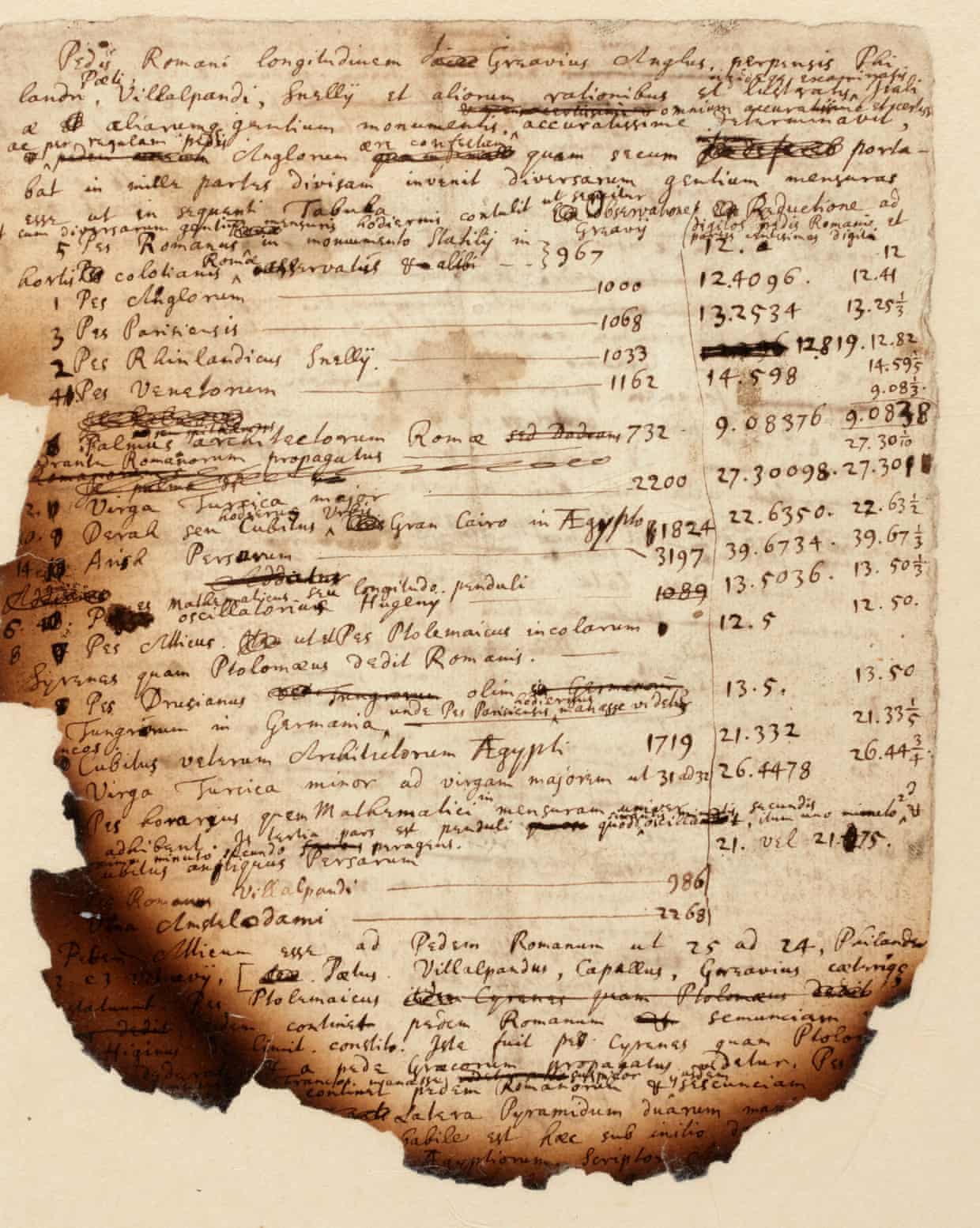
Today one can behold the pyra­mids of Giza and feel the temp­ta­tion to believe that the ancient Egyp­tians knew some­thing we mod­erns did­n’t. Just imag­ine, then, what it must have felt like in the 17th cen­tu­ry, when the recov­ery of lost ancient knowl­edge was still very much an active enter­prise. Back then, no less for­mi­da­ble a mind than Sir Isaac New­ton sus­pect­ed that to under­stand the pyra­mids would be to under­stand much else besides, from the nature of grav­i­ty — a sub­ject on which he would become some­thing of an author­i­ty — to Bib­li­cal prophe­cy. The key he reck­oned, lay in an ancient Egypt­ian unit of mea­sure­ment called the roy­al cubit.

“Estab­lish­ing the pre­cise length of the Egypt­ian cubit would allow him to recon­struct in turn oth­er ancient mea­sures, cru­cial­ly the sacred cubit of the Hebrews, and so be able to recon­struct with pre­ci­sion a build­ing that was, to New­ton, of much greater import even than the Great Pyra­mid: the Tem­ple of Solomon,” says Sothe­by’s.

There, a few pages of New­ton’s notes on the sub­ject (burnt at the edges, which leg­end has it hap­pened when his dog knocked over a can­dle) recent­ly sold for £378,000, but you can still view them online. Giv­en that Ezekiel describes the Tem­ple of Solomon as the set­ting of the Apoc­a­lypse — the end of the world being anoth­er sub­ject of New­ton­ian inter­est“an exact knowl­edge of the Tem­ple’s archi­tec­ture and dimen­sions was there­fore need­ed to cor­rect­ly inter­pret the Bible’s deep and hid­den mean­ings.” It would also reveal the even­tu­al tim­ing of the the Apoc­a­lypse.

New­ton’s belief that “the ancient Egyp­tians pos­sessed knowl­edge that had been lost in the inter­ven­ing cen­turies,” as Smithsonian.com’s Livia Ger­shon puts it, did not set him far apart from main­stream Euro­pean schol­ar­ship at the time. He also thought, Ger­shon writes, “that the ancient Greeks had suc­cess­ful­ly mea­sured Earth’s cir­cum­fer­ence using a unit called the stade, which he believed was bor­rowed from the Egyp­tians. By trans­lat­ing the ancient mea­sure­ment, New­ton hoped to val­i­date his own the­o­ry of grav­i­ty,” as he ulti­mate­ly did, though not, per­haps, in the man­ner he first expect­ed to. We must, it seems, con­sid­er the pyra­mids, along­side the Philoso­pher’s stone, the South Sea Com­pa­ny, and toad-vom­it plague cures, as anoth­er exam­ple of the great genius’ occa­sion­al­ly exces­sive enthu­si­asms — albeit an unusu­al­ly pow­er­ful one.

Relat­ed Con­tent:

Neil deGrasse Tyson on the Stag­ger­ing Genius of Isaac New­ton

Isaac New­ton Con­ceived of His Most Ground­break­ing Ideas Dur­ing the Great Plague of 1665

In 1704, Isaac New­ton Pre­dicts the World Will End in 2060

Isaac Newton’s Recipe for the Myth­i­cal ‘Philosopher’s Stone’ Is Being Dig­i­tized & Put Online (Along with His Oth­er Alche­my Man­u­scripts)

How the Egypt­ian Pyra­mids Were Built: A New The­o­ry in 3D Ani­ma­tion

Based in Seoul, Col­in Mar­shall writes and broad­casts on cities, lan­guage, and cul­ture. His projects include the Sub­stack newslet­ter Books on Cities, the book The State­less City: a Walk through 21st-Cen­tu­ry Los Ange­les and the video series The City in Cin­e­ma. Fol­low him on Twit­ter at @colinmarshall, on Face­book, or on Insta­gram.

A Quay Brothers Animation Explains Anamorphosis, the Renaissance Illusion That Hides Pictures within Pictures

First appear­ances can be deceiv­ing.

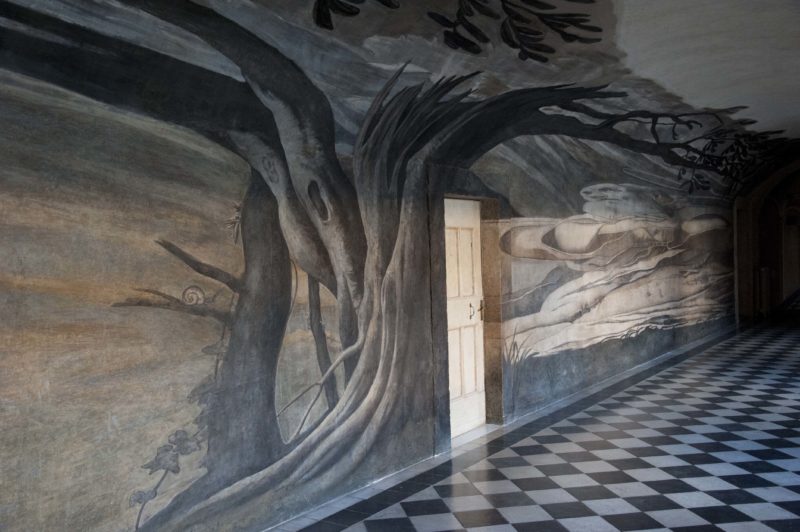
Take physi­cist Emmanuel Maig­nan’s 1642 fres­co in a cor­ri­dor of Rome’s Trinità dei Mon­ti monastery.

Viewed head on, it appears to be a some­what uncon­ven­tion­al land­scape in which one of the few remain­ing branch­es of a muti­lat­ed tree spreads over a city, far in the dis­tance. Streaky clouds sug­gest heavy weath­er is brew­ing.

Stroll to the end of the cor­ri­dor and take anoth­er look. You’ll find that the tree has con­tract­ed, and the clouds have recon­fig­ured them­selves into a por­trait of Saint Francesco of Pao­la, pray­ing beneath its boughs.

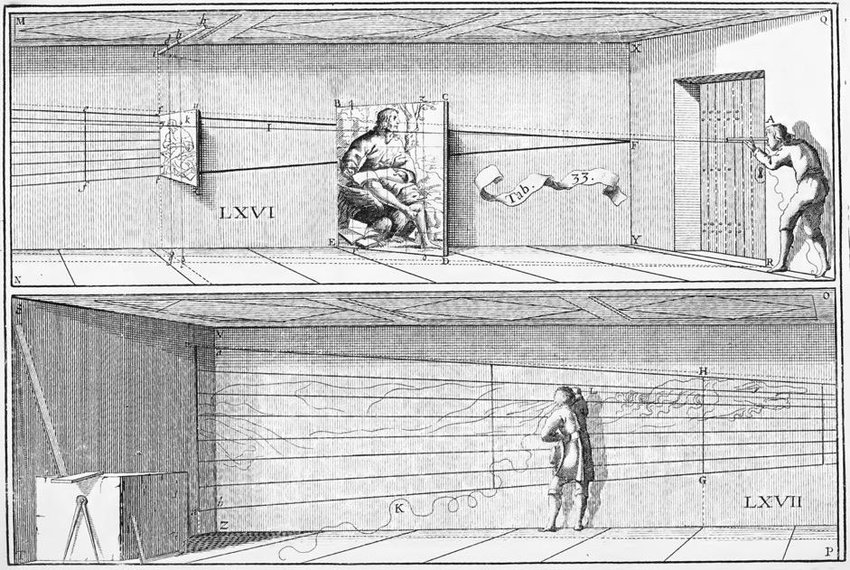
It’s a prime exam­ple of oblique anamor­pho­sis, an image that has been delib­er­ate­ly dis­tort­ed by an artist well versed in per­spec­tive, with the end result that the image’s true nature will only be revealed to those view­ing the work from an uncon­ven­tion­al point.

The Quay Broth­ers’ doc­u­men­tary short, above, a col­lab­o­ra­tion with art his­to­ri­an Roger Car­di­nal, uses a com­bi­na­tion of their delight­ful­ly creepy sig­na­ture pup­pet stop motion, as well as ani­mat­ed 3‑D cut outs, to lift the cur­tains on how the human eye can be manip­u­lat­ed, using prin­ci­ples of per­spec­tive.

Anamor­pho­sis may not seem like such a feat in an age when a num­ber of soft­ware pro­grams can pro­vide a major assist, but why would Renais­sance artists put them­selves to so much extra trou­ble?

The Quay Broth­ers delve into this too.

Per­haps the artist was inject­ing a bit of social crit­i­cism, like Hans Hol­bein the Younger, whose 1533 por­trait, The Ambas­sadors, includes a secret anamor­phic skull. This could be tak­en as a jab at the excess­es of the wealthy young diplo­mats who pro­vide the painting’s sub­ject, except that the one who com­mis­sioned the work, Jean de Din­teville, prized the mot­to “Memen­to mori.

Maybe he know­ing­ly ordered up the naked death’s head to go along with his ermine and bling, an exam­ple of hav­ing one’s cake and eat­ing it too, and yet anoth­er dizzy­ing head trip for those view­ing the paint­ing from the intend­ed angle.

(Betcha didn’t have to work too hard to guess the skull’s loca­tion, though…)

Or an artist might choose to employ anamor­pho­sis as a brown paper wrap­per of sorts, as in the case of Erhard Schön’s erot­ic wood­block prints.

Else­where, the goal was to empha­size patience, reflec­tion, and cleav­ing to a pious path by reward­ing those who craned their necks toward a spir­i­tu­al peep­hole with an appro­pri­ate­ly reli­gious view.

(Pity the poor pil­grim who stepped up expect­ing Erhard Schön…)

For a 21st-cen­tu­ry take on anamor­phic art, have a look at the work of the graf­fi­ti col­lec­tive TRULY | Urban Artists here.

The Quay Broth­ers’ short film, “De Arti­fi­ciali Per­spec­ti­va, or Anamor­pho­sis,” has been made avail­able on The Met Muse­um’s YouTube chan­nel.

via Aeon

Relat­ed Con­tent: 

Opti­cal Poems by Oskar Fischinger, the Avant-Garde Ani­ma­tor Despised by Hitler, Dissed by Dis­ney

Watch Mar­cel Duchamp’s Hyp­not­ic Rotore­liefs: Spin­ning Discs Cre­at­ing Opti­cal Illu­sions on a Turntable (1935)

The Anatom­i­cal Draw­ings of Renais­sance Man, Leonar­do da Vin­ci

Ayun Hal­l­i­day is an author, illus­tra­tor, the­ater mak­er and Chief Pri­ma­tol­o­gist of the East Vil­lage Inky zine.  Fol­low her @AyunHalliday.

J. Robert Oppenheimer Explains How He Recited a Line from Bhagavad Gita–“Now I Am Become Death, the Destroyer of Worlds”–Upon Witnessing the First Nuclear Explosion

No mat­ter how lit­tle we know of the Hin­du reli­gion, a line from one of its holy scrip­tures lives with­in us all: “Now I am become Death, the destroy­er of worlds.” This is one facet of the lega­cy of J. Robert Oppen­heimer, an Amer­i­can the­o­ret­i­cal physi­cist who left an out­sized mark on his­to­ry. For his cru­cial role in the Man­hat­tan Project that dur­ing World War II pro­duced the first nuclear weapons, he’s now remem­bered as the“father of the atom­ic bomb.” He secured that title on July 16, 1945, the day of the test in the New Mex­i­can desert that proved these exper­i­men­tal weapons actu­al­ly work — that is, they could wreak a kind of destruc­tion pre­vi­ous­ly only seen in visions of the end of the world.

“We knew the world would not be the same,” Oppen­heimer remem­bered in 1965. “A few peo­ple laughed, a few peo­ple cried. Most peo­ple were silent. I remem­bered the line from the Hin­du scrip­ture, the Bha­gavad Gita; Vish­nu is try­ing to per­suade the Prince that he should do his duty and, to impress him, takes on his mul­ti-armed form and says, ‘Now I am become Death, the destroy­er of worlds.’ ” The trans­la­tion’s gram­mat­i­cal archaism made it even more pow­er­ful, res­onat­ing with lines in Ten­nyson (“I am become a name, for always roam­ing with a hun­gry heart”), Shake­speare (“I am come to know your plea­sure”), and the Bible (“I am come a light into the world, that whoso­ev­er believeth on me should not abide in dark­ness”).

But what is death, as the Gita sees it? In an inter­view with Wired, San­skrit schol­ar Stephen Thomp­son explains that, in the orig­i­nal, the word that Oppen­heimer speaks as “death” refers to “lit­er­al­ly the world-destroy­ing time.” This means that “irre­spec­tive of what Arju­na does” — Arju­na being the afore­men­tioned prince, the nar­ra­tive’s pro­tag­o­nist — every­thing is in the hands of the divine.” Oppen­heimer would have learned all this while teach­ing in the 1930s at Berke­ley, where he learned San­skrit and read the Gita in the orig­i­nal. This cre­at­ed in him, said his col­league Isidor Rabi, “a feel­ing of mys­tery of the uni­verse that sur­round­ed him like a fog.”

The neces­si­ty of the Unit­ed States’ sub­se­quent drop­ping of not one but two atom­ic bombs on Japan, exam­ined in the 1965 doc­u­men­tary The Deci­sion to Drop the Bomb, remains a mat­ter of debate. Oppen­heimer went on to oppose nuclear weapons, describ­ing him­self to an appalled Pres­i­dent Har­ry Tru­man as hav­ing “blood on my hands.” But in devel­op­ing them, could he have sim­ply seen him­self as a mod­ern Prince Arju­na? “It has been argued by schol­ars,” writes the Eco­nom­ic Times’ Mayank Chhaya, “that Oppen­heimer’s approach to the atom­ic bomb was that of doing his duty as part of his dhar­ma as pre­scribed in the Gita.” He knew, to quote anoth­er line from that scrip­ture brought to mind by the nuclear explo­sion, that “if the radi­ance of a thou­sand suns were to burst into the sky that would be like the splen­dor of the Mighty One” — and per­haps also that splen­dor and wrath may be one.

Relat­ed Con­tent:

Intro­duc­tion to Indi­an Phi­los­o­phy: A Free Online Course

Oppen­heimer: The Man Behind the Bomb

Haunt­ing Unedit­ed Footage of the Bomb­ing of Nagasa­ki (1945)

The “Shad­ow” of a Hiroshi­ma Vic­tim, Etched into Stone Steps, Is All That Remains After 1945 Atom­ic Blast

63 Haunt­ing Videos of U.S. Nuclear Tests Now Declas­si­fied and Put Online

53 Years of Nuclear Test­ing in 14 Min­utes: A Time Lapse Film by Japan­ese Artist Isao Hashimo­to

Based in Seoul, Col­in Mar­shall writes and broad­casts on cities, lan­guage, and cul­ture. His projects include the book The State­less City: a Walk through 21st-Cen­tu­ry Los Ange­les and the video series The City in Cin­e­ma. Fol­low him on Twit­ter at @colinmarshall, on Face­book, or on Insta­gram.

One of the Oldest Buddhist Manuscripts Has Been Digitized & Put Online: Explore the Gandhara Scroll

Bud­dhism goes way back — so far back, in fact, that we’re still exam­in­ing impor­tant evi­dence of just how far back it goes. Take the exhib­it above, which may look like noth­ing more than a col­lec­tion of fad­ed scraps with writ­ing on them. In fact, they’re pieces of the labo­ri­ous­ly and care­ful­ly unrolled and scanned Gand­hara Scroll, which, hav­ing orig­i­nal­ly been writ­ten about two mil­len­nia ago, ranks as one of the old­est Bud­dhist man­u­scripts cur­rent­ly known. You can read the scrol­l’s sto­ry at the blog of the Library of Con­gress, the insti­tu­tion that pos­sess­es it and only last year was able to put it online for all to see.

“The scroll orig­i­nat­ed in Gand­hara, an ancient Bud­dhist kind­gom locat­ed in what is today the north­ern bor­der areas of Afghanistan and Pak­istan,” writes the Library’s Neely Tuck­er. “Sur­viv­ing man­u­scripts from the Gand­ha­ran realm are rare; only a few hun­dred are known to still exist.” That realm “was under the rule of numer­ous kings and dynas­ties, includ­ing Alexan­der the Great, the Mau­ryan emper­or Ashoka and the Kushan emper­or Kan­ish­ka I,” and for a time “became a major seat of Bud­dhist art, archi­tec­ture and learn­ing. One of the region’s most notable char­ac­ter­is­tics is the Hel­lenis­tic style of its Bud­dhist sculp­tures, includ­ing fig­ures of the Bud­dha with wavy hair, defined facial fea­tures, and con­toured robes rem­i­nis­cent of Gre­co-Roman deities.”

Writ­ten in the Gand­hari vari­ant of San­skrit, the “Bahubud­dha Sutra” or “Many Bud­dhas Sutra,” as this scroll has been called, con­sti­tutes part of “the much larg­er Mahavas­tu, or ‘Great Sto­ry,’ a biog­ra­phy of the Bud­dha and his past lives.” Here Tuck­er draws from the schol­ar­ship of Richard G. Salomon, emer­i­tus pro­fes­sor of San­skrit and Bud­dhist stud­ies at the Uni­ver­si­ty of Wash­ing­ton, anoth­er insti­tu­tion that holds a piece of the Gand­ha­ran Bud­dhist texts. Many more reside at the British Library, which acquired them in 1994. The Library of Con­gress bought its Gand­hara Scroll from a British deal­er more recent­ly, in 2003, and it arrived in what Tuck­er describes as “an ordi­nary pen case, accom­pa­nied by a hand­writ­ten note: ‘Extreme­ly frag­ile, do not open unless nec­es­sary.’ ”

So began “sev­er­al years of thought and plan­ning to devise a treat­ment strat­e­gy,” an effort that at one point saw the Library’s con­ser­va­tor prac­tic­ing “her unrolling tech­nique on a dried-up cig­ar — an item that only approx­i­mates the dif­fi­cul­ty of work­ing with a com­pact­ed birch bark scroll.” Then came “grad­ual humid­i­fi­ca­tion over a few days, care­ful unrolling by hand with pre­ci­sion tools on a sheet of inert glass, fol­lowed by plac­ing anoth­er sheet of glass on top once the scroll was com­plete­ly unrolled,” a “dra­mat­ic and silent affair” described in greater detail by Atlas Obscu­ra’s Sab­ri­na Imbler.

The result was six large frag­ments and more than 100 small­er ones, togeth­er con­sti­tut­ing rough­ly 80 per­cent of the scrol­l’s orig­i­nal text. You can see all those frag­ments of the Gand­hara Scroll, scanned in high res­o­lu­tion, at the Library of Con­gress’ web site. This will nat­u­ral­ly be a more edi­fy­ing expe­ri­ence if, like Salomon, you hap­pen to be able to read Gand­hari. Even if you can’t, there’s some­thing to be felt in the expe­ri­ence of sim­ply behold­ing a 2,000 year old text com­posed on birch bark through the dig­i­tal medi­um on which we do most of our read­ing here in the 21st cen­tu­ry — where inter­est in Bud­dhism shows no signs of wan­ing.

Relat­ed Con­tent:

Breath­tak­ing­ly-Detailed Tibetan Book Print­ed 40 Years Before the Guten­berg Bible

The World’s Largest Col­lec­tion of Tibetan Bud­dhist Lit­er­a­ture Now Online

2,000-Year-Old Man­u­script of the Ten Com­mand­ments Gets Dig­i­tized: See/Download “Nash Papyrus” in High Res­o­lu­tion

Google Dig­i­tizes Ancient Copies of the Ten Com­mand­ments and Gen­e­sis

Google Puts The Dead Sea Scrolls Online (in Super High Res­o­lu­tion)

Archae­ol­o­gists Think They’ve Dis­cov­ered the Old­est Greek Copy of Homer’s Odyssey: 13 Vers­es on a Clay Tablet

Based in Seoul, Col­in Mar­shall writes and broad­casts on cities, lan­guage, and cul­ture. His projects include the book The State­less City: a Walk through 21st-Cen­tu­ry Los Ange­les and the video series The City in Cin­e­ma. Fol­low him on Twit­ter at @colinmarshall, on Face­book, or on Insta­gram.

When Astronomer Johannes Kepler Wrote the First Work of Science Fiction, The Dream (1609)

The point at which we date the birth of any genre is apt to shift depend­ing on how we define it. When did sci­ence fic­tion begin? Many cite ear­ly mas­ters of the form like Jules Verne and H.G. Wells as its prog­en­i­tors. Oth­ers reach back to Mary Shelley’s 1818 Franken­stein as the gen­e­sis of the form. Some few know The Blaz­ing World, a 1666 work of fic­tion by Mar­garet Cavendish, Duchess of New­cas­tle, who called her book a “her­maph­ro­dit­ic text.” Accord­ing to the judg­ment of such experts as Isaac Asi­mov and Carl Sagan, sci-fi began even ear­li­er, with a nov­el called Som­ni­um (“The Dream”), writ­ten by none oth­er than Ger­man astronomer and math­e­mati­cian Johannes Kepler. Maria Popo­va explains at Brain Pick­ings:

In 1609, Johannes Kepler fin­ished the first work of gen­uine sci­ence fic­tion — that is, imag­i­na­tive sto­ry­telling in which sen­si­cal sci­ence is a major plot device. Som­ni­um, or The Dream, is the fic­tion­al account of a young astronomer who voy­ages to the Moon. Rich in both sci­en­tif­ic inge­nu­ity and sym­bol­ic play, it is at once a mas­ter­work of the lit­er­ary imag­i­na­tion and an invalu­able sci­en­tif­ic doc­u­ment, all the more impres­sive for the fact that it was writ­ten before Galileo point­ed the first spy­glass at the sky and before Kepler him­self had ever looked through a tele­scope.

The work was not pub­lished until 1634, four years after Kepler’s death, by his son Lud­wig, though “it had been Kepler’s intent to per­son­al­ly super­vise the pub­li­ca­tion of his man­u­script,” writes Gale E. Chris­tian­son. His final, posthu­mous work began as a dis­ser­ta­tion in 1593 that addressed the ques­tion Coper­ni­cus asked years ear­li­er: “How would the phe­nom­e­na occur­ring in the heav­ens appear to an observ­er sta­tioned on the moon?” Kepler had first come “under the thrall of the helio­cen­tric mod­el,” Popo­va writes, “as a stu­dent at the Luther­an Uni­ver­si­ty of Tübin­gen half a cen­tu­ry after Coper­ni­cus pub­lished his the­o­ry.”

Kepler’s the­sis was “prompt­ly vetoed” by his pro­fes­sors, but he con­tin­ued to work on the ideas, and cor­re­spond­ed with Galileo 30 years before the Ital­ian astronomer defend­ed his own helio­cen­tric the­o­ry. “Six­teen years lat­er and far from Tübin­gen, he com­plet­ed an expand­ed ver­sion,” says Andrew Boyd in the intro­duc­tion to a radio pro­gram about the book. “Recast in a dream­like frame­work, Kepler felt free to probe ideas about the moon that he oth­er­wise couldn’t.” Not con­tent with cold abstrac­tion, Kepler imag­ined space trav­el, of a kind, and peo­pled his moon with aliens.

And what an imag­i­na­tion! Inhab­i­tants weren’t mere recre­ations of ter­res­tri­al life, but entire­ly new forms of life adapt­ed to lunar extremes. Large. Tough-skinned. They evoked visions of dinosaurs. Some used boats, imply­ing not just life but intel­li­gent, non-human life. Imag­ine how shock­ing that must have been at the time.

Even more shock­ing to author­i­ties were the means Kepler used in his text to reveal knowl­edge about the heav­ens and trav­el to the moon: beings he called “dae­mons” (a Latin word for benign nature spir­its before Chris­tian­i­ty hijacked the term), who com­mu­ni­cat­ed first with the hero’s moth­er, a witch prac­ticed in cast­ing spells.

The sim­i­lar­i­ties between Kepler’s pro­tag­o­nist, Dura­co­tus, and Kepler him­self (such as a peri­od of study under Dan­ish astronomer Tycho Bra­he) led the church to sus­pect the book was thin­ly veiled auto­bi­o­graph­i­cal occultism. Rumors cir­cu­lat­ed, and Kepler’s moth­er was arrest­ed for witch­craft and sub­ject­ed to ter­ri­tio ver­balis (detailed descrip­tions of the tor­tures that await­ed her, along with pre­sen­ta­tions of the var­i­ous devices).  It took Kepler five years to free her and pre­vent her exe­cu­tion.

Kepler’s sto­ry is trag­ic in many ways, for the loss­es he suf­fered through­out his life, includ­ing his son and his first wife to small­pox. But his per­se­ver­ance left behind one of the most fas­ci­nat­ing works of ear­ly sci­ence fiction—published hun­dreds of years before the genre is sup­posed to have begun. Despite the fan­tas­ti­cal nature of his work, “he real­ly believed,” says Sagan in the short clip from Cos­mos above, “that one day human beings would launch celes­tial ships with sails adapt­ed to the breezes of heav­en, filled with explor­ers who, he said, would not fear the vast­ness of space.”

Astron­o­my had lit­tle con­nec­tion with the mate­r­i­al world in the ear­ly 17th cen­tu­ry. “With Kepler came the idea that a phys­i­cal force moves the plan­ets in their orbits,” as well as an imag­i­na­tive way to explore sci­en­tif­ic ideas no one would be able to ver­i­fy for decades, or even cen­turies. Hear Som­ni­um read at the top of the post and learn more about Kepler’s fas­ci­nat­ing life and achieve­ments at Brain Pick­ings.

Relat­ed Con­tent:

Mary Shelley’s Hand­writ­ten Man­u­script of Franken­stein: This Is “Ground Zero of Sci­ence Fic­tion,” Says William Gib­son

Stream 47 Hours of Clas­sic Sci-Fi Nov­els & Sto­ries: Asi­mov, Wells, Orwell, Verne, Love­craft & More

The Ency­clo­pe­dia of Sci­ence Fic­tion: 17,500 Entries on All Things Sci-Fi Are Now Free Online

Free Sci­ence Fic­tion Clas­sics Avail­able on the Web (Updat­ed)

Josh Jones is a writer and musi­cian based in Durham, NC. Fol­low him at @jdmagness

A Beatboxing Buddhist Monk Creates Music for Meditation

Most of us assume Japan­ese Bud­dhist monks to be silent types. In their per­son­al lives they may well be, but if they want to go viral, they’ve got to log onto the inter­net and make some noise. This is the les­son one draws from some of the Bud­dhist fig­ures pre­vi­ous­ly fea­tured here on Open Cul­ture: Kos­san, he of the Bea­t­les and Ramones cov­ers, or Gyōsen Asaku­ra, the priest who per­forms psy­che­del­ic ser­vices sound­tracked with elec­tron­ic dance music. Depend­ing on your taste in music, their per­for­mances may or may not induce the men­tal qui­et one asso­ciates with Bud­dhist prac­tice, and the music of Yoget­su Akasa­ka, the lat­est Japan­ese Bud­dhist monk to attain inter­net fame, may at first sound equal­ly untra­di­tion­al. But lis­ten and you may well find your­self in a med­i­ta­tive state with­out even try­ing.

“The 37-year-old went viral in May, after post­ing his ‘Heart Sutra Live Loop­ing Remix,’ a video that’s relax­ing like ASMR, and engross­ing like a DJ set,” writes Vice’s Miran Miyano. “With the loop machine, he lay­ers sounds and chants all com­ing from one instru­ment — his voice.” A musi­cian since his teens and a beat­box­er since his ear­ly twen­ties, the Tokyo-based Akasa­ka became a monk five years ago, fol­low­ing the path tak­en by his father, an abbott at a tem­ple in rur­al Iwate Pre­fec­ture.

“Before he was ordained in 2015, he belonged to a the­atre com­pa­ny formed in Fukushi­ma pre­fec­ture, north­east Japan, after the region was dev­as­tat­ed by the 2011 Tohoku earth­quake and tsuna­mi,” writes Richard Lord in the South Chi­na Morn­ing Post. “He has also been a full-time busker in coun­tries includ­ing the Unit­ed States and Aus­tralia.”

A busker Akasa­ka remains, in a sense, albeit one who, from the cor­ner of YouTube he’s made his own, can be heard across the globe. In addi­tion to record­ings like his hit ver­sion of the Heart Sutra, he’s also been live stream­ing per­for­mances for the past two months. Last­ing up to near­ly two hours, these streams pro­vide Akasa­ka an oppor­tu­ni­ty to vary his musi­cal as well as spir­i­tu­al themes, bring dif­fer­ent instru­ments into the mix, and respond to fans who send him mes­sages from all over the world, most­ly out­side his home­land. “I think in Japan, peo­ple often asso­ciate Bud­dhism with funer­als, and the sutra has a lit­tle bit of a neg­a­tive and sad image,” he says to Vice. Indeed, as the say­ing goes, the mod­ern Japan­ese is born Shin­to, mar­ries Chris­t­ian, and dies Bud­dhist. But as Akasa­ka shows us, his tra­di­tion has some­thing to offer all of us, no mat­ter our nation­al­i­ty, in life as well.

via Metafil­ter

Relat­ed Con­tent:

Japan­ese Bud­dhist Monk Cov­ers Ramones’ “Teenage Lobot­o­my,” “Queen’s “We Will Rock You,” Bea­t­les’ “Yel­low Sub­ma­rine” & More

Bud­dhist Monk Cov­ers Judas Priest’s “Break­ing the Law,” Then Breaks Into Med­i­ta­tion

Japan­ese Priest Tries to Revive Bud­dhism by Bring­ing Tech­no Music into the Tem­ple: Attend a Psy­che­del­ic 23-Minute Ser­vice

Beat­box­ing Bach’s Gold­berg Vari­a­tions

What Beat­box­ing and Opera Singing Look Like Inside an MRI Machine

Based in Seoul, Col­in Mar­shall writes and broad­casts on cities, lan­guage, and cul­ture. His projects include the book The State­less City: a Walk through 21st-Cen­tu­ry Los Ange­les and the video series The City in Cin­e­ma. Fol­low him on Twit­ter at @colinmarshall, on Face­book, or on Insta­gram.

An Introduction to Thought Forms, the Pioneering 1905 Theosophist Book That Inspired Abstract Art: It Has Returned to Print

“It is some­times dif­fi­cult to appre­ci­ate the impact that the late-nine­teenth cen­tu­ry (and ongo­ing) occult move­ment called Theos­o­phy had on glob­al cul­ture,” Mitch Horowitz writes in his intro­duc­tion to the new­ly repub­lished 1905 Theo­soph­i­cal book, Thought Forms. That impact man­i­fest­ed “spir­i­tu­al­ly, polit­i­cal­ly, and artis­ti­cal­ly” in the work of lit­er­ary fig­ures like James Joyce and William But­ler Yeats and reli­gious fig­ures like Jid­du Krish­na­mur­ti, hand­picked as a teenag­er by Theosophist leader Charles W. Lead­beat­er to become the group’s mes­sian­ic World Teacher.

The Theo­soph­i­cal Soci­ety helped re-intro­duce Bud­dhism, or a new­ly West­ern­ized ver­sion, to West­ern Europe and the U.S., pub­lish­ing the 1881 “Bud­dhist Cat­e­chism” by Hen­ry Steel Olcott, a for­mer Colonel for the Union Army. Olcott co-found­ed the soci­ety in New York City in 1875 with Russ­ian occultist Hele­na Blavatsky. Soon after­ward, the group of spir­i­tu­al seek­ers relo­cat­ed to India. “Near­ly a cen­tu­ry before the Bea­t­les’ trek to Rishikesh,” writes Hor­witz, “Blavatsky and Olcott laid the tem­plate for the West­ern­er seek­ing wis­dom in the East.”

Theos­o­phy also had a sig­nif­i­cant influ­ence on mod­ern art, includ­ing the work of Wass­i­ly Kandin­sky, until recent­ly con­sid­ered the first Abstract painter—that is until the paint­ings of Hilma af Klint came to be wide­ly known. The reclu­sive Swedish artist, whom we’ve cov­ered here a few times before, came first, though no one knew it at the time. After show­ing her rev­o­lu­tion­ary abstract work to philoso­pher and one­time Ger­man and Aus­tri­an Theo­soph­i­cal Soci­ety leader Rudolf Stein­er, she was told to hide it for anoth­er fifty years.

Theos­o­phy gained many promi­nent con­verts in the UK, Europe, and around the world. Af Klint joined the Swedish soci­ety and remained a mem­ber until 1915. The sym­bol­ism in her mys­te­ri­ous abstrac­tions, which she attrib­uted to clair­voy­ant com­mu­ni­ca­tion with “an enti­ty named Amaliel,” may also have been sug­gest­ed by the draw­ings in Thought Forms, an illus­trat­ed book cre­at­ed by Theo­soph­i­cal Soci­ety lead­ers Lead­beat­er and Annie Besant, who was “an ear­ly suf­frag­ist and polit­i­cal activist,” notes Sacred Bones Books. The small press will release a new edi­tion of the book online and in stores on Novem­ber 6. (See their Kick­starter page here and video trail­er below.)

Besant was “far ahead of her time as an artist and thinker. Theos­o­phy was the first occult group to open its doors to women and Thought Forms offers a reminder that the his­to­ry of mod­ernist abstrac­tion and women’s con­tri­bu­tion to it is still being writ­ten.” Although that unfold­ing his­to­ry cen­tral­ly includes af Klint and Besant, the lat­ter did not actu­al­ly make all of the illus­tra­tions we find in this strange book. She and Lead­beat­er claimed to have received, through clair­voy­ant means, “forms caused by def­i­nite thoughts thrown out by one of them, and also watched the forms pro­ject­ed by oth­er per­sons under the influ­ence of var­i­ous emo­tions.”

So Besant would write in 1896 in the Theo­soph­i­cal jour­nal Lucifer. After these “exper­i­ments,” the two then described going into trances and view­ing “auras, vor­tices, ether­ic mat­ter, astral pro­jec­tions, ener­gy forms, and oth­er expres­sions from the unseen world.” The two described these visions to a col­lec­tion of visu­al artists, who ren­dered them into the paint­ings in the 1905 book.

Among those who do study the Theo­soph­i­cal Society’s impact, its first gen­er­a­tion of publications—especially Olcott’s “Bud­dhist Cat­e­chism” and Blavatsky’s 1888 The Secret Doc­trine—are espe­cial­ly well-known texts. But Thought Forms may prove “the most wide­ly read, last­ing, and direct­ly influ­en­tial book to emerge from the rev­o­lu­tion that Theos­o­phy ignit­ed,” Horowitz argues.

“By many esti­mates, Thought Forms marks the ger­mi­na­tion of abstract art”—originated through sev­er­al artists’ best guess at what visions of psy­chic phe­nom­e­na might look like. You can fol­low Sacred Bones’ Kick­starter cam­paign here.

Relat­ed Con­tent:  

A Vision­ary 115-Year-Old Col­or The­o­ry Man­u­al Returns to Print: Emi­ly Noyes Vanderpoel’s Col­or Prob­lems

Dis­cov­er Hilma af Klint: Pio­neer­ing Mys­ti­cal Painter and Per­haps the First Abstract Artist

New Hilma af Klint Doc­u­men­tary Explores the Life & Art of the Trail­blaz­ing Abstract Artist

Josh Jones is a writer and musi­cian based in Durham, NC. Fol­low him at @jdmagness

Breathtakingly-Detailed Tibetan Book Printed 40 Years Before the Gutenberg Bible

The Guten­berg Bible went to press in the year 1454. We now see it as the first piece of mass media, print­ed as it was with the then-cut­ting-edge tech­nol­o­gy of met­al mov­able type. But in the his­to­ry of aes­thet­ic achieve­ments in book-print­ing, the Guten­berg Bible was­n’t with­out its prece­dents. To find tru­ly impres­sive exam­ples requires look­ing in lands far from Europe: take, for instance, this “Sino-Tibetan con­certi­na-fold­ed book, print­ed in Bei­jing in 1410, con­tain­ing San­skrit dhāranīs and illus­tra­tions of pro­tec­tive mantra-dia­grams and deities, wood­block-print­ed in bright red ink on heavy white paper,” whose “breath­tak­ing­ly detailed print­ing” pre­dates Guten­berg by 40 years.

That descrip­tion comes from a Twit­ter user called Incunab­u­la (a term refer­ring to ear­ly books), a self-described bib­lio­phile and rare book col­lec­tor who posts about “the his­to­ry of writ­ing, and of the book, from cave paint­ing to cuneiform tablet to papyrus scroll to medieval codex to Kin­dle.”

Incunab­u­la’s six-tweet thread on this ear­ly 15th-cen­tu­ry Sino-Tibetan book includes both pic­tures and descrip­tions of this remark­able arti­fac­t’s inte­ri­or and exte­ri­or.

Its text, writ­ten in the Tibetan and Nepalese Rañ­janā script, “is print­ed twice, once on each side of the paper, so that the book may be read in the Indo-Tibetan man­ner by turn­ing the pages from right to left or in Chi­nese style by turn­ing from left to right.” The book’s con­tent is “a sequence of Tibetan Bud­dhist recita­tion texts,” or chants, all “pro­tect­ed at front and back by thick­er board-like wrap­pers,” each “cov­ered in fine pen-draw­ings in gold paint on black of 20 icons of the Tathā­gatas.”

Incunab­u­la has also post­ed exten­sive­ly about Bud­dhist texts from oth­er times and lands: a Thai fold­ing man­u­script from the mid-19th cen­tu­ry telling of a monk’s jour­neys to heav­en and hell; a Mon­go­lian man­u­script from the same peri­od that trans­lates the Čoy­i­jod Dagi­ni, “a pop­u­lar Bud­dhist text about virtue, sin and the after­life”; an exam­ple of “Japan­ese Bud­dhist print­ing 150 years before Guten­berg”; an “8th cen­tu­ry Khotanese amulet­ic scroll from the Silk Road.” The cre­ators of these texts would have meant the words they were pre­serv­ing to sur­vive them — but our mar­veling at them hun­dreds, even more than a thou­sand years lat­er, would sure­ly have come as a sur­prise.

Relat­ed Con­tent:

The Old­est Book Print­ed with Mov­able Type is Not The Guten­berg Bible: Jikji, a Col­lec­tion of Kore­an Bud­dhist Teach­ings, Pre­dat­ed It By 78 Years and It’s Now Dig­i­tized Online

The World’s Old­est Mul­ti­col­or Book, a 1633 Chi­nese Cal­lig­ra­phy & Paint­ing Man­u­al, Now Dig­i­tized and Put Online

The World’s Largest Col­lec­tion of Tibetan Bud­dhist Lit­er­a­ture Now Online

Free Online Course: Robert Thurman’s Intro­duc­tion to Tibetan Bud­dhism (Record­ed at Colum­bia U)

Tibetan Musi­cal Nota­tion Is Beau­ti­ful

Oxford Uni­ver­si­ty Presents the 550-Year-Old Guten­berg Bible in Spec­tac­u­lar, High-Res Detail

Based in Seoul, Col­in Mar­shall writes and broad­casts on cities, lan­guage, and cul­ture. His projects include the book The State­less City: a Walk through 21st-Cen­tu­ry Los Ange­les and the video series The City in Cin­e­ma. Fol­low him on Twit­ter at @colinmarshall, on Face­book, or on Insta­gram.

« Go BackMore in this category... »
Quantcast