British Advertisers Predict in 1935 What the World Will Look Like in 2500: Wireless TV, Atomic Cars & More

greys-1

Back before the pub­lic came to terms with the grim causal rela­tion­ship between cig­a­rettes and can­cer, smok­ing was a jol­ly affair, whose plea­sures extend­ed well beyond the phys­i­cal act.

Smok­ing was socia­ble. Yes, there were cer­tain sit­u­a­tions in which three on a match could spell doom, but a far greater like­li­hood that light­ing an attrac­tive stranger’s cof­fin nail might kin­dle con­ver­sa­tion, and more.

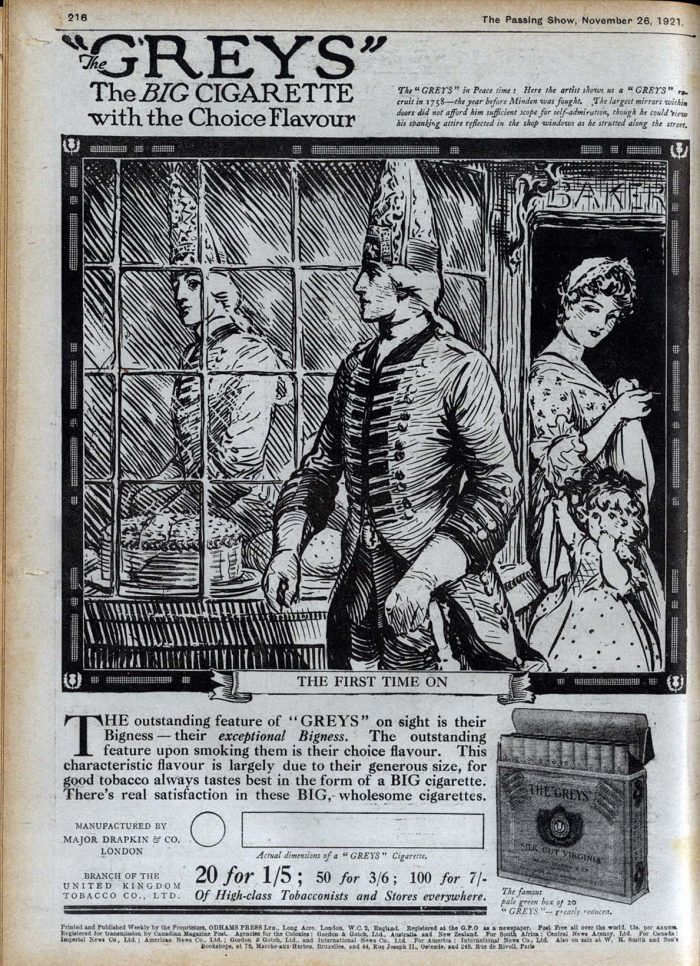
If you were at a loss for words, you might break the ice with the trad­ing cards man­u­fac­tur­ers slipped inside cig­a­rette packs, such as these mid-30s beau­ties that came inside packs of Greys, a now-defunct British cig­a­rette brand, and favorite of WWI vets.

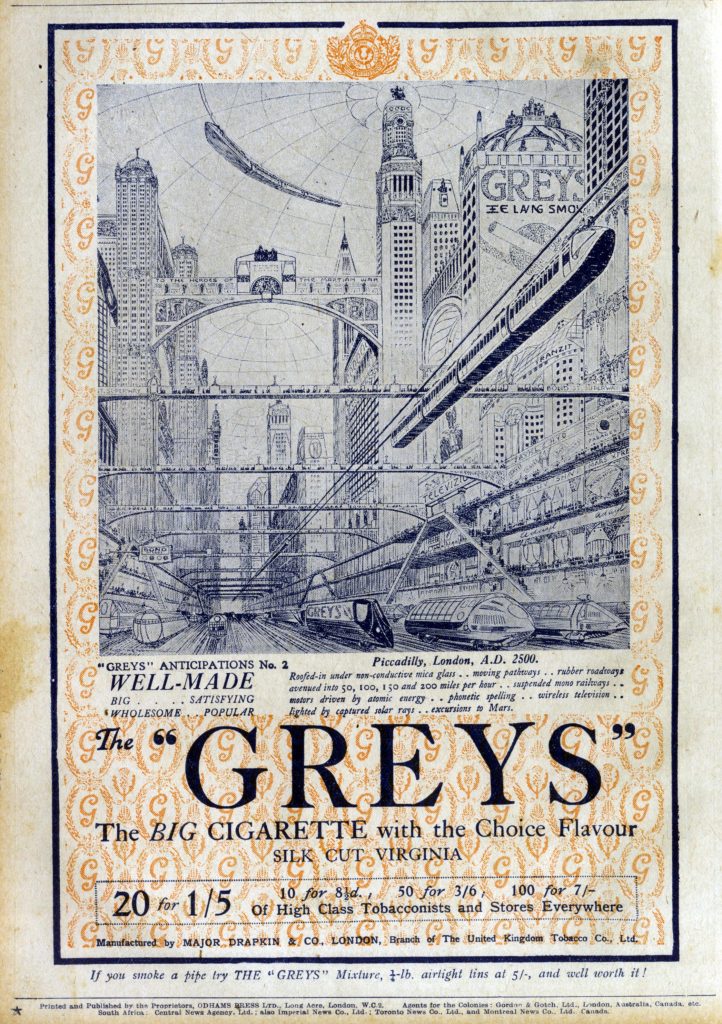
The sub­ject is unusu­al. Sports, cin­e­ma stars, and mil­i­tary scenes were com­mon themes of the time. The “Greys Antic­i­pa­tions” series took cre­ative lib­er­ties, by imag­in­ing a (can­cer-free) year 2500, in which Lon­don­ers would be privy to such inno­va­tions as solar-light­ing, mov­ing side­walks, and wire­less tele­vi­sion…

Great Scott! Were they psy­chic!?

Hope­ful­ly not.

Hope­ful­ly, we’ve still got 484 years to find out…

picadilly-2500

“Pica­dil­ly, Lon­don, A.D. 2500: Roofed-in under non-con­duc­tive mica glass . . mov­ing path­ways . . rub­ber road­ways avenued into 50, 100, 150 and 200 miles per hour . . sus­pend­ed mono rail­ways . . motors dri­ven by atom­ic ener­gy . . pho­net­ic spelling . . wire­less tele­vi­sion . . light­ed by cap­tured solar rays . . excur­sions to Mars.”

I’m fine with excur­sions to Mars and mono­rails but atom­ic ener­gy is as prob­lem­at­ic as the health claims once put for­ward by cig­a­rette ads.

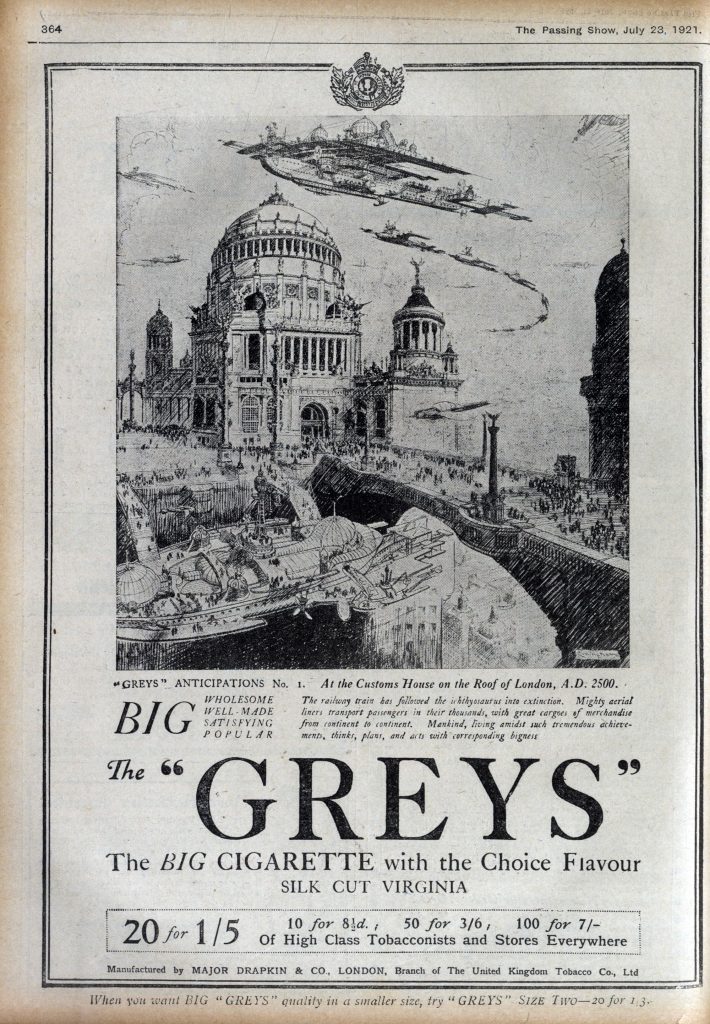
greys-2500-5

“At the Cus­toms House on the Roof of Lon­don, A.D. 2500: The rail­way train has fol­lowed the ichthyosaurus into extinc­tion. Mighty aer­i­al lin­ers trans­port pas­sen­gers in their thou­sands, with great car­goes of mer­chan­dise from con­ti­nent to con­ti­nent. Mankind, liv­ing amidst such tremen­dous achieve­ments, thinks, plans, and acts with cor­re­spond­ing big­ness.”

Hmm…I was kind of root­ing for train trav­el to make a come­back

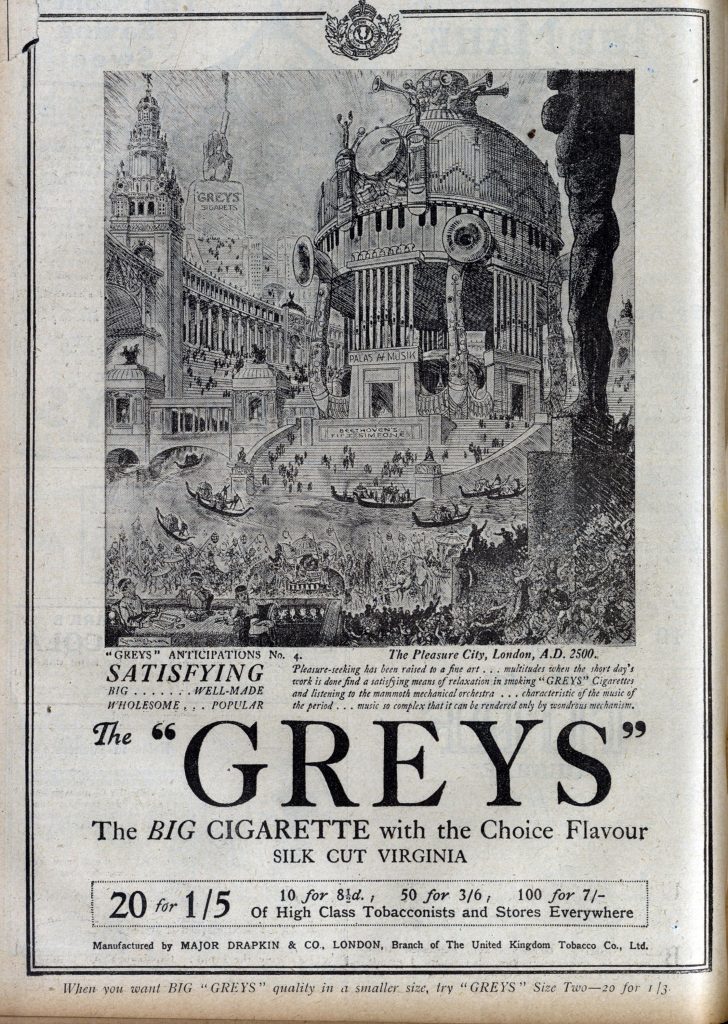
greys-2500-3

“The Plea­sure City, Lon­don, A.D. 2500: Plea­sure-seek­ing has been raised to a fine art … muti­tudes when the short day’s work is done find a sat­is­fy­ing means of relax­ation in smok­ing “GREYS” Cig­a­rettes and lis­ten­ing to the mam­moth mechan­i­cal orches­tra … char­ac­ter­is­tic of the music of the peri­od … music so com­plex that it can be ren­dered only by won­der­ous mech­a­nism.”

This does sound rather fun, depend­ing on who’s doing the pro­gram­ming… per­haps we should just stick with head­phones and a busker on every cor­ner.

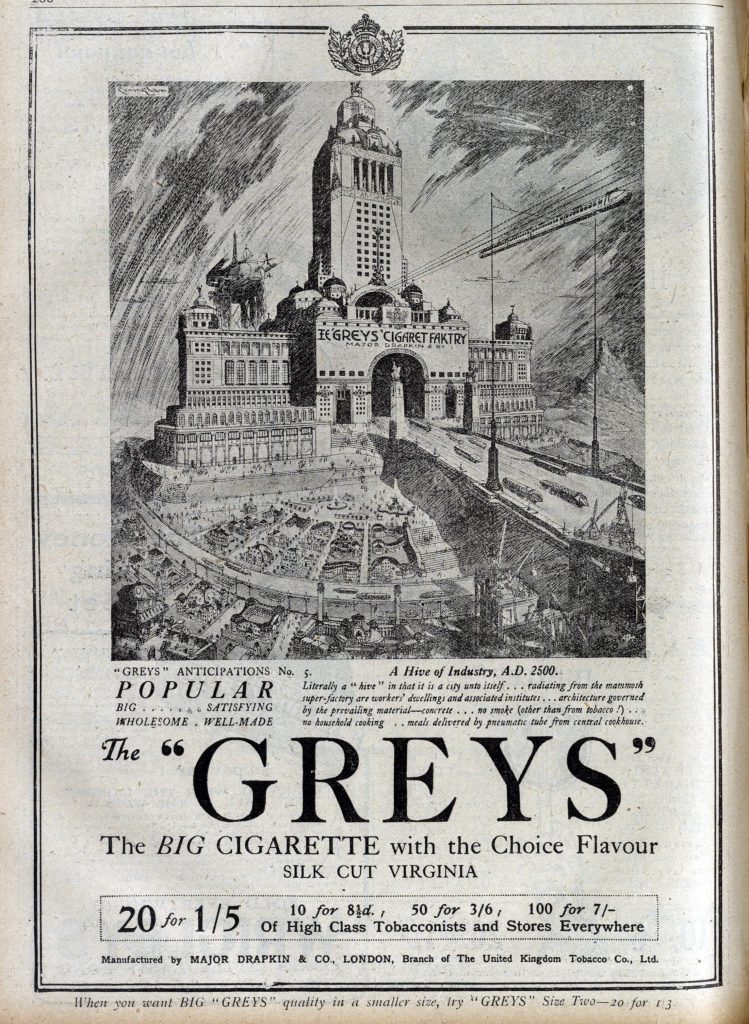
greys-2500-4

A Hive of Indus­try, A.D. 2500: Lit­er­al­ly a “hive” in that it is a city unto itself … radi­at­ing from the mam­moth super-fac­to­ry are work­ers’ dwellings and asso­ci­at­ed insti­tutes … archi­tec­ture gov­erned by the pre­vail­ing mate­r­i­al — con­crete … no smoke (oth­er than from tobac­co!) … no house­hold cook­ing . . meals deliv­ered by pneu­mat­ic tube from cen­tral cook­house.

Um…I strong­ly sug­gest revis­it­ing Ter­ry Gilliam’s 1985 film, Brazil,  before sign­ing off on the whole pneu­mat­ic tube thing.

Dar­ran Ander­son, author of  Imag­i­nary Cities, took a clos­er look at one of the cards in the above talk about imag­i­nary Lon­don. I share his opin­ion that “phonet­ic spelling… is the best thing that they envis­aged of the future.”

He also notes that the card is about 20 years ahead of its time in pro­mot­ing a mid-50s‑style vision of the future, but that it failed to pre­dict the demise of Greys Cig­a­rettes, by promi­nent­ly adver­tis­ing them on the side of a sus­pend­ed mono­rail.

Hubris!

via Metafil­ter

Relat­ed Con­tent:

In 1900, Ladies’ Home Jour­nal Pub­lish­es 28 Pre­dic­tions for the Year 2000

Niko­la Tesla’s Pre­dic­tions for the 21st Cen­tu­ry: The Rise of Smart Phones & Wire­less, The Demise of Cof­fee, The Rule of Eugen­ics (1926/35)

Cig­a­rette Com­mer­cials from David Lynch, the Coen Broth­ers and Jean Luc Godard

Ayun Hal­l­i­day is an author, illus­tra­tor, the­ater mak­er and Chief Pri­ma­tol­o­gist of the East Vil­lage Inky zine.  Her play Zam­boni Godot is open­ing in New York City in March 2017. Fol­low her @AyunHalliday

How to Recognize a Dystopia: Watch an Animated Introduction to Dystopian Fiction

Lit­er­a­ture and film can open up to the depth and immen­si­ty of social truths we find pro­found­ly dif­fi­cult, if not impos­si­ble, to artic­u­late. If our polit­i­cal vocab­u­lary (as Oxford Dic­tio­nar­ies sug­gest­ed in their word of the year) has become “post-truth,” it can seem like the only hon­est rep­re­sen­ta­tions of real­i­ty are found in the imag­i­nary.

Amidst the vio­lent upheavals of the last cou­ple decades, for exam­ple, we have seen an explo­sion of the dystopi­an, that ven­er­a­ble yet mod­ern genre we use to explain our con­tem­po­rary polit­i­cal con­di­tions to our­selves. It has become com­mon prac­tice in seri­ous debate to ges­ture toward the out­sized cin­e­mat­ic sce­nar­ios of Snow­piercer, or The Hunger Games and Har­ry Pot­ter series, as stand-ins for dis­turb­ing present real­i­ties.

You may have also encoun­tered recent ref­er­ences to lit­er­ary spec­u­la­tive fic­tion like William Gibson’s The Periph­er­al, Mar­garet Atwood’s The Handmaid’s Tale, Olivia Butler’s Para­ble series, and Philip K. Dick’s Radio Free Albe­muth, the first nov­el Dick wrote before VALIS about his sup­posed reli­gious expe­ri­ence. Draft­ed in 1976 but only pub­lished posthu­mous­ly in 1985, Dick­’s pre­scient nov­el takes place in an alter­nate U.S. (like The Man in the High Cas­tle), in which para­noid right-wing zealot Fer­ris Fre­mont, a Joseph McCarthy/Richard Nixon-like fig­ure, suc­ceeds Lyn­don John­son as pres­i­dent.

There is no point in dwelling on the ethics of Fer­ris Fre­mont.… The Sovi­ets backed him, the right-wingers backed him, and final­ly just about every­one… Fre­mont had the back­ing of the US intel­li­gence com­mu­ni­ty, as they liked to call them­selves, and exi­gents played an effec­tive role in dec­i­mat­ing polit­i­cal oppo­si­tion. In a one-par­ty sys­tem there is always a land­slide.

The sti­fling total­i­tar­i­an con­trol Fre­mont exer­cis­es is very much a hall­mark of dystopi­an fic­tion. But does Dick’s novel—set in an alter­nate present rather than a fright­en­ing future, and with an alien/supernatural invasion—qualify as dystopi­an? What about Har­ry Pot­ter, with its fairy tale intru­sions of the mag­i­cal into the present? The TED Ed video at the top, nar­rat­ed by Alex Gendler, sets flex­i­ble bound­aries for a cat­e­go­ry we’ve most­ly come to asso­ciate with prophet­ic, futur­is­tic sci­ence fic­tion, and offers a broad­ly com­pre­hen­sive def­i­n­i­tion.

The word dystopia, a Greek coinage for “bad place,” dates to 1868, from a usage by John Stu­art Mill to char­ac­ter­ize the indus­tri­al world’s moral inver­sion of Sir Thomas More’s Utopia. That word, Gendler points out, is a term More invent­ed to mean either “no place” or “good place.” Gendler dates the emer­gence of the dystopi­an to Jonathan Swift’s satire Gulliver’s Trav­els, a book, like Har­ry Pot­ter, set in an alter­nate present fea­tur­ing many mon­strous intru­sions of the fan­tas­tic into the real. Unlike the boy wiz­ard’s saga, how­ev­er, the mon­sters in Gul­liv­er serve as alle­gories for us.

Swift, Gendler argues, “estab­lished a blue­print for dystopia.” His Lil­liputians, Bob­d­ing­na­gians, Laputions, and Houy­hnhn­ms all rep­re­sent “cer­tain trends in con­tem­po­rary soci­ety… tak­en to extremes.” In lat­er exam­ples, the form con­tin­ued to reflect the per­ni­cious thought and sci­ence of the age: the extreme eugen­ics of H.G. Wells’ The Time Machine, the prison-like fac­to­ry con­di­tions of Fritz Lang’s film Metrop­o­lis, the repres­sive hyper-ratio­nal­iza­tion in Yevge­ny Zamyatin’s 1924 Sovi­et-based dystopia We, and the med­ical tech­noc­ra­cy of Aldous Huxley’s Brave New World.

Bor­row­ing lib­er­al­ly from Zamy­atin and com­pet­ing with Hux­ley, George Orwell’s 1984 set a new stan­dard of verisimil­i­tude for dystopi­an fic­tion, stark­ly remind­ing thou­sands of post-war read­ers that “the best-known dystopias were not imag­i­nary at all,” Gendler says. The his­tor­i­cal night­mares of World War II and the fol­low­ing Cold War dic­ta­tor­ships birthed hor­rors for which we can nev­er find appro­pri­ate lan­guage. And so we turn to nov­els like 1984 and Kurt Vonnegut’s Cat’s Cra­dle, both of which apt­ly show us worlds where lan­guage has ceased to func­tion in any ordi­nary com­mu­nica­tive sense.

Per­haps one of the most-ref­er­enced of dystopi­an nov­els in U.S. polit­i­cal dis­course, Sin­clair Lewis’ 1935 It Can’t Hap­pen Here, gave lit­tle but its title to the pop­u­lar lex­i­con. “Lewis,” writes Alexan­der Nazaryan in The New York­er, “was nev­er much of an artist, but what he lacked in style he made up for with social obser­va­tion.” The nov­el “envi­sioned how eas­i­ly,” Gendler says, “democ­ra­cy gives way to fas­cism.” The cri­sis point comes when the peo­ple want “safe­ty and con­ser­vatism again,” as Roo­sevelt observed that same year—a year in which “the promise of the New Deal,” Nazaryan remarks, “remained unful­filled for many.”

The irony of Lewis’ sce­nario is that those left behind by Roo­sevelt’s poli­cies are those who suf­fer most under the fic­tion­al pres­i­den­cy of author­i­tar­i­an Sen­a­tor Berzelius “Buzz” Win­drip. Mean­while, the more com­fort­able con­sole them­selves with hol­low denials: “it can’t hap­pen here.” Extreme eco­nom­ic inequal­i­ty and social strat­i­fi­ca­tion have been an essen­tial fea­ture of clas­si­cal utopi­an fic­tion since its first appear­ance in Plato’s Repub­lic. In the mod­ern lit­er­ary dystopia, the sci­ence, tech­nol­o­gy, and polit­i­cal mech­a­niza­tion that philoso­phers once cel­e­brat­ed become implaca­ble weapons of war against the cit­i­zen­ry.

For all the mal­leable bound­aries of the genre—which strays into sci­ence fic­tion, fan­ta­sy, sur­re­al­ism, and satire—dystopian fic­tions all have one uni­fy­ing theme: “At their heart,” says Gendler, “dystopias are cau­tion­ary tales, not about some par­tic­u­lar gov­ern­ment or tech­nol­o­gy, but the very idea that human­i­ty can be mold­ed into an ide­al shape.”

Relat­ed Con­tent:

A Clock­work Orange Author Antho­ny Burgess Lists His Five Favorite Dystopi­an Nov­els: Orwell’s 1984, Huxley’s Island & More

Octavia Butler’s 1998 Dystopi­an Nov­el Fea­tures a Fascis­tic Pres­i­den­tial Can­di­date Who Promis­es to “Make Amer­i­ca Great Again”

Hux­ley to Orwell: My Hell­ish Vision of the Future is Bet­ter Than Yours (1949)

Josh Jones is a writer and musi­cian based in Durham, NC. Fol­low him at @jdmagness

When Akira Kurosawa Watched Solaris with Andrei Tarkovsky: I Was “Very Happy to Find Myself Living on Earth”

tarkovsky-kurosawa

Image of Kuro­sawa and Tarkovsky via NPR

Though Aki­ra Kuro­sawa and Andrei Tarkovsky occu­py the same plane in the pan­theon of auteurs — the high­est one — nei­ther their lives nor their films had much obvi­ous­ly in com­mon. The old­er, longer-lived Kuro­sawa start­ed his career ear­li­er and end­ed it lat­er, but dur­ing those cin­e­mat­i­cal­ly glo­ri­ous decades of the 1960s and 70s, the two brought into the world such pic­tures as Yojim­bo, Ivan’s Child­hoodHigh and LowRed Beard, Andrei Rublev, Dodesukaden, Solaris, The Mir­ror, Der­su Uza­la (Kuro­sawa’s sole Japan­ese-Sovi­et co-pro­duc­tion, though Tarkovsky was­n’t involved), and Stalk­er.

They actu­al­ly met around the mid­dle of that peri­od, when Kuro­sawa came to vis­it the set of Solaris (watch Solaris online along with many oth­er major Tarkovsky films). “Tarkovsky guid­ed me around the set, explain­ing to me as cheer­ful­ly as a young boy who is giv­en a gold­en oppor­tu­ni­ty to show some­one his favorite toy­box,” Kuro­sawa writes in an essay orig­i­nal­ly run in the Asahi Shin­bun in 1977 and repub­lished at Cinephil­ia & Beyond.


“[Direc­tor Sergei] Bon­darchuk, who came with me, asked him about the cost of the set, and left his eyes wide open when Tarkovsky answered it. The cost was so huge: about six hun­dred mil­lion yen as to make Bon­darchuk, who direct­ed that grand spec­ta­cle of a movie War and Peace, agape in won­der.”

But the work, as Kuro­sawa soon found out, mer­it­ed the cost and then some:

Mar­velous progress in sci­ence we have been enjoy­ing, but where will it lead human­i­ty after all? Sheer fear­ful emo­tion this film suc­ceeds in con­jur­ing up in our soul. With­out it, a sci­ence fic­tion movie would be noth­ing more than a pet­ty fan­cy.

These thoughts came and went while I was gaz­ing at the screen.

Tarkovsky was togeth­er with me then. He was at the cor­ner of the stu­dio. When the film was over, he stood up, look­ing at me as if he felt timid. I said to him, “Very good. It makes me feel real fear.” Tarkovsky smiled shy­ly, but hap­pi­ly. And we toast­ed vod­ka at the restau­rant in the Film Insti­tute. Tarkovsky, who didn’t drink usu­al­ly, drank a lot of vod­ka, and went so far as to turn off the speak­er from which music had float­ed into the restau­rant, and began to sing the theme of samu­rai from Sev­en Samu­rai at the top of his voice.

As if to rival him, I joined in.

For I was at that moment very hap­py to find myself liv­ing on Earth.

Solaris makes a view­er feel this, and even this sin­gle fact shows us that Solaris is no ordi­nary SF film. It tru­ly some­how pro­vokes pure hor­ror in our soul. And it is under the total grip of the deep insights of Tarkovsky.

Kuro­sawa pays spe­cial atten­tion to the sequence, which you can watch above ana­lyzed by film schol­ars Vida John­son and Gra­ham Petrie, filmed in his own home­land: “What makes us shud­der is the shot of the loca­tion of Akasakamit­suke, Tokyo, Japan. By a skill­ful use of mir­rors, he turned flows of head lights and tail lamps of cars, mul­ti­plied and ampli­fied, into a vin­tage image of the future city. Every shot of Solaris bears wit­ness to the almost daz­zling tal­ents inher­ent in Tarkovsky.”

Like all of Tarkovsky’s fea­tures, Solaris only holds up more firm­ly with time and thus still enjoys revival screen­ings all over the world, but you can also watch it free online right now. Just get ready, when you descend to Earth after­ward, to feel your own grat­i­tude at find­ing your­self back here.

Relat­ed Con­tent:

Aki­ra Kuro­sawa to Ing­mar Bergman: “A Human Is Not Real­ly Capa­ble of Cre­at­ing Real­ly Good Works Until He Reach­es 80”

Aki­ra Kuro­sawa & Gabriel Gar­cía Márquez Talk About Film­mak­ing (and Nuclear Bombs) in Six Hour Inter­view

Watch Aki­ra Kuro­sawa & Fran­cis Ford Cop­po­la in Japan­ese Whiskey Ads from 1979: The Inspi­ra­tion for Lost in Trans­la­tion

Watch Solaris (1972), Andrei Tarkovsky’s Haunt­ing Vision of the Future

Andrei Tarkovsky’s Solaris Shot by Shot: A 22-Minute Break­down of the Director’s Film­mak­ing

Based in Seoul, Col­in Mar­shall writes and broad­casts on cities and cul­ture. He’s at work on a book about Los Ange­les, A Los Ange­les Primer, the video series The City in Cin­e­ma, the crowd­fund­ed jour­nal­ism project Where Is the City of the Future?, and the Los Ange­les Review of Books’ Korea Blog. Fol­low him on Twit­ter at @colinmarshall or on Face­book.

The 14-Hour Epic Film, Dune, That Alejandro Jodorowsky, Pink Floyd, Salvador Dalí, Moebius, Orson Welles & Mick Jagger Never Made

Frank Her­bert, David Lynch, and Ale­jan­dro Jodor­owsky sure­ly all rank among the most imag­i­na­tive cre­ators of the sec­ond half of the twen­ti­eth cen­tu­ry. It made sense to film pro­duc­ers to turn Her­bert’s Dune into a movie, but they had a dev­il of a time find­ing the right direc­tor to bring that epic nov­el of the feu­dal inter­stel­lar future to the screen. Lynch, as all his fans know and most regret, wound up with the job, and soon after the botched result hit the­aters in 1984, it made his­to­ry as one of the all-time clas­sic mis­match­es between film­mak­er and project, and at $40 mil­lion, one of the most expen­sive. Les­son learned: don’t hire the direc­tor of Eraser­head to helm your big-bud­get sci-fi block­buster.

But what about the direc­tor of the even stranger and more ambi­tious The Holy Moun­tain? In 1975, almost a decade before Lynch’s Dune, Jodor­owsky announced his own adap­ta­tion of Dune, fund­ed by a French con­sor­tium and made in col­lab­o­ra­tion with artists like Chris Foss, H.R. Giger, and Moe­bius, writer and spe­cial effects design­er Dan O’Ban­non (who’d just made the low-bud­get space com­e­dy Dark Star with John Car­pen­ter), and actors like Orson Welles, Glo­ria Swan­son, and David Car­ra­dine.

He also cast such icons not known pri­mar­i­ly for act­ing as Mick Jag­ger and Sal­vador Dalí. “Jodorowsky’s mid­night audi­ences were noto­ri­ous for being high,” writes The Hol­ly­wood Reporter’s Chris O’Falt, “but with Dune the direc­tor set out to make a film that fab­ri­cat­ed the effects of LSD for a sober audi­ence, com­plete with a sound­track by Pink Floyd.”

Or as Dalí once declared, “I don’t do drugs. I am drugs.” This cin­e­mat­ic expe­ri­ence of expand­ed con­scious­ness would have run approx­i­mate­ly four­teen hours, as Her­bert dis­cov­ered when he checked in on the pre-pro­duc­tion to find $2 mil­lion of the film’s $9.5 mil­lion bud­get already spent and a script “the size of a phone book.” Unable to find a stu­dio to bankroll the Dune he and his col­lab­o­ra­tors had envi­sioned, Jodor­owsky ulti­mate­ly dropped the project, but its mate­ri­als — and the stag­ger­ing breadth as well as depth of its vision — pro­vid­ed the basis for the 2014 doc­u­men­tary Jodor­owsky’s Dune, whose trail­er you can watch above.

“Almost all the bat­tles were won, but the war was lost,“Jodorowsky writes in an essay on his expe­ri­ence with the project. “The project was sab­o­taged in Hol­ly­wood. It was French and not Amer­i­can. Its mes­sage was not ‘enough Hol­ly­wood.’ There were intrigues, plun­der­ing. The sto­ry-board cir­cu­lat­ed among all the large stu­dios. Lat­er, the visu­al aspect of Star Wars resem­bled our style. To make Alien, they invit­ed Moe­bius, Foss, Giger, O’Ban­non, etc.,” to say noth­ing of its traces vis­i­ble in Blade Run­ner and The Matrix. While the 87-year-old Jodor­owsky has made a return to film­mak­ing in recent years, his Dune will most like­ly remain on the lists of the great­est movies nev­er made. But its influ­ence, if not its scale, will no doubt con­tin­ue to man­i­fest in gen­er­a­tions of sci-fi cin­e­ma to come.

Relat­ed Con­tent:

Moe­bius’ Sto­ry­boards & Con­cept Art for Jodorowsky’s Dune

Mœbius & Jodorowsky’s Sci-Fi Mas­ter­piece, The Incal, Brought to Life in a Tan­ta­liz­ing Ani­ma­tion

The Glos­sary Uni­ver­sal Stu­dios Gave Out to the First Audi­ences of David Lynch’s Dune (1984)

Napoleon: The Great­est Movie Stan­ley Kubrick Nev­er Made

Based in Seoul, Col­in Mar­shall writes and broad­casts on cities and cul­ture. He’s at work on a book about Los Ange­les, A Los Ange­les Primer, the video series The City in Cin­e­ma, the crowd­fund­ed jour­nal­ism project Where Is the City of the Future?, and the Los Ange­les Review of Books’ Korea Blog. Fol­low him on Twit­ter at @colinmarshall or on Face­book.

What Happens When Blade Runner & A Scanner Darkly Get Remade with an Artificial Neural Network

Philip K. Dick, titling the 1968 nov­el that would pro­vide the basis for Blade Run­ner, asked whether androids dream of elec­tric sheep. But what goes on in the “mind” of an arti­fi­cial intel­li­gence designed specif­i­cal­ly to watch movies? Ter­ence Broad, a com­put­ing researcher at Gold­smiths, Uni­ver­si­ty of Lon­don, took on a form of that ques­tion for his mas­ter’s dis­ser­ta­tion, using “arti­fi­cial neur­al net­works to recon­struct films — by train­ing them to recon­struct indi­vid­ual frames from films, and then get­ting them to recon­struct every frame in a giv­en film and rese­quenc­ing it.”

Neur­al net­works” sounds like a term straight out of one of Dick­’s influ­en­tial sci­ence-fic­tion nov­els, but you’ve almost cer­tain­ly heard quite a bit about them in recent years of real life. A neur­al net­work, in the words of neu­ro­com­put­er pio­neer Dr. Robert Hecht-Nielsen, “is a com­put­ing sys­tem made up of a num­ber of sim­ple, high­ly inter­con­nect­ed pro­cess­ing ele­ments, which process infor­ma­tion by their dynam­ic state response to exter­nal inputs.” These sys­tems, in oth­er words, imi­tate the prob­lem-solv­ing meth­ods of the human brain as we cur­rent­ly under­stand them, and can, when pro­vid­ed with suit­able data, “learn” from it.

One thinks less of the Repli­cants, Blade Run­ner’s lethal­ly engi­neered super­hu­mans, than of Num­ber 5, the arti­fi­cial­ly intel­li­gent robot star of Short Cir­cuit (co-designed, inci­den­tal­ly, by Blade Run­ner’s “visu­al futur­ist” Syd Mead), with his con­stant demands for “input.” When it came out in the mid-1980s, that goofy com­e­dy once looked like by far the more suc­cess­ful film, but over the inter­ven­ing three decades Rid­ley Scot­t’s one-time bomb has become per­haps the most respect­ed work of its kind. “The first ever film remade by a neur­al net­work had to be Blade Run­ner,” Ter­ence Broad told Vox, point­ing in his expla­na­tion of his project to the movie’s pre­scient treat­ment of the theme “that the task of deter­min­ing what is and isn’t human is becom­ing increas­ing­ly dif­fi­cult, with the ever-increas­ing tech­no­log­i­cal devel­op­ments.”

Dick, as his gen­er­a­tions of read­ers know, had deep con­cerns about the dif­fer­ence between the real and the unre­al, and how human beings can ever tell one from the oth­er. He tack­led that issue again, from a very dif­fer­ent angle, in his 1977 nov­el A Scan­ner Dark­ly. Richard Lin­klater turned that book into a movie almost thir­ty years lat­er, one which Broad also fed as input into his neur­al net­work, which then attempt­ed to recon­struct it. Though still the­mat­i­cal­ly appro­pri­ate, its col­or­ful roto­scoped ani­ma­tion posed more of a chal­lenge, and “the results are less tem­po­ral­ly coher­ent than the Blade Run­ner mod­el.” But “on the oth­er hand, the images are incred­i­bly unusu­al and com­plex, once again pro­duc­ing video with a rich unpre­dictabil­i­ty.”

At the top of the post, you can watch Broad­’s Blade Run­ner-trained neur­al net­work recon­struct Blade Run­ner’s trail­er, and below that his A Scan­ner Dark­ly-trained neur­al net­work recon­struct A Scan­ner Dark­ly’s trail­er. Curios­i­ty demand­ed, of course, that Broad let a neur­al net­work trained to watch one film have a go at recon­struct­ing the oth­er, and just above we have the A Scan­ner Dark­ly-trained neur­al net­work’s recon­struc­tion of Blade Run­ner. He’s also giv­en Scot­t’s famous 1984-themed Super Bowl Apple ad and God­frey Reg­gio’s Koy­aanisqat­si the neur­al-net­work treat­ment. We read so often, these days, about arti­fi­cial intel­li­gence’s grow­ing abil­i­ty to out-think, out-work, and one day even out-cre­ate us. What on Earth, the Philip K. Dicks of our day must won­der, will the neur­al net­works come up with when they can final­ly out-watch us?

Relat­ed Con­tent:

Watch an Ani­mat­ed Ver­sion of Rid­ley Scott’s Blade Run­ner Made of 12,597 Water­col­or Paint­ings

Philip K. Dick Pre­views Blade Run­ner: “The Impact of the Film is Going to be Over­whelm­ing” (1981)

Rid­ley Scott Talks About Mak­ing Apple’s Land­mark “1984” Com­mer­cial, Aired 30 Years Ago on Super Bowl Sun­day

Watch Sun­spring, the Sci-Fi Film Writ­ten with Arti­fi­cial Intel­li­gence, Star­ring Thomas Mid­dled­itch (Sil­i­con Val­ley)

Arti­fi­cial Intel­li­gence Pro­gram Tries to Write a Bea­t­les Song: Lis­ten to “Daddy’s Car”

Two Arti­fi­cial Intel­li­gence Chat­bots Talk to Each Oth­er & Get Into a Deep Philo­soph­i­cal Con­ver­sa­tion

Based in Seoul, Col­in Mar­shall writes and broad­casts on cities and cul­ture. He’s at work on a book about Los Ange­les, A Los Ange­les Primer, the video series The City in Cin­e­ma, the crowd­fund­ed jour­nal­ism project Where Is the City of the Future?, and the Los Ange­les Review of Books’ Korea Blog. Fol­low him on Twit­ter at @colinmarshall or on Face­book.

Hear J.G. Ballard Stories Adapted as Surreal Soundscapes That Put You Inside the Heads of His Characters

ballard_02

Image by Thier­ry Erhmann via Wiki­me­dia Com­mons

“This enor­mous nov­el we’re liv­ing inside thrives on sen­sa­tion,” J.G. Bal­lard once said. “It needs sen­sa­tion to sus­tain itself.” The author of nov­els like High-RiseCrash, and Empire of the Sun knew how to deliv­er a cer­tain kind of tex­tu­al sen­sa­tion, and he often under­scored (as first evi­denced by his exper­i­men­tal text col­lages) that he pos­sessed a com­mand of visu­al sen­sa­tion as well. Bal­lard’s use of son­ic sen­sa­tion has tak­en longer to gain a wide appre­ci­a­tion, but the BBC has fur­thered that cause with two new radio dra­mas adapt­ing his sto­ries “Track 12” and “Venus Smiles.”

These pro­duc­tions debuted togeth­er this past week­end on “Between Bal­lard’s Ears,” an episode of the pro­gram Between the Ears, which for twen­ty years has show­cased “inno­v­a­tive and thought-pro­vok­ing fea­tures that make adven­tur­ous use of sound and explore a wide vari­ety of sub­jects.” They both make use of a tech­nol­o­gy called bin­au­r­al audio, sound record­ed just as humans hear it. The process involves an arti­fi­cial head with micro­phones embed­ded in each ear, the indus­try-stan­dard mod­el of which comes from a com­pa­ny called Neu­mann. (You can see a gallery of the cast and crew of “Between Bal­lard’s Ears” using, and hang­ing out with, their own Neu­mann head here.)

All this has the effect of putting you, the head­phone-wear­ing radio-dra­ma lis­ten­er, right into not just the set­ting of the sto­ry but into the very head of the char­ac­ter — in the case of J.G. Bal­lard, as any of his fans know, a trou­bling place indeed. We hear 1958’s “Track 12” from with­in the head of Maxted, a for­mer ath­lete turned com­pa­ny man invit­ed over to the home of Sher­ing­ham, the bio­chem­istry pro­fes­sor he’s been cuck­old­ing. Sher­ing­ham sits Maxted, and us, down to lis­ten to his great­ly slowed and ampli­fied “microson­ic” record­ings of cells divid­ing and pins drop­ping. We won­der, as Maxted won­ders, when the inevitable con­fronta­tion will come, though none of us can fore­see what form Sher­ing­ham’s revenge will take.

“Venus Smiles,” which Bal­lard first wrote in 1957 and rewrote in 1971, takes place in his fic­tion­al desert resort town of Ver­mil­lion Sands. This sto­ry opens with the instal­la­tion of a new piece of pub­lic art, a “musi­cal sculp­ture” that makes me think of the Tri­fo­ri­um in Los Ange­les. But unlike the lone­ly Tri­fo­ri­um, neglect­ed and ignored for most of its his­to­ry, this sculp­ture caus­es pan­de­mo­ni­um from day one, pip­ing out quar­ter-tone com­po­si­tions pleas­ing to the ears of the Mid­dle East, but appar­ent­ly not to those of Ver­mil­lion Sands. When one com­mis­sion­er trans­plants the hat­ed sculp­ture to his back­yard, it reveals its true nature: much more com­pli­cat­ed than that of a big music box, and much more inter­est­ing to hear besides. As much as the bin­au­r­al pro­duc­tion will make you feel like you’re stand­ing right there beside it, Bal­lard makes you feel relieved, as the sto­ry goes on, that you’re actu­al­ly not.

Relat­ed Con­tent:

The Very First Film of J.G. Ballard’s Crash, Star­ring Bal­lard Him­self (1971)

Sci-Fi Author J.G. Bal­lard Pre­dicts the Rise of Social Media (1977)

J.G. Bal­lard on Sen­sa­tion

J.G. Ballard’s Exper­i­men­tal Text Col­lages: His 1958 For­ay into Avant-Garde Lit­er­a­ture

Based in Seoul, Col­in Mar­shall writes and broad­casts on cities and cul­ture. He’s at work on a book about Los Ange­les, A Los Ange­les Primer, the video series The City in Cin­e­ma, the crowd­fund­ed jour­nal­ism project Where Is the City of the Future?, and the Los Ange­les Review of Books’ Korea Blog. Fol­low him on Twit­ter at @colinmarshall or on Face­book.

Isaac Asimov Laments the “Cult of Ignorance” in the United States (1980)

Rochester Insti­tute of Tech­nol­o­gy, via Wiki­me­dia Com­mons

In 1980, sci­en­tist and writer Isaac Asi­mov argued in an essay that “there is a cult of igno­rance in the Unit­ed States, and there always has been.” That year, the Repub­li­can Par­ty stood at the dawn of the Rea­gan Rev­o­lu­tion, which ini­ti­at­ed a decades-long con­ser­v­a­tive groundswell that many pun­dits say may final­ly come to an end in Novem­ber. GOP strate­gist Steve Schmidt (who has been regret­ful about choos­ing Sarah Palin as John McCain’s run­ning mate in 2008) recent­ly point­ed to what he called “intel­lec­tu­al rot” as a pri­ma­ry cul­prit, and a cult-like devo­tion to irra­tional­i­ty among a cer­tain seg­ment of the elec­torate.

It’s a famil­iar con­tention. There have been cri­tiques of Amer­i­can anti-intel­lec­tu­al­ism since the country’s found­ing, though whether or not that phe­nom­e­non has inten­si­fied, as Susan Jaco­by alleged in The Age of Amer­i­can Unrea­son, may be a sub­ject of debate. Not all of the unrea­son is par­ti­san, as the anti-vac­ci­na­tion move­ment has shown. But “the strain of anti-intel­lec­tu­al­ism” writes Asi­mov, “has been a con­stant thread wind­ing its way through our polit­i­cal and cul­tur­al life, nur­tured by the false notion that democ­ra­cy means that ‘my igno­rance is just as good as your knowl­edge.’”

Asimov’s pri­ma­ry exam­ples hap­pen to come from the polit­i­cal world. How­ev­er, he doesn’t name con­tem­po­rary names but reach­es back to take a swipe at Eisen­how­er (“who invent­ed a ver­sion of the Eng­lish lan­guage that was all his own”) and George Wal­lace. Par­tic­u­lar­ly inter­est­ing is Asimov’s take on the “slo­gan on the part of the obscu­ran­tists: ‘Don’t trust the experts!’” This lan­guage, along with charges of “elit­ism,” Asi­mov wry­ly notes, is so often used by peo­ple who are them­selves experts and elites, “feel­ing guilty about hav­ing gone to school.” So many of the Amer­i­can polit­i­cal class’s wounds are self-inflict­ed, he sug­gests, but that’s because they are behold­en to a large­ly igno­rant elec­torate:

To be sure, the aver­age Amer­i­can can sign his name more or less leg­i­bly, and can make out the sports headlines—but how many nonelit­ist Amer­i­cans can, with­out undue dif­fi­cul­ty, read as many as a thou­sand con­sec­u­tive words of small print, some of which may be tri­syl­lab­ic?

Asimov’s exam­ples are less than con­vinc­ing: road signs “steadi­ly being replaced by lit­tle pic­tures to make them inter­na­tion­al­ly leg­i­ble” has more to do with lin­guis­tic diver­si­ty than illit­er­a­cy, and accus­ing tele­vi­sion com­mer­cials of speak­ing their mes­sages out loud instead of using print­ed text on the screen seems to fun­da­men­tal­ly mis­un­der­stand the nature of the medi­um. Jaco­by in her book-length study of the prob­lem looks at edu­ca­tion­al pol­i­cy in the Unit­ed States, and the resis­tance to nation­al stan­dards that vir­tu­al­ly ensures wide­spread pock­ets of igno­rance all over the coun­try. Asimov’s very short, pithy essay has nei­ther the space nor the incli­na­tion to con­duct such analy­sis.

Instead he is con­cerned with atti­tudes. Not only are many Amer­i­cans bad­ly edu­cat­ed, he writes, but the broad igno­rance of the pop­u­la­tion in mat­ters of “sci­ence… math­e­mat­ics… eco­nom­ics… for­eign lan­guages…” has as much to do with Amer­i­cans’ unwill­ing­ness to read as their inabil­i­ty.

There are 200 mil­lion Amer­i­cans who have inhab­it­ed school­rooms at some time in their lives and who will admit that they know how to read… but most decent peri­od­i­cals believe they are doing amaz­ing­ly well if they have cir­cu­la­tion of half a mil­lion. It may be that only 1 per cent—or less—of Amer­i­cans make a stab at exer­cis­ing their right to know. And if they try to do any­thing on that basis they are quite like­ly to be accused of being elit­ists.

One might in some respects charge Asi­mov him­self of elit­ism when he con­cludes, “We can all be mem­bers of the intel­lec­tu­al elite.” Such a blithe­ly opti­mistic state­ment ignores the ways in which eco­nom­ic elites active­ly manip­u­late edu­ca­tion pol­i­cy to suit their inter­ests, crip­ple edu­ca­tion fund­ing, and oppose efforts at free or low cost high­er edu­ca­tion. Many efforts at spread­ing knowledge—like the Chatauquas of the ear­ly 20th cen­tu­ry, the edu­ca­tion­al radio pro­grams of the 40s and 50s, and the pub­lic tele­vi­sion rev­o­lu­tion of the 70s and 80s—have been ad hoc and near­ly always imper­iled by fund­ing crises and the designs of prof­i­teers.

Nonethe­less, the wide­spread (though hard­ly uni­ver­sal) avail­abil­i­ty of free resources on the inter­net has made self-edu­ca­tion a real­i­ty for many peo­ple, and cer­tain­ly for most Amer­i­cans. But per­haps not even Isaac Asi­mov could have fore­seen the bit­ter polar­iza­tion and dis­in­for­ma­tion cam­paigns that tech­nol­o­gy has also enabled. Need­less to say, “A Cult of Igno­rance” was not one of Asimov’s most pop­u­lar pieces of writ­ing. First pub­lished on Jan­u­ary 21, 1980 in Newsweek, the short essay has nev­er been reprint­ed in any of Asimov’s col­lec­tions. You can read the essay as a PDF here. There’s also, one of our read­ers reminds us, a tran­script on Github.

via Aphe­lis

Relat­ed Con­tent:

Isaac Asimov’s 1964 Pre­dic­tions About What the World Will Look 50 Years Lat­er

How Isaac Asi­mov Went from Star Trek Crit­ic to Star Trek Fan & Advi­sor

Isaac Asi­mov Explains His Three Laws of Robots

Josh Jones is a writer and musi­cian based in Durham, NC. Fol­low him at @jdmagness

H.G. Wells Pans Fritz Lang’s Metropolis in a 1927 Movie Review: It’s “the Silliest Film”

metropolis-wells

When we watch Fritz Lang’s Metrop­o­lis now, we see an aes­thet­i­cal­ly dar­ing land­mark work of sci­ence-fic­tion cin­e­ma. When H.G. Wells watched Metrop­o­lis back in 1927, the year of its release, he saw some­thing very dif­fer­ent indeed. “I have recent­ly seen the sil­li­est film,” wrote the author of The War of the Worlds and The Time Machine as an open­er for his New York Times review. “I do not believe it would be pos­si­ble to make one sil­li­er.”

Despite its giant bud­get, Metrop­o­lis gives “in one eddy­ing con­cen­tra­tion almost every pos­si­ble fool­ish­ness, cliché, plat­i­tude, and mud­dle­ment about mechan­i­cal progress and progress in gen­er­al, served up with a sauce of sen­ti­men­tal­i­ty that is all its own.” His­to­ry remem­bers Lang and Wells both as vision­ar­ies who looked, often with lit­tle opti­mism, to the future, but clear­ly they had a dif­fer­ence of opin­ion as to how that future would actu­al­ly play out.

The sci­en­tif­i­cal­ly-mind­ed Wells took the impres­sion­is­tic Metrop­o­lis lit­er­al­ly, tak­ing issue with — among oth­er things — how its air­planes “show no advance on con­tem­po­rary types”; its “motor cars are 1926 mod­els or ear­li­er”; its vision of a ver­ti­cal­ly strat­i­fied city look, “to put it mild­ly, high­ly improb­a­ble”; the appar­ent con­di­tion that the city’s “machines are engaged quite furi­ous­ly in the mass pro­duc­tion of noth­ing that is ever used”; and the sen­ti­men­tal­i­ty of its mak­ers, “who are all on the side of soul and love and such like.”

Metrop­o­lis opened to mixed reviews at first (some of which you can read here), but no con­tem­po­rary crit­ic could match Wells for sheer dis­dain. “Nev­er for a moment does one believe any of this fool­ish sto­ry; nev­er for a moment is there any­thing amus­ing or con­vinc­ing in its drea­ry series of strained events,” he wrote, steer­ing his point-by-point take­down to its con­clu­sion. “It is immense­ly and strange­ly dull. It is not even to be laughed at.”

Strong stuff, but the high­est form of film crit­i­cism, as the French New Wave would lat­er artic­u­late, is film­mak­ing. And so, in 1936, came Things to Come, anoth­er cin­e­mat­ic spec­ta­cle of the future, this one built to the osten­si­bly more plau­si­ble spec­i­fi­ca­tions Wells laid out as its screen­writer — that film itself just one more pre­de­ces­sor to the unend­ing series of dystopias, utopias, and every kind of future in-between to appear on the screen over the next eight decades.

Relat­ed Con­tent:

Read the Orig­i­nal 32-Page Pro­gram for Fritz Lang’s Metrop­o­lis (1927)

Fritz Lang Invents the Video Phone in Metrop­o­lis (1927)

Things to Come, the 1936 Sci-Fi Film Writ­ten by H.G. Wells, Accu­rate­ly Pre­dicts the World’s Very Dark Future

Based in Seoul, Col­in Mar­shall writes and broad­casts on cities and cul­ture. He’s at work on a book about Los Ange­les, A Los Ange­les Primer, the video series The City in Cin­e­ma, the crowd­fund­ed jour­nal­ism project Where Is the City of the Future?, and the Los Ange­les Review of Books’ Korea Blog. Fol­low him on Twit­ter at @colinmarshall or on Face­book.

« Go BackMore in this category... »
Quantcast