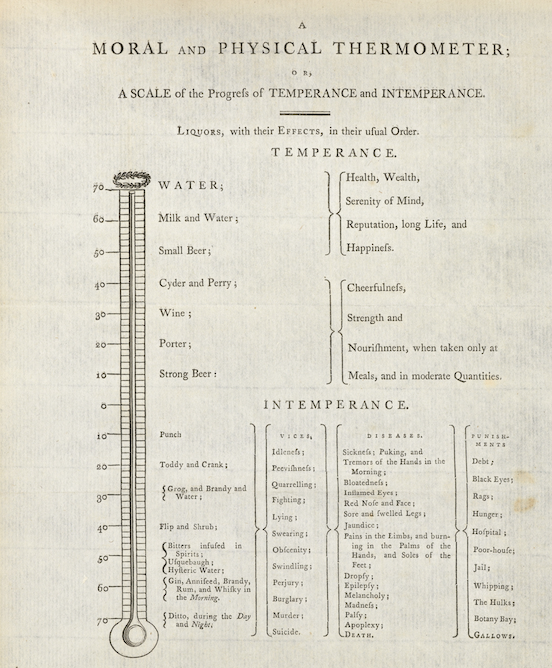
It’s nothing to be ashamed of—anything above zero constitutes a passing score. The founder of the Medical Society of London, Lettsom was a proponent of true temperance, not total abstinence. According to his rubric, a “small beer” has all the virtues of milk and water.
Dip below a zero, though, and you’re in for a bumpy night.
Punch is apparently the gateway to such demon influences as flip, shrub, whiskey and rum. Gosh. You may as well just skip the punch and go straight for the hard stuff, if, as in Lettsom’s view, they all end in the same vices and diseases.
Puking and Tremors of the Hands in the Morning?
Yes, on occasion.
Peevishness, Idleness, and Obscenity?
Yep, that too.
Murder, Madness, and Death?
Mercifully, no. At least not yet.
While not entirely free of stigma, alcoholism is now something many view through the lens of AA, a problem best remedied through a system of personal accountability shored up by a network of nonjudgmental, sympathetic support.
Back in Lettsom’s day, when an alcoholic hit rock bottom, it was assumed he or she would stay there, a task made easier when the wages of this particular sin included the poor house, a one way ticket to the Botany Bay penal colony, and the gallows.
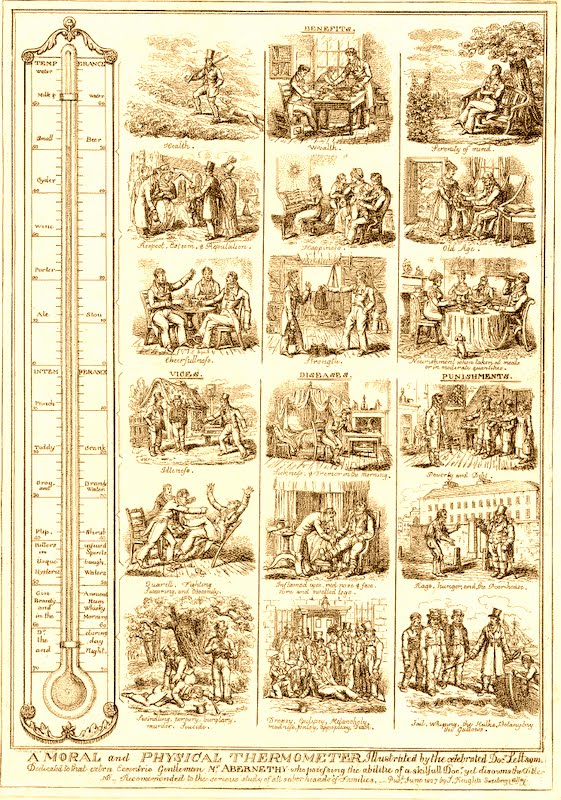
Such looming consequences are easily laughed off when you’ve had a snoot, which may be why Lettsom also published the illustrated version of his thermometer below. A picture is worth a thousand words, particularly when depicting the pre-Dickensian misery that awaits the drunkard and his family.
It’d be interesting to know how the Internet changes the game. Seems like it would go a long way toward democratizing the process by which lingo gets mingled.
Alex Gendler’s TED-Ed lesson, winningly animated by Igor Coric, rolls back the clock to a time when communal groups would subdivide and strike out on their own, usually in order to beef up the food supply.
This sort of geographic and temporal separation was bound to take a toll, linguistically. Evolution is need-based. Vocabulary and pronunciation eventually betray the specifics of the speaker’s surroundings, their circumstances and needs.
It takes some forensics to figure out how, or, even if, various languages relate to each other. A cunning linguist (forgive me) will also have the power to fill in historical gaps, by identifying words that have been borrowed from neighboring cultures, as well as more transient acquaintances.
As a little experiment, look at the way you talk! Those of us without royal blood or a stick up our heinies tend to speak a mongrel patois custom tailored by our own experience. A little bit of regionalism, some professional jargon, a few colorful words gleaned from life’s characters, lines from long ago entertainments deployed as if the references were fresh.
I’ll bet a linguist would have a field day with you, Bub.
Maybe we should all “speak Mandarin,” as per the billboards I saw in Singapore on a post-collegiate trip. (As a Western backpacker in Birkenstocks and a wrap-around hippie skirt, I was exempt, leaving me plenty of time to worry about being caned for spitting gum on the sidewalk, a thing I’d never do, by the way.)
Back to the animated lesson, above. While I agree that political and national interests can be hugely influential with regard to language development, I’m not sure a pig is the wisest choice when depicting this linguistic phenomenon as an animal’s worth of re-zoned primal cuts, labelled a la the former Yugoslavia.
As does language, which explains why there could be as many as 8000 of them in use. A more conservative estimate puts the number at 3000. Not to alarm you, but if the number of people who speak your language is what the foodie hipsters of Brooklyn would refer to as “small batch,” there are linguists who would downgrade your tongue to mere dialect.
Ayun Halliday’s highly idiosyncratic approach to language can be studied in seven books, a number of anthologies, and her long suffering zine, the East Village Inky. Follow her @AyunHalliday
Generations of us know Roald Dahl as, first and foremost, the author of popular children’s novels like The BFG, The Witches, Charlie and the Chocolate Factory (that book of the “subversive” lost chapter), and James and the Giant Peach. We remember reading those with great delight, and some of us even made it into the rumored literary territory of his “stories for grown-ups.” But few of us, at least if we grew up in the past few decades, will have familiarized ourselves with all the purposes to which Dahl put his pen. Like many fine writers, Dahl always drew something from his personal experience, and few personal experiences could have had as much impact as the sudden death of his measles-stricken seven-year-old daughter Olivia in 1962. A chapter of Donald Sturrock’s biography Storyteller: The Life of Roald Dahl, excerpted at The Telegraph, tells of both the event itself and Dahl’s stoic, writerly (according to some, perhaps too stoic and too writerly) way of handling it.
But good did come out of Dahl’s response to the tragedy. In 1986, he wrote a leaflet for the Sandwell Health Authority entitled Measles: A Dangerous Illness, which tells Olivia’s story and provides a swift and well-supported argument for universal vaccination against the disease:
Olivia, my eldest daughter, caught measles when she was seven years old. As the illness took its usual course I can remember reading to her often in bed and not feeling particularly alarmed about it. Then one morning, when she was well on the road to recovery, I was sitting on her bed showing her how to fashion little animals out of coloured pipe-cleaners, and when it came to her turn to make one herself, I noticed that her fingers and her mind were not working together and she couldn’t do anything.
“Are you feeling all right?” I asked her.
“I feel all sleepy,” she said.
In an hour, she was unconscious. In twelve hours she was dead.
The measles had turned into a terrible thing called measles encephalitis and there was nothing the doctors could do to save her. That was twenty-four years ago in 1962, but even now, if a child with measles happens to develop the same deadly reaction from measles as Olivia did, there would still be nothing the doctors could do to help her.
On the other hand, there is today something that parents can do to make sure that this sort of tragedy does not happen to a child of theirs. They can insist that their child is immunised against measles. I was unable to do that for Olivia in 1962 because in those days a reliable measles vaccine had not been discovered. Today a good and safe vaccine is available to every family and all you have to do is to ask your doctor to administer it.
It is not yet generally accepted that measles can be a dangerous illness. Believe me, it is. In my opinion parents who now refuse to have their children immunised are putting the lives of those children at risk. In America, where measles immunisation is compulsory, measles like smallpox, has been virtually wiped out.
Here in Britain, because so many parents refuse, either out of obstinacy or ignorance or fear, to allow their children to be immunised, we still have a hundred thousand cases of measles every year. Out of those, more than 10,000 will suffer side effects of one kind or another. At least 10,000 will develop ear or chest infections. About 20 will die.
LET THAT SINK IN.
Every year around 20 children will die in Britain from measles.
So what about the risks that your children will run from being immunised?
They are almost non-existent. Listen to this. In a district of around 300,000 people, there will be only one child every 250 years who will develop serious side effects from measles immunisation! That is about a million to one chance. I should think there would be more chance of your child choking to death on a chocolate bar than of becoming seriously ill from a measles immunisation.
So what on earth are you worrying about? It really is almost a crime to allow your child to go unimmunised.
The ideal time to have it done is at 13 months, but it is never too late. All school-children who have not yet had a measles immunisation should beg their parents to arrange for them to have one as soon as possible.
Incidentally, I dedicated two of my books to Olivia, the first was ‘James and the Giant Peach’. That was when she was still alive. The second was ‘The BFG’, dedicated to her memory after she had died from measles. You will see her name at the beginning of each of these books. And I know how happy she would be if only she could know that her death had helped to save a good deal of illness and death among other children.
Alas, this message hasn’t quite fallen into irrelevance. What with anti-vaccination movements having somehow picked up a bit of steam in recent years (and with the number of cases of measles cases now climbing again), it might make sense to send Dahl’s leaflet back into print — or, better yet, to keep it circulating far and wide around the internet. Not that others haven’t made cogent pro-vaccination arguments of their own, in different media, with different illustrations of the data, and with different levels of profanity. Take, for instance, Penn and Teller’s segmentbelow, which, finding the perfect target given its mandate against non-evidence-based beliefs, takes aim at the proposition that vaccinations cause autism:
When I was a child, my father, enchanted by the notion that I might someday provide live piano accompaniment to his evening cocktails, signed me up for lessons with a mild-mannered widow who—if memory serves—charged 50¢ an hour.
Had I only been forced to practice more regularly, I’d have no trouble remembering the exact price of these lessons. My memory would be a supremely robust thing of beauty. Ditto my math skills, my cognitive function, my ability to multitask.
Instead, my dad eventually conceded that I was not cut out to be a musician (or a ballerina, or a tennis whiz…) and Mrs. Arnold was out a pupil.
Would that I stuck with it beyond my halting versions of “The Entertainer” and “Für Elise.” According to the TED-Ed video above, playing an instrument is one of the very best things you can do for your brain. Talent doesn’t matter in this context, just ongoing practice.
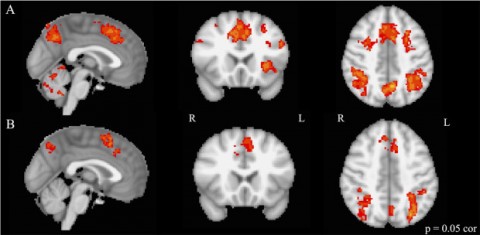
Neuroscientists using fMRI (Functional Magnetic Resonance Imaging) and PET (Positron Emission Tomography) technology to monitor the brain activity of subjects listening to music saw engagement in many areas, but when the subjects traded in headphones for actual instruments, this activity morphed into a grand fireworks display.
(The animated explanation of the interplay between various musically engaged areas of the brain suggests the New York City subway map, a metaphor I find more apt.)
This massive full brain workout is available to anyone willing to put in the time with an instrument. Reading the score, figuring out timing and fingering, and pouring one’s soul into creative interpretation results in an interoffice cerebral communication that strengthens the corpus calossum and executive function.
Though to bring up the specter of another stereotype, stay away from the hard stuff, guys…don’t fry those beautiful minds.
If you’d like to know more about the scientific implications of music lessons, WBUR’s series “Brain Matters” has a good overview here. And good luck breaking the good news to your children.
For the last three decades my right ankle has been the site of a deeply botched tattoo. It was supposed to be a yin yang, but with every passing year, it looks more and more like a cancerous mole. The drunken Vietnam Vet who administered it barely glanced at the design taking shape on my once virgin skin as he chatted with a pal. I was too intimidated to say, “Um…is it just me or are you filling in the white circle?” (I convinced myself that he knew what he was doing, and the ink would recede as it healed. Needless to say…)
My pathetic, little yin-ya’ is an embarrassment in an era of intricate four-color sleeves and souped up rockabilly gorgeousness, but I confess, I’ve grown fond of it. The fact that I have an out-of-balance symbol for balance permanently engraved onto my body is far more appropriate than the poorly grasped flash art could have been. It’ll be with me til the day I die.
I feel fortunate to have developed tender feelings for my bush league modification. Claudia Aguirre’s TED-Ed lesson “What Makes Tattoos Permanent,” above, does not make an easy case for removal.
In the words of your grandma, don’t embellish your birthday suit with any old junk.
Choose wisely! If you’re veering toward a Tasmanian devil or a rose, do yourself a favor and browse the Museum of Online Museums. Feel a kinship with anything there? Good! Once you’ve figured out how to best feature it on your hide, take Aguirre’s anatomy-based quiz. See if it’s true that you’ll be barred from burial in a Jewish cemetery. Your tattoo artist will likely be impressed that you cared enough to do some research. Watch a couple of episodes of the Smithsonian’s Tattoo Odysseyfor good measure.
Then lay in a tube of Preparation H, and prepare to love whatever you wind up with. It’s a lot easier than the pain of regret.
According to Harvard Medical School’s Admissions department, “to study medicine at Harvard is to prepare to play a leading role” in the “quest to improve the human condition.”
It might also prepare you to play a giant spleen, as Richard Ngo, Class of 2016, does in this video for the Harvard Medical School and Harvard School of Dental Medicine’s 107th Annual Second Year Show.
In this anatomical homage to “The Fox,” Norwegian comedy duo Ylvis’ deliberately bizarre hit, the Crimsonites demonstrate a pretty straightforward grasp of their studies:
Their parents, particularly the hard working immigrant ones, must have been so relieved to learn that music videos are a fallback should the doctor thing not work out.
Though why wouldn’t it? Secret male uterus? Vestigial fin? Possibly a backup tongue?
They may be guesses, but they’re educated guesses!
I’d say those kids stand a good chance of getting into Harvard.
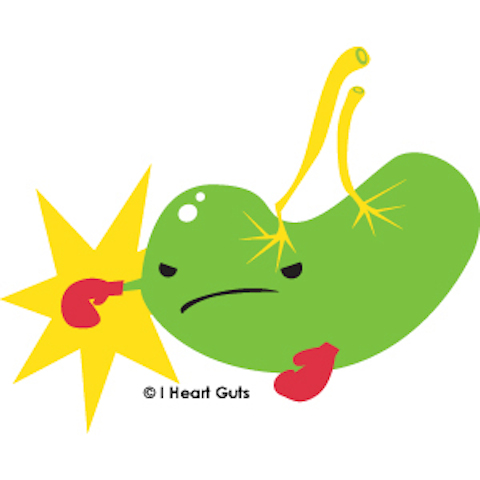
(Don’t be embarrassed if you remain a bit shaky on what exactly the spleen’s there to do. This simple, non-musical primer on the “Queen of Clean,” compliments of I Heart Guts, should clear things up right away.
“If by some miracle some prophet could describe the future exactly as it was going to take place, his predictions would sound so absurd, so far-fetched that everyone would laugh him to scorn.”
That was Sir Arthur C. Clarke, science fiction author best known for 2001: A Space Odyssey, describing the inherent folly of predicting the future in a 1964 BBC documentary. Of course, he then goes on to do exactly that – with remarkable, unnerving accuracy. Part one of the documentary is above. Part two is below.
The piece opens with a generic narration that describes a diorama of future society at the GM pavilion at the 1964 World Fair. Perhaps because it was a more innocent time or maybe because it was sponsored by an automaker, this vision of the future is touchingly oblivious to anything related to climate change. Machines with laser guns will clear jungles in hours flat and people will live in domed communities on the ice caps. (Ice caps in the future. Hilarious.)
Then the reedy, bespectacled author appears and starts to describe how he thinks the world in fifty years (i.e. 2014) will look. And this is where the movie starts to feel uncanny. He talks about how the advancement of transistors and satellites will radically alter our understanding of physical space.
These things will make possible a world in which we can be in instant contact wherever we may be. Where we can contact our friends anywhere on earth, even if we don’t know their actual physical location. It will be possible in that age, possibly 50 years from now, for a man to conduct his business from Tahiti or Bali just as well as he could from London.
For the record, I’m writing this post in a coffee shop in Los Angeles, hundreds of miles from the massive Open Culture headquarters in Palo Alto, but I could just as easily be writing this on a beach in Sri Lanka or a hotel room in Dubrovnik. Clarke sounds here less like some pie-in-the-sky futurist than an aspirational lifestyle guru like Tim Ferris.
Clarke then describes how medicine might change. “One day, we might have brain surgeons in Edinburgh operating on patients in New Zealand.” The long-distance virtual surgery first was pioneered back in 2001 and it continues to improve as internet speeds increase.
And he predicts that at some point science will invent a “replicating device” that would create an exact copy of anything. That sounds an awful lot like a 3D printer. Clarke warns that this invention might cause massive societal disruption. “Confronted by such a device, our present society would probably sink into a kind of gluttonous barbarism. Since everyone would want unlimited quantities of everything.” In other words, 3D printers might turn the world into Black Friday at Walmart.
Some of his other ideas are just weird. Clarke proposes to tame and train armies of chimpanzees to cook, clean and do society’s grunt work. “We can certainly solve our servant problem with the help of the monkey kingdom. “ Planet of the Apes wouldn’t come out for another four years so Clarke could be forgiven for not realizing that that is one terrible idea. On the other hand, it’s hard to see how hiring monkeys could possibly make the customer service at Time Warner Cable any worse than it already is.
Jonathan Crow is a Los Angeles-based writer and filmmaker whose work has appeared in Yahoo!, The Hollywood Reporter, and other publications. You can follow him at @jonccrow.
On April 26, 1986, the number 4 reactor at the Chernobyl nuclear power plant blew up in what is now Ukraine. The site spewed a cloud of radioactive material that spread over much of Europe. The area immediately around Chernobyl received more than 400 times the radiation as Hiroshima and won’t be safely inhabitable for about 20,000 years. The government set up a 1,000 square mile exclusion zone around the site. While short visits to the zone are possible without too much danger, living there is not advisable. Cancer is a real problem for the couple hundred elderly stalwarts who still make the zone their home.
Within the zone, nature has taken its own course, dismantling the Soviet-era brutalist tenements of the surrounding abandoned cities and turning it into what at first blush looks more and more like a prelapsarian Eden. The truth proves to be more complicated.
Dr. Timothy Mousseau, a biologist from the University of South Carolina, has been examining the wildlife around Chernobyl for fifteen years. He’s discovered that the radiation that has been bathing the area for almost 30 years is changing nature. As you can see in the New York Times Op-Doc video above, birds are developing tumors, bugs have abnormal spots and spider webs seem much more freeform than usual. Get more on the story over at the Times.
If you would like to support the mission of Open Culture, consider making a donation to our site. It’s hard to rely 100% on ads, and your contributions will help us continue providing the best free cultural and educational materials to learners everywhere. You can contribute through PayPal, Patreon, and Venmo (@openculture). Thanks!
Jonathan Crow is a Los Angeles-based writer and filmmaker whose work has appeared in Yahoo!, The Hollywood Reporter, and other publications. You can follow him at @jonccrow.
We're hoping to rely on loyal readers, rather than erratic ads. Please click the Donate button and support Open Culture. You can use Paypal, Venmo, Patreon, even Crypto! We thank you!
Open Culture scours the web for the best educational media. We find the free courses and audio books you need, the language lessons & educational videos you want, and plenty of enlightenment in between.




.jpg)