Last week, we featured a Prize-Winning Animation of 17th Century London. In many ways, it could be paired with these short virtual tours of the Globe Theatre. Built in 1599 by Shakespeare’s playing company, the Lord Chamberlain’s Men, the original theatre hosted some of the Bard’s greatest plays until it burned down 14 years later. In 1613, during a performance of Henry VIII, a stage cannon ignited the thatched roof and the theatre burned to the ground in less than two hours. Rebuilt with a tile roof, the theatre re-opened in 1614, and remained active until England’s Puritan administration closed all theatres in 1642. A modern reconstruction of the Globe, named “Shakespeare’s Globe,” was built in 1997, just a few feet away from the original structure. If you want to get a feel for what Shakespeare’s theatre looked like, then look no further than this virtual tour. All you need is this free Quicktime plugin for your browser and you can take a 360 tour of the stage, the yard, the middle gallery, and the upper gallery … all without leaving your seat.
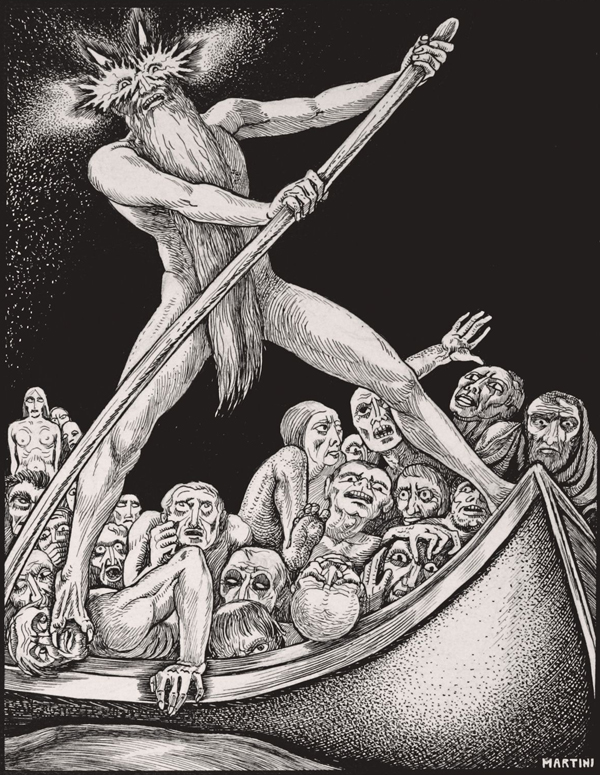
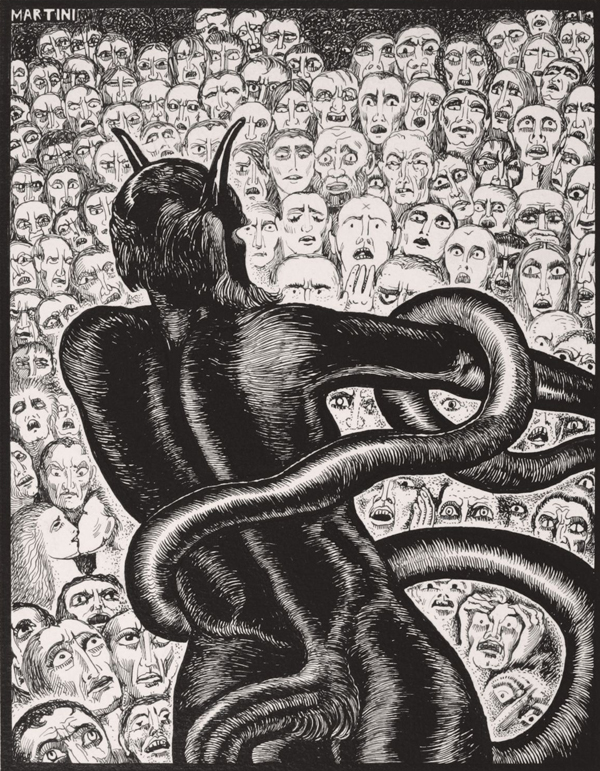
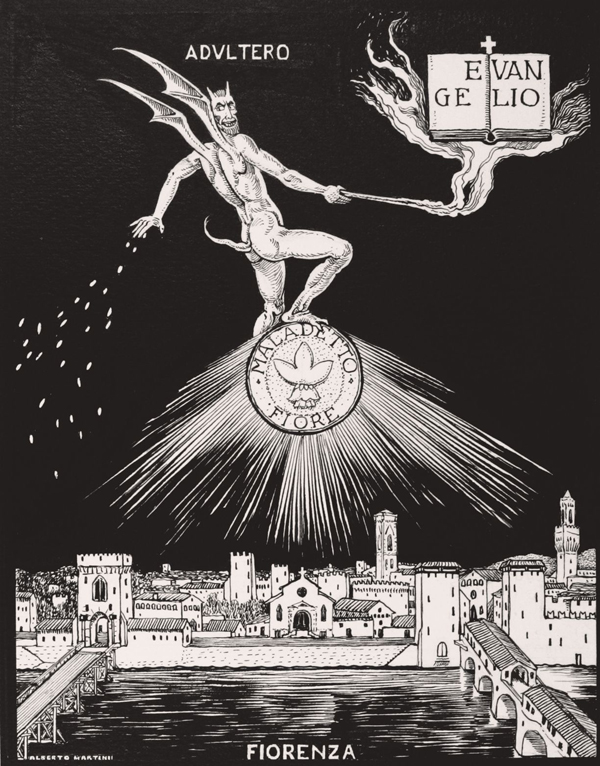
In 1901, Vittorio Alinari, head of Fratelli Alinari, the world’s oldest photographic firm, decided to publish a new illustrated edition of Dante’s Divine Comedy. To do so, Alinari announced a competition for Italian artists: each competitor had to send illustrations of at least two cantos of the epic poem, which would result in one winner and a public exhibition of the drawings. Among the competitors were Alberto Zardo, Armando Spadini, Ernesto Bellandi, and Alberto Martini.
While Martini did not win the competition, he, as Vittorio Sgarbi wrote in his foreword to Martini’s La Divina Commedia, “seemed born to illustrate the Divine Comedy.” The 1901 contest was followed by two more sets of illustrations between 1922 and 1944, which produced altogether almost 300 works in a wide range of styles, including pencil and ink to the watercolor tables painted between 1943 and 1944. While repeatedly rejected publication during his lifetime, a comprehensive edition of Martini’s La Divinia Commedia is available today.
With his feeling for the grotesque and the macabre, Martini’s work was much more influenced by the Northern Mannerism movement than Italian art and is often seen as a precursor to Surrealism, as Martini was a favorite of André Breton. However, while steeped in the surrealism of Odilon Redon and Aubrey Beardsley black and white counterpoints, Martini’s Divine Comedy is filled with an original sense of fantasy and beautifully conveys Dante’s more abstract imagery. Needless to say, Martini’s interpretation was very much in a world apart from the Italian Futurist and Metaphysical movements of the day.
Ignored by Italian critics most his life, Martini continued to produce a large number of illustrations and painting until his death in 1954. As he wrote in his autobiography, “Only the true great artists do not age, because they are able to innovate and invent new forms, new colors, genuine inventions.” Martini’s Divine Comedy is as shocking and beautiful today as it was in the early twentieth century, and is the best example of Martini’s progression as an artist throughout his career.
For a very different artistic interpretation of the Divine Comedy, see our posts on editions by Salvador Dalí and Gustave Doré.
“The following film describes an unusual motion picture now being produced in London for release all over the world starting in 1967.” We hear and see this announcement, which precedes A Look Behind the Future, the promotional documentary above, delivered by a pomade-haired, horn-rimmed middle-aged fellow. He has much else to say about our need to prepare ourselves through edifying entertainment for the “radical revisions in our total society” fast ushered in by the Space Age. Another, even more official-sounding announcer introduces this man as “the publisher of Look magazine, Mr. Vernon Myers.” This could happen at no time but the mid-1960s, and Myers could refer to no other “unusual motion picture” than Stanley Kubrick’s 2001: A Space Odyssey.
Modern-day examinations of 2001 usually celebrate the film’s still-striking artistic vision and its influence on so much of the science fiction that followed. But when this short appeared, not only did the year 2001 lay far in the future, so did the movie itself. Contemporary with Kubrick’s production, it touts how thoroughly researchers have rooted the speculative devices of the story in the thrilling technologies then in real-life development (whether ultimately fruitful or otherwise), and how the picture thus offers the most accurate prediction of mankind’s high-tech future yet. It even brings in co-author Arthur C. Clarke himself to comment upon the NASA lunar exploration gear under construction. The Apollo 11 moon landing would, of course, come just three years later. A Look Behind the Future reflects the enterprising if square technological optimism of that era, a tone that perhaps hasn’t aged quite as well as the haunting, bottomlessly ambiguous film it pitches.
If you would like to support the mission of Open Culture, consider making a donation to our site. It’s hard to rely 100% on ads, and your contributions will help us continue providing the best free cultural and educational materials to learners everywhere. You can contribute through PayPal, Patreon, and Venmo (@openculture). Thanks!
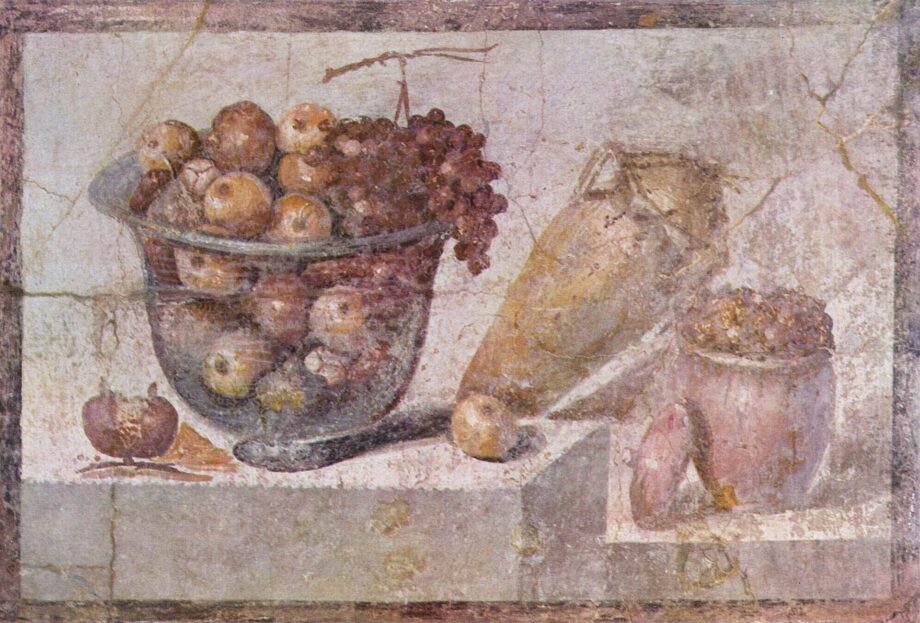
Marcus Gavius Apicius, who lived in the first century AD, was as fine an embodiment of Rome’s insatiable excess as any of his fellow citizens. While some men gained infamy for wanton cruelty or feats of courage, Apicius came to be known as Rome’s most prodigious glutton, with Pliny calling him “the most riotous glutton and bellie-god of his time.” (An alternative, and equally delectable translation, is the “most gluttonous gorger of all spendthrifts.”)
Hearing too that [the crawfish] were very large in Africa, he sailed thither, without waiting a single day, and suffered exceedingly on his voyage. But when he came near the place, before he disembarked from the ship, (for his arrival made a great noise among the Africans,) the fishermen came alongside in their boats and brought him some very fine crawfish; and he, when he saw them, asked if they had any finer; and when they said that there were none finer than those which they brought, he, recollecting those at Minturnæ, ordered the master of the ship to sail back the same way into Italy, without going near the land.
Some would say that sailing all the way to Libya for fish and refusing to set foot ashore because you weren’t impressed with some fishermen’s wares might be called petulant. They would be wrong. It is gastronomically discerning. No less, however, would be expected of a man who ended his life when, as Martial remarks, his purse could no longer support his stomach:
Apicius, you have spent 60 million [sesterces] on your stomach, and as yet a full 10 million remained to you. You refused to endure this, as also hunger and thirst, and took poison in your final drink. Nothing more gluttonous was ever done by you, Apicius.
Only fitting, then, that one of Rome’s best known gourmands became the attributed author of the oldest surviving cookbook. Apicius’ De re coquinaria, which emerged between the 4th and 5th centuries AD,is a compilation of almost 500 Roman recipes arranged, much like contemporary cookbooks, by ingredients. This culinary goldmine, which includes instructions on preparing brains and udders, was inaccessible to English speakers until the advent of Barbara Flower and Elizabeth Rosenbaum’s The Roman cookery book: A critical translation of “The art of cooking” by Apicius, for use in the study and kitchen (1958). Here’s a sample from Book 9, From The Sea:
- Mussels: liquamen, chopped leeks, passum, savory, wine. Dilute the mixture with water, and boil the mussels in it.
- (Sauce) for oysters: pepper, lovage, yolk of egg, vinegar, liquamen, oil and wine. If you wish, add honey.
- (Sauce) for all kinds of shellfish: pepper, lovage, parsley, dried mint, lots of cumin, honey, vinegar, liquamen. If you wish, add a bay leaf and folium indicum.
Unfortunately for the aspiring Roman chef, neither De re coquinaria nor Mmes. Flower and Rosenbaum included the necessary quantities of the ingredients. While one may choose to parse the translation independently to arrive at the appropriate meaning of “lots of cumin,” there is help for those looking for a quick fix.
In 2003, a chef and food historian named Patrick Faas published Around the Roman Table: Food and Feasting in Ancient Rome. While some of the content concerns Roman table manners, the heart of the book lies in the recipes. Faas provides over 150 recipes, most of which he sources from Flower and Rosenbaum’s translation (alongside a few dishes mentioned by Pliny and Cato). Eight are freely available on the University of Chicago Press website, and we’ve provided a few as an amuse-bouche:
Roast Wild Boar
Aper ita conditur: spogiatur, et sic aspergitur ei sal et cuminum frictum, et sic manet. Alia die mittitur in furnum. Cum coctus fuerit perfundutur piper tritum, condimentum aprunum, mel, liquamen, caroenum et passum.
Boar is cooked like this: sponge it clean and sprinkle with salt and roast cumin. Leave to stand. The following day, roast it in the oven. When it is done, scatter with ground pepper and pour on the juice of the boar, honey, liquamen, caroenum, and passum. (Apicius, 330)
For this you would need a very large oven, or a very small boar, but the recipe is equally successful with the boar jointed. Remove the bristles and skin, then scatter over it plenty of sea salt, crushed pepper and coarsely ground roasted cumin. Leave it in the refrigerator for 2–3 days, turning it occasionally.
Wild boar can be dry, so wrap it in slices of bacon before you roast it. At the very least wrap it in pork caul. Then put it into the oven at its highest setting and allow it to brown for 10 minutes. Reduce the oven temperature to 180°C/350°F/Gas 4, and continue to roast for 2 hours per kg, basting regularly.
Meanwhile prepare the sauce. To make caroenum, reduce 500ml wine to 200ml. Add 2 tablespoons of honey, 100ml passum, or dessert wine, and salt or garum to taste. Take the meat out of the oven and leave it to rest while you finish the sauce. Pour off the fat from the roasting tin, then deglaze it with the wine and the honey mixture. Pour this into a saucepan, add the roasting juices, and fat to taste.
Carve the boar into thin slices at the table, and serve the sweet sauce separately.
Ostrich Ragoût
Until the 1980s the ostrich was considered as exotic as an elephant, but since then it has become available in supermarkets. Cooking a whole ostrich is an enormous task, but Apicius provides a recipe for ostrich:
In struthione elixo: piper, mentam, cuminum assume, apii semen, dactylos vel caryotas, mel, acetum, passum, liquamen, et oleum modice et in caccabo facies ut bulliat. Amulo obligas, et sic partes struthionis in lance perfundis, ete desuper piper aspargis. Si autem in condituram coquere volueris, alicam addis.
For boiled ostrich: pepper, mint, roast cumin, celery seed, dates or Jericho dates, honey, vinegar, passum, garum, a little oil. Put these in the pot and bring to the boil. Bind with amulum, pour over the pieces of ostrich in a serving dish and sprinkle with pepper. If you wish to cook the ostrich in the sauce, add alica. (Apicius, 212)
You may prefer to roast or fry your ostrich, rather than boil it. Whichever method you choose, this sauce goes with it well. For 500g ostrich pieces, fried or boiled, you will need:
2 teaspoon flour
2 tablespoons olive oil
300ml passum (dessert wine)
1 tablespoon roast cumin seeds
1 teaspoon celery seeds
3 pitted candied dates
3 tablespoons garum or a 50g tin of anchovies
1 teaspoon peppercorns
2 tablespoons fresh chopped mint
1 teaspoon honey
3 tablespoons strong vinegar
Make a roux with the flour and 1 tablespoon of the olive oil, add the passum, and continue to stir until the sauce is smooth. Pound together in the following order: the cumin, celery seeds, dates, garum or anchovies, peppercorns, chopped mint, the remaining olive oil, the honey, and vinegar. Add this to the thickened wine sauce. Then stir in the ostrich pieces and let them heat through in the sauce.
Nut Tart
Patina versatilis vice dulcis: nucleos pineos, nuces fractas et purgatas, attorrebis eas, teres cum melle, pipere, liquamine, lacte, ovis, modico mero et oleo, versas in discum.
Try patina as dessert: roast pine nuts, peeled and chopped nuts. Add honey, pepper, garum, milk, eggs, a little undiluted wine, and oil. Pour on to a plate. (Apicius, 136)
400g crushed nuts—almonds, walnuts or pistachios
200g pine nuts
100g honey
100ml dessert wine
4 eggs
100ml full-fat sheep’s milk
1 teaspoon salt or garum
pepper
Preheat the oven to 240°C/475°F/Gas 9.
Place the chopped nuts and the whole pine nuts in an oven dish and roast until they have turned golden. Reduce the oven temperature to 200°C/400°F/Gas 6. Mix the honey and the wine in a pan and bring to the boil, then cook until the wine has evaporated. Add the nuts and pine nuts to the honey and leave it to cool. Beat the eggs with the milk, salt or garum and pepper. Then stir the honey and nut mixture into the eggs. Oil an oven dish and pour in the nut mixture. Seal the tin with silver foil and place it in roasting tin filled about a third deep with water. Bake for about 25 minutes until the pudding is firm. Take it out and when it is cold put it into the fridge to chill. To serve, tip the tart on to a plate and pour over some boiled honey.
Columella Salad
Columella’s writings suggest that Roman salads were a match for our own in richness and imagination:
Addito in mortarium satureiam, mentam, rutam, coriandrum, apium, porrum sectivum, aut si non erit viridem cepam, folia latucae, folia erucae, thymum viride, vel nepetam, tum etiam viride puleium, et caseum recentem et salsum: ea omnia partier conterito, acetique piperati exiguum, permisceto. Hanc mixturam cum in catillo composurris, oleum superfundito.
Put savory in the mortar with mint, rue, coriander, parsley, sliced leek, or, if it is not available, onion, lettuce and rocket leaves, green thyme, or catmint. Also pennyroyal and salted fresh cheese. This is all crushed together. Stir in a little peppered vinegar. Put this mixture on a plate and pour oil over it. (Columella, Re Rustica, XII-lix)
A wonderful salad, unusual for the lack of salt (perhaps the cheese was salty enough), and that Columella crushes the ingredients in the mortar.
100g fresh mint (and/or pennyroyal)
50g fresh coriander
50g fresh parsley
1 small leek
a sprig of fresh thyme
200g salted fresh cheese
vinegar
pepper
olive oil
Follow Columella’s method for this salad using the ingredients listed.
In other salad recipes Columella adds nuts, which might not be a bad idea with this one.
Apart from lettuce and rocket many plants were eaten raw—watercress, mallow, sorrel, goosefoot, purslane, chicory, chervil, beet greens, celery, basil and many other herbs.
Philosophers are quirky creatures. Some become household names, in certain well-educated households, without anyone knowing a thing about their lives, their loves, their apartments. The life of the mind, after all, rarely makes for good theater (or TV). And prior to the creation of whole academic departments devoted to contemplation and regional conferences, a philosopher’s life could be a very lonely one. Or so it would seem to those who shun solitude. But for the bookish among us, the glimpses we have here into the well-kept homes and studies of several famous dead male European thinkers may elicit sighs of wonder, or envy even. It was so much easier to keep a room of one’s own neat before computer paraphernalia and tiny sheaves of Post-it notes cluttered everything up, no?
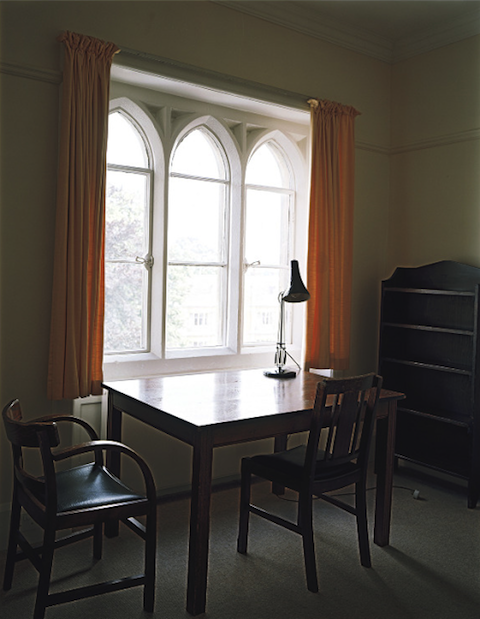
At the top of the post, we have an austere space for a severely austere thinker, Ludwig Wittgenstein. His desk in Cambridge faces a vaulted triptych of sunlit windows, but the bookshelf has clearly been emptied since his stay, unless Herr Wittgenstein preferred to work free of the distraction of other people’s published work. Above, another angle reveals comfortable seating near the fireplace, since blocked up with what appears to be an electric heater, an appliance the ultra-minimalist Wittgenstein may have found superfluous.
In addition to his philosophy, the German scion of a wealthy and eccentric family had an interest in photography and architecture, and he built his sister Margaret a house (above) that became known for “for its clarity, precision, and austerity—and served as a foil for his written work.” Wittgenstein’s eldest sister Hermione pronounced the house unlivable, as it “seemed indeed to be much more a dwelling for the gods than for a small mortal like me.”
Another polymath, credited along with Goethe for a phase of German thought called Weimar Classicism, poet and philosopher Friedrich Schiller’s studio in his Weimar house above presents us with a light, airy space, a standing desk, and some surprisingly well-tended furnishings. Whether they are original or not I do not know, but the space befits the man who wrote Letters Upon the Aesthetic Education of Man, in which (Fordham University informs us) he “gives the philosophic basis for his doctrine of art, and indicates clearly and persuasively his view of the place of beauty in human life.” The entire house is a study in beauty. A much gloomier character, whose view of humankind’s capacity for rational development was far less optimistic than Schiller’s, Arthur Schopenhauer lived a solitary existence, surrounded by books—a life much more like the caricature of philosophy. Below, see Schopenhauer’s book collection lined up neatly and catalogued.
The façade of Schopenhauer’s birth house in Gdansk, below, doesn’t stand out much from its neighbors, none of whom could have guessed that the strange child inside would prepare the way for Nietzsche and other scourges of the good Christian bourgeoisie. No doubt little Arthur received his portion of ridicule as he shuffled in and out, an odd boy with an odd haircut. And if Schopenhauer didn’t actually write the words attributed to him about the “three stages of truth”—ridicule, violent opposition, and acceptance—he may have fully agreed with the sentiment.
Finally, speaking of Nietzsche, we have below the Nietzsche-Haus in Sils-Maria, Switzerland, where the lover of mountainous climes and hater of the vulgar rabble’s noise holed away to work in the summers of 1881, 1883, and 1888. The house now contains an open library, one of the world’s largest collections of books on Nietzsche. Trip Advisor gives the site four-and-a-half stars, a crowd-sourced score, of course, of which Nietzsche, I’m sure, would be proud.
Cinema history now looks back to Georges Méliès, creator of 1902’s A Trip to the Moon and other early motion pictures previously featured here, as the medium’s first master of the fantastical. Visual effects, imagined worlds, and the seemingly impossible made seemingly real remain reliable draws for modern-day filmgoers, but so does something far simpler to produce: skin. But Méliès knew that, and he even demonstrated the extent of his knowledge in 1897’s After the Ball, viewable in all of its 19th-century titillation, and for its entire 1:06 length, here. While not the very first “adult” film — that historical honor goes to Eugène Pirou’s Bedtime for the Bride in France, and Esmé Collings’ A Victorian Lady in Her Boudoir in Britain — it must count as the earliest one by such a distinguished filmmaker. And it’s the only one of the three mentioned here you can watch online.
Michael Brooke’s Georges Méliès blog describes the action, shall we say, as follows: “A woman enters her boudoir, and her maid helps her to undress, peeling off her outer garments until she is clad in a shift and stockings. She sits down, and the maid helps remove the latter. Almost naked aside from skimpy underwear, the woman gets into a tub and the maid pours the contents of a large jug over her, drying her off with a towel afterwards. They leave the room together.” While modern-day adult filmmakers can and do continue to dine out on such premises, After the Ball’s rendition of the circumstances now looks tame enough to play freely on Youtube. Brooke adds that this film, along with Collings’ and probably Pirou’s, was “marketed as being suitable for private screenings to broad-minded bachelors.” Méliès’ contribution to this innovation must have made for a few worthwhile fin de siècle bachelor parties.
Following his retirement from filmmaking earlier this year, Steven Soderbergh has filled his time with some interesting endeavors. He tweeted an entire novella, and now he has posted a log of all the films and television shows he watched, and all the books and plays he read, in 2009.
As you will see in the log (below), Soderbergh spent much of that year in preparation for the scheduled June shoot of his adaptation of Michael Lewis’s book Moneyball, which was abruptly shut down only days before shooting was to begin, due to disagreements over revisions to Steven Zaillian’s screenplay. Soderbergh read the book for the second, third, and fourth time, as well as much of the work of baseball statistician Bill James, including every abstract James published from 1977 to 1988.
More interesting is his film and television log, which alternates between current Hollywood and indie releases and classic Hollywood titles. The list should be no surprise coming from a filmmaker repeatedly called a stylistic chameleon. Should we be surprised he follows a Ken Russell phase with The Lone Ranger? Or that he’s just like us and binge-watches Breaking Bad?
The log also sheds light on the post-production process of two of his films released in 2009, The Girlfriend Experience and The Informant, the former viewed three times, the latter four. Was his repeated viewing of Being There inspiration? Or is it simply one of his favorite films?
This is not the first time Soderbergh revealed his viewing log. In 2011, he gave Studio 360’s Kurt Anderson his 2010 log, which included twenty viewings of his film Haywire and several Raiders of the Lost Ark, in black and white.
See the full 2009 list below.
SEEN, READ 2009
All caps: MOVIE
All caps, star: TV SERIES*
All caps, italics: BOOK
Quotation marks: “Play”
1/1/09 VALKRYIE, THE GODFATHER
1/4/09 REMAINDER, Tom McCarthy
1/7/09 BURN AFTER READING
1/10/09 MADE IN USA, STATE AND MAIN
1/13/09 BEING THERE
1/14/09 THE INFORMANT, THE GIRLFRIEND EXPERIENCE
1/15/09 ARSENALS OF FOLLY, Richard Rhodes
1/24/09 THE GRAND, JAWS
1/25/09 THE HOT ROCK
1/27/09 SOLITARY MAN
1/30/09 THE APARTMENT, MONEYBALL (2) Michael Lewis
2/3/09 THE INFORMANT
2/6/09 “The Removalists”
2/7/09 “The War of the Roses, Part One”, THE GIRLFRIEND EXPERIENCE
2/8/09 THINGS I DIDN’T KNOW, Robert Hughes, FIVE EASY PIECES
2/9/09 SOLITARY MAN
2/11/09 MONEYBALL (3)
2/11/09 “The Talking Cure”, Christopher Hampton
2/14/09 HISTORICAL BASEBALL ABSTRACT, Bill James. CORALINE, W., REBECCA.
2/15/09 FROZEN RIVER, WHATEVER HAPPENED TO COOPERSTOWN, Bill James.
2/18/09 BEING THERE
2/20/09 THE OSCAR
2/21/09 PANIC ROOM, THE PARALLAX VIEW
2/22/09 THE BRIDE WORE BLACK
2/23/09 1977, ’78, ’79 BASEBALL ABSTRACT, Bill James.
5/24/09 DIGITAL BARBARISM, Mark Helprin, BREAKING BAD* (1 episode), TRANSSIBERIAN
5/31/09 THREE DAYS OF THE CONDOR, DRAG ME TO HELL, BREAKING BAD* (1 episode)
6/02/09 THE CULT OF THE AMATEUR, Andrew Keen
6/04/09 3 NIGHTS IN AUGUST, Buzz Bissinger
6/06/09 THE HANGOVER, MISSION: IMPOSSIBLE
6/21/09 MOON
6/23/09 THE FORTUNE COOKIE
6/26/09 THE HURT LOCKER, BARRY LYNDON
6/27/09 THE GRADUATE
6/28/09 BEING THERE
6/29/09 2001: A SPACE ODYSSEY
7/01/09 SUNSET BOULEVARD
7/02/09 CLOSE ENCOUNTERS OF THE THIRD KIND
7/03/09 PUBLIC ENEMIES
7/04/09 THE KILLING OF SISTER GEORGE
7/07/09 TWO LOVERS
7/08/09 THE EMPEROR’S NAKED ARMY MARCHES ON, THE FAILURE, James Greer.
7/09/09 HUMAN SMOKE, Nicholson Baker
7/10/09 SLAP SHOT
7/11/09 BRUNO
7/12/09 THE PRIVATE LIFE OF SHERLOCK HOLMES, PERSONA, THE CHARGE OF THE LIGHT BRIGADE (’68), ELGAR*, THE DEBUSSY FILM*, PYGMY, Chuck Palahniuk
7/14/09 ALWAYS ON SUNDAY*, ISADORA: THE BIGGEST DANCER IN THE WORLD*
7/15/09 DANTE’S INFERNO*, ALTERED STATES
7/16/09 THE LONE RANGER
7/17/09 THE LONE RANGER AND THE CITY OF LOST GOLD
7/18/09 GET SHORTY
7/26/09 ORPHAN, REPULSION
7/27/09 THE HOSPITAL
7/30/09 THE COLLECTOR (’65)
7/31/09 ZODIAC, SONG OF SUMMER*, MUSICOPHILIA, Oliver Sacks
8/01/09 A PERFECT MURDER
8/02/09 VOX, NIcholson Baker, CACHE
8/03/09 ADVISE AND CONSENT
8/05/09 THE LONG GOODBYE
8/06/09 THE RED SHOES
8/08/09 INHERENT VICE, Thomas Pynchon, UNMAN, WITTERING, AND ZIGO, ELECTRA GLIDE IN BLUE, THE ASCENT OF MONEY*, THE SHINING
8/13/09 THIEVES LIKE US, REDS (part two)
8/15/09 CHINATOWN, CITIZEN RUTH
8/16/09 DISTRICT 9, MADE MEN* (1 episode)
Justin Alvarez is the digital director of The Paris Review. His work has appeared in Ploughshares, Guernica, and Flatmancrooked’s Slim Volume of Contemporary Poetics. Follow him at @Alvarez_Justin.
For some time now, Slavoj Žižek has been showing up as an author and editor of theology texts alongside orthodox thinkers whose ideas he thoroughly naturalizes and reads through his Marxist lens. Take, for example, an essay titled, after the Catholic G.K. Chesterton, “The ‘Thrilling Romance of Orthodoxy’ ” in the 2005 volume, partly edited by Žižek, Theology and the Political: The New Debate. In Chesterton’s defense of Christian orthodoxy, Žižek sees “the elementary matrix of the Hegelian dialectical process.” While “the pseudo-revolutionary critics of religion” eventually sacrifice their very freedom for “the atheist radical universe, deprived of religious reference… the gray universe of egalitarian terror and tyranny,” the same paradox holds for the fundamentalists. Those “fanatical defenders of religion started with ferociously attacking the contemporary secular culture and ended up forsaking religion itself (losing any meaningful religious experience).”
For Žižek, a middle way between these two extremes emerges, but it is not Chesterton’s way. Through his method of teasing paradox and allegory from the cultural artifacts produced by Western religious and secular ideologies—supplementing dry Marxist analysis with the juicy voyeurism of psychoanalysis—Žižek finds that Christianity subverts the very theology its interpreters espouse. He draws a conclusion that is very Chestertonian in its ironical reversal: “The only way to be an atheist is through Christianity.” This is the argument Žižek makes in his latest film, The Pervert’s Guide to Ideology. In the clip above, over footage from Scorsese’s The Last Temptation of Christ, Žižek claims:
Christianity is much more atheist than the usual atheism, which can claim there is no God and so on, but nonetheless it retains a certain trust into the Big Other. This Big Other can be called natural necessity, evolution, or whatever. We humans are nonetheless reduced to a position within the harmonious whole of evolution, whatever, but the difficult thing to accept is again that there is no Big Other, no point of reference which guarantees meaning.
The charge that Christianity is a kind of atheism is not new, of course. It was levied against the early members of the sect by Romans, who also used the word as a term of abuse for Jews and others who did not believe their pagan pantheon. But Žižek means something entirely different. Rather than using atheism as a term of abuse or making a deliberate attempt to shock or inflame, Žižek attempts to show how Christianity differs from Judaism in its rejection of “the big other God” who hides his true desires and intentions, causing immense anxiety among his followers (illustrated, says Žižek, by the book of Job). This is then resolved by Christianity in an act of love, a “resolution of radical anxiety.”
And yet, says Žižek, this act—the crucifixion—does not reinstate the metaphysical certainties of ethical monotheism or populist paganism. “The death of Christ,” says Žižek, “is not any kind of redemption… it’s simply the disintegration of the God which guarantees the meaning of our lives.” It’s a provocative, if not particularly original, argument that many post-Nietzschean theologians have arrived at by other means. Žižek’s reading of Christianity in The Pervert’s Guide to Ideology—alongside his copious writing and lecturing on the subject—constitutes a challenge not only to traditional theistic orthodoxies but also to secular humanism, with its quasi-religious faith in progress and empirical science. Of course, his critique of the vulgar certainties of orthodoxy should also apply to orthodox Marxism, something Žižek’s critics are always quick to point out. Whether or not he’s sufficiently critical of his communist vision of reality, or has anything coherent to say at all, is a point I leave you to debate.
Despite being the paragon of imperturbable masculinity of his time, Ernest Hemingway had a highly sensitive artistic temperament. Nowhere did he exhibit this more than when discussing his writing. Papa did not suffer fools gladly, and literary critics tended to fare even worse. After Max Eastman dared to write, “Come out from behind that false hair on your chest, Ernest. We all know you,” Hemingway was reported to have slapped him with a book. When Orson Welles—a cinematic firebrand in his own right—decided to chide Hemingway about his script, the author took a swing.
In this YouTube clip, the critic seems to have gotten away with merely a verbal wallop. Although there is no video, the audio is clear, and we hear Hemingway’s measured baritone reading, then commenting on, an Irish critic’s review that he had received in 1931:
‘Your book lies upon my table. I have finished reading it, and I eye it dubiously.’ You’ve got a nice eye, boy!
‘The pages are cut rather unevenly.’ Nice work, you’re in there.
‘The stiff covers and the binding are normal, I think.’ Who are you, kid?
‘The signature on the cover is stamped in gold, or what looks like gold. There is nothing printed on the back side of the jacket.’ Your own backside.
The reviewer, one Walter H. McKay, fails to probe beyond the book’s binding, and Hemingway, in his typical style, tersely rips him a new one (bonus points if you noticed Hem’s Joycean turn of phrase).
Ilia Blinderman is a Montreal-based culture writer. Follow him at @iliablinderman
A Pacific Northwest artist becomes infatuated with the process of laser engraving wood and hatches a plan for a stop motion animation featuring hundreds of engraved maple blocks that can later be mailed as rewards to his project’s Kickstarter donors.
Fans of the television show Portlandia may find themselves experiencing a false sense of deja vu. Remarkably, Nando Costa is not the invention of comedian Fred Armisen. He’s a real person, and two years ago, whilst living in Portland, he gleefully embarked on what proved to be a very ambitious and time-consuming project.
The sort of project a guy with his skills and experience could have knocked out in a couple of months had the chosen materials been magic markers or clay.
Two years and some 800 wood blocks later, The New America is finally available for viewing, all two minutes and 37 seconds of it. Costa describes the abstract storyline as “a union between concepts and experiments born during the Situationist movement and real life events experienced during the last few years in American society. Particularly the duality between the economic downturn and the shift in values and beliefs of many citizens.”
For now, Costa is content to focus on a new job and settling into a new house after a recent move to Seattle. After that, perhaps an animation that would involve laser-cut paper, but that, he says, would require research.
The 80s saw a number of hits by mostly UK synth-pop and new wave bands with prominent gay members (whether their fans knew it or not) like Culture Club, Soft Cell, Frankie Goes to Hollywood, and Wham!. One of the most impressively talented singers on this burgeoning 80s dance scene was Scottish musician Jimmy Somerville who defined the tremulous falsetto disco sound of bands like Bronski Beat and the Communards. Somerville’s first hit, 1984’s “Smalltown Boy,” was something of an early “It Gets Better” message coupled with a hard-edged dance-pop sound and a very autobiographical video (below). The song, writes Allmusic, dealt openly with Somerville’s sexuality, “a recurring theme [in his work] that met with surprisingly little commercial resistance.”
Today, Somerville lives in Berlin with his dog, and he’s still got that tremendous set of pipes. A Berlin street musician found this out recently while busking “Smalltown Boy” on an acoustic guitar, and bystanders happened to catch it on video (at top). As the young street performer hits the chorus, up walks Somerville to casually join in. The singer starts over and they finish the song in harmony. The more cynical corners of the internet swear the whole thing’s staged, perhaps for a Somerville comeback, but I like to think it’s genuine serendipity, especially at the end as the German busker suddenly has a flash of recognition: “it’s you?” he asks. “It’s me,” says Somerville, “it’s a hit.”
We're hoping to rely on loyal readers, rather than erratic ads. Please click the Donate button and support Open Culture. You can use Paypal, Venmo, Patreon, even Crypto! We thank you!
Open Culture scours the web for the best educational media. We find the free courses and audio books you need, the language lessons & educational videos you want, and plenty of enlightenment in between.