51 Propaganda Techniques Explained in 11 Minutes: From Cognitive Dissonance to Appeal to Fear
The concept of propaganda has a great deal of power to fascinate. So does the very word propaganda, which to most of us today sounds faintly exotic, as if it referred mainly to phenomena from distant places and times. But in truth, can any one of us here in the twenty-first century go a day without being subjected to the thing itself? Watch the video above, in which The Paint Explainer lays out 51 different propaganda techniques in 11 minutes, and you’ll more than likely recognize many of the insidiously effective rhetorical tricks labeled therein from your recent everyday life.
You won’t be surprised to hear that these manifest most clearly in the media, both offline and on. The list begins with “agenda setting,” the “ability of the news to influence the importance placed on certain topics by public opinion, just by covering them frequently and prominently.”
Scattered throughout the news, or throughout your social-media feed, advertisements bring out the “beautiful people,” which “suggests that if people buy a product or follow a certain ideology, they, too will be happy or successful” – or, in its basest forms, operates through “classical conditioning,” in which “a natural stimulus is associated with a neutral stimulus enough times to create the same response by using just the neutral one.”
In the even more shameless realm of politics, the common “plain folk” strategy “attempts to convince the audience that the propagandist’s positions reflect the common sense of the people.” When “an individual uses mass media to create an idealized and heroic public image, often through unquestioning flattery and praise,” a powerful “cult of personality” can arise. And in propaganda for everything from presidential candidates to fast-food chains, you’ll hear and read no end of “glittering generalities,” or “emotionally appealing words that are applied to a product idea, but present no concrete argument or analysis.” You can find many of these strategies explained at Wikipedia’s list of propaganda techniques, or this list from the University of Virginia of “propaganda techniques to recognize” — and not just when the “other side” uses them.
Related content:
Sell & Spin: The History of Advertising, Narrated by Dick Cavett (1999)
Based in Seoul, Colin Marshall writes and broadcasts on cities, language, and culture. His projects include the Substack newsletter Books on Cities, the book The Stateless City: a Walk through 21st-Century Los Angeles and the video series The City in Cinema. Follow him on Twitter at @colinmarshall or on Facebook.
Read More...Why Caspar David Friedrich’s Painting Wanderer Above the Sea of Fog (1818) Is a Romantic Masterpiece, Evoking the Power of the Sublime
When Caspar David Friedrich completed Der Wanderer über dem Nebelmeer, or Wanderer Above the Sea of Fog, in 1818, it “was not well received.” So says gallerist-Youtuber James Payne in his new Great Art Explained video above, which focuses on Friedrich’s most famous painting. In the artist’s lifetime, the Wanderer in fact “marked the gradual decline of Friedrich’s fortunes.” He withdrew from society, and in 1835, “he suffered a stroke that left the left side of his body effectively paralyzed, effectively ending his career.” How, over the centuries since, did this once-ill-fated painting become so iconic that many of us now see it referenced every few weeks?
Friedrich had known popular and critical scorn before. His first major commission, painted in 1808, was “an altarpiece which shows a cross in profile at the top of a mountain, alone and surrounded by pine trees. Hard for us to understand now, but it caused a huge scandal.” This owed in part to the lack of traditional perspective in its composition, which presaged the feeling of boundlessness — overlaid with “rolling mists and fogs” — that would characterize his later work. But more to the point, “landscape had never been considered a suitable genre for overtly religious themes. And of course, normally the crucifixion is shown as a human narrative populated by human figures, not Christ dying alone.”
It’s fair to say that Friedrich did not do things normally, both philosophically — breaking away, with his fellow Romanticists, from the mechanistic Enlightenment consensus about the world — and aesthetically. The Wanderer (further analyzed in the Nerdwriter video just below) presents a Weltanschauung in which “landscape was a representation of a divine world order, and man was an individual who watches, contemplates, and feels much more than he calculates and thinks.” To achieve his desired effect, Friedrich assembles an imagined vista out of various elements seen around Dresden, presenting it in a manner that combines characteristics of both landscapes and portraits to “create a powerful sense of space” while directing our attention to the lone unidentified figure right in the center.
The “curious combination of loneliness and empowerment” that results is key to understanding not just the priorities of the Romantics, but the very nature of the aesthetic sublime they reverently expressed. To be sublime is not just to be beautiful or pleasurable, but also to exude a kind of intimidating, even fearsome vastness; how it feels to enter the presence of the sublime can never be fully replicated, let alone explained, but as Friedrich demonstrates, it can effectively be evoked. Hence, as Payne points out, the tendency of current media like movie posters to crib from the Wanderer, in service of the likes of Dunkirk, Oblivion, Into Darkness, and After Earth. Determining whether those pictures live up to the ambitions evident in Friedrich’s artistic legacy is an exercise left to the reader.
Related content:
An Introduction to the Painting of Caspar David Friedrich, Romanticism & the Sublime
The Otherworldly Art of William Blake: An Introduction to the Visionary Poet and Painter
How the Avant-Garde Art of Gustav Klimt Got Perversely Appropriated by the Nazis
Brian Eno on Creating Music and Art As Imaginary Landscapes (1989)
Based in Seoul, Colin Marshall writes and broadcasts on cities, language, and culture. His projects include the Substack newsletter Books on Cities, the book The Stateless City: a Walk through 21st-Century Los Angeles and the video series The City in Cinema. Follow him on Twitter at @colinmarshall or on Facebook.
Read More...My Neighbor Totoro Inspires a Line of Traditional Japanese Handicrafts
We suppose it’s conceivable that a gift of a wooden Totoro figurine, hand-carved from a single block using 50 different kinds of chisels, might spark a reverence for traditional Japanese craft and nature in the next generation…
Or, they may be left wishing you’d given them a vastly more huggable machine-made plushie version, especially if you can’t help sucking in your breath every time they start fumbling with that exquisitely crafted ¥330,000 yen heirloom-to-be. (That’s $2341.81 in US dollars.)
Of course, director Hayao Miyazaki’s 1988 animated feature My Neighbor Totoro has legions of fans of all ages, and some will consider themselves quite lucky if they win the lottery that grants them the ability to purchase such a treasure.



They’re not only carved by skilled artisans in Inami, the city of woodcarving, but the wood is also that of a camphor tree — the natural habitat of the mysterious, magical Totoro! (It’s also considered holy by practitioners of the Shinto religion.)
Still, if it’s unclear that the recipient will truly appreciate such thoughtfulness, you’re probably better off going with another offering from Studio Ghibli’s Totoro-themed collaboration with Nakagawa Masashichi Shoten, a purveyor of traditional Japanese crafts.

Perhaps a¥4180 bud vase fired in Ureshino City’s Edo-period Yozan Kiln, featuring Totoro or a cluster of susuwatari, the pom pom-like soot sprites infesting the Kusakabe family’s new home, who also play a part in Spirited Away.

Maybe a tiny Totoro bell amulet, molded by craftsmen in Odawara, celebrated for the quality of their metalwork since the early 1500s, when they outfitted samurai with weapons, armor and helmets?
What about a Totoro-emblazoned treasure box from Yatsuo, made of stencil-dyed handmade washi paper? There’s nothing inherently wrong with stashing your acorn collection in an old Altoid’s tin, but this vessel comes with historic pedigree:
As one of the leading towns along the trunk road, Yatuso flourished through … production of wrapping paper for the nation-wide famous “Toyama Medicine”. At its golden age, from the Edo Era to the beginning of the Meiji Era in the 19th century, many people were engaged in papermaking by handwork in their homes. Yatsuo Japanese paper was expected to be unbreakable because it was used as package for expensive medicine and at the same time it should look brilliant. It had to be thick and stout so that it could be impervious to water and the label printed on the surface would not be smeared.
The list of Totoro-inspired traditional crafts is impressive. A representative sampling:
Chusen-dyed tenugui handkerchiefs and t‑shirts…
Dishtowels made from five layers of Kayaori fabric that “was introduced to Japan during the Nara period and is said to allow wind to pass through but keep mosquitoes out”…
Tiny Arita ware acorn plates that reward members of the clean plate club with a view of the Catbus…
View the collection and learn more about February’s lottery for a chance to purchase a Camphor wood Totoro here.
Hands-on fans may prefer to cultivate an appreciation for traditional Japanese handicrafts by attempting a DIY Totoro.
Via Spoon & Tamago/Colossal
Related Content
– Ayun Halliday is the Chief Primatologist of the East Village Inky zine and author, most recently, of Creative, Not Famous: The Small Potato Manifesto and Creative, Not Famous Activity Book. Follow her @AyunHalliday.
Read More...Hear the Haunting Aztec “Death Whistle,” the Instrument That Made Sounds Resembling a Human Scream
The received image of the Aztecs, with their savage battles and frequent acts of human sacrifice, tends to imply a violence-saturated, death-obsessed culture. Given that, it will hardly come as a surprise to learn of an Aztec musical instrument discovered in the hands of a sacrificed human body, or that the instrument has come to be known as the “death whistle.” Not that it was an especially recent find: the excavation in question happened in Mexico City in the late nineteen-nineties. But only over the past decade, with the creation of replicas like the one played by the late Xavier Quijas Yxayotl in the clip above, have listeners around the world been able to hear the death whistle for themselves.
“The sound of the death whistle is the most frightening thing we’ve ever heard,” writes Reuben Westmaas at Discovery.com. “It literally sounds like a screeching zombie. We can only imagine what it would be like to hear hundreds of whistles from an Aztec army on the march. We’re not entirely certain what the whistles were used for, however.”
Whatever its application, the distinctive sound of the death whistle is created by blown air interacting “with a well or ‘spring’ of air inside a rounded internal chamber, creating distortions,” as Dave Roos writes at How Stuff Works. In his analysis of the death whistle’s inner workings, mechanical engineer Roberto Velázquez Cabrera gives that component the evocative name “chaos chamber.”
That the death whistle would be used in war and human sacrifice certainly aligns with the reputation of the Aztecs, but the instrument has also inspired other historically informed speculations. In the video from Gizmodo just above, professor of Mesoamerican and Latino studies Jaime Arredondo even suggests that it could have had its therapeutic uses, as a tool to create a “hypnotic, sort of soothing atmosphere.” It could well have been designed to imitate the sound of the wind, given that the sacrificial victim had been buried at the temple of the wind god Ehecatl. And though the death whistle may seem the least likely tool of relaxation imaginable, put your mind to it and just hear it as sounding less like the screech of a zombie than like the fifteenth-century equivalent of a white-noise machine.
via Boing Boing
Related content:
Based in Seoul, Colin Marshall writes and broadcasts on cities, language, and culture. His projects include the Substack newsletter Books on Cities, the book The Stateless City: a Walk through 21st-Century Los Angeles and the video series The City in Cinema. Follow him on Twitter at @colinmarshall or on Facebook.
Read More...Two Tiny Rembrandt Paintings Have Been Rediscovered & Put On Display in Amsterdam
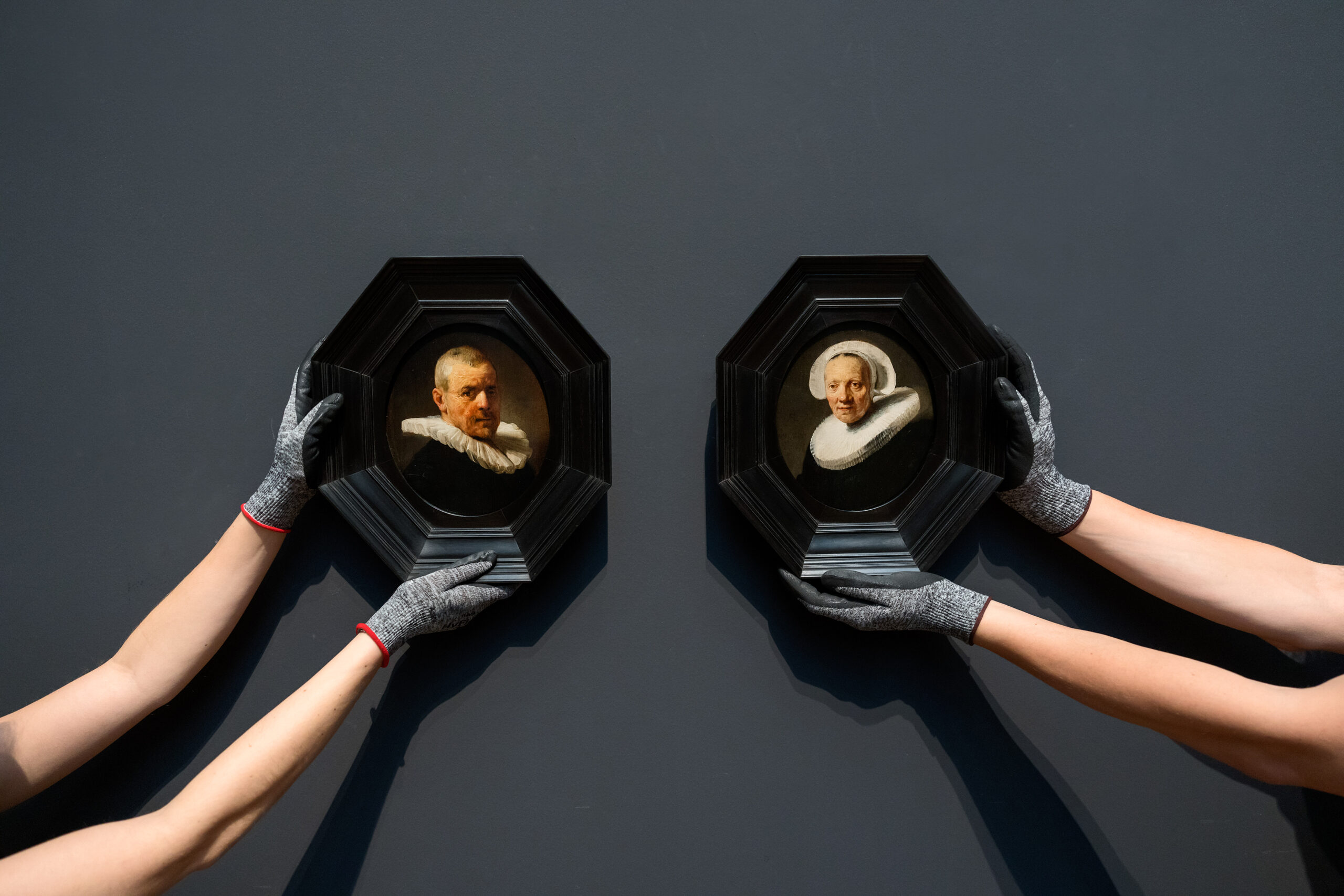
Many first-time visitors to the Louvre experience a letdown to discover how small the Mona Lisa is -just 21” x 30”.
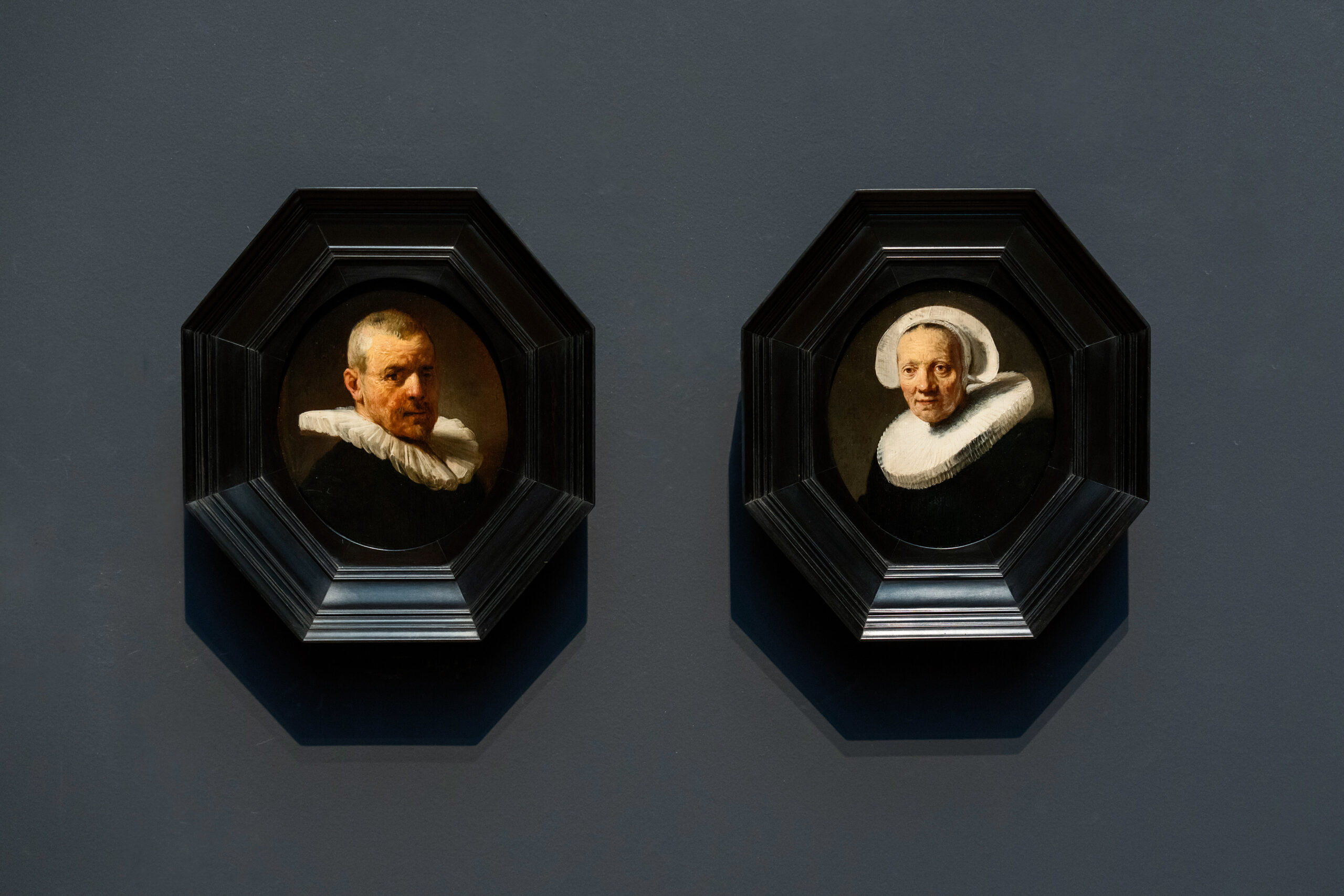
Meanwhile, over in Amsterdam, visitors have been flocking to the Rijksmuseum, eager to lay eyes on the two smallest formal works in the museum’s collection.
Measuring slightly less than 8” tall, they are about as tall as the average retail banana as per US Department of Agriculture estimates.
It’s not just the matching oval portraits’ size that’s packing ’em in.
The recently rediscovered paintings have been identified as the work of Rembrandt Harmenszoon van Rijn, the leading artist of the Dutch Golden Age.
Painted in 1635, the portraits feature Jan Willemsz van der Pluym, a wealthy 17th-century plumber and his wife, Jaapgen Caerlsdr, dressed in black with stiff white ruffs. The couple owned the garden next to the painter’s mother, and he was distantly related to them through a marriage on her side.
Their triple-great-grandchildren put the portraits up for auction in 1760, after which they passed through several private collections, before dropping entirely from public view following an auction in the summer of 1824.
Nearly two hundred years later, Jan and Jaapgen’s portraits weren’t making much of an impression on that winning bidder’s descendants.
As Henry Pettifer, an Old Master Paintings specialist at Christies, which conducted both the 1824 auction and the one last summer, where the portraits fetched 14.3 million dollars, told the Washington Post, “the family liked the pictures but were never certain that they were by Rembrandt and never really looked into that:”
The pictures were completely absent from the Rembrandt literature in the 19th and 20th centuries, which was extraordinary. They have intimacy about them, a dignity. They’re extraordinary… They’re unlike some of his grand, formal commissioned portraits, and they are something much more spontaneous and intimate. I think the reason for that is that the sitters were very closely connected to Rembrandt. They were very much from Rembrandt’s own inner circle. We should regard them as personal documents rather than formal commissions.
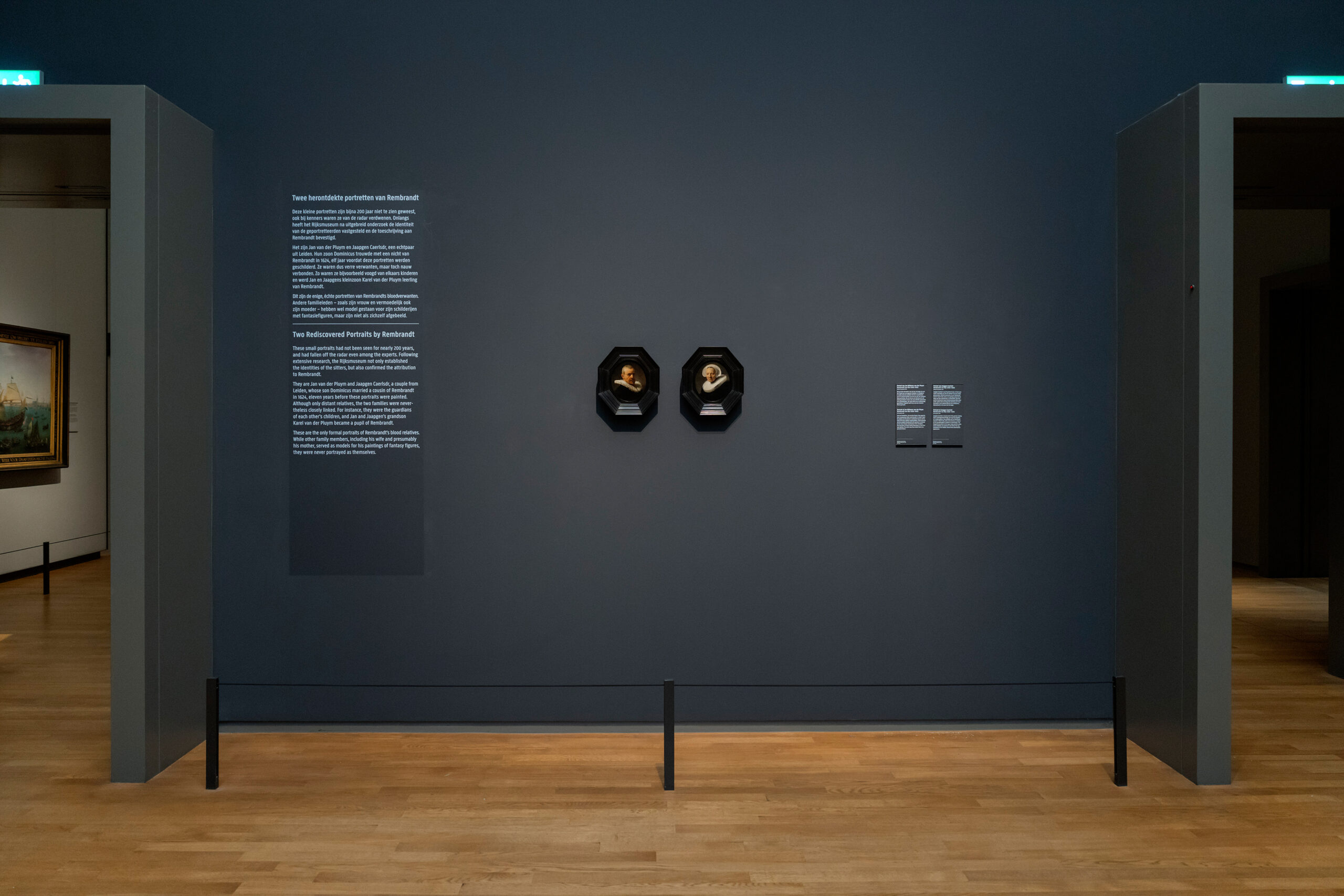
The most recent winning bidder is committed to keeping the paintings in the public eye with a long term-loan to the Rijksmuseum, where extensive research using X‑radiography, infrared photography, infrared reflectography, macro X‑ray fluorescence, stereomicroscopy and paint sample analysis confirmed their provenance.
Experts have also noted similarities in composition, color, and painting technique between these works and larger portraits Rembrandt executed during the same period.
Jonathan Bikker, the Rijksmuseum’s curator of 17th-century Dutch painting, describes the verification of provenance as “mindblowing:”
Totally unknown works hardly ever happen. We really wanted to be able to show them.
Related Content
300+ Etchings by Rembrandt Now Free Online, Thanks to the Morgan Library & Museum
The Rembrandt Book Bracelet: Behold a Functional Bracelet Featuring 1400 Rembrandt Drawings
– Ayun Halliday is the Chief Primatologist of the East Village Inky zine and author, most recently, of Creative, Not Famous: The Small Potato Manifesto and Creative, Not Famous Activity Book. Follow her @AyunHalliday.
Read More...Why Violins Have F‑Holes: The Science & History of the Renaissance Design
Before electronic amplification, instrument makers and musicians had to find newer and better ways to make themselves heard among ensembles and orchestras and above the din of crowds. Many of the acoustic instruments we’re familiar with today—guitars, cellos, violas, etc.—are the result of hundreds of years of experimentation focused on solving just that problem. These hollow wooden resonance chambers amplify the sound of the strings, but that sound must escape, hence the circular sound hole under the strings of an acoustic guitar and the f‑holes on either side of a violin.
I’ve often wondered about this particular shape and assumed it was simply an affected holdover from the Renaissance. While it’s true f‑holes date from the Renaissance, they are much more than ornamental; their design—whether arrived at by accident or by conscious intent—has had remarkable staying power for very good reason.
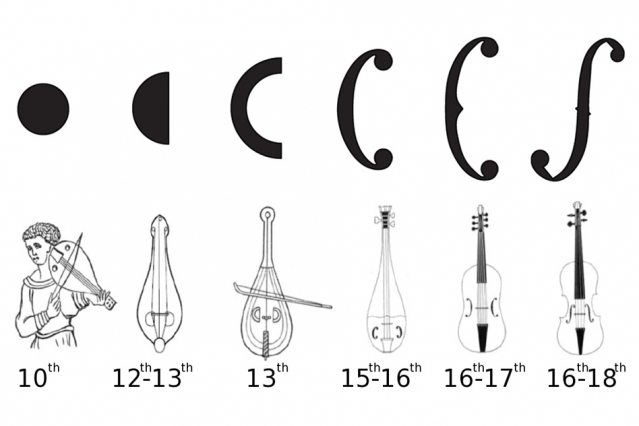
As acoustician Nicholas Makris and his colleagues at MIT announced in a study published by the Royal Society, a violin’s f‑holes serve as the perfect means of delivering its powerful acoustic sound. F‑holes have “twice the sonic power,” The Economist reports, “of the circular holes of the fithele” (the violin’s 10th century ancestor and origin of the word “fiddle”).
The evolutionary path of this elegant innovation—Clive Thompson at Boing Boing demonstrates with a color-coded chart—takes us from those original round holes, to a half-moon, then to variously-elaborated c‑shapes, and finally to the f‑hole. That slow historical development casts doubt on the theory in the above video, which argues that the 16th-century Amati family of violin makers arrived at the shape by peeling a clementine, perhaps, and placing flat the surface area of the sphere. But it’s an intriguing possibility nonetheless.
Instead, through an “analysis of 470 instruments… made between 1560 and 1750,” Makris, his co-authors, and violin maker Roman Barnas discovered, writes The Economist, that the “change was gradual—and consistent.” As in biology, so in instrument design: the f‑holes arose from “natural mutation,” writes Jennifer Chu at MIT News, “or in this case, craftsmanship error.” Makers inevitably created imperfect copies of other instruments. Once violin makers like the famed Amati, Stradivari, and Guarneri families arrived at the f‑hole, however, they found they had a superior shape, and “they definitely knew what was a better instrument to replicate,” says Makris. Whether or not those master craftsmen understood the mathematical principles of the f‑hole, we cannot say.
What Makris and his team found is a relationship between “the linear proportionality of conductance” and “sound hole perimeter length.” In other words, the more elongated the sound hole, the more sound can escape from the violin. “What’s more,” Chu adds, “an elongated sound hole takes up little space on the violin, while still producing a full sound—a design that the researchers found to be more power-efficient” than previous sound holes. “Only at the very end of the period” between the 16th and the 18th centuries, The Economist writes, “might a deliberate change have been made” to violin design, “as the holes suddenly get longer.” But it appears that at this point, the evolution of the violin had arrived at an “optimal result.” Attempts in the 19th century to “fiddle further with the f‑holes’ designs actually served to make things worse, and did not endure.”
To read the mathematical demonstrations of the f‑hole’s superior “conductance,” see Makris and his co-authors’ published paper here. And to see how a contemporary violin maker cuts the instrument’s f‑holes, see a careful demonstration in the video above.
Note: An earlier version of this post appeared on our site in 2016.
Related Content:
Josh Jones is a writer and musician based in Durham, NC. Follow him at @jdmagness
Read More...All the Rivers of the World Shown in Rainbow Colors: A Data Visualization to Explore
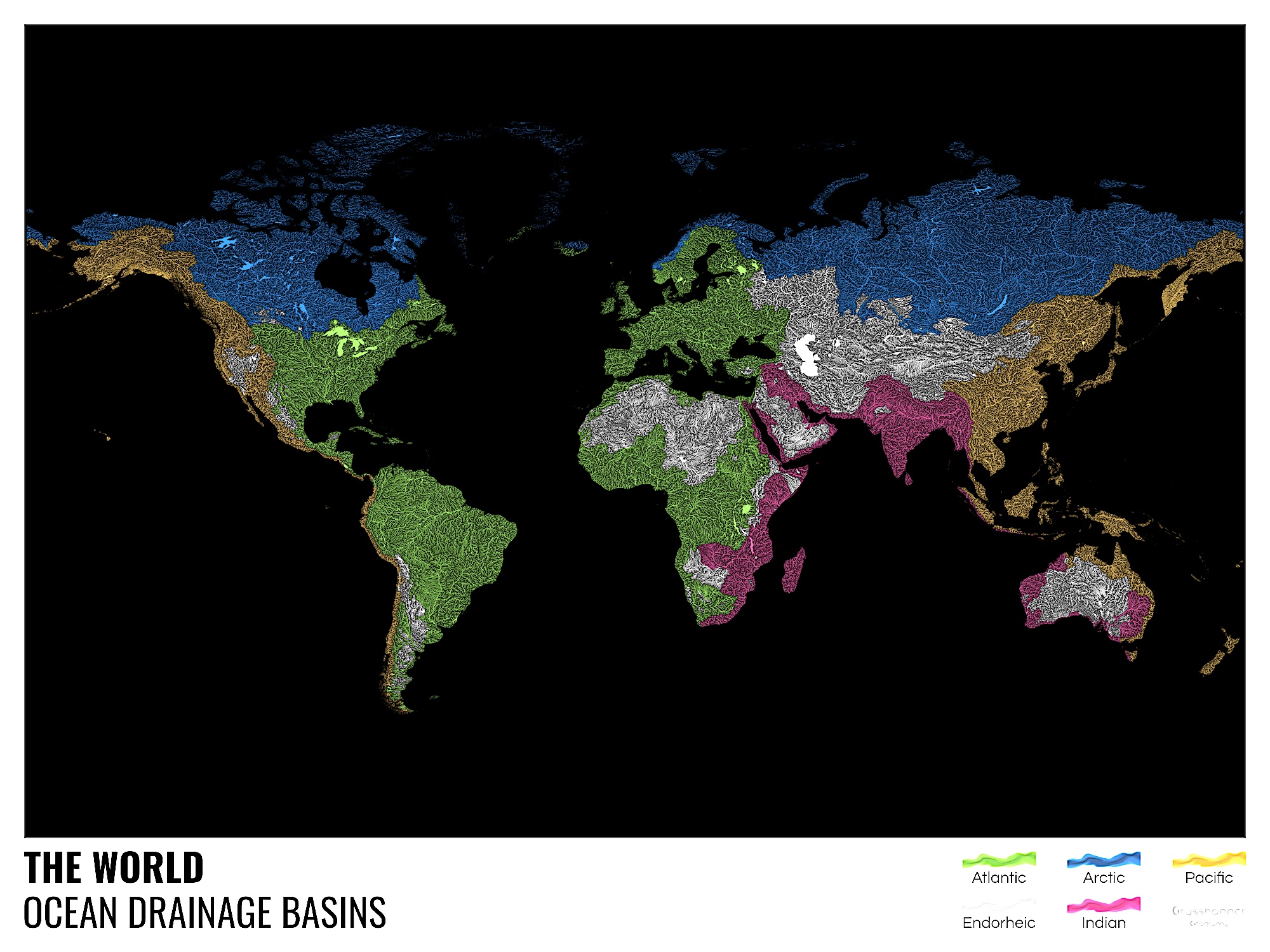
Even if you’ve never traveled the seas, you’ve surely known at least a few rivers in your time. And though you must be conscious of the fact that all of those rivers run, ultimately, to the sea, you may not have spent much time contemplating it. Now, thanks to the work of mapmaker and data analyst Robert Szucs, you won’t be able to come upon at a river without considering the particular sea into which it flows. He’s created what he calls “the first ever map of the world’s rivers divided into ocean drainage basins,” which appears just above.

This world map “shows, in different colors, all the rivers that flow into the Atlantic, Arctic, Indian or Pacific oceans, plus endorheic river basins which never reach the coast, mostly due to drying up in desert areas.”
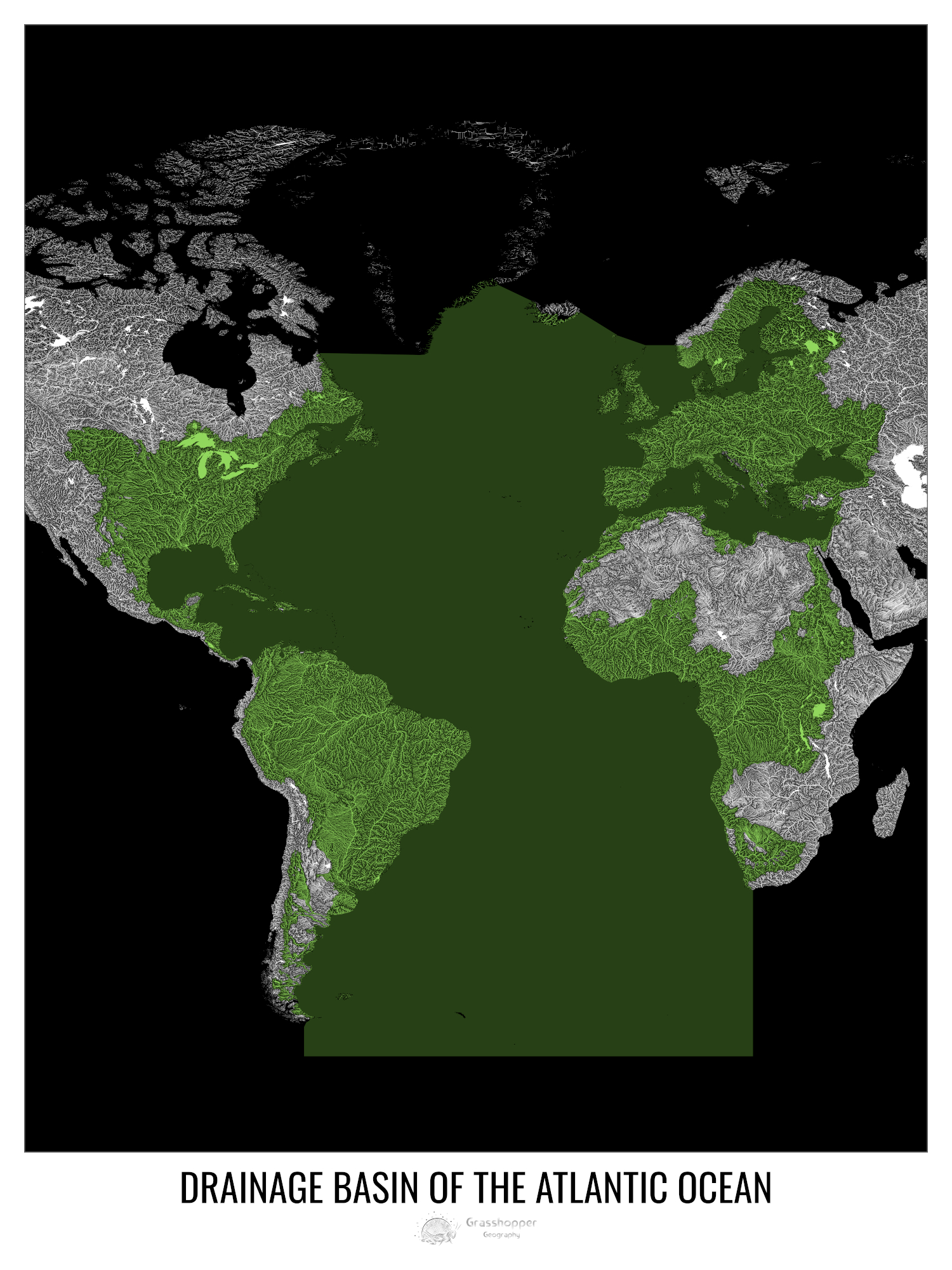
Szucs has also broken it down into “a set of 43 maps in this style for different countries, states and continents,” all of them available to download (and to purchase as large-format posters) from his web site Grasshopper Geography.
We previously featured Szucs here on Open Culture back in 2017, when he published a river-and-stream-visualizing map of the United States made according to a similarly colorful and informative scheme. Examining that work of information design gave me a richer context in which to imagine the rivers around which I grew up in Washington State — the Sammamish, the Snoqualmie, the Columbia — as well as a clearer sense of just how much the United States’ larger, much more complex waterway network must have contributed to the development of the country as a whole.

Of course, having lived the better part of a decade in South Korea, I’ve lately had less reason to consider those particular geographical subjects. But Szucs’ new global ocean drainage maps have brought related ones to mind: it will henceforth be a rare day when I ride a train across the Han River (one of the more sublime everyday sights Seoul has to offer) and don’t imagine it making its way out to the Pacific — the very same Pacific that was the destination of all those rivers of my west-coast American youth. Oceanically speaking, even a move across the world doesn’t take you quite as far as it seems.
Related content:
All the Rivers & Streams in the U.S. Shown in Rainbow Colors: A Data Visualization to Behold
That Time When the Mediterranean Sea Dried Up & Disappeared: Animations Show How It Happened
A Radical Map Puts the Oceans — Not Land — at the Center of Planet Earth (1942)
Tour the Amazon with Google Street View; No Passport Needed
Based in Seoul, Colin Marshall writes and broadcasts on cities, language, and culture. His projects include the Substack newsletter Books on Cities, the book The Stateless City: a Walk through 21st-Century Los Angeles and the video series The City in Cinema. Follow him on Twitter at @colinmarshall or on Facebook.
Read More...Napoleon’s Kindle: Discover the Miniaturized Traveling Library That the Emperor Took on Military Campaigns

Every piece of technology has a precedent. Most have several different types of precedents. You’ve probably used (and may well own) an eBook reader, for instance, but what would have afforded you a selection of reading material two or three centuries ago? If you were a Jacobean Englishman of means, you might have used the kind of traveling library we featured in 2017, a handsome portable case custom-made for your books. (If you’re Tom Stoppard in the 21st century, you still do.) If you were Napoleon, who seemed to love books as much as he loved military power — he didn’t just amass a vast collection of them, but kept a personal librarian to oversee it — you’d take it a big step further.
“Many of Napoleon’s biographers have incidentally mentioned that he […] used to carry about a certain number of favorite books wherever he went, whether traveling or camping,” says an 1885 Sacramento Daily Union article posted by Austin Kleon, “but it is not generally known that he made several plans for the construction of portable libraries which were to form part of his baggage.” The piece’s main source, a Louvre librarian who grew up as the son of one of Napoleon’s librarians, recalls from his father’s stories that “for a long time Napoleon used to carry about the books he required in several boxes holding about sixty volumes each,” each box first made of mahogany and later of more solid leather-covered oak. “The inside was lined with green leather or velvet, and the books were bound in morocco,” an even softer leather most often used for bookbinding.
To use this early traveling library, Napoleon had his attendants consult “a catalogue for each case, with a corresponding number upon every volume, so that there was never a moment’s delay in picking out any book that was wanted.” This worked well enough for a while, but eventually “Napoleon found that many books which he wanted to consult were not included in the collection,” for obvious reasons of space. And so, on July 8, 1803, he sent his librarian these orders:
The Emperor wishes you to form a traveling library of one thousand volumes in small 12mo and printed in handsome type. It is his Majesty’s intention to have these works printed for his special use, and in order to economize space there is to be no margin to them. They should contain from five hundred to six hundred pages, and be bound in covers as flexible as possible and with spring backs. There should be forty works on religion, forty dramatic works, forty volumes of epic and sixty of other poetry, one hundred novels and sixty volumes of history, the remainder being historical memoirs of every period.
In sum: not only did Napoleon possess a traveling library, but when that traveling library proved too cumbersome for his many and varied literary demands, he had a whole new set of not just portable book cases but even more portable books made for him. (You can see how they looked packed away in the image tweeted by Cork County Library above.) This prefigured in a highly analog manner the digital-age concept of recreating books in another format specifically for compactness and convenience — the kind of compactness and convenience now increasingly available to all of us today, and to a degree Napoleon never could have imagined, let alone demanded. It may be good to be the Emperor, but in many ways, it’s better to be a reader in the 21st century.
Note: This post was originally published in 2017. Given that Napoleon is back in the news, with the new Ridley Scott film, we’re bringing it back.
Related Content:
Discover the Jacobean Traveling Library: The 17th Century Precursor to the Kindle
Why Is Napoleon’s Hand Always in His Waistcoat?: The Origins of This Distinctive Pose Explained
Based in Seoul, Colin Marshall writes and broadcasts on cities and culture. His projects include the book The Stateless City: a Walk through 21st-Century Los Angeles and the video series The City in Cinema. Follow him on Twitter at @colinmarshall or on Facebook.
Read More...The Surprisingly Long History of Auto-Tune, the Vocal-Processing Technology Music Critics Love to Hate
In the fall of 1998, pop music changed forever — or at least it seems that way today, a quarter-century later. The epochal event in question was the release of Cher’s comeback hit “Believe,” of whose jaggedly fractured vocal glissando no listener had heard the likes of before. “The glow-and-flutter of Cher’s voice at key points in the song announced its own technological artifice,” writes critic Simon Reynolds at Pitchfork, “a blend of posthuman perfection and angelic transcendence ideal for the vague religiosity of the chorus.” As for how that effect had been achieved, only the tech-savviest studio professionals would have suspected a creative misuse of Auto-Tune, a popular digital audio processing tool brought to market the year before.
As its name suggests, Auto-Tune was designed to keep a musical performance in tune automatically. This capability owes to the efforts of one Andy Hildebrand, a classical flute virtuoso turned oil-extraction engineer turned music-technology entrepreneur. Employing the same mathematical acumen he’d used to assist the likes of Exxon in determining the location of prime drilling sites from processed sonar data, he figured out a vast simplification of the calculations theoretically required for an algorithm to put a real vocal recording into a particular key.
Rapidly adopted throughout the music industry, Hildebrand’s invention soon became a generic trademark, like Kleenex, Jell‑O, or Google. Even if a studio wasn’t using Auto-Tune, it was almost certainly auto-tuning, and with such subtlety that listeners never noticed.
The producers of “Believe,” for their part, turned the subtlety (or, technically, the “smoothness”) down to zero. In an attempt to keep that discovery a secret, they claimed at first to have used a vocoder, a synthesizer that converts the human voice into manipulable analog or digital signals. Some would also have suspected the even more venerable talkbox, which had been made well-known in the seventies and eighties by Earth, Wind & Fire, Stevie Wonder, and Roger Troutman of Zapp. Though the “Cher effect,” as it was known for a time, could plausibly be regarded as an aesthetic descendant of those devices, it had an entirely different technological basis. A few years after that basis became widely understood, conspicuous Auto-Tune became ubiquitous, not just in dance music but also in hip-hop, whose artists (not least Rappa Ternt Sanga T‑Pain) used Auto-Tune to steer their genre straight into the currents of mainstream pop, if not always to high critical acclaim.
Used as intended, Auto-Tune constituted a godsend for music producers working with any singer less freakishly skilled than, say, Freddie Mercury. Producer-Youtuber Rick Beato admits as much in the video just above, though given his classic rock- and jazz-oriented tastes, it doesn’t come as a surprise also to hear him lament the technology’s overuse. But for those willing to take it to ever-further extremes, Auto-Tune has given rise to previously unimagined subgenres, bringing (as emphasized in a recent Arte documentary) the universal language of melody into the linguistically fragmented arena of global hip-hop. As a means of generating “digital soul, for digital beings, leading digital lives,” in Reynolds’ words, Auto-Tune does reflect our time, for better or for worse. Its detractors can at least take some consolation in the fact that recent releases have come with something called a “humanize knob.”
Related content:
The Evolution of Music: 40,000 Years of Music History Covered in 8 Minutes
How the Yamaha DX7 Digital Synthesizer Defined the Sound of 1980s Music
How Computers Ruined Rock Music
Brian Eno on the Loss of Humanity in Modern Music
Based in Seoul, Colin Marshall writes and broadcasts on cities, language, and culture. His projects include the Substack newsletter Books on Cities, the book The Stateless City: a Walk through 21st-Century Los Angeles and the video series The City in Cinema. Follow him on Twitter at @colinmarshall or on Facebook.
Read More...Open Planet Lets You Download & Use 4,500 Free Videos That Document Nature & Climate Change
Plastic pollution in the Red Sea…
A melting glacier in Iceland…
Trees scorched by a wildfire in Australia…
As the effects of climate change become increasingly dire, we’ve grown accustomed to such grimly sobering visions.
Some look away.
Others work to heighten awareness of these clear and present environmental dangers.
And some strive to implement innovative solutions before it’s too late:
Solar panels in Costa Rica
Bubble barriers filtering plastic refuse from Amsterdam’s canals…
Sustainable agroforestry in the Amazon.
A classroom full of desks constructed from recycled one-time use plastics in India…
The creators of Open Planet, a soon-to-launch free footage library, hope to support change-making organizations and individuals by supplying video that can be edited together into narratives to “inspire optimism and action in this decisive decade for our planet.”
Caroline Petit, who prioritizes education and awareness in her position as Deputy Director for the United Nations Regional Information Centre for Europe, hails Open Planet for supplying worldwide free access to high-quality, accurate footage:
At this halfway point of the Sustainable Development Goals, it is crucial to provide all possible tools to supercharge the breakthroughs needed to achieve them. Capturing hearts and minds to motivate action is one powerful way to do so.
Enlisting some non-humans players to help achieve that end is a sound idea.
Behold a Nepal Gray Langur mother and baby hanging out in the treetops…
Cheetah cubs playfully sparring with each other in Kenya’s Masai Mara National Reserve…
A group of Pashmina goats peacefully grazing on wild sea buckthorn berries on the high plateaus of Ladakh.
Open Planet’s 4,500 clip strong collection also teems with photogenic birds, insects, and marine life, with more being added all the time.
Studio Silverback, which is collaborating with Carnegie Mellon University’s CREATE Lab on this project, created some of the footage specifically for the platform.
The remainder has been donated by outside filmmakers, broadcasters, and production companies who are credited in their clips’ content details.
In advance of its 2024 global launch, Open Planet has released a mostly uplifting 74-clip spotlight collection drawn from over 2000 pieces of footage filmed in India
A look at the platform’s searchable filter themes reminds us that the picture is not so overwhelmingly rosy, but also makes a strong case that change is possible:
Biodiversity
Climate
Consumption
Deforestation
Energy
Extreme Weather
Food
Human Health
Land Management
Natural Disasters
Nature-only
Pollution
Waste
Water
Sustainable Future
Technology
Explore Open Planet’s footage library and create a free account to download the clips of your choice here. The videos are free to use for educational, environmental and impact storytelling.
via Colossal
Related Content
Carl Sagan Warns Congress about Climate Change (1985)
Frank Capra’s Science Film The Unchained Goddess Warns of Climate Change in 1958
– Ayun Halliday is the Chief Primatologist of the East Village Inky zine and author, most recently, of Creative, Not Famous: The Small Potato Manifesto and Creative, Not Famous Activity Book. Follow her @AyunHalliday.
Read More...Support Us
We're hoping to rely on loyal readers, rather than erratic ads. Please click the Donate button and support Open Culture. You can use Paypal, Venmo, Patreon, even Crypto! We thank you!

About Us

Open Culture scours the web for the best educational media. We find the free courses and audio books you need, the language lessons & educational videos you want, and plenty of enlightenment in between.
Advertise With Us
FREE UPDATES!
GET OUR DAILY EMAIL
Get the best cultural and educational resources on the web curated for you in a daily email. We never spam. Unsubscribe at any time.
FOLLOW ON SOCIAL MEDIA
Open Culture editor Dan Colman scours the web for the best educational media. He finds the free courses and audio books you need, the language lessons & movies you want, and plenty of enlightenment in between.
Advertise With Us

