Renaissance Knives Had Music Engraved on the Blades & Now You Can Hear the Songs Performed by Modern Singers
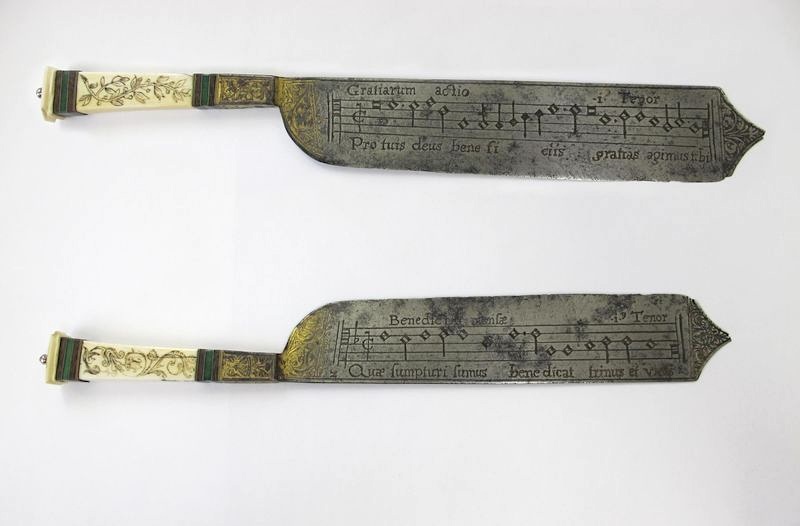
Image courtesy of The Victoria and Albert Museum
On any given weekend, in any part of the state where I live, you can find yourself standing in a hall full of knives, if that’s the kind of thing you like to do. It is a very niche kind of experience. Not so in some other weapons expos—like the Arms and Armor galleries at the Metropolitan Museum of Art, where everyone, from the most warlike to the staunchest of pacifists, stands in awe at the intricate ornamentation and incredibly deft craftsmanship on display in the suits of armor, lances, shields, and lots and lots of knives.
We must acknowledge in such a space that the worlds of art and of killing for fame and profit were never very far apart during Europe’s late Medieval and Renaissance periods. Yet we encounter many similar artisanal instruments from the time, just as finely tuned, but made for far less belligerent purposes.
As Maya Corry of the Fitzwilliam Museum in Cambridge—an institution with its own impressive arms and armor collection—comments in the video above (at 2:30), one unusual kind of 16th century knife meant for the table, not the battlefield, offers “insight into that harmonious, audible aspect of family devotions,” prayer and song.
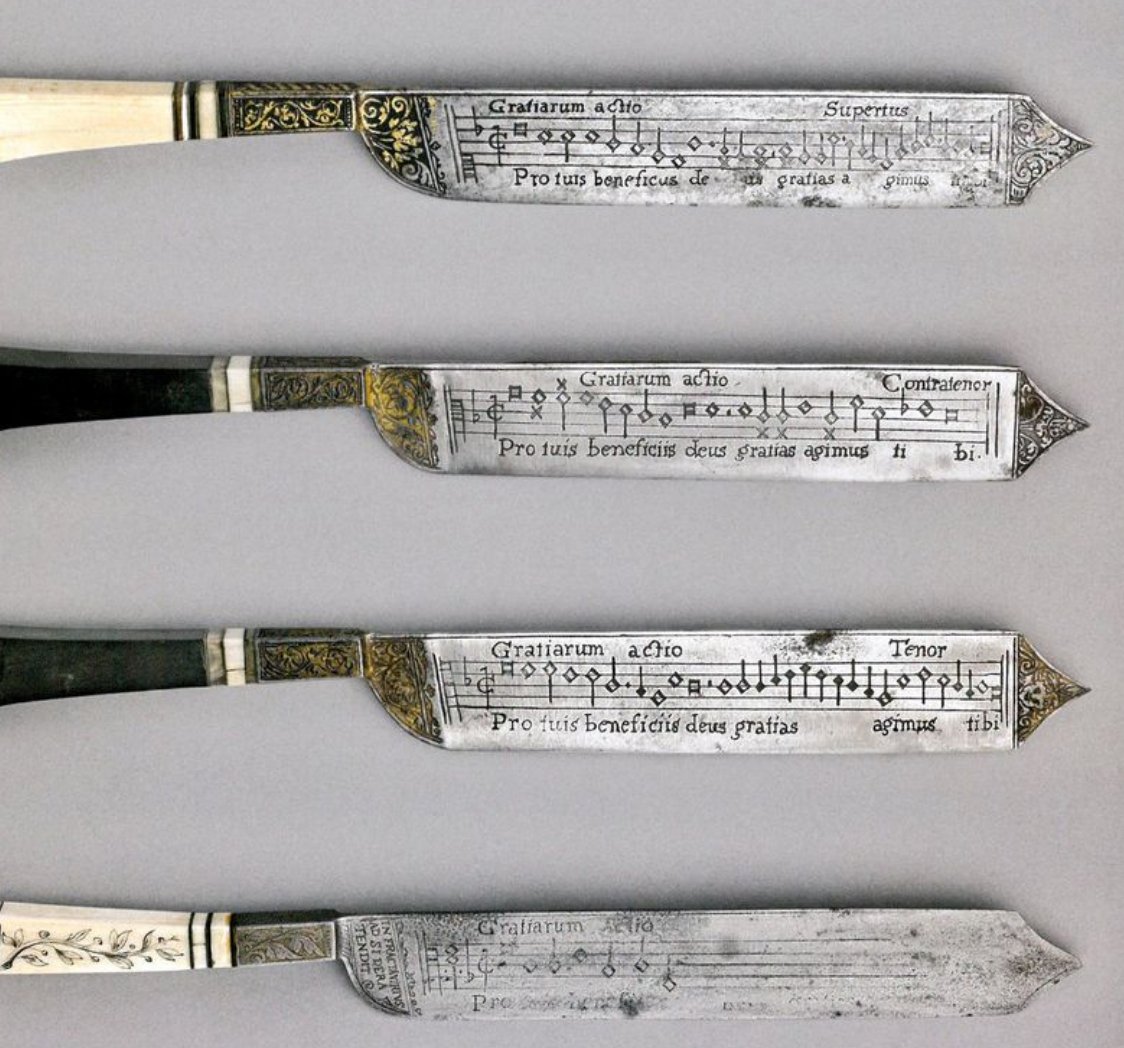
From the collection of the Fitzwilliam Museum, in Cambridge. (Johan Oosterman )
These knives, which have musical scores engraved in their blades, brought a table together in singing their prayers, and may have been used to carve the lamb or beef in their “striking balance of decorative and utilitarian function.” At least historians think such “notation knives,” which date from the early 1500s, were used at banquets. “The sharp, wide steel would have been ideal for cutting and serving meat,” writes Eliza Grace Martin at the WQXR blog, “and the accentuated tip would have made for a perfect skewer.” But as Kristen Kalber, curator at the Victoria and Albert Museum, which houses the knives at the top of the post, tells us “diners in very grand feasts didn’t cut their own meat.” It’s unlikely they would have sung from the bloody knives held by their servants.
The knives’ true purpose “remains a mystery,” Martin remarks, like many “rituals of the Renaissance table.” Victoria and Albert Museum curator Kirstin Kennedy admits in the video above that “we are not entirely sure” what the “splendid knife” she holds was used for. But we do know that each knife had a different piece of music on each side, and that a set of them together contained different harmony parts in order to turn a roomful of diners into a chorus. One set of blades had the grace on one side, with the inscription, “the blessing of the table. May the three-in-one bless that which we are about to eat.” The other side holds the benediction, to be sung after the dinner: “The saying of grace. We give thanks to you God for your generosity.”
Common enough verbiage for any household in Renaissance Europe, but when sung, at least by a chorus from the Royal College of Music, who recreated the music and made the recordings here, the prayers are superbly graceful. Above, hear one version of the Grace and Benediction from the Victoria and Albert Museum knives; below, hear a second version. You can hear a captivating set of choral prayers from the Fitzwilliam Museum knives at WQXR’s site, recorded for the Fitzwilliam’s “Madonnas & Miracles” exhibit. We are as unlikely now to encounter singing kitchen knives as we are to run into a horse and rider bearing 100 pounds of finely-wrought wearable steel sculpture. Such strange artifacts seem to speak of a strange people who valued beauty whether carving up the main course or cutting down their enemies.
Note: An earlier version of this post appeared on our site in 2017.
If you would like to support the mission of Open Culture, consider making a donation to our site. It’s hard to rely 100% on ads, and your contributions will help us continue providing the best free cultural and educational materials to learners everywhere. You can contribute through PayPal, Patreon, and Venmo (@openculture). Thanks!
Josh Jones is a writer and musician based in Durham, NC. Follow him at @jdmagness
Read More...How Rocky Horror Became a Cult Phenomenon
Call us old fashioned but invoking pumpkin spice and The Rocky Horror Picture Show in the same breath feels transgressive to the point of sacrilege.
The creator of the Polyphonic video, above, is on much firmer footing tying the film to queer liberation.
Prior to its now famous cinematic adaptation, The Rocky Horror Show was a low budget theatrical success, with nearly 3,000 performances and the 1973 Evening Standard Theatre Award for Best Musical to its name.
Reviewer Michael Billington lauded Tim Curry’s “garishly Bowiesque performance” as Dr. Frank-N-Furter, the self-proclaimed Sweet Transvestite from Transsexual, Transylvania, but also acknowledged some drabber peacocks defying gender expectations in that production:
…for me the actor of the evening was Jonathan Adams as the Narrator: a bulky, heavy-jowled Kissinger-like figure who enters into the rock numbers with the stately aplomb of a dowager duchess doing a strip.
Playwright Richard O’Brien, who doubled as Frank-N-Furter’s sepulchral butler, Riff Raff, conceived of the show as a spoof on campy sci fi and gothic horror films in the Hammer Productions vein. He also owed a debt to glam rock, which “allowed me to be myself more.”
(Hats off, here, to Polyphonic for one of the best nutshell descriptions of glam rock we’ve ever encountered:
Glam rock was a queer led movement that was built on the back of gender non-conformity. Visually it was a hodgepodge of style from early Hollywood glamour to 50s pinups and cabaret theater augmented by touches of ancient civilizations sci-fi and and the occult.)
“The element of transvestism wasn’t intended as a major theme,” O’Brien told interviewer Patricia Morrisroe, “although it turned out to be one:”
I’ve always thought of Frank as a cross between Ivan the Terrible and Cruella de Ville of Walt Disney’s 101 Dalmations. It’s that sort of evil beauty that’s attractive. I found Brad and Janet very appealing too, especially the whole fifties image of boy-girl relationships. In the end, you see that Janet is not the weak little thing that society demands her to be and Brad is not the pillar of strength.
Audiences and critics may have loved the original show, but the film version did not find immediate favor. Reviewer Roger Ebert reflected that “it would be more fun, I suspect, if it weren’t a picture show:
It belongs on a stage, with the performers and audience joining in a collective send-up…The choreography, the compositions and even the attitudes of the cast imply a stage ambiance. And it invites the kind of laughter and audience participation that makes sense only if the performers are there on the stage, creating mutual karma.
A prophetic statement, as it turns out…
Once the producers began marketing the film as a midnight movie, repeat customers started coming up with the snarky callbacks that have become a de rigueur part of the experience.
“All the characters appear to be sophisticated, knowledgeable people but they’re really not,” O’Brien observed:
That allows people of a similar adolescent nature to feel they could be part of the whole thing. And now, in fact, they are.
Shadow casts positioned themselves in front of the screen, mimicking the action in cobbled together versions of designer Sue Blane’s costumes.
Audiences also afforded themselves the opportunity to dress outside the norm, creating a safe space where attendees could mess around with their gender expressions. The film may not end happily but that final scene is a great excuse for anyone who wants to take a lap in a corset and fishnets.
Rocky Horror’s flamboyance, humor, and defiance of the mainstream made it a natural fit with the queer community, with folks costumed as Frank-N-Furter, Riff Raff, Magenta and Columbia regularly turning up at fundraisers and pride events.
The film also deserves some activist street cred for saving a number of small indie movie theaters by fattening midnight box office receipts, a trend that continues nearly 50 years after the original release.
Admittedly, certain aspects of the script haven’t aged well.
“Virgins” attending their first live screening may be more shocked at the dearth of consent than the spectacle of Frank-n-Furter murdering Columbia’s rocker boyfriend Eddy with a pickaxe, then serving his remains for dinner.
Will they also recoil from Frank as an embodiment of toxic masculity in the queer space?
Quoth Columbia:
My God! I can’t stand any more of this! First you spurn me for Eddie, and then you throw him like an old overcoat for Rocky! You chew people up and then you spit them out again… I loved you… do you hear me? I loved you! And what did it get me? Yeah, I’ll tell you: a big nothing. You’re like a sponge. You take, take, take, and drain others of their love and emotion.
We’re hoping Frank, problematic though he may now seem, won’t ultimately be consigned to the dust bin of history.
For context, O’Brien recently told The Hollywood Reporter that the character was informed by his own experiences of cross-dressing as he tried to get a grip on his gender identity in the early 70s:
I used to beat myself up about the hand I was dealt. I don’t know how it works. I have no idea. I’ve read many tomes about the subject of the transvestic nature. It’s the cards you’re dealt. In a binary world it’s a bit of curse, really. Especially in those days when homosexuality was a crime. It’s just one of those things that western society wasn’t very keen on.
Real Content
1978 News Report on the Rocky Horror Craze Captures a Teenage Michael Stipe in Drag
– Ayun Halliday is the Chief Primatologist of the East Village Inky zine and author, most recently, of Creative, Not Famous: The Small Potato Manifesto and Creative, Not Famous Activity Book. Follow her @AyunHalliday.
Read More...A Lavishly Illustrated Catalog of All Hummingbird Species Known in the 19th Century Gets Restored & Put Online
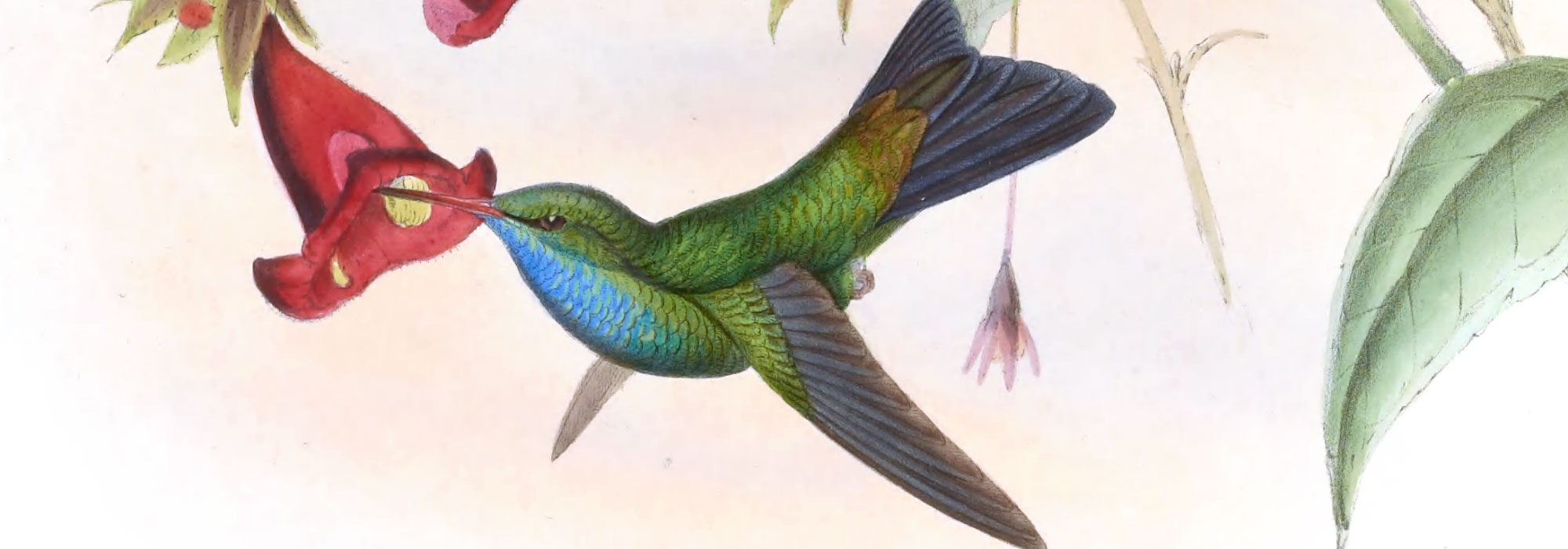
If you don’t live in a part of the world with a lot of hummingbirds, it’s easy to regard them as not quite of this earth. With their wide array of shimmering colors and frenetic yet eerily stable manner of flight, they can seem like quasi-fantastical creatures even to those who encounter them in reality. They certainly captured the imagination of English ornithologist John Gould, who between the years of 1849 and 1887 created A Monograph of the Trochilidæ, or Family of Humming-Birds, a catalog of all known species of hummingbird at the time. As you might expect, this is just the kind of old book you can peruse at the Internet Archive, but now there’s also an online restoration that returns Gould’s illustrations to their original glory.

A Monograph of the Trochilidæ “is considered one of the finest examples of ornithological illustration ever produced, as well as a scientific masterpiece,” writes the site’s creator, Nicholas Rougeux (previously featured here on Open Culture for his digital restorations of British & Exotic Mineralogy and Euclid’s Elements).
“Gould’s passion for hummingbirds led him to travel to various parts of the world, such as North America, Brazil, Colombia, Ecuador, and Peru, to observe and collect specimens. He also received many specimens from other naturalists and collectors.” Taken together, the work’s five volumes — one of them published as a supplement years after his death — catalog 537 species, documenting their appearance with 418 hand-colored lithographic plates.

All these images were “analyzed and restored to their original vibrant colors in a process that took nearly 150 hours to complete. As much of the original plate was preserved — including the delicate colors of the scenic backgrounds in each vignette.” You can view and download them at the site’s illustrations page, where they come accompanied by Gould’s own text and classified according to the same scheme he originally used. You may not know your Phaëthornis from your Sphenoproctus, to say nothing of your Cyanomyia from your Smaragdochrysis, but after seeing these small wonders of the natural world as Gould did (all arranged into a chromatic spectrum by Rougeux to make a striking poster), you may well find yourself inspired to learn the differences — or at least to put a feeder outside your window.
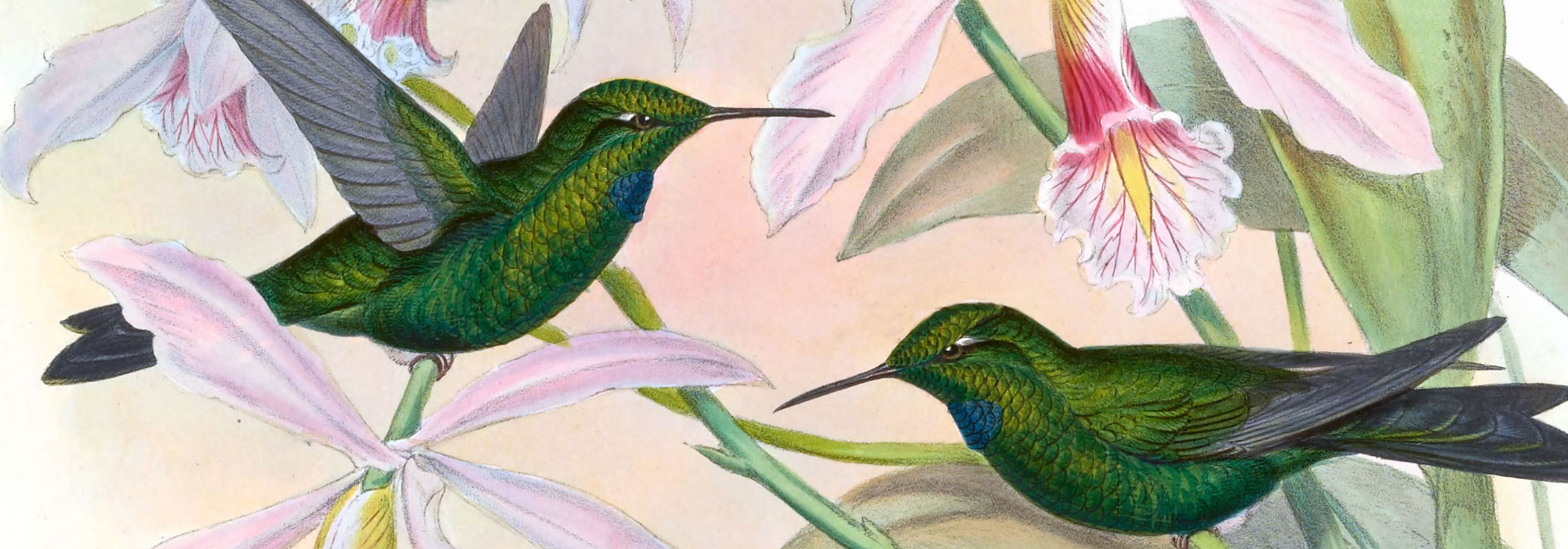
via Kottke
Related content:
The Hummingbird Whisperer: Meet the UCLA Scientist Who Has Befriended 200 Hummingbirds
What Kind of Bird Is That?: A Free App From Cornell Will Give You the Answer
Based in Seoul, Colin Marshall writes and broadcasts on cities, language, and culture. His projects include the Substack newsletter Books on Cities, the book The Stateless City: a Walk through 21st-Century Los Angeles and the video series The City in Cinema. Follow him on Twitter at @colinmarshall or on Facebook.
Read More...An Introduction to René Magritte, and How the Belgian Artist Used an Ordinary Style to Create Extraordinarily Surreal Paintings
With his dark suit, neat haircut, and bowler hat, René Magritte embodied early-twentieth-century Belgian normality. Yet the feelings his work stirred in their viewers were very much the opposite of normal. He had various ways of accomplishing this. One was “to combine two familiar objects and make a new one,” says gallerist-Youtuber James Payne in the new Great Art Explained video above. “Another method was to paint a solid object as if it were a see-through portal. In some paintings he would defy gravity and show heavy objects floating. He would give an unfamiliar name to familiar objects. He would change scale by making small objects huge and large objects impossibly tiny.”
One of Magritte’s particularly effective methods was “to obscure or to hide a face or an object, setting up a conflict between the visible that is hidden and the visible that is present.” The power of this technique is vividly showcased by The Lovers II, from 1928, in which Magritte takes the “cinematic cliché” of the kiss and “disrupts our voyeuristic pleasure by covering the faces in cloth. A moment of collection becomes one of isolation, of sexual frustration. An intimate moment becomes something dark and effortlessly disturbing, something hidden and anonymous.”
Might this have something to do with the death of his mother, who threw herself in a river when he was young? “When her body was eventually found, a nightdress had been dragged up over her naked body and was covering her face.”
The artist himself wouldn’t have thought so. “Psychology didn’t interest Magritte, who avoided any in-depth interpretation of his work,” Payne says, and yet his work “offers so much opportunity for armchair analysis.” Employing an “extreme contrast between the drabness of his style and the extraordinary subject matter,” he demonstrated his understanding that people want to see what’s hidden, that removing what they expect “creates a tension and an anxiety,” and that “if the style of the image doesn’t attract attention, the irrationality of the image becomes even more shocking.” Given Magritte’s current stature, it may come as a surprise to hear that his painting didn’t earn him much in his lifetime. But given his evident ability to manipulate viewers’ thoughts and feelings through visual means alone, it won’t come as a surprise to hear that he made his money running an advertising agency.
Related content:
René Magritte’s Early Art Deco Posters (1924–1927)
The Home Movies of Two Surrealists: Look Inside the Lives of Man Ray & René Magritte
An Introduction to Surrealism: The Big Aesthetic Ideas Presented in Three Videos
Based in Seoul, Colin Marshall writes and broadcasts on cities, language, and culture. His projects include the Substack newsletter Books on Cities, the book The Stateless City: a Walk through 21st-Century Los Angeles and the video series The City in Cinema. Follow him on Twitter at @colinmarshall or on Facebook.
Read More...The Fantastic Women Of Surrealism: An Introduction
When André Breton, a leader of the Surrealist movement and author of its first manifesto, wrote that “the problem of woman is the most marvelous and disturbing problem in all the world,” he was not alluding to the unfair lack of recognition experienced by his female peers.
Marquee name Surrealists like Breton, Salvador Dalí, Man Ray, René Magritte, and Max Ernst positioned the women in their circle as muses and symbols of erotic femininity, rather than artists in their own right.
As Méret Oppenheim, subject of a recent retrospective at the Museum of Modern Art, is seen remarking at the outset of Behind the Masterpiece’s introduction to “the fantastic women of Surrealism”, above, it was up to female Surrealists to free themselves of the narrowly defined role society — and their male counterparts — sought to impose on them:
A woman isn’t entitled to think, to express aggressive ideas.
The first artist Behind the Masterpiece profiles needs no introduction. Frida Kahlo is surely one of the best known female artists in the world, a woman who played by her own rules, turning to poetic, often brutal imagery as she delved into her own physical and mental suffering:
I paint self-portraits, because I paint my own reality. I paint what I need to. Painting completed my life. I lost three children and painting substituted for all of this… I am not sick, I am broken. But I am happy to be alive as long as I can paint.
The National Museum of Women in the Arts notes that Remedios Varo — the subject of a current exhibition at the Art Institute of Chicago- and Leonora Carrington “were seen as the ‘femmes-enfants’ to the famous and much older male artists in their lives.”
Their friendship was ultimately more satisfying and far longer lasting then their romantic attachments to Surrealist luminaries Ernst and poet Benjamin Péret. Carrington paid tribute to it in her novel, The Hearing Trumpet.
The pair’s work reveals a shared interest in alchemy, astrology and the occult, approaching them from characteristically different angles, as per Stefan van Raay, author of Surreal Friends: Leonora Carrington, Remedios Varo, and Kati Horna:
Carrington’s work is about tone and color and Varo’s is about line and form.
The name of Dorothea Tanning, like that of Leonora Carrington, is often linked to Max Ernst, though she made no bones about her desire to keep her artistic identity separate from that of her husband of 30 years.
Her work evolved several times over the course of a career spanning seven decades, but her first major museum survey was a posthumous one.
University of Cambridge art history professor, Alyce Mahon, co-curator of that Tate Modern exhibit, touches on the nature of Tanning’s deceptively feminine soft sculptures:
If I asked for two words that you associate with pin cushions, you would say sewing and craft, and you would associate those with the female in the house. Tanning played with the idea of wifely skills and took a very humble object and turned it into a fetish. She crafted her first one out of velvet in 1965 and randomly placed pins in it and aligned it with a voodoo doll. She says it ‘bristles’ with images. So she takes something fabulously familiar and makes it uncanny and strange to encourage us to think differently.
Tanning rejected the label of ‘woman artist’, viewing it as “just as much a contradiction in terms as ‘man artist’ or ‘elephant artist’.”
Put that in your pipe and smoke it, Sigmund Freud!
The famed psychoanalyst’s concept of the subconscious mind was central to Surrealism, but he also wrote that “women oppose change, receive passively, and add nothing of their own.”
One wonders what he would have made of Object, the fur lined teacup, saucer and spoon that is Oppenheim’s best known work, for better or worse.
In an essay for Khan Academy’s AP/College Art History course Josh Rose describes how Museum of Modern Art patrons declared it the “quintessential” Surrealist object when it was featured in the influential 1936–37 exhibition “Fantastic Art, Dada, and Surrealism:”
But for Oppenheim, the prestige and focus on this one object proved too much, and she spent more than a decade out of the artistic limelight, destroying much of the work she produced during that period. It was only later when she re-emerged, and began publicly showing new paintings and objects with renewed vigor and confidence, that she began reclaiming some of the intent of her work. When she was given an award for her work by the City of Basel, she touched upon this in her acceptance speech, (saying,) “I think it is the duty of a woman to lead a life that expresses her disbelief in the validity of the taboos that have been imposed upon her kind for thousands of years. Nobody will give you freedom; you have to take it.”
Related Content
Discover Leonora Carrington, Britain’s Lost Surrealist Painter
A Brief Animated Introduction to the Life and Work of Frida Kahlo
The Forgotten Women of Surrealism: A Magical, Short Animated Film
– Ayun Halliday is the Chief Primatologist of the East Village Inky zine and author, most recently, of Creative, Not Famous: The Small Potato Manifesto and Creative, Not Famous Activity Book. Follow her @AyunHalliday.
Carl Jung on the Power of Tarot Cards: They Provide Doorways to the Unconscious & Perhaps a Way to Predict the Future
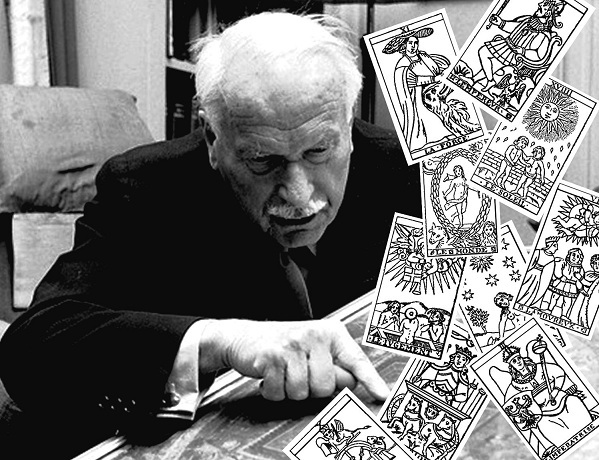
It is generally accepted that the standard deck of playing cards we use for everything from three-card monte to high-stakes Vegas poker evolved from the Tarot. “Like our modern cards,” writes Sallie Nichols, “the Tarot deck has four suits with ten ‘pip’ or numbered cards in each…. In the Tarot deck, each suit has four ‘court’ cards: King, Queen, Jack, and Knight.” The latter figure has “mysteriously disappeared from today’s playing cards,” though examples of Knight playing cards exist in the fossil record. The modern Jack is a survival of the Page cards in the Tarot. (See examples of Tarot court cards here from the 1910 Rider-Waite deck.) The similarities between the two types of decks are significant, yet no one but adepts seems to consider using their Gin Rummy cards to tell the future.
The eminent psychiatrist Carl Jung, however, might have done so.
As Mary K. Greer explains, in a 1933 lecture Jung went on at length about his views on the Tarot, noting the late Medieval cards are “really the origin of our pack of cards, in which the red and the black symbolize the opposites, and the division of the four—clubs, spades, diamonds, and hearts—also belongs to the individual symbolism.
They are psychological images, symbols with which one plays, as the unconscious seems to play with its contents.” The cards, said Jung, “combine in certain ways, and the different combinations correspond to the playful development of mankind.” This, too, is how Tarot works—with the added dimension of “symbols, or pictures of symbolical situations.” The images—the hanged man, the tower, the sun—“are sort of archetypal ideas, of a differentiated nature.”
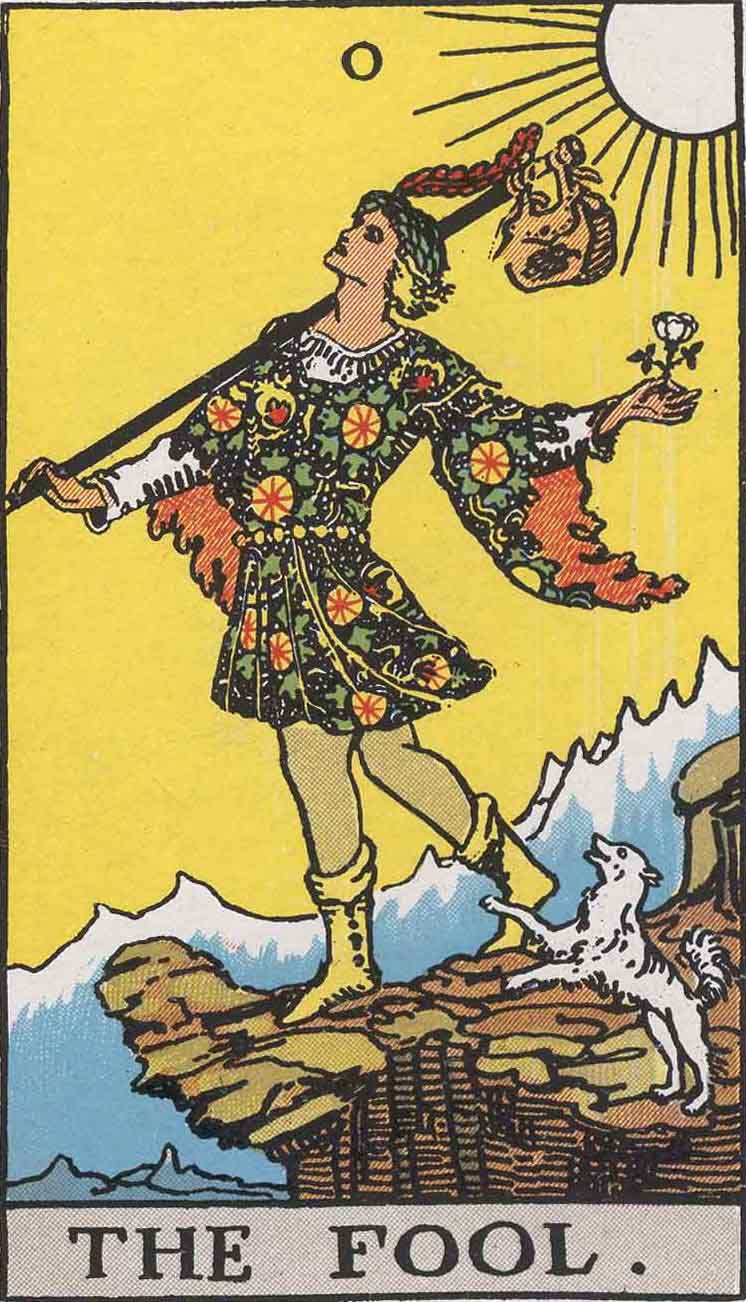
Thus far, Jung hasn’t said anything many orthodox Jungian psychologists would find disagreeable, but he goes even further and claims that, indeed, “we can predict the future, when we know how the present moment evolved from the past.” He called for “an intuitive method that has the purpose of understanding the flow of life, possibly even predicting future events, at all events lending itself to the reading of the conditions of the present moment.” He compared this process to the Chinese I Ching, and other such practices. As analyst Marie-Louise von Franz recounts in her book Psyche and Matter:
Jung suggested… having people engage in a divinatory procedure: throwing the I Ching, laying the Tarot cards, consulting the Mexican divination calendar, having a transit horoscope or a geometric reading done.
Content seemed to matter much less than form. Invoking the Swedenborgian doctrine of correspondences, Jung notes in his lecture, “man always felt the need of finding an access through the unconscious to the meaning of an actual condition, because there is a sort of correspondence or a likeness between the prevailing condition and the condition of the collective unconscious.”
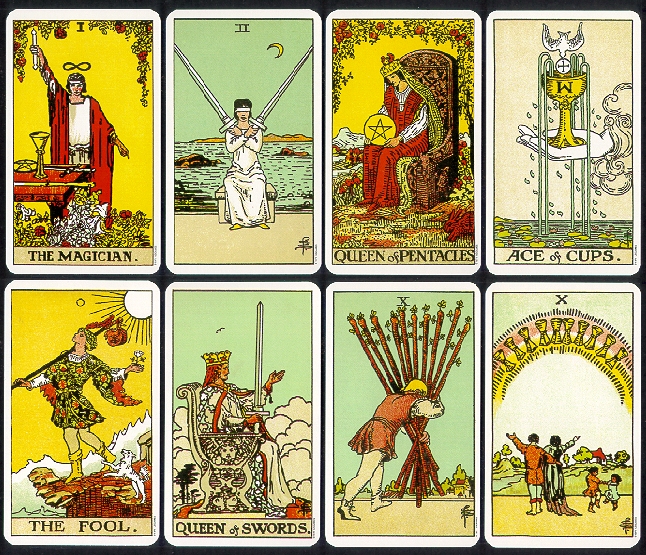
What he aimed at through the use of divination was to accelerate the process of “individuation,” the move toward wholeness and integrity, by means of playful combinations of archetypes. As another mystical psychologist, Alejandro Jodorowsky, puts it, “the Tarot will teach you how to create a soul.” Jung perceived the Tarot, notes the blog Faena Aleph, “as an alchemical game,” which in his words, attempts “the union of opposites.” Like the I Ching, it “presents a rhythm of negative and positive, loss and gain, dark and light.”
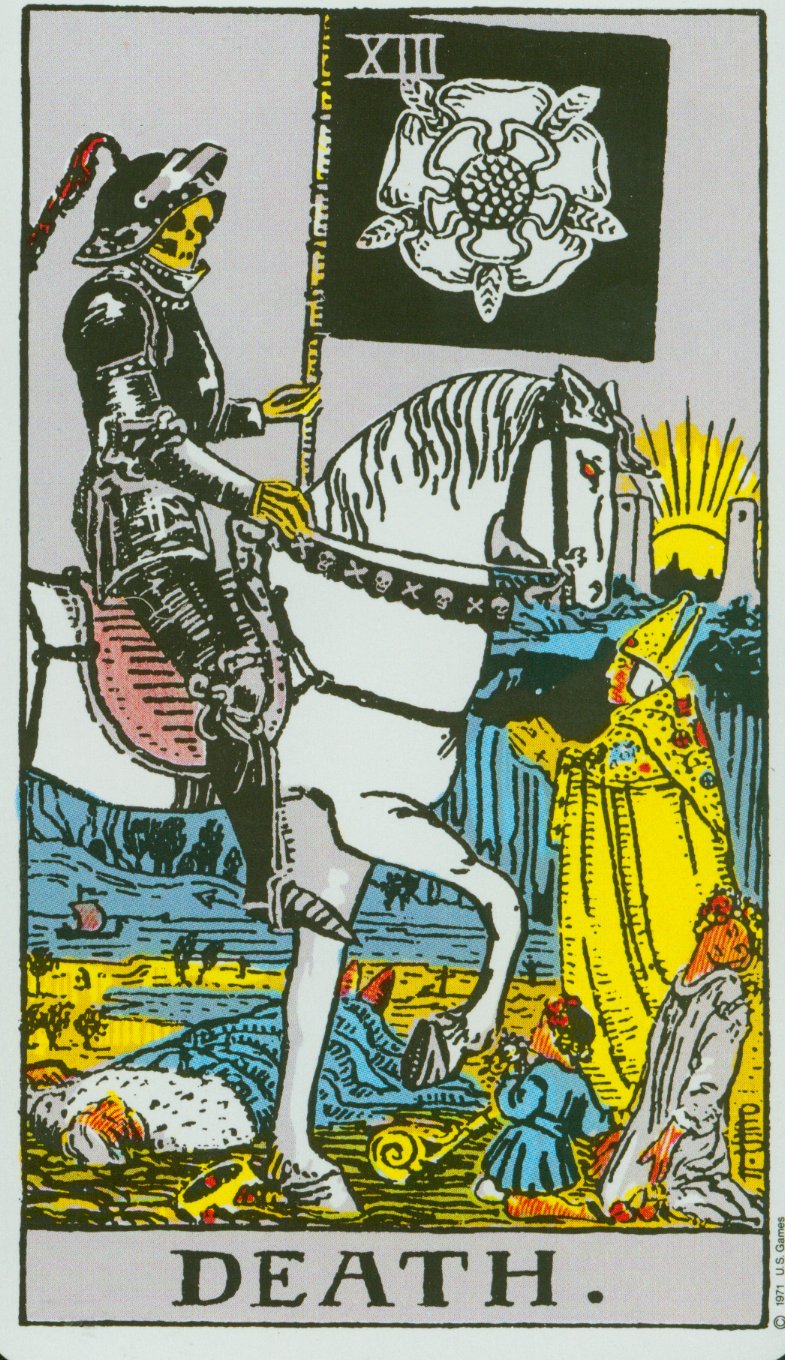
Much later in 1960, a year before his death, Jung seemed less sanguine about Tarot and the occult, or at least downplayed their mystical, divinatory power for language more suited to the laboratory, right down to the usual complaints about staffing and funding. As he wrote in a letter about his attempts to use these methods:
Under certain conditions it is possible to experiment with archetypes, as my ‘astrological experiment’ has shown. As a matter of fact we had begun such experiments at the C. G. Jung Institute in Zurich, using the historically known intuitive, i.e., synchronistic methods (astrology, geomancy, Tarot cards, and the I Ching). But we had too few co-workers and too little means, so we could not go on and had to stop.
Later interpreters of Jung doubted that his experiments with divination as an analytical technique would pass peer review. “To do more than ‘preach to the converted,’” wrote the authors of a 1998 article published in the Journal of Parapsychology, “this experiment or any other must be done with sufficient rigor that the larger scientific community would be satisfied with all aspects of the data taking, analysis of the data, and so forth.” Or, one could simply use Jungian methods to read the Tarot, the scientific community be damned.
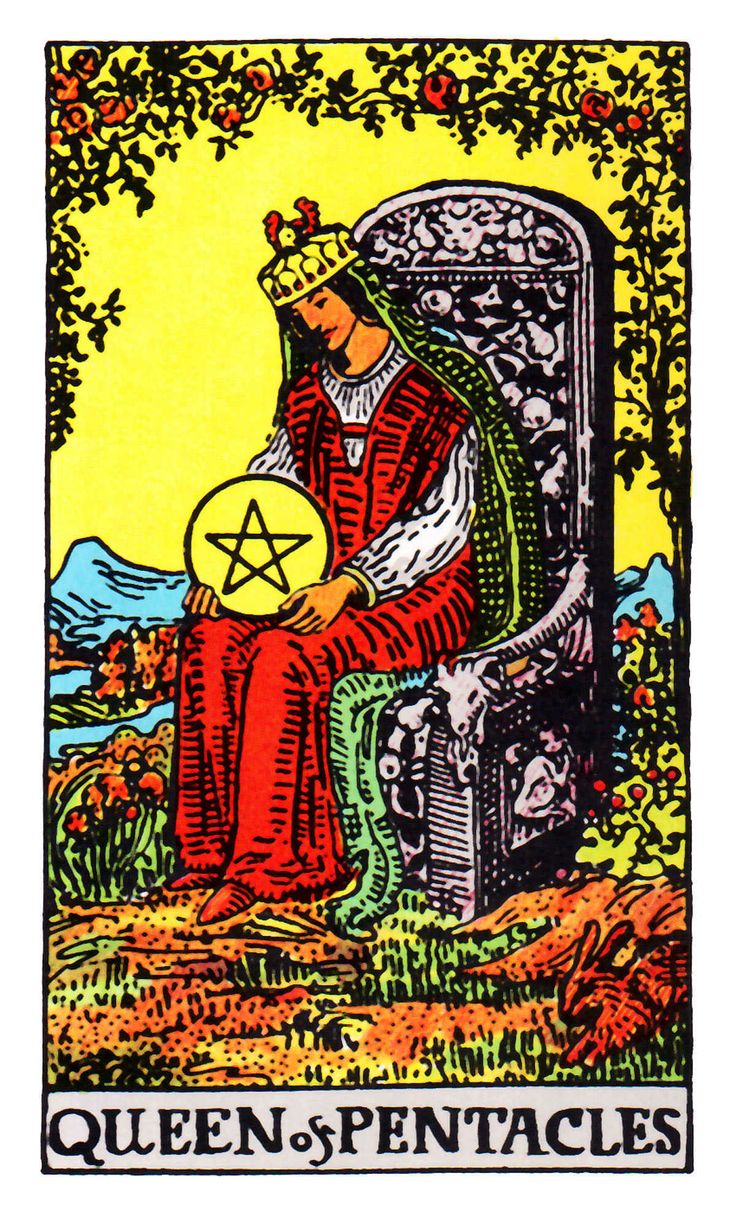
As in Jung’s many other creative reappropriations of mythical, alchemical, and religious symbolism, his interpretation of the Tarot inspired those with mystical leanings to undertake their own Jungian investigations into parapsychology and the occult. Inspired by Jung’s verbal descriptions of the Tarot’s major arcana, artist and mystic Robert Wang has created a Jungian Tarot deck, and an accompanying trilogy of books, The Jungian Tarot and its Archetypal Imagery, Tarot Psychology, and Perfect Tarot Divination.
You can see images of each of Wang’s cards here. His books purport to be exhaustive studies of Jung’s Tarot theory and practice, written in consultation with Jung scholars in New York and Zurich. Sallie Nichols’ Jung and Tarot: An Archetypal Journey is less voluminous and innovative—using the traditional, Pamela Coleman-Smith-illustrated, Rider-Waite deck rather than an updated original version. But for those willing to grant a relationship between systems of symbols and a collective unconscious, her book may provide some penetrating insights, if not a recipe for predicting the future.
Note: An earlier version of this post appeared on our site in 2017.
If you would like to support the mission of Open Culture, consider making a donation to our site. It’s hard to rely 100% on ads, and your contributions will help us continue providing the best free cultural and educational materials to learners everywhere. You can contribute through PayPal, Patreon, and Venmo (@openculture). Thanks!
Related Content
Carl Jung Offers an Introduction to His Psychological Thought in a 3‑Hour Interview (1957)
The Visionary Mystical Art of Carl Jung: See Illustrated Pages from The Red Book
How Carl Jung Inspired the Creation of Alcoholics Anonymous
Josh Jones is a writer and musician based in Durham, NC. Follow him at @jdmagness
Read More...Noam Chomsky Explains Why Nobody Is Really a Moral Relativist, Even Michel Foucault
Noam Chomsky made his name as a linguist, which is easy to forget amid the wide range of subjects he has addressed, and continues to address, in his long career as a public intellectual. But on a deeper level, his commentary on politics, society, media, and a host of other broad fields sounds not unlike a natural outgrowth of his specialized linguistic theories. Throughout the past five or six decades, he’s occasionally made the connection explicit, or nearly so, by drawing analogies between language and other domains of human activity. Take the panel-discussion clip above, in which Chomsky faces the question of why he doesn’t accept the notion of cultural relativism, which holds moral norms as not absolute but created wholly within particular cultural contexts.
“There are no skeptics,” Chomsky says. “You can discuss it in a philosophy seminar, but no human being can, in fact, be a skeptic. They wouldn’t survive for two minutes if they were. I think pretty much the same is true of moral relativism. There are no moral relativists: there are people who profess it, you can discuss it abstractly, but it doesn’t exist in ordinary life.” He identifies “a tendency to move from the uncontroversial concept of moral relativism” — that, say, certain cultures at certain times hold certain moral values, and other cultures at other times hold other ones — “to a concept that is, in fact, incoherent, and that is to say that moral values can range indefinitely,” tethered to no objective basis.
If morality is transmitted through culture, “how does a person acquire his or her culture? You don’t get it by taking a pill. You acquire your culture by observing a rather limited number of behaviors and actions, and from those, constructing, somehow, in your mind, the set of attitudes and beliefs that constitutes culture.” He draws a natural comparison between this process and that of language acquisition, which also depends on “having a rich built-in array of constraints that allow the leap from scattered data to whatever it is that you acquire. That’s virtually logic.” And so, “even if you’re the most extreme cultural relativist, you are presupposing universal moral values. Those can be discovered.” When he spoke of “the most extreme cultural relativist,” he was thinking of Michel Foucault?
Back in 1971, Chomsky engaged the French philosopher of power in a debate, broadcast on Dutch television, about human nature and the origin of morality. There he practically lead with linguistics: a child learning to talk starts “with the knowledge that he’s hearing a human language of a very narrow and explicit type that permits a very small range of variation.” This “highly organized and very restrictive schematism” allows him to “make the huge leap from scattered and degenerate data to highly organized knowledge.” This mechanism “is one fundamental constituent of human nature,” in not just language but “other domains of human intelligence and other domains of human cognition and even behavior” as well. Perhaps we do have the freedom to speak, think, and act however we wish — but that very freedom, if Chomsky is correct, emerges only within strict, absolute, wholly un-relative natural boundaries.
Related content:
Michel Foucault and Noam Chomsky Debate Human Nature & Power on Dutch TV (1971)
An Animated Introduction to Michel Foucault, “Philosopher of Power”
Michel Foucault Offers a Clear, Compelling Introduction to His Philosophical Project (1966)
Moralities of Everyday Life: A Free Online Course from Yale University
Based in Seoul, Colin Marshall writes and broadcasts on cities, language, and culture. His projects include the Substack newsletter Books on Cities, the book The Stateless City: a Walk through 21st-Century Los Angeles and the video series The City in Cinema. Follow him on Twitter at @colinmarshall or on Facebook.
Read More...Martin Scorsese Breaks Down His Most Iconic Films: Mean Streets, Taxi Driver, GoodFellas, and More
“Did Scorsese make the best movie of each decade since the ’70s?” asks GQ’s Zach Baron in a recent profile of that long-lived auteur. “Probably not (I think his case is weakest in the first decade of this century), but you could argue it, and many people have.” And indeed, you may well find yourself believing it after watching the video above, also published by GQ, in which Scorsese himself discusses a selection of features from the past half-century of his career, the earliest of which, Mean Streets, was a breakout project for both its young director and even younger star, a certain Robert de Niro, in 1973.
Scorsese’s latest, Killers of the Flower Moon, opens next month as not just another of his many collaborations with de Niro, but the first Scorsese film to feature both de Niro and Leonardo DiCaprio. “We were acquainted with each other when we were sixteen years old,” the director says of de Niro in the GQ video. “He experienced what I experienced growing up” in rough-and-tumble New York neighborhoods like Little Italy and the Bowery, and thus “knows who I am and where I came from.” Hence the trust with which Scorsese took de Niro’s recommendation of DiCaprio in the early nineties: “You gotta work with him someday.”
That someday came in 2002, with Gangs of New York, after which the Scorsese-diCaprio professional relationship would mature to bear additional cinematic fruit with projects like The Departed and The Wolf of Wall Street. At this point it has become a parallel enterprise to Scorsese-de Niro, which can be traced from The Irishman, which came out in 2019, back through the likes of GoodFellas (though it stars the late Ray Liotta), Casino, The King of Comedy, and Raging Bull — a picture that, along with other brazenly ambitious United Artists releases like Francis Ford Coppola’s Apocalypse Now and Michael Cimino’s Heaven’s Gate, Scorsese now sees as marking the end of “the power of the director.”
In “new Hollywood” era of the nineteen-seventies, Scorsese remembers, “things were wide open, and we went in and took it like the barbarians at the gate, and we transformed whatever we could, but they caught us.” Still, since then he’s “never stopped working for any noticeable amount of time,” as Baron puts it, though in recent years he’s been given to rueful comment about the artistic and economic dynamics of his industry and art form. As for the state of the world in general, he makes an equally grim diagnosis with reference to his and de Niro’s best-known collaboration, Taxi Driver: “Every other person is like Travis Bickle now.”
Related content:
How Martin Scorsese Directs a Movie: The Techniques Behind Taxi Driver, Raging Bull, and More
The Filmmaking of Martin Scorsese Demystified in 6 Video Essays
Martin Scorsese Explains the Difference Between Cinema and Movies
Based in Seoul, Colin Marshall writes and broadcasts on cities, language, and culture. His projects include the Substack newsletter Books on Cities, the book The Stateless City: a Walk through 21st-Century Los Angeles and the video series The City in Cinema. Follow him on Twitter at @colinmarshall or on Facebook.
Read More...Scientists Working in Antarctica Unwittingly Started to Develop a New Accent

The distinctiveness of the accent heard in a place reflects that place’s isolation. It’s probably no coincidence that, as almost every place in the world has become less isolated, accents have become less distinctive. In these days of vanishing forms of regional speech, if you wanted to hear a new one coming into being, you’d have to go to the ends of the Earth — or one specific end of the Earth, anyway, as demonstrated not long ago by researchers from the Ludwig Maximilian University of Munich. Taking and analyzing recordings made over the course of one winter, they discovered that a new accent has begun to take shape in English as spoken in Antarctica.
“Antarctica has no native population or permanent residents, but it does have a transitory community of scientists and support staff who live there for part of the year on a rotational basis,” writes Tom Hale at IFL Science. “In the summer months, there are typically around 5,000 people living in Antarctica, but that drops to just 1,000 in the winter.” It was from this group of the Antarctic “over-winterers” — and in particular, from those working on the British Antarctic Survey — that the linguistic researchers recruited their subjects, eight of whom were from England, one from the United States, one from Germany, and one from Iceland.
“The findings revealed subtle but measurable changes in the speech of the overwintering staff during their time in Antarctica,” writes Mental Floss’ Brett Reynolds. “One change was convergence, where individuals in a close-knit group unconsciously begin to adopt similar speech characteristics. In this case, that meant convergence of /u/ (the ‘oo’ in goose), /ju/ (the ‘you’ in few), /ou/ (the ‘oh’ in goat), and /ɪ:/ (the ‘ee’ in the last syllable in happy).” Apart from that phenomenon, the researchers also noticed another change in the /ou/ of goat: “the over-winterers began to pronounce it more toward the front of their mouths than toward the back. (British pronunciations are already typically fronter than American /ou/.)”
Even if you got into a conversation with a scientist just back from a long winter in Antarctica, you probably wouldn’t notice any of this. But the fact that the differences between the series of recordings taken at six-week intervals during the winter show measurable changes in pronunciation when compared to control recordings taken back in the United Kingdom suggests that the isolation of Antarctica really does encourage the formation of a new accent. Given a sufficiently long time span, an accent naturally becomes a dialect, and eventually a separate language. Perhaps, even in our age of much-lamented loss of linguistic diversity, some of us can look forward to having Antarctic-speaking descendants.
via Mental Floss
Related content:
The Speech Accent Archive: The English Accents of People Who Speak 341 Different Languages
Why You Have an Accent When You Speak a Foreign Language
What English Would Sound Like If It Was Pronounced Phonetically
Based in Seoul, Colin Marshall writes and broadcasts on cities, language, and culture. His projects include the Substack newsletter Books on Cities, the book The Stateless City: a Walk through 21st-Century Los Angeles and the video series The City in Cinema. Follow him on Twitter at @colinmarshall or on Facebook.
Read More...Why the Leaning Tower of Pisa Still Hasn’t Fallen Over, Even After 650 Years
The Leaning Tower of Pisa has stood, in its distinctive fashion, for six and a half centuries now. But it hasn’t always leaned at the same angle: to get the most dramatic view, the best time to go see it was the early nineteen-nineties, when its tilt had reached a full 5.5 degrees. Granted, at that point — when by some reckonings, the tower should no longer have been standing at all — it was closed to the public, presumably due to fears that the sheer weight of tourism would push it over the tipping point. The 1989 collapse of Pavia’s eleventh-century Civic Tower also had something to do with it: couldn’t something be done to spare Pisa’s world-famous landmark from a similar fate?
Attempts to shore up the Leaning Tower up to that point had a checkered history, to put it mildly. Built on soft soil, it started to lean in back in the twelfth century, before its construction was even complete. The process of that construction, in the event, took nearly 200 years to complete; during one decades-long pause during a particularly embattled period for the Republic of Pisa, the tower actually settled enough to prevent its later collapse, though it remained aslant. In the late thirteenth century, the best solution available for this condition was simply to build the rest of its floors in a curved shape in compensation.
For centuries after, the sight of the Leaning Tower tempted generations of structural engineers to straighten it out. It even tempted non-engineers like Benito Mussolini, who in 1934 ordered large amounts of concrete pumped into its foundation. Like most such operations, it only made the tower lean more; only in the second half of the twentieth century did the technology come along to analyze its foundations and the soil in which they were embedded clearly enough to devise an effective solution. This ended up involving the removal of soil with a slanted drill from under the tower’s higher end, which eventually brought it back to lean about four degrees, as it did nearly two centuries ago. After subsequent stabilization work, it was guaranteed to remain upright for at least another two centuries.
You can learn more about the construction and re-engineering of the Leaning Tower in the videos above from TED-Ed and Discovery UK. But you may still ask, why was it never brought down by an earthquake? “It turns out that the squishy soil at the structure’s base that caused its fetching infirmity – the tower was tilting by the time its second story was built in 1178 – contains the secret to its structural resilience,” writes Joe Quirke at Global Construction Review. This means that “the softness of the foundation soil cushions the tower from vibrations in such a way that the tower does not resonate with earthquake ground motion.” The very element that caused the tower to lean kept it from falling over, an irony to match the fact that such a seemingly misbegotten building project has become one of Italy’s proudest tourist attractions.
Related content:
Why Hiroshima, Despite Being Hit with the Atomic Bomb, Isn’t a Nuclear Wasteland Today
Based in Seoul, Colin Marshall writes and broadcasts on cities, language, and culture. His projects include the Substack newsletter Books on Cities, the book The Stateless City: a Walk through 21st-Century Los Angeles and the video series The City in Cinema. Follow him on Twitter at @colinmarshall or on Facebook.
Read More...Support Us
We're hoping to rely on loyal readers, rather than erratic ads. Please click the Donate button and support Open Culture. You can use Paypal, Venmo, Patreon, even Crypto! We thank you!

About Us

Open Culture scours the web for the best educational media. We find the free courses and audio books you need, the language lessons & educational videos you want, and plenty of enlightenment in between.
Advertise With Us
FREE UPDATES!
GET OUR DAILY EMAIL
Get the best cultural and educational resources on the web curated for you in a daily email. We never spam. Unsubscribe at any time.
FOLLOW ON SOCIAL MEDIA
Open Culture editor Dan Colman scours the web for the best educational media. He finds the free courses and audio books you need, the language lessons & movies you want, and plenty of enlightenment in between.
Advertise With Us

