Why Humans Are Obsessed with Cats
A house cat is not really a fur baby, but it is something rather more remarkable: a tiny conquistador with the whole planet at its feet —Abigail Tucker
As part of its Annals of Obsession video series, The New Yorker invited science journalist Abigail Tucker, author of The Lion in the Living Room, to reflect on “how felines took over the Internet, our homes, and our lives.”
It goes without saying that cats and humans have co-existed for a very long time.
Most of us are acquainted with the high regard in which Ancient Egyptians held Felis catus.
And we may know something of their seafaring history, beginning with the Vikings and continuing on through Unsinkable Sam and other celebrated ship’s cats.
An overwhelming majority of us have spent the last decade or so glued to online examples of their antics—riding robot vacuums, reacting with terror to cucumbers, and pouncing on humans, some of whom have had the temerity to write and record voiceovers that suggest they have insight as to what goes on inside a cat’s hat. (As if!)
It’s gratifying to hear Tucker echo what cat lovers have long suspected (and emblazoned on t‑shirts, coffee mugs, and decorative pillows)—the cats, not the owners, are the ones running the show.
Forgive us. Dogs have owners. Cats have staff.
Cats took a commensal path to domestication, motivated, then as now, by the food they knew to be stored in our settlements.
Tucker describes it as a series of cat controlled takeovers—a process of artificial selection, undertaken on the cats’ own initiative:
House cats are supremely adaptable. They can live anywhere and, while they must have plenty of protein, they eat practically anything that moves, from pelicans to crickets, and many things that don’t, like hot dogs. (Some of their imperiled feline relatives, by contrast, are adapted to hunt only a rare species of chinchilla.) House cats can tweak their sleeping schedules and social lives. They can breed like crazy.
In certain ways the house cat’s rise is tragic, for the same forces that favor them have destroyed many other creatures. House cats are carpetbaggers, arrivistes, and they’re among the most transformative invaders the world has ever seen—except for Homo sapiens, of course. It’s no coincidence that when they show up in ecosystems, lions and other megafauna are usually on their way out.
Aloof as many of their number may be, cats have engineered things in such a way as to be physically irresistible to most humans:
Their big heads and big eyes are so cute!
Their fur is so soft!
We can carry them around!
Dress them in doll clothes (sometimes)!
Their cries mimic the cries of hungry human babies, and elicit a similar response from their human caregivers.
We may not love litter box duty, but with 1 in 3 humans infected by Toxoplasma gondii, we’ll likely be tethered to them for all eternity.
For better or worse, we love them. And so do dog lovers. They just don’t know it yet.
But do not ever imagine that the feeling is reciprocal.
They’re archcarnivores who cannot open their own cans. As Tucker wryly observes:
I think it’s fair to say that we are obsessed and they are not.
Related Content:
GPS Tracking Reveals the Secret Lives of Outdoor Cats
In 1183, a Chinese Poet Describes Being Domesticated by His Own Cats
How Humans Domesticated Cats (Twice)
Ayun Halliday is an author, illustrator, theater maker and Chief Primatologist of the East Village Inky zine. She loves cats, but most recently appeared as a French Canadian bear who travels to New York City in search of food and meaning in Greg Kotis’ short film, L’Ourse. Follow her @AyunHalliday.
Read More...One of the Greatest Dances Sequences Ever Captured on Film Gets Restored in Color by AI: Watch the Classic Scene from Stormy Weather
It really is a wonder, knowing what we know about the history of racism and discrimination in Hollywood and America in general, that the musical Stormy Weather even got made in 1943. Along with one other similar film Cabin in the Sky, it’s one of the few American musicals of the 20th century with an all-Black cast, top billing and all. And what a cast, just some of the most talented artists of their time: Bojangles Robinson, Lena Horne, Fats Waller, Cab Calloway, and the Nicholas Brothers star. Katherine Dunham, the “queen mother of Black dance” performs and choreographs. Coleman Hawkins, though uncredited, is there too, playing sax.
The film also gave you its money’s worth, with nearly two dozen musical numbers in less than 80 minutes. And the top performance is the one that closes the film, seen here remastered from a high quality source (make sure your YouTube is set to 1080p) and colorized with DeOldify, the machine-learning colorization tool. (Your mileage may vary with the colorization, but hey, it’s a start. Check back in a year or so and we might have another version that looks like it was truly shot in color.)
If you’ve never seen the “Jumpin’ Jive” number, or never heard of the Nicholas Brothers, you will soon find out why Fred Astaire called it the greatest dancing he’d ever seen on film. Their journey down the risers, one leapfrogging over the other and landing in the splits, has never been matched. There’s moments where they just seem to float on air. The band leader, Cab Calloway, who knew how to slink and slide around a stage, wisely gives them the floor. And at the end, while applause bursts out, the entire club is invited to flood the dancefloor. It’s pure joy on film.
Older brother Fayard Nicholas was 29 in the film, his younger brother Harold was 22. Eleven years before that they had moved to New York from Philadelphia and wowed the audiences at the Cotton Club with their mix of tap, ballet, and acrobatics. It was when producer Samuel Goldwyn saw them at the Club that their career took off. But their sequences were always separate in white musicals, so that racist cinemas in the South could easily edit them out. Not so in Stormy Weather, where they end the film.
It is often written that this sequence was shot in “one take” and improvised, but that is plainly not the case. There’s eleven cuts in the dance sequence where the camera repositions itself. That’s not to take away from the Nicholas Brothers’ mastery, and hey, maybe they zipped through the sequence, as dancing was like breathing to them. Let’s just celebrate this for what it actually is: the Nicholas Brothers at the height of their powers, bringing the house down.
Related Content:
A 1932 Illustrated Map of Harlem’s Night Clubs: From the Cotton Club to the Savoy Ballroom
Ted Mills is a freelance writer on the arts who currently hosts the Notes from the Shed podcast and is the producer of KCRW’s Curious Coast. You can also follow him on Twitter at @tedmills, and/or watch his films here.
Read More...The Internet Archive is Saving Classic Flash Animations & Games from Extinction: Explore Them Online

Flash is finally dead, and the world… does not mourn. Because the announcement of its end actually came three years ago, “like a guillotine in a crowded town square,” writes Rhett Jones at Gizmodo. It was a slow execution, but it was just. So useful in Web 1.0 days for making animations, games, and serious presentations, Flash had become a vulnerability, a viral carrier that couldn’t be patched fast enough to keep the hackers out. “Adobe’s Flash died many deaths, but we can truly throw some dirt on its grave and say our final goodbyes because it’s getting the preservation treatment.” Like the animated GIF, Flash animations have their own online library.

All those lovely Flash memes—the dancing badgers and the snake, peanut butter and jelly time—will be saved for perplexed future generations, who will use them to decipher the runes of early 2000’s internet-speak. However silly they may seem now, there’s no denying that these artifacts were once central constituents of pop culture.
Flash was much more than a distraction or frustrating browser crasher. It provided a “gateway,” Jason Scott writes at the Internet Archive blog, “for many young creators to fashion near-professional-level games and animation, giving them the first steps to a later career.” (Even if it was a career making “advergames.”)
A single person working in their home could hack together a convincing program, upload it to a huge clearinghouse like Newgrounds, and get feedback on their work. Some creators even made entire series of games, each improving on the last, until they became full professional releases on consoles and PCs.
Always true to its purpose, the Internet Archive has devised a way to store and play Flash animations using emulators created by Ruffle and the BlueMaxima Flashpoint Project, who have already archived tens of thousands of Flash games. All those adorable Homestar Runner cartoons? Saved from extinction, which would have been their fate, since “without a Flash player, flash animations don’t work.” This may seem obvious, but it bears some explanation. Where image, sound, and video files can be converted to other formats to make them accessible to modern players, Flash animations can only exist in a world with Flash. They are like Edison’s wax cylinders, without the charming three-dimensions.

Scott goes into more depth on the rise and fall of Flash, a history that begins in 1993 with Flash’s predecessor, SmartSketch, which became FutureWave, which became Flash when it was purchased by Macromedia, then by Adobe. By 2005, it started to become unstable, and couldn’t evolve along with new protocols. HTML5 arrived in 2014 to issue the “final death-blow,” kind of.… Will Flash be missed? It’s doubtful. But “like any container, Flash itself is not as much of a loss as all the art and creativity it held.” The Archive currently hosts over 1,500 Flash animations from those turn-of-the-millennium internet days, and there are many more to come. Enter the Archive’s Flash collection here.

Related Content:
36,000 Flash Games Have Been Archived and Saved Before Flash Goes Extinct: Play Them Offline
What the Entire Internet Looked Like in 1973: An Old Map Gets Found in a Pile of Research Papers
Josh Jones is a writer and musician based in Durham, NC. Follow him at @jdmagness
Read More...What Ancient Egyptian Sounded Like & How We Know It
If you’ve seen any Hollywood movie set in ancient Egypt, you already know how its language sounded: just like English, but spoken with a more formal diction and a range of broadly Middle-Eastern accents. But then there are many competing theories about life that long ago, and perhaps you’d prefer to believe the linguistic-historical take provided in the video above. A production of Joshua Rudder’s NativLang, a Youtube channel previously featured here on Open Culture for its videos on ancient Latin and Chinese, it tells the story of “the many forms of the long-lived Egyptian languages,” as well as its “ancestors and relatives,” and how they’ve helped linguists determine just how the ancient Egyptians really spoke.
Rudder begins with a certain artifact called — perhaps you’ve heard of it — the Rosetta Stone. Discovered in 1799 during Napoleon’s campaign in Egypt, it “bore two Egyptian scripts and, auspiciously, a rough translation in perfectly readable Greek.” Using this information, the scholar Jean-François Champollion became the first to decipher ancient Egyptian hieroglyphs. But as to the question of what they sounded like when pronounced, the stone had no answers. Champollion eventually became convinced that the still-living Coptic language was “the Egyptian language, the very same one that stretches back continuously for thousands of years.”
Though Coptic sounds and grammar could provide clues about spoken ancient Egyptian, it couldn’t get Champollion all the way to accurate pronunciation. One pressing goal was to fill in the language’s missing vowels, an essential type of sound that nevertheless went unrecorded by hieroglyphs. To the archives, then, which in Egypt were especially vast and contained documents dating far back into history. These enabled a process of “internal reconstruction,” which involved comparing different versions of the Egyptian language to each other, and which ultimately “resulted in an explosion of hieroglyphic knowledge.”
But the journey to reconstruct the speaking of this “longest written language on Earth” doesn’t stop there: it thereafter makes such side quests as one to a “pocket of Ethiopia” where people speak “a cluster of languages grouped together under the label Omotic.” Along with the Semitic, the Amazigh, the Chadic, and others, traceable with Egyptian to a common ancestor, these languages provided information essential to the state of ancient Egyptian linguistic knowledge today. Given the enormous amount of scholarship required to let us know what to call them, it’s enough to make you want ankhs to come back into fashion.
Related Content:
What Ancient Chinese Sounded Like — and How We Know It: An Animated Introduction
What Ancient Latin Sounded Like, And How We Know It
Hear The Epic of Gilgamesh Read in the Original Akkadian and Enjoy the Sounds of Mesopotamia
Based in Seoul, Colin Marshall writes and broadcasts on cities, language, and culture. His projects include the Substack newsletter Books on Cities, the book The Stateless City: a Walk through 21st-Century Los Angeles and the video series The City in Cinema. Follow him on Twitter at @colinmarshall, on Facebook, or on Instagram.
Read More...Watch Digital Dancers Electrify the Streets of Istanbul
Are you open to the idea of otherworldly beings moving amongst us, benign but unseen?
Director Gökalp Gönen seems to be in the above video for jazz innovator Ilhan Ersahin’s “Hurri-Mitanni” (Good News).
Things kick off in a decidedly low key manner—a young woman sets off for a nighttime stroll through the streets of Istanbul, her face deliberately obscured by a snugly tied black and white cloth.
Turning a corner, she passes an anonymous figure, wrapped head to toe in similar stripes.
Does this unexpected sight elicit any discernible reaction?
Our guess is no, but we can’t say for sure, as the camera loses interest in the young woman, opting to linger with the svelte and exuberant mummy, who’s dancing like no one is watching.
Elsewhere, other increasingly colorful beings perform variations on the mummy’s box step, alone or in groups.
As their outfits become more fanciful, Gönen employs CGI and 3D animation to unhitch them from the laws of physics and familiar boundaries of human anatomy.
They pixellate, sprout extra legs, project rays reminiscent of string art, appear more vegetable than animal.…
Some grow to Godzilla-like proportions, shedding little humanoid forms and bounding across the Bosporus.
A small spiky version ignores the paws of a curious kitten.
These fantastical, faceless beings are invisible to passerby. Only one, performing on an outdoor stage, seems eager for interaction. None of them seen to mean any harm.
They just wanna boogie…
…or do they?
The director’s statement is not easily parsed in translation:
A group of anonymous wandering the streets. Everywhere is very crowded but identities are very few. Trying to be someone is as difficult as writing your name on the waves left by this fast-moving giant ship. Everyone is everyone and everyone is nobody anymore. This silence could only exist through glowing screens, even if it found itself nooks. On those loud screens, they reminded who actually had the power by entering the places that were said to be inaccessible. But they didn’t even care about this power. The areas where we had passionate conversations about it for days were a “now like this” place for us, but they looked like this to say “no, it was actually like that” but they did not speak much. They had the charm of a cat. When they said, “Look, it was like this,” they became part of everything that made it “like this” and became unnoticeable like paving stones. They just wanted to have a little fun, to be able to live a few years without worry. In five minutes, fifteen seconds at most, they existed and left.
A few creatures who got left on the cutting room floor can be seen dancing on Gönen’s Instagram profile.
via Colossal
Related Content:
The Dance Theatre of Harlem Dances Through the Streets of NYC: A Sight to Behold
Ayun Halliday is an author, illustrator, theater maker and Chief Primatologist of the East Village Inky zine. Follow her @AyunHalliday.
Read More...The Great Courses Offers Every Course for $40 Until Midnight Tonight

Here’s a holiday season deal worth mentioning. The Great Courses (formerly The Teaching Company) is offering every course for $40 in digital format (or $60 in DVD format). The deal lasts through midnight on Black Friday.
If you’re not familiar with it, the Great Courses provides a very nice service. They travel across the U.S., recording great professors lecturing on great topics that will appeal to any lifelong learner. They then make the courses available to customers in different formats (DVD, CD, Video & Audio Downloads, etc.). The courses are very polished and complete, and they can be quite reasonably priced, especially when they’re on sale, as they are today. Click here to explore the offer.
Separately, it’s also worth mentioning that the Great Courses Plus–which makes courses available in streaming format as part of a monthly subscription service–is running a Black Friday deal where you can get a free trial for the service, plus 20% of popular plans.
Note: The Great Courses is a partner with Open Culture. So if you purchase a course, it benefits not just you and Great Courses. It benefits Open Culture too. So consider it win-win-win.
Related Content:
1,700 Free Online Courses from Top UniversitiesMasterclass Is Running a “Buy One, Give One Free” Deal (Until November 30)
4,000+ Free Movies Online: Great Classics, Indies, Noir, Westerns, Documentaries & MoreRead More...
Stevie Ray Vaughan Gives a Blistering Demonstration of His Guitar Technique
What made Stevie Ray Vaughan such a great guitarist? If you ask Metallica’s Kirk Hammett, a devoted student of the blues, it’s “his timing, his tone, his feel, his vibrato, his phrasing–everything. Some people are just born to play guitar, and Stevie was definitely one of them.” This may come as disappointing news to guitar players who want to sound like SRV but weren’t born with his genes. Hammett assures them it’s possible to approximate his style, to some degree, with the right gear and mastery of his signature techniques. Hammett lays out the SRV repertoire thoroughly, but there is no substitute for the source.
SRV’s dual education in both the British blues and the American blues of his heroes gave him “less reservations and less reasons to be so-called a ‘purist,’” he says in the video above. He then proceeds to blow us away with imitations of the greats and his own particular spin on their techniques.
You could call it a guitar lesson, but as his student, you had better have advanced blues chops and a very good ear. As he runs through the styles of his idols, Vaughan doesn’t slow down or pause to explain what he’s doing. If you can keep up, you probably don’t need the lessons after all.
Although compared, favorably or otherwise, to his idol Jimi Hendrix during his life and after his tragic death at 35, Vaughan also “incorporated the jazz stylings of Django Reinhardt, Kenny Burrell and Wes Montgomery,” Guitar magazine notes, and was “a keen student of Muddy Waters, Albert King, Freddie King, Chuck Berry, Lonnie Mack and Otis Rush.” Muddy Waters, in turn, was a great admirer of Vaughan. “Stevie could perhaps be the greatest guitar player that ever lived,” the blues legend remarked in 1979. But like his hero Hendrix, Vaughan’s talent could be overshadowed by his addictions. “He won’t live to get 40 years old if he doesn’t leave that white powder alone,” Waters went on.
The drugs and alcohol nearly killed him, but they didn’t seem to cramp his playing. The video above comes from a January 1986 soundcheck, the same year Vaughan’s substance abuse hit its peak and he entered rehab after nearly dying of dehydration in Germany. He would get sober and survive, only to die in a helicopter crash four years later. While his early death may have something to do with the way he has been deified, what comes through in his albums and performances thirty years after he left us is the brute fact of his originality as a blues player.
Perhaps the the most concise statement of this comes from John Mayer’s Rock and Roll Hall of Fame induction speech:
There is an intensity about Stevie’s guitar playing that only he could achieve, still to this day. It’s a rage without anger, it’s devotional, it’s religious. He seamlessly melded the supernatural vibe of Jimi Hendrix, the intensity of Albert King, the best of British, Texas and Chicago Blues and the class and sharp shooter precision of his older brother Jimmie. Stevie is the ultimate guitar hero.
If you’ve ever had reason to doubt, see it for yourself above.
Related Content:
Josh Jones is a writer and musician based in Durham, NC. Follow him at @jdmagness
Read More...The Eden Project Built a Rainforest Ecosystem Inside Buckminster Fuller-Inspired Geodesic Domes
Buckminster Fuller had a difficult time as an inventor in his early years. “Having been expelled from Harvard for irresponsible conduct,” notes The Guardian, “he struggled to find a job and provide a living for his young family in his early 30s.” Despite later successes, and a later reputation as legendary as Nikola Tesla’s, he was often, like Tesla, seen by critics as a utopian visionary, whose visions were too impractical to really change the world.
But his body of work remains a testament to an imagination that rises above the trends of industrial design and engineering. After a period of decline, for example, Fuller’s geodesic domes experienced a revival in the early 2000’s when “aging baby-boomers across America” began “building dream homes in the shape of geodesic domes.” Meanwhile in Cornwall, England, a few years ahead of the curve, Dutch-born businessman and archaeologist-turned-successful-music-producer Sir Timothy Smit broke ground on what would become a far more British use of Fullerist principles.
In the late 90s, Smit started work on an enormous complex of geodesic biomes called the Eden Project, a facility “akin to a quintessentially Victorian creation: the English greenhouse,” which reached its apex in the famed “Crystal Palace” built for the Great Exhibition in Hyde Park in 1851. These were buildings “born out of a playful, decadent imagination—yet in their architecture and design they often opened new pathways for the future.” So too do Fuller’s designs, in an application melding Victorian and Fullerist ideas about curatorship and sustainability.
Looking like “clusters of soap bubbles” the Eden Project slowly rose above an exhausted clay pit and opened in 2001 (see a short time-lapse film of the construction above). Each of the two huge central domes recreates an ecosystem. The Rainforest Biome allows visitors to get lost in nearly 4 acres of tropical forest and includes banana, coffee, and rubber plants. The Mediterranean Biome houses an acre and a half of olives and grape vines. Smaller adjoining domes house thousands of additional plant species. There is a performance space and a yearly music festival; sculptures and art exhibitions in both the indoor and outdoor gardens. The facility has hosted well over a million visitors each year.

Photo via Wikimedia Commons
In 2016, the Eden Project began planting redwoods, introducing a forest of the North American trees to Europe for the first time. Next year, it will begin drilling for a geothermal energy project to turn heat from the granite underground into power, an undertaking that, unlike fracking, will not release contaminants into the water supply or additional fossil fuels into the air and could power and heat the facility and 5000 additional homes. In 2018, the project began construction on Eden Project North, in Morecambe, Lancashire, with buildings designed to look like giant mussels and a focus on marine environments.
Eden Project International aims to build unique facilities all around the world, “to create new attractions with a message of environmental, social and economic regeneration” and “to protect and rejuvenate natural landscapes.” None of these ambitious expansions use the geodesic domes of the original Eden Project, but that is not a reflection on the domes’ structural soundness. Many other transparent uses of Fuller’s design have encountered difficulties with water tightness and heat flow. The Eden Project’s domes use innovative inflatable, triangular panels instead of glass to solve those problems. Fuller surely would have approved.

The project also represents a poignant personal vindication for the Fuller family. Fuller “vowed to dedicate his life to improving standards of living through good design,” The Guardian writes, after his daughter Alexandra died in 1922. In 2009, his only surviving child, Allegra Fuller Snyder, then 82 and Chairwoman of the Buckminster Fuller Institute, visited the Eden Project. “Of all the projects related to my father’s work,” she remarked afterward, “I would say that this is the one I am most aware of as being a powerful, comprehensive project…. My father would have been just thrilled. He would feel that it is a marvellous application of his thinking.”
Learn more about the Eden Project, which reopens December 3, here. And learn how to “create Eden wherever you are” with the project’s free resources for gardeners at home.
Related Content:
Buckminster Fuller’s Map of the World: The Innovation that Revolutionized Map Design (1943)
The Life & Times of Buckminster Fuller’s Geodesic Dome: A Documentary
Josh Jones is a writer and musician based in Durham, NC. Follow him at @jdmagness
Read More...The Geometry of Sound: Watch Artist Kenichi Kanazawa Make Amazing Geometric Designs Out of Sand, Using Sound Waves Alone
Before our eyes, Japanese artist Kenichi Kanazawa creates crisp shapes and geometric patterns with no special tools but sand and sound, the kind of work that at first looks expressly designed to go viral on social media. But he’s been at it much longer than that: “Originally a sculptor by trade,” according to Spoon & Tamago’s Johnny Waldman, “Kanazawa began working with steel and sound in 1987 after collaborating with the late sound artist Hiroshi Yoshimura. Today, his work primarily involves elements like sound, vibration and heat: making the invisible, visible.” Or in other words, using what critic and music Ted Gioia calls, in a tweet of one of Kanazawa’s short tabletop performances, “the power of sound to create order out of chaos.”
Kanazawa doesn’t use just any old tables, but special ones made of steel, the better to resonate when he taps and strokes them with his variety of mallets. Nor does he use just any old sand, opting instead for either a pure white — for maximum visual starkness against the black steel — or a set of bright colors, as in the video at the top of the post.
Whatever its place on the spectrum, the stuff seems to rearrange itself across the surface in response to the tones created by the artist. The striking precision of the effects produced by this interaction of sand, steel, and sound gets viewers wondering what, scientifically, is going on here. The underlying set of phenomena has a name: cymatics, coined in the 1960s by a Swiss doctor named Hans Jenny.
In his book Healing Songs, Gioia calls Jenny’s study of cymatics “the most impressive and rigorous inquiry yet made into the nature of vibrations and their impact on physical objects of various sorts.” In such a medium sensitive to sonic vibrations, Jenny himself writes, “a pattern appears to take shape before the eye and, as long as the sound is spoken, to behave like something alive.” This also fairly describes Kanazawa’s dancing sand, whether seen from up close or at a distance. Physically speaking, sound is, of course, a form of vibration, which is itself a form of motion. But for an observer like Jenny — an adherent of esoteric philosopher Rudolf Steiner’s anthroposophy, a school of thought oriented toward the observation of the spiritual world through sensory experience — Kanazawa’s work would surely have, as it were, much deeper resonances.
via @TedGioia
Related Content:
The Geometry of Sound Waves Visualized
What Does Sound Look Like?: The Audible Rendered Visible Through Clever Technology
Based in Seoul, Colin Marshall writes and broadcasts on cities, language, and culture. His projects include the Substack newsletter Books on Cities, the book The Stateless City: a Walk through 21st-Century Los Angeles and the video series The City in Cinema. Follow him on Twitter at @colinmarshall, on Facebook, or on Instagram.
Read More...Behold One of the Earliest Known Color Charts: The Table of Physiological Colors (1686)
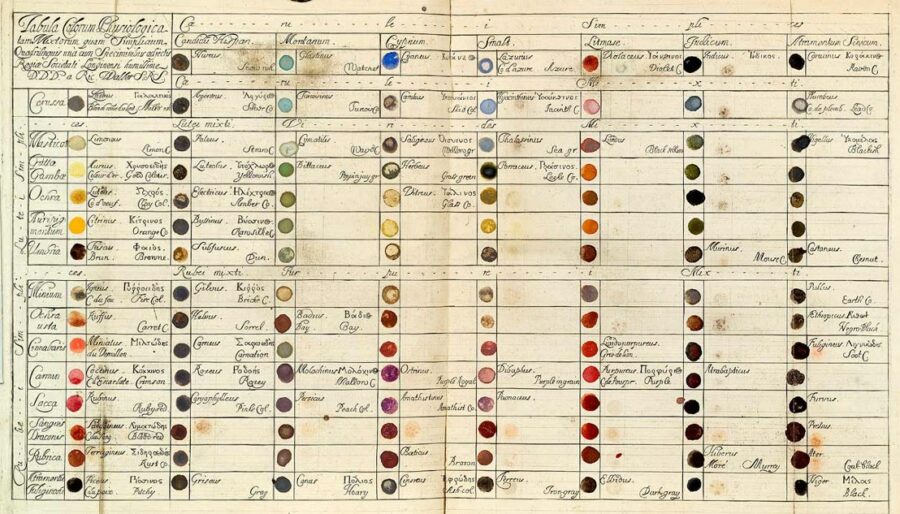
The period called the Enlightenment produced a revolution in which one sense, vision, became privileged above all others. As a result, Sachiko Kusukawa writes at The Royal Society Journal of the History of Science, “science is supremely visual. Indeed, one might say, excessively so.” Kusukawa situates English naturalist and illustrator Richard Waller at the beginning of her history about how sight came to dominate, and Sarah Lowengard places Waller’s color chart, presented at the Royal Society in 1686, at a formative moment in “the creation of color in Eighteenth-Century Europe.”
That’s not to say, of course, that color didn’t exist before charts like Waller’s, but it didn’t exist in neat taxonomies that divided color discretely, named and categorized it, and mapped the natural world by means of color theory. Waller’s “‘Table of Physiological Colors Both Mixt and Simple’ would permit unambiguous descriptions of the colors of natural bodies. To describe a plant, for example, one could compare it to the chart and use the names found there to identify the colors of the bark, wood, leaves, etc. Similar applications of the information collected in the chart might also extend to the arts and trades, he suggested.”
The naturalist approach to color would inform the artificial creation of color, helping “manufacturers to produce consistent dyes and paints,” notes the Smithsonian Libraries. Waller’s system was not precise enough for the task, but many others, including board game pioneer Milton Bradley, picked up his work and refined it, producing not only scientific and industrial color guides, but also pedagogies like Bradley’s Elementary Color textbook for children. Keith Moore, Head of Library & Information Services at the Royal Society, traces Waller’s color dots through the arts, “from the low art Ben-Day dots in the vintage comic books I used to read as a child to the high art pointillism and divisionism pioneered by Georges Seurat.”
Dozens of color systems, wheels, charts, and tables appeared over the next few hundred years, from the elaborate to the very simple. All of them have encountered the same basic issue, namely the subjectivity of visual perception. “Waller’s visual system exhibits the same conceptual problem… that plagued nearly all eighteenth-century classification systems. Which colors can be included and what is their ‘correct’ order? The answer was always tempered by available coloring materials and choice of media.” As more pigments became available, so too did more colors in the color charts.
Is the making of color classification systems more of a science or an art? It depends, perhaps, on what they’re used for, but “color remains elusive to scientists and color experts,” the Smithsonian points out, over 400 years after Waller’s chart. Since then, however, the language of color has evolved, as he envisioned, into a practical and poetic syntax and vocabulary.
See a larger version of the chart here and read about it in detail in Lowengard’s excellent article.
Related Content:
A Pre-Pantone Guide to Colors: Dutch Book From 1692 Documents Every Color Under the Sun
The Vibrant Color Wheels Designed by Goethe, Newton & Other Theorists of Color (1665–1810)
Josh Jones is a writer and musician based in Durham, NC. Follow him at @jdmagness
Read More...Support Us
We're hoping to rely on loyal readers, rather than erratic ads. Please click the Donate button and support Open Culture. You can use Paypal, Venmo, Patreon, even Crypto! We thank you!

About Us

Open Culture scours the web for the best educational media. We find the free courses and audio books you need, the language lessons & educational videos you want, and plenty of enlightenment in between.
Advertise With Us
FREE UPDATES!
GET OUR DAILY EMAIL
Get the best cultural and educational resources on the web curated for you in a daily email. We never spam. Unsubscribe at any time.
FOLLOW ON SOCIAL MEDIA
Open Culture editor Dan Colman scours the web for the best educational media. He finds the free courses and audio books you need, the language lessons & movies you want, and plenty of enlightenment in between.
Advertise With Us


