David Byrne Turns His Acclaimed Musical American Utopia into a Picture Book for Grown-Ups, with Vivid Illustrations by Maira Kalman
Whatever your feelings about the sentimental, lighthearted 1960 Disney film Pollyanna, or the 1913 novel on which it’s based, it’s fair to say that history has pronounced its own judgment, turning the name Pollyanna into a slur against excessive optimism, an epithet reserved for adults who display the guileless, out-of-touch naïveté of children. Pitted against Pollyanna’s effervescence is Aunt Polly, too caught up in her grown-up concerns to recognize, until it’s almost too late, that maybe it’s okay to be happy.
Maybe we all have to be a little like practical Aunt Polly, but do we also have a place for Pollyannas? Can that not also be the role of the modern artist? David Byrne hasn’t been waiting for permission to spread joy in his late career. Contra the common wisdom of most adults, a couple years back Byrne began to gather positive news stories under the heading Reasons to Be Cheerful, now an online magazine.
Then, Byrne had the audacity to call a 2018 album, tour, and Broadway show American Utopia, and the gall to have Spike Lee direct a concert film with the same title, and release it smack in the middle of 2020, a year all of us will be glad to see in hindsight. Byrne’s two-year endeavor can be seen as his answer to “American Carnage,” the grim phrase that began the Trump era.
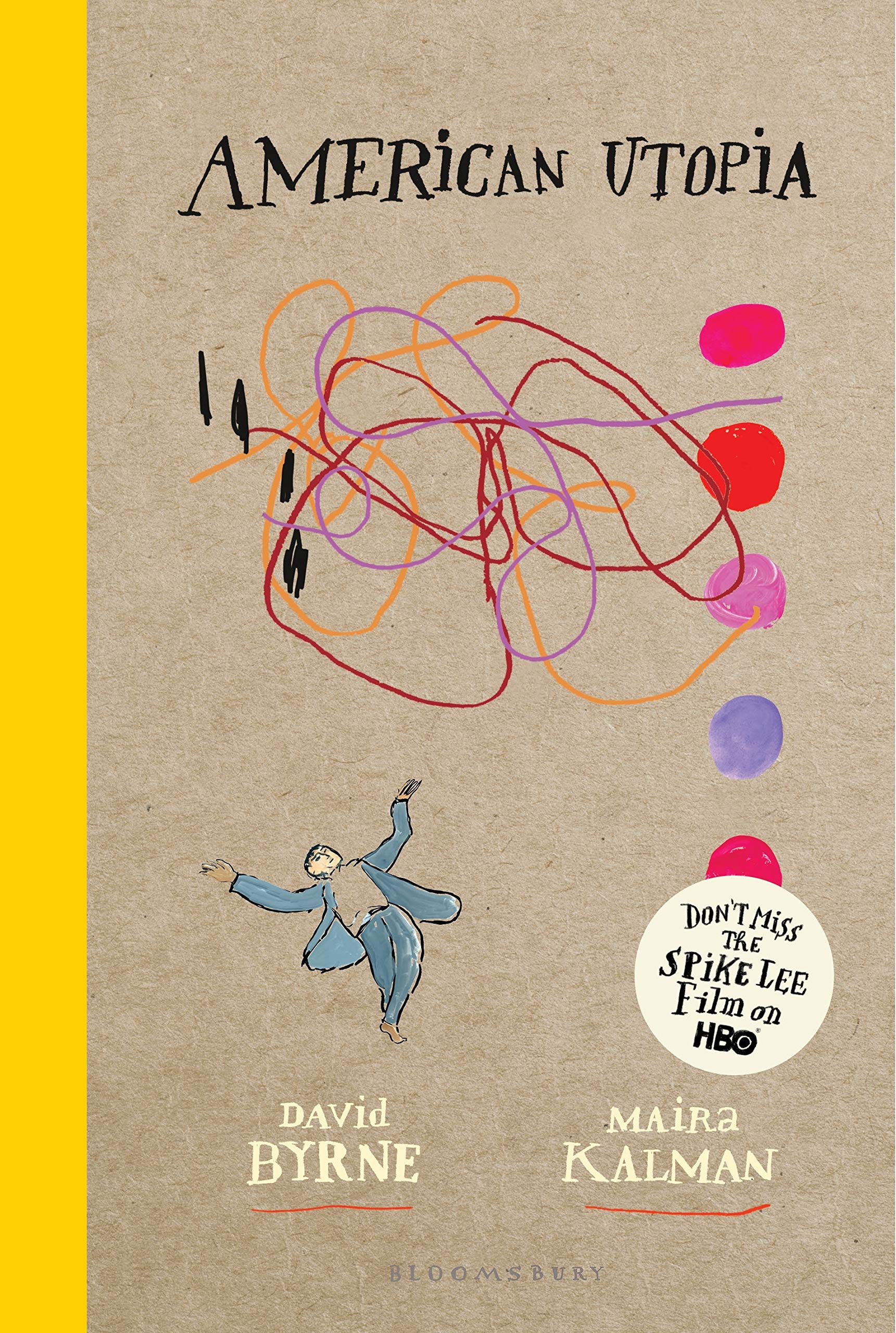
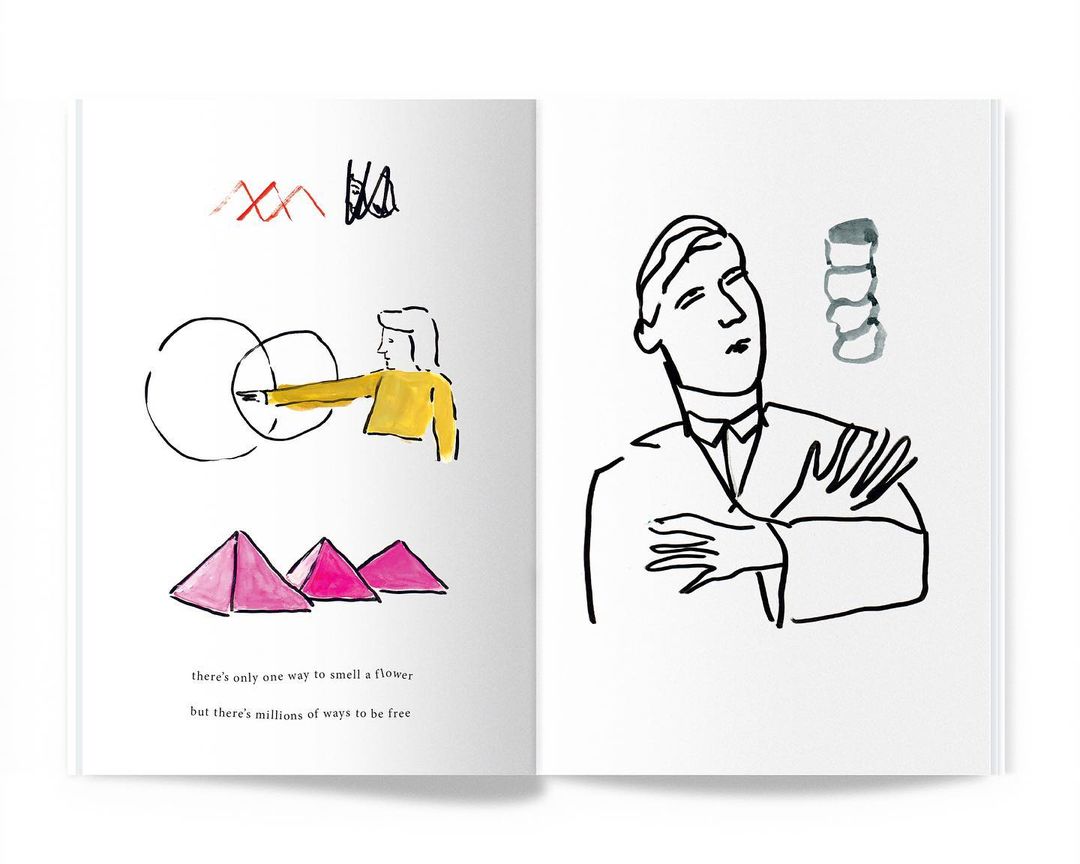
As if all that weren’t enough, American Utopia is now an “impressionistic, sweetly illustrated adult picture book,” as Lily Meyer writes at NPR, “a soothing and uplifting, if somewhat nebulous, experience of art.” Working with artist Maira Kalman, Byrne has turned his conceptual musical into something like a “book-length poem… filled with charming illustrations of trees, dancers, and party-hatted dogs.”
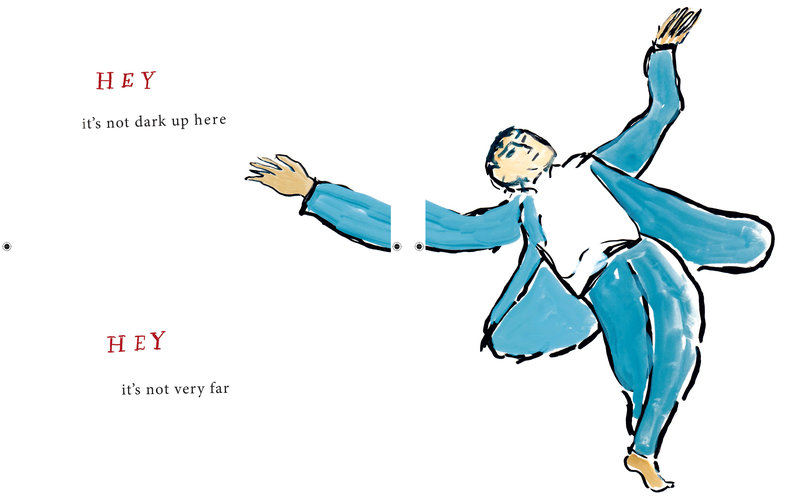
Byrne’s project is not naive, Maria Popova argues at Brain Pickings, it’s Whitmanesque, a salvo of irrepressible optimism against “a kind of pessimistic ahistorical amnesia” in which we “judge the deficiencies of the present without the long victory ledger of past and fall into despair.” American Utopia doesn’t articulate this so much as perform it, either with bare feet and gray suits onstage or the vivid colors of Kalman’s drawings, “lightly at odds,” Meyer notes, “with Byrne’s words, transforming their plain optimism into a more nuanced appeal.”
American Utopia the book, like the musical before it, was written and drawn before the pandemic. Do Byrne and Kalman still have reasons to be cheerful post-COVID? Just last week, they sat down with Isaac Fitzgerald for Live Talks LA to discuss it. You can see the whole, hour-long conversation just above. Kalman confesses she’s still in “quiet shock,” but finds hope in historical perspective and “incredible people out there doing fantastic things.”
Byrne takes us on one of his fascinating investigations into the history of thought, referencing a theorist named Aby Warburg who saw in the sum total of art a kind “animated life” that connects us, past, present, and future, and who reminded him, “Yes, there are other ways of thinking about things!” Perhaps the visionary and the Pollyannaish need not be so far apart. See several more of Kalman and Byrne’s beautifully optimistic pages from American Utopia, the book, at Brain Pickings.
Related Content:
David Byrne’s American Utopia: A Sneak Preview of Spike Lee’s New Concert Film
Watch Life-Affirming Performances from David Byrne’s New Broadway Musical American Utopia
Josh Jones is a writer and musician based in Durham, NC. Follow him at @jdmagness
Read More...How the Garage-Rock Anthem “Louie Louie” Became the Subject of a Lengthy FBI Investigation (1964)
Rock and roll history is built on happy accidents, moments where enthusiasm and raw talent exceed the limits of technology. Distortion, the sine qua non of modern rock, came from broken amplifiers and mixing boards, and speakers slashed to ribbons. Such excesses can be threatening. Link Wray’s gritty 1958 instrumental “Rumble” earned a ban from the airwaves for its alleged menace. Since then, rock has survived one crusade after another, launched by parents, church groups, and scaremongering charlatans.
One classic case illustrates the norm: parental overreaction to teenage rumors, incompetent response from authorities, and, as above, a technical limitation that led to a stylistic revolution. The incomprehensible vocals in the Kingsmen’s 1963 recording of “Louie, Louie” are legendary, covered and imitated by garage bands and rock stars since, and going down “in pop history,” Anwen Crawford writes at The New Yorker, “as one of the medium’s more endearing (and enduring) moments of amateurism.”
The performance “was a result of accident rather than design.” The Kingsmen recorded the song into a single microphone suspended several feet above singer Jack Ely and the band. “Ely was wearing dental braces,” notes Crawford, “and his bandmates, who were gathered around Ely in a circle, played their instruments loudly.” The band had learned the song from the Wailers, whose 1961 version covered songwriter Richard Berry’s original, both of which had been regional hits in the Pacific Northwest.
The Kingsman’s “Louie Louie” became an instant garage-rock classic, hitting No. 2 on the Billboard singles charts, despite the fact that no one who hadn’t heard the earlier versions had a clue what it was about. Since the lyrics could have said almost anything, it seemed, they provoked immediate speculation about obscenity. Rock critic Dave Marsh describes the phenomenon:
Back in 1963, everybody who knew anything about rock ‘n’ roll knew that the Kingsmen’s “Louie Louie” concealed dirty words that could be unveiled only by playing the 45 rpm single at 33–1/3. This preposterous fable bore no scrutiny even at the time, but kids used to pretend it did, in order to panic parents, teachers, and other authority figures. Eventually those ultimate authoritarians, the FBI got involved, conducting a thirty-month investigation that led to “Louie”‘s undying — indeed, unkillable — reputation as a dirty song.
So “Louie Louie” leaped up the chart on the basis of a myth about its lyrics so contagious that it swept cross country quicker than bad weather. Nobody — not you, not me, not the G‑men ultimately assigned to the case — knows where the story started. That’s part of the proof that it was a myth, because no folk tales ever have a verifiable origin. Instead society creates them through cultural spontaneous combustion.
The FBI investigation into “Louie Louie”’s lyrics began when outraged parents wrote letters to attorney general Robert F. Kennedy and J. Edgar Hoover. Off and on, for two years, the Bureau investigated the recording. They played it “backwards and forwards,” says Eric Predoehl, director of a documentary about the song. “They played it at different speeds, they spent a lot of time on it–but it was indecipherable at any speed.” Why they bothered is really anyone’s guess. Agents finally had to give up and close the case, after a meaningless expenditure of government resources.
They never bothered, during their investigation, to listen to the earlier recordings of the song. (The band swears Ely sung the lyrics as written verbatim.) They never interviewed Ely himself. Nor did anyone have the bright idea to walk down to the Bureau of Copyright, where they would have found un-salacious lyrics to “Louie Louie” on file. Rumor and innuendo were as good as evidence. Read the Full FBI report at NPR. “Reader beware,” they caution, “the document describes listener theories that the lyrics of ‘Louie Louie’ were secretly vulgar, and includes the supposed vulgarities.”
via Ted Gioia
Related Content:
Two Guitar Effects That Revolutionized Rock: The Invention of the Wah-Wah & Fuzz Pedals
Josh Jones is a writer and musician based in Durham, NC. Follow him at @jdmagness
Read More...Study Less, Study Smart: A Longtime Psych Professor Explains How to Study (or Do Any Intellectual Work) Effectively
If you’ve left formal education, you no doubt retain a few good memories from your years as a student. None of them, safe to say, involve studying — assuming you managed to get any studying done in the first place. The unfortunate fact is that few of us ever really come to grips with what it means to study, apart from sitting by oneself with a textbook for hours on end. Despite its obvious inefficiency as a learning method, we’ve all found ourselves doing that kind of “studying” at one time or another. Having taught psychology classes for 40 years, Pierce College professor Marty Lobdell has seen thousands of students laboring, indeed suffering, under similar studying-related assumptions, and in his 8.7‑million-times-viewed talk “Study Less, Study Smart,” he sets out to correct them. He has also dispensed his wisdom in a book by the same title.
Not many of us can get much out of a textbook after a few hours with it, or indeed, after more than about thirty minutes. It’s thus at such an interval that Lobdell suggests taking a regular five-minute break to listen to music, play a game, talk to a friend, meditate — to do anything but study — in order to recharge your ability to focus and head off these diminishing returns of absorption. At the end of each entire study session, you’d do well to schedule a bigger reward in order to reinforce the behavior of engaging in study sessions in the first place. Ideally, you’ll enjoy this reward in a different place than you do your studying, which itself shouldn’t be a room that comes with its own distracting primary use, like the bedroom, kitchen, or living room.
Even if you have a dedicated study area (and better yet, a dedicated study lamp that you turn on only while hitting the books), you won’t get much accomplished there if you rely on simply reading texts over and over again in hopes of eventually memorizing their contents. Lobdell recommends focusing primarily on not facts but the broader concepts that organize those facts. An effective means of checking whether you understand a concept is to try explaining it in your own words: Richard Feynman premised his “notebook technique” for learning, previously featured here on Open Culture, on just such a process. You’ll also want to make use of the notes you take in class, but only if you take them in a useful way, which necessitates a process of expansion and revision immediately after each class.
Lobdell has much more advice to offer throughout the full, hourlong talk. In it he also covers the value of study groups; the more questionable value of highlighting; genuine remembering versus simple recognition; the necessity of a good night’s sleep; the “survey, question, read, recite, review” approach to textbooks; and the usefulness of mnemonics (even, or perhaps especially, silly ones). If you’re a student, you can make use of Lobdell’s techniques right away, and if you once were a student, you may find yourself wishing you’d known about them back then. But properly adapted, they can benefit the intellectual work you do at any stage of life. Never, after all, does concentration become less valuable, and never can we claim to have learned something unless we can first make it understood to others – or indeed, to ourselves.
If you want the cliff notes version of the Study Less, Study Smart lecture, watch the video below:
Related Content:
The “Feynman Technique” for Studying Effectively: An Animated Primer
Richard Feynman’s Technique for Learning Something New: An Animated Introduction
What’s a Scientifically-Proven Way to Improve Your Ability to Learn? Get Out and Exercise
Based in Seoul, Colin Marshall writes and broadcasts on cities, language, and culture. His projects include the Substack newsletter Books on Cities, the book The Stateless City: a Walk through 21st-Century Los Angeles and the video series The City in Cinema. Follow him on Twitter at @colinmarshall, on Facebook, or on Instagram.
Read More...When Italian Futurists Declared War on Pasta (1930)
We must fight against puddles of sauce, disordered heaps of food, and above all, against flabby, anti-virile pastasciutta. —poet Filippo Tommaso Marinetti
Odds are Filippo Tommaso Marinetti, the father of Futurism and a dedicated provocateur, would be crestfallen to discover how closely his most incendiary gastronomical pronouncement aligns with the views of today’s low-carb crusaders.
In denouncing pasta, “that absurd Italian gastronomic religion,” his intention was to shock and criticize the bourgeoisie, not reduce bloat and inflammation.
He did, however, share the popular 21st-century view that heavy pasta meals leave diners feeling equally heavy and lethargic.
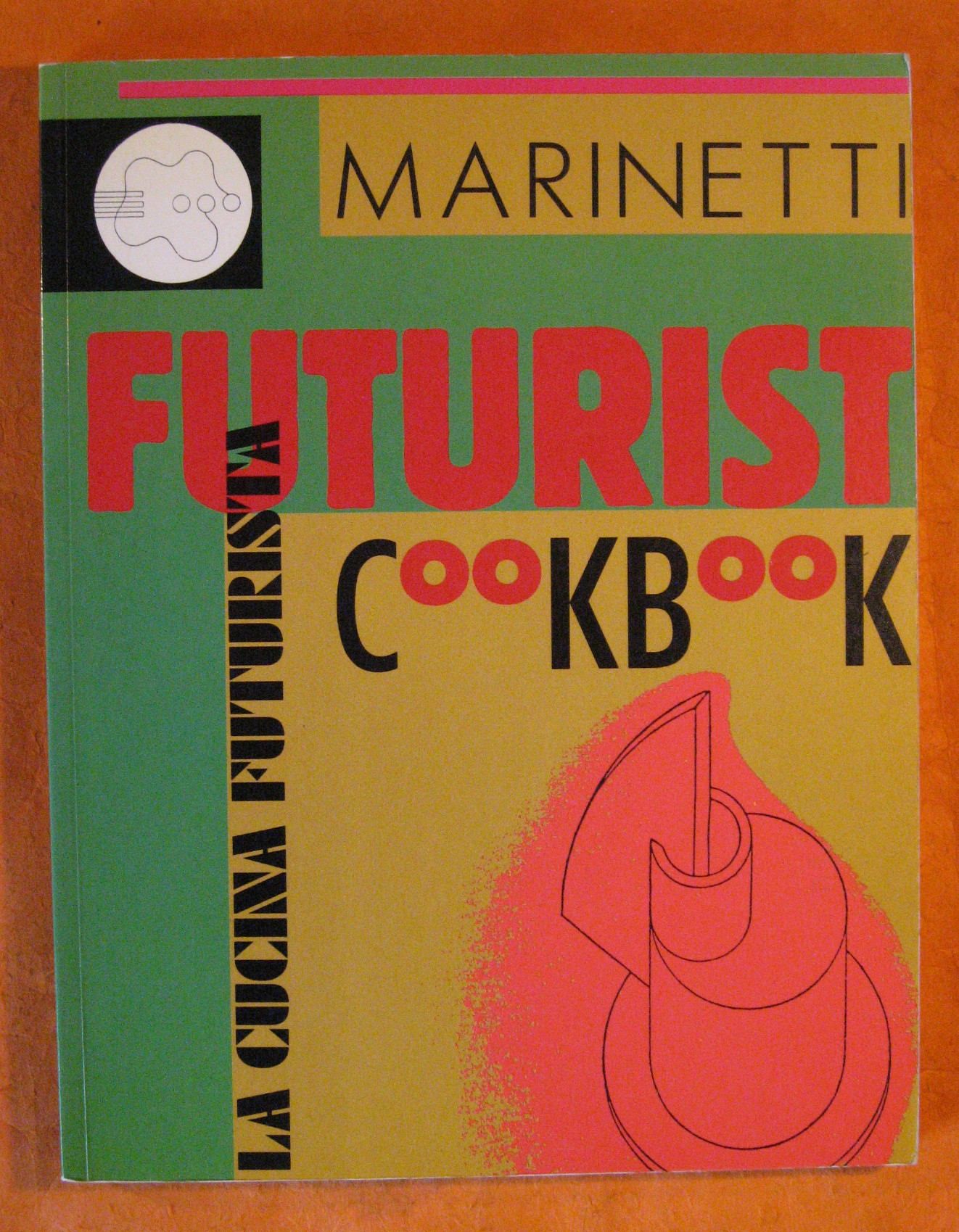
As he declared in 1930 in The Futurist Cookbook:
Futurist cooking will be free of the old obsessions with volume and weight and will have as one of its principles the abolition of pastasciutta. Pastasciutta, however agreeable to the palate, is a passéist food because it makes people heavy, brutish, deludes them into thinking it is nutritious, makes them skeptical, slow, pessimistic… Any pastascuittist who honestly examines his conscience at the moment he ingurgitates his biquotidian pyramid of pasta will find within the gloomy satisfaction of stopping up a black hole. This voracious hole is an incurable sadness of his. He may delude himself, but nothing can fill it. Only a Futurist meal can lift his spirits. And pasta is anti-virile because a heavy, bloated stomach does not encourage physical enthusiasm for a woman, nor favour the possibility of possessing her at any time.
Bombast came naturally to him. While he truly believed in the tenets of Futurism—speed, industry, technology, and the cleansing effects of war, at the expense of tradition and the past—he gloried in hyperbole, absurdity, and showy pranks.
The Futurist Cookbook reflects this, although it does contain actual recipes, with very specific instructions as to how each dish should be served. A sample:
RAW MEAT TORN BY TRUMPET BLASTS: cut a perfect cube of beef. Pass an electric current through it, then marinate it for twenty-four hours in a mixture of rum, cognac and white vermouth. Remove it from the mixture and serve on a bed of red pepper, black pepper and snow. Each mouthful is to be chewed carefully for one minute, and each mouthful is divided from the next by vehement blasts on the trumpet blown by the eater himself.
Intrepid host Trevor Dunseith documents his attempt to stage a faithful Futurist dinner party in the above video.
Guests eat salad with their hands for maximum “pre-labial tactile pleasure” before balancing oranges stuffed with antipasto on their heads to randomize the selection of each mouthful. While not all of the flavors were a hit, the party agreed that the experience was—as intended—totally novel (and 100% pasta free).
Marinetti’s anti-pasta campaign chimed with Prime Minister Benito Mussolini’s goal of eliminating Italy’s economic dependence on foreign markets—the Battle for Grain. Northern farmers could produce ample supplies of rice, but nowhere near the amount of wheat needed to support the populace’s pasta consumption. If Italians couldn’t grow more wheat, Mussolini wanted them to shift from pasta to rice.
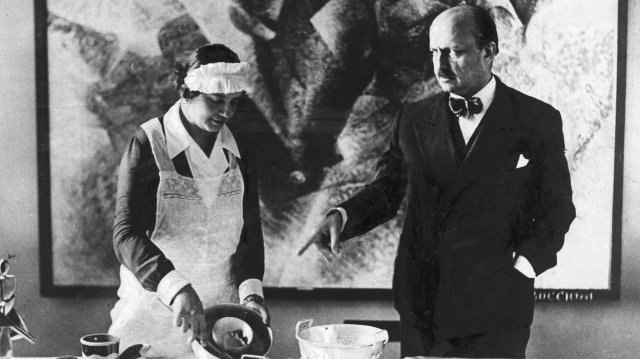
F.T. Marinetti by W. Seldow, 1934
Marinetti agreed that rice would be the “patriotic” choice, but his desired ends were rooted in his own avant-garde art movement:
… it is not just a question of replacing pasta with rice, or of preferring one dish to another, but of inventing new foods. So many mechanical and scientific changes have come into effect in the practical life of mankind that it is also possible to achieve culinary perfection and to organize various tastes, smells and functions, something which until yesterday would have seemed absurd because the general conditions of existence were also different. We must, by continually varying types of food and their combinations, kill off the old, deeply rooted habits of the palate, and prepare men for future chemical foodstuffs. We may even prepare mankind for the not-too-distant possibility of broadcasting nourishing waves over the radio.
Futurism’s ties to fascism are not a thing to brush off lightly, but it’s also important to remember that Marinetti believed it was the artist’s duty to put forward a bold public personae. He lived to ruffle feathers.
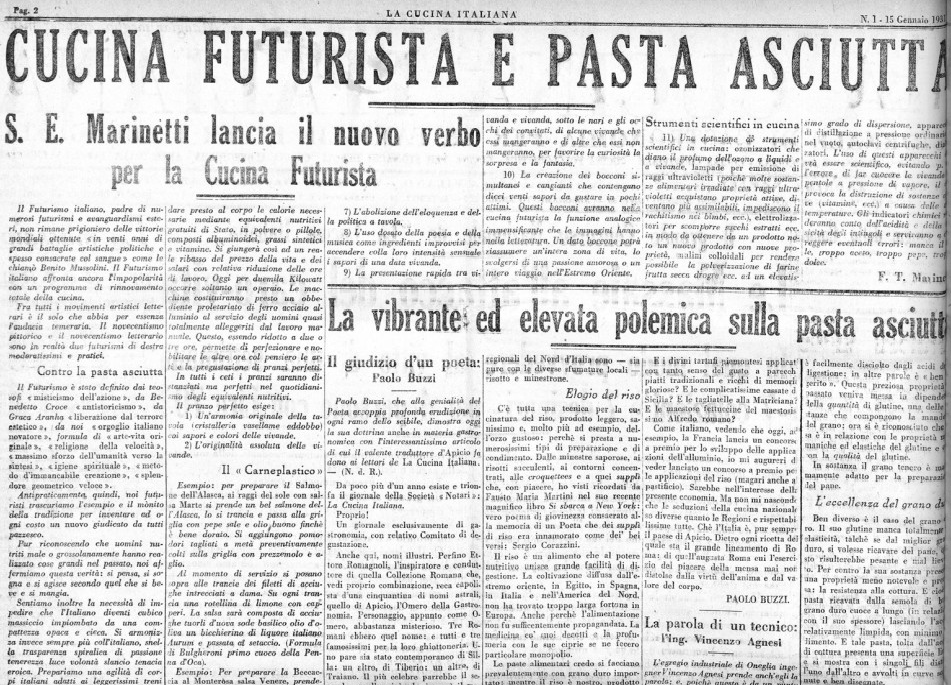
Mission accomplished. His anti-pasta pronouncements resulted in a tumult of public indignation, both locally and in the States.
The Duke of Bovino, mayor of Naples, reacted to Marinetti’s statement that pasta is “completely hostile to the vivacious spirit and passionate, generous, intuitive soul of the Neapolitans” by saying, “The angels in Heaven eat nothing but vermicelli al pomodoro.” Proof, Marinetti sniped back, of “the unappetizing monotony of Paradise and of the life of the Angels.”
He agitated for a futuristic world in which kitchens would be stocked with ”atmospheric and vacuum stills, centrifugal autoclaves (and) dialyzers.”
His recipes, as Trevor Dunseith discovered, function better as one-time performance art than go-to dishes to add to one’s culinary repertoire.
There is a reason why Julia Child’s Coq a Vin and Tarte Tatin endure while Marinetti’s Excited Pig and Black Shirt Snack have fallen into disuse.
Uh… progress?
As Daniel A. Gross writes in the Science History Institute’s Distillations:
Marinetti supported Fascism to the extent that it too advocated progress, but his allegiance eventually wavered. To Marinetti, Roman ruins and Renaissance paintings were not only boring but also antithetical to progress. To Mussolini, by contrast, they were politically useful. The dictator drew on Italian history in his quest to build a new, powerful nation—which also led to a national campaign in food self-sufficiency, encouraging the growing and consumption of such traditional foods as wheat, rice, and grapes. The government even funded research into the nutritional benefits of wheat, with one scientist claiming whole-wheat bread boosted fertility. In short, the prewar dream of futurist food was tabled yet again.
Get your own copy of Filippo Tommaso Marinetti’s The Futurist Cookbook here.
via Mental Floss
Related Content:
Salvador Dalí’s 1973 Cookbook Gets Reissued: Surrealist Art Meets Haute Cuisine
Recipes from the Kitchen of Georgia O’Keeffe
Ayun Halliday is an author, illustrator, theater maker and Chief Primatologist of the East Village Inky zine. See her as a French Canadian bear who travels to New York City in search of food and meaning in Greg Kotis’ short film, L’Ourse. Follow her @AyunHalliday.
Read More...Jimi Hendrix’s Home Audio System & Record Collection Gets Recreated in His London Flat
A visit to William Faulkner’s house once convinced me I’d seen his ghost. Millions of people commune with Elvis’s spirit at Graceland each year. Some lucky person will end up with Toni Morrison’s personal library, and maybe also her Tribeca condo. No matter how well we think we know a favorite artist, there’s nothing like connecting with the spaces and things they left behind. Since 2016, Jimi Hendrix devotees have been able to make a pilgrimage to the London apartment he shared with his girlfriend, Kathy Etchingham, between 1968 and 1969.
The flat on 23 Brook Street has been set up the way it was when Hendrix lived there, thanks to Handel & Hendrix in London, who also maintain the house of George Frideric Handel just next door. The only other connection between the two artists is Hendrix’s ownership of two copies of Handel’s Messiah, “both of which show signs of wear and tear,” the foundation notes, and “which would have been uncanny listening so near to where it was composed.” Jimi tastefully decorated the apartment to his tastes, and told Etchingham it was “my first real home of my own.”
Hendrix’s home was made complete by a 100-plus collection of LPs and a high-end audio system that has recently been recreated in collaboration with the makers of the original components: Bang & Olufsen, Lowther, and LEAK supply the same or similar models of turntable, speaker, and amplifier, respectively, on which Jimi listened to Handel next door to the ghost of Handel. Hearing those records in Jimi’s space, the way he heard them, says Nabihah Iqbal in a video that debuted on Hendrix’s birthday, November 27th, is “a time-traveling experience.”
Iqbal chooses her favorites from the collection—Bob Dylan, Ravi Shankar, Muddy Waters, Django Reinhardt—discussing them as they quietly play in the background. For the full Hendrix experience, we’d need to crank the vintage amplifier to 11. He liked to listen loud. Etchingham “recalled that they had to ‘stick a ha’penny with sellotape onto the turntable arm… otherwise it would jump up and down the louder it got.” He would occasionally blow the reinforced speakers during parties and have to take them in for repair.
The flat also functioned as a composition room, and Hendrix’s friends stopped by to jam. (Richie Havens debuted his “anti-war anthem ‘Handsome Johnny’ to a small party in the flat on Hendrix’s Epiphone acoustic guitar.”) Handel & Hendrix in London have revived the practice with their Hendrix Flat Sessions, inviting musicians to play in the space. Above, Marcus Machado talks about what Hendrix means to him and jams a version of “Voodoo Child (Slight Return)” while sitting on Hendrix’s bed.
See several more Hendrix Flat Sessions here. The records in Hendrix’s collection “cover blues, jazz, folk, rock, psychedelia and even a handful of classical LPs.” See Iqbal’s selections, with annotations from Handel & Hendrix in London, here. The Hendrix Flat is currently open to the public on Saturdays.
Related Content:
How Science Fiction Formed Jimi Hendrix
Behold Moebius’ Many Psychedelic Illustrations of Jimi Hendrix
Josh Jones is a writer and musician based in Durham, NC. Follow him at @jdmagness
Read More...Comic Book Writer Fred Van Lente Touts “Comic Supremacy” on Pretty Much Pop: A Culture Podcast #72
Fred Van Lente has written for more than 15 years for his own Evil Twin Comics, Marvel and other outlets. In this episode of Pretty Much Pop, he joins your hosts Mark Linsenmayer, Erica Spyres, and Brian Hirt to discuss comics as an idiosyncratic form of literature.
In the realm of non-fiction, Ryan started with the beloved Action Philosophers! series in 2004 with illustrator Ryan Dunlavey, and this team has gone on to create the very successful Comic Book History of Comics, plus more recently Action Presidents, Action Activists (available free in association with the NYC Department of Education’s Civics for All program), and have just begun releasing The Comic Book History of Animation. While the non-fiction comics format is common in places like Japan, and has a storied history in America, having been used to train soldiers in World War II, this is still something of a novelty in America as comics still struggle to overcome their reputation in (as Ryan puts it) “trash for morons.” Given that visual content is well known to help people learn as compared to text alone, the use of tools like Action Presidents in classrooms shouldn’t be surprising.
The interview also gets into Ryan’s fiction work, from Cowboys & Aliens, which was turned into a 2011 Jon Favreau/Steven Spielberg film entirely without Ryan’s involvement, to titles like Marvel Zombies and X‑Men Noir which use alternate dimension versions of popular characters to tell stories too dark and/or whimsical to have much possibility of ever being transferred to the screen. Despite comics’ reputation as being basically like elaborate film story-boards, their low overhead is exactly what distinguishes them so strongly from film: Their creativity is unlimited by budget, and creators can take tremendous risks. Whatever the mainstream palatability of (alternate dimension) Peter Parker eating Aunt May’s brain, this has been one of the most popular things that Ryan’s been involved with among comic book readers.
Learn more about Fred’s work at fredvanlente.com. You can read there about how Fred constructs scripts; the one Mark refers to with the mysteriously changed coat is right there highlighted at the top of this page, and there are also several sample scripts including the one for Action Philosophers: Immanuel Kant that demonstrates Fred’s methods for vividly explaining a complex idea.
Hear more of this podcast at prettymuchpop.com. This episode includes bonus discussion you can access by supporting the podcast at patreon.com/prettymuchpop. This podcast is part of the Partially Examined Life podcast network.
Pretty Much Pop: A Culture Podcast is the first podcast curated by Open Culture. Browse all Pretty Much Pop posts.
Read More...A Biostatistician Uses Crochet to Visualize the Frightening Infection Rates of the Coronavirus
Chances are you’ve looked at more graphs this past year than you did over the previous decade — not just while working at home, but while scrolling through cascades of often-troubling quantitative information during your “off” hours as well. This phenomenon has hardly been limited to the Americans who obsessed over the predictions of and returns from their presidential election last month, an event turned practically into a sideshow by the ongoing pandemic. Around the world, we’ve all wanted to know: Where did the coronavirus come from? What is it? Where is it going?
Apologies to Paul Gauguin, who didn’t even live to see the Spanish flu of 1918, a time when nobody could have imagined instantaneously and widely sharing visual renderings of data about that disease. The world of a century ago may not have had dynamic animated maps and charts, updated in real time, but it did have crochet. Whether or not it had then occurred to anyone as a viable medium for visualizing the spread of disease, it can be convincing today. This is demonstrated by Norwegian biostatistician Kathrine Frey Frøslie, who in the video above shows us her crocheted representations of various “R numbers.”
This now much-heard term, Frøslie’s explains, “denotes reproduction. If the R number is one, this means that each infected person will on average infect one new person during the course of the disease. If R equals two, each infected person will infect two persons,” and so on. Her crocheted version of R=1, with a population of ten, is small and narrow — it looks, in other words, entirely manageable. Such a disease “will always be always present, but the number of infected persons will be constant.” Her R=0.9, which steadily narrows in a way that resembles an unfinished Christmas stocking, looks even less threatening.
Alas, “for the coronavirus, the R is mostly larger than one.” In crocheted form, even R=1.1 is pretty formidable; when she brings out her R=1.5, “it is evident that we have a problem. Even the crochet patch kind of crumbles.” Then out comes R=2, which must have been quite a project: its ten original infections bloom into 2,560 new cases, all represented in almost organically dense folds of yarn. As for R=2.5, when Frøslie eventually gets it hoisted onto her lap, you’ll have to see it to believe it. Throughout 2020, of course, many of our at-home hobbies have grown to monstrous proportions — even those taken up by medical scientists.
via Metafilter
Related Content:
Simulating an Epidemic: Using Data to Show How Diseases Like COVID-19 Spread
Everything You Need To Know About Viruses: A Quick Visual Explanation of Viruses in 9 Images
The History of the Plague: Every Major Epidemic in an Animated Map
An Artist Crochets a Life-Size, Anatomically-Correct Skeleton, Complete with Organs
The Beautiful Math of Coral & Crochet
Based in Seoul, Colin Marshall writes and broadcasts on cities, language, and culture. His projects include the Substack newsletter Books on Cities, the book The Stateless City: a Walk through 21st-Century Los Angeles and the video series The City in Cinema. Follow him on Twitter at @colinmarshall, on Facebook, or on Instagram.
Read More...Marina Abramović’s Method for Overcoming Trauma: Go to a Park, Hug a Tree Tight, and Tell It Your Complaints for 15 Minutes
One of the most renowned of Chinese poets, Du Fu, survived the devastating An Lushan rebellion that nearly brought down the Tang Dynasty and resulted in an incredible loss of life around the country. His poems are full of grief, as translator David Hinton notes. The opening of “Spring Landscape” contains “possibly the most famous line in Chinese poetry,” and a painful comment on humanity’s place in the natural world.
The country in ruins, rivers and mountains
continue. The city grows lush with spring.Blossoms scatter tears for us, and all these
separations in a bird’s cry startle the heart.
The poem presents a tragic irony. Nature invites us in, seems to promise comfort and refuge. “Du Fu tells us that birds seem to cry for us, and blossoms weep,” writes Madeleine Thien at The New York Review of Books. But “of course, this is a fairy-tale view, and ‘in the knowledge of its falsity, heartbreaking.’”
Is nature indifferent to human suffering? It would seem so to the broken-hearted Confucian poet. But nature is not devoid of fellow feeling. Trees talk to each other, create social worlds and families, and communicate with the other plants and animals around them. Japanese researchers have shown that the oils trees secrete can measurably lower stress levels, reduce hostility and depression, and boost immunity. Trees may not weep, but they care.
Trees are also, says performance artist Marina Abramović in the short video above, “perfectly silent listeners”—a rare and valuable quality in times of stress. “They have intelligence. They have feelings.” And for this reason, a tree is the ideal companion when we need an ear.
You can complain to them. And I started this a long time ago when I was in the Amazon with the native Indians. You know, they will go to the Sequoia tree, which is one of the oldest on the planet. And they will make a dance for the tree. These dances for the tree are so incredibly moving an emotional. So I thought, Wow! Why don’t I create an exercise that really works for me?
Abramović’s tree therapy is one part of her “Abramović Method,” notes Paper, “a set of techniques that enables artists to get to higher states of consciousness.” She recommends it for anyone who’s reeling from the traumas of this year. In our own age of devastation and isolation, it certainly couldn’t hurt, and perhaps we know more than Du Fu did about how nature supports our emotional lives.
So “please, go to the park near you,” the artist implores. “Pick the tree you like. Hold the tree tight. Really tight. And just pour your heart into it. Complain to the tree for a minimum of 15 minutes. It’s the best healing that you can do.” Included in the video is a testimonial from an ex-rugby player, who found the Complaining to Trees method transformative. “There is something in it,” he says. “It’s almost like you become part of the tree as well.” Trees are not people. They don’t dispense advice. They listen and console in their own mysteriously ancient, silent way.
Related Content:
Josh Jones is a writer and musician based in Durham, NC. Follow him at @jdmagness
Read More...The Sistine Chapel of the Ancients: Archaeologists Discover 8 Miles of Art Painted on Rock Walls in the Amazon

All images by José Iriarte
Over twelve thousand years ago, some of the first humans in the Amazon hunted, painted, and danced with the massive extinct mammals of the ice age: giant sloths and armadillos, ice-age horses, and mastodons…. How do we know? We have pictures, or rock paintings, rather–many thousands of them made around 12,500 years ago and only recently “found on an eight-mile rock surface along the Guayabero River the Colombian Amazon,” Hakim Bishara reports at Hyperallergic. The prehistoric wonder has been dubbed the “Sistine Chapel of the ancients.”
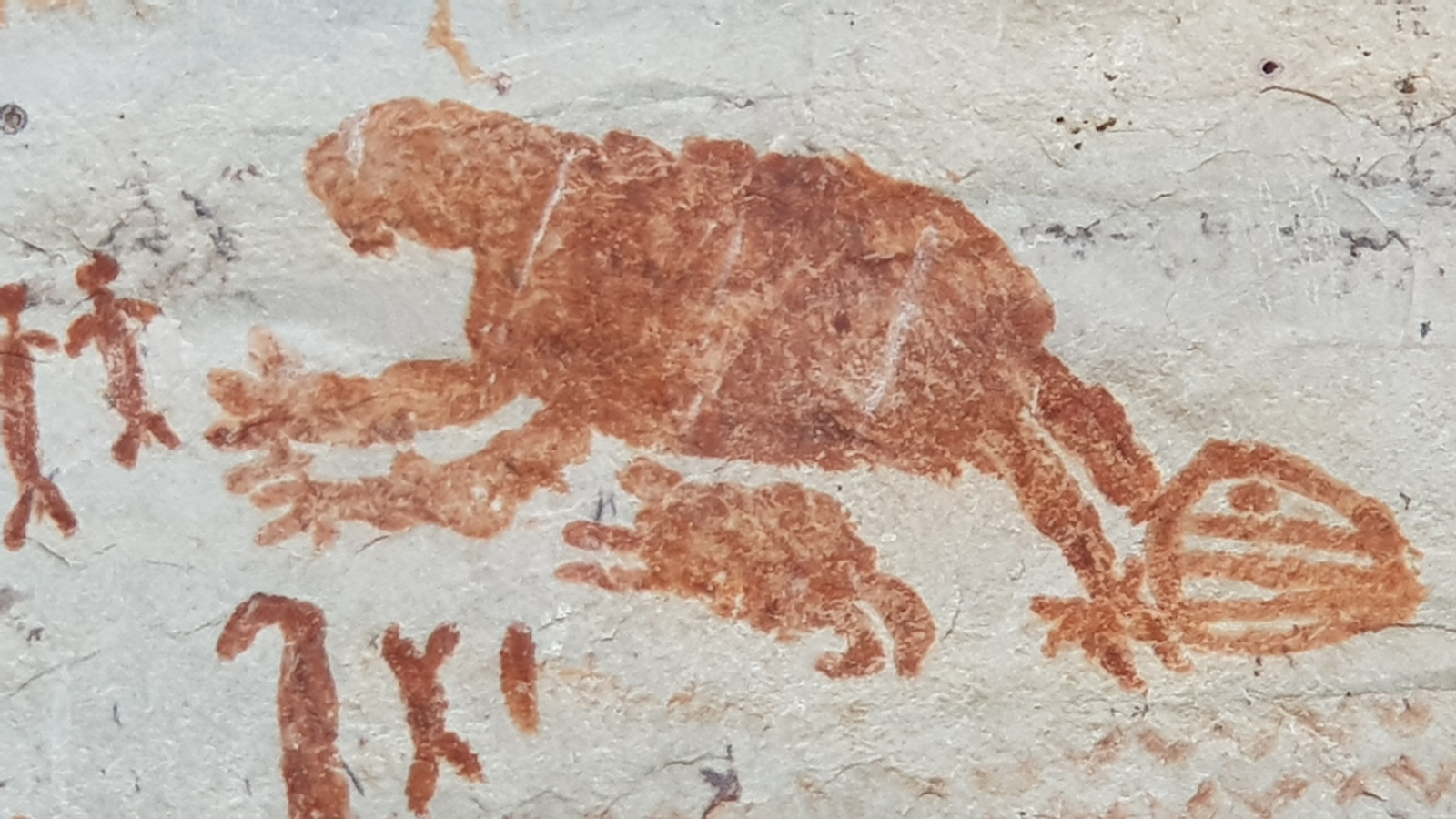
The discovery, made last year, was kept secret until the release of a new documentary airing this month called Jungle Mystery: Lost Kingdoms of the Amazon. Palaeo-anthropologist Ella Al-Shamahi, presenter of the Channel 4 series and a member of the team that found the site, explains why it may be hard to imagine such great prehistoric beasts lumbering through the rainforest.
Their existence in this rock art offers a clue to major climatological shifts that have occurred in the region over millennia. As Al-Shamahi tells The Observer:
One of the most fascinating things was seeing ice age megafauna because that’s a marker of time. I don’t think people realise that the Amazon has shifted in the way it looks. It hasn’t always been this rainforest. When you look at a horse or mastodon in these paintings, of course they weren’t going to live in a forest. They’re too big. Not only are they giving clues about when they were painted by some of the earliest people – that in itself is just mind-boggling – but they are also giving clues about what this very spot might have looked like: more savannah-like.
“We’re talking about several tens of thousands of paintings,” says the team’s leader, José Iriarte, professor of archaeology at Exeter University. “It’s going to take generations to record them.” The rock wall art illustrates many extinct species, including prehistoric lama and three-toed hoofed mammals with trunks, as well as realistic depictions of monkeys, bats, snakes, turtles, tapirs, birds, lizards, fish, and deer. Remains found near the site offer clues to the ancient peoples’ diets, which included piranha, alligators, snakes, frogs, and “rodents such as paca, capybara, and armadillos,” Bishara notes.

Many of the images are painted to the scale of handprints left in many places along the wall, and some are much larger. Researchers were particularly surprised by the method of composition. Some of the art is so high up it can only be seen by drone. “I’m 5ft 10in,” says Shamahi, “and I would be breaking my neck looking up. How were they scaling those walls?” It appears the artists used some form of rappelling. There are “depictions of wooden towers among the paintings,” reports The Guardian, “including figures appearing to bungee jump from them.”
Further study in the coming decades, and centuries, will reveal much more about how the paintings were made. The why, however, will prove more elusive. Iriarte speculates they served a sacred purpose. “It’s interesting to see that many of these large animals appear surrounded by small men with their arms raised, almost worshipping these animals.” The presence of hallucinogenic plants among the paintings leads him to compare the paintings with contemporary Amazonian people, for whom “non-humans like animals and plants have souls, and they communicate and engage with people in cooperative or hostile ways through the rituals and shamanic practices that we see depicted in the rock art.”
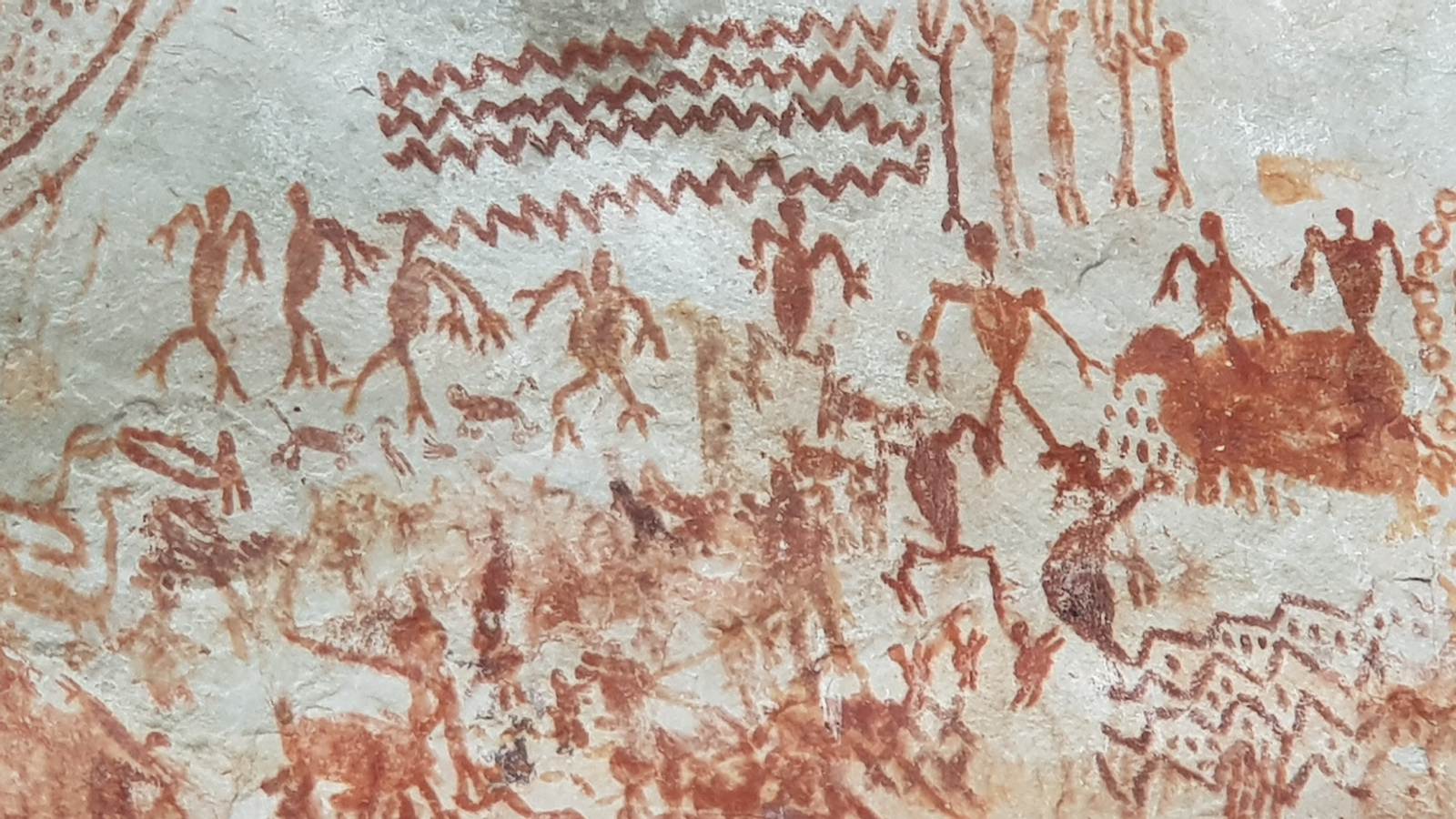
Whatever their purpose, the over 100,000 paintings on the eight-mile wall contain an immeasurable store of information about ancient Amazonians’ creativity and ingenuity. They also add, perhaps, to the mountain of rock art evidence suggesting, Barbara Ehrenreich argued recently, that before organized war became the dominant practice of civilizations, “humans once had better ways to spend their time.” The publication of the research team’s findings is available here. See more images of the site at Hyperallergic and Designboom and watch the first two episodes of Jungle Mystery: Lost Kingdoms of the Amazon here.
via Colossal
Related Content:
A Recently-Discovered 44,000-Year-Old Cave Painting Tells the Oldest Known Story
Was a 32,000-Year-Old Cave Painting the Earliest Form of Cinema?
40,000-Year-Old Symbols Found in Caves Worldwide May Be the Earliest Written Language
Josh Jones is a writer and musician based in Durham, NC. Follow him at @jdmagness
Read More...
For Dave Brubeck’s 100th Birthday, Watch Pakistani Musicians Play an Enchanting Version of “Take Five”
How’s this for fusion? Here we have The Sachal Studios Orchestra, based in Lahore, Pakistan, playing an innovative cover of “Take Five,” the jazz standard written by Paul Desmond and originally performed by The Dave Brubeck Quartet in 1959. Brubeck–who would have celebrated his 100th birthday today–called it the “most interesting” version he had ever heard. Once you watch the performance above, you’ll know why.
According to The Guardian, The Sachal Studios Orchestra was created by Izzat Majeed, a philanthropist based in London. When Pakistan fell under the dictatorship of General Zia-ul-Haq during the 1980s, Pakistan’s classical music scene fell on hard times. Many musicians were forced into professions they had never imagined — selling clothes, electrical parts, vegetables, etc. Whatever was necessary to get by. Today, many of these musicians have come together in a 60-person orchestra that plays in a state-of-the-art studio, designed partly by Abbey Road sound engineers.
You can purchase their album, Sachal Jazz: Interpretations of Jazz Standards & Bossa Nova, on Amazon and iTunes. It includes versions of “Take Five” and “The Girl from Ipanema.”
For good measure, we’ve added Sachal’s take on “Eleanor Rigby,” something George Harrison would surely have loved.
Note: A version of this post first appeared on our site back in 2013. But as enchanting as it is, it seemed worth bringing back.
If you would like to support the mission of Open Culture, consider making a donation to our site. It’s hard to rely 100% on ads, and your contributions will help us continue providing the best free cultural and educational materials to learners everywhere. You can contribute through PayPal, Patreon, and Venmo (@openculture). Thanks!
Related Content:
How Dave Brubeck’s Time Out Changed Jazz Music
Watch Jimi Hendrix’s ‘Voodoo Chile’ Performed on a Gayageum, a Traditional Korean Instrument
An Uplifting Musical Surprise for Dave Brubeck in Moscow (1997)
Ultra Orthodox Rabbis Sing Pink Floyd’s “Wish You Were Here” on the Streets of Jerusalem
Read More...Support Us
We're hoping to rely on loyal readers, rather than erratic ads. Please click the Donate button and support Open Culture. You can use Paypal, Venmo, Patreon, even Crypto! We thank you!

About Us

Open Culture scours the web for the best educational media. We find the free courses and audio books you need, the language lessons & educational videos you want, and plenty of enlightenment in between.
Advertise With Us
FREE UPDATES!
GET OUR DAILY EMAIL
Get the best cultural and educational resources on the web curated for you in a daily email. We never spam. Unsubscribe at any time.
FOLLOW ON SOCIAL MEDIA
Open Culture editor Dan Colman scours the web for the best educational media. He finds the free courses and audio books you need, the language lessons & movies you want, and plenty of enlightenment in between.
Advertise With Us

