Stream 48 Hours of Vintage Christmas Radio Broadcasts Featuring Orson Welles, Bob Hope, Frank Sinatra, Jimmy Stewart, Ida Lupino & More (1930–1959)
The Golden Age of American Radio began in the 1930s and lasted well into the 50s. That makes nearly thirty Christmases, not one of which passed without special broadcasts by the major networks. This Christmas, thanks to The World War II News and Old Time Radio Channel on Youtube, you can experience the Golden Age’s three decades through 48 straight hours of holiday broadcasts. Strung like an audio garland in chronological order, these begin with an episode of NBC’s Empire Builders, quite possibly the first-ever Western radio drama, first broadcast on December 22nd, 1930 — a rare year from which to hear a recorded radio show at all, let alone a Christmas special. The compilation ends one day shy of 29 years later, with a Top 40 broadcast from WMGM in New York.
Throughout this all-Christmas listening experience, old-time radio enthusiasts will recognize many of America’s very favorite shows: Lum and Abner, Amos and Andy, Fibber McGee and Molly and The Great Gildersleeve, The Jack Benny Program and The Charlie McCarthy Show. For many seasonally appropriate episodes of those series as well as one-off variety broadcasts, networks would wrangle as many big names as they could into the studio, from Bob Hope and Lionel Barrymore to Gary Cooper and Frank Sinatra to Carmen Miranda and Ida Lupino (director, film noir fans know, of The Hitch-Hiker).
In 1947, CBS’ Lux Radio Theater put on a full production of It’s a Wonderful Life with Jimmy Stewart and Donna Reed, stars of the film that had come out just the year before. Even U.S. presidents like Franklin D. Roosevelt and Dwight D. Eisenhower turn up to deliver Christmas addresses.
Open Culture readers may well remember CBS’ 1941 production of Oscar Wilde’s “The Happy Prince” featuring Orson Welles and Bing Crosby, but even those of us who know our classic radio will hear a good deal in these 48 hours of broadcasts that we’ve never heard before. Though all of them celebrate the season in one way or another, they do so in a host of different forms and genres, even beyond the broad divisions of drama, comedy, music, and celebrity chat. In gradually passing from living memory, the golden age of American radio comes to seem a longer era than it was. But through that relatively brief window, opened by the household adoption of radio and closed by the rise of television, came an abundance of creativity that can still surprise us — and indeed inspire us — here at the close of the year 2020.
Related Content:
A Christmas Carol, A Vintage Radio Broadcast by Orson Welles and Lionel Barrymore (1939)
Bob Dylan Reads “‘Twas the Night Before Christmas” On His Holiday Radio Show (2006)
Based in Seoul, Colin Marshall writes and broadcasts on cities, language, and culture. His projects include the Substack newsletter Books on Cities, the book The Stateless City: a Walk through 21st-Century Los Angeles and the video series The City in Cinema. Follow him on Twitter at @colinmarshall, on Facebook, or on Instagram.
Read More...The Ukulele Orchestra of Great Britain Performs The Rolling Stones’ “(I Can’t Get No) Satisfaction”
The Ukulele Orchestra of Great Britain–we’ve featured them here before, playing covers of everything from David Bowie’s “Heroes,” to Nirvana’s “Smells Like Teen Spirit,” Talking Heads’ “Psycho Killer” and The Who’s “Pinball Wizard.” And let’s not forget their stirring performances of Ennio Morricone’s western theme songs. Now, to help lift you out of the COVID gloom, they’re back with a novel take on the Stones’ 1965 classic, “(I Can’t Get No) Satisfaction.” Hope you enjoy.
Note: The orchestra plans to post a new video every Sunday on their YouTube channel, and a full (pay-per-view) concert every month available on their website.
If you would like to support the mission of Open Culture, consider making a donation to our site. It’s hard to rely 100% on ads, and your contributions will help us continue providing the best free cultural and educational materials to learners everywhere. You can contribute through PayPal, Patreon, and Venmo (@openculture). Thanks!
Related Content
David Bowie’s “Heroes” Delightfully Performed by the Ukulele Orchestra of Great Britain
Read More...Tune Into Tree.fm: An Online Radio Station That Streams the Soothing Sounds of Forests from Around the World
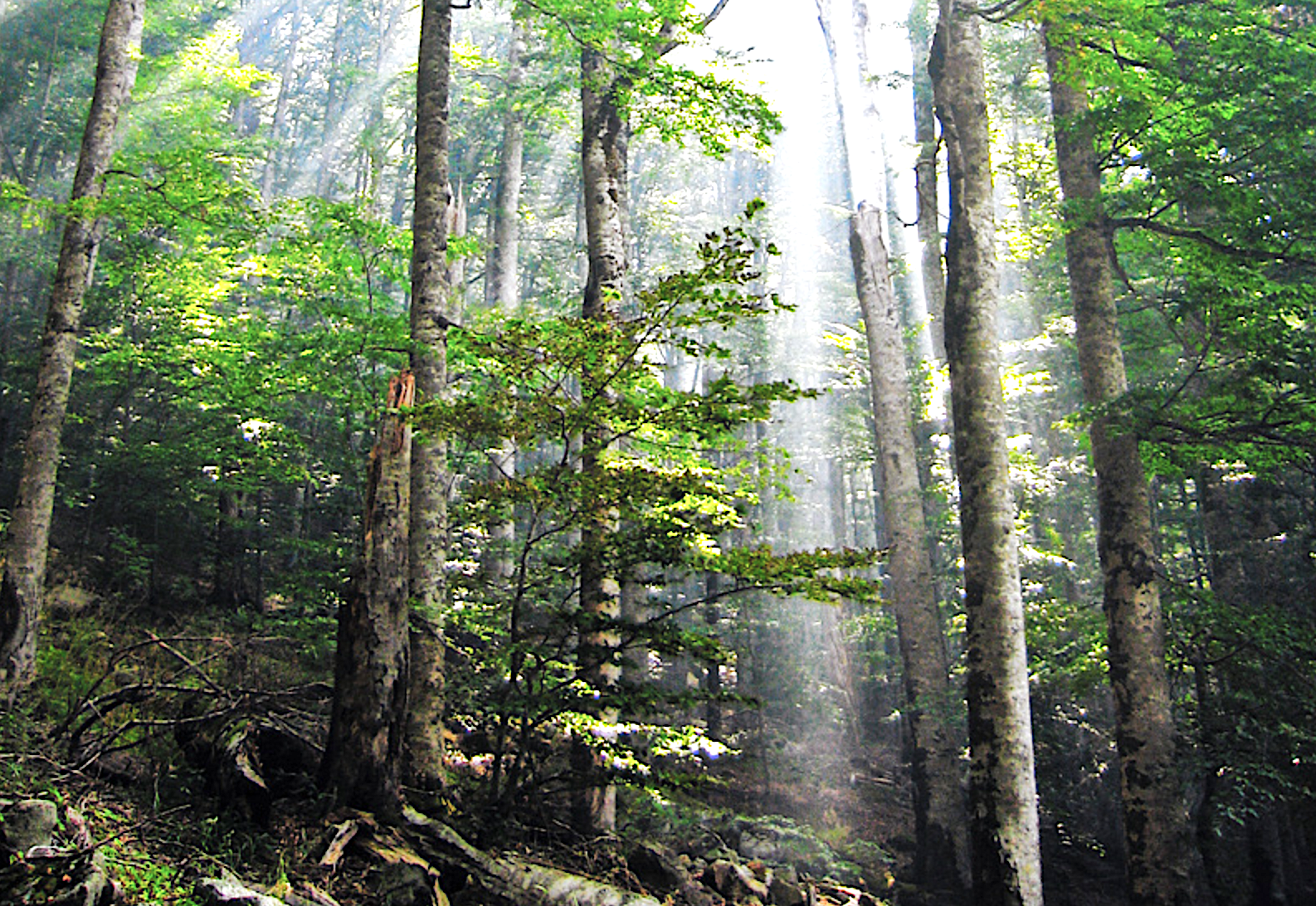
Image by Snežana Trifunović, via Wikimedia Commons
Walk into a forest. Stand perfectly still. Close your eyes. What do you hear? The sounds of birds, the rustling leaves, yes, yes…. But what’s that? And that? The forest is full of sounds you can’t identify! Curious sounds, far-away sounds, soothing sounds, sounds that are not the churning anxious wheels inside your head when you try to relax….
Experiencing ourselves around trees has several demonstrable benefits, as the science of forest bathing has taught us. Many of these have to do with visual, olfactory, and tactile pleasures. But we must not neglect the natural acoustic system all around us: an immersive experience in full 360-degree sound. Trees’ “vibratory energies reveal humanity’s many connections with forests,” writes David George Haskell at Scientific American.
Forests “are full of song.”
That’s all very well for people who can go outside. But if you’re locked down in a major city, say, or the office, or an ill-advised holiday gathering, and you feel cortisol levels rising, we’ve got you covered. Back in September, we featured Sounds of the Forest, a crowdsourced audio archive gathering sounds from forests all over the world. Now, these clips are streaming at Tree.fm, an online radio station for tree songs in stereo.
Streams rill, frogs hoot, birds caw and squawk in chorus. And then there are the trees, each species possessed of its own voice, Haskell writes:
Gusts of wind sonify plant diversity. Oak’s voice is coarse-grained, throaty; maple’s is sandy and light. These differences have their origins in plant evolution and adaptation. Drought-resistant oak leaves are thicker, tougher than the water-hungry maple. The different sounds of trees on a dry mountain ridge and in a moist forested hollow speak to the particularities of the ecology of each place. Ponderosa pine sings sweetly in the winds of California, its long needles were, John Muir wrote, “finest music” and a “free, wing-like hum”. But in Colorado, pines have evolved shorter, stiffer needles to cope with heavy loads of snow and ice. There, the trees wail as their wiry needles harrow the wind.
Tree.fm “is a tool that gives you instant access to the sounds of the world’s forests,” Beth Skwarecki writes at Lifehacker. Many of those sounds, like the forests that produced them, are endangered, not only from the usual suspects but also the noise pollution of highways and housing developments. Listen to forest songs on repeat or hit “listen to a random forest” and be “transported to Madagascar to listen to some lemurs, or to Ghana to hear some peacefully rushing water, or to Russia, where a bird I’ve never heard of puts on a vocal performance.” This is good medicine. Discover the forest songs that best soothe your nervous system or delight ears at Tree.fm.
Related Content:
Sounds of the Forest: A Free Audio Archive Gathers the Sounds of Forests from All Over the World
Free: Download the Sublime Sights & Sounds of Yellowstone National Park
How to Find Silence in a Noisy World
Josh Jones is a writer and musician based in Durham, NC. Follow him at @jdmagness
Read More...Bill Gates Picks 5 Good Books for a Lousy Year
2020 has been a terrible year. But that hasn’t stopped Bill Gates (as is his custom) from choosing, he says, “five books that I enjoyed—some because they helped me go deeper on a tough issue, others because they offered a welcome change of pace.”
Below, you can read, in his own words, the selections he published here.
Range: Why Generalists Triumph in a Specialized World, by David Epstein. I started following Epstein’s work after watching his fantastic 2014 TED talk on sports performance. In this fascinating book, he argues that although the world seems to demand more and more specialization—in your career, for example—what we actually need is more people “who start broad and embrace diverse experiences and perspectives while they progress.” His examples run from Roger Federer to Charles Darwin to Cold War-era experts on Soviet affairs. I think his ideas even help explain some of Microsoft’s success, because we hired people who had real breadth within their field and across domains. If you’re a generalist who has ever felt overshadowed by your specialist colleagues, this book is for you. More on the book here.
The New Jim Crow: Mass Incarceration in the Age of Colorblindness, by Michelle Alexander. Like many white people, I’ve tried to deepen my understanding of systemic racism in recent months. Alexander’s book offers an eye-opening look into how the criminal justice system unfairly targets communities of color, and especially Black communities. It’s especially good at explaining the history and the numbers behind mass incarceration. I was familiar with some of the data, but Alexander really helps put it in context. I finished the book more convinced than ever that we need a more just approach to sentencing and more investment in communities of color. More on the book here.
The Splendid and the Vile: A Saga of Churchill, Family, and Defiance During the Blitz, by Erik Larson. Sometimes history books end up feeling more relevant than their authors could have imagined. That’s the case with this brilliant account of the years 1940 and 1941, when English citizens spent almost every night huddled in basements and Tube stations as Germany tried to bomb them into submission. The fear and anxiety they felt—while much more severe than what we’re experiencing with COVID-19—sounded familiar. Larson gives you a vivid sense of what life was like for average citizens during this awful period, and he does a great job profiling some of the British leaders who saw them through the crisis, including Winston Churchill and his close advisers. Its scope is too narrow to be the only book you ever read on World War II, but it’s a great addition to the literature focused on that tragic period. More on the book here.
The Spy and the Traitor: The Greatest Espionage Story of the Cold War, by Ben Macintyre. This nonfiction account focuses on Oleg Gordievsky, a KGB officer who became a double agent for the British, and Aldrich Ames, the American turncoat who likely betrayed him. Macintyre’s retelling of their stories comes not only from Western sources (including Gordievsky himself) but also from the Russian perspective. It’s every bit as exciting as my favorite spy novels. More on the book here.
Breath from Salt: A Deadly Genetic Disease, a New Era in Science, and the Patients and Families Who Changed Medicine, by Bijal P. Trivedi. This book is truly uplifting. It documents a story of remarkable scientific innovation and how it has improved the lives of almost all cystic fibrosis patients and their families. This story is especially meaningful to me because I know families who’ve benefited from the new medicines described in this book. I suspect we’ll see many more books like this in the coming years, as biomedical miracles emerge from labs at an ever-greater pace. More on the book here.
If you would like to support the mission of Open Culture, consider making a donation to our site. It’s hard to rely 100% on ads, and your contributions will help us continue providing the best free cultural and educational materials to learners everywhere. You can contribute through PayPal, Patreon, and Venmo (@openculture). Thanks!
Related Content:
Take Big History: A Free Short Course on 13.8 Billion Years of History, Funded by Bill Gates
Bill Gates Recommends 5 Thought-Provoking Books to Read This Summer
Bill Gates Names His New Favorite Book of All Time
Read More...Peter Jackson Gives Us an Enticing Glimpse of His Upcoming Beatles Documentary The Beatles: Get Back
The legendary acrimony of the Beatles’ break-up comes through in Michael Lindsay-Hogg’s 1970 film Let it Be, which documents the recording of their last studio album and their famous rooftop sendoff concert, joined by keyboardist Billy Preston. Things got so tense that George Harrison left the band during the sessions. He later called them “the low of all time.” Lennon went further: “hell… the most miserable sessions on earth.”
Though some of the worst moments of those sessions were cut in editing, there’s no doubt Lindsay-Hogg built the film around studio drama instead of “the monotonies, the lackluster workaday yawns, of four people who know each other too well,” wrote Jonathan Cot and David Dalton in a 1970 Rolling Stone review. “We only get a few moments because with 300 hours of footage, only the highlights, the more dramatic scenes, and the funnier dialogue are shown.”
In the film, the band ends their last performance together with “Get Back,” then Lennon famously jokes, “I hope we’ve passed the audition.” Let it Be, Cott and Dalton revealed, was originally titled Get Back, the name Peter Jackson—yes that Peter Jackson—has chosen for his upcoming Beatles film, which will finally see the light next year, after the COVID delays that have slowed down every production.
Building on the archival and restoration skills he refined during the making of They Shall Not Grow Old, Jackson and his team have combed through those hundreds of hours of film, cutting together 56 hours of “never-before-seen footage,” notes Brenna Ehrlich at Rolling Stone. “The film promises to be ‘the ultimate ‘fly on the wall’ experience that Beatles fans have long dreamt about,’” as Jackson says. “We get to sit in the studio watching these four friends make great music together.”
The film will also “present a much sunnier vision of the Beatles’ breakup” and has been made with the full permission of surviving members Paul McCartney and Ringo Starr as well as Yoko Ono and George Harrison’s wife Olivia. As Starr put it, “There were hours and hours of us just laughing and playing music, not at all like the version that came out. There was a lot of joy and I think Peter will show that. I think this version will be a lot more peace and loving, like we really were.”
As if to prove the point, McCartney, who just dropped his latest album, McCartney III, tweeted out the five-minute clip above yesterday, in which Jackson introduces what he calls a “montage” from the film’s editing process so far. The vivid lifelikeness of the images is a result of Jackson’s digital processing, and it does not seem intrusive. What stands out most of all is the joy the band clearly still took in each other’s company, “just laughing and playing music,” as Ringo remembered. Get Back is slated for release in theaters on August, 2021.
Related Content:
When the Beatles Refused to Play Before Segregated Audiences on Their First U.S. Tour (1964)
How “Strawberry Fields Forever” Contains “the Craziest Edit” in Beatles History
Josh Jones is a writer and musician based in Durham, NC. Follow him at @jdmagness
Read More...How Do Vaccines (Including the COVID-19 Vaccines) Work?: Watch Animated Introductions
The other day, I found myself reading about what life is like in countries that have successfully minimized the pandemic: worry free holidays, meeting friends and family without the danger of infection, a general air of normalcy thanks to a combination of rigorous public health efforts and public cooperation. I live in the U.S., where the political party currently in power (and desperate to keep it) convinced millions of my fellow citizens that the virus was a hoax, a scam, a political ploy. The reality of a virus-free existence seems like a fairy tale.
But perhaps, after a year of death, suffering, and lunacy, we will begin to see the tide turn once enough people get vaccinated… if we can overcome the massive wave of anti-science bias and disinformation about vaccines…. “The anti-vaccination movement is going to make Covid-19 more difficult to get under control,” says Scott Ratzan, distinguished lecturer at the CUNY Graduate School of Public Health and Health Policy.
Long before the vaccine arrived, Katherine O’Brien, a director at WHO, noted there was already a prominent “anti-vaccination voice” on social media. “We have to take this seriously,” she told The BMJ. “Vaccination isn’t just an individual choice; it protects those who can’t be vaccinated.” We’ve seen the term “herd immunity” misused a lot lately. What it essentially means is that a small number of people can be shielded from the virus if the vast majority get vaccinated. Or as WHO puts it, “herd immunity is achieved by protecting people from a virus, not by exposing them to it.”
All of this means there will likely never be a more critical moment to educate ourselves and others on the science of vaccines. We may not sway those faithful to a certain narrative, but it can help shift the conversation from fears of the unknown to the long history of the known when it comes to eradicating highly infectious, deadly diseases. A great way to start is with the basics, which you’ll find in the videos above from TED-Ed, Mechanisms of Medicine, and PBS. Watch them yourself, share them on social media, and keep the conversation about vaccines’ efficacy going.
In the TED-Ed lesson just above, we learn some more specific information about the key phases of developing a new vaccine: exploratory research, clinical testing, and manufacturing. You’ll find much more detailed information on the history of vaccines, spurious anti-vaccination claims, and the coronavirus vaccines now on the market and currently shipping around the world, at the award-winning site, The History of Vaccines, from the College of Physicians of Philadelphia.
The COVID-19 vaccine is a special kind of vaccine (mRNA) that works differently from most, and you can learn about how it works here. A quick primer on herd immunity appears at the bottom.
Related Content:
19th Century Maps Visualize Measles in America Before the Miracle of Vaccines
Josh Jones is a writer and musician based in Durham, NC. Follow him at @jdmagness.
Read More...When Martin Scorsese Directed Michael Jackson in the 18-Minute “Bad” Music Video & Paid Cinematic Tribute to West Side Story (1986)
In 1983, Michael Jackson’s Thriller was the biggest album in the world, and he was the biggest pop star. And then he was expected to top it. But could he? The mounting pressures of fame and money, his falling out with his family over the Jacksons tour, and his perfectionist status as a musician meant the follow-up album kept being pushed back further and further. He became more reclusive and strange-looking, and went from being a sex symbol to being the butt of jokes. And in the background of all that was his increasing addiction to pain killers, which had started after a malfunctioning pyrotechnic burned his scalp to the bone.
Meanwhile his closest competitor, Prince, had been releasing an album a year since 1999. And, in 1986, as this Spin profile mentions, the two met for an odd, mostly-silent “summit.” Whatever was said, it spurred Jackson to finally finish his next album.
Jackson had worked with John Landis on the “Thriller” video, and then with Francis Ford Coppola for Captain EO, but for the title track off of his comeback album, he hired Martin Scorsese to direct, working from a script by Richard Price. Scorsese and Price had just worked together on The Color of Money, and the latter’s script was originally about a private school kid who gets killed in a Harlem shootout. A lot of that is still there in the finished full video, although the murder is not. Instead, Jackson turns the “Bad” music video into something multilayered.
For Scorsese it allowed him to mix the street realism of his classic New York City tales, and to indulge in a musical number with its several nods to West Side Story. Scorsese’s original film clocks in at over 18 minutes and it takes until half-way for the music video to begin, when the black’n’white realism gives way to color, and typical NYC winter wear turns into b‑boy dance attire, including Jackson’s black buckle jacket. Choreographed by Jackson alongside Gregg Burge and Jeffrey Daniel, with input from Geron ‘Caszper’ Candidate, the team created a performance that is a collage of styles, from Jerome Robbins’ musical theater dance to moves from the days of Soul Train (Daniel and Burge had both been featured performers), to Jackson’s own idiosyncratic moves. Scorsese was there to capture it all with his always-moving camera.
Also of note is the debut of Wesley Snipes, playing the antagonist Mini Max. There are few actors who can take a secondary role in a music video and make it stand out, but Snipes’ performance was so powerful, audiences and casting directors took notice.
And while most broadcasts of the video end with the final line of the song, the original film ends with a most amazing sequence. Jackson sings a capella, while his backup dancers repeat his improvisation, a call and response straight out of gospel music, caught on three cameras in one take. This scene, even more than the surrounding video, is Jackson placing himself in the history of Black entertainment, calling up the power of James Brown and Mavis Staples (from whom he got “shamone”) and numerous other singers. It was the rawest he had even been, and you can see all the tension of those four previous years spill out. He wasn’t a freak show or an oddity—he was part of a tradition that reached back through the 20th century, a lineage that the documentary makes clear.
Related Content:
Ted Mills is a freelance writer on the arts who currently hosts the Notes from the Shed podcast and is the producer of KCRW’s Curious Coast. You can also follow him on Twitter at @tedmills, and/or watch his films here.
Read More...Three Amateur Cryptographers Finally Decrypted the Zodiac Killer’s Letters: A Look Inside How They Solved a Half Century-Old Mystery
If we envision serial killers as figures who taunt law enforcement with cryptic messages sent to the media, we do so in large part because of the Zodiac Killer, who terrorized northern California in the late 1960s and early 70s. Though he seems to have stopped killing more than half a century ago, he remains an object of great fascination (and even became the subject of David Fincher’s acclaimed film Zodiac in 2007). As thoroughly as the case has been investigated, much remains unknown — not least what he actually said in some of his coded letters. But just this month, a team of three cryptography enthusiasts managed to break one of the Zodiac’s ciphers, finally revealing the contents of a 51-year old letter.
The Zodiac wrote this particular communiqué in a transposition cipher, which, as Ars Technica’s Dan Goodin writes, uses “rules to rearrange the characters or groups of characters in the message.” In the case of the 340, named for the number of symbols, the content “was probably rearranged by manipulating triangular sections cut from messages written into rectangles.” For the past half-century, nobody could successfully return the text to its original arrangement, but in 2020, there’s an app for that. Or rather, a software engineer named David Oranchak, a mathematician named Sam Blake, and a programmer named Jarl Van Eycke made an app for that. Goodin quotes Oranchak as saying the three had been “working on and off on solving the 340 since 2006.”
You can see Oranchak explain how he and his collaborators finally cracked the 340’s cipher in the video at the top of the post, the final episode of his five-part series Let’s Crack the Zodiac. This wasn’t a matter of simply whipping up the right piece of artificial intelligence and letting it rip: they had to generate hundreds of thousands of permutations of the message as well as attempts at decryptions of those messages. And even when recognizable words and phrases began to emerge in the results — “TRYING TO CATCH ME,” “THE GAS CHAMBER” — quite a bit of trial, error, and thought, remained to be done. It helped that Oranchak knew his Zodiac history, such as that someone claiming to be the killer mentioned not wanting to be sent to the gas chamber when he called in to a local television show on October 20, 1969, two weeks before the 340 was received.
Was it really him? The 340, when finally decoded — a process complicated by the mistakes the Zodiac made, not just in spelling but in executing his laborious, fully analog encryption process — seems to provide the answer:
I HOPE YOU ARE HAVING LOTS OF FUN IN TRYING TO CATCH ME
THAT WASNT ME ON THE TV SHOW
WHICH BRINGS UP A POINT ABOUT ME
I AM NOT AFRAID OF THE GAS CHAMBER
BECAUSE IT WILL SEND ME TO PARADICE ALL THE SOONER
BECAUSE I NOW HAVE ENOUGH SLAVES TO WORK FOR ME
WHERE EVERYONE ELSE HAS NOTHING WHEN THEY REACH PARADICE
SO THEY ARE AFRAID OF DEATH
I AM NOT AFRAID BECAUSE I KNOW THAT MY NEW LIFE IS
LIFE WILL BE AN EASY ONE IN PARADICE DEATH
“The message doesn’t really say a whole lot,” admits Oranchak. “It’s more of the same attention-seeking junk from Zodiac. We were disappointed that he didn’t put any personally identifying information in the message, but we didn’t expect him to.” The Zodiac Killer remains unidentified, and indeed remains one of recent history’s more compelling villains, not just to those with an interest in true crime, but to those with an interest in cryptography as well. For two more messages still remain to be decoded, and in one of them he offers a short cipher that, he writes, contains his name — but then, if there’s any correspondent we shouldn’t rush to take at his word, it’s this one.
Related Content:
The Enigma Machine: How Alan Turing Helped Break the Unbreakable Nazi Code
How British Codebreakers Built the First Electronic Computer
The Serial Killer Who Loved Jazz: The Infamous Story of the Axeman of New Orleans (1919)
The Gruesome Dollhouse Death Scenes That Reinvented Murder Investigations
Based in Seoul, Colin Marshall writes and broadcasts on cities, language, and culture. His projects include the Substack newsletter Books on Cities, the book The Stateless City: a Walk through 21st-Century Los Angeles and the video series The City in Cinema. Follow him on Twitter at @colinmarshall, on Facebook, or on Instagram.
Read More...The Dune Graphic Novel: Experience Frank Herbert’s Epic Sci-Fi Saga as You’ve Never Seen It Before
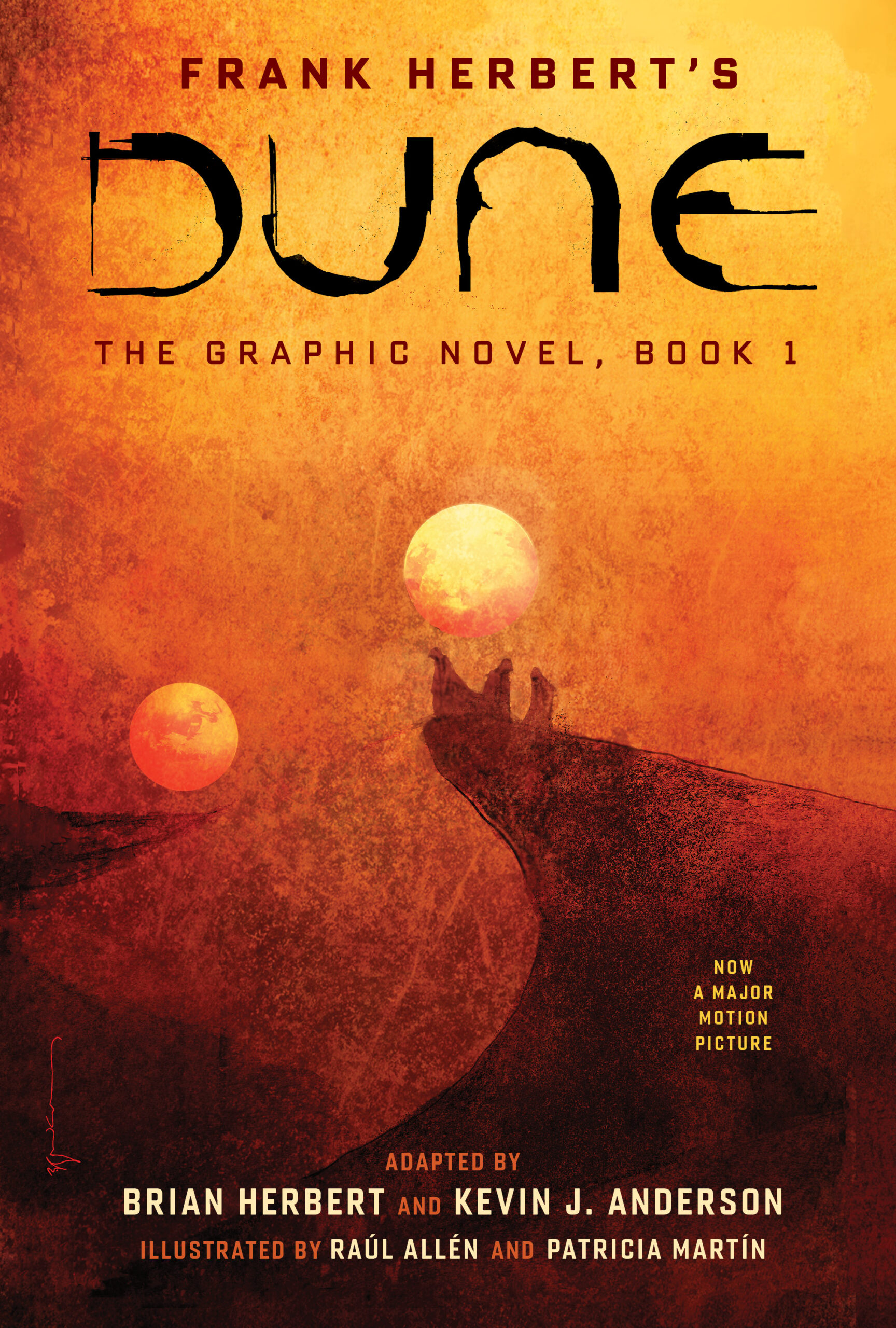
Like so many major motion pictures slated for a 2020 release, Denis Villeneuve’s Dune has been bumped into 2021. But fans of Frank Herbert’s epic science-fiction saga haven’t had to go entirely without adaptations this year, since last month saw the release of the first Dune graphic novel. Written by Kevin J. Anderson and Frank Herbert’s son Brian Herbert, co-authors of twelve Dune prequel and sequel novels, this 160-page volume constitutes just the first part of a trilogy intended to visually retell the story of the first Dune book. This tripartite breakdown seems to have been a wise move: the many adaptors (and would-be) adaptors of the linguistically, mythologically, and technologically complex novel have found out over the decades, it’s easy to bite off more Dune than you can chew.
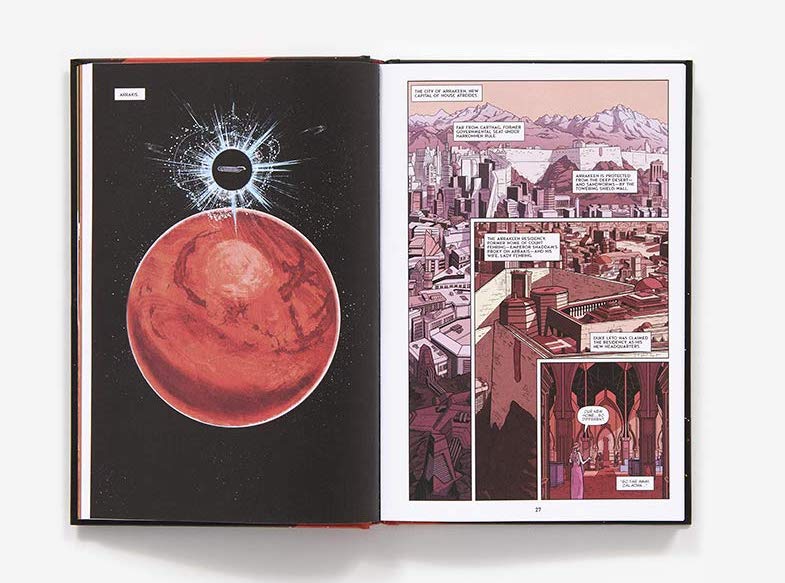
Audiences, too, can only digest so much Dune at a sitting themselves. “The particular challenge to adapting Dune, especially the early part, is that there is so much information to be conveyed — and in the novel it is done in prose and dialog, rather than action — we found it challenging to portray visually,” says Anderson in an interview with the Hollywood Reporter.
“Fortunately, the landscape is so sweeping, we could show breathtaking images as a way to convey that background.” This is the landscape of the desert planet Arrakis, source of a substance known as “spice.” Used as a fuel for space travel, spice has become the most precious substance in the galaxy, and its control is bitterly struggled over by numerous royal houses. (Any resemblance to Earth’s petroleum is, of course, entirely coincidental.)
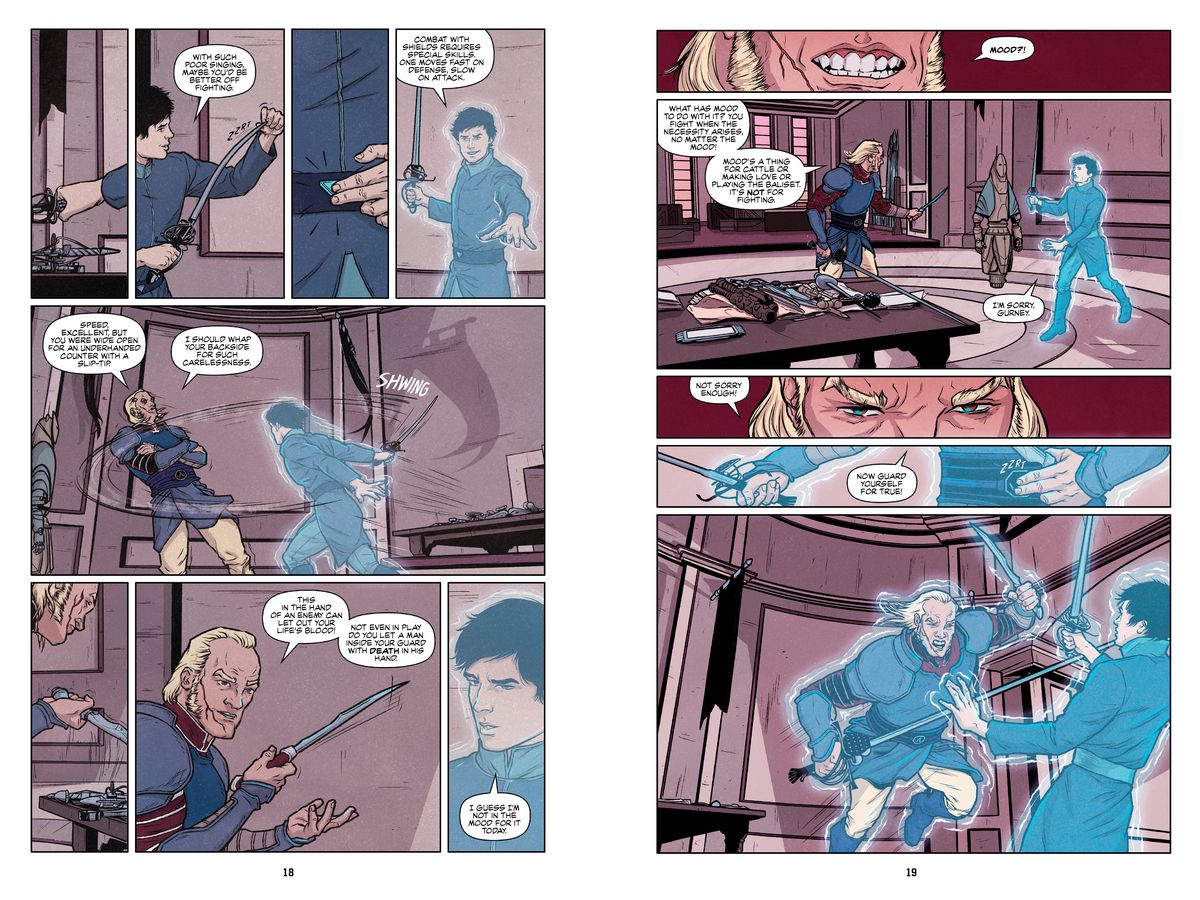
The main narrative thread of the many running through Dune follows Paul Atreides, scion of the House Atreides. With his family sent to run Arrakis, Paul finds himself at the center of political intrigue, planetary revolution, and even a clandestine scheme to create a superhuman savior. Though Herbert and Anderson have produced a faithful adaptation, the graphic novel “trims the story down to its most iconic touchstone scenes,” as Thom Dunn puts it in his Boing Boing review (adding that it happens to focus in “a lot of the same scenes as David Lynch did with his gloriously messy film adaptation”). This streamlining also employs techniques unique to graphic novels: to retain the book’s shifting omniscient narration, for example, “differently colored caption boxes present inner monologues from different characters like voiceovers so as not to interrupt the scene.”
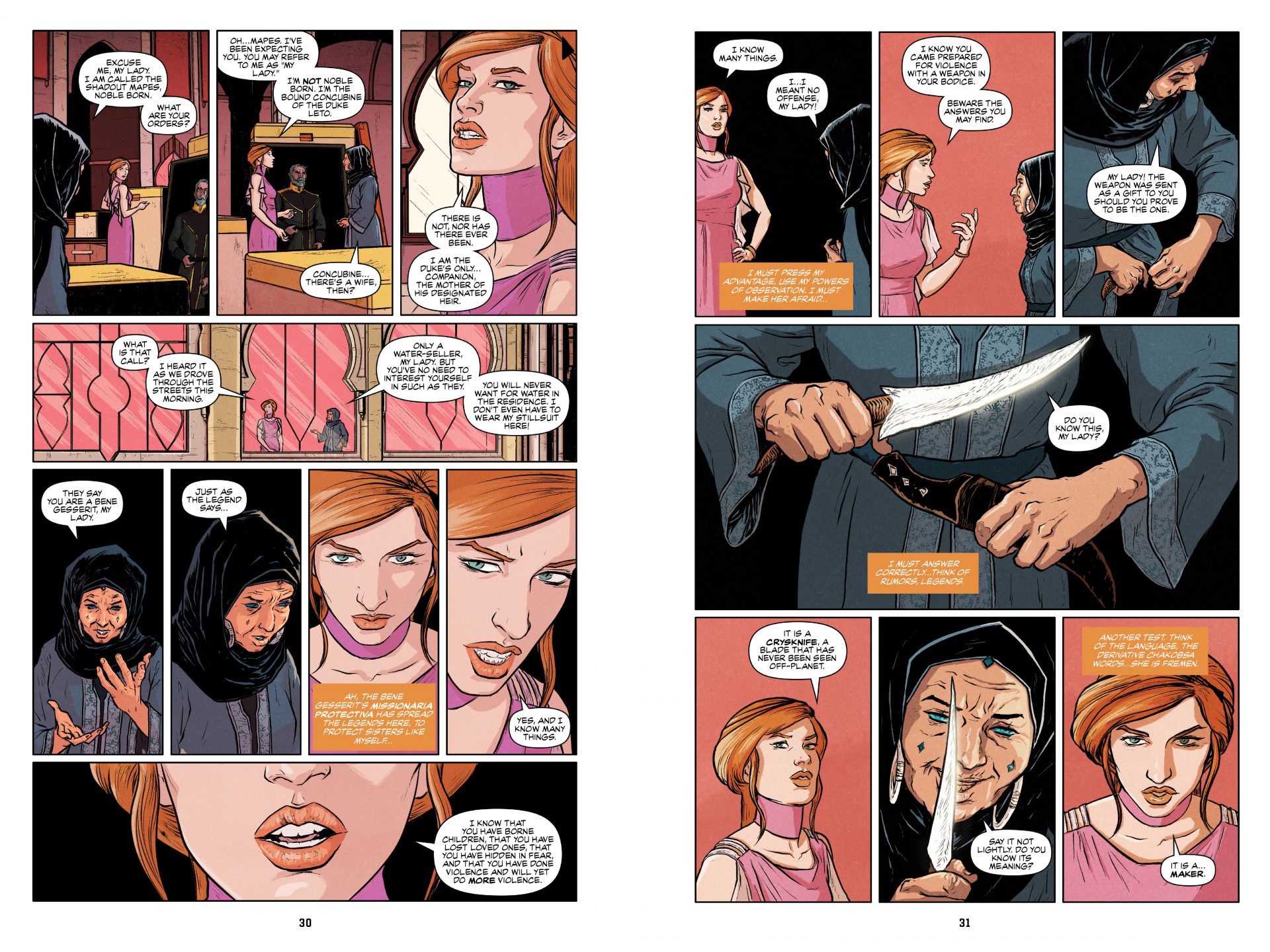
As if telling the story of Dune at a graphic novel’s pace wasn’t task enough, Anderson, Herbert and their collaborators also have to convey its unusual and richly imagined world — in not just words, of course, but images. “Dune has had a lot of visual interpretations over the years, from Lynch’s bizarre pseudo-period piece treatment to the modern televised mini-series’ more gritty interpretation,” writes Polygon’s Charlie Hall. While “Villeneuve’s vibe appears to take its inspiration from more futuristic science fiction — all angles and chunky armor,” the graphic novel’s artists Raúl Allén and Patricia Martín “opt for something a bit more steampunk.” These choices all further what Brian Herbert describes as a mission to “bring a young demographic to Frank Herbert’s incredible series.” Such readers have shown great enthusiasm for stories of teenage protagonists who grow to assume a central role in the struggle between good and evil — not that, in the world of Dune, any conflict is quite so simple.
Related Content:
Moebius’ Storyboards & Concept Art for Jodorowsky’s Dune
Based in Seoul, Colin Marshall writes and broadcasts on cities, language, and culture. His projects include the Substack newsletter Books on Cities, the book The Stateless City: a Walk through 21st-Century Los Angeles and the video series The City in Cinema. Follow him on Twitter at @colinmarshall, on Facebook, or on Instagram.
Read More...Get Inside the Head of a New York City Christmas Tree: A Gonzo Short Film from Artist Nina Katchadourian
For every year this Christmas tree
Brings to us such joy and glee
O Christmas tree, O Christmas tree
Such pleasure do you bring me…
All over New York City, tree stands are springing up like mushrooms.
Unlike the fanciful windows lining 5th avenue, the Union Square holiday market, or Rockefeller Center’s tree and skating rink, this seasonal pleasure requires no special trip, no threat of crowds.
You could battle traffic, and lose half a day, dragging the kids to a cut-your-own farm on Long Island or in New Jersey, but why, when the sidewalk stands are so festive, so convenient, so quintessentially New York?
The vendors hail from as far away as Vermont and Canada, shivering in lawn chairs and mobile homes 24–7.
What befalls the unsold trees on Christmas Eve?
No one knows. They vanish along with the vendors by Christmas morning.
The spontaneous cooperation of two such vendors was critical to artist Nina Katchadourian’s “Tree Shove,” above.
Katchadourian, who may look familiar to you from Lavatory Self-Portraits in the Flemish Style, recalls:
My friend Andrew had been hearing me say for years that I wanted to be shoved through one of those things and he found two friendly Canadians selling Christmas trees in a Brooklyn supermarket parking lot and worked it out with them.
The result is highly accessible, gonzo performance art from an artist who always lets the public in on the joke.
Add it to your annual holiday special playlist.
Related Content:
Artist Nina Katchadourian Creates Flemish Style Self-Portraits in Airplane Lavatory
Watch The Insects’ Christmas from 1913: A Stop Motion Film Starring a Cast of Dead Bugs
When Salvador Dalí Created Christmas Cards That Were Too Avant Garde for Hallmark (1960)
Ayun Halliday is an author, illustrator, theater maker and Chief Primatologist of the East Village Inky zine. Follow her @AyunHalliday.
Read More...Support Us
We're hoping to rely on loyal readers, rather than erratic ads. Please click the Donate button and support Open Culture. You can use Paypal, Venmo, Patreon, even Crypto! We thank you!

About Us

Open Culture scours the web for the best educational media. We find the free courses and audio books you need, the language lessons & educational videos you want, and plenty of enlightenment in between.
Advertise With Us
FREE UPDATES!
GET OUR DAILY EMAIL
Get the best cultural and educational resources on the web curated for you in a daily email. We never spam. Unsubscribe at any time.
FOLLOW ON SOCIAL MEDIA
Open Culture editor Dan Colman scours the web for the best educational media. He finds the free courses and audio books you need, the language lessons & movies you want, and plenty of enlightenment in between.
Advertise With Us


