How to Talk with a Conspiracy Theorist: What the Experts Recommend
Why do people pledge allegiance to views that seem fundamentally hostile to reality? Maybe believers in shadowy, evil forces and secret cabals fall prey to motivated reasoning. Truth for them is what they need to believe in order to get what they want. Their certainty in the justness of a cause can feel as comforting as a warm blanket on a winter’s night. But conspiracy theories go farther than private delusions of grandeur. They have spilled into the streets, into the halls of the U.S. Capitol building and various statehouses. Conspiracy theories about a “stolen” 2020 election are out for blood.
As distressing as such recent public spectacles seem at present, they hardly come near the harm accomplished by propaganda like Plandemic—a short film that claims the COVID-19 crisis is a sinister plot—part of a wave of disinformation that has sent infection and death rates soaring into the hundreds of thousands.
We may never know the numbers of people who have infected others by refusing to take precautions for themselves, but we do know that the number of people in the U.S. who believe conspiracy theories is alarmingly high.
A Pew Research survey of adults in the U.S. “found that 36% thought that these conspiracy theories” about the election and the pandemic “were probably or definitely true,” Tanya Basu writes at the MIT Technology Review. “Perhaps some of these people are your family, your friends, your neighbors.” Maybe you are conspiracy theorist yourself. After all, “it’s very human and normal to believe in conspiracy theories…. No one is above [them]—not even you.” We all resist facts, as Cass Sunstein (author of Conspiracy Theories and Other Dangerous Ideas) says in the Vox video above, that contradict cherished beliefs and the communities of people who hold them.
So how do we distinguish between reality-based views and conspiracy theories if we’re all so prone to the latter? Standards of logical reasoning and evidence still help separate truth from falsehood in laboratories. When it comes to the human mind, emotions are just as important as data. “Conspiracy theories make people feel as though they have some sort of control over the world,” says Daniel Romer, a psychologist and research director at the University of Pennsylvania’s Annenberg Public Policy Center. They’re airtight, as Wired shows below, and it can be useless to argue.
Basu spoke with experts like Romer and the moderators of Reddit’s r/ChangeMyView community to find out how to approach others who hold beliefs that cause harm and have no basis in fact. The consensus recommends proceeding with kindness, finding some common ground, and applying a degree of restraint, which includes dropping or pausing the conversation if things get heated. We need to recognize competing motivations: “some people don’t want to change, no matter the facts.”
Unregulated emotions can and do undermine our ability to reason all the time. We cannot ignore or dismiss them; they can be clear indications something has gone wrong with our thinking and perhaps with our mental and physical health. We are all subjected, though not equally, to incredible amounts of heightened stress under our current conditions, which allows bad actors like the still-current U.S. President to more easily exploit universal human vulnerabilities and “weaponize motivated reasoning,” as University of California, Irvine social psychologist Peter Ditto observes.
To help counter these tendencies in some small way, we present the resources above. In Bill Nye’s Big Think answer to a video question from a viewer named Daniel, the longtime science communicator talks about the discomfort of cognitive dissonance. “The way to overcome that,” he says, is with the attitude, “we’re all in this together. Let’s learn about this together.”
We can perhaps best approach those who embrace harmful conspiracy theories by not immediately telling them that we know more than they do. It’s a conversation that requires some intellectual humility and acknowledgement that change is hard and it feels really scary not to know what’s going on. Below, see an abridged version of MIT Technology Review’s ten tips for reasoning with a conspiracy theorist, and read Basu’s full article here.
- Always, always speak respectfully: “Without respect, compassion, and empathy, no one will open their mind or heart to you. No one will listen.”
- Go private: Using direct messages when online “prevents discussion from getting embarrassing for the poster, and it implies a genuine compassion and interest in conversation rather than a desire for public shaming.”
- Test the waters first: “You can ask what it would take to change their mind, and if they say they will never change their mind, then you should take them at their word and not bother engaging.”
- Agree: “Conspiracy theories often feature elements that everyone can agree on.”
- Try the “truth sandwich”: “Use the fact-fallacy-fact approach, a method first proposed by linguist George Lakoff.”
- Or use the Socratic method: This “challenges people to come up with sources and defend their position themselves.”
- Be very careful with loved ones: “Biting your tongue and picking your battles can help your mental health.”
- Realize that some people don’t want to change, no matter the facts.
- If it gets bad, stop: “One r/ChangeMyView moderator suggested ‘IRL calming down’: shutting off your phone or computer and going for a walk.”
- Every little bit helps. “One conversation will probably not change a person’s mind, and that’s okay.”
Related Content:
Constantly Wrong: Filmmaker Kirby Ferguson Makes the Case Against Conspiracy Theories
Michio Kaku & Noam Chomsky School Moon Landing and 9/11 Conspiracy Theorists
Josh Jones is a writer and musician based in Durham, NC. Follow him at @jdmagness
Read More...Discover the First Illustrated Book Printed in English, William Caxton’s Mirror of the World (1481)
The printing history of early English books may not seem like the most fascinating subject in the world, but if you mention the name William Caxton to a book historian, you may get a fascinating lecture nonetheless. Caxton, the merchant and diplomat who introduced the printing press to England in 1476, was an unusually enterprising figure. He first learned the trade in Cologne and was pressured to begin printing in English after the success of his translation of the Recuyell of the Historyes of Troye, a series of stories based on Homer’s Iliad. His first known printed book was Chaucer’s Canterbury Tales, and he went on to print translations of classical and medieval texts from the French.
Caxton’s (often inaccurate) translations became so popular that, like Chaucer, he introduced new standards into the language as a whole with his use of court Chancery English. The books printed at the time also give us a fascinating look at how the printed book evolved slowly as a new source of scientific information and a means of literary innovation.
The so-called Gutenberg Revolution did not usher in a radical break with the late medieval past so much as a gradual evolution away from its adherence to classical and church authorities and chivalric romance stories. It would take early modern writers like Shakespeare, Cervantes, and Francis Bacon to truly revolutionize the possibilities of print.
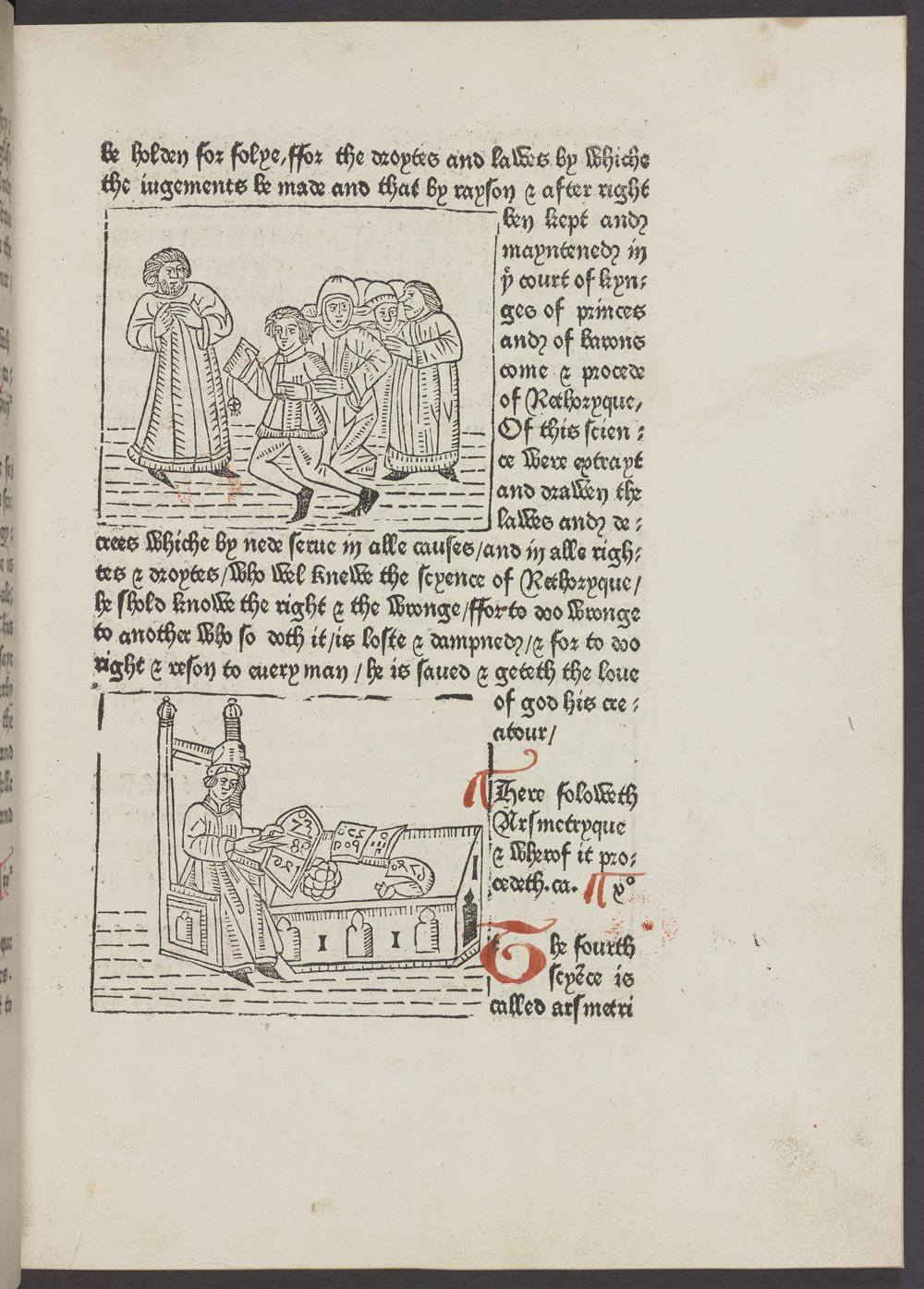
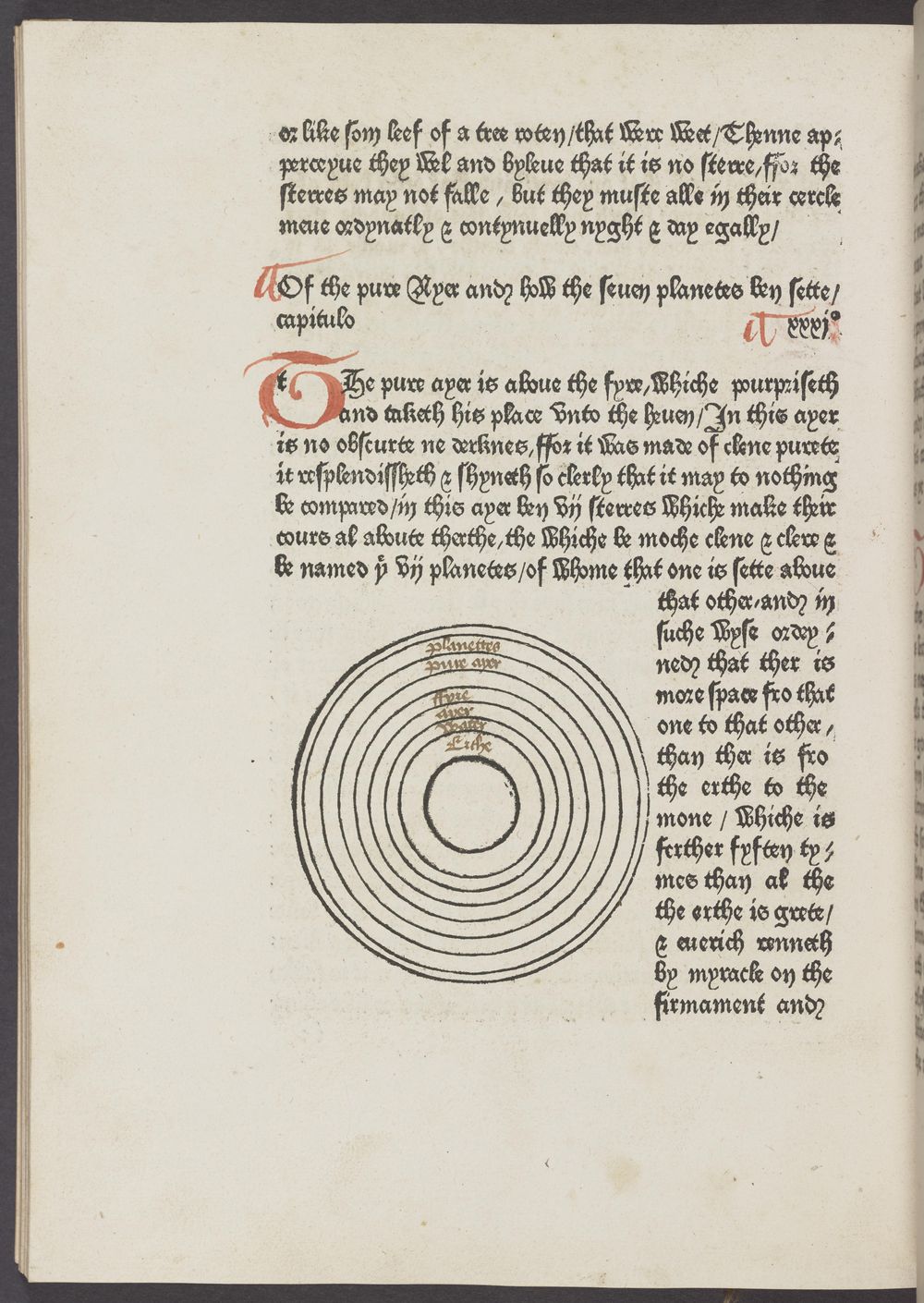
The first illustrated book Caxton printed in English offers an excellent example of early printing history’s reliance on reproducing extant medieval ideas rather than disseminating new ones. The Mirror of the World, first written in French as L’image du monde, was an encyclopedia based on a 12th century text by Honorius Augustodunensis called Imago mundi. “Encyclopedic texts were popular throughout the Middle Ages,” Glasgow University Library notes. “During this period it was commonly believed that it was possible to create one volume digests of all knowledge,” drawing solely on classical and Biblical authorities. In the introduction to Caxton’s text, we are told that the book “treateth of the world & of the wonderful dyuision [division] thereof.”
We are quite a long way yet from the Royal Society’s motto Nullius in verba, or “take no one’s word for it.” But Caxton’s press made several medieval manuscript prose works available for the first time to a new readership. “Evidence of early ownership of copies of his editions,” writes the British Library, “suggests the social breadth of that audience, including royalty, nobility, gentry, the mercantile classes and religious houses.” Caxton was “not content to simply draw on pre-existing markets for manuscripts.” And he would eventually use print “to create new markets for novel and different kinds of writing,” such as the 1485 publication of Thomas Malory’s contemporary Arthurian romance, Le Morte D’arthur.
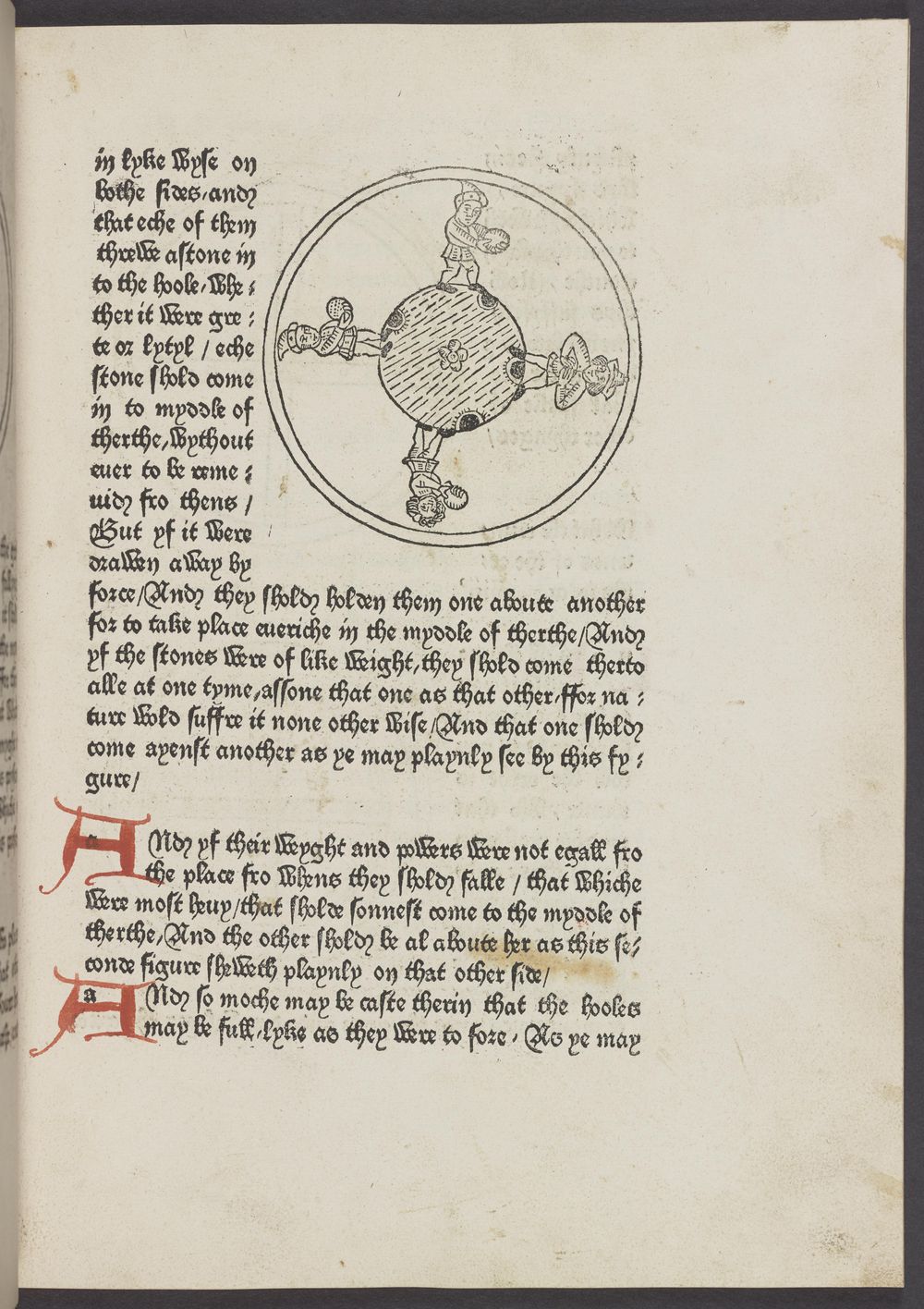
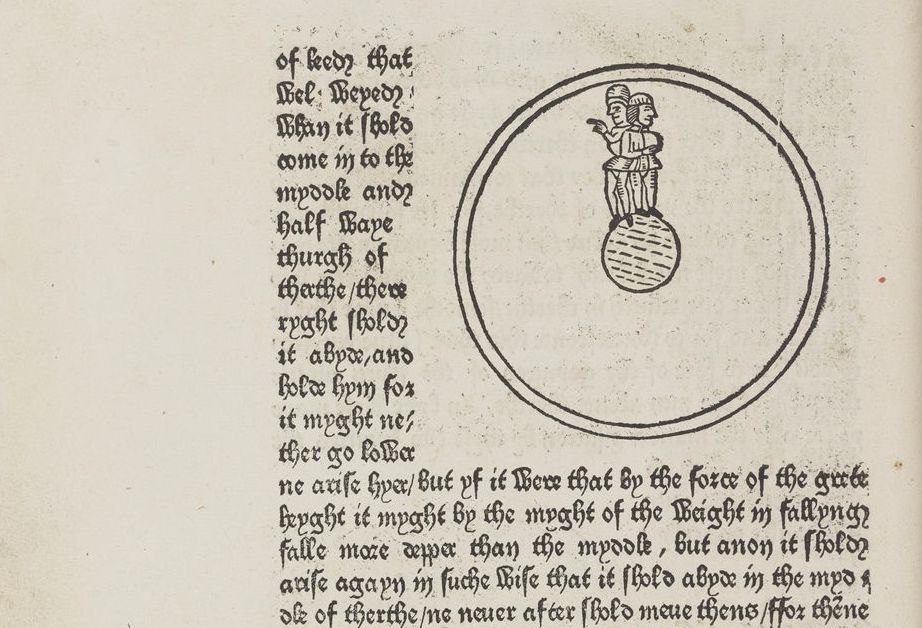
Representing the confident but cramped worldview of the medieval sciences, the Mirror of the World is “ambitious,” Allison Meier writes at Hyperallergic, dispelling any notion of a flat Earth, with descriptions of “large ideas like the roundness of the Earth and why we experience day and night… Along with some historical information, there are descriptions of the Earth, the solar system, and eclipses. The round shape of the Earth is illustrated by two men who stand back-to-back, walking away from each other and meeting again in a circle. Another describes the same idea with a rock tossed through a hole sliced in the world, with it tumbling out the other side.”
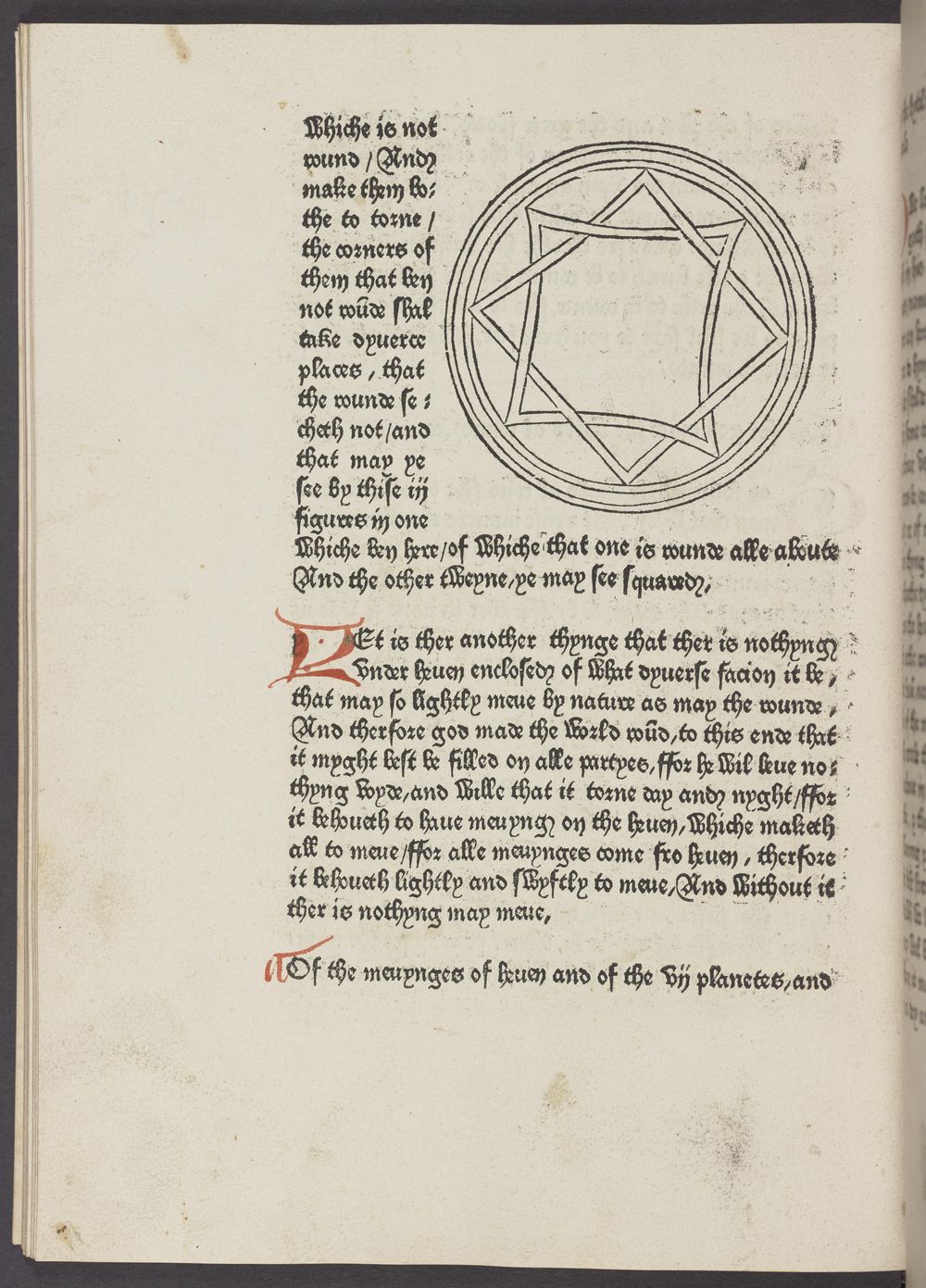
Mike Millward of the Blackburn Museum describes the images further:
The illustrations are woodcut prints which could be printed as part of the text. Caxton’s prints were probably produced in England and are rather primitive. Many are merely illustrative… Others are essential to an understanding of the text, such those illustrating the roundness of the Earth and the effect of gravity, both showing a surprisingly modern understanding
These illustrations, notes John T. McQuillan, assistant curator of printed books at the Pierpont Morgan library, were remarkably preserved from the original French text of two centuries earlier. “Print only carried on existing manuscript and textual traditions,” he notes, “and did not radically alter them, at first. Anyone who wanted to buy this text would have expected it to have these specific illustrations, and Caxton provided that to them.” Pierpont Morgan himself, who owned several of Caxton’s early printed books, “valued Caxton even over Gutenberg,” Meier writes, and “had the printer painted on the ceiling of his library’s East Room.”
Another rare books library, Princeton’s Scheide, which holds perhaps the finest collection of early European and American printing in the world, features a scanned full-text edition of Mirror of the World, the first illustrated book printed in England and a work that sits squarely on the threshold between the medieval and the modern, and that challenges our ideas about both designations.
Related Content:
One of World’s Oldest Books Printed in Multi-Color Now Opened & Digitized for the First Time
See the Oldest Printed Advertisement in English: An Ad for a Book from 1476
Josh Jones is a writer and musician based in Durham, NC. Follow him at @jdmagness
Read More...See Devo Perform Live for the Very First Time (Kent State University, 1973)
Kent State University is known as the site of two important events in American culture: the massacre of May 4, 1970, and the formation of Devo. When the National Guard shot thirteen students at a Vietnam War protest, it signaled to many the end of the youth-driven optimism of the late 1960s. It also motivated a group of musically inclined undergraduates to consolidate the band/conceptual art project they’d premised on the idea of “de-evolution.” Around that time, the group’s founders, art students Gerald Casale and Bob Lewis, met a keyboardist named Mark Mothersbaugh, who contributed some of the signature musical and comedic sensibilities of what would become Devo.
“The band, or at least a band known as Sextet Devo, first performed at a 1973 arts festival in Kent,” writes Calvin C. Rydbom in The Akron Sound: The Heyday of the Midwest’s Punk Capital. Filling out that sextet were Casale’s brother Bob, drummer Rod Reisman, and vocalist Fred Weber. A handout for the show promises a series of “polyrhythmic exercises in de-evolution,” including a number called “Private Secretary,” footage of which appears above.
“The group were all dressed oddly, Bob in scrubs, Jerry in a butcher’s coat, Bob Lewis behind the keyboards in a monkey mask, and Mark in a doctor’s robe,” writes George Gimarc in Punk Diary: The Ultimate Trainspotter’s Guide to Underground Rock, 1970–1982. “The audience was, at times, confused, amused, and some even danced.”
Sextet Devo “would have been off the charts in most environments,” says Myopia, a retrospective volume on Mothersbaugh’s work. At the Kent Creative Arts Festival “the band actually fit within the spectrum of normal behavior, albeit at the far end of the scale.” But even their most appreciative viewers couldn’t have known how far the concept of de-evolution had to go, to say nothing of the pop-cultural heights to which the oddballs onstage would carry it. Just five years later, Devo would make their national-television debut as a quintet on Saturday Night Live, “de-evolving” the Rolling Stones’ “Satisfaction.” But they didn’t forget where they’d come from: nearly thirty years after their first show, they came back around to 1970 for a de-evolution of Crosby, Stills, Nash & Young’s “Ohio.”
Related Content:
The Mastermind of Devo, Mark Mothersbaugh, Presents His Personal Synthesizer Collection
DEVO Is Now Selling COVID-19 Personal Protective Equipment: Energy Dome Face Shields
Based in Seoul, Colin Marshall writes and broadcasts on cities, language, and culture. His projects include the Substack newsletter Books on Cities, the book The Stateless City: a Walk through 21st-Century Los Angeles and the video series The City in Cinema. Follow him on Twitter at @colinmarshall, on Facebook, or on Instagram.
Read More...
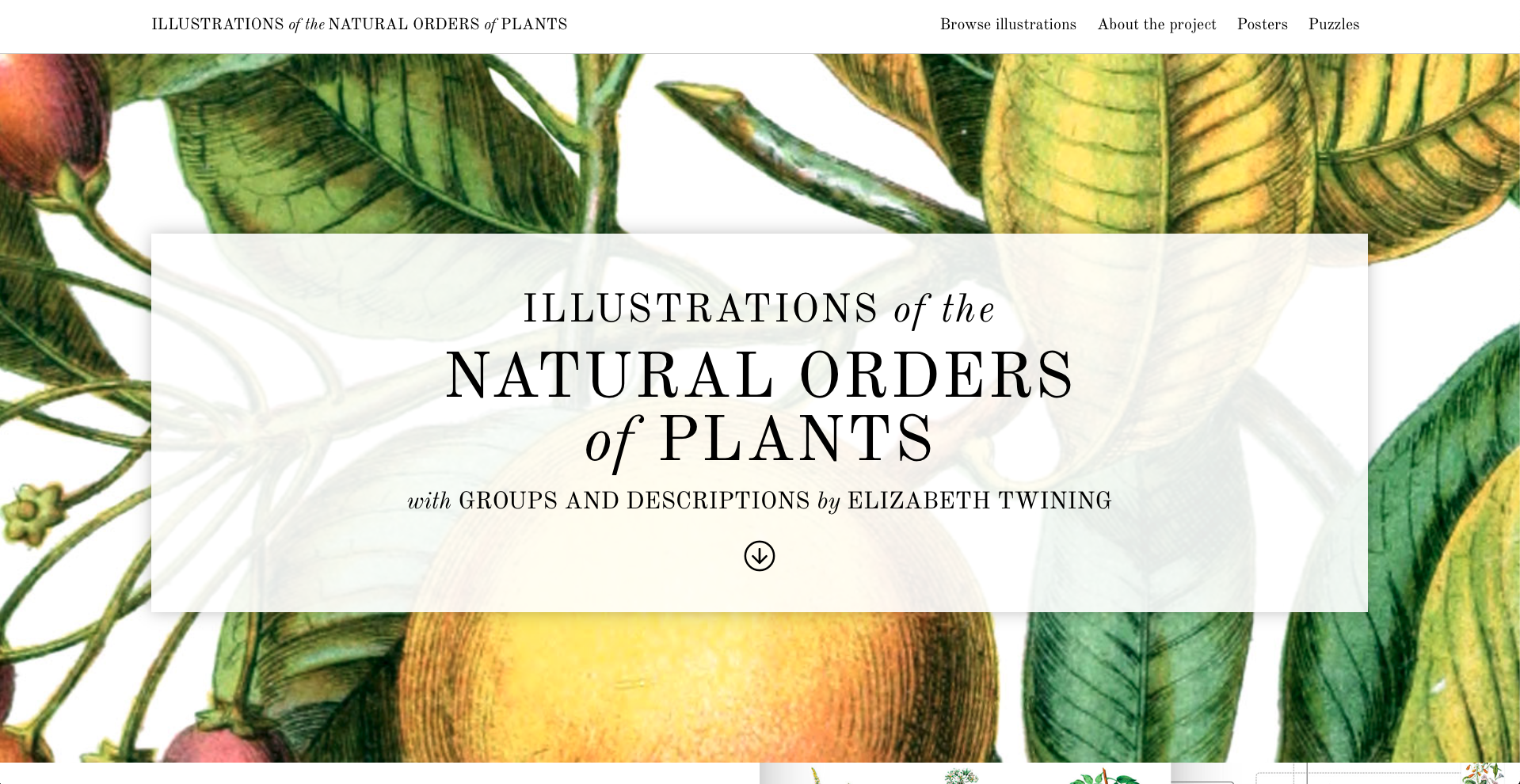
Behold an Interactive Online Edition of Elizabeth Twining’s Illustrations of the Natural Orders of Plants (1868)
Of all the varied objects of creation there is, probably, no portion that affords so much gratification and delight to mankind as plants. —Elizabeth Twining
“Who owned nature in the eighteenth century?” asks Londa Schiebinger in Plants and Empire, a study of what the Stanford historian of science calls “colonial bioprospecting in the Atlantic World.” The question was largely decided at the time by “heroic voyaging botanists” and “biopirates” who claimed the world’s natural resources as their own. The matter was settled in the next couple centuries by merchants like Thomas Twining and his descendants, proprietors of Twinings tea. Founded as Britain’s first known tea shop in 1706, the company went on to become one of the largest purveyors of teas grown in the British colonies.
One of Twining’s descendants, Elizabeth Twining, carried on the legacy as what Schiebinger calls one of many “armchair naturalists, who coordinated and synthesized collecting from sinecures in Europe,” a role often taken on by women who could not travel the world. Twining aimed, however, not to create taxonomies of the world’s plants but those of her own country in a comparative analysis.
Her 1868 Illustrations of the Natural Orders of Plants, she wrote in her introduction, was “the first work which has thus done due honour to our British plants by connecting with others, and placing them whenever possible at the head of the Order to be illustrated.”
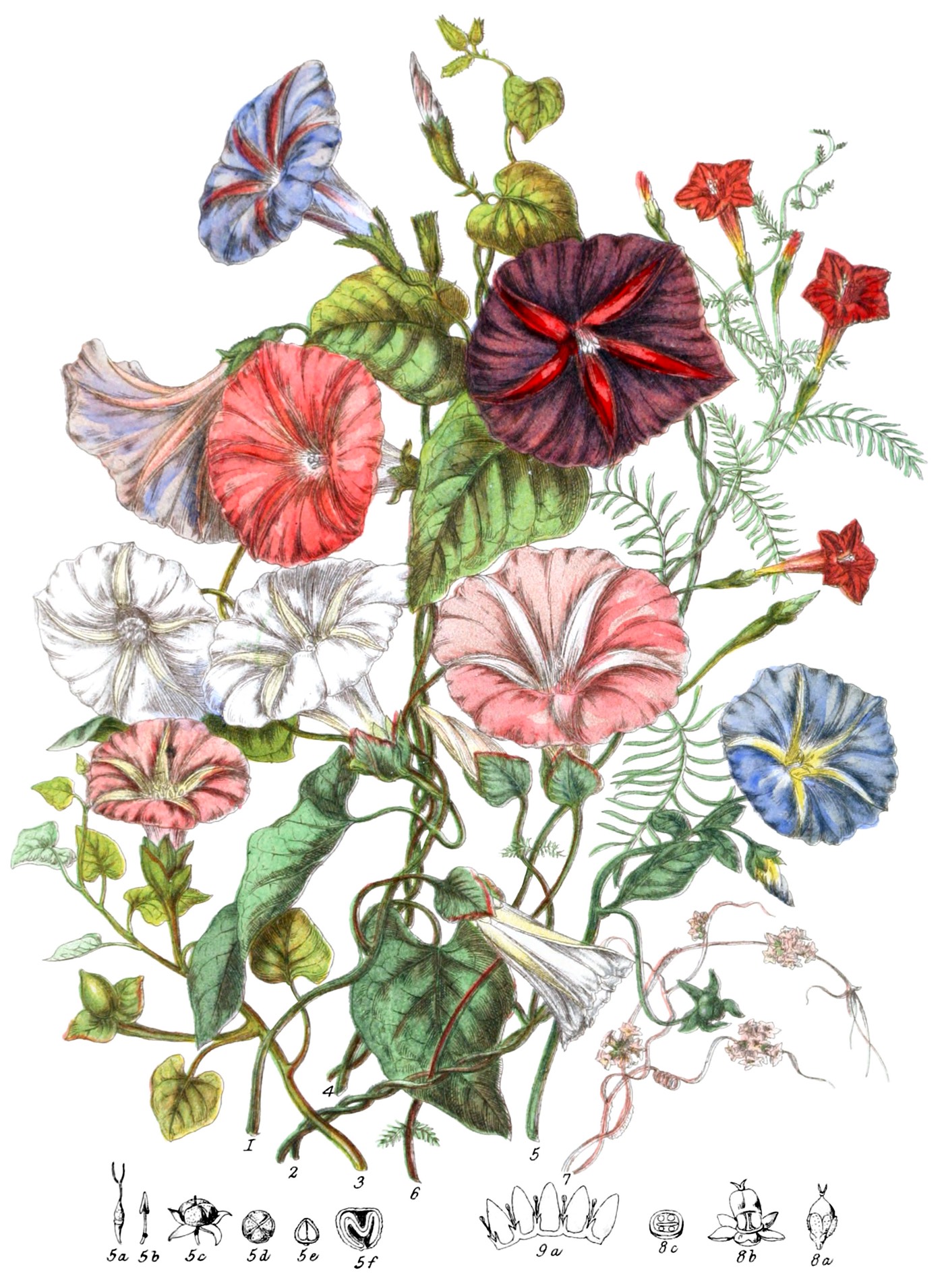
Twining’s revaluation of local British plants was in keeping with the reformist spirit of the age, and she herself was such a reformer. “Apart from her artistic endeavors,” writes Nicholas Rougeaux, Twining “was a notable philanthropist,” establishing almshouses and temperance halls, founding “mother’s meetings” in London, and helping to found the Bedford College for Women. She was inspired by Curtis’s The Botanical Magazine and “she practiced by making sketches from works in the Dulwich Picture Gallery, and toured famous museums thanks to her father’s patronage.”

Twining authored and illustrated several botanical books, “most notably,” Rougeux writes, “the two volume Illustrations of the Natural Orders of Plants, which included a total of 160 hand-colored lithographs, royal folio, reportedly based on observation at the Royal Botanical Gardens in Kew and at Lexden Park in Colchester.” Rougeux has done for her work what the designer previously did for other illustrated classics of science and math (see the related links below): digitizing the illustrations and transliterating the text into a digital format, with hyperlinks and sharing features.
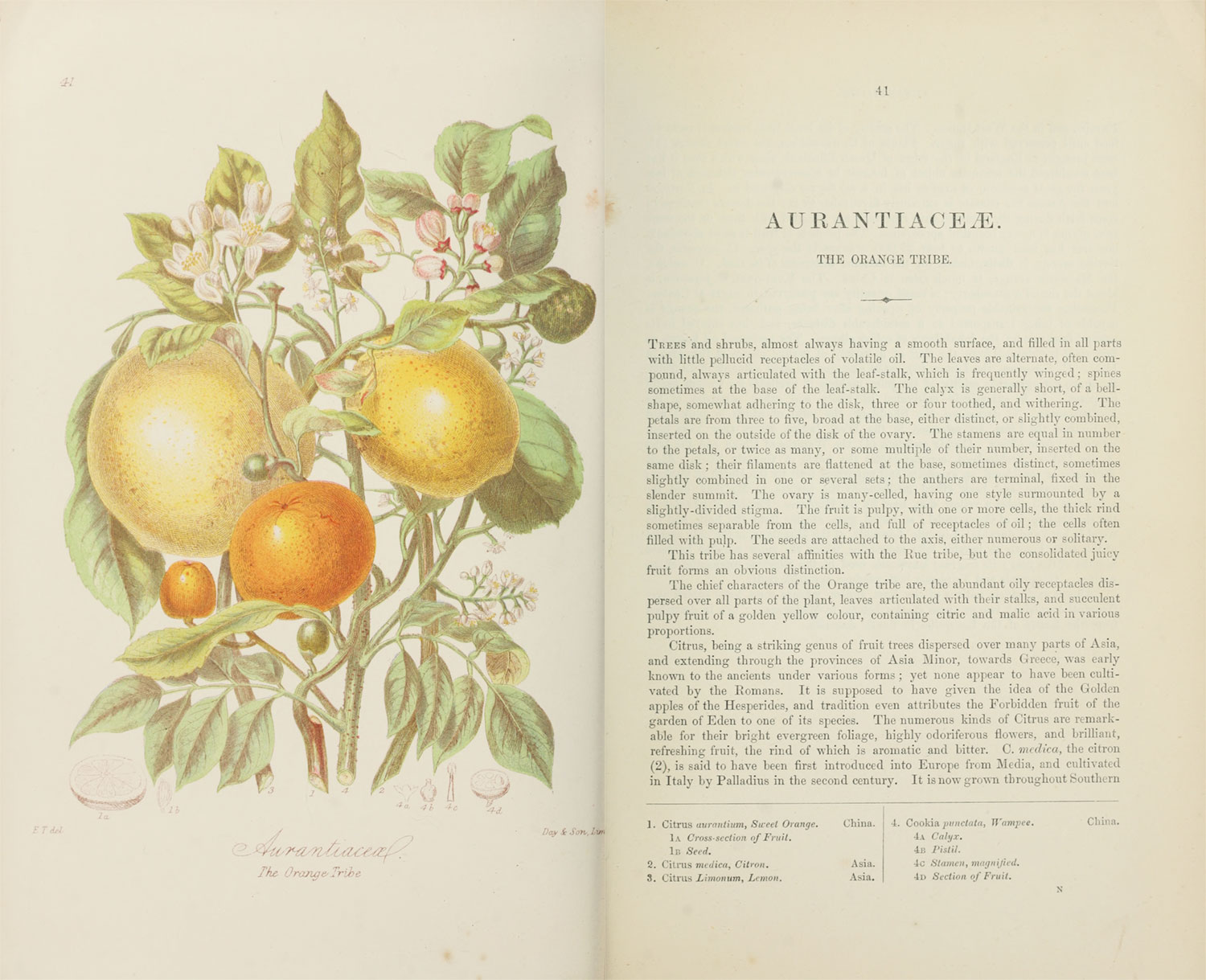
Rougeux’s Illustrations of the Natural Orders of Plants offers itself as “a complete reproduction and restoration… enhanced with interactive illustrations, descriptions, and posters featuring the illustrations.” The first two volumes of the original book were published in 1849 and 1855. Rougeux’s online version of the text is based on the 1868 second edition “with re-drawn illustrations based on her originals.” (See pages from the text above and below.) Rougeux’s digitized text is thus two steps removed from Twining’s original illustrations, but we can see the care and attention she put into classifying the flora of her native country.
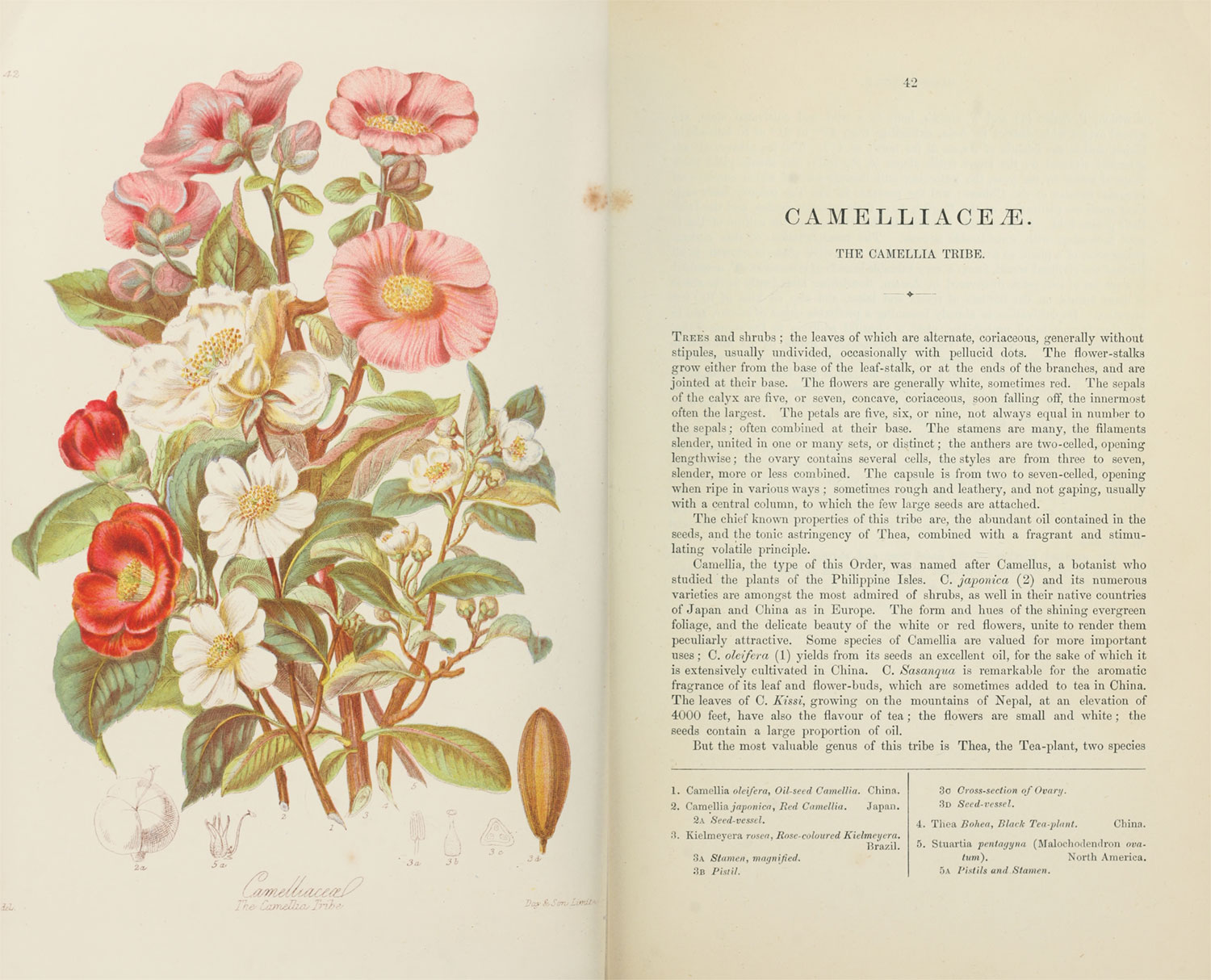
“Twining chose to illustrate plants using the classification system created by Augustin-Pyrame de Candolle based on multiple characteristics of plants—rather than the more widely used system by Carl Linnaeus which was focused on plants’ reproductive characteristics,” notes Rougeux, “because the De Candolle system was newer and she wanted her readers to be up to date as classification systems were evolving.”
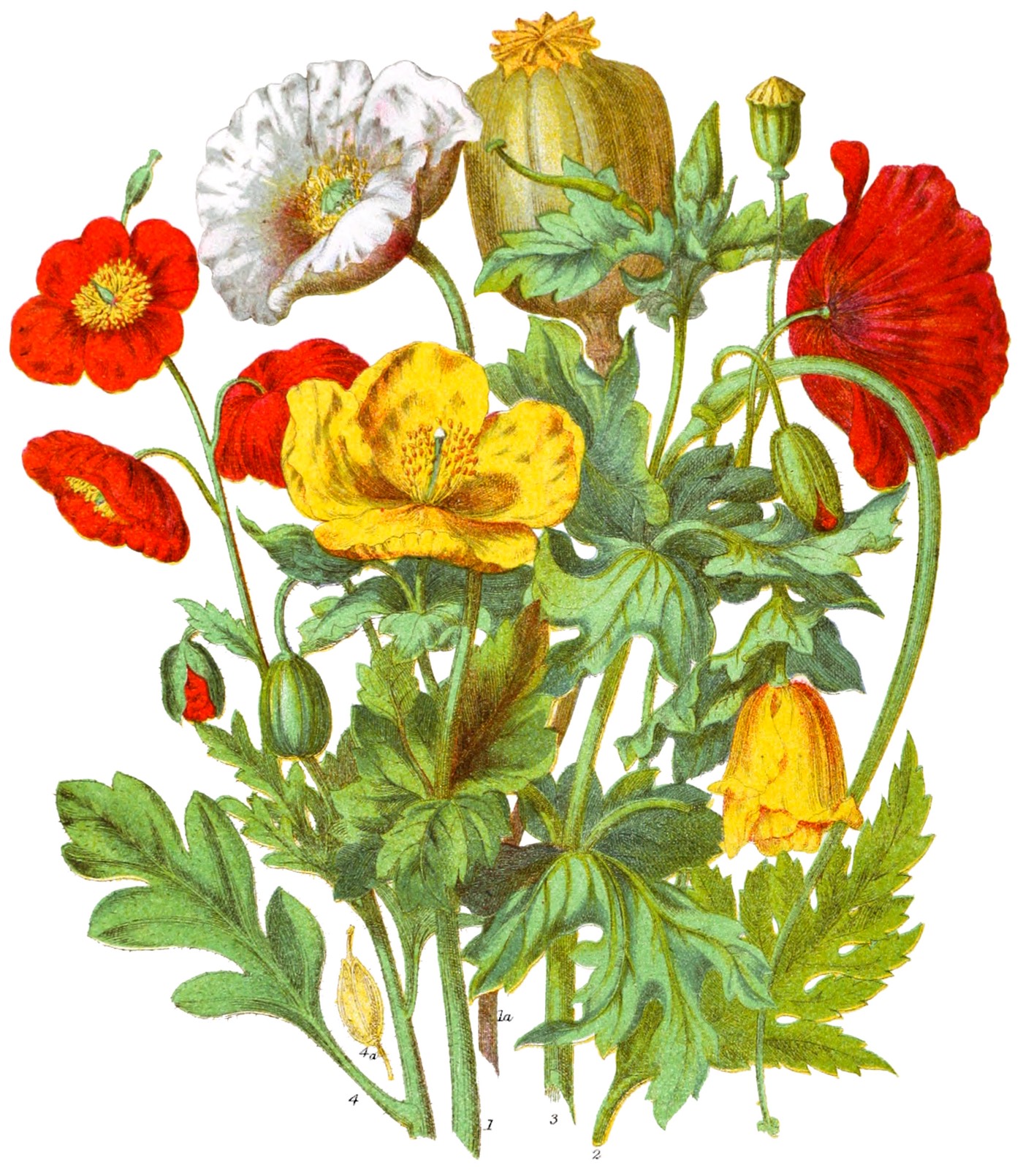
Although biological taxonomies have changed considerably since her time, Twining’s Illustrations of the Natural Orders of Plants remains an intriguing “snapshot in time” that depicts not only the latest ideas about plant classification in the mid-19th century but also the attitudes a prominent member of the British ruling class adopted toward nature as a whole. See Rougeux’s online edition of Twining’s text here.

Related Content:
Josh Jones is a writer and musician based in Durham, NC. Follow him at @jdmagness
Read More...The Rijksmuseum in Amsterdam Has Digitized 818,000 Works of Art, Including Famous Works by Rembrandt and Vermeer
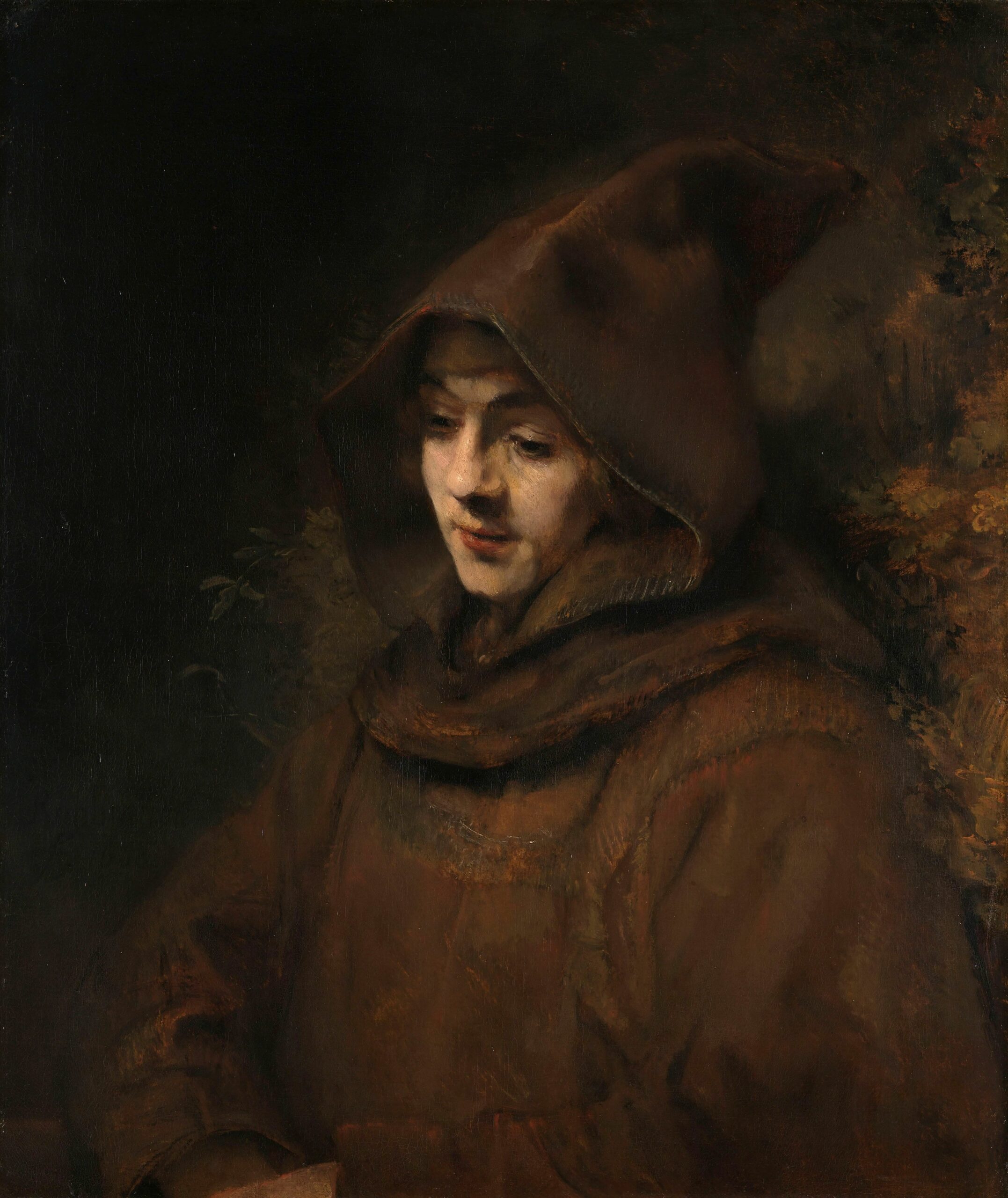
Art may seem inessential to those who make the big decisions in times of crisis. But it has never seemed more necessary to artists working in the time of COVID. So it was 360 years ago when Rembrandt painted a portrait of his son, Titus, in a monk’s robe in 1660. Eight years later, Titus was dead from plague, which had only a few years earlier killed Hendrickje Stoffels, Rembrandt’s former housekeeper and second wife, who helped raise Titus, Rembrandt’s only child to survive into adulthood.
These unimaginable losses “contributed to the tragedy and anguish we see in Rembrandt’s late self-portraits,” writes The Guardian’s Jonathan Jones. During the plague, Rembrandt also used his work as social critique.
His painting The Rat-Poison Peddler, shows, “in a sense,” the Minneapolis Institute of Art’s Tom Rassieur tells the Star Tribune, “the guy who purports to be helping—the exterminator—is probably doing as much to spread the disease as anyone else. That relates to [criticism] of our leadership today.” In his last years, Rembrandt painted self-portraits of his isolation and grief that still resonate with our isolation and grief today.
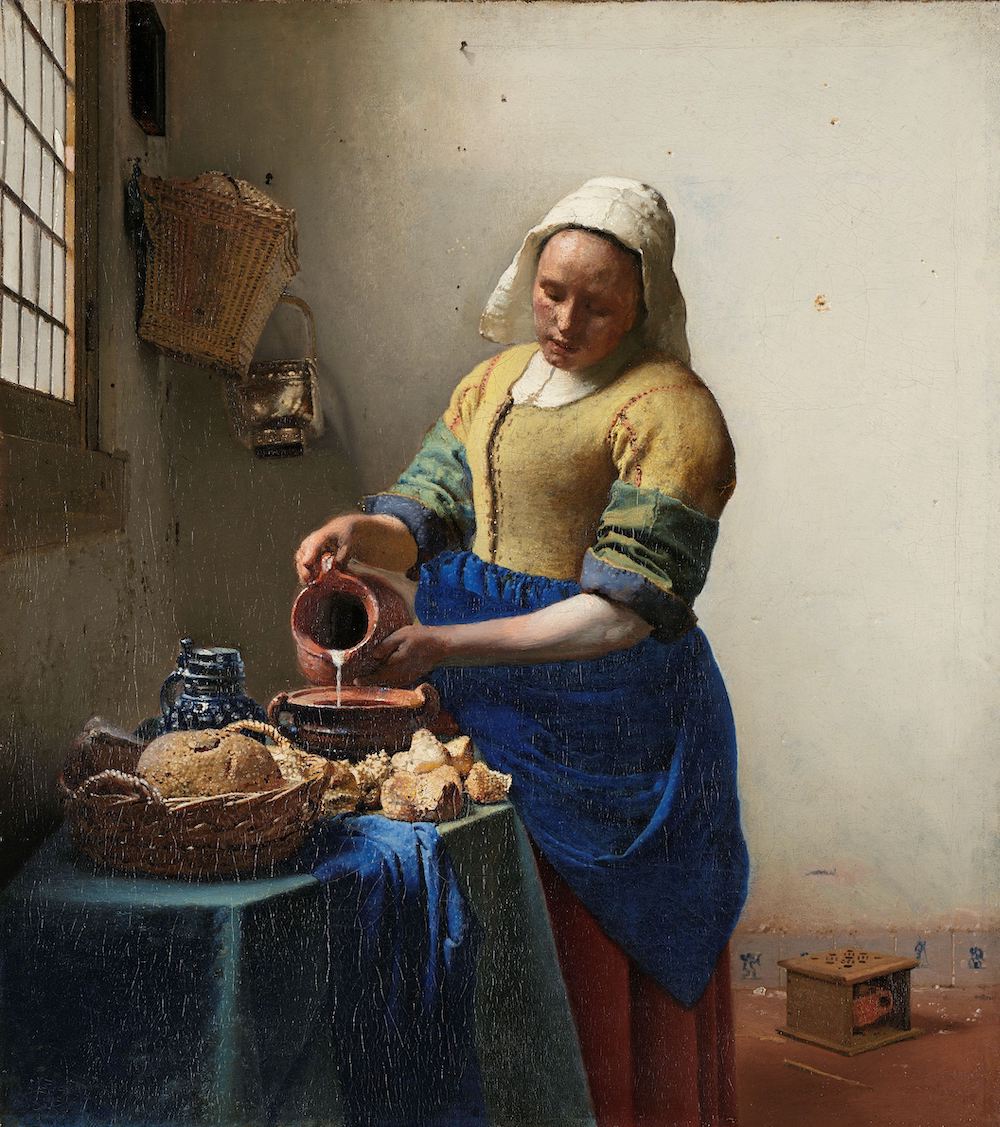
Elsewhere in the Netherlands, Rembrandt’s contemporary Jan Vermeer “was no stranger to the kind of socially isolated world we now find ourselves in,” Breeze Barrington writes at CNN. “His hometown of Delft was stricken with plague several times in the artist’s lifetime. In 1635 and 1636 over 2,000 people died, and in the mid-1650s and mid-1660s hundreds more.” The qualities we most associate with Vermeer’s work, the solitude and attentive presence, were developed during time spent in isolation.
“In this time of forced isolation,” says Friso Lammertse, curator of 17th-century Dutch painting at the Rijksmuseum in Amsterdam, Vermeer’s work “can point us at the fact that extreme beauty can be found just in our room.” The Rijksmuseum hasn’t just recommended art in our current state of aloneness, but the museum has also doubled its collection of free, high resolution works online, by Rembrandt, Vermeer, and a host of other artists who used art to cope with loss and loneliness during the plagues of their times. The museum now offers 818,000 digitized images in total.
The museum has promised to “bring the museum to you,” and they have delivered not only with their extensive digital collection, free for downloading, sharing and editing with a free Rijksmuseum account, but also with informative series on their website. Art is essential in the best and worst of times, and especially now, when it shows us how to look closely at ourselves, our loved ones, and our surroundings, and treat life with more care and attention. Enter the Rijksmuseum online collections here.
Related Content:
Josh Jones is a writer and musician based in Durham, NC. Follow him at @jdmagness
Read More...Did Beethoven Use a Broken Metronome When Composing His String Quartets? Scientists & Musicians Try to Solve the Centuries-Old Mystery
When it comes to classical composers, Beethoven was pretty metal. But was he writing some kind of classical thrash? Hardcore orchestrations too fast for the average musician to play? 66 out of 135 of Beethoven’s tempo markings made with his new metronome in the early 1800s seem “absurdly fast and thus possibly wrong,” researchers write in a recent American Mathematical Society article titled “Was Something Wrong with Beethoven’s Metronome?” Indeed, the authors go on, “many if not most of Beethoven’s markings have been ignored by latter day conductors and recording artists” because of their incredible speed.
Since the late 19th century and into the age of recorded music, conductors have slowed Beethoven’s quartets down, so that we have all internalized them at a slower pace than he presumably meant them to be played. “These pieces have throughout the years entered the subconscious of professional musicians, amateurs and audiences, and the tradition,” writes the Beethoven Project, “handed down by the great quartets of yesteryear.” Slower tempos have “become a norm against which all subsequent performances are judged.”
Eybler Quartet violist Patrick Jordan found out just how deeply musicians and audiences have internalized slower tempi when he became interested in playing and recording at Beethoven’s indicated speeds in the mid-80s. “Finding a group of people who were prepared to actually take [Beethoven’s metronome marks] seriously—that was a 30-year wait,” he tells CBC. “A huge amount of our labour required that we un-learn those things; that we get notions of what we’ve heard recorded and played in concerts many times out of our heads and try to put in what Beethoven, at least at some point in his life, believed and thought highly enough to make a note of and publish.”
But did he? The subject of Beethoven’s metronome has been a source of controversy for some time. A few historians have theorized that the inventor of the metronome, Johann Nepomuk Mälzel, “something of a mechanical wizard,” Smithsonian writes, and also something of a disreputable character, sabotaged the device he presented to the composer in 1815 as a peace offering after he sued Beethoven for the rights to a composition. (Mälzel actually stole the metronome’s design from a Dutch mechanic named Dietrich Winkel.) But most musicologists and historians have dismissed the theory of deliberate trickery.
Still, the problem of too-fast tempi persists. “The literature on the subject is enormous,” admit the authors of the American Mathematical Society study. Their research suggests that Beethoven’s metronome was simply broken and he didn’t notice. Likewise data scientists at the Universidad Carlos III de Madrid have theorized that the composer, one of the very first to use the device, misread the machine, a case of musical misprision in his reaction against what he called in 1817 “these nonsensical terms allegro, andante, adagio, presto….”
Theorists may find the tempi hard to believe, but the Toronto-based Eybler Quartet was undeterred by their skepticism. “I don’t think there’s any evidence to suggest that the mechanism itself was [faulty],” says Jordan, “and we know from [Beethoven’s] correspondence and contemporaneous accounts that he was very concerned that his metronome stay in good working order and he had it recalibrated frequently so it was accurate.” Jordan instead credits the punishing speeds to Romanticism’s passionate individualism, and to the fact that “Beethoven was not always so very nice.” Maybe, instead of soothing his audiences, he wanted to shock them and set their hearts racing.
Who are we to believe? Questions of tempo can be fraught in classical circles (witness the reactions to Glenn Gould’s absurdly slow versions of Bach.) The metronome was supposed to solve problems of rhythmic imprecision. Instead, at least in Beethoven’s case, it reinscribed them in compositions that boldly challenge ideas of what a classical quartet is supposed to sound like, which makes me think he knew exactly what he was doing.
Related Content:
How Did Beethoven Compose His 9th Symphony After He Went Completely Deaf?
Stream the Complete Works of Bach & Beethoven: 250 Free Hours of Music
Josh Jones is a writer and musician based in Durham, NC. Follow him at @jdmagness
Read More...What’s Entering the Public Domain in 2021: The Great Gatsby & Mrs. Dalloway, Music by Irving Berlin & Duke Ellington, Comedies by Buster Keaton, and More
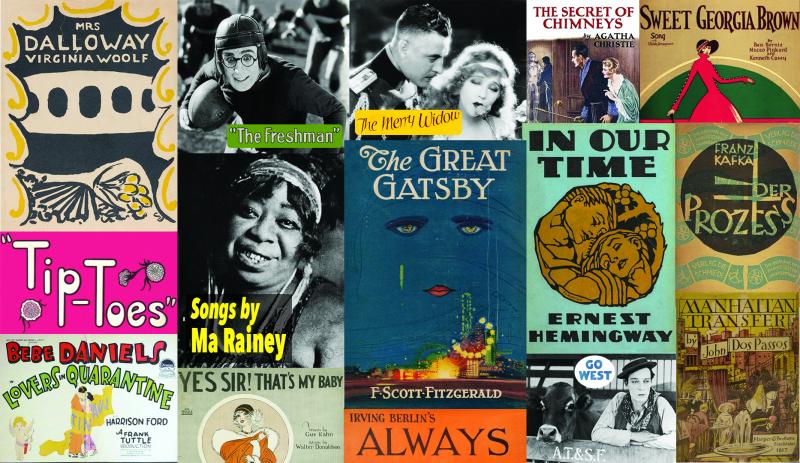
“The year 1925 was a golden moment in literary history,” writes the BBC’s Jane Ciabattari. “Ernest Hemingway’s first book, In Our Time, Virginia Woolf’s Mrs. Dalloway and F. Scott Fitzgerald’s The Great Gatsby were all published that year. As were Gertrude Stein’s The Making of Americans, John Dos Passos’ Manhattan Transfer, Theodore Dreiser’s An American Tragedy and Sinclair Lewis’s Arrowsmith, among others.” In that year, adds Director of Duke’s Center for the Study of the Public Domain Jennifer Jenkins, “the stylistic innovations produced by books such as Gatsby, or The Trial, or Mrs. Dalloway marked a change in both the tone and the substance of our literary culture, a broadening of the range of possibilities available to writers.”
In the year 2021, no matter what area of culture we inhabit, we now find our own range of possibilities broadened. Works from 1925 have entered the public domain in the United States, and Duke University’s post rounds up more than a few notable examples. These include, in addition to the aforementioned titles, books like W. Somerset Maugham’s The Painted Veil and Etsu Inagaki Sugimoto’s A Daughter of the Samurai; films like The Freshman and Go West, by silent-comedy masters Harold Lloyd and Buster Keaton; and music like Irving Berlin’s “Always” and several compositions by Duke Ellington, including “Jig Walk” and “With You.”
These works’ public-domain status means that, among many other benefits to all of us, the Internet Archive can easily add them to its online library. In addition, writes Jenkins, “HathiTrust will make tens of thousands of titles from 1925 available in its digital repository. Google Books will offer the full text of books from that year, instead of showing only snippet views or authorized previews. Community theaters can screen the films. Youth orchestras can afford to publicly perform, or rearrange, the music.” And the creators of today “can legally build on the past — reimagining the books, making them into films, adapting the songs.”
Does any newly public-domained work of 2021 hold out as obvious a promise in that regard as Fitzgerald’s great American novel? Any of us can now make The Great Gatsby “into a film, or opera, or musical,” retell it “from the perspective of Myrtle or Jordan, or make prequels and sequels,” writes Jenkins. “In fact, novelist Michael Farris Smith is slated to release Nick, a Gatsby prequel telling the story of Nick Carraway’s life before he moves to West Egg, on January 5, 2021.” Whatever results, it will further prove what Ciabattari calls the “continuing resonance” of not just Jay Gatsby but all the other major characters created by the novelists of 1925, inhabitants as well as embodiments of a “transformative time” who are “still enthralling generations of new readers” — and writers, or for that matter, creators of all kinds.
Related Content:
Free: The Great Gatsby & Other Major Works by F. Scott Fitzgerald
Duke Ellington’s Symphony in Black, Starring a 19-Year-old Billie Holiday
18 (Free) Books Ernest Hemingway Wished He Could Read Again for the First Time
Based in Seoul, Colin Marshall writes and broadcasts on cities, language, and culture. His projects include the Substack newsletter Books on Cities, the book The Stateless City: a Walk through 21st-Century Los Angeles and the video series The City in Cinema. Follow him on Twitter at @colinmarshall, on Facebook, or on Instagram.
Read More...Why Has The Great British Baking Show Conquered America? Pretty Much Pop: A Culture Podcast #75 w/ Stephen Carlile (from Broadway’s The Lion King)
What explains the immense quarantine-time popularity in America of this quaint British reality cooking show? What do we get out of watching talented amateurs bake things? Stephen Carlile, who is famous for playing Scar in The Lion King on Broadway (and is VERY British himself), joins your hosts Erica Spyres, Brian Hirt, and Mark Linsenmayer to consider the format, context, and appeal of the show.
A few articles we reviewed to prepare included:
- “The ‘Great British Baking Show’ Is Broken. Here’s a Five-Point Plan to Fix It.” by Brian Phillips
- “Why Americans love the Great British Bake Off” by Vicky Baker
- “Bake Off’s Mel and Sue Quit on Day One After Tears Left a Bad Taste” by Mark Brown
- “Paul Hollywood: ‘Girls Abandoned Bake Off’ Over Channel 4 Move” from Sky News.
- “Bake Off Hidden Secrets” by Kyle O’Sullivan
Follow Stephen on Instagram @carlile1. Visit with him online.
Hear more of this podcast at prettymuchpop.com. This episode includes bonus discussion you can access by supporting the podcast at patreon.com/prettymuchpop. This podcast is part of the Partially Examined Life podcast network.
Pretty Much Pop: A Culture Podcast is the first podcast curated by Open Culture. Browse all Pretty Much Pop posts.
Read More...In 1896, a French Cartoonist Predicted Our Socially-Distanced Zoom Holiday Gatherings
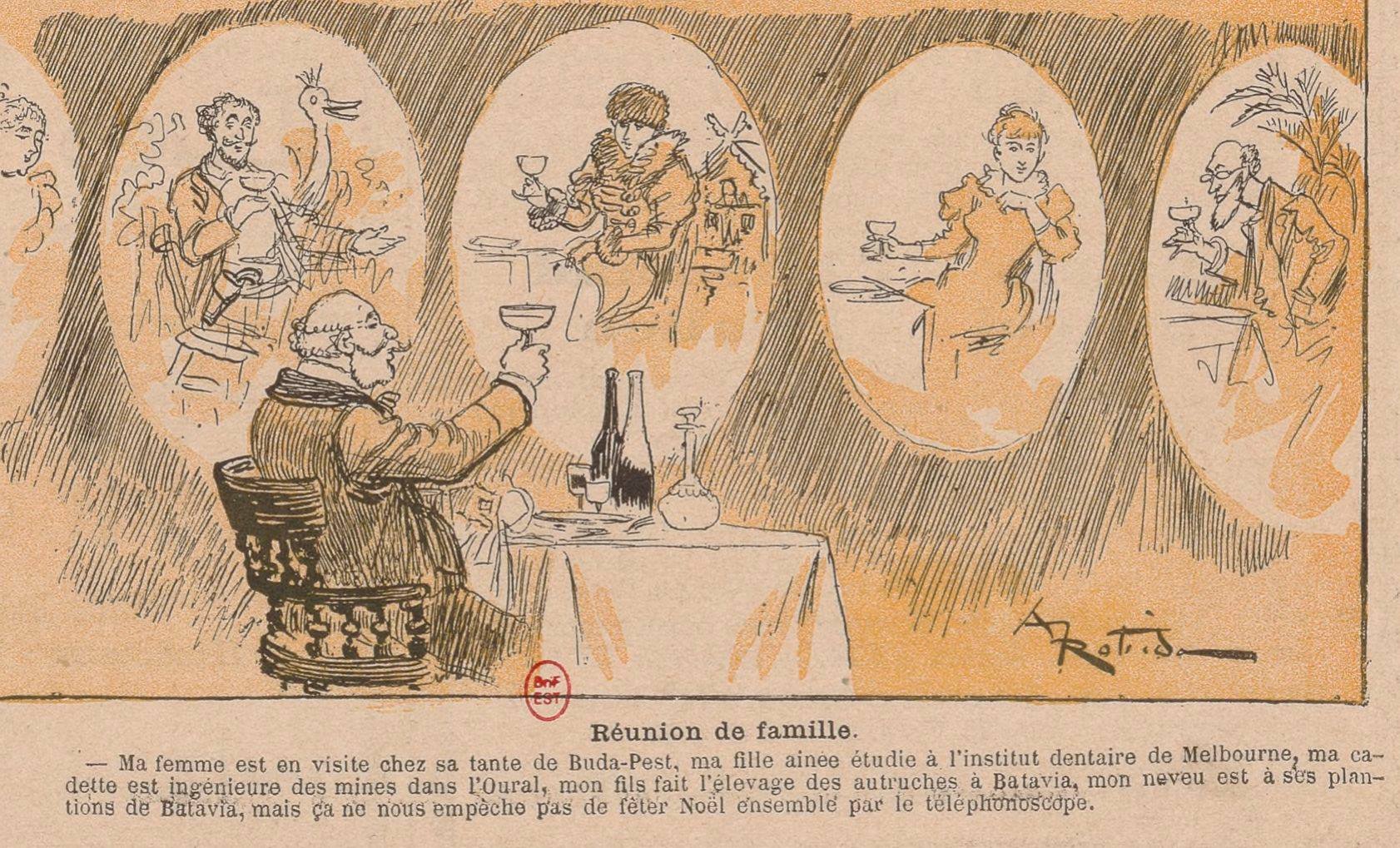
Imagine that, this time last year, you’d heard that your family’s holiday gatherings in 2020 would happen on the internet. Even if you believed such a future would one day come, would you have credited for a moment that kind of imminence? Yet our videoconference toasts this season were predicted — even rendered in clear and reasonably accurate detail — more than 120 years ago. “My wife is visiting her aunt in Budapest, my older daughter is studying dentistry in Melbourne, my younger daughter is a mining engineer in the Urals, my son raises ostriches in Batavia, my nephew is on his plantations in Batavia,” says the caption of the 1896 cartoon above. “But this does not prevent us from celebrating Christmas on the telephonoscope.”
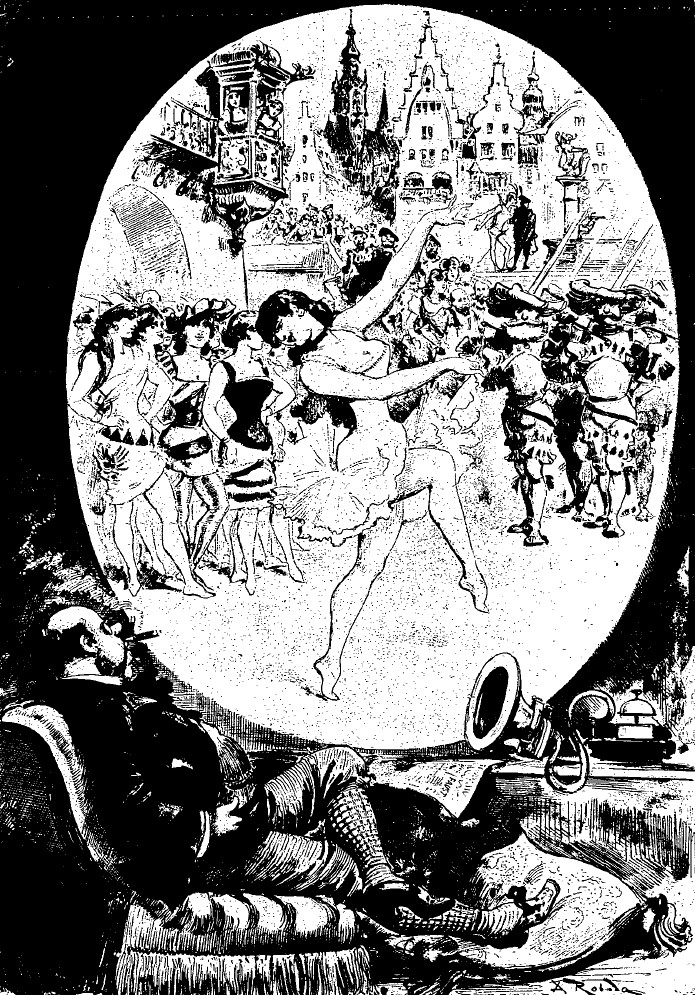
This panel ran in Belle Époque humor magazine Le rire (available to read at the Internet Archive), drawn by the hand and produced by the imagination of Albert Robida. A novelist as well as an artist, Robida drew acclaim in his day for the series Le Vingtième Siècle, whose stories offered visions of the technology to come in that century.
“Next to Zoom Christmas,” tweets philosophy professor Helen de Cruz, Robida also imagined a future in which this “telephonoscope” would “give us education, movies, teleconferencing.” As early as the 1860s, says the Public Domain Review, Robida had “published an illustration depicting a man watching a ‘televised’ performance of Faust from the comfort of his own home.” See image above.
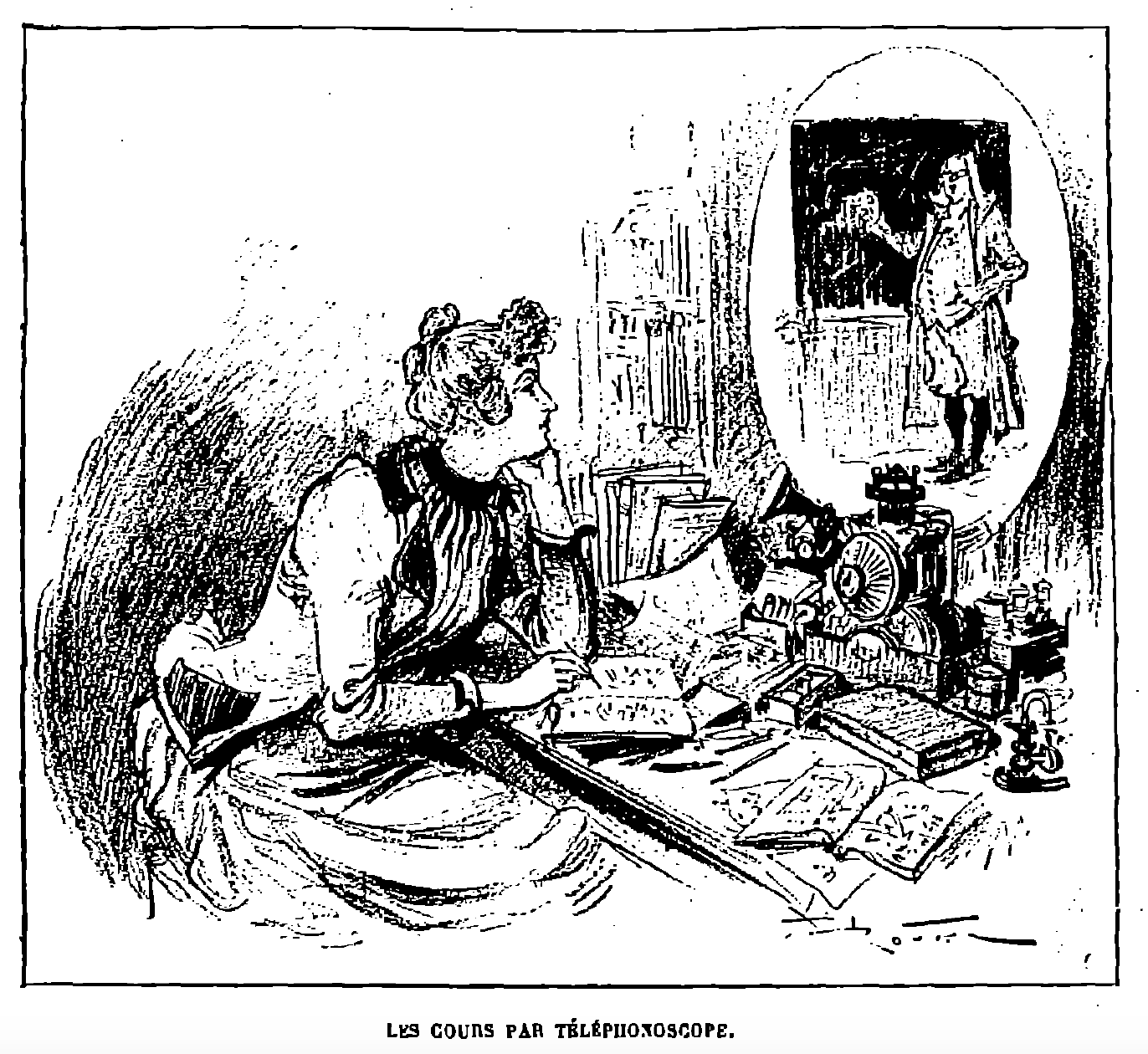
Though Robida seems to have coined the word “telephonoscope,” he wasn’t the first to publish the kind of idea to which it referred. “The concept of the device first appeared not long after the telephone was patented in 1876,” writes Verity Hunt in a Literature and Science article quoted by the Public Domain Review. “The term ‘telectroscope’ was used by the French scientist and publisher Louis Figuier in L’Année Scientifique et Industrielle in 1878 to popularize the invention, which he incorrectly interpreted as real and ascribed to Alexander Graham Bell.” The goal was to “do for the eye what the telephone had done for the ear,” though it wouldn’t be fully realized for well over a century. When you raise a glass to a webcam this week, consider toasting Albert Robida, to whom the year 2021 would have sounded impossibly distant — but who has proven more prescient about it than many of us alive today.
Related Content:
A 1947 French Film Accurately Predicted Our 21st-Century Addiction to Smartphones
How French Artists in 1899 Envisioned Life in the Year 2000: Drawing the Future
Paris Had a Moving Sidewalk in 1900, and a Thomas Edison Film Captured It in Action
Based in Seoul, Colin Marshall writes and broadcasts on cities, language, and culture. His projects include the Substack newsletter Books on Cities, the book The Stateless City: a Walk through 21st-Century Los Angeles and the video series The City in Cinema. Follow him on Twitter at @colinmarshall, on Facebook, or on Instagram.
Read More...Revisit Kate Bush’s Peculiar Christmas Special, Featuring Peter Gabriel (1979)
It’s been hard out there for Kate Bush fans. Since the genius “Queen of British Pop” retired from touring in 1979, public appearances have been few and far-between. She found the machinery of pop-stardom a hindrance to her process, and she’s been busy with other things, she says. “Every time I finish an album, I go into visual projects…. So I started to veer away from the thing of being a live performing artist, to one of being a recording artist with attached visuals.”
Fans are not entitled to her presence, but Kate Bush was sorely missed in the 35 years between her first tour and her 2014 “Before the Dawn” residency at London’’s Hammersmith Apollo. Before returning to the stage, she kept herself in the public eye with elaborately costumed music videos, a format perfectly suited to her theatrical and cinematic ambitions. (Asked by an interviewer in 1980 what she wanted to do next, she answered, “Everything.”)
But then there’s the Kate Bush Christmas Special, “titled simply Kate on-screen,” writes Christine Pallon. The program, which “aired on the BBC on December 28th, 1979,” followed on the heels of the Tour of Life, the whirlwind debut concert series that promised, but did not deliver, so many more. “The Christmas special’s choreography borrows heavily from that tour. But where she sang live on the Tour of Life, she lip-syncs to pre-recorded tracks here and incorporates pre-recorded video segments. As a result, the Christmas special plays out more like a crazy, longform music video than a traditional stage show.”
Does Kate Bush sing Christmas songs? Does she sit on Santa’s lap? Does she mime, arms akimbo, before the yule log?
Does she lounge on a piano next to a Golden Age crooner?
C’mon…
Okay, she sings one Christmas song, “December Will Be Magic Again,” an original released as a UK single that year. The song pays earnest homage to traditional Christmas figures like Bing Crosby, Saint Nick, and Oscar Wilde before Kate turns into some kind of strange Santa-like being who drops down on “the white city” in a parachute to “cover the lovers.”
Otherwise, the Christmas Special draws on Bush’s first three albums. In addition to her entourage of dancers and backup lip-syncers, she also invites a special guest—Peter Gabriel, of course (who might just as well be called the male Kate Bush)—to sing his “Here Comes the Flood” and duet with her on the extremely downbeat “Another Day.”
Christmas spirit? Who needs it? This is Kate, answering the age-old question, Pallon writes, “what would happen if the BBC gave a Christmas special to an incredibly ambitious 21-year-old art rocker who also smokes a ton of weed?” See the full tracklist, with timestamps, just below. Enjoy, and Happy Kate Bush Christmas Special Day!
Kate Bush — Christmas Special Tracklist:
(Intro) 00:00
Violin 00:29
(Gymnopédie No.1 — composed by Erik Satie) 03:44
Symphony In Blue 04:44
Them Heavy People 08:20
(Intro for Peter Gabriel) 12:52
Here Comes The Flood (Peter Gabriel) 13:22
Ran Tan Waltz 17:02
December Will Be Magic Again 19:43
The Wedding List 23:35
Another Day (with Peter Gabriel) 28:05
Egypt 31:41
The Man With The Child In His Eyes 36:21
Don’t Push Your Foot On The Heartbreak 39:24
Related Content:
300 Kate Bush Impersonators Pay Tribute to Kate Bush’s Iconic “Wuthering Heights” Video
2009 Kate Bush Documentary Dubs Her “Queen of British Pop”
Josh Jones is a writer and musician based in Durham, NC. Follow him at @jdmagness
Read More...Support Us
We're hoping to rely on loyal readers, rather than erratic ads. Please click the Donate button and support Open Culture. You can use Paypal, Venmo, Patreon, even Crypto! We thank you!

About Us

Open Culture scours the web for the best educational media. We find the free courses and audio books you need, the language lessons & educational videos you want, and plenty of enlightenment in between.
Advertise With Us
FREE UPDATES!
GET OUR DAILY EMAIL
Get the best cultural and educational resources on the web curated for you in a daily email. We never spam. Unsubscribe at any time.
FOLLOW ON SOCIAL MEDIA
Open Culture editor Dan Colman scours the web for the best educational media. He finds the free courses and audio books you need, the language lessons & movies you want, and plenty of enlightenment in between.
Advertise With Us

