The Formula for The Coen Brothers/Noah Hawley’s Fargo – Pretty Much Pop: A Culture Podcast #79
Your hosts Mark Linsemayer, Erica Spyres, and Brian Hirt are joined by Tamler from the Very Bad Wizards podcast to consider the plaudits and complaints heaped on this morality-tale-turned-organized-crime-drama that began with the 1006 film and has continued through a 4‑season TV show. We delve into its elaborate style, “tundra western” setting, dry humor (including “Minnesota nice”), speechifying, gender issues, stunt casting, and the role of chance in its plotting. Did the show go downhill in its later seasons, and is there altogether too much rehash involved? Yes, there are spoilers, but no, it barely matters.
Check out these resources for more opinions and background information:
- “How All the Fargo Seasons are Connected” by Pete Peppers
- “Fargo Season 4 Has a Lot of Nothing to Say About America” by Darren Franich
- “Fargo: The 10 Best Examples of Stunt Casting on the Series” by David Mello
- “‘Fargo’ Season 4 Wanted to Talk About Race, but Had a Big Communication Problem” by Julian Kimble
- “‘Fargo’ Showrunner Noah Hawley Reveals What Happens Between Season 4 Finale and the Beginning of Season 2″ by Daniel Holloway
- “A Superb ‘Fargo’ Swerves into the ’70s with Almost Too Much Story to Tell” by Hank Steuver
- “Fargo’s Second Season Will Be a Classic in Its Own Right” by Matt Zoller Seitz
- “‘Fargo’: How a Great Movie Became a Perfect TV Series” by Jeff Ridskopf
- “A Guide to the New ‘Fargo’ ” by Alicia Lutes
Follow @tamler. Hear him on The Partially Examined Life. Check out his book, Why Honor Matters.
Hear more of this podcast at prettymuchpop.com. This episode includes bonus discussion that you can access by supporting the podcast at patreon.com/prettymuchpop. This podcast is part of the Partially Examined Life podcast network.
Pretty Much Pop: A Culture Podcast is the first podcast curated by Open Culture. Browse all Pretty Much Pop posts.
Read More...Watch John Cage Play His “Silent” 4′33″ in Harvard Square, Presented by Nam June Paik (1973)
Have you ever played 4′33″ in public? Or rather, have you ever not played 4′33″ in public? Calling as its score does for no notes at all over its titular duration, John Cage’s signature 1952 composition has made many ponder (and just as many joke about) what it means to actually perform the thing. If music is, by its most basic definition, organized sound, then 4′33″ is anti-music, the deliberate absence of organized sound. Yet it isn’t silence: rather, the piece offers a performative frame for the disorganized sound that occurs uncontrollably in the environment.
In a concert hall, 4′33″ encompasses all the non-musical noises made by everyone onstage and in the seats, try though they might to make none at all. Naturally, the piece sounds completely different when played in, say, the streets of a major city. John Cage did exactly that in 1973, sitting at a piano in the middle of Boston’s Harvard Square.
“He flipped open the piano cover while traffic roared by, and, except for periodically checking his stopwatch, did nothing for four minutes and thirty-three seconds,” writes the Brooklyn Rail’s Ellen Pearlman. “Then workmen slowly carted the piano off while Cage keened like a distressed Japanese monk.” You can witness this public happening, or at least one minute and 22 seconds of it, in the video above.
The clip comes from A Tribute to John Cage, the video artist Nam June Paik’s audiovisual homage to the composer, who counted among his major sources of inspiration along with his compatriots in the international experimental art movement Fluxus. (Just over a decade later, Paik would involve Cage in a much higher-profile project, the New Year’s broadcast Good Morning, Mr. Orwell.) Here Paik “reverses John Cage’s proposal by overloading the screen with messages,” writes Thérèse Beyler at the New Media Encyclopedia. “This is Zen for TV,” announces one of his onscreen messages. “Do you hear a cricket?” asks another. “… or a mouse.” Unlikely, at the intersection of Brattle and JFK — but then, we can hear anything when offered an opportunity truly to listen.
Related Content:
John Cage’s Silent, Avant-Garde Piece 4’33” Gets Covered by a Death Metal Band
The Curious Score for John Cage’s “Silent” Zen Composition 4’33”
The 4’33” App Lets You Create Your Own Version of John Cage’s Classic Work
Based in Seoul, Colin Marshall writes and broadcasts on cities, language, and culture. His projects include the Substack newsletter Books on Cities, the book The Stateless City: a Walk through 21st-Century Los Angeles and the video series The City in Cinema. Follow him on Twitter at @colinmarshall or on Facebook.
Read More...Watch Amanda Gorman Read “The Hill We Climb,” “Making Mountains As We Run,” “Fury and Faith,” and More
Led by celebrity host Tom Hanks, the Biden inauguration’s entertainers, A‑listers all, were safe bets, reliable stadium-fillers with instant mass appeal. They “did exactly what we needed them to do,” remarked Stephanie Zacharek at TIME, offering the reassurance that “we no longer need to live in dread.” They were “singers you actually know,” Alexis Petridis wrote at The Guardian. The comment was a dig at the previous administration’s C and D‑list lineup, and also, perhaps, an admission that what Americans most crave is the familiar, which, of course, means, first and foremost, a national focus on celebrities we all know and love.
For a moment, however, this repetition of comforting household names was punctuated by an entirely new young face and voice—that of a poet, no less, a standard bearer of the form that has held the nation’s rapt attention in the work of Whitman, Frost, Hughes, and Angelou.
Amanda Gorman, chosen as the first National Youth Poet Laureate in 2017, channeled a tradition of American lyric writing about America in her inauguration poem, and she brought to it her own experiences as a Gen Z black feminist and activist who overcame a speech impediment to address the country at one of the most significant televised public events in recent history.
Gorman’s resume is a testament to her generation’s commitment to art and activism in the face of compounding crises, and to her personal commitment to change in a country that promises little for young black artists in particular. Named youth poet laureate of Los Angeles in 2014 at age 16, she published her first book of poetry, The One for Whom Food is Not Enough, the following year. She then went on to found a nonprofit writing and leadership program, open the literary season for the Library of Congress in 2017, and graduate cum laude from Harvard College with a degree in sociology in 2020.
While charting her own literary path, Gorman learned to use her voice as “a political choice,” as she says in her TED-Ed student talk above, in which she confidently asks a small audience of her peers, “whose shoulders do you stand on?” and “what do you stand for?” These are the questions she asks students in workshops, she says, to shake them out of the idea that poetry is for “dead white men who were just born to be old.” Then she shares her own answers. Gorman’s public appearances tend to focus on process as much as on politics and prosody. In a talk on “Presentation and Reading” at the Academy of Arts & Sciences in Cambridge below, she reads a poem, then has a brief discussion of “how it came to be.”
Gorman is as skilled a storyteller as she is a poet and educator. In her 2017 Moth GrandSLAM appearance in Boston, further up, she tells the story of trying to catch her big break auditioning for Broadway, an aspiration shaped by her childhood love of The Lion King. Her inaugural poem, she tells PBS, was written to “be accessible to anyone who might be watching, that they can feel that they are represented and well-established in this poem,” an act of writing she calls “a really difficult dance to do.” The effort did not blunt the poem’s most incisive lines, however, including its reference to “the belly of the beast,” in which “we’ve learned that quiet isn’t always peace.”
For Gorman, speaking out is a personal imperative she honed as “a form of a pathology,” overcoming her speech issues “by embarking on spoken word over and over and over again and reciting my poems. No matter how terrified I was, because I had the support of others, I was able to kind of slowly climb my way to the place I am at today.”
For millions of young people who watched the inauguration, it will be Gorman’s story of perseverance, community, personal growth, and refusal to be passive and silent in the face of social injustice that will most resonate, perhaps for the rest of their lives, amidst celebrations of a longed-for return to the familiar. See Gorman read more of her poetry above and below, including a poem for another inauguration, that of Harvard President Lawrence S. Bacow, in 2018.
Related Content:
Animated Poetry by US Poet Laureate
Josh Jones is a writer and musician based in Durham, NC. Follow him at @jdmagness
Read More...How Richard Feynman’s Diagrams Revolutionized Physics
If you want to understand theoretical physics these days—as much as is possible without years of specialized study—there are no shortage of places to turn on the internet. Of course, this was not the case in the early 1960s when Richard Feynman gave his famous series of lectures at Caltech. In published form, these lectures became the most popular book on physics ever written. Feynman’s subsequent autobiographical essays and accessible public appearances further solidified his reputation as the foremost popular communicator of physics, “a fun-loving, charismatic practical joker,” writes Mette Ilene Holmnis at Quanta magazine, even if “his performative sexism looks very different to modern eyes.”
Feynman’s genius went beyond that of “ordinary geniuses,” his mentor, Hans Bethe, director of the Manhattan Project, exclaimed: “Feynman was a magician.” That may be so, but he was never above revealing how he learned his tricks, such that anyone could use his methods, whether or not they could achieve his spectacular results. Feynman didn’t only teach his students, and his millions of readers, about physics; he also taught them how to teach themselves. The so-called “Feynman technique” for effective studying ensures that students don’t just parrot knowledge, but that they can “identify any gaps” in their understanding, he emphasized, and bolster weak points where they “can’t explain an idea simply.”
Years before he became the foremost public communicator of science, Feynman performed the same service for his colleagues. “With physicists in the late 1940s struggling to reformulate a relativistic quantum theory describing the interactions of electrically charged particles,” Holmnis writes, “Feynman conjured up some Nobel Prize-winning magic. He introduced a visual method to simplify the seemingly impossible calculations needed to describe basic particle interactions.” The video above, animated by Holmnis, shows just how simple it was—just a few lines, squiggles, circles, and arrows.
Holmnis quotes Feynman biographer James Gleick’s description: Feynman “took the half-made conceptions of waves and particles in the 1940s and shaped them into tools that ordinary physicists could use and understand.” Feynman Diagrams helped make sense of quantum electrodynamics, a theory that “attempted to calculate the probability of all possible outcomes of particle interactions,” the video explains. Among the theory’s problems was the writing of “equations meant keeping track of all interactions, including virtual ones, a grueling, hopeless exercise for even the most organized and patient physicist.”
Using his touch for the relatable, Feynman drew his first diagrams in 1948. They remain, wrote Nobel Prize-winning physicist Frank Wilczek, “a treasured asset in physics because they often provide good approximations to reality. They help us bring our powers of visual imagination to bear on worlds we can’t actually see.” Learn more about Feynman Diagrams in the video above and at Holmnis’ article in Quanta here.
Related Content:
The “Feynman Technique” for Studying Effectively: An Animated Primer
What Made Richard Feynman One of the Most Admired Educators in the World
Josh Jones is a writer and musician based in Durham, NC. Follow him at @jdmagness
Read More...Pussy Riot’s Nadya Tolokonnikova Tells Protestors What to Do–and Not Do–If Arrested by Authoritarian Police
Note: If the subtitles don’t play automatically, please click the “cc” at the bottom of the video.
Oligarchic regimes built on corruption and naked self-interest don’t typically exhibit much in the way of creativity when responding to crises of legitimacy. The most recent challenge to the oligarchic rule of Vladimir Putin, for example, after the attempted assassination and jailing of his rival, anti-corruption activist Alexey Navalny, revealed “the regime’s utter lack of imagination and inability to plan ahead,” writes Masha Gessen at The New Yorker, and seems to promise an opening for a revolutionary movement.
Perhaps it’s safer to say, Joshua Yaffa writes, “that Russian politics are merely entering the beginning of a protracted new phase,” that will involve more large, coordinated mass protests against the “perceived impunity and lawlessness of Putin’s system,” such as happened all over the country in recent days: “In St. Petersburg, a sizable crowd blocked Nevsky Prospekt, the city’s main thoroughfare. Several thousand gathered in Novosibirsk, the largest city in Siberia. Even in Yakutsk, a faraway regional capital, where the day’s temperatures reached minus fifty-eight degrees Fahrenheit, a number of people came out to the central square.”
Footage from the protests “shows activists pelting Russian riot police and vehicles with snowballs,” Dazed reports. Massive, in-real-life protests have been organized and supported by online activists on Tik Tok, YouTube, and other social media sites, where young people like viral teenager Neurolera share tips—such as pretending to be an indignant American—that might help protestors avoid arrest. In one video calling on young students to attend Saturday’s protests, a young woman holds a book, and captions “explain how she is reading about how citizens’ rights are guaranteed,” writes Brendan Cole at Newsweek. “But wait!” she says in one caption, “In Russia things happen differently.”
Russian citizens, and especially young activists, do not walk into protest situations unprepared for arrest and detention—particularly those who follow longtime trouble-makers Pussy Riot, famous for staging flamboyant anti-Putin protests and getting arrested. In the video at the top, the band/activist collective’s Nadya Tolokonnikova explains “how to behave when you’re arrested.” Detention “is an unpleasant experience,” she says, but it need not “end up being such a traumatic experience.” One must conquer fear with knowledge. During her first arrest, “I was scared because I felt that the police officers held an enormous power over me. That’s not true.”
The English translation seems inexact and many of the intricacies of Russian law will not translate to other national contexts. Woven throughout the video, however, are generally prudent tips—like not adding criminal charges by attacking police during arrest. Last year, the group distributed anti-surveillance make-up tips also useful to activists everywhere. The viral spread of videos like Pussy Riot’s and Neurolera’s tutorial show us a worldwide desire for youthful hope and determination in the face of brutal realities. Yaffa describes the “scenes of police employing brute force” that filled his Russian-language social media during the protests:
In one such video, from St. Petersburg, a woman confronts a column of riot policemen dragging a protester by his arms and asks, “Why are you arresting him?” One of the police officers kicks her in the chest, knocking her to the ground. Watching these scenes, I couldn’t help but think of Belarus, where months of street protests against the rule of Alexander Lukashenka have been marked by brutality and torture by the security forces, and a remarkable willingness from protesters to fight back against riot police, at times forcing them to retreat or abandon making an arrest.
These images do not spread so readily in English-language media, perhaps giving a superficial impression that the current anti-Putin, pro-Navalny movement is a new, young online phenomenon, rather than the continuation of a battle-hardened resistance to twenty years of misrule. “Throwing the book at Navalny could spark protests of undetermined strength and longevity,” Yaffa argues, from which mass movements around the world draw inspiration for years to come.
via Dazed
Related Content:
A History of Pussy Riot: Watch the Band’s Early Performances/Protests Against the Putin Regime
Josh Jones is a writer and musician based in Durham, NC. Follow him at @jdmagness
Read More...Cocktails with a Curator: The Frick Pairs Weekly Art History Lectures with Cocktail Recipes
Once upon a time, not so long ago, First Fridays at the Frick were a gracious way for New Yorkers to kick off the weekend. Admission was waived, participants could take part in open sketching sessions or enjoy live performance, and curators were on hand to give mini lectures on the significance and historical context of certain prized paintings in the collection.
Rather than pull the plug entirely when the museum closed due to the pandemic, the Frick sought to preserve the spirit of this longstanding tradition with weekly episodes of Cocktails with a Curator, matching each selection with recipes for make-at-home themed drinks, with or without alcohol.
Much as we miss these communal live events, there’s something to be said for enjoying these wildly entertaining, educational mini-lectures from the comfort of one’s own couch, drink in hand, no need to crane past other visitors for a view, or worry that one might keel over from locking one’s knees too long.
Deputy Director and Peter Jay Sharp Chief Curator Xavier F. Salomon makes for an especially engaging host. His coverage of James McNeill Whistler’s Symphony in Flesh Color and Pink: Portrait of Mrs. Frances Leyland, above, touches on the artist’s affinity for butterflies, music, Japanese themes and building his own frames.
But the greatest delight is Salomon’s talent for imbuing 19th-century art world gossip with a sense of immediacy.
Sip a sake highball (or a virgin sangria-style refresher of plum juice and mint) and chew on the true nature of the artist’s relationship with his shipping magnate patron’s wife.
Sake Highball
sake (of your choice)
club soda (as much/little as needed)
lots of iceAlternative Mocktail
plum juice
ice
cut orange, lemon and apple (sangria style)
mint leaves
sugar (as needed)
Salomon returns to consider one of the Frick’s most iconic holdings, François Boucher’s rococo Four Seasons.
Commissioned in 1755 to serve as over-door decorations for King Louis XV’s mistress Madame de Pompadour, they now reside in the Frick’s ornate Boucher Room.
Salomon draws comparisons to another swooning Frick favorite, Jean-Honoré Fragonard’s series Progress of Love. While the romantic nature of these works is hardly a secret, Salomon is able to speak to the erotic significance of dolphins, grapes, and tiny 18th-century shepherdess bonnets.
Those who are respecting COVID protocols by courting outdoors this winter will welcome Salomon’s thoughts on Winter’s central figure, a coquette riding in a sleigh driven by a well-bundled man in Tartar dress:
Her hands may be warmed by a muff, but her upper body is completely exposed. It’s a combination of luxury and seduction typical of Boucher, all treated in a fanciful, even humorous manner.
Also, is it just us, or is Curator Salomon taking the opportunity to enjoy his Proust-inspired Time Regained cocktail in a kimono? (A perk of the virtual office…)
Time Regained
2 oz. Scotch whisky
0.75 oz. Dry vermouth
0.5 oz. Pisco
0.25 oz. Jasmine tea syrup (equal parts of jasmine tea and sugar)Alternative Mocktail
Cold jasmine tea
One spoonful of golden syrup
Top with tonic water
Salomon hands hosting duties to colleague Aimee Ng for Vermeer’s Mistress and Maid, one of three works by the Dutch Master in the Frick’s collection.
Here the drama is less explicitly informed by the boudoir, though there’s a big reveal around the 10 minute mark, thanks to recent advances in infrared reflectography and some well-coordinated art sleuthing.
As to the contents of the message the maid proffers her ermine trimmed mistress, we’ll never know, although those of us with ready access to the Dutch spirit genever can have fun speculating over a glass of Genever Brûlée.
Genever Brûlée
2 oz genever
1 teaspoon brown sugar
A few dashes of classic bitters
A dash of orange bitters
A splash of sparkling water
Garnished with a caramelized orange sliceAlternative Mocktail
Juice of half an orange
2 dashes orange blossom water
A splash of sparkling water
Garnished with a caramelized orange slice
To explore a playlist of every Cocktails with a Curator episode, covering such notable works as Velázquez’s King Philip IV of Spain, Claude Monet’s Vétheuil in Winter, and Hans Holbein’s Sir Thomas More, click here.
To read more in-depth coverage of each episode’s featured artwork, along with its cocktail and mocktail recipes, click here.
Related Content:
Visit 2+ Million Free Works of Art from 20 World-Class Museums Free Online
14 Paris Museums Put 300,000 Works of Art Online: Download Classics by Monet, Cézanne & More
Ayun Halliday is an author, illustrator, theater maker and Chief Primatologist of the East Village Inky zine. She most recently appeared as a French Canadian bear who travels to New York City in search of food and meaning in Greg Kotis’ short film, L’Ourse. Follow her @AyunHalliday.
Read More...When the Grateful Dead Performed on Hugh Hefner’s Playboy After Dark & Secretly Dosed Everyone With LSD (1969)
At one time, whatever else people did with it, they really did read Playboy for the articles. And whatever other vicarious thrills they might obtain from Hugh Hefner’s Playboy’s Penthouse variety show or its follow-up, Playboy After Dark, they definitely tuned in for the music. Guests included Ike & Tina Turner, The Byrds, Buddy Rich, Cher, Deep Purple, Fleetwood Mac, Steppenwolf, James Brown, and many more. On January 18, 1969, the Grateful Dead performed, and it went exactly as one might expect, meaning “things got totally out-of-hand,” Dave Melamed writes at Live for Live Music, “but everything wound up working out just fine.
Things worked out more than fine, despite, or because of, the fact that the band’s legendary sound-man Owsley “Bear” Stanley (at that time the largest supplier of LSD in the country) dosed the coffee pot on set. Dead drummer Bill Kreutzmann tells the story in the Conan clip below. It all started, he says, during soundcheck, when he noticed that the crew was acting “kinda loose.” Knowing Stanley as he did, he immediately suspected the cause: “the whole crew, all of you” he says pointing toward the Conan camera operators, “was high on acid.”
There’s not much evidence of it in the footage. There don’t seem to be any technical problems in the clip at the top. In their brief, jovial interview, Hefner and Garcia seem plenty relaxed. Jerry tells the Playboy founder why the band has two drummers. (They “chase each other around, sort of like the serpent that eats its own tail” and “make a figure in your mind” if you stand between them.) Then he takes the stage and the band plays “Mountains of the Moon” and “St. Stephen.”
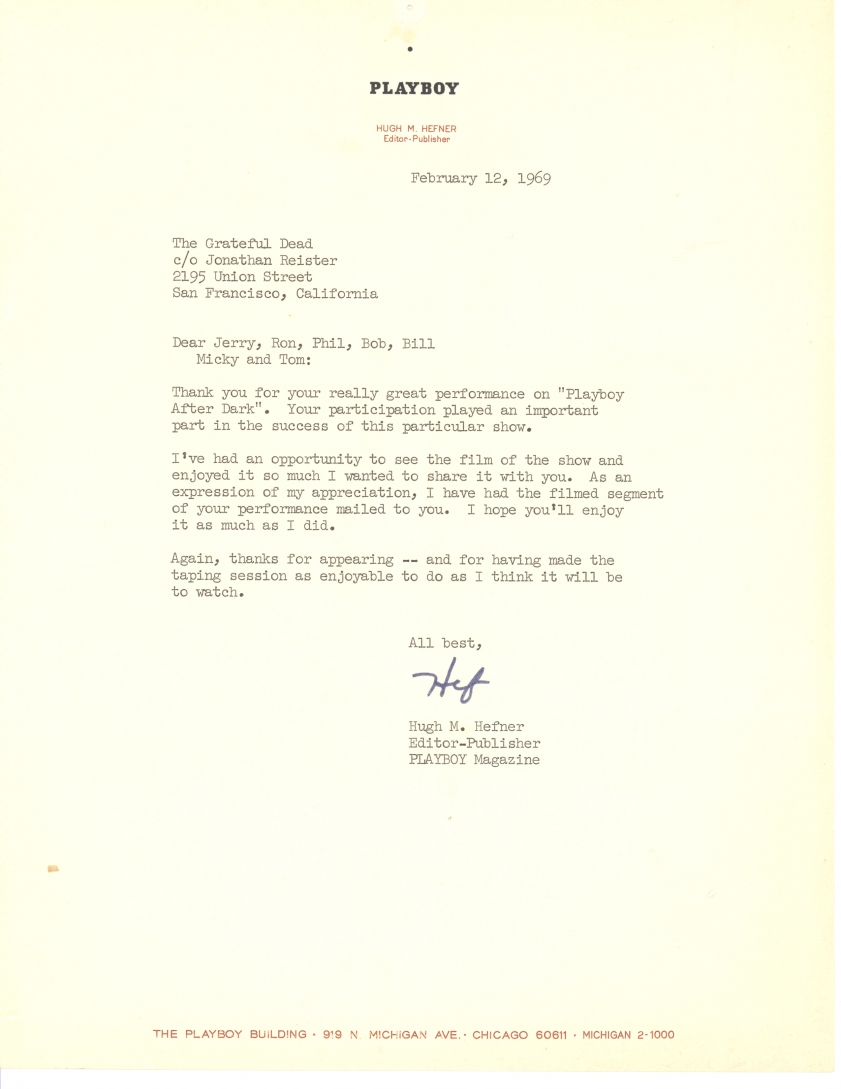
Hefner was so appreciative of whatever happened on set that he sent a personal letter of thanks the following month (below), addressed to each member of the band. “Your participation played an important part in the success of this particular show.” He enclosed a film of the performances and expressed his gratitude “for having made the taping session as enjoyable to do as I think it will be to watch.”
Kreutzmann relates some other anecdotes in his 2015 Conan interview, including a funny bit about how the band got its name. But the best part of the appearance is watching him imitate Hefner, who was apparently plastered to the wall by the end of the set, the coffee really starting to kick in.
This strange chapter of Grateful Dead history is one of many memorialized in the new graphic novel, Grateful Dead Origins.
via Laughing Squid
Related Content:
Josh Jones is a writer and musician based in Durham, NC. Follow him at @jdmagness
Read More...Rarely-Seen Illustrations of Dante’s Divine Comedy Are Now Free Online, Courtesy of the Uffizi Gallery
We know Dante’s Divine Comedy—especially its famous first third, Inferno—as an extended theological treatise, epic love poem, and vicious satire of church hypocrisy and the Florentine political faction that exiled Dante from the city of his birth in 1302. Most of us don’t know it the way its first readers did (and as Dante scholars do): a compendium in which “a number of medieval literary genres are digested and combined,” as Robert M. Durling writes in his translation of the Inferno.
These literary genres include vernacular traditions of romance poetry from Provence, popular long before Dante turned his Tuscan dialect into a literary language to rival Latin. They include “the dream-vision (exemplified by the Old French Romance of the Rose)”; “accounts of journeys to the Otherworld (such as the Visio Pauli, Saint Patrick’s Purgatory, the Navigatio Sancti Brendani)”; and Scholastic philosophical allegory, among other well-known forms of writing at the time.
By the time the Divine Comedy captured imaginations in the period of incunabula, or the infancy of the printed book, many of these associations and influences had receded. And by the time of the Counter-Reformation, the poem most impressed readers and illustrators of the text as a divine plan for a torture chamber and an encyclopedia of the tortures therein. Whatever other associations we have with Dante’s poem, we all know the nine circles of hell and have an ominous sense of what goes on there.
No doubt we also have in our mind’s eye some of the hundreds of illustrations made of the text’s gruesome depictions of hell, from Sandro Botticelli to Robert Rauschenberg. Illustrated editions of Dante’s poem began appearing in 1472, and the first fully illustrated edition in 1491. By the late 16th century, the poem had become a literary classic (the word Divine joined Comedy in the title in 1555). By this time, the tradition of depicting a literal, rather than a literary, hell was firmly established.
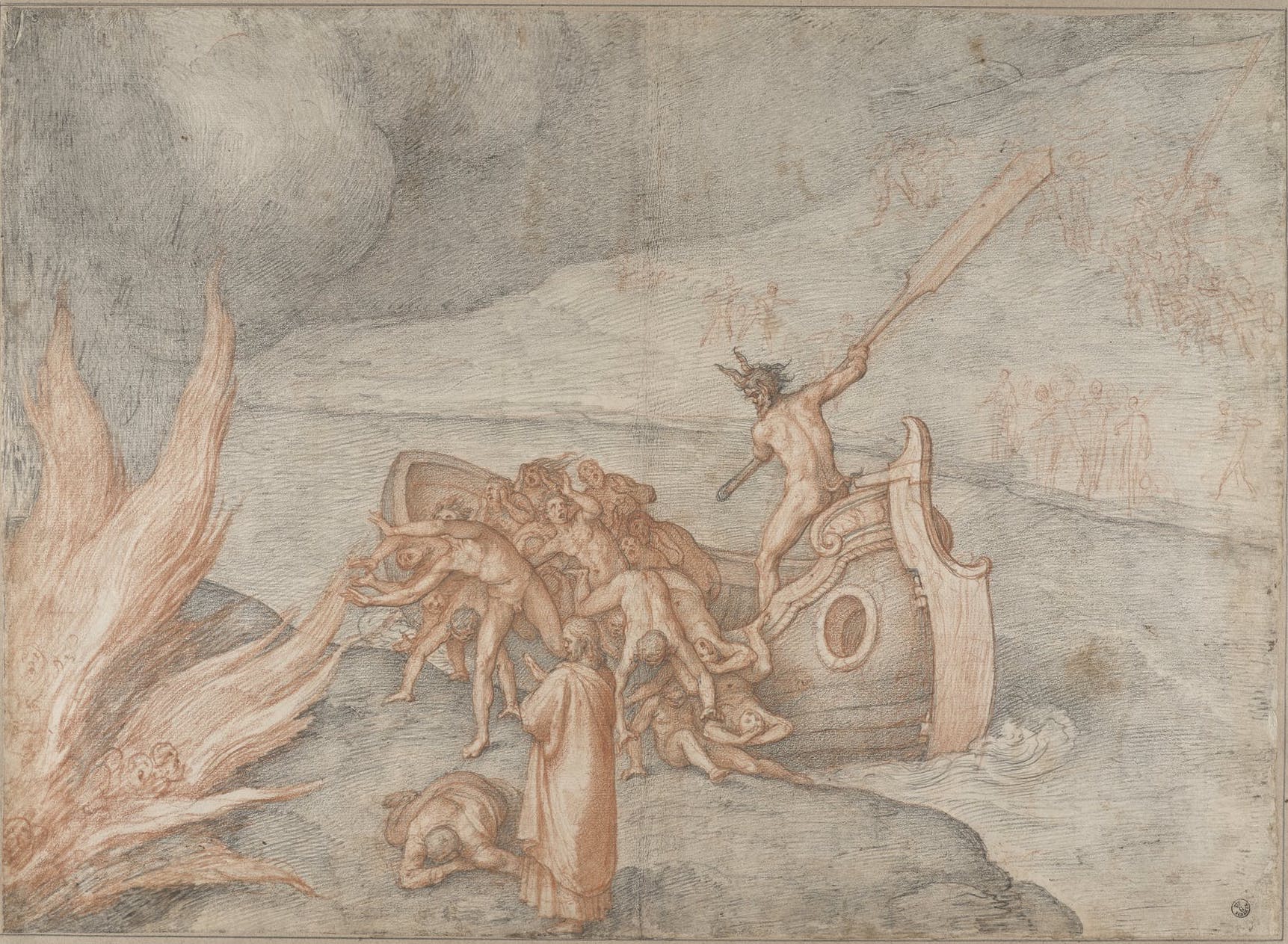
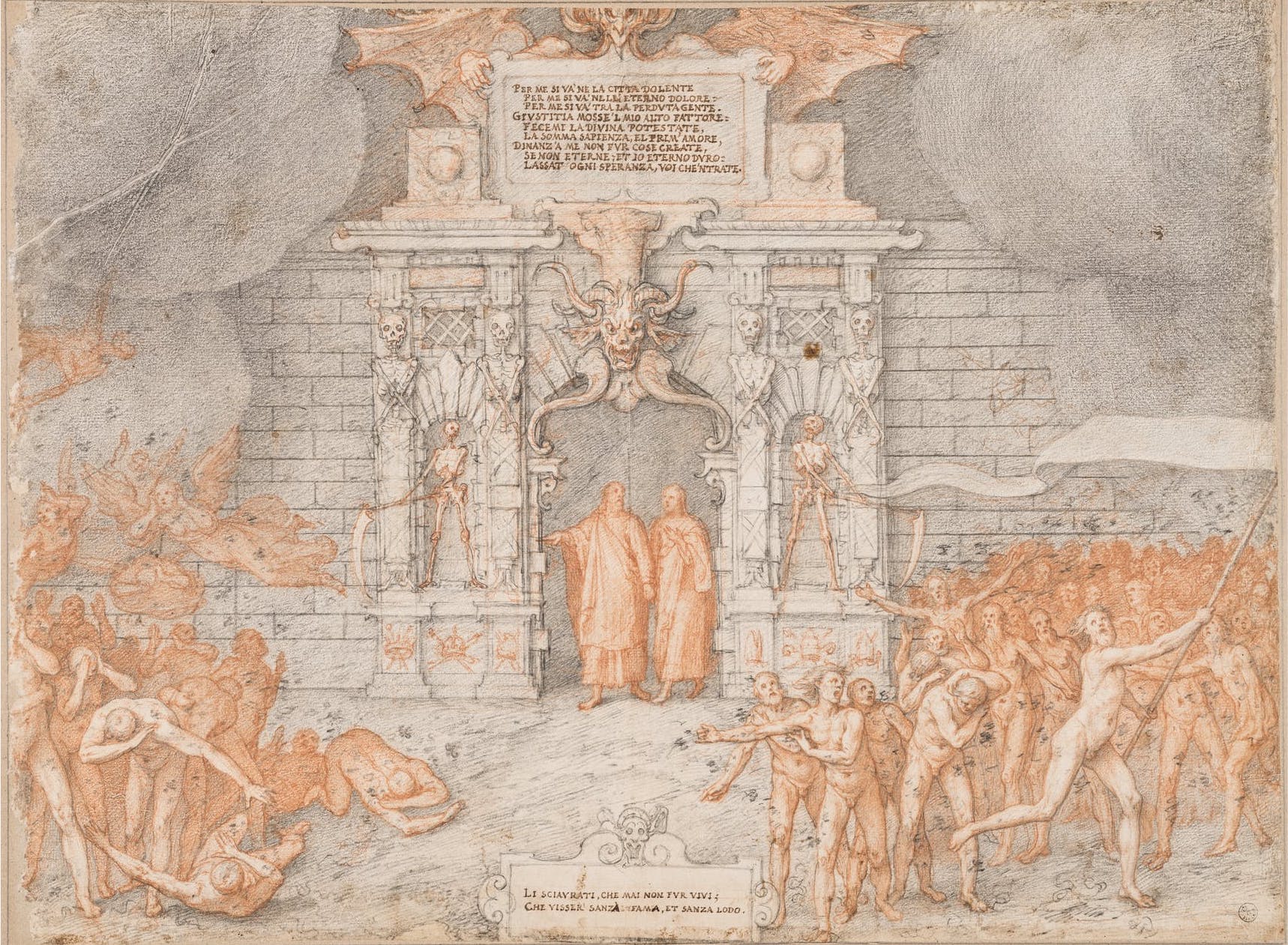
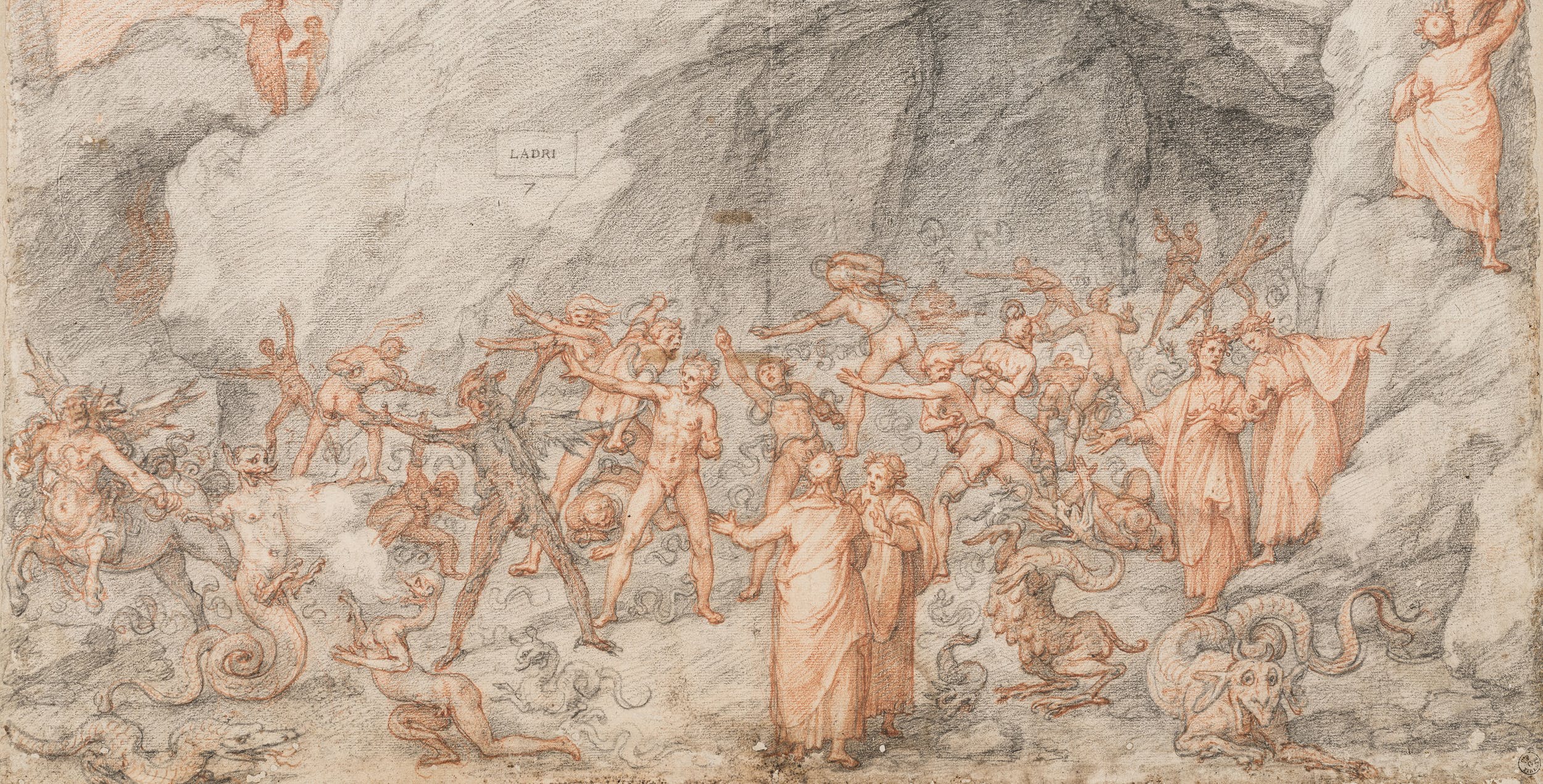
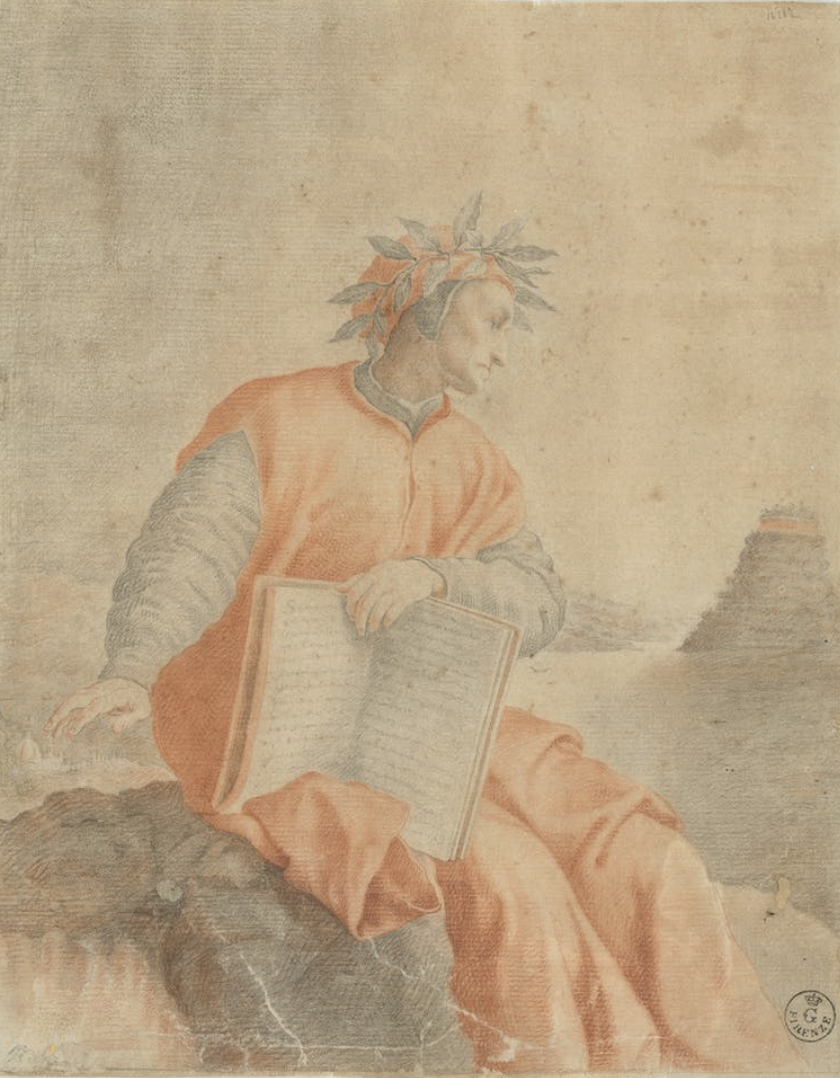
It was in this period that Frederico Zuccari made the beautiful illustrations you see here, completed, Angela Giuffrida writes at The Guardian, “during a stay in Spain between 1586 and 1588. Of the 88 illustrations, 28 are depictions of hell, 49 of purgatory and 11 of heaven. After Zuccari’s death in 1609, the drawings were held by the noble Orsini family, for whom the artist had worked, and later by the Medici family before becoming part of the Uffizi collection in 1738.”
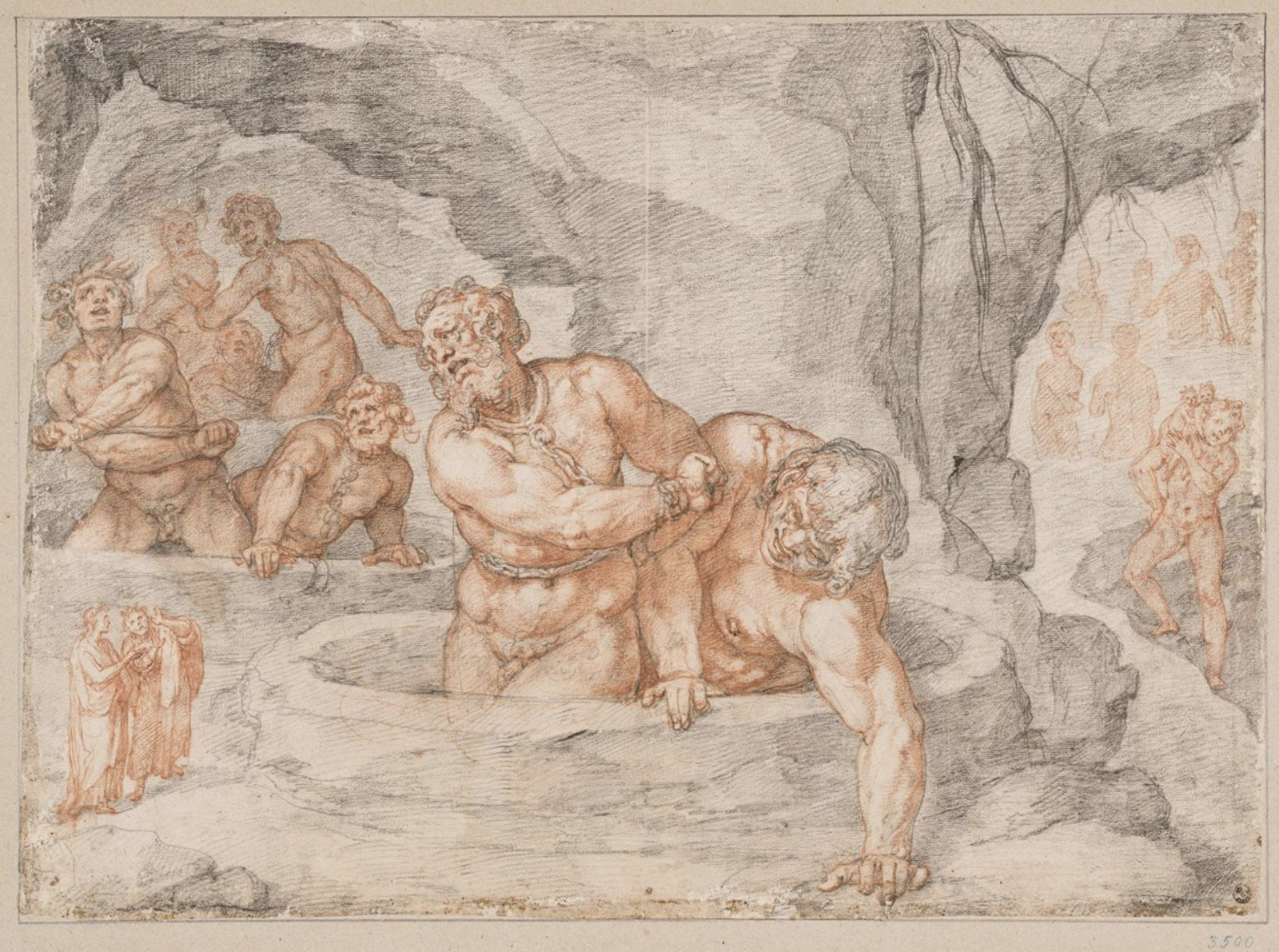
The pencil-and-ink drawings have rarely been seen before because of their fragile condition. They were only exhibited publicly for the first time in 1865 for the 600th anniversary of Dante’s birth and of Italian unification. Now, they are on display, virtually, for free, as part of a “year-long calendar of events to mark the 700th anniversary of the poet’s death.” This is an extraordinary opportunity to see these illustrations, which have until now “only been seen by a few scholars and displayed to the public only twice, and only in part,” says Uffizi director Eike Schmidt.
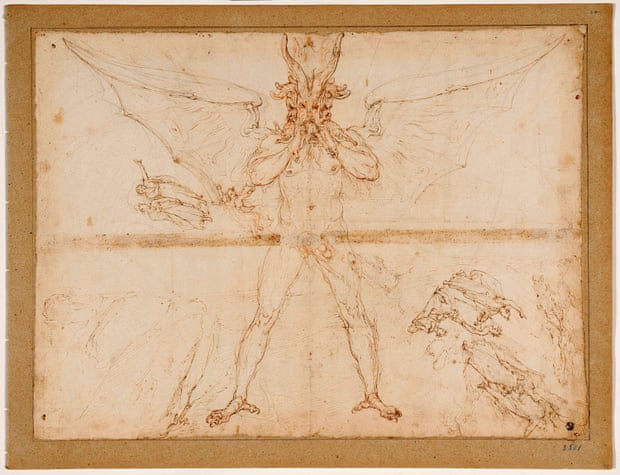
Much of the promised “didactic-scientific comment” to accompany each drawing is marked as “upcoming” on the English version of the Uffizi site, but you can see high resolution scans of each drawing and zoom in to examine the many tortures of the damned and the grotesque demons who torment them. Learn much more at Khan Academy about how Dante’s literary epic in terza rima left “a lasting impression on the Western imagination for more than half a millennium,” solidifying and reshaping images of hell “into new guises that would become familiar to countless generations that followed.” If you like, you can also take a free course on Dante’s Divine Comedy from Yale University.
via MyModernMet/The Guardian
Related Content:
Why Should We Read Dante’s Divine Comedy? An Animated Video Makes the Case
A Digital Archive of the Earliest Illustrated Editions of Dante’s Divine Comedy (1487–1568)
Josh Jones is a writer and musician based in Durham, NC. Follow him at @jdmagness
Read More...David Lynch’s Projection Instructions for Mulholland Drive (2001)
David Lynch is known for being persnickety about delivering the correct viewing experience to his audience, as he considers the cinema a sacred place. In a documentary short a few years back, he explained, “It’s so magical, I don’t know why, to go into a theater and have the lights go down. It’s very quiet and then the curtains start to open. And then you go into a world.”
However, the cinematheque is also the space where directors have the least control. They can hope that each print that goes out has been printed correctly (especially during the days of film), or that the sound is clear and/or loud enough, but, in a wide release, hope is all directors can do most of the time. There are exceptions: Stanley Kubrick oversaw the rerelease prints of his films. And Alfred Hitchcock demanded that there would be no late seating for Psycho-—a tactic that worked to the film’s advantage.
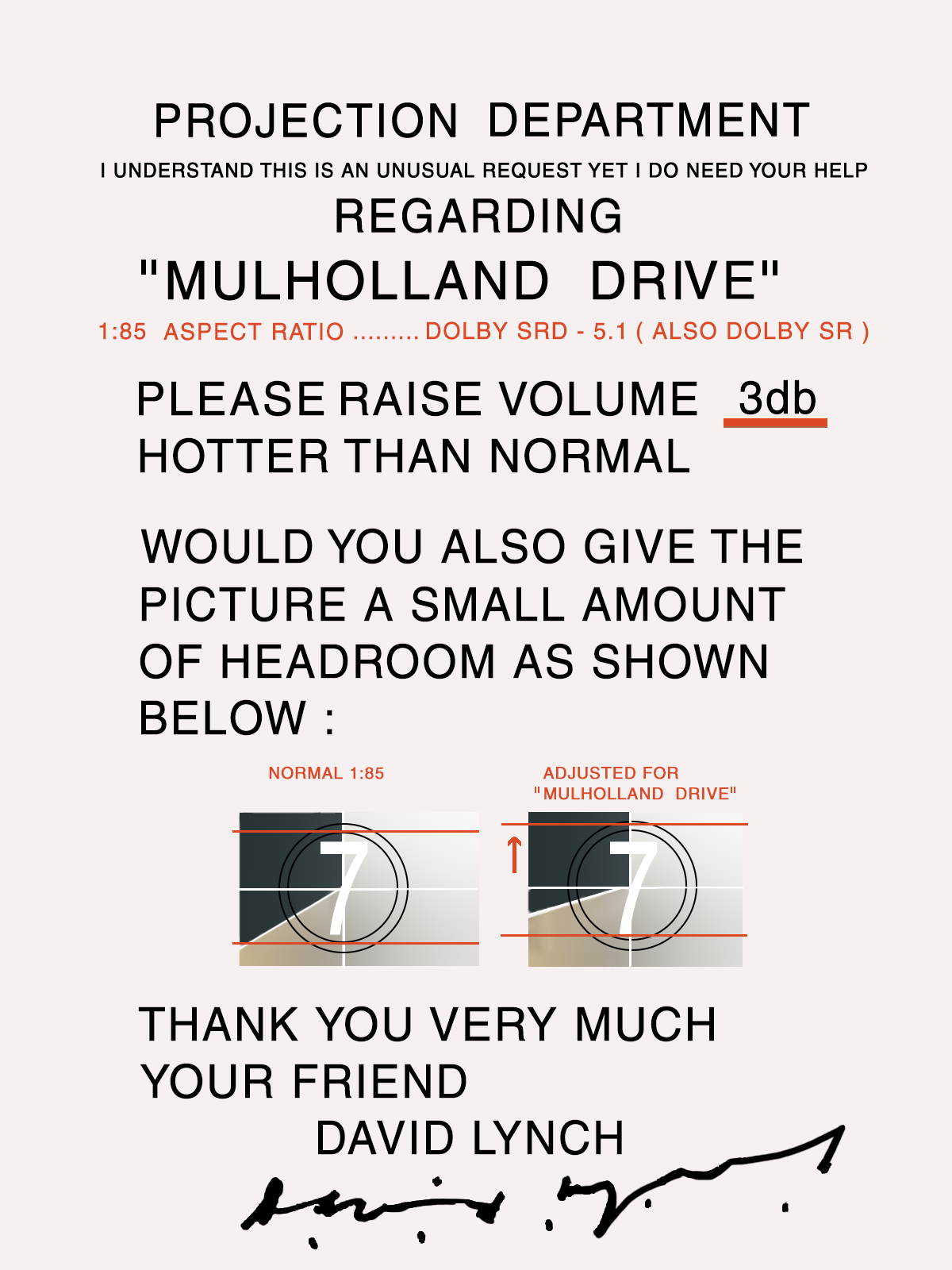
This card (above) from David Lynch came with every print of Mulholland Drive that was sent out to theaters. “I understand this is an unusual request yet I do need your help,” he writes. Lynch asks that the volume be raised 3db and that the image be given a tad more headroom.
John Neff, in a post on the Facebook Lynchland group, explained the card: “The volume request was because when we heard it in the Director’s Guild Theater for the cast and crew screening, David thought it was too quiet. The picture headroom request was because of the original TV aspect ratio. These concerns have been addressed in all format releases since the original DVD release.”
Mulholland Drive was originally shot, or rather, the first half of the film was shot as a television pilot for ABC, so a 16:9 (1.78:1) aspect ratio was expected. But when the studios passed on the pilot, Lynch finished the film as a standalone feature. Cinemas matt projections at 1.85:1, cutting down on the headroom. (None of this effects the original negative, which is standard 35mm.)
Lynch similarly cares about home viewers. The first director-approved box set of his short films came with a similar, Lynch-created calibration video so you could control the color and the white balance. And one of the reasons fans keep waiting for a proper Blu-Ray release of Lost Highway is that Lynch has yet to oversee a proper transfer. When Kino Lorber released theirs in 2019, Lynch took to Twitter to tell fans to skip it: “Dear Twitter Friends, A Blu-ray of LOST HIGHWAY will be released very soon. It was made from old elements and NOT from a restoration of the original negative. I hope that a version from the restoration of the original negative will happen as soon as possible.”
As far as I know, he has not weighed in on the current problems associated with HDTVs, but Tom Cruise has been taking care of that. And whatever you do, do not watch Mulholland Drive on your iPhone.
Related Content:
Watch an Epic, 4‑Hour Video Essay on the Making & Mythology of David Lynch’s Twin Peaks
David Lynch Explains How Simple Daily Habits Enhance His Creativity
David Lynch Being a Madman for a Relentless 8 Minutes and 30 Seconds
Ted Mills is a freelance writer on the arts who currently hosts the Notes from the Shed podcast and is the producer of KCRW’s Curious Coast. You can also follow him on Twitter at @tedmills, and/or watch his films here.
Read More...The CIA Has Declassified 2,780 Pages of UFO-Related Documents, and They’re Now Free to Download
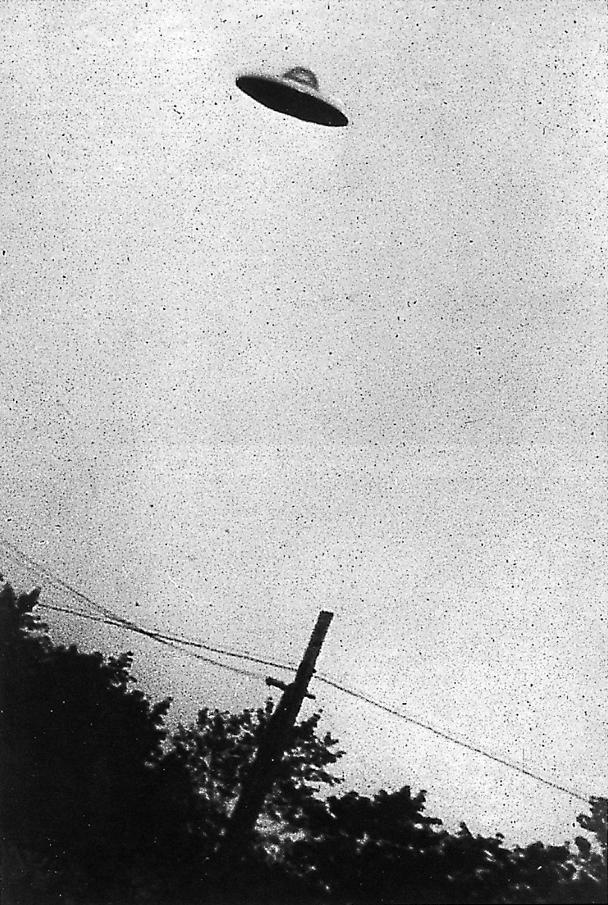
Everybody knows that UFO stands for “unidentified flying object.” Coined by the United States Air Force in 1953, the term has come to stand for a wide range of phenomena that suggest we’ve been contacted by alien civilizations — and in fact has even spawned the field of ufology, dedicated to the investigation of such phenomena. But times change, and with them the approved terminology. These days the U.S. government seems to prefer the abbreviation UAP, which stands for “unidentified aerial phenomenon.” Those three words may sound more precisely descriptive, but they also provide some distance from the decades of not entirely desirable cultural associations built up around the concept of the UFO.
Yet this is hardly a bad time to be a ufologist. “Buried in the latest federal omnibus spending bill signed into law on December 27, 2020 — notable for its inclusion of coronavirus relief — is a mandate that may bring UFO watchers one step closer to finding out whether the government has been watching the skies,” writes Mental Floss’ Jake Rossen.
That same site’s Ellen Gutoskey followed up with an announcement that the CIA’s entire collection of declassified UFO documents is now available to download. You can do so at The Black Vault, a clearing house for UFO related-information run by ufologist John Greenewald Jr. These documents come to 2,780 pages in total, the release of which necessitated the filing of more than 10,000 Freedom of Information Act reports.
Samir Ferdowsi at Vice’s Motherboard quotes Greenewald describing the process as “like pulling teeth,” with results more impressive in quantity than quality. “The CIA has made it INCREDIBLY difficult to use their records in a reasonable manner,” Greenewals writes. “They offer a format that is very outdated (multi page .tif) and offer text file outputs, largely unusable,” all of which “makes it very difficult for people to see the documents, and use them, for any research purpose.” He’s thus also made available a version of the CIA’s declassified UFO documents converted into 713 PDFs. The Black Vault advises downloaders to bear in mind that “many of these documents are poorly photocopied, so the computer can only ‘see’ so much to convert for searching.”
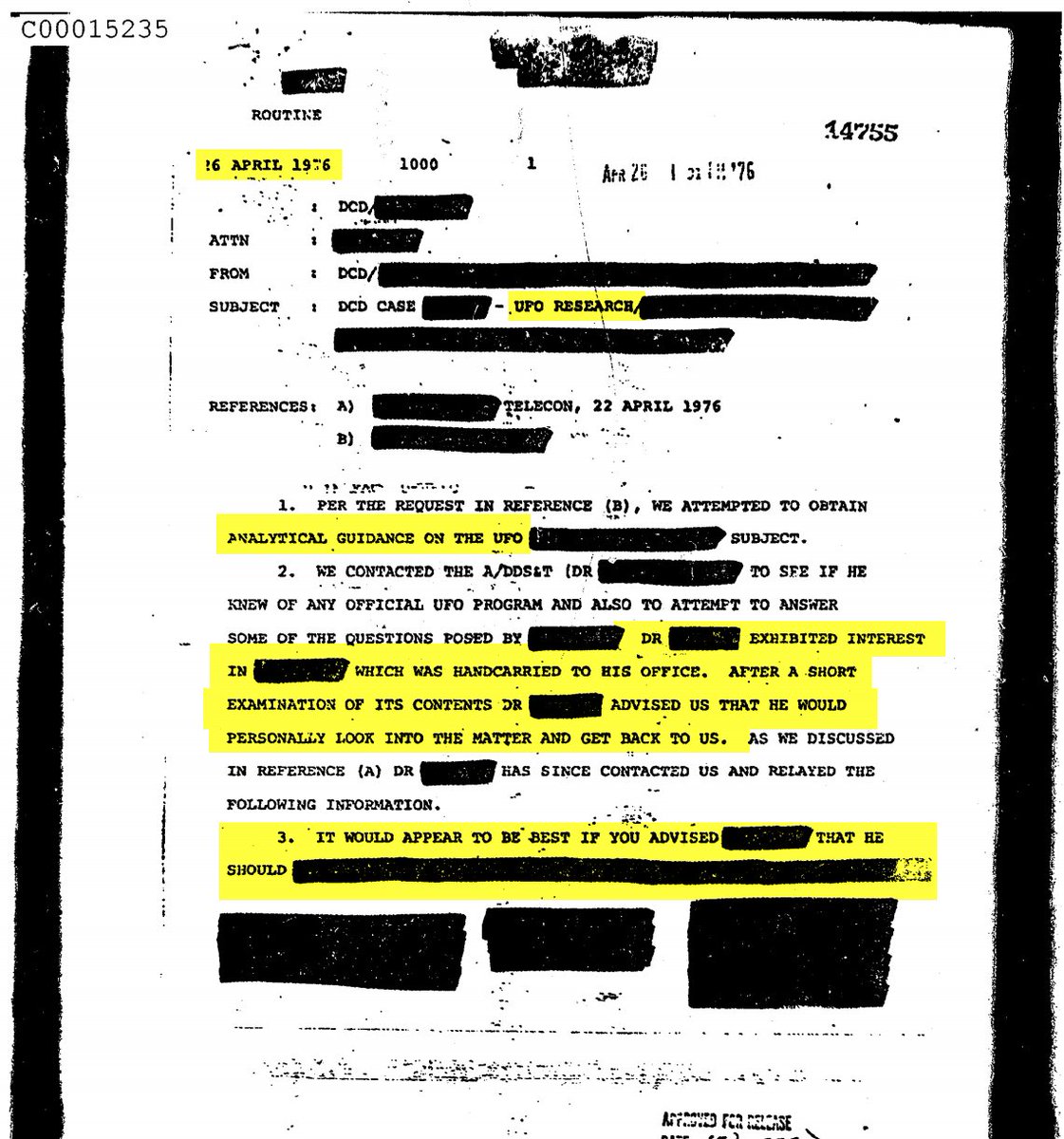
But even with these difficulties, UFO enthusiasts have already turned up material of interest: “From a dispute with a Bosnian fugitive with alleged E.T. contact to mysterious midnight explosions in a small Russian town, the reports definitely take readers for a wild ride,” writes Ferdowsi. “One of the most interesting documents in the drop, Greenewald said, involved the Assistant Deputy Director for Science & Technology being hand-delivered some piece of information on a UFO in the 1970s.” This document, like most of the others, comes with many parts blacked out, but as Greenewald recently tweeted, “I have an open ‘Mandatory Declassification Review’ request to HOPEFULLY get some of these redactions lifted, so we can see what was hand delivered, and what his advice may be.” Ufology demands a great deal of curiosity, but an even greater deal of patience. Enter the Black Vault here.
Related Content:
The Appeal of UFO Narratives: Investigative Journalist Paul Beban Visits Pretty Much Pop #14
Richard Feynman: The Likelihood of Flying Saucers
Carl Jung’s Fascinating 1957 Letter on UFOs
Based in Seoul, Colin Marshall writes and broadcasts on cities, language, and culture. His projects include the Substack newsletter Books on Cities, the book The Stateless City: a Walk through 21st-Century Los Angeles and the video series The City in Cinema. Follow him on Twitter at @colinmarshall, on Facebook, or on Instagram.
Read More...Support Us
We're hoping to rely on loyal readers, rather than erratic ads. Please click the Donate button and support Open Culture. You can use Paypal, Venmo, Patreon, even Crypto! We thank you!

About Us

Open Culture scours the web for the best educational media. We find the free courses and audio books you need, the language lessons & educational videos you want, and plenty of enlightenment in between.
Advertise With Us
FREE UPDATES!
GET OUR DAILY EMAIL
Get the best cultural and educational resources on the web curated for you in a daily email. We never spam. Unsubscribe at any time.
FOLLOW ON SOCIAL MEDIA
Open Culture editor Dan Colman scours the web for the best educational media. He finds the free courses and audio books you need, the language lessons & movies you want, and plenty of enlightenment in between.
Advertise With Us

