Discover the Cyanometer, the Device Invented in 1789 Just to Measure the Blueness of the Sky
English astronomer and physicist James Jeans’ 1931 essay “Why the Sky is Blue” has become a classic of concise expository writing since it was first published in a series of talks. In only four paragraphs and one strikingly detailed, yet simple analogy, Jeans gave millions of students a grasp of celestial blueness in prose that does not substitute nature’s poetry for scientific jargon and diagrams.
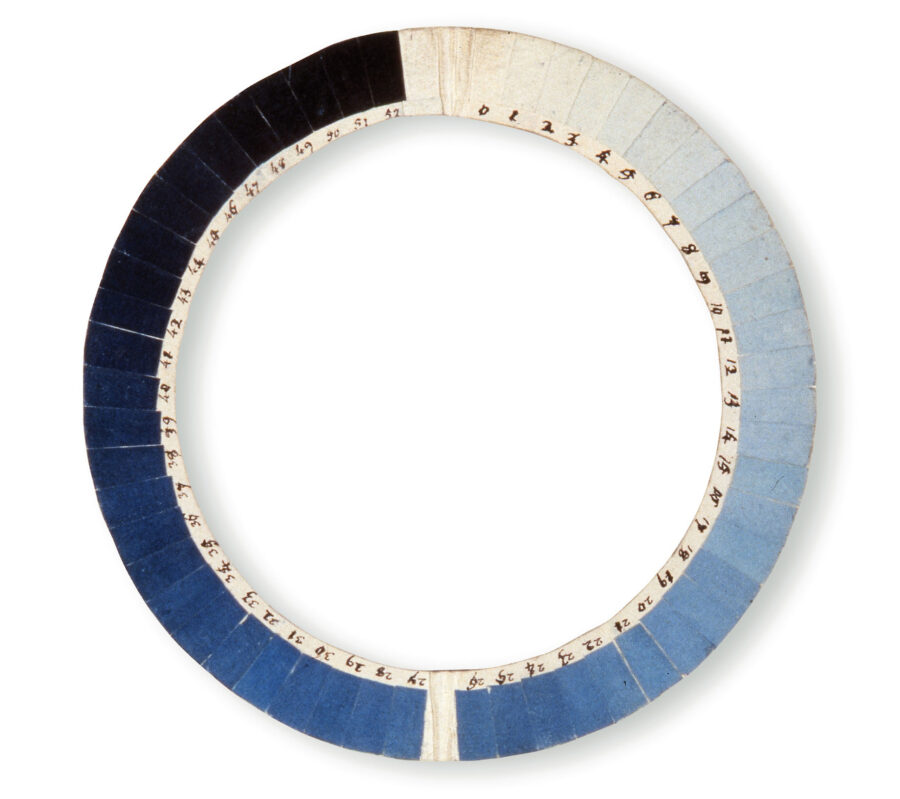
Over a hundred years earlier, another scientist created a similarly poetic device; in this case, one which attempted to depict how the sky is blue. Swiss physicist Horace Bénédict de Saussure’s 1789 Cyanometer, “a circle of paper swatches dyed in increasingly deep blues, shading from white to black,” Sarah Laskow writes at Atlas Obscura, “included 52 blues… in its most advanced iteration,” intended to show “how the color of the sky changed with elevation.”
Saussure’s fascination with the blueness of the sky began when he was a young student and traveled to the base of Mont Blanc. Overawed by the summit, he dreamt of climbing it, but instead used his family’s wealth to offer a reward to the first person who could. Twenty-seven years later, Saussure himself would ascend to the top, in 1786, carrying with him “pieces of paper colored different shades of blue, to hold up against the sky and match its color.”
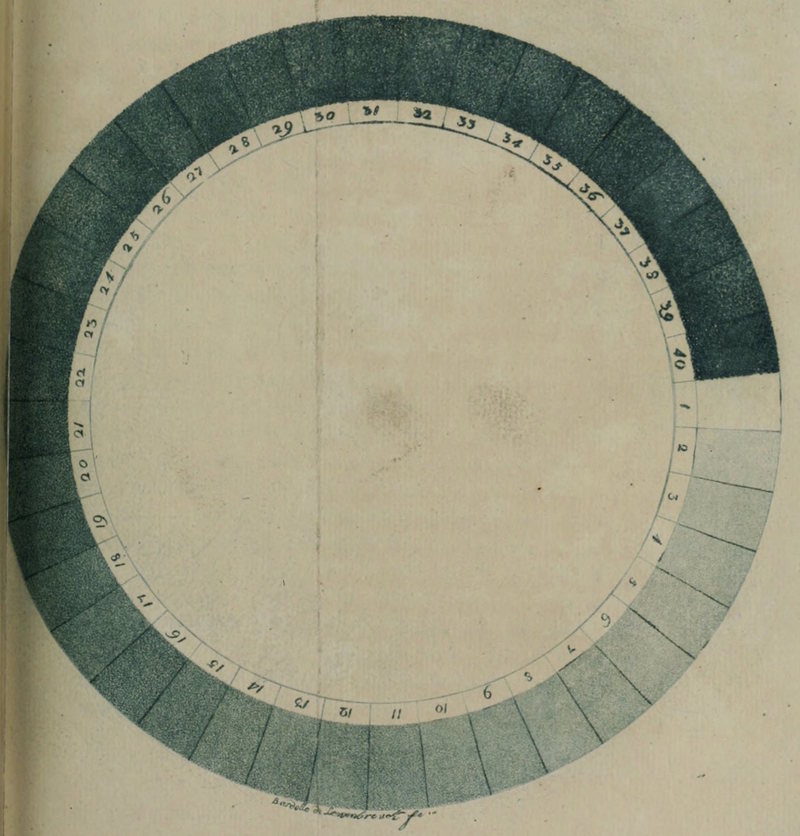
Saussure was taken with a phenomenon reported by mountaineers: as one climbs higher, the sky turns a deeper shade of blue. He began to formulate a hypothesis, the Royal Society of Chemistry Explains:
Armed with his tools and a small chemistry set, he trekked round the valleys and beyond. As his trips carried him ever higher, he puzzled about the colour of the sky. Local legend had it that if one climbed high enough it turned black and one would see, or even fall into, the void — such terrors kept ordinary men away from the peaks. But to Saussure, the blue colour was an optical effect. And because on some days the blue of the sky faded imperceptibly into the white of the clouds, Saussure concluded that the colour must indicate its moisture content.
At the top of Mont Blanc, the physicist measured what he deemed “a blue of the 39th degree.” The number meant little to anyone but him. “Upon its invention, the cyanometer rather quickly fell into disuse,” as Maria Gonzalez de Leon points out. “After all, very little scientific information was given.”
The tool did, however, accompany the famed geographer Alexander von Humboldt across the Atlantic, “to the Caribbean, the Canary Islands, and South America,” writes Laskow, where Humboldt “set a new record, at the 46th degree of blue, for the darkest sky ever measured” on the summit of the Andean mountain Chimborazo. This would be one of the only notable uses of the poetic device. “When the true cause of the sky’s blueness, the scattering of light, was discovered decades later, in the 1860s, Saussure’s circle of blue had already fallen into obscurity.”
via MessyNessy/Colossal
Related Content:
A 900-Page Pre-Pantone Guide to Color from 1692: A Complete Digital Scan
The Vibrant Color Wheels Designed by Goethe, Newton & Other Theorists of Color (1665–1810)
Josh Jones is a writer and musician based in Durham, NC. Follow him at @jdmagness
Read More...Pop Songs with Narrative: Pretty Much Pop (#69) Discusses Tunes Ranging from Bob Dylan’s “Hurricane” to “The Pina Colada Song” with Songwriter/Author Rod Picott
Plenty of songs purport to tell stories, and the narrative ballad of course has a long enough history that the two forms certainly aren’t alien. But how do our listening practices conditioned by pop music jibe with recognizing and understanding narrative?
Singer/songwriter and short story author Rod Picott joins your hosts Mark Linsenmayer, Erica Spyres, and Brian Hirt to talk about classics by writers like Bob Dylan and Johnny Cash, formative nightmares like “Leader of the Pack” and “Escape (The Pina Colada Song), borderline cases like “Bohemian Rhapsody,” and more. We also consider how this form relates to musical theater, music videos, soundtracks, and commercials.
We tried to stick to popular songs, but most of us are pretty old. You can listen and read the lyrics if you’re not following:
- “Mack the Knife” by Bobby Darin
- “The Long Black Veil” by Johnny Cash
- “Coward of the Country” by Kenny Rogers
- “Leader of the Pack” by The Shangri-Las
- “Bohemian Rhapsody” by Queen
- “Hurricane” by Bob Dylan
- “Scenes from an Italian Restaurant” by Billy Joel
- “Escape (The Pina Colada Song)” by Rupert Holmes (Watch him on Burt Sugarman’s Midnight Special. Yes, there was a Taco Bell commercial that used this song.)
- “Paradise by the Dashboard Light” by Meat Loaf (written by Jim Steinman). Read Tim Quirk’s extensive analysis of this disturbing song.
- “Famous Blue Raincoat” by Leonard Cohen
- “Jack and Diane” by John Cougar Mellencamp
- “Glory Days” by Bruce Springsteen
- “Fortunate Son” by Creedence Clearwater Revival
- “Tiger Tom Dixon’s Blues” by Rod Picott
Why these songs? Well, we found a few lists online:
- “Inventory: 26 Songs That are Just as Good as Short Stories” from the AV Club
- “15 Songs That Tell Better Stories Than Your Favorite Novel” by Josue Brocca
- “168 Favorite Pop, Rock, and Country Songs That Tell a Story” from FlourishAnyway
Hear Mark interview Rod on Nakedly Examined Music. Learn more at rodpicott.com.
Hear more of this podcast at prettymuchpop.com. This episode includes bonus discussion you can access by supporting the podcast at patreon.com/prettymuchpop. This time, an update on Rod’s music plus political discussion and more.
This podcast is part of the Partially Examined Life podcast network.
Pretty Much Pop: A Culture Podcast is the first podcast curated by Open Culture. Browse all Pretty Much Pop posts.
Read More...How Soy Sauce Has Been Made in Japan for Over 220 Years: An Inside View
Soy sauce has figured into the cuisine of east Asia for more than two millennia. By that standard, the two-century-old Fueki Shoyu Brewing hasn’t been in the game long. But in running the operation today, Masatsugu Fueki can hardly be accused of failing to uphold tradition: he adheres to just the same practices for making soy sauce (shoyu, in Japanese) as the company’s founders did back in 1879. You can see the entire process in the Eater video above, shot at the Fueki factory in Saitama Prefecture, just northwest of Tokyo. Fueki himself guides the tour, explaining first the sheer simplicity of the ingredients — soybeans, flour, and salt — and then the intricate biological interactions between them that must be properly managed if the result is to possess a suitably rich umami flavor.
That we all know what umami is today owes in part to the propagation of soy sauce across the world. One of the “five basic flavors,” this distinctive savoriness manifests in certain fish, cheeses, tomatoes, and mushrooms, but if you need a quick shot of umami, you reach for the soy sauce. In bottles small and large, it had already become a common product in the United States by the time I was growing up there in the 1980s and 90s.
It must be said, however, that Americans then still had some odd ways of using it: the now-acknowledged Western faux pas, for instance, of liberally drizzling the stuff over rice. But wider awareness of soy sauce has led to a wider understanding of its proper place in food, and also of what sets the best apart from the mediocre — as well as a curiosity about what it takes to make the best.
Fueki and his workers take pains every step of the way, from steaming the soybeans to decomposing the wheat with a mold called koji to heating the raw soy sauce in tanks before bottling. But the key is the kioke, a large wooden fermentation barrel, the oldest of which at Fueki Shoyu Brewing goes back 150 years. Today, Fueki explains, fewer that 50 craftsmen in all of Japan know how to make them: hence the launch of the in-house Kioke Project, a series of workshops meant to revitalize the craft. As he climbs down into an empty kioke, Fueki describes it as “filled with invisible yeast fungus that’s unique to our place” — far from a contaminant, “the most important element, or treasure and our heart.” The care and sensitivity required, and indeed the industrial techniques themselves, aren’t so different from those involved in the making of fine wines. But it surely takes a palate as experienced as Fueki’s to taste “chocolate, vanilla, coffee, rose, hyacinth” in the final product.
Related Content:
Short Fascinating Film Shows How Japanese Soy Sauce Has Been Made for the Past 750 years
How Japanese Things Are Made in 309 Videos: Bamboo Tea Whisks, Hina Dolls, Steel Balls & More
Cookpad, the Largest Recipe Site in Japan, Launches New Site in English
20 Mesmerizing Videos of Japanese Artisans Creating Traditional Handicrafts
The Right and Wrong Way to Eat Sushi: A Primer
Based in Seoul, Colin Marshall writes and broadcasts on cities, language, and culture. His projects include the Substack newsletter Books on Cities, the book The Stateless City: a Walk through 21st-Century Los Angeles and the video series The City in Cinema. Follow him on Twitter at @colinmarshall, on Facebook, or on Instagram.
Read More...John Waters Gives Art Collection to The Baltimore Museum Of Art in Exchange for Getting Its Bathrooms Named After Him
It’s not unusual for an institution to recognize a major benefactor’s generosity by naming something in their honor — a wing, an atrium, a library, a gymnasium, a concert hall…
But bathrooms?
It’s a fitting tribute for the Pope of Trash, filmmaker John Waters.
So fitting that he himself suggested it when donating 372 prints, paintings, and photographs from his personal collection to the Baltimore Museum Of Art.
With Harvard, the University of Pennsylvania, and the University of Colorado at Boulder, New York City’s New Museum of Contemporary Art and famed downtown performance venue Dixon Place all boasting restrooms that double as temples to philanthropy, Waters is not the first donor to be lionized in latrine form…
But he is surely the most famous, thanks to a career that spans six decades, includes numerous books and exhibitions of his photography and sculptures, in addition to his infamous cult films.
Waters got his start as an art collector at the age of 12: he spent $2 on a Joan Miró poster in the Baltimore Museum’s gift shop:
After taking it home and hanging it on my bedroom wall at my parents’ house, I realized from the hostile reaction of my neighborhood playmates that art could provoke, shock, and cause trouble. I became a collector for life. It’s only fitting that the fruits of my 60-year search for new art that could startle, antagonize, and infuriate even me, ends up where it all began—in my hometown museum.
Museum director Christopher Bedford calls Waters a “man of extraordinary refinement” as well as “a local treasure.”
Curator Asma Naeem adds that Waters’ donation, in addition to being one of the largest gifts of art in recent history, is also one of the “most personal and individualized, showing the true stamp of the donor’s taste, eye, and predilections.”
Among the 125 artists represented are Mike Kelley, Cindy Sherman, Roy Lichtenstein, Diane Arbus, Nan Goldin, Cy Twombly, Andy Warhol, and Waters himself. (The museum hosted a retrospective of his visual art two years ago.)
Waters is personally acquainted with many of the artists in his collection, and has a strong preference for early work. “They were never blue-chip artists,” he told The New York Times. “They became that later.”
In an interview with the CBC’s Carol Off, Waters reflected that he loves art that inspires outrage:
…because I’m in on it. You finally learn to see differently if you like art. And it’s a secret club. It’s like a biker gang where you learn a special language, you have to dress a certain way. I love all the ridiculous elitism about the art world. I think it’s hilarious.
In addition to the two bathrooms in the East Lobby, a rotunda in the European art galleries will also bear Waters’ name.
The museum has pledged to never deaccession the works in the collection, and Waters speculates that it’s only a matter of time until a gender-neutral bathroom bearing his name will also be made available to patrons.
“I loved going [to the BMA],” he told Baltimore Fishbowl:
When I was a kid, that was a huge world that I was turned onto. Thank God my parents took me.
Related Content:
John Waters Designs a Witty Poster for the New York Film Festival
John Waters’ RISD Graduation Speech: Real Wealth is Life without A*Holes
Ayun Halliday is an author, illustrator, theater maker and Chief Primatologist of the East Village Inky zine. Follow her @AyunHalliday.
Read More...Experience a Video Painting of Brian Eno’s Thursday Afternoon That Has Soothed & Relaxed Millions of People
Brian Eno may not have invented ambient music, but he did give it a name. What better to call an album like his 1978 Music for Airports, whose slowly shifting pieces forego not just melody but all then-accepted methods of composition and performance? The result, as its title suggests, is meant not to occupy the intention of the listener but to color the atmosphere of a space. This marked one evolutionary step for an idea Eno first essayed in 1975’s Discreet Music, issued on his own label Obscure Records in an era when much of the music people listened to was anything but discreet. Recording technology first made ambient music possible; by the mid-1980s, video technology had developed to the point that it could possess a visual dimension as well.
Just as Eno’s ambient music wasn’t made for listening, Eno’s “video paintings,” as he called them, weren’t made for viewing. 1981’s Mistaken Memories of Medieval Manhattan, previously featured here on Open Culture, captures the urban landscape outside from Eno’s New York window — ironically, with a portrait orientation, so that any TV displaying it had to be turned on its side.
Thursday Afternoon, the next in the series, looks not to the built environment but that other traditional subject of painting, the female form: specifically that of Eno’s friend, photographer Christine Alicino. Here video making possible something truly new, with no artistic connection to, as Eno put it, “Sting’s new rock video” or “boring, grimy ‘Video Art.’ ”
But just like a Hollywood movie, Thursday Afternoon had an eponymous soundtrack album. Released in 1985, it cut the 80-minute video painting’s ambient score down to an unbroken track of nearly 61 minutes, a length made possible by the recently introduced Compact Disc. “Played” on an acoustic piano and synthesizers, the music shifts subtly in texture throughout the hour, creating a sonic environment that many have found highly congenial for working, thinking, and relaxing. I myself have listened to it hundreds of times over the past twenty years, and in the form of a Youtube video painting made by fan Jonathan Jolly, it’s racked up more than four million views. The color-treated time-lapse footage of passing clouds fits right in with the spirit of the music, and it certainly seems to do the trick for the video’s commenters, grateful as they are for reduced anxieties, recovered memories, increased focus, and even altered consciousness.
Related Content:
A Six-Hour Time-Stretched Version of Brian Eno’s Music For Airports: Meditate, Relax, Study
Watch Brian Eno’s “Video Paintings,” Where 1980s TV Technology Meets Visual Art
Brian Eno Explains the Loss of Humanity in Modern Music
Brian Eno on Creating Music and Art As Imaginary Landscapes (1989)
The “True” Story Of How Brian Eno Invented Ambient Music
Based in Seoul, Colin Marshall writes and broadcasts on cities, language, and culture. His projects include the Substack newsletter Books on Cities, the book The Stateless City: a Walk through 21st-Century Los Angeles and the video series The City in Cinema. Follow him on Twitter at @colinmarshall, on Facebook, or on Instagram.
Read More...Watch the Making of Japanese Woodblock Prints, from Start to Finish, by a Longtime Tokyo Printmaker
There are a few names anyone interested in Japanese woodblock printing today can’t help but hear sooner or later: Utagawa Hiroshige, Katsushika Hokusai, Kitagawa Utamaro, David Bull. That last, you may have guessed, is not the name of an 18th-century Japanese man. In fact, David Bull still walks among us today, especially if we happen to live in the old Asakusa section of Tokyo, where he keeps his woodblock-print studio Mokuhankan.
Born in England and raised in Canada, Bull discovered the world of ukiyo‑e, those Japanese “pictures of the floating world,” in his late twenties. Just a few years after first trying his hand, without formal training, at making his own prints, he moved to the Japanese capital to dedicate himself to the form. Today, on his personal site and Youtube channel, he offers a wealth of English-language resources on the art and craft of the Japanese woodblock print.
In the video up top, he provides expert commentary on the making of one particular print by a young Mokuhankan printer named Natsuki Suga. The work is broken into ten stages, beginning with the application of the basic orange background color, moving on through the addition of sky blues and tea-field greens (not to mention shadows, shadows, and “more shadows”), all the way through to the final embossing of the title and artist’s name. The result, revealed at the end in a stage-by-stage time lapse, is a vivid and idyllic scene aesthetically balanced between ukiyo‑e tradition and the present-day art styles.
In the video just above, you can see Bull himself provide commentary as he makes a woodblock print of his own — in real time, from start to finish, with no cuts. Originally shot as a live Twitch stream, it shows Bull’s entire process from blank block to completed print, which takes nearly three and a half hours. That may actually seem like a surprisingly short time in which to create a work of art, but then, Bull has been at this for nearly 40 years.
Bull’s experience also comes through in his ability to explain his techniques and tell stories about the Japanese woodblock’s artistic development as well as his own. What may seem like a video of interest only to ukiyo‑e specialists has in fact racked up, as of this writing, more than 1.2 million views on Youtube alone. But then, it isn’t entirely unknown for a soft-spoken artist dedicated to a highly specific form to win a wide audience with his educational productions. “I’m completely certain that Bob Ross hasn’t died,” as one commenter puts it. “He just got a new haircut.”
Related Content:
Enter a Digital Archive of 213,000+ Beautiful Japanese Woodblock Prints
Download 2,500 Beautiful Woodblock Prints and Drawings by Japanese Masters (1600–1915)
Download Hundreds of 19th-Century Japanese Woodblock Prints by Masters of the Tradition
See Classic Japanese Woodblocks Brought Surreally to Life as Animated GIFs
Based in Seoul, Colin Marshall writes and broadcasts on cities, language, and culture. His projects include the Substack newsletter Books on Cities, the book The Stateless City: a Walk through 21st-Century Los Angeles and the video series The City in Cinema. Follow him on Twitter at @colinmarshall, on Facebook, or on Instagram.
Read More...Hear a Rare First Recording of Janis Joplin’s Hit “Me and Bobby McGee,” Written by Kris Kristofferson
“You can’t think of that song without thinking of Janis,” says Kris Kristofferson of Janis Joplin’s raw, bittersweet, posthumously released “Me and Bobby McGee.” Kristofferson, who wrote the song, only heard Joplin’s version after her death, when he returned to California after playing the Isle of Wight in 1970. He met the producer of Joplin’s last album, Pearl, in L.A., who told him to come to the studio “to play me her recording of ‘Bobby McGee.’ And it just blew me away. Just blew me away.” Above, you can hear a rare recording, possibly the first take, and possibly one of the early versions Kristofferson heard in the studio.
Many people have assumed Kristofferson wrote the song for Joplin, but that’s not the case: he didn’t know she was recording it at all. It was written, in 1969, about a woman, Barbara “Bobby” McKee, who worked as a secretary in songwriter Fred Foster’s building. Foster gave Kristofferson the title “Me and Bobby McKee,” Kristofferson misheard the last name, assumed it was a man, and wrote the famous lyrics, inspired not by Barbara but by Federico Fellini’s La Strada, in which Anthony Quinn and Giulietta Masina travel together on a motorcycle as a performing duo. (The Louisiana references come in because Kristofferson was working as a helicopter pilot in the Gulf at the time.)
In La Strada, Quinn “got to the point where he couldn’t put up with [Masina] anymore and left her by the side of the road while she was sleeping,” says Kristofferson. Later, when he finds out she has died, he “goes to a bar and gets in a fight. He’s drunk and ends up howling at the stars on the beach.” In a parallel to this mournful scene, Tom Breihan at Stereogum describes how Kristofferson, after hearing Joplin’s version of the song, “spent the rest of the day walking around Los Angeles, crying. He probably wasn’t alone. A lot of people probably cried when they heard Joplin singing ‘Me and Bobby McGee.’” A lot of people still do.
A long list of famous singers has covered the song, originally recorded by Roger Miller—just about anyone you might name in folk and country. But Joplin “made it her own,” Kristofferson says, and it’s no empty cliché. Written as a country song, Joplin doesn’t quite sing it that way, and she “doesn’t really sing it as blues or psychedelic rock either,” writes Breihan. “Instead, she just lets it rip, her phrasing immediate and instinctive,” howling at the stars like Anthony Quinn. “Joplin might’ve never hitchhiked across the country with anyone named Bobby McGee,” but she “did what great interpreters do.” She made the song “about Janis Joplin, because that’s what Janis Joplin made it.”
Related Content:
Watch Janis Joplin’s Final Interview Get Reborn as an Animated Cartoon
Janis Joplin’s Last TV Performance & Interview: The Dick Cavett Show (1970)
Janis Joplin & Tom Jones Bring the House Down in an Unlikely Duet of “Raise Your Hand” (1969)
Josh Jones is a writer and musician based in Washington, DC. Follow him @jdmagness
Read More...Trips on the World’s Oldest Electric Suspension Railway in 1902 & 2015 Show How a City Changes Over a Century
Today we take a ride on the world’s oldest electric suspension railway—the Wuppertal Schwebebahn in Germany.
Actually, we’ll take two rides, traveling back in time to do so, thanks to YouTuber pwduze, who had a bit of fun trying to match up two videos discovered online for comparison’s sake.
The journey on the left was filmed in 1902, when this miracle of modern engineering was but a year old.
The train passes over a broad road traveled mostly by pedestrians.
Note the absence of cars, traffic lights, and signage, as well as the proliferation of greenery, animals, and space between houses.
The trip on the right was taken much more recently, shortly after the railway began upgrading its fleet to cars with cushioned seats, air conditioning, information displays, LED lighting, increased access for people with disabilities and regenerative brakes.
An extended version at the bottom of this page provides a glimpse of the control panel inside the driver’s booth.
There are some changes visible beyond the windshield, too.
Now, cars, buses, and trucks dominate the road.
A large monument seems to have disappeared at the 2:34 mark, along with the plaza it once occupied.
Fieldstone walls and 19th-century architectural flourishes have been replaced with bland cement.
There’s been a lot of building—and rebuilding. 40% of Wuppertal’s buildings were destroyed by Allied bombing in WWII.
Although Wuppertal is still the greenest city in Germany, with access to public parks and woodland paths never more than a ten-minute walk away, the views across the Wupper river to the right are decidedly less expansive.
As Benjamin Schneider observes in Bloomberg CityLab:
For the Schwebebahn’s first riders at the turn of the 20th century, these vistas along the eight-mile route must have been a revelation. Many of them would have ridden trains and elevators, but the unobstructed, straight-down views from the suspended monorail would have been novel, if not terrifying.
The bridge structures appear to have changed little over the last 120 years, despite several safety upgrades.
Those steampunk silhouettes are a testament to the planning—and expense—that resulted in this unique mass transit system, whose origin story is summarized by Elmar Thyen, head of Schwebebahn’s Corporate Communications and Strategic Marketing:
We had a situation with a very rich city, and very rich citizens who were eager to be socially active. They said, ‘Which space is publicly owned so we don’t have to go over private land?… It might make sense to have an elevated railway over the river.’
In the end, this is what the merchants wanted. They wanted the emperor to come and say, ‘This is cool, this is innovative: high tech, and still Prussian.’
At present, the suspension railway is only operating on the weekends, with a return to regular service anticipated for August 2021. Face masks are required. Tickets are still just a few bucks.
Related Content:
The Flying Train: A 1902 Film Captures a Futuristic Ride on a Suspended Railway in Germany
Trains and the Brits Who Love Them: Monty Python’s Michael Palin on Great Railway Journeys
Ayun Halliday is an author, illustrator, theater maker and Chief Primatologist of the East Village Inky zine. Follow her @AyunHalliday.
Read More...The Plastic Bag Store: A Pop Art Installation with a Whimsical But Deadly Serious Environmental Message
When COVID-19 exploded in New York City last March, it erased everything on the calendar, including:
All live theater…
The city’s freshly implemented ban on single use plastic bags…
And The Plastic Bag Store, a pop-up installation that was preparing to open in Times Square.
The theaters remain dark, but the ban is back on, as of October 19th. The 7‑month pause was hastened by the pandemic, but also by an unsuccessful lawsuit brought by flexible packing manufacturer Poly-Pak Industries.
The Plastic Bag Store was allowed to open, too, albeit in an altered format from the hybrid art installation-adult puppet show creator Robin Frohardt has been working on for several years.
She has long intended for the project’s New York premiere to coincide with the ban.
Not because she hoped to get rich selling bags to citizens accustomed to getting them free with purchase.
There’s nothing to buy in this “store.”
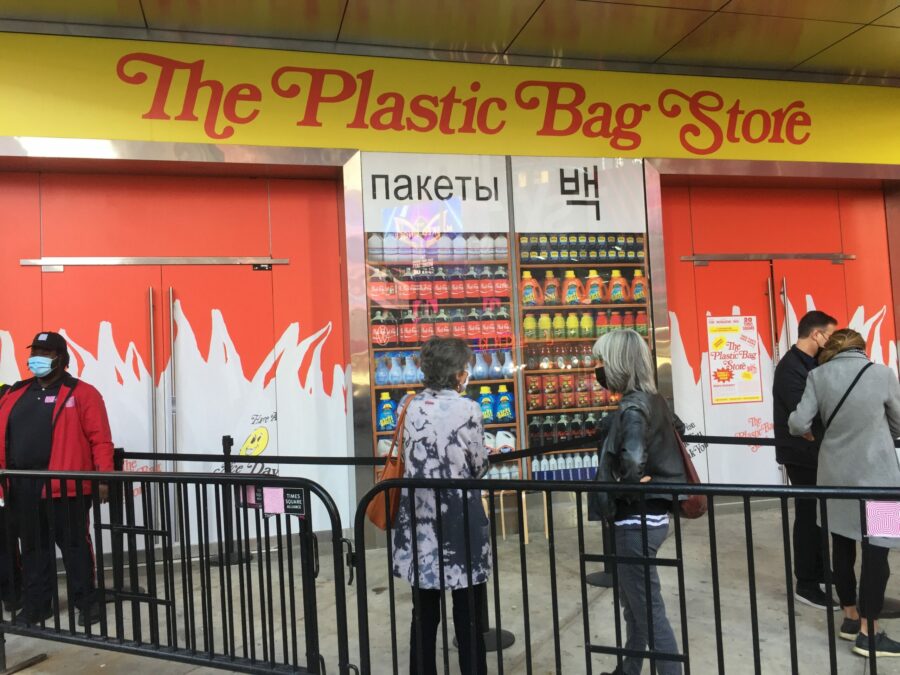

It’s a performance of sorts, but there’s no admission charge.
It’s definitely an education, and a meditation on how history can be doomed to repeat itself, in one way or another.
The Plastic Bag Store just ended its sold out 3‑week run, playing to crowds of ticket holders now capped at 12 audience members per performance. The live elements have morphed into a trio of short films that are projected after ticket holders—customers if you will—have had a chance to look around.
There’s plenty to see.
The Times Square installation space has been kitted out to resemble a roomy bodega stocked with produce, baked goods, sushi rolls on plastic trays, shrink wrapped meat, and other familiar, if slightly skewed items.
Rows of 2 liter soda bottles with iconic red labels are shelved across from the magazine rack. Tubs of Bag & Jerry’s Mint Plastic Chip are in the freezer case.
The original plan allowed for customers to handle the goods as they wanted. Now such interactions are prohibited.
Prior to March, New Yorkers were pretty handsy with produce, unabashedly pressing thumbs into avocados and holding tomatoes and melons to nostrils to determine ripeness.
The pandemic curbed that habit.
No matter. Nothing is ripe in the Plastic Bag Store, where any item not contained in a can or cardboard box has been constructed from the thousands of plastic bags Frohardt has collected over the years.
The facsimiles are shockingly adroit.
“I hunt plastic bags on the streets of New York,” she said in an interview with cultural funder Creative Capital:
I’m a real connoisseur now. There are certain colors I’m really attracted to. Certain bags are harder to find. I definitely look at trash differently than most people. I’m always looking for reds and oranges and greens. Sometimes I find a really interesting color that I haven’t seen before, like salmon or lavender. That’s always exciting.


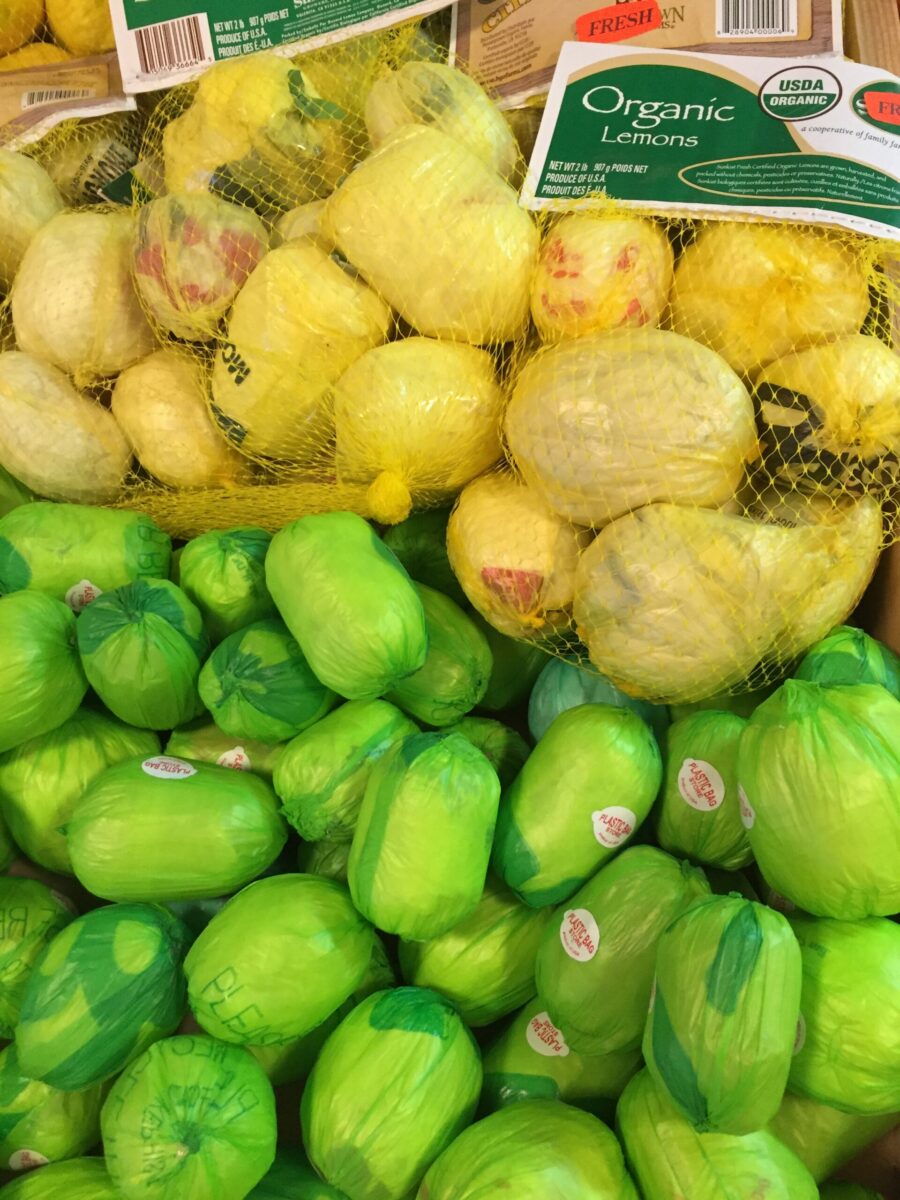
This diversity of materials helps with visual verisimilitude, most impressive in the produce section.
The product labels been richly fortified with satirical commentary.

A family sized package of Yucky Shards appeals to children with sparkles, a rainbow, and a bright eyed cartoon mascot who doesn’t seem to mind the 6‑pack yoke that’s attached itself to its person.
Everything about the “non-organic, triple-washed Spring Green Mix” from “Earthbag Farm” looks familiar, including the plastic container.
Packages of Sometimes feminine pads promise “super protection” that will “literally last forever.”
The cupcakes on display in the bakery section are topped with such festive embellishments as a “disposable” lighter and flossing pick.
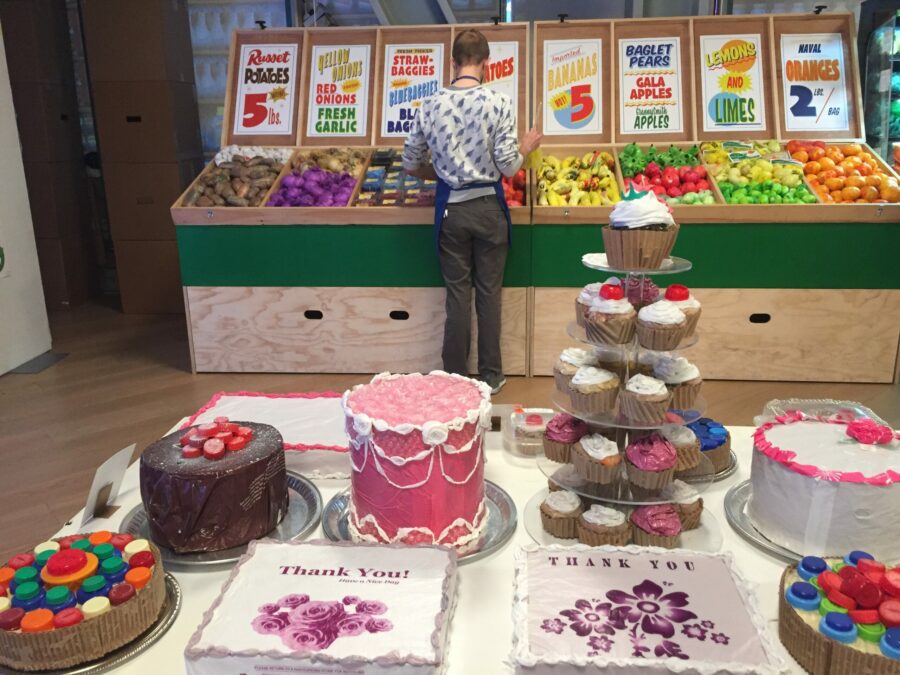
The tone is not scolding but rather comic, as Frohardt uses her spoofs to delight attendees into serious consideration of the “foreverness” of plastic and its environmental impact:
There is great humor to be found in the pitfalls of capitalism, and I find that humor and satire can be powerful tools for social criticism especially with issues that feel too sad and overwhelming to confront directly.
It’s really easy to turn away from images of turtles choking on straws. That stuff comes up in my Instagram feed all the time, and I’m like “Whoa! Swipe on past” because it’s too hard to look at. So what I’m trying to do is to make something that’s fun to look at, and fun to engage with, so you can think about it. Instead of just saying, “That’s fucked up! Ok on to the next thing.”
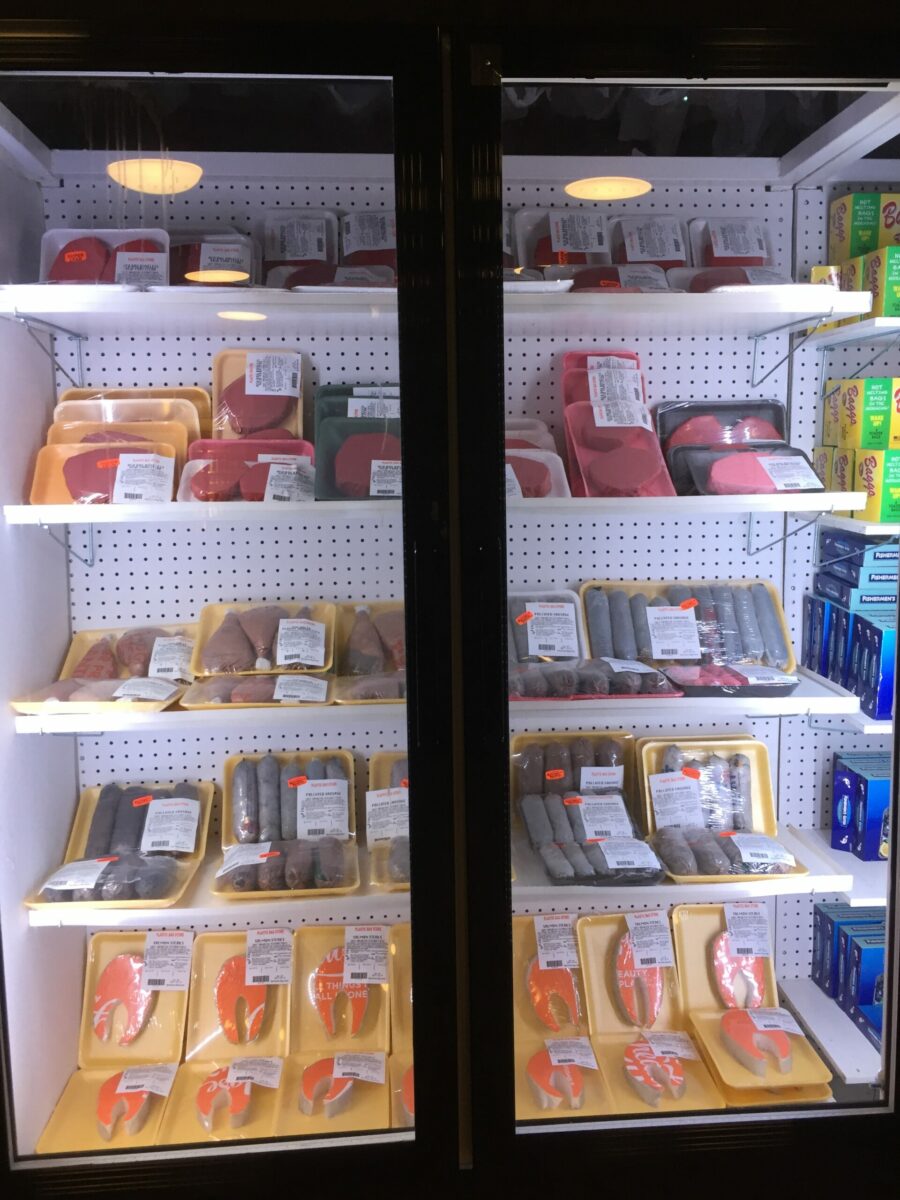
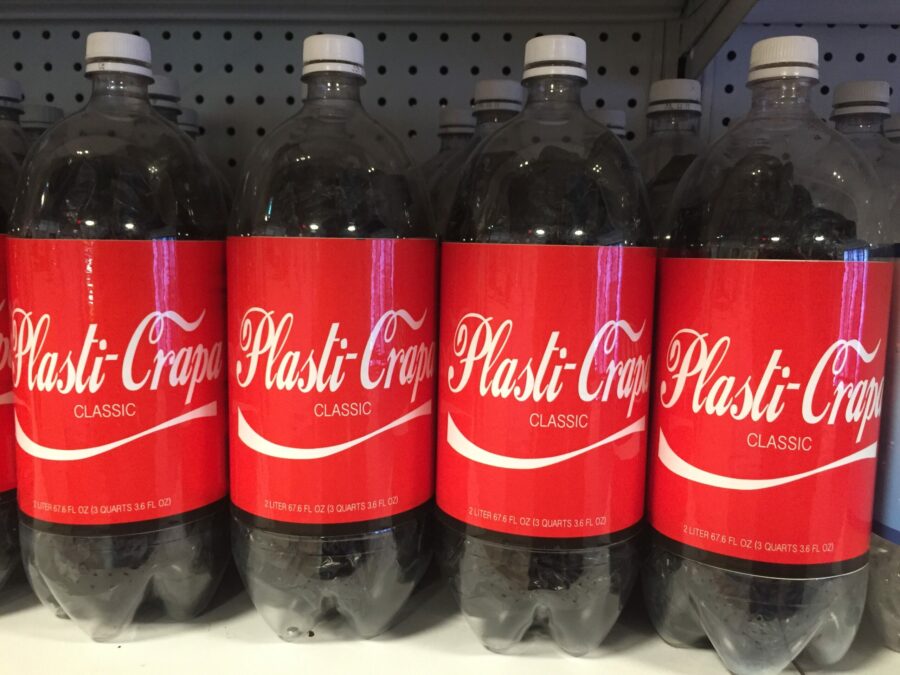

The Plastic Bag Store’s film segments also wield comedy to get their message across.
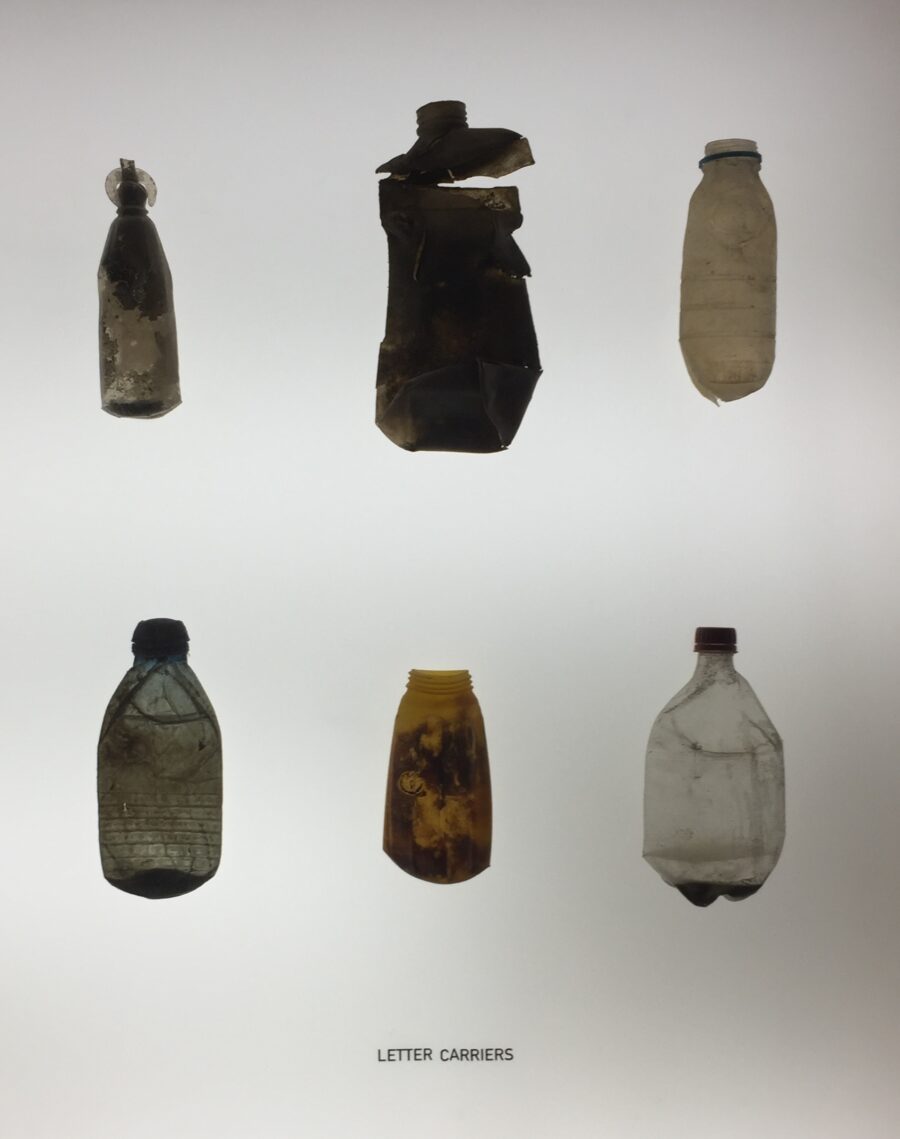
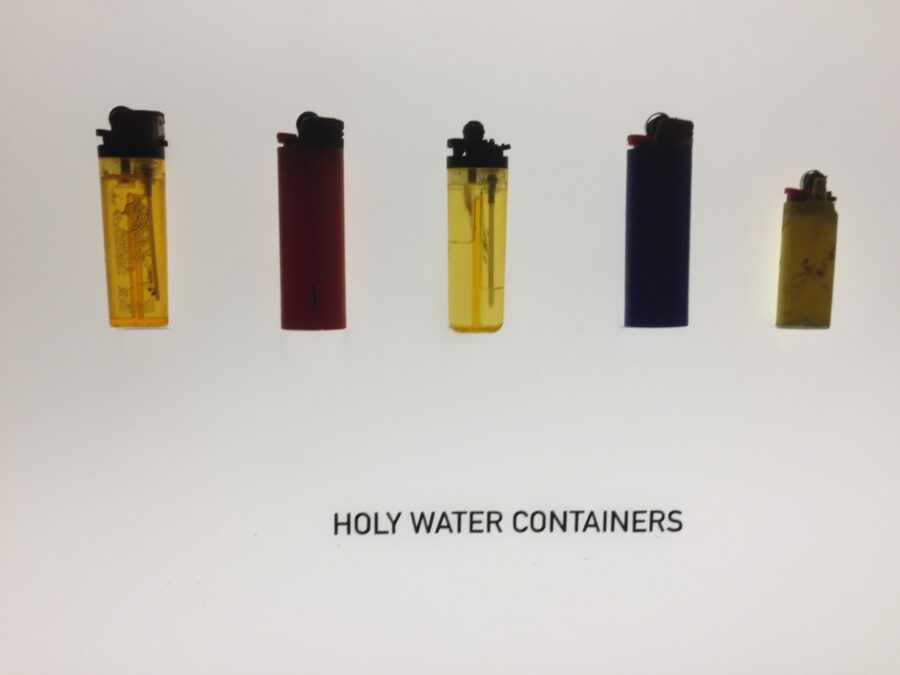
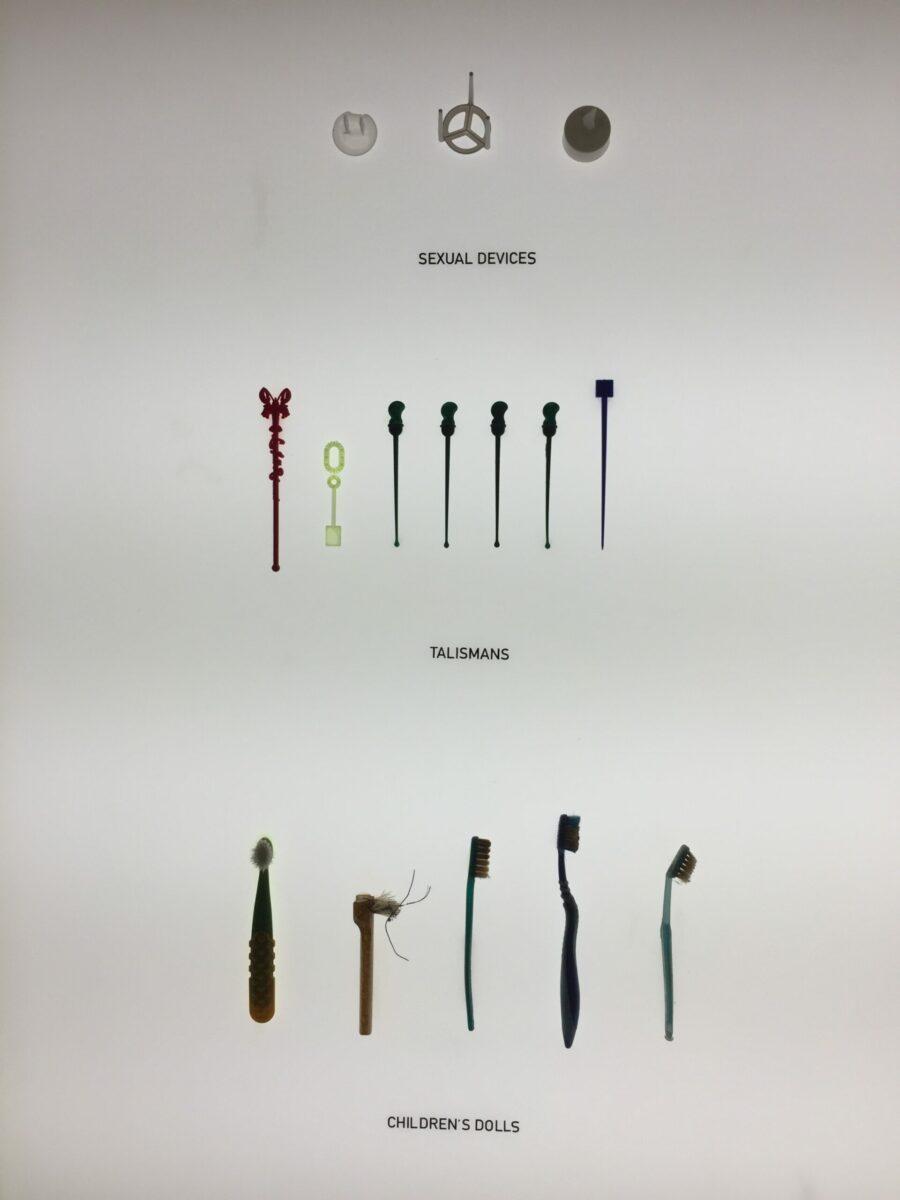
From the stiff shadow puppet Ancient Greeks who are seduced by the self-flattering slogan of a new product, Knowledge Water, which comes in single use vessels, to the recipient of a message in a plastic bottle, discovered so far into the future that he can only admire its craftsmanship, having no clue as to its purpose. (Letter carrier is his best guess. Eventually, other letter carriers are discovered in the freezing equatorial ocean, and housed in a museum alongside other hilariously mislabeled relics of a long dead civilization.)
Related Content:
Take a Virtual Tour of the Mütter Museum and Its Many Anatomically Peculiar Exhibits
Ayun Halliday is an author, illustrator, theater maker and Chief Primatologist of the East Village Inky zine. Follow her @AyunHalliday.
Read More...How Charlie Chaplin Used Groundbreaking Visual Effects to Shoot the Death-Defying Roller Skate Scene in Modern Times (1936)
When I think of roller skates, I first think of 1997’s Boogie Nights and De La Soul’s 1991 hit “A Roller Skating Jam Named ‘Saturdays.’” I date myself to a time not particularly well known as a golden age of roller skating (not the kinds in those references, in any case). The 90s were known as a golden age of visual effects, when Jurassic Park, its sequels, and at the decade’s end, The Matrix, previewed a brave new world of filmmaking to come.…
When I think of roller skates, I do not tend to think of Charlie Chaplin.…
But if you’ve watched Chaplin’s classic 1936 Modern Times recently, you’ll have the film’s famous roller skating scene fresh in your mind. You may or may not know that Chaplin’s seemingly death-defying stunt on skates in that film was itself a pioneering invention of visual effects, in a strikingly contemporary work from Chaplin that, like The Matrix, helped advance the modern technologies it critiqued (and ended up playing an important role in modern philosophy).
The scene in Modern Times takes place in the toy department, on the fourth floor of a department store. Chaplin’s Tramp and Ellen (Paulette Goddard) strap on skates, he cruises around blindfolded, and seems to back right to the edge of a sheer drop where the railing has broken. “The stunt looks so real that it’s impossible to figure out where the effects are at first sight,” Nicolas Ayala writes at Screenrant, “but the technique is actually simpler than it seems. In fact, there is no gap in the floor. It’s a practical effect consisting of a matte painting placed right in front of the camera.”
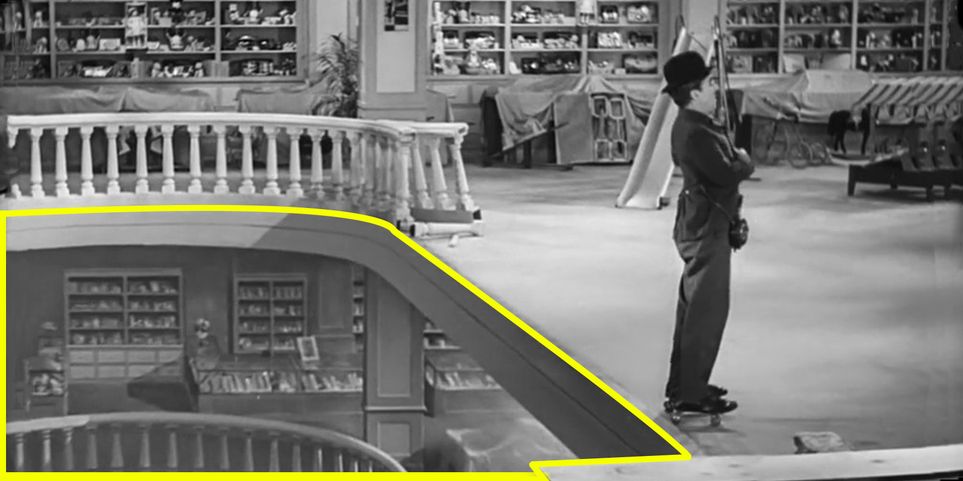
Performed live on set (“with no stunt doubles,” Ayala notes), the scene doesn’t actually show Chaplin in any danger. He performs “on a fully-floored set” with a ledge to help him “discern when to stop, since it was measured to fit exactly with the photorealistic matte painting that was placed on a sheet of glass just a couple feet in front of the lens. This way, the painting would appear to be the precise size of the gap without interfering with Chaplin’s performance.”
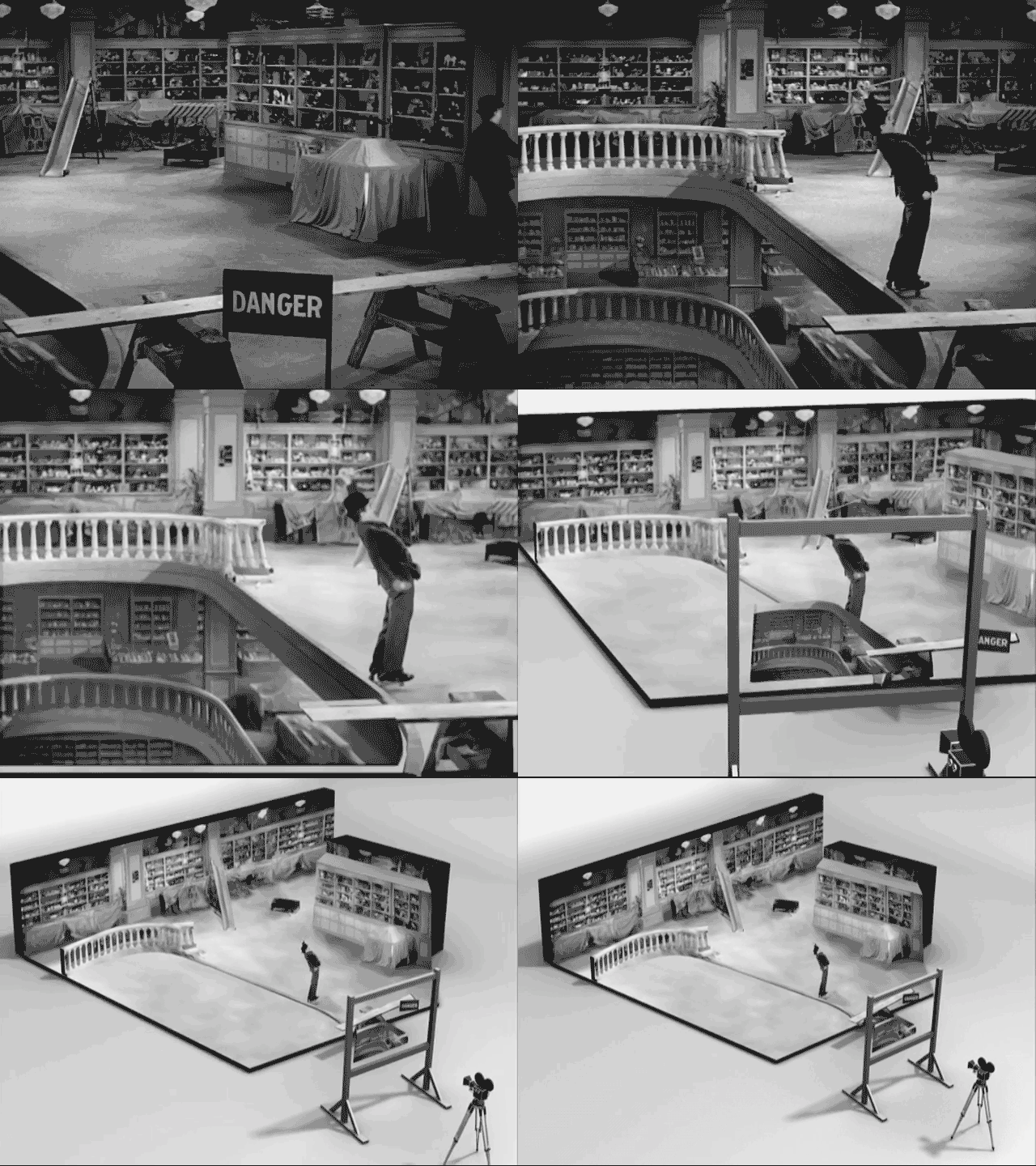
See the matte painting outlined in a still further up, courtesy of Ayala, see the stunt diagrammed in the animation above from Petr Pechar, and learn more about the filming of Modern Times, the Matrix of its day, here.
Related Content:
Charlie Chaplin Does Cocaine and Saves the Day in Modern Times (1936)
Josh Jones is a writer and musician based in Washington, DC. Follow him @jdmagness
Read More...Support Us
We're hoping to rely on loyal readers, rather than erratic ads. Please click the Donate button and support Open Culture. You can use Paypal, Venmo, Patreon, even Crypto! We thank you!

About Us

Open Culture scours the web for the best educational media. We find the free courses and audio books you need, the language lessons & educational videos you want, and plenty of enlightenment in between.
Advertise With Us
FREE UPDATES!
GET OUR DAILY EMAIL
Get the best cultural and educational resources on the web curated for you in a daily email. We never spam. Unsubscribe at any time.
FOLLOW ON SOCIAL MEDIA
Open Culture editor Dan Colman scours the web for the best educational media. He finds the free courses and audio books you need, the language lessons & movies you want, and plenty of enlightenment in between.
Advertise With Us