How the First Rock Concert Ended in Mayhem (Cleveland, 1952)
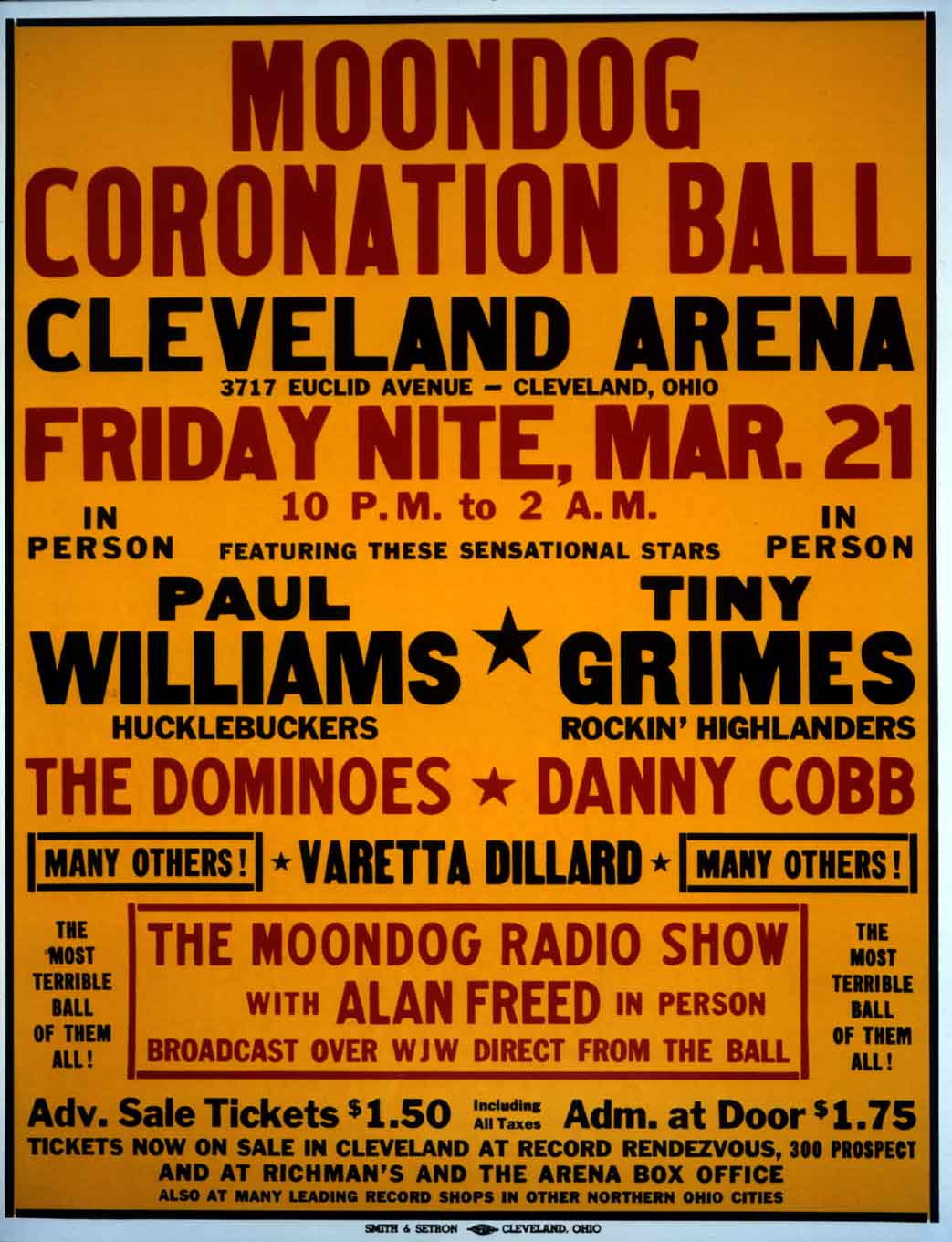
“America has only three cities: New York, San Francisco, and New Orleans. Everywhere else is Cleveland.” That observation tends to be attributed to Tennessee Williams, though it’s become somewhat detached from its source, so deeply does it resonate with a certain experience of life in the United States. But consider this: can every American city claim to be where rock and roll began — or at least the site of the very first rock and roll concert? Cleveland can, thanks to Alan Freed, a famous radio announcer of the nineteen-forties and fifties. The Moondog Coronation Ball he organized in 1952 may have ended in disaster, but it began a pop-cultural era that arguably continues to this day.
Having attained popularity announcing in a variety of radio formats, including jazz and classical music, Freed was awakened to the possibility of what was then known as rhythm and blues by a local record-store owner, Leo Mintz. It was with Mintz’s sponsorship that Freed launched a program on Cleveland’s WJW-AM, for which he cultivated a hepcat persona called “Moondog.” (Some credit the name to an album by Robby Vee and The Vees, and others to the avant-garde street musician Moondog and his eponymous “symphony.”) Starting at midnight, the show broadcast hours of so-called “race music” to not just its already-enthusiastic fan base, but also the young white listeners increasingly intrigued by its captivating, propulsive sounds.
Freed soon commanded enough of an audience to describe himself as “King of the Moondoggers.” When he announced the upcoming Moondog Coronation Ball, a show at Cleveland’s hockey arena featuring sets from such popular acts as Paul Williams and the Hucklebuckers, Tiny Grimes and the Rocking Highlanders (an all-black group whose signature kilts would surely stir up “cultural appropriation” discourse today), Varetta Dillard, and Danny Cobb, the Moondoggers turned out. About 20,000 of them turned out, in fact, twice what the venue could handle. A ticket misprint was to blame, but the damage had been done — or rather, it would be done, when the well-dressed but over-excited crowd stormed the arena and the authorities were called in to shut the show down by force.
In the event, only the first two acts ever took the stage. The planned coronation of the two most popular teenagers in attendance (a holdover from another cultural dimension entirely) never happened. But the spirit of rebelliousness witnessed at this first-ever rock concert was like a genie that couldn’t be put back in its bottle. However square his image, Freed, who popularized the term “rock and roll” as applied to music, was never much of a rule-follower in his professional life. His later implication in the payola bribe scandals of the late fifties sent his career into a tailspin, and his early death followed a few years later. But to judge by re-tellings like the one in the Drunk History video just above, he remains the hero of the story of the Moondog Coronation Ball — and thus a hero of rock and roll history.
Related content:
The Live Music Archive Lets You Stream/Download More Than 250,000 Concert Recordings–for Free
Based in Seoul, Colin Marshall writes and broadcasts on cities, language, and culture. His projects include the Substack newsletter Books on Cities and the book The Stateless City: a Walk through 21st-Century Los Angeles. Follow him on the social network formerly known as Twitter at @colinmarshall.
Read More...How Steven Soderbergh Directs a Scene & Makes It Great
Steven Soderbergh was one of the earliest filmmakers to break out in what’s now called the “Indiewood” movement of the nineteen-nineties. He was early enough, in fact, to have done so in the eighties, with the Palme d’Or-winning Sex, Lies, and Videotape. His subsequent films have been many and varied, even more so than those of his Indiewood peers Spike Lee, Robert Rodriguez, and Quentin Tarantino. Some, like Schizopolis, Bubble, The Girlfriend Experience, and Let Them All Talk, have been more “indie”; others, like, Out of Sight, Erin Brockovich, and the Ocean’s and Magic Mike series, have been more “Hollywood.” But wherever on the one-for-them-and-one-for-me spectrum he’s worked, never has he compromised on his craft.
To illuminate this dedication, Evan Puschak, known on YouTube as the Nerdwriter, breaks down a scene from Soderbergh’s latest picture in the video above. Black Bag, which came out this past March, is a mid-budget thriller, a form that has proven fruitful for the director in recent decades.
It’s proven creatively fruitful, at any rate, if not always financially; already, Soderbergh himself has publicly expressed his disappointment with the movie’s box-office performance. But if audiences have overlooked Black Bag, they haven’t done so due to its shoddy work. In even one minor, transitional scene under two minutes long, Puschak explains, we can identify numerous directorial choices that make everything work effectively.
Examining each of the scene’s eleven shots (a blessedly patient editing rhythm, by today’s standards), Puschak points out Soderbergh’s cuts, framings, camera placements, movements, and focal lengths, explaining the relevance of each to the story playing out. This isn’t just a fanboy’s auteurism: Soderbergh always operates his own camera and edits his own footage, crediting the jobs to pseudonyms. That this practice leaves his movies with a deep authorial stamp, whatever their subject matter or target audience, is obvious; what’s less clear is how he’s managed to keep it up while making a feature every year, on average, since Sex, Lies, and Videotape. If, after all this, you’re somehow not sold on watching Black Bag, just wait for Soderbergh’s next movie — which that most “efficient and creative cinematic problem solver” already finished shooting three months ago.
Related Content:
The Scene That Reveals the Beauty of Classic Hollywood Cinema
Based in Seoul, Colin Marshall writes and broadcasts on cities, language, and culture. His projects include the Substack newsletter Books on Cities and the book The Stateless City: a Walk through 21st-Century Los Angeles. Follow him on the social network formerly known as Twitter at @colinmarshall.
Read More...David Bowie/Nirvana’s “The Man Who Sold The World” Played on the Gayageum, a Korean Instrument from the 6th Century
East meets West, and the Ancient, the Modern. That’s what happens every time Luna Lee plays one of your favorites on the Gayageum, a Korean instrument that dates back to the 6th century. We’ve featured her work in years past (see the Relateds below). Above, watch one of her standout performances—a cover of “The Man Who Sold The World,” the song first written by David Bowie in 1970, then famously performed by Nirvana on MTV Unplugged in 1993. An alternate video features Luna on vocals here. Enjoy!
If you would like to support the mission of Open Culture, consider making a donation to our site. It’s hard to rely 100% on ads, and your contributions will help us continue providing the best free cultural and educational materials to learners everywhere. You can contribute through PayPal, Patreon, and Venmo (@openculture). Thanks!
Related Content:
David Bowie and Klaus Nomi’s Hypnotic Performance on SNL (1979)
Watch Jimi Hendrix’s ‘Voodoo Chile’ Performed on a Gayageum, a Traditional Korean Instrument
Read More...How Charlie Chaplin, Buster Keaton & Harold Lloyd Pulled Off Their Spectacular Stunts During Silent Film’s Golden Age
It can be tempting to view the box office’s domination by visual-effects-laden Hollywood spectacle as a recent phenomenon. And indeed, there have been periods during which that wasn’t the case: the “New Hollywood” that began in the late nineteen sixties, for instance, when the old studio system handed the reins to inventive young guns like Peter Bogdanovich, Francis Ford Coppola, and Martin Scorsese. But lest we forget, that movement met its end in the face of competition from late-1970s blockbusters like Jaws and Star Wars, a new kind of blockbuster that signaled a return to the simple thrills of silent cinema.
Even a century ago, many moviegoers expected two experiences above all: to be wowed, and to be made to laugh. No wonder that era saw visual comedians like Harold Lloyd, Buster Keaton, and Charlie Chaplin become not just the most famous actors in the world, but some of the most famous human beings in the world.
Staying on top required not just serious performative skill, but also equally serious technical ingenuity, as explained in the new Lost in Time video above. It breaks down just how Lloyd, Keaton, and Chaplin pulled off some of their career-defining stunts on film, putting the actual clips alongside CGI reconstructions of the sets as they would have looked during shooting.
When Lloyd hangs from the arms of a clock high above downtown Los Angeles in Safety Last! (1923), he’s really hanging high above downtown Los Angeles — albeit on a set constructed atop a building, shot from a carefully chosen angle. When the entire façade of a house falls around Keaton in Steamboat Bill, Jr. (1928), leaving him standing unharmed in a window frame, the façade actually fell around him — in a precisely choreographed manner, but with only a couple of inches of clearance on each side. When a blindfolded Chaplin skates perilously close to a multistory drop in Modern Times (1936), he’s perfectly safe, the edge of the floor being nothing more than a matte painting: one of those analog technologies of movie magic whose obsolescence is still bemoaned by classic-film enthusiasts, from whom CGI, no matter how expensive, never quite thrills or amuses in the same way.
Related content:
The Art of Creating Special Effects in Silent Movies: Ingenuity Before the Age of CGI
Watch the Only Time Charlie Chaplin & Buster Keaton Performed Together On-Screen (1952)
Charlie Chaplin Does Cocaine and Saves the Day in Modern Times (1936)
Based in Seoul, Colin Marshall writes and broadcasts on cities, language, and culture. His projects include the Substack newsletter Books on Cities and the book The Stateless City: a Walk through 21st-Century Los Angeles. Follow him on the social network formerly known as Twitter at @colinmarshall.
Read More...How a Papal Conclave Works, and Who Might Be the Next Pope
On Tuesday, the cardinals locked themselves into the Sistine Chapel, officially beginning the conclave to elect the 267th pope. First formalized by Pope Gregory X in 1274, the conclave (a word derived from the Latin words cum clave, meaning “with a key”) follows a highly scripted process honed over the past 800 years. How the conclave works, and how it came into being—all of that gets covered in the Religion for Breakfast video above. It’s hosted by the religious studies scholar Dr. Andrew M. Henry.
Below, you can also delve into the more recent history of papal elections. Created by Useful Charts, this video covers every papal conclave since 1958 and includes a prediction for who the next pope will be once the white smoke rises. Who is the next likely pontiff? No spoilers here. You’ll have to watch the video to find out.
If you would like to support the mission of Open Culture, consider making a donation to our site. It’s hard to rely 100% on ads, and your contributions will help us continue providing the best free cultural and educational materials to learners everywhere. You can contribute through PayPal, Patreon, and Venmo (@openculture). Thanks!
Related Content
Take a 3D Virtual Tour of the Sistine Chapel & Explore Michelangelo’s Masterpieces Up Close
Pope Francis Set to Release a Rock/Pop Album: Listen to the First Single
Pope John Paul II Takes Batting Practice in California, 1987
Read More...
Take a 3D Virtual Tour of the Sistine Chapel & Explore Michelangelo’s Masterpieces Up Close
Today, 133 cardinals from around the world enter the conclave to determine the next pope, during which they’ll cast their votes in the Sistine Chapel. Despite being one of the most famous tourist attractions in Europe, the Sistine Chapel still serves as a venue for such important official functions, just as it has since its completion in 1481. When its namesake Pope Sixtus IV commissioned it, he also ordered its walls covered in frescoes by some of the finest artists of that period of the Renaissance, including Sandro Botticelli, Domenico Ghirlandaio, and Cosimo Rosselli. He also made the unusual choice of having the cross-vault ceiling covered by a blue-and-gold painting of the night sky, ably executed by Piermatteo Lauro de’ Manfredi da Amelia.
No longer do the cardinals vote for their next leader under the stars, nor have they for about half a millennium. Even if you’ve never set foot in the Sistine Chapel, you surely know it as the building whose ceiling was painted by Michelangelo, lying flat on a scaffold all the while (a pleasing but highly doubtful image in the collective cultural memory).
In fact, that master of Renaissance masters didn’t touch his brush to the place until 1508. He’d been brought in by a later pope, Julius II, after having first resisted the commission, insisting that he was a sculptor first, not a painter. Fortunately for Renaissance art enthusiasts, not only did Julius II prevail upon Michelangelo, so, nearly thirty years later, did Paul III, who had him paint over the altar the work that turned out to be the Last Judgment.
In the video at the top of the post, history-and-architecture YouTuber Manuel Bravo (previously featured here on Open Culture for his explanations of historic places like Venice, Pompeii, the Cathedral of Santa Maria del Fiore, and St. Peter’s Basilica, which was also touched by the hand of Michelangelo) narrates a 3D virtual tour of the Sistine Chapel. That format makes it possible to see not only its numerous works of Biblical art, by Michelangelo and a host of other painters besides, from every possible angle, but also the building itself just as it would have looked in eras past, even before Michelangelo made his contribution. The more you understand each individual element, the better you can appreciate this “veritable Divina Commedia of the Renaissance,” as Bravo calls it, when next you can see it in person. That, of course, will only be after the conclave finishes up: in a few hours, or days, or weeks, or maybe — a phenomenon not unexampled in the history of the church — a few years.
Related content:
Michelangelo’s David: The Fascinating Story Behind the Renaissance Marble Creation
A Secret Room with Drawings Attributed to Michelangelo Opens to Visitors in Florence
Michelangelo’s Illustrated Grocery List
Based in Seoul, Colin Marshall writes and broadcasts on cities, language, and culture. His projects include the Substack newsletter Books on Cities and the book The Stateless City: a Walk through 21st-Century Los Angeles. Follow him on the social network formerly known as Twitter at @colinmarshall.
Read More...Was William Shakespeare’s Marriage Closer—and Less Estranged—Than We Thought?: A 17th-Century Letter Changes What We Know About the Bard’s Life.
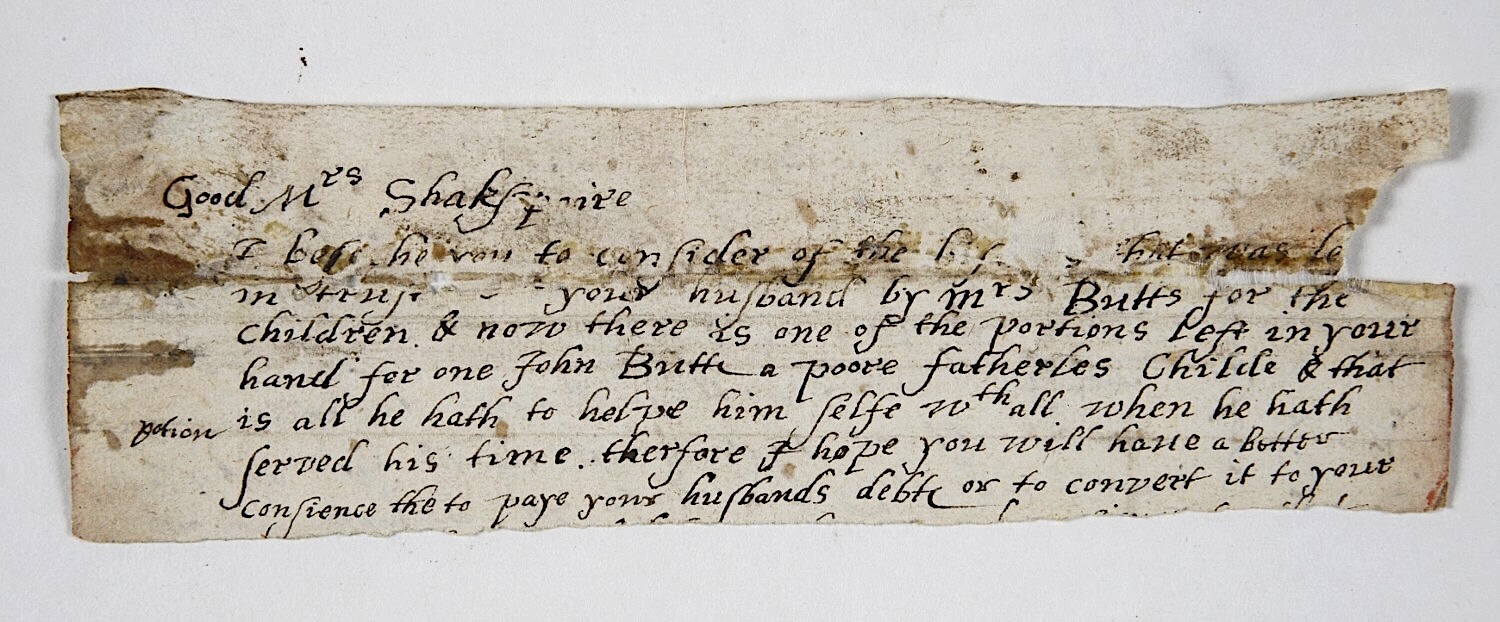
Image via Hereford Cathedral and Hereford Mappa Mundi Trust
At this point, every aspect of William Shakespeare’s life has produced more speculation than any of us could digest in a lifetime. That goes for his professional life, of course, but also his even more scantily documented personal life. As far as his marriage is concerned, the known facts are these: on November 27th, 1582 a marriage license was issued in Worcester to the 18-year-old William Shakespeare and the approximately 26-year-old Anne Hathaway. Six months later came the first of their three children, Susanna. For most of his professional life, William lived in London, while Anne — willed only her husband’s “second-best bed” — remained in his hometown of Stratford-upon-Avon.
According to one common interpretation, the Shakespeares’ was a shotgun wedding avant la lettre, motivated less by romance than expediency. That would certainly explain their apparent choice to live apart, though William’s career would probably have brought him to London anyway, and without a good reason to be in the city, it wasn’t a bad idea to keep the kids out of plague range. (As for his best bed, it would customarily have been reserved for guests.) But according to a new interpretation of an old document by the University of Bristol professor Matthew Steggle, the couple could not only have remained in communication, but also lived together in the capital for a time.
“Hereford Cathedral Library holds a fragmentary seventeenth-century letter addressed to a ‘Mrs Shakspaire,’ concerning her husband’s dealings with a fatherless apprentice,” writes Steggle in his research paper recently published in the journal Shakespeare. “Of the Shakespeares recorded in London, William Shakespeare is the only viable candidate to fit with the letter’s details.” In Steggle’s analysis, it “paints a picture of William and Anne Shakespeare together in London, and living, perhaps around 1599–1603, in Trinity Lane. It further suggests an Anne Shakespeare who is not absent from her husband’s London life, but present and engaged in his financial and social networks.”
The New York Times’ Ephrat Livni quotes Steggle as saying that “this letter, if it belongs to them, offers a glimpse of the Shakespeares together in London, both involved in social networks and business matters, and, on the occasion of this request, presenting a united front against importunate requests to help poor orphans.” This, Livni adds, would “lend some heft to feminist readings of Shakespeare’s life,” as well as to the pop-culture trend of “rethinking the marriage and Hathaway’s role in it.” Each era thus continues to create the Shakespeare for whom it feels the need — and the Mrs. Shakespeare as well.
Related content:
Free Course: A Survey of Shakespeare’s Plays
Why Should We Read William Shakespeare? Four Animated Videos Make the Case
The Only Surviving Script Written by Shakespeare Is Now Online
Did Shakespeare Write Pulp Fiction? (No, But If He Did, It’d Sound Like This)
Did Bach’s Wife Compose Some of “His” Masterpieces? A New Documentary Says Yes
Based in Seoul, Colin Marshall writes and broadcasts on cities, language, and culture. His projects include the Substack newsletter Books on Cities and the book The Stateless City: a Walk through 21st-Century Los Angeles. Follow him on the social network formerly known as Twitter at @colinmarshall.
Read More...Marvin Gaye’s Classic Vocals on ‘I Heard It Through the Grapevine’: The A Cappella Version
It’s hard to believe, but Marvin Gaye’s classic 1967 recording of “I Heard It Through the Grapevine” was originally rejected by his record label.
The song, about a man’s grief over hearing rumors of his lover’s infidelity, was written by the legendary Motown Records producer Norman Whitfield and singer Barrett Strong. Smokey Robinson and the Miracles first recorded the track in 1966, but that version got nixed by Motown founder Berry Gordy during a weekly quality control meeting. Then, Whitfield recorded the song with Gaye in early 1967, but for some reason Gordy didn’t like that version either. So Whitfield changed the lyrics a bit and recorded it with Gladys Knight and the Pips. The fast-tempo arrangement, influenced by Aretha Franklin’s “Respect,” was released as a single in September of 1967 and rose to number one on the Billboard R&B chart.
Gaye’s version might have been forgotten had it not been included in his 1968 album, In the Groove, where it soon became noticed. “The DJs played it so much off the album,” Gordy said later, “that we had to release it as a single.”
Gaye’s recording of the song became a crossover hit. It rose not only to the top of the R&B charts, but also spent seven weeks at the top of the Billboard Pop Singles chart. It was Motown’s biggest-selling single up to that time, and the In the Groove album name was soon changed to I Heard It Through the Grapevine.
Gaye was known for his sweet-sounding tenor voice, which he could modulate from a baritone to a silky high falsetto. During the “Grapevine” sessions, the singer reportedly quarreled with Whitfield over the producer’s insistence that he sing the song in a high rasp. Whitfield prevailed, and Gaye’s performance is one of the greatest of the Motown era. You can hear his classic vocals “a cappella” in the video above. And for a reminder of Whitfield’s classic arrangement, with its pulsing electric piano introduction and shimmering strings, see the video below. The Funk Brothers, the legendary Motown backing group, played on the track, as did the backing vocal group The Andantes and the Detroit Symphony Orchestra.
Note: An earlier version of this post appeared on our site in 2013.
Related Content
Zoo Hires Marvin Gaye Impersonator to Help Endangered Monkeys “Get It On”
Hear Grace Slick’s Hair-Raising Vocals in the Isolated Track for “White Rabbit” (1967)
Freddie Mercury & David Bowie’s Isolated Vocals for Queen’s “Under Pressure” (1981)
Read More...When Queen’s Freddie Mercury Performed with Opera Superstar Montserrat Caballé in 1988: A Meeting of Two Powerful Voices
Combining pop music with opera was always the height of pretension. But where would we be without the pretentious? As Brian Eno observed in his 1995 diary, “My assumptions about culture as a place where you can take psychological risks without incurring physical penalties make me think that pretending is the most important thing we do. It’s the way we make our thought experiments, find out what it would be like to be otherwise.” And with Freddie Mercury and Queen, if it wasn’t for pretense we wouldn’t have “Bohemian Rhapsody.” Hell, we wouldn’t have Queen, period.
But in 1988 the gamble didn’t exactly pay off. To the British music press, Mercury was coasting on Live Aid fumes and the shadow of his unsuccessful solo album. And then to hear that he’d teamed up with opera singer Montserrat Caballé? Despite what any hagiographic tale of Mercury might say, this passed your average rock fan by.
Outside the whims of the charts, however, Mercury’s teaming up with Caballé was the fulfillment of a goal he’d had since 1981. The singer had fallen in love with Caballé’s voice in 1981 when he’d seen her perform alongside Luciano Pavarotti.
Then began a dance between the two artists. Mercury was worried that Caballé would not take this rock star seriously. Caballé, on the other hand, was a rock music fan just like so many people. They owned each other’s albums. Finally, in early 1986, the two met: Caballé’s brother was the music director of the upcoming 1992 Barcelona Olympics and ‘Who better to do a theme song with than Freddie Mercury?’ said the singer.
According to Peter Freestone, Mercury’s personal assistant and longtime friend, meeting Caballé was the most nervous he’d ever been. Mercury was worried the opera singer would be aloof and distant. But she was as down to earth as Mercury in their offstage moments.
As Freestone recounted, “Freddie assumed they’d only make one song together. Then Montserrat said: ‘How many songs do you put on a rock album?’ When Freddie told her eight or 10, she said: ‘Fine – we will do an album.’”
Mercury had two deadlines: one based around Caballé’s schedule, and the other based around his recent AIDS virus diagnosis. Though he had composed the opening song “Barcelona” to sing alongside Caballé at the 1992 opening ceremonies, he told her that he probably wouldn’t be around for that to happen. (Caballé instead sang “Amigos para siempre (Friends forever)” with Spanish tenor José Carreras.) They did manage to perform together, singing “Barcelona” at a promotional event at Ku nightclub in Ibiza in May, 1987.
Mercury wrote the eight songs on the Barcelona album with Mike Moran, the songwriter who’d also worked with Mercury on his previous solo album and whose “Exercises in Free Love” was adapted into “Ensueño” for the album, with Caballé helping in the rewrite.
According to Freestone, watching Caballé was the most emotional he’d seen the usually reserved singer: “When Montserrat sang ‘Barcelona’, after her first take was the nearest I ever saw Freddie to tears. Freddie was emotional, but he was always in control of his emotions, because he could let them out in performing or writing songs. He grabbed my hand and said: ‘I have the greatest voice in the world, singing my music!’ He was so elated.”
In time, the album has gained in reputation, but critics point out that the label spent most of its budget on the title track—full orchestration, the works, as befits a meeting of two operatic minds—and relied on synths for the remaining songs. Fans are asking for a rerecording that brings the full orchestra to all the tracks. We’ve certainly seen odder requests granted in the last few years, like the remix of what many consider Bowie’s worst album. So who indeed can tell? Watch this space.
Note: An earlier version of this post appeared on our site in 2020.
Related Content:
Freddie Mercury & David Bowie’s Isolated Vocals for Queen’s “Under Pressure” (1981)
Hear a Previously Unheard Freddie Mercury Song, “Time Waits for No One,” Unearthed After 33 Years
Meet Freddie Mercury and His Faithful Feline Friends
Ted Mills is a freelance writer. You can also follow him on Twitter at @tedmills, and/or watch his films here.
Read More...How Zaha Hadid Revolutionized Architecture & Drew Inspiration from Russian Avant-Garde Art
Zaha Hadid died in 2016, at the age of 65. She certainly wasn’t old, by the standards of our time, though in most professions, her best working years would already have been behind her. She was, however, an architect, and by age 65, most architects are still very much in their prime. Take Rem Koolhaas, who today remains a leader of the Office of Metropolitan Architecture in his eighties — and who, back in the seventies, was one of Hadid’s teachers at the Architectural Association School of Architecture in London. It was there that Koolhaas gave his promising, unconventional student the assignment of basing a project on the art of Kazimir Malevich.
Specifically, as architect Michael Wyetzner explains in the new Architectural Digest video above, Hadid had to adapt one of Malevich’s “arkhitektons,” which were “objects that took his ideas of shapes that he used in his paintings” — the most widely known among them being Black Square, from 1915, previously featured here on Open Culture — “and turned them into a 3D piece.”
To understand Hadid’s formation, then, we must go back to the early-twentieth-century Russia in which Malevich operated as an avant-garde artist, and in which he launched the movement he called Suprematism, whose name reflects “the idea that his art was concerned with the supremacy of pure feeling, as opposed to the representation of the real world.”
As a pioneer of “non-objective” art, Malevich did his part to inspire Hadid on her path to designing buildings that come as close to abstraction as technologically possible. In fact, during the initial phases of Hadid’s career, what we think of as her signature curve-intensive architectural style — exemplified by buildings like the London Aquatics Centre and the Dongdaemun Design Plaza in Seoul — wasn’t technologically possible. Examining her early paintings, such as the one of the arkhitekton-based bridge hotel she turned in to Koolhaas, or her first built projects like the Vitra Fire Station in Weil am Rhein, shows us how her ideas were already evolving in directions then practically unthinkable in architecture. Zaha Hadid has now been gone nearly a decade, but her field is in many ways still catching up with her.
Related content:
An Introduction to the World-Renowned Architect Zaha Hadid, “the Queen of the Curve”
What Makes Kazimir Malevich’s Black Square (1915) Not Just Art, But Important Art
Based in Seoul, Colin Marshall writes and broadcasts on cities, language, and culture. His projects include the Substack newsletter Books on Cities and the book The Stateless City: a Walk through 21st-Century Los Angeles. Follow him on the social network formerly known as Twitter at @colinmarshall.
Read More...Support Us
We're hoping to rely on loyal readers, rather than erratic ads. Please click the Donate button and support Open Culture. You can use Paypal, Venmo, Patreon, even Crypto! We thank you!

About Us

Open Culture scours the web for the best educational media. We find the free courses and audio books you need, the language lessons & educational videos you want, and plenty of enlightenment in between.
Advertise With Us
FREE UPDATES!
GET OUR DAILY EMAIL
Get the best cultural and educational resources on the web curated for you in a daily email. We never spam. Unsubscribe at any time.
FOLLOW ON SOCIAL MEDIA
Open Culture editor Dan Colman scours the web for the best educational media. He finds the free courses and audio books you need, the language lessons & movies you want, and plenty of enlightenment in between.
Advertise With Us

