Tibetan Musical Notation Is Beautiful
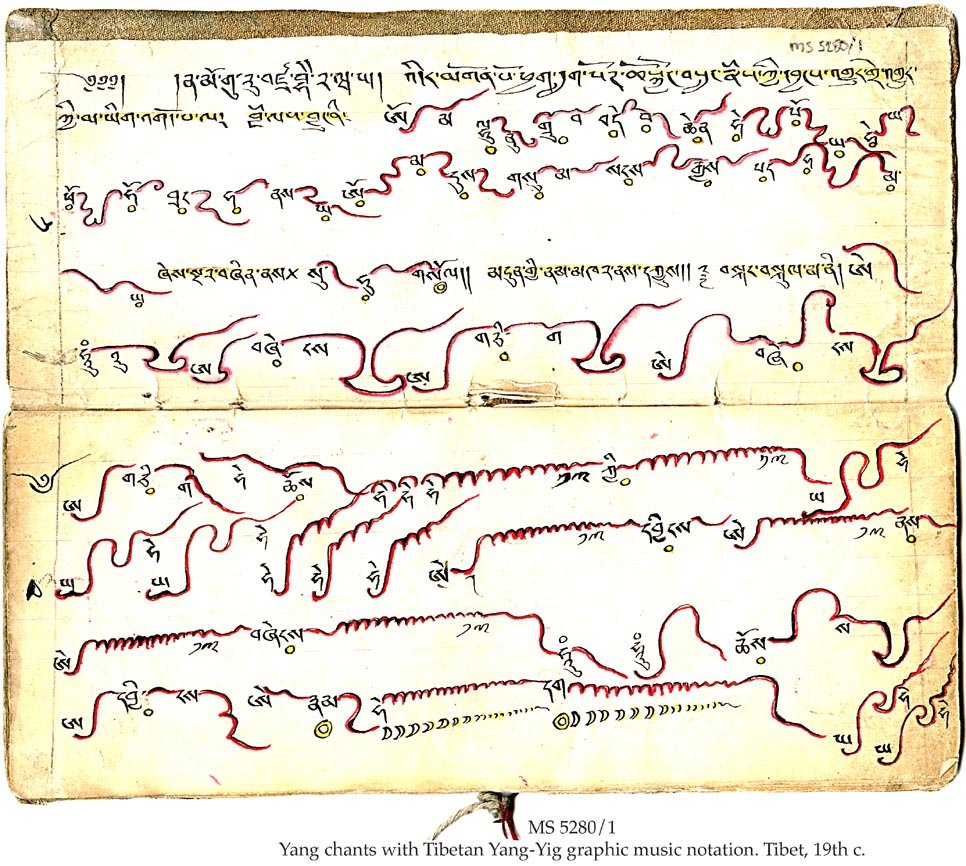
Religions take the cast and hue of the cultures in which they find root. This was certainly true in Tibet when Buddhism arrived in the 7th century. It transformed and was transformed by the native religion of Bon. Of the many creative practices that arose from this synthesis, Tibetan Buddhist music ranks very highly in importance.
As in sacred music in the West, Tibetan music has complex systems of musical notation and a long history of written religious song. “A vital component of Tibetan Buddhist experience,” explains Google Arts & Cultures Buddhist Digital Resource Center, “musical notation allows for the transference of sacred sound and ceremony across generations. A means to memorize sacred text, express devotion, ward off feral spirits, and invoke deities.”

Some of these features may be alien to secular Western Buddhists focused on mindfulness and silent meditation, but to varying degrees, Tibetan schools place considerable value on the aesthetic experience of extra-human realms. As University of Tulsa musicologist John Powell writes, “the use of sacred sound” in Tibetan Buddhism, a “Mantrayana” tradition, acts “as a formula for the transformation of human consciousness.”
Tibetan musical notations, Google points out, “symbolically represent the melodies, rhythm patterns, and instrumental arrangements. In harmony with chanting, visualizations, and hand gestures, [Tibetan] music crucially guides ritual performance.” It is characterized not only by its integration of ritual dance, but also by a large collection of ritual instruments—including the long, Swiss-like horns suited to a mountain environment—and unique forms of polyphonic overtone singing.
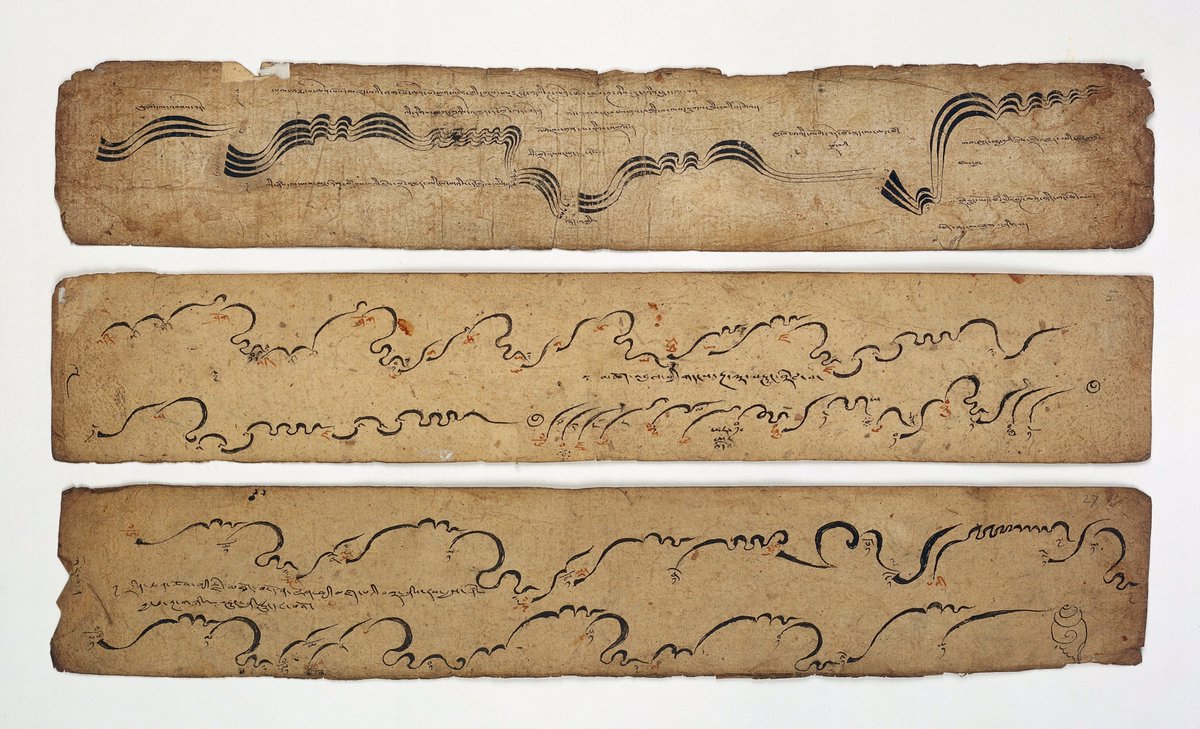
The examples of musical notation you see here came from the appropriately-named Twitter account Musical Notation is Beautiful and typeface designer and researcher Jo De Baerdemaeker. At the top is a 19th century manuscript belonging to the “Yang” tradition, “the most highly involved and regarded chant tradition in Tibetan music,” notes the Schoyen Collection, “and the only one to rely on a system of notation (Yang-Yig).”

The curved lines represent “smoothly effected rises and falls in intonation.” The notation also “frequently contains detailed instructions concerning in what spirit the music should be sung (e.g. flowing like a river, light like bird song) and the smallest modifications to be made to the voice in the utterance of a vowel.” The Yang-Yig goes all the way back to the 6th century, predating Tibetan Buddhism, and “does not record neither the rhythmic pattern nor duration of notes.” Other kinds of music have their own types of notation, such as that in the piece above for voice, drums, trumpets, horns, and cymbals.
Though they articulate and elaborate on religious ideas from India, Tibet’s musical traditions are entirely its own. “It is essential to rethink the entire concept of melody and rhythm” to understand Tibetan Buddhist chant, writes Powell in a detailed overview of Tibetan music’s vocal and instrumental qualities. “Many outside Tibetan culture are accustomed to think of melody as a sequence of rising or falling pitches,” he says. “In Tibetan Tantric chanting, however, the melodic content occurs in terms of vowel modification and the careful contouring of tones.” Hear an example of traditional Tibetan Buddhist chant just above, and learn more about Tibetan musical notation at Google Arts & Culture.
Note: An earlier version of this post appeared on our site in 2019.
Related Content:
Breathtakingly-Detailed Tibetan Book Printed 40 Years Before the Gutenberg Bible
The World’s Largest Collection of Tibetan Buddhist Literature Now Online
Free Online Course: Robert Thurman’s Introduction to Tibetan Buddhism (Recorded at Columbia U)
Leonard Cohen Narrates Film on The Tibetan Book of the Dead, Featuring the Dalai Lama (1994)
Josh Jones is a writer and musician based in Durham, NC. Follow him at @jdmagness
Read More...The Soviet Union Creates a List of 38 Dangerous Rock Bands: Kiss, Pink Floyd, Talking Heads, Village People & More (1985)
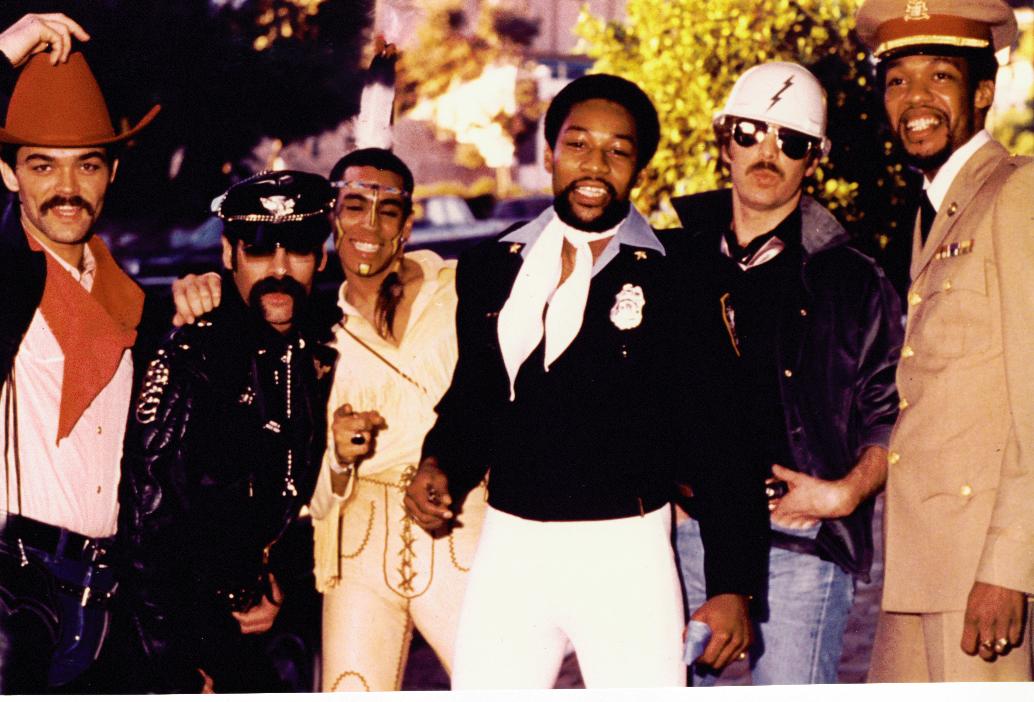
Image by Mario Casciano via Wikimedia Commons
Music is dangerous and powerful, and can be, without intending to, a political weapon. All authoritarian regimes have understood this, including repressive elements in the U.S. throughout the Cold War. I remember having books handed to me before the Berlin Wall came down, by family friends fearful of the evils of popular music—especially punk rock and metal, but also pretty much everything else. The descriptions in these paranoid tracts of the bands I knew and loved sounded so ludicrous and hyperbolic that I couldn’t help suspect that each was in fact a work of satire. They were at the very least anachronistic, yet ideal, types of Poe’s Law.
Such may be your reaction to a list published in 1985 by the Komsomol, the Soviet youth organization formed as the All-Union Leninist Young Communist League in 1918. (Find it below.) Consisting of thirty-eight punk, rock, metal, disco, and New Wave bands, the list is not at all unlike the materials printed around the same time by certain youth organizations I came into contact with.
The mechanisms of state repression in the Soviet Union on the eve of perestroika overmatched comparatively mild attempts at music censorship made by the U.S. government, but the propaganda mechanisms were similar. As in the alarmed pamphlets and books handed to me in churches and summer camps, the Komsomol list describes each band in obtuse and absurd terms, each one a category of the “type of propaganda” on offer.
Black Sabbath, a legitimately scary—and politically astute—band gets pegged along with Iron Maiden for “violence” and “religious obscurantism.” (Nazareth is similarly guilty of “violence” and “religious mysticism.”) A great many artists are charged with only “violence” or with “sex,” which in some cases was kind of their whole métier. A handful of punk bands—the Sex Pistols, the Clash, the Stranglers—are cited for violence, and also simply charged with “punk,” a crime given as the Ramones’ only offense. There are a few oddly specific charges: Pink Floyd is guilty of a “distortion of Soviet foreign policy (‘Soviet aggression in Afghanistan’)” and Talking Heads endorse the “myth of the Soviet military threat.” A couple hilariously incongruous tags offer LOLs: Yazoo and Depeche Mode, two of the gentlest bands of the period, get called out for “punk, violence.” Kiss and the Village People (above), two of the silliest bands on the list, are said to propagate, “neofascism” and “violence.”
- Sex Pistols: punk, violence
- B‑52s: punk, violence
- Madness: punk, violence
- Clash: punk, violence
- Stranglers: punk, violence
- Kiss: neofascism, punk, violence
- Crocus: violence, cult of strong personality
- Styx: violence, vandalism
- Iron Maiden: violence, religious obscuritanism
- Judas Priest: anticommunism, racism
- AC/DC: neofascism, violence
- Sparks: neofascism, racism
- Black Sabbath: violence, religious obscuritanism
- Alice Cooper: violence, vandalism
- Nazareth: violence, religious mysticism
- Scorpions: violence
- Gengis Khan: anticommunism, nationalism
- UFO: violence
- Pink Floyd (1983): distortion of Soviet foreign policy (“Soviet agression in Afghanistan”)***
- Talking Heads: myth of the Soviet military threat
- Perron: eroticism
- Bohannon: eroticism
- Originals: sex
- Donna Summer: eroticism
- Tina Turner: sex
- Junior English: sex
- Canned Heat: homosexuality
- Munich Machine: eroticism
- Ramones: punk
- Van Halen: anti-soviet propaganda
- Julio Iglesias: neofascism
- Yazoo: punk, violence
- Depeche Mode: punk, violence
- Village People: violence
- Ten CC: neofascism
- Stooges: violence
- Boys: punk, violence
- Blondie: punk, violence
The list circulated for “the purpose of intensifying control over the activities of discotheques.” It comes to us from Alexei Yurchak’s Everything Was Forever, Until It Was No More: The Last Soviet Generation, which cites it as an example, writes one reader, of “the contradictory nature of Soviet life, where as citizens participated in the ritualized, pro forma ideological discourse, this very discourse allowed them to carve out what they called ‘normal meaningful life’ that went beyond the state’s ideology.” A large part of that “normal” life involved circulating bootlegs of ideologically suspect music on improvised materials like discarded and stolen X‑Rays. The Komsomol eventually wised up. As Yurchak documents in his book, they co-opted local amateur rock bands and promoted their own events as a counter-attack on the influence of bourgeois culture. You can probably guess how much success they had with this strategy.
See the full list of thirty-eight bands and their “type of propaganda” above.
Note: An earlier version of this post appeared on our site in 2015.
Related Content:
Josh Jones is a writer and musician based in Durham, NC. Follow him at @jdmagness
Read More...The History of the World in One Beautiful, 5‑Foot-Long Chart (1931)
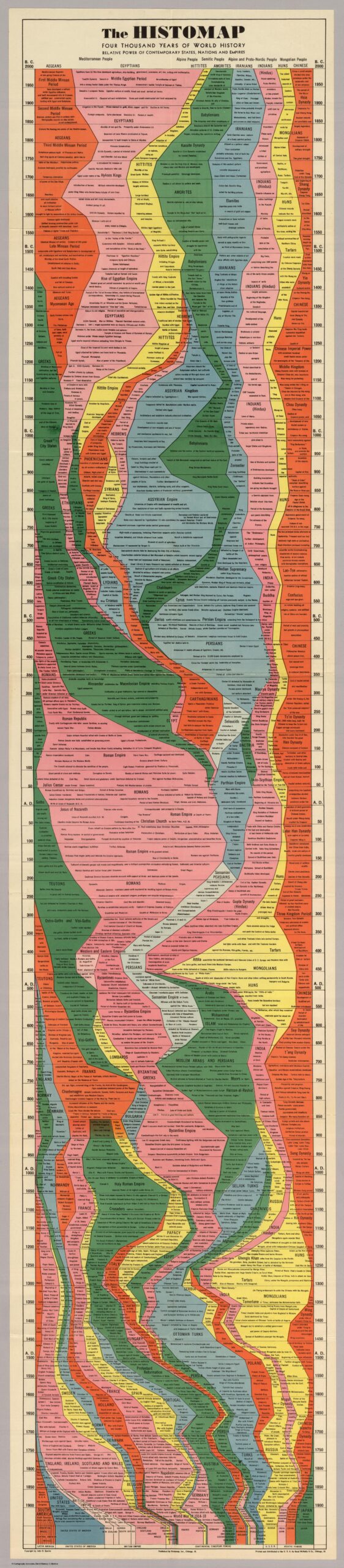
In the image above, we see an impressive pre-internet macro-infographic called a “Histomap.” Its creator John B. Sparks (who later created “histomaps” of religion and evolution) published the graphic in 1931 with Rand McNally. The five-foot-long chart—purportedly covering 4,000 years of “world” history—is, in fact, an example of an early illustration trend called the “outline,” of which Rebecca Onion at Slate writes: “large subjects (the history of the world! every school of philosophy! all of modern physics!) were distilled into a form comprehensible to the most uneducated layman.” Here we have the full description of most every political chart, graph, or animation in U.S.A. Today, most Internet news sites, and, of course, The Onion.
The similarity here isn’t simply one of form. The “outline” functioned in much the same way that simplified animations do—condensing heavy, contentious theoretical freight trains and ideological baggage. Rebecca Onion describes the chart as an artifact very much of its time, presenting a version of history prominent in the U.S. between the wars. Onion writes:
The chart emphasizes domination, using color to show how the power of various “peoples” (a quasi-racial understanding of the nature of human groups, quite popular at the time) evolved throughout history.
Sparks’ map, however, remains an interesting document because of its seeming disinterestedness. While the focus on racialism and imperial conquest may seem to place Sparks in company with populist “scientific” racists of the period like Lothrop Stoddard (whom Tom Buchanan quotes in Fitzgerald’s Gatsby), it would also seem that his design has much in common with early Enlightenment figures whose conception of time was not necessarily linear. Following classical models, thinkers like Thomas Hobbes tended to divide historical epochs into rising and falling actions of various people groups, rather than the gradual ascent of one race over all others towards an end of history. For example, poet Abraham Cowley writes a compressed “universal history” in his 1656 poem “To Mr. Hobs,” moving from Aristotle (the “Stagirite”) to the poem’s subject Thomas Hobbes. The movement is progressive, yet the historical representatives of each civilization receive some equal weight and similar emphasis.
Long did the mighty Stagirite retain
The universal Intellectual reign,
Saw his own Countreys short-liv’ed Leopard slain;
The stronger Roman-Eagle did out-fly,
Oftner renewed his Age, and saw that Dy.
Mecha it self, in spight of Mahumet possest,
And chas’ed by a wild Deluge from the East,
His Monarchy new planted in the West.
But as in time each great imperial race
Degenerates, and gives some new one place:
The period of Cowley recognized theories of racial, cultural, and natural supremacy, but such qualities, as in Sparks’ map, were the product of a long line of succession from equally powerful and noteworthy empires and groups to others, not a social evolution in which a superior race naturally arose. Rand McNally advertised the chart as presenting “the march of civilization, from the mud huts of the ancients thru the monarchistic glamour of the middle ages to the living panorama of life in present day America.” While the blurb is filled with pseudoscientific colonialist talking points, the chart itself has the dated, yet strikingly egalitarian arrangement of information that—like much of the illustration in National Geographic—sought to accommodate the best consensus models of the times, displaying, but not proselytizing, its biases.
Note: An earlier version of this post appeared on our site in 2013.
Related Content:
180,000 Years of Religion Charted on a “Histomap” in 1943
10 Million Years of Evolution Visualized in an Elegant, 5‑Foot Long Infographic from 1931
The History of the World in One Video: Every Year from 200,000 BCE to Today
Josh Jones is a writer and musician based in Durham, NC. Follow him at @jdmagness
Read More...The Dylatov Pass Incident: Has One of the Biggest Soviet Mysteries Been Solved?
Most of us would go out of our way not to set foot anywhere near a place the local natives refer to as “Dead Mountain.” That didn’t stop the Dyatlov Hiking Group, who set out on a sixteen-day skiing expedition across the northern Urals in late January of 1959. Experienced and intrepid, those ten young Soviet ski hikers had what it took to make the journey, at least if nothing went terribly wrong. A bout of sciatica forced one member of the group to turn back early, which turned out to be lucky for him. About a month later, the irradiated bodies of his nine comrades were discovered scattered in different areas of Dead Mountain some distance from their campsite, with various traumatic injuries and in various states of undress.
Something had indeed gone terribly wrong, but nobody could figure out what. For decades, the fate of the Dyatlov Hiking Group inspired countless explanations ranging widely in plausibility. Some theorized a freak weather phenomenon; others some kind of toxic airborne event; others still, the actions of American spies or even a yeti.
“In a place where information has been as tightly controlled as in the former Soviet Union, mistrust of official narratives is natural, and nothing in the record can explain why people would leave a tent undressed, in near-suicidal fashion,” writes the New Yorker’s Douglas Preston. Only in the late twenty-tens, when the Dyatlov Group Memorial Foundation got the case reopened, did investigators assess the contradictory evidence while making new measurements and conducting new experiments.
The probable causes were narrowed down to those explained by experts in the Vox video above: a severe blizzard and a slab of ice that must have shifted and crushed the tent. Densely packed by the wind, that massive, heavy slab would have “prevented them from retrieving their boots or warm clothing and forced them to cut their way out of the downslope side of the tent,” proceeding to the closest natural shelter from the avalanche they believed was coming. But no avalanche came, and they couldn’t find their way back to their camp in the darkness. “Had they been less experienced, they might have remained near the tent, dug it out, and survived,” writes Preston. “The skiers’ expertise doomed them.” Not everyone accepts this theory, but then, the idea that knowledge can kill might be more frightening than even the most abominable snowman.
Related content:
The Denali Experiment: A Test of Human Limits
The Curious Death of Vincent van Gogh
The Gruesome Dollhouse Death Scenes That Reinvented Murder Investigations
Based in Seoul, Colin Marshall writes and broadcasts on cities, language, and culture. His projects include the Substack newsletter Books on Cities and the book The Stateless City: a Walk through 21st-Century Los Angeles. Follow him on the social network formerly known as Twitter at @colinmarshall.
Read More...An Introduction to George Orwell’s 1984 and How Power Manufactures Truth
Soon after the first election of Donald Trump to the presidency of the United States, George Orwell’s Nineteen Eighty-Four became a bestseller again. Shooting to the top of the American charts, the novel that inspired the term “Orwellian” passed Danielle Steel’s latest opus, the poetry of Rupi Kaur, the eleventh Diary of a Wimpy Kid book, and the memoir of an ambitious young man named J. D. Vance. But how much of its renewed popularity owed to the relevance of a nearly 70-year-old vision of shabby, totalitarian future England to twenty-first century America, and how much to the fact that, as far as influence on popular culture’s image of political dystopia, no other work of literature comes close?
For all the myriad ways one can criticize his two administrations, Trump’s America bears little superficial resemblance to Oceania’s Airstrip One as ruled by The Party. But it can hardly be a coincidence that this period of history has also seen the concept “post-truth” become a fixture in the zeitgeist.
There are many reasons not to want to live in the world Orwell imagines in Nineteen Eighty-Four: the thorough bureaucratization, the lack of pleasure, the unceasing surveillance and propaganda. But none of this is quite so intolerable as what makes it all possible: the rulers’ claim to absolute control over the truth, a form of psychological manipulation hardly limited to regimes we regard as evil.
As James Payne says in his Great Books Explained video on Nineteen Eighty-Four, Orwell worked for the BBC’s overseas service during the war, and there received a troubling education in the use of information as a political weapon. The experience inspired the Ministry of Truth, where the novel’s protagonist Winston Smith spends his days re-writing history, and the dialect of Newspeak, a severely reduced English designed to narrow its speakers’ range of thought. Orwell may have overestimated the degree to which language can be modified from the top down, but as Payne reminds us, we now all hear culture warriors describe reality in highly slanted, politically-charged, and often thought-terminating ways all day long. Everywhere we look, someone is ready to tell us that two plus two make five; if only they were as obvious about it as Big Brother.
Related content:
George Orwell Explains in a Revealing 1944 Letter Why He’d Write 1984
George Orwell’s Harrowing Race to Finish 1984 Before His Death
George Orwell’s Final Warning: Don’t Let This Nightmare Situation Happen. It Depends on You!
What “Orwellian” Really Means: An Animated Lesson About the Use & Abuse of the Term
Aldous Huxley to George Orwell: My Hellish Vision of the Future is Better Than Yours (1949)
Based in Seoul, Colin Marshall writes and broadcasts on cities, language, and culture. His projects include the Substack newsletter Books on Cities and the book The Stateless City: a Walk through 21st-Century Los Angeles. Follow him on the social network formerly known as Twitter at @colinmarshall.
Read More...When the State Department Used Dizzy Gillespie and Jazz to Fight the Cold War (1956)
It’s been said that the United States won the Cold War without firing a shot — a statement, as P. J. O’Rourke once wrote, that doubtless surprised veterans of Korea and Vietnam. But it wouldn’t be entirely incorrect to call the long stare-down between the U.S. and the Soviet Union a battle of ideas. Dwight Eisenhower certainly saw it that way, a worldview that inspired the 1956 creation of the President’s Special International Program for Participation in International Affairs, which aimed to use American culture to improve the country’s image around the world. (That same year, Eisenhower also signed off on the construction of the Interstate Highway System, such was the country’s ambition at the time.)
For an unambiguously American art form, one could hardly do better than jazz, which also had the advantage of counterbalancing U.S.S.R. propaganda focusing on the U.S.’ troubled race relations. And so the State Department picked a series of “jazz ambassadors” to send on carefully planned world tours, beginning with Dizzy Gillespie and his eighteen-piece interracial band (with the late Quincy Jones in the role of music director).
Starting in March of 1956, Gillespie’s ten-week tour featured dates all over Europe, Asia, and South America. These wouldn’t be his last State Department-sponsored tours abroad: in the videos above, you can see a clip from his performance in Germany in 1960. This touring even resulted in live albums like Dizzy in Greece and World Statesman.
Other jazz ambassadors would follow: Louis Armstrong (who quit over the high-school integration crisis in Little Rock), Duke Ellington, Benny Goodman, and Dave Brubeck (whose dim view of the program inspired the musical The Real Ambassadors). But none went quite so far in pursuing their cultural-political interests as Gillespie, who announced himself as a write-in candidate in the 1964 U.S. presidential election. He promised not only to rename the White House the Blues house, but also to appoint a cabinet including Miles Davis as Director of the CIA, Charles Mingus as Secretary of Peace, Armstrong as Secretary of Agriculture, and Ellington as Secretary of State. This jazzed-up administration was, alas, never to take power, but the music itself has left more of a legacy than any government could. Surely the fact that I write these words in a café in Korea soundtracked entirely by jazz speaks for itself.
Related Content:
Dizzy Gillespie Worries About Nuclear & Environmental Disaster in Vintage Animated Films
Louis Armstrong Plays Historic Cold War Concerts in East Berlin & Budapest (1965)
When Louis Armstrong Stopped a Civil War in The Congo (1960)
Dizzy Gillespie Runs for US President, 1964. Promises to Make Miles Davis Head of the CIA
Based in Seoul, Colin Marshall writes and broadcasts on cities, language, and culture. His projects include the Substack newsletter Books on Cities and the book The Stateless City: a Walk through 21st-Century Los Angeles. Follow him on the social network formerly known as Twitter at @colinmarshall.
Read More...Albert Einstein’s Grades: A Fascinating Look at His Report Cards
Albert Einstein was a precocious child.
At the age of twelve, he followed his own line of reasoning to find a proof of the Pythagorean Theorem. At thirteen he read Kant, just for the fun of it. And before he was fifteen he had taught himself differential and integral calculus.
But while the young Einstein was engrossed in intellectual pursuits, he didn’t much care for school. He hated rote learning and despised authoritarian schoolmasters. His sense of intellectual superiority was resented by his teachers.
In Subtle is the Lord: The Science and Life of Albert Einstein, author Abraham Pais tells a funny story from Einstein’s days at the Luitpold Gymnasium, a secondary school in Munich now called the Albert-Einstein-Gymnasium:
At the Gymnasium a teacher once said to him that he, the teacher, would be much happier if the boy were not in his class. Einstein replied that he had done nothing wrong. The teacher answered, “Yes, that is true. But you sit there in the back row and smile, and that violates the feeling of respect that a teacher needs from his class.”
The same teacher famously said that Einstein “would never get anywhere in life.”
What bothered Einstein most about the Luitpold was its oppressive atmosphere. His sister Maja would later write:
“The military tone of the school, the systematic training in the worship of authority that was supposed to accustom pupils at an early age to military discipline, was also particularly unpleasant for the boy. He contemplated with dread that not-too-distant moment when he will have to don a soldier’s uniform in order to fulfill his military obligations.”
When he was sixteen, Einstein’s parents moved to Italy to pursue a business venture. They told him to stay behind and finish school. But Einstein was desperate to join them in Italy before his seventeenth birthday. “According to the German citizenship laws,” Maja explained, “a male citizen must not emigrate after his completed sixteenth year; otherwise, if he fails to report for military service, he is declared a deserter.”
So Einstein found a way to get a doctor’s permission to withdraw from the school on the pretext of “mental exhaustion,” and fled to Italy without a diploma. Years later, in 1944, during the final days of World War II, the Luitpold Gymnasium was obliterated by Allied bombing. So we don’t have a record of Einstein’s grades there. But there is a record of a principal at the school looking up Einstein’s grades in 1929 to fact check a press report that Einstein had been a very bad student. Walter Sullivan writes about it in a 1984 piece in The New York Times:
With 1 as the highest grade and 6 the lowest, the principal reported, Einstein’s marks in Greek, Latin and mathematics oscillated between 1 and 2 until, toward the end, he invariably scored 1 in math.
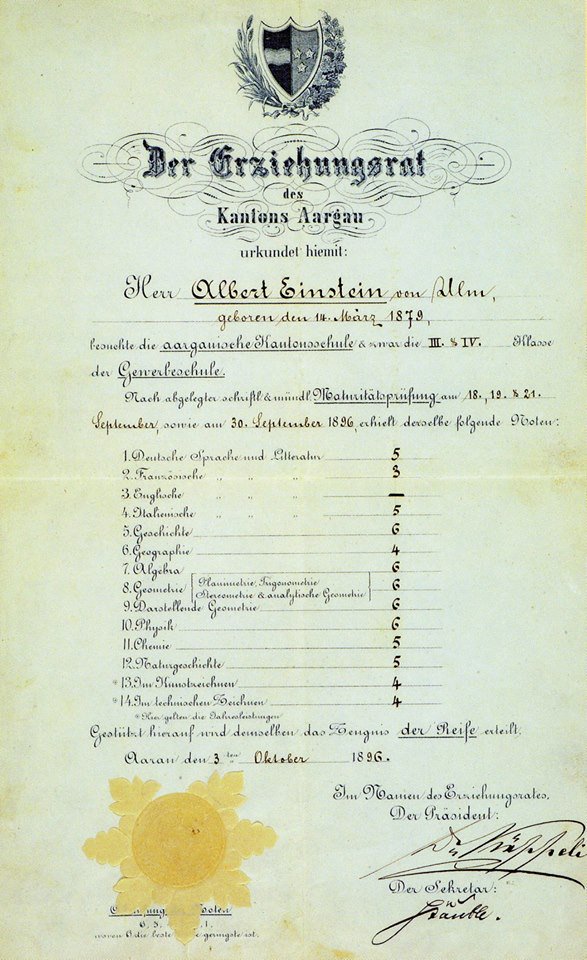
After he dropped out, Einstein’s family enlisted a well-connected friend to persuade the Swiss Federal Institute of Technology, or ETH, to let him take the entrance exam, even though he was only sixteen years old and had not graduated from high school. He scored brilliantly in physics and math, but poorly in other areas. The director of the ETH suggested he finish preparatory school in the town of Aarau, in the Swiss canton of Aargau. A diploma from the cantonal school would guarantee Einstein admission to the ETH.
At Aarau, Einstein was pleasantly surprised to find a liberal atmosphere in which independent thought was encouraged. “When compared to six years’ schooling at a German authoritarian gymnasium,” he later said, “it made me clearly realize how much superior an education based on free action and personal responsibility is to one relying on outward authority.”
In Einstein’s first semester at Aarau, the school still used the old method of scoring from 1 to 6, with 1 as the highest grade. In the second semester the system was reversed, with 6 becoming the highest grade. Barry R. Parker talks about Einstein’s first-semester grades in his book, Einstein: The Passions of a Scientist:
His grades over the first few months were: German, 2–3; French, 3–4; history, 1–2; mathematics, 1; physics, 1–2; natural history, 2–3; chemistry, 2–3; drawing, 2–3; and violin, 1. (The range is 1 to 6, with 1 being the highest.) Although none of the grades, with the exception of French, were considered poor, some of them were only average.
The school headmaster, Jost Winteler, who had welcomed Einstein into his home as a boarder and had become something of a surrogate father to him during his time at Aarau, was concerned that a young man as obviously brilliant as Albert was receiving average grades in so many courses. At Christmas in 1895, he mailed a report card to Einstein’s parents. Hermann Einstein replied with warm thanks, but said he was not too worried. As Parker writes, Einstein’s father said he was used to seeing a few “not-so-good grades along with very good ones.”
In the next semester Einstein’s grades improved, but were still mixed. As Toby Hendy of the YouTube channel Tibees shows in the video above, Einstein’s final grades were excellent in math and physics, but closer to average in other areas.
Einstein’s uneven academic performance continued at the ETH, as Hendy shows. By the third year his relationship with the head of the physics department, Heinrich Weber, began to deteriorate. Weber was offended by the young man’s arrogance. “You’re a clever boy, Einstein,” said Weber. “An extremely clever boy. But you have one great fault. You’ll never allow yourself to be told anything.” Einstein was particularly frustrated that Weber refused to teach the groundbreaking electromagnetic theory of James Clerk Maxwell. He began spending less time in the classroom and more time reading up on current physics at home and in the cafes of Zurich.
Einstein increasingly focused his attention on physics, and neglected mathematics. He came to regret this. “It was not clear to me as a student,” he later said, “that a more profound knowledge of the basic principles of physics was tied up with the most intricate mathematical methods.”
Einstein’s classmate Marcel Grossmann helped him by sharing his notes from the math lectures Einstein had skipped. When Einstein graduated, his conflict with Weber cost him the teaching job he had expected to receive. Grossmann eventually came to Einstein’s rescue again, urging his father to help him secure a well-paid job as a clerk in the Swiss patent office. Many years later, when Grossmann died, Einstein wrote a letter to his widow that conveyed not only his sadness at an old friend’s death, but also his bittersweet memories of life as a college student:
“Our days together come back to me. He a model student; I untidy and a daydreamer. He on excellent terms with the teachers and grasping everything easily; I aloof and discontented, not very popular. But we were good friends and our conversations over iced coffee at the Metropol every few weeks belong among my nicest memories.”
Note: An earlier version of this post appeared on our site in 2020.
Related Content:
Hear Albert Einstein Read “The Common Language of Science” (1941)
When Albert Einstein & Charlie Chaplin Met and Became Fast Famous Friends (1930)
Read More...Pablo Picasso’s Childhood Paintings: Precocious Works Painted Between the Ages of 8 and 15
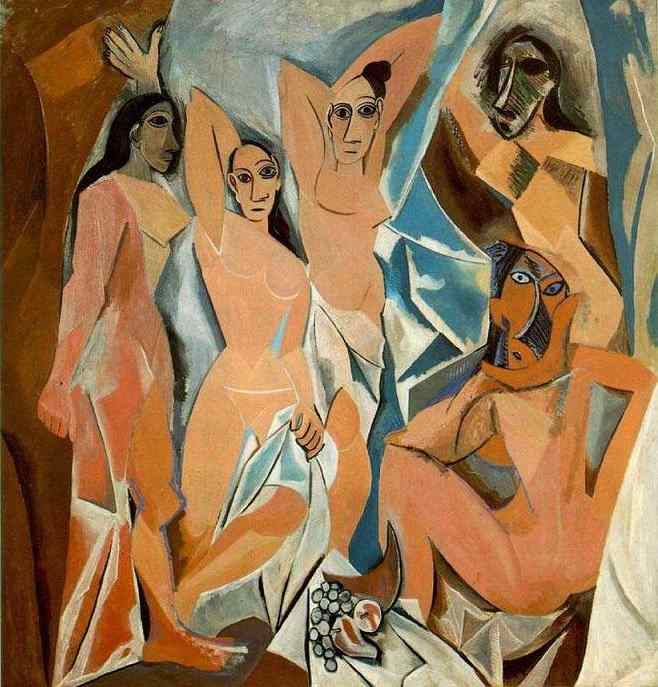
It’s hard to imagine from this historical distance how upsetting Pablo Picasso’s 1907 modernist painting Les Demoiselles d’Avignon was to Parisian society at its debut. On its 100th anniversary, Guardian critic Jonathan Jones described it as “the rift, the break that divides past and future.” The painting caused an uproar, even among the artist’s peers. It was a moment of culture shock, notes PBS. Its five nude figures, broken into proto-cubist planes and angles with faces painted like African masks, met “with almost unanimous shock, distaste, and outrage.”
Henri Matisse, himself often credited with ushering in modernist painting with his flattened fields of color, “is angered by the work, which he considers a hoax, an attempt to paint the fourth dimension.” Much of the outrage was purported to come from middle-class moral qualms about the painting’s subject, “the sexual freedom depicted in a brothel.”
This is a little hard to believe. Nude women in brothels, “odalisques,” had long been a favorite subject of some of the most revered European painters. But where the women in these paintings always appear passive, if not submissive, Picasso’s nudes pose suggestively and meet the viewer’s gaze, actively unashamed.
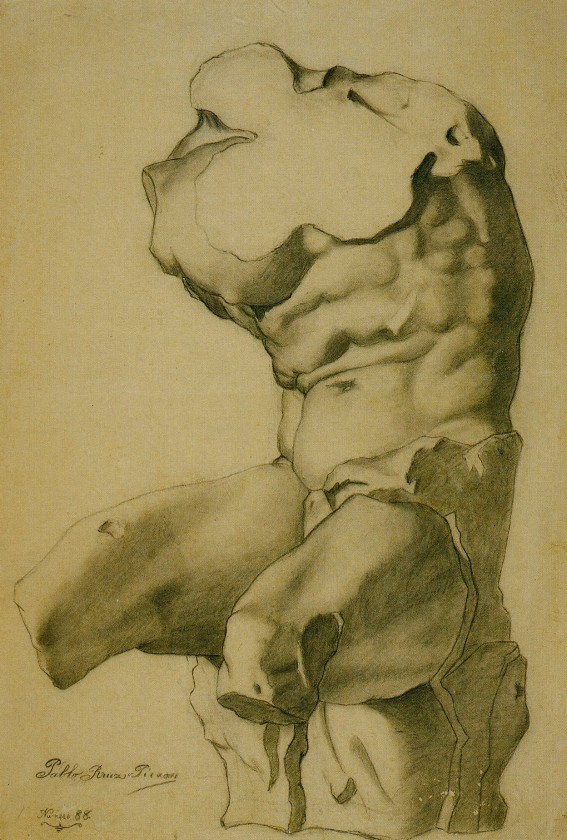
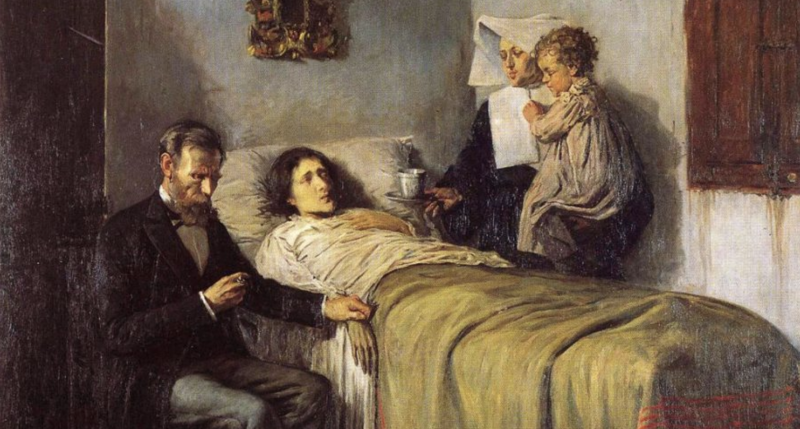
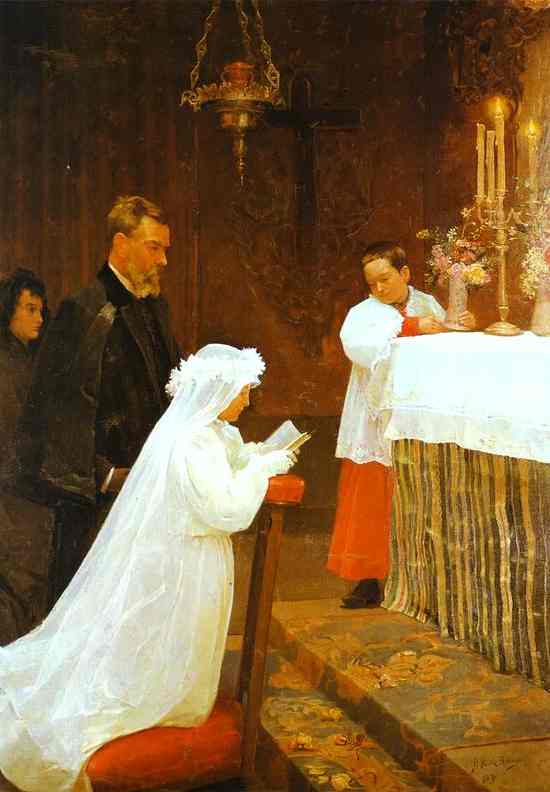
What likely most disturbed those first viewers was the perceived violence done to tradition. While we cannot recover the tender sensibilities of early 20th-century Parisian critics, we can, I think, experience a similar kind of shock by looking at work Picasso had done ten years earlier, such as the 1896 First Communion, further up, and 1897 study Science and Charity at the top, conservative genre paintings in an academic style, beautifully rendered with exquisite skill by a then 15-year-old artist. See an earlier drawing, Study for a Torso, above, completed in 1892 when Picasso was only 11.
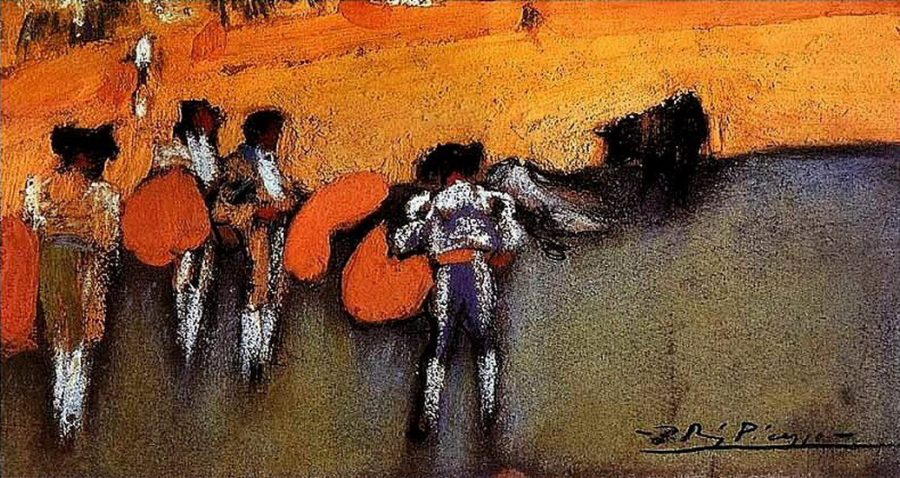
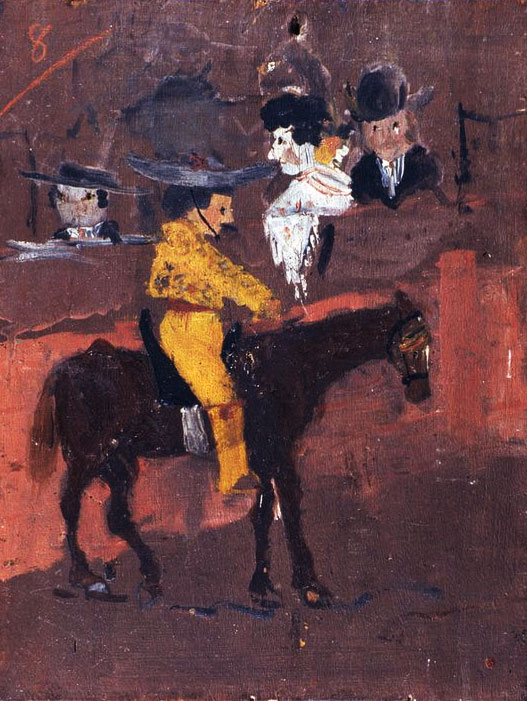
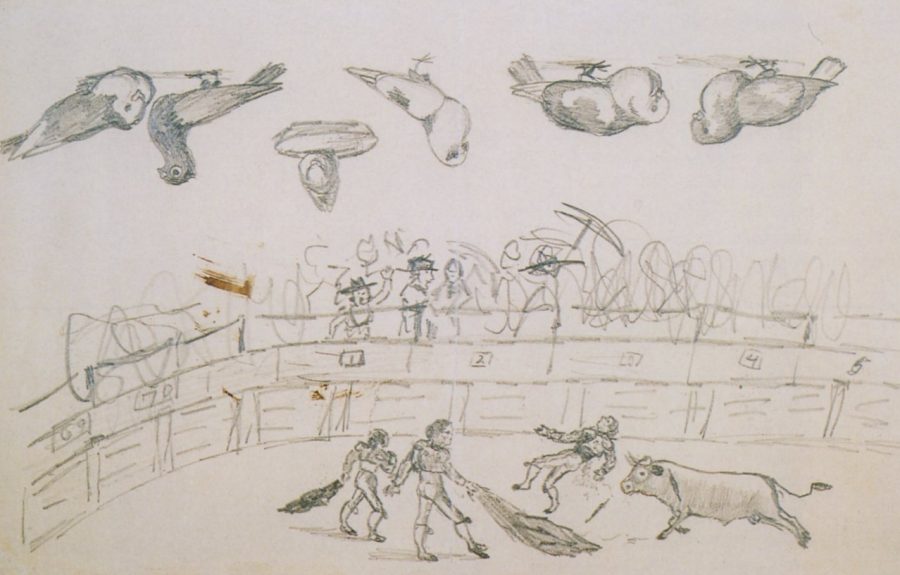
Given his incredible precocity, it may seem hardly any wonder that Picasso innovated scandalously new means of using line, color, and composition. He was a prodigious master of technique at an age when many artists are still years away from formal study. Where else could his restless talent go? He painted a favorite subject in 1900, in the loose, impressionist Bullfight, above, a return of sorts to his first oil painting, Picador, below, made when he was 8. Further down, see a drawing from the following year in his early development, “Bullfight and Pigeons.”
This piece, with its realistic-looking birds carefully drawn upside-down atop a loose sketch of a bullfight, appeared in a 2006 show at the Phillips Collection in Washington, DC featuring childhood artworks from Picasso and Paul Klee. Contrary, perhaps, to our expectations, curator Jonathan Fineberg remarks of this drawing that “9‑year-old Picasso’s confident, playful scribble” gives us more indication of his talent than the finely-drawn birds.
“It’s not just that Picasso could render well, because you could teach anybody to do that,” Fineberg says. Maybe not anybody, but the point stands—technique can be taught, creative vision cannot. “It’s not about skill. It’s about unique qualities of seeing. That’s what makes Picasso a better artist than Andrew Wyeth. Art is about a novel way of looking at the world.” You may prefer Wyeth, or think the downward comparison unfair, but there’s no denying Picasso had a very “novel way of seeing,” from his earliest sketches to his most revolutionary modernist masterpieces. See several more highly accomplished early works from Picasso here.
Note: An earlier version of this post appeared on our site in 2018.
Related Content:
9‑Year-Old Edward Hopper Draws a Picture on the Back of His 3rd Grade Report Card
Josh Jones is a writer and musician based in Durham, NC. Follow him at @jdmagness
Read More...Harvard Lets You Take 133 Free Online Courses: Explore Courses on Justice, American Government, Literature, Religion, CompSci & More

Image by Rizka, via Wikimedia Commons
In South Korea, where I live, there may be no brand as respected as Habodeu. Children dream of it; adults seemingly do anything to play up their own connections to it, however tenuous those connections may be. But what is Habodeu? An electronics company? A line of clothing? Some kind of luxury car? Not at all: it is, in fact, the Korean pronunciation of Harvard, the American university. Practically everyone around the world is aware of Harvard’s prestige, but relatively few know that you can take many of its courses online without paying tuition, or even applying. In fact, you can find a list of more than 130 such courses right here, all available to take right now.
Those looking to start building a base of technical skill might consider Introduction to Computer Science or Introduction to Programming (of which there’s even a version for lawyers). Once you’ve got a handle on coding, you could move on to other courses in data science or machine learning and artificial intelligence.
If your scientific interests lie elsewhere, Harvard also has such online offerings as Fundamentals of Neuroscience, The Einstein Revolution, and Science & Cooking for both physics and chemistry. If you’d prefer to shore up your knowledge of religion, there are also courses on Christianity, Judaism, Buddhism, Hinduism, Islam, and Sikhism through their scriptures.
Faith in art can also be satisfied through, to name just a few examples, Masterpieces of World Literature (with specialized courses in masterpieces modern and ancient); the life and work of Shakespeare and such specific plays as Hamlet, The Merchant of Venice, and Othello; pieces of music including Beethoven’s 9th Symphony and Stravinsky’s Rite of Spring; and courses on Japanese books and Chinese humanities. But then, since we happen to live in what the Chinese call “interesting times,” perhaps you feel a more urgent need to take courses on American government and its constitutional foundations, civic engagement, the modern media environment, and resilient leadership. You can even take the blockbuster course on justice from the political philosopher Michael Sandel: a huge celebrity here in Korea, incidentally, even by Habodeu standards. Find the complete list of free online courses here. Also see our list, 1,700 Free Online Courses from Top Universities.
If you would like to support the mission of Open Culture, consider making a donation to our site. It’s hard to rely 100% on ads, and your contributions will help us continue providing the best free cultural and educational materials to learners everywhere. You can contribute through PayPal, Patreon, and Venmo (@openculture). Thanks!
Related content
Download The Harvard Classics as Free eBooks: A “Portable University” Created in 1909
An Animated Michael Sandel Explains How Meritocracy Degrades Our Democracy
Harvard Puts Online a Huge Collection of Bauhaus Art Objects
Based in Seoul, Colin Marshall writes and broadcasts on cities, language, and culture. His projects include the Substack newsletter Books on Cities and the book The Stateless City: a Walk through 21st-Century Los Angeles. Follow him on the social network formerly known as Twitter at @colinmarshall.
Read More...How Bob Dylan Kept Reinventing His Songwriting Process, Breathing New Life Into His Music
On his 84th birthday this past Saturday, Bob Dylan played a show. That was in keeping with not only his still-serious touring schedule, but also his apparently irrepressible instinct to work: on music, on writing, on painting, on sculpture. Even his occasional tweeting draws an appreciative audience every time. The Bob Dylan of 2025 is not, of course, the Bob Dylan of 1965, but then, the Bob Dylan of 1965 wasn’t the Bob Dylan of 1964. This constant artistic change is just what his fans appreciate, not that they don’t still put on his early stuff with regularity.
In the earliest of that early stuff, as music YouTuber David Hartley explains in the new video above, Dylan “wrote songs by reinventing tradition.” Using nothing but his voice, guitar, and harmonica, the young Dylan “imitated some of the most well-known folk melodies,” placing himself in that long American tradition of borrowing and reinterpretation. But as dramatized in the recent film A Complete Unknown, he soon “went electric,” and with the change in instrumentation came a change in songwriting method: “He would just come up with endless pages of lyrics, something he once called ‘the long piece of vomit.’ ”
The advice to “puke it out now and clean it up later” has long been given, in various forms, to aspiring artists everywhere. One aspect worth highlighting about the way Dylan did it was that, despite writing popular songs, he drew a great deal of inspiration from more traditional literature, to the point that his notes hardly appear to contain anything resembling verses or choruses at all. Only in the studio, with a band behind him, could Dylan give these ideas their final musical shape — or rather, their final shape on that particular album, often to be modified endlessly, and sometimes radically, over decades of live performances to come.
Hartley tells of more dramatic changes to Dylan’s music and his process of creating. The motorcycle crash, the Basement Tapes, the open E tuning, Blood on the Tracks: all of these now lie half a century or more in the past. To go over all the ways Dylan has approached music since then would require more hours than all but the most rabid enthusiasts (though there are many) would watch. The video does include a 60 Minutes clip from 2004 in which Dylan says that “those early songs were almost magically written,” and that he wouldn’t be able to create them anymore. But then, nor could the Dylan of Highway 61 Revisited have recorded Time Out of Mind, and nor, for that matter, could the Dylan of Time Out of Mind have recorded any of Dylan’s albums from this decade — or those that could, quite possibly, be still to come.
Related content:
A Massive 55-Hour Chronological Playlist of Bob Dylan Songs: Stream 763 Tracks
How Bob Dylan Created a Musical & Literary World All His Own: Four Video Essays
Watch Bob Dylan Make His Debut at the Newport Folk Festival in Colorized 1963 Footage
Hear Bob Dylan’s Newly Released Nobel Lecture: A Meditation on Music, Literature & Lyrics
Bob Dylan Explains Why Music Has Been Getting Worse
Based in Seoul, Colin Marshall writes and broadcasts on cities, language, and culture. His projects include the Substack newsletter Books on Cities and the book The Stateless City: a Walk through 21st-Century Los Angeles. Follow him on the social network formerly known as Twitter at @colinmarshall.
Read More...Support Us
We're hoping to rely on loyal readers, rather than erratic ads. Please click the Donate button and support Open Culture. You can use Paypal, Venmo, Patreon, even Crypto! We thank you!

About Us

Open Culture scours the web for the best educational media. We find the free courses and audio books you need, the language lessons & educational videos you want, and plenty of enlightenment in between.
Advertise With Us
FREE UPDATES!
GET OUR DAILY EMAIL
Get the best cultural and educational resources on the web curated for you in a daily email. We never spam. Unsubscribe at any time.
FOLLOW ON SOCIAL MEDIA
Open Culture editor Dan Colman scours the web for the best educational media. He finds the free courses and audio books you need, the language lessons & movies you want, and plenty of enlightenment in between.
Advertise With Us



