How Jackie Chan Filmed the Best Fight Scene in Cinema History
Though now in his seventies, Jackie Chan continues to appear on the big screen with regularity. For most world-famous actors, that’s hardly notable, but it’s not as if Sir John Gielgud, say, had spent decades filming scenes of hand-to-hand combat and sustaining severe injuries in the performance of elaborate stunts. Viewers of New Police Story 2 and Rush Hour 4, to name just two upcoming franchise projects, will surely delight, as always, in Chan’s very screen presence. But it goes without saying that he won’t be attempting anything like what he did in his breakout Hong Kong films of the seventies and eighties, which required a singular dedication both physical and cinematic.
There are also fans who argue that Chan reached his peak in the nineties, most of whom would adduce the climactic fight scene above from Drunken Master II. Made in 1994, when Chan was 40 years old, it came as the ostensible sequel to Drunken Master, from 1978, in which Chan’s portrayal of the titular Qing dynasty folk hero launched him to stardom in Asia.
Released in the U.S. as The Legend of Drunken Master in 2000 — after Chan had finally made it stateside with Rumble in the Bronx and the first Rush Hour — Drunken Master II met with critical astonishment. “It involves some of the most intricate, difficult and joyfully executed action sequences I have ever seen,” wrote Roger Ebert. His judgment of the final, steel-forge-set showdown: “It may not be possible to film a better fight scene.” The Rossatron video below explains how the scene has drawn such reactions.
One element has been key to Chan’s success from the beginning: his humor, visibly descended from the physical comedy of Western silent stars like Charlie Chaplin and Buster Keaton, which comes through even in the midst of the most intense hand-to-hand combat. In Drunken Master II, it’s “not only a pleasing addition to the film, but a necessary part of the story itself,” through the course of which Chan’s protagonist must gain control over the style of “drunken boxing” born of his own fondness for the bottle. It is controlled drunkenness, of course, that eventually brings him victory in his both cartoonish and masterful last fight, which required four months to shoot under the direction of the star himself (the film’s actual director Lau Kar-leung having ceded control of the scene due to stylistic differences). Today, there may be no action-comedy performer equal to Jackie Chan in his prime. But even if there were, would any studio allow him so much of the other secret ingredient, time?
via Metafilter
Related content:
Kung Fu & Martial Arts Movies Online
The Only Footage of Bruce Lee Fighting for Real (1967)
The Graceful Movements of Kung Fu & Modern Dance Revealed in Stunning Motion Visualizations
Radical French Philosophy Meets Kung-Fu Cinema in Can Dialectics Break Bricks? (1973)
Why Is Jackie Chan the King of Action Comedy? A Video Essay Masterfully Makes the Case
Based in Seoul, Colin Marshall writes and broadcasts on cities, language, and culture. His projects include the Substack newsletter Books on Cities and the book The Stateless City: a Walk through 21st-Century Los Angeles. Follow him on the social network formerly known as Twitter at @colinmarshall.
Read More...Albert Einstein Tells His Son That the Key to Learning & Happiness Is Losing Yourself in Creativity (or “Finding Flow”)
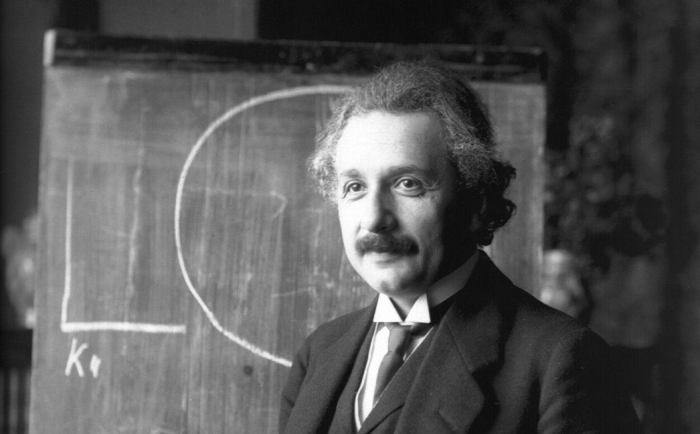
As one particularly astute observer of human emotions might put it, it is a truth universally acknowledged that we can’t all be Albert Einstein. In fact, none of us can. That unique experience was denied even Einstein’s son Hans Albert, though he did go on to his own distinguished career as an engineer and professor of hydraulics. Einstein father and son had a strained relationship, yet the great physicist had a hand in his son’s success, inspiring him to pursue his scientific passion. But Einstein’s paternal encouragement extended further, beyond scientific pursuits and toward a general theory of learning and enjoyment that suggests we can be happiest and most productive when being most ourselves.
While living in Berlin in 1915, Einstein wrote a poignant letter to his son, just two days after finishing his theory of general relativity. His tone swings from buoyant to pained—lamenting his family’s “awkward” separation and proposing to spend more time with Albert, as he calls him. His son can “learn many good and beautiful things from me,” writes Einstein, “These days I have completed one of the most beautiful works of my life.”
Einstein also writes, “I am very pleased that you find joy with the piano. This and carpentry are in my opinion for your age the best pursuits.” An amateur musician himself, Einstein understood the value of developing an informal avocation. “Mainly play the things on the piano which please you,” he tells his son, “even if the teacher does not assign those.” Doing what you love, the way you like to do it, he goes on, “is the way to learn the most, that when you are doing something with such enjoyment that you don’t notice that the time passes.”
This great theme of total immersion in a creative endeavor surfaced several decades later in another scientist’s work, that of Hungarian psychologist Mihaly Csikszentmihalyi, described by Martin Seligman—former President of the American Psychological Association—as “the world’s leading researcher” in the field of positive psychology. Presented in his popular TED talk above, and at more length in his books on the subject, Csikszentmihalyi’s insights into human flourishing mirror Einstein’s: he calls such creative immersion “flow,” or the state of “being completely involved in an activity for its own sake.”
The ego falls away. Time flies. Every action, movement, and thought follows inevitably from the previous one, like playing jazz. Your whole being is involved, and you’re using your skills to the utmost.
Contrary to our usual conceptions of using one’s “skills to the utmost,” Csikszentmihalyi tells us that the reward for entering such a state is not the material benefits it generates, but the positive emotions. These emotions, as Einstein theorized, not only motivate us to become better, but they also provide a source of meaning no amount of financial gain above a minimum level can offer. “The lack of basic material resources contributes to unhappiness,” Csikszentmihalyi’s data demonstrates, “but the increase in material resources does not increase happiness.” While none of us can be Einstein, Csikszentmihalyi tells us we can all benefit from Einstein’s advice, by doing whatever we do to the best of our abilities and without any motive other than sheer pleasure.
Note: An earlier version of this post appeared on our site in 2015.
Related Content:
How to Enter a ‘Flow State’ on Command: Peak Performance Mind Hack Explained in 7 Minutes
How to Get into a Creative “Flow State”: A Short Masterclass
Josh Jones is a writer and musician based in Durham, NC. Follow him at @jdmagness
Read More...Watch Animated Sheet Music for Miles Davis’ “So What,” Coltrane’s “Giant Steps,” and Charlie Parker’s “Confirmation”
Miles Davis’ Kind of Blue changed jazz. It changed music, period. So I take it very seriously. But when I see the animated sheet music of the first cut, “So What,” I can’t help but think of Charles Schulz’s Peanuts cartoons, and their Vince Guaraldi compositions. I mean no offense to Miles. His modal jazz swings, and it’s fun, as fun to listen to as it is to watch in rising and falling arpeggios. The YouTube uploader, Dan Cohen, gives us this on his channel Animated Sheet Music, with apologies to Jimmy Cobb for the lack of drum notation.
Also from Cohen’s channel, we have Charlie Parker’s music animated. Never one to keep up with his admin, Parker left his estate unable to recuperate royalties from compositions like “Confirmation” (above).
Nonetheless, everyone knows it’s Bird’s tune, and to see it animated above is to see Parker dance a very different step than Miles’ post-bop cool, one filled with complex melodic paragraphs instead of chordal phrases.
And above, we have John Coltrane’s massive “Giant Steps,” with its rapid-fire bursts of quarter notes, interrupted by half-note asides. Coltrane’s iconic 1960 composition displays what Ira Gitler called in a 1958 Downbeat piece, “sheets of sound.” Gitler has said the image he had in his head was of “bolts of cloth undulating as they unfurled,” but he might just as well have thought of sheets of rain, so multitudinous and heavy is Coltrane’s melodic attack.
See Cohen’s Animated Sheet Music channel for two more Charlie Parker pieces, “Au Privave” and “Bloomdido.”
If you would like to support the mission of Open Culture, consider making a donation to our site. It’s hard to rely 100% on ads, and your contributions will help us continue providing the best free cultural and educational materials to learners everywhere. You can contribute through PayPal, Patreon, and Venmo (@openculture). Thanks!
Note: An earlier version of this post appeared on our site in 2013.
Related Content:
Behold John Coltrane’s Handwritten Outline for His Masterpiece A Love Supreme
Josh Jones is a writer and musician based in Durham, NC. Follow him at @jdmagness
Read More...How 16th-Century Artist Joris Hoefnagel Made Insects Beautiful—and Changed Science Forever
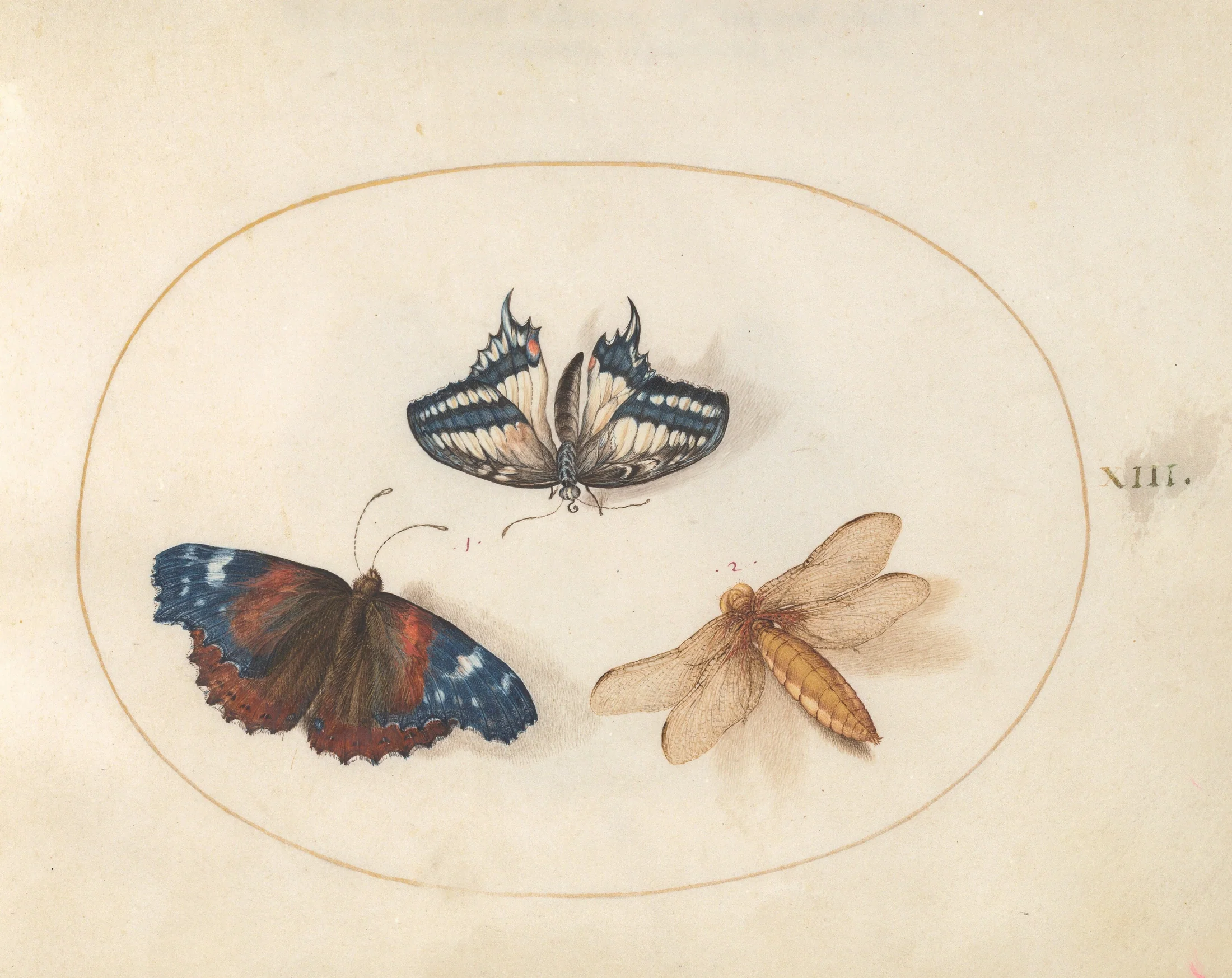
In English, most of the words we’d use to refer to insects sound off-putting at best and fearsome at worst, at least to those without an entomological bent. Dutch, close a linguistic relation though it may be, offers a more endearing alternative in beestjes, which refers to all these “little beasts” in which the artists and scientists of Europe started to take a major interest in the late sixteenth century. As was the style of that era, the magisteria of art and science tended to overlap, a phenomenon nowhere more clearly reflected — at least with regard to the insect kingdom — than in the work of Joris Hoefnagel, a Flemish artist whose illustrations of beestjes combined beauty and accuracy in a manner never seen before.
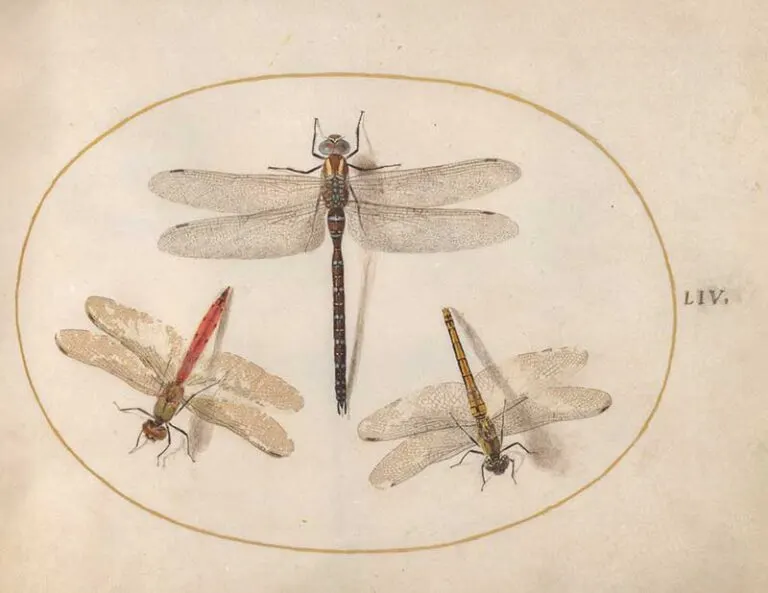
You can now see Hoefnagel’s art up close at the exhibition Little Beasts: Art, Wonder, and the Natural World, which will be up at the National Gallery of Art in Washington, DC until early November. If you won’t be able to make it out to the museum, have a look at the exhibition’s web site, which shows off the splendor of Hoefnagel’s work as published in The Four Elements, a collection of about 300 watercolors grouped into four volumes in the fifteen-seventies and eighties, each one named for an element: Aqua contains water animals; Terra land animals; Aier birds and plants; and Ignis, or “fire,” insects.
“We don’t really know why Hoefnagel put insects in the fire volume,” says Evan “Nerdwriter” Puschak in the new video above. “Maybe because both fire and insects symbolize transformation.”
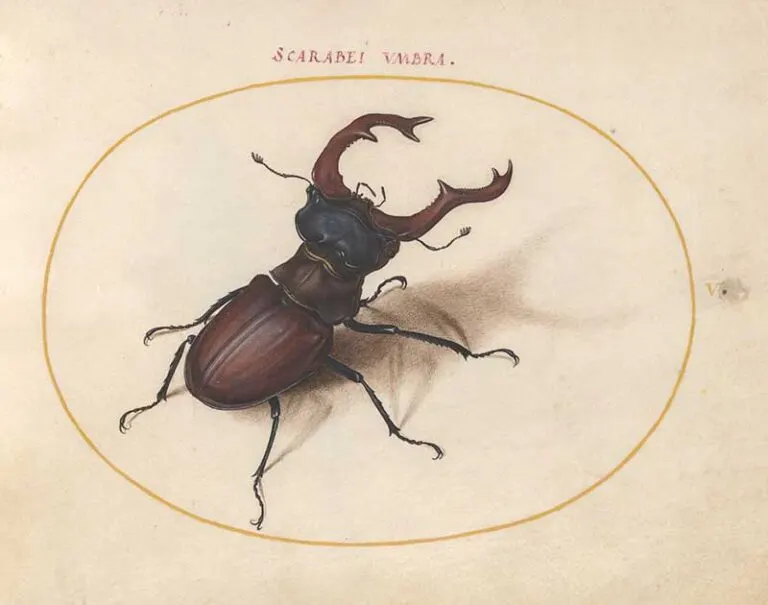
“What we do know,” Puschak adds, “is that these insect miniatures are magnificently rendered.” Hoefnagel even made improvements on the nature illustrations of his artistic predecessor Albrecht Dürer, whose own abilities to render our world with fidelity had been regarded as nearly superhuman. One particular work that surpasses Dürer is Hoefnagel’s depiction of a stag beetle, which he accompanied with the Latin inscription “SCARABEI UMBRA,” or “the shadow of the stag beetle”: possibly a reference to the unprecedented realism of the insect’s shadow as Hoefnagel rendered it, but in any case a common saying at the time about hollow threats. For however frightening the stag beetle looked, as Hoefnagel well knew, the actual creature was gentle — just another wee beastie after all.
Related Content:
The Genius of Albrecht Dürer Revealed in Four Self-Portraits
Vladimir Nabokov’s Delightful Butterfly Drawings
Two Million Wondrous Nature Illustrations Put Online by The Biodiversity Heritage Library
Captivating Collaboration: Artist Hubert Duprat Uses Insects to Create Golden Sculptures
Watch The Insects’ Christmas from 1913: A Stop Motion Film Starring a Cast of Dead Bugs
Based in Seoul, Colin Marshall writes and broadcasts on cities, language, and culture. His projects include the Substack newsletter Books on Cities and the book The Stateless City: a Walk through 21st-Century Los Angeles. Follow him on the social network formerly known as Twitter at @colinmarshall.
Read More...Hear the World’s Oldest Instrument, the “Neanderthal Flute,” Dating Back Over 43,000 Years
Several years ago, we brought you a transcription and a couple of audio interpretations of the oldest known song in the world, discovered in the ancient Syrian city of Ugarit and dating back to the 14th century B.C.E.. Likely performed on an instrument resembling an ancient lyre, the so-called “Hurrian Cult Song” or “Hurrian Hymn No. 6” sounds otherworldly to our ears, although modern-day musicologists can only guess at the song’s tempo and rhythm.
When we reach even further back in time, long before the advent of systems of writing, we are completely at a loss as to the forms of music prehistoric humans might have preferred. But we do know that music was likely a part of their everyday lives, as it is ours, and we have some sound evidence for the kinds of instruments they played. In 2008, archeologists discovered fragments of flutes carved from vulture and mammoth bones at a Stone Age cave site in southern Germany called Hohle Fels. These instruments date back 42,000 to 43,000 years and may supplant earlier findings of flutes at a nearby site dating back 35,000 years.

Image via the The Archaeology News Network
The flutes are meticulously crafted, reports National Geographic, particularly the mammoth bone flute, which would have been “especially challenging to make.” At the time of their discovery, researchers speculated that the flutes “may have been one of the cultural accomplishments that gave the first European modern-human (Homo sapiens) settlers an advantage over their now extinct Neanderthal-human (Homo neanderthalensis) cousins.” But as with so much of our knowledge about Neanderthals, including new evidence of interbreeding with Homo sapiens, these conclusions may have to be revised.
It is perhaps possible that the much-underestimated Neanderthals made their own flutes. Or so a 1995 discovery of a flute made from a cave bear femur might suggest. Found by archeologist Ivan Turk in a Neanderthal campsite at Divje Babe in northwestern Slovenia, this instrument (above) is estimated to be over 43,000 years old and perhaps as much as 80,000 years old. According to musicologist Bob Fink, the flute’s four finger holes match four notes of a diatonic (Do, Re, Mi…) scale. “Unless we deny it is a flute at all,” Fink argues, the notes of the flute “are inescapably diatonic and will sound like a near-perfect fit within ANY kind of standard diatonic scale, modern or antique.” To demonstrate the point, the curator of the Slovenian National Museum had a clay replica of the flute made. You can hear it played at the top of the post by Slovenian musician Ljuben Dimkaroski.
The prehistoric instrument does indeed produce the whole and half tones of the diatonic scale, so completely, in fact, that Dimkaroski is able to play fragments of several compositions by Beethoven, Verdi, Ravel, Dvořák, and others, as well as some free improvisations “mocking animal voices.” The video’s YouTube page explains his choice of music as “a potpourri of fragments from compositions of various authors,” selected “to show the capabilities of the instrument, tonal range, staccato, legato, glissando….” (Dimkaroski claims to have figured out how to play the instrument in a dream.) Although archeologists have hotly disputed whether or not the flute is actually the work of Neanderthals, as Turk suggested, should it be so, the finding would contradict claims that the close human relatives “left no firm evidence of having been musical.” But whatever its origin, it seems certainly to be a hominid artifact—not the work of predators—and a key to unlocking the prehistory of musical expression.
Note: An earlier version of this post appeared on our site in 2015.
Related Content:
Hear the Oldest Song in the World: A Sumerian Hymn Written 3,400 Years Ago
What Ancient Greek Music Sounded Like: Hear a Reconstruction That is ‘100% Accurate’
Josh Jones is a writer and musician based in Durham, NC. Follow him at @jdmagness
Read More...Watch the Very First YouTube Video, a Defining Moment in Internet History
Given the dominance YouTube has achieved over large swaths of world culture, we’d all expect to remember the first video we watched there. Yet many or most of us don’t: rather, we simply realized, one day in the mid-to-late two-thousands, that we’d developed a daily YouTube habit. Like as not, your own introduction to the platform came through a video too trivial to make much of an impression, assuming you could get it to load at all. (We forget, in this age of instantaneous streaming, how slow YouTube could be at first.) But perhaps the triviality was the point, a precedent set by the first YouTube video ever uploaded, “Me at the Zoo.”
“Alright, so here we are in front of the, uh, elephants,” says YouTube co-founder Jawed Karim, standing before those animals’ enclosure at the San Diego Zoo. “The cool thing about these guys is that, is that they have really, really, really long, um, trunks, and that’s, that’s cool. And that’s pretty much all there is to say.”
The runtime is 19 seconds. The upload date is April 24, 2005, two years before “Charlie Bit My Finger” and “Chocolate Rain,” four years before The Joe Rogan Experience, and seven years before “Gangnam Style.” The pop-cultural force that is MrBeast, then a child known only as Jimmy Donaldson, would have been anticipating his seventh birthday.
“After the zoo, the deluge,” wrote Virginia Heffernan in a 2009 New York Times piece on YouTube’s first four and a half years, when the site contained barely any of the content with which we associate it today. If you have a favorite YouTube channel, it probably didn’t exist then. Heffernan approached the “fail,” “haul,” and “unboxing” videos going viral at the time as new cultural forms, as indeed they were, but the conventions of the YouTube video as we now know them had yet to crystallize. Not everyone who saw the likes of “Me at the Zoo” would have understood the promise of YouTube. Perhaps it didn’t feel particularly revelatory to be informed that elephants have trunks — but then, that’s still more informative than many of the countless explainer videos being uploaded as we speak.
Related Content:
How to Watch Hundreds of Free Movies on YouTube
The Very First Webcam Was Invented to Keep an Eye on a Coffee Pot at Cambridge University
The Complete History of the Music Video: From the 1890s to Today
Based in Seoul, Colin Marshall writes and broadcasts on cities, language, and culture. His projects include the Substack newsletter Books on Cities and the book The Stateless City: a Walk through 21st-Century Los Angeles. Follow him on the social network formerly known as Twitter at @colinmarshall.
Read More...The Very First Coloring Book, The Little Folks’ Painting Book (Circa 1879)
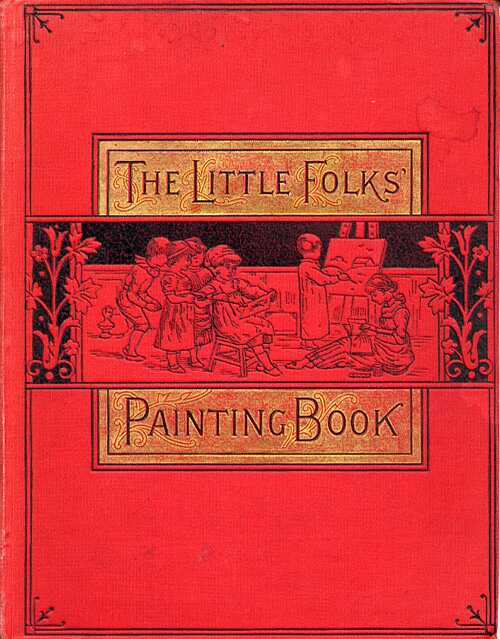
Funny how not that long ago coloring books were considered the exclusive domain of children. How times have changed. If you are the sort of adult who unwinds with a big box of Crayolas and pages of mandalas or outlines of Ryan Gosling, you owe a debt of gratitude to the McLoughlin Brothers and illustrator Kate Greenaway.
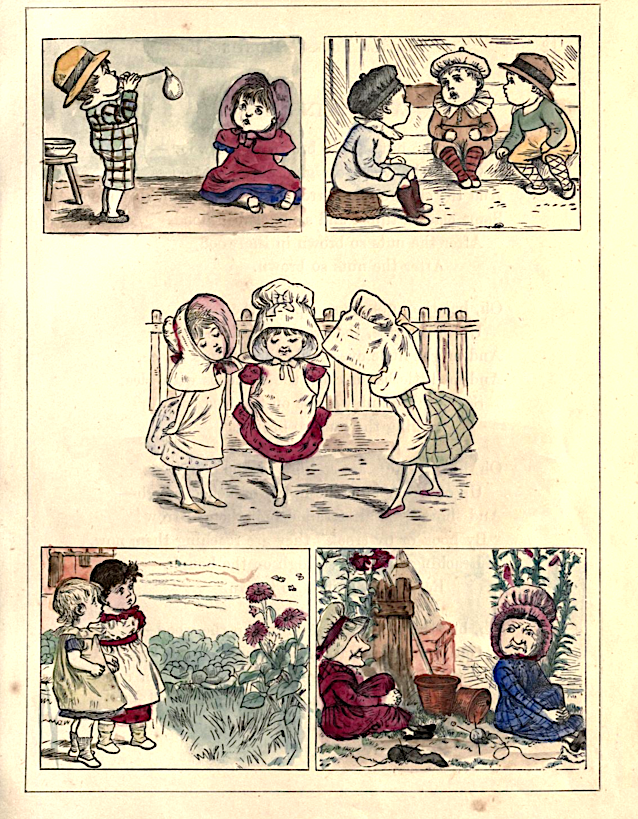
Their Little Folks’ Painting Book burst onto the scene in around 1879 with such fun-to-color outline engravings as “The Owl’s Advice,” “A Flower Fairy,” and “Little Miss Pride,” each accompanied by nursery rhymes and stories. The abundance of mob caps, pinafores, and breeches is of a piece with Greenaway’s enduring takes on nursery rhymes, though grown-up manual dexterity seems almost mandatory given the tiny patterns and other details.
Seeing as how there was no precedent, the publishers of the world’s first coloring book went ahead and filled in the frontispiece so that those tackling the other hundred drawings would know what to do. (Hint: Stay inside the lines and don’t get too creative with skin or hair color.)
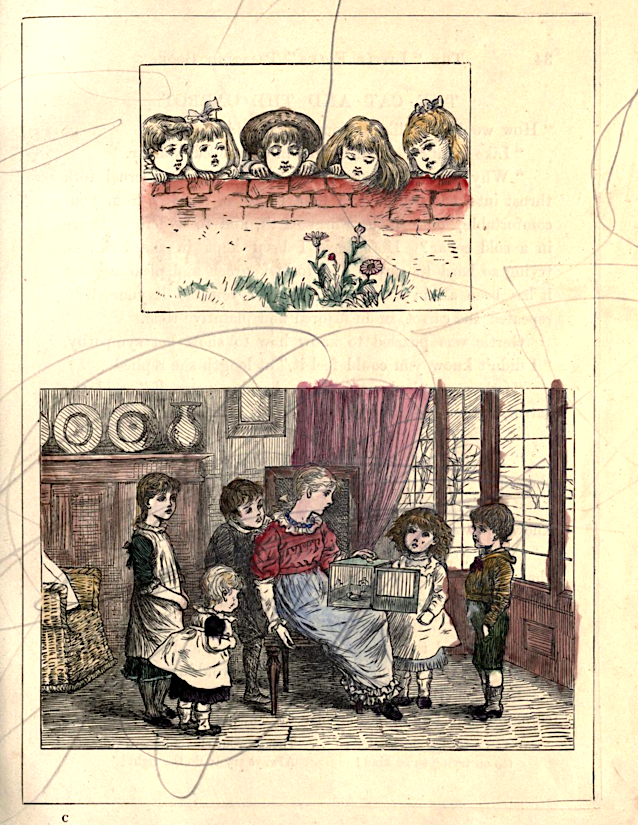
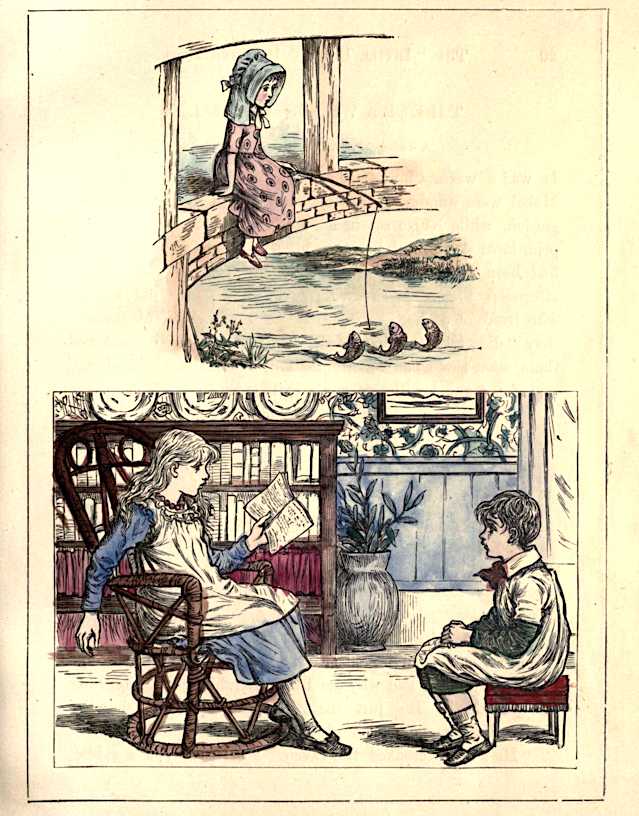
Also note: the copy represented here has been carefully hand-colored by the previous owners, with one contributing some exuberant scribbles in pencil. See the full book, and download it in various formats, at Archive.org.
Note: An earlier version of this post appeared on our site in 2016.
Related Content:
Free Coloring Books from Libraries & Museums: Download & Color Thousands of Free Images (2024)
The First Adult Coloring Book: See the Subversive Executive Coloring Book From 1961
Read More...The History of Electronic Music in 476 Tracks (1937–2001)
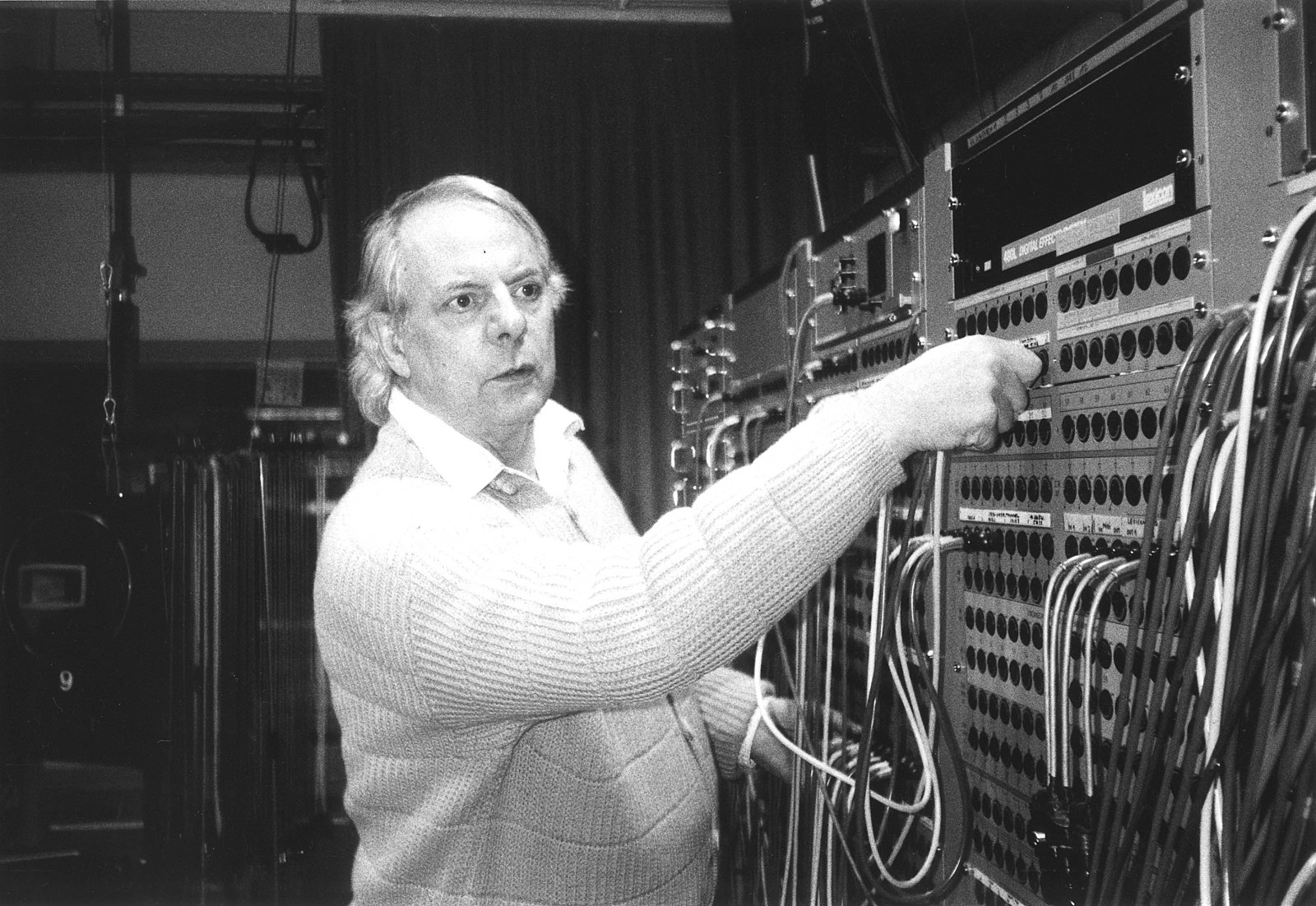
Photo of Karlheinz Stockhausen by Kathinka Pasveer via Wikimedia Commons
You may hear the phrase “electronic music” and think of superstar dubstep DJs in funny helmets at beachside celebrity parties. Alternatively, you may think of the mercurial compositions of Karlheinz Stockhausen, the musique concrete of Pierre Henry, or the otherworldly experimentalism of François Bayle. If you’re in that latter camp of music nerd, then this post may bring you very glad tidings indeed. Ubuweb—that stalwart repository of all things 20th-century avant-garde—now hosts an extraordinary compilation: the 476-song History of Electronic/Electroacoustic Music, originally a 62 CD set. (Hear below Stockhausen’s “Kontact,” Henry’s “Astrologie,” and Bayle’s spare “Theatre d’Ombres” further down.)
Spanning the years 1937–2001, the collection should especially appeal to those with an avant-garde or musicological bent. In fact, the original uploader of this archive of experimental sound, Caio Barros, put these tracks online in 2009 while a student of composition at Brazil’s State University of São Paulo. Barros’ “initiative,” as he writes at Ubuweb, “became some sort of legend” among musicophiles in the know.
And yet, Ubuweb reposts this phenomenal collection with a disclaimer: “It’s a clearly flawed selection,” they write:
There’s few women and almost no one working outside of the Western tradition (where are the Japanese? Chinese? etc.). However, as an effort, it’s admirable and contains a ton of great stuff.
Take it with a grain of salt, or perhaps use it as a provocation to curate a more intelligent, inclusive, and comprehensive selection
It’s a fair critique, though Barros points out that the exclusions mostly have to do with “the way our society and the tradition this music represent works” (sic). And yet, as disciplinary boundaries expand all the time, and histories broaden along with them, that description no longer holds. It would be a fascinating exercise, for example, to listen to these tracks alongside the history of women in electronic music, 1938–2014 that we posted recently.
Also, there’s clearly much more to electronic music than either celebrity DJs or obscure avant-garde composers. Many hundreds of popular electronic composers and musicians—like Brian Eno, Kraftwerk, Bruce Haack, or Clara Rockmore—fall somewhere in-between the worlds of pop/dance/performance and serious composition, and their contributions deserve representation alongside more experimental or classical artists.
All that said, however, there’s no reason you can’t curate your own playlist of the history of electronic music as you see it—drawing from the astounding wealth of music available free at The History of Electroacoustic Music. Or consider this collection a fully immersive course in “traditional, western avant-garde electronic music” from “the area of Europe-America,” as Barros puts it. As that, it succeeds admirably.
Note: An earlier version of this post appeared on our site in 2016.
Related Content:
What is Electronic Music?: Pioneering Electronic Musician Daphne Oram Explains (1969)
Hear Seven Hours of Women Making Electronic Music (1938- 2014)
Josh Jones is a writer and musician based in Durham, NC. Follow him at @jdmagness
Read More...Elementary School Kids Sing David Bowie’s “Space Oddity” & Other Rock Hits: A Cult Classic Recorded in 1976
In 1976 and 1977 an inspired music teacher in the small school district of Langley Township, British Columbia, a suburb of Vancouver, recorded his elementary school students singing popular songs in a school gym. Two vinyl records were produced over the two years, and families were invited to pay $7 for a copy. The recordings were largely forgotten — just another personal memento stored away in a few homes in Western Canada — until a record collector stumbled across a copy in a thrift store in 2000.
Enthralled by what he heard, the collector sent a sample to a disc jockey at WFMU, an eclectic, listener-supported radio station in New Jersey. The station began playing some of the songs over the airwaves. Listeners were touched by the haunting, ethereal quality of the performances. In 2001, a small record company released a compilation called The Langley Township Music Project: Innocence & Despair.
The record became an underground hit. The Washington Post called it “an album that seems to capture nothing less than the sound of falling in love with music.” Spin said the album “seems to sum up all the reasons music is holy.” And Dwight Gamer of The New York Times wrote that the music was “magic: a kind of celestial pep rally.” Listeners were moved by the ingenuousness of the young voices, the strange authenticity of performances by children too young to understand all of the adult themes in the lyrics. As Hans Fenger, the music teacher who made the recordings, writes in the liner notes:
The kids had a grasp of what they liked: emotion, drama, and making music as a group. Whether the results were good, bad, in tune or out was no big deal — they had élan. This was not the way music was traditionally taught. But then I never liked conventional “children’s music,” which is condescending and ignores the reality of children’s lives, which can be dark and scary. These children hated “cute.” They cherished songs that evoked loneliness and sadness.
You can learn the story of Fenger’s extraordinary music project in the 2002 VH1 documentary above, which includes interviews and a reunion with some of the students. And listen below for a few samples of that touching quality of loneliness and sadness Fenger and others have been talking about.
David Bowie’s ‘Space Oddity’:
One of the most widely praised songs from Innocence & Despair is the 1976 recording of David Bowie’s “Space Oddity.” In a 2001 interview with Mike Appelstein for Scram magazine, Fenger explained the sound effects in the recording. “When I first taught ‘Space Oddity,’ ” he said, “the first part I taught after the song was the kids counting down. They loved that: they’d go ‘TEN!’ They couldn’t say it loud enough; the countdown in the song was the big winner. But as soon as they got to zero, nothing happened. So I brought this old steel guitar. Well, one of the little guys whose name I’ve forgot, I put him on this thing and said, ‘Now listen, when they get to zero, you’re the rocket. So make a lot of noise on this. He’s fooling around with this steel guitar, and I didn’t even think of this, but he intuitively took out a Coke bottle from his lunch and started doing this (imitates a bottle running up and down the fretboard). I just cranked up the volume and turned down the master volume so it was really distorted. And that was the ‘Space Oddity’ sound effect.”
The Beach Boys’ ‘In My Room’:
The children recorded “In My Room” by the Beach Boys in 1977. Fenger told Appelstein it was the ultimate children’s song. “It’s the perfect introspective song for a nine-year-old,” he said, “just as ‘Dust in the Wind’ is the perfect philosophy song for a nine-year-old. Adults may think it’s dumb, but for a child, it’s a very heavy, profound thought. To think that there is nothing, and it’s expressed in such a simple way.”
The Eagles’ ‘Desperado’:
Several of the recordings feature soloists. A young girl named Sheila Behman sang the Eagles’ “Desperado” in 1977. “With ‘Desperado,’ ” said Fenger, “you can see it as a cowboy romantic story, but that’s not the way Sheila heard it. She couldn’t articulate metaphorically what the song was about, but in that sense, I think it was purer because it was unaffected. It’s not as if the kids were trying to be somebody else. They were just trying to be who they were, and they’re doing this music and falling in love with it.”
Note: An earlier version of this post appeared on our site in 2013.
Related Content
David Bowie Urges Kids to READ in a 1987 Poster Sponsored by the American Library Association
When David Bowie Launched His Own Internet Service Provider: The Rise and Fall of BowieNet (1998)
How David Bowie Used William S. Burroughs’ Cut-Up Method to Write His Unforgettable Lyrics
Read More...Watch Bob Dylan Play “Mr. Tambourine Man” in Color at the 1964 Newport Folk Festival
It was at the 1965 Newport Folk Festival that Bob Dylan famously “went electric,” alienating certain adherents to the folk scene through which he’d come up, but also setting a precedent for the kind of quick-change musical adaptation that he’s kept up into his eighties. At the 1964 Newport Folk Festival, however, all that lay in the future. Yet even then, the young Dylan wasn’t shy of making controversial choices. Take, for example, the choice to play “Mr. Tambourine Man,” a song that — however redolent of the mid-nineteen-sixties when heard today — would hardly have been topical enough to meet the expectations of folk fans who regarded the music’s topicality as its main strength.
At the top of the post, you can watch colorized footage of Dylan’s performance of “Mr. Tambourine Man” at the 1964 Newport Folk Festival; the original black-and-white clip appears below. Consider the resonances it could have set off in the minds of his youthful, clean-cut audience: Rimbaud? Fellini? Lord Buckley? Mardi Gras? Confessions of an English Opium-Eater? Dylanologists have suggested all these sources of inspiration and others. It is possible, of course, that — as Dylan himself once said — the lyrics’ central image is that of guitarist Bruce Langhorne, who played on the song as recorded for Bringing It All Back Home, a musician then known for his ownership of a gigantic tambourine.
Despite its lack of references to the issues of the day, “Mr. Tambourine Man” reflects its historical moment with a clarity that few songs ever have. (Some would say that’s even truer of The Byrds’ cover version, a radio hit that came out just a month after Dylan’s original.) Dylan himself must have sensed that it marked not just the peak of an era, but also that of his own compositional and performative efforts in this particular musical style. Though he did attempt to write a follow-up to the song, its failure to cohere showed him the way forward. Dylan still plays it in concert today, and to enthusiastic reception from his audiences, but in such a way as to reinvent it each time — knowing that he both is and is not the same man who took the stage at Newport those sixty years ago, and that “Mr. Tambourine Man” both is and is not the same song.
Related content:
Bob Dylan’s Historic Newport Folk Festival Performances, 1963–1965
Watch Bob Dylan Make His Debut at the Newport Folk Festival in Colorized 1963 Footage
How Bob Dylan Kept Reinventing His Songwriting Process, Breathing New Life Into His Music
How Bob Dylan Created a Musical & Literary World All His Own: Four Video Essays
“Mr. Tambourine Man” & Other Bob Dylan Classics, Sung Beautifully by Kids
Based in Seoul, Colin Marshall writes and broadcasts on cities, language, and culture. His projects include the Substack newsletter Books on Cities and the book The Stateless City: a Walk through 21st-Century Los Angeles. Follow him on the social network formerly known as Twitter at @colinmarshall.
Read More...Support Us
We're hoping to rely on loyal readers, rather than erratic ads. Please click the Donate button and support Open Culture. You can use Paypal, Venmo, Patreon, even Crypto! We thank you!

About Us

Open Culture scours the web for the best educational media. We find the free courses and audio books you need, the language lessons & educational videos you want, and plenty of enlightenment in between.
Advertise With Us
FREE UPDATES!
GET OUR DAILY EMAIL
Get the best cultural and educational resources on the web curated for you in a daily email. We never spam. Unsubscribe at any time.
FOLLOW ON SOCIAL MEDIA
Open Culture editor Dan Colman scours the web for the best educational media. He finds the free courses and audio books you need, the language lessons & movies you want, and plenty of enlightenment in between.
Advertise With Us


