Watch Nina Simone’s Flawless Tribute to Johann Sebastian Bach on The Ed Sullivan Show (1960)
Some 80 years ago, in a small North Carolina town, Eunice Waymon, a musically gifted, nine-year-old black girl, began taking piano lessons in the home of an exacting Englishwoman named Muriel Mazzanovich.
At first, young Eunice — the given name of jazz superstar Nina Simone — felt intimidated, recalling in her autobiography, I Put a Spell on You, that they “only played Bach and he seemed so complicated and different:”
In those first lessons, it seemed like the only thing she said was, “You must do it this way, Eunice. Bach would like it this way. Do it again.” And so I would.
As time went on I understood why Mrs. Mazzanovich only allowed me to practice Bach and soon I loved him as much as she did. He is technically perfect… Once I understood Bach’s music I never wanted to be anything other than a concert pianist. Bach made me dedicate my life to music.
Her talent, commitment, and progress were such that other citizens of Tryon, North Carolina pitched in to help her afford a summer session at New York City’s famed Juilliard School, prior to auditioning for Philadelphia’s Curtis Institute of Music.
“I knew I was good enough, but (the Curtis Institute) turned me down,” she says in the documentary, What Happened, Miss Simone? “And it took me about six months to realize it was because I was Black. I never really got over that jolt of racism at the time.”
And yet, she persevered, becoming active in the Civil Rights movement and using the proceeds from her debut album, Little Girl Blue, to further her classical training.
On September 11, 1960, Simone, who had scored a Top 20 hit the previous year with a cover of “I Loves You, Porgy” from George Gershwin’s Porgy and Bess, made her national television debut on The Ed Sullivan Show.
Performing before an all-white studio audience, she paid tribute to both her early training and the genre that would make her a star, imbuing the 1928 jazz standard “Love Me Or Leave Me,” above, with a counterpoint solo in the style of Bach’s Inventions.
It was a skill she had developed during a standing piano gig at Atlantic City’s Midtown Bar and Grill. Its owner demanded that she sing as well as play, and she agreed out of necessity, improvising, experimenting, and occasionally allowing herself flights of classical fancy that did not go unnoticed by local music aficionados.
She prided herself on bringing a classical musician’s absolute concentration to these performances, and expected the audience to abide by a similar code, taking her hands off the keys if a rowdy drunk talked over her, noting that “if they don’t want to listen, I don’t want to play:”
When you play Bach’s music, you have to understand that he’s a mathematician and all the notes you play add up to something — they make sense. They always add up to climaxes, like ocean waves getting bigger and bigger until after a while so many waves have gathered you have a great storm. Each note you play is connected to the next note, and every note has to be executed perfectly or the whole effect is lost.
Throughout her storied career, she found ways to weave Bach-like fugues and other classical references into her work. Witness her 1987 performance of “My Baby Just Cares For Me” at the Montreux Jazz Festival, below.
Related Content
How Nina Simone Became Hip Hop’s “Secret Weapon”: From Lauryn Hill to Jay Z and Kanye West
Nina Simone’s Live Performances of Her Poignant Civil Rights Protest Songs
Nina Simone Song “Color Is a Beautiful Thing” Animated in a Gorgeous Video
– Ayun Halliday is the Chief Primatologist of the East Village Inky zine and author, most recently, of Creative, Not Famous: The Small Potato Manifesto and Creative, Not Famous Activity Book. Follow her @AyunHalliday.
Read More...A New Course Teaches You How to Tap the Powers of ChatGPT and Put It to Work for You

Released in November 2022, ChatGPT gave us all a glimpse into the future world of AI–a sense of what the world will look like when chatbots can think and execute tasks on our behalf. There’s a good chance that you’ve already experimented loosely with ChatGPT, trying to test its strengths and weaknesses. But have you considered using ChatGPT to unlock your creativity and productivity in more substantive ways? If so, Vanderbilt University has a new course for you: Prompt Engineering for ChatGPT.
Created by Dr. Jules White, Prompt Engineering for ChatGPT will teach students how to write effective “prompts” (or well-crafted questions) so that they can leverage ChatGPT and other large language models. Large language models (LLMs) respond to “prompts” posed by users in natural language statements. If users can write good prompts, they can get effective answers from large language models and discover creative uses for these tools. Divided into six modules, the Vanderbilt course covers the art of writing effective prompts, starting with basic prompts and building toward more sophisticated ones. By course’s end, students should feel comfortable using ChatGPT to complete meaningful tasks in their personal and professional lives. For example, one student left this testimonial after completing the course:
As a medical researcher and medical writer with >30 years of experience, I was really stunned to see what the capabilities of LLMs are. Dr. White made a great work of explaining and giving examples. About halfway through the course I was able to put ChatGPT to work on a real work-related issue. With its help, I was able in fact to complete in 7 hours a job that would have required at least 20. Now, after completing the course, I believe that — by applying some more complex formatting — I could have shaved another couple of hours…”
Offered on the Coursera platform, Prompt Engineering for ChatGPT is designed for beginners. You only need a browser and a ChatGPT account. Designed to be completed in 18 hours, students can take the course for a fee ($49) and earn a credential at the end. Or they can also audit the course–and forego the credential–for no fee. Enroll here.
Nota Bene: Open Culture has a partnership with Coursera. We often feature their courses because the courses offer value to our readers. We typically receive fees when users sign up for a paid course, and sometimes we receive a fee for featuring an educational program itself. Those fees help support our operation.
Related Content
Read More...Discover the Buddhist Diamond Sutra, the World’s Oldest Surviving Complete Printed Book (868 AD)
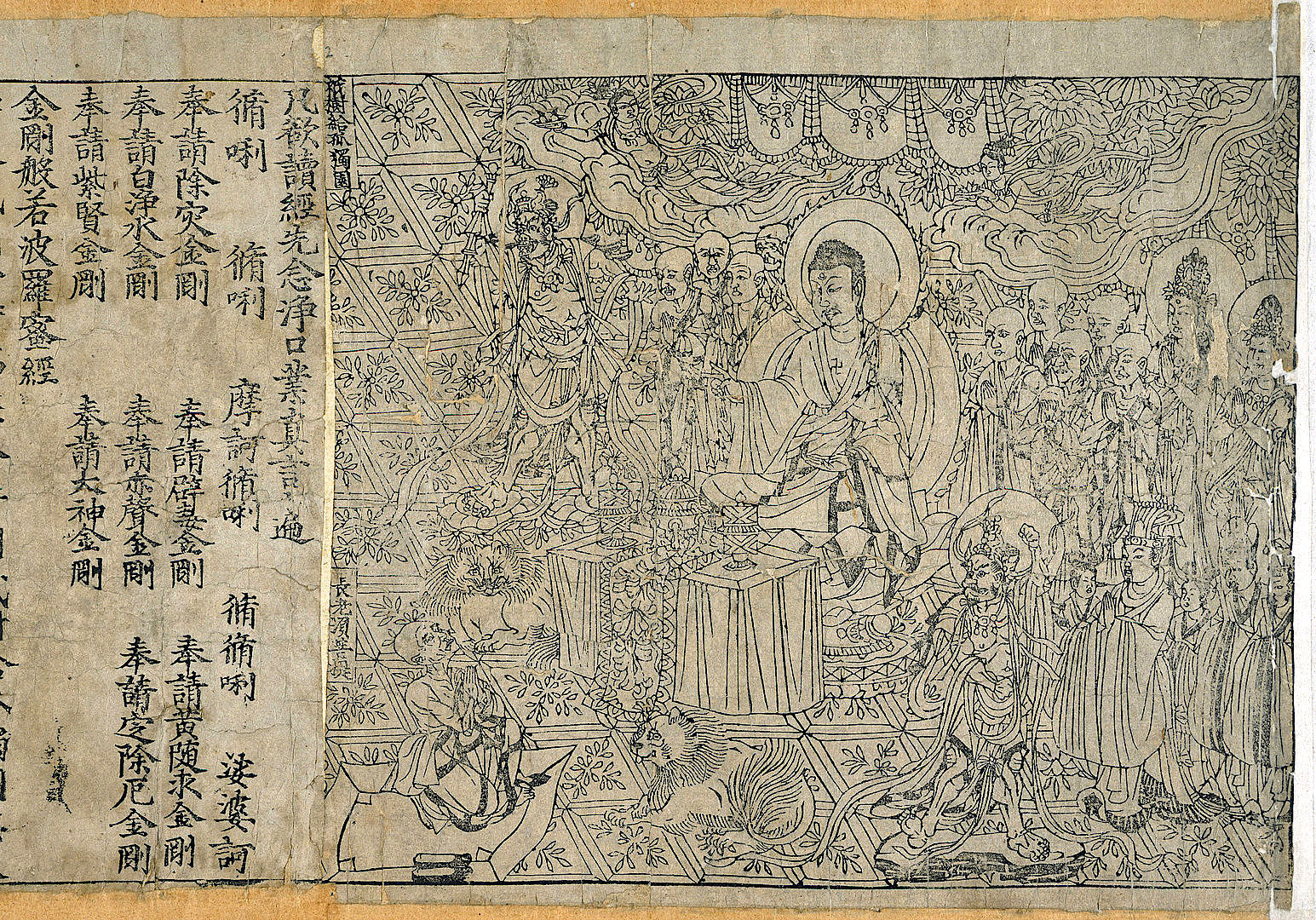
It isn’t easy to say which book is the oldest in the world, because the answer depends on what, exactly qualifies as a book. Dating from the year 868, the Chinese Diamond Sūtra is known as “the world’s earliest dated, printed book,” the words used on the web site of the British Library, which owns the thing itself. It was found in northwest China, “in a holy site called the Mogao (or ‘Peerless’) Caves or the ‘Caves of a Thousand Buddhas,’ which was a major Buddhist centre from the 4th to 14th centuries,” its page explains. “In 1900, a monk named Wang Yuanlu discovered the sealed entrance to a hidden cave, where tens of thousands of manuscripts, paintings and other artifacts had been deposited and sealed up sometime around the beginning of the 11th century.”
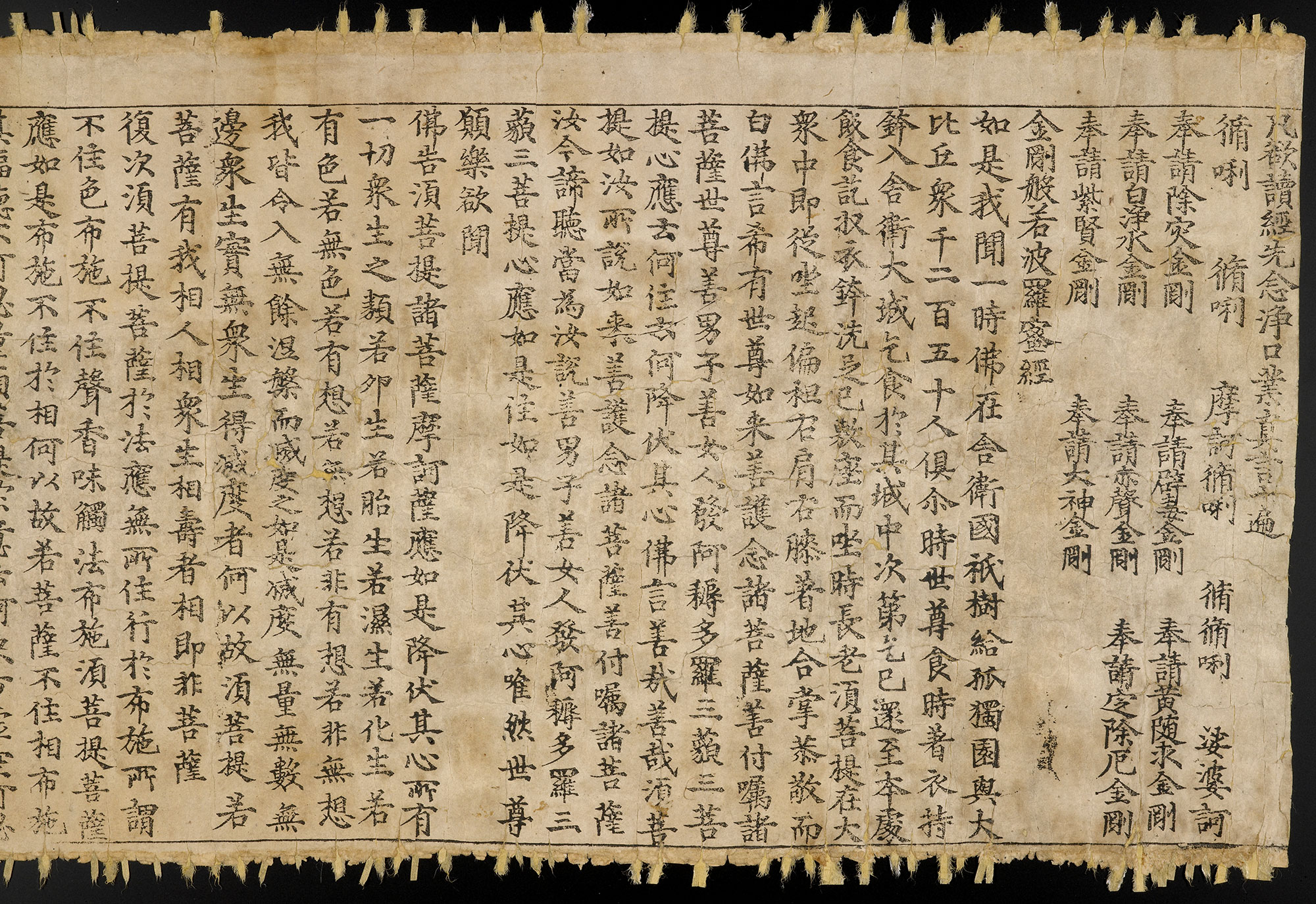
Included in this treasure trove, this copy of the Diamond Sutra “was brought to England by the explorer Sir Aurel Stein in 1907.” With the form of not a‑book-as-we-know-it but “seven strips of yellow-stained paper printed from carved wooden blocks and pasted together to form a scroll 16 feet by 10. 5 inches wide,” as Jeremy Norman writes at Historyofinformation.com, it may not seem all that impressive when seen from a distance.
But “its text, printed in Chinese, is one of the most important sacred works of the Buddhist faith,” a dialogue between the Buddha and one of his pupils on the “perfection of insight” and the nature of reality itself, titled for its potential to cut like a diamond blade through the layers of illusion in which we live.
Today, we need not examine the Chinese Diamond Sutra only at a distance, for The Dunhuang Programme has made a complete digitization of the scroll available on its site. For those who don’t read ninth-century Chinese, the most interesting element will be the frontispiece, which, as Norman writes, “shows the Buddha expounding the sutra to an elderly disciple called Subhuti. That is the earliest dated book illustration, and the earliest dated woodcut print.” The British Library notes that “the finesse in the details evidences the fact that printing had already grown into a mature technology by the ninth century in China,” long before such other famous books as Shakespeare’s First Folio or even the Gutenberg Bible. This is an artifact of great historical value, reflected by the degree of care with which it’s been conserved. But as a believer might add, why focus on the age of a book when the wisdom it offers is timeless? View the Diamond Sutra here.
Related content:
Europe’s Oldest Intact Book Was Preserved and Found in the Coffin of a Saint
The Medieval Masterpiece The Book of Kells Has Been Digitized and Put Online
Oxford University Presents the 550-Year-Old Gutenberg Bible in Spectacular, High-Res Detail
Behold a Digitization of “The Most Beautiful of All Printed Books,” The Kelmscott Chaucer
One of World’s Oldest Books Printed in Multi-Color Now Opened & Digitized for the First Time
Based in Seoul, Colin Marshall writes and broadcasts on cities, language, and culture. His projects include the Substack newsletter Books on Cities, the book The Stateless City: a Walk through 21st-Century Los Angeles and the video series The City in Cinema. Follow him on Twitter at @colinmarshall or on Facebook.
Read More...The Band’s Classic Song, “The Weight,” Sung by Robbie Robertson (RIP) and Musicians Around the World
Yesterday Robbie Robertson, the Canadian songwriter and guitarist for The Band, passed away at age 80 after a long illness. As a tribute, we’re bringing back a video that pays homage to “The Weight,” a song Robertson wrote for The Band’s influential 1968 album, “Music from Big Pink.” The video features cameos of Robertson himself, and also Ringo Starr and other special guests. Enjoy…
Robbie Robertson’s “The Weight,” the Band’s most beloved song, has the quality of Dylan’s impressionistic narratives. Elliptical vignettes that seem to make very little sense at first listen, with a chorus that cuts right to the heart of the human predicament. “Robertson admits in his autobiography,” notes Patrick Doyle at Rolling Stone, “that he struggled to articulate to producer John Simon what the song was even about.” An artist needn’t understand a creation for it to resonate with listeners.
A read of “The Weight”’s lyrics make its poignant themes evident—each stanza introduces characters who illustrate some sorrow or small kindness. The chorus offers what so many people seem to crave these days: a promise of rest from ceaseless toil, freedom from constant transactions, a community that shoulders everyone’s burdens…. “It’s almost like it’s good medicine,” Robertson told Doyle, “and it’s so suitable right now.” He refers specifically to the song’s revival in a dominant musical form of our isolation days—the online sing-along.
Though its lyrics aren’t nearly as easy to remember as, say, “Lean on Me,” Robertson’s classic, especially the big harmonies of its chorus (which everyone knows by heart), is ideal for big ensembles like the globe-spanning collection assembled by Playing for Change, “a group dedicated to ‘opening up how people see the world through the lens of music and art.” The group’s producers, Doyle writes, “recently spent two years filming artists around the world, from Japan to Bahrain to Los Angeles, performing the song,” with Ringo Starr on drums and Robertson on rhythm guitar. They began on the 50th anniversary of the song’s release.
The performances they captured are flawless, and mixed together seamlessly. If you want to know how this was achieved, watch the short behind-the-scenes video above with producer Sebastian Robertson, who happens to be Robbie’s son. He starts by praising the stellar contributions of Larkin Poe, two sisters whose rootsy country rock updates the Allman Brothers for the 21st century. But there are no slouches in the bunch (don’t be intimated out of your own group sing-alongs by the talent on display here). The song resonates in a way that connects, as “The Weight”’s chorus connects its non-sequitur stanzas, many disparate stories and voices.
Robertson was thrilled with the final product. “There’s a guy on a sitar!” he enthuses. “There’s a guy playing an oud, one of my favorite instruments.” The song suggests there’s “something spiritual, magical, unsuspecting” that can come from times of darkness, and that we’d all feel a whole lot better if we learned to take care of each other. The Playing for Change version “screams of unity,” he says, “and I hope it spreads.”
Related Content:
Jeff Bridges Narrates a Brief History of Bob Dylan’s and The Band’s Basement Tapes
Stream Marc Maron’s Excellent, Long Interview with The Band’s Robbie Robertson
Watch The Band Play “The Weight,” “Up On Cripple Creek” and More in Rare 1970 Concert Footage
Martin Scorsese Captures Levon Helm and The Band Performing “The Weight” in The Last Waltz
Josh Jones is a writer and musician based in Durham, NC. Follow him at @jdmagness
Read More...The Live Music Archive Lets You Stream/Download More Than 250,000 Concert Recordings–for Free
The Internet Archive maintains an enormous Live Music Archive of concert recordings, not all of them by the Grateful Dead. There are more than 17,000 such recordings in its Grateful Dead collection — 2,000 more than when last we featured it here on Open Culture — but one must compare that figure to the 250,000 items now in the whole of the LMA. “It would be a great story to have the first item as part of the collection to be some rare Grateful Dead recording from 1968,” says a post at the Internet Archive blog reflecting on the twentieth anniversary of the LMA last year, “but it is actually an unassuming Rusted Root audience recording from August 24, 2001.”
In addition to Rusted Root and the Grateful Dead, you can stream or download a wealth of recorded live shows from bands like Little Feat, Blues Traveler, My Morning Jacket, Los Lobos, and the Smashing Pumpkins, as well as singer-songwriters like Warren Zevon, Elliott Smith, Jack Johnson, Robyn Hitchcock, and John Mayer.
How wide or narrow a variety of musical experiences these names conjure up will, of course, depend on your perspective. But if they do share a major characteristic in common, it’s the fact, to their true fans, their live performances count for as much as — or, often, more than — their studio recordings. The truest (or at least most technically adept) such fans have donated their time and skills to make these live performances freely accessible and endlessly relivable on the LMA.
“For years, concert-goers recorded and traded tapes, but in 2002, the Internet Archive offered a reliable infrastructure to preserve performances files,” writes the Internet Archive’s Caralee Adams in a blog post marking the uploading of 250,000 recordings. “Partnering with the etree music community, the Live Music Archive was established to provide ongoing, free access to lossless and MP3-encoded audio recordings.” Over the past 21 years, “more than 8,000 artists have given permission to have recordings of their shows archived on the Live Music Archive, and users from around the world have listened to files more than 600 million times.” Whether or not you’re into jam bands, if you’ve ever enjoyed live music, have a look through the LMA’s 250 terabytes of recordings made in venues from stadiums to neighborhood coffee shops. There’ll be a concert for you, no charge for admission.
Related content:
Stream a Massive Archive of Grateful Dead Concerts from 1965–1995
BBC Launches World Music Archive
Based in Seoul, Colin Marshall writes and broadcasts on cities, language, and culture. His projects include the Substack newsletter Books on Cities, the book The Stateless City: a Walk through 21st-Century Los Angeles and the video series The City in Cinema. Follow him on Twitter at @colinmarshall or on Facebook.
Read More...Watch Fritz Lang’s Metropolis with a Modern, New Electronic Soundtrack (1927)
From sound artist Tomer Baruch and drummer Alex Brajković comes a new electronic soundtrack for Fritz Lang’s century-old classic film, Metropolis. The new score comes with this preface:
One of the most significant themes in the dystopian feature is the blurred-to-nonexistent line separating man and machine; Human-like machines, Mechanical-humans, real-life android deepfakes, and above all the city of Metropolis, an enormous machine and within it men, slaved to maintain its operation. The theme that was disturbing in the beginning of the 20th century is as relevant as ever with the latest developments in AI, forcing us to rethink again what makes us human.
In analogy to that the soundtrack is based on archive recordings of early 20th century machinery, on top of which Tomer Baruch and Alex Brajkovic play analog synthesizers and drums. They interface with the machines and embody a relentlessly repetitive mechanical motion, one which is usually sequenced or programmed. By creating music which is in itself blurring the line between man and machine, by subjecting themselves to machine-like patterns, the musicians become a part of Metropolis, creating a disillusioned, intensified and darker than ever soundtrack for the film.
Baruch and Alex Brajković created the soundtrack for the Sounds of Silence Film Festival, Den Haag in 2019. Stream it above.
If you would like to support the mission of Open Culture, consider making a donation to our site. It’s hard to rely 100% on ads, and your contributions will help us continue providing the best free cultural and educational materials to learners everywhere. You can contribute through PayPal, Patreon, and Venmo (@openculture). Thanks!
Related Content
If Fritz Lang’s Iconic Film Metropolis Had a Kraftwerk Soundtrack
Read the Original 32-Page Program for Fritz Lang’s Metropolis (1927)
See Metropolis‘ Scandalous Dance Scene Colorized, Enhanced, and Newly Soundtracked
Read More...William Friedkin, RIP: Why the 80s Action Movie To Live and Die in L.A. Is His “Subversive Masterpiece”
William Friedkin, who died yesterday, will be most widely remembered as the director of nineteen-seventies genre hits like The French Connection and The Exorcist. But it was in the subsequent decade that he made his most impressive picture, at least according to the Paper Starship video essay above. As its narrator Marcus Muscato puts it, Friedkin’s To Live and Die in L.A. came out in 1985 as “a perfect blending of the crime and renegade cop genres, drenched brilliantly in eighties aesthetic and nihilistic existential glory.” Over nearly half an hour, he breaks down every major element of this “subversive masterpiece,” from its simultaneously slick and dingy look and feel to its technical and narrative brazenness to its soundtrack by none other than Wang Chung.
Like Friedkin’s earlier crime films, To Live and Die in L.A. traces “the thin line between cops and criminals, stating how some of the best cops have some criminal in them, or have been criminals themselves.” It does most of this through the character of Secret Service agent Richard Chance, played by William Petersen as a kind of “nihilistic Fonzie.” In pursuit of Willem Dafoe’s sinister artist-counterfeiter Rick Masters, Chance shows no caution, and his daring-to-the-point-of-reckless dedication. Friedkin matched it with his own “spontaneous, anti-authoritarian guerrilla filmmaking,” covertly shooting and using performances his actors (whom he wasn’t above encouraging to do some rule-breaking of their own) had been led to believe were rehearsals.
Friedkin and his collaborators meticulously planned and painstakingly executed other sequences, such as the central car chase. “The chase isn’t just on a freeway. It goes the wrong way down the freeway,” wrote Roger Ebert in his contemporary review. “I don’t know how Friedkin choreographed this scene, and I don’t want to know.” However astonishing (and anxiety-inducing) it remains today, it wouldn’t be as effective without the “hypnotizing yet energetic atmosphere” created throughout the film by the music of Wang Chung, a band both indelibly associated with the eighties and also possessed of a penchant for unconventional, even sinister sonic textures. That’s true even of their earlier singles: witness how well “Wait,” released in 1983, suits the vertiginous plunge of the film’s startling but chillingly inevitable ending.
Yet even this conclusion is just one memorable part among many. “Along with one of the greatest chase scenes, the film contains one of the most authentic and aesthetically pleasing depictions of the money counterfeiting process,” Muscato says. Those with an aversion to spoilers would do best to watch the movie itself before the video essay, but like the work of any respectable auteur, it draws its power from much more than plot twists. Its main theme, as Friedkin himself put it, was the “counterfeit world: counterfeit emotions, counterfeit money, the counterfeit superstructure of the Secret Service. Everyone in the film has a kind of counterfeit motive.” Given that the world has become no more real over the past four decades, perhaps it’s no wonder that To Live and Die in L.A. holds up so well today.
Related content:
Watch Randy Newman’s Tour of Los Angeles’ Sunset Boulevard, and You’ll Love L.A. Too
Based in Seoul, Colin Marshall writes and broadcasts on cities, language, and culture. His projects include the Substack newsletter Books on Cities, the book The Stateless City: a Walk through 21st-Century Los Angeles and the video series The City in Cinema. Follow him on Twitter at @colinmarshall or on Facebook.
Read More...When Mississippi Tried to Ban Sesame Street for Showing a “Highly Integrated Cast” (1970)
On November 10, 1969, Sesame Street made its broadcast debut.
The very first lines were spoken by Gordon (Matt Robinson), a Black schoolteacher who’s showing a new kid around the neighborhood, introducing her to a couple of other kids, along with Sesame Street adult mainstays Bob, Susan, and Mr. Hooper, and Big Bird, whose appearance had yet to find its final form:
Sally, you’ve never seen a street like Sesame Street. Everything happens here. You’re gonna love it.
The milieu would have felt familiar to children growing up on New York City’s Upper West Side, or Harlem or the Bronx. While not every block was as well integrated as Sesame Street’s cheerful, deliberately multicultural, brownstone setting, any subway ride was an opportunity to rub shoulders with New Yorkers of all races, classes and creeds.
Not six months later, the all-White Mississippi State Commission for Educational Television voted 3 to 2 to remove Sesame Street from their state’s airwaves.
A disgruntled pro-Sesame commission member leaked the reason to The New York Times:
Some of the members of the commission were very much opposed to showing the series because it uses a highly integrated cast of children.
The whistleblower also intimated that those same members objected to the fact that Robinson and Loretta Long, the actor portraying Susan, were Black.
They claimed Mississippi was “not yet ready” for such a show, even though Sesame Street was an immediate hit. Professionals in the fields of psychology, education, and medicine had consulted on its content, helping it secure a significant amount of federal and private grants prior to filming. The show had been lauded for its main mission — preparing American children from low-income backgrounds for kindergarten through lively educational programming with ample representation.
Kids growing up in sheltered, all-white enclaves stood to gain, too, by being welcomed into a television neighborhood where Black and white families were shown happily coexisting, treating each other with kindness, patience and respect. (Sonia Manzano and Emilio Delgado, who played Maria and Luis, joined the cast soon after.)
Even though Alabama, Arkansas, Florida, Louisiana and Tennessee also moved to pre-empt the innovative hit show, the government appointees on the Mississippi State Commission for Educational Television who’d ousted Sesame Street found themselves outnumbered when Jackson residents of all ages staged a protest in front of Mississippi Public Broadcasting’s HQ.]
The Delta Democrat-Times published an editorial piece arguing that “there is no state which more desperately needs every educational tool it can find than Mississippi:”
There is no educational show on the market today better prepared than Sesame Street to teach preschool children what many cannot or do not learn in their homes….The needs are immense.
After 22 days, the ban was rolled back and Sesame Street was reinstated.
That fall, the cast made a pitstop in Jackson during a 14-city national tour. Susan, Gordon, Bob, Mr. Hooper and Big Bird sang and joked with audience members as part of an event co-sponsored by the very same commission that had tried to blackball them, and left without having received a formal apology.
Sesame Street has stayed true to its progressive agenda throughout its fifty+ year history, a commitment that seems more essential than ever in 2023.
Below, Elmo, a Muppet who rose through the ranks to become a Sesame Street star engages in an entry-level conversation about race with some newer characters in an episode from two years ago.
The Sesame Workshop recommends it for viewers aged 1 to 4, though it seems our country doesn’t lack for adult citizens who could do with a refresher on the subject…
Related Content
Watch Twin Beaks, Sesame Street’s Parody of David Lynch’s Iconic TV Show (1990)
Philip Glass Composes Music for a Sesame Street Animation (1979)
– Ayun Halliday is the Chief Primatologist of the East Village Inky zine and author, most recently, of Creative, Not Famous: The Small Potato Manifesto and Creative, Not Famous Activity Book. Follow her @AyunHalliday.
Read More...How to Enter Flow State, Increase Your Ability to Concentrate, and Let Your Ego Fall Away : An Animated Primer
One needs hardly state that human beings desire things like wealth, power, and love. But it does bear repeating that, on a deeper level, we all desire flow. To say this is to repeat, in one form or another, the theories of the late psychologist Mihaly Csikszentmihalyi, author of Flow: The Psychology of Optimal Experience. When we enter a flow state, Csikszentmihalyi once said in an interview, “the ego falls away,” and it is those words that open the animated TED-Ed lesson above. “A unique mental state of effortless engagement,” says its narrator, flow has been defined as “an altered state of consciousness,” and those who enter it “feel so effortlessly engaged in a task that time seems to fly by.”
If you’re a normal twenty-first-century person, this may not sound like an especially familiar experience. In fact, you may well think of your working life as more characterized by “cycles of procrastination, when it can feel impossible to start an activity.”
During flow, by contrast, “it can feel difficult to stop”; “feelings of worry or self-judgment” are diminished; a “sense of oneness” can arise between yourself and your activity. This state occurs when you do “intrinsically motivating” work, and even more so when the difficulty of that work matches or just slightly exceeds your skill level: “If a task is too easy, you may get distracted or feel bored. If it’s too challenging, you may become discouraged.”
To maximize your own chances of finding flow, engage in “activities that have clear goals and allow you to assess your progress along the way.” If possible, do it in “a quiet environment, free from distracting noises or devices.” Before you start, “break your tasks into small, specific segments that are easy to track and learn from,” and also “set clear end goals that are challenging, but not frustratingly so.” Above all, “don’t focus too much on reaching flow; that sort of distraction might just prevent you from finding it.” The talks by Flow Research Collective founder Steven Kotler and by Cskizentmihalyi himself previously featured here on Open Culture can supplement the TED-Ed lesson — and, perhaps, reassure you that the strange puckered expressions on the face of its characters are not, in fact, a requirement for entering the flow state.
Related Content:
How to Get into a Creative “Flow State”: A Short Masterclass
How to Enter a ‘Flow State’ on Command: Peak Performance Mind Hack Explained in 7 Minutes
The Philosophy of “Flow”: A Brief Introduction to Taoism
Based in Seoul, Colin Marshall writes and broadcasts on cities, language, and culture. His projects include the Substack newsletter Books on Cities, the book The Stateless City: a Walk through 21st-Century Los Angeles and the video series The City in Cinema. Follow him on Twitter at @colinmarshall or on Facebook.
Read More...Novelist Michael Chabon Digitally Re-Creates the Science Fiction & Fantasy Section of His Favorite 1970s Bookstore
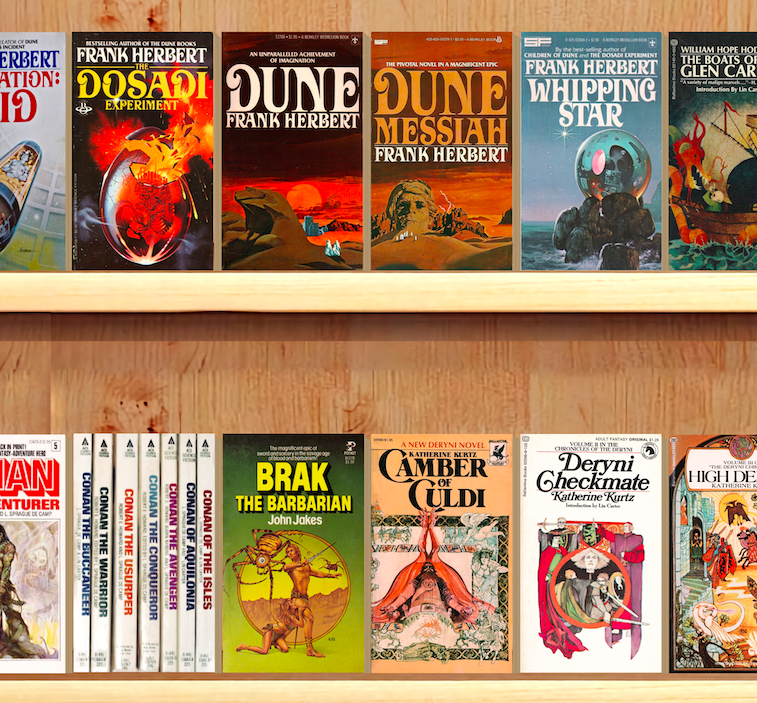
Michael Chabon was born in 1963, which placed him well to be influenced by the unpredictable, indiscriminate, and often lurid cultural cross-currents of the nineteen-seventies. He seemed to have received much of that influence at Page One, the local bookstore in his hometown of Columbia, Maryland — and it was to Page One that his imagination drifted during the long days of the COVID-19 pandemic spent in his personal library. “As I sat around communing with my tattered old friends,” he writes, “I discovered that I retained a sharp recollection — title, author, cover design — of what felt like every single book that had ever appeared on those tall shelves along the left wall of Page One, toward the back, between 1972 and 1980.”
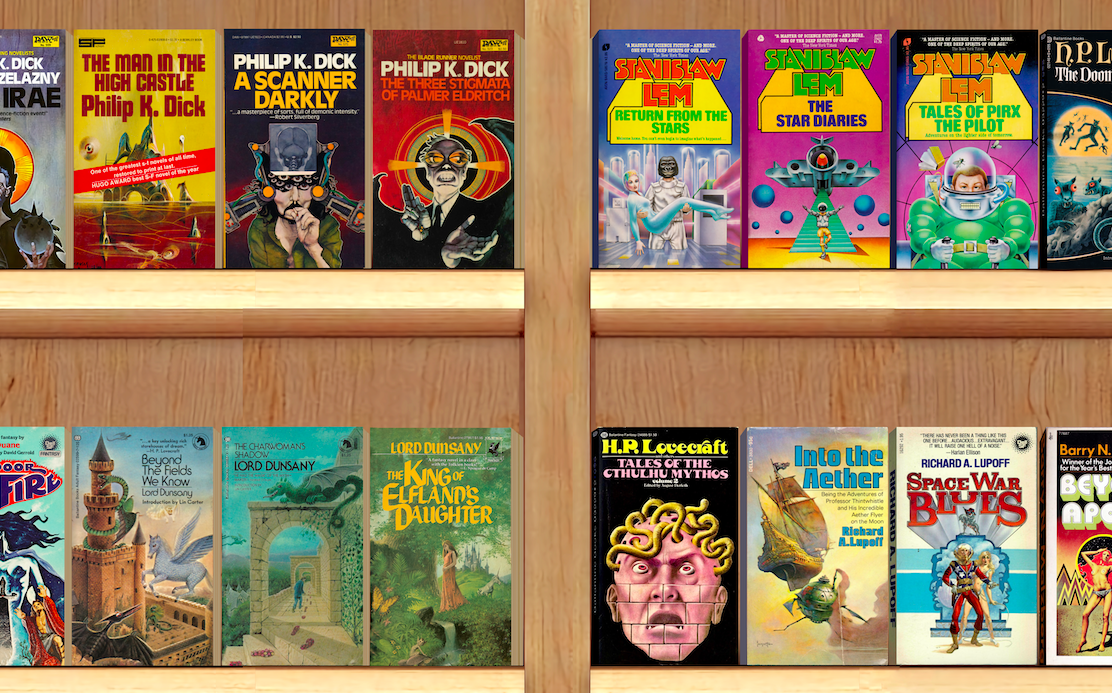
That was the store’s “Science Fiction & Fantasy” section, which in that period was well-stocked with titles by such stars of those genres as Ray Bradbury, Ursula K. LeGuin, Arthur C. Clarke, J. G. Ballard, C. J. Cherryh, Michael Moorcock, and Philip K. Dick.
Or at least it did if Chabon’s digital re-creation “The Shelves of Time” is anything to go by. Downloadable here in “small” (96 MB), “large” (283 MB) and “very large” (950 MB) formats, the lavish image functions as what Chabon calls a “time telescope,” offering “a look back at the visuals that embodied and accompanied my early aspirations as a writer, and at the mass-market splendor of paperback sf and fantasy in those days.”
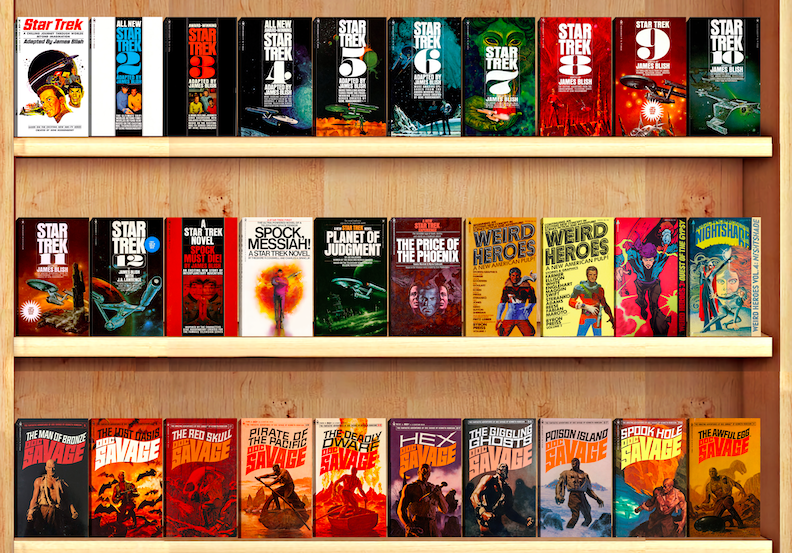
“I’m the same age as Chabon, and I was also a bookstore rat, staring at these exact same covers and agonizing over which one I’d lay down my $1.25 for,” writes Ruben Bolling at Boing Boing. “Just look at those beautiful John Carter of Mars covers. I collected and cherished these, and the Tarzan series.” Bolling also highlights the adaptations Chabon includes on these re-imagined shelves: there’s “the James Blish Star Trek series, just as I remember it,” and also the novelization of Star Wars, which he read before the opening of the film itself. “So instead of experiencing the movie as it should have been — as campy movie fun — I experienced it as an adaptation of a literary work.”
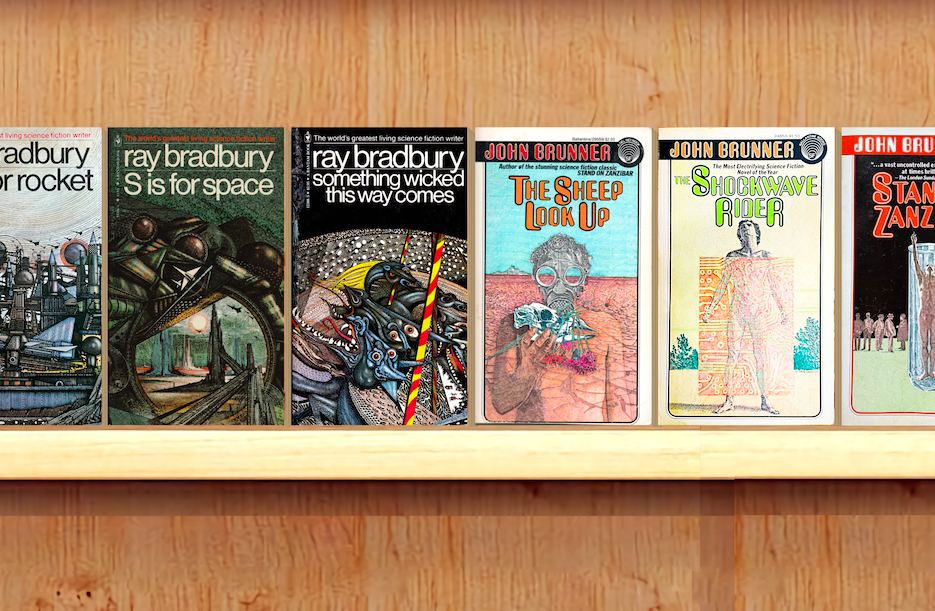
Despite being a couple of decades younger, I, too, remember these covers vividly. My own sci-fi-and-fantasy period occurred in the late nineties, by which time these very same mass-market paperbacks from the seventies were turning up in quantity at used bookstores. For me, few images from these genres of that era could trigger reading memories as rich as those Ballantine covers of The Sheep Look Up, The Shockwave Rider, and Stand on Zanzibar by John Brunner, a British specialist in social and environmental catastrophe. Like many readers, I put this sort of thing aside after a few years, but Chabon has proven infinitely more dedicated: half a century after his days haunting Page One, his mission to “drag the decaying corpse of genre fiction out of the shallow grave where writers of serious literature abandoned it,” as critic Ruth Franklin once described it, continues apace.
via Boing Boing
Related content:
The Art of Sci-Fi Book Covers: From the Fantastical 1920s to the Psychedelic 1960s & Beyond
Novelist Michael Chabon Sang in a Punk Band During the ’80s: Newly Released Audio Gives Proof
600+ Covers of Philip K. Dick Novels from Around the World: Greece, Japan, Poland & Beyond
The Amazing Adventures of Kavalier and Clay: Animation Concepts
The Encyclopedia of Science Fiction: 17,500 Entries on All Things Sci-Fi Are Now Free Online
Based in Seoul, Colin Marshall writes and broadcasts on cities, language, and culture. His projects include the Substack newsletter Books on Cities, the book The Stateless City: a Walk through 21st-Century Los Angeles and the video series The City in Cinema. Follow him on Twitter at @colinmarshall or on Facebook.
Read More...Support Us
We're hoping to rely on loyal readers, rather than erratic ads. Please click the Donate button and support Open Culture. You can use Paypal, Venmo, Patreon, even Crypto! We thank you!

About Us

Open Culture scours the web for the best educational media. We find the free courses and audio books you need, the language lessons & educational videos you want, and plenty of enlightenment in between.
Advertise With Us
FREE UPDATES!
GET OUR DAILY EMAIL
Get the best cultural and educational resources on the web curated for you in a daily email. We never spam. Unsubscribe at any time.
FOLLOW ON SOCIAL MEDIA
Open Culture editor Dan Colman scours the web for the best educational media. He finds the free courses and audio books you need, the language lessons & movies you want, and plenty of enlightenment in between.
Advertise With Us

