Tom Jones & Chuck Berry Perform Together, Singing “Roll Over Beethoven” & “Memphis” (1974)
Another chapter from the Annals of Unlikely Performances…
Last week, we highlighted Chuck Berry performing with the Bee Gees on a 1973 episode of the Midnight Special. It’s a pairing that doesn’t work on paper. But, on stage, it’s magic. The same goes for when Berry sang with Tom Jones on a 1974 episode of the same show. It’s magic once again.
If you’re a veteran OC reader, you know that Jones could sing with anyone. On his variety show, This Is Tom Jones, he shared the stage with Janis Joplin, not to mention Crosby, Stills, Nash & Young, and Stevie Wonder. It worked. Just watch the expression on Janis and Crosby’s face.
Now 83, Tom Jones and his voice are still going strong. Below, you can watch him sing “Samson And Delilah” in 2021.
If you would like to support the mission of Open Culture, consider making a donation to our site. It’s hard to rely 100% on ads, and your contributions will help us continue providing the best free cultural and educational materials to learners everywhere. You can contribute through PayPal, Patreon, and Venmo (@openculture). Thanks!
Related Content
Janis Joplin & Tom Jones Bring the House Down in an Unlikely Duet of “Raise Your Hand” (1969)
Read More...The Lunar Codex Will Digitize the Work of 30,000 Artists, and Then Archive Them on the Moon

There may not yet be civilization on the moon, but that doesn’t mean there’s no culture up there. We’ve previously featured the tiny ceramic tile, smuggled onto the Apollo 12 lunar lander, that bears art by the likes of Claes Oldenburg, Robert Rauschenberg, and Andy Warhol. “Fallen Astronaut, an aluminum sculpture by the Belgian artist Paul van Hoeydonck, was left on the lunar surface by the Apollo 15 crew in 1971,” writes the New York Times’ J. D. Biersdorfer. “The Arch Mission Foundation has sent Isaac Asimov’s Foundation trilogy and millions of Lunar Library pages into space,” and artists like Jeff Koons and Sacha Jafri are among the artists currently aiming to install their own work on the moon’s surface.
The Lunar Codex has grander ambitions, having assembled works from “over 30,000 artists, writers, musicians, and filmmakers, from 158 countries, in four time capsules launched to the moon.” You can browse their contents at the project’s official web site, which breaks it all down into not just eight “galleries” of visual art, but also sections dedicated to film, television, music, and poetry, among other forms and media. There’s even a section for books and novels (as well as another, oddly, for novels and books), which includes a large number of curious titles to represent the achievements of human civilization: Kamikaze Kangaroos, Goofy Newfies, Don’t Taco ‘Bout Murder, In Bed with Her Millionaire Foe.
Also among all these books, stored on either digital memory cards or a nickel-based medium called NanoFiche, is The Zoo at the End of the World by one Samuel Peralta, who also happens to be the mastermind of the Lunar Codex project. “A semiretired physicist and author in Canada with a love of the arts and sciences,” Peralta has selected for preservation on the moon everything from “prints from war-torn Ukraine” to “more than 130 issues of PoetsArtists magazine” to images like “New American Gothic, by Ayana Ross, the winner of the 2021 Bennett Prize for women artists; Emerald Girl, a portrait in Lego bricks by Pauline Aubey; and the aptly titled New Moon, a 1980 serigraph by Alex Colville.”
All the work to be placed on the moon through the Lunar Codex was created by artists who are now active, or have been active in the past decade or two. As such, it reflects a particular moment in the cultural history of humanity, constituting what Peralta calls “a message in the bottle for the future that during this time of war, pandemic and economic upheaval people still found time to create beauty.” They also found time to create podcasts, as will be evidenced by the inclusion of a quarter-century-long archive of Grace Cavalieri’s interview show The Poet and the Poem, which has reached a new audience in recent years through that relatively new format — one that, to future generations of spacefarers making a stop on the moon, will offer as good a representation as any of life on Earth in the twenty-first century.
Related content:
There’s a Tiny Art Museum on the Moon That Features the Art of Andy Warhol & Robert Rauschenberg
NASA Puts Online a Big Collection of Space Sounds, and They’re Free to Download and Use
Based in Seoul, Colin Marshall writes and broadcasts on cities, language, and culture. His projects include the Substack newsletter Books on Cities, the book The Stateless City: a Walk through 21st-Century Los Angeles and the video series The City in Cinema. Follow him on Twitter at @colinmarshall or on Facebook.
Read More...The 5 Innovative Bridges That Make New York City, New York City
The Brooklyn Bridge ignites the passions of tourists and locals alike.
For every 10,000 visitors who pause in its bike lanes to snap selfies, there’s an alum of nearby PS 261 who celebrated its birthday with a song that mentions the fates of its engineers John and Washington Roebling to the tune of I’ve Been Working on the Railroad.
(A sample chorus: Caisson’s disease! Caissons disease! Caisson’s disease is really bad!)
Native son Adam Suerte of Brooklyn Tattoo estimates that he inks its likeness on a half dozen customers per month. (A temporary option is available for those with commitment issues…)
In 1886, a hustler named Steve Brodie claimed to have survived a jump off of it, a tale propagated by Bugs Bunny.
We watch movies at its feet and draw attention to causes by marching across it.
It continues to mesmerize artists, poets, filmmakers and photographers.
But, as architect Michael Wyetzner makes clear in his most recent video for Architectural Digest, it’s not the only bridge in New York City.
Also, despite what you may have heard, it’s not for sale.
Understandably, the hybrid cable-stayed/suspension superstar connecting Brooklyn to lower Manhattan takes the lead in Wyetzner’s coverage of five bridges that have had an enormous impact on the development of a city whose five boroughs were once traversable solely by ferry.
The other notable players:
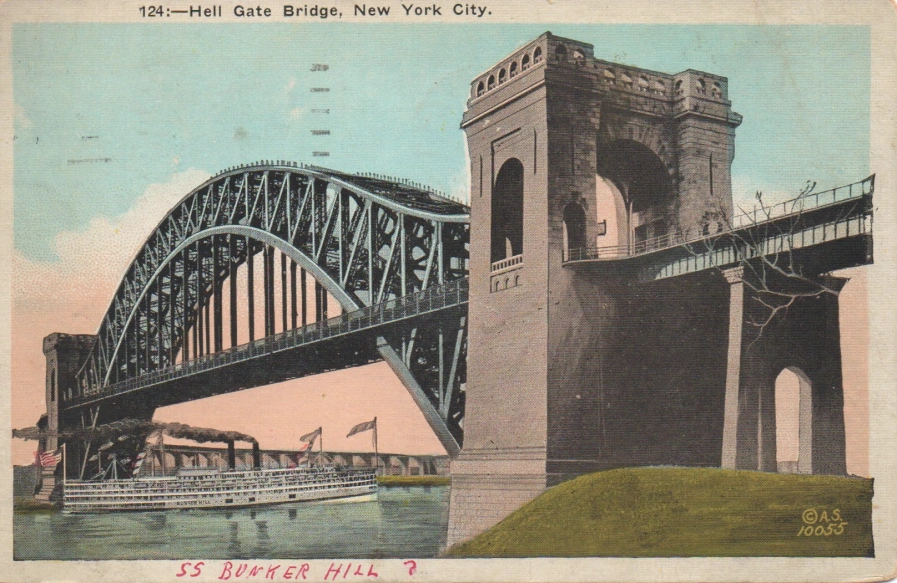
The Hell Gate Bridge — a feat of WWI-era railroad engineering connecting Queens to Randall’s and Wards Island over a particularly perilous stretch of waterway, it was once the longest steel arch bridge in the world.
In his 1921 book New York: The Great Metropolis, painter Peter Marcus noted that “if laid over Manhattan it would reach from Wanamaker’s store at Eighth Street, to One Hundred and Twenty-fifth Street.”
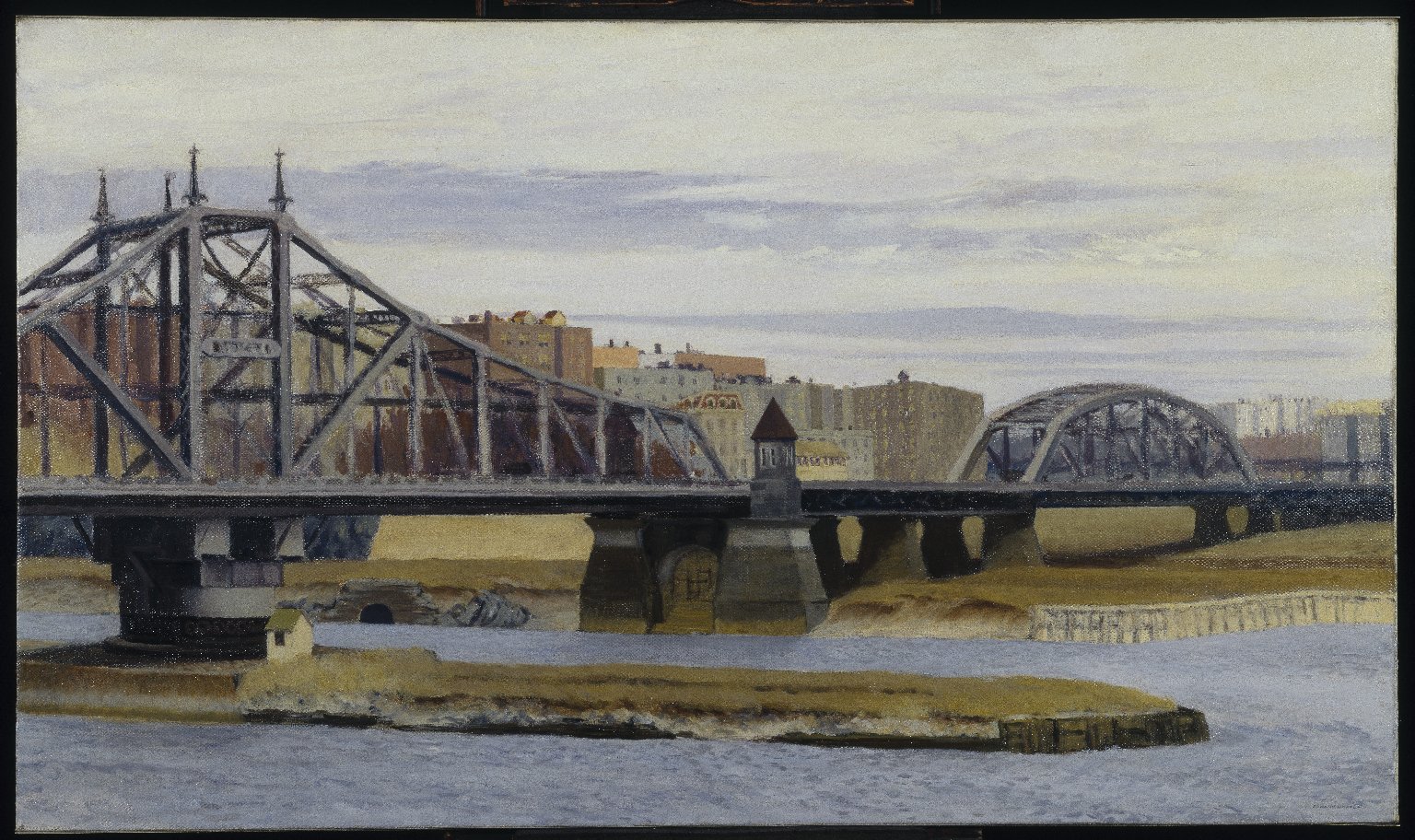
Macomb’s Dam Bridge, a low lying swing bridge whose center portion pivots to accommodate boat traffic on the Harlem River. When construction began in late 1890, the New York Times gushed that it would be a “street built in mid-air” between the Bronx and Washington Heights in upper Manhattan:
It is hardly enough to say of it that it will be the greatest piece of engineering of the kind in the world. Nothing like it has ever been attempted.
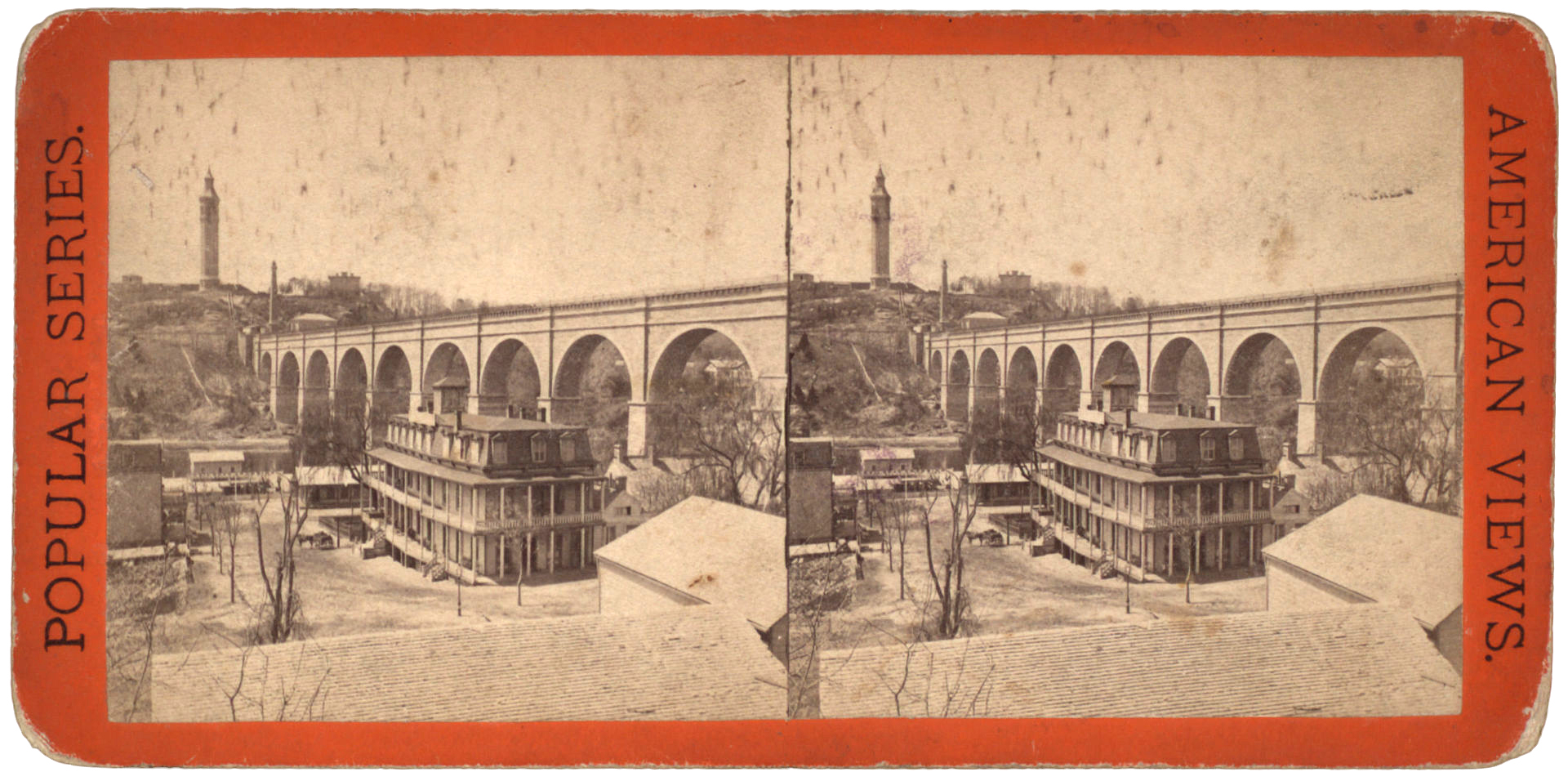
The High Bridge - Originally part of the Croton Aqueduct, it is technically the oldest surviving bridge in the city, as well as a community-led preservation campaign success story. Having languished in the latter part of the 20th century, it is now a beautiful pedestrian bridge whose killer views can be enjoyed without the hassle of Brooklyn Bridge-sized crowds.
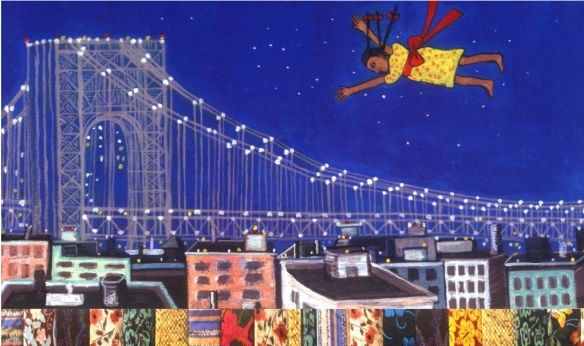
The George Washington Bridge - a major money maker for the Port Authority, it’s not only the world’s busiest bridge, it puts a lot of the bridge in “bridge and tunnel crowd” by connecting Manhattan to New Jersey.
Architecture buffs can geek out on the Concrete Industry Board Award-winning bus station and storied Little Red Lighthouse in its shadow.
The GWB’s most ardent fan has got to be artist Faith Ringgold, who immortalized it in her Tar Beach story quilt and related children’s book:
I never want to be more than three minutes from the George. I could always see it as I grew up. That bridge has been in my life for as long as I can remember. As a kid, I could walk across it anytime I wanted. I love to see it sparkling at night. I moved to New Jersey, and I’m still next to it.
Wyetzner, whose architectural round up shoehorns in a lot of interesting information about public health, economics, transportation, labor practice and New York City history, is actively courting viewers to suggest bridges for a sequel.
We’ll throw our weight behind the Manhattan, the Williamsburg, the Queensboro, the Verrazzano, and the admittedly dark horse 103rd Street Footbridge.
You?
Related Content
A Mesmerizing Trip Across the Brooklyn Bridge: Watch Footage from 1899
An Online Gallery of Over 900,000 Wonderful Photos of Historic New York City
– Ayun Halliday is the Chief Primatologist of the East Village Inky zine and author, most recently, of Creative, Not Famous: The Small Potato Manifesto and Creative, Not Famous Activity Book. Follow her @AyunHalliday.
Read More...How the Human Population Reached 8 Billion: An Animated Video Covers 300,000 Years of History in Four Minutes
Having come out less than two weeks ago, the American Museum of Natural History video above incorporates up-to-date information on the number of human beings on planet Earth. But what’s interesting here isn’t so much the current global-population figure (eight billion, incidentally) as how we reached it. That story emerges through an animated visualization that compresses a period of 300,000 years — with all its migrations, its growing and declining empires, its major trade routes, its technological developments, its plagues, and its wars — into about four and a half minutes.
“Modern humans evolved in Africa about 300,000 years ago,” says the video’s explanatory text. “Around 100,000 years ago, we began migrating around the globe,” a process that shows no signs of stopping here in the twenty-first century.
The same can’t be said for the way our numbers have increased over the past few hundred years, at least according to the projection that “global population will peak this century” around ten billion, due to “average fertility rates falling in nearly every country.” For some, this is not entirely unwelcome, given that “as our population grows, so has our use of Earth’s resources.”
It’s been a while since the developed world has felt a widespread fear of overpopulation, which had a climate change-like power to inspire apocalyptic visions in the nineteen-seventies. Nowadays, we’re more likely to hear warnings of imminent global population collapse, with low-birthrate countries like South Korea, where I live, held up as cautionary demographic examples. From another perspective, the patterns of humanity’s expansion thus far could also be used to illustrate calls to explore and colonize other planets, not least to secure our species a path to survival should something go seriously wrong here on Earth. However our population graph changes in the future, we can rest assured that we’ll always think of ourselves as living at one kind of decisive moment or another.
Related content:
Hans Rosling Uses Ikea Props to Explain World of 7 Billion People
How Humans Migrated Across The Globe Over 200,000 Years: An Animated Look
Colorful Animation Visualizes 200 Years of Immigration to the U.S. (1820-Present)
Who Is the World’s Most Typical Person?
Based in Seoul, Colin Marshall writes and broadcasts on cities, language, and culture. His projects include the Substack newsletter Books on Cities, the book The Stateless City: a Walk through 21st-Century Los Angeles and the video series The City in Cinema. Follow him on Twitter at @colinmarshall or on Facebook.
Read More...Watch Rare Videos Showing Steely Dan Performing Live During the Early 1970s
The band performing in the video above is Steely Dan. Yet it doesn’t sound quite like Steely Dan, an impression partially explained by it being a live show rather than the kind of perfectionist studio recordings for whose meticulous construction (and repeated reconstruction) the group’s very name has long been a byword. But its founding masterminds Walter Becker and Donald Fagen hadn’t yet settled into that complexly pristine aesthetic at the time of this appearance, which aired fifty years ago next week on The Midnight Special. Back then, having put out only their first couple of albums, they could still present their project as a relatively conventional early-seventies rock band.
It helped that they had a relatively conventional frontman in singer David Palmer, who handles lead vocals on their Midnight Special performance of “Do It Again,” Steely Dan’s first hit. That he didn’t do so on the studio recording underscores that the band is genuinely playing live, not miming to a backing track, as was standard practice on other music shows.
It also constitutes another reason this version sounds “off” to a serious Danfan, but it would take a truly blinkered purism (a condition widespread among the ranks of Danfans, admittedly) not to appreciate this performance, especially when it gets around to the solo by the band’s original guitarist Denny Dias — another of which comes along in “Reelin’ in the Years,” played in the video just above.
Not that one guitarist could suffice for Steely Dan, even in this early lineup: they also had Jeff “Skunk” Baxter, now regarded as one of the finest studio players in the subgenre of “yacht rock.” Baxter appears prominently in their live rendition of “Show Biz Kids,” albeit as just one element of the full stage necessary to reproduce that song live. Unlike “Do It Again” and “Reelin’ in the Years,” two singles from Steely Dan’s album Can’t Buy a Thrill, “Show Biz Kids” comes from their then-newly released follow-up Countdown to Ecstasy, which offered a richer realization of both Steely Dan’s distinctive sound and even more distinctive worldview. To the refinement of that sound and worldview Becker and Fagen would devote themselves less than a year after their Midnight Special broadcast, when they quit live performance entirely for the comforts and rigors of their natural habitat: the recording studio.
Related Content:
Deconstructing Steely Dan: The Band That Was More Than Just a Band
How Steely Dan Wrote “Deacon Blues,” the Song Audiophiles Use to Test High-End Stereos
Based in Seoul, Colin Marshall writes and broadcasts on cities, language, and culture. His projects include the Substack newsletter Books on Cities, the book The Stateless City: a Walk through 21st-Century Los Angeles and the video series The City in Cinema. Follow him on Twitter at @colinmarshall or on Facebook.
Read More...Chuck Berry & the Bee Gees Perform Together in 1973: An Unexpected Video from The Midnight Special Archive
During the 1970s, Burt Sugarman produced The Midnight Special, a late-night musical variety show that featured great rock and pop music performances. In recent months, Sugarman has started bringing the show’s archive to YouTube, allowing you to revisit vintage performances by David Bowie, Steely Dan, Tina Turner, Fleetwood Mac, Blondie, Richard Pryor and much more. Above, you can watch one such gem in the archive–that is, Chuck Berry & the Bee Gees performing Reelin’ and Rockin’ (a song originally released as a B‑side with “Sweet Little Sixteen” in 1957). As one YouTuber put it, “what an odd combination that absolutely works; one of Chuck’s most satisfying performances of this era; his guitar’s in tune, the band is hot & supportive (who’s that piano player?!), and it’s always cool to hear Maurice sing solo.” The performance took place on October 12, 1973. Enjoy.
If you would like to support the mission of Open Culture, consider making a donation to our site. It’s hard to rely 100% on ads, and your contributions will help us continue providing the best free cultural and educational materials to learners everywhere. You can contribute through PayPal, Patreon, and Venmo (@openculture). Thanks!
Related Content
Chuck Berry Takes Keith Richards to School, Shows Him How to Rock (1987)
Read More...Neuroscientists Reconstruct a Pink Floyd Song from Listeners’ Brain Activity, with a Little Help from AI
Anyone who’s worked in an operating room knows that many surgeons like to put on music while they do their job, and that their working soundtracks often include surprising artists. It hardly requires a leap of imagination to assume that there are more than a few scalpel-wielding Pink Floyd fans out there — scalpel-wielding Pink Floyd fans who will surely feel their musical taste vindicated by a study that involved playing “Another Brick in the Wall (Part 1)” to patients undergoing epilepsy-related neurosurgery. Afterward, with help from artificial intelligence, the researchers were able to reconstruct the song from those patients’ recorded brainwaves.
That this turns out to be possible offers “a first step toward creating more expressive devices to assist people who can’t speak,” writes the New York Times’ Hana Kiros. “Over the past few years, scientists have made major breakthroughs in extracting words from the electrical signals produced by the brains of people with muscle paralysis when they attempt to speak. But a significant amount of the information conveyed through speech comes from what linguists call ‘prosodic’ elements, like tone.”
It is the musical elements of speech, one might say, that have so far eluded reproduction by existing brain-machine interfaces, whose sentences “have a robotic quality akin to how the late Stephen Hawking sounded when he used a speech-generating device,” as Robert Sanders writes in Berkeley News.
You can hear a clip of “Another Brick in the Wall (Part 1)” as generated from the researchers’ AI work with brainwave data in the Euronews video above. Indistinct though it may sound, the song will come through recognizably even to the ears of casual Pink Floyd fans (irked though they’ll be by the video’s accompanying it with the cover image from The Dark Side of the Moon). They may also feel the urge to continue listening to the rest of The Wall, especially “Another Brick in the Wall (Part 2),” with its school-choir delivered declaration that we don’t need no mind control. But as for just-dawning technologies that allow us to control things with our minds — well, that wouldn’t be so bad, would it?
Related content:
Neurosymphony: A High-Resolution Look into the Brain, Set to the Music of Brain Waves
The Neuroscience of Bass: New Study Explains Why Bass Instruments Are Fundamental to Music
How Pink Floyd Built The Wall: The Album, Tour & Film
Based in Seoul, Colin Marshall writes and broadcasts on cities, language, and culture. His projects include the Substack newsletter Books on Cities, the book The Stateless City: a Walk through 21st-Century Los Angeles and the video series The City in Cinema. Follow him on Twitter at @colinmarshall or on Facebook.
Read More...Albert Einstein Appears in Remarkably Colorized Video & Contemplates the Fate of Humanity After the Atomic Bomb (1946)
We lived in one world before August 6, 1945, and have lived in another ever since. Nobody understood this more clearly than Albert Einstein, who had advocated for the research that culminated in that day. “A letter from Dr. Einstein in 1939 informed President Roosevelt that the Germans were engaged in the development of an atomic bomb and urged that science and technology in the United States be mobilized on a similar effort,” says a 1946 New York Times article. “This [1939] letter gave the first impetus to the development of the Atomic Bomb.” This story was included by way of context of a new call to action by Einstein and other prominent scientists, one meant to secure humanity’s future in a world with the bomb.
“Our world faces a crisis as yet unperceived by those possessing power to make great decisions for good or evil,” declares a telegram sent by Einstein to what the Times calls “several hundred prominent Americans.” “The unleashed power of the atom has changed everything save our modes of thinking and we thus drift toward unparalleled catastrophe. We scientists who released this immense power have an overwhelming responsibility in this world life-and-death struggle to harness the atom for the benefit of mankind and not for humanity’s destruction.”
Hence the formation of the Emergency Committee of Atomic Scientists, chaired by Einstein and including as members such figures as Hans A. Bethe, who’d directed the Theoretical Division at Los Alamos, and Leo Szilard, Einstein’s collaborator on the 1939 letter to Roosevelt.
Szilard also appears along Einstein in the colorized short film clip above, in which they listen to a version of their telegram read aloud “We beg you to support our efforts to bring realization to America that mankind’s destiny is being decided today, now, this moment,” reads the announcer. The telegram itself specifies that “we need two hundred thousand dollars at once for a nation-wide campaign to let the people know that a new type of thinking is essential if mankind is to survive and move toward higher levels.” In other words, one mindset had enabled the creation of nuclear weapons, and quite another was needed to prevent them from ever being used again. In 1954, the year before his death, Einstein wrote that “I made one great mistake in my life — when I signed the letter to President Roosevelt recommending that atom bombs be made.” It’s one kind of ambition to change the mind of a politician, and quite another to change the mind of humanity.
Related content:
Albert Einstein in Four Color Films
Hear Albert Einstein Read “The Common Language of Science” (1941)
Albert Einstein Explains Why We Need to Read the Classics
Based in Seoul, Colin Marshall writes and broadcasts on cities, language, and culture. His projects include the Substack newsletter Books on Cities, the book The Stateless City: a Walk through 21st-Century Los Angeles and the video series The City in Cinema. Follow him on Twitter at @colinmarshall or on Facebook.
Read More...Alfred Hitchcock’s Strict Rules for Watching Psycho in Theaters (1960)
Psycho, one of Alfred Hitchcock’s iconic films, didn’t come together very easily. Hitchcock’s studio, Paramount Pictures, didn’t like anything about the film and denied him a proper budget. So the director went solo and funded the film through his television company Shamley Productions. The budget was tight — less than $1,000,000. Costs were firmly controlled. Hence why, in 1960, the film was shot in black and white.
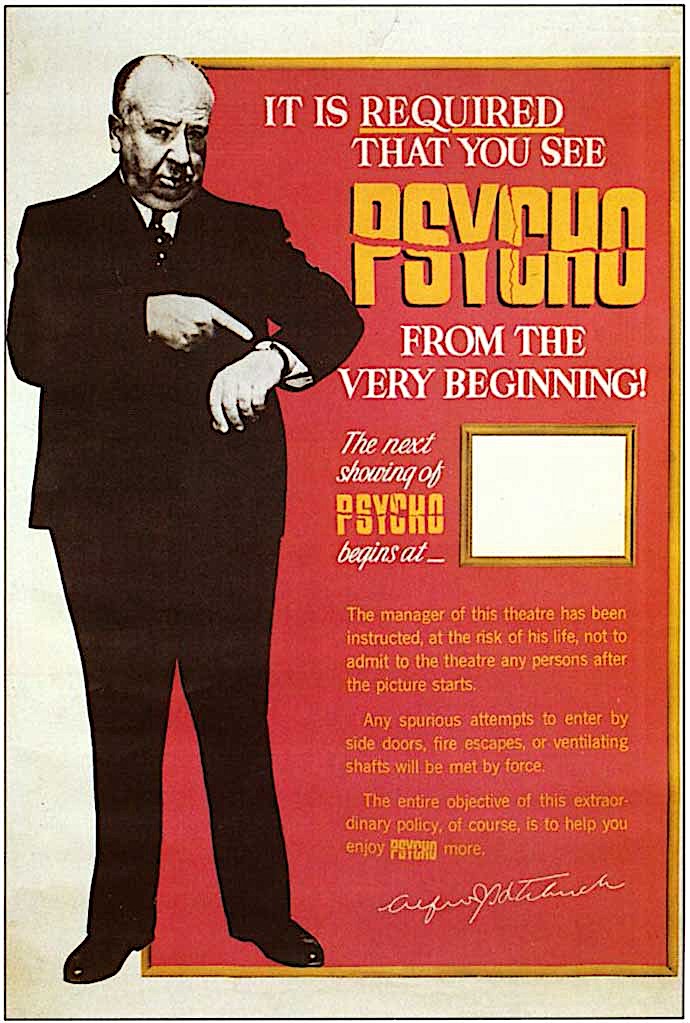
When Psycho hit theaters, Hitchcock controlled the promotion. The stars — Anthony Perkins and Janet Leigh — didn’t make the usual rounds in the media. Critics weren’t given private screenings. And Hitchcock created buzz for the film when he exerted directorial control over the viewing experience of the audience. Showings of the film began on a tightly-controlled schedule in theaters in New York, Chicago, Boston, and Philadelphia. And a firm “no late admission” policy was put in place. You either saw the film from the very beginning, or you didn’t see it all. Signs appeared in front of cinemas reading:
We won’t allow you to cheat yourself. You must see PSYCHO from the very beginning. Therefore, do not expect to be admitted into the theatre after the start of each performance of the picture. We say no one — and we mean no one — not even the manager’s brother, the President of the United States, or the Queen of England (God bless her)!
Theater managers initially balked at the idea, fearing financial losses. But Hitchcock had his way. And he was right. Long lines formed outside the theaters. Psycho enjoyed critical and commercial success, so much so the film was re-released in 1965.
Note: An earlier version of this post appeared on our site in 2012.
If you would like to support the mission of Open Culture, consider making a donation to our site. It’s hard to rely 100% on ads, and your contributions will help us continue providing the best free cultural and educational materials to learners everywhere. You can contribute through PayPal, Patreon, and Venmo (@openculture). Thanks!
Related Content:
The 5 Essential Rules of Film Noir
Watch Alfred Hitchcock Make Cameo Appearances in 37 of His Films
Alfred Hitchcock Reveals The Secret Sauce for Creating Suspense
Read More...How to Be a Stoic in Your Everyday Life: Philosophy Professor Massimo Pigliucci Explains
To a viewer on the internet, TED Talks and TEDx talks may seem more or less the same. That makes sense, since the main difference between them isn’t of format, but physical location: TED talks take place at official TED conferences, and TEDx talks at TED-licensed but independently-organized events. The latter are more numerous, and also more geographically varied. Take the talk above from TEDxAthens, the ideal place for speaker Massimo Pigliucci to deliver his opening historical sketch, which he begins by asking his audience to “imagine, if you will, that you’re walking down the streets of Athens 24 centuries ago, give or take.”
In such a setting, “you might meet this guy: Zeno of Citium.” A once-prosperous merchant stranded by a shipwreck, he’d wound up in the Greek metropolis, where he spent his days hanging around bookstores. One day “he read Xenophon’s Memorabilia, which is a book about Socrates, and he was so intrigued that he turned to the bookseller and said, ‘Where I can find me one of these people, one of these philosopher folks?’ ” Luckily for Zeno, the streets of Athens were crawling with philosophers at the time, and it was under their tutelage that he developed his own philosophical acumen to a level that prepared him to found his own school: Stoicism, so named because its members met in the stoa, where the markets set up.
The early Stoics were concerned with everyday life, and how it can be lived “according to nature”: the world’s nature, but also our own. Then, as now, a great many people suffered unnecessarily out of confusion as to where the world ended and they began. They had, in other words, no clear sense of what was under their control and what wasn’t, a condition that the core teachings of Stoicism are designed to rectify. “The idea is that you can do things, you can make decisions about your health, your reputation, et cetera, et cetera, but ultimately, you don’t control the outcome,” Pigliucci explains. In practice, this means that “we should try to walk through life by internalizing our goals — not worry about the outcomes, because those are outside our control, but worry about our intentions and our efforts, because those are very much under our control.”
“Worry” may not be quite the appropriate term. It connotes, in any case, a self-defeating habit that would hardly be condoned by history’s best-known proponents of Stoicism, like the first century Roman statesman and man of letters Seneca, the second-century Roman emperor Marcus Aurelius, and especially the Greek ex-slave Epictetus, whose life bridged those eras. Epictetus believed, as Pigliucci puts it, that “a great part of happiness lies in the serenity,” in “the idea that you always walk through life by knowing that you’ve done your best, and that nothing else could be done on top of that.” We can learn more about how, exactly, to do our best from the work these Stoics left behind, all of which is free online: Epictetus’ Enchiridion, Marcus Aurelius’ Meditations, the collection of Seneca’s writings previously featured here on Open Culture.
Of course, we could also read Pigliucci’s own book, How to Be A Stoic: Using Ancient Philosophy to Live a Modern Life, or even watch “Think Like a Stoic: Ancient Wisdom for Today’s World,” his series from The Great Courses (which is also available through Audible free to its members). Pigliucci is but one of the host of practitioners willing to introduce us to the principles of Stoicism, even these 24 centuries — give or take — after its invention. But whether on the streets of ancient Athens or in the digital labyrinths of the 21st century, the best teachers of this particular philosophy are the vicissitudes of life itself. Whether we can meet them with virtue and equanimity is up to us — and indeed, to put it Stoically, the only thing that’s ever been up to us.
Related content:
Three Huge Volumes of Stoic Writings by Seneca Now Free Online, Thanks to Tim Ferriss
350 Animated Videos That Will Teach You Philosophy, from Ancient to Post-Modern
Based in Seoul, Colin Marshall writes and broadcasts on cities, language, and culture. His projects include the Substack newsletter Books on Cities, the book The Stateless City: a Walk through 21st-Century Los Angeles and the video series The City in Cinema. Follow him on Twitter at @colinmarshall or on Facebook.
Read More...Support Us
We're hoping to rely on loyal readers, rather than erratic ads. Please click the Donate button and support Open Culture. You can use Paypal, Venmo, Patreon, even Crypto! We thank you!

About Us

Open Culture scours the web for the best educational media. We find the free courses and audio books you need, the language lessons & educational videos you want, and plenty of enlightenment in between.
Advertise With Us
FREE UPDATES!
GET OUR DAILY EMAIL
Get the best cultural and educational resources on the web curated for you in a daily email. We never spam. Unsubscribe at any time.
FOLLOW ON SOCIAL MEDIA
Open Culture editor Dan Colman scours the web for the best educational media. He finds the free courses and audio books you need, the language lessons & movies you want, and plenty of enlightenment in between.
Advertise With Us

