Martin Scorsese Breaks Down His Most Iconic Films: Mean Streets, Taxi Driver, GoodFellas, and More
“Did Scorsese make the best movie of each decade since the ’70s?” asks GQ’s Zach Baron in a recent profile of that long-lived auteur. “Probably not (I think his case is weakest in the first decade of this century), but you could argue it, and many people have.” And indeed, you may well find yourself believing it after watching the video above, also published by GQ, in which Scorsese himself discusses a selection of features from the past half-century of his career, the earliest of which, Mean Streets, was a breakout project for both its young director and even younger star, a certain Robert de Niro, in 1973.
Scorsese’s latest, Killers of the Flower Moon, opens next month as not just another of his many collaborations with de Niro, but the first Scorsese film to feature both de Niro and Leonardo DiCaprio. “We were acquainted with each other when we were sixteen years old,” the director says of de Niro in the GQ video. “He experienced what I experienced growing up” in rough-and-tumble New York neighborhoods like Little Italy and the Bowery, and thus “knows who I am and where I came from.” Hence the trust with which Scorsese took de Niro’s recommendation of DiCaprio in the early nineties: “You gotta work with him someday.”
That someday came in 2002, with Gangs of New York, after which the Scorsese-diCaprio professional relationship would mature to bear additional cinematic fruit with projects like The Departed and The Wolf of Wall Street. At this point it has become a parallel enterprise to Scorsese-de Niro, which can be traced from The Irishman, which came out in 2019, back through the likes of GoodFellas (though it stars the late Ray Liotta), Casino, The King of Comedy, and Raging Bull — a picture that, along with other brazenly ambitious United Artists releases like Francis Ford Coppola’s Apocalypse Now and Michael Cimino’s Heaven’s Gate, Scorsese now sees as marking the end of “the power of the director.”
In “new Hollywood” era of the nineteen-seventies, Scorsese remembers, “things were wide open, and we went in and took it like the barbarians at the gate, and we transformed whatever we could, but they caught us.” Still, since then he’s “never stopped working for any noticeable amount of time,” as Baron puts it, though in recent years he’s been given to rueful comment about the artistic and economic dynamics of his industry and art form. As for the state of the world in general, he makes an equally grim diagnosis with reference to his and de Niro’s best-known collaboration, Taxi Driver: “Every other person is like Travis Bickle now.”
Related content:
How Martin Scorsese Directs a Movie: The Techniques Behind Taxi Driver, Raging Bull, and More
The Filmmaking of Martin Scorsese Demystified in 6 Video Essays
Martin Scorsese Explains the Difference Between Cinema and Movies
Based in Seoul, Colin Marshall writes and broadcasts on cities, language, and culture. His projects include the Substack newsletter Books on Cities, the book The Stateless City: a Walk through 21st-Century Los Angeles and the video series The City in Cinema. Follow him on Twitter at @colinmarshall or on Facebook.
Read More...Stream Hundreds of Hours of Studio Ghibli Movie Music That Will Help You Study, Work, or Simply Relax: My Neighbor Totoro, Spirited Away & More
The Boy and the Heron, the latest feature from master animator Hayao Miyazaki, opened in Japan this past summer. In that it marks his latest emergence from his supposed “retirement,” we could label it not just as late Miyazaki, but perhaps even “post-late” Miyazaki. But the film nevertheless shares significant qualities with his earlier work, not least a score composed by Joe Hisaishi. Since Nausicaä of the Valley of the Wind — which opened in 1984, even before the foundation of Studio Ghibli — Hisaishi’s music has done nearly as much to establish the sensibility of Miyazaki’s films as their lavish, imaginative animation, and you can stream hundreds of hours of it with this Youtube playlist.
Each of the playlist’s 121 two-hour videos offers musical selections from a mix of Ghibli movies, including Miyazaki favorites like My Neighbor Totoro, Porco Rosso, and Spirited Away, and also the works of other directors: Yoshifumi Kondō’s Whisper of the Heart, Hiromasa Yonebayashi’s Arrietty, Gorō Miyazaki’s From Up on Poppy Hill.
If you’ve seen those pictures, these quiet, often minimal renditions of their music will surely bring their animated fantasies right back to mind. Even if you haven’t, they can still fulfill the function promised by the videos’ titles of setting a mood conducive to study, work, or simple relaxation.
So beloved are Hisaishi’s scores, for Miyazaki and others (most notably comedian-auteur Takeshi Kitano), that it’s possible to know the music long before you’ve seen the movies. And even in performances considerably different from the versions heard on the actual soundtracks, they always sound immediately recognizable as Hisaishi’s work. Shaped by an eclectic set of influences (born Mamoru Fujisawa, he took on his professional name as an homage to Quincy Jones), he developed a compositional style neither strictly Eastern nor Western. The same can be said about Ghibli movies themselves, which often possess both fairy-tale European settings and Japanese philosophical underpinnings. Wherever you place yourself on the cultural map, you’d do well to make their music the soundtrack of your own life.
Related content:
Calm Down & Study with Relaxing Piano, Jazz & Harp Covers of Music from Hayao Miyazaki Films
De-Stress with 30 Minutes of Relaxing Visuals from Director Hayao Miyazaki
Based in Seoul, Colin Marshall writes and broadcasts on cities, language, and culture. His projects include the Substack newsletter Books on Cities, the book The Stateless City: a Walk through 21st-Century Los Angeles and the video series The City in Cinema. Follow him on Twitter at @colinmarshall or on Facebook.
Read More...Welcome to Llanfairpwllgwyngyllgogerychwyrndrobwllllantysiliogogogoc, the Town with the Longest Name in Europe
Its name can be squeezed onto a tea towel, a decorative plate, a magnet, a mug, and other touristic souvenirs, but has the northern Welsh town of Llanfairpwllgwyngyllgogerychwyrndrobwllllantysiliogogogoc been celebrated in song?
Indeed it has. The Great Big Story’s Human Condition episode, above, has vinyl proof, though the tune’s unlikely to give The White Cliffs of Dover, The Bonnie Banks of Loch Lomond, or The Rocky Road To Dublin much of a run for the money.
Still, whichever outside-the-box Victorian thinker had the bright idea to attract tourists by expanding the village’s original name — Pwllgwyngyll — by 46 letters was onto something.
Turns out you don’t need natural wonders or world-renowned cultural attractions to stake a claim, when out-of-towners will make the trip just to take photos of the local signage.

Image by Adraio, via Wikimedia Commons
Village Community Council Chairman Alun Mummery attributes the name-lengthening publicity stunt in 1869 to a local cobbler.
Or perhaps he was a tailor. That’s what poet John Morris-Jones, author of 1913’s A Welsh Grammar, Historical and Comparative, maintained, while refusing to outright identify this clever civic booster.
Wikipedia throws doubt on these origin stories by citing an entry in an ecclesiastical directory published a few years prior to 1869, which gave the full parish name as “Llanfairpwllgwyngyllgogerbwlltysiliogogo.”
(Close enough!)
Someone in the tourist information office told travel writer Dave Fox that it translates to “St. Mary’s Church in the hollow of white hazel near a rapid whirlpool and the Church of St. Tysilio near the red cave.”
It’s tempting to think this little Welsh town has the longest name in the world, but that honor actually goes to Bangkok.
Wait, what?
The name by which most foreigners know Thailand’s capital city is actually an archaic reference to its pre-1782 location.
Thai people call their capital Krung Thep — short for Krungthepmahanakornamornratanakosinmahintarayutthayamahadilokphopnopparatrajathaniburiromudomrajaniwesmahasatharnamornphimarnavatarnsathitsakkattiyavisanukamprasit.
It means “City of angels, great city of immortals, magnificent city of the nine gems, seat of the king, city of royal palaces, home of gods incarnate, erected by Vishvakarman at Indra’s behest” and looks like this, when written in Thai script:
กรุงเทพมหานคร อมรรัตนโกสินทร์ มหินทรายุธยามหาดิลก ภพนพรัตน์ ราชธานีบุรีรมย์ อุดมราชนิเวศน์ มหาสถาน อมรพิมาน อวตารสถิต สักกะทัตติยะ วิษณุกรรมประสิทธิ์
Llanfairpwllgwyngyllgogerychwyrndrobwllllantysiliogogogochians still get to brag that they have the longest town name in Europe.
Their football club, Clwb Pêl Droed Llanfairpwllgwyngyllgogerychwyrndrobwllllantysiliogogogoch Football Club — CPD Llanfairpwll FC for short — might well be the longest named football club in the world if it weren’t for that damn Amon Rattanakosin Krung Thep Mahanakhon Mahinthara Mahadilok Phop Noppharat Ratchathani Ayuthaya Burirom Udomratchaniwet Mahasathan Amon Piman Awatan Sathit Sakkathattiya Witsanukam Prasit Bravo Association Football Club (aka Bangkok Bravo FC).
Some of the fun of living in a town with such a cumbersome name must be amazing tourists by how casually it rolls off local tongues.
Pub owner Kevin Bryant obliges visitors from The Great Big Story by downing a pint on camera before rapping it out.
Anything for the local economy!
Llanfairpwllgwyngyllgogerychwyrndrobwllllantysiliogogogoc also got a boost from mentions on Groucho Marx’s quiz show, You Bet Your Life, in a Bossa Nova-inflected Stephen Sondheim song, and in several films, including 1968’s Barbarella.
As YouTuber Tom Scott points out below, long words are invariably shortened in everyday speech, and place names are no exception.
Postmaster Jim Evans advocates shortening the town name to Llanfairpwllgwyngyll.
When not actively impressing tourists, local people say Llanfairpwll.
Which is still a pretty impressive consonant to vowel ratio.
Related Content
The Medieval City Plan Generator: A Fun Way to Create Your Own Imaginary Medieval Cities
The Atlas of True Names Restores Modern Cities to Their Middle Earth-ish Roots
Fly Through 17th-Century London’s Gritty Streets with Prize-Winning Animations
– Ayun Halliday is the Chief Primatologist of the East Village Inky zine and author, most recently, of Creative, Not Famous: The Small Potato Manifesto and Creative, Not Famous Activity Book. Follow her @AyunHalliday.
Read More...The Story of Lorem Ipsum: How Scrambled Text by Cicero Became Used by Typesetters Everywhere
In high school, the language I most fell in love with happened to be a dead one: Latin. Sure, it’s spoken at the Vatican, and when I first began to study the tongue of Virgil and Catullus, friends joked that I could only use it if I moved to Rome. Tempting, but church Latin barely resembles the classical written language, a highly formal grammar full of symmetries and puzzles. You don’t speak classical Latin; you solve it, labor over it, and gloat, to no one in particular, when you’ve rendered it somewhat intelligible. Given that the study of an ancient language is rarely a conversational art, it can sometimes feel a little alienating.
And so you might imagine how pleased I was to discover what looked like classical Latin in the real world: the text known to designers around the globe as “Lorem Ipsum,” also called “filler text” and (erroneously) “Greek copy.”
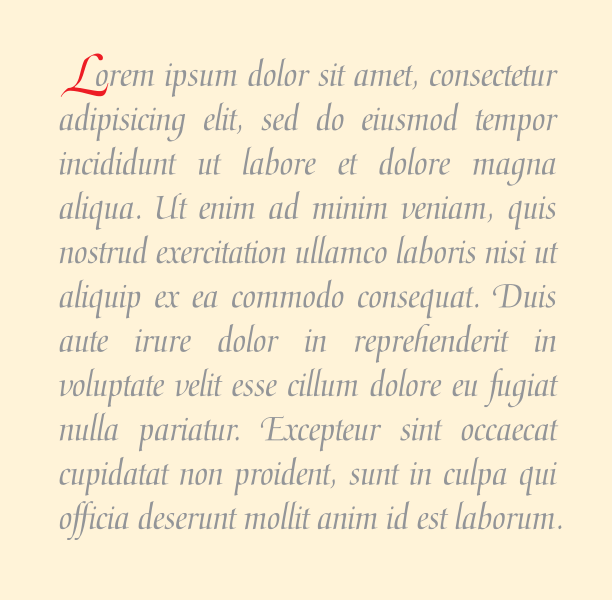
The idea, Priceonomics informs us, is to force people to look at the layout and font, not read the words. Also, “nobody would mistake it for their native language,” therefore Lorem Ipsum is “less likely than other filler text to be mistaken for final copy and published by accident.” If you’ve done any web design, you’ve probably seen it, looking something like this:
Lorem ipsum dolor sit amet, consectetur adipiscing elit, sed do eiusmod tempor incididunt ut labore et dolore magna aliqua. Ut enim ad minim veniam, quis nostrud exercitation ullamco laboris nisi ut aliquip ex ea commodo consequat. Duis aute irure dolor in reprehenderit in voluptate velit esse cillum dolore eu fugiat nulla pariatur. Excepteur sint occaecat cupidatat non proident, sunt in culpa qui officia deserunt mollit anim id est laborum.
When I first encountered this text, I did what any Latin geek will—set about trying to translate it. But it wasn’t long before I realized that Lorem Ipsum is mostly gibberish, a garbling of Latin that makes no real sense. The first word, “Lorem,” isn’t even a word; instead it’s a piece of the word “dolorem,” meaning pain, suffering, or sorrow. So where did this mash-up of Latin-like syntax come from, and how did it get so scrambled? First, the source of Lorem Ipsum—tracked down by Hampden-Sydney Director of Publications Richard McClintock—is Roman lawyer, statesmen, and philosopher Cicero, from an essay called “On the Extremes of Good and Evil,” or De Finibus Bonorum et Malorum.
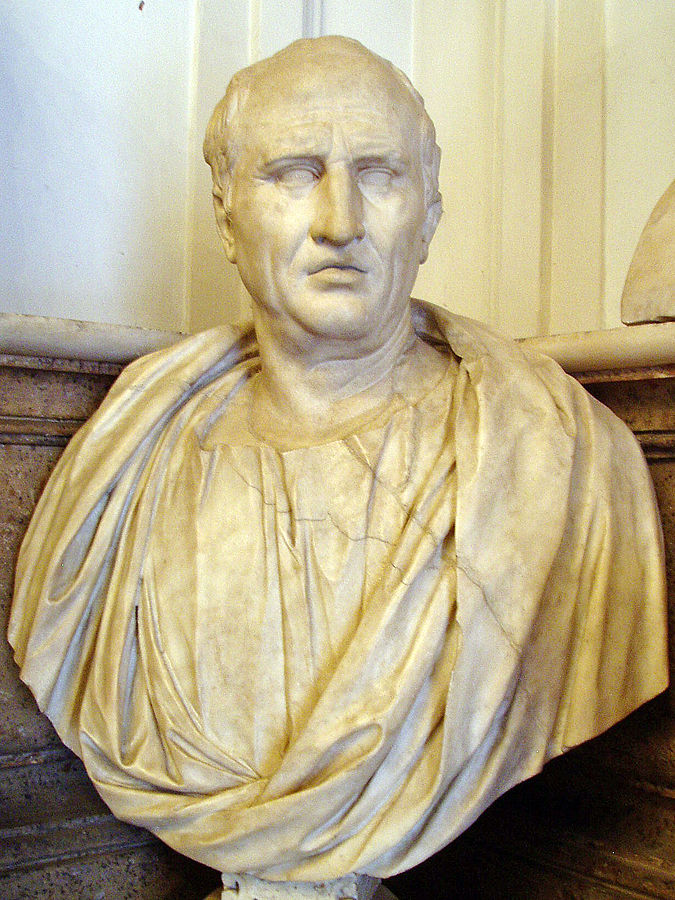
Why Cicero? Put most simply, writes Priceonomics, “for a long time, Cicero was everywhere.” His fame as the most skilled of Roman rhetoricians meant that his writing became the benchmark for prose in Latin, the standard European language of the Middle Ages. The passage that generated Lorem Ipsum translates in part to a sentiment Latinists will well understand:
Nor is there anyone who loves or pursues or desires to obtain pain of itself, because it is pain, but occasionally circumstances occur in which toil and pain can procure him some great pleasure.
Dolorem Ipsum, “pain in and of itself,” sums up the tortuous feeling of trying to render some of Cicero’s complex, verbose sentences into English. Doing so with tolerable proficiency is, for some of us, “great pleasure” indeed.
But how did Cicero, that master stylist, come to be so badly manhandled as to be nearly unrecognizable? Lorem Ipsum has a history that long predates online content management. It has been used as filler text since the sixteenth century when—as McClintock theorized—“some typesetter had to make a type specimen book, to demo different fonts” and decided that “the text should be insensible, so as not to distract from the page’s graphical features.” It appears that this enterprising craftsman snatched up a page of Cicero he had lying around and turned it into nonsense. The text, says McClintock, “has survived not only four centuries of letter-by-letter resetting but even the leap into electronic typesetting, essentially unchanged.”
The story of Lorem Ipsum is a fascinating one—if you’re into that kind of thing—but its longevity raises a further question: should we still be using it at all, this mangling of a dead language, in a medium as vital and dynamic as web publishing, where “content” refers to hundreds of design elements besides font. Is Lorem Ipsum a quaint piece of nostalgia that’s outlived its usefulness? In answer, you may wish to read Karen McGrane’s spirited defense of the practice. Or, if you feel it’s time to let the garbled Latin go the way of manual typesetting machines, consider perhaps as an alternative “Nietzsche Ipsum,” which generates random paragraphs of mostly verb-less, incoherent Nietzsche-like text, in English. Hey, at least it looks like a real language.
Note: An earlier version of this post appeared on our site in 2015.
Related Content:
What Ancient Latin Sounded Like, And How We Know It
Can Modern-Day Italians Understand Latin? A Youtuber Puts It to the Test on the Streets of Rome
Josh Jones is a writer and musician based in Durham, NC. Follow him at @jdmagness
Read More...Scientists Working in Antarctica Unwittingly Started to Develop a New Accent

The distinctiveness of the accent heard in a place reflects that place’s isolation. It’s probably no coincidence that, as almost every place in the world has become less isolated, accents have become less distinctive. In these days of vanishing forms of regional speech, if you wanted to hear a new one coming into being, you’d have to go to the ends of the Earth — or one specific end of the Earth, anyway, as demonstrated not long ago by researchers from the Ludwig Maximilian University of Munich. Taking and analyzing recordings made over the course of one winter, they discovered that a new accent has begun to take shape in English as spoken in Antarctica.
“Antarctica has no native population or permanent residents, but it does have a transitory community of scientists and support staff who live there for part of the year on a rotational basis,” writes Tom Hale at IFL Science. “In the summer months, there are typically around 5,000 people living in Antarctica, but that drops to just 1,000 in the winter.” It was from this group of the Antarctic “over-winterers” — and in particular, from those working on the British Antarctic Survey — that the linguistic researchers recruited their subjects, eight of whom were from England, one from the United States, one from Germany, and one from Iceland.
“The findings revealed subtle but measurable changes in the speech of the overwintering staff during their time in Antarctica,” writes Mental Floss’ Brett Reynolds. “One change was convergence, where individuals in a close-knit group unconsciously begin to adopt similar speech characteristics. In this case, that meant convergence of /u/ (the ‘oo’ in goose), /ju/ (the ‘you’ in few), /ou/ (the ‘oh’ in goat), and /ɪ:/ (the ‘ee’ in the last syllable in happy).” Apart from that phenomenon, the researchers also noticed another change in the /ou/ of goat: “the over-winterers began to pronounce it more toward the front of their mouths than toward the back. (British pronunciations are already typically fronter than American /ou/.)”
Even if you got into a conversation with a scientist just back from a long winter in Antarctica, you probably wouldn’t notice any of this. But the fact that the differences between the series of recordings taken at six-week intervals during the winter show measurable changes in pronunciation when compared to control recordings taken back in the United Kingdom suggests that the isolation of Antarctica really does encourage the formation of a new accent. Given a sufficiently long time span, an accent naturally becomes a dialect, and eventually a separate language. Perhaps, even in our age of much-lamented loss of linguistic diversity, some of us can look forward to having Antarctic-speaking descendants.
via Mental Floss
Related content:
The Speech Accent Archive: The English Accents of People Who Speak 341 Different Languages
Why You Have an Accent When You Speak a Foreign Language
What English Would Sound Like If It Was Pronounced Phonetically
Based in Seoul, Colin Marshall writes and broadcasts on cities, language, and culture. His projects include the Substack newsletter Books on Cities, the book The Stateless City: a Walk through 21st-Century Los Angeles and the video series The City in Cinema. Follow him on Twitter at @colinmarshall or on Facebook.
Read More...Patti Smith Reads Sylvia Plath’s Poem, “The Moon and the Yew Tree”
Court Green, the rural Devon property Sylvia Plath called home for sixteen months toward the end of her life is a popular pilgrimage for Plathophiles, seeking to worship at the wellspring of some of her best known poems — The Bee Meeting, Daddy, Lady Lazarus, and many other works posthumously published in 1965’s Ariel.
(Her ex-husband Ted Hughes wrote his collection, Crow, there as well, not long after Plath died by suicide. Something tells us his widow, Carol, a staunch defender of her husband’s legacy, doesn’t exactly roll out the welcome mat when she sees starry eyed devotee’s of her husband’s first wife tromping around the perimeter of the property where she still lives…)
Plath scholar Dorka Tamás made the trip to St. Peter’s, the North Tawton church abutting Court Green. Plath took pleasure in describing its grounds in letters to friends and family, and immoratlized its massive yew in “The Moon and the Yew Tree”:
I looked around the Victorian gravestones, slowly passing the souls of the dead. The beautiful green trees could not contrast more with the Neo-gothic church. I knew at first sight which one is the yew tree in Plath’s poem. I was searching for the window of Court Green, Plath’s office window, from which she could have an expansive view of the yew…North Tawton has been an ambiguous place for both Plath and Plathians. In the year she spent in the isolated village, she produced her best and most well-known poems, but it was also a place where she experienced extreme isolation after Hughes left her. Nevertheless, the country life provided plenty of opportunities for Plath to explore her creative, aesthetic, and domestic independence, such as horse riding in the field of Devon, experimenting with beekeeping, painting her children’s nursery elbow chair, and making apple pie from the apples of her garden. The poetry and fiction Plath wrote between autumn 1961 and winter 1962 are embedded in the natural environment in Devon and community, places, and non-human life of North Tawton.
Poet David Trinidad, an avid collector of Plath-related memorabilia, whose souvenirs include a vial of dust from the studio she occupied during a residency at Yaddo and a facsimile of a blue patterned Liberty of London scarf she gave her mother during a 1962 visit to Court Green, prizes his cuttings from St. Peter’s yew:
Plath wrote The Moon and the Yew Tree on October 22, 1961, less than two months after moving to Court Green. Everything in the poem is true: her property was separated from an adjacent church by a row of headstones; on Sunday eight bells would toll; an ancient yew tree grew in the church graveyard. …She doesn’t mention the yew tree specifically in any of her letters; she saved that for the poem.
Godmother of Punk Patti Smith, whose souvenirs run more toward Polaroids, wrote of visiting Plath’s grave in her memoir, M Train, and identifies the poet as someone who makes her want to write.
Her performance of “The Moon and The Yew Tree,” above, is more straightforward than Plathian, allowing the darkness of the work–which The Marginalian’s Maria Popova calls “one of (Plath’s) finest poems and one of the most poignant portraits of depression in the history of literature”–to speak for itself.
As Popova notes, the poem was written during a difficult period, in an attempt to fulfill a writing exercise suggested by Hughes, “to simply describe what she saw in the Gothic churchyard outside her window.”
Who would dare fault Plath for obeying the impulse to editorialize a bit?
The New Yorker had accepted but not yet published “The Moon and the Yew Tree” when Plath took her own life on February 11, 1963. It was published posthumously in a two-page spread along with five other poems six months later. You can read it online here.
Related Content
Why Should We Read Sylvia Plath? An Animated Video Makes the Case
Hear Sylvia Plath Read 18 Poems From Her Final Collection, Ariel, in a 1962 Recording
Hear Patti Smith Read 12 Poems From Seventh Heaven, Her First Collection (1972)
– Ayun Halliday is the Chief Primatologist of the East Village Inky zine and author, most recently, of Creative, Not Famous: The Small Potato Manifesto and Creative, Not Famous Activity Book. Follow her @AyunHalliday.
Read More...A Playlist of 45 Shakespeare Film Trailers, from 1935 — 2021
The Internet Movie Database credits Shakespeare as the writer on 1787 films, 42 of which have yet to be released.
The Shakespeare Network has compiled a chronological playlist of trailers for 45 of them.
First up is 1935’s A Midsummer Night’s Dream, featuring Olivia de Havilland, Jimmy Cagney, Dick Powell, and, in the role of Puck, a 15-year-old Mickey Rooney, hailed by the New York Times as “one of the major delights” of the film, and Variety as “so intent on being cute that he becomes almost annoying.”
Tragedies dominate, with no fewer than six Hamlets, Shakespeare’s most filmed work, and “one of the most fascinating and most thankless tasks in show business” according to novelist and frequent film critic James Agee:
There can never be a definitive production of a play about which no two people in the world can agree. There can never be a thoroughly satisfying production of a play about which so many people feel so personally and so passionately. Very likely there will never be a production good enough to provoke less argument than praise.
Lawrence Olivier, Nicol Williamson, Mel Gibson, Kenneth Branagh, Ethan Hawke, David Tennant — take your pick:
MacBeth, Richard III, Romeo and Juliet, and The Tempest — a comedy — are other crowd-pleasing workhorses, chewy assignments for actors and directors alike.
Those with a taste for deeper cuts will appreciate the inclusion of Ralph Fiennes’ Coriolanus (2011), Branagh’s Love’s Labour’s Lost (2000) and Titus, Julie Taymor’s 1999 adaptation of Shakespeare’s most shocking bloodbath.
Moviegoing connoisseurs of the Bard may feel moved to stump for films that didn’t make the playlist. If you can find a trailer for it, go for it! Lobby the Shakespeare Network on its behalf, or make your case in the comments.
We’ll throw our weight behind Michael Almereyda’s Cymbeline, featuring Ed Harris roaring down the porch steps of a dilapidated Brooklyn Victorian on a motorcycle, the bizarre Romeo.Juliet pairing A‑list British vocal talent with an all-feline line-up of Capulets and Montagues, and Shakespeare Behind Bars, a 2005 documentary following twenty incarcerated men who spent nine months delving into The Tempest prior to a production for guards, fellow inmates, and invited guests.
Enjoy the complete playlist of Shakespeare film trailers below. They move from 1935 to 2021.
Related Content
Take a Virtual Tour of Shakespeare’s Globe Theatre in London
– Ayun Halliday is the Chief Primatologist of the East Village Inky zine and author, most recently, of Creative, Not Famous: The Small Potato Manifesto and Creative, Not Famous Activity Book. Follow her @AyunHalliday.
Read More...Vin Mariani, the 19th-Century Cocaine-Infused Wine, Imbibed and Endorsed by Presidents, Popes & Writers
In the neverending quest to elevate themselves above the fray, today’s mixologists — formerly known as bartenders — are putting a modern spin on obscure cocktail recipes, and resurrecting anachronistic spirits like mahia, Chartreuse, Usquebaugh, and absinthe.
Might we see a return of Vin Mariani, a Belle Époque ‘tonic wine’ that was hit with such august personages as Queen Victoria, Ulysses S. Grant, Alexander Dumas and Emile Zola?
Probably not.
It’s got coca in it, known for its psychoactive alkaloid, cocaine.
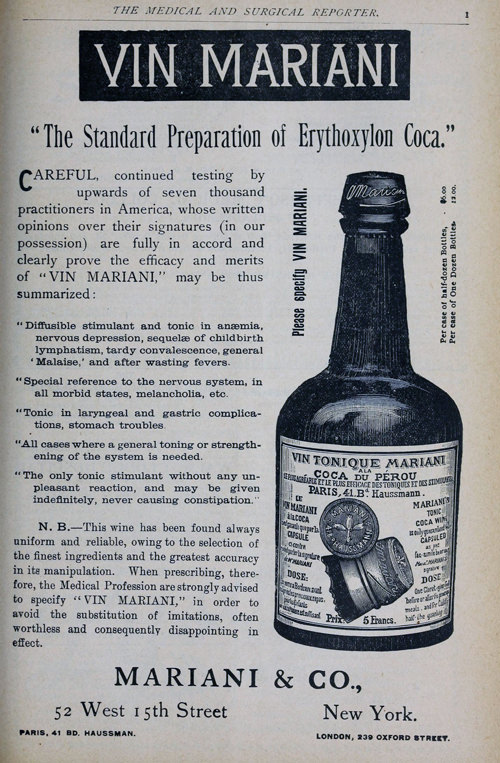
Corsican chemist Angelo Mariani came up with the restorative beverage, formally known as Vin Tonique Mariani à la Coca de Peroum, in 1863, inspired by physician and anthropologist Paolo Mantegazza who served as his own guinea pig after observing native use of coca leaves while on a trip to South America:
I sneered at the poor mortals condemned to live in this valley of tears while I, carried on the wings of two leaves of coca, went flying through the spaces of 77,438 words, each more splendid than the one before…An hour later, I was sufficiently calm to write these words in a steady hand: God is unjust because he made man incapable of sustaining the effect of coca all life long. I would rather have a life span of ten years with coca than one of 10,000,000,000,000,000,000 000 centuries without coca.
Mariani identified an untapped opportunity and added ground coca leaves to Bordeaux, at a ratio of 6 milligrams of coca to one ounce of wine.
Unsurprisingly, the resulting concoction not only took the edge off, it was accorded a number of healthful benefits in an age where general cure-alls were highly prized.
The recommended dosage for adults was two or three glasses a day, before or after meals. For kids, the amount could be divided in two.
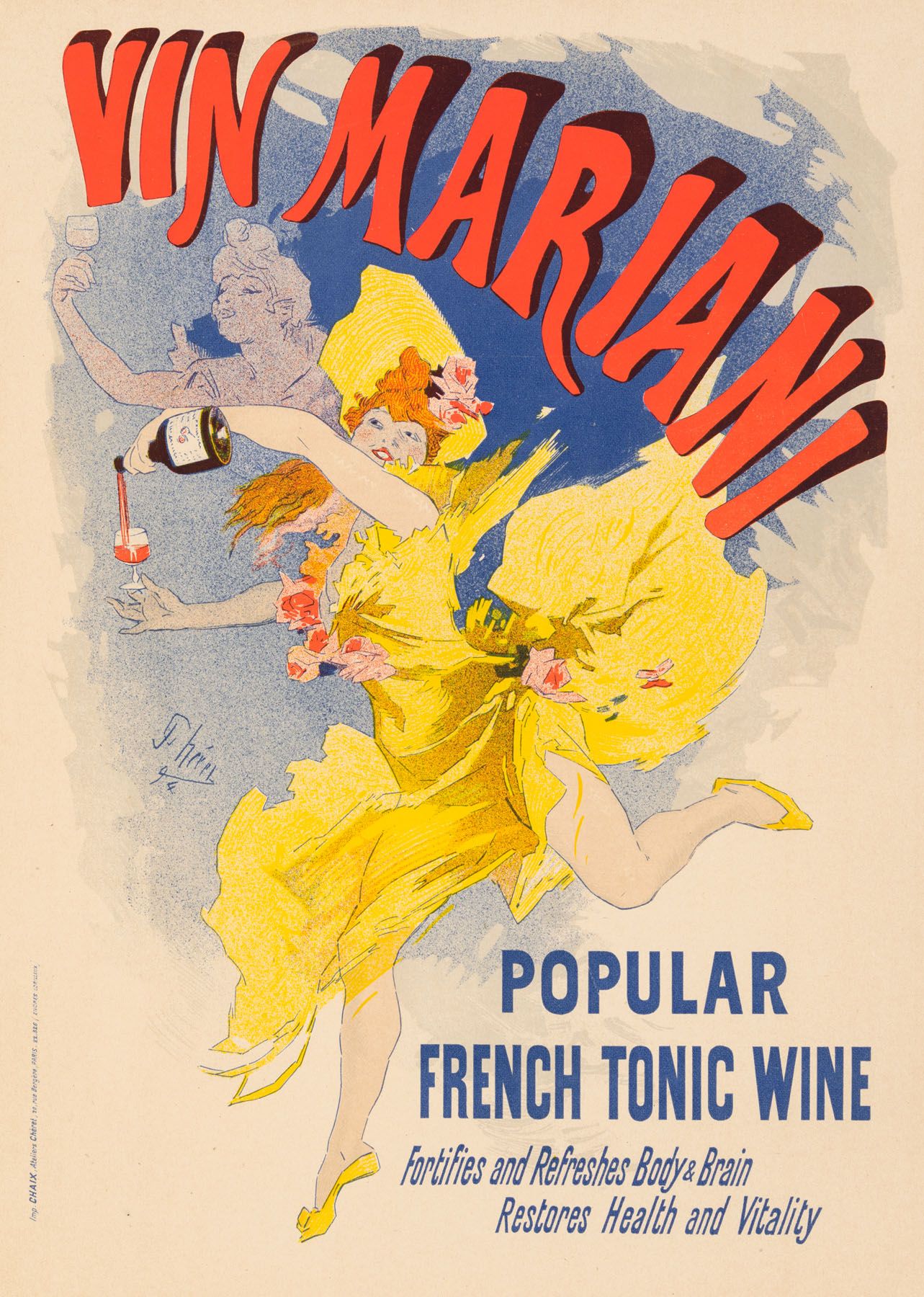
Reigning masters of graphic design were enlisted to promote the miracle elixir.
Jules Chéret leaned into its energy boosting effects by depicting a comely young woman clad in skimpy, sheer yellow replenishing her glass mid-leap, while Alphonse Mucha went dark, claiming that “the mummies themselves stand up and walk after drinking Vin Mariani.”
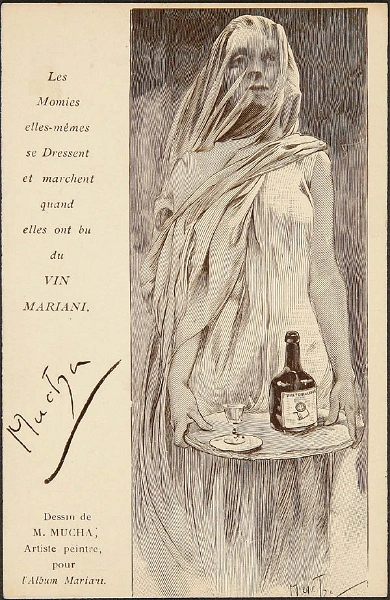
While we’re on the subject of corpse revivers, 21st-century mixologists will please note that a cocktail of Vin Mariani, vermouth and bitters, served with a twist, was a particularly popular preparation, especially across the Atlantic, where Vin Mariani was exported in a more potent version containing 7.2 milligrams of coca.
Angelo Mariani’s innovations were not limited to the chemistry of alcoholic compounds.
He was also a marketing genius, who curried celebrity favor by sending a complimentary case of Vin Mariani to dozens of famous names, along with a humble request for an endorsement and photo, should the contents prove pleasing.
These accolades were collected and repurposed as advertisements that assured adoring fans and followers of the product’s quality.
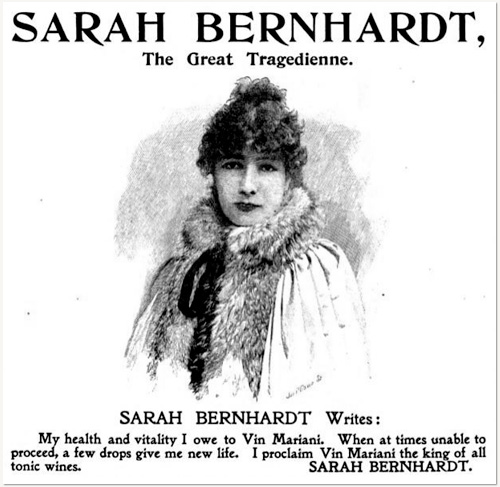
Sarah Bernhardt conferred superstar status on the drink, and not so subtly shored up her own, grandly pronouncing the blend the “King of Tonics, Tonic of Kings:”
I have been delighted to find Vin Mariani in all the large cities of the United States, and it has, as always, largely helped to give me that strength so necessary in the performance of the arduous duties which I have imposed upon myself. I never fail to praise its virtues to all my friends and I heartily congratulate upon the success which you so well deserve.
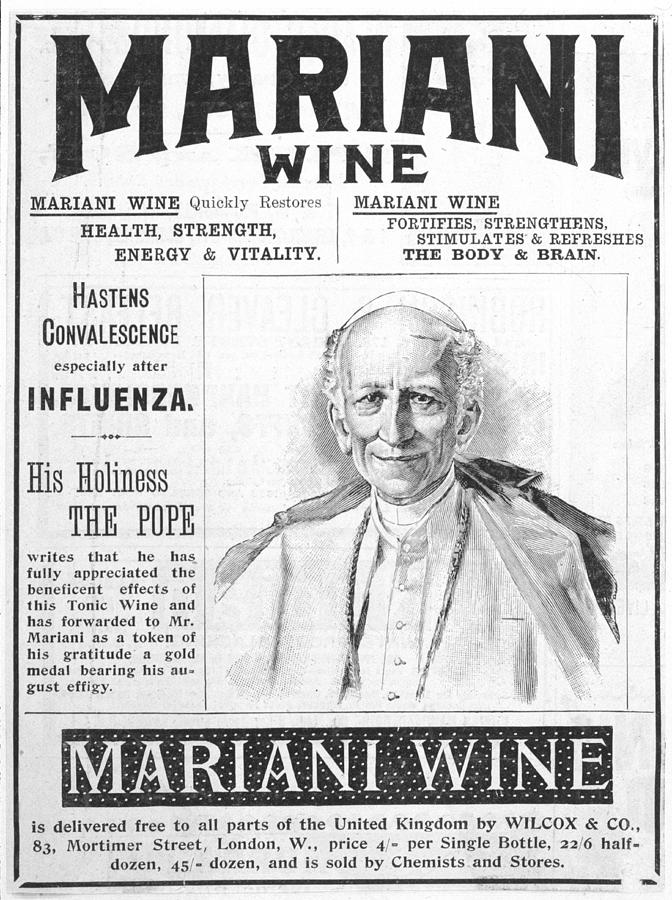
Pope Leo XIII not only carried “a personal hip flask” of the stuff to “fortify himself in those moments when prayer was insufficient,” he invented and awarded a Vatican gold medal to Vin Mariani “in recognition of benefits received.”
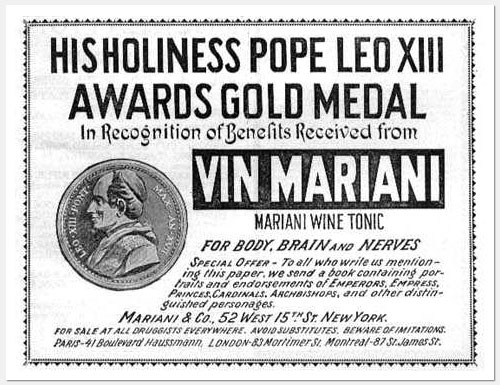
Mariani eventually packaged the glowing endorsements he’d been squirreling away as Portraits from Album Mariani. It’s a compendium of famous artists, writers, actors, and musicians of the day, some remembered, mostly not…
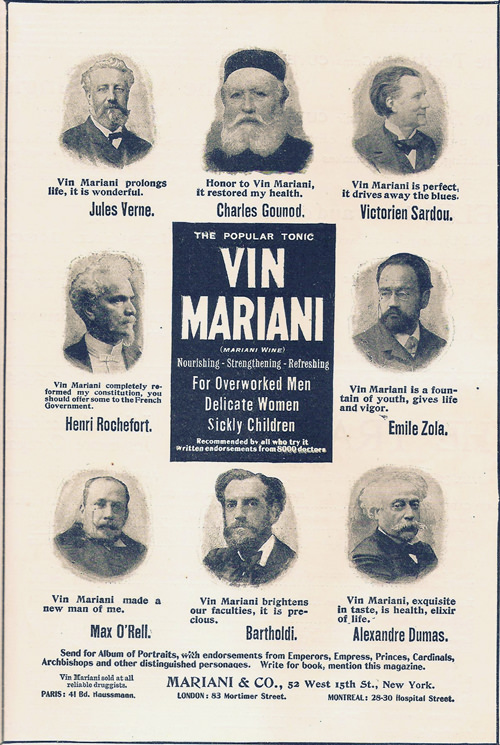
Composer John Philip Sousa:
When worn out after a long rehearsal or a performance, I find nothing so helpful as a glass of Vin Mariani. To brain workers and those who expend a great deal of nervous force, it is invaluable.
Opera singer Lillian Blauvelt:
Vin Mariani is the greatest of all tonic stimulants for the voice and system. During my professional career, I have never been without it.
Illustrator Albert Robida:
At last! At last! It has been discovered — they hold it, that celebrated microbe so long sought after — the microbe of microbes that kills all other microbes. It is the great, the wonderful, the incomparable microbe of health! It is, it is Vin Mariani!
(We suspect Robida penned his entry after swallowing more than a few glasses… or he was of a mischievous nature and would’ve fit right in with the Surrealists, the Futurists, Fluxus, or any other movement that jabbed at the bourgeoisie with hyperbole and humor.
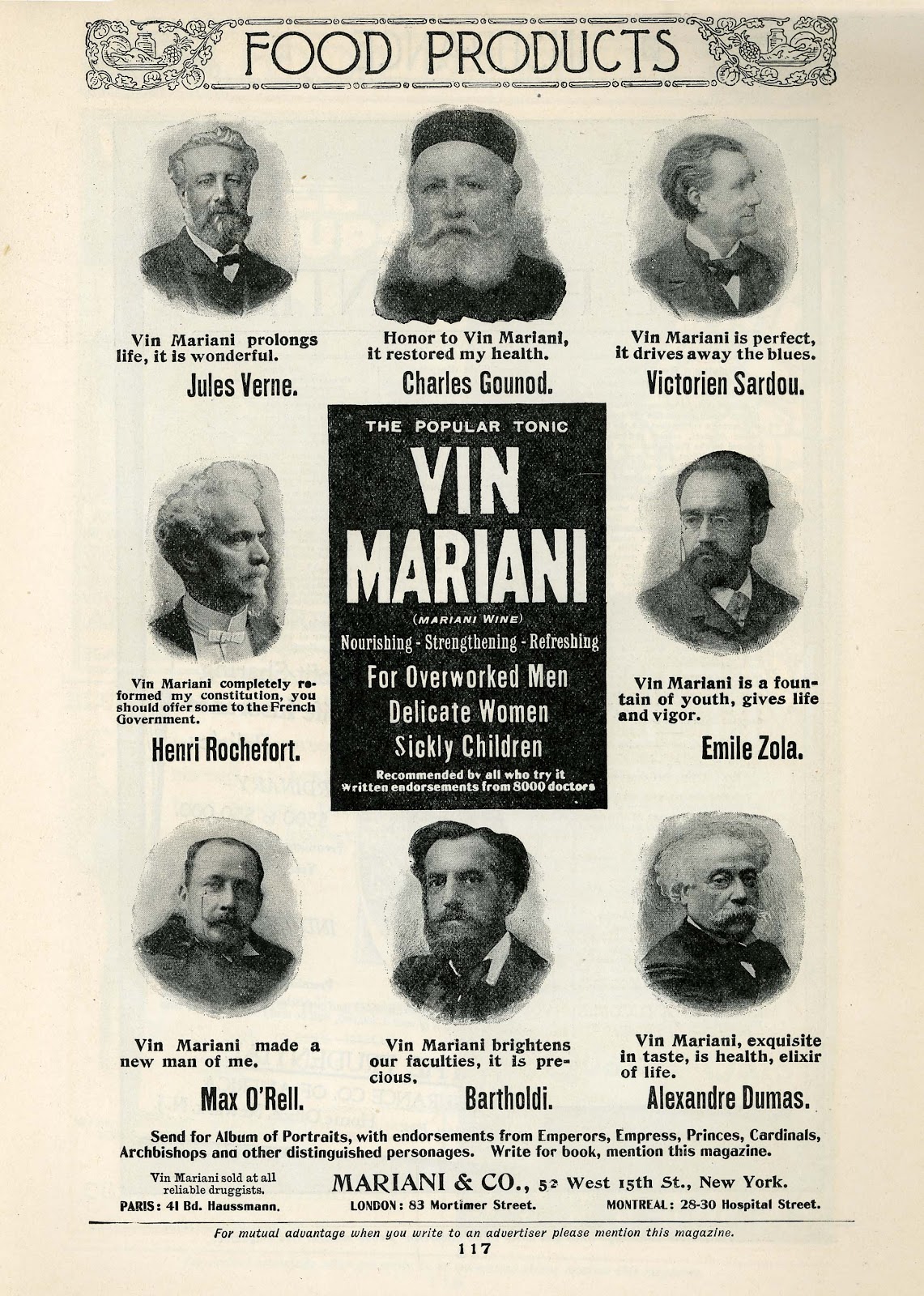
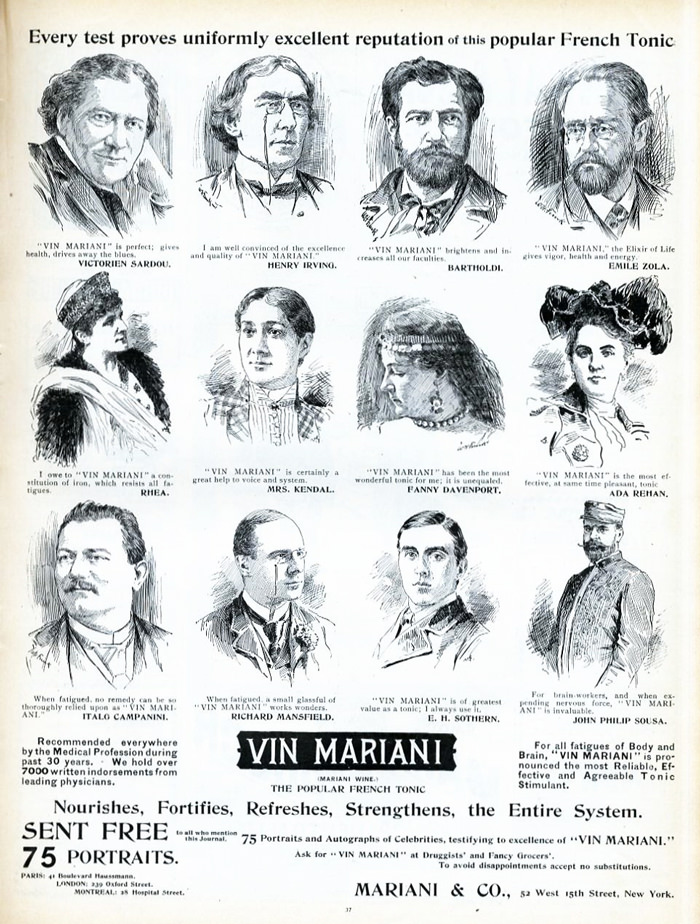

Mariani used the album to publish the Philadelphia Medical Times’ defense of celebrity endorsements:
The array of notable names is a strong one. Too strong in standing, as well as in numbers, to allow of the charge of interested motives.
Mariani also included an excerpt from the New York Medical Journal, denouncing the unscrupulous manufacturers of “rival preparations of coca” who pirated Vin Mariani’s glowing reviews, “craftily making those records appear to apply to their own preparations.”
Elsewhere in the album, medical authorities tout Vin Mariani’s success in combatting such maladies as headaches, heart strain, brain exhaustion, spasms, la grippe, laryngeal afflictions, influenza, inordinate irritability and worry.
They fail to mention that it could get you much higher than vins ordinaires, defined, for purposes of this post, as “wines lacking in coca.”
The psychoactive properties of coca definitely received a boost from the alcohol, a collision that gave rise to a third chemical compound, cocaethylene, a long-lasting intoxicant that produces intense euphoria, along with a heightened risk of cardiotoxicity and sudden death.
…some dead celebrities could likely tell us a thing or two about it.
Mariani’s fortunes began to turn early in the 20th century, owing to the Pure Food and Drug Act, the growing temperance movement, and increased public awareness of the dangers of cocaine.
We may never see a Vin Mariani cocktail on the menu at Death & Co, Licorería Limantour, or Paradiso, but the Drug Enforcement Administration’s Museum keeps a bottle on hand.
Related Content
How a Young Sigmund Freud Researched & Got Addicted to Cocaine, the New “Miracle Drug,” in 1894
The Coffee Pot That Fueled Honoré de Balzac’s Coffee Addiction
– Ayun Halliday is the Chief Primatologist of the East Village Inky zine and author, most recently, of Creative, Not Famous: The Small Potato Manifesto and Creative, Not Famous Activity Book. Follow her @AyunHalliday.
Read More...Behold 1,600-Year-Old Egyptian Socks Made with Nålbindning, an Ancient Proto-Knitting Technique
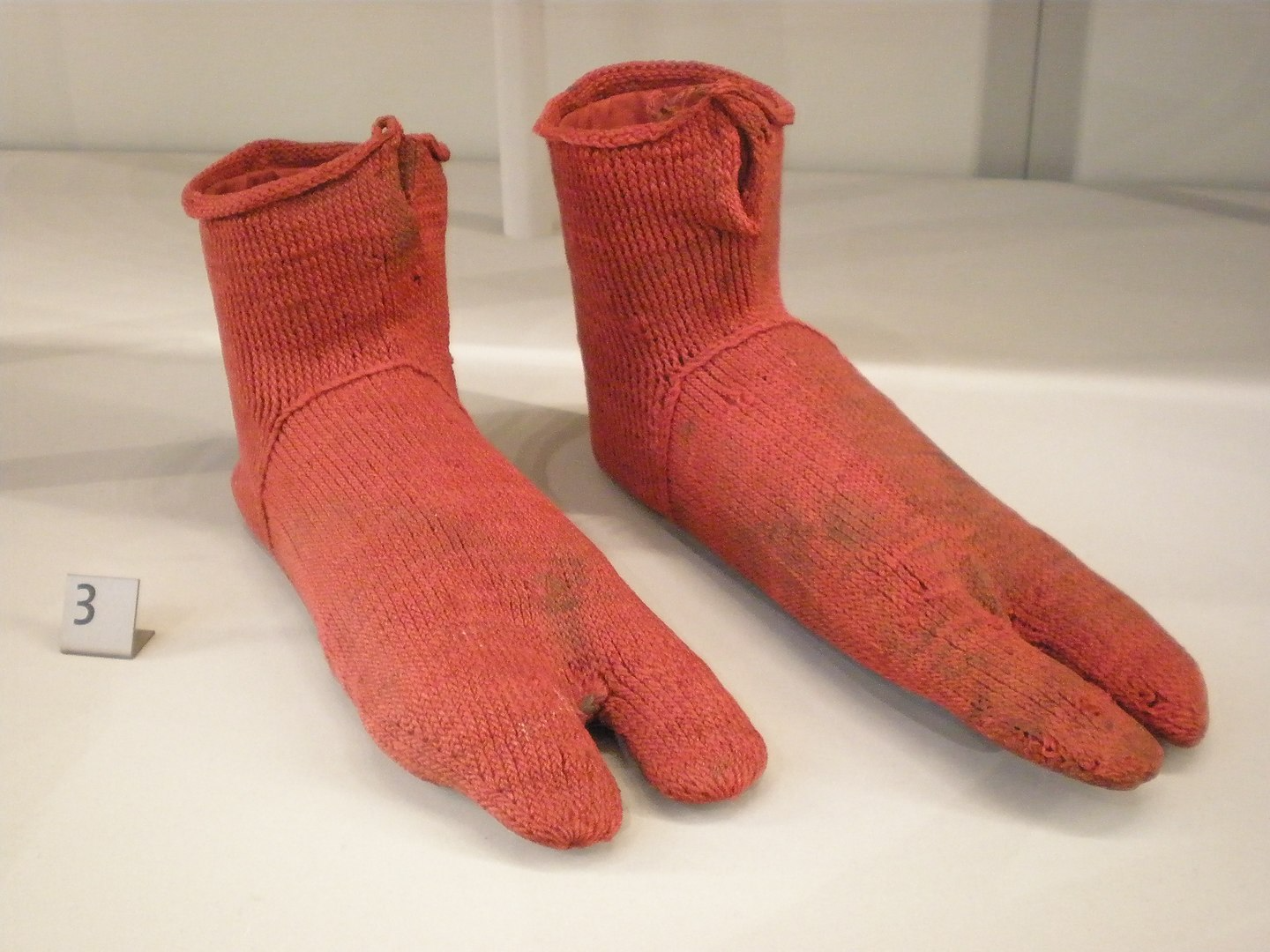
We have, above, a pair of socks. You can tell that much by looking at them, of course, but what’s less obvious at a glance is their age: this pair dates back to 250–420 AD, and were excavated in Egypt at the end of the nineteenth century. That information comes from the site of the Victoria and Albert Museum, where you can learn more about not just these Egyptian socks but the distinctive, now-vanished technique used to make socks in Egypt at the time: “nålbindning, sometimes called knotless netting or single needle knitting — a technique closer to sewing than knitting,” which, as we know it, wouldn’t emerge until the eleventh century in Islamic Egypt. The technique still remains in use today.
Time consuming and skill-intensive, nålbindning produced especially close-fitting garments, and “fit is of particular importance in a cold climate but also for protecting feet clothed in sandals only.” And yes, it seems that socks like these were indeed worn with sandals, a function indicated by their split-toe construction.
A few years ago, we featured archaeological research here on Open Culture pointing to the ancient Romans as the first sock-and-sandal wearers in human history. These particular socks were also made in the time of the Roman Empire, though they were unearthed at its far reaches, from “the burial grounds of ancient Oxyrhynchus, a Greek colony on the Nile.”
As Smithsonian.com’s Emily Spivack writes, “We don’t know for sure whether these socks were for everyday use, worn with a pair of sandals to do the ancient Egyptian equivalent of running errands or heading to work — or if they were used as ceremonial offerings to the dead (they were found by burial grounds, after all).” But the fact that their appearance is so striking to us today, at least sixteen centuries later, reminds us that we aren’t as familiar as we think with the world that produced them. And if, to our modern eyes, they even look a bit goofy — though less goofy than they would if worn properly, along with a pair of sandals — we should remember the painstaking method with which they must have been crafted, as well as the way they constitute a thread, as it were, through the history of western civilization.
Related content:
An Ancient Egyptian Homework Assignment from 1800 Years Ago: Some Things Are Truly Timeless
3,200-Year-Old Egyptian Tablet Records Excuses for Why People Missed Work: “The Scorpion Bit Him,” “Brewing Beer” & More
Based in Seoul, Colin Marshall writes and broadcasts on cities, language, and culture. His projects include the Substack newsletter Books on Cities, the book The Stateless City: a Walk through 21st-Century Los Angeles and the video series The City in Cinema. Follow him on Twitter at @colinmarshall or on Facebook.
Read More...All This and World War II: The Forgotten 1976 Film That Mashed Up WWII Film Clips & Beatles Covers by Peter Gabriel, Elton John, Keith Moon & More
You may not hear the term mash-up very often these days, but the concept itself isn’t exactly the early-two-thousands fad that it might imply. It seems that, as soon as technology made it possible for enthusiasts to combine ostensibly unrelated pieces of media — the more incongruous, the better — they started doing so: take the synchronization of The Wizard of Oz and Pink Floyd’s The Dark Side of the Moon, known as The Dark Side of the Rainbow. But even back in the seventies, the art of the proto-mash-up wasn’t practiced only by rogue projectionists in altered states of mind, as evidenced by the 1976 20th Century Fox Release All This and World War II, which assembled real and dramatized footage of that epoch-making geopolitical conflict with Beatles covers.
Upon its release, All This and World War II “was received so harshly it was pulled from theaters after two weeks and never spoken of again,” as Keith Phipps writes at The Reveal.
Those who actually seek it out and watch it today will find that it gets off to an even less auspicious start than they might imagine: “A clip of Charlie Chan (Sidney Toler) skeptically receiving the news of Neville Chamberlain’s ‘peace in our time’ declaration in the 1939 film City in Darkness gives way to a cover of ‘Magical Mystery Tour’ by ’70s soft-rock giants Ambrosia. Accompanying the song: footage of swastika banners, German soldiers marching in formation, and a climactic appearance from a smiling Adolf Hitler, by implication the organizer of the ‘mystery tour’ that was World War II.”
The other recording artists of the seventies enlisted to supply new versions of well-known Beatles numbers include the Bee Gees, Elton John, the Who’s Keith Moon, and Peter Gabriel, names that assured the soundtrack album (which you can hear on this Youtube playlist) a much greater success than the film itself, with its fever-dream mixture of newsreels Axis and Allied with 20th Century Fox war-picture clips.
As for what everyone involved was thinking in the first place, Phipps quotes an explanation that soundtrack producer Lou Reizner once provided to UPI: “It would have been easy to take the music of the era and dub it to match the action on screen. But we’d have lost the young audience. We want all age groups to see this picture because we think it makes a statement about the absurdity of war. It is the definitive anti-war film” — or, as Phipps puts it, the definitive “cult film in search of cult.”
via Metafilter
Related content:
Hear 100 Amazing Cover Versions of Beatles Songs
Dark Side of the Rainbow: Pink Floyd Meets The Wizard of Oz in One of the Earliest Mash-Ups
Watch 85,000 Historic Newsreel Films from British Pathé Free Online (1910–2008)
Based in Seoul, Colin Marshall writes and broadcasts on cities, language, and culture. His projects include the Substack newsletter Books on Cities, the book The Stateless City: a Walk through 21st-Century Los Angeles and the video series The City in Cinema. Follow him on Twitter at @colinmarshall or on Facebook.
Read More...Support Us
We're hoping to rely on loyal readers, rather than erratic ads. Please click the Donate button and support Open Culture. You can use Paypal, Venmo, Patreon, even Crypto! We thank you!

About Us

Open Culture scours the web for the best educational media. We find the free courses and audio books you need, the language lessons & educational videos you want, and plenty of enlightenment in between.
Advertise With Us
FREE UPDATES!
GET OUR DAILY EMAIL
Get the best cultural and educational resources on the web curated for you in a daily email. We never spam. Unsubscribe at any time.
FOLLOW ON SOCIAL MEDIA
Open Culture editor Dan Colman scours the web for the best educational media. He finds the free courses and audio books you need, the language lessons & movies you want, and plenty of enlightenment in between.
Advertise With Us


