India’s Answer to M.I.T. Presents 268 Free Online Courses (in English)
 During the 1940s, when India won its independence from Britain, the leaders of the newly-formed nation began imagining the Indian Institutes of Technology, otherwise known as the IITs. Much like MIT in the US, these schools would cultivate some of the world’s top scientists and engineers. And they’d make technology key to the future of India’s economic development.
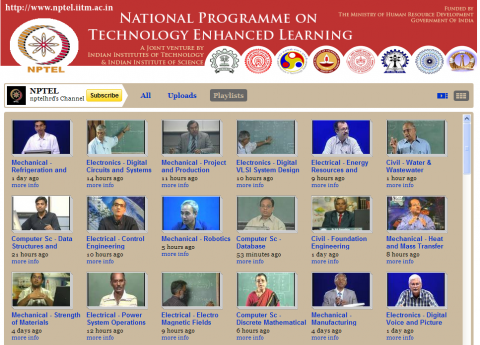
Today, the IITs stand atop the Indian educational system and, like their peer institutions in the US, they’re making a point of putting free courses on the web. Rather quietly, they’ve amassed some 268 courses, giving anyone with an internet connection access to 10,000+ video lectures. As you might expect, the course lineup skews heavily toward science and technology, the stuff that contributes to India’s industrial base — Introduction to Basic Electronics, High Performance Computer Architecture, Space Flight Mechanics, Steel Making, and all of the rest. But they’ve also added a few contemplative courses to the mix, courses like Contemporary Literature, Quantum Physics, the History of Economic Theory, and Game Theory and Economics.
You can start rummaging through the complete list of IIT courses on YouTube here, or you can access them via this IIT website, which gives you the ability to download videos straight to your computer. Naturally we’ve added many essential IIT courses to our list of Free Online Courses from Great Universities — Harvard, Yale, Stanford, MIT, UC Berkeley, Oxford, the list goes on.
Related Content:
Yale Introduces Another Seven Free Online Courses, Bringing Total to 42
Harvard Presents Free Courses with the Open Learning Initiative
MIT Introduces Complete Courses to OpenCourseWare Project
Read More...
The Final Descent of NASA’s Mars Rover Curiosity Captured in High Resolution
A few weeks back, we showed you the first grainy footage of NASA’s rover, Curiosity, landing on the dusty surface of Mars. And we promised to follow up with higher res footage when it became available. Well, it’s now online and on display above. Just to recap, the video shows the final descent of Curiosity, from the point where it jettisons its heat shield to the moment when it touches down on the martian surface. The video was stitched together with 666 images taken at a rate of four per second.
Related Content:
Find Astronomy courses in our collection of 500 Free Online Courses
Carl Sagan Presents Six Lectures on Earth, Mars & Our Solar System … For Kids (1977)
Ray Bradbury Reads Moving Poem on the Eve of NASA’s 1971 Mars Mission
Follow us on Facebook, Twitter and now Google Plus and share intelligent media with your friends! They’ll thank you for it.
Read More...Parking Garage Door Does Impression of Miles Davis’ Jazz Album, Bitches Brew
Classic. And if you’re not familiar with the reference — Miles Davis’ 1970 experimental jazz album, Bitches Brew — you can catch it on YouTube, or snag a copy online.
H/T Kottke
Related Content:
‘The Sound of Miles Davis’: Classic 1959 Performance with John Coltrane
1959: The Year that Changed Jazz
The Universal Mind of Bill Evans: Advice on Learning to Play Jazz & The Creative Process
Read More...
Remembering The Clash’s Frontman Joe Strummer on His 60th Birthday
It’s hard to imagine him as an old man, but Joe Strummer would have turned 60 today. Strummer was the heart and soul of the legendary punk group The Clash, the reason many people called it “The only band that matters.”
He was a man with a Bob Dylan-like instinct for self-invention. Born John Graham Mellor on August 21, 1952 in Ankara, Turkey (his father was in the British diplomatic service), he changed his name to Joe Strummer in the early 1970s while playing in a rhythm and blues band called the 101’ers. When the Sex Pistols opened for the 101’ers, Strummer was so impressed with the band’s take-no-prisoners attitude that he threw himself into the punk movement, accepting an offer from guitarist Mick Jones, bassist Paul Simonon and manager Bernie Rhodes to join what would eventually become The Clash.
With the Clash, Strummer helped move punk beyond the self-absorbed nihilism of its early days to embrace political and social awareness. After the band disintegrated in the mid 1980s, Strummer spent over a decade in semi-retirement before returning in the late 1990s for what he called his “Indian summer,” with a popular BBC radio show and a new band, The Mescaleros. But just as he was regaining his old momentum, Strummer died unexpectedly of heart failure on December 22, 2002, at the age of 50.
In the video above, Strummer sings the title song to the The Clash’s 1980 album London Calling, which Rolling Stone ranked Number 8 on its list of the 500 Greatest Albums of All Time. “Recorded in 1979 in London,” writes the magazine, “which was then wrenched by surging unemployment and drug addiction, and released in America in January 1980, the dawn of an uncertain decade, London Calling is 19 songs of apocalypse, fueled by an unbending faith in rock & roll to beat back the darkness.”
Related content:
The Clash: Westway to the World
The Clash Star in 1980’s Gangster Parody: Hell W10
Mick Jones, The Clash Guitarist, Sings ‘Train in Vain’ at the Library
Read More...What If Everyone Jumped at Once? What Color is a Mirror? Big Questions Answered in Viral Videos
Michael Stevens knows something about viral videos. Yes, he’s a Googler who works on Programming Strategy at YouTube. That gives him some professional bona fides. But he also rolls up his sleeves and produces his own wildly popular videos under the Vsauce banner. Perhaps you’ll remember when Stevens asked the question late last year: Just how much does the entire internet — all 5 million terabytes of information — actually weigh? (That got 1.3 million views, putting it certainly into viral territory.) Two weeks ago, Stevens returned with another tantalizing question: What color is a mirror? Hint: It’s not what you think. And now, just two days ago, he dropped this question on us: What would happen if everyone on the planet jumped at once? Catch it below.
“Learn English With Ricky Gervais,” A New Podcast Debuts (NSFW)
Bombastically billed as “a new landmark in human comprehension,” Ricky Gervais’ video podcast, “Learn English with Ricky Gervais” does, in a way, break new pedagogical ground. The trailer above provides a brief glimpse of the series’ first episode, currently available for free on iTunes. The premise of the show is that Gervais and his partner Karl Pilkington, in a posh-looking study with globe and fireplace, parody video language courses for non-English speakers. Gervais’ obnoxious grandiosity and the almost methodical obtuseness of Pilkington have become legendary to fans of HBO’s The Ricky Gervais Show. Missing here is the third member of that program, co-creator of the original British The Office, Stephen Merchant, but whatever the reason for his absence, this concept probably works better as a duo, with Gervais playing the overbearing and somewhat abusive teacher and Pilkington standing in for the hypothetical “students,” who would no doubt find this method as bewildering as he does.
The full episode includes subtitles in a language that resembles Welsh but mostly seems like gibberish (correct me, Welsh speakers, if I’m wrong), and Gervais and Pilkington’s exchanges are chock-full of non-sequiturs and insults, some benign, some skirting the boundaries of the uncomfortably xenophobic, but that’s kind of the point, and the source of much of the humor. The characters here are too culturally insensitive and dense to teach anyone anything. Gervais—with Merchant and Pilkington—uses a similar shtick in his An Idiot Abroad series, and it works, I think, but you’ll need to decide for yourself in the case of “Learn English,” and you’ll need to download iTunes (on the off chance you don’t have it) and subscribe to the podcast to view the full first episode, which debuted on August 14th. Gervais has said that future episodes may involve either a small fee or advertising to cover costs.
In the meantime, stop by our collection of Free Language Lessons, where you can download serious lessons in 40 different languages, including French, Spanish, Italian, Mandarin, Arabic, and, yes, English and Welsh.
Josh Jones is a doctoral candidate in English at Fordham University and a co-founder and former managing editor of Guernica / A Magazine of Arts and Politics.
Read More...Sonny Rollins’ Enduring Musical Power: A Vintage 1965 Performance and Beyond
“No one knows why exactly Sonny Rollins, the tenor saxophone colossus, hasn’t recorded a good studio album since the 1960s,” writes New York Review of Books blogger Christopher Carroll. “Yet anyone who has seen Rollins perform on a good night knows that, even at eighty-one, he is still capable of playing with the same brilliance that first made giants like Charlie Parker, Miles Davis, and Thelonious Monk take an interest in him in the 1950s.” “I haven’t heard every note that Rollins has ever recorded, but I’ve heard lots of them,” writes New Yorker film blogger Richard Brody, “and if I had to carry just one recorded performance of his to the hereafter, it would be one from Copenhagen, from 1965.” You’ll find a clip of this very show above, 45 minutes that might give you a sense of just what Rollins enthusiasts like Carroll and Brody are enthusing about.
As Brody describes the full show, “Rollins plays almost uninterruptedly for nearly an hour, picking up heat and whimsy as he goes along. His full, hearty sound is exceptionally sculptured, bluff, and pliable; the notes of the rising phrase in the opening number, ‘There Will Never Be Another You,’ seem to hang in the air like balloons. Dawson sets a brisk, light tempo, Rollins makes room for [bassist Niels-Henning Ørsted] Pedersen’s solo, and then sidles over into the harmonic wilds and lets fly cascades of notes and broken, modernistic tones while trading fours with the drummer, before ending with a suave solo cadenza.” For a more recent showcase of Rollins’ musical powers at work, see also the video just above, a 1992 performance from his sextet in München, Germany. Sometimes well-respected jazz players spend long stretches in the artistic wilderness — Rollins in particular having been “irreparably damaged by years spent experimenting with funk, disco, and fusion in the seventies and eighties,” in Carroll’s words — but you can never really take your ears off them.
Related content:
Sonny Rollins’ New York City Bridge Sabbatical Recreated in 1977 Pioneer Electronics Ad
Colin Marshall hosts and produces Notebook on Cities and Culture. Follow him on Twitter at @colinmarshall.
Read More...Leonard Bernstein Explains Modern Music, From Stravinsky to Cage, with Baseball Analogies (1957)

We’ve blogged before about Leonard Bernstein’s appearances on a 1950s television program called Omnibus, “the most successful cultural magazine series in the history of U.S. commercial television,” which featured scientists and artists presenting original ideas and compositions. In this documentary, Bernstein introduces his audience to “modern music,” including such a more or less classical composer as Stravinsky to the avant-garde instrumentation of John Cage’s prepared piano and early electronics of Pierre Henry’s musique concrete. After watching a sextet of “musicians” “playing” transistor radios, Bernstein admits, “Now compared with all these wildest outposts of experimentation… Stravinsky probably sounds tame or more like, well… music.” Bernstein then goes on to make a case for modern, experimental music, hoping to persuade his audience to “hate it less, or hate it more intelligently, or even grow to like it.” He’s a very patient teacher, and he anticipates his students’ first objection to the modernism of his time: “What has happened to beauty?” The beauty of Mozart, say, or Tchaikovsky?
In order to answer this question, Bernstein uses easily visualized analogies to baseball and numerous more or less familiar symphonic passages to explain basic music theory—tonality, harmonics, chord structure, scale patterns, melody, dissonance. By the time he comes to describe the conflict, post-Wagner, between atonal composers and more conservative “tonalists” around the twenty minute mark, you’ve got a pretty good idea of what he’s talking about, even if this debate is entirely new to you. It’s a captivating lecture tracing the history and logic of musical composition, and despite Bernstein’s range of references, he’s never esoteric. He had the patience of a Fred Rogers and media personality of a musical Carl Sagan (and, oddly, some of the mannerisms of Rod Serling). Like Rogers and Sagan, he was part of an age when television presenters could be educators first, entertainers second, and solipsists not at all. Luckily for us, we’ve got him on Youtube.
If you would like to support the mission of Open Culture, consider making a donation to our site. It’s hard to rely 100% on ads, and your contributions will help us continue providing the best free cultural and educational materials to learners everywhere. You can contribute through PayPal, Patreon, and Venmo (@openculture). Thanks!
Related Content:
Leonard Bernstein’s Masterful Lectures on Music (11+ Hours of Video Recorded in 1973)
Glenn Gould and Leonard Bernstein Play Bach
Josh Jones is a doctoral candidate in English at Fordham University and a co-founder and former managing editor of Guernica / A Magazine of Arts and Politics.
Read More...Bill Murray Reads Wallace Stevens Poems — “The Planet on The Table” and “A Rabbit as King of the Ghosts”
On June 11th, Poets House hosted The 17th Annual Poetry Walk Across the Brooklyn Bridge. The event features “readings of the poetry of Walt Whitman, Marianne Moore, Langston Hughes and other greats,” all in order to raise funds for the New York City non-profit dedicated to cultivating a wider audience for poetry. And the event is regularly attended by the greatest cinematic supporter of Poets House — the actor Bill Murray.
In 2001, Murray took part in the festivities and read three poems: Sarah Manguso’s “What We Miss,” Cole Porter’s “Brush Up,” and Billy Collins’ “Forgetfulness.” (Click links to see the readings.) This year, he returned and delighted the audience with a reading of two poems by Wallace Stevens: “The Planet on The Table” and “A Rabbit as King of the Ghosts.”
But if you’re looking for my favorite reading, then I’ll steer you back to 2009, when Murray read poems by Billy Collins, Lorine Niedecker and Emily Dickinson to construction workers building the new home for Poets House. It’s a charming, very Bill Murray moment.
Find more poetry in our collection of Free Audio Books.
h/t @webacion
Read More...Russian Punk Band, Sentenced to Two Years in Prison for Deriding Putin, Releases New Single
Yesterday wasn’t particularly a good day for the freedom of expression in Russia. On the same day that a top court banned gay pride marches in Moscow for the next 100 years, three young members of the punk band Pussy Riot were sentenced to two years in a penal colony. Their crime? Staging an anti Putin protest on the altar of the Cathedral of Christ the Savior in Moscow. Protests supporting Pussy Riot were held in 60 cities worldwide (including one in the capital where chess champion Garry Kasparov was beaten by police); Western governments called the sentence disproportionate; and already the band has released a new single called “Putin Lights Up the Fires.” The Guardian has created an accompanying video. Watch it above.…
via BoingBoing
Read More...Support Us
We're hoping to rely on loyal readers, rather than erratic ads. Please click the Donate button and support Open Culture. You can use Paypal, Venmo, Patreon, even Crypto! We thank you!

About Us

Open Culture scours the web for the best educational media. We find the free courses and audio books you need, the language lessons & educational videos you want, and plenty of enlightenment in between.
Advertise With Us

FREE UPDATES!
GET OUR DAILY EMAIL
Get the best cultural and educational resources on the web curated for you in a daily email. We never spam. Unsubscribe at any time.
FOLLOW ON SOCIAL MEDIA

Open Culture editor Dan Colman scours the web for the best educational media. He finds the free courses and audio books you need, the language lessons & movies you want, and plenty of enlightenment in between.
Advertise With Us

