The Cardboard Bernini: An Artist Spends 4 Years Building a Giant Cardboard Fountain Inspired by the Baroque Sculptor Bernini, Only to Let It Dissolve in the Rain
From the Triton Fountain in the Piazza Barberini to the Fountain of the Four Rivers in Piazza Navona, sculptor Gian Lorenzo Bernini’s glorious public fountains have impressed visitors to Rome for centuries.
Bernini angled for immorality when carving his Baroque masterpieces from marble.

Image by Trdinfl, via Wikimedia Commons
Eternity occupied artist James Grashow’s mind, too, throughout four years of toil on his Corrugated Fountain, a masterpiece of planned obsolescence.
“All artists talk about process”, he ruminates in an outtake from Olympia Stone’s documentary, The Cardboard Bernini, “but the process that they talk about is always from beginning to finish:
Nobody really talks about full term process to the end, to the destruction, to the dissolution of a piece. Everything dissolves in an eternity. I’d like to speak to that.

He picked the right medium for such a meditation — corrugated cardboard, sourced from the Danbury Square Box Company. (The founders chose its name in 1906 to alert the local hatting industry that they did not traffic in round hat boxes.)
Grashow challenged himself to make something with cardboard and hot glue that would “outshine” Bernini before it was sacrificed to the elements:
Water and cardboard cannot exist together. The idea of a paper fountain is impossible, an oxymoron that speaks to the human dilemma. I wanted to make something heroic in its concept and execution with full awareness of its poetic absurdity. I wanted to try to make something eternal out of cardboard… the Fountain was an irresistible project for me.
The documentary catches a mix of emotions as his meticulously constructed Baroque figures — nymphs, horses, dolphins, Poseidon — are positioned for destruction on the grounds of the Aldrich Contemporary Art Museum.
A young boy at the exhibition’s opening is untroubled by the sculpture’s impending fate:
I think it’s cool, coz it’s made out of trees and it’s returning to mush…or whatever you want to call it.
His buddy finds it hard to share his enthusiasm, gesturing helplessly toward the monumental work, his voice trailing off as he remarks, “I don’t see why you would want that to…”
An adult visitor unashamedly reveals that she had been actively rooting for rain.
When a storm does reduce the sculpture to an Ozymandian tableau a short while later, Grashow suspects the project was ultimately a self portrait, “full of bluster and bravado, hollow and melancholy at its core, doomed from the start, and searching for beauty in all of the sadness.”
Then he and a helper cart what’s left off to a waiting dumpster.

His daughter, Rabbi Zoë Klein, likens the Corrugated Fountain’s impermanence to the sand mandalas Tibetan monks spend months creating, then sweep away with little fanfare:
…the art is about just the gift of creation, that we have this ability to create, that we celebrate that, not that we can conquer time, but rather we can make the most of the time we have by making it beautiful and meaningful, living up to our potential..
Grashow speaks tenderly of the ephemeral material he uses frequently in his work:
It’s so grateful for the opportunity to become something, because it knows it’s going to be trash.
Watch The Cardboard Bernini here.
See more of James Grashow’s cardboard works here.
Related Content
Designer Creates Origami Cardboard Tents to Shelter the Homeless from the Winter Cold
Kraftwerk’s “The Robots” Performed by German 1st Graders in Cute Cardboard Robot Costumes
– Ayun Halliday is the Chief Primatologist of the East Village Inky zine and author, most recently, of Creative, Not Famous: The Small Potato Manifesto and Creative, Not Famous Activity Book. Follow her @AyunHalliday.
Read More...Music Producer Steve Albini, Director Godfrey Reggio & Actor Fred Armisen Explain Why Creating Is Crucial to Human Existence
Imagine, if you will, an evening’s entertainment consisting of an episode of Portlandia, a spin of Nirvana’s In Utero, and a screening of Koyaanisqatsi. Perhaps these works would, at first glance, seem to have little in common. But if you end the night by watching the above episode of Big Think’s series Dispatches from the Well with Kmele Foster, their common spirit may well come into view. In it, Foster travels America in order to visit with Godfrey Reggio, Steve Albini, and Fred Armisen, widely known, respectively, as the director of Koyaanisqatsi, the producer of In Utero, and the co-creator of Portlandia. All of them have also made a great deal of other work, and none of them are about to stop now.
“When you have a mania, you can scream and go nuts, or you can write everything down,” says Reggio. “I write everything down.” The same concept arises in Foster’s conversation with Albini, who believes that “the best music is made in service of the mania of the people doing it at the moment.” As for “the people who are trying to be popular, who are trying to, like, entertain — a lot of that music is trivial.”
Foster credibly describes Albini as “a man with a code,” not least that which dictates his rejection of digital media. “I’m not making an aesthetic case for analog recording,” he says. “Analog recordings are a durable archive of our culture, and in the distant future, I want people to be able to hear what our music sounded like.”
To create as persistently as these three have demands a willingness to play the long game — and to “re-perceive the normal,” as Reggio puts it while articulating the purpose of his unconventional documentary films. To his mind, it’s what we perceive least that affects us most, and if “what we do every day, without question, is who we are,” we can enrich our experience of reality by asking questions in our life and our work like, “Is it the content of your mind that determines your behavior, or is it your behavior that determines the content of your mind?” This line of inquiry will send each of us in different intellectual and aesthetic directions, impossible though it is to arrive at a final answer. And in the face of the fact that we all end up at the same place in the end, Armisen has a creative strategy: “I really celebrate death,” he explains. “I have my funeral all planned out and everything.”
Related content:
Read Steve Albini’s Uncompromising Proposal to Produce Nirvana’s In Utero (1993)
Fred Armisen Teaches a Short Seminar on the History of Punk
Koyaanisqatsi at 1552% Speed
Why Man Creates: Saul Bass’ Oscar-Winning Animated Look at Creativity (1968)
Based in Seoul, Colin Marshall writes and broadcasts on cities, language, and culture. His projects include the Substack newsletter Books on Cities, the book The Stateless City: a Walk through 21st-Century Los Angeles and the video series The City in Cinema. Follow him on Twitter at @colinmarshall or on Facebook.
Read More...The Roman Author Pliny the Younger Gets Ghosted by a Friend, and Goes on a Rant: Hear It Read by Actor Rob Delaney
Pliny the Younger may be best remembered for writing the only eye-witness account of the destruction of Pompeii in 79 AD. It’s a memorable letter still found in modern collections of Pliny the Younger’s correspondence. There, you can also find a simple letter authored by Pliny, one that reflects not on a shattering historical event, but rather something we can all relate to: the anger the author felt upon getting ghosted by a friend. To set the scene, Pliny had invited Septicius Clarus to join him for some food, wine, and conversation. But his friend never showed up, and so Pliny fired off a snub letter, which actor and comedian Rob Delaney reads above at a Letters Live event. You can follow along with the text below:
Shame on you! You promised to come to dinner, and you never came!
I’ll take you to court, and you will pay to the last penny for my losses, and quite a sum! Ready for each of us were a lettuce, three snails, and two eggs, barley water with honey wine cooled with snow (you must add the cost of snow as well, in fact the snow in particular, as it melts in the dish). There were olives, beetroot, gourds, onions, and countless other delicacies no less elegant. You would have heard performers of comedy, or a reader, or a lyre-player, or even all three, such is my generosity!
But you preferred to dine at some nobody’s house, enjoying oysters, sow’s tripe, sea urchins, and performing-girls from Cadiz. You’ll be punished for this, I won’t say how. What boorishness was this! You begrudged perhaps yourself, and certainly me – but yes, yourself as well. What joking and laughter and learning we would have enjoyed!
You can dine in many houses on more elaborate fare, but nowhere more genially, innocently, and unguardedly. Farewell!
In the end, Pliny forgave his friend. For Pliny dedicated the first of his letter to Septicius, stating: “You have constantly urged me to collect and publish the more highly finished of the letters that I may have written. I have made such a collection… I can only hope that you will not have cause to regret the advice you gave, and that I shall not repent having followed it.” You can read the collection online here.
Related Content
The Little-Known Bombing of Pompeii During World War II
Read More...Stanford Continuing Studies Offering a Course on the History & Music of the Grateful Dead, Taught by David Gans: Starts on Monday, January 22
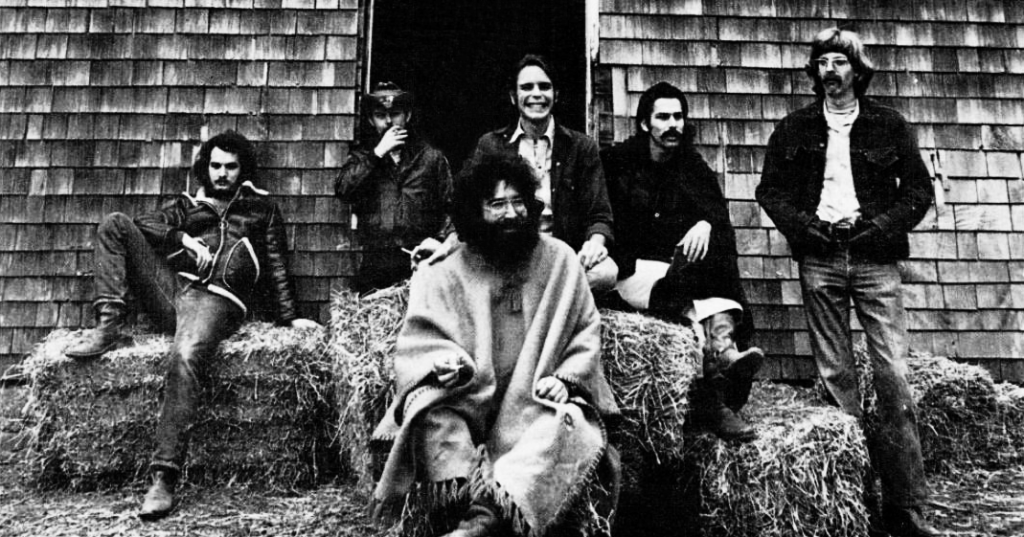
Image via Wikimedia Commons
A quick heads up: On Monday, Stanford Continuing Studies will kick off an online course called Psychedelia and Groove: The Music and Culture of the Grateful Dead. Taught by David Gans (author of Playing in the Band: An Oral and Visual Portrait of the Grateful Dead), the course got a nice shout out from drummer Mickey Hart on Instagram. Open to any adult, the course description reads:
The Grateful Dead’s groundbreaking fusion of music, counterculture, and community engagement forged an enduring legacy that transcends generations while shaping the evolution of music and cultural expression. Fresh off the farewell performance of Dead & Company in San Francisco in July, this course invites students to delve into the phenomenon that is the Grateful Dead through a captivating exploration of the band’s history, music, and cultural impact.
The course will start by tracing the band’s evolution, from its humble beginnings to its legendary status as one of the most influential bands in music history. We will explore the band’s formation, the early San Francisco music scene, its unique approach to touring, and the various eras of its existence. We’ll next embark on a sonic journey through the band’s diverse and ever-evolving musical catalog. Students will dissect the distinctive blend of rock, folk, blues, and improvisation that defined the Grateful Dead’s sound.
Finally, we’ll examine the band’s cultural impact on society, diving into the band’s connection to art, literature, and social change, as well as its unique fan culture and the phenomenon of the “Deadhead.” By the end of the course, students will have a well-rounded appreciation for the roots, struggles, and milestones that shaped the Grateful Dead’s trajectory, an understanding of its profound impact on music and culture, and insight into a legacy that still resonates deeply today.
Guest speakers for this course will include Steve Silberman, who was featured in the documentary Long Strange Trip and is a regular voice on the Good Ol’ Grateful Deadcast. He is also a co-author of Skeleton Key: A Dictionary for Deadheads.
Again, the course starts on Monday, January 22. Tuition is $405. You can enroll here.
Stanford Continuing Studies also offers many other courses online, across many disciplines, at a reasonable price. Check out the catalogue here.
Related Content
Stream a Massive Archive of Grateful Dead Concerts from 1965–1995
The Grateful Dead Movie: Watch It Free Online
Read More...How Loneliness Is Killing Us: A Primer from Harvard Psychiatrist & Zen Priest Robert Waldinger
In 1966, Paul McCartney famously sang of “all the lonely people,” wondering aloud where they come from. Nearly six decades later, their numbers seem only to have increased; as for their origin, psychiatrist, psychoanalyst, and Zen priest Robert Waldinger has made it a longtime professional concern. “Starting in the nineteen fifties, and going all the way through to today, we know that people have been less and less invested in other people,” he says in the Big Think video above. “In some studies, as many as 60 percent of people will say that they feel lonely much of the time,” a feeling “pervasive across the world, across all age groups, all income groups, all demographics.”
“Having an extensive network of friends is no guarantee against loneliness,” writes the late sociologist Ray Oldenburg in The Great Good Place. “Nor does membership in voluntary associations, the ‘instant communities’ of our mobile society, ensure against social isolation and attendant feelings of boredom and alienation. The network of friends has no unity and no home base.” He names as a key factor the disappearance, especially in American life since World War II, of “convenient and open-ended socializing — places where individuals can go without aim or arrangement and be greeted by people who know them and know how to enjoy a little time off.”
Oldenburg’s elegy for and defense of “cafés, coffee shops, community centers, general stores, bars,” and other engines of community life, was published in 1989, well before the rise of social media — which Waldinger frames as the latest stage in a process that began with television. As more American homes acquired sets of their own, “there was a decline in investing in our communities. People went out less, they joined clubs less often. They went to houses of worship less often. They invited people over less often.” Then, “the digital revolution gave us more and more screens to look at, and software that was designed specifically to grab our attention, hold our attention, and therefore keep it away from the people we care about.”
We also know, he continues, that “people with strong social bonds are much less likely to die in any given year than people without strong social bonds.” This is a credible claim, given that he happens to direct the now 85-year-long Harvard Study of Adult Development. In 2016, we featured Waldinger’s TED Talk on some of its findings here on Open Culture. Before that, we posted a PBS BrainCraft video that considers the Harvard Study of Adult Development along with other research on the contributing factors to happiness, a body of work that, taken together, points to the importance of love — which, even if it isn’t all you need, is certainly something you need. And thus one more Beatles lyric continues to resonate.
Related content:
New Animation Explains Sherry Turkle’s Theories on Why Social Media Makes Us Lonely
What Are the Keys to Happiness? Lessons from a 75-Year-Long Harvard Study
All You Need is Love: The Keys to Happiness Revealed by a 75-Year Harvard Study
A Guide to Happiness: Alain de Botton Shows How Six Great Philosophers Can Change Your Life
Based in Seoul, Colin Marshall writes and broadcasts on cities, language, and culture. His projects include the Substack newsletter Books on Cities, the book The Stateless City: a Walk through 21st-Century Los Angeles and the video series The City in Cinema. Follow him on Twitter at @colinmarshall or on Facebook.
Every Political Ideology Explained in 8 Minutes
From the guy who brought you 51 Propaganda Techniques Explained in 11 Minutes comes this: Every Political Ideology Explained in 8 Minutes. You get the usual suspects–conservatism, liberalism, socialism, communism and fascism. And then some less frequently encountered ideologies: transhumanism, syndicalism, and communitarianism. By the end, he covers 23 different belief systems that organize our political and economic lives. The video is brief, necessarily superficial. But it’s a place to start. To take a deeper dive, you can explore Andrew Heywood’s book, Political Ideologies: An Introduction.
Related Content
Umberto Eco Makes a List of the 14 Common Features of Fascism
Introduction to Political Philosophy: A Free Online Course from Yale University
How to Spot a Communist by Using Literary Criticism: A 1955 Manual from the U.S. Military
Read More...
Jewish Comedy with Daniel Lobell (“Reconquistador”) — Pretty Much Pop: A Culture Podcast #165

Your hosts Mark, Lawrence, Sarahlyn, and Al explore the characteristics of Jewish comedy with stand-up/graphic novelist Daniel, whose film Reconquistador explores his ancestors being kicked out of Spain. What’s the connection of Jewish humor to anti-semitism?
We talk about relating as a creator to your identity, Jewish people seeing themselves in film and TV, the experience of literally seeing yourself in a film, Jewish comedy as philosophy or social commentary, and “Jewish humor” vs. humor by people who happen to be Jewish.
We touch on Mel Brooks, Larry David, Adam Sandler, Woody Allen, Lenny Bruce, and feminist Jewish comedy shows such as Broad City, Crazy Ex-Girlfriend, and Inside Amy Schumer.
FYI this was recorded back in early November when the Gaza war and its accompanying flurry of anti-Semitism was a bit more raw.
Follow us @DanielLobell, @law_writes, @sarahlynbruck, @ixisnox, @MarkLinsenmayer.
Listen to our earlier episode with Daniel about philosophy as comedy.
Hear more Pretty Much Pop, including many recent episodes that you haven’t seen on this site. Support the show and hear bonus talking for this and nearly every other episode at patreon.com/prettymuchpop or by choosing a paid subscription through Apple Podcasts. This week our supporter-exclusive Aftertalk includes our stories of seeing elderly performers; should you run out and see so-and-so before they’re dead?
This podcast is part of the Partially Examined Life podcast network.
Pretty Much Pop: A Culture Podcast is the first podcast curated by Open Culture. Browse all Pretty Much Pop posts.
Read More...A Beautiful Visual Tour of Tirranna, One of Frank Lloyd Wright’s Remarkable, Final Creations
“When I first encountered Wright’s work as an eight-year-old boy, it was the space and the light that got me all excited,” says Stuart Graff in the Architectural Digest video above. “I now understand why that gives us the feeling that it does, why we feel different in a Frank Lloyd Wright house. That’s because he uses space and light to create this sense of intimacy with the world around us.” As luck would have it, Graff has grown up to become president and CEO of the Frank Lloyd Wright Foundation, and it is in that capacity that he leads us through one of the renowned American architect’s last projects, a 1955 house along the Noroton River in New Canaan, Connecticut called Tirranna.
“While Tirranna was being built, Wright was in New York City working on his largest commission, the Guggenheim Museum,” says Graff. Also known as the Rayward–Shepherd House, Tirranna is certainly less widely known than the Guggenheim, and indeed, less widely known than some of Wright’s other residential work.
But as his private houses go, Tiranna’s “setting rivals even perhaps Wright’s most famous work, Fallingwater, in the way that house engages nature.” Built along a curve that “follows the movement of the sun through the day” and textured with contrasting concrete block and Philippine mahogany — not to mention plenty of glass through which to take in the landscape outside — it stands as a rich example of late Wright.
And rich is what you’d better be if you want to live it: according to a notice published in Architectural Digest, Tirranna went on the market last year for an asking price of $8 million. Its 7,000 square feet make it one of Wright’s “largest and most expansive residential projects”; the “low-slung main home is designed in a hemicycle style — a uniquely Wright shape — and features seven bedrooms, eight bathrooms, a rooftop observatory, and a wine cellar that has been converted into a bomb shelter.” It even boasts the distinction of Wright himself having stayed there, during the time he was still working on the Guggenheim. For a deep-pocketed enthusiast of twentieth-century American architecture, there could hardly be a more intriguing prospect in New Canaan — as least since the Glass House isn’t for sale.
Related content:
What Frank Lloyd Wright’s Unusual Windows Tell Us About His Architectural Genius
130+ Photographs of Frank Lloyd Wright’s Masterpiece Fallingwater
When Frank Lloyd Wright Designed a Doghouse, His Smallest Architectural Creation (1956)
Based in Seoul, Colin Marshall writes and broadcasts on cities, language, and culture. His projects include the Substack newsletter Books on Cities, the book The Stateless City: a Walk through 21st-Century Los Angeles and the video series The City in Cinema. Follow him on Twitter at @colinmarshall or on Facebook.
Read More...J.S. Bach’s Opera, “The Coffee Cantata,” Sings the Praises of the Great Stimulating Drink (1735)
From the time that a nameless genius in either Ethiopia or Yemen decided to dry, crush and strain water through a berry known for making goats nervous and jumpy, coffee has been loved and worshiped like few other beverages. Early Arab doctors proclaimed the stuff to be a miracle drug. Thoroughly caffeinated thinkers from Voltaire to Jonathan Swift to Jack Kerouac debated literature, philosophy and everything in between at coffee houses. Author Honoré Balzac even reportedly died because of excessive coffee drinking (it was either that or the syphilis.)
Johann Sebastian Bach (1685–1750) was also apparently a coffee enthusiast. So much so that he wrote a composition about the beverage. Although known mostly for his liturgical music, his Coffee Cantata (AKA Schweigt stille, plaudert nicht, BWV 211) is a rare example of a secular work by the composer. The short comic opera was written (circa 1735) for a musical ensemble called The Collegium Musicum based in a storied Zimmerman’s coffee house in Leipzig, Germany. The whole cantata seems very much to have been written with the local audience in mind.
Coffee Cantata is about a young vivacious woman named Aria who loves coffee. Her killjoy father is, of course, dead set against his daughter having any kind of caffeinated fun. So he tries to ban her from the drink. Aria bitterly complains:
Father sir, but do not be so harsh!
If I couldn’t, three times a day,
be allowed to drink my little cup of coffee,
in my anguish I will turn into
a shriveled-up roast goat.Ah! How sweet coffee tastes,
more delicious than a thousand kisses,
milder than muscatel wine.
Coffee, I have to have coffee,
and, if someone wants to pamper me,
ah, then bring me coffee as a gift!
The copywriters at Starbucks marketing department couldn’t have written it any better. Eventually, daughter and father reconcile when he agrees to have a guaranteed three cups of coffee a day written into her marriage contract. You can watch it in its entirety below, or get a quick taste above. The lyrics in German and English can be read here.
Note: An earlier version of this post appeared on our site in 2014.
Related Content:
“The Vertue of the COFFEE Drink”: London’s First Cafe Creates Ad for Coffee in the 1650s
The Coffee Pot That Fueled Honoré de Balzac’s Coffee Addiction
The Birth of Espresso: The Story Behind the Coffee Shots That Fuel Modern Life
Jonathan Crow is a Los Angeles-based writer and filmmaker whose work has appeared in Yahoo!, The Hollywood Reporter, and other publications. You can follow him at @jonccrow.
Read More...Can You Crack the Uncrackable Code in Kryptos, the CIA’s Work of Public Art?
It can be challenging to parse the meaning of many non-narrative artworks.
Sometimes the title will offer a clue, or the artist will shed some light in an interview.
Is it a comment on the cultural, socio-economic or political context in which it was created?
Or is the act of creating it the artist’s most salient point?
Are multiple interpretations possible?
Artist Jim Sanborn’s massive sculpture Kryptos may inspire various reactions in its viewers, but there’s definitely a single correct interpretation.
But 78-year-old Sanborn isn’t saying what…
He wants someone else to identify it.
Kryptos’ main mystery — more like “a riddle wrapped in a mystery inside an enigma” to quote Winston Churchill — was hand cut into an S‑shaped copper screen using jigsaws.
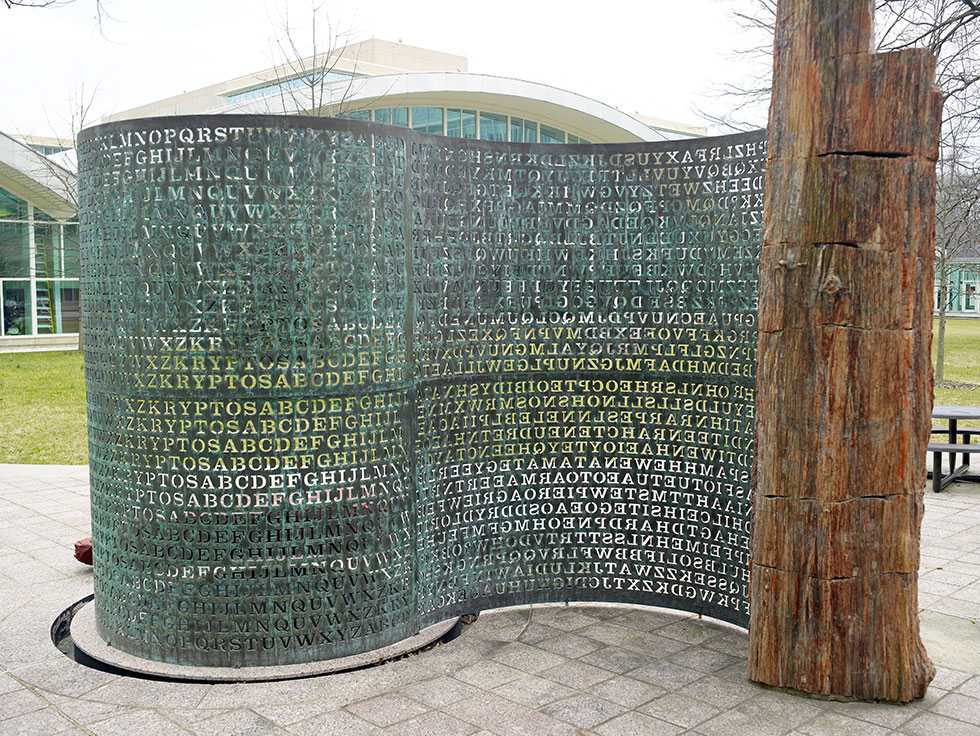
Image courtesy of the CIA
Professional cryptanalysts, hobbyists, and students have been attempting to crack the code of its 865 letters and 4 question marks since 1990, when it was installed on the grounds of CIA headquarters in Langley, Virginia.
The hands-on part fell well within Sanborn’s purview. But a Masters in sculpture from Pratt Institute does not automatically confer cryptography bonafides, so Sanborn enlisted Edward Scheidt, the retired chairman of the CIA’s Cryptographic Center, for a crash course in late 20th-century coding systems.
Sanborn sampled various coding methods for the finished piece, wanting the act of deciphering to feel like “peeling layers off an onion.”
That onion has been partially peeled for years.
Deciphering three of its four panels is a pelt shared by computer scientist and former president of the American Cryptogram Association, James Gillogly, and CIA analyst David Stein.
Gillogly arrived at his solution in 1999, using a Pentium II.
Stein reached the same conclusion a year earlier, after chipping away at it for some 400 hours with pencil and paper, though the CIA kept his achievement on the down low until Gillogly went public with his.
The following year the National Security Agency claimed that four of their employees, working collaboratively, had reached an identical solution in 1992, a fact corroborated by documents obtained through the Freedom of Information Act.
(On a related note, I got Wordle in three this morning…)
This still leaves the 97-character phrase from the final panel up for grabs. Cracking it will be the penultimate step in solving Kryptos’ puzzle. As Sanborn told NPR in 2020, “that phrase is in itself a riddle:”
It’s mysterious. It’s going to lead to something else. It’s not going to be finished when it’s decoded.
The public is welcome to continue making educated guesses.
Sanborn has leaked three clues over the years, all words that can be found in the final passage of decrypted text.
BERLIN, at positions 64 — 69 (2010)
CLOCK, at positions 70 — 74 (2014)
NORTHEAST, at position 26 — 34
Have you solved it, yet?
No?
Don’t feel bad…
Sanborn has been fielding incorrect answers daily for decades, though a rising tide of aggressive and racist messages led him to charge 50 bucks per submission, to which he responds via e‑mail, with absolutely no hope of hints.
Kryptos’ most dedicated fans, like game developer /cryptologist Elonka Dunin, seen plying Sanborn with copious quantities of sushi above in Great Big Story’s video, find value in working together and, sometimes, in person.
Their dream is that Sanborn might inadvertently let slip a valuable tidbit in their presence, though that seems like a long shot.
The artist claims to have gotten very skilled at maintaining a poker face.
(Wait, does that suggest his interlocutors have been getting warmer?)
Dunin has relinquished all fantasies of solving Kryptos solo, and now works to help someone — anyone — solve it.
(Please, Lord, don’t let it be chatGPT…)
Sanford has put a contingency plan in place in case no one ever manages to get to the bottom of the Kryptos (ancient Greek for “hidden”) conundrum.
He, or representatives of his estate, will auction off the solution. He is content with letting the winning bidder decide whether or not to share what’s been revealed to them.
“I do realize that the value of Kryptos is unknown and that perhaps this concept will bear little fruit,” he told the New York Times, though if one takes the masses of people desperate to learn the solution and factors in Sanford’s intention to donate all proceeds to climate research, it may well bear quite a healthy amount of fruit.
Join Elonka Dunin’s online community of Kryptos enthusiasts here.
To give you a taste of what you’re in for, here are the first two panels, followed by their solutions, with the artist’s intentional misspellings intact.
1.
Encrypted Text
EMUFPHZLRFAXYUSDJKZLDKRNSHGNFIVJ
YQTQUXQBQVYUVLLTREVJYQTMKYRDMFD
Decrypted Text
Between subtle shading and the absence of light lies the nuance of iqlusion.
2.
Encrypted Text
VFPJUDEEHZWETZYVGWHKKQETGFQJNCE
GGWHKK?DQMCPFQZDQMMIAGPFXHQRLG
TIMVMZJANQLVKQEDAGDVFRPJUNGEUNA
QZGZLECGYUXUEENJTBJLBQCRTBJDFHRR
YIZETKZEMVDUFKSJHKFWHKUWQLSZFTI
HHDDDUVH?DWKBFUFPWNTDFIYCUQZERE
EVLDKFEZMOQQJLTTUGSYQPFEUNLAVIDX
FLGGTEZ?FKZBSFDQVGOGIPUFXHHDRKF
FHQNTGPUAECNUVPDJMQCLQUMUNEDFQ
ELZZVRRGKFFVOEEXBDMVPNFQXEZLGRE
DNQFMPNZGLFLPMRJQYALMGNUVPDXVKP
DQUMEBEDMHDAFMJGZNUPLGEWJLLAETG
Decrypted Text
It was totally invisible Hows that possible? They used the Earths magnetic field X
The information was gathered and transmitted undergruund to an unknown location X
Does Langley know about this? They should Its buried out there somewhere X
Who knows the exact location? Only WW This was his last message X
Thirty eight degrees fifty seven minutes six point five seconds north
Seventy seven degrees eight minutes forty four seconds west ID by rows
View step by step solutions for the first three of Kryptos’ encrypted panels here.
Related Content
The Enigma Machine: How Alan Turing Helped Break the Unbreakable Nazi Code
– Ayun Halliday is the Chief Primatologist of the East Village Inky zine and author, most recently, of Creative, Not Famous: The Small Potato Manifesto and Creative, Not Famous Activity Book. Follow her @AyunHalliday.
Read More...Support Us
We're hoping to rely on loyal readers, rather than erratic ads. Please click the Donate button and support Open Culture. You can use Paypal, Venmo, Patreon, even Crypto! We thank you!

About Us

Open Culture scours the web for the best educational media. We find the free courses and audio books you need, the language lessons & educational videos you want, and plenty of enlightenment in between.
Advertise With Us
FREE UPDATES!
GET OUR DAILY EMAIL
Get the best cultural and educational resources on the web curated for you in a daily email. We never spam. Unsubscribe at any time.
FOLLOW ON SOCIAL MEDIA
Open Culture editor Dan Colman scours the web for the best educational media. He finds the free courses and audio books you need, the language lessons & movies you want, and plenty of enlightenment in between.
Advertise With Us



.png)