Plato’s Dialogue Gorgias Gets Adapted into a Short Avant-Garde Film
The word sophisticated may sound like praise today, but it originated as more of an accusation. Trace its etymology back far enough and you’ll encounter the sophists, itinerant lecturers in ancient Greece who taught subjects like philosophy, mathematics, music, and rhetoric — the last of which they mastered no matter their ostensible subject area. Their reputation has passed down to us our current understanding of the word sophistry as “subtly deceptive reasoning or argumentation.” A sophist may or may not have known what he was talking about, but he knew how to talk about it in the way his audience wanted to hear.
It is in the company of sophists that Plato places Socrates in the dialogue Gorgias, a section of which has been adapted into the short film above. An “experimental video essay from Epoché magazine,” as Aeon describes it, it “combines somewhat cryptic archival visuals, a haunting, dissonant score, and text from an exchange between Socrates and the titular Gorgias on the nature of oratory.” The latter describes oratory as his “art,” which serves “to produce the kind of conviction needed in courts of law and other large masses of people” on the subject of “right and wrong.” Socrates, in his questioning way, leads Gorgias to hear his objection that oratory produces conviction without knowledge, making it a mere pseudo-art or form of “flattery” akin to baking pastries or beautifully adorning one’s own body.
“For someone with no knowledge of the objects involved,” writes Epoché’s co-editor John C. Brady, “the arts and the pseudo-arts appear perhaps indistinguishable. But, insofar as the pseudo-arts focus on generating belief first and foremost (as opposed to rational justification) they have an advantage. In front of an audience of children, the chef will beat the doctor when it comes to demonstrating prowess in preparing ‘wholesome’ foods.” To that extent, Socrates’ basic observation holds up still today, more than 2,400 years after Gorgias. The situation may even have worsened in that time: “far from us moderns having a more ‘scientific’ (i.e. ‘artful’) approach to our action,” haven’t the pseudo-arts just “added to their repertoire the language of ‘knowledge’?”
Such enlightened twenty-first century men and women “clip on a Fitbit to track the minutiae of movements, download a ‘Pomodoro’ system app to record the when and the what of their work through the day,” use “calorie-counted food diaries, budget apps, online trackers that tell them how much time they are spending on Twitter vs. e‑mail.” Their eyes are on the prize of a balcony, a work-life balance; there’s often a carafe of wine airing in there somewhere too.” We believe that, in order to realize this dream, “we need to be scientific, rational, collect the data, work smarter not harder etc., etc. But haven’t we just here fallen into the orators’ trap?” All this “better living through data” starts to look like simple perpetuation of “the ease and pleasure of being ‘convinced’ by the many pseudo-arts, rather than grappling with the real objects that constitute the concreteness of our lives.” Wanting is fun; knowing exactly what we want and why we want it is philosophy.
via Aeon
Related content:
Literary Theorist Stanley Fish Offers a Free Course on Rhetoric, or the Power of Arguments
The Drinking Party (1965 Film) Adapts Plato’s Symposium to Modern Times
How Pulp Fiction Uses the Socratic Method, the Philosophical Method from Ancient Greece
Based in Seoul, Colin Marshall writes and broadcasts on cities, language, and culture. His projects include the Substack newsletter Books on Cities, the book The Stateless City: a Walk through 21st-Century Los Angeles and the video series The City in Cinema. Follow him on Twitter at @colinmarshall or on Facebook.
Read More...Meet Alma Deutscher, the Classical Music Prodigy: Watch Her Performances from Age 6 to 14
One needn’t think too hard to come up with a list of celebrated children who seem somehow less exceptional when their baby fat comes off and their permanent teeth come in.
We’ll eat Werner Herzog’s shoe if Alma Deutscher’s name is on it.
When she was 11, conductor Johannes Wildner told the New York Times that “she is not good because she is young. She is good because she is extremely talented and has matured very early.”
Her parents were the first to recognize her extraordinary abilities.
It’s nice when a musically gifted child is born to parents who are not only willing to cultivate that seed, they understand that their 18 month old sings with perfect pitch…
She was nearing the age of reason when the general public became acquainted with the pigtailed composer who played piano and violin, loved improvising and drew constant, not universally welcome comparisons to Mozart.
At seven, she penned a short opera inspired by “The Sweeper of Dreams”, a short story by Neil Gaiman.
She followed that up with a full length operatic reimagining of Cinderella (age 10) and rigorous training that built on her early exposure to Partimenti — keyboard improvisation.
Now 18, Alma continues to spellbind listeners with her seemingly magical ability to conjure a piano sonata using randomly selected notes in less that a minute, just as she wowed 60 Minutes correspondent Scott Pelley after he picked a B, an A, an E flat, and a G from a hat back in 2017, when she was 12.
She’s was unabashed about her love of melody in the 60 Minutes appearance, and has remained so, explaining the reasoning behind her piece, Waltz of the Sirens, to a 2019 Carnegie Hall audience by saying that she’s always wanted to write beautiful music:
Music that comes out of the heart and speaks directly to the heart, but some people have told me that nowadays melodies and beautiful harmonies are no longer acceptable in serious classical music because in the 21st century, music must reflect the ugliness of the modern world. Well, in this waltz, instead of trying to make my music artificially ugly in order to reflect the modern world, I went in exactly the opposite direction. I took some ugly sounds from the modern world, and I tried to turn them into something more beautiful through music.
The full length opera The Emperor’s New Waltz is the soon to be 19-year-old’s first major adult achievement in what promises to be a long career.
Taking her inspiration from Hans Christian Andersen’s The Emperor’s New Clothes, she sought to create a love story that would appeal to young pop fans (while also getting a few swipes in at the “tuneless world of atonal contemporary music.”)
As she noted in an interview with Germany’s Klassik Radio, it’s “definitely the beautiful melodies that unite pop and classical music:”
I’m sure that if Mozart or Schubert had heard the most beautiful melodies of ABBA, or Queen or Elton John, then they would have been jealous and they would have said, “I wish I had thought of that!”
Related Content
Leonard Bernstein’s First “Young People’s Concert” at Carnegie Hall Asks, “What Does Music Mean?”
Hear the Highest Note Sung in the 137-Year History of the Metropolitan Opera
– Ayun Halliday is the Chief Primatologist of the East Village Inky zine and author, most recently, of Creative, Not Famous: The Small Potato Manifesto and Creative, Not Famous Activity Book. Follow her @AyunHalliday.
Read More...How Being Bilingual Helps Your Brain (Even If You Learn a New Language in Adulthood)
There was a time in America, not so very long ago, when conventional wisdom discouraged immigrants from speaking the language of the old country at home. In fact, “it used to be thought that being bilingual was a bad thing, that it would confuse or hold people back, especially children. Turns out we couldn’t have been more wrong.” These words are spoken by one of the variety of multilingual narrators of the recent BBC Ideas video above, which explains “why being bilingual is good for your brain” — not just if you pick up a second language in childhood, but also, and differently, if you deliberately study it as an adult.
“Learning a new language is an exercise of the mind,” says Li Wei of the Institute of Education at University College London. “It’s the mental equivalent of going to a gym every day.” In the bilingual brain, “all our languages are active, all at the same time.” (This we hear simultaneously in English and the professor’s native Mandarin.) “The continual effort of suppressing a language when speaking another, along with the mental challenge that comes with regularly switching between languages, exercises our brain. It improves our concentration, problem-solving, memory, and in turn, our creativity.”
In this century, some of the key discoveries about the benefits of bilingualism owe to the research of York University cognitive scientist Ellen Bialystok and her collaborators. Speaking a foreign language, she explains in this Guardian interview, requires using the brain’s “executive control system, whose job it is to resolve competition and focus attention. If you’re bilingual, you are using this system all the time, and that enhances and fortifies it.” In one study, she and her team found that bilinguals with advanced Alzheimer’s could function at the same cognitive levels with milder degrees of the same condition. “That’s the advantage: they could cope with the disease better.”
Mastering a foreign language is, of course, an aspiration commonly held but seldom realized. Based on personal experience, I can say that nothing does the trick quite like moving to a foreign country. But even if you’d rather not pull up stakes, you can benefit from the fact that the internet now provides the greatest, most accessible abundance of language-learning resources and tools humanity has ever known — an abundance you can start exploring right here at Open Culture. If it feels overwhelming to choose just one foreign language from this world of possibilities, feel free to use my system: study seven of them, one for each day of the week. Now, if you’ll excuse me, it’s Tuesday, which means I’ve got some français à apprendre.
Related content:
Learn 48 Languages Online for Free: Spanish, Chinese, English & More
Becoming Bilingual Can Give Your Brain a Boost: What Recent Research Has to Say
A Map Showing How Much Time It Takes to Learn Foreign Languages: From Easiest to Hardest
Why You Have an Accent When You Speak a Foreign Language
Based in Seoul, Colin Marshall writes and broadcasts on cities, language, and culture. His projects include the Substack newsletter Books on Cities, the book The Stateless City: a Walk through 21st-Century Los Angeles and the video series The City in Cinema. Follow him on Twitter at @colinmarshall or on Facebook.
Read More...Pangea to the Present to the Future: Watch Animations Showing 500 Million Years of Continental Drift
Things change…
Especially when you’re tracking the continental movement from Pangea to the present day in 5 million years increments at the rate of 2.5 million years per second.
Wherever you are, 350 million years ago, your address would’ve been located on the mega-continent of Pangea.
Here’s a map of what things looked like back then.
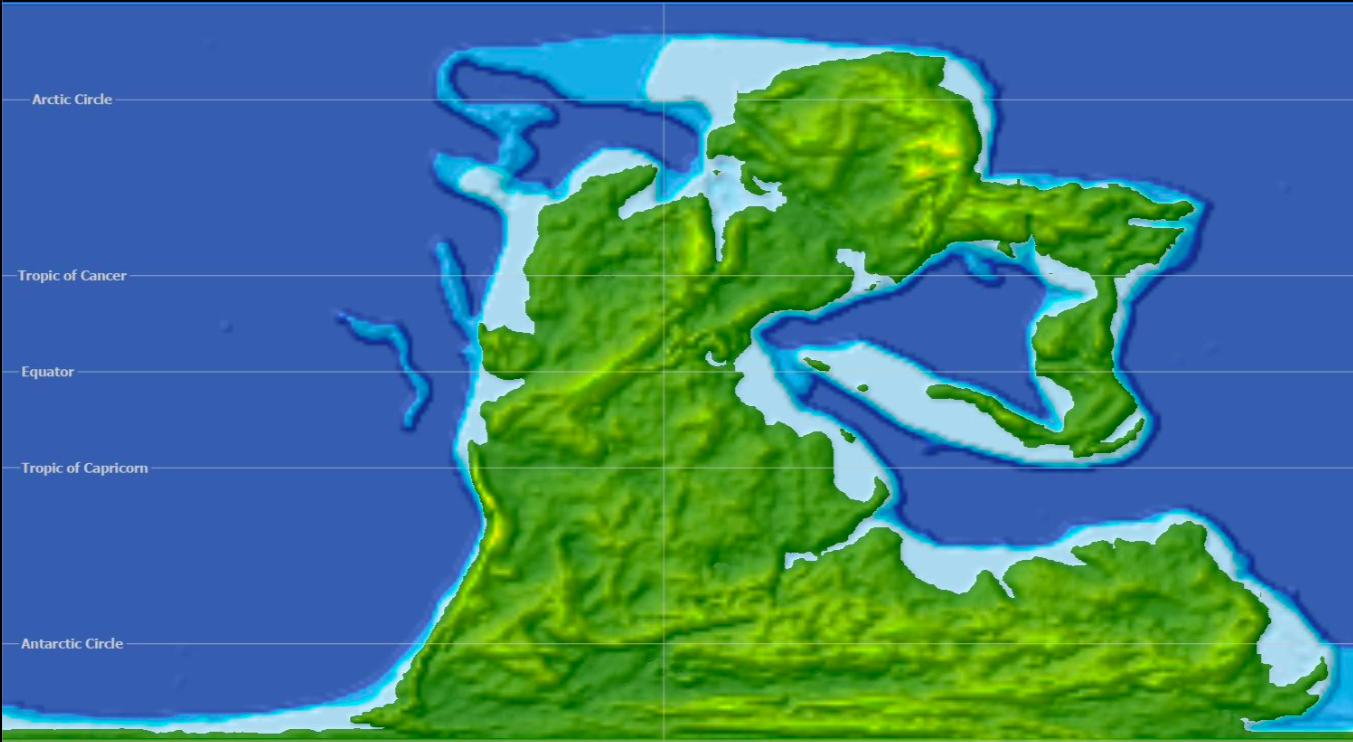
Those who’ve grown a bit fuzzy on their geography may require some indications of where future landmasses formed when Pangea broke apart. Your map apps can’t help you here.
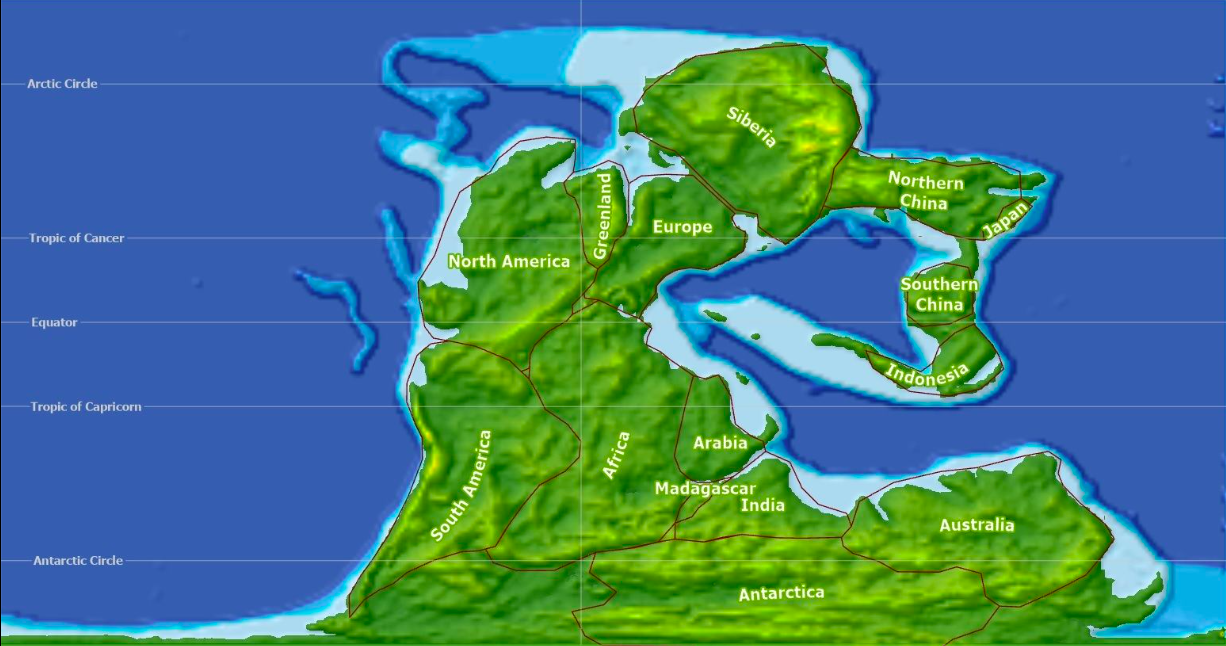
The first split occurred in the middle of the Jurassic period, resulting in two hemispheres, Laurasia to the north and Gondwana.
As the project’s story map notes, 175 million years ago Africa and South America already bore a resemblance to their modern day configurations.
North America, Asia, and Europe needed to stay in the oven a bit longer, their familiar shapes beginning to emerge between 150 and 120 million years ago.
India peeled off from its “mother” continent of Gondwana some 100 million years ago.
Its tectonic plate collided with the Eurasian Plate, giving rise to the Himalayas and the Tibetan Plateau, by which point, dinosaurs had been extinct for about 15 million years…)
Geography nerds may chafe at the seemingly inaccurate sizes of Greenland, Antarctica and Australia. Rest assured that the mapmakers are aware, chalking it to the “distortion of the cartographic projection that exaggerates areas close to the Poles.”
Just for fun, let’s run it backwards!
But enough of the past. What of the future?
Those who really want to know could jump ahead to the end of the story map to see PALEOMAP Project founder Christopher Scotese’s speculative configuration of earth 250 million years hence, should current tectonic plate motion trends continue.
Behold his vision of mega-continent, Pangea Proxima, a landmass “formed from all current continents, with an apparent exception of New Zealand, which remains a bit on the side:”
On the opposite side of the world, North America is trying to fit to Africa, but it seems like it does not have the right shape. It will probably need more time…
Not to bum you out, but a more recent study paints a grimmer picture of a coming supercontinent, Pangea Ultima, when extreme temperatures have rendered just 8 percent of Earth’s surface hospitable to mammals, should they survive at all.
As the study’s co-author, climatologist Alexander Farnsworth, told Nature News, humans might do well to get “off this planet and find somewhere more habitable.”

Related Content
Map Showing Where Today’s Countries Would Be Located on Pangea
– Ayun Halliday is the Chief Primatologist of the East Village Inky zine and author, most recently, of Creative, Not Famous: The Small Potato Manifesto and Creative, Not Famous Activity Book. Follow her @AyunHalliday.
Read More...The Codex Seraphinianus: How Italian Artist Luigi Serafini Came to Write & Illustrate “the Strangest Book Ever Published” (1981)
The Codex Seraphinianus is not a medieval book; nor does it date from the Renaissance along with the codices of Leonardo. In fact, it was published only in 1981, but in the intervening decades it has gained recognition as “the strangest book ever published,” as we described it when we previously featured it here on Open Culture a few years ago. Since then, Rizzoli has published a fortieth-anniversary edition of the Codex, which author-artist Luigi Serafini has granted interviews to promote. What new light has thus been shed on its more than 400 pages filled with bizarre illustrations and indecipherable text?
“The book is designed to be completely alien to anybody who picks it up,” says the narrator of the Curious Archive video at the top of the post. “Not only are the images utterly mind-bending, it’s written in a made-up and thoroughly untranslatable language. And yet, the more you read, the more you might find a strange sense of continuity among the images. That’s because Serafini intended this book to be an encyclopedia: an encyclopedia of a world that doesn’t exist.”
The experience of reading it — if “reading” be the word — “reminds me of being young and flipping through an encyclopedia, staring at pictures and not comprehending the words, but feeling a strange, untranslatable world hovering just outside my understanding.”
Serafini himself describes the Codex as “an attempt to describe the imaginary world in a systematic way” in the Great Big Story video above. To create it, he spent two and a half years in a state he likens to “going in a trance,” drawing all these “fish with eyes or double rhinoceroses and whatever.” These images came first, and they were all so strange that he “had to find a language to explain” them. The resulting experience lets us experience what it is “to read without knowing how to read” — an experience that has attracted the attention of thinkers from Douglas Hofstadter to Roland Barthes to Serafini’s countryman Italo Calvino, a man possessed of no scant interest in the strange, mythical, and inscrutable.
In a 1982 essay, Calvino writes of Serafini’s “very clear italics,” which “we always feel we are just an inch away from being able to read and yet which elude us in every word and letter. The anguish that this Other Universe conveys to us does not stem so much from its difference to our world as from its similarity.” Clearly, “Serafini’s universe is inhabited by freaks. But even in the world of monsters there is a logic whose outlines we seem to see emerging and vanishing, like the meanings of those words of his that are diligently copied out by his pen-nib.” It all brings to mind a joke I once heard that likens humanity, with its invincible instinct to ask what everything means, to a race of space aliens with enormous trunks. When these aliens visit Earth, they respond to everything we try to tell them with the same question: “Yes, but what does that have to do with trunks?”
Related content:
An Introduction to the Codex Seraphinianus, the Strangest Book Ever Published
Wonderfully Weird & Ingenious Medieval Books
Carl Jung’s Hand-Drawn, Rarely-Seen Manuscript The Red Book: A Whispered Introduction
The Meaning of Hieronymus Bosch’s The Garden of Earthly Delights Explained
Based in Seoul, Colin Marshall writes and broadcasts on cities, language, and culture. His projects include the Substack newsletter Books on Cities, the book The Stateless City: a Walk through 21st-Century Los Angeles and the video series The City in Cinema. Follow him on Twitter at @colinmarshall or on Facebook.
Read More...Amazon Offers Free AI Courses, Aiming to Help 2 Million People Build AI Skills by 2025
Late last year, Amazon announced AI Ready, a new initiative “designed to provide free AI skills training to 2 million people globally by 2025.” This includes eight free AI and generative AI courses, some designed for beginners, and others designed for more advanced students.
As the Wall Street Journal podcast notes above, Amazon created the AI Ready initiative with three goals in mind: 1) to increase the overall number of people in the workforce who have a basic understanding of AI, 2.) to compete with Microsoft and other big companies for AI talent, and 3.) to expose a large number of people to Amazon’s AI systems.
For those new to AI, you may want to explore these AI Ready courses:
- Introduction to Generative AI: Art of the Possible: This course provides an introduction to generative AI, its applications, and need-to-know concepts, like foundation models.
- Introduction to Machine Learning — Art of the Possible: This digital course is designed to help business decision makers understand the fundamentals of machine learning (ML).
- Generative AI Learning Plan for Decision Makers: A three-course series covering how to plan a generative AI project and build a generative AI–ready organization.
- Introduction to Amazon CodeWhisperer: This short course teaches participants how to use Amazon’s AI code generator, which produces whole lines of code.
You can find more information (including more free courses) on this AI Ready page. We have other free AI courses listed in the Relateds below.
Note: Until February 1, 2024, Coursera is running a special deal where you can get $200 off of Coursera Plus and gain unlimited access to courses & certificates, including a lot of courses on AI. Get details here.
Related Content
A New Course Teaches You How to Tap the Powers of ChatGPT and Put It to Work for You
Generative AI for Everyone: A Free Course from AI Pioneer Andrew Ng
Read More...How to Use Writing to Sharpen Your Thinking: Advice from Tim Ferriss
With the rise of AI tools like ChatGPT, which can generate essay after essay near-instantaneously from even the simplest prompt, surely the skill of writing will soon go the way of arrowhead-sharpening. That would be easy to believe, anyway, amid the current technological buzz. But venture capitalist Paul Graham, a man as well-placed as any to grasp these developments and their prospects, sees things differently. “People are switching to using ChatGPT to write things for them with almost indecent haste,” he wrote in a Twitter thread last year. “This is going to have unfortunate consequences, just as switching to living in suburbia and driving everywhere did. When you lose the ability to write, you also lose some of your ability to think.”
Graham is also well-known as an essayist, and in recent years the identity of writing and thinking has become one of his major themes. He opens “Putting Ideas into Words” with the observation that “writing about something, even something you know well, usually shows you that you didn’t know it as well as you thought.” And “if writing down your ideas always makes them more precise and more complete, then no one who hasn’t written about a topic has fully formed ideas about it.” In the video above, Tim Ferriss (another figure, like Graham, well known in the greater Silicon Valley universe) offers a few tips on just how to form and improve your own ideas through the process of writing.
“Without writing, it’s very hard to freeze your thinking on paper so that you can sharpen it,” eliminating “words that aren’t well-defined” or “things that don’t need to be said.” The first step to mastering the craft is to “write anything” regularly, without regard to structure or quality, which exposes “where you are sharp and where you are dull in your thinking.” From there, you must bear in mind the old saw that “writing is rewriting,” going on to perform round after round of edits from your own perspective or different imagined ones. Graham suggests making the effort to read your writing as if you were a complete stranger, someone “who knows nothing of what’s in your head, only what you wrote.”
Ferris then recommends asking people you know to read over your writing. If you don’t have any connections to professional writers, anyone with legal training should be able to bring a keen critical eye to the task. Even a non-specialist can help by pointing out the parts they find confusing. Whoever Ferris enlists as a proofreader, he employs what he calls the “ten percent rule,” requesting that the reader of the text indicate “the ten percent I should keep no matter what.” Even if you have no desire to write professionally, this practice will keep you in mental shape for your chosen pursuit in life, or indeed, for the task of life itself. As Graham tweeted last year, “Reading won’t be obsolete till writing is, and writing won’t be obsolete till thinking is” — though the average day on social media may convince you that the latter has already come to pass.
Related content:
George Orwell’s Six Rules for Writing Clear and Tight Prose
Three Huge Volumes of Stoic Writings by Seneca Now Free Online, Thanks to Tim Ferriss
10 Writing Tips from Legendary Writing Teacher William Zinsser
Umberto Eco’s 36 Rules for Writing Well (in English or Italian)
Based in Seoul, Colin Marshall writes and broadcasts on cities, language, and culture. His projects include the Substack newsletter Books on Cities, the book The Stateless City: a Walk through 21st-Century Los Angeles and the video series The City in Cinema. Follow him on Twitter at @colinmarshall or on Facebook.
Read More...
Bruce Hornsby Discusses His Adventurous Compositions and Collaborations on Nakedly Examined Music

Bruce Hornsby is best known for his first album The Way It Is (1986), but has come light years since then through 18+ albums, experimenting with different styles, playing over 100 shows with the Grateful Dead, and scoring numerous projects for Spike Lee. He’s won three Grammys and recorded with music royalty including Elton John, Ornette Coleman, Branford Marsalis, Willie Nelson, Bob Dylan, etc.
On this episode of Nakedly Examined Music, host Mark Linsenmayer and Bruce discuss “Sidelines” (feat. Ezra Koenig from Vampire Weekend) from ‘Flicted (2022), “My Resolve” (feat. James Mercer of The Shins) from Non-Secure Connection (2020), and a new live version of “Shadow Hand” from the 25th Anniversary Edition of Spirit Trail. End song: “Cast-Off” (feat. Justin Vernon of Bon Iver) from Absolute Zero (2019). Intro: “The Way It Is” (Live from Köln, 2019). Learn more at brucehornsby.com and bruuuce.com.
Here, of course, is the original “The Way It is.” Listen to the 2019 NYC Epicenters version in full. My favorite single from that first album was “Every Little Kiss.” An early tune recently featured prominently in the second season of the TV show The Bear is “The Show Goes On.” You may or may not recall that Bruce co-wrote Don Henley’s hit “The End of the Innocence”; watch Bruce play that live with several jazz greats. Hear the original 1998 version of “Shadow Hand.” Bruce’s 2004 “Halcyon Days” features both Sting and Eric Clapton.
The track that Bruce co-wrote for Bon Iver’s album is “U (Man Like).” Watch the video for “Days Ahead,” another single from Bruce’s newest album ‘Flicted. Here’s the video for “Sidelines.” Watch a lyric video for “Cast-Off.” Watch Bruce and James Mercer performing “My Resolve” over the Internet during the pandemic.
Watch Bruce play piano with The Grateful Dead in 1991. Listen to Other Ones (Grateful Dead after Jerry Garcia’s death) play a classic Hornsby tune, “White-Wheeled Limousine,” live in 1998. His own version of that (from 1995’s Hot House), featured Pat Metheny and Béla Fleck. Watch him live in 2012 with Bob Weir and Branford Marsalis playing his tune “Standing on the Moon.”
Listen to Bruce on The Art of Longevity podcast. Here he is on Sodajerker. Bruce’s appearance on Ezra Koenig’s Time Crisis podcast is on #126, and you may be able to hear it with an Apple Music subscription.
Photo by Kat Fisher.
Nakedly Examined Music is a podcast hosted by Mark Linsenmayer, who also hosts The Partially Examined Life Philosophy Podcast, Pretty Much Pop: A Culture Podcast, and Philosophy vs. Improv. He releases music under the name Mark Lint.
Read More...The Golden Age of Japanese Cinema: Kurosawa, Ozu, Mizoguchi & Beyond
Oliver Hermanus’ latest film Living transplants the story of Akira Kurosawa’s Ikiru to postwar London. Apart from its own considerable merits, it has given viewers across the world reason to revisit the 1952 original, a standout work even in a golden decade of Japanese cinema — the decade The Cinema Cartography co-creator Lewis Bond (previously featured here for other explorations of Japanese cinema and animation) explains in the video above. In the nineteen-fifties, “concentrated within a single country were some of the greatest filmmakers to ever live, simultaneously producing their greatest works. The result was a complete decentralization of classic cinema as the world was exposed to its new troupe of masters.”
After World War II, the Japanese people were “left with the reality that they were an ethnically homogeneous and culturally unified unit that did not fit in with the new, democratic world.” The American military occupation “took control of the entire Japanese film industry from 1945 until 1952,” forcibly removing any image, theme, or line of dialogue thought liable stoke recidivist popular sentiment. With not just war movies but “feudal” period pieces off the table, the only viable genre was what scholars have since labeled shomingeki, the realistic cinema of common people in ordinary situations. Even there, the censors had their scissors out: on their orders, Masahiro Makino had to eliminate a shot of the potentially nationalist symbol of Mount Fuji; Yasujirō Ozu had to cut a line from Late Spring about Tokyo being full of bomb sites.
These rules loosened toward the end of the occupation. By 1951, Kurosawa could make a daring historical picture like Rashomon, and even have it (without his consent) go on to screen at the Venice Film Festival and win a Golden Lion, then an Academy Award. The West had acquired a taste for Japanese movies, and the Japanese film industry was only too happy to cater to it. The country’s five major studios “hired the best artists of the time and gave them the financial backing and creative freedom that they needed. The result was that the studios made a lot of money, the filmmakers created an abundance of masterpieces, and the golden age of Japanese cinema meant that people filled the theaters.”
The nineteen-fifties brought worldwide acclaim to a Mount Rushmore of Japanese auteurs. Kurosawa, who revived the samurai film, “did for cinema as a whole was what most filmmakers hope, at some point, to do”: bridging “the gap between one’s artistry and mainstream appeal.” Ugetsu director Kenji Mizoguchi looked on all reality — and especially women — with a transcendental gaze. “Although not as grandiose as Kurosawa, nor as spiritual as Mizoguchi, Ozu epitomizes a sentimentality that, perhaps, has not been as well achieved by any other filmmaker to this day.” Mikio Naruse, Masaki Kobayashi, Teinosuke Kinugasa, Hiroshi Inagaki: one could enjoy a rich cinematic life with only the works of Japanese filmmakers of the fifties. It shows us “the pinnacle of what cinema can achieve, and the standard we should continue to strive for,” as Bond’s puts it in his closing line, speaking over a shot from Ikiru.
Related content:
Essential Japanese Cinema: A Journey Through 50 of Japan’s Beautiful, Often Bizarre Films
The Aesthetic of Anime: A New Video Essay Explores a Rich Tradition of Japanese Animation
How One Simple Cut Reveals the Cinematic Genius of Yasujirō Ozu
A Page of Madness: The Lost, Avant Garde Masterpiece from Early Japanese Cinema (1926)
Based in Seoul, Colin Marshall writes and broadcasts on cities, language, and culture. His projects include the Substack newsletter Books on Cities, the book The Stateless City: a Walk through 21st-Century Los Angeles and the video series The City in Cinema. Follow him on Twitter at @colinmarshall or on Facebook.
Read More...A Fan-Made Film Reconstructs an Entire Tom Waits Concert from His “Glitter and Doom Tour” (2008)
Everybody who’s been to a Tom Waits concert has stories to tell about it — no few of them heard straight from the mouth of Waits himself. The official live album for his 2008 Glitter and Doom tour actually devotes its entire second disc to “a selection of the comic bromides, strange musings, and unusual facts that Tom traditionally shares with his audience during the piano set,” with topics ranging from “the ritual of insects to the last dying breath of Henry Ford.” This after a first disc crafted from musical performances recorded in ten different cities, “from Paris to Birmingham; Tulsa to Milan; and Atlanta to Dublin.”
“Tom Waits — Glitter and Doom Concert Experience,” the fan video above, pulls off a similar feat of assemblage, but with a visual component as well. Its creator describes it as “a compilation of professional footage and fan films,” using “all the released soundboard audio that had footage to accompany it to make a concert film that should make a good experience of what it would have been like being in the audience.”
The resulting hour-and-three-quarters includes a few examples of Waits’ onstage oratory, and more importantly, such beloved numbers from his songbook as “Goin’ Out West,” Chocolate Jesus,” “Hold On”, and “Innocent When You Dream” — each one as much of a narrative of deepest, darkest Americana as his non-musical monologues.
“A trip through the world of Tom Waits can be disorienting,” writes NPR’s Robin Hilton (alongside a streamable recording of Waits’ July 5, 2008 show at Atlanta’s Fox Theater). “His ramshackle story-songs, with their creaky instrumentation and dusty poetry, usually leave listeners with more questions than answers, and his persona outside of his music revolves around a playful but guarded mix of fiction and reality.” To promote the Glitter and Doom tour, out came “a taped press conference, featuring Waits seated at a table of microphones, answering questions amid bursts of flashbulbs and murmurs” — all of which was soon revealed not to be what it seemed. But as Waits’ strangely captivating career demonstrates, the ambiguity between performance and reality is where it’s at.
via MetaFilter
Related content:
Stream All of Tom Waits’ Music in a 24 Hour Playlist: The Complete Discography
An Animated Tom Waits Talks About Laughing at Funerals & the Moles Under Stonehenge (1988)
Tom Waits’ Many Appearances on David Letterman, From 1983 to 2015
Tom Waits Reads Charles Bukowski
The Tom Waits Map: A Mapping of Every Place Waits Has Sung About, From L.A. to Africa’s Jungles
Based in Seoul, Colin Marshall writes and broadcasts on cities, language, and culture. His projects include the Substack newsletter Books on Cities, the book The Stateless City: a Walk through 21st-Century Los Angeles and the video series The City in Cinema. Follow him on Twitter at @colinmarshall or on Facebook.
Read More...
Support Us
We're hoping to rely on loyal readers, rather than erratic ads. Please click the Donate button and support Open Culture. You can use Paypal, Venmo, Patreon, even Crypto! We thank you!

About Us

Open Culture scours the web for the best educational media. We find the free courses and audio books you need, the language lessons & educational videos you want, and plenty of enlightenment in between.
Advertise With Us
FREE UPDATES!
GET OUR DAILY EMAIL
Get the best cultural and educational resources on the web curated for you in a daily email. We never spam. Unsubscribe at any time.
FOLLOW ON SOCIAL MEDIA
Open Culture editor Dan Colman scours the web for the best educational media. He finds the free courses and audio books you need, the language lessons & movies you want, and plenty of enlightenment in between.
Advertise With Us

