Watch 950 Weather Reports Presented by David Lynch, Straight from His Los Angeles Home
Los Angeles is hardly a city known for its varied weather, but if one lives there long enough, one does become highly attuned to its many subtleties. (Granted, some of the local phenomena involved, like the notorious Santa Ana winds, can produce far-from-subtle effects.) The late David Lynch, who spent much of his life in Los Angeles, was more attuned to them than most. For a time, he even posted daily YouTube videos in which he talked about nothing else. Or rather, he talked about almost nothing else: much of the appeal of his weather reports, 950 of which you can watch on this playlist, lies in his unpredictable asides.
In addition to announcing the date (in a slightly eccentric form, e.g. “June one, two-thousand and twenty”), reading the temperature in both Fahrenheit and Celsius, and remarking on the presence or absence of “blue skies and golden sunshine,” Lynch would sometimes mention what was on his mind that day. “Today I’m thinking about tin cans,” he declared in his weather report for October 11th, 2020. A couple of months later, he was remembering Percy Faith’s theme from the Sandra Dee and Troy Donahue vehicle A Summer Place, which to him encapsulated the “romantic, wondrous feeling of the fifties” at that decade’s very end.
The weather-reporting Lynch showed an awareness of his audience as well, occasionally presenting them with a hand-drawn Valentine’s Day card or expression of thanks for viewing: “What a great bunch you all are, those of you who come each day to check out the weather.” But as Ali Raz writes in the Believer, one views Lynch’s weather reports “not to learn about the weather but to watch Lynch perform — even though, precisely because, he doesn’t perform in any actorly way. Instead, he performs himself.” And he’d been doing it in that form longer than many realized, having begun his reports as a call-in segment on Los Angeles radio station Indie 103.1 FM in 2005, then posting them as videos to his own web site.
Lynch returned to weather reportage on YouTube during the COVID-19 pandemic, which made the at-home setting fashionable. His videos inspired some of their viewers, who presumably had more time on their hands than usual, to do the hard work of exegesis. One user of the David Lynch subreddit found the weather reports key to understanding Lynch’s work, specifically through “the idea of awareness. What does it mean to look at the world around us?” In his films, “this is accomplished by surrealism, violence, and a general sense of the unsettling or menacing. But those are vehicles for the idea of awareness, not its essence.” His Weather Reports show that “awareness doesn’t have to come through an extreme mental state, but could be part of our daily life,” in times of blue skies and golden sunshine or otherwise.
Related content:
David Lynch Tries to Make a List of the Good Things Happening in the World… and Comes Up Blank
Based in Seoul, Colin Marshall writes and broadcasts on cities, language, and culture. His projects include the Substack newsletter Books on Cities and the book The Stateless City: a Walk through 21st-Century Los Angeles. Follow him on the social network formerly known as Twitter at @colinmarshall.
Read More...Download a 417-Megapixel Panorama of the Andromeda Galaxy—A Decade-Long NASA Project in the Making
Using the Hubble Space Telescope, astronomers have created a majestic 417-megapixel panorama of the Andromeda galaxy, located some 2.5 million light-years away from our planet. Taking more than a decade to complete, the photomosaic captures 200 million stars, which is only a fraction of Andromeda’s estimated one trillion stars. According to NASA, the 2.5 billion pixel mosaic “will help astronomers piece together the galaxy’s past history that includes mergers with smaller satellite galaxies.” On this NASA website, you can download a copy of the mosaic, and learn more about the exploration of Andromeda.

If you would like to support the mission of Open Culture, consider making a donation to our site. It’s hard to rely 100% on ads, and your contributions will help us continue providing the best free cultural and educational materials to learners everywhere. You can contribute through PayPal, Patreon, and Venmo (@openculture). Thanks!
Related Content
Sun Ra Applies to NASA’s Art Program: When the Inventor of Space Jazz Applied to Make Space Art
Read More...
Watch Design for Disaster, a 1962 Film That Shows Why Los Angeles Is Always at Risk of Devastating Fires
“This is fire season in Los Angeles,” Joan Didion once wrote, relating how every year “the Santa Ana winds start blowing down through the passes, and the relative humidity drops to figures like seven or six or three per cent, and the bougainvillea starts rattling in the driveway, and people start watching the horizon for smoke and tuning in to another of those extreme local possibilities — in this instance, that of imminent devastation.” The New Yorker published this piece in 1989, when Los Angeles’ fire season was “a particularly early and bad one,” but it’s one of many writings on the same phenomenon now circulating again, with the highly destructive Palisades Fire still burning away.
Back in 1989, longtime Angelenos would have cited the Bel Air Fire of 1961 as a particularly vivid example of what misfortune the Santa Ana winds could bring. Widely recognized as a byword for affluence (not unlike the now virtually obliterated Pacific Palisades), Bel Air was home to the likes of Dennis Hopper, Burt Lancaster, Joan Fontaine, Zsa Zsa Gabor and Aldous Huxley — all of whose houses counted among the 484 destroyed in the conflagration (in which, miraculously, no lives were lost). You can see the Bel Air Fire and its aftermath in “Design for Disaster,” a short documentary produced by the Los Angeles Fire Department and narrated by William Conrad (whose voice would still have been instantly recognizable as that of Marshal Matt Dillon from the golden-age radio drama Gunsmoke).
Los Angeles’ repeated affliction by these blazes is perhaps overdetermined. The factors include not just the dreaded Santa Anas, but also the geography of its canyons, the dryness of the vegetation in its chaparral (not, pace Didion, desert) ecology, and the inability of its water-delivery system to meet such a sudden and enormous need (which also proved fateful in the Palisades Fire). It didn’t help that the typical house at the time was built with “a combustible roof; wide, low eaves to catch sparks and fire; and a big picture window to let the fire inside,” nor that such dwellings were “closely spaced in brush-covered canyons and ridges serviced by narrow roads.” The Bel Air Fire brought about a wood-shingle roof ban and a more intensive brush-clearance policy, but the six decades of fire seasons since do make one wonder what kind of measures, if any, could ever subdue these particular forces of nature.
via Boing Boing
Related content:
NASA Captures the World on Fire
When Steve Buscemi Was a Firefighter — and Took It Up Again After 9/11
Aldous Huxley Explains How Man Became “the Victim of His Own Technology” (1961)
Take a Drive Through 1940s, 50s & 60s Los Angeles with Vintage Through-the-Car-Window Films
Based in Seoul, Colin Marshall writes and broadcasts on cities, language, and culture. His projects include the Substack newsletter Books on Cities and the book The Stateless City: a Walk through 21st-Century Los Angeles. Follow him on the social network formerly known as Twitter at @colinmarshall.
Read More...Watch Bob Ross’ The Joy of Painting from Start to Finish: Every Episode from 31 Seasons in Chronological Order
Bob Ross the man died nearly thirty years ago, but Bob Ross the archetypal TV painter has never been more widely known. “With his distinctive hair, gentle voice, and signature expressions such as ‘happy little trees,’ he’s an enduring icon,” writes Michael J. Mooney in an Atlantic piece from 2020. “His likeness appears on a wide assortment of objects: paints and brushes, toasters, socks, calendars, dolls, ornaments, and even a Chia Pet.” Here in Korea, where I live, he’s universally called Bob Ajeossi, ajeossi being a kind of colloquial title for middle-aged men. It’s quite an afterlife for a soft-spoken public-television host from the eighties.
Ross quickly became a pop-cultural figure in that era, starring in semi-ironic MTV spots by the early nineties. But over the decades, writes Mooney, “the appreciation of Bob Ross has morphed into something nearly universally earnest.” It helps that he has “the ultimate calming presence,” which has drawn special appreciation here in the twenty-first century: “More than a decade before most therapists were telling clients to be mindful and present, Ross was telling his viewers to appreciate their every breath.” This meditative, positive mood pervades all of The Joy of Painting’s more than 400 recorded broadcasts, and they even deliver the soothing effects of what YouTube-viewing generations know as “unintentional ASMR.”
Now you can watch almost all those broadcasts on a single YouTube playlist, which includes all of The Joy of Painting’s 31 seasons, originally aired between 1983 and 1994. (The videos come from the official YouTube channel of The Joy of Painting and Bob Ross.) Despite having ended its run well before any of us had ever imagined watching video online, the show now feels practically made for the internet, what with not just its ASMR qualities, but also the parasocial friendliness of Ross’ personality, the instructional value and sheer quantity of its content, and the highly consistent format. Every time, Ross paints a complete picture from start to finish: usually a landscape featuring mighty mountains, freedom-loving clouds, and happy little trees, but occasionally something just different enough to keep it interesting. And so the man Mooney describes as “probably America’s most famous painter” lives on as a beloved YouTuber.
Related comment:
What Happened to the 1200 Paintings Painted by Bob Ross? The Mystery Has Finally Been Solved
Experience the Bob Ross Experience: A New Museum Open in the TV Painter’s Former Studio Home
Watch a Master Japanese Printmaker at Work: Two Unintentionally Relaxing ASMR Videos
Based in Seoul, Colin Marshall writes and broadcasts on cities, language, and culture. His projects include the Substack newsletter Books on Cities and the book The Stateless City: a Walk through 21st-Century Los Angeles. Follow him on the social network formerly known as Twitter at @colinmarshall.
Read More...Nirvana Before They Were Nirvana: Watch Their 1988 Performance Recorded in a Radio Shack
Here’s a strange home video of Nirvana when they were unknown, playing inside a Radio Shack in the band’s hometown of Aberdeen, Washington. The video was recorded on the evening of January 24, 1988, after the store had closed. In those days the group went by the name of Ted Ed Fred.
Only the day before, the band had recorded its first demo tape at a studio in Seattle. Guitarist and singer Kurt Cobain asked his new friend Eric Harter, who managed the Radio Shack, to videotape the band playing “Paper Cuts,” one of 10 songs from the demo. Along with Cobain, the video features Nirvana co-founder Krist Novoselic on bass and Dale Crover of the Melvins on drums.
The video below includes footage of Harter talking about the Radio Shack video and giving a copy of the tape to Cobain’s grieving widow Courtney Love, who is shown with her friend Kat Bjelland of Babes in Toyland. At one point, Harter mentions a “Ted Ed Fred” concert at the Community World Theater in Tacoma. To see a full video of that show, which was staged the night before the Radio Shack taping (and only hours after the demo session), click here.
Note: An earlier version of this post appeared on our site in 2013.
If you would like to support the mission of Open Culture, consider making a donation to our site. It’s hard to rely 100% on ads, and your contributions will help us continue providing the best free cultural and educational materials to learners everywhere. You can contribute through PayPal, Patreon, and Venmo (@openculture). Thanks!
Related Content:
The First Live Performance of ‘Smells Like Teen Spirit’ (1991)
Nirvana’s “Come As You Are” Played By Musicians Around the World
Kurt Cobain’s Isolated Vocal Track From ‘Smells Like Teen Spirit’
Nirvana’s Home Videos: An Intimate Look at the Band’s Life in 1988
Patti Smith’s Cover of Nirvana’s “Smells Like Teen Spirit” Strips the Song Down to its Heart
Read More...The World in a Cloverleaf: A World Map from 1581
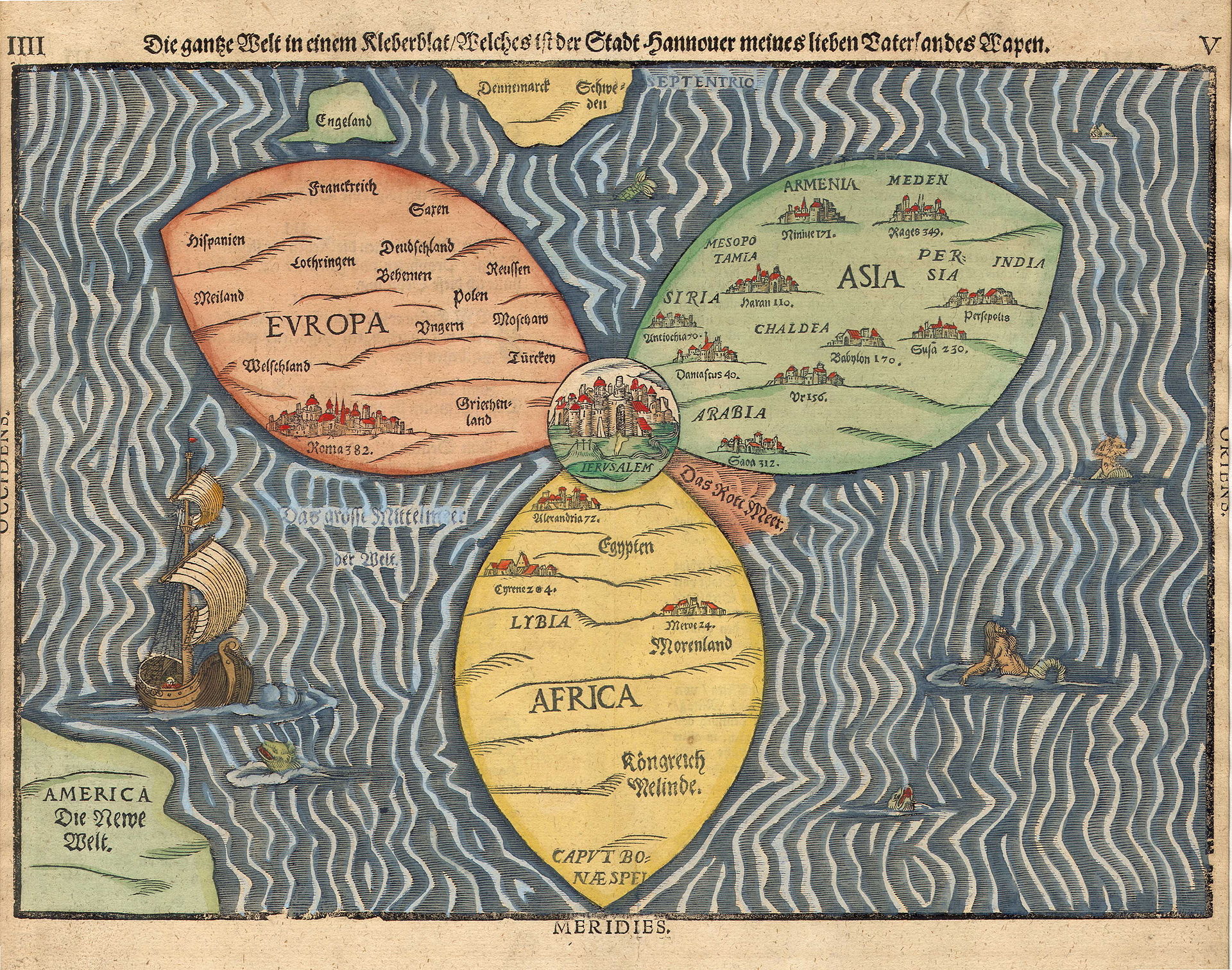
In 1581, the medieval cartographer and Protestant theologian Heinrich Bünting created a symbolic map of the world that adorned his book Itinerarium Sacrae Scripturae (Travel Through Holy Scripture). Hand-colored and shaped like a three-leaf clover, the map put Jerusalem at its center, highlighting its central role in Christianity, Judaism, and Islam. From that center flowed three continents—Europe, Africa, and Asia—each surrounded by swirling waters teeming with ships, mermaids, and sea monsters. Then, off to one side, we find a barren “America,” otherwise known as the “New World.”
The three-leaf clover design likely symbolizes the Christian trinity, while also paying homage to the clover design found on the coat of arms of Bünting’s native hometown, Hanover. Beyond the map featured above, Bünting also designed some other notably unconventional maps. Take, for example, a map where Europe takes the form of a virgin queen, or a map of Asia that’s shaped like the winged horse Pegasus. You can view a copy of the Itinerarium Sacrae Scripturae online.
If you would like to support the mission of Open Culture, consider making a donation to our site. It’s hard to rely 100% on ads, and your contributions will help us continue providing the best free cultural and educational materials to learners everywhere. You can contribute through PayPal, Patreon, and Venmo (@openculture). Thanks!
Related Content
Explore the Hereford Mappa Mundi, the Largest Medieval Map Still in Existence (Circa 1300)
Europe’s Oldest Map: Discover the Saint-Bélec Slab (Circa 2150–1600 BCE)
Read More...Francis Ford Coppola Picks His Favorite Criterion Movies & Gives Advice to Filmmakers
Upon stepping into the hallowed Criterion Closet, stocked with hundreds of that cinephile video label’s finest releases, Francis Ford Coppola speaks of a director who “believed in a film he wanted to make, and used his entire fortune, because the financing system of the time wouldn’t finance it. And it came out and it was a big flop, and he died sort of penniless, not realizing that this film he put everything up for” would “be considered today the masterpiece that we consider it.” The auteur in question is Jacques Tati, and the film is Playtime, though one imagines that Coppola’s own recent experience with Megalopolis wasn’t so very far from his mind.
“I think he’s the only filmmaker, other than present company, who took a big hunk of what wealth he had earned in his life and put it up to make a film that nobody else would make,” Coppola continues. But when you do that, “usually it withstands the test of time.”
His long career has afforded him many a lesson in the unexpected turns a picture’s afterlife can take. Take Rumble Fish, his second S. E. Hinton adaptation of 1983 after The Outsiders. He intended it as “an art film for kids,” but “the kids at that time didn’t totally get it right away, and I thought it was a very big failure and was very upset about it, because I sort of loved the film.”
Only later did Coppola find out how influential this seeming dud had been in Latin America, where young people “went to this one theater to see this weird movie called Rumble Fish, which they had no idea what it was, but it somehow struck them, and it inspired a whole generation to become filmmakers and novelists.” But he’d never have been in a position to make it — to say nothing of The Godfather, The Conversation, and Apocalypse Now — if he hadn’t heeded the words of Dance, Girl, Dance director Dorothy Arzner, who happened to be his directing teacher at UCLA. Doubtful about his potential to become a filmmaker, he declared his intention to quit trying. To which Arzner responded: “I’ve been around, and I know you’ll make it.” Indeed, Coppola made it in the movies — and, more importantly, he continues making movies today.
Related content:
The Story of Francis Ford Coppola’s Four-Decade-Struggle to Make Megalopolis
Francis Ford Coppola Breaks Down His Most Iconic Films: The Godfather, Apocalypse Now & More
120 Artists Pick Their Top 10 Films in the Criterion Collection
Martin Scorsese Names His Top 10 Films in the Criterion Collection
Based in Seoul, Colin Marshall writes and broadcasts on cities, language, and culture. His projects include the Substack newsletter Books on Cities and the book The Stateless City: a Walk through 21st-Century Los Angeles. Follow him on the social network formerly known as Twitter at @colinmarshall.
Read More...Bob Dylan Reads “ ‘Twas the Night Before Christmas” On His Holiday Radio Show (2006)
Allow me to name just a few of the people I want to hear hosting and curating radio shows—former Sex Pistols’ singer John Lydon, former Clash frontman Joe Strummer, former Woody Guthrie impersonator Bob Dylan.…
Luckily for me, this ain’t just fantasy baseball; at various times, and with varying levels of commitment, each of these tastemakers has hosted a program showcasing their own favorite artists. In Dylan’s case, the commitment was pretty substantial. His show, Theme Time Radio Hour, ran for almost three years—once a week from 2006 to 2009—on satellite radio.
Each episode centered on a general theme, hence the title, but the selections were all over the place—more or less what you’d expect from Dylan: an eclectic collection of folk, blues, gospel, soul, country, modern pop, and rock ‘n’ roll mixed with old-time radio jingles, novelties, and promos, and the host’s oddball commentary and hokey humor. Recorded while Dylan was on the road, then edited together with phony “listener calls” and emails, Theme Time Radio Hour aimed, Dylan said, “to expand the musical taste” of his listeners. That it did, even in its most traditional episode, namely the holiday special on Christmas and New Year’s, or as Dylan calls it, “a Yuletide extravaganza.”
In his 2006 Christmas broadcast, above, Dylan bounces from Bob Seger to the Staples Singers to Lord Nelson, “uncrowned king of Soca,” and Mabel Mafuya, who plays “a Marabi style, sort of like South African ragtime.” The wide variety of well- and lesser-known artists—all playing Christmas music—combined with Dylan’s wry interjections, makes for delightfully weird listening. But when it comes time for his own contribution, he goes for the obvious and recites Clement Clarke Moore’s “‘Twas the Night Before Christmas.” You may not have thought much of this the first time you heard it, much less the millionth. But in Dylan’s reading, the stockings sound like they were hung with care in some dim, smoky beatnik coffeehouse and the sugar plums dance to the finger-snapping bop rhythms of jazz poetry while a harpsichord plays “O Tannenbaum” in the background.
It’s a very cool rendition, in other words, of a very corny piece of writing. Throughout the special, Dylan displays a real knack for sussing new sounds and angles from old, tired holiday cliches. His extensive knowledge of holiday tunes may place him in the company of John Waters and the many other “men who love Christmas music” profiled in the documentary Jingle Bell Rocks! Whether he is a collector or just an avid listener, I do not know, but by the time you’ve finished listening to his 2006 Theme Time Radio Hour Christmas special, you will find your appreciation for the holiday genre thoroughly expanded.
Note: An earlier version of this post appeared on our site in 2014.
Related Content:
Bob Dylan’s Thanksgiving Radio Show: A Playlist of 18 Delectable Songs
The Top 10 New Year’s Resolutions Read by Bob Dylan
Bob Dylan Reads From T.S. Eliot’s Great Modernist Poem The Waste Land
Josh Jones is a writer and musician based in Durham, NC. Follow him at @jdmagness
Read More...A Simple, Down-to-Earth Christmas Card from the Great Depression (1933)
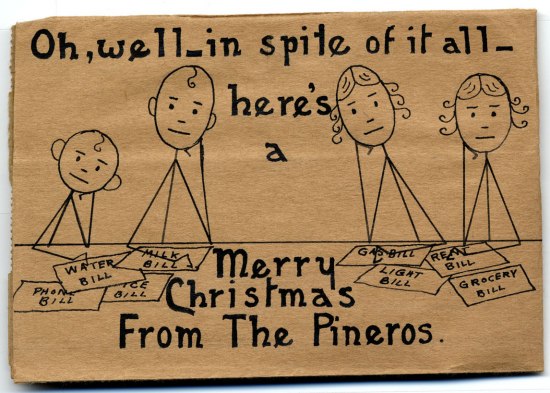
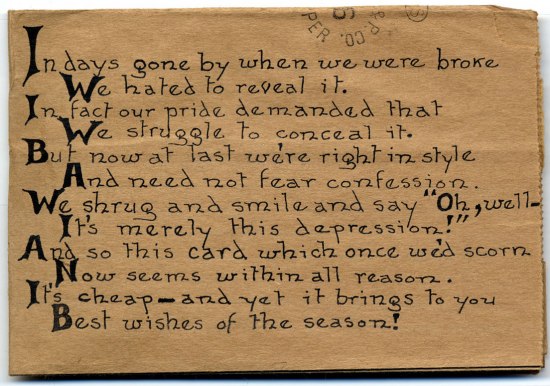
The Smithsonian sets the scene for this Christmas card sent in 1933, a few years into the Great Depression. They write:
Despite the glum economic situation, the Pinero family used a brown paper bag to fashion an inexpensive holiday greeting card. They penned a clever rhyme and added some charming line drawings of Mom, Dad, and the kids with the message: “Oh, well—in spite of it all—here’s a Merry Christmas from the Pineros.” On December 19, 1933, they mailed it from Chicago to friends in Massachusetts, using a one-and-a-half-cent stamp. For a minimal outlay of cash, they were able to keep in touch with friends and comment on their reduced circumstances with wit and humor.
This hand-lettered poem is a delightful example of light verse, a whimsical form of poetry intended to entertain or amuse, even if treating a serious subject in a humorous manner. In the poem, the Pineros suggest that they had struggled economically for some time, but now, due to the continuing Depression, others shared their financial plight, which enabled them to be more open and candid about their situation.
Like many families, the Pineros probably had lots of bills for necessities including rent, groceries, utilities, milk, and ice. Because not every family had electric refrigeration in 1933, many relied on regular deliveries of ice to keep their perishable foods cold. These bills for milk and ice were separate; they were not part of the grocery account. Local dairies supplied milk and other products on a daily basis. Both the Ice Man and the Milk Man would cometh, as long as they were paid!
It’s a historical case of when less is indeed more…
If you would like to support the mission of Open Culture, consider making a donation to our site. It’s hard to rely 100% on ads, and your contributions will help us continue providing the best free cultural and educational materials to learners everywhere. You can contribute through PayPal, Patreon, and Venmo (@openculture). Thanks!
Related Content:
Behold! The Very First Christmas Card (1843)
When Salvador Dalí Created Christmas Cards That Were Too Avant Garde for Hallmark (1960)
John Waters’ Hand-Made, Oddball Christmas Cards: 1964-Present
Langston Hughes’ Homemade Christmas Cards From 1950
Salvador Dalí’s Avant-Garde Christmas Cards
Read More...Binge-Watch Classic Television Programs Free: The Dick Van Dyke Show, The Lone Ranger, Dragnet, That Girl & More
Earlier this week, we featured the 99-year-old Dick Van Dyke’s performance in Coldplay’s new music video, full of visual references to the sitcom that made him a household name in the early nineteen-sixties. And a household name he remains these six decades later, though one does wonder how many of those who appreciate his extreme longevity — both cultural and biological — have ever seen an episode of The Dick Van Dyke Show. I myself only caught the occasional late-night rerun in childhood, but however much he indulged his characteristic goofiness, the thirty-something Van Dyke in the role of comedy writer Rob Petrie always struck me as the very image of mature adulthood.
Whether or not you saw it in the first place, you can now watch The Dick Van Dyke Show’s five seasons free on Youtube, starting with the first here. They’ve come available at a channel called FilmRise Television, on whose collection of playlists you’ll also find such pillars of mid-century American television as Dragnet, The Lone Ranger, Bonanza, and That Girl.
Hard though it may be to understand for anyone who came of age under the firehose of on-demand content these regularly scheduled entertainments became veritable cultural institutions when they originally aired on major networks in the fifties and sixties, with an influence that extended far beyond their already considerable viewership.
The millennial generation grew up regarding shows of this kind as hokey but sufficiently amusing diversions when nothing more irreverent or postmodern happened to be on. At worst, they felt like inferior predecessors of the then-current sitcoms and dramas we were watching in prime time. But then began the long “golden age” of prestige television, with its new levels of aesthetic and narrative complexity, which changed our very conception of television.
Today, watching The Dick Van Dyke Show or any of the other hits with which it shared the scarce airwaves feels almost exotic, like traveling to the past: a foreign country, as L. P. Hartley famously put it, where they do things differently — and a few of whose citizens are, fortunately, still around to entertain us.
Related content:
Dick Van Dyke Still Dancing at 96!
Based in Seoul, Colin Marshall writes and broadcasts on cities, language, and culture. His projects include the Substack newsletter Books on Cities and the book The Stateless City: a Walk through 21st-Century Los Angeles. Follow him on the social network formerly known as Twitter at @colinmarshall.
Read More...Support Us
We're hoping to rely on loyal readers, rather than erratic ads. Please click the Donate button and support Open Culture. You can use Paypal, Venmo, Patreon, even Crypto! We thank you!

About Us

Open Culture scours the web for the best educational media. We find the free courses and audio books you need, the language lessons & educational videos you want, and plenty of enlightenment in between.
Advertise With Us

FREE UPDATES!
GET OUR DAILY EMAIL
Get the best cultural and educational resources on the web curated for you in a daily email. We never spam. Unsubscribe at any time.
FOLLOW ON SOCIAL MEDIA

Open Culture editor Dan Colman scours the web for the best educational media. He finds the free courses and audio books you need, the language lessons & movies you want, and plenty of enlightenment in between.
Advertise With Us


