Hannah Arendt Explains How Totalitarian Regimes Arise–and How We Can Prevent Them
“Adolf Eichmann went to the gallows with great dignity,” wrote the political philosopher Hannah Arendt, describing the scene leading up to the prominent Holocaust-organizer’s execution. After drinking half a bottle of wine, turning down the offer of religious assistance, and even refusing the black hood offered him at the gallows, he gave a brief, strangely high-spirited speech before the hanging. “It was as though in those last minutes he was summing up the lesson that this long course in human wickedness had taught us — the lesson of the fearsome word-and-thought-defying banality of evil.”
These lines come from Eichmann in Jerusalem: A Report on the Banality of Evil, originally published in 1963 as a five-part series in the New Yorker. Eichmann “was popularly described as an evil mastermind who orchestrated atrocities from a cushy German office, and many were eager to see the so-called ‘desk murderer’ tried for his crimes,” explains the narrator of the animated TED-Ed lesson above, written by University College Dublin political theory professor Joseph Lacey. “But the squeamish man who took the stand seemed more like a dull bureaucrat than a sadistic killer,” and this “disparity between Eichmann’s nature and his actions” inspired Arendt’s famous summation.
A German Jew who fled her homeland in 1933, as Hitler rose to power, Arendt “dedicated herself to understanding how the Nazi regime came to power.” Against the common notion that “the Third Reich was a historical oddity, a perfect storm of uniquely evil leaders, supported by German citizens, looking for revenge after their defeat in World War I,” she argued that “the true conditions behind this unprecedented rise of totalitarianism weren’t specific to Germany.” Rather, in modernity, “individuals mainly appear in the social world to produce and consume goods and services,” which fosters ideologies “in which individuals were seen only for their economic value, rather than their moral and political capacities.”
In such isolating conditions, she thought, “participating in the regime becomes the only way to recover a sense of identity and community. While condemning Eichmann’s “monstrous actions, Arendt saw no evidence that Eichmann himself was uniquely evil. She saw him as a distinctly ordinary man who considered obedience the highest form of civic duty — and for Arendt, it was exactly this ordinariness that was most terrifying.” According to her theory, there was nothing particularly German about all of this: any sufficiently modernized culture could produce an Eichmann, a citizen who defines himself by participation in his society regardless of that society’s larger aims. This led her to the conclusion that “thinking is our greatest weapon against the threats of modernity,” some of which have become only more threatening over the past six decades.
Related content:
Take Hannah Arendt’s Final Exam for Her 1961 Course “On Revolution”
Watch Hannah Arendt’s Final Interview (1973)
Based in Seoul, Colin Marshall writes and broadcasts on cities, language, and culture. His projects include the Substack newsletter Books on Cities, the book The Stateless City: a Walk through 21st-Century Los Angeles and the video series The City in Cinema. Follow him on Twitter at @colinmarshall or on Facebook.
Read More...George Orwell’s Political Views, Explained in His Own Words
Among modern-day liberals and conservatives alike, George Orwell enjoys practically sainted status. And indeed, throughout his body of work, including but certainly not limited to his oft-assigned novels Animal Farm and Nineteen Eighty-Four, one can find numerous implicitly or explicitly expressed political views that please either side of that divide — or, by definition, views that anger each side. The readers who approve of Orwell’s open advocacy for socialism, for example, are probably not the same ones who approve of his indictment of language policing. To understand what he actually believed, we can’t trust current interpreters who employ his words for their own ends; we must return to the words themselves.
Hence the structure of the video above from Youtuber Ryan Chapman, which offers “an overview of George Orwell’s political views, guided by his reflections on his own career.” Chapman begins with Orwell’s essay “Why I Write,” in which the latter declares that “in a peaceful age I might have written ornate or merely descriptive books, and might have remained almost unaware of my political loyalties. As it is I have been forced into becoming a sort of pamphleteer.”
His awakening occurred in 1936, when he went to cover the Spanish Civil War as a journalist but ended up joining the fight against Franco, a cause that aligned neatly with his existing pro-working class and anti-authoritarian emotional tendencies.
After a bullet in the throat took Orwell out of the war, his attention shifted to the grand-scale hypocrisies he’d detected in the Soviet Union. It became “of the utmost importance to me that people in western Europe should see the Soviet regime for what it really was,” he writes in the preface to the Ukrainian edition of the allegorical satire Animal Farm. “His concerns with the Soviet Union were part of a broader concern on the nature of truth and the way truth is manipulated in politics,” Chapman explains. An important part of his larger project as a writer was to shed light on the widespread “tendency to distort reality according to their political convictions,” especially among the intellectual classes.
“This kind of thing is frightening to me,” Orwell writes in “Looking Back on the Spanish War,” “because it often gives me the feeling that the very concept of objective truth is fading out of the world”: a condition for the rise of ideology “not only forbids you to express — even to think — certain thoughts, but it dictates what you shall think, it creates an ideology for you, it tries to govern your emotional life as well as setting up a code of conduct.” Such is the reality he envisions in Nineteen Eighty-Four, a reaction to the totalitarianism he saw manifesting in the USSR, Germany, and Italy. “But he also thought it was spreading in more subtle forms back home, in England, through socially enforced, unofficial political orthodoxy.” No matter how supposedly enlightened the society we live in, there are things we’re formally or informally not allowed to acknowledge; Orwell reminds us to think about why.
Related content:
An Animated Introduction to George Orwell
George Orwell Reveals the Role & Responsibility of the Writer “In an Age of State Control”
George Orwell Explains in a Revealing 1944 Letter Why He’d Write 1984
Based in Seoul, Colin Marshall writes and broadcasts on cities, language, and culture. His projects include the Substack newsletter Books on Cities, the book The Stateless City: a Walk through 21st-Century Los Angeles and the video series The City in Cinema. Follow him on Twitter at @colinmarshall or on Facebook.
Read More...The First Recording of Allen Ginsberg Reading “Howl” (1956)
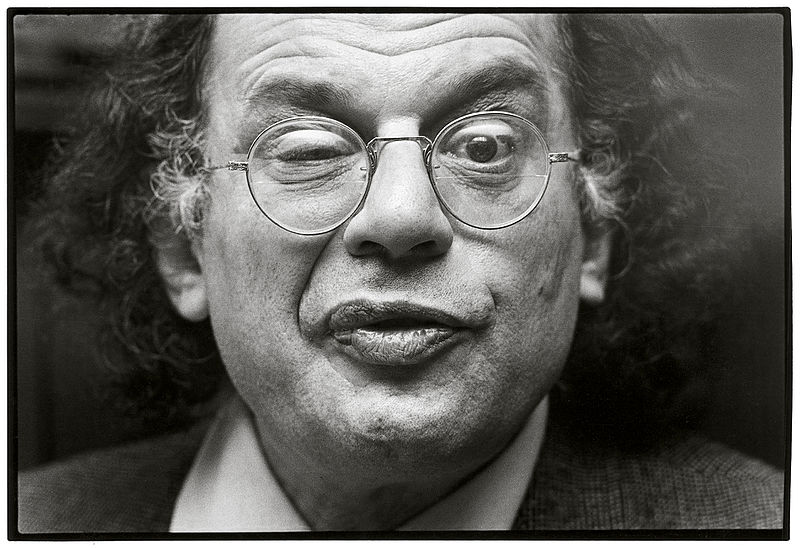
Image by Michiel Hendryckx, via Wikimedia Commons
Occasionally I slip into an ivory tower mentality in which the idea of a banned book seems quaint—associated with silly scandals over the tame sex scenes in James Joyce or D.H. Lawrence. After all, I think, we live in an age when bestseller lists are topped (no pun) by tawdry fan fiction like Fifty Shades of Grey. Nothing’s sacred. But this notion is a massive blind spot on my part; the whole awareness-raising mission of the annual Banned Books Week seeks to dispel such complacency. Books are challenged, suppressed, and banned all the time in public schools and libraries, even if we’ve moved past outright government censorship of the publishing industry.
It’s also easy to forget that Allen Ginsberg’s generation-defining poem “Howl” was once almost a casualty of censorship. The most likely successor to Walt Whitman’s vision, Ginsberg’s oracular utterances did not sit well with U.S. Customs, who in 1957 tried to seize every copy of the British second printing. When that failed, police arrested the poem’s publisher, Lawrence Ferlinghetti, and he and Ginsberg’s “Howl” were put on trial for obscenity. Apparently, phrases like “cock and endless balls” did not sit well with the authorities. But the court vindicated them all.
The story of Howl’s publication begins in 1955, when 29-year-old Ginsberg read part of the poem at the Six Gallery, where Ferlinghetti—owner of San Francisco’s City Lights bookstore—sat in attendance. Deciding that Ginsberg’s epic lament “knocked the sides out of things,” Ferlinghetti offered to publish “Howl” and brought out the first edition in 1956. Prior to this reading, “Howl” existed in the form of an earlier poem called “Dream Record, 1955,” which poet Kenneth Rexroth told Ginsberg sounded “too formal… like you’re wearing Columbia University Brooks Brothers ties.” Ginsberg’s rewrite jettisoned the ivy league decorum.
Unfortunately, no audio exists of that first reading, but above you can hear the first recorded reading of “Howl,” from February, 1956 at Portland’s Reed College. The recording sat dormant in Reed’s archives for over fifty years until scholar John Suiter rediscovered it in 2008. In it, Ginsberg reads his great prophetic work, not with the cadences of a street preacher or jazzman—both of which he had in his repertoire—but in an almost robotic monotone with an undertone of manic urgency. Ginsberg’s reading, before an intimate group of students in a dormitory lounge, took place only just before the first printing of the poem in the City Lights edition.
Note: This post originally appeared on our site in 2013. Over the years, the audio originally featured in the post, along with many of the links, went dead. So we gave everything a refresh and brought it back.
If you would like to support the mission of Open Culture, consider making a donation to our site. It’s hard to rely 100% on ads, and your contributions will help us continue providing the best free cultural and educational materials to learners everywhere. You can contribute through PayPal, Patreon, and Venmo (@openculture). Thanks!
Related Content:
Allen Ginsberg Recordings Brought to the Digital Age. Listen to Eight Full Tracks for Free
James Franco Reads a Dreamily Animated Version of Allen Ginsberg’s Epic Poem ‘Howl’
2,000+ Cassettes from the Allen Ginsberg Audio Collection Now Streaming Online
13 Lectures from Allen Ginsberg’s “History of Poetry” Course (1975)
Josh Jones is a writer and musician based in Washington, DC. Follow him at @jdmagness
Read More...A Bicycle Trip: Watch an Animation of The World’s First LSD Trip in 1943
On August 16, 1943, Swiss chemist Albert Hofmann was synthesizing a new compound called lysergic acid diethylamide-25 when he got a couple of drops on his finger. The chemical, later known worldwide as LSD, absorbed into his system, and, soon after, he experienced an intense state of altered consciousness. In other words, he tripped.
Intrigued by the experience, Hofmann dosed himself with 250 micrograms of LSD and then biked his way home through the streets of Basel, making him the first person ever to intentionally drop acid. The event was later commemorated by psychonauts and LSD enthusiasts as “Bicycle Day.”
Italian animators Lorenzo Veracini, Nandini Nambiar and Marco Avoletta imagine what Hofmann might have seen during his historic journey in their 2008 short A Bicycle Trip.
The film shows Hofmann riding through the Swiss medieval town as he sees visions like a trail of flowers coming off a woman in red, cobblestones coming alive and scurrying away, and a whole forest becoming transparent before the marveling scientist’s eyes. The film also shows Hofmann slamming into a fence, illustrating why it’s never a good idea to drive under the influence of hallucinogens.
After his early experiments, Albert Hofmann became convinced that LSD is not only a powerful potential treatment for the mentally ill but also a valuable bridge between the spiritual and the scientific. He called the substance “medicine for the soul.”
If you’re interested in learning more about the turbulent history of the drug, check out below the 2002 documentary Hofmann’s Potion, by Canadian filmmaker Connie Littlefield, which traces Hofmann’s invention from being a promising psychological treatment, to counterculture symbol, to banned substance. The 56-minute doc features footage and interviews with such psychedelic luminaries as Aldous Huxley, Stanislav Grof, Richard Alpert (AKA Ram Dass) along with Hofmann himself.
Hofmann was always uncomfortable with the casual way the ‘60s counterculture used his invention. “[LSD] is not just fun,” he says in Littlefield’s movie. “It is a very serious experiment.”
Jonathan Crow is a Los Angeles-based writer whose work has appeared in Yahoo!, The Hollywood Reporter, and other publications. You can follow her at @jonccrow.
Related Content:
Ken Kesey’s First LSD Trip Animated
Artist Draws Nine Portraits on LSD During 1950s Research Experiment
Aldous Huxley’s LSD Death Trip
Take a Trip to the LSD Museum, the Largest Collection of “Blotter Art” in the World
Read More...Behold The Drawings of Franz Kafka (1907–1917)
Runner 1907–1908
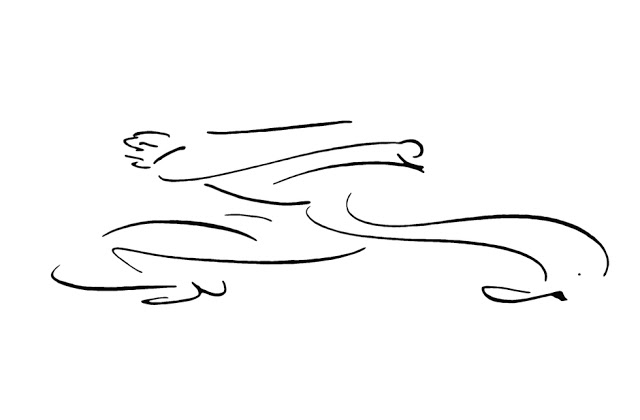
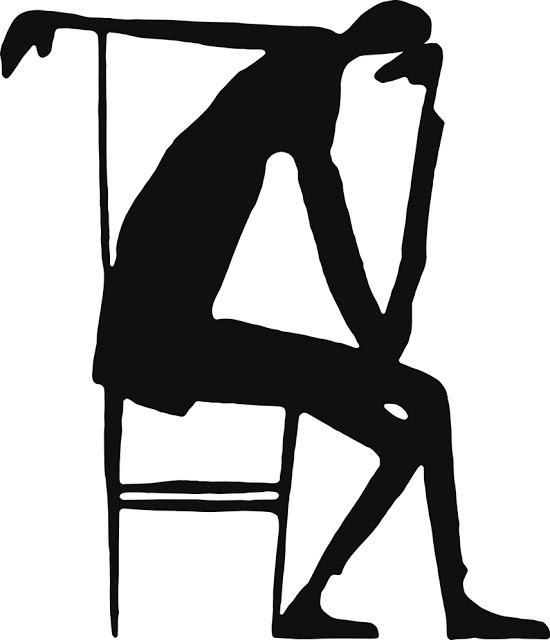
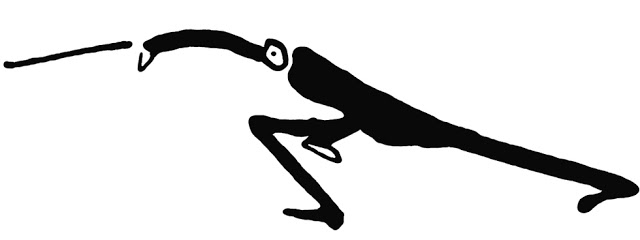
UK-born, Chicago-based artist Philip Hartigan has posted a brief video piece about Franz Kafka’s drawings. Kafka, of course, wrote a body of work, mostly never published during his lifetime, that captured the absurdity and the loneliness of the newly emerging modern world: In The Metamorphosis, Gregor transforms overnight into a giant cockroach; in The Trial, Josef K. is charged with an undefined crime by a maddeningly inaccessible court. In story after story, Kafka showed his protagonists getting crushed between the pincers of a faceless bureaucratic authority on the one hand and a deep sense of shame and guilt on the other.
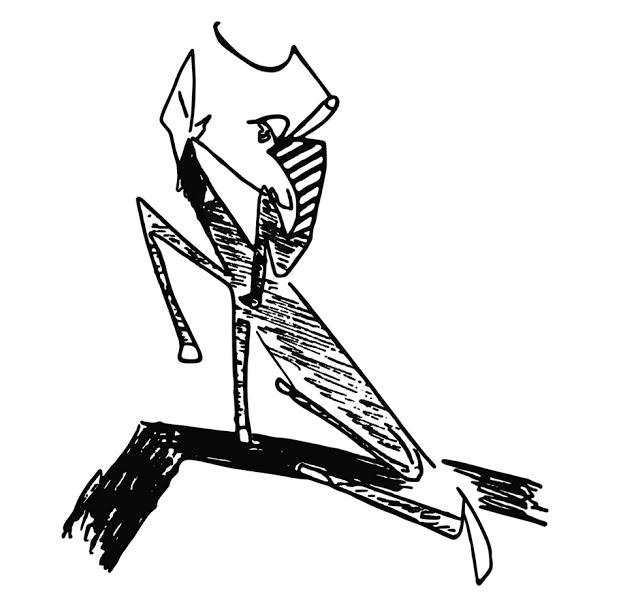
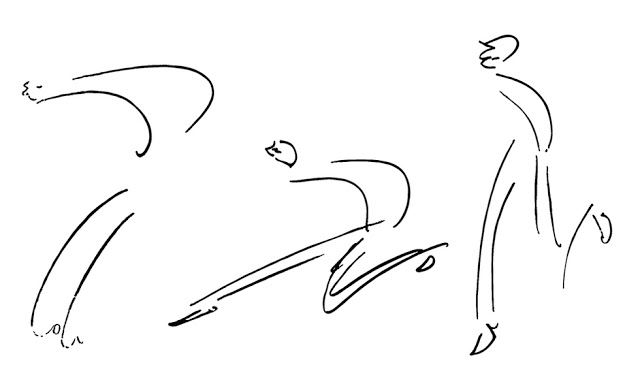
On his deathbed, the famously tortured writer implored his friend Max Brod to burn his unpublished work. Brod ignored his friend’s plea and instead published them – novels, short stories and even his diaries. In those diaries, Kafka doodled incessantly – stark, graphic drawings infused with the same angst as his writing. In fact, many of these drawings have ended up gracing the covers of Kafka’s books.
“Quick, minimal movements that convey the typical despairing mood of his fiction” says Hartigan of Kafka’s art. “I am struck by how these simple gestures, these zigzags of the wrist, contain an economy of mark making that even the most experienced artist can learn something from.”
In his book Conversations with Kafka, Gustav Janouch describes what happened when he came upon Kafka in mid-doodle: the writer immediately ripped the drawing into little pieces rather than have it be seen by anyone. After this happened a couple times, Kafka relented and let him see his work. Janouch was astonished. “You really didn’t need to hide them from me,” he complained. “They’re perfectly harmless sketches.”
“Kafka slowly wagged his head to and fro – ‘Oh no! They are not as harmless as they look. These drawing are the remains of an old, deep-rooted passion. That’s why I tried to hide them from you…. It’s not on the paper. The passion is in me. I always wanted to be able to draw. I wanted to see, and to hold fast to what was seen. That was my passion.”
Check out some of Kafka’s drawings below. Or definitely see the recently-published edition, Franz Kafka: The Drawings. It’s the “first book to publish the entirety of Franz Kafka’s graphic output, including more than 100 newly discovered drawings.”
Horse and Rider 1909–1910
Three Runners 1912–1913
The Thinker 1913
Fencing 1917
If you would like to support the mission of Open Culture, consider making a donation to our site. It’s hard to rely 100% on ads, and your contributions will help us continue providing the best free cultural and educational materials to learners everywhere. You can contribute through PayPal, Patreon, and Venmo (@openculture). Thanks!
Related Content:
Vladimir Nabokov’s Delightful Butterfly Drawings
The Art of William Faulkner: Drawings from 1916–1925
The Drawings of Jean-Paul Sartre
Flannery O’Connor’s Satirical Cartoons: 1942–1945
Jonathan Crow is a Los Angeles-based writer and filmmaker whose work has appeared in Yahoo!, The Hollywood Reporter, and other publications. You can follow him at @jonccrow.
Read More...The Origins of Anime: Watch Early Japanese Animations (1917 to 1931)
Japanese animation, AKA anime, might be filled with large-eyed maidens, way cool robots, and large-eyed, way cool maiden/robot hybrids, but it often shows a level of daring, complexity and creativity not typically found in American mainstream animation. And the form has spawned some clear masterpieces from Katsuhiro Otomo’s Akira to Mamoru Oishii’s Ghost in the Shell to pretty much everything that Hayao Miyazaki has ever done.
Anime has a far longer history than you might think; in fact, it was at the vanguard of Japan’s furious attempts to modernize in the early 20th century. The oldest surviving example of Japanese animation, Namakura Gatana (Blunt Sword), dates back to 1917, though much of the earliest animated movies were lost following a massive earthquake in Tokyo in 1923. As with much of Japan’s cultural output in the first decades of the 20th Century, animation from this time shows artists trying to incorporate traditional stories and motifs in a new modern form.
Above is Oira no Yaku (Our Baseball Game) from 1931, which shows rabbits squaring off against tanukis (raccoon dogs) in a game of baseball. The short is a basic slapstick comedy elegantly told with clean, simple lines. Rabbits and tanukis are mainstays of Japanese folklore, though they are seen here playing a sport that was introduced to the country in the 1870s. Like most silent Japanese movies, this film made use of a benshi – a performer who would stand by the movie screen and narrate the movie. In the old days, audiences were drawn to the benshi, not the movie. Akira Kurosawa’s elder brother was a popular benshi who, like a number of despondent benshis, committed suicide when the popularity of sound cinema rendered his job obsolete.
Then there’s this version of the Japanese folktale Kobu-tori from 1929, about a woodsman with a massive growth on his jaw who finds himself surrounded by magical creatures. When they remove the lump, he finds that not everyone is pleased. Notice how detailed and uncartoony the characters are.
Another early example of early anime is Ugokie Kori no Tatehiki (1931), which roughly translates into “The Moving Picture Fight of the Fox and the Possum.” The 11-minute short by Ikuo Oishi is about a fox who disguises himself as a samurai and spends the night in an abandoned temple inhabited by a bunch of tanukis (those guys again). The movie brings all the wonderful grotesqueries of Japanese folklore to the screen, drawn in a style reminiscent of Max Fleischer and Otto Messmer.
And finally, there is this curious piece of early anti-American propaganda from 1936 that features a phalanx of flying Mickey Mouses (Mickey Mice?) attacking an island filled with Felix the Cat and a host of other poorly-rendered cartoon characters. Think Toontown drawn by Henry Darger. All seems lost until they are rescued by figures from Japanese history and legend. During its slide into militarism and its invasion of Asia, Japan argued that it was freeing the continent from the grip of Western colonialism. In its queasy, weird sort of way, the short argues precisely this. Of course, many in Korea and China, which received the brunt of Japanese imperialism, would violently disagree with that version of events.
Related Content:
The Art of Hand-Drawn Japanese Anime: A Deep Study of How Katsuhiro Otomo’s Akira Uses Light
The Aesthetic of Anime: A New Video Essay Explores a Rich Tradition of Japanese Animation
How Master Japanese Animator Satoshi Kon Puhed the Boundaries of Making Anime: A Video Essay
“Evil Mickey Mouse” Invades Japan in a 1934 Japanese Anime Propaganda Film
Watch the Oldest Japanese Anime Film, Jun’ichi Kōuchi’s The Dull Sword (1917)
Jonathan Crow is a Los Angeles-based writer and filmmaker whose work has appeared in Yahoo!, The Hollywood Reporter, and other publications. You can follow him at @jonccrow.
Read More...
Hear Flannery O’Connor Read “A Good Man is Hard to Find” (1959)
Flannery O’Connor was a Southern writer who, as Joyce Carol Oates once said, had less in common with Faulkner than with Kafka and Kierkegaard. Isolated by poor health and consumed by her fervent Catholic faith, O’Connor created works of moral fiction that, according to Oates, “were not refined New Yorker stories of the era in which nothing happens except inside the characters’ minds, but stories in which something happens of irreversible magnitude, often death by violent means.”
In imagining those events of irreversible magnitude, O’Connor could sometimes seem outlandish–even cartoonish–but she strongly rejected the notion that her perceptions of 20th century life were distorted. “Writers who see by the light of their Christian faith will have, in these times, the sharpest eye for the grotesque, for the perverse, and for the unacceptable,” O’Connor said. “To the hard of hearing you shout, and for the almost-blind you draw large and startling figures.”
In April of 1959–five years before her death at the age of 39 from lupus–O’Connor ventured away from her secluded family farm in Milledgeville, Georgia, to give a reading at Vanderbilt University. She read one of her most famous and unsettling stories, “A Good Man is Hard to Find.” The audio, accessible above, is one of two known recordings of the author reading that story. In her distinctive Georgian drawl, O’Connor tells the story of a fateful family trip:
The grandmother didn’t want to go to Florida. She wanted to visit some of her connections in east Tennessee and she was seizing at every chance to change Bailey’s mind. Bailey was the son she lived with, her only boy. He was sitting on the edge of his chair at the table, bent over the orange sports section of the Journal. “Now look here, Bailey,” she said, “see here, read this,” and she stood with one hand on her thin hip and the other rattling the newspaper at his bald head. “Here this fellow that calls himself The Misfit is aloose from the Federal Pen and headed toward Florida and you read here what it says he did to these people. Just you read it. I wouldn’t take my children in any direction with a criminal like that aloose in it. I couldn’t answer to my conscience if I did.”
After you listen to this rare track, you can follow this link to a recording of O’Connor reading her 1960 essay, “Some Aspects of the Grotesque in Southern Fiction,” in which she writes: “I have found that anything that comes out of the South is going to be called grotesque by the Northern reader, unless it is grotesque, in which case it is going to be called realistic.”
Related Content:
Flannery O’Connor Reads ‘Some Aspects of the Grotesque in Southern Fiction’ (c. 1960)
Flannery O’Connor’s “Everything That Rises Must Converge” Read by Estelle Parsons
Read More...Watch Iconic Artists at Work: Rare Videos of Picasso, Matisse, Kandinsky, Renoir, Monet, Pollock & More
Claude Monet, 1915:
We’ve all seen their works in fixed form, enshrined in museums and printed in books. But there’s something special about watching a great artist at work. Over the years, we’ve posted film clips of some of the greatest artists of the 20th century caught in the act of creation. Today we’ve gathered together eight of our all-time favorites.
Above is the only known film footage of the French Impressionist Claude Monet, made when he was 74 years old, painting alongside a lily pond in his garden at Giverny. The footage was shot in the summer of 1915 by the French actor and dramatist Sacha Guitry for his patriotic World War I‑era film, Ceux de Chez Nous, or “Those of Our Land.” For more information, see our previous post, “Rare Film: Claude Monet at Work in His Famous Garden at Giverny, 1915.”
Pierre-Auguste Renoir, 1915:
You may never look at a painting by the French Impressionist Pierre-Auguste Renoir in quite the same way after seeing the footage above, which is also from Sacha Guitry’s Ceux de Chez Nous. Renoir suffered from severe rheumatoid arthritis during the last decades of his life. By the time this film was made in June of 1915, the 74-year-old Renoir was physically deformed and in constant pain. The painter’s 14-year-old son Claude is shown placing the brush in his father’s permanently clenched hand. To learn more about the footage and about Renoir’s terrible struggle with arthritis, be sure to read our post, “Astonishing Film of Arthritic Impressionist Painter, Pierre-Auguste Renoir (1915).”
Auguste Rodin, 1915:
The footage above, again by Sacha Guitry, shows the French sculptor Auguste Rodin in several locations, including his studio at the dilapidated Hôtel Biron in Paris, which later became the Musée Rodin. The film was made in late 1915, when Rodin was 74 years old. For more on Rodin and the Hôtel Biron, please see: “Rare Film of Sculptor Auguste Rodin working at his Studio in Paris (1915).”
Wassily Kandinsky, 1926:
In 1926, filmmaker Hans Cürlis took the rare footage above of the Russian abstract painter Wassily Kandinsky applying paint to a blank canvas at the Galerie Neumann-Nierendorf in Berlin. Kandinsky was about 49 years old at the time, and teaching at the Bauhaus. To learn more about Kandinsky and to watch a video of actress Helen Mirren discussing his work at the Museum of Modern Art in New York, see our post, “The Inner Object: Seeing Kandinsky.”
Henri Matisse, 1946:
The French artist Henri Matisse is shown above when he was 76 years old, making a charcoal sketch of his grandson, Gerard, at his home and studio in Nice. The clip is from a 26-minute film made by François Campaux for the French Department of Cultural Relations. To read a translation of Matisse’s spoken words and to watch a clip of the artist working on one of his distinctive paper cut-outs, go to “Vintage Film: Watch Henri Matisse Sketch and Make His Famous Cut-Outs (1946).”
Pablo Picasso, 1950:
In the famous footage above, Spanish artist Pablo Picasso paints on glass at his studio in the village of Vallauris, on the French Riviera. It’s from the 1950 film Visite à Picasso (A Visit with Picasso) by Belgian filmmaker Paul Haesaerts. Picasso was about 68 years old at the time. You can find the full 19-minute film here.
Jackson Pollock, 1951:
In the short film above, called Jackson Pollock 51, the American abstract painter talks about his work and creates one of his distinctive drip paintings before our eyes. The film was made by Hans Namuth when Pollock was 39 years old. To learn about Pollock and his fateful collaboration with Namuth, see “Jackson Pollock: Lights, Camera, Paint! (1951).”
Alberto Giacometti, 1965:
The Swiss artist Alberto Giacometti is most famous for his thin, elongated sculptures of the human form. But in the clip above from the 1966 film Alberto Giacometti by the Swiss photographer Ernst Scheidegger, Giacometti is shown working in another medium as he paints the foundational lines of a portrait at his studio in Paris. The footage was apparently shot in 1965, when Giacometti was about 64 years old and had less than a year to live. To learn about Giacometti’s approach to drawing and to read a translation of the German narration in this clip, be sure to see our post, “Watch as Alberto Giacometti Paints and Pursues the Elusive ‘Apparition,’ (1965).”
Related Content:
1922 Photo: Claude Monet Stands on the Japanese Footbridge He Painted Through the Years
Read More...Daniel Dennett Presents the 4 Biggest Ideas in Philosophy in One of His Final Videos (RIP)
A week ago, Big Think released this video featuring philosopher Daniel Dennett talking about the four biggest ideas in philosophy. Today, we learned that he passed away at age 82. The New York Times obituary for Dennett reads: “Espousing his ideas in best sellers, he insisted that religion was an illusion, free will was a fantasy and evolution could only be explained by natural selection.” “Mr. Dennett combined a wide range of knowledge with an easy, often playful writing style to reach a lay public, avoiding the impenetrable concepts and turgid prose of many other contemporary philosophers. Beyond his more than 20 books and scores of essays, his writings even made their way into the theater and onto the concert stage.”
Above, Dennett, a long-time philosophy professor at Tufts University, outlines the “four eras he evolved through on his own journey as a philosopher: classical philosophy, evolutionary theory, memetic theory, and the intentional stance. Each stage added depth to his perspective and understanding… Dennett’s key takeaway is a request for philosophers to reevaluate their methodologies, urging modern-day thinkers to embrace the insights offered by new scientific discoveries. By combining the existential and theoretical viewpoints of philosophers with the analytical and evidential perspective of scientists, we can begin to fully and accurately interpret the world around us.”
To help you delve a little deeper into Daniel Dennett’s world, we’ve also posted below a vintage TED video where the philosopher discusses the illusion of consciousness. We would also encourage you to explore the Dennett items in the Relateds below.
Related Content
Daniel Dennett Presents Seven Tools For Critical Thinking
How to Argue With Kindness and Care: 4 Rules from Philosopher Daniel Dennett
Daniel Dennett and Cornel West Decode the Philosophy of The Matrix
Hear What It Sounds Like When Philosopher Daniel Dennett’s Brain Activity Gets Turned into Music
Read More...Watch Stalker, Andrei Tarkovsky’s Mind-Bending Masterpiece Free Online
“I feel like every single frame of the film is burned into my retina,” said Oscar-winning actress Cate Blanchett about the movie Stalker (1979). “I hadn’t seen anything like it before and I haven’t really seen anything like it since.
Andrei Tarkovsky’s final film in the USSR seems like an unlikely movie to have a devoted, almost cultish, following. It is a dense, multivalent, maddeningly elusive work that has little of the narrative pay-offs of a Hollywood movie. Yet the film is so slippery and so seemingly pliable to an endless number of interpretations that it requires multiple viewings. “I’ve seen Stalker more times than any film except The Great Escape,” wrote novelist and critic Geoff Dyer,” and it’s never quite as I remember. Like the Zone, it’s always changing.”
The movie’s story is simple: a guide, called here a Stalker, takes a celebrated writer and a scientist from a rotting industrial cityscape into a verdant area called The Zone, the site of some undefined calamity which has been cordoned off by rings of razor wire and armed guards. There, one supposedly can have their deepest, darkest desires fulfilled. Yet even if you manage to give the guards a slip, there are still countless subtle traps laid by whatever sentient intelligence that controls the Zone. Rationality is of no help here. One can only progress along a meandering path that can only be followed by intuition.
The Stalker, with his shaved head and a perpetually haunted expression on his face, is a sort of holy fool; a man who is both addicted to the strange energy of the Zone and bound to help his fellow man. His clients’ motives, however, are far less altruistic. Once deep in the room, the three engage in a series of philosophical arguments that quickly turns personal.
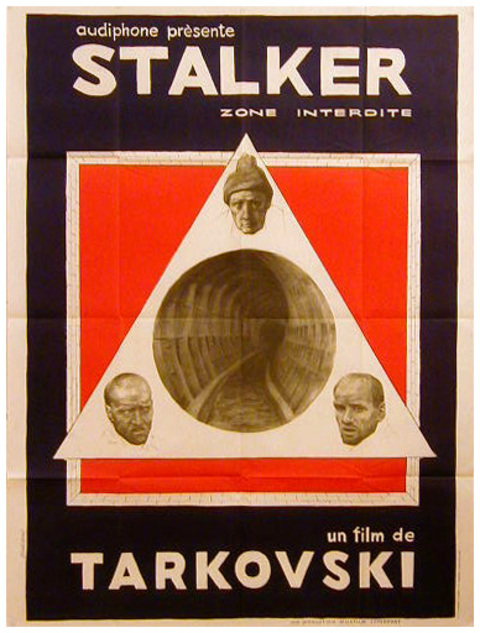
The movie’s power, however, is not found in traditional dramatics. Instead it’s a cumulative effect of Tarkovsky’s hypnotic pace, his philosophical commentary and perhaps most of all his imagery. Shot with smudgy, almost completely desaturated colors, the world outside the Zone seems to be a grim, dismal place – as if Tarkovsky were trying to evoke the industrial hellscape of Eraserhead by way of Samuel Beckett. (Stalker was in fact shot in an industrial wasteland outside of Tallinn, Estonia, down river from a chemical plant. Exposure to that plant’s runoff might very well have caused the filmmaker’s death.) Inside the Zone, however, the surroundings are lush and colorful, filled with glimpses of inexplicable wonder and beauty.
Stalker screenwriter Arkady Strugatsky once said that the movie was not “a science fiction screenplay but a parable.” The question is, a parable of what? Religious faith? Art? The cinema itself? Reams of paper have been devoted to this question and I’m not offering any theories. Tarkovsky himself, in his book Sculpting Time, wrote “People have often asked me what The Zone is, and what it symbolizes…The Zone doesn’t symbolize anything, any more than anything else does in my films: the zone is a zone, it’s life.”
Of course, that explanation does little to explain the film’s startling, utterly cryptic final minutes.
Above, you can watch the film online, thanks to Mosfilm. You can also find other Tarkovsky films in the Relateds below.
Related Content:
Watch Andrei Tarkovsky’s Films Free Online: Stalker, The Mirror & Andrei Rublev
Andrei Tarkovsky’s Very First Films: Three Student Films, 1956–1960
Andrei Tarkovsky Answers the Essential Questions: What is Art & the Meaning of Life?
Jonathan Crow is a Los Angeles-based writer and filmmaker whose work has appeared in Yahoo!, The Hollywood Reporter, and other publications. You can follow him at @jonccrow. And check out his blog Veeptopus, featuring lots of pictures of vice presidents with octopuses on their heads. The Veeptopus store is here.
Read More...Support Us
We're hoping to rely on loyal readers, rather than erratic ads. Please click the Donate button and support Open Culture. You can use Paypal, Venmo, Patreon, even Crypto! We thank you!

About Us

Open Culture scours the web for the best educational media. We find the free courses and audio books you need, the language lessons & educational videos you want, and plenty of enlightenment in between.
Advertise With Us

FREE UPDATES!
GET OUR DAILY EMAIL
Get the best cultural and educational resources on the web curated for you in a daily email. We never spam. Unsubscribe at any time.
FOLLOW ON SOCIAL MEDIA

Open Culture editor Dan Colman scours the web for the best educational media. He finds the free courses and audio books you need, the language lessons & movies you want, and plenty of enlightenment in between.
Advertise With Us


