How the “Lost Cities” of the Amazon Were Finally Discovered
About a decade and a half ago, The Lost City of Z seemed to have been placed front-and-center in most bookstores of the English-speaking world. It was the first book by journalist David Grann, and it handily proved that he knew how to deal with history in a way that could capture the public imagination. (His second, Killers of the Flower Moon, provided the basis for the acclaimed Martin Scorsese film now in theaters.) Subtitled A Tale of Deadly Obsession in the Amazon, the book tells of British explorer Captain Percy Fawcett, who went missing with his son in that vast jungle back in 1925. They’d been looking for the “lost city” of the title, of whose existence Fawcett had been convinced by what may now strike us as rather scant evidence.
“The idea was based on rumors that had circulated for centuries that there were once large cities, filled with people, deep in the Amazon,” says the narrator of the Vox Atlas video above, fired by the discovery of grand capitals like Tenochtitlan in modern-day Mexico and Cusco in Peru. Experts, for their part, “believed that this rainforest was simply too hostile and too remote to ever have supported cities.”
More recently, scientists started identifying man-made ditches and mounds all over the Amazon, which complicated the picture considerably. Instead of the extravagant metropolis intimated by explorers in the centuries before him, Fawcett only encountered small groups of natives living in simple villages. The consensus came to hold that a host of environmental, geological, and biological factors conspired against the growth of large-scale civilizations in the rainforest.
But “it turns out, Fawcett was looking in the right place, just for the wrong thing.” He never took note of patches of intentionally cultivated fertile soil, ditches where once stood walls leading to a plaza, and “delineated areas for gardens and orchards.” Though none of this quite suggested the fabled El Dorado, “over the past few decades, experts have uncovered evidence of large settlements all over the Amazon,” a single one of which could have had up to 60,000 inhabitants. By the time Fawcett arrived in the early twentieth century, most of those locals had long since died of European-imported diseases, leaving their wood- and-Earth structures to decompose. Given how far transport and construction technologies have come since then, perhaps it’s time to try out a different obsession: not over finding old Amazonian cities, but building new ones.
Related content:
Tour the Amazon with Google Street View; No Passport Needed
Hear Ernest Shackleton Speak About His Antarctic Expedition in a Rare 1909 Recording
Listen to Plato Invent the Myth of Atlantis (360 B.C)
Based in Seoul, Colin Marshall writes and broadcasts on cities, language, and culture. His projects include the Substack newsletter Books on Cities, the book The Stateless City: a Walk through 21st-Century Los Angeles and the video series The City in Cinema. Follow him on Twitter at @colinmarshall or on Facebook.
Read More...
Watch David Byrne Practice His Dance Moves for Stop Making Sense in Newly Released Behind-the-Scenes Footage
A new 4K restoration of Stop Making Sense debuted last month at the Toronto International Film Festival, then opened in theaters around the world. The promotional push for this cultural event started early (as featured here on Open Culture), and has involved the release of rarely-seen supplementary materials chosen to delight Talking Heads fans. Take the short video above, a compilation of video clips in which David Byrne rehearses his dance moves in advance of the band’s 1983 Speaking in Tongues tour, four of whose shows would be combined, with the help of many collaborators including director Jonathan Demme, into a seamless, still-beloved musical-cinematic experience.
In a film full of memorable elements, from the Pablo Ferro titles to the lamp to the big suit, Byrne’s distinctive way of carrying himself stands out. “His wide-eyed stare, jerky movements and onstage cool reminded many commentators of Anthony Perkins, star of Hitchcock’s movie Psycho,” Colin Larkin writes of earlier Heads shows in The Encyclopedia of Popular Music.
This elaborate awkwardness, so thoroughly deliberate-looking that it comes around the other side to suavity, may seem like a natural expression of his artistic personality. But as revealed by the video he shot of himself trying out different choreographic ideas — and even more so by the full 25-minute version, which features not just numerous VHS glitches but also the band’s backup singers — it took trial and error to develop.
“The film’s peak moments come through Byrne’s simple physical presence,” Roger Ebert wrote of Stop Making Sense upon its initial release in 1984. “He jogs in place with his sidemen; he runs around the stage; he seems so happy to be alive and making music,” and even “serves as a reminder of how sour and weary and strung-out many rock bands have become.” Though, when rock bands may be less strung-out but are certainly no less weary, his restored performance is reminding countless Heads enthusiasts why they got into the band in the first place — and no doubt giving heretofore uninitiated new generations a few paranoically exuberant, rigidly uninhibited, and smoothly un-smooth moves to try out on the dance floor themselves.
Related content:
David Byrne Plays Seven Characters & Interviews Himself in Funny Promo for Stop Making Sense
Talking Heads Live in Rome, 1980: The Concert Film You Haven’t Seen
Based in Seoul, Colin Marshall writes and broadcasts on cities, language, and culture. His projects include the Substack newsletter Books on Cities, the book The Stateless City: a Walk through 21st-Century Los Angeles and the video series The City in Cinema. Follow him on Twitter at @colinmarshall or on Facebook.
Read More...130 Animators Remake an Episode of Frasier, One Frame at a Time
Behold a crowdsourced, collaborative art project where more than 130 animators and filmmakers from 11 different countries joined together and remade a full episode of Frasier. (It’s the finale of Season 1, “My Coffee with Niles.”) The project’s mastermind, Jacob Reed, asked individual artists to animate different scenes, each with a different style, and then he stitched them all together. Above, you can see how everything hangs together.
If you would like to support the mission of Open Culture, consider making a donation to our site. It’s hard to rely 100% on ads, and your contributions will help us continue providing the best free cultural and educational materials to learners everywhere. You can contribute through PayPal, Patreon, and Venmo (@openculture). Thanks!
Related Content
Watch “Pass the Ball,” a Collaborative Animation Made by 40 Animators Across the Globe
Disney’s 12 Timeless Principles of Animation
Read More...Watch a Strange Animation of Edgar Allan Poe’s “Tell-Tale Heart,” Voted the 24th Best Cartoon of All Time (1953)
Animation studio UPA—United Productions of America—is best known these days as the studio that gave us Mr. Magoo and Gerald McBoing Boing (which inspired a certain website). But the studio, originally created by three former Disney employees, wanted to broaden horizons back in the 1950s, and created this quite disturbing adaptation of Edgar Allan Poe’s “The Tell-Tale Heart,” narrated by the venerable James Mason.
Due to its adult subject matter, it was the first animated film to receive an “X” rating
(or “suitable for those aged 16 and over”) in the UK. Though not intended for children, many undoubtedly saw the film as kids and were profoundly affected by it. The film, designed by Paul Julian, borrows both from Dali-esque surrealism and German expressionism.
And while it does feature some traditional cell animation, there’s a mix of techniques that keep the film in the realm of the dreamlike and avant-garde: sudden zooms, shadows that fade in and out, flattened perspectives, inventive use of chiaroscuro. In this film, one can see both the future careers of Roger Corman and Dario Argento, both grabbing influences left and right.
In fact, though designer Paul Julian is best known for his background work at Warner Bros. animation studios (he also is known as the creator of the Road Runner’s beep-beep sound), he wound up providing director Roger Corman with artwork for movies like Dementia 13 and The Terror.
UPA continued to produce films with its modern and flat space-age aesthetic during the ‘50s, but it never really hit these adult heights again. The ‘60s however, would pick up from where UPA left off.
Julian’s “The Tell-Tale Heart” was voted the 24th greatest cartoon of all time, in a 1994 survey of 1,000 animation professionals. It was also nominated for the Academy Award for Best Animated Short Film. We hope you enjoy this glimpse into disturbia. It will be added to our list of Free Animations, a subset of our collection, 4,000+ Free Movies Online: Great Classics, Indies, Noir, Westerns, Documentaries & More.
Related Content:
Christopher Lee Reads “The Tell-Tale Heart,” Edgar Allan Poe’s 1843 Classic
Watch Vincent Price Turn Into Edgar Allan Poe & Read Four Classic Poe Stories (1970)
Ted Mills is a freelance writer on the arts who currently hosts the FunkZone Podcast. You can also follow him on Twitter at @tedmills, read his other arts writing at tedmills.com and/or watch his films here.
Read More...Discover the Regions in Italy Where the People Descended from the Medieval or Ancient Greeks, and Still Speak Greek
All of us, across the world, know that Italy is shaped like a boot. But almost none of us know that, in the regions of Apulia and Calabria at the country’s “heel” and “toe,” live small communities who, among themselves, still speak not Italian but Greek. The word “still” applies because these peoples, known as Griko (or Grecanici), are thought to have descended from the much larger medieval or even ancient Greek communities that once existed there. Of course, it wouldn’t have been at all unusual back then for inhabitants of one part of what we now call Italy to speak a quite different language from the inhabitants of another.
John Kazaklis at Istoria writes that “the Italian language did not become the staple language until well into the end of the 19th Century during the process of Italian unification, or the Risorgimento,” which turned the Tuscan dialect into the national language. Yet “there exists today a tiny enclave of Greek-speaking people in the Aspromonte Mountain region of Reggio Calabria that seem to have survived millennia.”
Are they “descendants of the Ancient Greeks who colonized Southern Italy? Are they remnants of the Byzantine presence in Southern Italy? Did their ancestors come in the 15th-16th Centuries from the Greek communities in the Aegean fleeing Ottoman invasion?” Everyone who considers the origins of the Griko/Grecanici people (or their Griko/Grico/Greko languages) seems to come to a slightly different conclusion.
“I suspect they speak a dialect more closely related to the Koine Greek spoken at the time of the 11th century Byzantine Empire, the last and final time Southern Italy was still part of the Greek-speaking world,” writes Grecophone Youtuber Tom_Traveler, who visits the Griko-speaking villages of Gallicianò and Bova in the video above. “Or perhaps it was influenced by Greek refugees fleeing Constantinople upon its fall to the Turks in 1453.” However it developed, it’s long been a language on the decline: “the clearest estimate of remaining Greko speakers seems to be between 200–300,” Kazaklis wrote in 2017, “and numbers continue to decrease.” In the interest of preserving the language and the history reflected within it, now would be a good time for a few of those speakers to start up Youtube channels of their own.
via Messy Nessy
Related content:
Learn Ancient Greek in 64 Free Lessons: A Free Online Course from Brandeis & Harvard
Can Modern-Day Italians Understand Latin? A Youtuber Puts It to the Test on the Streets of Rome
Based in Seoul, Colin Marshall writes and broadcasts on cities, language, and culture. His projects include the Substack newsletter Books on Cities, the book The Stateless City: a Walk through 21st-Century Los Angeles and the video series The City in Cinema. Follow him on Twitter at @colinmarshall or on Facebook.
Read More...Ian Bremmer on The Israel-Hamas War, and What It Means for the World
In the wake of Hamas’ gruesome attack on Israeli civilians, political scientist Ian Bremmer explains “the historical context of the conflict, how Israel might respond and what it means for Jews, Palestinians and the world at large.” The conversation also covers “how the US may factor into the global response and how to find reliable information amid the breathless media coverage and the fog of war.” Hosted by TED’s head of curation Helen Walters, this conversation was recorded on October 9, 2023.
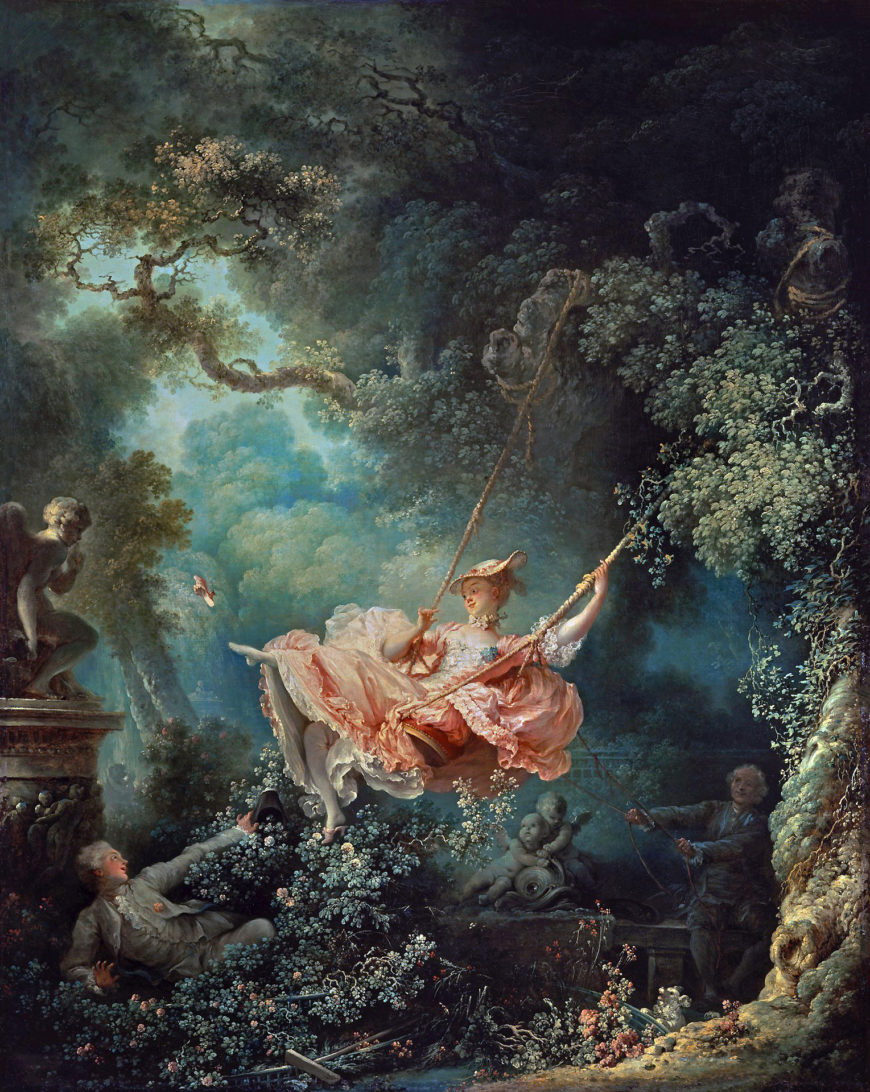
Read More...Why Jean-Honoré Fragonard’s Rococo Masterpiece, The Swing, Is Less Innocent Than It First Appears
If you were to see Jean-Honoré Fragonard’s L’Escarpolette, or The Swing, at the Wallace Collection, you might not think particularly hard about it. Though all the subtle light effects that make the young woman in pink pop out of the lush garden that surrounds her are impressive, granted — and they’ve become even more so since the painting’s recent restoration — there doesn’t seem to be much else of interest at first glance. But take a second glance, and you may well get a sense of what, back in the seventeen-sixties, made this commission “so raunchy, many artists wouldn’t have done it for all the money in the world.”
So says the narrator of the Art Deco video above, which promises an explanation of why The Swing “isn’t as innocent as it seems.” Take, for example, the young man reclining in the canvas lower-left corner, whose ecstatic expression can perhaps be explained by what’s entered his line of sight. But “forget about the fact that he can see up her skirt: her ankle is showing, a very erotic gesture at the time.”
All of this intensifies when we know the story behind the painting, and specifically that “the man who commissioned the painting is the man in the bush, and he’s also the woman’s lover, not her husband.” Is her husband the older fellow crouched in the opposite corner, clutching the swing’s reins? Perhaps, but like any piece of art worth regarding, this one leaves room for interpretation.
Still, if you understand something of the mores of its time and place, there’s no mistaking its titillating intent. None of Fragonard’s contemporaries could have imagined that this painting would one day hang in a public gallery for all the world to see, commissioned as it was for display only in a private home. Many paintings were in the time of Rococo, “a style of art that comes out of the Baroque,” as art historian Steven Zucker says in the Smarthistory video just above, which despite having “jettisoned the seriousness, the morality” of its predecessor, nevertheless retained “a sense of energy, a sense of movement.” The Swing remains “a perfect expression of the frivolity, the luxury, and the indulgence of the Rococo” — and a reminder, as the Art Deco video puts it, that “whatever happens in the mystical garden, stays in the mystical fairy garden.”
Related content:
What Makes Vermeer’s The Milkmaid a Masterpiece?: A Video Introduction
When John Singer Sargent’s “Madame X” Scandalized the Art World in 1884
Why Does This Lady Have a Fly on Her Head?: A Curious Look at a 15th-Century Portrait
Based in Seoul, Colin Marshall writes and broadcasts on cities, language, and culture. His projects include the Substack newsletter Books on Cities, the book The Stateless City: a Walk through 21st-Century Los Angeles and the video series The City in Cinema. Follow him on Twitter at @colinmarshall or on Facebook.
Read More...Martin Scorsese Breaks Down His Most Iconic Films: Mean Streets, Taxi Driver, GoodFellas, and More
“Did Scorsese make the best movie of each decade since the ’70s?” asks GQ’s Zach Baron in a recent profile of that long-lived auteur. “Probably not (I think his case is weakest in the first decade of this century), but you could argue it, and many people have.” And indeed, you may well find yourself believing it after watching the video above, also published by GQ, in which Scorsese himself discusses a selection of features from the past half-century of his career, the earliest of which, Mean Streets, was a breakout project for both its young director and even younger star, a certain Robert de Niro, in 1973.
Scorsese’s latest, Killers of the Flower Moon, opens next month as not just another of his many collaborations with de Niro, but the first Scorsese film to feature both de Niro and Leonardo DiCaprio. “We were acquainted with each other when we were sixteen years old,” the director says of de Niro in the GQ video. “He experienced what I experienced growing up” in rough-and-tumble New York neighborhoods like Little Italy and the Bowery, and thus “knows who I am and where I came from.” Hence the trust with which Scorsese took de Niro’s recommendation of DiCaprio in the early nineties: “You gotta work with him someday.”
That someday came in 2002, with Gangs of New York, after which the Scorsese-diCaprio professional relationship would mature to bear additional cinematic fruit with projects like The Departed and The Wolf of Wall Street. At this point it has become a parallel enterprise to Scorsese-de Niro, which can be traced from The Irishman, which came out in 2019, back through the likes of GoodFellas (though it stars the late Ray Liotta), Casino, The King of Comedy, and Raging Bull — a picture that, along with other brazenly ambitious United Artists releases like Francis Ford Coppola’s Apocalypse Now and Michael Cimino’s Heaven’s Gate, Scorsese now sees as marking the end of “the power of the director.”
In “new Hollywood” era of the nineteen-seventies, Scorsese remembers, “things were wide open, and we went in and took it like the barbarians at the gate, and we transformed whatever we could, but they caught us.” Still, since then he’s “never stopped working for any noticeable amount of time,” as Baron puts it, though in recent years he’s been given to rueful comment about the artistic and economic dynamics of his industry and art form. As for the state of the world in general, he makes an equally grim diagnosis with reference to his and de Niro’s best-known collaboration, Taxi Driver: “Every other person is like Travis Bickle now.”
Related content:
How Martin Scorsese Directs a Movie: The Techniques Behind Taxi Driver, Raging Bull, and More
The Filmmaking of Martin Scorsese Demystified in 6 Video Essays
Martin Scorsese Explains the Difference Between Cinema and Movies
Based in Seoul, Colin Marshall writes and broadcasts on cities, language, and culture. His projects include the Substack newsletter Books on Cities, the book The Stateless City: a Walk through 21st-Century Los Angeles and the video series The City in Cinema. Follow him on Twitter at @colinmarshall or on Facebook.
Read More...How Big Ben Works: A Detailed Look Inside London’s Beloved Victorian Clock Tower
If asked to name the best-known tower in London, one could, perhaps, make a fair case for the likes of the Shard or the Gherkin. But whatever their current prominence on the skyline, those works of twenty-first-century starchitecture have yet to develop much value as symbols of the city. If sheer age were the deciding factor, then the Tower of London, the oldest intact building in the capital, would take the top spot, but for how many people outside England does its name call a clear image to mind? No, to find London’s most beloved vertical icon, we must look to the Victorian era, the only historical period that could have given rise to Big Ben.
We must first clarify that Big Ben is not a tower. The building you’re thinking of has been called the Elizabeth Tower since Queen Elizabeth II’s Diamond Jubilee in 2012, but before that its name was the Clock Tower. That was apt enough, since tower’s defining feature has always been the clock at the top — or rather, the four clocks at the top, one for each face.
You can see how they work in the animated video from Youtuber Jared Owen above, which provides a detailed visual and verbal explanation of both the structure’s context and its content, including a tour of the mechanisms that have kept it running nearly without interruption for more than a century and a half.
Only by looking into the tower’s belfry can you see Big Ben, which, as Owens says, is actually the name of the largest of its bells. Its announcement of each hour on the hour — as well as the ringing of the other, smaller bells — is activated by a system of gear trains ultimately driven by gravity, harnessed by the swinging of a large pendulum (to which occasional speed adjustments have always been made with the reliable method of placing pennies on top of it). Owens doesn’t clarify whether or not this is the same pendulum Roger Miller sang about back in the sixties, but at least now we know that, technically speaking, we should interpret the following lyrics as not “the tower, Big Ben” but “the tower; Big Ben.”
Related content:
The Oldest Known Footage of London (1890–1920) Features the City’s Great Landmarks
Prague Monument Doubles as Artist’s Canvas
Based in Seoul, Colin Marshall writes and broadcasts on cities, language, and culture. His projects include the Substack newsletter Books on Cities, the book The Stateless City: a Walk through 21st-Century Los Angeles and the video series The City in Cinema. Follow him on Twitter at @colinmarshall or on Facebook.
Read More...Sylvia Plath’s Ten Back to School Commandments (1953)
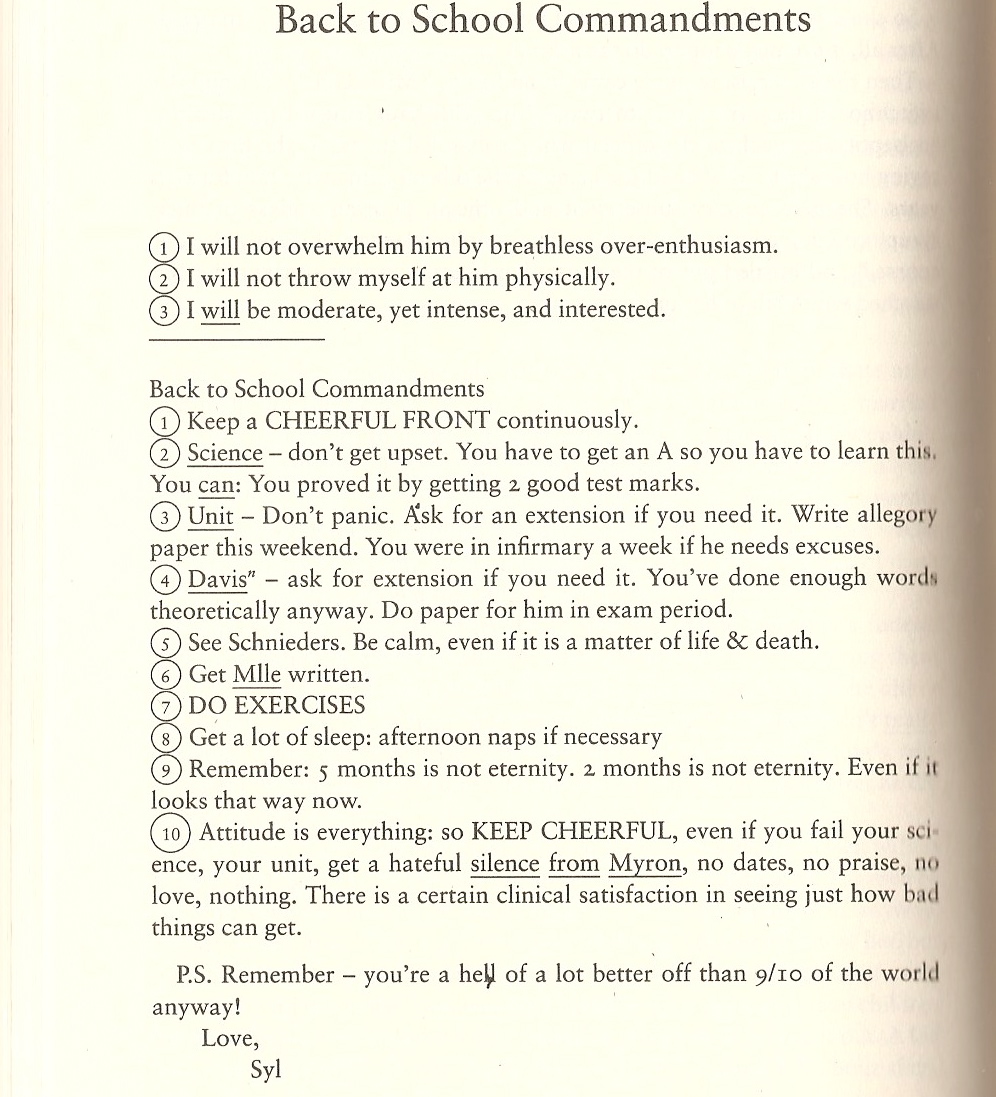
Before her literary fame, her stormy relationship with Ted Hughes and her crippling battles with depression, Sylvia Plath was an enthusiastic student at Smith College. “The world is splitting open at my feet like a ripe, juicy watermelon,” she wrote to her mother. “If only I can work, work, work to justify all of my opportunities.”
During her junior year, she broke her leg on a skiing trip in upstate New York. The accident landed her briefly in the hospital and she wound up with a cast on her leg. Her mood darkened.
Psyching herself out for her return to college, she wrote in her diary a pair of lists.
The first list is a short series of rules about how to behave around her new beau, Myron Lotz. All three points are good advice for anyone who is utterly smitten, particularly number two – “I will not throw myself at him physically.” In the end, Plath’s relationship with Lotz didn’t amount to much. She reportedly commemorated him within her poem “Mad Girl’s Love Song” with the refrain “I think I made you up inside my head.”
The second list is a collection of “Back to School Commandments.” These commandments included asking her English prof Robert Gorham Davis for an extension; consulting with her German teacher Marie Schnieders (“Be calm,” she writes mysteriously, “even it is a matter of life & death.”); and completing her application to be a guest editor for Mademoiselle magazine. (She nailed that last task.)
The list’s final commandment comes off bleaker than the mildly panicky motivational tone of the rest of the list. “Attitude is everything: so KEEP CHEERFUL, even if you fail your science, your unit, get a hateful silence from Myron, no dates, no praise, no love, nothing. There is a certain clinical satisfaction in seeing just how bad things can get.”
Note: An earlier version of this post appeared on our site in 2015.
via The Excellent Lists of Note book
Related Content:
Why Should We Read Sylvia Plath? An Animated Video Makes the Case
Christopher Hitchens Creates a Revised List of The 10 Commandments for the 21st Century
Jonathan Crow is a Los Angeles-based writer and filmmaker whose work has appeared in Yahoo!, The Hollywood Reporter, and other publications. You can follow him at @jonccrow. And check out his blog Veeptopus, featuring lots of pictures of vice presidents with octopuses on their heads. The Veeptopus store is here.
Read More...Support Us
We're hoping to rely on loyal readers, rather than erratic ads. Please click the Donate button and support Open Culture. You can use Paypal, Venmo, Patreon, even Crypto! We thank you!

About Us

Open Culture scours the web for the best educational media. We find the free courses and audio books you need, the language lessons & educational videos you want, and plenty of enlightenment in between.
Advertise With Us

FREE UPDATES!
GET OUR DAILY EMAIL
Get the best cultural and educational resources on the web curated for you in a daily email. We never spam. Unsubscribe at any time.
FOLLOW ON SOCIAL MEDIA

Open Culture editor Dan Colman scours the web for the best educational media. He finds the free courses and audio books you need, the language lessons & movies you want, and plenty of enlightenment in between.
Advertise With Us

