Why Violins Have F‑Holes: The Science & History of the Renaissance Design
Before electronic amplification, instrument makers and musicians had to find newer and better ways to make themselves heard among ensembles and orchestras and above the din of crowds. Many of the acoustic instruments we’re familiar with today—guitars, cellos, violas, etc.—are the result of hundreds of years of experimentation focused on solving just that problem. These hollow wooden resonance chambers amplify the sound of the strings, but that sound must escape, hence the circular sound hole under the strings of an acoustic guitar and the f‑holes on either side of a violin.
I’ve often wondered about this particular shape and assumed it was simply an affected holdover from the Renaissance. While it’s true f‑holes date from the Renaissance, they are much more than ornamental; their design—whether arrived at by accident or by conscious intent—has had remarkable staying power for very good reason.
As acoustician Nicholas Makris and his colleagues at MIT announced in a study published by the Royal Society, a violin’s f‑holes serve as the perfect means of delivering its powerful acoustic sound. F‑holes have “twice the sonic power,” The Economist reports, “of the circular holes of the fithele” (the violin’s 10th century ancestor and origin of the word “fiddle”).
The evolutionary path of this elegant innovation—Clive Thompson at Boing Boing demonstrates with a color-coded chart—takes us from those original round holes, to a half-moon, then to variously-elaborated c‑shapes, and finally to the f‑hole. That slow historical development casts doubt on the theory in the above video, which argues that the 16th-century Amati family of violin makers arrived at the shape by peeling a clementine, perhaps, and placing flat the surface area of the sphere. But it’s an intriguing possibility nonetheless.
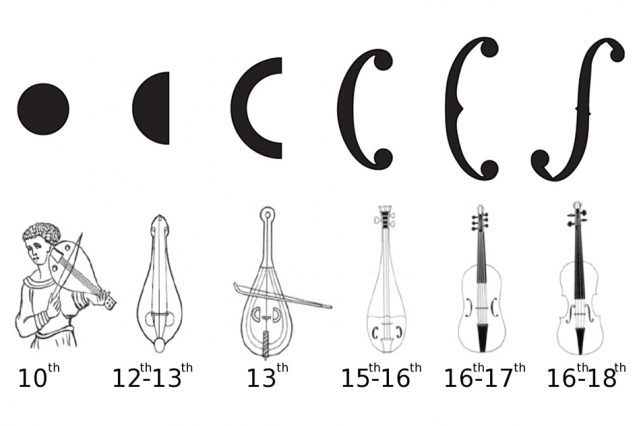
Instead, through an “analysis of 470 instruments… made between 1560 and 1750,” Makris, his co-authors, and violin maker Roman Barnas discovered, writes The Economist, that the “change was gradual—and consistent.” As in biology, so in instrument design: the f‑holes arose from “natural mutation,” writes Jennifer Chu at MIT News, “or in this case, craftsmanship error.” Makers inevitably created imperfect copies of other instruments. Once violin makers like the famed Amati, Stradivari, and Guarneri families arrived at the f‑hole, however, they found they had a superior shape, and “they definitely knew what was a better instrument to replicate,” says Makris. Whether or not those master craftsmen understood the mathematical principles of the f‑hole, we cannot say.
What Makris and his team found is a relationship between “the linear proportionality of conductance” and “sound hole perimeter length.” In other words, the more elongated the sound hole, the more sound can escape from the violin. “What’s more,” Chu adds, “an elongated sound hole takes up little space on the violin, while still producing a full sound—a design that the researchers found to be more power-efficient” than previous sound holes. “Only at the very end of the period” between the 16th and the 18th centuries, The Economist writes, “might a deliberate change have been made” to violin design, “as the holes suddenly get longer.” But it appears that at this point, the evolution of the violin had arrived at an “optimal result.” Attempts in the 19th century to “fiddle further with the f‑holes’ designs actually served to make things worse, and did not endure.”
To read the mathematical demonstrations of the f‑hole’s superior “conductance,” see Makris and his co-authors’ published paper here. And to see how a contemporary violin maker cuts the instrument’s f‑holes, see a careful demonstration in the video above.
Note: An earlier version of this post appeared on our site in 2016.
Related Content:
Josh Jones is a writer and musician based in Durham, NC. Follow him at @jdmagness
Read More...Discover the Mikiphone, the World’s First Portable Record Player: “Fits a Jacket Pocket; Goes into a Lady’s Handbag” (1924)
The iPod shuffle recently enjoyed a bit of a comeback on TikTok.
Can the Mikiphone be far behind?
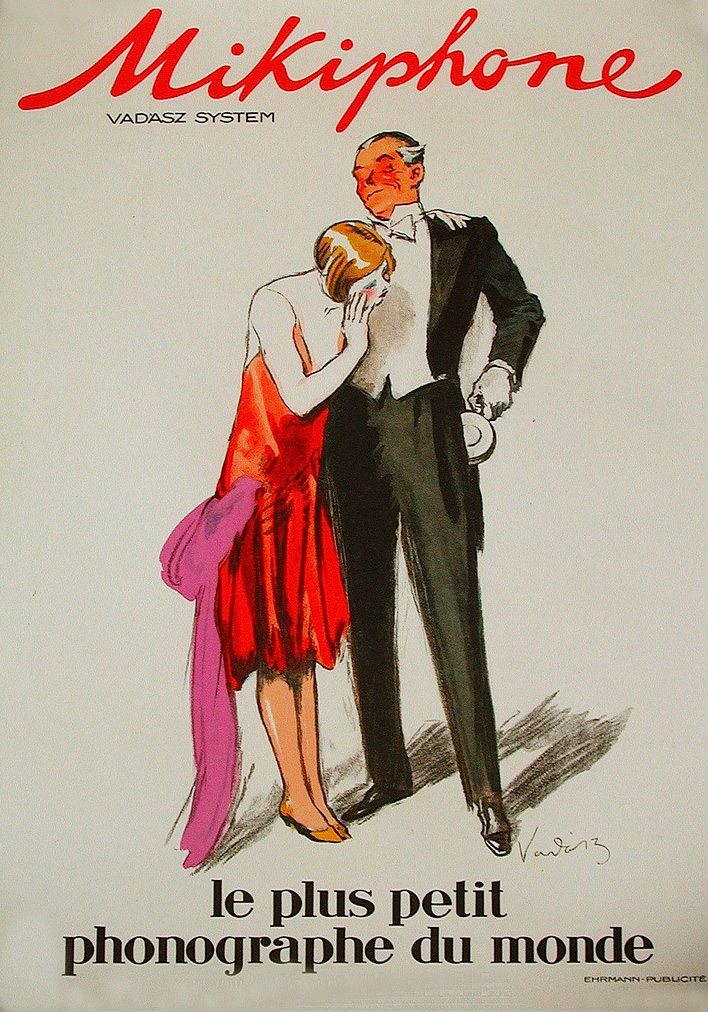
The invention of siblings Miklós and Étienne Vadász, the world’s first pocket record player caused a stir when it was introduced a century ago, nabbing first prize at an international music exhibition and finding favor with modernist architect Le Corbusier, who hailed it for embodying the “essence of the esprit nouveau.”
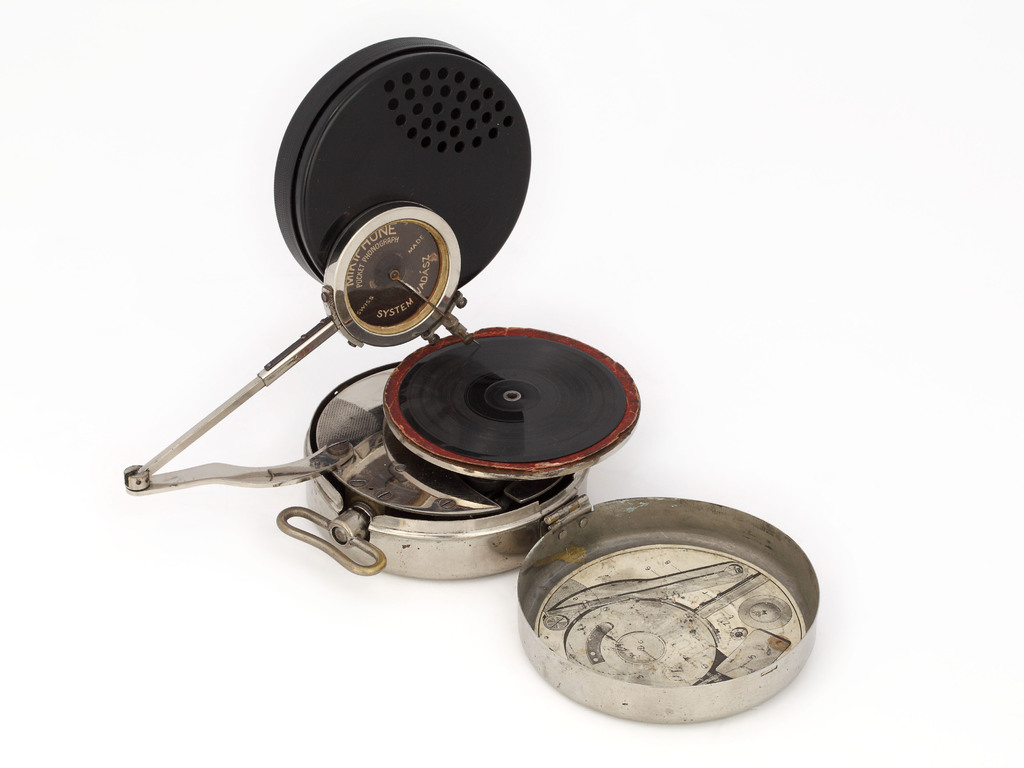
Unlike more recent portable audio innovations, some assembly was required.
It’s fair to assume that the Stanford Archive of Recorded Sound staffer deftly unpacking antique Mikiphone components from its cunning Sony Discman-sized case, above, has more practice putting the thing together than a nervous young fella eager to woo his gal al fresco with his just purchased, cutting edge 1924 technology.
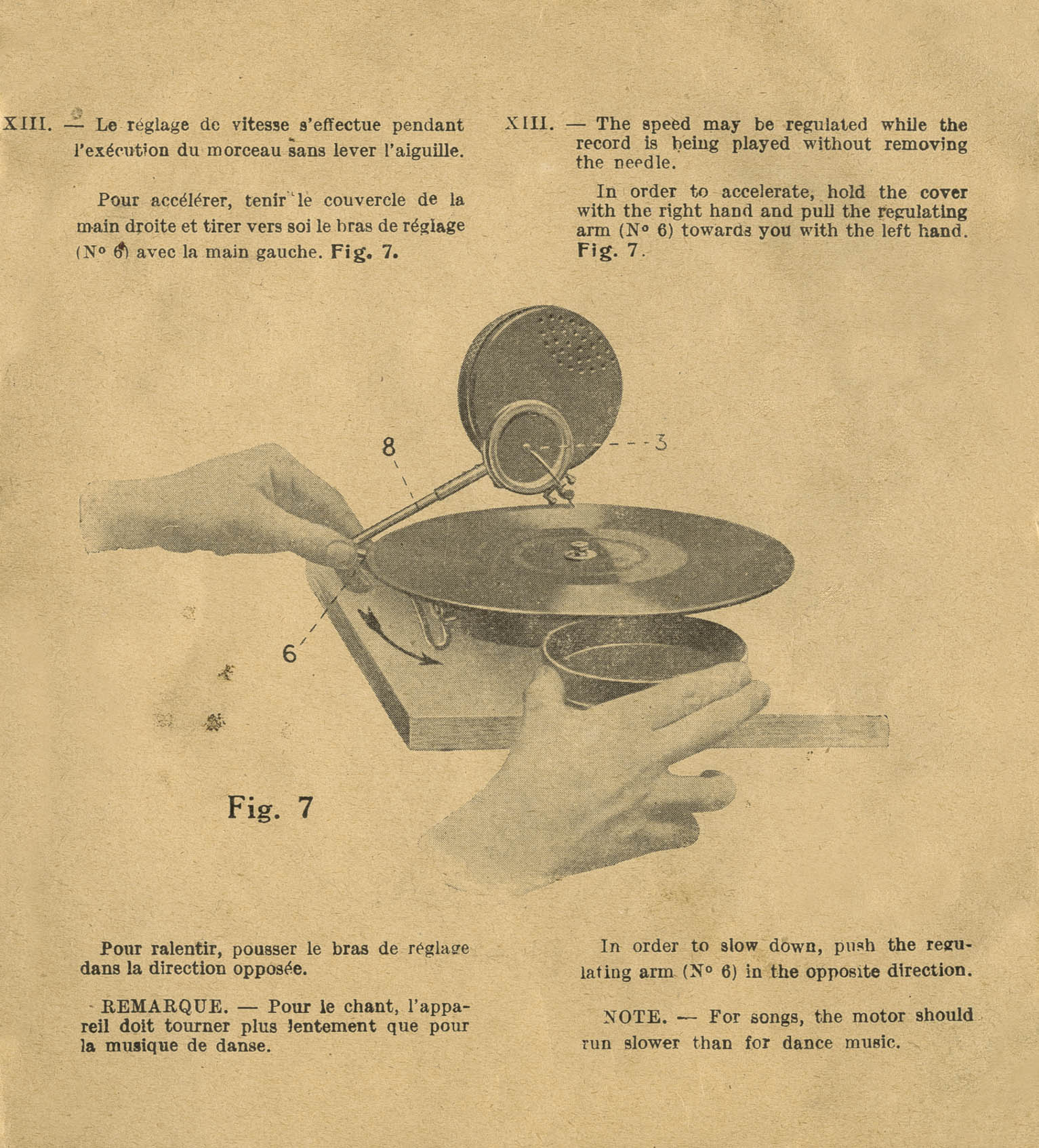
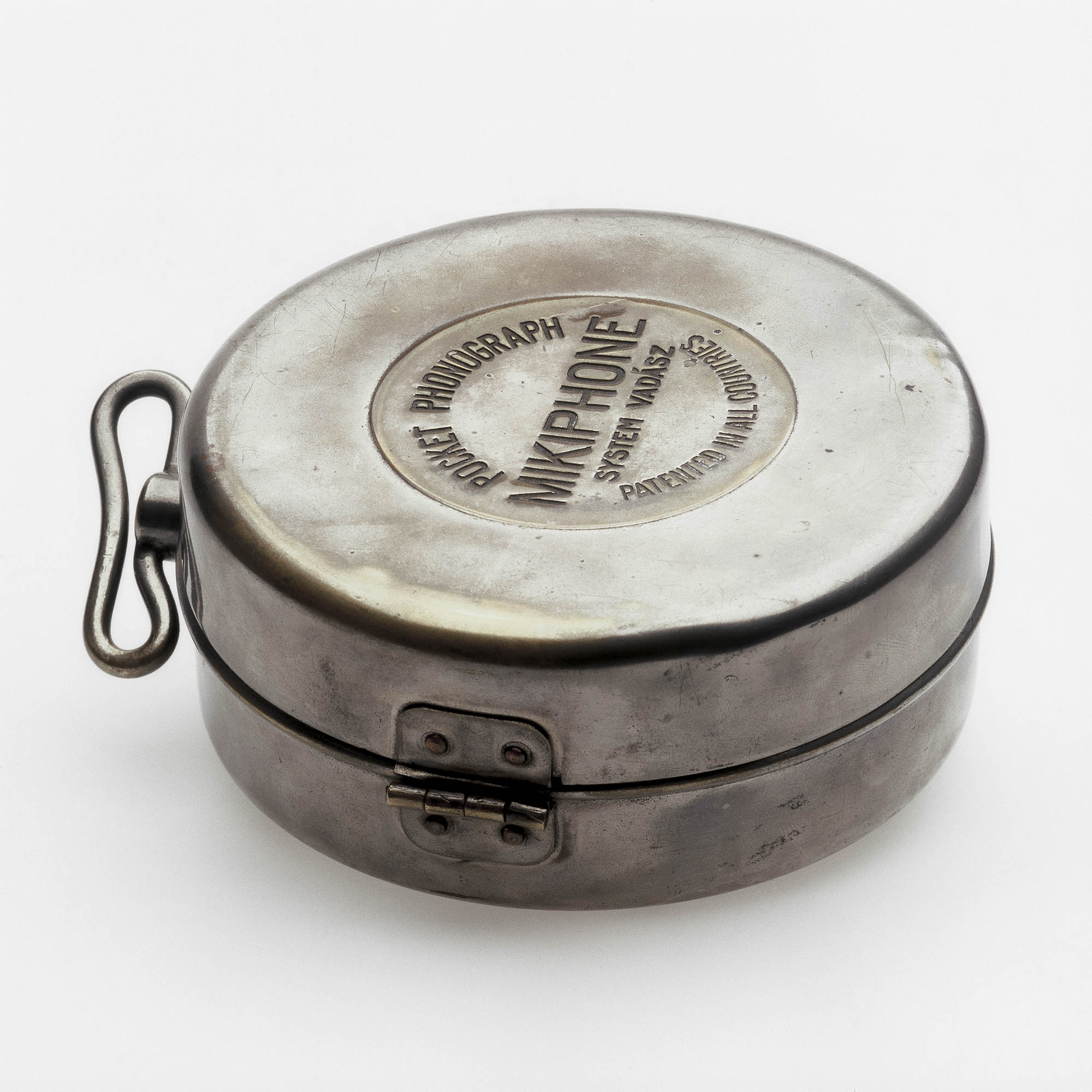
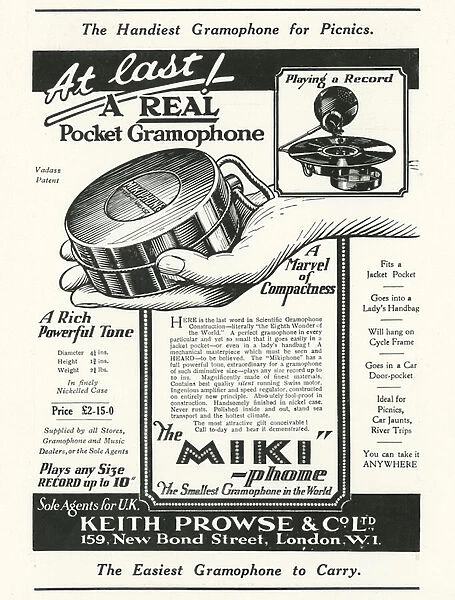
A period advertisement extols the Mikiphone’s portability …
Fits in a jacket pocket
Goes in a lady’s handbag
Will hang on a cycle frame
Goes in a car door pocket
Ideal for picnics, car jaunts, river trips
…but fails to mention that in order to enjoy it, you’d also have to schlep along a fair amount of 78 RPM records, whose 10-inch diameters aren’t nearly so pocket and purse-compatible.
Maison Paillard produced approximately 180,000 of these hand-cranked wonders over the course of three years. When sales dropped in 1927, the remaining stock was sold off at a discount or given away to contest winners.
These days, an authentic Mikphone can fetch $500 and upward at auction. (Beware of Mikiphonies!)
Related Content
Behold the Jacobean Traveling Library: The 17th Century Forerunner to the Kindle
The Walkman Turns 40: See Every Generation of Sony’s Iconic Personal Stereo in One Minute
– Ayun Halliday is the Chief Primatologist of the East Village Inky zine and author, most recently, of Creative, Not Famous: The Small Potato Manifesto and Creative, Not Famous Activity Book. Follow her @AyunHalliday.
Read More...
130+ Photographs of Frank Lloyd Wright’s Masterpiece Fallingwater
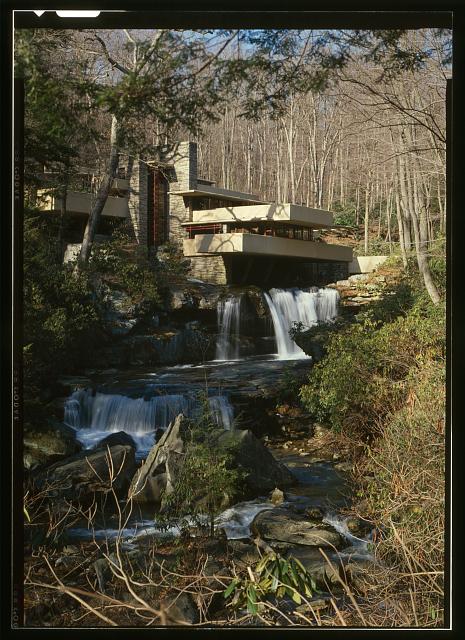
We’ve featured a variety of buildings designed by Frank Lloyd Wright here on Open Culture, from his personal home and studio Taliesin and the Imperial Hotel in Tokyo, to a gas station and a doghouse. But if any single structure explains his enduring reputation as a genius of American architecture, and perhaps the genius of American architecture, it must be the house called Fallingwater.
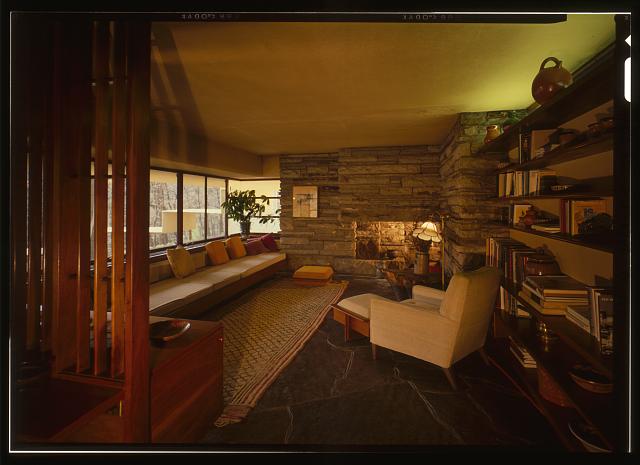
Designed in 1935 for Pittsburgh department-store magnate Edgar J. Kaufmann and his wife Liliane, it sits atop an active waterfall — not below it as Kaufmann had originally requested, to name just one of the disagreements that arose between client and architect throughout the process.
In the event, Wright had his way as far as the positioning of the house on the site, as with much else about the project — and so much the better for its stature in the history of architecture, which has only risen since completion 85 years ago.
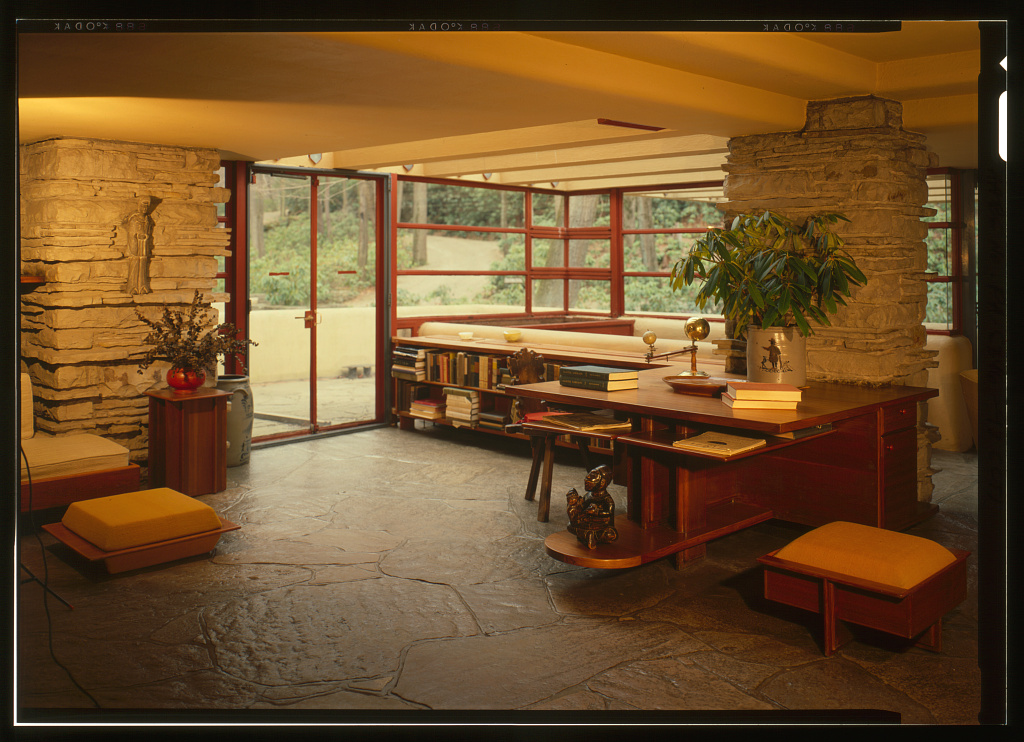
Inspired by the Kaufmann’s love of the outdoors, as well as his own appreciation for Japanese architecture, Wright employed techniques to integrate Fallingwater’s spaces with one another, as well as with the surrounding nature. Time magazine wasted no time, as it were, declaring the result Wright’s “most beautiful job”; more recently, it’s received high praise from no less a master Japanese architect than Tadao Ando.
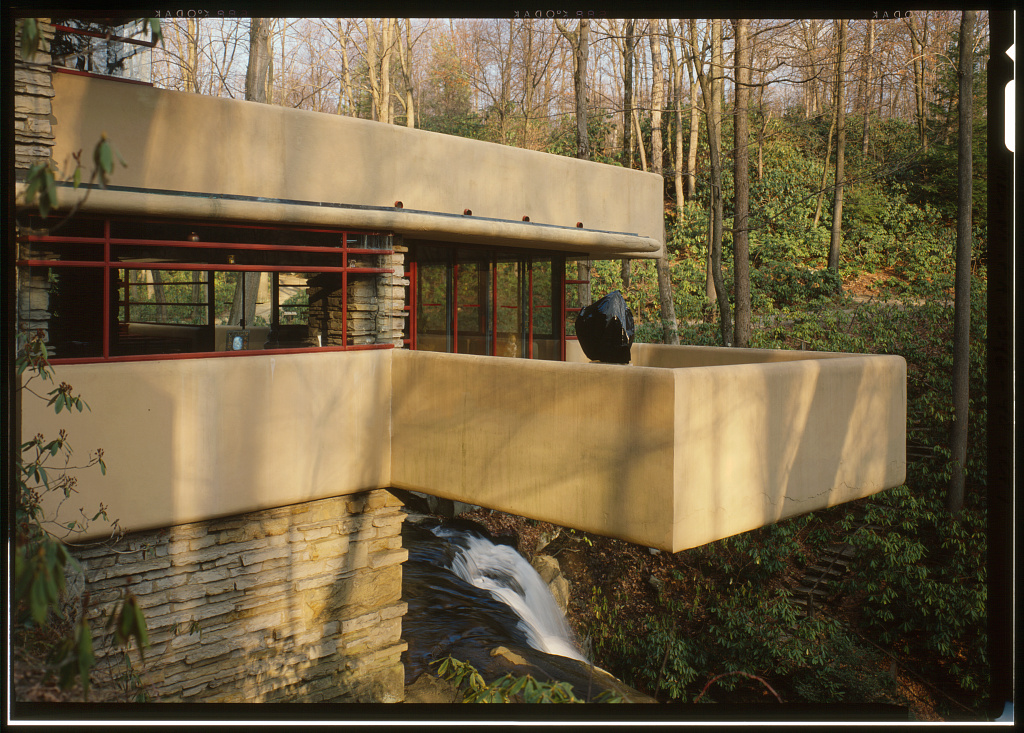
When he visited Fallingwater, Ando experienced first-hand a use of space similar to that which he knew from the built environment of his homeland, and also how the house lets in the sounds of nature. Though such a pilgrimage can greatly expand one’s appreciation of the house, rare is the viewer who fails to be enraptured by pictures alone.
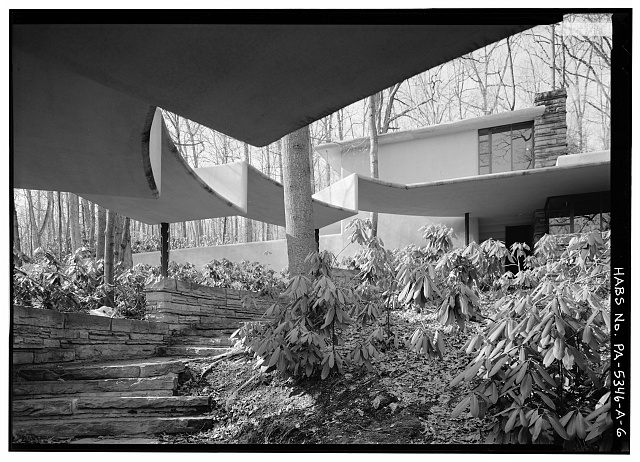
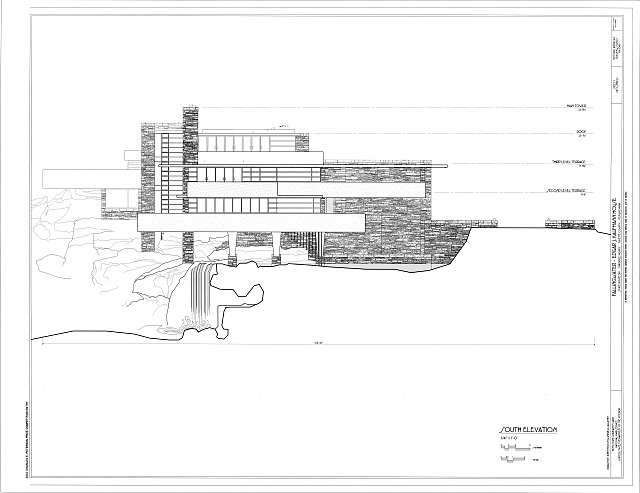
Nearly as astute in the realm of publicity as in that of architecture, Wright would have known that Fallingwater had to photograph well, a quality vividly on display in this archive of 137 high-resolution images at the Library of Congress. From it, you can download color and black-and-white photos of the house’s exterior and interior as well as its plans, which — so the story goes — Wright originally drew up in just two hours after months of inaction. Fallingwater thus stands as not just concrete proof of once-brazen architectural notions, but also vindication for procrastinators everywhere.
Related content:
An Animated Tour of Fallingwater, One of Frank Lloyd Wright’s Finest Creations
What It’s Like to Work in Frank Lloyd Wright’s Iconic Office Building
What Frank Lloyd Wright’s Unusual Windows Tell Us About His Architectural Genius
1,300 Photos of Famous Modern American Homes Now Online, Courtesy of USC
Based in Seoul, Colin Marshall writes and broadcasts on cities, language, and culture. His projects include the Substack newsletter Books on Cities, the book The Stateless City: a Walk through 21st-Century Los Angeles and the video series The City in Cinema. Follow him on Twitter at @colinmarshall or on Facebook.
Read More...Astronomers Create a Digital Atlas of Over 380,000 Galaxies
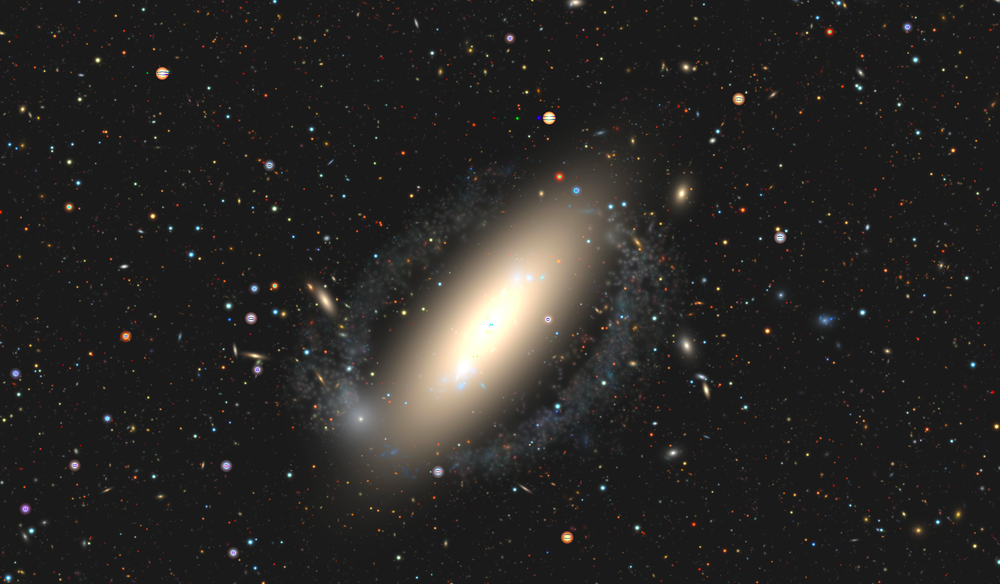
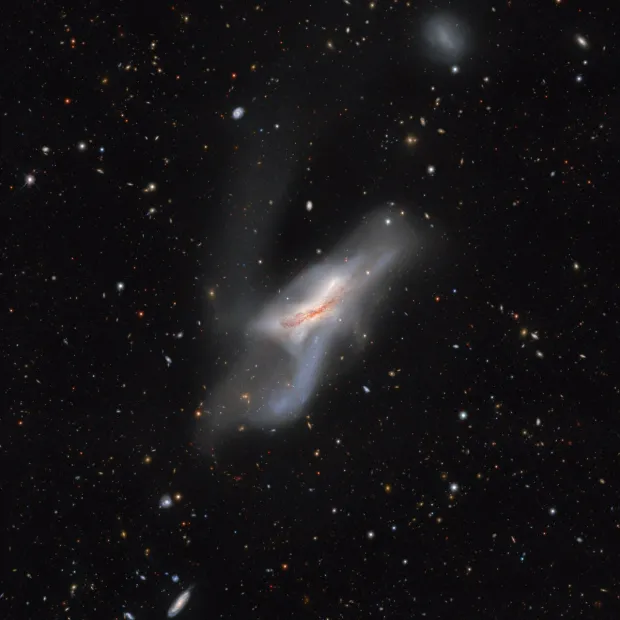
In the observable universe, there are estimated to be between 200 billion to two trillion galaxies. By comparison to these super-Saganian numbers, the 383,620 galaxies captured by the Siena Galaxy Atlas may seem like small potatoes. But the SGA actually represents a landmark achievement among digital astronomy catalogs: as Samantha Hill writes in Astronomy, it draws its data from three Dark Energy Spectroscopic Instrument Legacy Surveys, which together constitute “one of the largest surveys ever conducted.” Coming to 7,637 downloadable pages, it “presents a new possible naming convention for the galaxies, and captures images of the objects in optical and infrared wavelengths. Each of the target’s data set includes a whole slew of other information including its size and morphology.”

Though publicly accessible online, the formidably technical SGA may present the non-astronomer with a somewhat steep learning curve. One way to approach the archive through some of the especially impressive galaxies it captures is to organize the list below its search filters according to size. The images that result are not, of course, photographs of the kind any of us could take by pointing a camera up at the night sky, no matter how pricey the camera. Rather, they’re the results, processed into visual legibility, of enormous amounts of data collected by advanced telescope and satellite.
To get more technical, the SGA is also “the first cosmic atlas to feature the light profiles of galaxies — a curve that describes how the brightness of the galaxy changes from its brightest point, usually at the center, to its dimmest, commonly at its edge.”

So writes Space.com’s Robert Lea, who also explains more about the SGA’s usefulness to scientific professionals. It “represents peak accuracy, promising to be a gold mine of galactic information for scientists aiming to investigate everything from the births and evolutions of galaxies to the distribution of dark matter and propagation of gravitational waves through space.” Its data could also help astronomers “find the sources of gravitational wave signals detected on Earth, because these faint ripples in the very fabric of space and time wash over our planet after traveling for millions of light years.” Even if you’re undertaking no such searches of your own, a trip through the SGA can still enhance your appreciation of how much humanity has come to learn about these “nearby” galaxies — and how much remains to be learned about all those that lie beyond. Enter the archive here.
Related content:
What Would It Be Like to Fly Through the Universe?
Lux Aeterna: A Journey of Light, From Distant Galaxies to Small Drops of Water
Based in Seoul, Colin Marshall writes and broadcasts on cities, language, and culture. His projects include the Substack newsletter Books on Cities, the book The Stateless City: a Walk through 21st-Century Los Angeles and the video series The City in Cinema. Follow him on Twitter at @colinmarshall or on Facebook.
Read More...Political Scientist Ian Bremmer Breaks Down the Israeli-Palestinian Conflict
Ian Bremmer, a political scientist and president of Eurasia Group, has an intelligent, fair, and humane way of explaining crises around the world. That includes the current crisis in the Middle East. Above, he spends an hour discussing the Israeli-Palestinian conflict and its geo-political and historical context. Speaking with BigThink’s editor-in-chief, Robert Chapman-Smith, Bremmer delves “into internal politics in Israel — including growing dissent against the government, how the conflict in Gaza is being handled, the influence of hard-right political parties, and the impact of these factors on the relationship between Israel and the Palestinians.” Below you can find timestamps for the different subjects covered.
0:00 Palestinians forgotten
6:30 Israel’s domestic instability
13:17 Israel and Gulf states
19:28 Hamas’ strategy
27:06 Social media disinformation
37:20 Israel’s strategy and peace
44:40 U.S. support for Israel
49:32 World War 3?
54:07 Two-state solution
Related Content
Read More...Watch the Trailer for the Long-Lost First Film Adaptation of The Great Gatsby (1926)
Despite being a perennial contender for the title of the Great American Novel, F. Scott Fitzgerald’s The Great Gatsby has eluded a wholly satisfying cinematic adaptation. The most recent such attempt, now a decade old, was primarily a Baz Lurhmann kitsch extravaganza showcasing Leonardo DiCaprio; nor did its predecessors, which put in the title role such classic leading men as Robert Redford and Alan Ladd, ever distinguish themselves in an enduring way. But these pictures all met with happier fates than the very first Gatsby film, which came out in 1926 — just a year and a half after the novel itself — and seems not to have been seen since.
The first actor to portray Jay Gatsby on the silver screen was Warner Baxter, who would become the highest-paid star in Hollywood a decade later (and a fixture of Westerns, crime serials, and other B‑movie genres half a decade after that). In the role of Daisy Buchanan was Lois Wilson, an Alabama beauty queen turned all-American silent-era starlet (who would later turn director); in that of Nick Carraway, Neil Hamilton, whom television audiences of the nineteen-sixties would come to know as Batman’s Commissioner Gordon. But none of The Great Gatsby’s casting choices will please the old-Hollywood connoisseur as much as that of a young, pre-Thin Man William Powell as George Wilson.
“The reckless driving that results in the death of Myrtle Wilson serves to bring out a sterling trait in Gatsby’s character,” New York Times critic Mourdaunt Hall wrote (in 1926) of a memorable scene in the novel that seems to have become a memorable scene in the film. “Powell, while not quite in his element, gives an unerring portrayal of the chauffeur.” Though Hall pronounced The Great Gatsby “quite a good entertainment” on the whole, he also pointed out that “it would have benefited by more imaginative direction” from Herbert Brenon, who “has succumbed to a number of ordinary movie flashes without inculcating much in the way of subtlety.”
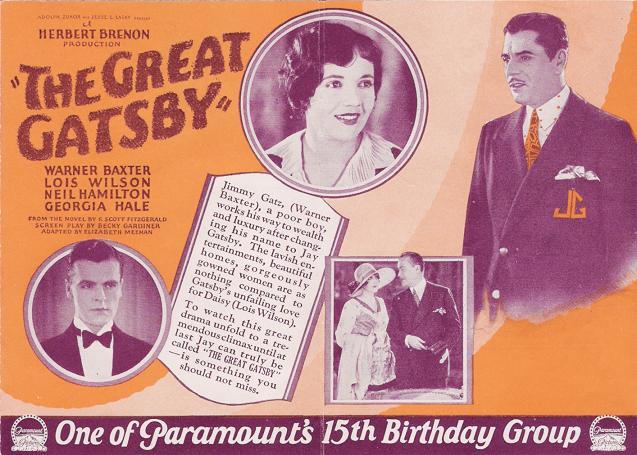
For Brenon, a prolific auteur who directed no fewer than five pictures that year, this criticism could only have stung so much. But as later came to light, F. Scott and Zelda Fitzgerald judged this first adaptation of the novel much more harshly. “We saw The Great Gatsby in the movies,” Zelda wrote to their daughter Scottie. “It’s ROTTEN and awful and terrible and we left.” Only its trailer survives today, and the glimpses it offers give little indication of what, exactly, would have spurred them to walk out. But now that the original Great Gatsby has entered the public domain, any of us could try our hand at making an adaptation without having to shell out for the rights. Maybe our interpretations wouldn’t please the Fitzgeralds either, but then, what ever did?
Related content:
Free: The Great Gatsby & Other Major Works by F. Scott Fitzgerald
Gertrude Stein Sends a “Review” of The Great Gatsby to F. Scott Fitzgerald (1925)
83 Years of Great Gatsby Book Cover Designs: A Photo Gallery
The Great Gatsby Is Now in the Public Domain and There’s a New Graphic Novel
Haruki Murakami Translates The Great Gatsby, the Novel That Influenced Him Most
Revealed: The Visual Effects Behind The Great Gatsby
Based in Seoul, Colin Marshall writes and broadcasts on cities, language, and culture. His projects include the Substack newsletter Books on Cities, the book The Stateless City: a Walk through 21st-Century Los Angeles and the video series The City in Cinema. Follow him on Twitter at @colinmarshall or on Facebook.
Read More...The Making of the Last Beatles Song, “Now and Then”: A Short Film
During the pandemic, Peter Jackson’s documentary, Get Back, used cutting-edge software to restore footage from the Beatles’ Let It Be recording sessions. If you watched the film, you know it was magic. Now, his technology offers us another gift–the final Beatles song.
As the short film explains above, the making of the song, “Now and Then,” began in 1995, when Paul, George and Ringo started working with a demo recorded by John Lennon during the 1970s. The project eventually stalled out when the trio couldn’t pristinely extract Lennon’s vocals. Then George Harrison died, and another two decades slipped by. Last year, Jackson’s software salvaged the project, allowing the Beatles to capture the elusive Lennon vocal and complete their final song. “Now and Then” is set to be released on November 3, accompanied by a music video created by Jackson himself. Stay tuned for that.
If you would like to support the mission of Open Culture, consider making a donation to our site. It’s hard to rely 100% on ads, and your contributions will help us continue providing the best free cultural and educational materials to learners everywhere. You can contribute through PayPal, Patreon, and Venmo (@openculture). Thanks!
Related Content
Watch Paul McCartney Compose The Beatles Classic “Get Back” Out of Thin Air (1969)
A Sneak Peek of Peter Jackson’s New Beatles Documentary Get Back: Watch the New Trailer
Read More...
Animated: The Rise & Fall of the Largest Cities in the World, from 3,000 BC to the 2020s
This is the first era of human history when more of us live in cities than not. That’s what we’ve often been told in recent years, at least, though the specifics do depend on what kinds of urbanized areas you count as proper cities. Still, this would seem to mark an important inflection point in human history, the past five millennia of which has also been the history of great cities rising and falling, in absolute terms but also relative to one another in size, power, and influence. You can see this animated in the video above from cartographical-historical Youtuber Ollie Bye, previously featured here on Open Culture for his visualizations of the history of London, of the British Empire, and of the entire world.
Here, Bye charts the largest cities in the world between the year 3000 BC and today, indicating their size on the map while also ranking them on an ever-changing leaderboard below. Out front in the very beginning was Uruk, capital of the Mesopotamian cradle of civilization (and a prominent location in the Epic of Gilgamesh).
A thousand years later, it was the Egyptian capital of Thebes; a thousand years after that, it was the later Egyptian capital of Alexandria. From that point on, the shuffle at the bottom of the screen grows more and more rapid: the title of largest city in the world is lost by Constantinople to Ctesiphon; by Lin’an, briefly, to Cairo, and then to Hangzhou; by London to New York.
It was in the nineteen-fifties that Tokyo — a city left in shambles by the Second World War a decade earlier — overtook New York for the top spot. There it has remained ever since, seeing off such different challengers in different eras as Osaka, Mexico City, and New Delhi. When Bye’s animation leaves off, in 2021, that last has a population of 31.1 million against Tokyo’s 37.3 million. Whether the Japanese capital has proportionately more power or influence in the world today than Beijing, São Paulo, or Los Angeles is, of course, a separate and less objective question. But no visitor to Tokyo can deny that it must have achieved something like the pinnacle of urban civilization per se — and has somehow kept the rents reasonable to boot.
Related content:
Timelapse Animation Lets You See the Rise of Cities Across the Globe, from 3700 BC to 2000 AD
The Entire History of the British Isles Animated: 42,000 BCE to Today
The History of the World in One Video: Every Year from 200,000 BCE to Today
A Wonderful Archive of Historic Transit Maps: Expressive Art Meets Precise Graphic Design
Based in Seoul, Colin Marshall writes and broadcasts on cities, language, and culture. His projects include the Substack newsletter Books on Cities, the book The Stateless City: a Walk through 21st-Century Los Angeles and the video series The City in Cinema. Follow him on Twitter at @colinmarshall or on Facebook.
Read More...Hear Classic Readings of Poe’s “The Raven” by Vincent Price, James Earl Jones, Christopher Walken, Neil Gaiman & More
It can seem that the writing of literature and the theory of literature occupy separate great houses, Game of Thrones-style, or even separate countries held apart by a great sea. Perhaps they war with each other, perhaps they studiously ignore each other or obliquely interact at tournaments with acronymic names like MLA and AWP. Like Thomas Pynchon’s characterization of the political right and left, scholars and writers represent opposing poles, the hothouse and the street. That rare beast, the academic poet, can seem like something of a unicorn, or dragon.
…Or like the ominous talking raven in Edgar Allan Poe’s most famous of poems.
The divide between theory and practice is a recent development, a product of state budgeting, political brinksmanship, the relentless publishing mills of academia that force scholars to find a pigeonhole and stay there.… In days past, poets and scholar/theorists frequently occupied the same place at the same time—Wallace Stevens, T.S. Eliot, Samuel Taylor Coleridge, Percy Shelley, and, of course, Poe, whose perennially popular “The Raven” serves as a point-by-point illustration for his theory of composition just as thoroughly as Eliot’s great works bear out his notion of the “objective correlative.”
Poe’s object, the titular creature, is an “archetypal symbol,” writes Dana Gioia, in a poem that aims for what its author calls a “unity of effect.” In his 1846 essay “The Philosophy of Composition,” Poe the poet/theorist tells us in great detail how “The Raven” satisfies all of his other criteria for literature as well, such as achieving its intent in a single sitting, using a repeated refrain, and so on.
Should we have any doubt about how much Poe wanted us to see the poem as the deliberate outcome of a conceptual scheme, we find him three years later, in 1849, the year of his death, delivering a lecture on the “Poetic Principle,” and concluding with a reading of “The Raven.”
John Moncure Daniel of the Richmond Semi-Weekly Examiner remarked after attending one of these talks that “the attention of many in this city is now directed to this singular performance.” At that point, Poe, who hardly made a dime from “The Raven,” had to suffer the indignity of having all of his work go out of print during his brief, unhappy lifetime. Moncure and the Examiner thereby furnished readers “with the only correct copy ever published,” previous appearances, it seems, having contained punctuation errors.
Nonetheless, for all of Poe’s pedantry and penury, “The Raven“ ‘s first appearances made him semi-famous. His readings were a sensation, and it’s a sure bet that his audiences came to hear him read the poem, not deliver a lecture on its principles. Oh, for some proto-Edison in the room with an early recording device. What would it be like to hear the mournful, grief-stricken, alcoholic genius—master of the macabre and inventor of the detective story—intone the raven’s enigmatic “Nevermore”?
While Poe’s speaking voice has receded irretrievably into history, his poetic voice may live close to forever. So mesmerizing are his meter and diction that many great actors known especially for their voices have become possessed by “The Raven.”
Likely when we think of the poem, what first comes to the mind’s ear is the voice of Vincent Price, or James Earl Jones, Christopher Lee, or Christopher Walken, all of whom have given “The Raven” its due.
And so have many other notables, such as the great Stan Lee, Poe successor Neil Gaiman, original Gomez Addams actor John Astin, and venerable Beat poet/scholar Anne Waldman (listen here). You will find those recitations here at this round-up of notable “Raven” readings, and if this somehow doesn’t satiate you, then check out Lou Reed’s take on the poem, the Grateful Dead’s musical tribute, “Raven Space,” or a reading in 100 different celebrity impressions.
Finally, we would be remiss not to mention The Simpsons’ James Earl Jones-narrated parody, a worthy teaching tool for distracted young visual learners. Is it a shame that we now think of “The Raven” as a Halloween yarn fit for the Treehouse of Horror or any number of enjoyable exercises in spooky oratory—rather than the theoretical thought experiment its author seemed to intend? Does Poe rotisserie in his grave as Homer snores in a wingback chair? Probably. But as the author told us himself at length, the poem works! It still never fails to excite our morbid curiosity, enchant our gothic sensibility, and maybe send a chill or two down the spine. Maybe we never really needed Poe to explain it to us.
Note: An earlier version of this post appeared on our site in 2017. We’re bringing it back for Halloween.
Related Content:
Gustave Doré’s Splendid Illustrations of Edgar Allan Poe’s “The Raven” (1884)
The Raven: a Pop-up Book Brings Edgar Allan Poe’s Classic Supernatural Poem to 3D Paper Life
A Reading of Edgar Allan Poe’s “The Raven” in 100 Celebrity Voices
Josh Jones is a writer and musician based in Durham, NC. Follow him at @jdmagness
Read More...Jerry Garcia Explains How Abbott and Costello Meet Frankenstein Changed His Life (1995)
If you’re looking for a classic monster movie to watch this Halloween, and one that will also give you a few non-ironic laughs along the way, you’d do well to put on Abbott and Costello Meet Frankenstein. But don’t take this recommendation from me: take it from the Grateful Dead’s own Jerry Garcia, who recalls his own formative viewing experience in the clip above from a 1995 broadcast of AMC’s The Movie that Changed My Life. When Abbott and Costello Meet Frankenstein came out, in 1948, he was just six years old: too tender an age, it seems, to appreciate the monstrous spectacle to which his mother had taken him. “I mostly hid behind the seats,” he remembers. “It was just pure panic.”
Unaware even of who Abbott and Costello were, the young Garcia could hardly have perceived the outwardly horrific picture’s lighthearted comic intentions. Yet it compelled him nevertheless, and even resonated with him on other emotional levels not having to do with fear.
“My father had died the previous year, in ’47, so that also made it kind of a heavy time in my life, emotionally,” he says, and one that perhaps gave him a certain receptiveness to the notion of “a dead thing brought to life.” Abbott and Costello Meet Frankenstein features not just the titular doctor’s monster, played by Glenn Strange, but also Lon Chaney Jr. as the Wolf Man and Bela Lugosi as Dracula. “This was a juicy cast, and it was the last time these characters had dignity.”
For Garcia, these Hollywood monsters “became figures of tremendous fascination,” which led him to discover cultural movements like German expressionist theater and film. While they cast a spell of primal fear — “I think there was some desire on my part to embrace that, to not let that control me” — Abbott and Costello, for their part, suggested to him the great promise of comedy: “It’s a smart strategy to get by in life. If you’re not powerful, if you’re not huge, if you’re not muscular, if intimidation is too much work for you, it works good at disarming powerful adversaries.” Garcia’s “general fascination with the bizarre” also originated with Abbott and Costello Meet Frankenstein, which showed him that “there are things in this world that are really weird” — a fact of which we could all stand to remind ourselves each and every Halloween.
Related content:
Bela Lugosi Discusses His Drug Habit as He Leaves the Hospital in 1955
Stream a Massive Archive of Grateful Dead Concerts from 1965–1995
Based in Seoul, Colin Marshall writes and broadcasts on cities, language, and culture. His projects include the Substack newsletter Books on Cities, the book The Stateless City: a Walk through 21st-Century Los Angeles and the video series The City in Cinema. Follow him on Twitter at @colinmarshall or on Facebook.
Read More...Support Us
We're hoping to rely on loyal readers, rather than erratic ads. Please click the Donate button and support Open Culture. You can use Paypal, Venmo, Patreon, even Crypto! We thank you!

About Us

Open Culture scours the web for the best educational media. We find the free courses and audio books you need, the language lessons & educational videos you want, and plenty of enlightenment in between.
Advertise With Us

FREE UPDATES!
GET OUR DAILY EMAIL
Get the best cultural and educational resources on the web curated for you in a daily email. We never spam. Unsubscribe at any time.
FOLLOW ON SOCIAL MEDIA

Open Culture editor Dan Colman scours the web for the best educational media. He finds the free courses and audio books you need, the language lessons & movies you want, and plenty of enlightenment in between.
Advertise With Us

