Why Frank Lloyd Wright Designed a Gas Station in Minnesota (1958)
In the small town of Cloquet, Minnesota stands a piece of urban utopia. It takes the surprising form of a gas station, albeit one designed by no less a visionary of American architecture than Frank Lloyd Wright. He originally conceived it as an element of Broadacre City, a form of mechanized rural settlement intended as a Jeffersonian democracy-inspired rebuke against what Wright saw as the evils of the overgrown twentieth century city, first publicly presented in his 1932 book The Disappearing City. “That’s an aspirational title,” says architectural historian Richard Kronick in the Twin Cities PBS video above. “He thought that cities should go away.”
Cities didn’t go away, and Broadacre City remained speculative, though Wright did pursue every opportunity he could identify to bring it closer to reality. “In 1952, Ray and Emma Lindholm commissioned Frank Lloyd Wright to build them a home on the south side of Cloquet,” writes photographer Susan Tregoning.
When Wright “discovered that Mr. Lindholm was in the petroleum business, he mentioned that he was quite interested in gas station design.” When Lindholm decided to rebuild a Phillips 66 station a few years later, he accepted Wright’s design proposal, calling it “an experiment to see if a little beauty couldn’t be incorporated in something as commonplace as a service station” — though Wright himself, characteristically, wasn’t thinking in quite such humble terms.
Wright’s R. W. Lindholm Service Station incorporates a cantilevered upper-level “customer lounge,” and the idea, as Kronick puts it, “was that customers would sit up here and while their time away waiting for their cars to be repaired,” and no doubt “discuss the issues of the day.” In Wright’s mind, “this little room is where the details of democracy would be worked out.” As with Southdale Center, Victor Gruen’s pioneering shopping mall that had opened two years earlier in Minneapolis, two hours south of Cloquet, the community aspect of the design never came to fruition: though its windows offer a distinctively American (or to use Wright’s language, Usonian) vista, the customer lounge has a bare, disused look in the pictures visitors take today.

Image by Library of Congress, via Wikimedia Commons
There are many such visitors, who arrive from not just all around the country but all around the world. But when it was last sold in 2018, the buyer it found was relatively local: Minnesota-born Andrew Volna, owner of such Minneapolis operations as vinyl-record manufacturer Noiseland Industries and the once-abandoned, now-renovated Hollywood Theater. “Wright saw the station as a cultural center, somewhere to meet a friend, get your car fixed, and have a cup of coffee while you waited,” writes Tregoning, though he never did make it back out to the finished building before he died in 1959. These sixty-odd years later, perhaps Volna will be the one to turn this unlikely architectural hot spot into an even less likely social one as well.
Related content:
Frank Lloyd Wright Designs an Urban Utopia: See His Hand-Drawn Sketches of Broadacre City (1932)
How Frank Lloyd Wright’s Son Invented Lincoln Logs, “America’s National Toy” (1916)
The Modernist Gas Stations of Frank Lloyd Wright and Mies van der Rohe
When Frank Lloyd Wright Designed a Doghouse, His Smallest Architectural Creation (1956)
Based in Seoul, Colin Marshall writes and broadcasts on cities, language, and culture. His projects include the Substack newsletter Books on Cities, the book The Stateless City: a Walk through 21st-Century Los Angeles and the video series The City in Cinema. Follow him on Twitter at @colinmarshall or on Facebook.
Read More...The 500-Year-Old Chinese “Bagel” That Helped Win a War
As a general rule, you can gain a decent understanding of any part of the world by eating its regional specialties. This holds especially true in a country like China, with its great size and deep history. Travel to the southeastern province of Fujian, for instance, and you’ve got to try guang bing or “shiny biscuit,” the Chinese equivalent of the bagel. “With flour, dietary alkali and salt, the cake, no bigger than a palm, can be simply cooked, and sells for about 1 yuan ($0.14) on the streets,” says China Daily. “Locals love it, not only because of the crispy and salty taste, but also because of a legendary story.”
The distinctive dishes of border or coastal areas always seem to have particularly intriguing histories, and so it is with the one behind Fujian’s guang bing. “During the Ming Dynasty (1368–1644), General Qi Jiguang brought an army to fight Japanese invaders in Fujian. Because of continuous rain, they could not cook for the soldiers, so Qi created a kind of cake with a small hole in the middle. Soldiers could string the cakes together and carry them while fighting the enemy.”
The result looks — and presumably tastes — like a necklace of bagels, the preparation of which could be accomplished in underground ovens that didn’t give away the soldiers’ position as clearly as open campfires would.
You can learn more about this bagel-powered victory of five centuries ago from the Great Big Story video at the top of the post, and more about the continued preparation and sale of guang bing by a few dedicated bakers in the Atlas Obscura video just above. Though plenty of Fujianese take them straight, “some like to add pork, or dried shrimp and Chinese chives in it; some fry it with chitterlings, duck’s gizzard or green been; and some break it into pieces and boil it with soup.” Written records of the bagel as Westerners know it date back to early seventeenth-century Poland, with apparent predecessors seen in that country as early as the late fourteenth century. It may naturally occur to an American traveler in China to unite these two long but distant culinary traditions, in which case he’d do well to pack his own with lox and cream cheese.
Related content:
A Brief History of Dumplings: An Animated Introduction
When Italian Futurists Declared War on Pasta (1930)
Bob Dylan Potato Chips, Anyone?: What They’re Snacking on in China
Philosophy Explained with Donuts
Based in Seoul, Colin Marshall writes and broadcasts on cities, language, and culture. His projects include the Substack newsletter Books on Cities, the book The Stateless City: a Walk through 21st-Century Los Angeles and the video series The City in Cinema. Follow him on Twitter at @colinmarshall or on Facebook.
Read More...Why the Leaning Tower of Pisa Still Hasn’t Fallen Over, Even After 650 Years
The Leaning Tower of Pisa has stood, in its distinctive fashion, for six and a half centuries now. But it hasn’t always leaned at the same angle: to get the most dramatic view, the best time to go see it was the early nineteen-nineties, when its tilt had reached a full 5.5 degrees. Granted, at that point — when by some reckonings, the tower should no longer have been standing at all — it was closed to the public, presumably due to fears that the sheer weight of tourism would push it over the tipping point. The 1989 collapse of Pavia’s eleventh-century Civic Tower also had something to do with it: couldn’t something be done to spare Pisa’s world-famous landmark from a similar fate?
Attempts to shore up the Leaning Tower up to that point had a checkered history, to put it mildly. Built on soft soil, it started to lean in back in the twelfth century, before its construction was even complete. The process of that construction, in the event, took nearly 200 years to complete; during one decades-long pause during a particularly embattled period for the Republic of Pisa, the tower actually settled enough to prevent its later collapse, though it remained aslant. In the late thirteenth century, the best solution available for this condition was simply to build the rest of its floors in a curved shape in compensation.
For centuries after, the sight of the Leaning Tower tempted generations of structural engineers to straighten it out. It even tempted non-engineers like Benito Mussolini, who in 1934 ordered large amounts of concrete pumped into its foundation. Like most such operations, it only made the tower lean more; only in the second half of the twentieth century did the technology come along to analyze its foundations and the soil in which they were embedded clearly enough to devise an effective solution. This ended up involving the removal of soil with a slanted drill from under the tower’s higher end, which eventually brought it back to lean about four degrees, as it did nearly two centuries ago. After subsequent stabilization work, it was guaranteed to remain upright for at least another two centuries.
You can learn more about the construction and re-engineering of the Leaning Tower in the videos above from TED-Ed and Discovery UK. But you may still ask, why was it never brought down by an earthquake? “It turns out that the squishy soil at the structure’s base that caused its fetching infirmity – the tower was tilting by the time its second story was built in 1178 – contains the secret to its structural resilience,” writes Joe Quirke at Global Construction Review. This means that “the softness of the foundation soil cushions the tower from vibrations in such a way that the tower does not resonate with earthquake ground motion.” The very element that caused the tower to lean kept it from falling over, an irony to match the fact that such a seemingly misbegotten building project has become one of Italy’s proudest tourist attractions.
Related content:
Why Hiroshima, Despite Being Hit with the Atomic Bomb, Isn’t a Nuclear Wasteland Today
Based in Seoul, Colin Marshall writes and broadcasts on cities, language, and culture. His projects include the Substack newsletter Books on Cities, the book The Stateless City: a Walk through 21st-Century Los Angeles and the video series The City in Cinema. Follow him on Twitter at @colinmarshall or on Facebook.
Read More...A Look Inside the Labor-Intensive Process of Making a Tiffany-Style Lamp
What do Tiffany lamps have in common with Kleenex?
A brand name so mighty, it’s become an umbrella term.
Of course, Kleenex is still manufacturing tissues, whereas authentic lamps from Louis Comfort Tiffany’s New York studio were produced between 1890 and 1930.
Handcrafted of coiled bronze wire and many pieces of blown favrile glass arranged in intricate natural motifs, bonafide Tiffany lamps can fetch prices of over a million dollars.
The “Tiffany lamps” for sale on Wayfair?
Not the genuine article.
Still, if the one on your end table brings you pleasure, who are we to get snippy about it?
There’s plenty of that attitude to be found in the YouTube comments for the above process video …
To be clear, what you’re seeing is the process by which an affordable colored glass lampshade in the style of Tiffany comes together at an overseas factory.
The quality may be lacking, but it’s still a pretty labor-intensive proposition.
First, the pieces are cut by hand or using blades mounted on metal arms. Their shapes and number are predetermined by a pattern…again in the style of Tiffany.
You won’t find the speckled confetti glass or golden hued glass with a translucent amber sheen that are defining features of the real McCoy here…
Once the pieces have been cut and sorted, their edges are wrapped in copper foil tape. (In Tiffany’s day this would have involved hand cutting strips of copper, then smearing them with beeswax to help them to adhere to the glass.)
The wrapped pieces are then laid out in a mold according to the pattern and soldered together.
The bottom edge is reinforced, and the shade is fitted onto a lamp base.
If you’re a museum curator, a connoisseur of the genuine article or a glazier, we don’t fault you for getting a bit salty.
(Our favorite comment: Oh the humanity. I used to be a glazier. I couldn’t finish watching the video. The way they cut the glass dry and slide it around without felt on the table makes me cringe. You can hear the crinkling sound of glass particles under it when it’s being slid around. The smallest contoured cuts and breaks are so rough they’re practically gnawed. If clear glass was handled this way every window would have deep scratches and would probably self destruct from thermal cycling or a strong breeze.)
If you’re susceptible to ASMR, enjoy your tingles — all those crinkling sounds of glass particles!
If you’re someone who’s insatiably curious as to how ordinary things are made, we hope you’ll consider the twelve minutes of this Process Discovery video time well spent, and no less interesting than their non-narrative peeks into the manufacture of bubble mailers, snow globes and swim goggles …
We leave you with a brief tour of the “real thing”, courtesy of the New York Historical Society:
Related Content
– Ayun Halliday is the Chief Primatologist of the East Village Inky zine and author, most recently, of Creative, Not Famous: The Small Potato Manifesto and Creative, Not Famous Activity Book. Follow her @AyunHalliday.
Read More...Patti Smith Reads Sylvia Plath’s Poem, “The Moon and the Yew Tree”
Court Green, the rural Devon property Sylvia Plath called home for sixteen months toward the end of her life is a popular pilgrimage for Plathophiles, seeking to worship at the wellspring of some of her best known poems — The Bee Meeting, Daddy, Lady Lazarus, and many other works posthumously published in 1965’s Ariel.
(Her ex-husband Ted Hughes wrote his collection, Crow, there as well, not long after Plath died by suicide. Something tells us his widow, Carol, a staunch defender of her husband’s legacy, doesn’t exactly roll out the welcome mat when she sees starry eyed devotee’s of her husband’s first wife tromping around the perimeter of the property where she still lives…)
Plath scholar Dorka Tamás made the trip to St. Peter’s, the North Tawton church abutting Court Green. Plath took pleasure in describing its grounds in letters to friends and family, and immoratlized its massive yew in “The Moon and the Yew Tree”:
I looked around the Victorian gravestones, slowly passing the souls of the dead. The beautiful green trees could not contrast more with the Neo-gothic church. I knew at first sight which one is the yew tree in Plath’s poem. I was searching for the window of Court Green, Plath’s office window, from which she could have an expansive view of the yew…North Tawton has been an ambiguous place for both Plath and Plathians. In the year she spent in the isolated village, she produced her best and most well-known poems, but it was also a place where she experienced extreme isolation after Hughes left her. Nevertheless, the country life provided plenty of opportunities for Plath to explore her creative, aesthetic, and domestic independence, such as horse riding in the field of Devon, experimenting with beekeeping, painting her children’s nursery elbow chair, and making apple pie from the apples of her garden. The poetry and fiction Plath wrote between autumn 1961 and winter 1962 are embedded in the natural environment in Devon and community, places, and non-human life of North Tawton.
Poet David Trinidad, an avid collector of Plath-related memorabilia, whose souvenirs include a vial of dust from the studio she occupied during a residency at Yaddo and a facsimile of a blue patterned Liberty of London scarf she gave her mother during a 1962 visit to Court Green, prizes his cuttings from St. Peter’s yew:
Plath wrote The Moon and the Yew Tree on October 22, 1961, less than two months after moving to Court Green. Everything in the poem is true: her property was separated from an adjacent church by a row of headstones; on Sunday eight bells would toll; an ancient yew tree grew in the church graveyard. …She doesn’t mention the yew tree specifically in any of her letters; she saved that for the poem.
Godmother of Punk Patti Smith, whose souvenirs run more toward Polaroids, wrote of visiting Plath’s grave in her memoir, M Train, and identifies the poet as someone who makes her want to write.
Her performance of “The Moon and The Yew Tree,” above, is more straightforward than Plathian, allowing the darkness of the work–which The Marginalian’s Maria Popova calls “one of (Plath’s) finest poems and one of the most poignant portraits of depression in the history of literature”–to speak for itself.
As Popova notes, the poem was written during a difficult period, in an attempt to fulfill a writing exercise suggested by Hughes, “to simply describe what she saw in the Gothic churchyard outside her window.”
Who would dare fault Plath for obeying the impulse to editorialize a bit?
The New Yorker had accepted but not yet published “The Moon and the Yew Tree” when Plath took her own life on February 11, 1963. It was published posthumously in a two-page spread along with five other poems six months later. You can read it online here.
Related Content
Why Should We Read Sylvia Plath? An Animated Video Makes the Case
Hear Sylvia Plath Read 18 Poems From Her Final Collection, Ariel, in a 1962 Recording
Hear Patti Smith Read 12 Poems From Seventh Heaven, Her First Collection (1972)
– Ayun Halliday is the Chief Primatologist of the East Village Inky zine and author, most recently, of Creative, Not Famous: The Small Potato Manifesto and Creative, Not Famous Activity Book. Follow her @AyunHalliday.
Read More...A Playlist of 45 Shakespeare Film Trailers, from 1935 — 2021
The Internet Movie Database credits Shakespeare as the writer on 1787 films, 42 of which have yet to be released.
The Shakespeare Network has compiled a chronological playlist of trailers for 45 of them.
First up is 1935’s A Midsummer Night’s Dream, featuring Olivia de Havilland, Jimmy Cagney, Dick Powell, and, in the role of Puck, a 15-year-old Mickey Rooney, hailed by the New York Times as “one of the major delights” of the film, and Variety as “so intent on being cute that he becomes almost annoying.”
Tragedies dominate, with no fewer than six Hamlets, Shakespeare’s most filmed work, and “one of the most fascinating and most thankless tasks in show business” according to novelist and frequent film critic James Agee:
There can never be a definitive production of a play about which no two people in the world can agree. There can never be a thoroughly satisfying production of a play about which so many people feel so personally and so passionately. Very likely there will never be a production good enough to provoke less argument than praise.
Lawrence Olivier, Nicol Williamson, Mel Gibson, Kenneth Branagh, Ethan Hawke, David Tennant — take your pick:
MacBeth, Richard III, Romeo and Juliet, and The Tempest — a comedy — are other crowd-pleasing workhorses, chewy assignments for actors and directors alike.
Those with a taste for deeper cuts will appreciate the inclusion of Ralph Fiennes’ Coriolanus (2011), Branagh’s Love’s Labour’s Lost (2000) and Titus, Julie Taymor’s 1999 adaptation of Shakespeare’s most shocking bloodbath.
Moviegoing connoisseurs of the Bard may feel moved to stump for films that didn’t make the playlist. If you can find a trailer for it, go for it! Lobby the Shakespeare Network on its behalf, or make your case in the comments.
We’ll throw our weight behind Michael Almereyda’s Cymbeline, featuring Ed Harris roaring down the porch steps of a dilapidated Brooklyn Victorian on a motorcycle, the bizarre Romeo.Juliet pairing A‑list British vocal talent with an all-feline line-up of Capulets and Montagues, and Shakespeare Behind Bars, a 2005 documentary following twenty incarcerated men who spent nine months delving into The Tempest prior to a production for guards, fellow inmates, and invited guests.
Enjoy the complete playlist of Shakespeare film trailers below. They move from 1935 to 2021.
Related Content
Take a Virtual Tour of Shakespeare’s Globe Theatre in London
– Ayun Halliday is the Chief Primatologist of the East Village Inky zine and author, most recently, of Creative, Not Famous: The Small Potato Manifesto and Creative, Not Famous Activity Book. Follow her @AyunHalliday.
Read More...A Mesmerizing Look at the Making of a Late Medieval Book from Start to Finish
Hand binding a book, using primarily 15-century methods and materials sounds like a major undertaking, rife with pitfalls and frustration.
A far more relaxing activity is watching Four Keys Book Arts’ wordless, 24-minute highlights reel of self-taught bookbinder Dennis tackling that same assignment, above. (Bonus — it’s a guaranteed treat for those prone to autonomous sensory meridian response tingles.)
Dennis, whose other recent forays into bespoke bookbinding include a number of elegant matchbox sized volumes and upcycling three Dungeons & Dragons rulebooks into a tome bound in vegetable tanned goatskin, labored on the late-medieval Gothic reproduction for over 60 hours.
For research on this type of binding, he turned to book designer J.A. Szirmai’s The Archaeology of Medieval Bookbinding, and while the goal was never 100% period accuracy, Dennis notes that the craft of traditional hand-binding has remained virtually unchanged for centuries:
The medieval binder would have found many of the tools and techniques to be very familiar. The single biggest anachronism is my use of synthetic PVA glue rather than period-appropriate animal glue. The second historic anomaly is my use of marbled paper, though it could be argued that the earliest European marbled papers of the mid-17th century do overlap with this binding style. The nonpareil pattern I have chosen for the endpapers, though, dates from the 1820’s, and so is distinctly out of place. But apart from those, virtually all of the other materials in this book would have been available to the medieval bookbinder.
Those craving a more step-by-step explanation should set time aside to view the longer videos, below, in which Dennis shares such time-consuming, detail-oriented tasks as trimming and tidying the edges with a cabinet scraper and bookbinder’s plough, sewing endbands to support and protect the book’s head and the spine, and decorating the leather cover with a hand-tooled floral pattern embellished with gold foil highlights.
Rather than cut corners, he literally cuts corners — the metal clasp and corner guards - from a .8mm thick sheet of brass.
Only the final video is narrated, so be sure to activate closed captioning / subtitles in the YouTube toolbar to read his commentary.
Materials and tools used in this project:
Text Paper: Fabriano Accademia 120 gsm drawing paper, 65 x 50 cm, long grain
Endpapers: Four Keys Book Arts handmade marbled paper, Fabriano Accademia 120 gsm drawing paper, red handmade paper
Thread: Undyed Linen 25/3, unknown brand
Cords: Leather, unknown type, roughly 3 oz/ 1 mm
Wax: Natural Beeswax
Glue: Mix of Acid-Free PVA and Methyl Cellulose, 3:2 ratio.
Paper Knife (made from an old kitchen knife)
Bone Folder (handmade in-house)
Scrap book board, various sizes/thickness
Pressing Boards (1/2″ maple plywood, made in house)
Cast-Iron Book Press (Patrick Ritchie, Edinburgh, circa 1850)
Stainless Steel rulers, various sizes
Small Stanley Knife
Maple Laying Press (handmade in-house)
Small Carpenter’s Square, unknown brand
Pencil (Blackwing)
Steel dividers, unknown brand
Lithography Stone (circa 1925)
Cotton Rag
Agate Burnisher
Piercing Cradle (handmade in-house)
Awl
2″ natural bristle brush, generic
parchment release paper
blotting paper
Acetate barrier sheets, .01 gauge
Dahle Vantage 12e Guillotine (found at a thrift store)
Scissors
Bookbinding Needles
Sewing Frame (handmade in-house)
Brass H‑Keys (handmade in-house)
Linen sewing tapes, 12 mm
Pins
Watch a full playlist of Four Keys Book Arts’ Medieval Gothic Binding videos here. See more of Dennis book binding projects on Four Keys Book Arts’ Instagram.
Related Content
Wonderfully Weird & Ingenious Medieval Books
When Medieval Manuscripts Were Recycled & Used to Make the First Printed Books
The Medieval Masterpiece, the Book of Kells, Has Been Digitized and Put Online
– Ayun Halliday is the Chief Primatologist of the East Village Inky zine and author, most recently, of Creative, Not Famous: The Small Potato Manifesto and Creative, Not Famous Activity Book. Follow her @AyunHalliday.
Read More...The 5 Innovative Bridges That Make New York City, New York City
The Brooklyn Bridge ignites the passions of tourists and locals alike.
For every 10,000 visitors who pause in its bike lanes to snap selfies, there’s an alum of nearby PS 261 who celebrated its birthday with a song that mentions the fates of its engineers John and Washington Roebling to the tune of I’ve Been Working on the Railroad.
(A sample chorus: Caisson’s disease! Caissons disease! Caisson’s disease is really bad!)
Native son Adam Suerte of Brooklyn Tattoo estimates that he inks its likeness on a half dozen customers per month. (A temporary option is available for those with commitment issues…)
In 1886, a hustler named Steve Brodie claimed to have survived a jump off of it, a tale propagated by Bugs Bunny.
We watch movies at its feet and draw attention to causes by marching across it.
It continues to mesmerize artists, poets, filmmakers and photographers.
But, as architect Michael Wyetzner makes clear in his most recent video for Architectural Digest, it’s not the only bridge in New York City.
Also, despite what you may have heard, it’s not for sale.
Understandably, the hybrid cable-stayed/suspension superstar connecting Brooklyn to lower Manhattan takes the lead in Wyetzner’s coverage of five bridges that have had an enormous impact on the development of a city whose five boroughs were once traversable solely by ferry.
The other notable players:
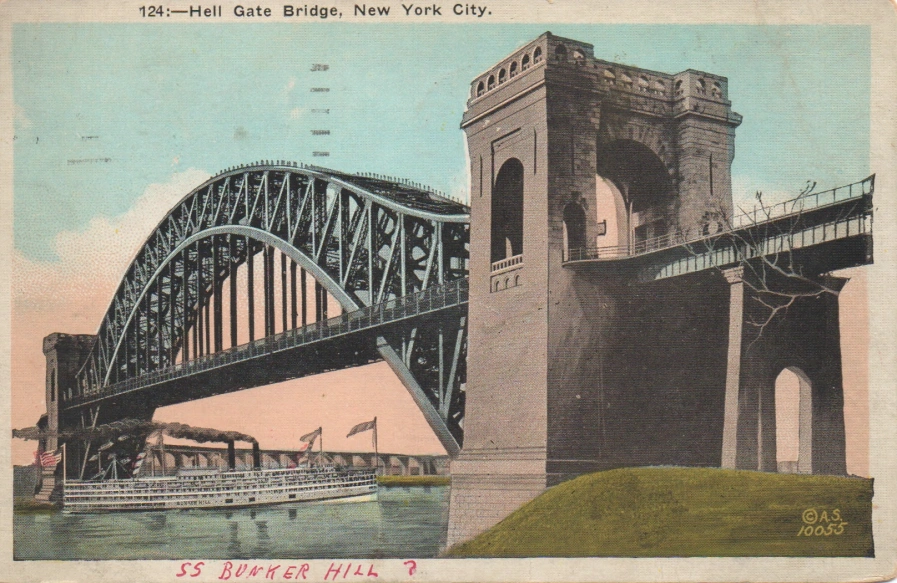
The Hell Gate Bridge — a feat of WWI-era railroad engineering connecting Queens to Randall’s and Wards Island over a particularly perilous stretch of waterway, it was once the longest steel arch bridge in the world.
In his 1921 book New York: The Great Metropolis, painter Peter Marcus noted that “if laid over Manhattan it would reach from Wanamaker’s store at Eighth Street, to One Hundred and Twenty-fifth Street.”
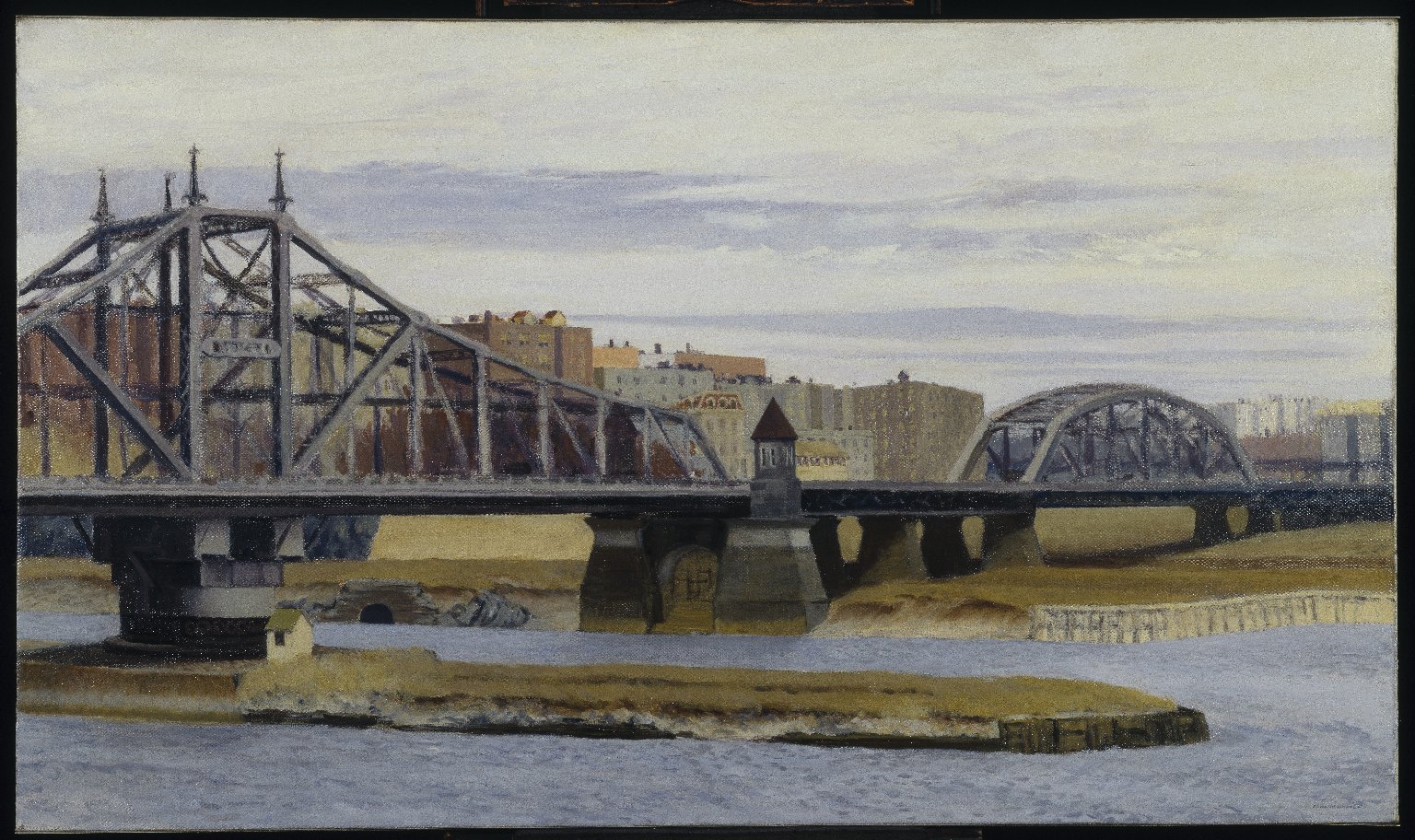
Macomb’s Dam Bridge, a low lying swing bridge whose center portion pivots to accommodate boat traffic on the Harlem River. When construction began in late 1890, the New York Times gushed that it would be a “street built in mid-air” between the Bronx and Washington Heights in upper Manhattan:
It is hardly enough to say of it that it will be the greatest piece of engineering of the kind in the world. Nothing like it has ever been attempted.
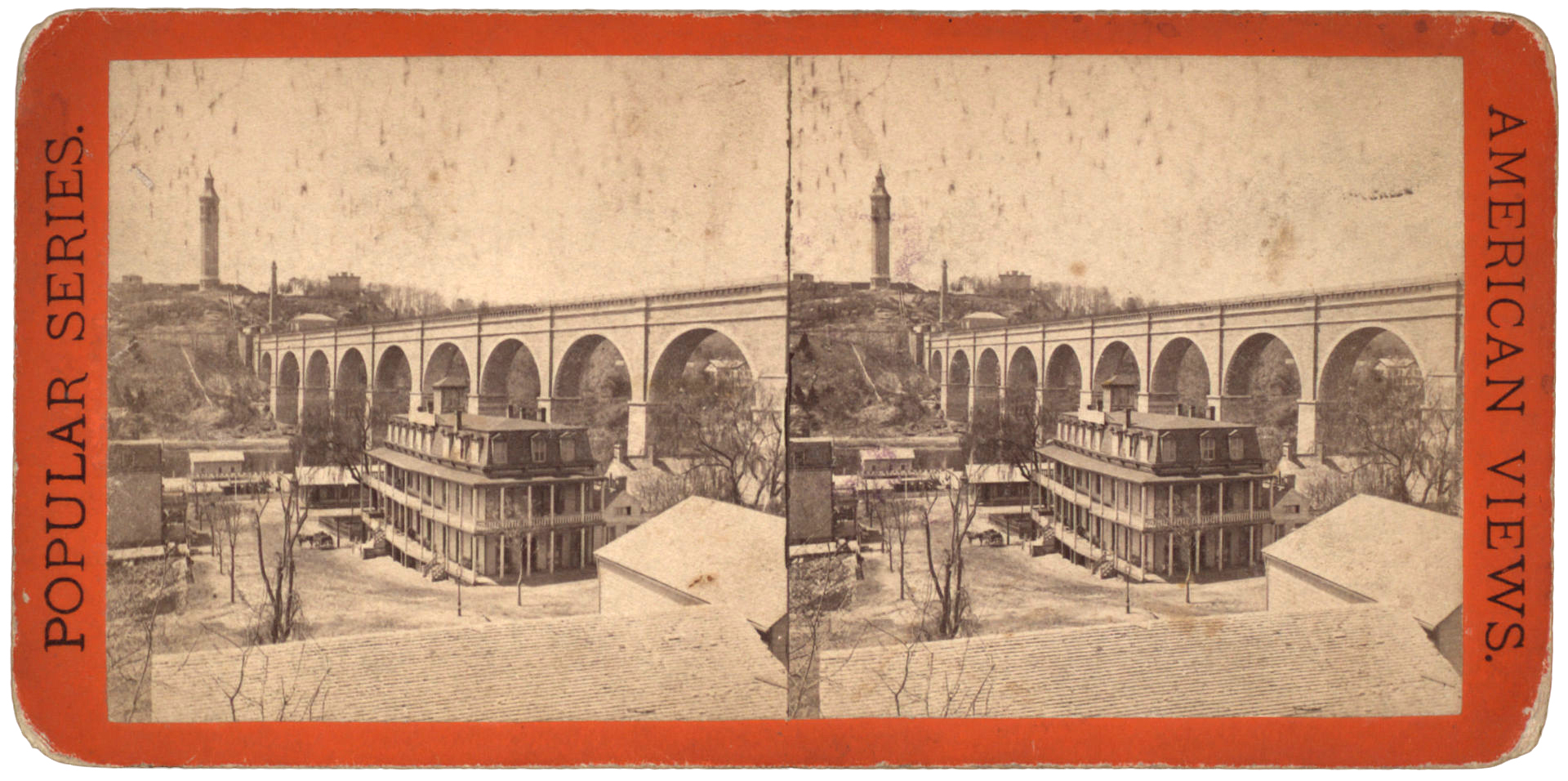
The High Bridge - Originally part of the Croton Aqueduct, it is technically the oldest surviving bridge in the city, as well as a community-led preservation campaign success story. Having languished in the latter part of the 20th century, it is now a beautiful pedestrian bridge whose killer views can be enjoyed without the hassle of Brooklyn Bridge-sized crowds.
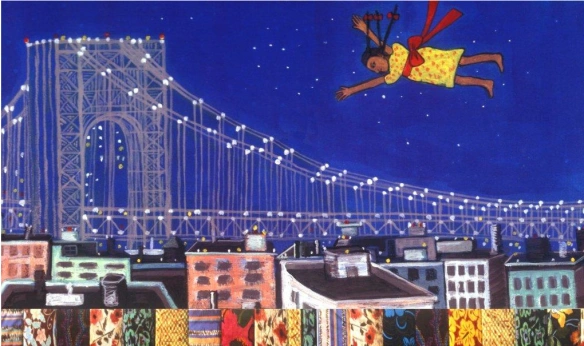
The George Washington Bridge - a major money maker for the Port Authority, it’s not only the world’s busiest bridge, it puts a lot of the bridge in “bridge and tunnel crowd” by connecting Manhattan to New Jersey.
Architecture buffs can geek out on the Concrete Industry Board Award-winning bus station and storied Little Red Lighthouse in its shadow.
The GWB’s most ardent fan has got to be artist Faith Ringgold, who immortalized it in her Tar Beach story quilt and related children’s book:
I never want to be more than three minutes from the George. I could always see it as I grew up. That bridge has been in my life for as long as I can remember. As a kid, I could walk across it anytime I wanted. I love to see it sparkling at night. I moved to New Jersey, and I’m still next to it.
Wyetzner, whose architectural round up shoehorns in a lot of interesting information about public health, economics, transportation, labor practice and New York City history, is actively courting viewers to suggest bridges for a sequel.
We’ll throw our weight behind the Manhattan, the Williamsburg, the Queensboro, the Verrazzano, and the admittedly dark horse 103rd Street Footbridge.
You?
Related Content
A Mesmerizing Trip Across the Brooklyn Bridge: Watch Footage from 1899
An Online Gallery of Over 900,000 Wonderful Photos of Historic New York City
– Ayun Halliday is the Chief Primatologist of the East Village Inky zine and author, most recently, of Creative, Not Famous: The Small Potato Manifesto and Creative, Not Famous Activity Book. Follow her @AyunHalliday.
Read More...The Birth and Rapid Rise of Islam, Animated (622‑1453)
To anyone unfamiliar with the history of Islam, it comes as something of a shock that it got started less than a millennium and a half ago. In that relatively short span of time, Islam has become the world’s second-largest religion, a fact that becomes more understandable when you see the running start to which it got off visualized in the video above. Created by Ollie Bye — previously featured here on Open Culture for his cartographical animations of the rise and fall of the British Empire, the spread of writing, and the history of the world — it depicts the spread of Islam, which began in earnest after the death of its founder, the prophet Muhammad, in the year 632, and whose legacy is the “Muslim world” as we know it today.
“By conquest and conversion, the new religion spread quickly westwards through the territories of the Byzantine empire,” says the Victoria and Albert Museum’s page on luxury objects of the period. “By the 640s, Muslim forces were advancing across North Africa, conquering Sicily in 652 and the Iberian Peninsula in 711.”
Let’s pause to give that achievement due consideration: Islam overtook Spain just a century after its foundation, a conquering speed that puts the Roman Empire in the shade. (The Muslims also managed to get the upper hand of the Persians, who’d presented such a stiff challenge to not just the Romans but the Greeks before them.) “By the early 8th century, Islamic territories had almost encircled the Mediterranean.“ ‘
“During this time Muslim rulers, soldiers, traders, Sufis, scholars, poets and architects all contributed to the shaping of distinctive Islamic cultures,” says the site of Harvard’s Pluralism Project. “Across the wide-reaching Islamic world, transregional Islamic culture mixed with local traditions to produce distinctive forms of statecraft, theology, art, architecture, and science.” (Nor should we neglect the delights of Moorish cuisine.) This Islamic Golden Age, like all golden ages, eventually came to an end. The center of civilization had shifted undeniably by the time of the European Renaissance — which, according to the Pluralism Project, may never have taken place “without the creativity and myriad achievements of Muslim scholars, thinkers, and civilizations.” And given that Islam remains the world’s fastest-growing major religion by births, it surely hasn’t exerted the last of its global influence just yet.
Related content:
Animated Map Shows How the Five Major Religions Spread Across the World (3000 BC – 2000 AD)
The Complex Geometry of Islamic Art & Design: A Short Introduction
How Arabic Translators Helped Preserve Greek Philosophy … and the Classical Tradition
A Visual Map of the World’s Major Religions (and Non-Religions)
The History of the World in One Video: Every Year from 200,000 BCE to Today
Based in Seoul, Colin Marshall writes and broadcasts on cities, language, and culture. His projects include the Substack newsletter Books on Cities, the book The Stateless City: a Walk through 21st-Century Los Angeles and the video series The City in Cinema. Follow him on Twitter at @colinmarshall or on Facebook.
Read More...The Oldest Known Photographs of Rome (1841–1871)
The ravages of COVID-19 have been followed by the ravages of the post-pandemic tourism boom. If you’ve been reading recent coverage of aggressive travel and its discontents, you may well assume that it’s too late to have a genuine experience of, say, the great cities of Europe. Paris, Vienna, Barcelona: none are as they used to be, we’re told, and the same may even be true of the Eternal City. Lovers of such places were complaining about tourists decades and decades ago, of course, but how far back in time would one have to travel in order to take in the glories of a Rome that hadn’t yet fallen to the invading T‑shirt-and-flip-flopped hordes?
One would have to travel back about 150 years, at least according to the pictorial evidence provided in the video above from Youtuber Jarid Boosters, who appears to have a strong interest in historical photography.
His most popular videos include gatherings-up of pictures of old Los Angeles, of the lost architecture of the German Empire, of nineteenth-century Iran. In this new episode, he presents the earliest known photographs taken in Rome, which date from the early eighteen-forties to the early eighteen-seventies. Most were taken by an early Italian adopter of photography named Gioacchino Altobelli.
Soon after picking up a camera in the eighteen-thirties, Altobelli dedicated his career to “photographing some of the most ancient and most infamous sites throughout Rome,” says Boosters. “From 1841 through 1871, Altobelli, along with a team of other photographers, including Richard Jones, took it upon themselves to document the most famous and ancient city of Rome as completely as possible.” Their subjects included the still-recognizable likes of the Colosseum and Hadrian’s tomb, naturally, as well as the Arch of Drusus, the Temple of Venus and Roma, and the Porto di Ripetta. Having been demolished by the early twentieth century, the Porto di Ripetta stands out as one of the features that sets the Rome of Altobelli’s day apart from the Rome of today — well, that and the absence of selfie-takers.
Related content:
Based in Seoul, Colin Marshall writes and broadcasts on cities, language, and culture. His projects include the Substack newsletter Books on Cities, the book The Stateless City: a Walk through 21st-Century Los Angeles and the video series The City in Cinema. Follow him on Twitter at @colinmarshall or on Facebook.
Read More...Support Us
We're hoping to rely on loyal readers, rather than erratic ads. Please click the Donate button and support Open Culture. You can use Paypal, Venmo, Patreon, even Crypto! We thank you!

About Us

Open Culture scours the web for the best educational media. We find the free courses and audio books you need, the language lessons & educational videos you want, and plenty of enlightenment in between.
Advertise With Us

FREE UPDATES!
GET OUR DAILY EMAIL
Get the best cultural and educational resources on the web curated for you in a daily email. We never spam. Unsubscribe at any time.
FOLLOW ON SOCIAL MEDIA

Open Culture editor Dan Colman scours the web for the best educational media. He finds the free courses and audio books you need, the language lessons & movies you want, and plenty of enlightenment in between.
Advertise With Us


