When Mississippi Tried to Ban Sesame Street for Showing a “Highly Integrated Cast” (1970)
On November 10, 1969, Sesame Street made its broadcast debut.
The very first lines were spoken by Gordon (Matt Robinson), a Black schoolteacher who’s showing a new kid around the neighborhood, introducing her to a couple of other kids, along with Sesame Street adult mainstays Bob, Susan, and Mr. Hooper, and Big Bird, whose appearance had yet to find its final form:
Sally, you’ve never seen a street like Sesame Street. Everything happens here. You’re gonna love it.
The milieu would have felt familiar to children growing up on New York City’s Upper West Side, or Harlem or the Bronx. While not every block was as well integrated as Sesame Street’s cheerful, deliberately multicultural, brownstone setting, any subway ride was an opportunity to rub shoulders with New Yorkers of all races, classes and creeds.
Not six months later, the all-White Mississippi State Commission for Educational Television voted 3 to 2 to remove Sesame Street from their state’s airwaves.
A disgruntled pro-Sesame commission member leaked the reason to The New York Times:
Some of the members of the commission were very much opposed to showing the series because it uses a highly integrated cast of children.
The whistleblower also intimated that those same members objected to the fact that Robinson and Loretta Long, the actor portraying Susan, were Black.
They claimed Mississippi was “not yet ready” for such a show, even though Sesame Street was an immediate hit. Professionals in the fields of psychology, education, and medicine had consulted on its content, helping it secure a significant amount of federal and private grants prior to filming. The show had been lauded for its main mission — preparing American children from low-income backgrounds for kindergarten through lively educational programming with ample representation.
Kids growing up in sheltered, all-white enclaves stood to gain, too, by being welcomed into a television neighborhood where Black and white families were shown happily coexisting, treating each other with kindness, patience and respect. (Sonia Manzano and Emilio Delgado, who played Maria and Luis, joined the cast soon after.)
Even though Alabama, Arkansas, Florida, Louisiana and Tennessee also moved to pre-empt the innovative hit show, the government appointees on the Mississippi State Commission for Educational Television who’d ousted Sesame Street found themselves outnumbered when Jackson residents of all ages staged a protest in front of Mississippi Public Broadcasting’s HQ.]
The Delta Democrat-Times published an editorial piece arguing that “there is no state which more desperately needs every educational tool it can find than Mississippi:”
There is no educational show on the market today better prepared than Sesame Street to teach preschool children what many cannot or do not learn in their homes….The needs are immense.
After 22 days, the ban was rolled back and Sesame Street was reinstated.
That fall, the cast made a pitstop in Jackson during a 14-city national tour. Susan, Gordon, Bob, Mr. Hooper and Big Bird sang and joked with audience members as part of an event co-sponsored by the very same commission that had tried to blackball them, and left without having received a formal apology.
Sesame Street has stayed true to its progressive agenda throughout its fifty+ year history, a commitment that seems more essential than ever in 2023.
Below, Elmo, a Muppet who rose through the ranks to become a Sesame Street star engages in an entry-level conversation about race with some newer characters in an episode from two years ago.
The Sesame Workshop recommends it for viewers aged 1 to 4, though it seems our country doesn’t lack for adult citizens who could do with a refresher on the subject…
Related Content
Watch Twin Beaks, Sesame Street’s Parody of David Lynch’s Iconic TV Show (1990)
Philip Glass Composes Music for a Sesame Street Animation (1979)
– Ayun Halliday is the Chief Primatologist of the East Village Inky zine and author, most recently, of Creative, Not Famous: The Small Potato Manifesto and Creative, Not Famous Activity Book. Follow her @AyunHalliday.
Read More...Novelist Michael Chabon Digitally Re-Creates the Science Fiction & Fantasy Section of His Favorite 1970s Bookstore
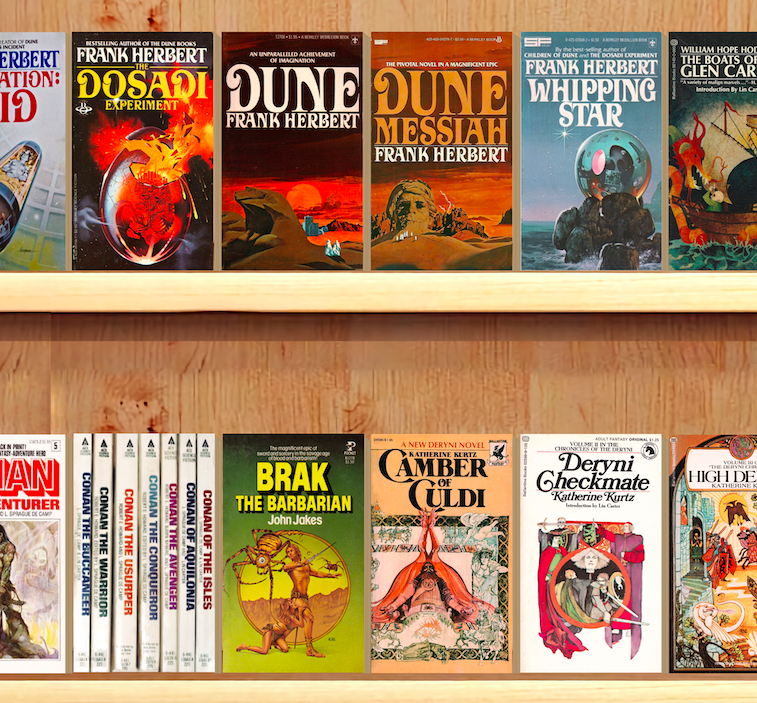
Michael Chabon was born in 1963, which placed him well to be influenced by the unpredictable, indiscriminate, and often lurid cultural cross-currents of the nineteen-seventies. He seemed to have received much of that influence at Page One, the local bookstore in his hometown of Columbia, Maryland — and it was to Page One that his imagination drifted during the long days of the COVID-19 pandemic spent in his personal library. “As I sat around communing with my tattered old friends,” he writes, “I discovered that I retained a sharp recollection — title, author, cover design — of what felt like every single book that had ever appeared on those tall shelves along the left wall of Page One, toward the back, between 1972 and 1980.”
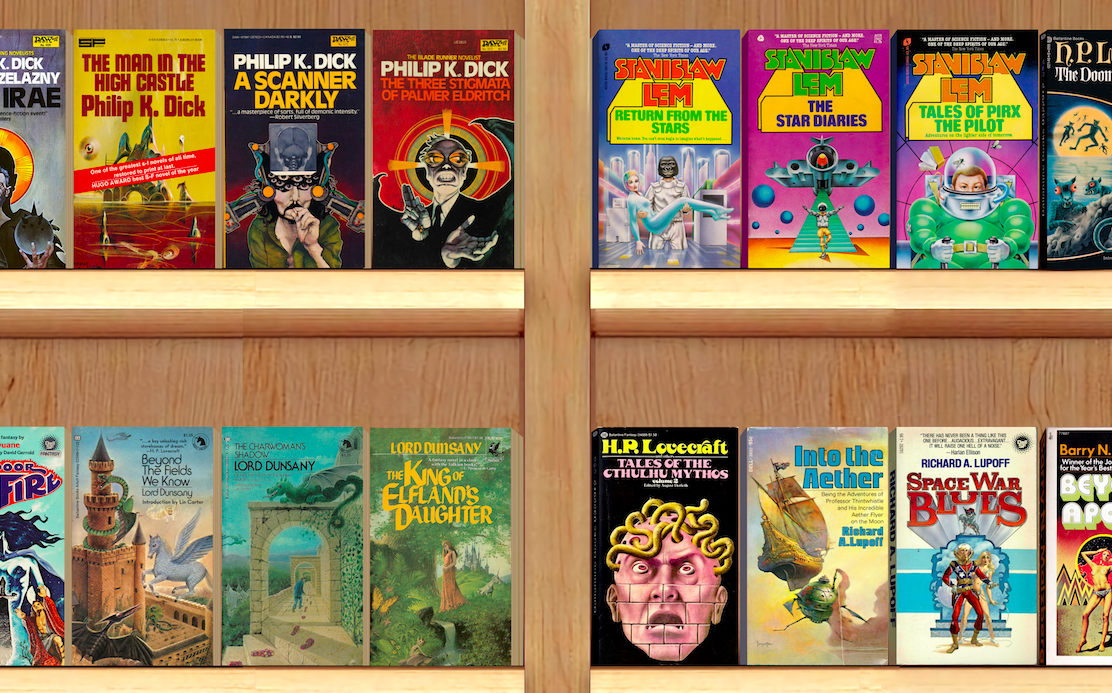
That was the store’s “Science Fiction & Fantasy” section, which in that period was well-stocked with titles by such stars of those genres as Ray Bradbury, Ursula K. LeGuin, Arthur C. Clarke, J. G. Ballard, C. J. Cherryh, Michael Moorcock, and Philip K. Dick.
Or at least it did if Chabon’s digital re-creation “The Shelves of Time” is anything to go by. Downloadable here in “small” (96 MB), “large” (283 MB) and “very large” (950 MB) formats, the lavish image functions as what Chabon calls a “time telescope,” offering “a look back at the visuals that embodied and accompanied my early aspirations as a writer, and at the mass-market splendor of paperback sf and fantasy in those days.”

“I’m the same age as Chabon, and I was also a bookstore rat, staring at these exact same covers and agonizing over which one I’d lay down my $1.25 for,” writes Ruben Bolling at Boing Boing. “Just look at those beautiful John Carter of Mars covers. I collected and cherished these, and the Tarzan series.” Bolling also highlights the adaptations Chabon includes on these re-imagined shelves: there’s “the James Blish Star Trek series, just as I remember it,” and also the novelization of Star Wars, which he read before the opening of the film itself. “So instead of experiencing the movie as it should have been — as campy movie fun — I experienced it as an adaptation of a literary work.”
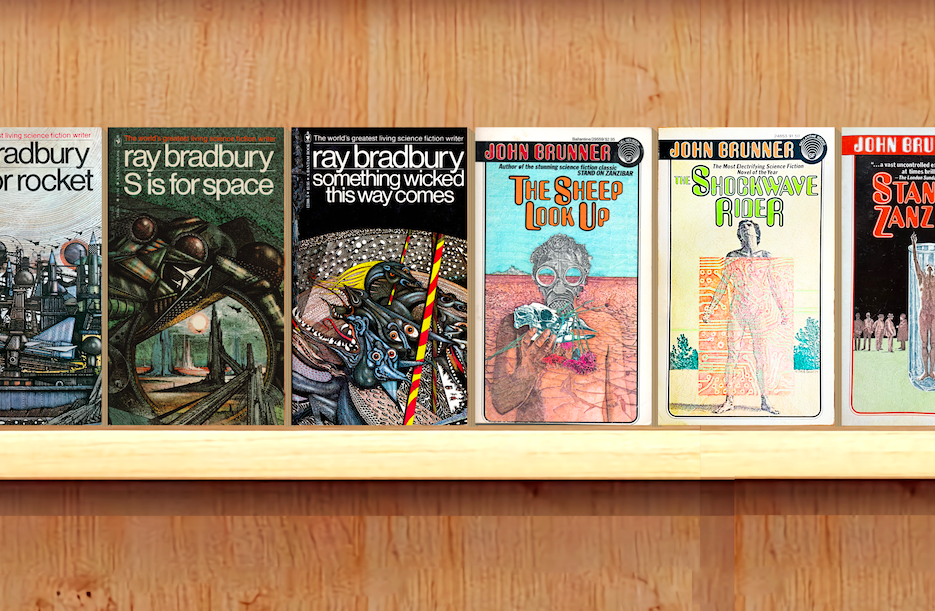
Despite being a couple of decades younger, I, too, remember these covers vividly. My own sci-fi-and-fantasy period occurred in the late nineties, by which time these very same mass-market paperbacks from the seventies were turning up in quantity at used bookstores. For me, few images from these genres of that era could trigger reading memories as rich as those Ballantine covers of The Sheep Look Up, The Shockwave Rider, and Stand on Zanzibar by John Brunner, a British specialist in social and environmental catastrophe. Like many readers, I put this sort of thing aside after a few years, but Chabon has proven infinitely more dedicated: half a century after his days haunting Page One, his mission to “drag the decaying corpse of genre fiction out of the shallow grave where writers of serious literature abandoned it,” as critic Ruth Franklin once described it, continues apace.
via Boing Boing
Related content:
The Art of Sci-Fi Book Covers: From the Fantastical 1920s to the Psychedelic 1960s & Beyond
Novelist Michael Chabon Sang in a Punk Band During the ’80s: Newly Released Audio Gives Proof
600+ Covers of Philip K. Dick Novels from Around the World: Greece, Japan, Poland & Beyond
The Amazing Adventures of Kavalier and Clay: Animation Concepts
The Encyclopedia of Science Fiction: 17,500 Entries on All Things Sci-Fi Are Now Free Online
Based in Seoul, Colin Marshall writes and broadcasts on cities, language, and culture. His projects include the Substack newsletter Books on Cities, the book The Stateless City: a Walk through 21st-Century Los Angeles and the video series The City in Cinema. Follow him on Twitter at @colinmarshall or on Facebook.
Read More...Oppenheimer’s Secret City: The Story Behind the Stealthy Creation of Los Alamos, New Mexico
We think of the atomic bomb as a destroyer of cities, namely Hiroshima and Nagasaki. But its development also produced a city: Los Alamos, New Mexico, an officially non-existent community in which the necessary research could be conducted in secret. More recently, it became a major shooting location for Oppenheimer, Christopher Nolan’s new movie about the titular theoretical physicist remembered as the father (or one of the fathers) of the atomic bomb based on his work as the director of the Los Alamos Laboratory. You can learn more about that laboratory, and the town of 6,000 constructed to support it, in the new Vox video above.
Los Alamos was necessary to the Manhattan Project, as the R&D of the world’s first nuclear weapon was code-named, but it wasn’t sufficient: other secret sites involved included “a nuclear reactor under a University of Chicago football field”; “the Alabama Ordinance Works, for producing heavy water”; “a large plant for the enrichment of uranium and production of some plutonium” in Oak Ridge, Tennessee”; and the Hanford Engineer Works in Washington State, which produced even more plutonium.
But the bomb itself was created in Los Alamos, into whose isolation Oppenheimer recruited the likes of Enrico Fermi, Edward Teller, Richard Feynman, and other powerful scientific minds — who brought their wives and children along.
As a 1944 Medical Corp memo warned, the “intellectuals” at Los Alamos would “seek more medical care than the average person”; at the same time, one-fifth of the married women there were pregnant, so up went maternity wards as well. The population of Los Alamos grew so rapidly that “hutments were a common form of accommodation,” though “apartment buildings were also available.” The housing sat alongside “facilities for graphite fabrication, and the cyclotron and Van de Graaff machines.” Less than 250 miles south lay what, in the summer of 1945, would become the site of the Trinity test. It was there, gazing upon the explosion of the unprecedented nuclear weapon whose development he’d overseen, that Oppenheimer saw not merely a destroyer of cities, but a destroyer of worlds.
Related content:
Oppenheimer: The Man Behind the Bomb
Watch Chilling Footage of the Hiroshima & Nagasaki Bombings in Restored Color
See Every Nuclear Explosion in History: 2153 Blasts from 1945–2015
Learn How Richard Feynman Cracked the Safes with Atomic Secrets at Los Alamos
Based in Seoul, Colin Marshall writes and broadcasts on cities, language, and culture. His projects include the Substack newsletter Books on Cities, the book The Stateless City: a Walk through 21st-Century Los Angeles and the video series The City in Cinema. Follow him on Twitter at @colinmarshall or on Facebook.
Read More...Steely Dan’s Lost Jingle for a Schlitz Beer Commercial (Circa 1973)
Somewhere between the recording of their first and second albums (1972–1973), Steely Dan wrote a jingle to promote Schlitz, “the beer that made Milwaukee famous.” According to American Songwriter, the jingle “features Steely Dan jazz fusion along with Fagen singing Once around life / Once around livin’ / Once around beer / And you’ll keep around Schlitz.”
Schlitz never ultimately used the track. The song included lyrics that Fagen translated from Spanish to English: When I get home from a hard day’s work / He says he likes to grab for all the gusto he can get / ‘Cause you only go around one time.” Apparently the word “grab” came from the Spanish word “coger,” which is also a Spanish slang word for sexual intercourse. Schlitz seemingly cold feet, and the jingle never reached the public. Until now.
If you would like to support the mission of Open Culture, consider making a donation to our site. It’s hard to rely 100% on ads, and your contributions will help us continue providing the best free cultural and educational materials to learners everywhere. You can contribute through PayPal, Patreon, and Venmo (@openculture). Thanks!
Related Content
Deconstructing Steely Dan: The Band That Was More Than Just a Band
How Steely Dan Wrote “Deacon Blues,” the Song Audiophiles Use to Test High-End Stereos
Read More...Noam Chomsky Teaches a MasterClass on Critical Thinking & Media Literacy
“We now have to decide within a couple of decades whether the human experiment is going to continue or whether it’ll go down in glorious disaster,” says Noam Chomsky in a new interview on economist Tyler Cowen’s podcast Conversations with Tyler. “That’s what we’re facing. We know answers, at least possible answers to all of the problems that face us. We’re not pursuing them.” This came in response to one of Cowen’s standard questions, about the guest’s “production function”: that is, the methods or systems the guest uses to remain productive in their work. Such a line of inquiry is especially pertinent in Chomsky’s case, given the famously intense work schedule he maintains as a public intellectual at the age of 94.
Recently, that schedule has also involved shooting a Masterclass on Independent Thinking and the Media’s Invisible Powers, whose trailer appears above. In the course\, Chomsky “explores the dark side of media,” teaching us “to cut through propaganda, defend against manipulation, and control what you consume.”
Propaganda, manipulation, and consumption are major themes of his work (one forgets that he first became well-known as a linguist), and he became popularly associated with them thanks in large part to Manufacturing Consent, the 1988 book he co-wrote with Edward S. Herman. Of course, the media landscape looked quite different 35 years ago, and this Masterclass — a class of product scarcely imaginable back then — offers him an opportunity to bring his views into the twenty-twenties.
“Social media tends to drive people into self-reinforcing bubbles,” Chomsky says in the trailer. “It’s driving people even to more extreme views.” This is the kind of lament one now hears aired three or four times before breakfast, but seldom from a figure who’s been theorizing about the underlying forces as long as Chomsky has. Social media may offer an avenue of freedom from the standard suite of top-down mainstream narratives, but it may also constitute just another “power system,” which by its very nature seeks only “control and domination.” Encouraging the habits of critical thinking needed to resist such control and domination has long been essential to Chomsky’s project. And the stakes of that project, as he’ll surely never stop seeking platforms from which to tell the world, could hardly be higher. Explore Noam Chomsky Teaches Independent Thinking and the Media’s Invisible Powers here.
Note: If you sign up for a MasterClass course by clicking on the links in this post, Open Culture will receive a small fee that helps support our operation.
Related content:
An Animated Introduction to Noam Chomsky’s Groundbreaking Linguistic Theories
Noam Chomsky Defines What It Means to Be a Truly Educated Person
When Rage Against the Machine Interviewed Noam Chomsky (1999)
Based in Seoul, Colin Marshall writes and broadcasts on cities, language, and culture. His projects include the Substack newsletter Books on Cities, the book The Stateless City: a Walk through 21st-Century Los Angeles and the video series The City in Cinema. Follow him on Twitter at @colinmarshall or on Facebook.
Read More...GWAR Performs a Tiny Desk Concert: When Heavy Metal Meets NPR
In February 2020, a parody news site posted the headline: “GWAR asks NPR’s Tiny Desk Staff if They’re Ready to Get Their A******* Ripped Open.” In July 2023, NPR made good on the joke, inviting the heavy metal band to perform their own tiny desk concert. NPR writes: “As the band of intergalactic monsters strapped guitars to their battle-worn bodies, thunder and rain pounded the NPR building outside. As if the late Oderus Urungus was pissing his blessing from Valhalla, the prophecy had finally been fulfilled: GWAR came to destroy the Tiny Desk once and for all.” Enjoy.
Related Content
Read More...A Creative List of Meat Carving Terms from the Middle Ages: “Splaye that Breme,” “Splatte that Pyke” & More
A lesser advertised joy of working in food service is achieving command of the slang:
Monkey dish…
Deuces and four tops…
Fire, flash, kill…
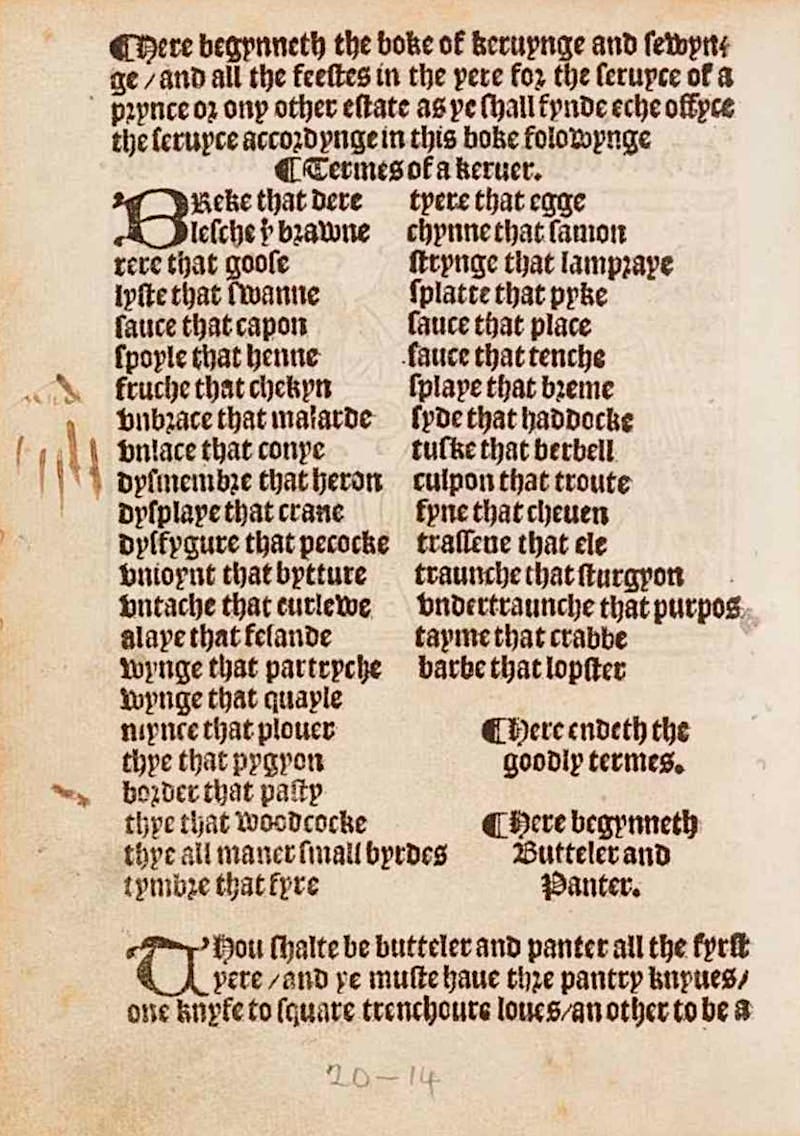
As you may have noticed, we here at Open Culture have an insatiable hunger for vintage lingo and it doesn’t get much more vintage than The Boke of Kervynge (The Book of Carving).
This 1508 manual was published for the benefit of young noblemen who’d been placed in affluent households, to learn the ropes of high society by serving the sovereigns.
Few families could afford to serve meat, let alone whole animals, so understandably, the presentation and carving of these precious entrees was not a thing to be undertaken lightly.
The influential London-based publisher Wynkyn de Worde compiled step-by-step instructions for getting different types of meat, game and fish from kitchen to plate, as well as what to serve on seasonal menus and special occasions like Easter and the Feast of St. John the Baptist.
The book opens with the list of “goodly termes” above, essential vocab for any young man eager to prove his skills around the carcass of a deer, goose, or lobster.
There’s nothing here for vegetarians, obviously. And some 21st-century carnivores may find themselves blanching a bit at the thought of tearing into a heron or porpoise.
If, however, you’re a medieval lad tasked with “disfiguring” a peacock, closely observed by an entire dining table of la crème de la crème, The Boke of Kervynge is a lifesaver.
(It also contains some invaluable tips for meeting expectations should you find yourself in the position of chaumberlayne, Marshall or usher.)
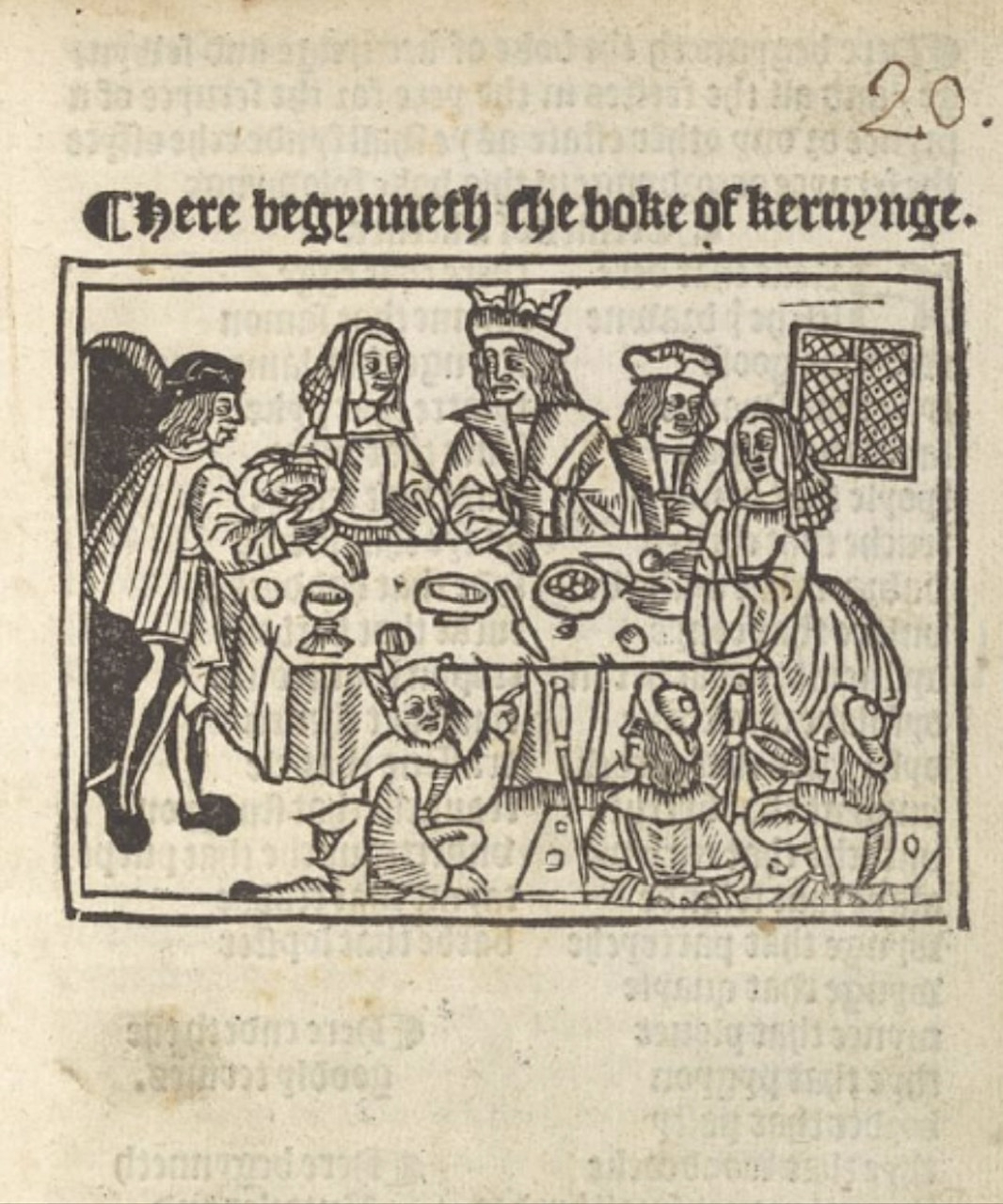
In any event, let’s spice up our vocabulary while rescuing some aged culinary terms from obscurity.
Don’t be surprised if they work their way into an episode of The Bear next season, though you should also feel free to use them metaphorically.
And don’t lose heart if some of the terms are a bit befuddling to modern ears. Lists of Note’s Shaun Usher has taken a stab at truffling up some modern translations for a few of the less familiar sounding words, wisely refraining from hazarding a guess as to the meaning of “fruche that chekyn”.
(It’s not the “chekyn” part giving us pause…)
Termes of a keruer —Terms of a carver
Breke that dere — break that deer
lesche y brawne — leach the brawn
rere that goose — rear that goose
lyft that swanne — lift that swan
sauce that capon — sauce that capon
spoyle that henne — spoil that hen
fruche that chekyn — ? that chicken
vnbrace that malarde — unbrace that mallard
vnlace that cony — unlace that coney
dysmembre that heron — dismember that heron
dysplaye that crane — display that crane
dysfygure that pecocke —disfigure that peacock
vnioynt that bytture — unjoint that bittern
vntache that curlewe — untack that curlew
alaye that fesande — allay that pheasant
wynge that partryche — wing that partridge
wynge that quayle — wing that quail
mynce that plouer — mince that plover
thye that pegyon — thigh that pigeon
border that pasty — border that pasty
thye all maner of small byrdes — thigh all manner of small birds
tymbre that fyre — timber that fire
tyere that egge — tear that egg
chyne that samon — chine that salmon
strynge that lampraye — string that lamprey
splatte that pyke — splat that pike
sauce that playce — sauce that plaice
sauce that tenche — sauce that tench
splaye that breme — splay that bream
syde that haddocke — side that haddock
tuske that barbell — tusk that barbel
culpon that troute — culpon that trout
fynne that cheuen — fin that cheven
trassene that ele — ? that eel
traunche that sturgyon — tranche that sturgeon
vndertraunche yt purpos — undertranch that porpoise
tayme that crabbe — tame that crab
barbe that lopster — barb that lobster
Here endeth the goodly termes.
Peruse a digital copy of the sole surviving copy of the first edition of the Boke of Kervynge here.
Via Lists of Note
Related Content
What Did People Eat in Medieval Times? A Video Series and New Cookbook Explain
A List of 1,065 Medieval Dog Names: Nosewise, Garlik, Havegoodday & More
Ernest Hemingway’s Favorite Hamburger Recipe
– Ayun Halliday is the Chief Primatologist of the East Village Inky zine and author, most recently, of Creative, Not Famous: The Small Potato Manifesto and Creative, Not Famous Activity Book. Follow her @AyunHalliday.
Read More...
How to Make the 2000-Year-Old “Pizza” Discovered on a Pompeii Fresco
Just last month, we featured here on Open Culture the discovery of a Pompeiian fresco purported to depict an ancient ancestor of pizza. For most of us pizza-loving millions — nay, billions — around the world, this was a notable curiosity but for Max Miller, it was clearly a challenge. As the creator of the hit Youtube channel Tasting History, each of whose episodes involves faithful re-creation of dishes from eras past, he couldn’t possibly have ignored this development. But it also poses even stiffer difficulties than most of his culinary projects, providing him not a recipe to work with but a picture, and not a particularly detailed picture at that.
The fresco’s genre is xenia, which, Miller explains in the video above, “comes from the Greek word that referred to a sort of social contract between hosts and guests.” The ancient Roman architect Vitruvius (he whose work inspired Leonardo’s Vitruvian Man) described how the Greeks, after becoming wealthy, “began providing dining rooms, chambers, and storerooms of provisions for their guests.”
The food and drink they brought out for their dinner parties became the subject of xenia artworks like this fresco from Pompeii, which happens to include a familiar-looking round bread. What’s more, “some scholars have suggested that one of the ingredients that probably is on this bread is sort of pizza-like, insofar as it is a kind of spreadable cheese.”
The quality of that ingredient, called moretum, seemingly makes or breaks this ancient pizza, and so Miller spends most of the video explaining its preparation, drawing details from a poem attributed to Virgil. Those following along in their own kitchens will need to gather a couple heads of garlic, large handfuls of parsley and cilantro, a small handful of rue, and ten ounces of white cheese. When you’ve made the moretum, you can bake the Roman bread, loaves of which were preserved by the explosion of Mount Vesuvius, then spread on the moretum and “top it with things like white cheese, dates, pomegranates, or whatever else you saw in the fresco.” Miller notes that actual Pompeiians probably wouldn’t have sliced the final product, but rather picked off and eaten its toppings one-by-one before getting around to the bread: a pizza consumption method practiced by more than a few of us moderns, at least in childhood.
Related content:
A Newly Discovered Fresco in Pompeii Reveals a Precursor to Pizza
Historical Italian Cooking: How to Make Ancient Roman & Medieval Italian Dishes
The First Pizza Ordered by Computer, 1974
Based in Seoul, Colin Marshall writes and broadcasts on cities, language, and culture. His projects include the Substack newsletter Books on Cities, the book The Stateless City: a Walk through 21st-Century Los Angeles and the video series The City in Cinema. Follow him on Twitter at @colinmarshall or on Facebook.
Read More...The First Known Photograph of People Having a Beer (1843)
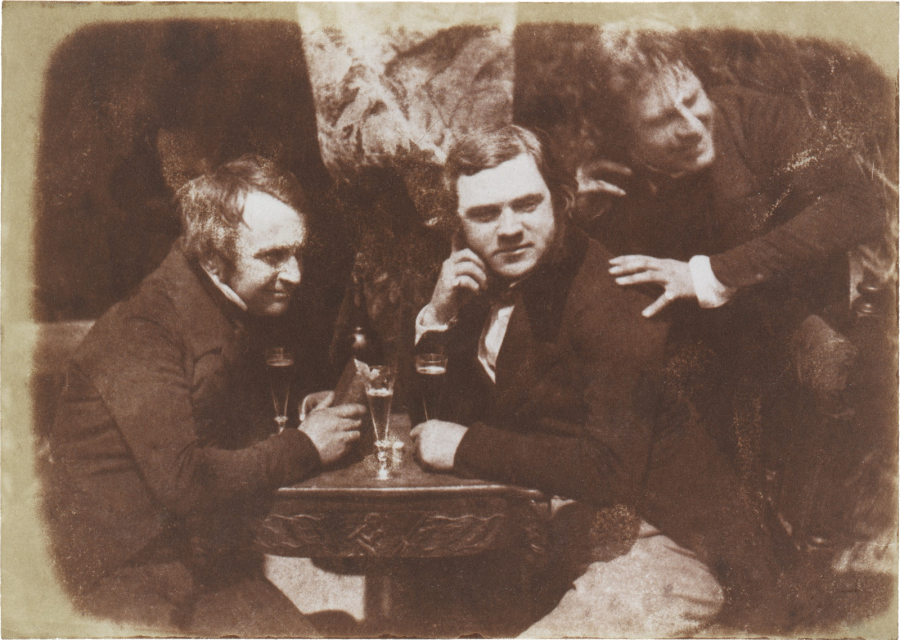
It should go without saying that one should drink responsibly, for reasons pertaining to life and limb as well as reputation. The ubiquity of still and video cameras means potentially embarrassing moments can end up on millions of screens in an instant, copied, downloaded, and saved for posterity. Not so during the infancy of photography, when it was a painstaking process with minutes-long exposure times and arcane chemical development methods. Photographing people generally meant keeping them as still as possible for several minutes, a requirement that rendered candid shots next to impossible.
We know the results of these early photographic portraiture from many a famous Daguerreotype, named for its French inventor, Louis-Jacques-Mandé Daguerre. At the same time, during the 1830s and 40s, another process gained popularity in England, called the Calotype—or “Talbotype,” for its inventor William Henry Fox Talbot. “Upon hearing of the advent of the Daguerreotype in 1839,” writes Linz Welch at the United Photographic Artists Gallery site, Talbot “felt moved to action to fully refine the process that he had begun work on. He was able to shorten his exposure times greatly and started using a similar form of camera for exposure on to his prepared paper negatives.”
This last feature made the Calotype more versatile and mechanically reproducible. And the shortened exposure times seemed to enable some greater flexibility in the kinds of photographs one could take. In the 1843 photo above, we have what appears to be an entirely unplanned grouping of revelers, caught in a moment of cheer at the pub. Created by Scottish painter-photographers Robert Adamson and David Octavius Hill—who grins, half-standing, on the right—the image looks like almost no other portrait from the time. Rather than sitting rigidly, the figures slouch casually; rather than looking grim and mournful, they smile and smirk, apparently sharing a joke. The photograph is believed to be the first image of alcoholic consumption, and it does its subject justice.
Though Talbot patented his Calotype process in England in 1841, the restrictions did not apply in Scotland. “In fact,” the Metropolitan Museum of Art writes, “Talbot encouraged its use there.” He maintained a correspondence with interested scientists, including Adamson’s older brother John, a professor of chemistry. But the Calotype was more of an artists’ medium. Where Daguerreotypes produced, Welch writes, “a startling resemblance of reality,” with clean lines and even tones, the Calotype, with its salt print, “tended to have high contrast between lights and darks…. Additionally, because of the paper fibers, the image would present with a grain that would diffuse the details.” We see this especially in the capturing of Octavius Hill, who appears both lifelike in motion and rendered artistically with charcoal or brush.
The other two figures—James Ballantine, writer, stained-glass artist, and son of an Edinburgh brewer, and Dr. George Bell, in the center—have the rakish air of characters in a William Hogarth scene. The National Galleries of Scotland attributes the naturalness of these poses to “Hill’s sociability, humour and his capacity to gauge the sitters’ characters.” Surely the booze did its part in loosening everyone up. The three men are said to be drinking Edinburgh Ale, “according to a contemporary account… ‘a potent fluid, which almost glued the lips of the drinker together.’ ” Such a side effect would, at least, make it extremely difficult to over-imbibe.
Note: An earlier version of this post appeared on our site in 2017.
If you would like to support the mission of Open Culture, consider making a donation to our site. It’s hard to rely 100% on ads, and your contributions will help us continue providing the best free cultural and educational materials to learners everywhere. You can contribute through PayPal, Patreon, and Venmo (@openculture). Thanks!
Related Content
The First Photograph Ever Taken (1826)
See The First “Selfie” In History Taken by Robert Cornelius, a Philadelphia Chemist, in 1839
See the First Photograph of a Human Being: A Photo Taken by Louis Daguerre (1838)
The First Faked Photograph (1840)
Josh Jones is a writer and musician based in Durham, NC. Follow him at @jdmagness
Read More...Demystifying the Activist Graffiti Art of Keith Haring: A Video Essay
The art of Keith Haring emerged in the highly specific place and time of early-eighties New York City. Four decades later, it’s visible all around the world, yet hasn’t lost its associations with its origins. Just the other day, I was walking down a street in my neighborhood in Seoul and noticed that a boutique had put a T‑shirt emblazoned with one of Haring’s artistic declarations that “CRACK IS WACK!!” Drug abuse use was just one of the issues to which he attached his work: others included apartheid, nuclear disarmament, and above all AIDS awareness. How, in contrast to so much activist art, has the Haring oeuvre achieved its enduring popularity?
Gallerist and Youtuber James Payne addresses this question in his new Great Art Explained video on Haring’s life and work. As soon as possible after a television-saturated suburban baby-boomer upbringing that did its part to teach him to “sell difficult politics in the same way Madison Avenue sold vacuum cleaners,” Haring moved to New York.
Within its cultural free-for-all he developed a signature style by making chalk drawings on unused ad spaces: “he called the New York subway his ‘laboratory,’ experimenting with ideas and form,” and only occasionally getting into trouble for it. New Yorkers “looked forward to seeing what he drew next and where, and before long mainstream media noticed him too and almost overnight he became a star.”
As Haring’s fame grew, it became clear that “he truly believed in the power of art to change the world. This belief, combined with the immediacy of his cartoon style, came together spectacularly in the nineteen-eighties.” Indeed, as Kurt Andersen writes in the New Yorker, Haring at his “manic, moneyed, fun, party-driven, celebrity-obsessed, shameless” prime was a personification of that decade. But even after his AIDS-related death in 1990, the simple exuberance of his art style lived on, not least in the form of posters and other products. “It’s definitely art for the age of mechanical reproduction,” Haring once said of his own work, and its sheer commonness — as well as its outward cheerfulness — make it easy to overlook the sources of its power. As has been said of Walt Disney, for whom he had dreamed of working since childhood, Haring didn’t just give people what they wanted; he wanted what they wanted.
Related Content:
A Short Biography of Keith Haring Told with Comic Book Illustrations & Music
Keith Haring’s Eclectic Journal Entries Go Online
An Animated History of Dogs, Inspired by Keith Haring
Based in Seoul, Colin Marshall writes and broadcasts on cities, language, and culture. His projects include the Substack newsletter Books on Cities, the book The Stateless City: a Walk through 21st-Century Los Angeles and the video series The City in Cinema. Follow him on Twitter at @colinmarshall or on Facebook.
Read More...Support Us
We're hoping to rely on loyal readers, rather than erratic ads. Please click the Donate button and support Open Culture. You can use Paypal, Venmo, Patreon, even Crypto! We thank you!

About Us

Open Culture scours the web for the best educational media. We find the free courses and audio books you need, the language lessons & educational videos you want, and plenty of enlightenment in between.
Advertise With Us

FREE UPDATES!
GET OUR DAILY EMAIL
Get the best cultural and educational resources on the web curated for you in a daily email. We never spam. Unsubscribe at any time.
FOLLOW ON SOCIAL MEDIA

Open Culture editor Dan Colman scours the web for the best educational media. He finds the free courses and audio books you need, the language lessons & movies you want, and plenty of enlightenment in between.
Advertise With Us

