A 3D Animation Reveals What Paris Looked Like When It Was a Roman Town
The standard tour of Paris feels like a journey back through time: the Eiffel Tower stands for the eighteen-eighties, the Arc de Triomphe for the turn of the nineteenth century, Les Invalides for the turn of the eighteenth century, Notre-Dame for the mid-fourteenth century, Sainte-Chapelle for the mid-thirteenth century, and so on. But of course, this is much too simple a way of seeing it, since so many of France’s historical landmarks have been repeatedly expanded, renovated, or modified over the centuries. (The Louvre, for example, boggles the mind with not just its sheer scale, but also the span of eras embodied by its construction.)
Paris’ history also goes much deeper than many tourists imagine. To discover it, they must go deeper in a literal sense, down into the Crypte Archeologique de l’île de la Cité. Conveniently located right next to Notre-Dame, this underground museum contains artifacts of the city as it was 2,000 years ago, when it was a relatively modest Gallo-Roman town called Lutetia, or in French, Lutèce.
On display there as well are some of the animations seen in the video above, which reconstruct Lutèce at the height of the Roman Empire in 3D. The aerial view it provides shows the Ile de la Cité, recognizable today in form but not function: 1,300 years before the completion of Notre-Dame, it had yet even to be occupied by the fortress of its Roman governor.
Long gone is the dominant feature of Lutèce’s built environment: its Roman forum, which was located on a choice piece of real estate between the current Boulevard Saint-Michel and Rue Saint-Jacques. But one important fragment of Lutécien public life does survive: the Arènes de Lutèce, l’orgueil de la cité, which hosted spectacles both religious and imperial, as well as no few gladiatorial contests. In this longer broadcast of Des Racines et des Ailes, you can see the 3D reconstruction of the amphitheater woven in with footage of its remains as they look in the modern day. Francophones should note that it also includes an interview with Sylvie Robin, a conservator from the Musée Carnavalet — another essential destination for anyone with a serious interest in Parisian time travel.
Related content:
The Roman Roads of Gaul Visualized as a Modern Subway Map
Take an Aerial Tour of Medieval Paris
A 3D Animated History of Paris: Take a Visual Journey from Ancient Times to 1900
Based in Seoul, Colin Marshall writes and broadcasts on cities, language, and culture. His projects include the Substack newsletter Books on Cities, the book The Stateless City: a Walk through 21st-Century Los Angeles and the video series The City in Cinema. Follow him on Twitter at @colinmarshall or on Facebook.
Read More...Watch Footage from New York City’s First Gay Pride March (1970)
The forecasted rain held off, the poor air quality caused by Canadian wildfires had abated, and the world’s largest Pride parade stepped off without incident in New York City on the final Sunday in June.
It’s grown quite a bit since the last Sunday of June 1970, when Christopher Street Liberation Day March participants paraded from Sheridan Square to Central Park’s Sheep Meadow.
Seeking to commemorate the one year anniversary of the Stonewall Uprising, when a police raid touched off a riot at the Greenwich Village gay bar, the event’s planners took inspiration from the organized resistance to the Vietnam War and Annual Reminders, a yearly call for equality from the Philadelphia-based Eastern Regional Conference of Homophile Organizations.
Parade co-organizer Craig Rodwell imagined a more freewheeling public event involving larger numbers than Annual Reminders, something that could “encompass the ideas and ideals of the larger struggle in which we are engaged—that of our fundamental human rights.”
In the lead up to the parade, Gay Liberation Front News reported that society stacked the deck against openly gay individuals, an observation echoed by a marcher in lesbian activist Lilli M. Vincenz’s documentary footage, above:
At first I was very guilty, and then I realized that all the things that are taught you, not only by society but by psychiatrists are just to fit you in a mold and I’ve just rejected the mold. And when I rejected the mold, I was happier.
Look carefully for placards from various participating groups, including the Mattachine Societies of Washington and New York, Lavender Menace, the Gay Activists Alliance, a church, and gay student groups at Rutgers and Yale.
Estimates place the crowd at anywhere from 3,000 to 20,000. In addition to marchers, the parade drew plenty of onlookers, some voicing support like a uniformed soldier stationed at Fort Dix who says “Great, man, do your thing!”. Others came prepared to voice their vigorous opposition.
“He’s a closet queen and you can find him in Howard Johnson’s any night,” a marcher cracks when asked his opinion of a counter demonstrator brandishing a sign invoking Sodom and Gomorrah.
Presumably the second part of this marcher’s comment was not intended to signify that the gent in question had a powerful attraction to the venerable Times Square diner’s fried clams, but rather its upstairs neighbor, the all-male Gaiety strip club.
Compared to the flashy festive costumes and booming club music that have become a staple of this millennia’s Pride Marches, 1970’s proceedings were a comparatively modest affair. Marchers chanted in unison, processing uptown in street clothes — hippie-style duds of the period with a couple of square suits and fedoras in the mix.
A clean cut young man in a windbreaker and natty star-spangled tie expressed frank disappointment that Mayor John Lindsay and other political figures had kept their distance.
Younger readers may be taken aback to hear Vincenz asking him how long he had been gay, but gratified when he responds, “I was born homosexual, it’s beautiful.”
By the time the marchers reached the Sheep Meadow, a number of men had shed their shirts. The parade morphed into a pastoral celebration in which revelers can be seen playing Ring Around the Rosie, plucking weeds to decorate each other’s hair, and attempting to break the record for longest kiss.
A man whose bib overalls have been customized with iron-on letters arranged to spell out Stud Farm expresses regret that he spent so many years in the closet.
Co-organizer Foster Gunnison Jr.’s wish was for every queer participant to leave the parade with “a new feeling of pride and self-confidence … to raise the consciences of participating homosexuals-to develop courage, and feelings of dignity and self-worth.”
That first parade’s marshal, Mark Segal, cofounder of Gay Liberation Front, summed it up on the 50th anniversary of the original event:
The march was a reflection of us: out, loud and proud.
Enjoy a glimpse of 2023’s New York City Pride March here.
Via Kottke
Related Content
The Untold Story of Disco and Its Black, Latino & LGBTQ Roots
Different From the Others (1919): The First Gay Rights Movie Ever … Later Destroyed by the Nazis
– Ayun Halliday is the Chief Primatologist of the East Village Inky zine and author, most recently, of Creative, Not Famous: The Small Potato Manifesto and Creative, Not Famous Activity Book. Follow her @AyunHalliday.
Read More...When David Bowie Starred in The Elephant Man on Broadway (1980)
Joseph Merrick, one of the most severely deformed individuals recorded in medical history, would hardly seem like the role David Bowie was born to play. The latter looked and acted as if destined for nineteen-seventies rock stardom; the former so horrified his fellow Victorians that he was exhibited under the name “The Elephant Man.” But whatever their outward differences, these Englishmen did both know fame, a condition Bowie rued alongside John Lennon in 1975. Yet in the following years he continued to expand his public profile, not least by turning to acting, and even came off as a viable movie star in Nicolas Roeg’s The Man Who Fell to Earth — not that playing a fragile but magnetic visitor from another world would have been much of a stretch.
In fact, it was The Man Who Fell to Earth that convinced theater director Jack Hofsiss to offer Bowie the lead in The Elephant Man, Bernard Pomerance’s play about the life of Joseph Merrick (referred to, in the script, as John Merrick). Hofsiss suspected that Bowie “would understand Merrick’s sense of otherness and alienation,” writes Louder’s Bill DeMain; he may or may not have known that Bowie’s experience studying mime, of which he made plenty of use in his concerts, would place him well to evoke the character’s misshapen body.
The Elephant Man explicitly calls for no prosthetic makeup; beginning with David Schofield, who starred in its first productions, all the actors playing Joseph Merrick have had to embody him with their acting skills alone.
You can see how Bowie did it in clips above. “I got a call within two weeks of having to go over and start rehearsal,” his web site quotes him as saying. “So I went to the London Hospital and went to the museum there. Found the plaster casts of the bits of Merrick’s body that were interesting to the medical profession and the little church that he’d made, and his cap and his cloak.” These artifacts gave him enough sufficient sense of “the general atmosphere” of Merrick’s life and times to make the role his own by the time of his first performances in Denver and Chicago in the summer of 1980. “Advance word on Bowie’s performance was encouraging, with box office records broken at the theaters in both cities,” writes DeMain; The Elephant Man soon made it to Broadway, opening at the Booth Theatre in the fall.
It was there, in December of 1980, that Mark David Chapman saw Bowie play Merrick, just two nights before he assassinated Lennon — and he also had another ticket, in the front row, for the very next night’s show. “John and Yoko were supposed to sit front-row for that show too,” said Bowie, “so the night after John was killed there were three empty seats in the front row. I can’t tell you how difficult it was to go on. I almost didn’t make it through the performance.” Having been number two on Chapman’s hit list surely did its part to inspire Bowie’s decision to recuse himself from live performance — to stop displaying himself for a living, as the character of Joseph Merrick would have put it — for the next few years. But it was only the early eighties, and Bowie could hardly have known that his real heights of fame, for better or worse, were yet to come.
Related content:
Watch David Bowie Star in His First Film Role, a Short Horror Flick Called The Image (1967)
David Bowie’s Mystical Appearances in David Lynch’s Twin Peaks
The Thin White Duke: A Close Study of David Bowie’s Darkest Character
How Nicolas Roeg (RIP) Used David Bowie, Mick Jagger & Art Garfunkel in His Mind-Bending Films
Based in Seoul, Colin Marshall writes and broadcasts on cities, language, and culture. His projects include the Substack newsletter Books on Cities, the book The Stateless City: a Walk through 21st-Century Los Angeles and the video series The City in Cinema. Follow him on Twitter at @colinmarshall or on Facebook.
Read More...The Tarot Card Deck Created by Salvador Dalí
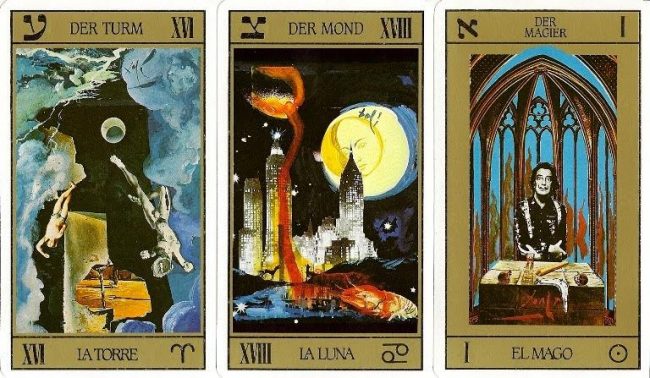
The Tarot has long been a tool of charlatans. But it has also long been embraced by brilliant, unconventional thinkers, many of whom themselves have a touch of the charlatan about them (and who would just as likely admit it with a smile). William Butler Yeats was a fan, as is visionary Chilean filmmaker, artist, writer, and psychonaut Alejandro Jodorowsky, who has recorded his own Youtube series explaining his take on this classic mode of divination. With its archetypal symbolism, the Tarot’s appeal to artists should be obvious. Most of them, like Jodorowsky, find far more interesting uses for it than fortune-telling. “You must not talk about the future,” Jodorowsky tells us in his series, “the future is a con. The tarot is a language that talks about the present.”
What might another visionary artist, Salvador Dalí, think of Jodorowsky’s Tarot interpretations? We’ll never know, but I suspect he would find them enchanting. Not only do the two seem like kindred spirits, but Dalí devoted some part of his life to the Tarot, designing his own deck in the 70s.
Initially, the project arrived as a commission from producer Albert Broccoli for the James Bond film Live and Let Die. “Likely inspired by his wife Gala, who nurtured his interest in mysticism,” writes Chicago’s Museum of Contemporary Art, “Dalí eagerly got to work, and continued the project of his own accord when the contractual deal fell through.”
It was just around this time that the Tarot saw a massive resurgence in popularity. The occult interests of the 60s counterculture were mainstreamed in the 70s thanks to books like Stuart Kaplan’s Tarot Cards for Fun and Fortune Telling. But while Dalí had channeled the vivid psychedelia of the age in an earlier illustration project, 1969’s Alice and Wonderland, his Tarot deck, writes Lisa Rainwater at Galo magazine, “actually shows reserve. Yes, reserve—as if his reverence for the tarot nearly humbles him.” His knack for “fanatical self-promotion” does get the better of him eventually: he chooses his own face to represent the Magician (above).
Overall, the deck combines the eclectic origins of occult practices with Dalí’s own unmistakable sensibility. Dalí’s Tarot is “a pastiche of old-world art, surrealism, kitsch, Christian iconography and Greek and Roman sculpture. Many of his recurring motifs such as the rose, the fly and the bull’s head are found throughout the deck.” First published in a limited edition in 1984—and reissued since in editions by TASCHEN and in book form by other publishers—the deck included an introductory booklet that reads, in Spanish, English, and French:
The Wizard (Arcanum I), Salvador Dalí, has transformed with his exceptional art and his marvelous talent the 78 golden plates of ‘The fabulous book of Thot’ into as many artistic marvels, each one of them duly signed by the hand of this unmatchable, internally famous painter … such an extraordinary artistic creation does not detract, in any way, from the Tarot’s close symbolism. On the contrary, it enhances with its captivating beauty, the Tarot’s esoteric and plastic meaning.
See a preview video of the full Dalí deck above, purchase a limited edition set here, or a much more affordable version here.
NOTE: An earlier version of this post appeared on our site in 2016.
Related Content:
Philip K. Dick Tarot Cards: A Tarot Deck Modeled After the Visionary Sci-Fi Writer’s Inner World
Alejandro Jodorowsky Explains How Tarot Cards Can Give You Creative Inspiration
Behold the Sola-Busca Tarot Deck, the Earliest Complete Set of Tarot Cards (1490)
The Pulp Tarot: A New Tarot Deck Inspired by Midcentury Pulp Illustrations
Josh Jones is a writer and musician based in Durham, NC. Follow him at @jdmagness
Read More...Charlie Chaplin’s Final Speech in The Great Dictator: A Statement Against Greed, Hate, Intolerance & Fascism (1940)
The narrow “toothbrush mustache” caught on in the late nineteenth century, first in the United States and soon thereafter across the Atlantic. When Charlie Chaplin put one on for a film in 1914, he became its most famous wearer — at least until Adolf Hitler rose to prominence a couple of decades later. By that point Chaplin had become the most famous comedy star in the world, which may have inspired the Nazi Party leader, a known fan of Chaplin’s work, to adopt the same mustache as a kind of tool of self-advancement. Chaplin himself could hardly have approved of his new doppelgänger, and it troubled him to discover their other shared qualities: their births in April of 1889, their poor childhoods, their love of Wagner.
Still, as an inveterate entertainer, Chaplin grasped the comedic potential of his and Hitler’s parallel iconic status. The result, released in 1940, was The Great Dictator, his first genuine sound film. Chaplin had continued making silent pictures, and refining his signature visual humor, well into the era of “talkies.”
But he could only have done so much to ridicule Hitler, who had come to power in large part through speeches broadcast over the radio, without being able to use his voice as well. Yet he delivers his most memorable lines not in the role of Hitler surrogate Adenoid Hynkel, but that of the unnamed Jewish barber who — through, of course, several absurd turns of events — ends up mistaken for Hynkel and made to address the nation.
“I’m sorry, but I don’t want to be an emperor,” says Chaplin-as-the-Barber-as-Hynkel. “That’s not my business. I don’t want to rule or conquer anyone. I should like to help everyone — if possible — Jew, Gentile, black man, white. We all want to help one another. Human beings are like that. We want to live by each other’s happiness, not by each other’s misery.” Throughout the three-and-a-half-minute monologue, he speaks against “greed,” “cleverness,” “national barriers,” and “the hate of men”; he advocates for “kindness and gentleness,” “universal brotherhood,” “a world of reason,” and “the love of humanity.” These may not be especially precise terms, but, knowing his public well — much better, indeed, than Hitler ever knew his — Chaplin also knew just when to go broad.
Related content:
When Mahatma Gandhi Met Charlie Chaplin (1931)
When Charlie Chaplin Entered a Chaplin Look-Alike Contest & Came in 20th Place
The Famous Downfall Scene Explained: What Really Happened in Hitler’s Bunker at the End?
Based in Seoul, Colin Marshall writes and broadcasts on cities, language, and culture. His projects include the Substack newsletter Books on Cities, the book The Stateless City: a Walk through 21st-Century Los Angeles and the video series The City in Cinema. Follow him on Twitter at @colinmarshall or on Facebook.
Read More...
Watch a Japanese Artisan Make a Noh Mask, Creating an Astonishing Character From a Single Block of Wood
Noh actors undergo years of rigorous training to perfect their performance technique.
The ancient classical art requires actors’ faces to be obscured by rigid masks carved from single blocks of hinoki wood. A thorough command of posture, physical gesture, and voice is essential for conveying the characters’ emotions.
The quality of the mask is of utmost importance, too.
Nakamura Mitsue, a maker of traditional Noh masks, whose interest in human faces and portraiture originally led her to study western art, notes that the creator must possess a high degree of skill if the mask is to function properly. The best masks will suggest different attitudes from different angles.
Terasu, or an upwards tilt conveys happy emotions, while the downward tilt of kumorasu expresses darker feelings and tears.
The most expertly carved masks’ eyes will appear to shift as the actor changes position.
The full range of human expression is the most difficult to achieve with delicate-featured female Noh masks.
“I used to change its direction and stare at it in the mirror all night,” Ms. Nakamura writes on her website, recalling how her mentor, the celebrated craftsman Yasuemon Hori, taught her how to carve Ko-Omote, a mask representing the youngest woman in the Noh canon.
When creating a mask of a beautiful girl or child I feel very happy but when creating an onryo (ghost spirit) I can feel sorrow or anger.
Ms. Nakamura’s dedication, expertise and patience are on abundant display in the wordless Process X video, above.
She is, as the New York Times notes, one of a growing number of female practitioners:
When she began, she knew of only one other woman in the field, but this year, all four of her current apprentices, some of whom study for as long as 10 years, are female. Some adhere to the traditional archetypes and techniques, while others radically reinterpret them.
Like many other Japanese women of her generation, she did as expected, marrying and having children shortly after completing her education. She began studying mask making when her children began school, waiting until they were 18 to leave her marriage. By then, she was well positioned to support herself as a professional nō-men-shi (Noh mask maker.)
A single mask by a respected nō-men-shi can take a month to complete, but can fetch a price in the neighborhood of ¥500,000.
Ms. Nakamura labors in a workshop in her traditional-style home in Kyoto.
Her tools and supplies are equally old-fashioned — a mixture of seashell powder and rice glue, a mortar and pestle, a chisel that she wields perilously close to her knees and slipper-clad feet…
As Jason Haidar writes in Kansai Scene:
It may be no coincidence that Ms. Nakamura wields a chisel so naturally and with such skill, One of the main chisels used for carving Noh masks is called a tou, which is another word meaning samurai sword. Ms. Nakamura always credited her parents for encouraging her to learn a skill that could allow her to support herself without a husband, and this modern thinking could be attributed to her family being of samurai lineage. After the reforms of the Meiji Restoration (1868–1912) that saw the ushering in of modern Japan, her ancestors learned the importance of being self-sufficient, independent, and having a diverse range of skills – values which were passed down to her.
Explore a gallery of Mitsue Nakamura’s Noh masks here. Click on specific images to learn about each mask’s purpose in Noh, recognized by UNESCO as having “Intangible Cultural Heritage”.
Related Content
A Hypnotic Look at How Japanese Samurai Swords Are Made
20 Mesmerizing Videos of Japanese Artisans Creating Traditional Handicrafts
– Ayun Halliday is the Chief Primatologist of the East Village Inky zine and author, most recently, of Creative, Not Famous: The Small Potato Manifesto and Creative, Not Famous Activity Book. Follow her @AyunHalliday.
Read More...The Map of Medicine: A Comprehensive Animation Shows How the Fields of Modern Medicine Fit Together
The Hippocratic Oath is popularly imagined as beginning with, or at least involving, the command “First, do no harm.” In fact, nothing like it appears among the original Greek words attributed to Hippocrates; the Latin phrase primum non nocere seems to have been added in the seventh century. But the principle makes a highly suitable starting point for Dominic Walliman’s video tour above of his new Comprehensive Map of Medicine. A physicist and science writer, Walliman has previously been featured many times here on Open Culture for his Youtube channel Domain of Science and his maps of other fields, from physics, chemistry, and biology to mathematics, engineering, and computer science.
This new map marks a return after what, to Walliman’s fans, felt like a long hiatus indeed. The prolonged absence speaks to the ambition of the project, whose subject demands the integration of a large number of fields and sub-fields both theoretical and practical.
For medicine existed long before science — science as we know it today, at least— and two and a half millennia after the time of Hippocrates, the connections and interactions between the realm of medicine presided over by doctors and that presided over by scientists are complex and not easily understood by the public. Hence the importance of Walliman’s clarity of visual explanation, as it has evolved throughout his scientific map-making career, as well as his clarity of verbal explanation, on display through all 50 minutes of this video.
As Walliman emphasizes right at the outset, he isn’t a medical doctor — but he is a “doctor” in the sense that he has a PhD, and intellectually, he comes more than well-placed to understand how each part of medicine relates to the others. This is especially true of a lesser-known area of study like medical physics, whose fruits include imaging techniques like X‑ray, MRI, CT, and ultrasound, with which many of us have first-hand experience as patients. Few non-specialists will ever be directly involved in the practice of, say, biology or engineering, but in the twenty-first century, it’s the rare human being indeed who never encounters the reality of medicine. The next time you find yourself in treatment, it certainly couldn’t do any harm to orient yourself on its map.
Related content:
The Map of Biology: Animation Shows How All the Different Fields in Biology Fit Together
Everything You Need To Know About Viruses: A Quick Visual Explanation of Viruses in 9 Images
The Map of Chemistry: New Animation Summarizes the Entire Field of Chemistry in 12 Minutes
Based in Seoul, Colin Marshall writes and broadcasts on cities, language, and culture. His projects include the Substack newsletter Books on Cities, the book The Stateless City: a Walk through 21st-Century Los Angeles and the video series The City in Cinema. Follow him on Twitter at @colinmarshall or on Facebook.
Read More...The Complete Collection Of MTV’s Headbangers Ball: Watch 1,215 Videos from the Heyday of Metal Videos
Premiering in April 1987, MTV’s Headbangers Ball featured music videos from metal and hard rock bands of the 80s and 90s–everyone from AC/DC and Mötley Crüe, to Ozzy Osbourne, Def Leppard and Twisted Sister, to Judas Priest, Iron Maiden and Van Halen. If you’re jonesing to revisit some metal classics, you’re in luck. Some enterprising soul has created a playlist of 1,215 music videos featured on Headbangers Ball. Watch them above. And all along, keep in mind, that the metalhead kids who passed their time watching these videos turned out alright in the end, largely becoming well-adjusted adults. Or so that’s what retrospective scientific studies show. Enjoy…
PS For those who want to re-experience another MTV show, visit this: All the Music Played on MTV’s 120 Minutes: A 2,500-Video Youtube Playlist
If you would like to support the mission of Open Culture, consider making a donation to our site. It’s hard to rely 100% on ads, and your contributions will help us continue providing the best free cultural and educational materials to learners everywhere. You can contribute through PayPal, Patreon, and Venmo (@openculture). Thanks!
Related Content
1980s Metalhead Kids Are Alright: Scientific Study Shows That They Became Well-Adjusted Adults
Watch the First Two Hours of MTV’s Inaugural Broadcast (August 1, 1981)
Read More...Behold the Bridges in India Made of Living Tree Roots
Living green walls and upcycled building materials are welcome environmentally-conscious design trends, but when it comes to sustainable architecture, the living root bridges made by indigenous Khasi and Jaintia people in the north-eastern Indian state of Meghalaya have them beat by centuries.
These traditional plant-based suspension bridges make it much easier for villagers to travel to neighboring communities, markets and outlying farms by spanning the dense tropical rainforest’s many gorges and rivers.
Their construction requires patience, as builders train the aerial roots of well-situated, mature rubber fig trees into position using bamboo, old tree trunks, and wire for support, weaving more roots in as they become available.
This multi-generational construction project can take up to 30 years to complete. The carefully-tended bridges become sturdier with age, as the roots that form the deck and handrails thicken.
The village of Nongriat has one bridge that has been in place for 200-some years. An upper bridge, suspended directly overhead, is a hundred years younger.
As village head and lifelong resident Wiston Miwa told Great Big Story, above, when he was a child, people were leery of using the newer bridge, worried that it was not yet strong enough to be safe. Six decades later, villagers (and tourists) traverse it regularly.
Architect Sanjeev Shankar, in a study of 11 living root bridges, learned that new structures are loaded with stones, planks, and soil to test their weight bearing capacity. Some of the oldest can handle 50 pedestrians at once.
Humans are not the only creatures making the crossing. Bark deer and clouded leopards are also known travelers. Squirrels, birds, and insects settle in for permanent stays.
The Khasi people follow an oral tradition, and have little written documentation regarding their history and customs, including the construction of living root bridges.
Architect Ferdinand Ludwig, a champion of Baubotanik — or living plant construction — notes that there is no set design being followed. Both nature and the villagers tending to the growing structures can be considered the architects here:
When we construct a bridge or a building, we have a plan – we know what it’s going to look like. But this isn’t possible with living architecture. Khasi people know this; they are extremely clever in how they constantly analyze and interact with tree growth, and accordingly adapt to the conditions…How these roots are pulled, tied and woven together differ from builder to builder. None of the bridges looks similar.
The bridges, while remote, are becoming a bucket list destination for adventurers and ecotourists, Nongriat’s double bridge in particular.
The BBC’s Zinara Rathnayake reports that such outside interest has provided villagers with an additional source of income, as well as some predictable headaches — litter, inappropriate behavior, and overcrowding:
Some root bridges see crowds of hundreds at a time as tourists clamber for selfies, potentially overburdening the trees.
The Living Bridge Foundation, which works to preserve the living root bridges while promoting responsible ecotourism is seeking to have the area designated as a UNESCO World Heritage Site.
Related Content
1,100 Delicate Drawings of Root Systems Reveals the Hidden World of Plants
The Tree of Languages Illustrated in a Big, Beautiful Infographic
– Ayun Halliday is the Chief Primatologist of the East Village Inky zine and author, most recently, of Creative, Not Famous: The Small Potato Manifesto and Creative, Not Famous Activity Book. Follow her @AyunHalliday.
Read More...Watch Ben Kingsley Play Salvador Dalí in the Trailer for the New Film, Dalíland
By itself, the prospect of seeing Sir Ben Kingsley play Salvador Dalí would be enough to get more than a few moviegoers into the theater (or onto their couches, streaming). But then, so would the prospect of seeing him play practically anyone: Mahatma Gandhi (as the Academy acknowledged), or Georges Méliès, or Dmitri Shostakovich, or a foulmouthed London gang enforcer. Dalíland, which comes out next month, promises a rich portrayal of Dalí not just by Kingsley, but by also Ezra Miller, an actor possessed of a physical resemblance to the artist in his youth as well as a public life seen as scandalous and occasionally criminal.
This choice of casting, with the troubled Miller playing the young Dalí and the ultra-respectable Kingsley playing the old, reflects a certain intent to capture the duality of the character himself. Kingsley has spoken of developing his interpretation of Dalí “based on his language; his behavior; his taste in love, life, food, wine, and everything; and also his daring to break so many rules.”
You can hear him reflect more on the experience in the Deadline Hollywood video just below. “I love his work,” he says. “I love his fearlessness, and he was exhilarating and exhausting to play, as I anticipated he would be.” He also has high praise for director Mary Harron, who’s known for her adaptation of Bret Easton Ellis’ American Psycho.
Harron’s first feature was I Shot Andy Warhol, about Warhol’s near-murderer Valerie Solanas, and her most recent, Charlie Says, tells the story of Leslie Van Houten and the Manson family. Such pictures demonstrate her facility with biographical drama, as well as her investment in the culture of postwar America and the eccentric personalities that both enlivened and darkened it. Dalíland takes place in the winter of 1974, which Dalí and his wife Gala spent at the St. Regis Hotel in New York. Its protagonist, a young gallery employee played by Christopher Briney, gets pulled into Dalí’s world and becomes responsible for making sure the artist has all the work ready for his fast upcoming show.
“The film’s seventies setting allows it to be a portrait of the moment when the art world underwent its tectonic shift, fusing with the money culture, becoming a kind of piggy bank for the wealthy,” writes Variety’s Owen Gleiberman. “Dalí and Gala have, in their way, played into this. They’re exploiters of Dalí’s legend who have, in turn, been exploited.” At that time Dalí still had about fifteen years to go, but Kingsley sees the period as “possibly the closing chapters of Dalí’s life,” the setting of “his coming to terms with mortality, a subject with which he struggled dreadfully.” The phenomenon witnessed by Briney’s character, and thus the audience, is “how a genius leaves the world” — and, in this particular case, leaves it considerably more surreal than he found it.
Related content:
A Soft Self-Portrait of Salvador Dalí, Narrated by the Great Orson Welles
Two Vintage Films by Salvador Dalí and Luis Buñuel: Un Chien Andalou and L’Age d’Or
Sir Ben Kingsley Reads a Letter Written by Gandhi to Hitler (in the Voice of Mahatma Gandhi)
Salvador Dalí on What’s My Line?
Based in Seoul, Colin Marshall writes and broadcasts on cities, language, and culture. His projects include the Substack newsletter Books on Cities, the book The Stateless City: a Walk through 21st-Century Los Angeles and the video series The City in Cinema. Follow him on Twitter at @colinmarshall or on Facebook.
Read More...Support Us
We're hoping to rely on loyal readers, rather than erratic ads. Please click the Donate button and support Open Culture. You can use Paypal, Venmo, Patreon, even Crypto! We thank you!

About Us

Open Culture scours the web for the best educational media. We find the free courses and audio books you need, the language lessons & educational videos you want, and plenty of enlightenment in between.
Advertise With Us

FREE UPDATES!
GET OUR DAILY EMAIL
Get the best cultural and educational resources on the web curated for you in a daily email. We never spam. Unsubscribe at any time.
FOLLOW ON SOCIAL MEDIA

Open Culture editor Dan Colman scours the web for the best educational media. He finds the free courses and audio books you need, the language lessons & movies you want, and plenty of enlightenment in between.
Advertise With Us

