How The Wrecking Crew Secretly Recorded Some of the Biggest Hits of the 1960s & 70s
The top flight crew of L.A. studio musicians known as The Wrecking Crew acquired their name, legend has it, because they “were wrecking the business for everyone else,” writes Janet Maslin at The New York Times, meaning older session players who couldn’t keep up. Drummers like Hal Blaine (“who justifiably calls himself ’10 of Your Favorite Drummers’ on his Web site”) and guitarists like Tommy Tedesco and Carol Kaye could play anything put in front of them perfectly, in one take, with the style and perfect timing that characterize the absolute best rock, folk, pop, and soul of the 1960s.
With some exceptions, this group kept a low profile and have only become known in subsequent retrospectives that reveal just how much they contributed to the music of the era. The answer is: more than anyone surely suspected at the time. But “the Wrecking Crew was not supposed to attract attention. Groups like the Beach Boys, the Byrds, the Monkees and many others didn’t care to point out why they sounded so much better on records than on the road.”
Not only did members of the Crew “work miracles,” playing a “first-take, no-glitch version of ‘The Little Old Lady From Pasadena,’” for example, but in many cases, they composed iconic parts without which songs like “The Beat Goes On” or “These Boots Were Made For Walking” would probably not have become hits.
“Nine times out of ten the producer or arranger would tell us to use the charts as a guide, that’s all,” Blaine remembered. “We were encouraged to go for it, to go beyond what had been written. We had the opportunity to create, to be a team of arrangers.”
Though mostly unknown to listeners, the couple dozen or so musicians in this group of exceptional performers did produce two major stars, Leon Russell and Glen Campbell, who toured with the Beach Boys in the mid-60s until he became a major superstar with the Jimmy Webb-penned songs “By the Time I Get to Phoenix” and “Wichita Lineman,” both recorded, of course, with members of the Crew. They played on jazz records and recorded iconic TV theme songs like The Twilight Zone, Green Acres, Bonanza, M*A*S*H*, Batman, Mission: Impossible, and Hawaii Five‑O.
The only female member of the Crew, Carol Kaye, was described as “the greatest bass player I’ve ever met,” by no less than Brian Wilson. Reported to have played on something like 10,000 sessions, she wrote basslines for songs from “California Girls” to the “Theme from Shaft.”
You can learn much more about the once-hidden work of some of the best studio musicians in the country, rivals of the best players in Motown, Memphis, and Muscle Shoals, in the documentary above directed by Danny Tedesco, son of Wrecking Crew guitarist Tony Tedesco. Or Kent Hartman’s book, The Wrecking Crew: The Inside Story of Rock and Roll’s Best-Kept Secret.
Listen to a YouTube playlist of classic Wrecking Crew tracks here. And see why when you thought you were listening to The Byrds, Beach Boys, Mamas and Papas, Monkees and even Simon & Garfunkel, you were really often listening to the Wrecking Crew.
Related Content:
How Carol Kaye Became the Most Prolific Session Musician in History
Meet Carol Kaye, the Unsung Bassist Behind Your Favorite 60s Hits
Josh Jones is a writer and musician based in Durham, NC. Follow him at @jdmagness
Read More...The New Enlightenment and the Fight to Free Knowledge: Part 3
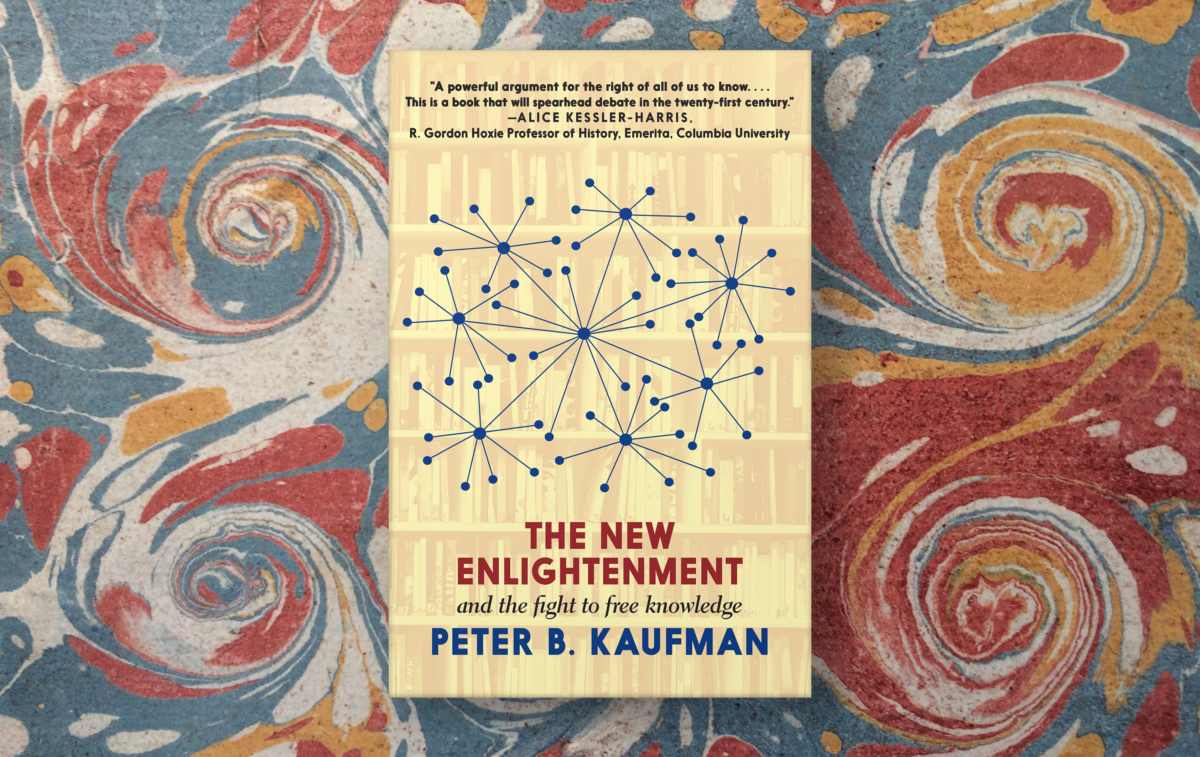
Editor’s Note: MIT Open Learning’s Peter B. Kaufman has just published The New Enlightenment and the Fight to Free Knowledge, a book that takes a historical look at the powerful forces that have purposely crippled our efforts to share knowledge widely and freely. His new work also maps out what we can do about it. Generously, Peter has made his book available through Open Culture by publishing three short essays along with links to the corresponding freely licensed sections of his book. Today, you can read his third essay “The Republic of Images” (below). Find his first essay, “The Monsterverse” here, his second essay “On Wikipedia, the Encyclopédie, and the Verifiability of Information” here, and purchase the entire book online.
In November 1965, after some hondling between the Carnegie Corporation and the Ford Foundation, a senior executive from Carnegie called former president of MIT James Killian with an invitation. Would Killian be interested in assembling a commission to study educational television with an eye toward strengthening the American system of learning on screen, and could he start right away? Killian jumped; a commission was formed; and two years, eight meetings, 225 interviews, and 92 site visits later, the Carnegie Commission’s report comes out, a bill gets written, the bill becomes law, and President Johnson is signing the 1967 Public Television Act to create public television and radio.
At the signing ceremony, Johnson said, “Today, we rededicate a part of the airwaves – which belong to all the people – and we dedicate them for the enlightenment of all the people. We must consider,” he said, “new ways to build a great network for knowledge – not just a broadcast system, but one that employs every means of sending and storing information that the individual can use.”
Heady stuff. But it gets even better:
Think of the lives that this would change:
The student in a small college could tap the resources of a great university. […]
The country doctor getting help from a distant laboratory or a teaching hospital;
A scholar in Atlanta might draw instantly on a library in New York;
A famous teacher could reach with ideas and inspirations into some far-off classroom, so that no child need be neglected.
Eventually, I think this electronic knowledge bank could be as valuable as the Federal Reserve Bank.
And such a system could involve other nations, too – it could involve them in a partnership to share knowledge and to thus enrich all mankind.
A wild and visionary idea? Not at all. Yesterday’s strangest dreams are today’s headlines and change is getting swifter every moment.
I have already asked my advisers to begin to explore the possibility of a network for knowledge – and then to draw up a suggested blueprint for it.
The system he was signing into law, Johnson said, “will be free, and it will be independent – and it will belong to all of our people.”
A new network for knowledge.
Imagine.
Fifty years later, totally (seemingly) unrelated, then MIT president Charles Vest went on to speak of something else, something that became MIT Open Courseware. Together with new foundations – this time the Hewlett Foundation and the Mellon Foundation led the way – Vest envisioned “a transcendent, accessible, empowering, dynamic, communally constructed framework of open materials and platforms on which much of higher education worldwide can be constructed or enhanced:”
A meta-university that will enable, not replace, residential campuses, that will bring cost efficiencies to institutions through the shared development of educational materials. That will be adaptive, not prescriptive. It will serve teachers and learners in both structured and informal contexts. It will speed the propagation of high-quality education and scholarship. It will build bridges across cultures and political boundaries. And it will be particularly important to the developing world.
Today, in our time of severe truth decay, our great epistemic crisis, it might be time again to envision another intervention, formative and transformational as the establishment of public broadcasting, imaginative and daring as the launch of open courseware and the open education movement. Indeed, something as breathtaking as the events above, and their own vital forbear over a century ago – the founding of a network of public libraries across America and other parts of the world (which also happened with Andrew Carnegie’s financial support).
The original Enlightenment brought us Newton’s physics, Rousseau’s political philosophy, Linnaeus’s taxonomies, Montesquieu’s laws, the Declaration of Independence, the Declaration of the Rights of Man – it was the Age of Reason. Its founders – as we noted in [Parts 1 and II on] Open Culture – comprised between themselves what became known as the great Republic of Letters. They were all men, though; and they all were white; while they had access to their own means and to the mean of media production, and they delivered new systems of thinking much of the modern world is based on today, their circles were limited; their imaginations were not our imaginations.
Today we have a chance to do more – to take advantage of the cultures and communities that have arisen in the centuries and from the struggles since that time, to launch a new Enlightenment, and to realize perhaps in bolder and more secure ways this new network for knowledge. Video, more than text now, has taken over the internet; video is a new key to our networked world. The company Cisco Systems – which makes many of the devices that connect us – deploys a forecasting tool it calls the Visual Networking Index (VNI). The latest VNI tells us that there were 3.4 billion Internet users on the planet in 2017, almost half of the planet’s current population of 7.7 billion people. By 2022, there will be 4.8 billion Internet users: 60 percent of the planet, and more people in the world will be connected to the Internet than not. By 2022, more than 28 billion “devices and connections” will be online. And – here’s the kicker – video will make up 82 percent of global Internet traffic. Video is dominant already. During peak evening hours in the Americas, Netflix can account for as much as 40 percent of downstream Internet traffic, and Netflix – Netflix alone – constitutes 15 percent of Internet traffic worldwide. All this forecasting was completed before the pandemic; before 125 million cases of Corona virus; before 3 million deaths worldwide; before the explosion of Zoom.
We are living in a video age. What will be our next media intervention? How do knowledge institutions secure their deservedly central place in search and on the web? We need to look over our rights vis-à-vis the government and the giant companies that increasingly control our Internet; we need to look at the growing power we have to contribute to access to knowledge and share our wealth especially in the online Commons; we need to make sure that the public record, especially video (and especially video of all the lies and crimes, and of all the outrageous falsehoods leaders circulate about COVID) is all archived and preserved. We need to strengthen how much of the network we own and control.
What’s important is that we have begun to reach toward the point where there is equity in the leadership of our knowledge institutions. No longer are white men and only white men in charge of the Library of Congress, for example, or the Smithsonian Institution, or, and thus by extension, of our new Enlightenment. New and diverse study and action groups are being formed specifically to address our information disorder. But many more of our leading knowledge institutions – and, critically, foundations and funding agencies again – need to lead this work. This is a 20th-anniversary year for MIT Open CourseWare, for Wikipedia, and for Creative Commons; indeed, MIT OCW starts to celebrate its birthday this month. Many other like-minded progressive institutions and their supporters are on the move. That network for knowledge is coming again: this time, our new Enlightenment moment will belong to all of us.
Peter B. Kaufman works at MIT Open Learning and is the author of The New Enlightenment and the Fight to Free Knowledge.
Read More...Why Do Wes Anderson Movies Look Like That?
The dominant form of Hollywood and/or mainstream filmmaking has been realism, the sense that even in our wildest fantasy, sci-fi, and superhero films there’s still an attempt to hide the camera, the crew, and the lighting, and that what we’re seeing just *is*, that nothing has been constructed for us. Despite the tricks that editing and non-diegetic sound (music, etc.) play on us, we are still willing to believe that we are seeing a thing that happened.
There’s very few filmmakers that explicitly resist this and still make popular and successful Hollywood films, and Wes Anderson is one of them. Hence the above video essay from Thomas Flight, who recently visited Anderson’s films to pull out the more esoteric of his references.
Flight’s thesis runs thusly. Anderson chose to use real fur on the stop-motion puppets in the Fantastic Mr. Fox not despite the hair moving from the animators’ hands’ manipulation, but *because* of it. Showing the fingerprints as it were of the creators within the film itself is a constant stylistic choice in his cinema, and one that is also reflected in his use of flat, diorama-like frames. This is what critic Matt Zoller Seitz, who has written several beautiful coffee table books on Wes Anderson, calls Planimetric Composition. But it’s also there in the titles, use of theater curtains, of the numerous storybook and comic book references that shape Anderson’s work.
This is not new of course, if you follow any writing on Anderson. It’s a key to understanding his aesthetic. But Flight goes further to ask why. Why construct something so artificial and risk alienating audiences?
Flight comes to the point: it’s a risk worth taking. It’s a moment in childhood—he compares it to a parent reading a bedtime story. A parent is present, often the focus of the child’s attention (there might not even be a book) but at the same time so is the story. Words unfold in speech and also unfold in a child’s mind. Both exist in the same space, the artificial and the real.
So many Anderson films unfold like storybooks—we often see a hardback book with the same title in the film itself, or in the case of The Grand Budapest Hotel, a series of stories and books, all nestled inside each other. Flight doesn’t make the comparison, but it is worth doing so: Anderson’s films are like epistolary novels of the 19th century, such as Frankenstein or Wuthering Heights, stories within letters within stories.
But here’s the interesting part: when Anderson has a moment of heightened emotion in his films, where characters let down their guard and speak from the heart, the director will give us the classic realist shot/reverse shot. It’s fleeting but it’s there.
And that works exactly because Anderson holds off on revealing it to us until that one moment. The storyteller knows it’s special and knows we’re going to find it special. At a time when the auteur theory is under attack from critics on one side and the capitalist machine, it’s good to know there’s a director like Anderson who doesn’t give us what we want, but gives us what we so sorely need.
Related Content:
Wes Anderson’s Shorts Films & Commercials: A Playlist of 8 Short Andersonian Works
A Complete Collection of Wes Anderson Video Essays
Ted Mills is a freelance writer on the arts who currently hosts the Notes from the Shed podcast and is the producer of KCRW’s Curious Coast. You can also follow him on Twitter at @tedmills, and/or watch his films here.
Read More...Why Every World Map Is Wrong
The idea that the world maps are wrong — all of them — is hardly controversial. It’s a mathematical fact that turning a globe (or an oblate spheroid) into a two-dimensional object will result in unavoidable distortions. In the TED-Ed lesson above by Kayla Wolf, you’ll learn a brief history of world maps, starting all the way back with the Greek mathematician Ptolemy, who “systematically mapped the Earth on a grid” in 150 AD in order to create maps that had a consistent scale. His grid system is still in use today — 180 lines of latitude and 360 lines of longitude.
Most of the world maps we knew come from the Mercator Projection, “a cylindrical map projection presented by the Flemish geographer and cartographer Gerardus Mercator in 1569,” writes Steven J. Fletcher.
This map projection is practical for nautical applications due to its ability to represent lines of constant course, known as rhumb lines, as straight segments that conserve the angles with the meridians…. the Mercator projection distorts the size of objects as the latitude increases from the equator to the poles, where the scale becomes infinite.
Mercator’s innovation allowed for the shipping routes that created the modern world (including those through the now-unblocked Suez Canal). But the projection has its problems: 14 Greenlands, for example, could fit inside the continent of Africa, says Wolf, but “you wouldn’t guess it from most maps of the world” in which the two land masses are almost the same size.
“In 2010,” Adam Taylor notes at The Washington Post, “graphic artist Kai Krause made a map to illustrate just how big the African continent is. He found that he was able to fit the United States, India and much of Europe inside the outline of the African continent.”
Geographical misperceptions “shape our understanding of the world,” Nick Routley writes at Business Insider, “and in an increasingly interconnected and global economy, this geographic knowledge is more important than ever.” We are no longer primarily using maps, that is to say, to chart, trade with, or conquer formerly unknown regions of the world — from locations assumed to be the natural centers of commerce, culture, or religion.
Non-Mercator world maps have, over the last few decades especially, attempted to correct the errors of cylindrical projection by unfolding the globe like an orange peel or a series of interlocking triangles, as in Buckminster Fuller’s 1943 Dymaxion Map. These have proved nautical miles more accurate than previous versions but they are useless in navigating the world.
Why create new, more accurate world maps? Because the Mercator projection has given the impression of Euro-American geographical supremacy for almost 500 years now, Wolf’s lesson argues, simply by virtue of the location of its origin and its original purpose. But it is now not only inaccurate and outdated, it is also irrelevant. Maps play a vital role in education. The practical utility, however, of flat world maps these days is pretty much beside the point, since GPS technology has mostly eliminated the need for them altogether.
Related Content:
Buckminster Fuller’s Map of the World: The Innovation that Revolutionized Map Design (1943)
Japanese Designers May Have Created the Most Accurate Map of Our World: See the AuthaGraph
Why Making Accurate World Maps Is Mathematically Impossible
Josh Jones is a writer and musician based in Durham, NC. Follow him at @jdmagness
Read More...Watch the Classic Silent Film The Ten Commandments (1923) with a New Score by Steve Berlin (Los Lobos), Steven Drozd (Flaming Lips) & Scott Amendola
For Passover 2021, the culture nonprofit Reboot has released “a modern day score to Cecil B. Demille’s 1923 classic silent film The Ten Commandments with Steve Berlin (Los Lobos), Steven Drozd (Flaming Lips) and Scott Amendola.”
Reboot writes: “Berlin, Drozd and Amendola created a momentous new score for the Exodus tale, musically following Moses out of Egypt and into the Dessert where he receives the Ten Commandments. Cecil B. DeMille’s first attempt at telling the Ten Commandments story was in the Silent era year of 1923. The film [now in the public domain] is broken up into two stories: the story of the Jewish Exodus from Egypt and a thinly related ‘present day’ melodrama.”
Enjoy it all above.
If you would like to support the mission of Open Culture, consider making a donation to our site. It’s hard to rely 100% on ads, and your contributions will help us continue providing the best free cultural and educational materials to learners everywhere. You can contribute through PayPal, Patreon, and Venmo (@openculture). Thanks!
Related Content:
Watch the German Expressionist Film, The Golem, with a Soundtrack by The Pixies’ Black Francis
Radiohead’s Thom Yorke Performs Songs from His New Soundtrack for the Horror Film, Suspiria
Read More...The Mathematics Behind Origami, the Ancient Japanese Art of Paper Folding
The two characters at the core of origami (折り紙), one of the best-known Japanese words around the world, mean “folding” and “paper.” You might well have guessed that, but given the variety and elaborateness of the constructions produced by origami masters over the past few centuries, the simplicity of the practice’s basic nature bears repeating. Those masters must develop no slight degree of manual dexterity, it goes without saying, but also a formidable mathematical understanding of their medium. In many cases that understanding is intuitive; in the TED-Ed lesson above, origami artist Evan Zodl makes it explicit.
Zodl’s lesson explains that “though most origami models are three-dimensional, their crease patterns are usually designed to fold flat, without introducing any new creases or cutting the paper.”(Incidentally, the Japanese word for paper art involving cuts is kirigami, or 切り紙.)
An “abstract, 2D design” thus becomes, in the origami master’s hands, “a 3D form,” but only in accordance with a set of four simple rules Zodl explains. He does so clearly and understandably — and in a way that for many of us may exhume buried geometry-class memories — but like actual works of origami, they’re better shown than described: hence the vivid accompanying animations of Charlotte Arene.
Origami’s principles and products may be fascinating to contemplate, but “the ability to fold a large surface into a compact shape” has also proven to have serious real-world applications. Zodl points to an origami-based re-imagination of “the traditional stent graft, a tube used to open and support damaged blood vessels.” This in addition to “airbags, solar arrays, self-folding robots, and even DNA nanostructures” — as well as a massive “star shade” for space telescopes that blocks the glare of nearby stars. If you’d like to get started on your own tactile understanding of all this, do have a look at Zodl’s own Youtube channel, as well as others like Origami Instructions. Don’t let the elaborately folded flowers, boats, or animals you’ve seen intimidate you; start with a simple box and work your way up from there. If origami shows us anything, after all, it’s that complexity begins with simplicity.
Related Content:
An Origami Samurai Made from a Single Sheet of Rice Paper, Without Any Cutting
A Database of Paper Airplane Designs: Hours of Fun for Kids & Adults Alike
MIT Creates Amazing Self-Folding Origami Robots & Leaping Cheetah Robots
Designer Creates Origami Cardboard Tents to Shelter the Homeless from the Winter Cold
The Making of Japanese Handmade Paper: A Short Film Documents an 800-Year-Old Tradition
Based in Seoul, Colin Marshall writes and broadcasts on cities, language, and culture. His projects include the Substack newsletter Books on Cities, the book The Stateless City: a Walk through 21st-Century Los Angeles and the video series The City in Cinema. Follow him on Twitter at @colinmarshall or on Facebook.
Read More...The Aesthetic of Anime: A New Video Essay Explores a Rich Tradition of Japanese Animation
Giant robots, superpowered schoolgirls, berzerker martial artists: we all know the sort of figures that represent anime. Though clichéd, the widespread nature of these perceptions actually shows how far Japanese animation has come over the past few decades. Not so long ago, the average Westerner didn’t know the meaning of the world anime, let alone its origin. Today, thanks not least to the films of Hayao Miyazaki’s Studio Ghibli, the average Westerner has likely already been exposed to one or two masterworks of the form. This viewing experience provides a sense of why Japanese animation, far from simply animation that happens to be Japanese, merits a term of its own: any of us, no matter how inexperienced, can sense “The Aesthetic of Anime.”
Taking that concept as the title of their latest video essay, Lewis and Luiza Liz Bond of The Cinema Cartography show us a range of cinematic possibilities that anime has opened up since the 1980s. I recall, long ago, staying up late to tune in to the Sci-Fi Channel’s “Saturday Night Anime” block to catch such classics from that decade as Venus Wars and Project A‑Ko.
While Japanese animation in all its forms has gone much more mainstream around the world since then, it hasn’t resulted in a loss of artistic, narrative, and thematic inventiveness. On the contrary, Bond argues: over the past quarter-century, series like Neon Genesis Evangelion, Serial Experiments Lain, and Death Note have not only pushed the boundaries of anime, but demonstrated a power to “re-signify storytelling conventions that go beyond the anime form itself.”
In the effort to reveal the true nature of “the misunderstood and often disregarded world of anime,” this video essay references and visually quotes dozens of different shows. (It stops short of the also-vast realm of feature films, such as Ghost in the Shell or the work of Satoshi Kon.) Its range includes the “existential meditation on loneliness” that is Cowboy Bebop, subject of another Bond exegesis previously featured here on Open Culture, and “city pop-fueled Superdimensional Fortress Macross,” which did so much back in the 80s to define not just giant-robot anime but anime itself. Trope-heavy, over-the-top, and “unapologetically weird” though it may seem (but usually not, as Bond implies, without self-awareness), anime continues to realize visions not available — nor even conceivable — to any other art form.
Related Content:
How Master Japanese Animator Satoshi Kon Pushed the Boundaries of Making Anime: A Video Essay
Based in Seoul, Colin Marshall writes and broadcasts on cities, language, and culture. His projects include the Substack newsletter Books on Cities, the book The Stateless City: a Walk through 21st-Century Los Angeles and the video series The City in Cinema. Follow him on Twitter at @colinmarshall or on Facebook.
Read More...Three Leonard Cohen Animations
Leonard Cohen, High Priest Of Pathos…
Lord Byron of Rock and Roll…
Gentleman Zen
Master Of Misery…Morbidity… Erotic Despair…
Prince of Pessimism…Pain…
Troubadour For Troubled Souls…
The gravel-voiced singer-songwriter accumulated hundreds of nicknames over a career spanning more than half a century. He wasn’t thrilled by some of them, remarking to the BBC, “You get tired, over the years, hearing that you’re the champion of gloom.”
Taken all together, however, they make for a decent composite portrait of a prolific artist whose sensuality, mordant wit, and obsession with love, loss, and redemption never wavered.
He took some hiatuses, including a 5‑year stint as a monk in California’s Mount Baldy monastery, but never retired.
His final studio album, You Want It Darker, was released mere weeks before his death.
Journalist Rob Sheffield articulated the Cohen mystique in a Rolling Stone eulogy:
This man was both the crack in everything and the light that gets in. Nobody wrote such magnificently bleak ballads for brooding alone in the dark, staring at a window or wall – “Joan of Arc,” “Chelsea Hotel,” “Tower of Song,” “Famous Blue Raincoat,” “Closing Time.” He was music’s top Jewish Canadian ladies’ man before Drake was born, running for the money and the flesh. Like Bowie and Prince, he tapped into his own realm of spiritual and sexual gnosis, and like them, he went out at the peak of his musical powers. No songwriter ever adapted to old age with more cunning or gusto.
Cohen also excelled at interviews, leaving behind a wealth of generous, freewheeling recordings, at least three of which have become fodder for animators.
The animation at the top of the page is drawn from Cohen’s 1966 interview with the Canadian Broadcasting Corporation’s Adrienne Clarkson, shortly after the release of his experimental novel, Beautiful Losers. (His debut album was still a year and a half away.)
Earlier in the interview, Cohen mentions the “happy revolution” he encountered in Toronto after an extended period on the Greek island of Hydra:
I was walking on Yorkville Street and it was jammed with beautiful, beautiful people last night. I thought maybe it could spread to the [other] streets and maybe even … where’s the money district? Bay Street?… I thought maybe they could take that over soon, too.
How to tap into the source of all this happiness?
The future Zen monk Cohen was pretty convinced it could be located by sitting quietly, though he doesn’t condemn those using drugs or alcohol as an assist, explaining that his fellow Canadian, abstract expressionist Harold Town, “gets beautiful under alcohol. I get stupid and generally throw up.”
8 years later, WBAI’s Kathleen Kendel came armed with a poem for Cohen to read on air, and also plumbed him as to the origins of “Sisters of Mercy,” one of his best known songs, and the only one that didn’t require him to “sweat over every word.” (Possibly the consolation prize for his dashed hopes of erotic adventure with the song’s protagonists.)
(The animation here is by Patrick Smith for PBS’ Blank on Blank series.)
Animator Joe Donaldson riffs on an excerpt from Cohen’s final major interview, with The New Yorker’s editor-in-chief, David Remnick, above.
Remnick recalled that his subject, who died a few days later, was “in an ebullient mood for a man… who knew exactly where he was going, and he was headed there in a hurry. And at the same time, he was incredibly gracious.”
The 82-year-old Cohen spoke enthusiastically if somewhat pessimistically about having a lot of new material to get through, “to put (his) house in order,” but also admitted, “sometimes I just need to lie down.”
Related Content:
Hear Leonard Cohen’s Final Interview: Recorded by David Remnick of The New Yorker
Ladies and Gentlemen… Mr. Leonard Cohen: The Poet-Musician Featured in a 1965 Documentary
Leonard Cohen Plays a Spellbinding Set at the 1970 Isle of Wight Festival
Ayun Halliday is an author, illustrator, theater maker and Chief Primatologist of the East Village Inky zine. Follow her @AyunHalliday.
Read More...A Finnish Astrophotographer Spent 12 Years Creating a 1.7 Gigapixel Panoramic Photo of the Entire Milky Way

In the final, climactic scene of Japanese novelist Yasunari Kawabata’s Snow Country, the Milky Way engulfs the protagonist — an aesthete who keeps himself detached from the world, a universal perspective overtaking an insignificant individual.
We now know the Milky Way itself to be a minuscule part of the whole, just one of 100 to 200 billion galaxies. But until Edwin Hubble’s observations in 1924, it was thought to contain all the stars in existence.

The Milky Way-as-universe is a powerful image, and certainly more comprehensible than the universe as astronomers currently understand it. Its vastness can’t be compressed into a symbolic form like the via lactea, “Milky Way,” or as the Greeks called it, galaktikos kýklos, “milky circle.” Andy Briggs summarizes just a few of the ancient myths and legends:
To the ancient Armenians, it was straw strewn across the sky by the god Vahagn. In eastern Asia, it was the Silvery River of Heaven. The Finns and Estonians saw it as the Pathway of the Birds.… Both the Greeks and the Romans saw the starry band as a river of milk. The Greek myth said it was milk from the breast of the goddess Hera, divine wife of Zeus. The Romans saw the river of light as milk from their goddess Ops.
A barred spiral galaxy spinning around a “galactic bulge” with an empty center, a “monstrous black hole,” notes Space.com, “billions of times as massive as the sun”… the Milky Way remains an awesome symbol for a universe too vast for us to hold in our minds.

Witness, for example, the just-released image further up, a 1.7 gigapixel panoramic photo of the Milky Way, from Taurus to Cygnus, 100,000 pixels wide, pieced together from 234 panels by Finnish astrophotographer J‑P Metsavainio, who began the project all the way back in 2009. “I can hear music in this composition,” he writes at his site, “from high sparks and bubbles at left to deep and massive sounds at right.”
Over 12 years, and around 1250 hours of exposure, Michael Zhang writes at Petapixel, Metsavainio “focused on different areas and objects in the Milky Way, shooting stitched mosaics of them as individual artworks.” As he began to knit the galactic clouds of stars and gasses together into a Photoshop panorama, he discovered a “complex image set which is partly overlapping with lots of unimaged areas between and around frames.” Over the years, he filled in the gaps, shooting the “missing data.” He describes his equipment and process in detail, for those fluent in the technical jargon. The rest of us can stare in silent wonder at more of Metsavainio’s work on his website (where you can also purchase prints) and Facebook, and let ourselves be overtaken by awe.
via Petapixel and Kottke
Related Content:
How Scientists Colorize Those Beautiful Space Photos Taken By the Hubble Space Telescope
Josh Jones is a writer and musician based in Durham, NC. Follow him at @jdmagness
Read More...The Story Behind the Iconic Bass-Smashing Photo on the Clash’s London Calling
Pennie Smith was not a fan. Maybe that’s what made her the perfect photographer for The Clash. “She was never particularly into rock music,” writes Rob Walker at The Guardian; she wasn’t starstruck or overawed by her subjects; and she also wasn’t even particularly in love with the most famous shot of her career — the iconic photo of bassist Paul Simonon raising his Fender Precision at New York’s Palladium, seconds before smashing it to bits. “I said, ‘it’s completely out of focus,’” Smith remembers of the image when Joe Strummer insisted on using it for the cover of legendary double-LP London Calling. “But Joe wouldn’t have it. He said, ‘That one is the photo.’”
He was obviously correct, though Smith still doesn’t sound convinced. “I’m pleased I took it,” she says, “but it’s a bit of a weight around my neck. It keeps coming back to whack me on the back of the head — nicely in some instances, but aggravatingly in others.” Hitting one in the head — front or back — is the aim of the best album covers in punk, and “punk rock’s rage and dissent have always been easy to represent visually,” says Noah Lefevre in the Polyphonic video above. Taking the perfect punk photograph, however, depended on a number of variables all coming together perfectly for a once-in-a-lifetime shot.
For one thing, Smith had to have made the gig. She nearly accepted an offer to go out with friends instead. She also decided to change it up that night and stand on Simonon’s side of the stage instead of next to guitarist Mick Jones. And then, as Lefevre explains, there was the show itself. “In London, the Clash would play raucous punk bars and dancehalls full of standing room crowds. In the U.S.,” during their first tour in 1979, “they often found themselves playing in theaters with fixed seating.” The Palladium was such a venue. “Bouncers would hold crowds back, make sure they stayed stapled to their seats.”
The sedentary crowd killed the vibe. By the end of the show, “Paul’s frustration turned to anger,” notes Snap Galleries, “and then he lost it completely. His watch stopped at 9:50pm.” Smith remembers seeing him suddenly spin toward her. “He was in a really bad mood, and that wasn’t like him.” She was so startled, she got the photograph. “It wasn’t a choice to take the shot. My finger just went off.” That chance moment gave the band an ideal image for the London Calling cover.
It was illustrator Ray Lowry’s idea to crib the typography of Elvis’ first record, and the font “called back to the roots of punk rock,” born out of the ‘50s rockabilly tradition of simple songs and bare-bones instrumentation and arrangements. “Punk and rock and roll held the same cultural significance,” Lefevre says, but The Clash announced themselves on the album cover as purifiers of the tradition, stripping out the “phony Beatlemania” Strummer decried in the title track and replacing it with righteous, if barely-in-focus, rage. Hear the full gig just above, including the bass-smashing at the end at 1:08:10.
Related Content:
“Stay Free: The Story of the Clash” Narrated by Public Enemy’s Chuck D: A New 8‑Episode Podcast
The Clash Play Their Final Show (San Bernardino, 1983)
The Clash Live in Tokyo, 1982: Watch the Complete Concert
Josh Jones is a writer and musician based in Durham, NC. Follow him at @jdmagness
Read More...Support Us
We're hoping to rely on loyal readers, rather than erratic ads. Please click the Donate button and support Open Culture. You can use Paypal, Venmo, Patreon, even Crypto! We thank you!

About Us

Open Culture scours the web for the best educational media. We find the free courses and audio books you need, the language lessons & educational videos you want, and plenty of enlightenment in between.
Advertise With Us

FREE UPDATES!
GET OUR DAILY EMAIL
Get the best cultural and educational resources on the web curated for you in a daily email. We never spam. Unsubscribe at any time.
FOLLOW ON SOCIAL MEDIA

Open Culture editor Dan Colman scours the web for the best educational media. He finds the free courses and audio books you need, the language lessons & movies you want, and plenty of enlightenment in between.
Advertise With Us


