The New Enlightenment and the Fight to Free Knowledge: Part 2
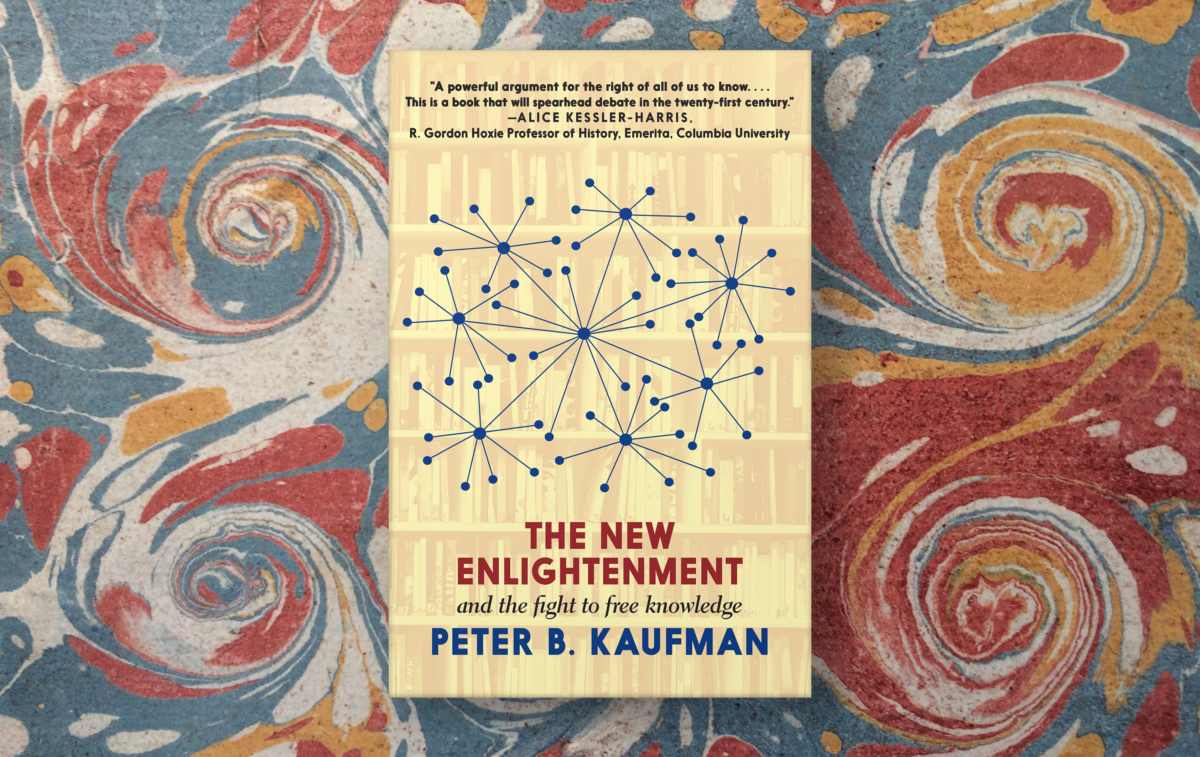
Editor’s Note: This month, MIT Open Learning’s Peter B. Kaufman has published The New Enlightenment and the Fight to Free Knowledge, a book that takes a historical look at the powerful forces that have purposely crippled our efforts to share knowledge widely and freely. His new work also maps out what we can do about it. In the coming days, Peter will be making his book available through Open Culture by publishing three short essays along with links to corresponding sections of his book. Today, you can read his second essay “On Wikipedia, the Encyclopédie, and the Verifiability of Information” (below), plus download the second chapter of his book here. Read his first essay, “The Monsterverse” here, and purchase the entire book online.
When the ideas that matter most to us – liberals, democrats, progressives, republicans, all in the original sense of the words – were first put forward in society in order to change society, they were advanced foremost in print. The new rules, new definitions, and new codicils of human and civil rights that undergird many of the freedoms we value today had as their heart text and its main delivery mechanism, the printing press.
In that sense the first Enlightenment was based upon the foundation of the printed word. And of the 18th century’s contributions to knowledge and society – Newton’s physics, Montesquieu’s laws, Linnaeus’s taxonomies, Rousseau’s political philosophy, the Declaration of Independence, the Declaration of the Rights of Man – there was perhaps no greater printed offering than the 22-million-word Encyclopédie that the French Enlightenment philosophers starting writing, compiling, and offering to the public in 1750.
The Encyclopédie was monumental. Not just from a content-assembly perspective – an effort to gather all the world’s knowledge and to print and publish it – but also from a sociopolitical one, given the powerful forces suppressing knowledge that such an effort would provoke. The Encyclopédie found the state and the church banning at one time or another almost every one of its 72,000 articles, 18,000 pages, and 28 volumes and invoking a hundred ways to forbid its distribution.
The encyclopedia’s entire approach to collecting and presenting knowledge was radical. The articles presented truths – some heretical, some blasphemous – that astonished contemporary readers. And its innovative approach to the verification its own content, to proving what could be proved, which was really its nuclear core, rocked the Western world.
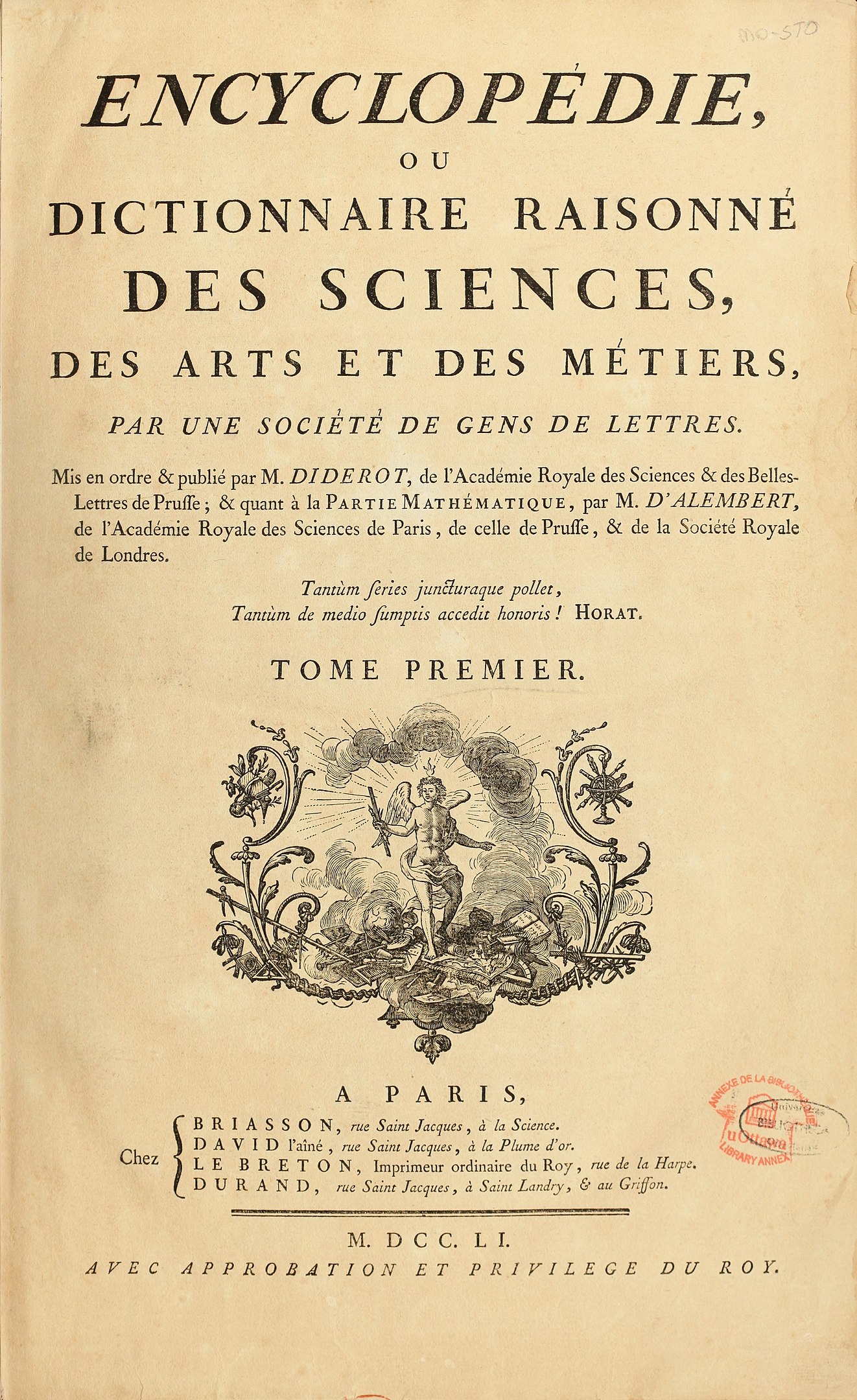
The Encyclopédie smote 18th-century orthodoxy with ink-and-paper sledgehammers. The article on “RAISON,” or “REASON,” for example, told every reader who for centuries had been steeped in church doctrine and the divine rights of royals that:
No proposition can be accepted as divine revelation if it contradicts what is known to us, either by immediate intuition, as in the case of self-evident propositions, or by obvious deductions of reason, as in demonstrations. It would be ridiculous to give preference to such revelations, because the evidence that causes us to adopt them cannot surpass the certainty of our intuitive or demonstrative knowledge…
Clerics and kings, needless to say, were not fans. Articles on religion, philosophy, and politics and society challenged the government and the church even as the censors watched. Direct swipes at the monarchy and the church appeared even where you might not expect – in articles on CONSCIENCE, LIBERTÉ DE; CROISADES; FANATISME; TOLÉRANCE; etc. The entry for FORTUNE spotlighted the gross inequalities of wealth already evident in 18th-century Europe. And a zinging condemnation of slavery in the article on the SLAVE TRADE made few friends among any who had a hand anywhere in the business.
Slave trade is the purchase of Negroes made by Europeans on the coasts of Africa, who then employ these unfortunate men as slaves in their colonies. This purchase of Negroes to reduce them into slavery […] violates all religion, morals, natural law, and human rights.
The Encyclopédistes announced from day one that this new work would be, as we would say today, fact-based. There would be an underlying and overarching commitment on the part of all contributors and the work as a whole to the verification of all of its source materials. Verification is potentially “a long and painful process,” Diderot wrote in his introduction to the whole enterprise – the famous “Preliminary Discourse” that these philosophers used to sell in the whole project:
We have tried as much as possible to avoid this inconvenience by citing directly, in the body of the articles, the authors on whose evidence we have relied and by quoting their own text when it is necessary.
We have everywhere compared opinions, weighed reasons, and proposed means of doubting or of escaping from doubt; at times we have even settled contested matters.… Facts are cited, experiments compared, and methods elaborated … in order to excite genius to open unknown routes, and to advance onward to new discoveries, using the place where great men have ended their careers as the first step.
What this meant in practice was revolutionary. There would be no accepted truths but for those that could be proven and cited. Fact-based versus faith- and belief-based: the start and spark of the Enlightenment. One of Diderot’s biographers explains that approximately 23,000 articles had at least one cross-reference to another article in one of the encyclopedia’s 28 volumes. “The total number of links – some articles had five or six – reached almost 62,000.” And all while retaining a sly sense of humor. The article on CANNIBALS ended with “the mischievous cross-reference,” as another historian would later describe it: “See Eucharist, Communion, Altar, etc.”
That commitment to reference citation continues in the Enlightenment’s most important successor project – Wikipedia, founded by Jimmy Wales and colleagues 20 years ago this year. It’s the foundation of what today’s Wikipedia terms verifiability, and in many key ways it’s the foundation for truth in knowledge and society today:
“Verifiability” … mean[s] that material added to Wikipedia must have been published previously by a reliable source. Editors may not add their own views to articles simply because they believe them to be correct, and may not remove sources’ views from articles simply because they disagree with them.
[V]erifiability is a necessary condition (a minimum requirement) for the inclusion of material, though it is not a sufficient condition (it may not be enough).
In 1999, free-software activist Richard M. Stallman called for this universal online encyclopedia covering all areas of knowledge, along with a complete library of instructional courses – and, equally important, a movement to develop it, “much as the Free Software Movement gave us the free operating system GNU/Linux.” That call (reproduced in full as the appendix in my book) is credited by Wikipedia as the origins of the work that is now the largest knowledge resource in history.
The free encyclopedia will provide an alternative to the restricted ones that media corporations will write.
Stallman published a list of what that the encyclopedia would need to do, what sort of freedoms it would need to give to the public, and how it could get started.
An encyclopedia located everywhere.
An encyclopedia open to anyone—but, most promisingly, to teachers and students.
An encyclopedia built of small steps.
An encyclopedia built on the long view: “If it takes twenty years to complete the free encyclopedia, that will be but an instant in the history of literature and civilization.”
An encyclopedia containing one or more articles for any topic you would expect to find in another encyclopedia – “for example, bird watchers might eventually contribute an article on each species of bird, along with pictures and recordings of its calls” – and “courses for all academic subjects.”
1999, and it sounds familiar. Wikipedia, of course, is one of the world’s most popular websites (the world’s most popular noncommercial one) now and an irreplaceable source of verifiable information – open to any and all. Its processes are transparent, and thanks to hackers affiliated with the project, you now can watch and listen to its edits live online:

Communities that work with Wikipedia are likely to benefit from this commitment to citation, and new collaborations that take effect around it are likely to benefit society. The Internet Archive is working with Wikipedia now, digitizing books so that links to sources in Wikipedia link all the way through to the books themselves – and render images and text on the cited pages. The reference link to a biography by Taylor Branch at the bottom of a Wikipedia article on Martin Luther King, Jr., for example, now hotlinks to the readable book online at Archive.org. That work is essential. “Only the use of footnotes and the research techniques associated with them” – as Princeton historian Anthony Grafton writes – “makes it possible to resist the efforts of modern governments, tyrannical and democratic alike, to conceal the compromises they have made, the deaths they have caused, the tortures they or their allies have inflicted.… Only the use of footnotes enables historians to make their texts not monologues but conversations, in which modern scholars, their predecessors, and their subjects all take part.”
Can we take verifiability further now, especially as our epistemic crisis deepens? Can we improve citation for the medium that’s beginning to overtake us all, which is video? Can we make resources on the web – also a new thing – verifiable? What is a citation like in a … podcast?
The great historian of the Encyclopédie, Robert Darnton, tells us in his new book, “When the printed word appeared in France in 1470, the state did not know what to make of it.” So, 700 years from now, what will tomorrow’s historians say about us? Further thoughts about how we can start more consciously collaborating with one another and producing – but immediately – for our burgeoning knowledge networks: next week.
Peter B. Kaufman works at MIT Open Learning and is the author of The New Enlightenment and the Fight to Free Knowledge. This is the second of three articles. You can find the first one in the Relateds below:
Related Content:
The New Enlightenment and the Fight to Free Knowledge: Part 1
An Animated Introduction to Voltaire: Enlightenment Philosopher of Pluralism & Tolerance
Social Media in the Age of Enlightenment and Revolution
Read More...The Iconic Dance Scene from Hellzapoppin’ Presented in Living Color with Artificial Intelligence (1941)
After Charles Lindbergh “hopped” the Atlantic in 1927, his history-making solo flight set off a craze for all things “Lindy.” Of the countless songs, foods, products, and trends created or named in honor of the famous onetime U.S. Air Mail pilot, only one remains recognizable these more than 90 years later: the Lindy Hop. Developed on the streets and in the clubs of Harlem, the dance proved explosively popular, though it took Hollywood a few years to capitalize on it. In the late 1930s, the musical Hellzapoppin’ brought the Lindy Hop to Broadway, and in 1941, Universal Pictures turned that stage show into a major motion picture directed by H.C. Potter (now best known for Mr. Blandings Builds His Dream House).
An often surreal, fourth-wall-breaking affair, Hellzapoppin’ is remembered mainly for the five-minute Lindy Hop musical number that comes about halfway through the film. It features a dance troupe called the Harlem Congaroos, played by the real-life Whitey’s Lindy Hoppers, a group of professional swing dancers founded at Harlem’s Savoy Ballroom, the origin point of the Lindy Hop as we know it today.
Its appearing members include Frankie Manning, whose name had become synonymous with the Lindy Hop in the 1930s, and Norma Miller, who as a twelve-year-old girl famously did the dance outside the Savoy for tips. Hellzapoppin’ preserves their athleticism and vitality for all time — with a hot jazz soundtrack to boot.
Like most Hollywood musicals of the early 1940s, Hellzapoppin’ was shot in black-and-white, and cinephiles will maintain that it’s best seen that way. But just as the technology powering long-haul flights has developed greatly since the days of Charles Lindbergh, so has the technology of film colorization. Take DeOldify, the “open-source, Deep Learning based project to colorize and restore old images and film footage” that “uses AI neural networks trained with thousands of reference pictures” – and that was used to produce the version of Hellzapoppin’s Lindy Hop number seen at the top of the post. It all looks much more convincing than when Ted Turner attempted to colorize Citizen Kane, but in lovers of dance, whatever sense of realism DeOldify contributes will mainly inspire a deeper longing to experience the culture of Harlem as it really was in the 1920s.
Related Content:
Based in Seoul, Colin Marshall writes and broadcasts on cities, language, and culture. His projects include the Substack newsletter Books on Cities, the book The Stateless City: a Walk through 21st-Century Los Angeles and the video series The City in Cinema. Follow him on Twitter at @colinmarshall or on Facebook.
Read More...John Cleese’s Very Favorite Comedy Sketches
Asked by Time magazine to name his favorite sketches among all those he has written or performed in, John Cleese deliberately excluded most of his Monty Python work. Instead he turned deeper into his back pages, all the way to At Last the 1948 Show, which originally aired on ITV in 1967. (Its title referenced the long delays inflicted by television’s executive decision-making processes.) The program was conceived at the behest of broadcaster David Frost, who’d previously engaged Cleese and fellow Cambridge Footlights alumnus (and future Python) Graham Chapman to write and perform on The Frost Report, one of the major fruits of the “satire boom” in mid-1960s Britain.
“We would come up with crazy ideas, and all the writers would roar with laughter at the table,” Cleese remembered of his Frost Report experience in a 2014 Q&A at the British Film Institute. But however hilarious, these ideas would inevitably be rejected for the reason that “they won’t get it in Bradford.”
The late-night 1948 Show let Cleese and his collaborators, including comedian Marty Feldman, take a few more chances: “We knew that not everyone in Bradford would get it, so were taking a little bit of a bet that enough people would get it.” This resulted in sketches like “The Bookshop,” in which Feldman’s customer makes a series of impossible demands of Cleese’s shopkeeper, allowing the latter to showcase his already well-honed ability to perform frustration boiling over into derangement.
Cleese, who still gets comedic mileage out of his upright “establishment” appearance, seems to have specialized in playing such absurdly burdened businessmen. His most iconic role must be the clenched, boorish hotelier Basil Fawlty, played in the post-Python series Fawlty Towers, but he was essaying such figures long before. Take the farcical sketch about a hard-of-hearing eyewear dealer, which later evolved into a segment of the German special Monty Python’s Fliegender Zirkus from 1972. Earlier that year, Monty Python’s Flying Circus put Cleese on the customer’s side of the counter, opposite Michael Palin’s cheese shop owner who evidently refuses to stock all known varieties of cheese. Though it didn’t originate on the 1948 Show, the now-immortal “cheese shop sketch” was written as another Cleese-Chapman collaboration — and one that displays a firm commitment to customer service, or the lack thereof, as comic material.
Related Content:
John Cleese Plays the Devil, Makes a Special Appeal for Hell, 1966
John Cleese’s Advice to Young Artists: “Steal Anything You Think Is Really Good”
Monty Python’s John Cleese Creates Ads for the American Philosophical Association
Based in Seoul, Colin Marshall writes and broadcasts on cities, language, and culture. His projects include the Substack newsletter Books on Cities, the book The Stateless City: a Walk through 21st-Century Los Angeles and the video series The City in Cinema. Follow him on Twitter at @colinmarshall or on Facebook.
Read More...B.B. King Plays “The Thrill is Gone” with Slash, Ron Wood & Other Legends
How many generations of guitarists have come and gone since B.B. King emerged on the Beale Street blues scene in the late 1940s?
60s blues-rock giants, 70s hard rockers, 80s metal shredders… at least two generations between B.B. and Slash, who is probably himself a guitar grandfather by now. Whether they know it or not, every rock and blues player descends from the Kings of the blues (B.B., Albert, Freddie, and guitarists who bore the title but not the surname). Slash knows it well.
We have three generations of guitar greats, and Simply Red’s Mick Hucknall, joining an 86-year-old King in the live performance above from 2011 at Royal Albert Hall with Derek Trucks and Susan Tedeschi, the Rolling Stones’ Ron Wood, and Slash, who sits next to the great man and lends him his top hat for a few bars.
The Guns n Roses lead guitarist named B.B. his favorite bluesman when King died in 2015 and put “The Thrill is Gone” in an ultimate guitar mix he compiled for Q magazine in 2004. At the live jam session above, he gets to play it with his hero, “the only hit I ever had,” says King by way of self-deprecating introduction.
Slash keeps a low profile, fitting himself into the mix of six guitars onstage (see the longer jam session further up). Another guitarist, John Mayer, maybe three generations of players removed from King, got to spread out a bit more in his jam with B.B. at the Guitar Center King of the Blues event in 2006. “It’s like stealing something from someone right in front of them,” he says. It’s a good joke, and it’s the truth.
Musicians have been following in B.B. King’s wake for over 60 years now. The best learn the same humbling lesson U2’s Bono did after his 1988 duet with King on “When Love Comes to Town” — “We had learned and absorbed, but the more we tried to be like B.B., the less convincing we were.” See more of King and Mayer just below.
Related Content:
B.B. King Plays Live at Sing Sing Prison in One of His Greatest Performances (1972)
B.B. King Explains in an Animated Video Whether You Need to Endure Hardship to Play the Blues
Josh Jones is a writer and musician based in Durham, NC. Follow him at @jdmagness
Read More...The New Enlightenment and the Fight to Free Knowledge: Part 1
Editor’s Note: This month, MIT Open Learning’s Peter B. Kaufman has published The New Enlightenment and the Fight to Free Knowledge, a book that takes a historical look at the powerful forces that have purposely crippled our efforts to share knowledge widely and freely. His new work also maps out what we can do about it. In the coming days, Peter will be making his book available through Open Culture by publishing three short essays along with links to corresponding sections of his book. Today, you can find his short essay “The Monsterverse” below, and meanwhile read/download the first chapter of his book here. You can purchase the entire book online.
The Monsterverse – what exactly is it? Like Sauron and his minions from Mordor in The Lord of the Rings, like Sheev Palpatine and the armies of the Galactic empire from Star Wars, like Lord Voldemort and his henchmen the Death Eaters in Harry Potter, it’s the collective force of evil, one that strives to shut down human progress, freedom, justice, the spread of knowledge –the dissemination of (let us just say it) open culture. It’s the subject of the first chapter of my book, The New Enlightenment and the Fight to Free Knowledge – and its incarnations have been with us for thousands of years.
In 1536, which is when the book begins, it found its embodiment in Jacobus Latomus, who oversaw the trial and execution – by strangling and burning at the stake – of a translator and a priest named William Tyndale. Latomus, who himself was overseen by Thomas More, who himself was overseen by Henry VIII (with Pope Clement VII in a supporting role), choreographed Tyndale’s formal degradation, such that a couple dozen apostolic inquisitors and theologians, university rectors and faculty, lawyers and privy councilors – “heresy-hunters,” as his biographer calls them – led him out of his prison cell in public and in his priestly raiment to a high platform outdoors where oils of anointment were scraped symbolically from his hands, the bread and wine of the Eucharist situated next to him and then just as quickly removed, and then his vestments “ceremonially stripped away,” so that he would find himself, and all would see him as, no longer a priest. Death came next. This scholar and polymath to whom, it is now known, we owe as much as we owe William Shakespeare for our language, this lone man sought and slain by church and king and holy Roman emperor – his initial strangling did not go well, so that when he was subsequently lit on fire, and the flames first lapped at his feet and up his legs, lashed tight to the stake, he came to, and, while burning alive in front of the crowd of religious leaders and so-called justices (some seventeen trial commissioners) who had so summarily sent Tyndale to his death and gathered to watch it, live, he cried out, less to the crowd, it would seem, than to Another: “Lord! Lord! Open the King of England’s eyes!”
What did Tyndale do? He believed that the structure of communication during his time was broken and unfair, and with a core, unwavering focus, he sought to make it so that the main body of knowledge in his day could be accessed and then shared again by every man alive. He engaged in an unparalleled act of coding (not for nothing do we speak of computer programming “languages”), working through the Latin, Greek, Hebrew, and Aramaic of the Bible’s Old, then New, Testaments to bring all of its good books – from Genesis 1 to Revelation 22—into English for everyday readers. He is reported to have said, in response to a question from a priest who had challenged his work, a priest who read the Bible only in Latin: “I will cause a boy that driveth the plough shall know more of the Scripture than thou dost.” And he worked with the distribution technologies of his time – the YouTubes, websites, and Twitters back then – by connecting personally with book designers, paper suppliers, printers, boat captains, and horsemen across sixteenth-century Europe to bring the knowledge and the book that contained it into the hands of the people.
It wasn’t easy. In Tyndale’s time, popes and kings had decreed, out of concern for keeping their power, that the Bible could exist and be read and distributed “only in the assembly of Latin translations” that had been completed by the monk Saint Jerome in approximately 400 CE. The penalties for challenging the law were among the most severe imaginable, for such violations represented a panoply of civil transgressions and an entire complexity of heresies. In taking on the church and the king – in his effort simply and solely to translate and then distribute the Bible in English – Tyndale confronted “the greatest power[s] in the Western world.” As he “was translating and printing his New Testament in Worms,” his leading biographer reminds us, “a young man in Norwich was burned alive for the crime of owning a piece of paper on which was written the Lord’s Prayer in English.” The Bible had been inaccessible in Latin for a thousand years, this biographer writes, and “to translate it for the people became heresy, punishable by a solitary lingering death as a heretic; or, as had happened to the Cathars in southern France, or the Hussites in Bohemia and Lollards in England, official and bloody attempts to exterminate the species.”
Yuckadoo, the Monsterverse, but very much still with us. The strangleholds are real. And Tyndale’s successors in the fight to free knowledge include many freedom fighters and revolutionaries – going up against the forces that seek to constrain our growth as a society. Were Tyndale alive today, he would wonder about the state of copyright law and its overreach; the pervasive estate of surveillance capitalism; the sweeping powers of government to see and interfere in our communication. And he would wonder why the seemingly progressive forces on the side of freedom today – universities, museums, libraries, archives – don’t fight more against information oppression. Tyndale would recognize that the health pandemic, the economic crisis, the political violence we face today, are all the result of an information disorder, one that relies on squelching knowledge and promoting the darkest forms of ignorance for its success. How we come to grips with that challenge is the number-one question for our time. Discovering new paths to defeating it – overcoming the Dark Lords, destroying the Horcruxes, finally harnessing the Force – is the subject of the next two articles, and of the rest of the book.
Peter B. Kaufman works at MIT Open Learning and is the author of The New Enlightenment and the Fight to Free Knowledge. This is the first of three articles.
Read More...Where Did the Metal Scream Come From? And How Do Metal Vocalists Avoid Destroying Their Vocal Cords?
Do metal singers take vocal lessons? Surely not the greats of old! Did Bruce Dickinson, Rob Halford, and Ozzy Osbourne take lessons? Or did they dive into the debauchery headfirst, screaming?
Iron Maiden’s Dickinson has been rumored to have received opera training. This is not true. Instead, he stole his vocal technique from his “dentist ex-girlfriend,” he says. “As an ex-pupil of the very prestigious Cheltenham Ladies’ College, she’d had quite extensive singing lessons, and she kept a notebook.” It changed his life.
Ozzy’s guitarist Zakk Wylde tells a funny story of the Black Sabbath legend’s wife Sharon ordering him up a coach… just once… a “man with a briefcase,” says the burly shredder, sent to take care of “our Joe Montana.” But Osbourne did end up working with a vocal coach, Kathleen Riggs, more regularly in later years.
Judas Priest’s Halford? He doesn’t mention a coach, but he does talk a lot about care and training. “My form of extreme singing,” he says, “it’s like a workout, you know…. Your vocal cords are muscles — they get burned out, they get tired.” As for his pioneering screams of over 40 years ago, he muses, “I sometimes think that’s a bit of a curse that I sang and recorded those certain songs so long ago, when I was a younger guy with a younger set of vocal cords.” He nearly wrecked his voice, he says, with cocaine and Jack Daniels.
It’s not opera, but metal singing is a seriously athletic activity and has only become more so as its vocals have grown more extreme, even if its fashion sense has not. As classically trained singer and actress Melissa Cross — the “Queen of Scream” — relates in the video at the top, she first became a metal vocal coach when a producer friend called her in dismay: the singers he was recording couldn’t get through a session without coughing blood.
Where did the metal scream come from, and why is it so prevalent if it’s such an unhealthy way to move one’s vocal folds day after day without training and technique? Vikings, Screamin’ Jay Hawkins’ “I Put a Spell on You,”; Led Zeppelin, Black Sabbath, AC/DC, and Judas Priest, of course… babies…. These are all points of origin for today’s extreme metal singing, say hosts LA Buckner and Nahre Sol in the PBS video further up.
The two talk to Cross about screaming without bleeding, and metal vocalist Natalie Kreuger talks about how warmups and opera-like breathing techniques are essential to maintaining vocal fitness. And if you need more convincing that metal singing requires serious power and stamina, take a look at the 10 longest live screams in metal, above. Let’s hope they all heed the example of the elder metal gods.
Related Content:
The Origins of the Death Growl in Metal Music
96-Year-Old Holocaust Survivor Fronts a Death Metal Band
Josh Jones is a writer and musician based in Durham, NC. Follow him at @jdmagness
Read More...A List of 132 Radical, Mind-Expanding Books from Rage Against the Machine
If you like Rage Against the Machine, but don’t like their “political bs,” you haven’t actually listened to Rage Against the Machine, whose entire raison d’être is contained within the name. What is “the Machine”? Let’s hear it from the band themselves. Singer Zack de la Rocha pointed out that the title of their second album, 1996’s Evil Empire, came from “Ronald Reagan’s slander of the Soviet Union in the eighties, which the band feels could just as easily apply to the United States.”
The Machine is capitalism and militarism, what Dwight D. Eisenhower once famously called the “military-industrial complex” but which has folded in other oppressive mechanisms since the coining of that phrase, including the prison-industrial complex and immigration-industrial complex. The Machine is a mega-complex with a lot of moving parts, and the members of RATM have done the work to critically examine them, informing their music and activism with reading and study.
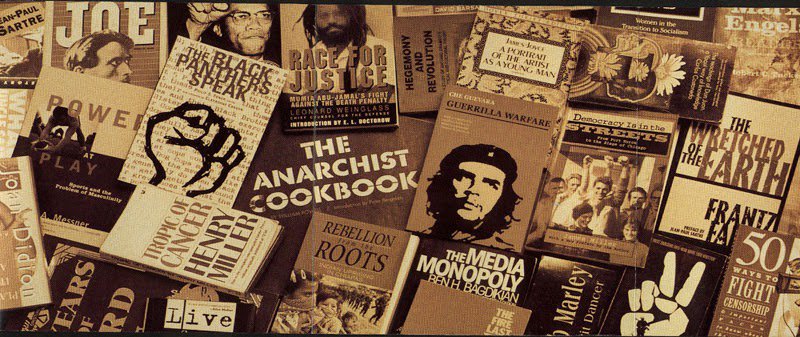
Evil Empire, for example, featured in its liner notes a photo of “a pile of radical books,” “and the group posted a lengthy reading list to complement it on their site,” declares the site Radical Reads. Debates often rage on social media over whether activists should read theory. One answer to the question might be the commitment of RATM, who have steadfastly lived out their convictions over the decades while also, ostensibly, reading Marx, Marcuse, and Fanon.
There are more accessible theorists on the list: fierce essayists like former death row inmate and Black Panther Mumia Abu-Jamal and Henry David Thoreau, whose Walden and “Civil Disobedience” both appear. The Anarchist Cookbook shows up, but so too does Dr. Suess’ The Lorax, biographies of Miles Davis and Bob Marley, Taschen’s Dali: The Paintings, James Joyce’s A Portrait of the Artist of a Young Man, and Henry Miller’s Tropic of Cancer. This is not a list of strictly “political” books so much as a list of books that open us up to other ways of seeing.
These are also, in many cases, books we do not encounter unless we seek them out. “I certainly didn’t find any of those books at my University High School library,” de la Rocha told MTV in 1996, “Many of those books may give people new insight into some of the fear and some of the pain they might be experiencing as a result of some of the very ugly policies the government is imposing upon us right now.” Doubtless, he would still endorse the sentiment. The workings of the Machine, after all, don’t seem to change much for the people on the bottom when it gets new management at the top.
Read the full list of Evil Empire book recommendations on Good Reads. And as a bonus, hear a Spotify playlist of radical music just above, compiled by RATM guitarist Tom Morello. The 241 song list runs
via Radical Reads
Related Content:
Josh Jones is a writer and musician based in Durham, NC. Follow him at @jdmagness
Read More...Hear Brian Eno Reinvent Pachelbel’s Canon (1975)
Discreet Music came out in 1975, when most of its first listeners had never heard anything quite like it; there must have been some debate as to whether to call it “music” at all. Brian Eno’s fourth solo album, released on his own label Obscure Records, represented a departure from his own previous work, and even more so from that of his former band, the art-rock outfit Roxy Music. The recording that occupies the entire A side of Discreet Music features no vocals, and indeed no lyrics; no percussion, and no beat. Those qualities, of course, had plenty of precedent in music history, but the same can’t be said for its near-accidental compositional method, which involved a synthesizer, a tape-delay system, a graphic equalizer, an echo unit, and a couple of tape recorders, all connected in a loop: a series of devices, left to their own devices.
Some cite Discreet Music, which preceded Eno’s well-known Music for Airports by three years, as the origin point of ambient music as we know it today. Its inspiration goes a few years further back, as Eno himself tells it, to a period around about 1970 when he was convalescing after a car wreck. “A friend of mine came over to see me. I was confined to bed; I couldn’t move. But as she left she said, ‘Shall I put a record on?’ ”
The music “was much too quiet but I couldn’t reach to turn it up, and it was raining outside. It was a record of 18th-century harp music, I remember. I lay there at first kind of frustrated by this situation, but then I started listening to the rain and listening to these odd notes of the harp that were just loud enough to be heard above the rain.”
Today Eno counts this “a great musical experience for me, and I suddenly thought of this idea of making music that didn’t impose itself on your space in the same way, but created a sort of landscape you could belong to.” His story illuminates the emergence of not just a new music, but a new way of hearing old music. Discreet Music’s B side performs a reinterpretation of its own with variations on Johann Pachelbel’s Canon in D, “Fullness of Wind,” “French Catalogues,” and “Brutal Ardour.” On Eno’s instructions, the Cockpit Ensemble repeated parts of the score while gradually altering it, imbuing this familiar (not least from weddings) 17th-century piece with an otherworldly grandeur. Like their mistranslated-from-the French titles, these variations may in some sense be “mangled,” but they become all the more ambiguously evocative for it.
Related Content:
Hear Albums from Brian Eno’s 1970s Label, Obscure Records
The “True” Story Of How Brian Eno Invented Ambient Music
Pachelbel’s Canon Played by Train Horns
Based in Seoul, Colin Marshall writes and broadcasts on cities, language, and culture. His projects include the Substack newsletter Books on Cities, the book The Stateless City: a Walk through 21st-Century Los Angeles and the video series The City in Cinema. Follow him on Twitter at @colinmarshall or on Facebook.
Read More...Flim: a New AI-Powered Movie-Screenshot Search Engine
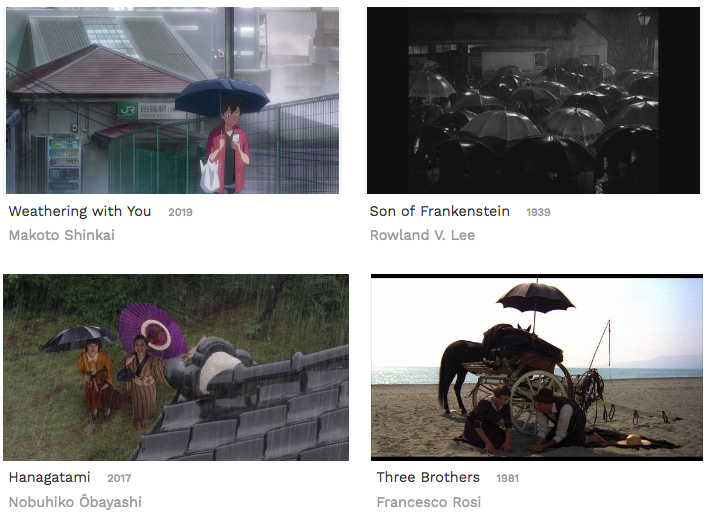
There was a time when cinephile shorthand consisted mostly of quotations from movies — from movies’ dialogue, to be precise. The distinction matters these days, now that the internet has enabled us to communicate just as easily with visual quotations as verbal ones. While some of us go the extra mile by manually combing through our film collections and taking the screenshots that best reflect our personal sentiments, most of us have long relied on the results, however approximate, served up by search engines like Google Images.
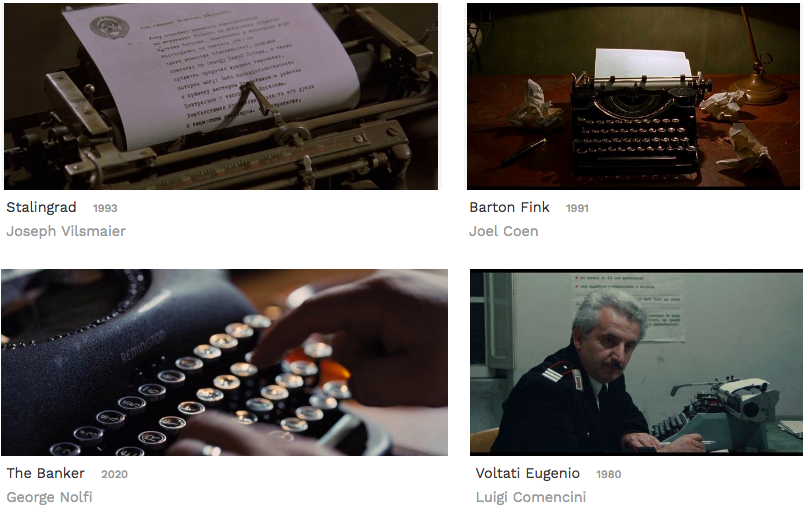
Now a promising new solution has emerged, called Flim (not to be confused with “film”). Described on its about page as “a constantly evolving database of HD screenshots,” with a claim of 50,000 provided daily, Flim uses artificial intelligence to perform color analysis and detect “objects, clothes, characters, etc.”
This means that when you enter terms like “tree,” “guitar,” “tuxedo,” or “pizza,” you get a selection of images including trees, guitars, tuxedos, and pizzas, all taken straight from a range of motion pictures wide enough to include The Nightmare Before Christmas and An American Werewolf in London, Easy Rider and Wayne’s World 2, Mélo and Wedding Crashers.
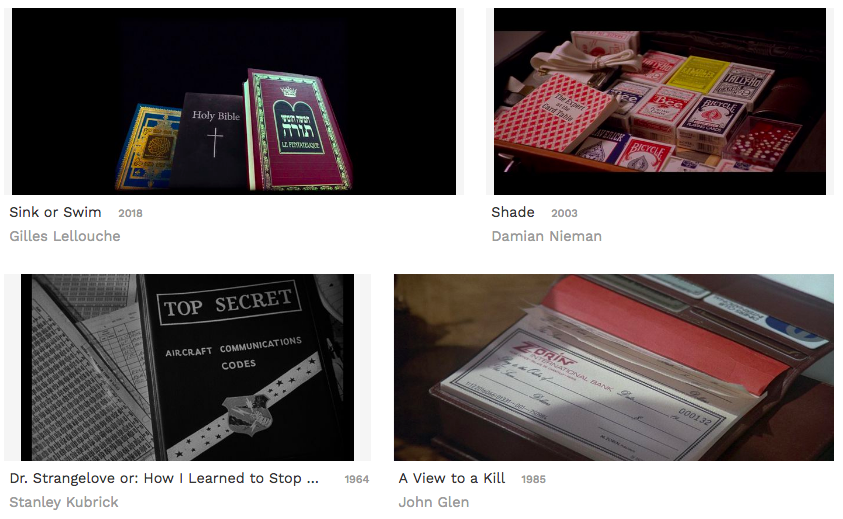
Artificial intelligence has come a long way in recent years, especially in its capacity to recognize the content of images. The one driving Flim does seem to have committed the occasional amusing misfile, but it’s still early days. And though cinephiles will be quick to notice the omissions in its database, they’ll find a great deal of visual material from the work of their favorite auteurs: more than 100 screenshots from that of David Lynch, more than 300 from that of Éric Rohmer, more than a thousand from that of Stanley Kubrick, and nearly 1,500 from that of Alfred Hitchcock.
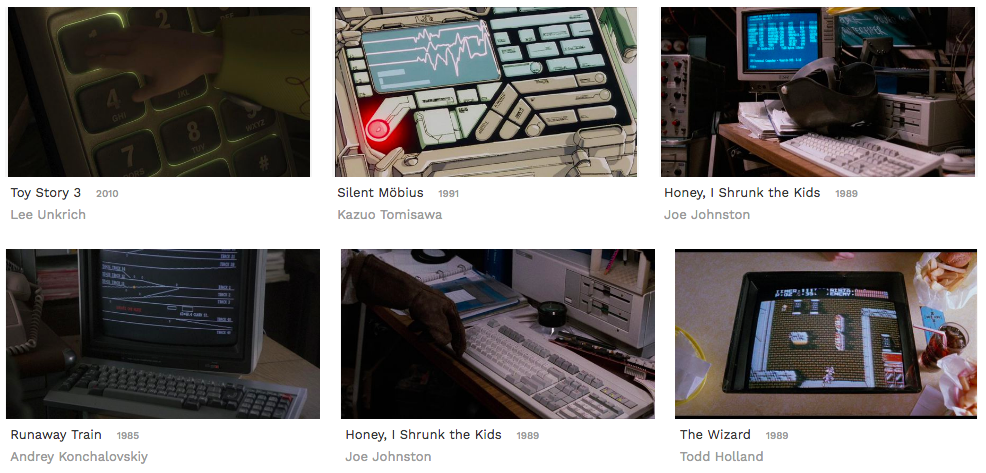
“I would love for the screenshot detail pages to include timecodes,” suggests Jason Kottke. It would make this an amazing tool for creating supercuts, film analysis videos, and other sorts of media. Imagine how much easier Christian Marclay’s job would have been with ‘clock’ and ‘watch’ searches on Flim.” Certainly I could have used it while making my own video essay on Los Angeles’ Bonaventure Hotel, a notable film-shoot location over the past few decades — though as yet the Bonaventure’s name returns no results, nor do the names of any other real-world buildings that come to mind.
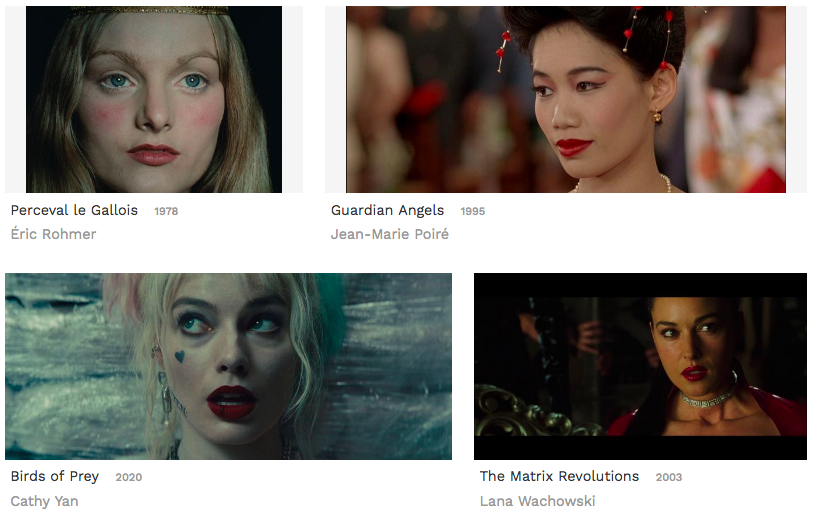
Still, if Flim expands apace, it will become a valuable resource for cinephiles and non-cinephiles alike, as well as filmmakers themselves: No Film School’s Jason Hellerman describes it as a potentially revolutionary aid for the assembly of “mood boards” and “lookbooks,” industry-standard elements of pitch presentations for “music videos, features, and commercials.” As with any newly developed tool of this kind, though, the most interesting uses will surely be the least obvious ones. In time, Flim could even prove to be a trusted source of reading recommendations.
via Kottke
Related Content:
The 100 Most Memorable Shots in Cinema Over the Past 100 Years
Download 6600 Free Films from The Prelinger Archives and Use Them However You Like
Download for Free 2.6 Million Images from Books Published Over Last 500 Years on Flickr
Based in Seoul, Colin Marshall writes and broadcasts on cities, language, and culture. His projects include the Substack newsletter Books on Cities, the book The Stateless City: a Walk through 21st-Century Los Angeles and the video series The City in Cinema. Follow him on Twitter at @colinmarshall or on Facebook.
Read More...René Magritte’s Early Art Deco Posters (1924–1927)
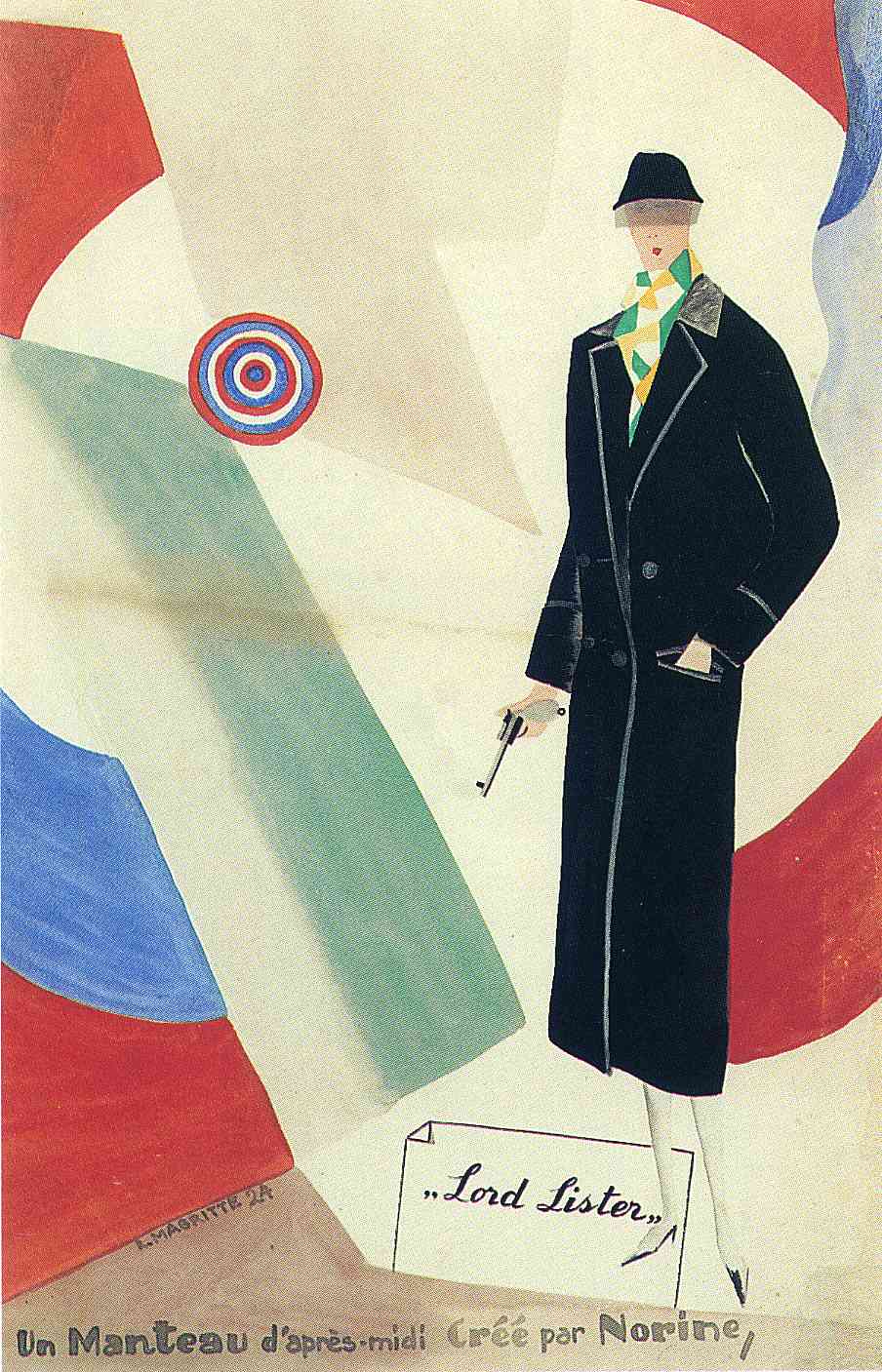
The Belgian painter René Magritte created some of the most enigmatic and iconic works in Surrealist art. But before he moved to Paris in 1927 and began forging relationships with André Breton and the Surrealists, Magritte struggled in Brussels as a freelance commercial artist, creating advertisements in the Art Deco style.
In 1924 Magritte began designing posters and advertisements for the couturier Honorine “Norine” Deschrijver and her husband Paul-Gustave Van Hecke, owners of the Belgian fashion company Norine. Van Hecke also owned art galleries, and was an early champion of surrealism. Van Hecke would eventually pay Magritte a stipend in exchange for the right to market his surrealist works. In the 1924 advertising poster above, Magritte portrays a woman in high heels pretending to be Lord Lister, the gentleman thief from German pulp fiction, wearing “an afternoon coat created by Norine.”
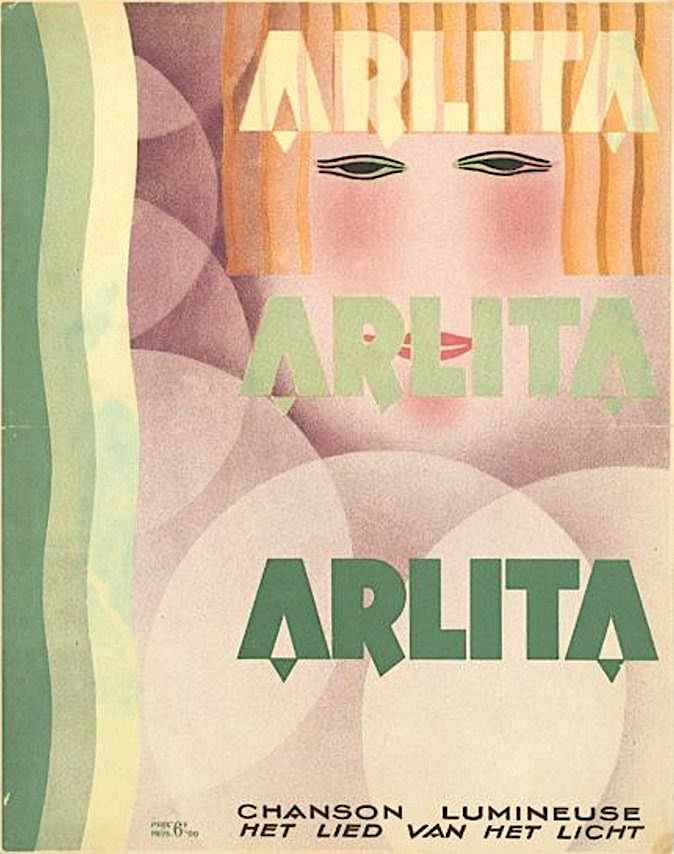
Magritte designed some 40 sheet music covers, most of them in the Art Deco style, according to Hrag Vartanian at Hyperallergic. The one above, “Arlita,” is from about 1925. The French and Dutch subtitles read “The Song of Light.”
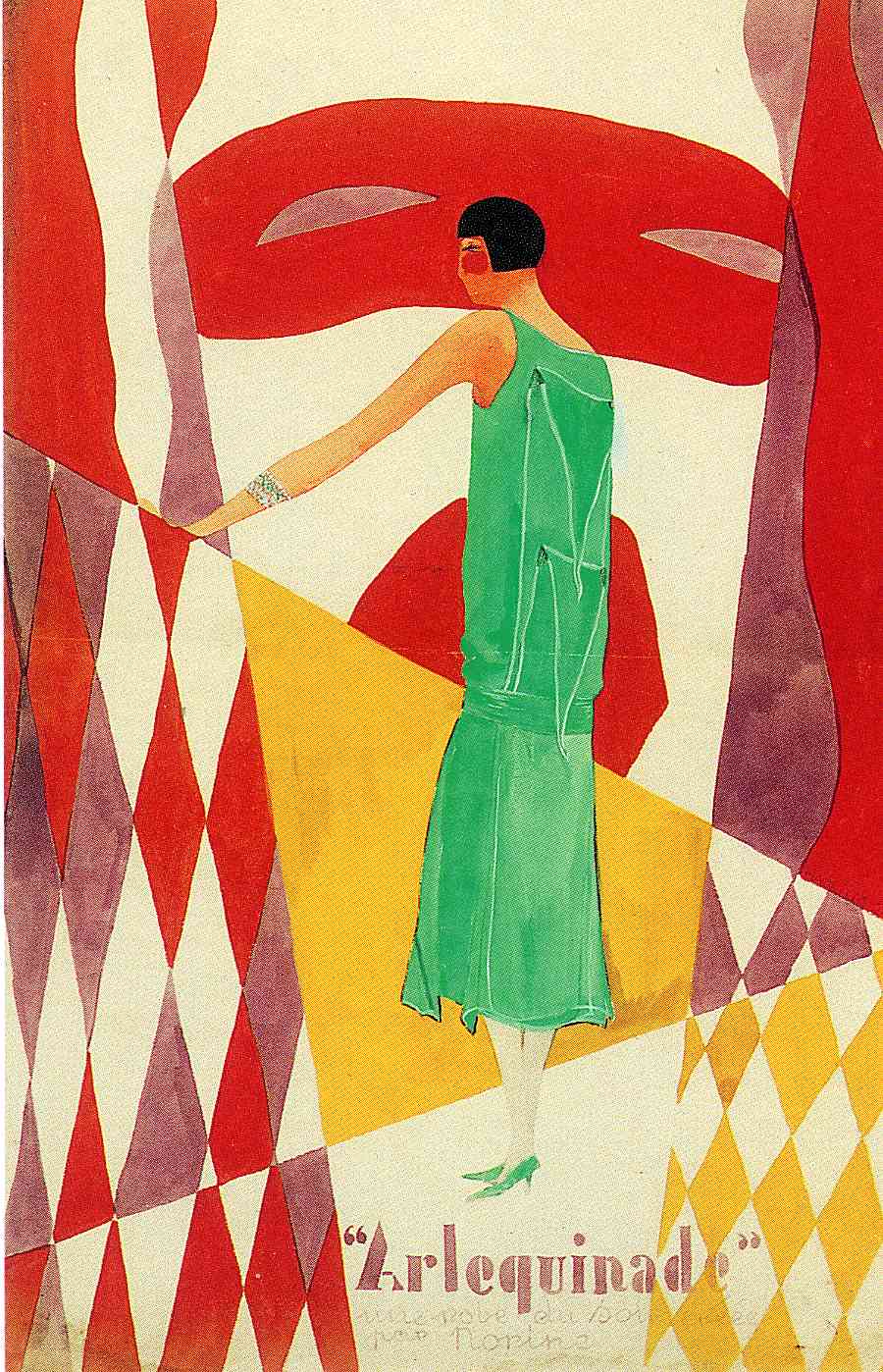
The harlequin-themed image above is another advertisement for Norine, circa 1925. Magritte painted it in watercolor and gouache. The penciled inscription at the bottom reads “une robe du soir par Norine” — “an evening gown by Norine.”
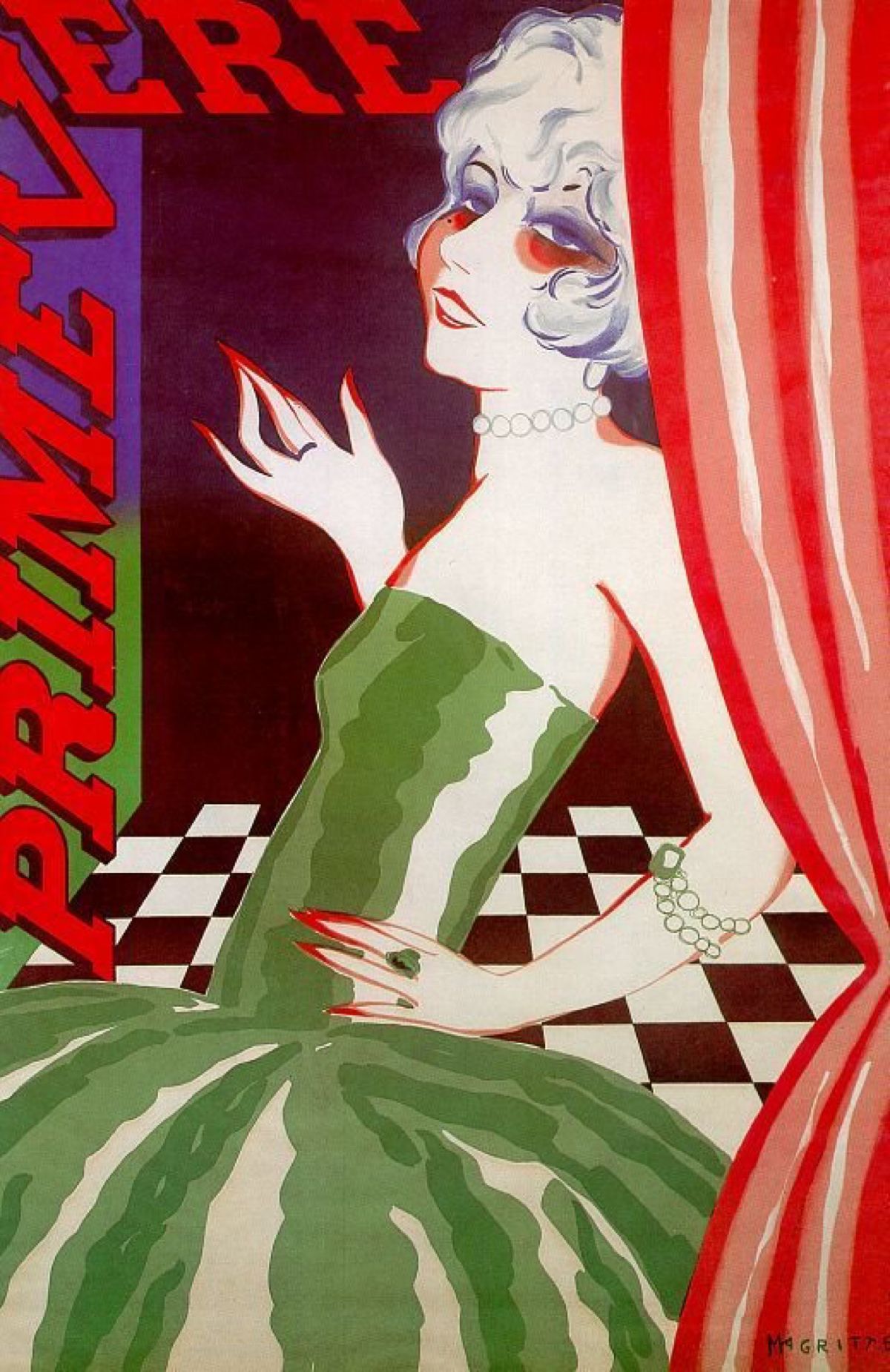
In 1926 Magritte was commissioned to create the poster above for the popular singer Marie-Louise Van Emelen, better known as Primevère. For more of Magritte’s Art Deco sheet music covers, visit Hyperallergic.
Note: An earlier version of this post appeared on our site in 2013.
If you would like to support the mission of Open Culture, consider making a donation to our site. It’s hard to rely 100% on ads, and your contributions will help us continue providing the best free cultural and educational materials to learners everywhere. You can contribute through PayPal, Patreon, and Venmo (@openculture). Thanks!
Related Content:
Dozens of M.C. Escher Prints Now Digitized & Put Online by the Boston Public Library
Philosopher Portraits: Famous Philosophers Painted in the Style of Influential Artists
The Art of William Faulkner: Drawings from 1916–1925
Bauhaus, Modernism & Other Design Movements Explained by New Animated Video Series
Read More...Support Us
We're hoping to rely on loyal readers, rather than erratic ads. Please click the Donate button and support Open Culture. You can use Paypal, Venmo, Patreon, even Crypto! We thank you!

About Us

Open Culture scours the web for the best educational media. We find the free courses and audio books you need, the language lessons & educational videos you want, and plenty of enlightenment in between.
Advertise With Us

FREE UPDATES!
GET OUR DAILY EMAIL
Get the best cultural and educational resources on the web curated for you in a daily email. We never spam. Unsubscribe at any time.
FOLLOW ON SOCIAL MEDIA

Open Culture editor Dan Colman scours the web for the best educational media. He finds the free courses and audio books you need, the language lessons & movies you want, and plenty of enlightenment in between.
Advertise With Us

