The Oldest Known Globe to Depict the New World Was Engraved on an Ostrich Egg, Maybe by Leonardo da Vinci (1504)
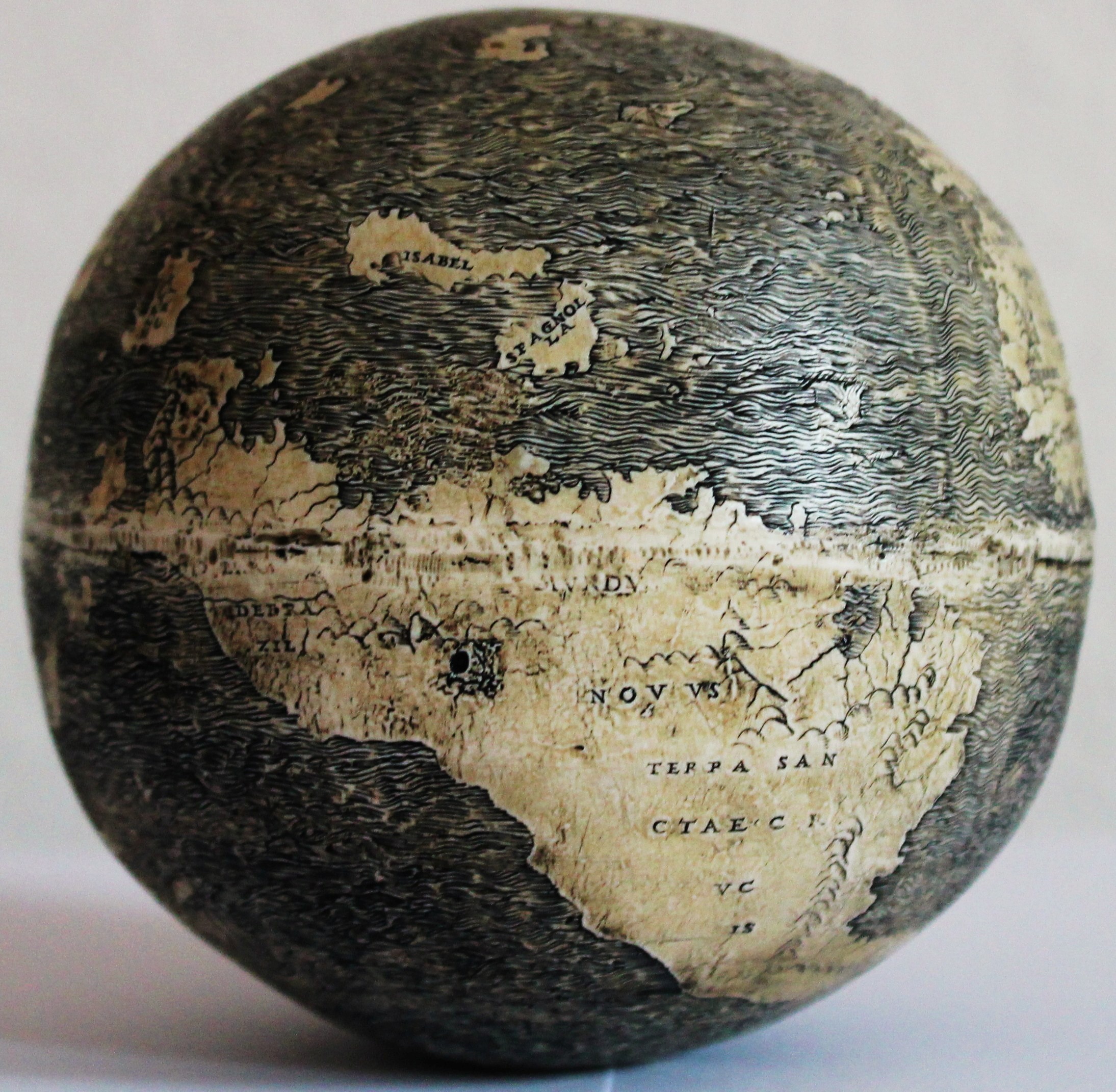
Image by Davidguam via Wikimedia Commons
Every time you think you’ve got a handle on Leonardo da Vinci’s genius (which is to say, you think you’ve heard about the most important things he painted, wrote, and invented), yet more evidence comes to light of the many ways he meets the standard for the adjective “genius”.… Recently, Leonardo re-appeared not only as an inventor of futuristic military technology or discoverer of complex human anatomy, but also as the first European to depict the “New World” on a globe–proving he knew about Columbus’ voyages when the globe was made in 1504.
The discovery “marks the first time ever that the names of countries such as Brazil, Germania, Arabia and Judea have appeared on a globe,” notes Cambridge Scholars Publishing, who released a book by the globe’s discoverer and primary researcher, Stefaan Missinne. The artifact attributed to Leonardo is engraved, “with immaculate detail,” writes Meeri Kim at The Washington Post, “on two conjoined halves of ostrich eggs.” And it features a single sentence, in Latin, above Southeast Asia: Hic Sunt Dracones–“Here be dragons.”
We’ll notice other unique features of the engraved egg Missinne calls, simply, “the Da Vinci Globe,” such as the fact that in place of Central and North America are the islands of Columbus’ “discovery,” surrounded by a vast ocean in which Pacific and Atlantic join. Why ostrich eggs? Humans have used them for decorative purposes for millennia. Also, “in that time period,” says Thomas Sander, editor of the Washington Map Society’s journal, Portolan, “the ostrich was quite the animal, and it was a big thing for the noble people to have ostriches in their back gardens.”
Missinne, a real estate developer, collector, and globe expert originally from Belgium, discovered the globe in 2012 at the London Map Fair. It was purchased “from a dealer who said it had been part of an important European collection for decades,” and its buyer and owner remain anonymous. After the globe appeared, Missinne “consulted more than 100 scholars and experts in his year-long analysis,” putting “about five years of research into one year,” says Sander, calling the research “an incredible detective story.”
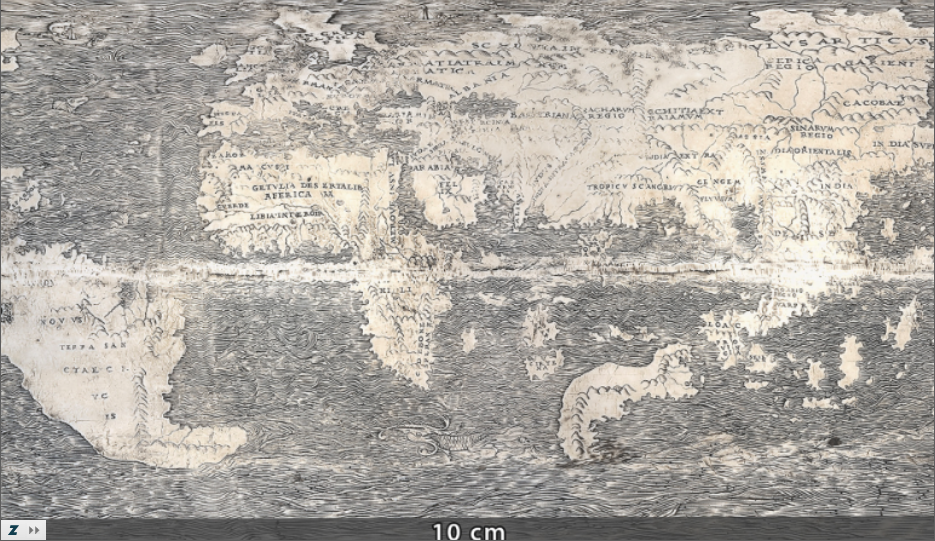
Missinne’s investigation seems to substantiate his claims that the globe was made by Leonardo or his workshop. The evidence, some of which you can find on the Cambridge Scholars Publishing site, includes a 1503 preparatory map in da Vinci’s papers; the presence of arsenic, which only Leonardo was known to use at the time in copper to keep it from losing its lustre; “The use of chiaroscuro, pentienti, triangular shapes, the mathematics of the scale reflecting Leonardo’s written dimension of planet earth”; and a 1504 letter from Leonardo himself stating, “my world globe I want returned back from my friend Giovanni Benci.”
Missinne and Geert Verhoeven, of the Ludwig Boltzmann Institute for Archaeological Prospection & Virtual Archeology, have published a paper on the “unfolding” of Leonardo’s globe into the two-dimensional image above (see an interactive version here). “This miniature egg globe is not only the oldest extant engraved globe,” the authors write, “but it is also the oldest post-Columbian globe of the world and the first ever to depict Newfoundland and many other territories.” Previously, the Hunt-Lenox Globe, a small copper globe, was thought to be the oldest known such artifact. Dated to around 1510, this globe, Missinne discovered, is actually a copy made from a cast of the older, original ostrich-egg globe.
Missinne’s findings have their detractors, including John W. Hessler of the Library of Congress, who claims Missinne himself is the anonymous owner of the globe, which raises issues of conflict of interest. “Where this thing comes from needs to be clarified,” says Renaissance cartography expert Chet Van Duzer of the John Carter Brown Library in Providence, R.I., though he adds, “It is an exciting discovery, no question.” Missinne’s claims for the egg’s provenance are more modest than his marketing. He “speculates,” writes Kim, “ the egg could have loose connections to the workshop of Leonardo da Vinci.” Hessler’s view is less equivocal: “The Leonardo connection is pure nonsense.”
A layperson like Missinne, whatever his personal investment, might be inclined to overinterpret evidence or make tenuous connections a trained scholar would avoid. The many scholars he cites in support of his claims for the globe are also vulnerable to these charges, however, though to a lesser degree. What do we make of French Mona Lisa expert Pascal Cotte’s testimonial, “I hereby confirm the evidence of the left-handedness of the engravings on the Ostrich Egg Globe. As Leonardo was the only left-handed artist in his workshop, I hereby endorse the hypothesis of Leonardo da Vinci’s authorship”? As in all such academic debates, “Here be dragons.” Weigh the case in full in Missinne’s 2018 book, The Da Vinci Globe.
Related Content:
Leonardo da Vinci’s Elegant Studies of the Human Heart Were 500 Years Ahead of Their Time
Leonardo da Vinci Draws Designs of Future War Machines: Tanks, Machine Guns & More
Josh Jones is a writer and musician based in Durham, NC. Follow him at @jdmagness
Read More...How the Internet Archive Digitizes 3,500 Books a Day–the Hard Way, One Page at a Time
Does turning the pages of an old book excite you? How about 3 million pages? That’s how many pages Eliza Zhang has scanned over her ten years with the Internet Archive, using Scribe, a specialized scanning machine invented by Archive engineers over 15 years ago. “Listening to 70s and 80s R&B while she works,” Wendy Hanamura writes at the Internet Archive blog, “Eliza spends a little time each day reading the dozens of books she handles. The most challenging part of her job? ‘Working with very old, fragile books.”
The fragile state and wide variety of the millions of books scanned by Zhang and the seventy-or-so other Scribe operators explains why this work has not been automated. “Clean, dry human hands are the best way to turn pages,” says Andrea Mills, one of the leaders of the digitization team. “Our goal is to handle the book once and to care for the original as we work with it.”
Raising the glass with a foot pedal, adjusting the two cameras, and shooting the page images are just the beginning of Eliza’s work. Some books, like the Bureau of Land Management publication featured in the video, have myriad fold-outs. Eliza must insert a slip of paper to remind her to go back and shoot each fold-out page, while at the same time inputting the page numbers into the item record. The job requires keen concentration.
If this experienced digitizer accidentally skips a page, or if an image is blurry, the publishing software created by our engineers will send her a message to return to the Scribe and scan it again.
It’s not a job for the easily bored; “It takes concentration and a love of books,” says Internet Archive founder Brewster Kahle. The painstaking process allows digitizers to preserve valuable books online while maintaining the integrity of physical copies. “We do not disbind the books,” says Kahle, a method that has allowed them to partner with hundreds of institutions around the world, digitizing 28 million texts over two decades. Many of those books are rare and valuable, and many have been deemed of little or no value. “Increasingly,” writes the Archive’s Chris Freeland, “the Archive is preserving many books that would otherwise be lost to history or the trash bin.”
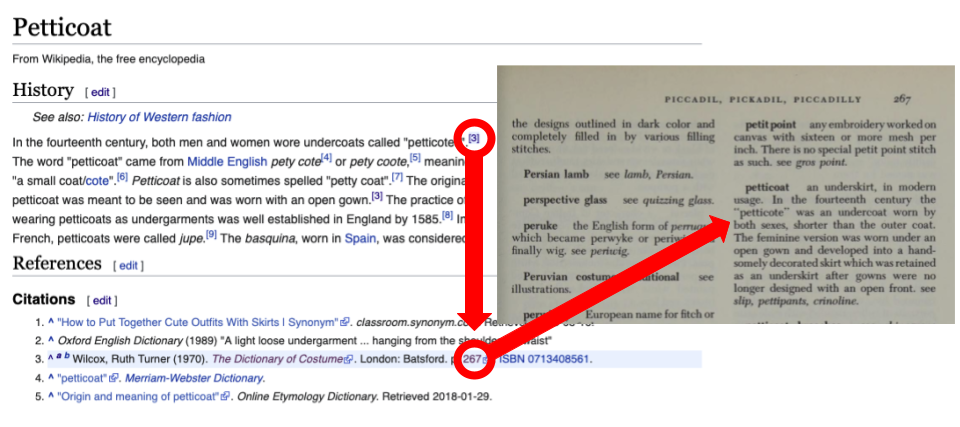
In one example, Freeland cites The dictionary of costume, “one of the millions of titles that reached the end of its publishing lifecycle in the 20th century.” It is also a work cited in Wikipedia, a key source for “students of all ages… in our connected world.” The Internet Archive has preserved the only copy of the book available online, making sure Wikipedia editors can verify the citation and researchers can use the book in perpetuity. If looking up the definition of “petticoat” in an out-of-print reference work seems trivial, consider that the Archive digitizes about 3,500 books every day in its 18 digitization centers. (The dictionary of costume was identified as the Archive’s 2 millionth “modern book.”)
Libraries “have been vital in times of crisis,” writes Alistair Black, emeritus professor of Information Sciences at the University of Illinois, and “the coronavirus pandemic may prove to be a challenge that dwarfs the many episodes of anxiety and crisis through which the public library has lived in the past.” A huge part of our combined global crises involves access to reliable information, and book scanners at the Internet Archive are key agents in preserving knowledge. The collections they digitize “are critical to educating an informed populace at a time of massive disinformation and misinformation,” says Kahle. When asked what she liked best about her job, Zhang replied, “Everything! I find everything interesting…. Every collection is important to me.”
The Internet Archive offers over 20,000,000 freely downloadable books and texts. Enter the collection here.
Related Content:
Josh Jones is a writer and musician based in Durham, NC. Follow him at @jdmagness
Read More...Witness the Birth of Kermit the Frog in Jim Henson’s Live TV Show, Sam and Friends (1955)
Long before “green” became synonymous with eco-friendly products and production, an 18-year-old Jim Henson created a puppet who would go on to become the color’s most celebrated face from his mother’s cast-off green felt coat and a single ping pong ball.
Kermit debuted in black and white in the spring of 1955 as an ensemble member of Sam and Friends, a live television show comprised of five-minute episodes that the talented Henson had been tapped to write and perform, following some earlier success as a teen puppeteer.
Airing on the Washington DC-area NBC affiliate between the evening news and The Tonight Show, Sam and Friends was an immediate hit with viewers, even if they ranked Kermit, originally more lizard than frog, fourth in terms of popularity. (Top spot went to a skull puppet named Yorick.)
Watching the surviving clips of Sam and Friends, it’s easy to catch glimpses of where both Kermit and Henson were headed.
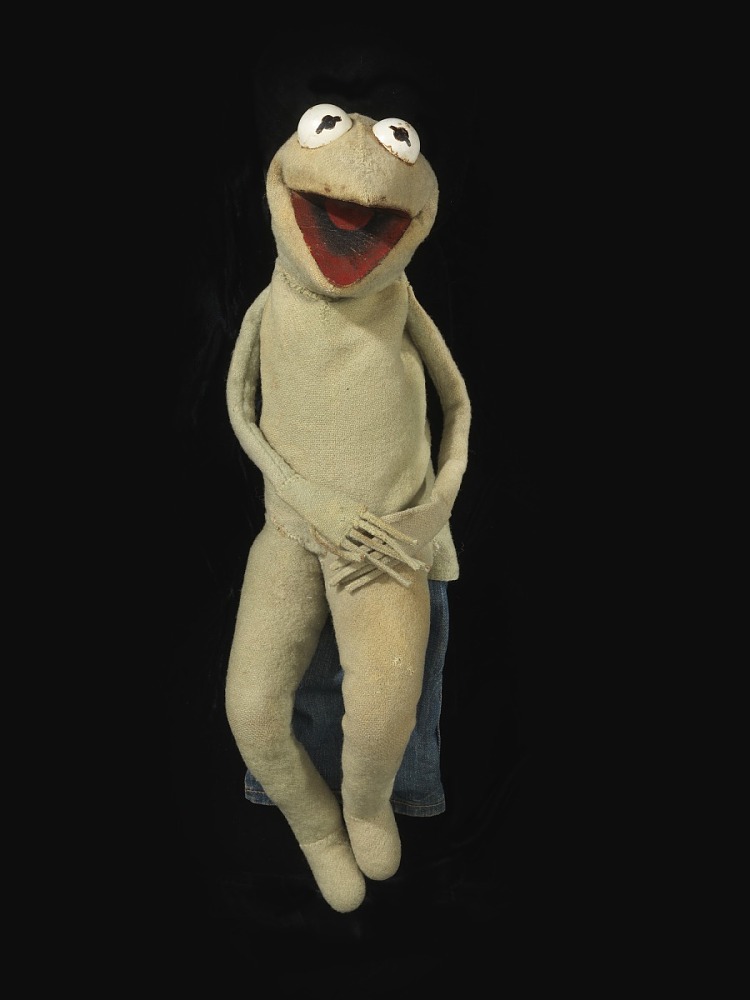
While Henson voiced Sam and all of his puppet friends, Kermit wound up sounding the closest to Henson himself.
Kermit’s signature face-crumpling reactions were by design. Whereas other puppets of the period, like the titular Sam, had stiff heads with the occasional moving jaw, Kermit’s was as soft as a footless sock, allowing for far greater expressiveness.
Henson honed Kermit’s expressions by placing live feed monitors on the floor so he and his puppeteer bride-to-be Jane, could see the puppets from the audience perspective.
Unlike previously televised puppet performances, which preserved the existing prosceniums of the theaters to which the players had always been confined, Henson considered the TV set frame enough. Liberating the puppets thusly gave more of a sketch comedy feel to the proceedings, something that would carry over to Sesame Street and later, The Muppet Show.
By the 12th episode, Kermit has found a niche as wry straight man for wackier characters like jazz aficionado Harry the Hipster who introduced an element of musical notation to the animated letters and numbers that would become a Sesame Street staple.
And surely we’re not the only ones who think the Muppets’ recent appearance in a Super Bowl ad pales in comparison to Kermit and Harry’s live commercial for Sam and Friends’ sponsor, a regional brand of bacon and lunch meat.
Sam and Friends ran from 1955 to 1961, but Kermit’s first performance on The Tonight Show in 1956, lip syncing to Rosemary Clooney’s recording of “I’ve Grown Accustomed to Your Face” and mugging in a blonde braided wig, hinted that he and Henson would soon outgrow the local television pond.
Related Content:
Jim Henson Creates an Experimental Animation Explaining How We Get Ideas (1966)
The Creative Life of Jim Henson Explored in a Six-Part Documentary Series
Watch The Surreal 1960s Films and Commercials of Jim Henson
Jim Henson Teaches You How to Make Puppets in Vintage Primer From 1969
Ayun Halliday is an author, illustrator, theater maker and Chief Primatologist of the East Village Inky zine, current issue #63. Follow her @AyunHalliday.
Read More...Archaeologists Find the Earliest Work of “Abstract Art,” Dating Back 73,000 Years
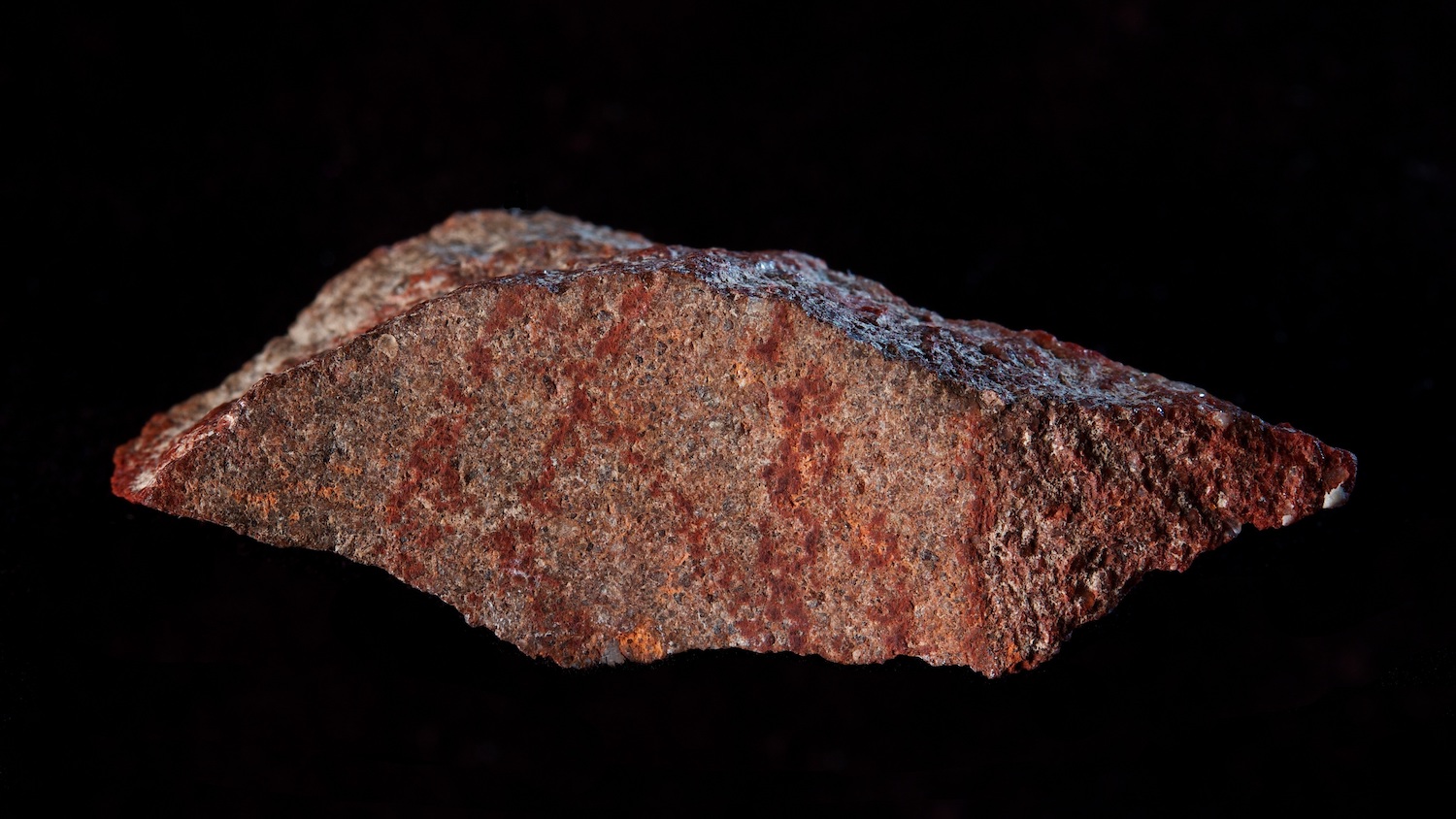
Art, as we understand the term, is an activity unique to homo sapiens and perhaps some of our early hominid cousins. This much we know. But the matter of when early humans began making art is less certain. Until recently, it was thought that the earliest prehistoric art dated back some 40,000 years, to cave drawings found in Indonesia and Spain. Not coincidentally, this is also when archaeologists believed early humans mastered symbolic thought. New finds, however, have shifted this date back considerably. “Recent discoveries around southern Africa indicate that by 64,000 years ago at the very least,” Ruth Schuster writes at Haaretz, “people had developed a keen sense of abstraction.”
Then came the “hashtag” in 2018, a drawing in ochre on a tiny flake of stone that archaeologists believe “may be the world’s oldest example of the ubiquitous cross-hatched pattern drawn on a silcrete flake in the Blombos Cave in South Africa,” writes Krystal D’Costa at Scientific American, with the disclaimer that the drawing’s creators “did not attribute the same meaning or significance to [hashtags] that we do.” The tiny artifact, thought to be around 73,000 years old, may have in fact been part of a much larger pattern that bore no resemblance to anything hashtag-like, which is only a convenient, if misleading, way of naming it.
The artifact was recovered from Blombos Cave in South Africa, a site that “has been undergoing excavation since 1991 with deposits that range from the Middle Stone Age (about 100,000 to 72,000 years ago) to the Later Stone Age (about 42,000 years ago to 2,000 years BCE).” These findings have been significant, showing a culture that used heat to shape stones into tools and, just as artists in caves like Lascaux did, used ochre, a naturally occurring pigment, to draw on stone. They made engravings by etching lines directly into pieces of ochre. Archaeologists also found in the Middle Stone Age deposits “a toolkit designed to create a pigmented compound that could be stored in abalone shells,” D’Costa notes.
Nicholas St. Fleur describes the tiny “hashtag” in more detail at The New York Times as “a small flake, measuring only about the size of two thumbnails, that appeared to have been drawn on. The markings consisted of six straight, almost parallel lines that were crossed diagonally by three slightly curved lines.” Its discoverer, Dr. Luca Pollarolo of the University of the Witwatersrand in Johannesburg, expresses his astonishment at finding it. “I think I saw more than ten thousand artifacts in my life up to now,” he says, “and I never saw red lines on a flake. I could not believe what I had in my hands.”
The evidence points to a very early form of abstract symbolism, researchers believe, and similar patterns have been found elsewhere in the cave in later artifacts. Professor Francesco d’Errico of the French National Center for Scientific Research tells Schuster, “this is what one would expect in traditional society where symbols are reproduced…. This reproduction in different contexts suggests symbolism, something in their minds, not just doodling.”
As for whether the drawing is “art”… well, we might as well try and resolve the question of what qualifies as art in our own time. “Look at some of Picasso’s abstracts,” says Christopher Henshilwood, an archaeologist from the University of Bergen and the lead author of a study on the tiny artifact published in Nature in 2018. “Is that art? Who’s going to tell you it’s art or not?”
Researchers at least agree the markings were deliberately made with some kind of implement to form a pattern. But “we don’t know that it’s art at all,” says Henshilwood. “We know that it’s a symbol,” made for some purpose, and that it predates the previous earliest known cave art by some 30,000 years. That in itself shows “behaviorally modern” human activities, such as expressing abstract thought in material form, emerging even closer to the evolutionary appearance of modern humans on the scene.
Related Content:
Hear a Prehistoric Conch Shell Musical Instrument Played for the First Time in 18,000 Years
A Recently-Discovered 44,000-Year-Old Cave Painting Tells the Oldest Known Story
40,000-Year-Old Symbols Found in Caves Worldwide May Be the Earliest Written Language
Was a 32,000-Year-Old Cave Painting the Earliest Form of Cinema?
Josh Jones is a writer and musician based in Durham, NC. Follow him at @jdmagness
Read More...The Color That May Have Killed Napoleon: Scheele’s Green
“Either the wallpaper goes, or I do.” —Oscar Wilde
Looking to repel bed bugs and rats?
Decorate your bedroom à la Napoleon’s final home on the damp island of Saint Helena.
Those in a position to know suggest that vermin shy away from yellowish-greens such as that favored by the Emperor because they “resemble areas of intense lighting.”
We’d like to offer an alternate theory.
Could it be that the critters’ ancestors passed down a cellular memory of the perils of arsenic?
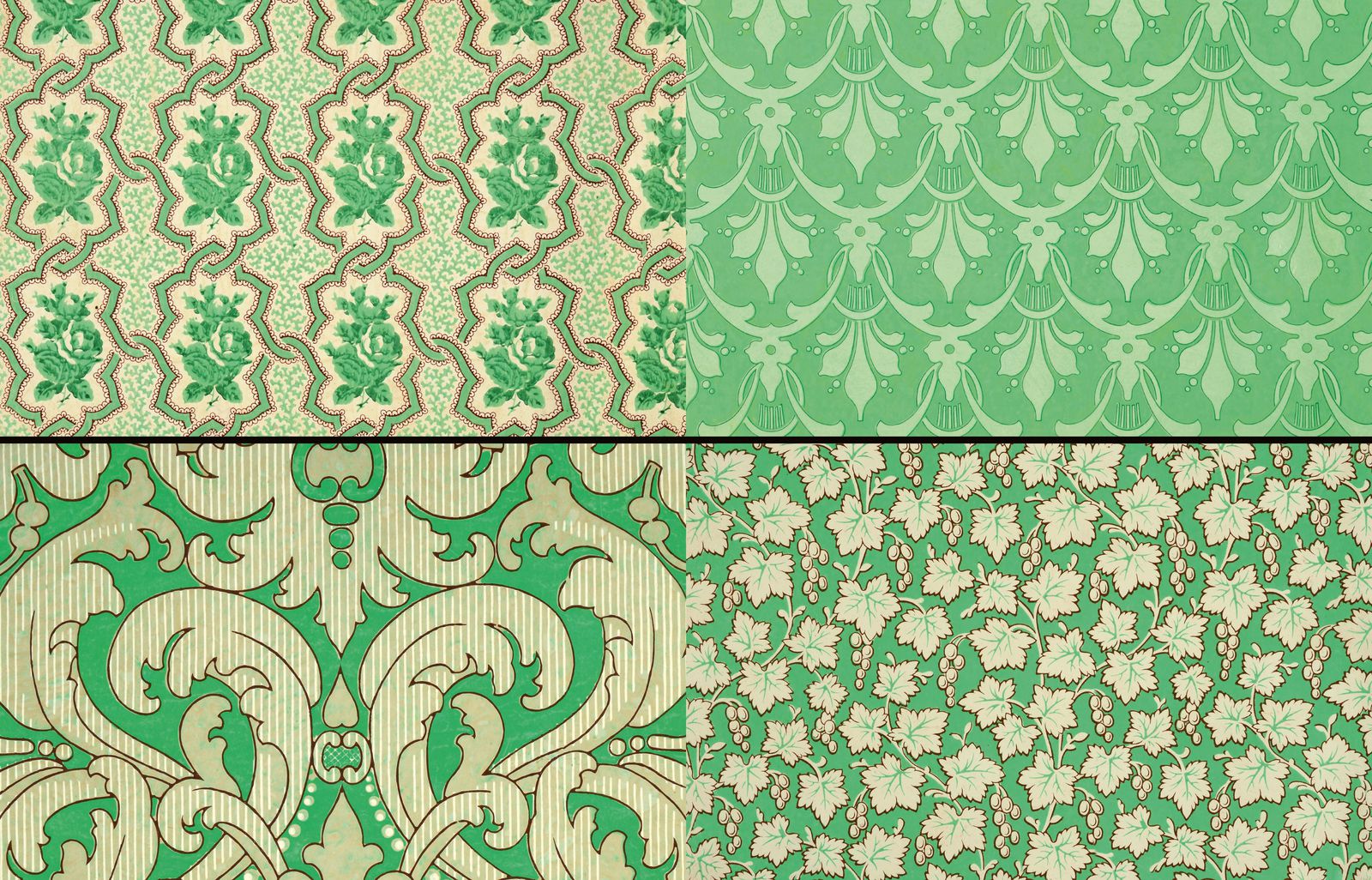
Napoleon, like thousands of others, was smitten with a hue known as Scheele’s Green, named for Carl Wilhelm Scheele, the German-Swedish pharmaceutical chemist who discovered oxygen, chlorine, and unfortunately, a gorgeous, toxic green pigment that’s also a cupric hydrogen arsenite.
Scheele’s Green, aka Schloss Green, was cheap and easy to produce, and quickly replaced the less vivid copper carbonate based green dyes that had been in use prior to the mid 1770s.
The color was an immediate hit when it made its appearance, showing up in artificial flowers, candles, toys, fashionable ladies’ clothing, soap, beauty products, confections, and wallpaper.
A month before Napoleon died, he included the following phrase in his will: My death is premature. I have been assassinated by the English oligopoly and their hired murderer…”
His exit at 51 was indeed untimely, but perhaps the wallpaper, and not the English oligopoly, is the greater culprit, especially if it was hung with arsenic-laced paste, to further deter rats.
When Scheele’s Green wallpaper, like the striped pattern in Napoleon’s bathroom, became damp or moldy, the pigment in it metabolized, releasing poisonous arsenic-laden vapors.
Napoleon’s First Valet Louis-Joseph Marchand recalled the “childish joy” with which the emperor jumped into the tub where he relished soaking for long spells:
The bathtub was a tremendous oak chest lined with lead. It required an exceptional quantity of water, and one had to go a half mile away and transport it in a barrel.
Baths also figured in Second Valet Louis Étienne Saint-Denis’ recollections of his master’s illness:
His remedies consisted only of warm napkins applied to his side, to baths, which he took frequently, and to a diet which he observed from time to time.
Saint-Denis’s recall seems to have had some lacunae. According to a post in conjunction with the American Museum of Natural History’s Power of Poison exhibit:
In Napoleon’s case, arsenic was likely just one of many compounds taxing an already troubled system. In the course of treatments for a variety of symptoms—swollen legs, abdominal pain, jaundice, vomiting, weakness—Napoleon was subjected to a smorgasbord of other toxic substances. He was said to consume large amounts of a sweet apricot-based drink containing hydrocyanic acid. He had been given tarter emetic, an antimonal compound, by a Corsican doctor. (Like arsenic, antimony would also help explain the preserved state of his body at exhumation.) Two days before his death, his British doctors gave him a dose of calomel, or mercurous chloride, after which he collapsed into a stupor and never recovered.
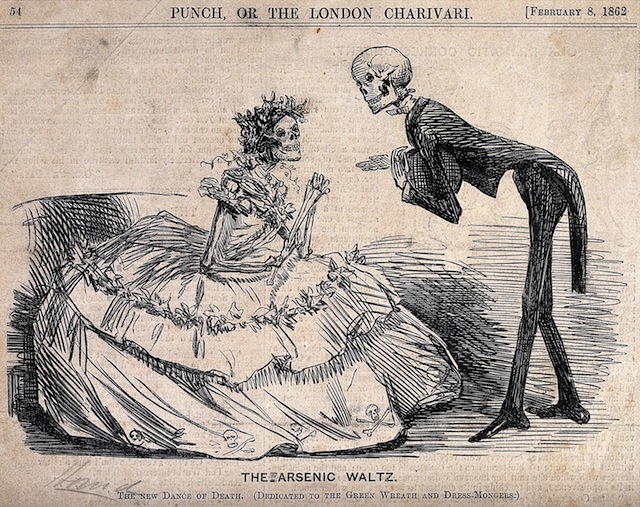
As Napoleon was vomiting a blackish liquid and expiring, factory and garment workers who handled Scheele’s Green dye and its close cousin, Paris Green, were suffering untold mortifications of the flesh, from hideous lesions, ulcers and extreme gastric distress to heart disease and cancer.
Fashion-first women who spent the day corseted in voluminous green dresses were keeling over from skin-to-arsenic contact. Their seamstresses’ green fingers were in wretched condition.
In 2008, an Italian team tested strands of Napoleon’s hair from four points in his life—childhood, exile, his death, and the day thereafter. They determined that all the samples contained roughly 100 times the arsenic levels of contemporary people in a control group.
Napoleon’s son and wife, Empress Josephine, also had noticeably elevated arsenic levels.
Had we been alive and living in Europe back then, ours likely would have been too.
All that green!
But what about the wallpaper?
A scrap purportedly from the dining room, where Napoleon was relocated shortly before death, was found by a woman in Norfolk, England, pasted into a family scrapbook above the handwritten caption, This small piece of paper was taken off the wall of the room in which the spirit of Napoleon returned to God who gave it.
In 1980, she contacted chemist David Jones, whom she had recently heard on BBC Radio discussing vaporous biochemistry and Victorian wallpaper. She agreed to let him test the scrap using non-destructive x‑ray fluorescence spectroscopy. The result?
.12 grams of arsenic per square meter. (Wallpapers containing 0.6 to 0.015 grams per square meter were determined to be hazardous.)
Dr. Jones described watching the arsenic levels peaking on the lab’s print out as “a crazy, wonderful moment.” He reiterated that the house in which Napoleon was imprisoned was “notoriously damp,” making it easy for a 19th century fan to peel off a souvenir in “an inspired act of vandalism.”
Death by wallpaper and other environmental factors is definitely less cloak and dagger than assassination by the English oligopoly, hired murderer, and other conspiracy theories that had thrived on the presence of arsenic in samples of Napoleon’s hair.
As Dr. Jones recalled:
…several historians were upset by my claim that it was all an accident of decor…Napoleon himself feared he was dying of stomach cancer, the disease which had killed his father; and indeed his autopsy revealed that his stomach was very damaged. It had at least one big ulcer…My feeling is that Napoleon would have died in any case. His arsenical wallpaper might merely have hastened the event by a day or so. Murder conspiracy theorists will have to find new evidence!
We can’t resist mentioning that when the emperor was exhumed and shipped back to France, 19 years after his death, his corpse showed little or no decomposition.
Green continues to be a noxious color when humans attempt to reproduce it in the physical realm. As Alice Rawthorn observed The New York Times:
The cruel truth is that most forms of the color green, the most powerful symbol of sustainable design, aren’t ecologically responsible, and can be damaging to the environment.
Take a deeper dive into Napoleon’s wallpaper with an educational packet for educators prepared by chemist David Jones and Hendrik Ball.
Related Content:
Why Is Napoleon’s Hand Always in His Waistcoat?: The Origins of This Distinctive Pose Explained
Ayun Halliday is an author, illustrator, theater maker and Chief Primatologist of the East Village Inky zine. She most recently appeared as a French Canadian bear who travels to New York City in search of food and meaning in Greg Kotis’ short film, L’Ourse. Follow her @AyunHalliday.
Read More...Watch the Food for Love Benefit Concert: David Byrne, The Chicks & Many More Raise Money for New Mexico Food Banks
Ever since COVID-19 struck, poverty levels have reached a crisis point in New Mexico, so much so that New Mexico food banks have become overloaded with requests, and they can’t keep up with demand. To provide assistance, a star-studded lineup of musicians banded together this weekend to stage the Food for Love Benefit Concert. Featured in the five hour performance were David Byrne (he gives a dance lesson), Jackson Brown, Shawn Colvin, The Chicks, Lyle Lovett, Kurt Vile, and many more. This video (above) will be available for a limited time–until midnight MST on Monday, February 15. Donations to support New Mexico’s food banks can be made here. To date, they’ve raised $704,000, or enough to provide 2.8 million meals.
Read More...Hear an Ancient Chinese Historian Describe The Roman Empire (and Other Voices of the Past)
Those who see the world from only one narrow point of view get called a number of things–parochial, provincial, and worse–and are encouraged to seek out other perspectives and broaden their view. Not everyone can travel the world, but the world comes to us through immigration and the internet, restaurants and recipes. Most of us, if we are inclined, can learn about and appreciate the cultures, cuisines, and histories of others.
But can we see ourselves the way that others see us? This is a harder ask, I think, especially for Americans, who are used to the world coming to us and to defining the world on our terms, whether through soft power or military force.
When we read about history, we might diversify our sources, taking in perspectives from writers with different ideological commitments and beliefs. But how often do we hear the observations, say, of Japanese historians, recording their impressions of the U.S. as they saw it in the 19th century?
A great part of why we don’t read such histories is that we generally don’t even know they exist. The YouTube project Voices of the Past aims to remedy this, introducing viewers to primary historical sources from the past, and from all over the world, that show professional historians and ordinary people recording events across barriers of language, culture, nation state, and social class. At the top, we have a reading from “Konyo Zukishi,” written in 1845 by Japanese geographer and historian Mitsukuri Shōgo, who, in turn, based much of his knowledge of the outside world on Dutch books, “as they were the only European trading partner through the Sakoku period of isolation,” a caption in the video informs us.
Mitsukuri Shōgo’s history accepts as fact that the territories of North America “didn’t even have a name” before the arrival of European settlers, completely ignoring the presence of hundreds of indigenous nations. The descriptions of those settlers are charmingly revealing, if not wholly accurate. “Several tens of thousands of Englishmen, who refused to subscribe to the tenets of the Anglican church, were arrested and sent to this distant country,” we learn. “These people lacked sufficient food and clothing at that time, but they privately rejoiced because there were no rulers in this land.”
Further up, we have an early third century commentary written by Chinese historian Yu Huan. Hundreds of years before European navigators set out to find and appropriate the riches of the Indies, only to end up in the Americas, the Chinese wrote of a world history that included the Roman Empire, reached by way of Egypt, which is called Haixi, “because it is west of the sea,” and which contains the great city of Wuchisan, or Alexandria. Yu Huan writes as though he’s giving driving directions, and leaves every impression of having made the journey himself or transcribed the words of those who had.
Above, a young soldier in Napoleon’s Grande Armée describes the real horror of the death marches through Russia in 1812 in excerpts from Jakob Walter’s Diary of Napoleonic Foot Soldier. He calls one march “indescribable and inconceivable for people who have not seen anything of it,” then goes on to paint a grisly scene in the kind of grim detail we do not get in Napoleon’s justifications of the invasion, below, taken from The Corsican: A Diary of Napoleon’s Life in His Own Words. There are many more histories we rarely, if ever, encounter, which show a world that has been networked and connected for thousands of years, as in excerpts below from an Arabic compilation of travel accounts, Abū Zayd al-Sīrāfī’s “Accounts of China and India,” written in 852.
Hear many more fascinating and usually inaccessible primary sources from ancient and modern history read aloud at Voices of the Past.
Related Content:
Get the History of the World in 46 Lectures, Courtesy of Columbia University
Free Courses in Ancient History, Literature & Philosophy
Josh Jones is a writer and musician based in Durham, NC. Follow him at @jdmagness
Read More...How Jazz Became the “Mother of Hip Hop”
Jazz and hip hop have been in a lively conversation in recent years, breaking new ground for both forms, as the work of artists like Kendrick Lamar and his collaborators amply shows. Lamar created his majorly-acclaimed albums To Pimp a Butterfly and Damn with the indispensable playing and arranging of jazz-fusion saxophonist Kamasi Washington and his frequent sideman, bassist Stephen “Thundercat” Bruner, who have contributed to the work of Flying Lotus. That’s the artist name of Stephen Ellison, nephew of Alice and John Coltrane, who has also been instrumental, no pun intended, in reshaping the sound of contemporary hip hop.
“The influence cuts both ways—from jazz to hip hop and back again,” writes John Lewis at The Guardian. Or as Washington puts it, “We’ve now got a whole generation of jazz musicians who have been brought up with hip-hop. We’ve grown up alongside rappers and DJs, we’ve heard this music all our life. We are as fluent in J Dilla and Dr Dre as we are in Mingus and Coltrane.”
The fusion of avant-garde hip hop with live jazz improvisation, instrumentation, and arranging may seem like a new phenomenon, though one could date it at least as far back as the Roots’ early 90s debut.
“Hip hop’s love affair with jazz goes back more than 30 years,” Lewis writes. The music was everywhere in the 90s, in the foreground on the records of A Tribe Called Quest, De La Soul, and Digable Planets and in more cut-and-paste ways in albums like Nas’ instant classic Illmatic, produced by Pete Rock, who crafted tracks like “N.Y. State of Mind” from layered samples of Ahmad Jamal, Donald Byrd, and little-known jazz-funk outfits like Jimmy Gordon & His Jazznpops Band. As pianist Robert Glasper shows above in the brief NPR Jazz Night in America video at the top, “Jazz is the mother of hip-hop.”
Both jazz and hip hop were born out of oppression, and both are forms of protest music, “going against the grain,” Glasper argues. But there’s more to it. Why do hip hop producers gravitate toward jazz, chopping and lifting classics and obscure rarities? For a wealth of melodic content—”for a mood, for a sonic timbre, for a unique rhythmic component,” writes interviewer Alex Ariff on YouTube; for a shared history of struggle and celebration and a desire to change the sound of music with each release. Glasper’s brief, three-minute demonstration is fascinating and it could, as one YouTube commenter points out, easily extend to three hours.
Until he makes that video, you can find jazz samples in hip hop records to your heart’s eternal content at Whosampled.com and consider how the influence of hip hop on jazz musicians has created new forms of fusion akin to Miles Davis’ experiments in the 70s. “I never had a problem moving between jazz and hip hop,” says Washington. “People like to compartmentalize music, especially African-American music, but it’s really one thing. One very wide thing…. When I first played some Coltrane-type stuff on the Pimp a Butterfly sessions, Kendrick got it immediately. ‘I want it to sound like it’s on fire,’ he’d say. That’s the kind of common ground that the best jazz and the best hip-hop have.”
Related Content:
How Nina Simone Became Hip Hop’s “Secret Weapon”: From Lauryn Hill to Jay Z and Kanye West
Josh Jones is a writer and musician based in Durham, NC. Follow him at @jdmagness
Read More...A New Yorker Cartoonist Explains How to Draw Literary Cartoons
“I enjoy poking fun at anything educated people do and civilized society perpetuates that is odd, frustrating, wacky, or hypocritical,” cartoonist Amy Kurzweil, above, recently told the New York Public Library’s Margo Moore.
Unsurprisingly, she’s been getting published in The New Yorker a lot of late.
The process for getting cartoons accepted there is the stuff of legend, though reportedly less grueling since Emma Allen, the magazine’s youngest and first-ever female cartoon editor, took over. Allen has made a point of seeking out fresh voices, and working with them to help mold their submissions into something in The New Yorker vein, rather than “this endless game of presenting work and then hearing ‘yes’ or ‘no.’”
Kurzweil has a fondness for literary themes (and the same brand of pencils that John Steinbeck, Truman Capote, and Vladimir Nabokov preferred—Blackwings—whether in her hand or, conversing with Allen on Zoom, above, in her ears.)
Getting the joke of a New Yorker cartoon often depends on getting the reference, and while both women seem tickled at the first example, Kurzweil’s mash-up of Proust’s Remembrance of Things Past and the picture book If You Give a Mouse a Cookie, it may go over many readers’ heads.
The thing that holds it all together?
Madeleines, of course, though outside France, not every Proust lover is able to identify an inked representation of this evocative cookie by shape.
Kurzweil states that she has never actually read the children’s book that supplies half the context.
(It’s okay. Like the idea that memories can be triggered by certain nostalgic scents, its concept is pretty easy to grasp.)
Nor has she read philosopher Derek Parfit’s whopping 1,928-page On What Matters. Her inspiration for using it in a cartoon is her personal connection to the massive, unread three-volume set in her family’s library. Because both the size and the title are part of the joke, she directs the viewer’s eye to the unwieldy tome with a light watercolor wash.
She also has a good tip for anyone drawing a library scene—go figurative, rather than literal, varying sizes and shapes until the eye is tricked into seeing what is merely suggested.
A all-too-true literary experience informs her second example at the 4:30 mark—that of a little known author giving a reading in a bookstore. Despite a preference for drawing “fleshy things like people and animals” she forgoes depicting the author or those in attendance, giving the punchline instead to the event posters in the store’s window.
As she told the NYPL’s Moore:
A cartoon is always an opportunity to showcase a contemporary phenomenon by exaggerating it or placing it in a different context.
Over the last year, a huge number of New Yorker cartoons have concerned themselves with the domestic dullness of the pandemic, but when Allen asked if she has a favorite New Yorker cartoon cliché, Kurzweil went with “the Moby Dick trope, because whales are easy to draw, and I like a good metaphor for the unattainable.”
Related Content:
New Yorker Cartoon Editor Bob Mankoff Reveals the Secret of a Successful New Yorker Cartoon
The Not Yorker: A Collection of Rejected & Late Cover Submissions to The New Yorker
Download a Complete, Cover-to-Cover Parody of The New Yorker: 80 Pages of Fine Satire
Ayun Halliday is an author, illustrator, theater maker and Chief Primatologist of the East Village Inky zine. She most recently appeared as a French Canadian bear who travels to New York City in search of food and meaning in Greg Kotis’ short film, L’Ourse. Follow her @AyunHalliday.
Read More...Support Us
We're hoping to rely on loyal readers, rather than erratic ads. Please click the Donate button and support Open Culture. You can use Paypal, Venmo, Patreon, even Crypto! We thank you!

About Us

Open Culture scours the web for the best educational media. We find the free courses and audio books you need, the language lessons & educational videos you want, and plenty of enlightenment in between.
Advertise With Us

FREE UPDATES!
GET OUR DAILY EMAIL
Get the best cultural and educational resources on the web curated for you in a daily email. We never spam. Unsubscribe at any time.
FOLLOW ON SOCIAL MEDIA

Open Culture editor Dan Colman scours the web for the best educational media. He finds the free courses and audio books you need, the language lessons & movies you want, and plenty of enlightenment in between.
Advertise With Us


